Trump admin, focused on “reopening,” sidelines COVID-19 experts

US President Donald Trump speaks about COVID-19 after signing a Proclamation in honor of National Nurses Day in the Oval Office of the White House in Washington, DC, May 6, 2020.
Enlarge / US President Donald Trump speaks about COVID-19 after signing a Proclamation in honor of National Nurses Day in the Oval Office of the White House in Washington, DC, May 6, 2020.

The poor federal response to the COVID-19 crisis has become even lighter on details in recent days as the Trump administration pushes hard on a message of “reopening” while leaving out any data or expertise that might conflict with that focus.

The White House has done everything possible to minimize messaging that might scare Americans into staying home and instead “relies on tightly controlling information” about the novel coronavirus disease, the Washington Post reports.

A source the Post described as a senior administration official told the paper that the task force addressing the crisis was already meeting less often before President Donald Trump said Wednesday its focus would be shifting away from emergency management and toward economic reopening. Public health warnings are scaring people, the source added, so the administration has been downplaying them.

The White House expressly prohibited task force members from accepting invitations to Congressional hearings, following a request from a House subcommittee. Members of the task force, including Dr. Anthony Fauci, are however scheduled to testify before the Senate this month about the administration’s response. Trump on Tuesday told reporters the difference is one of politics, saying, “The House is a setup. The House is a bunch of Trump haters.”

The Centers for Disease Control and Prevention, which one would ordinarily expect to be heavily involved in managing a pandemic, has been kept quiet since March. The agency’s last press briefing on the novel coronavirus was March 9, when about 20 people in the US were known to have died due to COVID-19. As of today, more than 75,000 people in the US have died as a result of the disease.

Yesterday, the AP made public a leaked 17-page reopening guide put together by the CDC. Administration officials allegedly told the CDC that its report, which included detailed guidelines for industries such as restaurants and child care, would “never see the light of day.”

The void made by the absence of CDC press conferences has instead been filled with messaging directly from the White House, such as Trump’s infamously absurd suggestion to America to consider injections of bleach or other disinfectants to cure the disease. (A reminder: Do not do this.) In the past week, White House Press Secretary Kayleigh McEnany has taken over the briefings, and she continues to push the administration’s messaging about economic recovery.

Experts have argued that states are not ready for phased reopening under the current plans made public by the administration, but governors in states such as Georgia and Texas have continued with rapid reopening efforts this week undeterred.

The administration seems comfortable with the human cost of sweeping expertise aside. The president agreed in an interview earlier this week that “there’ll be more death” in the US from a rapid reopening. “Will some people be affected badly? Yes. But we have to get our country open and we have to get it open soon,” Trump told ABC News.

Denial, however, has not proved a mitigating strategy for handling COVID-19 in the White House or elsewhere. The disease continues to spread nationwide, and that includes inside the Administration. At least three staffers who work directly with Trump or Vice President Mike Pence have tested positive for the disease in the past 24 hours, including Trump’s valet and Pence spokesperson Katie Miller, who is also married to White House adviser Stephen Miller.

https://arstechnica.com/?p=1674454


US military is furious at FCC over 5G plan that could interfere with GPS

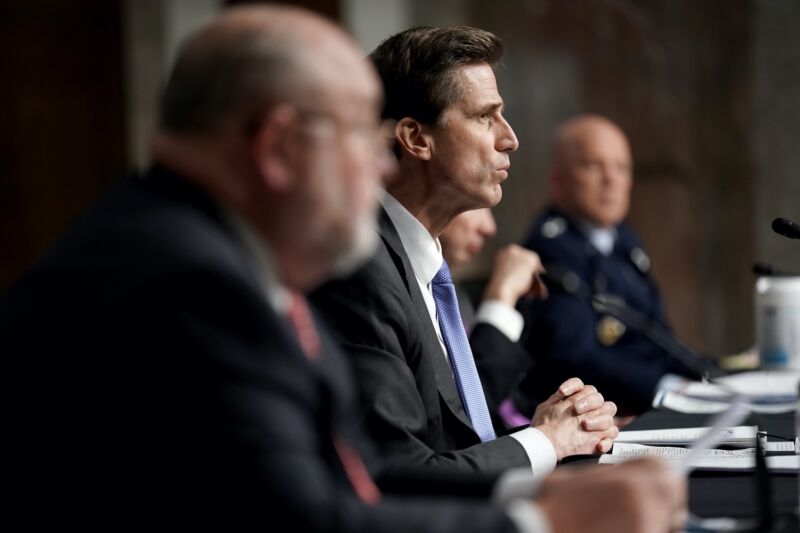
Department of Defense CIO Dana Deasy sitting at a table while testifying at a Senate hearing.
Enlarge / Dana Deasy, Department of Defense chief information officer, testifies during a Senate Armed Services Committee hearing on May 6, 2020 in Washington, DC.
Getty Images

GPS is facing a major interference threat from a 5G network approved by the Federal Communications Commission, US military officials told Congress in a hearing on Wednesday.

In testimony to the Senate Committee on Armed Services, Department of Defense Chief Information Officer Dana Deasy disputed the FCC’s claims that conditions imposed on the Ligado network will protect GPS from interference.

When the FCC approved Ligado’s plan last month, the agency required a 23MHz guard band to provide a buffer between the Ligado cellular network and GPS. Deasy argued that this guard band won’t prevent interference with GPS signals:

The Order includes the 23MHz “guard band” to protect GPS L1 receivers from Ligado’s terrestrial-based network. GPS receivers are designed to receive signals from space and would be overpowered by this terrestrial network regardless of this protection. Despite this guard band, many varieties of GPS receivers would still suffer interference. To be clear, Ligado’s proposal is to field a terrestrial-based network. GPS has a satellite-based space segment that transmits radio signals to users. This means that GPS L1 receivers are designed to tolerate interference from space systems in adjacent spectrum, but not to tolerate interference from terrestrial systems in the adjacent band.

Results from tests by federal agencies show that “conditions in this FCC order will not prevent impacts to millions of GPS receivers across the United States, with massive complaints expected to come,” Deasy said.

The FCC unanimously approved Ligado’s application, but the decision is facing congressional scrutiny. “I do not think it is a good idea to place at risk the GPS signals that enable our national and economic security for the benefit of one company and its investors,” Sen. James Inhofe (R-Okla.) said at the hearing, according to CNBC. “This is about much more than risking our military readiness and capabilities. Interfering with GPS will hurt the entire American economy.”

FCC calls opposition “baseless fear-mongering”

A spokesperson for FCC Chairman Ajit Pai called the military’s concerns “baseless fear-mongering” in a statement quoted by Multichannel News.

“The FCC made a unanimous, bipartisan decision based on sound engineering principles,” the spokesperson said. The FCC said “the metric used by the Department of Defense to measure harmful interference does not, in fact, measure harmful interference,” and that “testing on which they are relying took place at dramatically higher power levels than the FCC approved.”

The FCC also said that “the Department of Defense (and every executive branch agency that is part of the Interdepartment Radio Advisory Committee) was given our draft decision last autumn, so the assertion that they were blindsided by it this April is preposterous.”

“Ligado said Wednesday in a statement that it has gone to great lengths to prevent interference and will provide ‘a 24/7 monitoring capability, a hotline, a stop buzzer or kill switch’ and will ‘repair or replace at Ligado’s cost any government device shown to be susceptible to harmful interference,'” CNBC reported.

Ligado was previously known as LightSquared, and an earlier version of the company’s plan was rejected by the FCC in 2012.

Power limits

In addition to the guard band, the FCC imposed a power limit of 9.8dBW on Ligado’s downlink operations, with Pai saying “that represents a greater than 99 percent reduction from what Ligado proposed in its 2015 application.”

Deasy, though, said that “even these substantial reductions fail to meet the power levels that can be tolerated in bands adjacent to GPS L1 signals that were studied by the DoT [Department of Transportation].” GPS L1 operates at 1575MHz, while Ligado’s frequencies include the 1526-1536MHz, 1627.5-1637.5MHz, and 1646.5-1656.5MHz bands.

Deasy also criticized the coordination plan, which the FCC said “requires Ligado to protect adjacent band incumbents by reporting its base station locations and technical operating parameters to potentially affected government and industry stakeholders prior to commencing operations, continuously monitoring the transmit power of its base station sites, and complying with procedures and actions for responding to credible reports of interference, including rapid shutdown of operations where warranted.”

According to Deasy’s Senate testimony, this coordination system won’t be enough to protect many military and consumer GPS devices. He said:

Coordination and notification requirements normally work well with spectrum sharing and DoD often champions such measures. However, there are millions of GPS receivers in use by federal agencies, industry, and general consumers that are mobile. Given the massive scale, there is no way to protect those mobile operations. This challenge is compounded by the fact that most GPS users would never know if Ligado disrupted their equipment in the first place or who to call about a problem.

Deasy also said that “the FCC Order expects Ligado to protect US government GPS receivers and to repair or replace affected receivers identified before Ligado terrestrial operations commence.”

“But this overlooks the classified nature of military GPS use and the sheer number of government receivers and military platforms affected,” Deasy continued. “The FCC expectation is unreasonable and could never be employed in real practice. To avert significant mission impacts, the government would need to undertake unprecedented accelerated testing, modification and integration of new GPS receivers on existing platforms. This is cost- and schedule-prohibitive and would significantly degrade national security.”

FCC vote “must be reversed”

Ultimately, Deasy says, the FCC should have rejected the Ligado application because “no practical solution or mitigation is available that would permit Ligado to operate without high likelihood of widespread interference.” Deasy told senators that “the FCC’s Ligado decision is flawed and must be reversed.” Congress has the power to reverse agency decisions, as happened in 2017 when lawmakers killed the FCC’s broadband-privacy rules.

Senators also heard opposition to Ligado’s plan from Michael Griffin, undersecretary of defense for Research and Engineering, and Thad Allen, a retired US Coast Guard admiral. “Signals from GPS satellites, as from all satellites, are extremely weak, and earthbound GPS receivers must be highly sensitive in order to use them,” Griffin said. “For this reason, they are assigned to portions of the radio spectrum—frequency bands—reserved exclusively for their use. Any nearby transmitter operating in or close to the frequency bands that have been set aside for GPS would overwhelm their signals.”

The hearing did not include FCC officials. “There are two sides to this,” and it is difficult to “reverse a decision based upon the presence of one side,” Sen. Tim Kaine (D-Va.) said at the hearing, according to CNBC.

https://arstechnica.com/?p=1674387


“Disquisting whores”: Document reveals GirlsDoPorn plans to harass victims

“Disquisting whores”: Document reveals GirlsDoPorn plans to harass victims

The FBI says that the men behind the disgraced GirlsDoPorn website were willing to go to extraordinary lengths to harass and intimidate 22 women who sued them for fraud and coercion. A judge awarded those women $13 million in January. Now one of the men, Matthew Wolfe, is in custody and facing criminal charges. Authorities believe another defendant, ringleader Michael Pratt, has fled the country.

Wolfe is asking to be let out on bail. On Thursday, Motherboard published an FBI document arguing against his motion. It details just how far the men were willing to go to retaliate against the women.

The FBI arrested Wolfe in October and searched the offices of GirlsDoPorn the next day. The April 22 document, which came to light this week, describes the result of that search.

“Agents located a chart listing countries that do not extradite individuals to the United States,” US Attorney Robert Brewer wrote. “The chart indicated whether each country had on-line banking and whether citizens of New Zealand, like defendant, could obtain a visa.”

Brewer says that the defendant’s fiancée has a wealthy family and could access funds to assist in fleeing to New Zealand—and then to a third country with no US extradition treaty.

“22 Whores”

Brewer also says that FBI agents “found evidence of efforts to harass and intimidate the victims and their attorneys.”

They found a video script called “22 Whores + 5 Shady Lawyers VS GirlsDoPorn.” The subheading read “Share and spread this video as far and wide as possible.”

The typo-laden script listed the names of the 22 women who sued the porn site. “Put each girls [sic] full name and location on screen before rolling there [sic] shit,” the script said—presumably “their shit” here is footage from their pornographic videos.

The video was supposed to end with the text “These retarded lawyers and disquisting [sic] whores wasted 3 years of everyones [sic] time. Ask yourself how viral these videos will go now if nobody is controlling them… Good job.”

One of the allegations of women against GirlsDoPorn is that the site’s proprietors deliberately leaked their real names in order to drum up interest in their videos. But publishing a video like this would have been a more brazen act of doxing.

Brewer says he also found “a phone list with victims’ names and Jane Doe numbers” (plaintiffs were referred to as “Jane Doe 1,” “Jane Doe 2,” etc. during the trial) that “memorialized attempts to get information from them over the telephone by posing as a journalist.”

On the back of the list was handwritten: “Hi, my name is [******], I’m a journalist from LA, I’m calling in regards to the girlsdoporn case. I’ve heard from your [sic] related to the case and curious to get a comment if you have the spare time.”

Wolfe had argued that he should be released because he suffers from sleep apnea and doesn’t want to catch the coronavirus while in jail. But Brewer countered that sleep apnea is not a known risk factor for COVID-19. He argued that Wolfe should stay in jail despite the infection risk.

https://arstechnica.com/?p=1674257


Comcast resists call to open home Wi-Fi hotspots, cites potential congestion

A Comcast/NBC logo.

Three US senators today urged Comcast to open all of its Wi-Fi hotspots to children who lack Internet access at home during the pandemic. A letter from Sens. Ron Wyden (D-Ore.), Kamala Harris (D-Calif.), and Cory Booker (D-N.J.) says that Comcast recently refused a request to do so because it would cause congestion for subscribers. But the senators argue that “Comcast’s excuse simply does not add up.”

Comcast has been praised by advocates for its pandemic response, which includes two free months of home-Internet service for new low-income subscribers, temporary suspension of its data cap, and making many of its hotspots free to the general public. But while Comcast opened up 1.5 million hotspots located at businesses and other public areas, there’s another category of Comcast Wi-Fi hotspots that still require a Comcast login and subscription. Those are the hotspots that are enabled by default on Xfinity routers used by home-Internet subscribers.

Since 2013, Xfinity gateways have broadcasted a separate network that other Comcast subscribers can log in to with a Comcast username and password. Unless you’ve disabled the functionality, anyone within range of your Comcast router can get Internet access if they have a Comcast subscription or have paid for a temporary Wi-Fi pass.

Wyden, Harris, and Booker argue that Comcast should open these hotspots to children without Internet access during the pandemic so that kids can get free broadband at home instead of having to go to a parking lot or other public places. They wrote in a letter to Comcast CEO Brian Roberts:

Comcast has taken important steps to help Americans get connected during this global public health emergency. But it can—and should—do more to help children and teachers in Oregon and across the country. We urge you to start by dropping the paywall and providing free access to Comcast residential public Wi-Fi networks. While Comcast started providing free access to its business customers’ Wi-Fi access points on March 13, 2020, the paywall remains on the millions of Comcast-operated public Wi-Fi networks located in homes and apartment buildings across America.

Comcast subscribers have long been concerned that public hotspots broadcast by their routers would slow down their own broadband service. Comcast has denied that such problems exist, and those Comcast denials were cited in the senators’ letter:

According to statements that Comcast made to the press, the private and public Wi-Fi networks operated by Comcast’s residential Wi-Fi routers are completely separated, both for security reasons and, as Comcast Senior VP of Business Development Tom Nagel has said, so that Comcast’s “broadband customers will continue to get the service that they are paying for.” However, after Senator Wyden’s office asked you to drop the paywall on your residential public Wi-Fi networks, your staff stated that doing so could create Wi-Fi congestion and could impact the speed for paying subscribers’ Internet connections.

Comcast’s excuse simply does not add up. Millions of Comcast’s customers pay the company $14 a month to rent a Wi-Fi router which includes, by default, a Comcast-controlled public Wi-Fi network to which Comcast sells access. If Comcast’s previous statements are true, and use of that public Wi-Fi network does not impact the subscriber, it should not matter if the person using it has paid Comcast for a Wi-Fi access pass or if they are a low-income school child trying to do their homework. Alternatively, if use of the public Wi-Fi network can, in fact, impact the subscriber and prevent them from getting the level of service for which they are paying, Comcast has misled their customers.

Comcast defends pandemic response

We asked Comcast if the senators’ request would cause congestion for subscribers and whether the cable company will open up the residential hotspots as requested. Comcast didn’t directly answer those questions but told Ars that its network has “performed exceedingly well at this new record level of traffic due to our substantial investment in our network and the herculean efforts of our front-line technicians and workers. Our engineering teams are focused on the critical work of supporting our network to allow the millions of Americans who now depend on it to stay connected through the current crisis.”

Comcast also defended its existing pandemic offers for low-income subscribers.

“Comcast has taken multiple unprecedented steps to make broadband more accessible during this crisis,” Comcast said. “We’ve offered free Internet for 60 days for new low-income customers eligible for our Internet Essentials program. We opened our 1.5 million business and outdoor Wi-Fi hotspots for anyone to use for free across the country for the first time, and are keeping them open until June 30. We have committed not to disconnect service or to charge late fees to our customers who are unable to pay due to the pandemic.”

Comcast noted that, through 2019, it connected 180,000 low-income people to Internet Essentials in Sen. Wyden’s home state of Oregon. Comcast also pointed to partnerships in which some schools recently purchased Internet Essentials to support online learning during the pandemic. The low-income program Internet Essentials typically costs $10 a month and offers 25Mbps download speeds and 3Mbps uploads.

Questions for Comcast

The letter from Wyden, Harris, and Booker asks Comcast to answer a list of questions by May 22. For example, the senators asked Comcast how many subscribers rent an Xfinity gateway and how many customers “have opted to disable the public Wi-Fi network in their Comcast-supplied cable modem/Wi-Fi router, which Comcast enables by default.”

The senators further asked how much revenue Comcast earns from gateway rental fees and from people purchasing passes to public Wi-Fi hotspots, and they noted that Comcast “generated $18.7 billion from high-speed Internet access fees in 2019 alone.” They also want Comcast to provide specific details on how opening up the hotspots would affect network performance.

“Please identify the specific performance issues that you anticipate would impact Comcast subscribers and their ability to get the level of service for which they pay if Comcast removed the paywall on its residential public Wi-Fi networks,” the senators wrote. “For each issue you identify, please explain why the use today of a subscriber’s public network by someone who has purchased an access pass from Comcast does not cause the same problem.”

https://arstechnica.com/?p=1674186


Union rep apparently threatens coronavirus infections to stop clean energy rule

The city of San Luis Obispo in 2013.
Enlarge / The city of San Luis Obispo in 2013.
George Rose/Getty Images

There’s a battle raging in California over the future of natural gas. Environmentalists want building codes to encourage new buildings to be electrically heated in order to reduce carbon emissions. Natural gas utilities and labor unions representing their workers have been united in their opposition to these laws.

In March, Eric Hoffman, president of a local utility workers’ union, used an unusual tactic to stop the adoption of a new clean energy building code in San Luis Obispo, a city on California’s central coast.

“If the city council intends to move forward with another reading on a gas ban, I can assure you there will be no social distancing in place,” Hoffman wrote on March 16, in an email obtained by the Los Angeles Times. “Please don’t force my hand in bussing in hundreds and hundreds of pissed off people potentially adding to this pandemic.”

City officials say they were shocked by this apparent threat to potentially expose people to COVID-19. But Hoffman got his way. Officials abandoned plans to vote on the controversial new law at an April 7 meeting.

Michael Codron, the city’s community development director, told the LA Times that Hoffman’s apparent threat played a role in the decision to cancel the vote. “There’s no way to know whether it was bluster,” Codron told the Times.

The fight in San Luis Obispo is part of a broader debate over the future of energy in the Golden State, as the LA Times explains:

Climate activists and many energy experts see transitioning to all-electric buildings as the best way to slash emissions from homes and businesses. Gas is a fossil fuel that contributes to climate change, whereas California’s electricity is increasingly supplied by climate-friendly sources such as solar and wind farms.

SoCalGas has responded by convincing nearly 120 cities and counties to approve similarly worded resolutions, originally drafted by the gas company, calling for “balanced energy solutions.” The company’s climate solution of choice is renewable natural gas—a fuel that could replace some of the fossil gas that contributes to climate change, but which experts say has serious limitations.

The San Luis Obispo proposal would make all-electric construction the default in the city. Developers who wanted to offer natural gas in a home would have to either retrofit other homes or pay into a fund to reduce the use of natural gas elsewhere in the city.

City officials say they haven’t given up on passing the proposal, but they’re not sure when the new vote will happen. The city hopes to organize a digital forum that would allow members of the public to comment on the proposal remotely. But that idea is “fraught with technical challenges,” Coldron told the LA Times, so the city hasn’t attempted it yet.

https://arstechnica.com/?p=1673935


Trump admin’s botched pandemic response detailed in whistleblower complaint

Closeup photograph of a coach's whistle on a blue background.

A new whistleblower complaint by a former US health official details how the Trump administration’s COVID-19 response was hampered by cronyism and denial about the virus’s severity. The 89-page complaint filed by Rick Bright, an immunology expert who led the Biomedical Advanced Research and Development Authority (BARDA) until he says he was forced out of his position, provides an inside look at the Trump administration’s approach to public health before and during the pandemic.

From spring 2017 until his “involuntary removal” last month, “HHS [Health and Human Services] leadership pressured Dr. Bright and BARDA to ignore expert recommendations and instead to award lucrative contracts based on political connections and cronyism,” the complaint said. “Dr. Bright repeatedly clashed with [Assistant Secretary for Preparedness and Response Robert] Kadlec and other HHS leaders about the outsized role played by John Clerici, an industry consultant to pharmaceutical companies with a longstanding connection to Dr. Kadlec, in the award of government contracts.”

For example, Bright in 2017 objected to a push “to extend a contract with Mr. Clerici’s client, Aeolus Pharmaceuticals, which an IPR [in-process review] had concluded should be allowed to expire without further funding. In attempting to justify the extension of this failed contract, Mr. Clerici emphasized that Aeolus’s Chief Executive Officer was a ‘wildcard’ and a friend of Jared Kushner, President Trump’s son-in-law and a Senior Advisor to the President. Dr. Bright stood his ground on this contract, which led to some discord between him and HHS leadership.”

In fall 2019, Bright says he “rejected pressure by Dr. Kadlec to invest millions of dollars in EIDD-2801, a drug developed at Emory University by a longtime friend of Dr. Kadlec. EIDD-2081 was presented as a ‘miracle cure’ for influenza, Ebola and nearly every other virus, even though the developer had not yet conducted clinical trials and no data had been compiled to demonstrate either the efficacy or safety of the drug in humans.”

Rick Bright.
Enlarge / Rick Bright.

In February 2020, EIDD-2801 makers “were once again seeking funding for the drug—this time, as a treatment for COVID-19.” Bright says he fought the request for $100 million in part because “Emory still had not completed the clinical trials for which it had received nearly $30 million in NIH and DOD funds.” Ultimately, “the award was not made prior to Dr. Bright’s departure from BARDA.”

In a statement to The New York Times, Clerici said he “unequivocally” denied any wrongdoing and that “it’s sad that during a pandemic, Dr. Bright and his team have chosen to distract people like Dr. Kadlec, who are critical to the response, with politically motivated allegations. The record is clear that his allegations are false and will be proven so.”

Trump’s push for chloroquine

Bright’s whistleblower complaint, which cites many internal emails and events from in-person meetings, was filed with the US Office of Special Counsel. Among other things, the complaint delves into the curious case of hydroxychloroquine, a malaria drug President Donald Trump repeatedly promoted as a coronavirus treatment despite a lack of evidence. (The FDA has since issued a warning about the drug, saying it “should be limited to clinical trial settings or for treating certain hospitalized patients.”)

“In an apparent effort to score a short-term political victory for the Administration during the escalating health crisis, the Office of the ASPR [Assistant Secretary for Preparedness and Response] pressured BARDA to promote the malaria drug chloroquine as a therapeutic for COVID-19, despite a clear lack of scientific support,” the whistleblower complaint said.

Bright and another concerned colleague brokered a compromise in which the drug would remain “in the hands of healthcare professionals, and out of the hands of the public,” ensuring that “the drugs were administered to patients only under close physician supervision and who were known to be infected with the virus.”

“Despite the brokered compromise, the Administration nevertheless continued to push for expanded, unsupervised access to chloroquine and hydroxychloroquine, in blatant violation of the EUA [Emergency Use Authorization] issued by its own FDA and regardless of the risk to the American public,” the complaint said.

Bright’s complaint continued:

On April 4, 2020, hours after President Trump once again touted hydroxychloroquine as a treatment for COVID-19 during a White House press conference, HHS Assistant Secretary for Health Adm. Brett Giroir, M.D., instructed FEMA Administrator Peter Gaynor, Vice Director for Logistics of the Joint Chiefs of Staff Rear Adm. John Polowczyk, and Dr. Kadlec to mobilize the nation’s supply chain to “flood NY and NJ with treatment courses [of hydroxychloroquine].” Admiral Giroir issued this instruction based on orders from the White House. Mr. Gaynor likewise had received instructions from FDA Commissioner Dr. Stephen Hahn to distribute hydroxychloroquine to pharmacies nationwide, even though the EUA did not provide for outpatient use of the drug.

HHS announced its acceptance of a donation of 3 million hydroxychloroquine pills from Bayer, and the drug was “imported from factories in Pakistan and India that had not been inspected by the FDA,” the complaint said.

Bright revealed details to journalist

Bright eventually concluded that “he had exhausted all avenues to alert government officials, who refused to listen or take appropriate action to accurately inform the public” and that “his only remaining avenue was to share his concerns with a journalist who had contacted him and understood the specific issue and risks associated with these drugs and who had already gathered substantial information from multiple sources.”

Bright “provided information to a reporter about the specific danger to the public health and safety caused by the Administration’s decision to release these untested drugs for use by the general public,” the complaint said. The journalist was Katherine Eban, whose Reuters article on April 16 revealed internal emails about the Trump administration’s chloroquine push.

“HHS leadership, including [HHS] Secretary [Alex] Azar and Dr. Kadlec, were already gunning for Dr. Bright’s removal because of other issues he had raised about fraud, waste, and abuse, but they chose to remove him as BARDA Director within days of publication of the article about chloroquine because they suspected that he was the source,” Bright’s complaint said.

https://arstechnica.com/?p=1673882


“There’ll be more death,” Trump says, urging economic reopening

Trump wore protective eyewear on his May 5 trip to a Honeywell N95 mask factory in Arizona, but not an actual mask.
Enlarge / Trump wore protective eyewear on his May 5 trip to a Honeywell N95 mask factory in Arizona, but not an actual mask.

The White House’s coronavirus task force is shifting its focus away from emergency response and toward economic recovery from the COVID-19 crisis, even as the president openly acknowledges that the cost for easing restrictions affecting the US economy at this time may be paid in human lives.

Vice President Mike Pence told media on Tuesday that the task force managing the federal response to the novel coronavirus could be disbanded in the next month following “the tremendous progress we’ve made as a country.” Today, however, President Donald Trump walked Pence’s statement back—sort of.

Trump this morning claimed victory for the task force in a four-tweet thread. “Because of this success,” he concluded, “the Task Force will continue on indefinitely with its focus on SAFETY & OPENING UP OUR COUNTRY AGAIN.” The composition of the task force may now change “as appropriate,” he added, with new members coming on board and old ones leaving, and will “also be very focused on Vaccines & Therapeutics.”

One key member of the task force who seems at risk for ouster is Dr. Anthony Fauci, the nation’s top infectious disease expert. Fauci’s strongly science-based approach has conflicted with the president in the past. More recently, Fauci has publicly cautioned states against reopening too soon, warning that resurgences of the disease are likely to follow.

The announced shift came as a surprise to some of the members of the task force, The Wall Street Journal and CNN both reported, citing sources who said members learned about the change for the first time from Trump’s tweets and were unsure what the task force would be doing going forward.

It’s not difficult to make the argument that the crisis is far from over. Across the US, COVID-19 has led to more than 70,000 deaths so far. A leaked internal administration report published yesterday projected 3,000 coronavirus-related deaths per day in the US by the end of this month, about double the current average of 1,750 per day.

“Will some people be affected? Yes. Will some people be affected badly? Yes. But we have to get our country open and we have to get it open soon,” Trump said in a televised interview with ABC News.

“It’s possible there will be some [deaths] because you won’t be locked into an apartment or a house or whatever it is,” Trump told ABC, but “We can’t sit in the house for the next three years.”

“There’ll be more death, that the virus will pass, with or without a vaccine,” Trump added. “And I think we’re doing very well on the vaccines but, with or without a vaccine, it’s going to pass, and we’re going to be back to normal. But it’s been a rough process. There is no question about it.”

Despite the hardships posed by closed schools and lost jobs, however, recent polling finds that a majority of Americans think the country is nowhere near ready to reopen.

The Washington Post yesterday published the results of a poll it conducted jointly with the University of Maryland, which found that Americans are making their peace with going to the grocery store but feel uncomfortable with leaving the house for other commerce. Among respondents, 44 percent said they are uncomfortable grocery shopping, 67 percent said they would be uncomfortable shopping for clothing in a bricks-and-mortar retail store, and 78 percent said they would be uncomfortable eating out in a restaurant.

In the poll, 82 percent of respondents also said movie theaters should not be allowed to reopen at this time. Nearly as many, 78 percent, said gyms should be forced to remain closed, and 74 percent said restaurants and nail salons should remain closed.

More than 60 percent of respondents also wanted gun shops, barber shops and hair salons, and other retail stores to be closed. Golf courses, which are primarily large outdoor spaces, met the least opposition, but even then, 59 percent of respondents said they should remain closed as well.

https://arstechnica.com/?p=1673767


Frontier will charge up to $89 for social distancing on flights

A passenger jet with the word Frontier emblazoned on it lifts off.
Enlarge / A Frontier plane landing back in 2016, when sitting crammed next to other passengers was still deeply unpleasant but didn’t feel as potentially life-threatening.

With schools and businesses closed, conferences and conventions canceled, and travel restrictions in effect, very few of us are flying anywhere at the moment. States and countries are already slowly starting to bring themselves back online, though, and eventually, travel with pick up again—at least to some degree.

But commercial airplanes tend to be essentially airborne sardine cans in which germ-filled passengers are packed horrifyingly close together, all breathing the same recirculated air. For those who do have to travel, or who are planning to in the rest of 2020, prudence seems advisable. Passengers should wear masks, and airlines can help keep spacing between them by reducing capacity and leaving narrow, overcrowded seats empty for the time being.

No two airlines are handling the uncertain future in quite the same way. Frontier Airlines, though, is going all in on the industry’s worst nickel-and-diming impulses and is happy to let you gain a few precious inches of space from your neighbor and their bodily fluids—for an additional fee.

Frontier touts the new charge as the “more room” pledge. “While we believe the best measure to keep everyone healthy is to require face coverings, for those who want an empty seat next to them for extra peace of mind or simply additional comfort, we are now offering ‘More Room,'” Frontier CEO Barry Biffle said in a written statement.

The extra fee for a guaranteed empty middle seat will be between $39 and $89, depending on the route. It will be in effect starting this Friday and run at least through the end of August, if not later. Frontier is also requiring face coverings for all passengers in the gate area as well as aboard aircraft, and it will be implementing mandatory hand-washing and health screenings before boarding.

Every other major US airline is also mandating face coverings for passengers, but so far, none are charging passengers for trying to avoid being breathed on. American has blocked off half of the middle seats on its flights. Alaska is blocking off all of them. Delta is not only blocking bookings for middle seats but is also blocking off seats in other configurations to space passengers out more effectively. JetBlue limits seats sold and “reviews seat assignments [prior to flight] to ensure as much personal space as possible.” Southwest, which does not assign seats to passengers, has reduced the number of tickets sold per flight so that all middle seats can remain unoccupied after boarding.

Spirit Airlines, which like Frontier is an ultra-low-cost carrier and is known for charging passengers even for carry-on baggage, says it will leave middle seats vacant “when possible.”

https://arstechnica.com/?p=1673455


CenturyLink still hasn’t met 2019 FCC deadline, now faces pandemic roadblocks

A CenturyLink service van seen from behind, with several CenturyLink logos visible.
Enlarge / A CenturyLink service van parked in Santa Fe, New Mexico, on May 2, 2019.

CenturyLink’s slow broadband deployment, already a problem before the pandemic, has gotten even slower as the public health crisis causes cities and towns to halt construction.

Since 2015, CenturyLink has received $505.7 million each year from the US government’s Connect America Fund to deploy Internet service to nearly 1.2 million homes and businesses in 33 states. CenturyLink was required to complete 80 percent of that deployment by the end of 2019 but recently told the Federal Communications Commission that it did not meet the end-of-2019 deadline in 23 of the 33 states.

CenturyLink still has not met the end-of-2019 deadline in those 23 states, the company told Ars today. CenturyLink was thus already likely to have trouble meeting the end-of-2020 deadline for completing 100 percent of the government-subsidized construction. Pandemic-related restrictions on construction have slowed CenturyLink down further, the company told FCC officials in a meeting described in an ex parte filing last week:

Like other network operators, however, CenturyLink is experiencing several pandemic-related issues that are disrupting and slowing broadband network deployment, including ongoing and planned deployment toward Connect America Fund (CAF) milestones. In some cases, localities have mandated a complete work stoppage that extends to broadband deployment. Numerous permitting agencies, particularly at the county and local level, are shut down or have scaled back operations, substantially reducing their ability to process permit applications. In addition, we are facing higher instances of backorders and product unavailability for electronics, fiber, and other equipment needed for broadband deployment. In sum, it is becoming increasingly apparent that this year’s CAF deployment schedule faces significant challenges.

CenturyLink asked the FCC to extend the deployment deadlines. “Even a modest initial extension at this time would substantially reduce pressure and facilitate network operators’ ability to address and successfully respond to pandemic-related challenges,” the company said.

In a statement to Ars today, CenturyLink said that it met the end-of-2019 deadline to reach 80 percent deployment “in 10 states and are close in the remaining states, where we are working diligently and expect to meet the milestone soon.”

The 23 states where CenturyLink failed to meet the deadline are Alabama, Arkansas, Colorado, Iowa, Idaho, Illinois, Indiana, Kansas, Louisiana, Michigan, Minnesota, Missouri, Montana, Nebraska, New Mexico, North Dakota, Ohio, Oregon, South Dakota, Utah, Virginia, Washington, and Wisconsin. Under program rules, CenturyLink must provide service with speeds of at least 10Mbps downstream and 1Mbps upstream.

USTelecom also pushed for deadline extension

A deadline extension would also benefit Frontier Communications, which is in bankruptcy and similarly notified the FCC that it may not have met the end-of-2019 deadline to hit 80-percent deployment in 13 states. We asked Frontier for an update on its progress this afternoon and will update this story if we get an answer. Frontier did report a surge in broadband expansion in a recent FCC filing.

USTelecom, an industry trade group, on March 27 asked the FCC to extend interim and final deployment deadlines by six months “in recognition of the impact this event has had and will have on existing and future deployment plans.” USTelecom also asked the FCC to waive “performance measurement-related penalties associated with the inability to test or underperformance of testing given the impact of the COVID-19 pandemic, including the inability to install physical equipment in homes to support such testing.”

Like other universal service programs, the Connect America Fund is paid for by Americans through fees on their phone bills.

https://arstechnica.com/?p=1673511


US projects 200,000 new COVID-19 cases per day, 3,000 daily deaths by June

President Trump speaking in front of a podium at a daily briefing.
Enlarge / President Donald Trump speaks as Vice President Mike Pence looks on during a briefing on the coronavirus pandemic at the White House on March 26, 2020.

The United States is expected to see about 200,000 new COVID-19 cases per day by June 1, with daily deaths hitting 3,000, a leaked Trump administration document shows.

“As President Trump presses for states to reopen their economies, his administration is privately projecting a steady rise in the number of coronavirus cases and deaths over the next several weeks. The daily death toll will reach about 3,000 on June 1, according to an internal document obtained by The New York Times, nearly double the current number of about 1,750,” the Times reported today. “The projections, based on government modeling pulled together in chart form by the Federal Emergency Management Agency, forecast about 200,000 new cases each day by the end of the month, up from about 25,000 cases a day currently.”

The Times published the document, which is titled “Centers for Disease Control and Prevention Situation Update.” These charts show the projections of new daily cases and deaths as well as how confirmed cases and deaths have risen since the pandemic began:

It isn’t clear whether the document’s projections assume that states will keep enforcing stay-at-home orders through May. The US so far has nearly 1.2 million confirmed COVID-19 cases and about 62,000 deaths, according to the Johns Hopkins Coronavirus Resource Center.

The leaked Trump administration document said there are “a large number of counties whose burden continues to grow or are in an elevated incidence plateau, including in the Great Lakes region, parts of the Southeast, Northeast, and around southern California.” Good news from the document is that “incidence rates continue to decrease in multiple counties, including hard hit areas in Louisiana and in the New York City region” and that “incidence rates have recently plateaued in areas around Chicago.”

Despite the projected increase in daily cases and deaths, the White House is reportedly relying on other, more optimistic projections to support a plan to reopen the economy. A White House spokesperson told the NYT that “the president’s phased guidelines to open up America again are a scientific driven approach that the top health and infectious disease experts in the federal government agreed with.”

The White House also said the leaked document hasn’t been vetted. “This is not a White House document nor has it been presented to the Coronavirus Task Force or gone through interagency vetting,” a White House spokesperson said. “This data is not reflective of any of the modeling done by the task force or data that the task force has analyzed.”

According to the Washington Post, “A senior White House official said the document will not change the White House planning on reopening.” The Post story also said that “White House officials have been relying on other models to make decisions on reopening,” including a “‘cubic model’ prepared by the Council of Economic Advisers, led by Trump adviser Kevin Hassett. People with knowledge of the ‘cubic model’ say it currently shows deaths dropping precipitously in May—and essentially going to zero by May 15.” White House officials have also been relying on the Institute for Health Metrics and Evaluation model, which has been criticized for making flawed projections.

Trump said on Sunday that up to 100,000 Americans could die from the coronavirus, but US deaths could be much higher based on the internal projections. Trump has fought governors who favor a cautious approach in reopening state economies, and his administration is threatening to sue states and municipalities whose pandemic orders infringe on people’s rights or cause “undue interference with the national economy.”

https://arstechnica.com/?p=1673234