Coronavirus Monday update, May 4

Images of people standing on a tile floor in face masks.
Enlarge / Travelers wearing protective face masks stand around social distancing floor markers at “Gare du Nord” railway station as the lockdown continues due to the coronavirus outbreak (COVID-19) on May 04, 2020 in Paris, France.

During the pandemic, Ars has done its best to keep you on top of the most important news. But there are definitely gaps in our coverage: small updates to stories we’ve covered, or news that we’ve decided wasn’t worth the time to report deeply. Focusing on breaking news also limits our opportunity to provide bigger-picture perspective. To make up for this, we’re going to try doing a series of Monday updates to help keep you informed.

You can read Ars’ comprehensive coronavirus FAQ, or browse all of our coronavirus coverage.

Current counts: 3.5 million confirmed cases globally; 1.15 million of those in the United States. 250,000 deaths attributed to COVID-19; 62,000 deaths in the US.

Global trends

On Friday, the World Health Organization extended its declaration of global health emergency. SARS-CoV-2 is now being actively transmitted on every inhabited continent, and many new cases are occurring in developing nations in Africa and South America, which have more limited health care systems and far less testing capacity. Thus, it’s difficult to tell just how much the virus is spreading in these countries (to be fair, it’s difficult to tell how fast it’s spreading in many developed nations as well).

In Europe, the picture is mixed. Russia has seen over 10,000 new cases diagnosed in a single day, a record for that country. Meanwhile, a number of countries that were hit very hard in the early period of the pandemic appear to have gotten new infections under control. France, Italy, and Spain have now seen their daily fatality count drop to numbers not seen since early March, allowing them to start planning the lifting of some restrictions on public life.

Updates

Last week, we covered the announcement of a clinical trial that found that a drug called remdesivir reduces the recovery time of patients with COVID-19. On May 1, the US Food and Drug Administration issued an Emergency Use Authorization for the drug. This will allow hospitals to administer it to patients with confirmed or suspected cases of COVID-19. Cases have to be deemed severe, and the drug will be administered intravenously. There are fact sheets for patients and health care workers linked on that page that contain information on dosing and side effects.

Research news

A huge US consortium (with some assists from France and the UK) has figured out all the human proteins we might target with drugs in order to treat COVID-19. In order to reproduce, the virus has to rely on human proteins. To find out which ones, the authors tagged 26 of the 29 proteins encoded by SARS-CoV-2, then used them to pull out any human proteins the virus’ proteins interacted with. This resulted in a list of 332 human proteins that the virus may need to reproduce. Of that number, 66 are already targeted by drugs; 29 of those are already approved for human use, and 12 are in clinical trials for other disorders.

This doesn’t mean these drugs will do anything to SARS-CoV-2 or that they’ll even be safe to use in COVID-19 patients, but it does help provide a rational reason to expedite further screening.

US response

For several weeks, the Trump administration had touted its ability to keep the number of deaths in the United States below the predictions of some models, which placed the low end of possible fatalities at 60,000. With that number having been exceeded last week, President Trump on Sunday used a virtual town hall to acknowledge things would be worse but hopefully not much worse. Trump placed his new estimate at between 75,000 and 100,000 fatalities in total. With many states showing a long plateau of cases, the low end of that estimate is already looking unrealistic.

To see where your state stands on both government orders and number of cases, The New York Times has put together a tracker page.

Last week, ongoing tension over Congressional oversight of the administration spilled over to the pandemic response for the first time. Congress had requested testimony from Dr. Anthony Fauci, head of the National Institute of Allergy and Infectious Diseases; the Trump administration has now refused to make him available for testimony. Fauci has been a leading spokesman for the government’s response, and his accurate information and low-key delivery has made him a trusted source and allowed him to correct misstatements by Trump without obvious consequence. The administration says that Fauci’s time is better spent focused on the pandemic itself.

https://arstechnica.com/?p=1673205



NYT defeats Ajit Pai as judge orders FCC to provide net neutrality records

A document stamped with the words
Getty Images | Peter Dazeley

The New York Times has won its lawsuit against the Federal Communications Commission, as a federal judge ruled Thursday that the FCC must turn over net neutrality comment records that it refused to give to the NYT.

The NYT sued the FCC in September 2018, saying the agency denied a Freedom of Information Act (FoIA) request for records that the NYT said might shed light on possible Russian interference in the net neutrality repeal proceeding. The Times’ motion for summary judgment was granted by Judge Lorna Schofield of the US District Court for the Southern District of New York.

“We are pleased that the court saw through the FCC’s privacy arguments and understood the public interest in The Times having access to this data,” a NYT spokesperson told Ars today.

We asked the FCC if it will appeal the ruling or supply the records to the NYT as ordered by the judge. We’ll update this story if we get a response.

The public-comment process leading up to FCC Chairman Ajit Pai’s December 2017 repeal of net neutrality rules attracted more than 22 million comments, but millions were made using stolen identities. The NYT filed a FoIA request for server logs related to public comments in June 2017, but the newspaper narrowed its request multiple times in response to the FCC’s refusal to provide the records. The pared-down request the judge approved is for timestamps, originating IP addresses, and user-agent headers related to public comments, which are contained in an API proxy server log at the FCC.

FCC arguments rejected

Judge Schofield was not convinced by the FCC’s arguments that producing IP addresses and user-agent headers would be too cumbersome for the FCC and that doing so would violate commenters’ privacy. Her ruling noted that “every commenter was provided with a privacy notice, stating that ‘[a]ll information submitted, including names and addresses, will be publicly available via the Web.'”

The strongest argument for a substantial privacy risk “is that digital advertisers and digital platforms could combine this data with other available information to create a detailed and intimate profile” of each commenter, Schofield wrote. But the FCC didn’t make a persuasive argument on that point, as “the general statements in the agency’s declaration that IP addresses and other digital identifiers ‘often can be reliably linked to individual persons’ to create ‘detailed profiles’ fall short,” she wrote.

Addressing the FCC argument that producing the requested records is too difficult, Schofield wrote that “the FCC contends that the API proxy server log is not actually a database, but instead ‘a long and unwieldy list of various data’ that it should not have to search.” However, the FCC “d[id] not address why such a list does not fall under ‘information… in any format’ that is subject to FOIA.”

The ruling continued:

Second, the FCC objects to producing the relevant materials from the API proxy server log because to do so requires creating a script, which demands “research” rather than simply a “search.” This argument also fails as a matter of law. In contrast to completing a “search,” which FoIA defines as reviewing agency records by automated means to locate responsive records, conducting research and answering questions require “dig[ging] out all the information that might exist, in whatever form or place it might be found.” The FCC contends that the purpose of the script is to conduct a “matching and sorting process” that pulls only the relevant material from the API proxy server log. This “matching and sorting” process is closer to an automated search for responsive records than a scavenger hunt for disparate information. FOIA “clearly require[s] agencies to sort a pre-existing database of information to make information intelligible so that it may be transmitted to the public.”

The FCC also “made no showing that creating and running such a script would require more than ‘reasonable efforts to search’ or ‘would significantly interfere with the operation of the agency’s automated information system,'” the judge wrote.

The user-agent headers sought by the NYT “contain information about a commenter’s device, such as the operating system, operating system version, browser version, browser platform and language settings,” which “can help distinguish between different users who share the same IP address,” the ruling said.

NYT request in public interest

Pai’s repeal was opposed by an overwhelming majority of comments that weren’t either fraudulent or part of form-letter campaigns. Fraudulent comments and form-letter campaigns apparently helped make public opinion seem more divided, though Pai pointed out that the fraud went in both directions. In the FCC’s denial of the NYT public-records request, he said that a half-million comments submitted from Russian email addresses mostly supported keeping net neutrality rules.

Schofield said it’s in the public interest for the FCC to provide the data requested by the Times.

“Here, disclosing the originating IP addresses and user-agent headers would help clarify whether and to what extent fraudulent activity interfered with the comment process for the FCC’s [net neutrality repeal], and more generally, the extent to which administrative rulemaking may be vulnerable to corruption. This serves a vital public interest because of the importance of public comments in agency rulemaking,” Schofield wrote.

Schofield noted that “the integrity of the notice-and-comment process is directly tied to the legitimacy of an agency’s rulemaking,” and that the “comment process is sufficiently important that a rule may be vacated if the agency does not comply with the notice-and-comment requirements.”

The FCC “argues that adequate information is already available to the public,” noting “that its final rule runs over 500 pages and describes the public comments and other sources considered,” Schofield wrote. But this FCC argument “misunderstands the public interest at stake. The concern is not whether the FCC was appropriately responsive to certain comments. Rather, the concern is whether the notice-and-comment process functioned as a check on agency rulemaking authority as prescribed by federal administrative law.”

Schofield ruled against the NYT’s motion for the FCC to pay for its court costs because “the parties have not briefed this issue,” but denied the motion without prejudice so the NYT can resubmit the request.

Separately, the FCC’s net neutrality proceeding led to an investigation by the US Government Accountability Office (GAO). The GAO said recently that the FCC has implemented most of its recommendations for improving the security of its public comment system.

The NYT case wasn’t the only lawsuit over an FCC refusal to comply with a public records request related to the net neutrality proceeding. In another instance, a judge ordered the FCC to hand over records to a journalist; the FCC later paid the journalist $43,000 in a settlement to cover his attorneys’ fees and court costs.

https://arstechnica.com/?p=1673186


“Chickens**t” whistleblower firings are “poison,” resigning Amazon VP says

Amazon's orange-yellow logo wall.
Enlarge / Amazon’s orange-yellow logo wall.
David Ryder/Getty Images

Amazon VP Tim Bray, who had been with the company for more than five years, has resigned in protest of Amazon’s treatment of warehouse workers and the firing of other employees who spoke out.

The company fired multiple warehouse and office workers in recent weeks amid organizing efforts to improve conditions in the company’s distribution centers, where individuals have contracted COVID-19. Firing the whistleblowers is “evidence of a vein of toxicity running through the company culture,” Bray said in a blog post explaining his departure. “I choose neither to serve nor drink that poison.”

Bray was one of several thousand Amazon tech workers who joined together in 2019 as Amazon Employees for Climate Justice, he said. Warehouse workers this year reached out to that group for support, as it was already organized. Members of AECJ then put their heft behind the warehouse workers’ push, organizing a large video conference for Thursday, April 16, as part of those efforts.

Two prominent leaders of that group, Emily Cunningham and Maren Costa, were fired the next day, following several other warehouse workers who were let go after advocating for better working conditions. “The victims weren’t abstract entities but real people,” Bray said. “Here are some of their names: Courtney Bowden, Gerald Bryson, Maren Costa, Emily Cunningham, Bashir Mohammed, and Chris Smalls. I’m sure it’s a coincidence that every one of them is a person of color, a woman, or both. Right?”

“At that point I snapped,” Bray wrote. “VPs shouldn’t go publicly rogue, so I escalated through the proper channels and by the book.” But after doing that, Bray said, keeping his job “would have meant, in effect, signing off on actions I despised. So I resigned.”

He added:

Here are some descriptive phrases you might use to describe the activist-firing.

  1. “Chickenshit.”
  2. “Kill the messenger.”
  3. “Never heard of the Streisand effect.”
  4. “Designed to create a climate of fear.”
  5. “Like painting a sign on your forehead saying ‘Either guilty, or has something to hide.’”

Which do you like?

Bray ended his post with an exhortation for Amazon to do better. “Amazon’s messaging has been urgent that they are prioritizing this issue and putting massive efforts into warehouse safety. I actually believe this: I have heard detailed descriptions from people I trust of the intense work and huge investments,” he said. “Good for them; and let’s grant that you don’t turn a supertanker on a dime.”

But the company still has a long way to go, according to Bray. “I believe the worker testimony too. And at the end of the day, the big problem isn’t the specifics of Covid-19 response,” he added. “It’s that Amazon treats the humans in the warehouses as fungible units of pick-and-pack potential.” Only strong regulation, actively enforced, will change that, Bray said.

Bray was a VP and distinguished engineer for Amazon Web Services since 2014. He has an extensive software engineering career going back to the early 1980s, including stretches at both Sun Microsystems and Google in the past 15 years. He is most noted for being one of the original co-authors of the XML standard.

https://arstechnica.com/?p=1673017


How well can algorithms recognize your masked face?

How well can algorithms recognize your masked face?
Cindy Ord | Getty Images

Facial-recognition algorithms from Los Angeles startup TrueFace are good enough that the US Air Force uses them to speed security checks at base entrances. But CEO Shaun Moore says he’s facing a new question: How good is TrueFace’s technology when people are wearing face masks?

“It’s something we don’t know yet because it’s not been deployed in that environment,” Moore says. His engineers are testing their technology on masked faces and are hurriedly gathering images of masked faces to tune their machine-learning algorithms for pandemic times.

Facial recognition has become more widespread and accurate in recent years, as an artificial intelligence technology called deep learning made computers much better at interpreting images. Governments and private companies use facial recognition to identify people at workplaces, schools, and airports, among other places, although some algorithms perform less well on women and people with darker skin tones. Now the facial-recognition industry is trying to adapt to a world where many people keep their faces covered to avoid spreading disease.

Facial-recognition experts say that algorithms are generally less accurate when a face is obscured, whether by an obstacle, a camera angle, or a mask, because there’s less information available to make comparisons. “When you have fewer than 100,000 people in the database, you will not feel the difference,” says Alexander Khanin, CEO and cofounder of VisionLabs, a startup based in Amsterdam. With 1 million people, he says, accuracy will be noticeably reduced and the system may need adjustment, depending on how it’s being used.

Some vendors and users of facial recognition say the technology works well enough on masked faces. “We can identify a person wearing a balaclava, or a medical mask and a hat covering the forehead,” says Artem Kuharenko, founder of NtechLab, a Russian company whose technology is deployed on 150,000 cameras in Moscow. He says that the company has experience with face masks through contracts in southeast Asia, where masks are worn to curb colds and flu. US Customs and Border Protection, which uses facial recognition on travelers boarding international flights at US airports, says its technology can identify masked faces.

But Anil Jain, a professor at Michigan State University who works on facial recognition and biometrics, says such claims can’t be easily verified. “Companies can quote internal numbers, but we don’t have a trusted database or evaluation to check that yet,” says. “There’s no third-party validation.”

A US government lab at the National Institute of Standards and Technology that functions as the world’s arbiter on the accuracy of facial-recognition algorithms hopes to provide that external validation—but is being held up by the same pandemic that prompted the project.

Patrick Grother, a computer scientist who leads NIST’s facial-recognition testing program, says his group is preparing tests to quantify how accurately algorithms identify people wearing masks. NIST plans to digitally add masks to its existing stockpile of photos and test algorithms previously submitted to a test that involves checking whether one photo matches another, similar to the job of a border guard checking passports. Later, it will invite companies to submit new algorithms tuned for face masks. But Grother says the timing of the project is uncertain, because NIST has reduced staffing due to the Covid-19 crisis.

Chinese and Russian companies tend to dominate NIST’s widely watched leaderboards for facial-recognition accuracy. Lighter privacy rules and wider acceptance of surveillance make it easier for those companies to gather the data and operational experience needed to improve facial-recognition algorithms. This year, companies from China and Russia were first to claim their products are ready for a world of half-covered faces.

Early in March, China’s SenseTime, which became the world’s most valuable AI startup in part through providing face recognition to companies and government agencies, said it had upgraded its product for controlling access to buildings and workplaces to work with face masks. The software attends to facial features left uncovered, such as eyes, eyebrows, and the bridge of the nose, a spokesperson said. The US restricted sales to SenseTime and other Chinese AI companies last year for allegedly supplying technology used to oppress Uighur Muslims in China’s northwest.

China’s facial-recognition vendors faced the challenge of identifying masked faces earlier, and more broadly, because the country is both the origin of the novel coronavirus and the world’s most developed market for facial recognition. Chinese citizens can use their faces to pay in stores or use ATMs, while government agencies tap the technology to pluck persons of interest from streets and crowds.

Reports from China of the systems’ effectiveness with masks are mixed. One Beijing resident told WIRED she appreciated the convenience of not having to remove her mask to use Alipay, China’s leading mobile payments network, which has updated its facial-recognition system. But Daniel Sun, a Gartner analyst also in Beijing, says he has had to step out of crowds to pull down his mask to use facial recognition for payments. Still, he believes facial recognition will continue to grow in usage, perhaps helped by interest in more hygienic, touch-free transactions. “I don’t think Covid-19 will stop the increase in usage of this technology in China,” Sun says.

The Japanese conglomerate NEC, which provides the facial-recognition technology used by Customs and Border Patrol at US airports, is cautious in discussing the tech’s capability against masked faces. Benji Hutchinson, a vice president with NEC’s US division, says the company’s labs in Japan that develop its algorithms have always tested on face masks because they are commonly worn during flu seasons in Asia. But the company has launched new rounds of testing now that masks are set to become the norm. “Masks are nothing new to us, but that doesn’t mean it’s all perfect,” Hutchinson says. He says the company is advising customers, such as CBP, to make their own decisions about the technology for now.

Although international passengers are currently rare, a CBP spokesperson said it is still using facial recognition at more than two dozen US airports and that the technology works with masks. “CBP’s biometric facial-comparison technology can match travelers wearing masks to photos from their travel documents,” the spokesperson said.

CBP’s system checks faces of passengers at the departure gate against “faceprints” from photos the Department of Homeland Security has on file for people listed on that flight. Although the agency says passengers are always free to opt out, some people have found it difficult to do so. CBP says that if its technology fails on a person wearing a face mask, they may keep it on while a person manually checks their passport.

Will Knight contributed reporting.

This story originally appeared on wired.com.

https://arstechnica.com/?p=1672592


Frontier, amid bankruptcy, is suspected of lying about broadband expansion

A Frontier Communications service van parked in a snowy area.
Enlarge / A Frontier Communications service van.

Small Internet providers have asked for a government investigation into Frontier Communications’ claim that it recently deployed broadband to nearly 17,000 census blocks, saying the expansion seems unlikely given Frontier’s bankruptcy and its historical failure to upgrade networks in rural areas.

The accuracy of Frontier’s claimed expansion matters to other telcos because the Federal Communications Commission is planning to distribute up to $16 billion to ISPs that commit to deploying broadband in census blocks where there isn’t already home Internet service with speeds of at least 25Mbps downstream and 3Mbps upstream. An entire census block can be ruled ineligible for the $16 billion distribution under the FCC’s Rural Digital Opportunity Fund (RDOF) even if only one or a few homes in the block have access to 25/3Mbps broadband.

Frontier’s recent FCC filing lists about 17,000 census blocks in which it has deployed 25/3Mbps broadband since June 2019 and tells the FCC that these census blocks should thus be “removed” from the list of blocks where ISPs can get funding. Frontier reported more new broadband deployments than any other provider that submitted filings in the FCC proceeding. The 17,000 blocks are home to an estimated 400,000 Americans.

NTCA–The Rural Broadband Association, which represents about 850 small ISPs, is skeptical of Frontier’s reported deployment. “It may be possible that Frontier did precisely what was necessary to meet the standards for reporting significant increased deployment during this eight-month period in the face of years of historical inaction in these areas, admitted shortcomings on interim universal service buildout obligations, and increasing financial struggles,” NTCA told the FCC in a filing on Wednesday. “However, such a remarkable achievement warrants validation and verification given the implications. NTCA therefore urges the commission to immediately investigate the claims of coverage made in the Frontier [filing].”

NTCA further said that its members “serve rural areas in the same states as Frontier and, indeed, they frequently field pleas from consumers living in the latter’s service area in need of access to robust broadband service. This experience—and their decades of experience in serving sparsely populated rural areas of the nation more generally—have caused NTCA members to question whether the filing accurately reflects conditions on the ground changing so quickly in so many places in such a short time.”

“Now is the time to investigate”

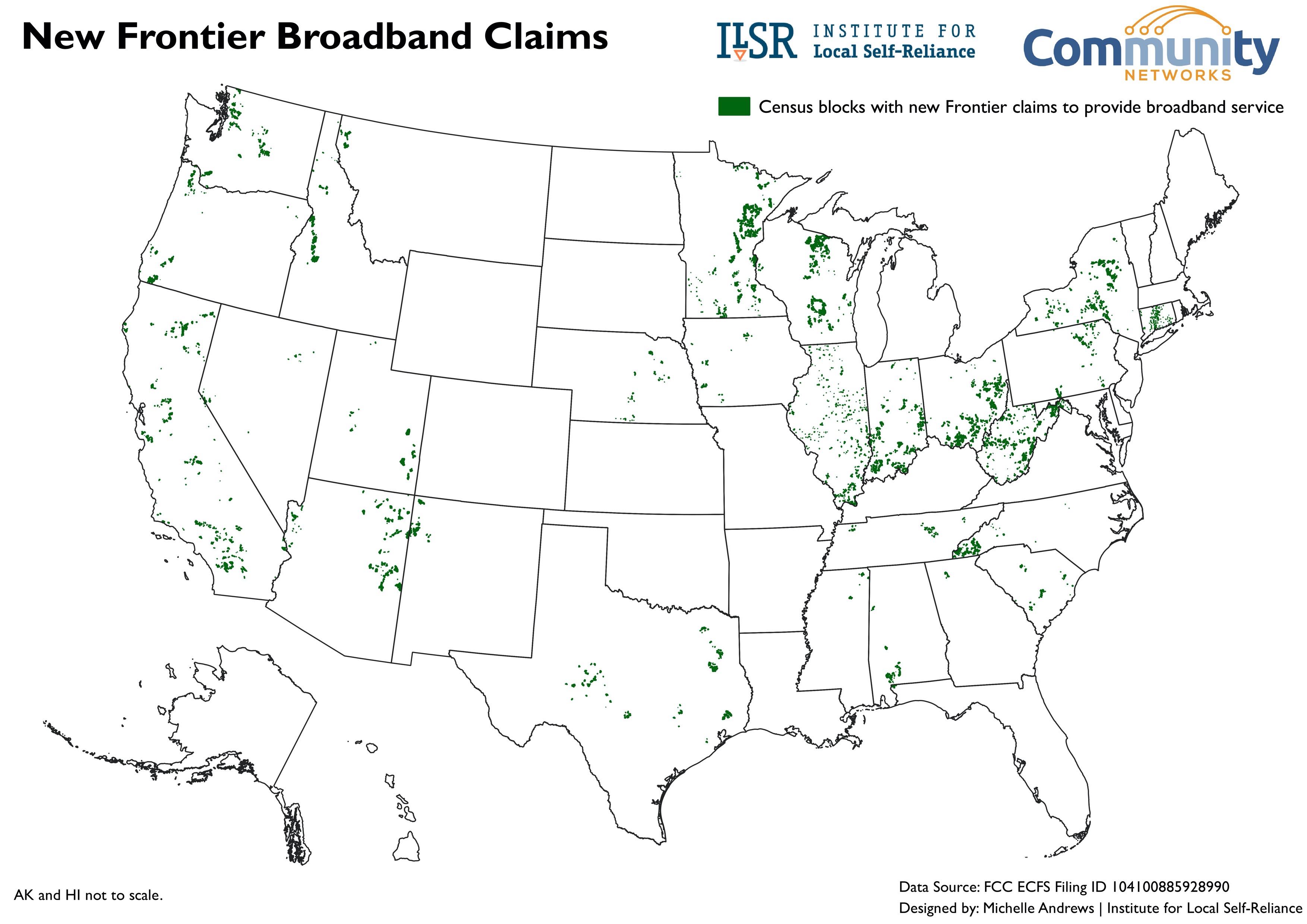
The Institute for Local Self-Reliance (ILSR) also questioned Frontier’s reported deployment and created a map of where Frontier is newly claiming 25/3Mbps broadband:

Institute for Local Self-Reliance

“We are extremely concerned that many of these locations may not actually be getting the claimed 25/3Mbps,” the ILSR’s Community Broadband Networks Initiative Director Christopher Mitchell wrote. “If Frontier is exaggerating its coverage, now is the time to investigate before those households miss out on a massive opportunity to get high-quality Internet service from a company that, unlike Frontier, has basic competence.” Mitchell noted that Frontier’s poor network maintenance has been investigated by multiple states and that Consumer Reports has repeatedly found Frontier “to be one of the worst Internet Service Providers in the nation.”

There are 11 million census blocks in the US, though several million are entirely unoccupied. “Generally, census blocks are small in area; for example, a block in a city bounded on all sides by streets. Census blocks in suburban and rural areas may be large, irregular, and bounded by a variety of features, such as roads, streams, and transmission lines. In remote areas, census blocks may encompass hundreds of square miles,” the US Census Bureau says.

The FCC plans to award the $16 billion in a reverse auction later this year, and the money would be distributed to ISPs over the ensuing ten years. The FCC says the auction “will target over six million homes and businesses in census blocks that are entirely unserved by voice and broadband with download speeds of at least 25Mbps.”

Frontier says filing is accurate

We asked Frontier about its filing last week. The company told us its new deployments were made with funding from a previous round of grants distributed through the FCC’s Connect America Fund (CAF).

“The census blocks included in Frontier’s filing are those to which Frontier offers broadband at speeds of 25/3 or greater and are associated with Frontier’s existing CAF Phase II deployments,” Frontier said. Frontier said it previously notified the FCC of its deployment in most of the 17,000 census blocks in its regularly scheduled December 2019 FCC filing “prior to the release of the FCC’s preliminary list of eligible census blocks for the Rural Digital Opportunity Fund.”

Using $283.4 million worth of annual CAF program money that Frontier began accepting in 2015, the ISP is required to deploy 10/1Mbps service to more than 774,000 customer locations in 29 states. In January 2020, Frontier told the FCC that it apparently missed an interim deadline in 13 of those states. But Frontier had already deployed to 596,000 locations and said it was committed to finishing the buildout, which it is supposed to complete by the end of 2020.

“[While] Frontier is missing CAF buildout milestones for 10/1Mbps service, losing a large number of customers, hemorrhaging cash, and seeking bankruptcy protection, it strains credulity for it to claim that it has upgraded service to 25/3Mbps in 16,000 census blocks in eight months,” two other groups that represent small Internet providers told the FCC in a filing on Monday. Those groups are the Wireless Internet Service Providers Association (WISPA) and National Rural Electric Cooperative Association (NRECA).

Although the CAF funding only requires 10/1Mbps speeds, Frontier told Ars that it’s providing speeds faster than that to homes in the 17,000 census blocks. This is copper-based DSL instead of fiber-to-the-home service, and data speeds over copper degrade with distance, so actual speeds depend on each customer’s location.

“Through Frontier’s CAF Phase II deployments, customers gain access to broadband of at least 10/1Mbps, with customers located closer to the deployment gaining access to faster speeds, including speeds of 25/3Mbps, and some as fast as 115Mbps,” Frontier told Ars.

https://arstechnica.com/?p=1672524


Congress calls on Bezos to come explain Amazon’s possible lies

Amazon Founder and CEO Jeff Bezos and his surprised face speaking in 2019.
Enlarge / Amazon Founder and CEO Jeff Bezos and his surprised face speaking in 2019.

A bipartisan group of House representatives wants Amazon CEO Jeff Bezos to show up and explain to their socially distanced faces why media reports say his company is doing something Amazon previously promised Congress it would never do.

The House Antitrust subcommittee opened its investigation into “abusive conduct” in the tech sector—focusing on Alphabet (Google), Amazon, Apple, and Facebook—last June, almost a year ago. So far the committee has held several public hearings and has gone through untold reams of documentation it requested from all four firms about several of their business practices.

Among the practices under examination is Amazon’s treatment of third-party vendors on its massive marketplace platform and its use of data generated by those merchants to compete against them directly with first-party private label sales. Company representatives explicitly told Congress several times in the past year that Amazon does not access vendors’ data in that way or for those purposes.

Except it turns out that it totally does. Media reports, most recently a story published last week by The Wall Street Journal, have found many employees saying they used and were encouraged to use that data, despite company policy saying not to.

Congress does not like feeling that it has been lied to, and the letter to Bezos (PDF) makes that displeasure clear.

“If the reporting in the Wall Street Journal article is accurate, then statements Amazon made to the Committee about the company’s business practices appear to be misleading, and possibly criminally false or perjurious,” they write.

“In light of our ongoing investigation, recent public reporting, and Amazon’s prior testimony before the Committee, we expect you, as Chief Executive Officer of Amazon, to testify before the Committee,” the letter continues. “It is vital to the committee, as part of its critical work investigating and understanding competition issues in the digital market, that Amazon respond to these and other critical questions concerning competition issues in digital markets.”

The invitation to come talk to Congress is also not really a request. “Although we expect that you will testify on a voluntary basis,” the letter ends, the committee will “resort to compulsory process”—such as a subpoena—if necessary.

“Amazon has had multiple chances to come clean about its business practices,” Rep. David Cicilline (D-R.I.), chairman of the antitrust subcommittee, said in a series of tweets. “Instead, its executives have repeatedly misled the Committee and the public. Enough.”

“In light of the gravity of this situation, I am also considering whether a perjury referral is warranted,” he added. “Powerful companies are not above the law.”

In addition to Cicilline, the letter was signed by House Judiciary Committee Chairman Rep. Jerrold Nadler (D-N.Y.), Antitrust Subcommittee Vice Chair Rep. Joe Neguse (D-Colo.), ranking member Rep. James Sensenbrenner (R-Wis.), and Reps. Ken Buck (R-Colo.), Matt Gaetz (R-Fla.), and Pramila Jayapal (D-Wash.).

Earlier this week, Sen. Josh Hawley (R-Mo.) urged the Justice Department to launch a criminal antitrust probe into Amazon over its alleged use of third-party merchant data. The European Commission’s competition bureau is also investigating the matter in depth.

https://arstechnica.com/?p=1672457


ICANN blocks controversial sale of .org domain to a private equity firm

ICANN blocks controversial sale of .org domain to a private equity firm
dalton00 / Getty

The Internet Corporation for Assigned Names and Numbers, the non-profit organization that oversees the Internet’s domain name system, has rejected a controversial proposal to sell the .org domain to a private equity group for more than $1 billion. It’s a serious—quite possibly fatal—blow to a proposal that had few supporters besides the organizations that proposed it.

Currently, the .org domain registry is run by the Public Interest Registry, a non-profit subsidiary of another non-profit called the Internet Society. PIR was created in 2002 to run the .org domain and has been doing so ever since. But last fall, the Internet Society stunned the non-profit world by announcing it would sell the PIR—and, effectively, ownership of the .org domain—to a new and secretive private equity firm called Ethos Capital for more than $1 billion.

The announcement created a swift and powerful backlash. In its resolution formally rejecting the transaction, ICANN says it received its first letter opposing the deal just two days after it was announced. The group would eventually receive letters from at least 30 groups opposing the deal, as well as numerous negative comments during public hearings. Meanwhile, ICANN says, the deal has received “virtually no counterbalancing support except from the parties involved in the transaction and their advisors.”

ICANN didn’t have unlimited discretion to block the deal. ICANN’s contract with the PIR required PIR to seek ICANN’s approval for a change in control of the registry, but it stated that ICANN’s “approval will not be unreasonably withheld.” The big legal question, then, was whether it was reasonable for ICANN to withhold its approval. On Thursday, ICANN’s board concluded that it was.

“We are disappointed that ICANN has acted as a regulatory body it was never meant to be, as laid out in Article 1 of its bylaws,” the Internet Society said in an email statement. “The outcome seems inconsistent with prior decisions made by ICANN in similar cases. We stand by our decision in favor of the transaction to unlock the full potential of the Internet Society, PIR, .ORG community, and ultimately the Internet.”

Too much debt

A significant factor in ICANN’s deliberations was a recent letter from California Attorney General Xavier Becerra. ICANN is a California-based non-profit corporation, and California law gives the attorney general authority to ensure non-profits uphold the terms of their articles of incorporation. In ICANN’s case, that includes a promise to make decisions “for the benefit of the Internet community as a whole.” ICANN’s board mentions Becerra’s letter—and his arguments against the deal—multiple times in its disapproval of it.

One big concern shared by both Becerra and the ICANN board was the prospect of loading the PIR up with debt. Ethos Capital was planning to do a leveraged buyout of the .org registry, requiring the PIR to take out a $360 million loan to help finance the transaction. So PIR would have needed to generate enough revenue to pay off the loan on top of the fees required to simply run the .org registry.

This wasn’t necessarily going to be a problem for PIR. The .org registry generates millions of dollars in extra revenue every year that help to finance the operation of the Internet Society. ICANN’s board notes that in 2018, PIR generated $95 million in revenue, with “nearly $50 million of that revenue distributed as grants.” Ethos submitted financial projections showing that the registry would continue to be profitable enough for PIR to comfortably pay down the $360 million loan.

But of course financial projections might be wrong. If things go worse than expected for PIR, having an extra $360 million in debt will make it more likely the company will run into financial difficulties that could endanger the stability of the .org domain.

“The incurrence of this debt was not for the benefit of PIR or the .org community, but for the financial interests of the Internet Society, Ethos Capital, and other investors in the transaction,” ICANN’s board wrote. “Burdening PIR with significant debt obligations could create uncertainty as to the long-term financial stability of PIR, particularly in light of the current and likely ongoing economic uncertainty.”

ICANN questioned Ethos Capital’s qualifications to manage a registry with over 10 million registered domains. Ethos had pointed out that Ethos founder Fadi Chehade had previously led the acquisition of the domain registry company Donuts. That argument didn’t impress ICANN. This “only demonstrates a track record of acquisition and does not demonstrate an ability or track record of successfully operating a registry operator, particularly one the size of .org.”

Not enough transparency

ICANN also faulted Ethos Capital for refusing to provide ICANN with full details about who owns Ethos.

“PIR declined to provide the specific ownership interests of the investors in the transaction,” ICANN notes. “ICANN has not been provided detailed information concerning various minority investors (many of whom are entities, likely with additional investors), including vehicles through which significant minority investors (the apparent second largest investor to Ethos Capital) will make its investment.”

A final factor working against the proposed deal, ICANN said, was a “lack of meaningful engagement” with the .org community “in the design of the proposed transaction.” As a non-profit focused on Internet governance issues, the Internet Society has a number of mechanisms for accountability to .org domain holders and the Internet at large. Obviously, a newly created private equity firm has much less ability or incentive to be responsive to Internet stakeholders.

“The public interest is better served in withholding consent as a result of various factors that create unacceptable uncertainty over the future of the third largest gTLD (generic Top Level Domain) registry,” ICANN’s board wrote.

ICANN’s decision isn’t necessarily the final word on this issue. ICANN left the door open for the Internet Society to address ICANN’s concerns and submit another proposal. Theoretically, the group could also take ICANN to court, arguing that its decision to withhold consent was unreasonable—and therefore barred by the contract governing the .org domain.

But the controversy over the .org sale has already done serious damage to the Internet Society’s reputation. And there’s little reason to think the group would get a sympathetic ear either from ICANN’s board or the courts.

But the Internet Society’s initial reaction shows little sign of contrition. The group writes that “despite ICANN’s decision, our work to connect the unconnected and strengthen the Internet will continue.” But it isn’t clear about whether it will make another attempt to sell off the .org domain.

https://arstechnica.com/?p=1672396


Amazon locks down internal employee communications amid organizing efforts

Multistory glass building with Amazon logo.
Enlarge / Amazon’s headquarters on a sunny day in 2018.

Amazon is reportedly (and suddenly) enforcing rules limiting employees’ internal communication as workers, critical of the company’s behavior, become increasingly outspoken and organized.

Internal listservs with more than 500 participants are now required to move to a moderated model where a manager must approve any content before its distribution, according to emails obtained by Recode.

Amazon had almost 800,000 total employees worldwide as of the end of 2019, a number that does not include the recent addition of another 175,000 temporary warehouse and delivery workers the company just hired to handle increased demand due to COVID-19. Of those 800,000, more than 500,000 are in the United States, and at least 275,000 of those are full-time employees.

Those hundreds of thousands of employees use thousands of internal listservs to talk among themselves about basically anything. That “anything,” of late, includes many criticisms of Amazon. The company has faced both internal and external reproof for its management of warehouses, where some employees have called for better cleaning, more protective equipment, and more paid time off as COVID-19 has spread through at least 50 US facilities.

Amazon fired one warehouse worker at the head of organization efforts in the company’s Staten Island warehouse about a month ago, then tried to paint him as the face of all attempts to organize while dismissing him as “not smart or articulate.” Several employees who had spoken out in those internal groups about the company’s treatment of its warehouse workers during COVID-19 were likewise fired earlier this month. At the time, Amazon said the employees were fired for “repeatedly violating internal policies,” adding, “We support every employee’s right to criticize their employer’s working conditions, but that does not come with blanket immunity against any and all internal policies.”

The company told Recode that the moderation policy is not new but that Amazon has begun enforcement against lists that either weren’t following the rules or had previously been granted exceptions after a “routine audit.” An internal message to employees, obtained by Recode, said the change was to “minimize disruption to any business-critical email lists.”

One corporate employee told Recode they felt the move was “obviously and transparently” to shut down employee communications, pointing out that any discussion about a firing, or attempt to organize a meeting or event, would now require approval from managers who, by approving such posts, would put their own jobs at risk.

Amazon is hardly the only large tech firm increasingly grappling with a dissatisfied and outspoken workforce. Google last year fired several staffers who filed a complaint with the National Labor Relations Board alleging they were let go for protected organizing activity. Google denied the pink slips were in any way retaliatory for “raising concerns or debating the company’s activities,” instead saying the workers violated “longstanding data security policies.”

https://arstechnica.com/?p=1672190


Who owns remdesivir, how much can they make, and how much does it cost?

Gilead logo amidst chemical equations.

Earlier on Wednesday, we reported on some clinical trial data that offered good, if ambiguous, news about treating COVID-19. In the study, participants treated with a drug called remdesivir recovered on average 30 percent quicker than those receiving a placebo. But who owns the drug, how much of it can be made, and what does it cost?

To answer the first question, remdesivir is owned by Gilead Sciences, a US biotechnology company. Gilead got its first patent for the drug in 2017 when the company was originally targeting it as a possible treatment for the Ebola virus. That didn’t pan out, but as our earlier article explains, biochemical similarities in how the Ebola and SARS-CoV-2 viruses function led Gilead to see if remdesivir could be repurposed for treating COVID-19. Gilead’s patents mean that it has a monopoly on the drug in the United States, so barring government intervention or Gilead licensing the patent to others, it’s the only company that can manufacture it until 2037, at which point a generic version could be possible.

To answer the second question, Gilead announced in April that it had ramped up production of remdesivir at its factory in La Verne, California, in January, and by the beginning of April, it had already stockpiled enough to treat 140,000 patients, each over the course of 10 days. The company also said that it plans to produce enough remdesivir to treat 500,000 patients by October and a million patients by the end of 2020. (This explains why there was some outcry in March when it was revealed that Gilead had applied for something called “orphan drug status” for remdesivir, which is supposed to be reserved for rare diseases. Gilead withdrew that application.)

Finally, there’s the question of how much that will cost. As of today, we don’t know how much Gilead intends to charge for remdesivir in the US or elsewhere. In CEO Daniel O’Day’s April letter that revealed the existing stockpile, he wrote that the company “is providing the entirety of this existing supply at no cost, to treat patients with the most severe symptoms of COVID-19. The 1.5 million individual doses are available for compassionate use, expanded access, and clinical trials and will be donated for broader distribution following any potential future regulatory authorizations.”

A recent study published in the Journal of Virus Eradication attempts to analyze the cost of manufacturing remdesivir. The authors looked at the chemical synthesis of the drug and concluded that a 10-day course for one person would cost $9, allowing for 20 percent losses during formulation, plus the cost of the vials, a profit margin, and tax. However, whether it costs Gilead that to actually produce the drug is unknown, and one needn’t be a scholar of the US healthcare system to be skeptical that a novel treatment would end up being quite so cheap.

https://arstechnica.com/?p=1672002


Trump admin threatens to sue states that don’t lift pandemic orders

Attorney General William Barr speaking at a podium while President Trump looks on.
Enlarge / Attorney General William Barr speaks as US President Donald Trump listens during a Coronavirus Task Force news conference on Monday, March 23, 2020.

The Trump administration is threatening to sue states and municipalities whose pandemic orders infringe on people’s rights or cause “undue interference with the national economy.”

“I am directing each of our United States Attorneys to also be on the lookout for state and local directives that could be violating the constitutional rights and civil liberties of individual citizens,” US Attorney General William Barr wrote yesterday in a memo to all 94 US attorneys’ offices. The Barr memo said that “even in times of emergency, when reasonable and temporary restrictions are placed on rights, the First Amendment and federal statutory law prohibit discrimination against religious institutions and religious believers.” The memo is available at The Washington Post website.

Barr’s memo is not just aimed at protecting members of religious groups. He continued:

The legal restrictions on state and local authority are not limited to discrimination against religious institutions and religious believers. For example, the Constitution also forbids, in certain circumstances, discrimination against disfavored speech and undue interference with the national economy. If a state or local ordinance crosses the line from an appropriate exercise of authority to stop the spread of COVID-19 into an overbearing infringement of constitutional and statutory protections, the Department of Justice may have an obligation to address that overreach in federal court.

Barr wrote that he is “therefore directing the Assistant Attorney General for Civil Rights, Eric Dreiband, and Matthew Schneider, the US Attorney for the Eastern District of Michigan, to oversee and coordinate our efforts to monitor state and local policies and, if necessary, take action to correct them.” While Barr said US officials “do not want to unduly interfere with the important efforts of state and local officials to protect the public,” he noted that “the Constitution is not suspended in times of crisis.”

“Disturbingly close to house arrest”

The memo did not detail what kinds of restrictions would cause the United States to sue states or cities, and it did not say whether the US will challenge any measures that are already in place. But Barr wrote that local restrictions, while “necessary in order to stop the spread of a deadly disease,” have “imposed tremendous burdens on the daily lives of all Americans.”

Barr previously criticized local policies in interviews, saying that “the idea that you have to stay in your house is disturbingly close to house arrest,” according to a Fox News article last week. “We’re looking carefully at a number of these rules that are being put into place,” Barr said. “And if we think one goes too far, we initially try to jawbone the governors into rolling them back or adjusting them. And if they’re not and people bring lawsuits, we file [a] statement of interest and side with the plaintiffs.”

The Justice Department has so far “intervened in only a single lawsuit over coronavirus restrictions, appearing to back a Greenville, Mississippi, church which had sued over the city’s efforts to shut down drive-in religious services,” The Washington Post wrote. The Justice Department “did not unequivocally support Temple Baptist Church in its legal statement of interest, though it said the circumstances the church described ‘suggest that the city singled out churches for distinctive treatment,’ which would be unconstitutional.”

Trump threatened states

President Trump on April 13 claimed he has “total” authority to override governors and force states to reopen their economies even while the coronavirus pandemic continues. “When somebody is the president of the United States, the authority is total, and that’s the way it’s got to be. It’s total, and the governors know that,” Trump said at a press conference.

That isn’t how it works, as states and local governments have police powers to protect the health and safety of residents with measures such as isolation and quarantines. But Trump’s claim and related developments showed that at least some states aren’t likely to succumb to federal pressure to reopen their economies. New York Gov. Andrew Cuomo said he would not follow a potential presidential order requiring him to lift pandemic orders. Shortly before Trump’s claim, coalitions of governors on the East and West Coasts announced pacts to follow science, not politics, in their decisions on when to reopen economies.

Trump backed down just one day later, saying, “I’m not going to put pressure on any governor to open.” However, Barr’s letter signals that the Trump administration is not done pressuring states to lift pandemic orders.

Update at 10:20pm ET: New York Attorney General Letitia James issued a statement saying she is prepared to take legal action to defend the state’s authority. “Despite the Trump Administration’s failure to do so, states are able to protect constitutional rights and enact policies to curb the spread of the coronavirus simultaneously,” James said. “The Tenth Amendment of the US Constitution is clear that ‘the powers not delegated to the’ federal government shall be ‘reserved to the States.’ Make no mistake: US Attorney General Barr is not the only one prepared to take legal action to guard the Constitution. My office will fight every day to defend it and the rights it affords the great State of New York.”

https://arstechnica.com/?p=1671607