Senator pushes DOJ to launch criminal antitrust probe of Amazon
Enlarge/ NEW YORK, NY – SEPTEMBER 9: Sen. Josh Hawley (R-MO) attends a a special Senate Committee on Homeland Security and Governmental affairs hearing on “The State of Homeland Security after 9/11” at the National September 11th Memorial & Museum on September 9, 2019 in New York City. The hearing featured three former secretaries of the U.S. Department of Homeland Security. (Photo by Drew Angerer/Getty Images)
Amazon is already facing a bevy of antitrust probes, both in the United States and overseas. Just about every state, federal, and international regulator with any kind of competition regulation power is investigating the company over some aspect of its business. Sen. Josh Hawley (R-Mo.), however, wants to add one more to the pile and is calling on the Justice Department to launch a criminal probe.
“Recent reports suggest that Amazon has engaged in predatory and exclusionary data practices to build and maintain a monopoly,” Hawley wrote today in a letter (PDF) to Attorney General William Barr. “These practices are alarming for America’s small businesses under ordinary circumstances. But at a time when most small retail businesses must rely on Amazon because of coronavirus-related shutdowns, predatory data practices threaten these businesses’ very existence.”
The recent report to which Hawley refers is last week’s Wall Street Journal exposé, which found that Amazon employees accessed third-party merchants’ data as a matter of habit in order to launch their own in-house products and undercut the marketplace vendors who rely on Amazon as a platform.
All retailers, of course, have access to sales data from their platforms or stores. Walmart or Target knows exactly how many name-brand cleaning products or over-the-counter pharmaceuticals sell in a given hour from a given location (or online), as well as how many of its private-label generic equivalents sell in the same time frame, and make decisions based on that data. But Amazon, as Hawley pointed out, has access to a much richer trove of information than a standard big-box store does. “[Amazon] can track how long a person’s attention lingers on a product, which features attract a person’s attention, which images a person views and for how long, and what reviews a person reads,” Hawley wrote. “Amazon’s capacity for data collection is like a brick-and-mortar retailer attaching a camera to every customer’s forehead.”
Antitrust law isn’t just about whether a company has a monopoly in its market sector. More often, antitrust cases are about anticompetitive behavior within a sector. In short: being the biggest is fine, legally speaking, and being the victor in marketplace combat is fine, but cheating or in some other way playing unfairly against your would-be competitors in order to attain and maintain your dominance is not.
The House of Representatives, the Department of Justice, the Federal Trade Commission, and massive, nationwide coalitions of states are all in the midst of investigations into potentially anticompetitive behavior by Google, Amazon, Facebook, and Apple. So, too, are the agencies’ counterparts in the European Union, as well as some individual member nations, along with regulators in a half-dozen other countries.
Amazon’s treatment of third-party sellers and use of the data those merchants generate have emerged as the focal point of several of those investigations. The FTC began talking to Amazon marketplace sellers last fall, and both The Washington Post and Bloomberg spoke last year with vendors who claimed Amazon was treating them unfairly. The European Commission’s competition bureau launched its probe into Amazon’s marketplace back in July.
https://arstechnica.com/?p=1671538
Supreme Court rules Georgia can’t put the law behind a paywall
Carl Malamud, founder of Public.Resource.Org.
A narrowly divided US Supreme Court on Monday upheld the right to freely share the official law code of Georgia. The state claimed to own the copyright for the Official Code of Georgia Annotated and sued a nonprofit called Public.Resource.Org for publishing it online. Monday’s ruling is not only a victory for the open-government group, it’s an important precedent that will help secure the right to publish other legally significant public documents.
“Officials empowered to speak with the force of law cannot be the authors of—and therefore cannot copyright—the works they create in the course of their official duties,” wrote Chief Justice John Roberts in an opinion that was joined by four other justices on the nine-member court.
Everyone involved in the case agreed that the text of state statutes could not be copyrighted. But the state of Georgia argued that it could copyright annotations that are distributed with the official code. These annotations provide supplemental information about the law, including summaries of judicial opinions, information about legislative history, and citations to relevant law review articles. The annotations are produced by a division of legal publishing giant LexisNexis under a work-for-hire contract with the state.
The copyright status of the annotated code matters because the state doesn’t publish any other official version. You can get an unofficial version of state law for free from LexisNexis’ website, but LexisNexis’ terms of service explicitly warned users that it might be inaccurate. The company also prohibits users from scraping the site’s content or using it commercially. If you need the official, up-to-date version of Georgia state law, you have to pay LexisNexis hundreds of dollars for a copy of the official version—which includes annotations.
Public.Resource.Org defied Georgia’s rules and published the entire code, including annotations, on its website. The group argued that as an official document of the state legislature, it couldn’t be protected by copyright. The state sued and won at the trial court level. The 11th Circuit Court of Appeals reversed that ruling and sided with the non-profit. In an unorthodox move, the people at PRO urged the Supreme Court to review the case, even though doing so could reverse their appellate win, because they wanted to set a nationwide precedent.
The group’s gamble paid off—but just barely. Five justices bought PRO’s argument that Georgia’s official code was in the public domain. Four justices dissented and would have allowed the Peach State to copyright portions of its official legal code.
Old precedents, new technology
The Supreme Court hasn’t ruled on the copyright status of official documents in over a century. But a couple of rulings from the 1800s said that judicial documents could not be copyrighted. These cases involved court reporters—writers who were chosen by the courts to keep records of court proceedings and publish them. Official court reporters were more independent in the 19th century than judicial staff today, and they would sometimes publish their own annotated versions of judicial opinions.
But the 19th-century Supreme Court nixed efforts to claim ownership of content that had originally been written by judges. This applied not only to majority opinions (which are legally binding) but also to dissenting opinions and official summaries of court rulings. At the same time, the Supreme Court held that court reporters could claim copyright over annotations that they produced independently from their official duties.
The Georgia case is about the legislative branch, not the judicial branch. But the parallels are obvious. PRO pointed to the Supreme Court’s prior holdings that official documents couldn’t be copyrighted. The state of Georgia countered by pointing to the ruling that annotations could be copyrighted.
The high court’s five-justice majority sided with the non-profit group. In an opinion written by Chief Justice John Roberts, the high court held that the key factor was who had written the materials. And while most of the annotations were initially drafted by LexisNexis personnel, the state’s legislative council held final authority over the document’s contents.
The council gave LexisNexis detailed instructions about what kinds of material to include, and legislative officials carefully reviewed each new annotation before approving it. Moreover, the high court held that Georgia’s legislative council was effectively an arm of the state legislature. The group was funded by the state of Georgia, and a majority of its members had to be Georgia legislators. Hence, the Georgia legislature bore ultimate responsibility for the code’s contents.
As a result, the Supreme Court held that any document produced by the Georgia legislature could not be protected by copyright.
Four justices disagreed
Four justices dissented, writing two dissenting opinions. Clarence Thomas, in an opinion joined by fellow conservative Sam Alito and largely joined by liberal Stephen Breyer, argued that the courts were stretching century-old precedents too far. The old rulings had been clear that laws themselves couldn’t be copyrighted, Thomas argued, but hadn’t been so clear about when copyright should apply to related materials that do not have the force of law.
Thomas pointed out that 22 other states have used arrangements similar to Georgia’s to publish their own state laws. Georgia—and a number of other states—grants a company like LexisNexis a monopoly right to publish the official annotated state code. In exchange, LexisNexis spends significant amounts of money to produce the annotations. This kind of deal saves states from having to spend taxpayer dollars to directly fund the annotation process.
Monday’s rulings will force states to rethink this approach—either paying for the annotations with cash or discontinuing annotations altogether. Thomas argued that it would be better for the high court to leave the status quo in place and let Congress alter copyright law if it didn’t approve of states claiming copyright over the non-binding portions of state legal codes.
A second dissent by liberal Ruth Bader Ginsburg—and also signed by Breyer—took a different tack. She argued that the law only denied copyright protection to works produced by a legislature in the course of its official duties. But she argued that the process of annotating existing laws is inherently separate from the process of enacting laws in the first place.
“Annotating begins only after lawmaking ends,” Ginsburg argued. Hence, she argued that it didn’t make sense to treat annotations the same way as the text of a statute itself.
One potential problem with the dissenters’ approach, however, is that it could have created a legal minefield for people wanting to republish the public domain portions of official documents. If Ginsburg and Thomas had gotten their way, Georgia’s official annotated code would continue to be a mixture of copyrighted and public domain works. That would have forced anyone who wanted to republish state law to perform the laborious task of deleting the copyrighted parts first. The practical impact would be to raise the cost of providing the public with copies of official legal documents like the Georgia code.
The Supreme Court majority rejected the dissenters’ narrow interpretations of past precedents. Instead, they held that any works produced by the legislature are excluded from copyright protection, whether or not they’re directly connected to the legislative process—and whether or not they’re legally binding.
Disclosure: Public.Resource.Org provided financial support for my graduate studies during the 2010-11 school year.
https://arstechnica.com/?p=1671437
Ajit Pai uses bad data to claim ISPs are deploying broadband to everyone
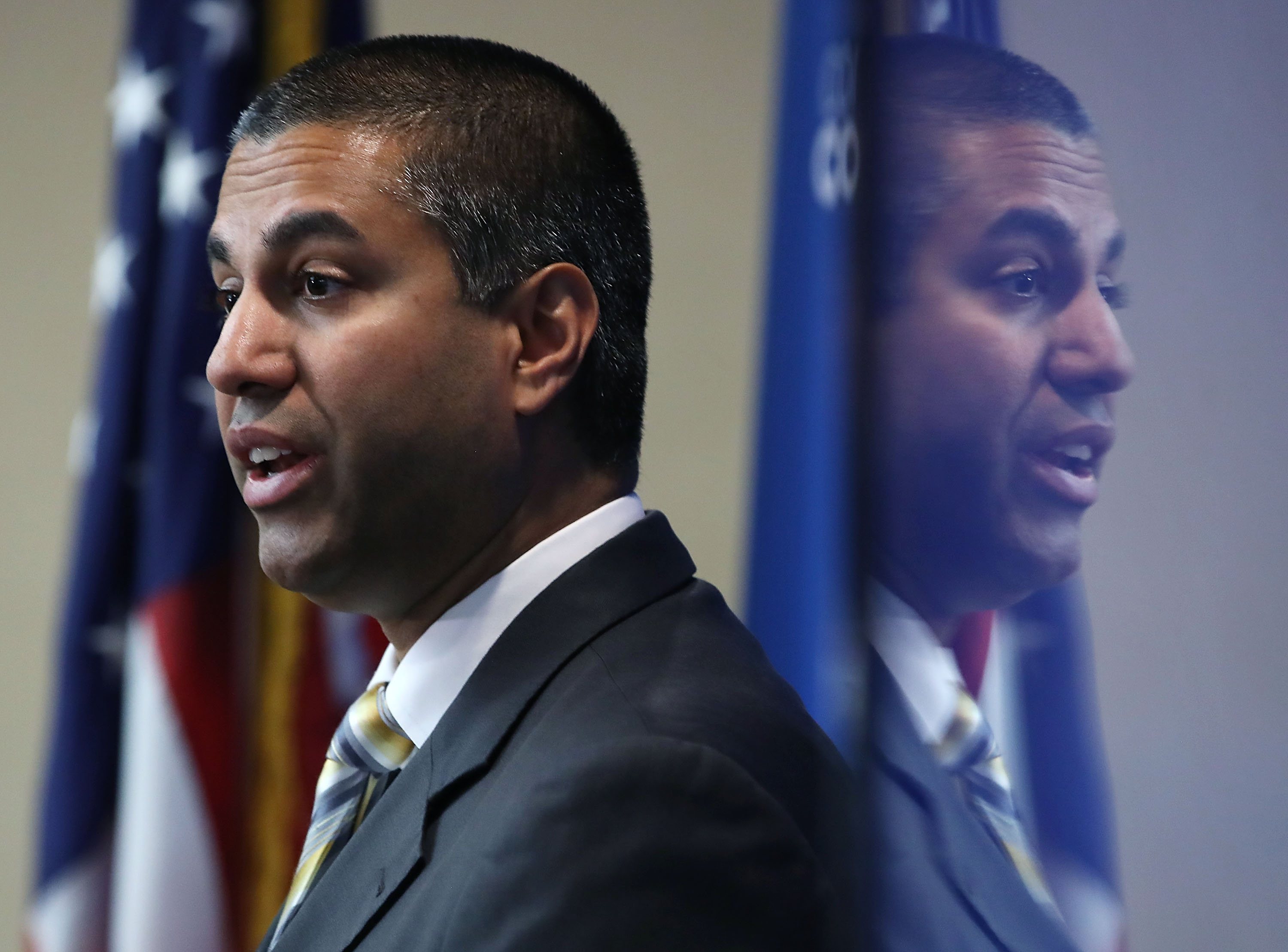
Enlarge/ FCC Chairman Ajit Pai speaking at a press conference on October 1, 2018, in Washington, DC.
The Federal Communications Commission on Friday issued its annual broadband deployment report, finding for the third straight year that broadband is “being deployed to all Americans in a reasonable and timely fashion.”
The FCC is required to report on broadband progress annually under Section 706 of the Telecommunications Act of 1996. Pai’s Republican majority pointed to the FCC’s deployment data to argue that broadband networks are expanding fast enough to serve all Americans, despite the three biggest ISPs—Comcast, AT&T, and Charter—lowering capital expenditures.
Pai’s conclusion is based on ISPs’ filings to the FCC, which are known to overcount the number of Americans who have broadband access. The FCC report also failed to consider whether data caps and broadband prices are impeding progress toward universal broadband access.
The annual report’s finding can have an impact on policymaking. The FCC is required to take further action to accelerate broadband deployment if it finds that it isn’t happening quickly enough.
Pai touts his leadership
Going back to his time as an FCC commissioner during the Obama administration, Pai has repeatedly argued that government regulation slows broadband investment and promised that his deregulatory agenda would cause investment to rise. This year, he pointed to industry research that found capital expenditures rose from $76.9 billion in 2017 to $80 billion in 2018. But the report didn’t mention the more recent spending declines at Comcast, AT&T, and Charter.
As we previously reported, Comcast lowered capital expenditures in its cable division by 10.5 percent in 2019, reducing the annual total to $6.9 billion. AT&T announced in October that it is lowering capital investment from $23 billion in 2019 to $20 billion in 2020, and Charter cut capital expenditures from $9.1 billion in 2018 to $7.2 billion in 2019.
“Under my leadership, the FCC’s top priority is to close the digital divide, and I’m proud of the progress that we have made,” Pai said in a press release Friday. “Having grown up in rural Kansas, I have a deep commitment to expanding broadband to all corners of the country. That’s why we’ve taken aggressive steps to remove regulatory barriers to broadband deployment and reform our Universal Service Fund programs.”
In previous years, Pai used the annual report to take credit for broadband deployment projects that were started during the Obama administration and claimed that his deregulatory policies were speeding up deployment even though broadband grew at similar rates during the Obama years.
Report is “baffling,” Democrat says
The FCC’s two Democrats disputed Pai’s conclusions. Commissioner Jessica Rosenworcel said:
This report is baffling. We are in the middle of a pandemic. So much of modern life has migrated online. As a result, it has become painfully clear there are too many people in the United States who lack access to broadband. In fact, if this crisis has revealed anything, it is the hard truth that the digital divide is very real and very big.
But you’ll find no evidence acknowledging that in today’s Broadband Progress Report from the Federal Communications Commission. Instead, you’ll find a glowing assessment that all is well. According to this rosy report the nation’s broadband efforts are all good. They are proceeding in a reasonable and timely fashion and they are reaching all Americans. This is just not right.
Among other things, Rosenworcel pointed out that people without broadband access are sitting in cars “in front of shuttered libraries and coffee shops, just to pick up a free Wi-Fi signal” during the pandemic.
FCC: 18.3 million people lack access
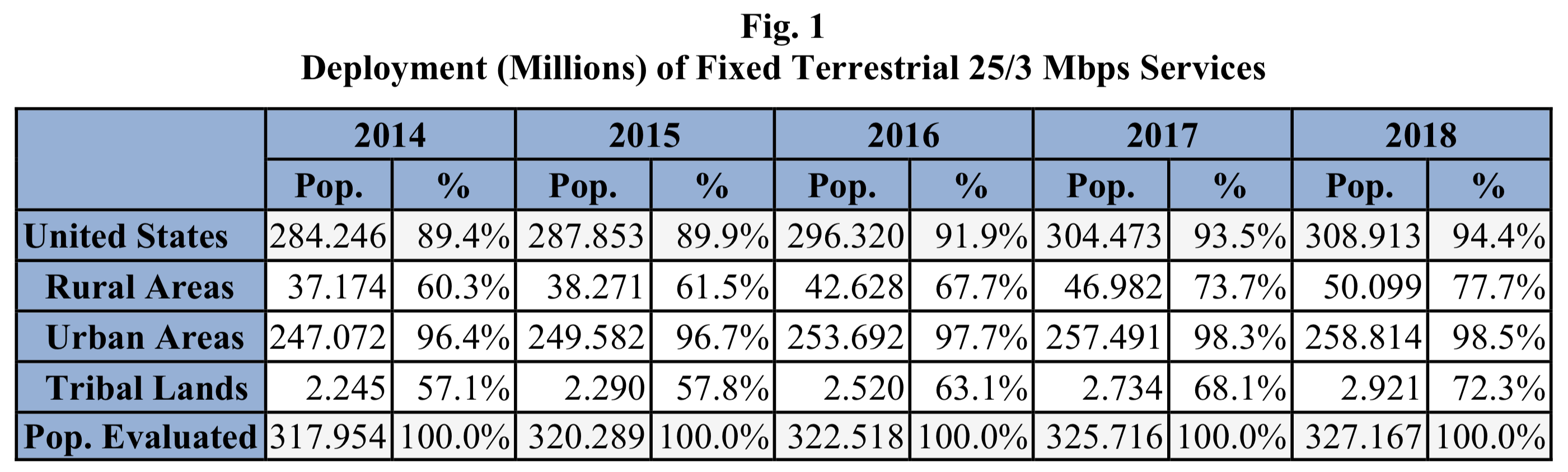
The report said that as of year-end 2018, 308.9 million out of 327.2 million Americans had access to fixed broadband with speeds of at least 25Mbps downstream and 3Mbps upstream, the FCC broadband speed standard that hasn’t been updated since 2015. The percentage of Americans with 25/3Mbps access rose from 93.5 percent to 94.4 percent from 2017 to 2018. Those numbers exclude satellite service, which has poor latency and restrictive data caps, making it a poor substitute for cable or fiber. (SpaceX’s satellite service may change that, but it isn’t available yet.)
Enlarge/ US broadband deployment from 2014 to 2018.
That leaves 18.3 million Americans who live in areas that don’t have what the FCC considers modern home-Internet service. The 94.4 percent and 18.3 million figures are in the report but aren’t mentioned in the press release Pai issued to tout the broadband industry’s progress. The press release said that “the number of Americans lacking access to fixed terrestrial broadband service at 25/3Mbps continued to decline, going down by more than 14 percent in 2018 and more than 30 percent over the course of 2017 and 2018.”
Real number may be much higher
The 18.3-million number “wildly understates the extent of the digital divide in this country,” Rosenworcel said. “That’s because if a broadband provider tells the FCC that it can offer service to a single customer in a census block, the agency assumes that service is available throughout [the census block].” Rosenworcel was referring to the Form 477 reports that ISPs are required to submit.
The real number of Americans without access to wired or fixed wireless broadband is 42.8 million, a February 2020 study by BroadbandNow found.
The FCC in August 2019 finally ordered ISPs to submit geospatial maps of where they provide service instead of merely reporting which census blocks they offer service in. But this more accurate data isn’t available yet. “[D]espite its deficiencies, Form 477 data remains the most comprehensive, reliable data available to us to meet our statutory obligation” to report annually on deployment progress, the FCC said.
There have been some big errors in the Form 477 data that relies on ISPs’ census-block filings. Last year, Pai had to correct the annual broadband report after a new ISP called BarrierFree falsely told the FCC that it went from serving zero customers to 20 percent of the country in just six months. The FCC didn’t notice the mistake, which was discovered by consumer-advocacy group Free Press.
Earlier this month, AT&T disclosed to the FCC that it provided false coverage data in parts of 20 states. The FCC hasn’t said whether it will investigate the rest of AT&T’s broadband data to verify its accuracy.
Like Rosenworcel, Democratic Commissioner Geoffrey Starks said he can’t support the conclusion that broadband is being deployed to everyone on a reasonable and timely fashion. “In light of the struggles many Americans have faced over the last six weeks, it is especially perplexing and disturbing that the majority would cast this report as a victory lap,” Starks said. “Too many Americans cannot access online work, medical help, and distance learning because broadband is too expensive or not available.”
https://arstechnica.com/?p=1671370
Newly unemployed and labeling photos for pennies
Getty Images
B.C. Kowalski, a writer at the local weekly in Wausau, Wisconsin, was expecting a boost to his income this spring. He was set to begin selling ads for local businesses on a podcast he’d launched on the side, Keep it Wausome. Then coronavirus restrictions shut down the town and its businesses.
To keep some extra dollars coming in, Kowalski has turned to Amazon’s crowd-work platform Mechanical Turk, where companies offer cents or dollars for small tasks such as labeling photos, transcribing audio clips, or answering survey questions.
Diane Brewer, who lives in Florida, is also counting on Mechanical Turk, as well as another crowd-work site called Prolific, where workers are paid to fill out surveys for academia and market research. She previously turned to crowd work during spells as a stay-at-home mom and convalescing after a car crash. Covid-19 convinced Brewer it was time to start again “to add some dollars to an uncertain future,” she says. Her long-term boyfriend works as a carpenter. “That may be an issue in the near future, because who is going to buy a house anytime soon?” she asks.
Brewer and Kowalski are among a global surge of people logging on to crowd-working sites due to the economic contagion of Covid-19. Millions of people are suddenly out of work or facing reduced hours, with many stuck at home sheltering in place. Crowd work can be done from anywhere with an internet connection.
UK-based Prolific saw 13 percent more workers in March than in February, according to its CEO, Katia Damer. Damer says that on average each crowd worker filled out more surveys, driving the value of transactions on the platform up more than 50 percent.
Hive, a crowd-work platform that specializes in tagging photos and other data for training machine-learning software, has also seen its workforce swell. Kevin Guo, the startup’s CEO and cofounder, says the daily count of new accounts on the service has more than doubled over recent weeks. A rush of new workers from Brazil and the Philippines has been particularly noticeable.
Amazon did not reply to a query about activity on Mechanical Turk, but Panos Ipeirotis, an NYU professor who has studied Mechanical Turk workers, says he’s seen more Turkers recently from Canada, Italy, and Brazil in particular. A spokesperson for Our Hit Stop, a discussion site for Mechanical Turk workers that sells a Chrome extension for finding the best paying tasks, says it has seen new memberships increase 20 percent and 30 percent of inactive members return.
Crowd work is generally not well paid. A 2018 study led by Carnegie Mellon University pegged the median wage at around $2 an hour although workers can push that higher by being careful about the tasks they select and using tools like Our Hit Stop’s that flag or snag the best work. Kowalski of Wausau says he uses those to select tasks that pay the equivalent of $9 to $15 per hour, but workers who need to take as much work as possible may not be able to be so choosy. Prolific markets itself to workers by promising that surveys pay at least $6.50 an hour.
The surge of crowd workers will increase the competition to land jobs, and could prompt those posting tasks to reduce their already low rates. But Kerri Reynolds, a vice president at Appen, which offers crowd-work jobs annotating images, text, or other data for clients including Microsoft and eBay, says she still has plenty of work to go around because Covid-19 has increased the supply of crowd work as well as crowd workers.
Reynolds says that might be because US companies have lost access to large pools of workers offshore as outsourcing companies have closed offices. “Perhaps with those shutting down, companies are looking for alternatives,” she adds.
Guo of Hive says some of his company’s usual high-volume tasks, like spotting logos on sports videos to help companies track sponsorship deals, are less plentiful. But he notes that the company has more work than ever from clients that use crowd workers to help moderate social content and check user profiles.
“We have seen a dramatic uptick in new customers, as well as existing customers sending in much higher volumes of content to be moderated,” Guo says. He believes that’s partly due to social sites seeing more traffic from people stuck at home, and also because companies have shuttered offices where moderation staff worked. Some companies, such as Facebook, are wary of the privacy risks of sending content for moderation outside their own facilities, but others are turning to crowd workers to help, Guo says.
Companies turning to Hive for moderation typically use machine-learning algorithms to take a first pass at content, and use crowd workers for trickier tasks or to handle surges. One Hive customer, live streaming app Yubo, which has 30 million users, has seen time spent in livestreams increase fourfold and daily signups more than triple.
The coronavirus that has driven more people to crowd work has also created a new, somewhat ironic, stream of work on Amazon’s Mechanical Turk. Longtime Turkers have noticed that the site has seen its own epidemic of surveys posted by psychologists, economists, and other researchers asking people about their Covid-19 related thoughts, feelings, and experiences. “If the disease is anything like the surveys,” one person noted on a Turker forum, “it’ll wear you down just thinking about it.”
https://arstechnica.com/?p=1670982
Amazon reportedly used merchant data, despite telling Congress it doesn’t
Enlarge/ An Amazon warehouse on a sunny day in Germany on April 2, 2020.
Amazon accounts for about a third of all US Internet retail sales, but it didn’t get there entirely on its own. It did so, in part, with the assistance of hundreds of thousands of smaller vendors who signed up to sell their goods on Amazon’s third-party merchant marketplace, which accounts for more than half the company’s retail sales. In theory, those agreements were beneficial for all involved: shoppers could easily one-stop-shop for products, merchants could rely on Amazon’s front and back-end infrastructure instead of building out their own, and Amazon could get a nice consistent cut flowing in.
The calculus of who benefits most from these arrangements, however, has changed over time. Amazon now offers a wide array of its own in-house brands, making it a direct competitor to many of the merchants who rely on its platform to reach consumers. That would be challenge enough, but the behemoth also captures sales data from those third-party vendors, then uses it to launch its own product lines and undercut the smaller firms, The Wall Street Journal reports.
The WSJ reviewed internal company documents showing Amazon executives requesting and accessing data from specific marketplace vendors, despite corporate policies against doing so. More than 20 former employees told the paper the practice of flouting those rules was commonplace. “We knew we shouldn’t,” one former employee said of accessing that data. “But at the same time, we are making Amazon branded products, and we want them to sell.”
The paper cites a car-trunk organizer as one such example. Amazon employees accessed documents relating to that vendor’s total sales, what the vendor paid Amazon for marketing and shipping, and the amount Amazon made on each sale of the organizer before the company then unveiled its own similar product.
Employees were able to get around the rules by bending the concept of “aggregation,” according to the WSJ. While Amazon says it will not access individual seller data, it does create reports of aggregate seller data. If the pool of participants is large enough, that wouldn’t be a problem: a report combining data from 200 vendors selling something like iPhone cases, for example, would be unlikely to reveal any proprietary data about any of them.
But the pool of vendors that can be aggregated, the WSJ explains, is any group of two or more entities. So if there’s only one vendor selling an item but Amazon itself sells returned or damaged versions through its Warehouse Deals program, that’s considered enough to aggregate.
Amazon in a written statement to the WSJ agreed that “like other retailers, we look at sales and store data to provide our customers with the best possible experience,” adding, “however, we strictly prohibit our employees from using nonpublic, seller-specific data to determine which private label products to launch.” The incidents the WSJ described to the company violate Amazon’s internal policies, and it has launched an internal investigation, the company added.
Deep waters
However Amazon determines which private-label brands to launch, it has been busy getting them live in recent years. The company now has more than 145 private-label brands as well as exclusive sales arrangements with another 640 brands, according to research firm TJI. Some, like Amazon Essentials or Amazon Basics, are obvious to shoppers. Others—such as kids’ clothing line Scout + Ro, women’s clothing brand Hayden Rose, or furniture line Stone & Beam—are anything but.
Altogether, those private labels account for about 1 percent of the company’s total sales, Amazon told Ars last September. Former employees told The Wall Street Journal, however, that they were operating under the directive that Amazon’s private-label sales should be up to 10 percent of the company’s retail sales by 2022.
Amazon’s occasionally contentious relationships with third-party vendors on its marketplace are already the subject of several regulatory probes in the United States and abroad. The European Union’s competition bureau opened an investigation in 2019 probing Amazon’s use of “competitively sensitive information about marketplace sellers, their products, and transactions on the marketplace” to boost its own retail business.
Congress, too, specifically asked Amazon for information about its use of marketplace vendor data as part of its massive ongoing antitrust probe into potentially unlawful anticompetitive behaviors by Amazon and other Big Tech firms. At a hearing last July, a witness for Amazon explicitly told Congress that Amazon “doesn’t use individual seller data directly to compete” with its marketplace vendors.
Antitrust subcommittee chair Rep. David Cicilline (D-R.I.) and House Judiciary Committee chair Rep. Jerrold Nadler (D-N.Y.) had sharp words for Amazon over the apparent contradiction revealed by the new report.
“This is yet another example of the sworn testimony of Amazon’s witness being directly contradicted by investigative reporting,” Cicilline said in a written statement. “At best, Amazon’s witness appears to have misrepresented key aspects of Amazon’s business practices while omitting important details in response to pointed questioning. At worst, the witness Amazon sent to speak on its behalf may have lied to Congress.”
https://arstechnica.com/?p=1670574
The pandemic is bringing us closer to our robot takeout future
On the morning of March 30, I set out from my home in Washington, DC, to the campus of George Mason University in Fairfax, Virginia. In only a few hours, DC Mayor Muriel Bowser and Virginia Governor Ralph Northam would issue coordinated stay-at-home orders. But I was going to GMU’s campus to check out a new technology seemingly tailor-made for the moment—technology that could help people get food without the risks of face-to-face interactions.
Campus was eerily quiet; most students and staff had long been sent home. But as I approached a Starbucks at the northern edge of GMU, I heard a faint buzzing and saw a six-wheeled, microwave-sized robot zip along the sidewalk, turn, and park in front of the coffee shop. The robot looked like—and essentially was—a large white cooler on wheels. It was a delivery robot from Starship, a startup that has been operating on campus since early last year.
Even before the COVID-19 pandemic, small sidewalk robots like this seemed to be slowly gaining traction here and at large. Generally, these bots are light and slow-moving enough that they’re unlikely to hurt anyone. That has allowed companies to start using them in real-world applications, with minimal supervision, at a time when larger autonomous vehicles designed for road use still seem far from mainstream commercial use.
These days, of course, coronavirus lockdowns have created a surge in demand for food deliveries. In recent weeks, I’ve talked to executives from two different sidewalk robot companies, Starship and Kiwibot. Both say they’re scrambling to build new robots and roll out service to new areas in the face of unprecedented interest.
Robot deliveries remain rare enough that it’s easy to dismiss them as curiosities. But that’s a mistake. The technology works now. Starship already has hundreds of robots in service delivering food to real customers. Spurred by demand from locked-down customers, that number could soon soar to the thousands and eventually into the millions. With lower costs and no need to tip, robots could make takeout more popular than ever as it gradually displaces human-driven food deliveries.
Sidewalk robots won’t eliminate human-driven food delivery entirely. We’ll need bigger, faster robots that travel in the street to reach customers in many suburban and rural areas. But Starship’s rapid growth is a sign of what’s to come. In a decade or two, having a human being bring you food could seem as anachronistic as paying for long-distance phone calls.
And right now, certainly, there’s clear appeal to less human-involved food delivery.
The Old Dominion
Fairfax City, Virginia, just north of George Mason University, represents one of Starship’s newest expansion areas. The company launched delivery service in the city last week, and setting that up only took a few weeks thanks to close cooperation with city officials who felt a sense of urgency due to the coronavirus.
“There are people in our city who will end up relying on this service as a way to access food,” Chris Bruno, Fairfax City’s director of economic development, told Ars last week. Bruno says the service will deliver some groceries from the local Safeway as well as takeout food from several nearby restaurants.
Fairfax City resident Stuart James tells Ars that the service suddenly seems to be everywhere in his town. When he went grocery shopping at Safeway last Friday, he saw Starship people picking out groceries, paying for them, and loading them into robots. James tried to order dinner for his family using Starship on Saturday evening, but he was unable to do so. The app said, “our robots are very busy right now.” He had better luck ordering breakfast the next morning.
“The food came in about 30 to 35 minutes,” James told Ars via email. “It was still pretty hot.”
James liked a lot about his initial Starship experience. Cost-wise, relying on robots didn’t come at a premium. “The fees they charged seemed in line with Grubhub and other apps I’ve used before,” he tells Ars. James even notes there was a big advantage to robot deliveries versus other on-demand delivery services: there’s no need to tip a robot.
Given the newness of the service, James describes the Starship app as “very basic.” It wouldn’t allow him to add a credit card until checkout, for instance. “Once you order, you can only see your order, and you can’t browse for other things,” he says.
[embedded content]
A video from Starship briefly explaining how its delivery bots work.
“The kids went nuts”
However, these inconveniences were more than made up for by the “fun factor,” James said. “The kids went nuts when that thing came up to the house. It pleasantly greets you when you get your food and even says ‘goodbye and have a nice day’ as it leaves.”
Starship’s previously existing service areas have seen strong demand as well. For example, the company has had a grocery delivery service for a couple of years in Milton Keynes, a dense suburban area an hour from London. “We saw that business double overnight” as a result of the region’s coronavirus lockdown,” Starship executive Ryan Touhy told Ars. Starship is currently working with local partners Tesco and Co-Op to further expand service.
In recent weeks, Starship launched another grocery-delivery service in the DMV, in the affluent DC neighborhood of Chevy Chase. Customers can choose from hundreds of common grocery items from the neighborhood’s Broad Branch Market—everything ranging from wine to diapers. Farther west, the company just launched a service in Tempe, Arizona, just south of Starship’s existing service at Arizona State University. Several area restaurants are participating. There’s also a new service in downtown Mountain View, California, offering grocery and restaurant deliveries, and Touhy says Irvine, California, will begin service shortly.
These fresh markets are in addition to a number of existing Starship services on a number of other university campuses, including the University of Houston, Purdue University, and the University of Pittsburgh. The company also delivers groceries in Estonia and is experimenting with industrial applications in Germany and Denmark, Touhy said. “We have many hundreds of robots around the world.”
Starship’s rapid growth is particularly impressive because the company can’t just plop down a robot in a new city and turn it on. It has to get buy-in from city officials, sign up commercial partners, and make sure it has enough back-end resources to support each robot.
It also needs to create a map. Like most self-driving projects, Starship pre-maps each area where its robots operate. This helps the robot in a number of ways. It can verify its position by noting the locations of known landmarks. The map also helps the robot figure out which objects are part of the landscape and which are likely to move, which aids the planning process. If the robot notices that the environment differs from the map, it sends back information to headquarters so the map can be updated.
https://arstechnica.com/?p=1669096
FCC moves cautiously in plan to prevent space debris and satellite collisions
Enlarge/ A SpaceX Falcon 9 rocket carrying 60 Starlink satellites launching from Cape Canaveral Air Force Station on January 29, 2020.
The Federal Communications Commission today unanimously approved new rules for preventing orbital debris and collisions in space, but only after revising the plan to address criticism that the commission was moving too fast and imposing requirements that could conflict with NASA recommendations. The Department of Commerce had urged the FCC to delay action, but the commission went ahead with a stripped-down plan.
The new rules, the first update to the FCC’s orbital-debris policies in 15 years, are being imposed as plans by SpaceX and other companies to launch thousands of broadband satellites raise concerns about collisions in space. While the FCC delayed action on several parts of the order, it still imposed these new requirements:
The new rules improve the specificity and clarity of rules that require disclosure of debris mitigation plans by satellite companies. The changes include requiring that satellite applicants assign numerical values to collision risk, probability of successful post-mission disposal, and casualty risk associated with those satellites that will re-enter earth’s atmosphere. Satellite applicants will also have new disclosure requirements related to protecting inhabitable spacecraft, maneuverability, use of deployment devices, release of persistent liquids, proximity operations, trackability and identification, and information sharing for situational awareness. The new rules also update the process for geostationary orbit satellite license term extension requests.
The order approved today hasn’t been released yet but is apparently substantially different from a draft version that was made public a few weeks ago. Originally, today’s vote was going to impose “a requirement that all satellites must be equipped with maneuverability sufficient to perform collision avoidance maneuvers during any period when the satellite is in an orbit that is above the International Space Station (approximately 400 kilometers altitude).” But instead of adopting that requirement today, the FCC moved it into a Further Notice of Proposed Rulemaking so the commission can seek public comment on the change before finalizing it.
“Some of my colleagues asked that we move our consideration of certain issues from the Report and Order to the Further Notice so that we could seek additional comment on them, and I was happy to accommodate that request. But let me make clear that I plan on bringing these issues to closure once we have received additional feedback,” FCC Chairman Ajit Pai said (DOCX) today.
Pai said the new rules “take a balanced approach: mitigating the risk posed by orbital debris, while at the same time continuing to light a regulatory path for space-based innovation.” Pai added that he “look[s] forward to continuing to work with the private sector and other government agencies to implement common-sense solutions to get the job done.”
Plan changed to avoid conflict with NASA
A few members of the FCC successfully urged Pai to change standards that would have conflicted with NASA recommendations. NASA also provided feedback to the commission directly. FCC Commissioner Geoffrey Starks, a Democrat, said:
In particular, I’m glad that we revised language regarding two aspects of the draft rules that would have significantly inhibited the growth of next-generation satellite broadband. The draft order originally adopted a standard for collision risk that departed from NASA’s recommendation to assess that risk on a per-satellite basis. Similarly, the draft adopted a casualty risk standard that differed from NASA’s recommendation both with respect to the chance of injury and by applying it on a per-constellation basis. While we should do our utmost to reduce the risk of collisions or injury, I also agree with NASA’s expert judgment that the approach we adopt today preserves safety while we and our sister agencies study whether a different standard makes sense for these constellations.
FCC Republicans Michael O’Rielly and Brendan Carr had also urged Pai to make those changes. Carr said the changes “align this item more closely with the positions held by expert agencies that have experience in aerospace engineering like NASA, NOAA, and the FAA.”
“With those substantial edits, I can now support the item,” Carr said.
We asked NASA for a response to today’s vote and will update this article if we hear back.
O’Rielly supported the FCC moving ahead with the revised plan, saying the commission’s authority over satellite deployment gave it ample reason to act. After revisions, today’s order strikes the “appropriate balance” between the FCC acting and deferring to other agencies that have “far more expertise in certain aspects of space travel and orbital debris than the FCC,” he said.
“Ultimately, the FCC provides licenses or grants market access for these satellite services, so we play a role in the good stewardship of space, and, to that end, we must ensure that our rules are up to date,” he said. “We can’t sit on the sidelines, argue that we have no responsibility or authority over the issue, and pass the buck entirely to other agencies.”
The FCC’s changes were welcomed by the Commercial Spaceflight Federation, an industry trade group. The FCC’s original plan “would have had far-reaching negative impacts, particularly on the small satellite and new space community,” the group said.
“The Commercial Spaceflight Federation is pleased to see that the FCC has listened to industry concerns and decided to delay final consideration of several problematic aspects of the proposed orbital debris rules during today’s FCC meeting,” the organization said.
Commerce Dept. questioned FCC authority
Today’s vote came less than three weeks after the US Department of Commerce asked the FCC to “defer action in this proceeding” until the Trump administration completes an ongoing review of space regulation.
“Without proper consideration, any [FCC] action may not only be duplicative but could result in the commission proposing overlapping or inconsistent regulations with those being undertaken by other federal agencies which would create confusion, increase costs, and be wholly at odds with the space commerce policies of the President,” the Commerce Department told the FCC.
The Commerce Department suggested that the FCC may not be the appropriate agency to oversee orbital-debris requirements. The department asked the FCC to participate in an interagency working group to “identify the proper agency to administer orbital debris regulations, develop regulatory parameters for any such regulations, and identify what approach the administration should take with regard to space insurance to advance US space commerce.” Commerce officials are still “gather[ing] industry insight into how best to promote and, where necessary, regulate commercial space activities in a way that results in responsible investment and operation,” the department’s filing said.
We contacted the Department of Commerce about today’s FCC vote and will update this story if we get a response.
Defense Dept. joins in
Department of Defense officials were reportedly also concerned about the FCC plan. While the DOD didn’t submit a filing in the FCC proceeding, the Breaking Defense news site reported Tuesday that the “DoD is fretting that the FCC may be undercutting some current best practices, sources say, especially with regard to how commercial and civil operators report their activities to DOD and the Commerce Department to ensure that their spacecraft can be tracked.”
One government source said the FCC seemingly “wrote these proposed rules mostly (if not entirely) in a vacuum, potentially failing to ensure White House directions in Space Policy Directives 1-through-4 were fully accounted for, as well as other perspectives and equities spanning the broader interagency,” the Breaking Defense report said. Those directives, available at this government website, include a goal of “streamlining regulations on commercial use of space” and implementation of a “national space traffic management policy.” The objections raised in the Breaking Defense report were made before the FCC announced its changes.
Jessica Rosenworcel, an FCC Democrat, said the FCC had to act because of “the issues raised by large constellations” that are “already being designed, built, and launched.”
“We need to recognize the FCC has unique authority,” Rosenworcel said. “We are the only ones with jurisdiction over commercial space activities.”
https://arstechnica.com/?p=1670589
Bing disables “trending” feature after wildly inappropriate results
Enlarge/ A screenshot from a shutterstock video of a tit. Bing linked to the video with the caption “big tits stock video footage.”
Microsoft has shut down a feature in its Bing search engine that shows popular articles from major websites after Ars Technica reported that the feature was showing wildly inappropriate results from the stock photo site Shutterstock. How inappropriate? Well, here are a couple of screenshots I took on Wednesday morning after a reader tipped me off to the problem:
The first three images in the carousel. We blurred the “little girl peeing” image.
The other three images in the carousel. We blurred the “girl take off panties” image.
This is what I saw after searching Bing for “Shutterstock.” These weren’t the very top results—I scrolled down a bit before taking these screenshots—but this “trending articles” carousel appeared on the first page.
I wasn’t about to click on a link to “boys erection” without talking to a lawyer first. So my editor advised our tipster to notify the FBI, while I emailed Microsoft and Shutterstock to see if they could explain what was going on.
Happily, Microsoft and Shutterstock confirmed that there was no child porn here. The “boys erection” video is an entirely wholesome video of a boy “erecting” a tent. The “big tits stock video” link went to a video of a bird called a tit. There’s nothing pornographic about the “mature mom and young son” video—though it was easy to assume otherwise given the titles of the other links.
“Little girl peeing” is a video of a toddler wearing a shirt and sitting on a toilet. Her hands are in her lap, obscuring her crotch. There’s nothing sexual about the video, and it’s easy to imagine it being used as B-roll in a training video for a pediatrician’s office.
One of the videos does seem to be mildly pornographic. “Girl takes off panties” features an adult woman removing her underwear. The video is racy but not explicit and might be used as B-roll in an ad for condoms or sex toys.
“We’ve disabled the preview feature”
“These search results were unacceptable, and we appreciate Ars Technica making us aware of them,” Microsoft said in an emailed statement on Wednesday evening. “We’ve disabled the preview feature responsible for these results while we examine how they occurred and how we can prevent them in the future.”
As the name suggests, this “trending articles” carousel is supposed to highlight articles on a website (Shutterstock in this case) that are most popular at the moment. Microsoft didn’t just shut it down for Shutterstock. It has disabled the feature for all websites.
Microsoft says that its software attempts to filter out pornographic and racy content from results like this. But the company admitted that its filters failed in this case, and it vowed to improve them before re-enabling the feature.
“Having reviewed the video clips, Shutterstock can confirm that the content is available on the platform and is in compliance with our content policy,” Shutterstock said in a Thursday morning email. “However, the titles of the videos on what appears to be a ‘Trending Articles’ feature on Bing do not match the titles of the videos available on Shutterstock. We are in contact with Microsoft on the matter and requested to have Shutterstock content removed from the feature.”
While Microsoft says it takes full responsibility for not filtering out these results, the company says that all the data—including phrases like “boys erection” and “big tits”—came from Shutterstock’s website. The titles shown in these results are not the titles shown on the corresponding video pages. The tent video, for example, is labeled “caucasian dad and son assembling tent on holiday outdoors,” not “boys erection.”
But the video has a bunch of tags, including “boy” and “erection.” This is presumably because the boy and his dad are “erecting” a tent. The video comes up as the top result if you use Shutterstock’s search engine to search videos for “boys erection.” Another top result for that search is this video in which “two boys erect buildings” using plastic blocks. Similarly, the bird video has “big tit” in its description, making it a top search result for the phrase “big tits.”
So it seems that Shutterstock exposed this metadata to Bing’s search engine in a way that caused Bing to think that “big tits stock video” was a reasonable title for the bird video.
Of course, this doesn’t explain why Bing chose to expose those particular pages as its top “trending articles” on Shutterstock. Microsoft tells Ars that the choice of which articles to feature in the “trending” section is also determined by Shutterstock via metadata provided automatically to search engine crawlers. I wasn’t able to confirm this claim for myself and have asked Shutterstock to weigh in.
Either way, I have to assume that this was the result of a prank. It can’t be a coincidence that four innocuous videos with suggestive titles all became trending topics at the same time. It could have been the work of a hacker or a disgruntled Shutterstock employee, or perhaps pranksters in the shadier corners of the Internet figured out how to drive traffic to those videos in a way that caused them to show up as trending articles on Bing.
https://arstechnica.com/?p=1670399
Head of US’ pandemic vaccine group says he was demoted in retaliation
Enlarge/ Secretary of Health and Human Services Alex Azar (right), shown here with Dr. Anthony Fauci and President Trump, has reportedly clashed with a key director in his agency.
Today, the former head of the agency responsible for rapid development of pandemic responses such as therapies and vaccines announced he would file a whistleblower complaint with the Department of Health and Human Services (HHS). Rick Bright, who had led the Biomedical Advanced Research and Development Authority until this week, says he was transferred to a different position because he insisted on funding scientifically valid vaccine and therapy research over the objections of political appointees at HHS.
The Biomedical Advanced Research and Development Authority (BARDA) has been a relatively obscure agency. It has a broad remit: to enable a rapid response to emerging biomedical threats. Many of its listed threats are focused on terrorism issues, like biological, chemical, and radioactive attacks. But it also handles the related issue of pandemics and emerging diseases, which makes it very relevant at the moment.
The responses BARDA is meant to foster include diagnostics, therapies, and vaccines, and it provides both funding to advance their development as well as technical consulting to help companies overcome bottlenecks in the development process. As such, it has played a key role in determining the government’s response to the SARS-CoV-2 pandemic, and it has seen its budget tripled in a recent coronavirus response bill.
Bright has led BARDA since his appointment in 2016, during the prior administration. It was reported yesterday, however, that he has been reassigned in a move the report termed sudden. Bright was being shifted to a public-private effort within HHS meant to expand and coordinate national testing efforts. While this would require a similar set of management skills in coordinating government and private industry, it was clearly a step down from the broad responsibilities of BARDA.
Lawyer up
Today, however, Bright released a statement indicating that he had retained a law firm that specializes in representing whistleblowers and will be asking the Office of Special Counsel to stay his transfer while the causes of it are determined. Bright alleges that they are purely retaliatory and result from his clashes with politically appointed leadership at HHS.
“I believe this transfer was in response to my insistence that the government invest the billions of dollars allocated by Congress to address the COVID-19 pandemic into safe and scientifically vetted solutions,” Bright’s statement reads, “and not in drugs, vaccines, and other technologies that lack scientific merit.” He goes on to be very specific about the ideas that lacked scientific merit: “Specifically, and contrary to misguided directives, I limited the broad use of chloroquine and hydroxychloroquine, promoted by the administration, but which clearly lack scientific merit.”
Bright also alleges that he received criticism for acting early to fund the development of a vaccine, as well as attempts to obtain supplies that could protect people from infections—presumably protective gear like masks and gowns.
Anecdotes
The wide use of chloroquine has been promoted a number of times by President Trump and echoed by media outlets that support his presidency. But its promise as a therapy was based on a small anecdotal study, which is consistent with Bright’s use of the terminology “lack scientific merit.” More recent studies, while remaining inconclusive, have validated this caution: they show both the dangerous side effects of these drugs and how they have no effect.
According to sources contacted by CNN, however, Bright’s issues were primarily with the head of HHS, Secretary Alex Azar.
Regardless of the cause of his transfer, the disruption of work at BARDA does not bode well for the chaotic federal response to the pandemic. In biology, many good ideas often fail for non-obvious reasons, and so pushing multiple avenues of development is critical to ensuring that something useful—be it a diagnostic, therapy, or vaccine—becomes available as soon as possible. While the biotech industry is global and these efforts are going on around the world, there’s little doubt that many of the companies best positioned to develop these technologies are based in the United States. Any sudden changes of strategy or disruptions of funding here could have global implications.
https://arstechnica.com/?p=1670363
Missouri sues China over coronavirus, claims nation “lied to the world”
Enlarge/ St. Louis, Missouri, back before everything was cancelled due to coronavirus.
The pandemic is a challenge for all of us. The economic knock-on effects of the health crisis are themselves another crisis. Many people are wildly casting about, not just for solutions, but for someone to take the blame. It’s hard to punish the SARS-CoV-2 virus, of course; whether or not one regards a virus as a living thing, it is most certainly not a legal person in any sense.
The office of Missouri Attorney General Eric Schmitt has apparently decided that, in the absence of any way to sue a virus, the next best course of action is to take to court the entire nation where the disease originated. To that end, Schmitt’s office said yesterday it had filed a lawsuit against “the Chinese government, Chinese Communist Party, and other Chinese officials and institutions” for the COVID-19 pandemic.
The complaint (PDF) first confirms that, as of Monday, there were more than 5,800 confirmed cases of COVID-19 in Missouri, from which at least 177 persons had died. It then claims that “the virus unleashed by the Communist Party of China and the Chinese government has left no community in the world untouched,” adding that the pandemic “is the direct result of a sinister campaign of malfeasance and deception” carried out by all of China’s leadership.
The suit accuses Chinese entities of denying the risk of human-to-human transmission of the disease, silencing whistleblowers, not acting to contain the outbreak, and hoarding personal protective equipment, instead only exporting “defective” equipment to other nations.
“In Missouri, the impact of the virus is very real—thousands have been infected and many have died, families have been separated from dying loved ones, small businesses are shuttering their doors, and those living paycheck to paycheck are struggling to put food on their table,” Schmitt said in a statement, alleging that Chinese authorities “lied to the world” and “must be held accountable.”
“Accountability,” in this case, would apparently look like a big sack of money. The suit asks for the defendants—i.e., China—to be required to pay civil penalties, punitive damages, compensatory damages, and restitution, including reimbursing the cost of the state’s “abatement efforts.”
That’s not how any of this works
To be sure, almost every state and local government is suddenly facing an immediate spending and budget crisis due to the COVID-19 pandemic. Tax revenues are drying up—you can’t tax paychecks that aren’t being issued to laid-off workers, meals that aren’t being served in closed restaurants, retail sales that aren’t being made in closed stores, or nights not spent in closed hotels—just as spending on unemployment and other health and social needs is skyrocketing.
Suing China, however, is not going to help. Even if every word in the suit had merit—which is a fairly big “if”—US law for the most part prohibits civil suits against foreign states. A handful of other coronavirus-related suits filed against China in other states are likely to fail quickly for the same reasons.
A spokesperson for China’s Ministry of Foreign Affairs said Wednesday that the suit had no factual or legal basis, adding, “These so-called lawsuits are purely malicious abuses.”
The administration has been focused on the Chinese origin of the virus since its emergence became public news in January, repeatedly demanding to have it called the “Wuhan virus” or the “China virus.”
In more recent days, the unsupported claim that China created the novel coronavirus in a laboratory, then tried to cover up its spread, has become a popular talking point among conservative news outlets such as Fox News, and US President Donald Trump on Friday called for an investigation. There is no scientific evidence that this is true, and last week Dr. Anthony Fauci, the top US infectious disease expert, told reporters, “A group of highly qualified evolutionary virologists looked at the sequences in bats as they evolve. The mutations that it took to get to the point where it is now are totally consistent with a jump of a species from an animal to a human.”