ICANN delays .org sale again after scathing letter from California AG

ICANN delays .org sale again after scathing letter from California AG

ICANN, the nonprofit that oversees the Internet’s domain name system, has given itself another two weeks to decide whether to allow control of the .org domain to be sold to private equity firm Ethos Capital. The decision comes after ICANN received a blizzard of letters from people opposed to the transaction, including California Attorney General Xavier Becerra.

Becerra’s letter was significant because ICANN is incorporated in California. That means it’s Becerra’s job to make sure that ICANN is living up to the commitments in its articles of incorporation, which promise that ICANN will operate “for the benefit of the Internet community as a whole.”

Becerra questioned whether ICANN was really doing that. “There is mounting concern that ICANN is no longer responsive to the needs of its stakeholders,” he wrote.

A secretive buyer and a lot of debt

California’s attorney general pointed to several specific concerns about the transaction. One was the shadowy nature of the proposed buyer, Ethos Capital. “Little is known about Ethos Capital and its multiple proposed subsidiaries,” Becerra writes. Ethos Capital, he said, has “refused to produce responses to many critical questions posted by the public and Internet community.”

Ethos Capital’s plan is to buy the Public Interest Registry (PIR) from its current parent organization, the nonprofit Internet Society. To help finance the sale, Ethos will saddle PIR with $300 million in debt—a common tactic in the world of leveraged buyouts. Becerra warns that this tactic could endanger the financial viability of the PIR—especially in light of the economic uncertainty created by the coronavirus.

“If the sale goes through and PIR’s business model fails to meet expectations, it may have to make significant cuts in operations,” Becerra warns. “Such cuts would undoubtedly affect the stability of the .org registry.”

Becerra also blasts the Internet Society for considering the sale in the first place. “ISOC purports to support the Internet, yet its actions, from the secretive nature of the transaction, to actively seeking to transfer the .org registry to an unknown entity, are contrary to its mission and potentially disruptive to the same system it claims to champion and support,” he writes.

Becerra ends his letter with a warning: “This office will continue to evaluate this matter, and will take whatever action necessary to protect Californians and the nonprofit community.”

“Totally inappropriate”

Becerra is far from the only critic of the .org deal. On Monday, ICANN’s first CEO, Michael Roberts, and original board chair Esther Dyson penned a letter blasting the transaction and their successors at ICANN.

“We write to express our deep dismay at ICANN’s rejection of its defining public-interest regulatory purpose as demonstrated in the totally inappropriate proposed sale of the .org delegation,” they wrote. “ICANN has not meaningfully acted to address the likely proposed service cuts, increase in prices or trafficking of data of non-profits to obtain additional revenue.”

They called for a six-month delay of the transaction to give ICANN and elected officials more time to scrutinize it.

ICANN is an unusual organization. It nominally represents the Internet community, but its governance structure doesn’t give ordinary Internet users much direct influence. In the past, ICANN has been overseen by the US Department of Commerce, but the US government has been gradually relaxing its oversight of the organization in recent years.

At the same time, US policymakers have resisted efforts to bring Internet governance under the control of international bodies such as the International Telecommunications Union. They feared that this would give too much influence to autocratic regimes such as China and Russia. As a result, ICANN is effectively accountable to no one, even as it controls a resource—the Internet’s domain name system—that’s worth billions of dollars.

That creates an obvious temptation for ICANN insiders. As the Register has documented, several of the people involved in the Ethos Capital transaction are former ICANN officials. That might be one reason why the deal is getting a sympathetic hearing from ICANN even as it has been strongly opposed by many independent voices.

https://arstechnica.com/?p=1669163


AT&T gave FCC false broadband-coverage data in parts of 20 states

An AT&T logo on the side of a building.

AT&T falsely reported to the Federal Communications Commission that it offers broadband in nearly 3,600 census blocks spread across parts of 20 states.

AT&T disclosed the error to the FCC in a filing a week ago. The filing provides “a list of census blocks AT&T previously reported as having broadband deployment at speeds of at least 25Mbps downstream/3 Mbps upstream that AT&T has removed from its Form 477 reports.” The 78-page list includes nearly 3,600 blocks.

With Form 477 reports, ISPs are required to tell the FCC which census blocks they offer service in. The FCC uses the data to track broadband-deployment progress and, crucially, to decide which census blocks get government funding for deploying Internet service. AT&T falsely reporting broadband-data coverage could prevent other ISPs from getting that funding and leave Americans without broadband access.

When contacted by Ars, AT&T said the mistake was caused by a software problem. “The updates to the census blocks address an issue with a third party’s geocoding software. There has been no change to our service area and this doesn’t affect the service we provide our customers,” AT&T told Ars.

Error “unnoticed for 2-plus years”

The error appeared in AT&T filings to the FCC going back to December 2017, broadband researcher Derek Turner told Ars. Turner is the research director of consumer-advocacy group Free Press.

The error affecting 3,600 census blocks is relatively small, as AT&T offers service in 2.2 million blocks, Turner said. But aside from one even bigger error by an ISP called BarrierFree last year, Turner said he hasn’t “seen any other ISP reporting error like this before” and that “it is curious that the [AT&T] error may have gone unnoticed for 2-plus years.”

There are more than 11 million census blocks in the US, though about 5 million are entirely unoccupied. “While relatively small errors like this don’t end up changing conclusions about national trends, it certainly can impact the FCC decisions about where to spend—and where to not spend—scarce subsidy funds,” Turner said. “AT&T should be quite a bit more forthcoming about the exact nature of this error and how it discovered it, so that other ISPs can be sure they’re not making similar errors.”

We asked the FCC if it plans to punish AT&T or at least investigate the rest of its Form 477 filings to make sure they are accurate, and we will update this article if we get a response.

The FCC recently found that Verizon, T-Mobile, and US Cellular exaggerated their 4G cellular coverage in official filings. But the carriers faced no punishment even though the FCC said it would issue an advisory to industry members reminding them “of the penalties associated with filings that violate federal law.”

AT&T offers wireline service in 21 states, and the mistake affected certain census blocks in all of those states except Nevada. The states where AT&T falsely reported coverage in some census blocks are Alabama, Arkansas, California, Florida, Georgia, Illinois, Indiana, Kansas, Kentucky, Louisiana, Michigan, Missouri, Mississippi, North Carolina, Ohio, Oklahoma, South Carolina, Tennessee, Texas, and Wisconsin.

FCC to issue $16B before getting more accurate data

AT&T discovered its error after the FCC asked carriers to update their Form 477 filings in preparation for Phase 1 of the commission’s $20.4 billion Rural Digital Opportunity Fund (RDOF). The FCC is targeting Phase 1 funding of up to $16 billion at census blocks where there isn’t any 25/3Mbps home-Internet service. The program is paid for by Americans through fees imposed on phone bills.

In its FCC filing, AT&T noted that the 3,600 census blocks “may be eligible for the RDOF Phase I auction” if no other ISPs report offering 25/3Mbps broadband in the blocks. If AT&T hadn’t found the error, none of the 3,600 blocks would have been considered for funding in the auction.

The FCC has long known that its Form 477 system is inaccurate because it counts entire census blocks as served if an ISP offers service to just one home in a block. The FCC in August 2019 finally ordered ISPs to submit geospatial maps of where they provide service instead of merely reporting which census blocks they offer service in.

But the FCC is proceeding with the RDOF auction in October before getting the new, more accurate data. Chairman Ajit Pai resisted calls from Democratic Commissioners Jessica Rosenworcel and Geoffrey Starks to delay the first auction until data based on geospatial maps is available.

Reader without wired broadband flagged AT&T filing

We didn’t notice the AT&T filing until a reader named Jonathan Meyer pointed it out to us. Meyer lives in a rural part of Indiana in Bartholomew County and said he has been following the RDOF process closely because he can’t get modern broadband service at his house.

“AT&T received a subsidy under the original CAF [Connect America Fund, the RDOF predecessor] program to provide DSL service in our area,” Meyer told Ars. “However, by the time that we built our home on the property, they claimed that they had met their coverage obligations and are no longer serving new customers.”

Meyer said he is “shocked that a company like AT&T would have so many errors and I’ll bet that those errors had been routinely repeated for quite some time.”

Because he lacks wired-broadband access, Meyer uses a Verizon residential service that connects to the cellular network and comes with an onerous data cap and overage fees. “Other than being very expensive if we go over our 40GB monthly cap, the service has ranged from decent three years ago to pretty good after Verizon built two new towers nearby. However, an average of $190 per month for service that averages 3 to 5Mbps makes me very anxious for a fiber or coax option,” he said.

John Bergmayer, legal director of consumer-advocacy group Public Knowledge, called AT&T’s Form 477 error “another example of how poor our broadband data-collection practices are in general.

“It’s hard to craft good policy without good data, and it’s frustrating to waste time arguing about data collection, mapping, and similar subjects, instead of what to do about actual broadband deployment and availability,” Bergmayer said.

https://arstechnica.com/?p=1669182


Amazon closes warehouses in France, tries to make US shoppers buy less

A large warehouse ringed by a giant parking lot.
Enlarge / An Amazon logistics center in Brétigny-sur-Orge, France, on April 13, 2020.

Amazon has shut down all six of its distribution centers in France for the time being following a ruling by a French court that it was not taking sufficient measures to protect its warehouse workers from COVID-19.

The court ruled Tuesday that Amazon must stop selling “non-essential” items in France by Wednesday or face a fine of €1 million (about $1.1 million) per day until it comes up with a stronger plan to protect the health of its employees.

While the ruling allows the company to keep sending items such as food, medicine, and “hygiene products,” company executives said the mandate was too broad to interpret. “Is a baby bottle a hygiene product? Yes, I think so,” Amazon executive Frédéric Duval told The Wall Street Journal. “But is this what the judge thinks is a hygiene product? I don’t know.”

The suit was filed by a group of French worker unions who alleged conditions inside Amazon’s warehouses were insufficiently safe for dealing with COVID-19. Amazon filed an immediate appeal to the ruling, saying at the time, “We disagree with today’s decision by the Nanterre court and are currently assessing its implications for our French logistics sites. We will also continue to work with all stakeholders and provide the necessary clarifications as we have done since the beginning of this unprecedented crisis.”

In an internal memo to French unions, obtained by Reuters, the company said its facilities would be closed through at least April 20 in order to “assess the inherent risks in the COVID-19 epidemic and take the necessary measures to ensure the safety of its employees.”

Excess demand

Demand for both essential and frivolous goods has soared for Amazon worldwide in recent weeks as shoppers are not only trying to avoid going out in public to local stores, but also many of those brick-and-mortar shops have shuttered—some temporarily, some permanently—in response to the novel coronavirus threat.

Amazon’s systems and workers have been overwhelmed with the rush. The company has rapidly moved to hire 175,000 new warehouse and delivery employees, even while warning of delays, de-prioritizing shipments of non-essential goods, and limiting grocery delivery services to existing customers.

A new report from The Wall Street Journal finds that in a bid to get consumers to lighten the load, Amazon is now reversing course on decades of design and trying to nudge consumers to buy less than they otherwise might.

One employee told the WSJ, “We typically want to sell as much as we can, but our entire network is so full right now with just hand sanitizers and toilet paper that we don’t have the capacity to serve other demand.”

In addition to scrapping upcoming promotions for Mother’s Day and Father’s Day it would ordinarily run, the WSJ reports, Amazon has also removed recommendation widgets, scaled back coupon promotions, and made other subtle changes designed to make visitors not fill their baskets with physical goods they otherwise might impulse buy. (Indeed, when I visited Amazon’s website earlier, all of the suggested modules on the page where I usually see items I have bought in the past now either relate directly to the company’s COVID-19 response or are promoting digital goods and services only, including Amazon Prime video and Kindle e-books.)

Sources inside the company told the WSJ that they do not expect many of the changes to be permanent but that Amazon may need more than two months from now before it can return to its pre-pandemic ways.

https://arstechnica.com/?p=1668905


DOD internal investigation finds DOD handled JEDI contract properly

An aerial view of the Pentagon, the Potomac river, and parts of Washington, DC, taken back before a pandemic started keeping most of those cars in the commuter lot at home.
Enlarge / An aerial view of the Pentagon, the Potomac river, and parts of Washington, DC, taken back before a pandemic started keeping most of those cars in the commuter lot at home.

The Department of Defense’s internal probe into a controversial $10 billion cloud-computing contract concluded that the process by which the contract was awarded was proper and not influenced by President Donald Trump or members of his administration—despite the fact that the White House declined to cooperate with the investigation.

The DOD Office of Inspector General circulated the report (a 317-page PDF) on the Joint Enterprise Defense Infrastructure contract (JEDI) award internally on Monday and made it public today. In the end, the inspectors determined that the evidence showed DOD personnel who made the decision were neither pressured by the White House directly nor by senior DOD officials who may have been in communication with the White House, even though “media swirl” made it seem otherwise.

Many enterprise computing vendors threw their hats in the ring for the JEDI contract. By April 2019, the shortlist was down to two finalists: Amazon AWS and Microsoft Azure. Industry experts and observers largely expected Amazon to win the contract and were generally surprised when the Pentagon sealed the deal with Microsoft in October.

Amazon sued in December, basically alleging that Microsoft won because Trump personally hates Amazon CEO Jeff Bezos. In more legal terms, Amazon said the administration applied “improper pressure” to block AWS from winning the contract, citing instructions from Trump to former Defense Secretary James Mattis to “screw Amazon,” as well as other tweets and comments about Bezos and his company.

The Pentagon in March said it would “reconsider” parts of its decision-making process, after Amazon won a preliminary injunction blocking the DOD and Microsoft from moving forward for the time being.

The report very explicitly does not address whether the DOD made the right choice when it awarded the contract to Microsoft over Amazon, however. “To be clear, our review did not assess the appropriateness of the DOD’s award of the JEDI Cloud contract to Microsoft rather than AWS,” the report reads. “We did not review the merits of the contractors’ proposals or DOD’s technical or price evaluations; rather, we reviewed the source selection process and whether it was in compliance with applicable statutes, policies, and the evaluation process described in the Request for Proposals, and also whether it was influenced by outside pressure.”

The internal probe

The Department of Defense launched its internal probe in June 2019 amid a legal challenge from Oracle over the deal.

Through 2019, Oracle (along with basically everyone else) still expected Amazon to succeed in the JEDI bid. It tried lawsuits in several different venues challenging the Pentagon’s decision-making process. Oracle’s challenges failed by July but not before the company managed to allege the process was “tainted” by several DOD employees having close business ties to Amazon.

To conduct the review, the report says, the investigators interviewed 25 witnesses, including:

DoD senior executives who were the most likely to have had direct contact with the White House; other DoD officials who reportedly heard Secretary Mattis talk about a phone call with President Trump; witnesses from the DoD Office of the Chief Information Officer, which oversaw the Cloud Computing Program Office; the Cloud Computing Program Office, which was responsible for managing the JEDI Cloud program; the Defense Digital Service, which initiated the procurement and provided subject matter expertise; and the source selection team, which evaluated proposals, made recommendations, and ultimately selected Microsoft. We also interviewed the Procuring Contracting Officer, who helped execute the procurement and awarded the contract.

The investigators were unable to speak to anyone from the White House, however. According to the report, the inspector general’s team presented the DOD general counsel with lists of questions to convey to witnesses through the White House’s lawyers. After “repeated requests for a response,” White House counsel told the DOD that it would only allow witnesses to provide written answers and that those written responses would first be subject to review by the White House counsel to review for executive privilege.

“We carefully considered this response and concluded it would not be an appropriate and practical way to conduct our review, because there was no assurance as to which questions would be answered, it would unduly delay the report, it would not allow for an interview and inevitable follow up questions, and it would not assure that we would be receiving full information from the witnesses,” the investigators write. “We therefore declined to proceed in this manner.” In short, the White House threw up so many roadblocks to getting any information that the investigators gave up.

The DOD inspector general who oversaw the investigation and report, Glenn Fine, was abruptly removed from the position on April 6 after he was tapped to head the federal panel created by Congress to review management of the $2 trillion coronavirus stimulus package. Fine had held the role for more than four years.

https://arstechnica.com/?p=1668624


Judge smacks down copyright suit over Instagram embedding

Judge smacks down copyright suit over Instagram embedding

A New York federal judge has ruled that the tech news site Mashable did not violate copyright law when it embedded an Instagram photo from photojournalist Stephanie Sinclair in an article.

James Grimmelmann, a copyright law expert at Cornell University, said that the ruling will provide a firmer legal footing for sites that embed third-party content. “It gives you a very clear basis for throwing out most of these cases quickly,” he told Ars in a phone interview.

The dispute began in 2016, when Mashable published an article highlighting the work of 10 female photojournalists whose work focuses on social justice. Mashable included Sinclair among the 10 featured photographers and initially offered her $50 for the rights to one of her photos. When Sinclair declined to license the photo, Mashable embedded the photo from Sinclair’s official Instagram account instead. Sinclair sued, arguing that Mashable had infringed her copyright.

Forget about the server test

In the past, this kind of legal dispute has revolved around a doctrine called the server test. It focuses on the fact that a publication using a photo-embed code never stores the photo on its own servers or transmits it to the user. Instead, the embed code tells the user’s browser how to download the photo directly from another site (in this case Instagram). Most courts have held that this fact means the publisher (in this case, Mashable) cannot be liable for direct copyright infringement since it didn’t distribute or display the photo to users.

But not all courts have bought this logic. In a bombshell 2018 ruling, another New York federal judge held that several news sites had infringed copyright when they embedded a photo of football player Tom Brady in stories. The judge concluded that the technical details of how the photo reached the user’s browser shouldn’t overshadow the fact that news websites were causing the photo to appear on users’ browsers without permission from copyright holders.

So rather than relying on the now-shaky server test, Mashable’s defense lawyers took a different approach. They argued that Sinclair had granted a license to Instagram to use her photo when she uploaded it. And Instagram’s terms of service state that it has the right to sub-license photos to others. Mashable argued that included users of Instagram’s embedding service—like Mashable.

That argument was persuasive to Judge Kimba Wood. While Sinclair didn’t directly license her photo to Mashable, Wood wrote, she “granted Instagram the right to sublicense the photograph, and Instagram validly exercised that right by granting Mashable a sublicense to display the photograph.”

It’s an elegant ruling that neatly sidesteps the complexities and uncertainties of the server test—which isn’t even mentioned in Wood’s opinion. The courts may or may not ultimately uphold the server test. But even if the test falls, Judge Wood’s ruling provides an alternate defense for people embedding content from third-party websites.

More clarity on what’s legal

This new legal principle draws a sharp distinction where the server test left things muddled: situations where someone other than the copyright owner uploaded an image or video. The server test said that someone embedding such an unauthorized social media post would not be a direct copyright infringer. But they could still be liable under complicated doctrines of indirect copyright liability.

In contrast, Judge Wood’s licensing-based reasoning draws a clear line between authorized and unauthorized social media uploads. Embedding social media posts authorized by copyright holders is unambiguously legal under Wood’s reasoning, while the same logic provides no defense to someone who embeds an unauthorized image.

This means that media organizations would be well-advised to train reporters to pay attention to the source of social media posts they embed. Media organizations are on safe legal ground if they embed social media images posted by their legitimate copyright holders. But they should be cautious about embedding images posted by third parties unconnected to the copyright holder—since in that case they’d be wholly reliant on the server test to justify their actions.

The licensing-based legal theory significantly limits how embedded images can be used. Like any Instagram user, Sinclair has the option to disable Mashable’s use at any time by marking her Instagram post private. Indeed, she appears to have ultimately exercised this option, as her photo no longer appears in Mashable’s article. Sinclair’s entire Instagram account, with almost 170,000 followers, is now locked down.

And while Mashable got a license to Sinclair’s photos, that license was limited to the use of Instagram’s embedding tool. If Mashable wants to use the photo for other purposes, it would need to negotiate a separate license.

Grimmelmann pointed to a 2013 ruling that found French news agency AFP had violated copyright law by redistributing a photo taken from Twitter for printing in newspapers. AFP may have had the right to embed a tweet containing the photo on its website, but that didn’t meant that AFP could do whatever it wanted with the photo.

“AFP was not using the photo within the terms of the license, because they weren’t using the API-based embedding,” Grimmelmann said.

https://arstechnica.com/?p=1668611


Trump halts US funding to WHO, says none of this is his fault

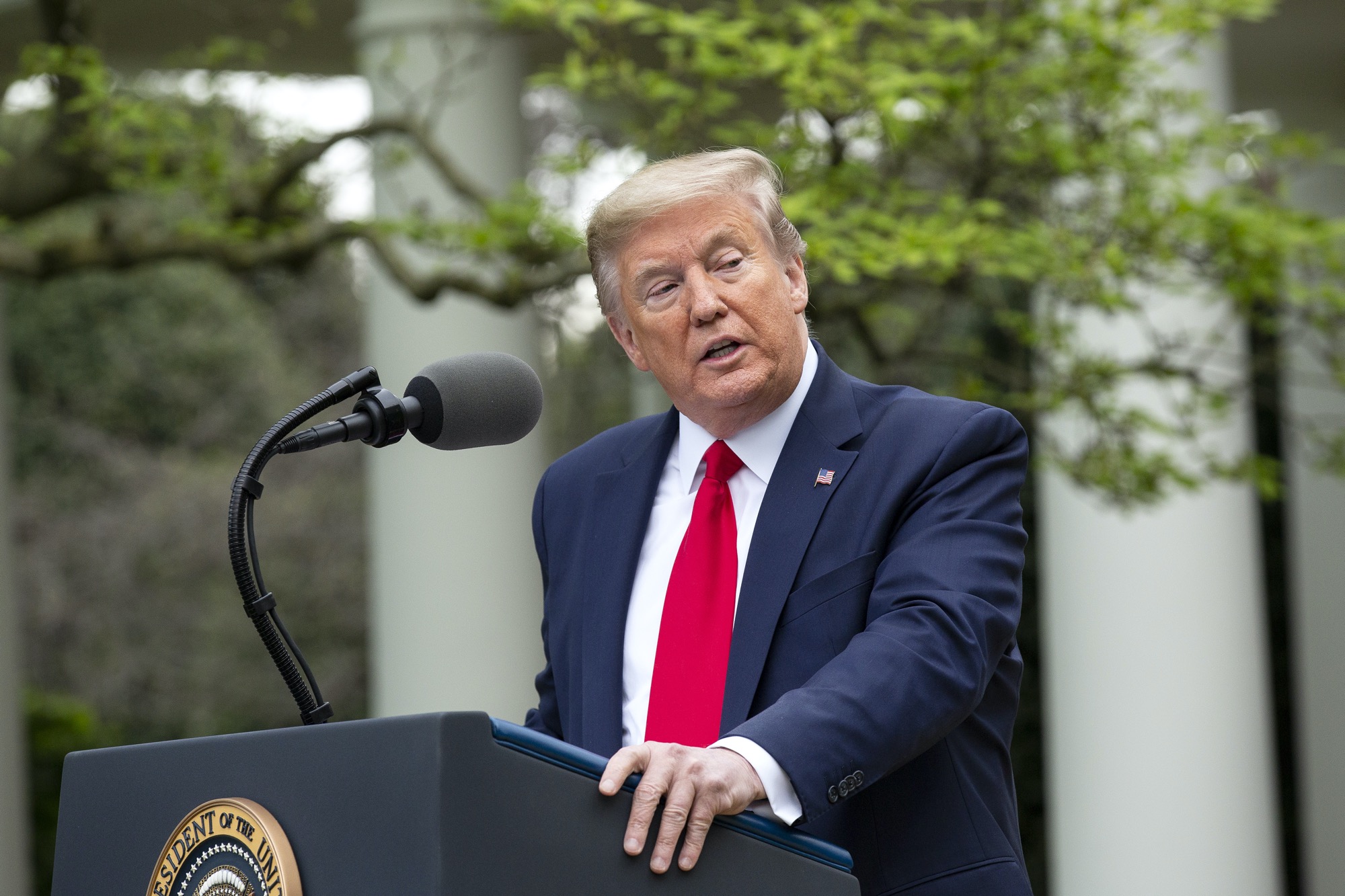
President Trump speaks in front of a podium at the White House's Rose Garden.
Enlarge / President Donald Trump speaks during a news conference in the Rose Garden of the White House on Tuesday, April 14, 2020.

President Donald Trump today said the United States will stop funding the World Health Organization until his administration completes a review of the group’s response to the coronavirus pandemic.

“Today, I am instructing my administration to halt funding of the World Health Organization while a review is conducted to assess the World Health Organization’s role in severely mismanaging and covering up the spread of the coronavirus,” Trump said at a press conference today.

The US gives the WHO $400 million to $500 million per year and “has a duty to insist upon full accountability,” Trump said. Trump said his administration will talk “with other countries and global health partners” about what to do with the US funding that would normally go to the WHO. The US provides about 15 percent of the WHO’s budget. “Administration officials signaled the [funding] suspension would be for 60 days,” according to Bloomberg, which noted that the US has “contributed $893 million to the WHO’s operations during its current two-year funding cycle.”

While “Congressional Democrats say Mr. Trump can’t cut WHO funding on his own,” the “White House budget office has concluded the president has several options to withhold money from the WHO without congressional approval,” such as by “order[ing] agencies to reroute the money to other related purposes,” The Wall Street Journal reported.

Trump argued today that “the outbreak could have been contained at its source with very little death” if the WHO had pushed back against China’s claims. He said:

The WHO failed to investigate credible reports from sources in Wuhan that conflicted directly with the Chinese government’s official accounts. There was credible information to suspect human-to-human transmission in December 2019, which should have spurred the WHO to investigate immediately. Through the middle of January, it parroted and publicly endorsed the idea that there was not human-to-human transmission happening, despite reports and clear evidence to the contrary. The delays the WHO experienced in declaring a public health emergency cost valuable time, tremendous amounts of time.

As The Washington Post wrote today, the WHO “declared a global health emergency [by January 30], after which the president continued to downplay the outbreak and compare it to the flu.” The Trump administration finally recommended social distancing in mid-March.

Trump praised China in January, said virus was under control

Despite claiming the WHO should have known China was lying by mid-January, Trump himself praised China on January 24 for its “transparency.”

“China has been working very hard to contain the Coronavirus,” Trump tweeted at the time. “The United States greatly appreciates their efforts and transparency. It will all work out well. In particular, on behalf of the American People, I want to thank President Xi!”

The United States announced its first confirmed coronavirus case on January 21. On January 22, Trump said “we have it totally under control. It’s one person coming in from China, and we have it under control. It’s going to be just fine.”

But today, Trump said that the WHO in December and January should have “done its job to get medical experts into China to objectively assess the situation on the ground and to call out China’s lack of transparency… this would have saved thousands of lives and avoided worldwide economic damage. Instead, the WHO willingly took China’s assurances at face value and… defended the actions of the Chinese government, even praising China for its so-called transparency.”

Trump says his travel ban saved many lives

Trump further argued that his China travel ban announced on January 31 saved “thousands and thousands” of lives while the WHO was “very much opposed to what we did.”

“The WHO pushed China’s misinformation about the virus, saying it was not communicable and there was no need for travel bans,” Trump said. “They told us when we put on our travel ban, there was no need to do it, don’t do it, they actually fought us.”

A USA Today article said “there is no public record of WHO at any point actively criticizing the US or any other country for deciding to implement a coronavirus-related travel ban” and that the WHO “opposes all travel bans during a pandemic, not just Trump’s.” Health experts say Trump’s travel ban had little effect on the pandemic’s spread. The WHO on January 24 said it “advises against the application of any restrictions of international traffic based on the information currently available on this event.”

Trump today said the pandemic would have been less severe if other countries had imposed travel bans like the US did. “Fortunately, I was not convinced [by the WHO], and I suspended travel from China, saving untold numbers of lives,” Trump said. “Had other nations likewise suspended travel from China, countless more lives would have been saved… the WHO’s attack on travel restrictions put political correctness above life-saving measures.”

According to The Washington Post, 38 countries imposed travel bans before Trump’s took effect on February 2.

“It would have been so easy to be truthful,” Trump said of the WHO, arguing that “the WHO has not addressed a single one of these concerns nor provided a serious explanation that acknowledges its own mistakes, of which there were many.”

As the coronavirus continues to spread throughout the US, states have shut down schools and businesses to limit disease and death. Trump wants to get moving on reopening the economy, claiming yesterday that he has “total” authority to override governors and force states to rescind shutdown orders. But coalitions of governors on the East and West Coasts yesterday announced pacts to follow science, not politics, in their decisions on when to reopen economies.

Trump today said he will speak to all 50 governors and “authorize” each individual governor to “implement a reopening plan of their state at a time and in a manner as is most appropriate.”

https://arstechnica.com/?p=1668441


Charter still hates broadband competition, asks FCC to help prevent it

A Charter Spectrum service vehicle.
Enlarge / A Charter Spectrum vehicle.

Charter Communications is asking the Federal Communications Commission to block government funding for ISPs that want to build networks in parts of New York where Charter is required to offer broadband.

An FCC rule for Phase 1 of the commission’s $20.4 billion Rural Digital Opportunity Fund (RDOF) bans funding in census blocks where at least one ISP has been awarded money from any federal or state broadband-subsidy program “to provide 25/3Mbps or better service,” and it also bans funding in areas that already have home-Internet access at those speeds. But that rule would not prevent ISPs from getting funding to serve parts of New York where Charter is required by the state government to offer service but in which it hasn’t yet finished construction.

Charter on Friday thus petitioned the FCC for a rules waiver that would ban funding in 2,400 census blocks “in which Charter has unfunded but nonetheless binding state obligations to deploy at least 25/3 Mbps broadband service.” Charter, which sells broadband and other cable services under its Spectrum brand name, said it is deploying speeds of at least 300Mbps downstream and 10Mbps upstream, far above the FCC’s 25/3Mbps standard.

“This will ensure scarce universal service support is deployed to close the gap/digital divide in actually unserved areas,” Charter said. “The Commission has previously granted rule waivers where, as here, the purposes of the rule would be disserved by its strict application, and where [a] waiver would affirmatively serve the public interest.”

Charter’s requested waiver would apply to Phase I of the RDOF, which would distribute up to $16 billion of the $20.4 billion. The FCC has said it wants the first phase to “target those areas that current data confirm are wholly unserved.”

The FCC today announced that it is seeking public comment on the Charter petition, which the FCC said would “exclude from eligibility census blocks in New York in which Charter will deploy broadband service to satisfy its commitments to the state.” Initial comments are due on April 21, and reply comments are due on April 28. (See docket.)

Charter clashed with NY over required broadband

Charter has dragged its feet in serving all the required areas of New York. When Charter bought Time Warner Cable in May 2016, it agreed to extend its network to 145,000 unserved and underserved residential housing units and businesses within four years. But the New York State Public Service Commission (PSC) in July 2018 voted to revoke its approval of the merger, saying that Charter repeatedly failed to meet interim deadlines for those broadband expansions.

Charter disputed the allegations but eventually settled with the state, agreeing to finish building out to the 145,000 locations by September 30, 2021, more than a year later than initially required.

In its new petition to the FCC, Charter said that “deployment on these census blocks will be complete by September 2021 (and possibly earlier given that Charter is ahead of its build-out obligations).” That’s before any possible construction resulting from the planned FCC funding, Charter said.

FCC Chairman Ajit Pai at one point was planning to completely exclude New York state from the RDOF, saying New Yorkers were already served by “previously established programs to fund rural broadband.” But after criticism from the state’s representatives in Congress, Pai reversed course and said on January 30 that New York’s eligibility “will be determined by the same neutral principles applicable to other states.”

RDOF Phase 1 funding is scheduled to be awarded in a reverse auction later this year and will be distributed over 10 years to winning ISPs. Nationwide, about 6 million rural homes and businesses are located in areas eligible for funding in Phase 1, but it’s not clear how many of those locations will be funded. The RDOF is the replacement for the Connect America Fund that has been subsidizing rural networks since 2011. Both programs are paid for by Americans through fees imposed on phone bills.

FCC helped Charter avoid competition in 2017

Charter, the second-biggest cable company in the United States after Comcast, prefers to only offer broadband in areas without serious competition. In 2016, Charter CEO Tom Rutledge explained that he doesn’t like to compete against other cable companies in part because the FCC would block mergers of competitors.

If Charter’s new petition is approved, it wouldn’t be the first time the FCC under Pai has helped Charter avoid competition. Before Pai took over, the FCC actually required Charter to compete against other ISPs in exchange for approving the Time Warner Cable deal. Specifically, the Obama-era FCC required Charter to deploy broadband with download speeds of 60Mbps to at least 2 million residential and small business locations, of which at least 1 million would have to be in areas served by at least one other high-speed provider. The FCC’s then-Democratic leadership reasoned that required “overbuilding” in areas served by only one ISP would bring lower prices and greater choice to consumers.

Pai eliminated that requirement shortly after taking over the commission in 2017, letting Charter provide the 2 million new connections entirely in areas that didn’t already have high-speed service.

Disclosure: The Advance/Newhouse Partnership, which owns 13 percent of Charter, is part of Advance Publications. Advance Publications owns Condé Nast, which owns Ars Technica.

https://arstechnica.com/?p=1668290


Amazon fires at least 3 employees who criticized workplace conditions

A worker hauling boxes at an Amazon warehouse in Baltimore, Maryland, on April 14.
Enlarge / A worker hauling boxes at an Amazon warehouse in Baltimore, Maryland, on April 14.

Amazon, which is desperately trying to bulk up staffing amid surges in demand, has reportedly fired another three employees and suspended a fourth after those workers led efforts to speak out against working conditions in the company’s warehouses.

Two workers let go on Friday, Emily Cunningham and Maren Costa, are both tech workers based in Seattle’s headquarters, the Washington Post reports. Both were active in an internal employee group advocating for climate issues and had circulated a petition inside the company calling on Amazon to expand benefits and pay for employees in warehouses. Both also posted tweets in March offering to match donations to a fund set up to support workers at Amazon’s warehouse in Queens.

Another employee, Chris Hayes, was not allowed to finish out his notice period after he resigned from the company in protest of its treatment of warehouse workers, The New York Times reports. He gave notice earlier, saying his last day would be April 17, but last week, after he sent colleagues an invitation to a discussion with warehouse workers, HR told him he was no longer allowed to work.

An Amazon representative told the Post the employees were fired for “repeatedly violating internal policies,” saying, “We support every employee’s right to criticize their employer’s working conditions, but that does not come with blanket immunity against any and all internal policies.”

An employee at a warehouse in Minnesota was also fired last week, according to a BuzzFeed News report today. The employee, Bashir Mohamed, said he had been organizing his coworkers to advocate for better working conditions and a more thorough response to protect against the spread of COVID-19.

Athena, a coalition of almost 50 labor rights, consumer rights, and racial justice organizations, issued a statement blasting Amazon, calling the firings “outrageous and quite likely illegal,” adding, “We expect better of every institution in American life in the midst of this crisis. If Amazon cannot ensure the safety of its facilities and resorts to firing those who speak up, public officials must step in.”

Not the first

The firings all came less than two weeks after Amazon fired employee Chris Smalls, who had been leading organization efforts among workers in the company’s Staten Island warehouse. Amazon strongly denied at the time that the firing was retaliatory, but a few days later, Vice obtained an internal memo from the company that clearly tried to make Smalls the face of the entire worker organization effort and to dismiss him.

“He’s not smart, or articulate, and to the extent the press wants to focus on us versus him, we will be in a much stronger PR position than simply explaining for the umpteenth time how we’re trying to protect workers,” David Zapolsky, Amazon general counsel, wrote in the memo.

“We should spend the first part of our response strongly laying out the case for why the organizer’s conduct was immoral, unacceptable, and arguably illegal, in detail, and only then follow with our usual talking points about worker safety,” Zapolsky went on. “Make him the most interesting part of the story, and if possible make him the face of the entire union/organizing movement.”

New York City Mayor Bill de Blasio on March 31 ordered city officials to investigate Smalls’ firing to determine if Amazon’s action was indeed retaliatory. “If so, that would be a violation of our city’s human rights law and we would act on it immediately,” de Blasio said.

https://arstechnica.com/?p=1668198


Trump claims “total authority” to override governors, force states to reopen

A flag with an illustration of a United States map under lock and key.
Aurich Lawson / Getty

President Donald Trump today falsely claimed he has “total” authority to override governors and force states to reopen their economies despite the ongoing coronavirus pandemic.

Trump faced numerous questions from reporters about his views on federal authority hours after he tweeted that the president, not governors, gets to make the “decision to open up the states.”

“When somebody is the president of the United States, the authority is total and that’s the way it’s got to be. It’s total, and the governors know that,” Trump said in response to one of the questions at a press briefing.

“You have a couple of bands of Democrat governors but they will agree to it,” Trump continued. “The authority of the president of the United States, having to do with the subject we’re talking about [reopening state economies], is total.”

When one reporter pointed out that it was states, not Trump, that made the decisions to close schools and businesses, Trump said, “that’s because I let that happen.”

Several fact-checks pointed out that Trump’s claim of such authority over the states is false. Here’s one from CNBC:

“State and local governments have strong police power to protect their citizens and so I’m unaware of any way in which the federal government could basically try to override anything the states and cities have been doing to protect the public health of their citizens,” said William Buzbee, a professor at Georgetown University Law School and an expert in federalism.

The Centers for Disease Control and Prevention says that “States have police-power functions to protect the health, safety, and welfare of persons within their borders.” Isolation and quarantine orders are among those police-power functions, which are “derived from the right of the state to take action affecting individuals for the benefit of society,” the CDC page on the topic says.

One reporter asked Trump which provision in the Constitution gives the president the power to open or close state economies. Trump answered, “numerous provisions. We’ll give you a legal brief if you want,” but didn’t point to any specific sources of authority.

States follow science, not politics

Today, coalitions of governors on both US coasts announced pacts to follow science, not politics, in decisions on when to reopen economies.

Massachusetts, New York, New Jersey, Connecticut, Pennsylvania, Delaware, and Rhode Island announced a council that will include health experts and economic experts from each of the states. The states “will work together to develop a fully integrated regional framework to gradually lift the states’ stay-at-home orders while minimizing the risk of increased spread of the virus,” they said.

The states will use tools “including testing, contact tracing, treatment, and social distancing” and “rely on the best available scientific, statistical, social and economic information” to evaluate progress, they said.

Similarly, the governors of California, Oregon, and Washington State today announced an agreement that the “region will move toward reopening based on health outcomes.”

“Health outcomes and science—not politics—will guide these decisions,” the governors said in their announcement. They continued:

Modifications to our states’ stay-at-home orders must be made based off our understanding of the total health impacts of COVID-19, including: the direct impact of the disease on our communities; the health impact of measures introduced to control the spread in communities—particularly felt by those already experiencing social disadvantage prior to COVID-19; and our health care systems’ ability to ensure care for those who may become sick with COVID-19 and other conditions. This effort will be guided by data. We need to see a decline in the rate of spread of the virus before large-scale reopening, and we will be working in coordination to identify the best metrics to guide this.

Trump, meanwhile, is forming an “Opening Our Country Council,” which Politico reports is “devoted to reopening the economy as soon as possible.” Trump is expected to announce the council’s members Tuesday, but on Monday, “the White House was still scrambling to fortify its membership, identify its leadership, and even outline the precise purpose of the group,” Politico wrote.

“My administration’s plan and corresponding guidelines will give the American people the confidence they need to begin returning to normal life,” Trump said. “That’s what we want. We want to have our country open, we want to return to normal life. Our country is going to be opened, and it’s going to be successfully opened.”

https://arstechnica.com/?p=1668107


Amazon pauses new grocery signups, hires another 75,000 workers

A smartphone displays the Whole Foods app.
Enlarge / If you’re not already an Amazon or Whole Foods grocery delivery customer, don’t try to sign up now; it won’t work.

As many consumers stay at home, limiting themselves to online shopping only, Amazon—already the default online “everything store” for millions—has been reaping the benefit. But even the massive conglomerate can’t keep up with consumer demand for groceries, home essentials, and everything else. In an attempt to catch up, it is both going on a hiring spree and limiting new customers.

The company said today it will be hiring an additional 75,000 part- and full-time employees for its businesses in the coming weeks to try and meet demand. That’s in addition to the 100,000 new workers the company hired for its warehouses, logistics, and grocery businesses through late March and into the first weeks of April.

The company also said it will allow third-party sellers to resume shipping “non-essential items” through its Amazon fulfillment service later this week, The Wall Street Journal was first to report. Even with up to 175,000 additional people trying to get goods from Amazon to shoppers, though, the company asked for patience from its customers. In addition to warning of delays for orders placed by Prime members, Amazon is now also closing grocery orders to new customers for the time being.

“We are temporarily asking new Amazon Fresh and Whole Foods Market delivery and pickup customers to sign up for an invitation to use online grocery delivery and pickup,” the company said in a blog post Sunday. “We’re increasing capacity each week and will invite new customers to shop every week.”

Amazon has increased Whole Foods online order capacity by more than 60 percent since the beginning of the COVID-19 crisis. The online giant also expects the combination of “restricted capacity due to social distancing” together with increased demand will keep it “challenging for customers” to find open delivery slots.

“If you are able to do so safely,” Amazon concluded, “We kindly encourage our customers who can to shop in-person.”

Employees are not immune

Amazon touted its dedication to “the health and safety of customers and employees” in its announcement limiting grocery orders. For several weeks, however, Amazon employees have been publicly criticizing the company’s response to the threat COVID-19 poses to its own workforce.

Employees at more than 100 Amazon warehouse locations have reportedly tested positive for the COVID-19. Federal officials began an investigation into one Pennsylvania warehouse last week following complaints from workers that the company was not taking the threat of the disease seriously enough.

Small groups of Amazon workers have staged walk-outs and other protests at several of the company’s locations in recent weeks. The company fired the leader of one such protest, Chris Smalls, first saying the termination was unrelated to the organization effort. Later, however, a leaked memo was made public in which Amazon’s general counsel tried to scapegoat Smalls, writing, “He’s not smart, or articulate, and to the extent the press wants to focus on us versus him, we will be in a much stronger PR position than simply explaining for the umpteenth time how we’re trying to protect workers.”

Amazon says it has stepped up its response to the virus, and the company is deploying more masks and gloves to workers. Last week, Amazon said it is launching its own testing program for employees, though it will take time to scale up. Despite these efforts, however, many employees have told media the changes feel like too little, too late.

“Were they slow? Yeah, definitely,” one employee told The Verge. “The only reason they’re doing this stuff is because we blasted them in the media.”

BuzzFeed News also reported over the weekend on “widespread confusion” among Amazon employees who are trying to receive compensation for time they spent quarantined due to COVID-19.

Amazon’s publicly stated policy promises two weeks’ pay for anyone who contracts the virus or is quarantined: “If someone is diagnosed or comes to us who is presumptively diagnosed (but unable to get a test), we are giving them extra paid time off. In addition, we are also contacting people who have been in close contact with a diagnosed individual and giving them time off as well, for 14 days, to stay home with pay.”

That hasn’t proven to be the case, employees told BuzzFeed, with both HR employees and hourly workers unsure when the new policies apply. One told BuzzFeed that trying to get the back pay he is owed requires “jumping through one hoop after another,” adding that he thought the policy was “really just a public relations thing.”

https://arstechnica.com/?p=1667881