French regulator says Google must pay news sites to send them traffic
France’s competition authority says that Google must go back to the bargaining table to negotiate a rate that the search giant will pay to link to articles on French news sites. So far, Google has flatly refused to pay fees to link to news articles, despite a new EU copyright directive designed to force Google to do so.
France was the first country to transpose the EU’s order into national law. Google read the French law as allowing unlicensed use of the headline of a story, but not more than that. So in September, Google removed the “snippet” that often appears below headlines from its French news search results, as well as thumbnail images.
“We don’t accept payment from anyone to be included in search results,” Google wrote in a September blog post. “We sell ads, not search results, and every ad on Google is clearly marked. That’s also why we don’t pay publishers when people click on their links in a search result.”
French news publishers cried foul. The goal of the French law, after all, was to get Google to give them money, not to make their articles less conspicuous in search results. So they complained to the French Competition Authority. In a preliminary order Thursday, the agency said that Google’s new strategy represented a “likely” abuse of its market power.
“Since the European Copyright law came into force in France last year, we have been engaging with publishers to increase our support and investment in news,” Google executive Richard Gingras said in an emailed statement. “We will comply with the FCA’s order while we review it and continue those negotiations.”
The French government wants Google to pay up
Under the ruling, Google must conduct “good faith negotiations” with French news organizations to arrive at a non-zero price for Google to pay to link to their content. Google must begin negotiations with news organizations within three months and send the competition agency monthly reports on its progress.
During negotiations, Google must reinstate snippets in news article search results. Google will be required to retroactively pay news organizations for linking to them, going back to October 2019, at whatever rate is determined in the negotiations. The regulator is also ordering Google not to alter the indexing, classification, or presentation of “protected content”—e.g. French news articles—in its search results.
Thursday’s ruling was a preliminary decision designed to protect French newspapers from Google’s allegedly abusive practices while the competition authority works on its ultimate ruling on the legal merits. Google controls more than 90 percent of the French search market, and the agency says that makes it likely to hold a dominant position. Thursday’s decision held that Google’s recent actions were “difficult to reconcile” with the new French copyright law, which was designed to generate payments from technology platforms to news organizations.
French authorities are trying to avoid the outcome of a similar law passed in Spain back in 2014. That law tried to force Google to pay Spanish news organizations for linking to them, but Google responded by shutting down the Spanish version of Google news. Traffic to Spanish news sites fell as a result, with smaller news publications taking the biggest hit.
The French fight could be a preview of battles in other EU nations, all of which are supposed to pass their own versions of the EU copyright directive, including the controversial provision on linking to news sites.
https://arstechnica.com/?p=1667256
Frontier bungles redaction of network audit that it doesn’t want you to see
Frontier Communications needs a lesson in how to redact documents.
Frontier is trying to hide large portions of an audit report from the public, claiming that details about the ISP’s broadband-network problems are trade secrets. But when Frontier made a redacted version of the report public, many of the blacked-out parts were still readable simply by copying and pasting from the document.
The Frontier-edited version of the 164-page report, which was ordered by the West Virginia Public Service Commission (PSC) and written by a consultant firm, includes about 80 redacted exhibits and many pages that have been fully or partially blacked out. Frontier seems to have successfully redacted the exhibits, including many charts, but the blacked-out text is easy to lift. (Update: It turns out some of the exhibits weren’t properly redacted, either.)
For example, one redacted sentence says that “Frontier WV’s copper network has at least 952,163 connection points that are susceptible to moisture, corrosion, loose connections, etc. that may cause interruptions of service to customers.” That “952,163” number was blacked out, but it’s still readable if you copy it from the document. We’ve uploaded the document to our server in case it gets taken down from the PSC website—you can view it here.
Describing the connection points, the report says, “Any electrically connected circuit has numerous points where connections are made. As systems and networks age, all of the connection points have the potential to cause service interruptions.” The 952,163 connection points include 376,897 overhead splices, 444,898 terminals, 4,508 crossboxes, and 125,865 pedestals. Copper networks were originally deployed with “a minimal number of splices,” but “later, splices have to be added as repairs are made,” the audit report said. “No installation date data was available for splices.”
Oops
The failed redaction of the number of connection points was coupled with failed redactions about the age of the network. The consultant firm’s report said that 46.8 percent of Frontier’s West Virginia network is between 36 and 47 years old. Both the percentage and the numbers of years were unsuccessfully “redacted” by Frontier.
Other unsuccessfully redacted information includes the number of customers and the number of miles of copper in the network. “Frontier WV has to operate and maintain a 49,402.1-mile copper cable network currently serving 309,088 customers that was originally constructed to serve over 2 million [customers],” the report said. Frontier’s fiber network in West Virginia is tiny by comparison, with just 8,077 miles of fiber-optic cable. Another “redacted” portion says the fiber “provides digital capability to portions of the copper network.”
Here’s what all that information looks like in the report:
Schumaker & Company audit report
Another redacted portion shows that Frontier repeatedly failed to meet a service-quality benchmark that 85 percent of outages should be fixed within 48 hours. The data shows that “Frontier West Virginia missed the metric 21 of the 60 months [from 2015 to 2019], with 14 of those months falling in the past 24 months.” While Frontier uses a 48-hour benchmark internally, state regulations say that outages should be fixed within 24 hours of customers reporting them, the report said.
It’s hard to imagine why Frontier redacted the number of customers, because it was already publicly known that the company had about 300,000 customers in the state. In another “redacted” portion, the audit report says that 175,131 of those customers subscribe to DSL Internet service. Many customers either buy phone service by itself or a bundle with phone and Internet, but Frontier’s customer base has dwindled over the years.
Other “redaction” decisions make even less sense. One completely blacked-out paragraph merely states the Federal Communications Commission’s broadband-speed standard of 25Mbps downstream and 3Mbps upstream, and it quotes from an FCC report that said 93.5 percent of the United States has broadband access, compared to 84.6 percent in West Virginia. That FCC report is publicly available, yet Frontier wants quotes from the report to be treated as a Frontier trade secret.
Regulator ordered report
The West Virginia PSC previously ordered the third-party audit of Frontier’s operations in the state in response to widespread outages and complaints from customers and a labor union. The resulting audit report was submitted on March 18 by consultancy Schumaker and Company, but the completely un-redacted version is under seal for now.
Frontier on March 25 made its redacted version of the report public and filed a motion seeking confidential treatment of the redacted details. “The redactions primarily are of information that, if known to competitors, would provide them with key competitive insights into Frontier’s business and, conversely, would place Frontier at an undeserved competitive disadvantage, likely resulting in harm to Frontier,” the company told the PSC.
The PSC is considering calls to make an un-redacted version public. West Virginia Public Broadcasting reporter Emily Allen filed a Freedom of Information Act (FoIA) request for the full, un-redacted report, and the PSC’s staff urged the commission to reject many of Frontier’s redactions.
PSC staff wrote:
[I]nformation regarding Internet service is West Virginia-specific and does not mention any other areas in the nation where Frontier is offering services, so it is hard to contemplate how the information regarding Internet service, including federal programs which provide federal funding sources for the provisioning of broadband services and are readily available to other telecommunications providers, would pose any threat to a trade secret essential to Frontier’s operations.
The PSC requested that Frontier file a response to Allen’s FoIA request, and Frontier’s response came in yesterday. Frontier told the PSC that it operates “in a hotly competitive industry where it enjoys no protected service territory and no guaranteed rate of return whatsoever” and said it would be “damage[d]… by the release of its competitively sensitive information.” Frontier claimed that the “redacted information is limited to trade secrets and other protected information that is truly exempt from disclosure under FOIA.” Frontier also said:
In part, the redacted information includes nonpublic information about Frontier’s broadband business—over which the Commission explicitly has no jurisdiction under state law. This information was included in the report over Frontier’s objection and has no bearing on the eight explicit areas the Commission directed the Auditors to examine regarding Frontier’s voice telephone service—the subject over which the Commission has jurisdiction to conduct a focused audit. Releasing this information would only serve to harm the Frontier to the benefit of its huge wireless, satellite and cable broadband competitors.
As we previously reported, Frontier is preparing to file for bankruptcy after years of failing to invest properly in upgrading its copper-based DSL network to fiber broadband. The company’s poor maintenance of its copper phone and broadband network has led to investigations and complaints of chronic outages in New York, Minnesota, Ohio, and West Virginia.
When the Minnesota Commerce Department finished its investigation into Frontier’s extensive failures last year, the resulting report was not redacted. It accused Frontier of violating more than 35 laws and rules. Frontier eventually settled with Minnesota.
Report shows problems, despite redactions
Despite Frontier’s extensive redactions to exhibits, the West Virginia report still offers details about the company’s customer-service problems. Schumaker reported “negative trends” in six service metrics, namely outages, service problems, repair answer times, repair troubles, repair appointments met, and residential and business answer times. Unfortunately for subscribers, “Frontier does not provide customers credit in situations where the same trouble for the same service are reported on the same line within 30 days.”
Frontier’s maintenance processes are lacking, the audit report said. “Frontier WV does not have a documented process for performing preventative and corrective maintenance,” and the company “does not have a documented tree trimming policy and process.”
“Frontier has not had a pole inspection program that detects poles that do not meet strength requirements for a number of years,” the report said. “This lack of knowledge about the condition of the pole population may have created a significant backlog of poles that need to be replaced.”
Frontier has “no standardized procedure/process to be followed when determining root causes for the poor performance of any given wire center,” the report said. Schumaker also pointed out that Frontier “does not have a computer system or management process for performing preventative maintenance” but said the company was “in the process” of setting that system up while the investigation was ongoing.
“Overall capital expenditures have declined over the past nine years by 25 percent, from $65.9 million in 2010 to $49.4 million in 2018,” the report said in another portion that Frontier tried and failed to redact.
“Plant-specific operations expenses” are listed in the report without attempted redactions, with the annual amount steadily dropping in recent years, from $165.3 million in 2012 to $120.5 million in 2018.
Complaints to the PSC about Frontier service have been rising, from about 30 formal complaints in 2015 to almost 90 in 2019. Informal complaints rose from less than 600 in 2015 to more than 1,200 in 2018, before dropping to a little more than 1,000 in 2019.
Enlarge/ Informal complaints made about Frontier service by year.
Schumaker & Company audit report
More than 775 members of the public submitted comments for the state’s investigation of Frontier, Schumaker wrote:
Over half (51 percent) of the comments were related to DSL service, telephone service represented 29 percent and problems with both services were noted in 20 percent of the comments. Regarding the details of the comments, the vast majority of the DSL comments were complaints on the slow speed of Frontier’s service and delays in getting the service repaired. The major complaint with respect to the telephone service centered on out-of-service and the poor quality of the voice service (static on line).
In addition to blacking out huge parts of the report, Frontier said it objects “to certain findings and recommendations” and that it intends to “correct various factual errors and inaccuracies throughout the Audit Report.” Frontier has until April 20 to provide a full response to the findings.
https://arstechnica.com/?p=1667192
Trump administration pulls funding for drive-through COVID-19 testing
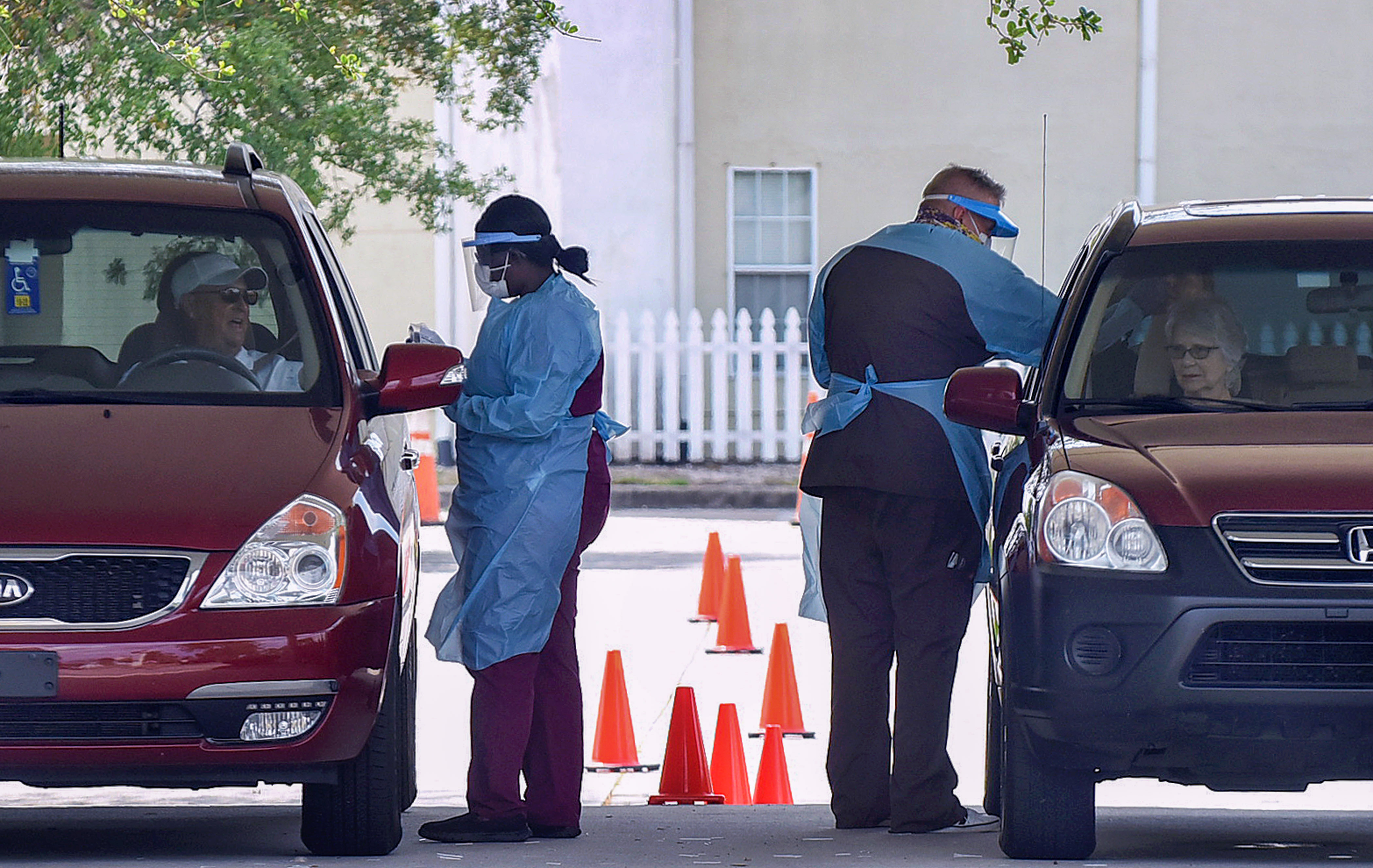
Enlarge/ A drive-through COVID-19 testing site operated by Omni Healthcare in Melbourne, Fla. on April 8.
One of the biggest challenges hampering US institutional response to the COVID-19 crisis is testing: when you can’t identify who has the disease, you can’t tell who might transmit it, or where they might do so. After critical months of delay, the US finally ramped up testing, but now, just as experts forecast many states are heading into the peak of this emergency, the federal government is ending funding for some successful testing programs.
The feds will stop covering the tab for most community testing sites as of Friday (tomorrow), April 10, NPR reports.
These popular drive-through sites have helped bolster other testing efforts in counties, towns, and cities nationwide. NPR spoke with officials in Pennsylvania’s Montgomery County who said their drive-through site has tested at least 250 individuals per day since opening on March 21. By the time it closes Friday due to lack of funding, officials said, more than 5,000 tests will have been performed at that site.
The funding program originally included 41 testing sites nationwide, representatives with FEMA and the Department of Health and Human Services told NPR. Some, such as the site in Montgomery County, as well as in nearby Philadelphia, will close when the money dries up. Others will be “transitioning to state-managed sites,” HHS told NPR. While many of those locations will close or change hands, however, local media in Texas report that two Dallas locations have received extended funding through May 30.
The spokesperson framed the withdrawal of funding as allowing states to dictate their own priorities, telling NPR, “The transition will ensure each state has the flexibility and autonomy to manage and operate testing sites within the needs of their specific community and to prioritize resources where they are needed the most.”
Behind the curve
The US finally developed capacity to start testing individuals at scale for the novel coronavirus in late March. By March 20, about 100,000 tests per day were being performed nationwide. But rather than continuing that exponential growth from the beginning of March, by April 1 it seemed testing had just about stalled out at that level of 100,000 tests per day.
According to data assembled by the COVID tracking project, that number has increased only very slightly in the past week, with about 140,000 new tests now reported each day. (One outlier, April 4, had about 227,000 new tests.) About 2.2 million cumulative COVID-19 tests have now been performed in the US, according to the tracking project.
Hospitals and private laboratories have been ramping up testing as quickly as they are able, but the number of daily tests needed still dwarfs the number being performed in many areas. The lack of available tests has led some doctors to use CT scans in their stead, Bloomberg News reported today, although the replacement “isn’t ideal.”
Not only can tests be hard to come by, but results can also take more than a week to come back. “At that point,” a radiologist in Georgia told Bloomberg, “a test that’s essentially not available is worthless.”
On Wednesday, HHS announced that licensed pharmacists will now be able to perform COVID-19 testing to help fill the gap.
“Giving pharmacists the authorization to order and administer COVID-19 tests to their patients means easier access to testing for Americans who need it,” Health and Human Services Secretary Alex Azar said in a statement, adding that the “Trump Administration is pleased to give pharmacists the chance to play a bigger role” in this crisis.
https://arstechnica.com/?p=1667096
US Senate tells members not to use Zoom
The US Senate has become the latest organization to tell its members not to use Zoom because of concerns about data security on the video conferencing platform that has boomed in popularity during the coronavirus crisis.
The Senate sergeant at arms has warned all senators against using the service, according to three people briefed on the advice.
One person who had seen the Senate warning said it told each senator’s office to find an alternative platform to use for remote working while many parts of the US remain in lockdown. But the person added it had stopped short of officially banning the company’s products.
Zoom is battling to stem a public and regulatory backlash over lax privacy practices and rising harassment on the platform that has sent its stock plummeting. The company’s shares have fallen more than 25 per cent from highs just two weeks ago, to trade at $118.91.
Zoom was forced to apologize publicly last week for making misleading statements about the strength of its encryption technology, which is intended to stop outside parties from seeing users’ data.
The company also admitted to “mistakenly” routing user data through China over the past month to cope with a dramatic rise in traffic. Zoom has two servers and a 700-strong research and development arm in China. It had stated that users’ meeting information would stay in the country in which it originated.
The revelations triggered complaints from US senators, several of whom urged the Federal Trade Commission to investigate whether the company had broken consumer protection laws. It also prompted the Taiwanese government to ban Zoom for official business.
The FBI warned last month that it had received reports that teleconferences were being hacked by people sharing pornographic messages or using abusive language — a practice that has become known as “Zoombombing.”
A spokesperson for the company said: “Zoom is working around-the-clock to ensure that universities, schools, and other businesses around the world can stay connected and operational during this pandemic, and we take user privacy, security and trust extremely seriously.
“We appreciate the outreach we have received on these issues from various elected officials and look forward to engaging with them.”
However, the US Department of Homeland Security said in a memo to government cyber security officials that the company was actively responding to concerns and understood how grave they were, according to Reuters. The Pentagon told the Financial Times it would continue to allow its personnel to use Zoom.
The Senate move follows similar decisions by companies including Google, which last week decided to stop employees from downloading the app for work.
“Recently, our security team informed employees using Zoom Desktop Client that it will no longer run on corporate computers as it does not meet our security standards for apps used by our employees,” Jose Castaneda, a Google spokesperson, said. However, he added that employees wanting to use Zoom to stay in touch with family and friends on their mobiles or via a web browser could do so.
The Google decision was first reported by BuzzFeed.
Zoom has tried to stem the tide of criticism in recent days. The company said on Wednesday it had hired Alex Stamos, the former Facebook security chief, as an outside security consultant, days after saying it would redirect its engineering resources to tackle security and privacy issues.
Zoom brings in former Facebook security head amid lawsuits, investigations
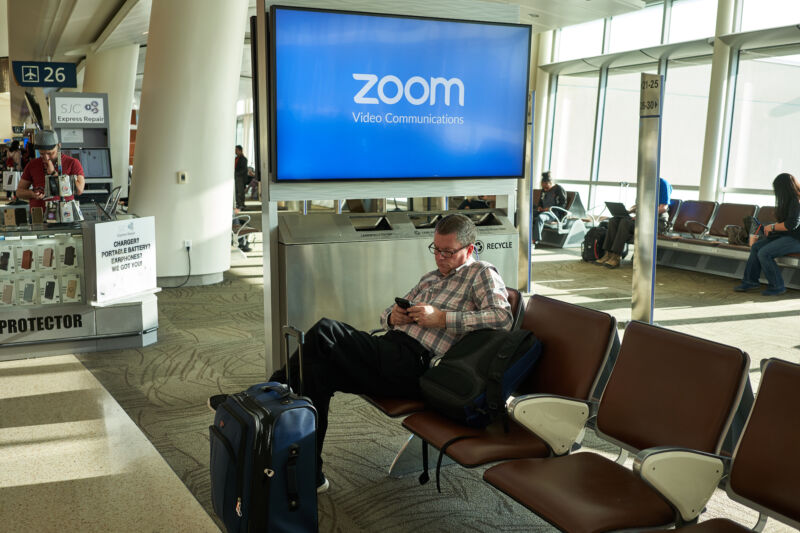
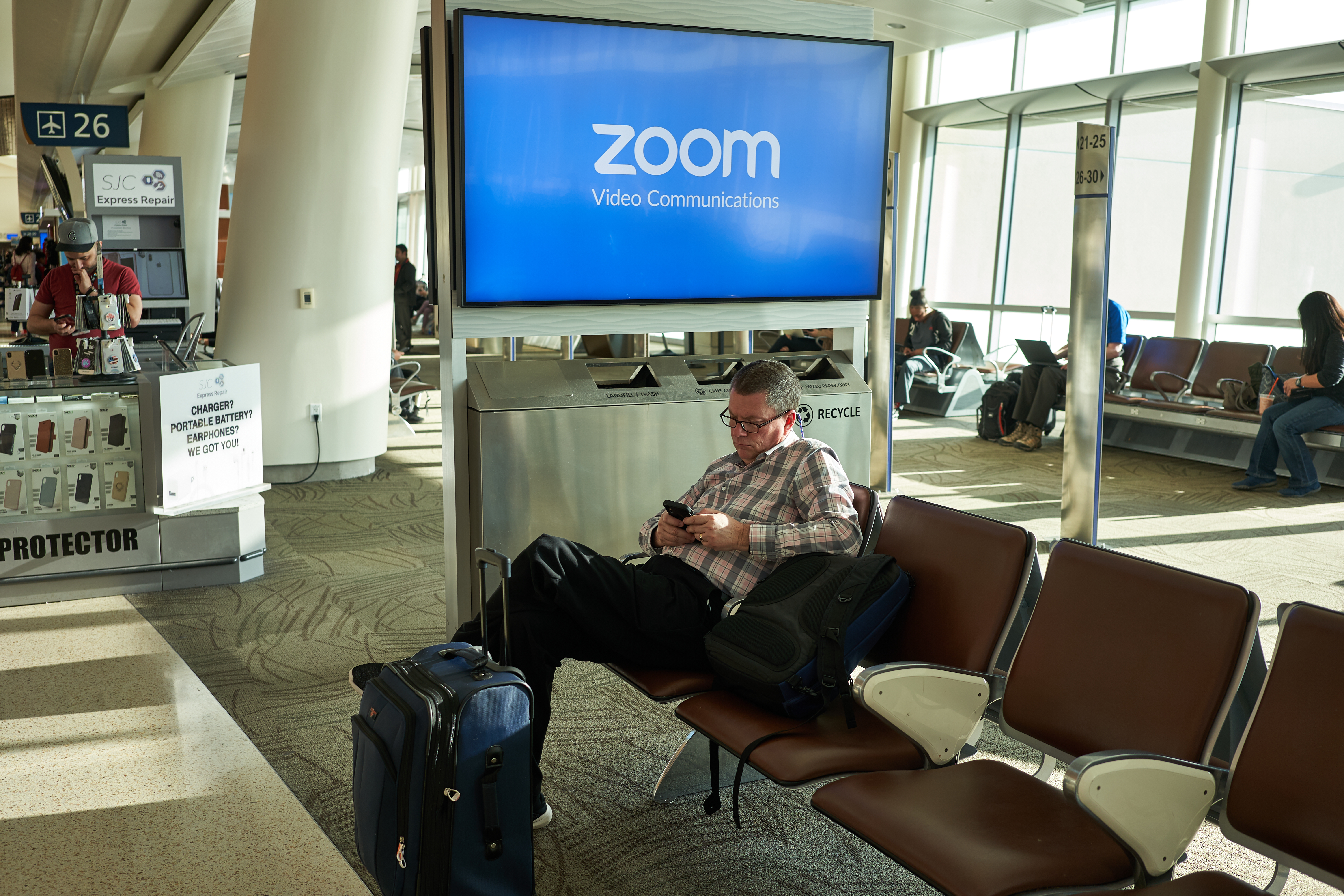
Enlarge/ Security and privacy protip: Don’t do your videoconference in the middle of an airport.
Zoom’s meteoric rise to prominence as the go-to teleconference tool of the COVID-19 pandemic has shined a spotlight on every single design flaw, privacy issue, or vulnerability the platform has. Now, the company is scrambling to react to problems while investigations and lawsuits mount.
The company is already facing lawsuits from consumers, but now investors have joined the fray. A shareholder filed a class-action suit (PDF) yesterday in federal court in California, alleging that Zoom violated securities law by covering up known problems with its product.
Publicly traded businesses are required by federal law to disclose issues or events that could materially affect their stock price so that investors can make informed decisions. Basically any time you hear of some catastrophe at a company—for example, Equifax’s disastrous 2017 data breach—there’s a shareholder suit right after from investors who are angry that they received no warning their shares were about to plummet in value.
The suit against Zoom alleges that the company made “false and misleading statements” to investors and should have known what was going to hit the fan eventually. “The truth about the deficiencies in Zoom’s software encryption began to come to light as early as July 2019,” the complaint reads. “However, due in large part to the company’s obfuscation, it was not until the COVID-19 pandemic in March and April of 2020, with businesses and other organizations increasingly relying on Zoom… that the truth was more fully laid bare in a series of corrective disclosures.”
Those “corrective” actions followed media reports highlighting, among other things, holes in Zoom’s privacy policy, the sharing of user data with Facebook, the mining and sharing of users’ LinkedIn data, and a feature that unintentionally exposed individuals’ contact information to complete strangers. Zoom also claimed to have end-to-end encryption on its data, only for that claim to be proven false, and it had vulnerabilities that could allow attackers to steal users’ Windows credentials with no warning.
Above and beyond all that, however, Zoom drew the most negative attention for default settings that allowed for rampant “zoombombing,” resulting in countless cases of meetings—particularly classes of schoolchildren—being interrupted by harassment. In some cases, the intruders spewed racist or neo-Nazi invective, while in other cases they exposed themselves or displayed pornographic material.
Many states, counties, and cities, including New York, have put the kibosh on educators using Zoom for classroom purposes, to the dismay of many parents and teachers who find the platform easier to use than rivals like Microsoft Teams. (Not a day in two weeks has gone by without someone starting a new thread to complain about the latter in the local PTA group I am a member of.)
Zoom has now changed many of those defaults (and you can check your own settings right now to prevent it happening to your next online meeting). But that, too, is just part of the everyday crisis mode Zoom now operates in, CEO Eric Yuan said in an interview with NBC News.
“You know, lesson learned,” Yuan told NBC. “We’ve got to double down on privacy, double down on security.”
To that end, Alex Stamos, formerly the chief security officer at Facebook, said today he’s now doing consulting work with the company. “I’m certain that the real challenge, one faced by every company trying to provide for the diverse needs of millions seeking low-friction collaboration, is how to empower one’s customers without empowering those who wish to abuse them,” Stamos wrote in a blog post. “I encourage the entire industry to use this moment to reflect on their own security practices and have honest conversations about things we could all be doing better.”
https://arstechnica.com/?p=1666788
University libraries offer online “lending” of scanned in-copyright books
Sethanan Saengsawang / EyeEm / Getty
The coronavirus crisis has forced the closure of libraries around the world, depriving the public of access to millions of printed books. Books old enough to be in the public domain may be available for free download online. Many recent books are available to borrow in e-book form. But there are many other books—especially those published in the mid-to-late 20th century—that are hard to access without going to a physical library.
A consortium of university libraries called HathiTrust recently announced a solution to this problem, called the Emergency Temporary Access Service. It allows participating HathiTrust member libraries to offer their patrons digital scans of books that they can “check out” and read online.
HathiTrust has a history of pushing the boundaries of copyright. It was the defendant in a landmark 2014 ruling that established the legality of library book scanning. At the time, HathiTrust was only allowing people with print disabilities to access the full text of scanned books. Now HathiTrust is expanding access to more people—though still with significant limits.
The program is only available to patrons of member libraries like the Cornell library. Libraries can only “lend” as many copies of the book as it has physical copies on its shelves. Loans last for an hour and are automatically renewed if a patron is still viewing a book at the hour’s end. If you want to read a book that’s currently in use by another patron, you have to wait until they’re finished.
These limits distinguish HathiTrust’s service from another recently announced “emergency library.” Two weeks ago, the Internet Archive announced it was offering the general public the opportunity to check out 1.4 million scanned books. During the pandemic, the Internet Archive isn’t limiting the number of people who can “borrow” a book simultaneously.
Cornell University legal scholar James Grimmelmann tells Ars that the limits on the HathiTrust program will put the group in a stronger position if it is ever challenged in court. The same fair use doctrine that allows HathiTrust to scan books in the first place might also justify what the organization is doing now—though that’s far from certain.
A key factor in fair use analysis is the effect of a new use on the market for the original work. HathiTrust can argue that its lending program will have minimal impact on the market for new books because it is merely giving existing patrons access to the same books they could access before the pandemic struck.
“The HathiTrust member libraries all had paper copies. Those copies could circulate freely within the university community in person. The pandemic has closed the physical campuses,” Grimmelmann wrote in an email to Ars. “The ETAS mimics physical circulation in many important ways: distribution is limited to the university community, only one patron has access at a time, there is no easy way to make and keep copies of whole books, and the program ends when the pandemic ends and physical access is restored.”
The result, Grimmelmann argues, is a “close nexus” between the access patrons enjoyed before the pandemic and the access they enjoy now. That might cause the courts to look favorably on HathiTrust’s approach.
Authors and publishers reacted with fury to the Internet Archive’s unlimited online lending program. And prior to the pandemic, leading authors’ groups weren’t happy about “controlled digital lending” programs that tried to duplicate the effects of physical lending in the online realm. But while the legality of HathiTrust’s emergency lending program is an open question, copyright holders may be reluctant to challenge it in court now. Not only would filing a lawsuit in the middle of a pandemic risk a public backlash, but there’s also a risk that they could lose, legitimizing controlled digital lending in the process.
https://arstechnica.com/?p=1666117
Zoombombing is a crime, not a prank, prosecutors warn
Charlotte Nation / Getty
Coronavirus-related social distancing measures have given a big popularity boost to Zoom, a video conferencing platform that’s known for its ease of use but not necessarily strong security or privacy protections. Internet trolls and other troublemakers have responded with “Zoombombing”: joining Zoom meetings uninvited and disrupting them. Zoombombers have exposed themselves to schoolchildren and shouted racial slurs.
In a Friday statement, federal prosecutors in Michigan warned the public that Zoombombing isn’t a harmless prank; it’s a crime.
“Hackers are disrupting conferences and online classrooms with pornographic and/or hate images and threatening language,” wrote the US Attorney’s Office for the Eastern District of Michigan. “Anyone who hacks into a teleconference can be charged with state or federal crimes.”
Possible charges include “disrupting a public meeting, computer intrusion, using a computer to commit a crime, hate crimes, fraud, or transmitting threatening communications,” the prosecutors warn. All of these charges come with the potential for fines and jail time, the authorities say.
The exact charges a Zoombomber faces would presumably depend on how they gained access to a Zoom meeting and what they did to disrupt it. For example, some Zoom meetings are advertised publicly, which might make it hard to make a computer intrusion charge stick. But someone could still be prosecuted for things they said or did to disrupt the meeting after joining it.
“You think Zoombombing is funny? Let’s see how funny it is after you get arrested,” Michigan US attorney Matthew Schneider said in Friday’s release. “If you interfere with a teleconference or public meeting in Michigan, you could have federal, state, or local law enforcement knocking at your door.”
In a recent story, Ars Technica security reporter Dan Goodin explained how Zoom users can protect themselves from Zoombombing attacks. He noted that meetings can be password-protected, and he advised against announcing login information on social media or other public channels.
Goodin notes that hosts can disable Zoom’s “Join Before Host” setting to ensure that the host is in control of a meeting from the outset. Zoom also has a “waiting room” feature, allowing a host to verify participants before allowing them to join the meeting.
https://arstechnica.com/?p=1665930
“We hit 3M hard“—Trump orders 3M to keep US-made masks in the US
pengpeng/Getty Images
Minnesota manufacturing giant 3M warned Friday that a Trump administration order reserving US-made N95 masks for the US market could backfire. Demand for these masks, also known as respirators, has surged in recent weeks because they help protect health care workers from contracting COVID-19.
“Ceasing all export of respirators produced in the United States would likely cause other countries to retaliate and do the same,” a 3M statement warned. “If that were to occur, the net number of respirators being made available to the United States would actually decrease.”
The statement was a response to President Trump’s Thursday decision to invoke the Defense Production Act against 3M. The 1950 law gives the president broad powers to order US companies to devote manufacturing capacity to products that are essential to national defense.
Trump invoked the law last week to order GM to manufacture ventilators. (GM was already planning to do so, but Trump said it was “wasting time” in negotiations over a federal contract.) He invoked the law again on Thursday to help several other manufacturers to “secure the supplies they need to build ventilators.”
Also on Thursday, the president invoked the law to require 3M to reserve all US-made N95 masks for the US market—a move that would hurt 3M customers in Canada and Latin America.
“We hit 3M hard today after seeing what they were doing with their Masks,” Trump tweeted on Thursday evening. “‘P Act’ all the way. Big surprise to many in government as to what they were doing – will have a big price to pay!”
“It would be a mistake”
Trump’s move prompted a sharp response from Canadian Prime Minister Justin Trudeau, who said it would be a “mistake” for the US to cut off shipments of medical supplies to America’s neighbor and closest ally. He pointed out that goods flow in both directions across the US-Canadian border.
“It would be a mistake to create blockages or reduce the amount of back-and-forth trade of essential goods and services, including medical goods, across our border,” Trudeau said.
A lot of N95 mask manufacturing—including 3M manufacturing—occurs overseas. 3M, for example, produces many of its N95 masks in Singapore, the Financial Timesreports. One of the reasons for tension between 3M and the White House is that 3M resisted US demands to divert 10 million masks from Singapore to the United States. These masks would otherwise go to nearby Asian markets.
“The company was reluctant to accept the White House request on legal and humanitarian grounds, as medical workers across the region would be deprived of protection,” a source told the Financial Times. “3M executives did commit to exporting a similar number of masks to the US from a plant in China but that did not stop the White House from publicly attacking the company.”
“Over the last several days we’ve had some issues making sure that all of the production that 3M does around the world, enough of it is coming back here to the right places,” White House trade advisor Peter Navarro said on Thursday.
https://arstechnica.com/?p=1665685
Google knows if everyone in your county is actually staying home or not
Enlarge/ The reports are all public, but the nifty magnifying glass effect is not actually included.
The entire world is scrambling to mitigate the novel coronavirus pandemic. By now, a majority of US states are under some kind of stay-at-home order, with governors nationwide asking or requiring non-essential businesses to close and everyone to plant their butts at home as much as possible.
As the disease continues to march its way across the country and the globe, though—as of this writing, there have been more than 250,000 US diagnosed cases—officials, regulators, and we the work-from-home masses are all wondering: are we all actually complying with these new rules, or is it still chaos on the streets out there somewhere?
Google has unfathomable reams of data from billions of individuals worldwide, and it has pulled some of that location information together into community mobility reports to try to answer that question. Here’s the good news: by and large, trips to virtually everywhere that isn’t “home” have dropped a whole lot.
To make the reports, Google used location data from any account that has opted into allowing Google to store location history. The company’s services have billions of active daily users, so even if only a minority of users allowed location use, it would still create an enormous data set. Google broke down locations into six broad categories: Retail and recreation, such as malls, restaurants, and museums; grocery and pharmacy, which includes farmer’s markets and food warehouses along with supermarkets and drugstores; parks, including local, national, and state parks; transit stations; workplaces; and residential.
The reports, which so far go through March 29 (last Sunday), are broken down by country. For the United States, Google has also provided state-level reports which show data at the county level. While there’s a fair amount of variation, the trend across the board shows a huge drop in non-essential travel and significantly reduced travel in the grocery and pharmacy category as well. The “residential” category is also up across the board, showing that people are staying home.
The regional reports are more robust for urban centers than rural ones, simply because more densely populated areas have more data for Google to draw from. For example, Kings County, New York—better known as the borough of Brooklyn—has a population of about 2.5 million packed into its borders. That’s a large enough data set for Google, which found that Brooklyn residents are indeed making significantly fewer trips through transit stations and to retailers. Travel to workplaces is also down, likely due to a combination of people working from home where possible and being laid off or furloughed where not.
Enlarge/ Travel inside New York City began to plummet after March 8, which was the day Governor Andrew Cuomo announced more than 100 confirmed cases of COVID-19 in the state.
The only real wildcard is the “parks” category, which has no consistent pattern across states and counties. Park visits are up by 27 percent in Mississippi, for example, and up by 19 percent in neighboring Alabama, to the east—but down by 18 percent in Louisiana to the west, and almost flat, with only a 2 percent decline, in nearby Georgia.
Outdoor time of course might be a location-specific phenomenon, as lousy weather is going to keep people indoors and nice weather will bring them outside—which is becoming its own problem. Time outdoors every day is strongly encouraged for your exercise and mental health during this time, and people are all going for more walks, jogs, and bike rides. But people, home from work and school, have been flocking all at once to many parks, trails, and beaches, which creates crowds and defeats the purpose of social distancing. Many jurisdictions are consequently closing parks, which will no doubt affect the data going forward.
Even in all the noise, there are some hopeful signs in the data that people are listening. For all the wholly justified concern about spring break travelers and slow-to-act leadership in places like Florida, for example, travel to parks is down by 77 percent from the norm in Florida’s Miami-Dade county.
“These are unprecedented times and we will continue to evaluate these reports as we get feedback from public health officials, civil society groups, local governments and the community at large,” Google executives wrote in a blog post. “We hope these insights will add to other public health information that will help people and communities stay healthy and safe.”
https://arstechnica.com/?p=1665547
US edits National Stockpile website after Kushner claims it’s not for states
Enlarge/ President Donald Trump speaks as Jared Kushner, senior White House adviser, listens during a Coronavirus Task Force news conference at the White House on Thursday, April 2, 2020.
Getty Images | Bloomberg
The Trump administration changed the Strategic National Stockpile website’s description of the program yesterday after White House adviser Jared Kushner falsely claimed that the medical-supply stockpile is not meant to be used to help states. The description was changed to minimize the stockpile’s role in helping states through crises like the current pandemic, but other portions of the official website still make it clear that Kushner was wrong.
After Jared Kushner’s comment about how the Strategic National Stockpile is not supposed to be for states, lots of people pointed to the fact that its own website says it is.
Kushner, President Trump’s son-in-law, claimed in a news conference Thursday that “the notion of the federal stockpile was it’s supposed to be our stockpile, it’s not supposed to be state stockpiles that they then use.” Kushner made the remark while discussing ventilators and masks. (See transcript.)
Kushner acknowledged that the federal government is giving ventilators and other equipment to states, even though he argued that the stockpile isn’t meant to be used by states. But the Strategic National Stockpile website homepage, maintained by the US Department of Health and Human Services (HHS), previously made it clear that the stockpile is for the entire country. Before Kushner’s remarks, the page said:
Strategic National Stockpile is the nation’s largest supply of life-saving pharmaceuticals and medical supplies for use in a public health emergency severe enough to cause local supplies to run out.
When state, local, tribal, and territorial responders request federal assistance to support their response efforts, the stockpile ensures that the right medicines and supplies get to those who need them most during an emergency.
All of that text, which you can see in an Internet Archive snapshot of the page from earlier today, was deleted sometime today after Kushner faced criticism for making the false claim. The new version of the page provides a vaguer description and stresses that states have their own stockpiles:
The Strategic National Stockpile’s role is to supplement state and local supplies during public health emergencies. Many states have products stockpiled, as well. The supplies, medicines, and devices for life-saving care contained in the stockpile can be used as a short-term stopgap buffer when the immediate supply of adequate amounts of these materials may not be immediately available.
Stockpile is used to “resupply state… agencies”
If the goal was to completely remove all traces of the stockpile’s role in helping states, the effort was not thorough enough. An “About the Stockpile” link on the homepage still leads to a fuller description that says it is supposed to “resupply state and local public health agencies in a catastrophic health event.”
When contacted by Ars, the HHS said the website change was in the works for a week, even though it was just deployed today.
“This is language we have been using in responding to inquiries for weeks now,” an HHS spokesperson told Ars. “ASPR [Office of the Assistant Secretary for Preparedness and Response] first began working to update the website text a week ago to more clearly explain to state and local agencies and members of the public the role of the SNS [Strategic National Stockpile].”
According to Politico, “A White House spokesperson had no comment when asked whether the White House ordered the change to the stockpile’s webpage.”
Kushner: States are asking for too much
At yesterday’s press conference, Kushner said the federal government uses “a simple formula” based on utilization-percentage data submitted by states to determine where to send ventilators.
Kushner said that “all over the country, a lot of people are asking for things that they don’t necessarily need at the moment,” and he urged reporters to be skeptical of states’ claims that the federal government isn’t providing enough ventilators and other medical supplies:
I would just encourage you, when you have governors saying that the federal government hasn’t given them what they need, I would just urge you to ask them, “well have you looked within your state to make sure that you haven’t been able to find the resources.”
Originally known as the National Pharmaceutical Stockpile, the stockpile was created in 1999 “to assemble large quantities of essential medical supplies that could be delivered to states and communities during an emergency within 12 hours of the federal decision to use the stockpile,” another federal webpage says.
That webpage lists numerous instances of the stockpile being deployed over the past 20 years to respond to natural disasters and public-health emergencies. The page had already been updated for the current pandemic, saying that as of March 31, “More than 10,308 tons of cargo [has been] shipped to support US repatriation efforts and state PPE [personal protective equipment] needs” related to COVID-19.
Trump said at yesterday’s press conference that the national stockpile has almost 10,000 ventilators. “The states should have been building their stockpile,” Trump said, calling the federal supply “a backup.” The federal government has already distributed half of its ventilators, The Wall Street Journal wrote.
The stockpile “has been overwhelmed by urgent requests for masks, respirators, goggles, gloves and gowns in the two months since the first US case of COVID-19 was confirmed,” a Washington Post article said last week. The Post article said the stockpile “was never intended for an emergency that spans the entire nation.” That doesn’t mean it isn’t to be used by states, but rather that it is stocked well enough for multiple regional emergencies.
“The response contains enough for multiple emergencies,” former CDC acting director Richard Besser said. “Multiple does not mean 50 states plus territories and, within every state, every locality.”