Comcast waiving data caps hasn’t hurt its network—why not make it permanent?
Back in the before times, when a larger percentage of the human race roamed the Earth, i.e., several weeks ago, Comcast customers had to deal with something called a “data cap.” Cable users who consumed more than a terabyte of Comcast-branded Internet data in a single month had to pay an extra $10 for each additional, precious block of 50GB, or $50 more each month for unlimited data. Now, with a pandemic sweeping the United States and more people spending each day at home than ever, consumer-broadband usage is way up. But instead of raking in as many overage fees as it can, Comcast decided to upgrade everyone to unlimited data for no extra charge, for two months beginning March 13—and its network has no problem handling it.
Comcast on Monday said it has measured a 32 percent increase in peak traffic since March 1 and an increase of 60 percent in some parts of the US. VoIP and video conferencing is up 212 percent, VPN traffic is up 40 percent, gaming downloads are up 50 percent, and streaming video is up 38 percent.
Comcast, the nation’s largest cable and home-Internet provider, described the pandemic’s impact as “an unprecedented shift in network usage” but not one that diminishes Comcast’s ability to provide sufficient Internet bandwidth. “It’s within the capability of our network; and we continue to deliver the speeds and support the capacity our customers need while they’re working, learning, and connecting from home,” Comcast said. The company continues to monitor network performance and “add capacity where it’s needed.”
Comcast’s long-term project to add fiber to its fiber-coaxial hybrid network “put us in a good position to manage the increases that we are experiencing today,” the company said. The ability of Comcast and other cable providers to handle traffic surges is supported by research we wrote about last week: it found that median speed-test results fell in dozens of big US cities, but in general the speeds haven’t fallen enough to prevent normal usage of the networks. The Federal Communications Commission’s Republican leadership has been touting US networks’ strong performance during the pandemic, saying drastic measures like limiting Netflix quality aren’t necessary because there’s enough bandwidth for everyone.
We asked Comcast today if it still plans to re-implement home-Internet data caps after 60 days and whether it’s considering extending the current arrangement or waiving the caps permanently. A Comcast spokesperson confirmed to us that the current plan is for the data-cap waiver to last until May 13 but said it’s too early to comment on what the company will do after that.
In this article, we’ll talk about why Comcast enforces a data cap, about some of the data-cap-related problems that harm customers even in normal times, and about how the ongoing pandemic shows that Comcast could make the data cap go away without ruining its Internet service.
Why do data caps exist? The answer is obvious
With Comcast’s network performing so well during the pandemic, why did Comcast’s data cap exist in the first place? The answer has always been “money,” of course—a Comcast executive once acknowledged in a Twitter reply that imposing data caps is a business decision, not one driven by technical necessity. But it might be useful to re-examine Comcast’s previous justifications for the data cap now that the arbitrary limit is temporarily gone and Comcast could face public pressure to make it go away forever.
Comcast’s official line is that it imposes a data cap to ensure “fairness” among its customers, which is not the same thing as saying data caps are necessary to prevent network congestion. But Comcast has occasionally spoken of Internet data as if it’s a depletable resource, like water or gas.
Using more broadband data is like driving farther in your car and thus using more gasoline or turning the air conditioning on higher and “consum[ing] more electricity… the same is true for [broadband] usage,” Comcast CEO Brian Roberts said in 2015. That’s when the company was rolling the cap out through much of its 39-state territory. (Comcast also makes sure to never call the data cap a “data cap” but rather a “data plan.”)
But Comcast’s commitment to “fairness” coincidentally doesn’t apply in the Northeast United States, where it faces strong competition from Verizon’s un-capped fiber-to-the-home FiOS service. Comcast was giving customers in the Northeast states unlimited data all along, even before the pandemic, despite imposing the caps in 27 other states. Customers in Northeastern states don’t experience this particular brand of Comcast-imposed “fairness,” but those customers don’t seem to mind since they can use their Internet as much as they like without paying overage fees.
https://arstechnica.com/?p=1664552
Saudi Arabia reportedly tracked phones by using industry-wide carrier weakness
The Guardian says it has evidence that Saudi Arabia is exploiting a decades-old weakness in the global telecoms network to track the kingdom’s citizens as they travel in the United States.
The publication cited data provided by a whistleblower that suggests Saudi Arabia is engaged in systematic spying by abusing Signalling System No. 7. Better known as SS7, it’s a routing protocol that allows cell phone users to connect seamlessly from carrier to carrier as they travel throughout the world. With little built-in security for carriers to verify one another, SS7 has always posed a potential hole that people with access could exploit to track the real-time location of individual users. SS7 abuse also makes it possible for spies to snoop on calls and text messages. More recently, the threat has grown, in part because the number of companies with access to SS7 has grown from a handful to thousands.
The data provided to The Guardian “suggests that millions of secret tracking requests emanated from Saudi Arabia over a four-month period beginning in November 2019,” an article published on Sunday reported. The requests, which appeared to originate from the kingdom’s three largest mobile phone carriers, sought the US location of Saudi-registered phones.
The unnamed whistleblower said they knew of no legitimate reason for requests of that volume. “There is no explanation, no other technical reason to do this,” The Guardian quoted the source as saying. “Saudi Arabia is weaponizing mobile technologies.”
The whistleblower’s data appears to show Saudi Arabia sending an unnamed major US mobile operator requests for PSI—short for Provide Subscriber Information. Sunday’s report said there were an average of 2.3 million such requests per month for the four months starting in November. The data, The Guardian said, suggests that Saudi Arabian phones were tracked as many as 13 times per hour as their owners carried them about the United States. The Saudi operators also sent separate PSLs. US carriers blocked the requests, indicating that the requests were suspicious.
System-breaking potential
Les Goldsmith, a researcher with Las Vegas security firm ESD, told me the volume reported by The Guardian had the potential to break systems used by the mobile operator being queried.
“Performing so many send subscriber data requests on a carrier could, in fact, result in the carriers’ Visiting Location Register (VLR) or even Home Location Register (HLR) to potentially crash,” he said. “So in essence, excessive tracking by Saudi Arabia could have potentially knocked legitimate users off a US cellular provider as the HLR and VLR reset.”
The Guardian, meanwhile, cited one mobile security expert who reviewed the data and said the requests had the ability to track the owners on a map to within hundreds of meters in a city. Several other experts said the requests indicated systematic spying on the part of Saudi Arabia.
In a statement, AT&T representatives wrote: “We have security controls to block location-tracking messages from roaming partners.” Representatives of T-Mobile and Verizon didn’t respond to a request to comment for this post. It will be updated later if the companies respond.
SS7 largely works on an honor system, although some carriers are in the process of rolling out measures designed to better lock it down. Given the current way mobile networks operate, there is little cell phone owners can do to prevent tracking through the abuse of SS7. Users can turn off phones to temporarily prevent tracking, but even, then adversaries can learn the location just before the device was turned off and obtain the location when it is later turned on.
https://arstechnica.com/?p=1664380
Coronavirus misinformation is the latest test for social media platforms
Enlarge/ It’s just you and your devices now, in this socially-distanced world we all live in for the time being. Too bad the misinformation campaigns aren’t also all on hold.
The presidential race has fallen off the top of every front page nationwide in favor of coronavirus coverage, but 2020 is still very much a high-stakes election year. Twitter, Facebook, and Google have all promised to beef up their efforts to let information spread freely while limiting falsehoods and disinformation, but it’s a long uphill battle—and with a little more than seven months to go until the election, it’s one they do not seem to be winning.
The problem, a report today by The New York Times points out, is that not only are foreign disinformation campaigns in full swing, but the metaphorical calls are also coming from inside the house. Some platforms seem to be handling the challenge better than others.
The Times spoke with several employees at both Facebook and Twitter about how they have to change their tactics endlessly, as their adversaries continually modify their own approaches.
“We’re moving away from a model of waiting for a report to spotting patterns of behavior that can spot stuff before it catches fire,” Carlos Monje Jr., Twitter’s head of public policy, told the Times. “We’re constantly trying to stay one step ahead.”
Facebook, in the aftermath of the 2016 US presidential election, began identifying and knocking down what it terms “coordinated inauthentic behavior.” State-backed campaigns, such as Russia’s well-documented (PDF) use of social media to influence 2016’s outcome, fall into that category. In its most recent report, Facebook says in February alone it removed networks of accounts, pages, and groups originating in India, Egypt, Russia, Iran, Myanmar, and Vietnam.
Domestic actors, however, are proving as big a problem for platforms to solve. While Facebook permits false and misleading political ads, for example, it does have a bright line prohibiting interference with voter registration or the 2020 census, currently in process. The site did in fact follow through earlier in March, pulling several Trump campaign ads with misleading census information—after the social media giant was called out by reporters, at least.
And yet even so, both Facebook and Google employees told the Times they fear to take any action that could lead to partisan blame. Some employees, “said they feared being blamed by Democrats for a Trump re-election, while others said they did not want to be seen as acting in Democrats’ favor,” the Times explained. “Privately, some said, the best-case scenario for them in November would be a landslide victory by either party, with a margin too large to be pinned on any one tech platform.”
Viral information
As important as the entire US democratic process is in the long run, though, for the present moment the election feels as though it may as well be a hundred years away. Much more pressing is the challenge of misinformation related to the international COVID-19 crisis, which is very literally a life-or-death situation for billions around the world.
Information related to the COVID-19 crisis is also distressingly politicized. Social media platforms back in early March (a few weeks, rather than a few decades, ago, no matter how long it feels) were caught flat-footed trying to keep up with the flow of incorrect information about the virus. In recent days, however, they seem to be catching up.
Google finally kicked conspiracy theorist Alex Jones’ Infowars app off of Google Play late last week after determining it was spreading misleading, harmful information about the disease.
In the last few days, Twitter has been particularly active with attempts to quash coronavirus misinformation—even when it comes from high-profile users. Since Friday, Twitter removed Tweets from presidential adviser Rudy Giulani, conservative magazine The Federalist, and Brazil president Jair Bolsonaro for spreading false information about COVID-19.
Neither has Twitter let up. Earlier today, the site made Fox News host Laura Ingraham delete a tweet touting misleading information about a drug that has not been proven to be effective in treating COVID-19. Patients who take the drug, hydroxychloroquine, for auto-immune conditions are facing severe shortages after President Donald Trump began publicly praising its supposed efficacy.
https://arstechnica.com/?p=1664325
Internet Archive offers 1.4 million copyrighted books for free online
Enlarge/ Hazard tape blocks the book returns slot at a London library.
One of the casualties of coronavirus-related social distancing measures has been public libraries, which are shut down in many communities around the world. This week, the Internet Archive, an online library best known for running the Internet’s Wayback Machine, announced a new initiative to expand access to digital books during the pandemic.
For almost a decade, an Internet Archive program called the Open Library has offered people the ability to “check out” digital scans of physical books held in storage by the Internet Archive. Readers can view a scanned book in a browser or download it to an e-reader. Users can only check out a limited number of books at once and are required to “return” them after a limited period of time.
Until this week, the Open Library only allowed people to “check out” as many copies as the library owned. If you wanted to read a book but all copies were already checked out by other patrons, you had to join a waiting list for that book—just like you would at a physical library.
Of course, such restrictions are artificial when you’re distributing digital files. Earlier this week, with libraries closing around the world, the Internet Archive announced a major change: it is temporarily getting rid of these waiting lists.
“The Internet Archive will suspend waitlists for the 1.4 million (and growing) books in our lending library by creating a National Emergency Library to serve the nation’s displaced learners,” the Internet Archive wrote in a Tuesday post. “This suspension will run through June 30, 2020, or the end of the US national emergency, whichever is later.”
The Tuesday announcement generated significant public interest, with almost 20,000 new users signing up on Tuesday and Wednesday. In recent days, the Open Library has been “lending” 15,000 to 20,000 books per day.
“The library system, because of our national emergency, is coming to aid those that are forced to learn at home,” said Internet Archive founder Brewster Kahle. The Internet Archive says the program will ensure students are able to get access to books they need to continue their studies from home during the coronavirus lockdown.
It’s an amazing resource—one that will provide a lot of value to people stuck at home due to the coronavirus. But as a copyright nerd, I also couldn’t help wondering: is this legal?
“It seems like a stretch”
The copyright implications of book scanning have long been a contentious subject. In 2005, the Authors Guild and the Association of American Publishers sued Google over its ambitious book-scanning program. In 2015, an appeals court ruled that the project was legal under copyright’s fair use doctrine. A related 2014 ruling held that it was legal for libraries who participated in the program to get back copies of the digital scans for purposes such as digital preservation and increasing access for disabled patrons.
Both rulings relied on the fact that scans were being used for limited purposes. Google built a search index and only showed users brief “snippets” of book pages in its search results. Libraries only offered full-text books to readers with print disabilities. Neither case considered whether it would be legal to distribute scanned books to the general public over the Internet.
Yet the Internet Archive has been doing just that for almost a decade. A 2011 article in Publishers Weekly says that Kahle “told librarians at the recent ALA Midwinter Meeting in San Diego that after some initial hand-wringing, there has been ‘nary a peep’ from publishers” about the Internet Archive’s digital book lending efforts.
James Grimmelmann, a legal scholar at Cornell University, told Ars that the legal status of this kind of lending is far from clear—even if a library limits its lending to the number of books it has in stock. He wasn’t able to name any legal cases involving people “lending” digital copies of books the way the Internet Archive was doing.
One of the closest analogies might be the music industry’s lawsuit against ReDigi, an online service that let users “re-sell” digital music tracks they had purchased online. Copyright’s first sale doctrine has long allowed people to resell books, CDs, and other copyrighted works on physical media. ReDigi argued that the same principle should apply to digital files. But the courts didn’t buy it. In 2018, an appeals court held that transmitting a music file across the Internet creates a new copy of the work rather than merely transferring an existing file to its new owner. That meant the first sale doctrine didn’t apply.
So it seems unlikely that the first sale doctrine would apply to book lending. Could digital book lending be allowed under fair use? ReDigi tried to make a fair use argument, but the appeals court rejected it. The court “said we won’t use fair use to re-create first sale,” Grimmelmann told me in a Thursday phone interview.
In its FAQ for the National Emergency Lending program, the Internet Archive mentions the concept of controlled digital lending (CDL) and links to this site, which has a detailed white paper defending the legality of “lending” books online. The white paper acknowledges that the ReDigi precedent isn’t encouraging, but it notes that the courts focused on the commercial nature of ReDigi’s service. Perhaps the courts would look more favorably on a fair use argument from a non-profit library.
“We believe that these library uses, of all the varying digital uses, are among the most likely to be justified under a fair use rationale,” the white paper says. “Several libraries have already engaged in limited CDL for years without issue. It can be inferred that this fact indicates a tacit acknowledgement of the strength of their legal position.”
But Grimmelmann isn’t so sure. “I never want to weigh in definitively on fair use questions, but I would say that it seems like a stretch to say that you can scan a book and have it circulate digitally,” he said. He added that the fair use argument could be stronger for books that are out of print—especially “orphan works” whose copyright holder can’t be found. However, he said, “it’s a tough argument for current, in-print titles.”
The legal basis for the Open Library’s lending program may be even shakier now that the Internet Archive has removed limits on the number of books people can borrow. The benefits of this expanded lending during a pandemic are obvious. But it’s not clear if that makes a difference under copyright law. “There is no specific pandemic exception” in copyright law, Grimmelmann told Ars.
Traditionally, fair use analysis is based on four factors, including the purpose of the use and the effect on the potential market. However, these factors are not exclusive. In theory, a judge could rule that the emergency circumstances of a pandemic created a new fair use justification for online book sharing. But Grimmelmann said he couldn’t think of prior cases where courts have made that kind of leap.
So should we expect the Internet Archive to face a legal battle over its new lending program? The most obvious plaintiffs for such a lawsuit have been conspicuously silent this week. On Thursday, I sent emails to the Authors Guild and the Association of American Publishers—the organizations that sued Google 15 years ago—for comment on the Internet Archive’s new library program. Neither has responded.
Two years ago, the Authors Guild blasted the Internet Archive’s lending program as a “flagrant violation of copyright law.” But as far as I can tell, they never went to court over the issue, and they don’t seem eager to start a fight now. (Update: I didn’t notice it before filing this story but the Authors Guild wrote on Friday that it was “appalled” by the National Emergency Library.)
The Internet Archive doesn’t seem that interested in discussing the legal issues here, either. The Open Library has an extensive FAQ on borrowing books, but it doesn’t have any questions about the legality of the program. When I emailed the Internet Archive asking about the legal theory behind the program, I got a response that directed me to another FAQ that doesn’t directly address the copyright issues raised by the program.
It may be that neither side would benefit from a high-profile legal battle right now. For publishers and authors, the optics of suing a library that’s expanding access to books during a pandemic would be terrible. And the Open Library’s customer base is still fairly small, so the practical financial impact for publishers and authors is likely to be small, too.
At the same time, the Internet Archive has no reason to goad the industry into a lawsuit that it has a decent chance of losing. As long as copyright holders are willing to look the other way, the Internet Archive can continue providing digital information to as many people as possible—which is why Kahle started the Internet Archive in the first place.
“This was our dream for the original Internet coming to life,” Kahle wrote on Tuesday. “The library at everyone’s fingertips.”
https://arstechnica.com/?p=1663571
A Twitch streamer is exposing coronavirus scams live
Enlarge/ Kitboga getting ready to out some scammers on Twitch.
Earlier this week, live on Twitch, the streamer Kitboga attempted to place a wholesale order for an essential oil that, the woman on the phone implied to him, cured COVID-19.
There is, of course, no cure for COVID-19, the disease that has infected hundreds of thousands of people internationally since January. If there were, it wouldn’t consist of oregano oil, cinnamon, clove bud, and eucalyptus essential oils. Kitboga was on the phone with a scammer. Eleven thousand live viewers were watching him expose her.
Using a voice modulator, Kitboga assumed a persona called Barbara “Barbie” Kendal, explaining that he wanted to place a wholesale order for essential oils and distribute it to the Mayo Clinic in Arizona. Kitboga continued to press her for details about the product—How many people has it cured? Can I keep the cure on the countertop? Can I pour the cure into a hot bath after my bridge game?—which she readily answered, never correcting his terminology. The scammer, who said her name was Anne, took down the hospital’s address.
“They should call you Saint Anne,” said Kitboga, eliding the words into the sound of “satan.”
You’d be hard-pressed to find someone who interacts with scam artists more often than Kitboga. Several times a week, Kitboga goes live on Twitch, where an average of 7,000 viewers watch him mercilessly troll the sort of people who tell old ladies in nursing homes that they owe the IRS thousands of dollars—and get their MasterCard number. Under the guise of grandma Edna or valley girl Navaeh, Kitboga might let a scammer posing as an antivirus software salesperson install ransomware onto a computer or explain ad nauseum how to transfer bitcoin to India. Weaving absurd narratives out of these interactions, Kitboga frustrates as much of the scammers’ time as possible before the big reveal: he’s not Barbie, Edna, or Navaeh, and he thinks these people are scumbags.
“You are a liar and a thief. You should be locked up,” he told a COVID-19 scammer earlier this week. Viewers spammed happy alarm bells to his stream’s accompanying chat.
Earlier this month, the Federal Trade Commission issued a notice about coronavirus scams that referenced new robocalls and online offers advertising coronavirus treatments and at-home test kits. Noting that “there currently are no vaccines, pills, potions, lotions, lozenges, or other prescription or over-the-counter products available to treat or cure coronavirus disease 2019 (COVID-19)—online or in stores,” the FTC warned consumers to be on high alert for con artists. Over the last couple of months, digital marketplaces like Amazon have struggled to remove bogus listings for miracle nasal sprays and canine testing kits.
So far, the FTC has issued stern letters to at least seven sellers of products claiming to treat or prevent COVID-19, including N-ergetics, GuruNanda LLC, and Herbal Amy LLC. New York’s attorney general sent conspiracy theorist Alex Jones a cease-and-desist order after he said his toothpaste could be a coronavirus “stopgate.” Bonnie Patten, the executive director of nonprofit watchdog Truth In Advertising, says a huge number of scams have cropped up around COVID-19, particularly in the massive supplement industry. “The FDA has made it fairly clear that, with its limited resources, it’s going to go after companies that are deceptively marketing supplements using disease treatment or specific health claims,” says Patten. To avoid Web crawlers looking for keywords, snake oil companies are implying they can help combat this virus without coming right out and saying so.
A couple of days ago, Kitboga, who keeps his real-life identity and location a secret, trawled Google for coronavirus-related scams. The search turned up an article under the Fox News header—though not on any Fox News site—that read, “While the world is waiting for a vaccine, one mom has found a solution to fight back against the coronavirus outbreak.” While the byline named an actual Fox News editor, the article was fake. It advertised a product called Immunity Blend, which promised to “distribute benefits” to entire households and “protect against environmental threats.” The fake article claimed that “even if you do catch a virus, the symptoms and time it affects you [sic] experience, are greatly reduced.”
Said the mom in the ad, “I am not worried about the coronavirus hitting our family because I have three ways to fight back in just one bottle of botanical oils.”
The concoction contains eucalyptus oil, which the ad claims has been “proven effective” against the swine flu and Herpes type 1. “Could it also kill the 2020 coronavirus?” it asks. The website links to an order form, underneath which a warning in red booms: “Due to global outbreaks and pandemic, demand is HIGH and supply is limited for our Powerful Immunity Blend.” The website and Facebook page, which was created March 16, are still up.
To investigate, Kitboga called a phone number listed on the ad. “I said my boyfriend was coughing up blood and I don’t have the money to go to a doctor,” Kitboga tells Wired. He had put on his valley girl persona. The woman on the line told him that the Immunity Blend would save the boyfriend, Kitboga says. He hung up, shocked. “I didn’t expect them to be so blatant about it.” The company behind Immunity Blend did not respond to Wired’s request for comment.
On-stream the next day, Kitboga called the number again. “I saw the article on Fox about how there was a mom who found a solution for the coronavirus,” said Kitboga in the voice of an elderly man. “Yes,” acknowledged the customer service agent.
“You’ve got to hand it to her. She’s probably very smart. There’s scientists all over the world trying to figure it out. Thankfully she did,” Kitboga said on the stream, raising an eyebrow to his viewers. “I just hope that eventually, she’ll let the government know. Do you have any of that available, the cure?”
“Yes sir, we have it. We have a limited stock, however,” said the customer service agent. The price was $40 per bottle; they only sold packs of five.
On a third call, this time with a different representative, Kitboga asked whether the oil was a vaccine, and finally, the agent corrected him: “It’s an essential oil that’s there to protect you and your immune system.” Still, the rep said, he and his father had been using it with good results.
On his livestreamed calls to scammers, Kitboga tries to remain calm and collected, persisting in his line of questioning to glean as much information as possible. Over the last three years, he’s dealt with scammers who try to squeeze thousands of dollars from old ladies under the false threat of arrest or imprisonment. (In fact, he got into this line of work after a scammer took advantage of his real-life grandmother, who had dementia.) This wave of COVID-19 snake oil, he says, feels different.
“I think a lot of the scams so far are based around the fear and uncertainty of it,” says Kitboga. “I’m not a psychologist, but I imagine you are less likely to make rational decisions when you’re afraid. Obviously there’s lots of fear right now. When the scammers I talk to say things like, ‘Ma’am, if you don’t give me my money back you’ll go to jail’ or ‘I’m calling the police right now,’ they’re trying to put you in that fearful, uncertain situation. In this case, we already are in that situation. So the scammers are one step ahead.”
Kitboga says the next scam to look out for is telemarketers pretending to be government officials. People who don’t know better might give their bank account information to a so-called government official who’s offering to unload a no-strings-attached $1,200 government aid check. He plans to expose them on his Twitch channel when he nails them down.
“When I heard about the stimulus, I started thinking, ‘There are gonna be scammers. Someone’s gonna call and say, ‘We’re the government trying to give you $1,000 or $2,000, and you have to pay us money.”
Trump orders GM to make ventilators, claims company is “wasting time”
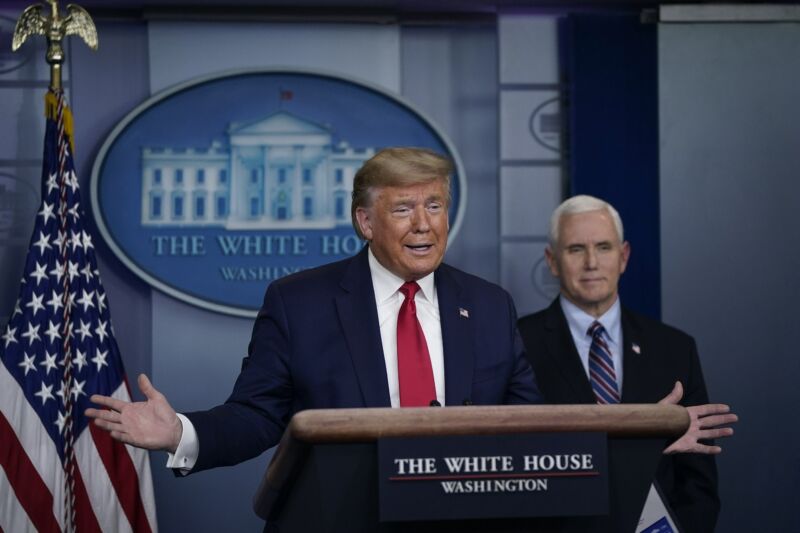
Enlarge/ President Donald Trump speaks as Vice President Mike Pence looks on during a briefing on the coronavirus pandemic at the White House on March 26, 2020.
Getty Images | Drew Angerer
President Donald Trump today ordered General Motors to make ventilators to treat COVID-19 patients and accused the company of “wasting time.” Trump announced that he “signed a Presidential Memorandum directing the Secretary of Health and Human Services to use any and all authority available under the Defense Production Act to require General Motors to accept, perform, and prioritize Federal contracts for ventilators.”
Hours before Trump took this step, GM said it is working with ventilator-maker Ventec Life Systems “to deliver the first ventilators next month and ramp up to a manufacturing capacity of more than 10,000 critical care ventilators per month with the infrastructure and capability to scale further.”
Trump’s statement did not specify how many ventilators GM should build, but he said that GM is moving too slowly:
Our negotiations with GM regarding its ability to supply ventilators have been productive, but our fight against the virus is too urgent to allow the give-and-take of the contracting process to continue to run its normal course. GM was wasting time. Today’s action will help ensure the quick production of ventilators that will save American lives.
Trump just yesterday was downplaying the need for ventilators, telling Fox News’ Sean Hannity, “I don’t believe you need 40,000 or 30,000 ventilators. You go into major hospitals sometimes, and they’ll have two ventilators. And now, all of a sudden, they’re saying, ‘Can we order 30,000 ventilators?'”
New York Governor Andrew Cuomo called Trump’s statement “ignorant.”
“So the point is, ‘well they’re in a stockpile, you must not need them’ is just ignorant—of course you don’t need them today,” Cuomo told CNN. “You need them when you hit the apex, which is 30,000. We’re not there yet.”
White House objected to $1 billion cost
The White House this week had been preparing to announce a GM/Ventec joint venture “that would allow for the production of as many as 80,000 desperately needed ventilators,” but the Trump administration had “second thoughts” because of the cost, The New York Times reported. The Times wrote:
The decision to cancel the announcement, government officials say, came after the Federal Emergency Management Agency said it needed more time to assess whether the estimated cost was prohibitive. That price tag was more than $1 billion, with several hundred million dollars to be paid upfront to General Motors to retool a car parts plant in Kokomo, Ind., where the ventilators would be made with Ventec’s technology.
Earlier today, Trump used his Twitter account to accuse GM of demanding too much money for ventilators, saying the company “want[s] top dollar.” He also told GM to “START MAKING VENTILATORS, NOW!!!!!!”
We asked GM how many ventilators it will make as a result of Trump’s order today but did not get an answer. GM instead provided us with a general statement about its partnership with Ventec, saying the companies “have been working around the clock for weeks to meet this urgent need,” and that GM’s “commitment to build Ventec’s high-quality critical care ventilator, VOCSN, has never wavered.”
“We are focused on executing our plan,” GM said.
Both GM and Ford were already starting to make ventilators. Trump hadn’t previously used the Defense Production Act to made demands of GM, but the Food and Drug Administration issued new guidance on Sunday that loosens the agency’s strict oversight of ventilator technology, making it easier to quickly build ventilators for the coronavirus pandemic.
The US on Thursday surpassed China as the country with the largest number of confirmed coronavirus cases. The Trump administration has, as we wrote yesterday, sent conflicting signals about the seriousness the pandemic and taken too long to implement a coherent plan for fighting the coronavirus.
https://arstechnica.com/?p=1663984
White House suspends environmental protection, citing coronavirus
Enlarge/ A man and a woman, properly socially distanced from the rest of Los Angeles, take in a view of the city on a low air quality day in November, 2019.
2020 has a new motto: “Cancelled due to the coronavirus.” Businesses, schools, sports, travel, film, and TV production, conferences, meetings, and basically any and all business as usual has been suspended in the US as individuals and institutions try to slow the spread of COVID-19. We have, at least, had outdoor space to go to—staying at least six feet away from others as we do—when we need a break from the four walls of our homes. But those spaces, along with the air we breathe and the water we drink, may get a whole lot less pleasant going forward, as the Trump administration is adding environmental protection regulations to the temporary cancellation list.
The Environmental Protection Agency is launching a “temporary enforcement discretion policy” due to the pandemic, it said late yesterday. The move comes as trade groups representing the oil and gas industry have been asking the White House and the EPA for compliance waivers.
Under the new policy, the agency will mostly not be investigating civil non-compliance with environmental regulations, although it “does not provide leniency for intentional criminal violations” of the law. EPA Administrator Andrew Wheeler said in a written statement that the policy is designed to provide discretion “under the current, extraordinary conditions, while ensuring facility operations continue to protect human health and the environment.”
Retroactive to March 13, penalties, including fines, will not apply to entities that fail to perform compliance monitoring, integrity testing, lab analysis, training, and relevant reporting if those entities say that COVID-19 is the reason they didn’t do it, the policy (PDF) says.
The EPA would still like it, however, if everyone would just keep on doing the right thing in the complete absence of investigation and enforcement. If staffing, supply, or other issues related to COVID-19 result specifically in the emission of air or water pollutants or affect wastewater or waste treatment systems, the facility having the problem is instructed to let the EPA and local (state or tribe) government know about it. If the EPA feels like the threat to human health from the pollution, runoff, or waste is “imminent,” the EPA will reach out to state governments to make a plan for minimizing or preventing the problem.
The agency is trying to prioritize the public water supply, the policy says, as safe drinking and hand-washing water is critical for public health. “The EPA expects operators of such systems to continue normal operations and maintenance as well as required sampling,” the policy reads.
Although the EPA says the change is temporary, the policy does not have a deadline, time limit, or ineffective date. Instead, the agency will post a public notice at least seven days ahead of terminating the policy, whenever that may be.
Environmental groups and former EPA officials expressed shock at the breadth of the suspension. “This is essentially a nationwide waiver of environmental rules,” Cynthia Giles, former head of the EPA’s enforcement division, told The New York Times. “It is so far beyond any reasonable response I am just stunned.”
An EPA spokesperson, however, said it was no such thing, saying, “For situations outside of routine monitoring and reporting, the agency has reserved its authorities and will take the pandemic into account on a case-by-case basis.”
https://arstechnica.com/?p=1663683
Charter gives techs $25 gift cards instead of hazard pay during pandemic
Charter Communications is giving its cable technicians $25 restaurant gift cards instead of hazard pay for going into customer homes during the coronavirus pandemic, BuzzFeed reported yesterday. The gift cards are a “token of our appreciation,” an internal email from management on Monday said, BuzzFeed reported. Of course, many restaurants are closed during the pandemic, so restaurant gift cards aren’t the most useful perk Charter management could have chosen.
“These gift cards never expire, so if you choose a restaurant that is currently not open, the card will remain valid for future use… Please take some time out of your busy day to enjoy a meal and recharge,” the email read.
Several Charter employees did not appreciate the minimal gesture. “It’s really insensitive, it shows they don’t care,” one New York City-based technician told BuzzFeed. “You think a gift card is supposed to make us feel better?”
No hand sanitizer or gloves
BuzzFeed previously reported that Charter technicians are being sent to customer homes without protective equipment such as masks, gloves, and hand sanitizer. The internal email to Charter technicians said the company has now “secured access to hand sanitizer and gloves, which would be available for workers to use ‘in the next few weeks,'” according to BuzzFeed. Numerous customers have asked Charter techs “why they aren’t in full protective gear.”
A Charter spokesperson told BuzzFeed that “The response from the technicians to all our recent changes, along with the gift card gesture, has been very positive.”
Charter, operator of Spectrum TV and Internet service, is the second-largest cable company in the US after Comcast. Charter has been slow to let call-center workers and other office-based employees work from home during the pandemic. We interviewed several Charter employees about their work conditions last week, with one saying a call center is “an absolute nightmare breeding ground for germs on a normal basis.”
By contrast, Comcast and AT&T have quickly moved many employees into work-from-home situations and given extra pay to workers who have to interact with the public. AT&T’s front-line employees are getting a 20-percent bonus, for example.
Home-Internet service is more essential than ever with Americans working at home en masse, so Internet providers have been exempt from state-issued orders to close businesses and shelter in place. Charter advised its employees in a memo this week that they should not be stopped by authorities from going to work.
“If authorities stop you, you should merely show them your Charter employee identification badge and explain to them that you work for a communications company that provides essential services,” Charter said in an email that employees shared with Ars. “If for some unforeseen reason you have difficulties with any law enforcement in commuting to work or carrying out your job duties, please contact your supervisor who will contact one of our attorneys right away.”
Charter was also criticized by New York City Mayor Bill de Blasio for not letting customers with unpaid bills take advantage of free service during the pandemic. Charter on March 13 said it would give new customers with children in school free Internet access for 60 days. “But as teachers, elected officials, and friends directed low-income families to those companies for help, some soon learned they couldn’t take advantage of the deals… because of previously unpaid bills,” Chalkbeat reported yesterday.
Optimum, which is owned by Altice, initially imposed the same restriction but waived the rule after being contacted by Chalkbeat. “Spectrum has not yet followed suit. Mayor Bill de Blasio said Thursday evening the practice was ‘unacceptable,'” Chalkbeat reported.
We contacted Charter this morning and will update this story if the company provides more information.
Update at 3:15pm ET: Charter told us it has reversed its policy on free service for new customers, but apparently only in New York, saying “we are making the 60-day free Internet offer available to New York customers with outstanding balances.” As for employees, Charter noted it is giving its staff “15 additional days of paid leave they can use for any COVID-19-related reason,” and has “stopped professional installations in markets where self-install is available to reduce in-home visits by our technicians.” There’s still no hazard pay for employees, but Charter said it “will continue to monitor both our employee and business continuity plans and adjust as needed.”
Disclosure: The Advance/Newhouse Partnership, which owns 13 percent of Charter, is part of Advance Publications. Advance Publications owns Condé Nast, which owns Ars Technica.
https://arstechnica.com/?p=1663710
Uber driver reportedly dies from COVID-19 after picking up sick passenger
Enlarge/ The Uber Technologies Inc. logo is seen on the windshield of a vehicle in New York on Thursday, Aug. 9, 2018.
An Uber driver in New York has died as a result of the coronavirus, the New York Post reports.
Anil Subba was a Nepalese immigrant in his 40s who lived in Queens. He had a wife and three children.
According to his cousin, Subba picked up a sick passenger from New York’s JFK airport during the first week of March. The experience scared him enough that he stopped driving for Uber, but it was too late. He developed COVID-19 symptoms and checked himself into the hospital about two weeks ago.
His condition worsened and he had to be hooked up to a ventilator. Two days later, early Tuesday morning, Subba died.
“I’m deeply saddened by this news,” Uber CEO Dara Khosrowshahi said in an email statement. “Our hearts go out to Anil’s loved ones and to everyone suffering during this unprecedented time.”
Subba’s death illustrates the precarious situation of Uber and Lyft drivers. Their jobs involve transporting many people every day—some of whom could be carriers of the coronavirus. As independent contractors, they don’t get paid sick days or health insurance coverage.
Uber and Lyft have taken some steps to reduce the spread of coronavirus—and the health threat to drivers. Uber and Lyft have both suspended their carpooling features, Uber Pool and Lyft Line. Uber offers drivers up to 14 days of financial assistance if they are diagnosed with COVID-19 or are placed in quarantine. Uber also says that it’s working to get cleaning supplies to drivers so they can regularly disinfect their vehicles. However, the company admits that “supplies are very limited.”
https://arstechnica.com/?p=1663396
Coronavirus: Is it too much to ask for an actual plan?
Enlarge/ To call the government’s response to the pandemic unsteady would be an understatement.
In difficult and frightening times, it’s normal for a certain amount of confusion and misinformation to spread. The existence of social media and hyperpartisan “news” outlets undoubtedly exacerbate the problem, but even those are just exaggerated versions of things that have been with us for some time.
But two things make the torrent of coronavirus misinformation distinct. The first one is simple: much of the misinformation starts at the top, where President Donald Trump seems willing to say whatever crosses his mind when he finds himself in front of a microphone.
But the second is trickier: unlike a national disaster or terrorist attack, we have no models for how long the coronavirus pandemic will last or how we will recover from it. There’s no “we’ll rebuild” mindset that people can use to make sense out of what’s going to happen and guide their expectations.
Here’s how we might create one.
No miracle cures
There are many really promising leads for potential treatments that can reduce the impact of the coronavirus among those who have been infected. While many of these will involve screening or developing new chemicals and will thus take months, others involve testing drugs that have already been approved for human use. Many of these tests are just shots in the dark—chemical X inhibits a protein from an unrelated virus, so maybe it will block a protein that coronavirus uses. But several drugs have solid biological justifications.
The good news is that much of the testing is being pursued by private companies and is taking place in other countries, leaving them free from the shambolic US response to the pandemic. Even within the United States, much of the effort is being coordinated by agencies like the FDA and NIH, which have largely been able to do their own thing during the period when official US policy appeared to be dismissing the threat posed by the virus. As a result, we’re already getting some preliminary results back from small trials.
But these trials are still so small that the results are little more than anecdote. Many, including President Trump himself, have been excited by early results using chloroquine, a drug originally developed for malaria. Yet a more recent trial now indicates that chloroquine is no better than doing nothing. So which is right? Combined, these two trials involved barely more than 100 people—not enough to tell us anything useful.
Yet the president has gone on television to tell everyone how excited he is about the drug. And that has had consequences. Chloroquine and its derivatives are standard treatments for things like malaria and lupus, and now they’re in short supply as people—including doctors—panic buy and hoard. Unfortunately, chloroquine is also very sensitive to dosing, and the side effects have already proven fatal both here and overseas.
Meanwhile, medical experts within the US government have to spend time pointing out that we don’t actually know if these drugs work. Not only is that confusing for the public, but it means that expert authorities like Dr. Anthony Fauci, who has served in the US government since Ronald Reagan’s presidency, could end up out of a job.
For now, talk about specific treatments should stop. It will be months before we know whether anything is truly safe and effective.
It’s tough to restart an economy in a pandemic
The US government’s public-facing response to the pandemic has been to downplay its significance. Several Trump statements have suggested that the problem might just disappear on its own once warmer weather arrives. Then, coronavirus was declared an emergency, beginning a short period in which the pandemic was taken seriously. But, torn between grim news of skyrocketing infections and a collapsing economy, Trump is already pushing to limit isolation, to restart businesses where people interact, and to push the US economy back to something approaching normal.
But there is no such thing as a normal economy during a pandemic like this.
By now, everybody in the government should know that easing the restrictions will result in a growth in the infection rate that makes what’s happening in New York City look like a warm-up act. There are two ways to look at this, and we’ll do both.
The first way is that people are looking at the death rate of the virus so far, as well as the populations that are high risk, and suggesting that having some people die is not too big of a sacrifice. (The Texas lieutenant governor has embraced the possibility.) But the whole point of the epidemiological studies that have been done is that the infection will exceed our capacity to care for anyone with the disease—so people who might otherwise survive will die due to lack of medical attention. That will mean more people outside the high-risk group will die, and the death rate directly attributable to the coronavirus will go up.
Such a course of action also means that anyone who might need critical care for other reasons might not get it, so there will be a lot of deaths that aren’t directly attributable to the virus but will be caused by it. Trying to enable normal economic activity will also increase the number of people who need critical care due to the risks posed by everyday activities: car crashes, job-site accidents, and so on. Thus, easing off restrictions risks a death rate that goes above the worst reported fatality rate for the virus—which is why public health experts are arguing strongly against it.
Beyond fatalities, there are large economic risks. What happens if the virus sweeps through the staff of a nuclear power plant and the plant has to be shut down? What about the people who run public transit systems? These sorts of problems will ripple out through the economy. Our reliance on interdependent supply chains means that a single company shutting down due to widespread infections can have effects well beyond that company.
On an individual level, backing away from these restrictions will force each company to make decisions on whether to resume normal operations, and each company will likely come to a different decision. With every sniffle, each employee will also have to make decisions about things like whether they might compromise an at-risk family member or the rest of their office—or whether what they’re feeling is normal seasonal allergies. Many employees will make the wrong decision.
Which is why even economists are saying that we’ll face chaos and economic disruptions even if social distancing and shelter-in-place orders were to end.
We have no testing policy
One piece of good news amid this mess has been the rapid expansion of testing for the virus. The bad news is that the expansion has almost immediately pushed up against a rapidly expanding infected population (over 50,000 cases confirmed in the United States as of this writing) and a shortage of raw materials for the tests.
Despite the shortage, there are indications that the rich and powerful—NBA players, for instance—have managed to get tested despite not meeting any of the criteria advised for the use of these tests. And the federal actions that opened up wider testing have also left us with a patchwork of local regulations for the use of this still-scarce resource.
Who gets tested when may seem like a secondary issue, but it’s actually central to the issue of restarting the economy. Countries that have managed to either restart their economies quickly or to limit the disruption have done so because they used testing strategically: to identify new cases, and then to check all of those who might have been exposed via newly diagnosed individuals.
This is, or should be, the end point of the severe restrictions many states are now imposing: new infections are limited enough, and testing capacity high enough, that we can control the problems caused by each newly identified infection. We’re nowhere close to this point, but without a national policy for testing, we’ll never get there even if sheltering in place makes it an option.
We need a plan—and some clearly marked lanes
The fact that there’s a potential way to end severe restrictions prior to having a treatment or a vaccine is probably news to people. That’s because nobody has bothered to take the time to explain to the public what our options are and what the risks are.
Trump’s press conferences on the topic have been rambling, ad hoc affairs without a clear structure. In addition to producing statements that require correction by medical experts, Trump has announced programs that were closer to half-baked ideas and which appeared to take the companies involved by surprise. If we have a broad plan that reflects our actual options—and to be clear, we could if we wanted to—it has not been communicated by anyone in charge.
Having and communicating a plan is critical for any public crisis like this. But it’s especially important for a crisis with no real antecedent in over a century. The clearest model for a pandemic like this one is the 1918 flu, which occurred decades before we had even confirmed that DNA was the carrier of genetic information and when the economy and travel were not nearly so globalized. So the public has no way of knowing what to expect. That’s in sharp contrast to things like natural disasters, where we have plenty of previous examples, so a recovery framework doesn’t need to be supplied to the public.
In the absence of a clear national plan, governors have been able to make decisions on how to handle the crisis that, to put it mildly, differed dramatically in quality. And the public has responded to the leadership vacuum with confusion and uncertainty.
With a plan in place, everyone communicating aspects of it will have a simple role: stay in their lane. Anybody who is not a medical expert shouldn’t be communicating anything about the prospects for treatments, a vaccine, or the capacity of any hospital system. At the same time, medical experts shouldn’t be promoting specific policy decisions. Policymakers have to weigh issues that are outside of an MD’s expertise—including deciding whether lives are worth the price required to save them.
Everybody involved with public communications needs to recognize the limits of their expertise.
A reality-based plan, clearly communicated by people who understand it, will help the public understand three things: what sacrifices will need to be made, what we will get in return for them, and, most importantly, how these sacrifices will be brought to an end. It’s tragic that, nearly three months into this growing crisis, we still lack such clear communications from our leaders.