Frontier gets away with “paltry” settlement after breaking 35 laws and rules

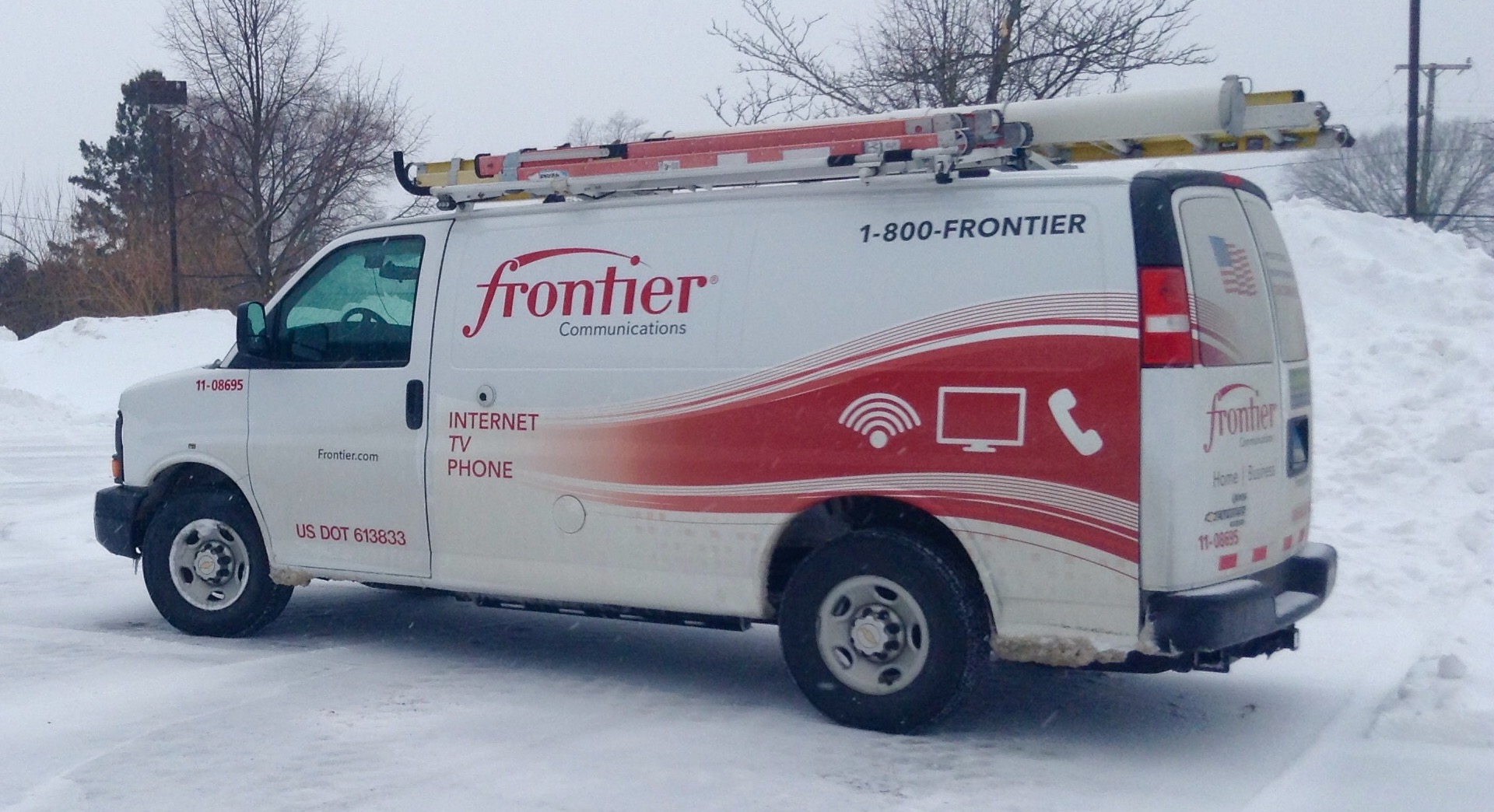
A Frontier Communications service van parked in a snowy area.
Enlarge / A Frontier Communications service van.

Minnesota regulators are letting Frontier Communications settle an investigation without admitting fault, despite the state attorney general’s office calling the settlement “paltry compared with Frontier’s alleged misconduct.”

Frontier failed to properly maintain its telecom network in Minnesota, leading to “frequent and lengthy” phone and Internet outages, the Minnesota Commerce Department said in January. Frontier also failed to provide refunds or bill credits to customers affected by outages that sometimes lasted for months, committed frequent billing errors that caused customers to pay for services they didn’t order, and failed to promptly provide telephone service to all customers who requested it, the department’s investigation found.

The Commerce Department in August announced a proposed settlement in which Frontier agreed to offer refunds to customers for problems dating back to November 2015, and to improve future service quality, customer service, and billing practices. The settlement would expire in two years if Frontier is in “substantial compliance” with its terms.

The Minnesota Public Utilities Commission (PUC) voted 5-0 to approve the settlement yesterday, the Star Tribune reported. Even though the Minnesota investigation found that Frontier violated “over 35 laws and rules,” the settlement document says it “shall not be construed as an admission by Frontier of any specific violation.”

The office of Minnesota Attorney General Keith Ellison filed comments on the settlement in August, saying it neither supports nor opposes the deal because Ellison’s office is continuing a “separate investigation of Frontier regarding Minnesota’s consumer protection laws.” But the AG office’s comments said the settlement is “not commensurate with the gravity of the allegations.” The AG’s office also said:

[T]he scope, gravity and pervasiveness of Frontier’s alleged violations of Minnesota’s telecommunications laws is well supported by the record. The Proposed Settlement, however, does not guarantee that Frontier will provide its customers with any relief or otherwise require Frontier to include a specific dollar amount in an escrow account to incentivize paying out customer remedies. Instead, that agreement merely provides a procedural framework for the types of remedies available to Frontier customers in the event Frontier later agrees with a customer’s complaint regarding past conduct. If Frontier disagrees with customers’ complaints, the Proposed Settlement provides that the Commission will be required to make a determination as to whether Frontier’s past conduct violates any applicable service quality, customer service, or billing practices. There is even less certainty as to how Frontier’s future conduct will be evaluated because the Proposed Settlement fails to set forth any detailed process for handling future customer claims of Frontier misconduct.

Settlement a “path to righting wrongs”

Frontier disputed the AG’s complaints, saying that the settlement “assures the benefits of specific customer remedies and ongoing, enforceable commitments to improve service” and lets the commission “avoid additional procedures that will add unnecessary expense and delay without any customer benefits.”

The Star Tribune article said the PUC made “a few tweaks [to the settlement] to essentially uphold the commission’s ultimate authority over the matter,” but it doesn’t sound like any major changes were made before the 5-0 vote.

“The settlement is a path—as the [Commerce] Department has said—to righting wrongs and correcting inequities that [Frontier] customers across Minnesota have faced,” PUC Chairwoman Katie Sieben said, according to the Star Tribune.

PUC Commissioner John Tuma said he was “really struggling with the settlement” and that Frontier’s “service quality just isn’t there. Still, I was convinced we at least got something [with the settlement] to move forward.”

Under the settlement, Frontier must provide pro rata credits to customers for outages if Frontier fails to restore phone service within 24 hours. Frontier also agreed to make quarterly filings to the state about its compliance with service metrics. Among other things, the settlement says that “Frontier will maintain service such that during any two consecutive months, the customer trouble reports in any single exchange are no greater than 6.5 per 100 telephone lines per month.”

Frontier will be judged to be in “substantial compliance” for any given metric if it “satisfies that metric… in at least 6 out of the 8 quarters of the two-year period.”

https://arstechnica.com/?p=1587903


Senators propose near-total ban on worker noncompete agreements

Pizza on display at a restaurant.
Enlarge / “We heard from people working at pizza parlors” being asked to sign noncompete agreements, a Massachusetts state legislator told Ars last year.

A bipartisan pair of senators has introduced legislation to drastically limit the use of noncompete agreements across the US economy.

“Noncompete agreements stifle wage growth, career advancement, innovation, and business creation,” argued Sen. Todd Young (R-Ind.) in a Thursday press release. He said that the legislation, co-sponsored with Sen. Chris Murphy (D-Conn.), would “empower our workers and entrepreneurs so they can freely apply their talents where their skills are in greatest demand.”

Noncompete agreements ban workers from performing similar work at competing firms for a limited period—often one or two years. These agreements have become widely used in recent decades—and not just for employees with sensitive business intelligence or client relationships.

“We heard from people working at pizza parlors, yogurt shops, hairdressers, and people making sandwiches,” Massachusetts state Rep. Lori Ehrlich told us in an interview last year.

Ehrlich was the author of 2018 Massachusetts legislation limiting the enforcement of noncompete agreements. Several other states—including Oregon, Illinois, and Maryland—have passed bills on the subject.

These state reforms focused on reining in the worst abuses of noncompete agreements. Some prohibit the use of noncompete clauses with low-wage workers. Others require employers to give employees notice of the requirement at the time they make a job offer.

The Young and Murphy bill goes much further, completely banning noncompete agreements outside of a few narrow circumstances—like someone selling their own business.

California suggests a near-total ban could work well

If debates in Massachusetts and elsewhere are any indication, we can expect business interests to lobby hard against such a sweeping proposal. Some business groups argue that noncompete agreements give companies incentives to invest in worker training—without having to worry that workers will take their new skills to another employer.

But supporters of broader reforms have a powerful counterexample: California. For decades, the Golden State has had the nation’s strictest laws against noncompetes, effectively banning the practice. Despite that—or maybe because of it—the state has become a powerful center for high-tech innovation.

In an influential 1994 book, political scientist AnnaLee Saxenian argued that a key factor in Silicon Valley’s economic success over the previous decades was the fact that employees could hop from job to job, taking their valuable skills with them. That freewheeling culture helped good ideas developed at one company to quickly spread elsewhere, ultimately benefitting the entire regional economy.

The lack of noncompetes is a boon to entrepreneurship in California. Many Silicon Valley technology companies were started by engineers who had great ideas but couldn’t get their big-company employers to take them seriously. California law ensures that workers in this situation have the option to quit and pursue their idea independently.

At least one leading presidential candidate, Sen. Elizabeth Warren (D-Mass.), is interested in this issue. Last year, Warren co-sponsored a noncompete reform bill with Murphy and Sen. Ron Wyden (D-Ore.). So expect this issue to get attention in the next few years if Warren captures the Democratic nomination and the presidency.

https://arstechnica.com/?p=1587321


Privacy bill would give FTC actual authority, land lying executives in jail

Men in suits talk into microphones.
Enlarge / Sen. Ron Wyden questions witnesses during a Senate Intelligence Committee hearing on social media influence in the 2016 US elections in Washington, DC, on Nov. 1, 2017.

Sen. Ron Wyden (D-Ore.) would like tech and data companies to mind their own business and get their noses out of yours. To that end, he has introduced a bill that would penalize them, potentially with jail time for executives, for not doing so.

The proposed bill (PDF), actually called the “Mind Your Own Business Act of 2019,” is in many ways an updated version of a discussion draft Wyden published last November.

The draft does not name any company specifically, instead focusing on the general concepts of personal data and company responsibility. That said, Wyden did name names in a statement, and Facebook is clearly front and center on his radar.

“Mark Zuckerberg won’t take Americans’ privacy seriously unless he feels personal consequences,” Wyden said. “A slap on the wrist from the FTC won’t do the job, so under my bill he’d face jail time for lying to the government.”

Not only do companies need to be more transparent and to give consumers more control, Wyden added, but also “corporate executives need to be held personally responsible when they lie about protecting our personal information.”

The proposal zeroes in on a few big challenges. First, consumers are tracked and monetized but do not have an effective way to control that tracking or to even know what’s done with the data collected from them. Second: businesses that siphon up and trade in consumer data have a terrible track record when it comes to securing that data and preventing unauthorized access. And third: the Federal Trade Commission, which is the closest thing we have to a privacy regulatory body, is woefully underpowered and under-resourced for addressing the challenge.

Sen. Wyden’s bill, then, would address those concerns by 1) imposing minimum privacy and security standards for user data, 2) increasing transparency for consumers to access their own data and learn what has been done with it, 3) creating steep penalties for companies that blow it, and 4) expanding the FTC’s authority and resources so that it would be able to enforce those penalties. The bill would allow companies to charge for higher-privacy versions of services, but it would exempt from those fees anyone using a Lifeline subsidy⁠ (a small credit that low-income individuals and families can use to pay for phone or broadband services)⁠. This would be a gesture against reserving privacy as a luxury good.

Putting someone on the beat

The FTC recently established a small division dedicated to technology enforcement issues, but Wyden’s proposal would beef it up substantially.

FTC chairman Joseph Simons has said several times this year that he feels his agency is hamstrung by its inability to impose stiff penalties for first-time violations of the FTC Act or of the Safeguards Rule, which requires financial institutions to take special care with consumer data.

“The CFPB and the states were able to obtain civil penalties for this massive breach by a major financial institution. The FTC could not,” Simons said in a July press conference explaining the agency’s settlement with Equifax. “Fortunately, other agencies were able to fill in the gap this time. That will not always be the case, which sends the wrong signal regarding deterrence.”

A few days later, when discussing the $5 billion settlement between the FTC and Facebook, Simons again called on Congress for a new bill. “We are a law enforcement agency without the authority to promulgate general privacy regulations,” Simons said at the time. “Our authority in this case comes from a 100-year-old statute that was never intended to deal with privacy issues like the ones that we address today.”

If Sen. Wyden’s bill were to become law, the FTC would gain 175 additional staff members to help enforce data and privacy standards⁠—and the penalties could be steep. A first offense, which currently carries no fine, would cost a company up to 4% of its annual revenue. In the case of the Equifax data breach, for example, that would have been an additional $136 million to the FTC, on top of the existing $500 million agreement.

Corporate officers would also be held personally accountable for their company’s behavior. If a business, such as Facebook or Google, were found to be filing incorrect reports about privacy, executives would be subject to penalties equaling 5% “of the largest amount of annual compensation received during the previous 3-year period,” or $1 million, whichever is greater, and up to 10 years in prison.

That’s just for an “oops.” If those officers were found to have lied intentionally on those reports, the penalties jump up to 25% of compensation or $5 million, whichever is greater, and up to 20 years in prison.

The challenge

Nearly everyone with a stake in the matter, including politicians from both major parties, agree that we in the United States are badly overdue for some kind of update to privacy law and regulation. The questions of what such a law should cover, what it should allow, and who should benefit, however, are contentious at best.

More than 50 of the nation’s largest companies—including Amazon, AT&T, and Comcast, among dozens of others—in September signed onto a letter (PDF) to Congress asking for federal privacy legislation.

The companies wrote:

We are committed to protecting consumer privacy and want consumers to have confidence that companies treat their personal information responsibly… We are also united in our belief that consumers should have meaningful rights over their personal information and that companies that access this information should be held consistently accountable under a comprehensive federal consumer data privacy law.

The Electronic Frontier Foundation and other critics called the corporate campaign “disingenuous,” saying it amounted to a “ploy to undermine real progress on privacy” being made at the state level nationwide.

The poster child for those state efforts is California’s Consumer Privacy Act, which becomes effective in less than three months, on January 1. California’s high population and influence as a tech center have in the past caused its privacy-related regulations to effectively become de facto national standards, and companies that rely on the ability to collect, remix, and exploit user data are not enthralled with that idea. They likely won’t love Wyden’s federal proposal, either, as it explicitly does not preempt states from setting their own, more stringent guidelines.

Beyond the issue of corporate money and corporate preferences, however, the greatest challenge to getting anything through Congress this decade is Congress. Astute observers may have noticed that the political process in Washington, DC, is somewhat acrimonious these days. Not only is there a significant partisan divide to contend with, but in the immediate sense, both chambers are occupied with questions such as “Can we keep this government funded past November, please?” and “Are we impeaching the president?”

That said, Wyden’s bill could easily become a template to which he and other senators return in future sessions of Congress, when conditions for making actual law may become more favorable.

https://arstechnica.com/?p=1587021


After flooding US with opioids, industry giants offer $50 billion settlement

Members of the International Brotherhood of Teamsters hold signs while protesting during the McKesson Corp. annual meeting at the Irving-Las Colinas Chamber of Commerce in Irving, Texas, US, on Wednesday, July 26, 2017.
Enlarge / Members of the International Brotherhood of Teamsters hold signs while protesting during the McKesson Corp. annual meeting at the Irving-Las Colinas Chamber of Commerce in Irving, Texas, US, on Wednesday, July 26, 2017.

Three of the nation’s largest drug distributors plus two big-name drug makers have reportedly offered a deal worth nearly $50 billion to settle more than two thousand opioid-crisis lawsuits, consolidated in federal court in Cleveland, Ohio. The first trial for the cases is scheduled to begin opening statements Monday.

The deal includes around $22 billion in cash, plus drugs and services valued at around $28 billion, according to sources familiar with the negotiations who spoke with Reuters.

Specifically, drug distributors McKesson Corp, AmerisourceBergen Corp, and Cardinal Health offered $18 billion in cash. Drug maker Johnson & Johnson offered another $4 billion. And finally, Israel-based Teva Pharmaceutical Industries offered to give away addiction medications and related services in a 10-year program that it estimated has a total value of $28 billion.

According to The New York Times, the cash is intended to go to healthcare, law enforcement, and other public costs of the opioid epidemic, which has killed nearly 400,000 people in the US in the past two decades.

If the scores of plaintiffs take the deal, the five companies would be released from the massive litigation. While the Times reported that multiple plaintiff states had agreed to the settlement terms, lead attorneys representing cities and counties in the cases—Joe Rice, Paul Farrell and Paul Hanly—pumped the brakes on the optimistic outlook on the deal, telling Reuters that media reports suggesting they, too, supported it were “inaccurate.”

“We await the fine print of the settlement framework so that we can work alongside the 2,600 communities we represent to determine the best path forward,” the attorneys said in a joint statement.

Collectively, the plaintiffs allege that opioid makers egregiously misrepresented their drugs’ risks and that distributors failed to prevent massive and obviously suspicious orders of opioids from flooding states and towns.

Make it rain

According to an analysis of federal data by The Washington Post, some rural areas received 200 to 300 opioid pills per person per year. McKesson Corp, AmerisourceBergen Corp, and Cardinal Health are three of just six companies responsible for distributing 75% of the 76 billion oxycodone and hydrocodone pain pills that inundated the country between 2006 and 2012. (The other three are CVS, Walgreens, and Walmart, who are also involved in the litigation but not this settlement negotiation.)

The three big distributors are also in the country’s top 20 in terms of revenue, the Times noted.

According to an analysis by the Society of Actuaries released this week, the opioid epidemic cost the US economy at least $631 billion from 2015 to 2018. Estimated costs for 2019 alone were up to $214 billion.

Without any agreed-upon settlement, jury selection is underway this week with the first trial scheduled to start Monday. Beyond the five companies in settlement negotiations, the trial also includes Walgreens Boots Alliance Inc and a smaller distributor, Henry Schein Inc. A full list of the parties involved in the consolidated federal case can be found here.

Purdue Pharma and its mega-rich owners, the Sackler family, are also involved in the litigation but have a temporary reprieve from the cases in the wake of Purdue filing for bankruptcy. The company and family have reportedly offered a settlement deal valued at $10 billion to $12 billion.

https://arstechnica.com/?p=1587231


T-Mobile and Sprint get FCC approval to merge in 3-2 party-line vote

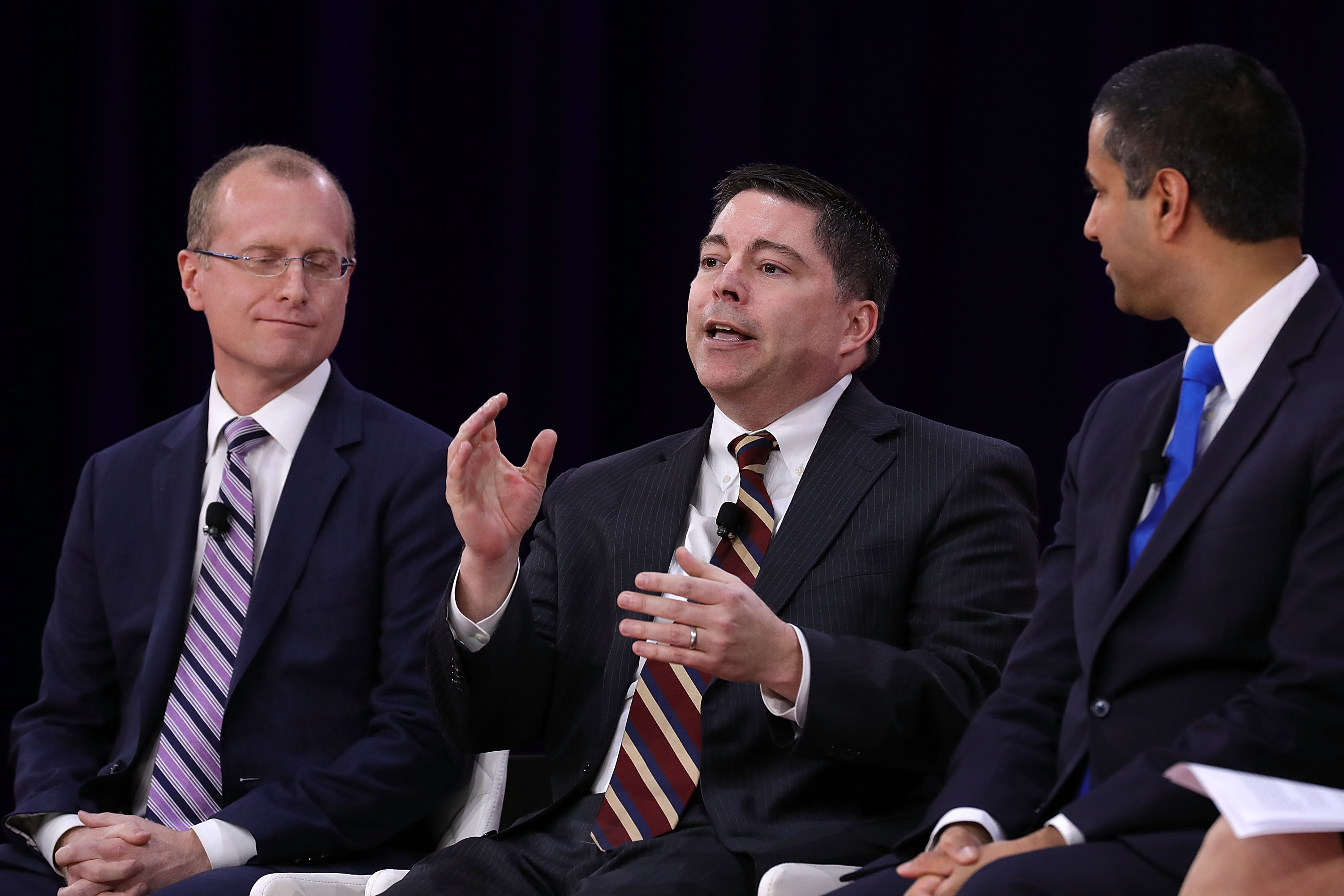
FCC Commissioner Michael O'Rielly speaks at a conference while FCC Commissioner Brendan Carr and Chairman Ajit Pai look on.
Enlarge / Federal Communication Commission Republican members (L-R) Brendan Carr, Michael O’Rielly, and Chairman Ajit Pai participate in a discussion during the Conservative Political Action Conference on February 23, 2018 in National Harbor, Maryland.

The Federal Communications Commission has voted 3-2 to approve T-Mobile’s acquisition of Sprint, an FCC spokesperson confirmed to Ars today.

Republican Commissioners Brendan Carr and Michael O’Rielly backed Chairman Ajit Pai’s proposal to allow the merger, while Democrats Jessica Rosenworcel and Geoffrey Starks voted against it.

T-Mobile and Sprint previously secured merger approval from the Department of Justice, so the deal has been fully cleared by the federal government. But the companies won’t be completing the merger just yet, as they face a lawsuit from a group of state attorneys general who are trying to block the deal.

The FCC hasn’t released its merger approval order publicly. But the final document should reflect what Chairman Pai proposed in May, requiring the merged company to deploy 5G to 97% of the US population within three years and to 99% of Americans within six years. That includes deploying 5G to 85% of rural Americans within three years and 90% within six years.

Investigation into Sprint continues

There is at least one addition to the merger order, though. Commissioner Starks had called for the FCC to halt its merger proceeding while the agency investigates a discovery that Sprint took millions of dollars in government subsidies for “serving” 885,000 low-income Americans who weren’t using Sprint service.

Instead of delaying the merger approval order, Pai added some language that acknowledges the ongoing investigation. Starks said that isn’t enough.

“The rush to judgment here is exemplified by the fact that it was only in response to questions from my office that the draft was amended at the last minute to explicitly preserve liability for these and any other potential violations,” Starks said in a statement today.

Democrats predict higher prices

Starks and Rosenworcel both criticized the merger approval in their statements today. Starks said:

The expert staff of the Commission and the Justice Department have agreed that the merger between T-Mobile and Sprint, as originally submitted, would likely harm competition and raise prices. Rather than denying that merger, however, the majority has turned to the parties for paper-thin commitments that they contend will expand broadband access and the deployment of 5G.

But these promises cannot mask reality. You don’t need to be an expert to know that going from four wireless carriers to three will hurt competition. This merger takes a bad situation and makes it worse. Higher prices and fewer options across the country will inevitably result. Quite simply, the effects of this ill-conceived merger will hit low-income and rural communities hardest of all.

Rosenworcel argued that “Overwhelming evidence demonstrates that the T-Mobile-Sprint merger will reduce competition, raise prices, lower quality, and slow innovation.”

“We’ve all seen what happens when markets become more concentrated after a merger like this one,” she said. “In the airline industry, it brought us baggage fees and smaller seats. In the pharmaceutical industry, it led to a handful of drug companies raising the prices of lifesaving medications. There’s no reason to think this time will be different.”

Carr: Merger creates stronger third competitor

Pai and the Republican commissioners did not issue statements on the agency’s website about the merger today. Republican commissioner Carr weighed in on Twitter, though, saying the merger will create “a stronger third competitor” and ensure that “99% of Americans will get 5G on an accelerated basis.”

Pai argued in May that the merger is “a unique opportunity to speed up the deployment of 5G throughout the United States and bring much faster mobile broadband to rural Americans.”

Dish will try to replace lost competition

The Department of Justice’s settlement with the merging companies requires T-Mobile and Sprint to sell some assets to Dish Network, which will attempt to build a 5G network. Specifically, Dish would be able to purchase spectrum licenses, wholesale access to the combined T-Mobile/Sprint network, and Sprint’s prepaid business. That includes subsidiaries Boost Mobile and Virgin Mobile.

Dish’s plan calls for covering 70% of the US population by June 2023, which would leave 100 million Americans without the option of a fourth carrier.

Consumer advocates and economists have warned against the merger. A group of seven economists argued in a filing to the DOJ that the agency’s plan involving Dish will not offset the merger’s anticompetitive effects. The DOJ is accepting short- and medium-term competitive harms and justifying them “based on an exceedingly optimistic view of possible benefits in the longer term,” they wrote.

“[I]f the substantial and acknowledged competitive problems with this four-to-three merger are remedied by this strategy of re-arranging some assets, negotiating some contracts, and then hoping for the best some years down the road, it is unclear what merger would not be salvageable with the same scheme,” the economists wrote.

https://arstechnica.com/?p=1586799


EU orders Broadcom to halt exclusivity deals while investigation deepens

A professional woman gives a speech in front of a video display.
Enlarge / EU Commissioner for Competition Margrethe Vestager imposes interim measures on Broadcom in TV and modem chipset markets on October 16, 2019, in Brussels, Belgium.

European regulators have hit chipmaker Broadcom with a rare “interim” restriction on its behavior as their antitrust probe into the company’s alleged abuse of its market power deepens.

Broadcom was ordered immediately to stop applying and enforcing “anticompetitive provisions” in its dealings with six major customers, the European Commission’s competition bureau said.

The order has to do with exclusivity agreements. Such agreements by suppliers are considered anticompetitive because they lock a dominant company into continued dominance. Exclusivity deals prevent would-be competitors from accessing any customers of their own, thus preventing their meaningful entry into the marketplace. In short: if nobody is allowed to buy from you, because they’re forced to buy from the bigger company, then you can’t sell anything, and your new business flops.

The EU has “strong indications” that Broadcom is behaving anticompetitively, said competition bureau head Margrethe Vestager. “Broadcom’s behavior is likely, in the absence of intervention, to create serious and irreversible harm to competition. We cannot let this happen.”

The company is Europe’s dominant provider of systems-on-a-chip for TV set-top boxes, fiber modems, and xDSL modems, the competition bureau said. The exclusivity clauses in its contracts not only grant it continued dominance in those markets but also “allow Broadcom to leverage its dominance into the market for cable modem chipsets in which Broadcom may not yet be dominant,” thus squeezing out the only other supplier of those chips.

The EU’s investigation of Broadcom began in June. The interim measures were imposed on a prima facie basis—legalese for something that looks to break the relevant law at first sight before a deeper probe reveals any more layers to the case. Essentially, Broadcom is now under an injunction preventing it from doing certain things while the EU’s investigation continues.

The Broadcom case marks the first time since 2001 that the EU has imposed interim measures on any company, The Wall Street Journal said.

Feel like you’ve seen this before?

Rival US chipmaker Qualcomm, which makes mobile phone chipsets, has of late been facing its own antitrust challenges, and the charges levied against it are very similar to the allegations against Broadcom.

The Federal Trade Commission in May won a suit it filed in 2015 against Qualcomm. The suit claimed that the company abused its monopolistic market position to overcharge nearly all mobile phone device makers for cellular chips—even if the manufacturers used another supplier.

Over the years, Qualcomm used its patent portfolio and market power to lock mobile device makers—including Apple, BlackBerry, Samsung, Motorola, and others—into deals that heavily favored it. The device manufacturers were required to agree to license Qualcomm’s patents, at very high fees, before they could purchase Qualcomm chips. Qualcomm also signed agreements with the device makers that would pay back rebates for every device sold with a Qualcomm wireless chip—but only if the handset maker sold only devices with Qualcomm chips. Qualcomm effectively held hundreds of millions of dollars hostage to exclusivity. (It is no coincidence that Apple acquired Intel’s wireless modem business earlier this year.)

EU regulators also launched two antitrust investigations into Qualcomm in 2015. The first, dealing with exclusivity payments, resulted in a $1.1 billion fine against Qualcomm in 2018. The second, dealing with predatory pricing, ended in July of this year with a $268 million fine.

Media reports earlier this year indicated that an investigation by the FTC into Broadcom’s behavior is also growing. The agency is reportedly probing whether Broadcom abused its market dominance by requiring customers to sign exclusivity deals—the exact same conduct at the heart of the FTC’s Qualcomm case.

Birds of a feather…

The past few years have proven tumultuous for Broadcom and Qualcomm both, and their strange stories have at times woven together. Increasing antitrust scrutiny from US and EU regulators has put pressure on the companies from one side, while increasing trade hostilities between the US and China have put pressure on them from another.

Broadcom spent months trying and failing to acquire rival Qualcomm in what turned out to be something of a high-stakes farce. In November 2017, Broadcom made an unsolicited $103 billion offer, which Qualcomm refused. Broadcom then took steps toward initiating a hostile takeover, which Qualcomm also pushed back against.

In February 2018, Broadcom tried the carrot instead of the stick and upped its bid to about $122 billion. Qualcomm again said “no.” (That offer was conditioned on Qualcomm either abandoning its own bid for rival NXP, which Qualcomm then raised its offer for and continued to pursue. The deal collapsed ingloriously for China trade-war reasons.)

In a brazen act of corporate negging, Broadcom then revised its bid for Qualcomm again. This time, the company reduced its bid to $117 billion, which Qualcomm—you guessed it—rejected. And yet, despite no actual deal ever having existed between Broadcom and Qualcomm, US President Donald Trump in March of last year signed an executive order prohibiting the companies from joining forces for nebulous national security reasons.

Had that deal not been scuttled both by Qualcomm’s unwillingness to pursue it and by the White House’s action, it would likely have invited a great deal of international antitrust scrutiny and landed the companies in more or less exactly the hot water they’re in now.

https://arstechnica.com/?p=1586485


UK porn blacklist is dead after government abandons age verification

Nicky Morgan, UK Secretary of State for Digital, Culture, Media, and Sport.
Enlarge / Nicky Morgan, UK Secretary of State for Digital, Culture, Media, and Sport.
Leon Neal/Getty Images

The United Kingdom is abandoning plans to try to force pornography websites to age-verify UK Internet users. Digital Secretary Nicky Morgan announced the shift in a Wednesday statement.

Morgan claimed that “the government’s commitment to protecting children online is unwavering.” However, she said, the government will now accomplish that goal “through our proposed online harms regulatory regime.” She didn’t elaborate on what those regulations would look like.

The age verification requirement was part of the Digital Economy Act that the UK parliament passed in 2017. It was supposed to go into effect last year but was delayed multiple times. Most recently, the government announced in April that the new requirement would go into effect on July 15.

But that didn’t happen. In June, the government said that it needed to delay implementation while it filed necessary paperwork with the European Union. Now the UK is tacitly admitting that the entire scheme is unworkable.

Why critics opposed the age-verification plan

Two big questions have dogged Britain’s plan to restrict children’s access to pornography. One is what to do about overseas porn sites. The UK government can easily require domestic porn sites to use age-verification technology. But porn sites based outside the UK—which is most of them—might not comply with a British law.

The government’s plan was to put recalcitrant sites on an official blacklist—and then require Internet service providers in the UK to block traffic from those sites. Critics warned that this approach could block access to legitimate content while doing nothing to prevent access by Brits who knew how to use a VPN.

The other big concern was about privacy. Rather than mandating that websites use a specific age verification technology, the rules would have left it up to each porn site to decide on the best method. Most sites were expected to verify users by asking for credit card numbers or information from government-issued IDs.

Critics argued it wasn’t a good idea to encourage British adults to turn over identifying information to porn sites that might not have the strongest security—or the highest ethical standards. The proposed rules didn’t include privacy safeguards for the identifying information sites collected—though the data would have been covered by EU-wide privacy laws.

https://arstechnica.com/?p=1586523


US green economy’s growth dwarfs the fossil fuel industry’s

A new solar array at the National Institute of Standards and Technology.
Enlarge / A new solar array at the National Institute of Standards and Technology.

While US President Donald Trump may be “the world’s most powerful climate change denier,” our latest research suggests that he took over a thriving green economy.

According to new data, by 2016 it was generating more than $1.3 trillion in annual revenue and employed approximately 9.5 million people—making it the largest green market in the world. It has been growing rapidly, too—between 2013 and 2016, both the industry’s value and employment figures grew by 20%.

For some time, economic data on the green economy in many countries has been lacking. In the US, the Bureau of Labor Statistics stopped measuring jobs in the green economy in March 2013 due to budget cuts. This meant that US politicians were not able to make informed decisions about the relative merits of supporting green industry or backing fossil fuels—as Trump had pledged to do during his 2016 campaign.

To fill this knowledge gap, we analyzed massive databases to record the latest available business transactions from every country in the world. We estimated sales revenue and employment figures across 24 economic sub-sectors covering renewable energy, environmental protection, and low-carbon goods and services—collectively termed the green economy. We used this same standardized method across all countries, allowing us to make meaningful comparisons between them.

Our study estimates that revenue in the global green economy was $7.87 trillion in 2016. At $1.3 trillion, the US made up 16.5% of the global market—the largest in the world.

Our analysis also suggests that in the US, nearly ten times more people were employed in the green economy and its supply chains (9.5 million) than employed directly in the fossil fuel industry (roughly 1 million)—that is, miners, electricity grid workers, infrastructure manufacturers, and construction workers. This wide gap comes despite the US fossil fuel industry receiving huge subsidies, estimated at $649 billion in 2015 alone.

America first?

Importantly, the green economy has been growing faster than Trump’s wildest dreams for the fossil fuel industry. As a presidential candidate in 2016, Trump set out his “America first” energy policy, promising to add 400,000 new jobs to the fossil fuel industry. During the campaign, he suggested that he could increase the industry’s economic output by $700 billion over 30 years.

Our data indicates that the green economy grew by over $60 billion per year in 2013 and 2016. This dwarfs Trump’s best hopes for growth in the fossil fuel industry, hopes that equate to an annual increase in value of $23 billion.

Employment in the US green economy also grew by the equivalent of 1.5 million full-time jobs during this time, whereas coal mining jobs declined by 37,000 over the same period.

A precarious position

These are strong numbers. But after three years of faltering support, the US’ position as a world leader in the green economy is precarious. Up to now, Trump’s campaign rhetoric has not been backed up by major policy changes, although his rollback of a number of Obama-era regulations has likely helped the fossil fuel industry in the short term. But unlike Trump, competing superpowers are strongly backing renewables.

China, for example, has emerged as a global climate leader in the wake of Trump’s determination to pull out of the Paris Agreement. In 2017, it announced plans to invest $361 billion in clean energy by 2020 to generate 13 million jobs. This investment alone could go a long way to closing the gap between the value of the US’ green economy and that of China’s, the second largest in the world. Other countries are also poised to overtake the US in the race to shape the global green economy.

The Green New Deal—popularized by Congresswoman Alexandria Ocasio-Cortez and others—is an ambitious policy agenda that could reestablish the US’ commitment to the green economy. It proposes massive investment in renewable energy and an environment-friendly public works program of gargantuan scale. Phasing out direct fossil fuel subsides could free up some of the funding required for such investment.

It’s not for us to say whether the Green New Deal is right for the US. But what our data does say loud and clear is this: if you want a strong economy that supports thousands of new jobs, then supporting its green quarters is essential. And of course, it will help our imperiled planet, too.The Conversation

Lucien Georgeson, researcher, Green Economy and Sustainable Development, UCL and Mark Maslin, professor of Earth System Science, UCL. This article is republished from The Conversation under a Creative Commons license. Read the original article.

https://arstechnica.com/?p=1586479


Bringing in the big gun: Army paves way for “strategic cannon”

Soldiers in combat gear fire a gigantic gun.
Enlarge / US Army troopers assigned to the Field Artillery Squadron, 3rd Cavalry Regiment, fire their M777 Howitzer. The Army is looking for a gun with a bit more range—over 1,000 nautical miles.

In 2017, the US Army established a collection of cross-functional teams (CFTs) aimed at rapidly pushing forward key technologies to advance the services’ next generation of capabilities. One of those teams was the Long Range Precision Fires “pilot,” an effort to develop the next generation of Army artillery—including “deep fires,” an artillery capability that can strike at strategic targets well within an adversary’s defenses.

That effort has spawned what Army Futures Command chief Gen. John Murray described to Congress last year as “the Strategic Long Range Cannon, which conceivably could have a range of up to 1,000 nautical miles” (1,150 miles, or 1,850 kilometers).

The Strategic Long Range Cannon program is now advancing through its first set of technical hurdles. Col. John Rafferty, head of the Long Range Precision Fires CFT, told Defense News in advance of this week’s Association of the US Army (AUSA) Annual Meeting that the Army wants to demonstrate a prototype of the gun system by 2023. Currently, the Army is working with the Center for Army Analysis and the Research and Analysis Center at White Sands Missile Range to confirm the technical feasibility of the cannon. The Army is preparing to perform early tests at Naval Support Facility Dahlgren, the site of the Navy’s test range for naval artillery.

Rafferty told Defense News that the road to the full prototype test will have to pass through “big technology gates” along the way. He added, “We’re about to knock down one of those gates with a test at Dahlgren.” Dalhgren has been the site of a number of advanced gun tests, including the Navy’s aborted railgun project.

The first test is an early ballistic evaluation. But there are much bigger technical issues that lay beyond that—including whether the range the Army seeks can be achieved without the projectiles being too expensive to fire, as happened with the Navy’s Advanced Gun System.

But there’s strong incentive for the Army to succeed because an extreme-long-range gun could help deal with the difficulty posed by adversaries with advanced over-the-horizon radar, shore defenses, and air defense systems—such as the kind being put in place by China in the South China Sea.

“One of the ways to solve that problem is to deliver surface-to-surface fires that can penetrate this complex and disintegrate its network and create windows of opportunity for the joint force to exploit,” Rafferty said.

https://arstechnica.com/?p=1586143


Washington State keeps enforcing net neutrality as it hails FCC court loss

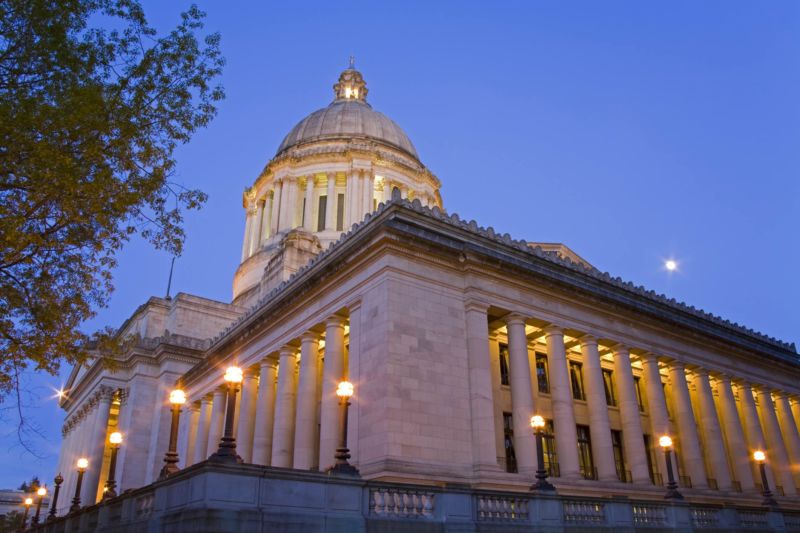
The outside of the Washington State Capitol building.
Enlarge / Washington State Capitol building in Olympia, Washington.

Although the Federal Communications Commission abandoned its regulation of net neutrality, it wouldn’t be accurate to say there are no net neutrality laws anywhere in the United States.

No one enforces net neutrality in Washington, DC, but on the opposite coast, the state of Washington imposed a net neutrality law in June 2018 that remains in effect today. The Washington State law prohibits home and mobile Internet providers from blocking or throttling lawful Internet traffic and from charging online services for prioritization.

The Washington State law cleared its biggest hurdle on October 1 when a federal appeals court vacated the Federal Communications Commission’s decision to preempt all state net neutrality laws.

Broadband users in Washington State can file net neutrality complaints against ISPs using this general consumer complaint form, a spokesperson for Washington Attorney General Bob Ferguson told Ars. The AG’s office said it wouldn’t comment on whether there are any pending net neutrality investigations.

The text of the Washington law is available on the state’s website here. Violations of the law are punishable under Washington’s Consumer Protection Act.

Washington stands alone

Washington is apparently alone when it comes to enforcing a state net neutrality law that applies directly to Internet providers.

“Four states—California, Oregon, Washington, and Vermont—have adopted statutes to regulate broadband providers’ network management practices,” Boston College law professor Daniel Lyons wrote this month in an overview of state net neutrality laws.

But California and Vermont aren’t enforcing their laws for now. Both of those states agreed to suspend enforcement until after all appeals in the FCC case are exhausted. Those agreements came in response to lawsuits filed against the states by broadband-industry lobby groups—and the Trump administration, which sued California.

Oregon’s law is still in effect, but it’s less strict than Washington’s. Instead of regulating ISPs directly, Oregon forbids state agencies from purchasing broadband service from ISPs that violate net neutrality principles. (Vermont’s suspended law is similar.) The governors of several other states issued executive orders that also handle net neutrality by imposing requirements on state agencies instead of directly on ISPs.

FCC lacks “blanket authority to stop states”

For whatever reason, the broadband industry hasn’t sued Washington over its net neutrality law. “We’ve been in the fight for over a year now with no legal challenge,” State Rep. Drew Hansen (D-Bainbridge Island), author of Washington’s net neutrality legislation, told Ars earlier this month.

Hansen doesn’t know why broadband lobby groups haven’t sued Washington, but he said, “I figured they would take their shot in California and resolve the issue once and for all there.”

Broadband providers were also counting on the FCC to wipe out all state net neutrality laws and executive orders in one fell swoop. But that didn’t work. Judges at the US Court of Appeals for the District of Columbia Circuit upheld the FCC’s repeal of federal net neutrality rules but vacated the FCC’s attempt at a blanket, nationwide preemption.

The FCC can still try to preempt state laws on a case-by-case basis, but it may have trouble doing so because the agency eliminated its own Title II authority to regulate net neutrality. “In any area where the Commission lacks the authority to regulate, it equally lacks the power to preempt state law,” the judges’ ruling said.

Hansen and other Washington State officials expressed confidence in keeping their law in force. The appeals court ruling shows that “the FCC does not have blanket authority to stop states like Washington from passing open Internet laws to protect consumers,” Gov. Jay Inslee and Ferguson said in a joint statement after the court decision. “Washingtonians will continue to have access to a fair, free, and open Internet, thanks to our first-in-the-nation open Internet access law. This is an important victory for our state.”

Hansen, who is a lawyer in addition to being a state lawmaker, said he doesn’t see anything in the circuit court ruling that makes him concerned about Washington’s ability to enforce net neutrality.

“The good news from the DC Circuit opinion is I don’t see how a preemption challenge succeeds,” he said. Hansen added that the ruling “clearly gives space for states to act… so now you hope as many other states as possible follow Washington’s and California’s lead and enact these protections on a state level, and it becomes a de facto nationwide standard.”

Hansen said the bipartisan support for net neutrality shows that no one wants Internet access to be “controlled by a handful of giant cable companies.” The Washington State legislation passed both chambers of the legislature by wide margins.

“If this can happen with bipartisan support in Washington State you think well, there’s no reason it couldn’t happen in any other state regardless of which party controls state government,” Hansen said.

https://arstechnica.com/?p=1586133