Meta axes third-party fact-checkers in time for second Trump term
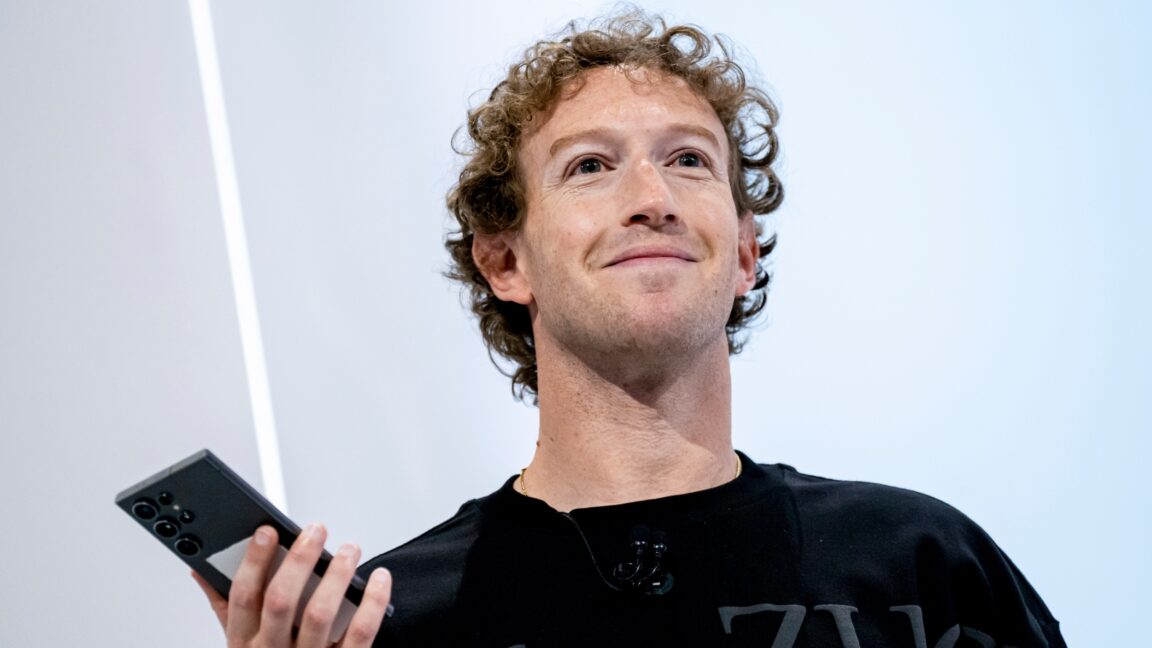
Meta announced today that it’s ending the third-party fact-checking program it introduced in 2016, and will rely instead on a Community Notes approach similar to what’s used on Elon Musk’s X platform.

The end of third-party fact-checking and related changes to Meta policies could help the company make friends in the Trump administration and in governments of conservative-leaning states that have tried to impose legal limits on content moderation. The operator of Facebook and Instagram announced the changes in a blog post and a video message recorded by CEO Mark Zuckerberg.

“Governments and legacy media have pushed to censor more and more. A lot of this is clearly political,” Zuckerberg said. He said the recent elections “feel like a cultural tipping point toward once again prioritizing speech.”

“We’re going to get rid of fact-checkers and replace them with Community Notes, similar to X, starting in the US,” Zuckerberg said. “After Trump first got elected in 2016, the legacy media wrote nonstop about how misinformation was a threat to democracy. We tried in good faith to address those concerns without becoming the arbiters of truth. But the fact-checkers have just been too politically biased and have destroyed more trust than they’ve created, especially in the US.”

Meta says the soon-to-be-discontinued fact-checking program includes over 90 third-party organizations that evaluate posts in over 60 languages. The US-based fact-checkers are AFP USA, Check Your Fact, Factcheck.org, Lead Stories, PolitiFact, Science Feedback, Reuters Fact Check, TelevisaUnivision, The Dispatch, and USA Today.

The independent fact-checkers rate the accuracy of posts and apply ratings such as False, Altered, Partly False, Missing Context, Satire, and True. Meta adds notices to posts rated as false or misleading and notifies users before they try to share the content or if they shared it in the past.

Meta: Experts “have their own biases”

In the blog post that accompanied Zuckerberg’s video message, Chief Global Affairs Officer Joel Kaplan said the 2016 decision to use independent fact-checkers seemed like “the best and most reasonable choice at the time… The intention of the program was to have these independent experts give people more information about the things they see online, particularly viral hoaxes, so they were able to judge for themselves what they saw and read.”

https://arstechnica.com/tech-policy/2025/01/meta-axes-third-party-fact-checkers-in-time-for-second-trump-term/




Do Kwon, the crypto bro behind $40B Luna/Terra collapse, finally extradited to US

The US government finally got its metaphorical hands on Do Hyeong Kwon, the 33-year-old Korean national who built a financial empire on the cryptocurrency Luna and the “stablecoin” TerraUSD, only to see it all come crashing down in a wipeout that cost investors $40 billion.

As private investors filed lawsuits, and as the governments of South Korea and the United States launched fraud investigations, Do Kwon was nowhere to be found. In 2022, the Korean government filed a “red notice” with Interpol, seeking Kwon’s arrest and his return to Korea. A few months later, the Securities and Exchange Commission charged Kwon with fraud in the US.

On September 17, 2022, Kwon famously tweeted, “I am not ‘on the run’ or anything similar”—but he also wouldn’t say where he was. He didn’t help his case when he was arrested in March 2023 by the authorities in Montenegro. At an airport. With fake travel documents. On his way to a country with no US extradition agreement.

After serving some time in a Montenegro prison, Kwon battled extradition to both Korea and the US. This delayed the process by some months, but on December 31, 2024, he was shipped off to US authorities. Today, he appeared in front of a federal judge in New York City, where he pled “not guilty” to fraud.

The US Justice Department crowed about the extradition, with US Attorney General Merrick Garland pointing out that the US can sometimes get to people in surprising ways.

“We secured this extradition despite Kwon’s alleged attempt to cover his tracks by laundering proceeds of his schemes and trying to use a fraudulent passport to travel to a country that did not have an extradition treaty with the United States,” Garland said in a statement. “This extradition from Montenegro is an example of the Justice Department’s international partnerships, which enable the pursuit of criminals wherever they attempt to hide.”

Five alleged misrepresentations

As for the charges, the US also unsealed a massive indictment against Kwon today, which you can read here (PDF) if you want all the gory details.

The basic claim is that Kwon “defrauded investors by falsely advertising the company’s blockchain products as decentralized, reliable, and effective, and by engaging in market manipulation, ultimately resulting in more than $40 billion in investor losses,” according to the US government. This, the government alleges, happened in five key ways:

https://arstechnica.com/tech-policy/2025/01/do-kwon-the-crypto-bro-behind-40b-luna-terra-collapse-finally-extradited-to-us/


Anthropic gives court authority to intervene if chatbot spits out song lyrics

Anthropic did not immediately respond to Ars’ request for comment on how guardrails currently work to prevent the alleged jailbreaks, but publishers appear satisfied by current guardrails in accepting the deal.

Whether AI training on lyrics is infringing remains unsettled

Now, the matter of whether Anthropic has strong enough guardrails to block allegedly harmful outputs is settled, Lee wrote, allowing the court to focus on arguments regarding “publishers’ request in their Motion for Preliminary Injunction that Anthropic refrain from using unauthorized copies of Publishers’ lyrics to train future AI models.”

Anthropic said in its motion opposing the preliminary injunction that relief should be denied.

“Whether generative AI companies can permissibly use copyrighted content to train LLMs without licenses,” Anthropic’s court filing said, “is currently being litigated in roughly two dozen copyright infringement cases around the country, none of which has sought to resolve the issue in the truncated posture of a preliminary injunction motion. It speaks volumes that no other plaintiff—including the parent company record label of one of the Plaintiffs in this case—has sought preliminary injunctive relief from this conduct.”

In a statement, Anthropic’s spokesperson told Ars that “Claude isn’t designed to be used for copyright infringement, and we have numerous processes in place designed to prevent such infringement.”

“Our decision to enter into this stipulation is consistent with those priorities,” Anthropic said. “We continue to look forward to showing that, consistent with existing copyright law, using potentially copyrighted material in the training of generative AI models is a quintessential fair use.”

This suit will likely take months to fully resolve, as the question of whether AI training is a fair use of copyrighted works is complex and remains hotly disputed in court. For Anthropic, the stakes could be high, with a loss potentially triggering more than $75 million in fines, as well as an order possibly forcing Anthropic to reveal and destroy all the copyrighted works in its training data.

https://arstechnica.com/tech-policy/2025/01/anthropic-gives-court-authority-to-intervene-if-chatbot-spits-out-song-lyrics/


Almost the entire US South is now being blocked by Pornhub

It’s getting harder to access popular adult sites in the US South.

On Wednesday, Pornhub’s owner, Aylo, kicked off the new year by blocking two more states that implemented age verification laws requiring ID to access porn, Florida and South Carolina. According to 404 Media, these states are now among 16 states where Aylo sites, including Pornhub, RedTube, and YouPorn, cannot be accessed. Tennessee also risked being blocked, but a court preliminarily blocked its age-verification law from taking effect.

The other blocked states are Alabama, Arkansas, Idaho, Indiana, Kansas, Kentucky, Mississippi, Montana, Nebraska, North Carolina, Oklahoma, Texas, Utah, and Virginia. Mapping it out, 404 Media noted that the Aylo blackout spans nearly the entire US South, with Georgia’s age verification law set to take effect in July and likely to trigger another block that would almost complete the blackout.

When users in any of the blocked states attempt to access sites like Pornhub, they see a message from adult performer Cherie Deville informing them that access is blocked for their own safety.

Aylo has long argued that age verification laws intended to protect kids from accessing adult content are flawed. Rather than keeping kids away from adult materials, these laws actually serve to restrict adult activity online, Aylo argues.

Aylo also says that requiring ID simply drives adult users to riskier adult sites that won’t comply with laws or moderate content wrongfully uploaded without performers’ consent, as Pornhub and other Aylo sites claim to do. And requiring adult sites to store personal information about each user also poses privacy risks, Aylo warned in a statement to 404 Media.

“First, to be clear, Aylo has publicly supported age verification of users for years, but we believe that any law to this effect must preserve user safety and privacy and must effectively protect children from accessing content intended for adults,” Aylo said. “Unfortunately, the way many jurisdictions worldwide, including Florida, have chosen to implement age verification is ineffective, haphazard, and dangerous. Any regulations that require hundreds of thousands of adult sites to collect significant amounts of highly sensitive personal information is putting user safety in jeopardy. Moreover, as experience has demonstrated, unless properly enforced, users will simply access non-compliant sites or find other methods of evading these laws.”

https://arstechnica.com/tech-policy/2025/01/almost-the-entire-us-south-is-now-being-blocked-by-pornhub/


Power company hid illegal crypto mine that may have caused outages

But Russia presumably gets no taxes on illegal crypto mining, and power outages can be costly for everyone in a region. So next year, Russia will ban crypto mining in 10 regions for six years and place seasonal restrictions that would disrupt some crypto mining operations during the coldest winter months in regions like Irkutsk, CoinTelegraph reported.

Illegal mining is still reportedly thriving in Irkutsk, though, despite the government’s attempts to shut down secret farms. To deter any illegal crypto mining disrupting power grids last year, authorities seized hundreds of crypto mining rigs in Irkutsk, Crypto News reported.

In July, Russian president Vladimir Putin linked blackouts to illegal crypto mines, warning that crypto mining currently consumes “almost 1.5 percent of Russia’s total electricity consumption,” but “the figure continues to go up,” the Moscow Times reported. And in September, Reuters reported that illegal mines were literally going underground to avoid detection as Russia’s crackdown continues.

Even though illegal mines are seemingly common in parts of Siberia and increasingly operating out of the public eye, finding an illegal mine hidden on state land controlled by an electrical utility was probably surprising to officials.

The power provider was not named in the announcement, and there are several in the region, so it’s not currently clear which one made the controversial decision to lease state land to an illegal mining operation.

https://arstechnica.com/tech-policy/2024/12/russian-power-provider-struck-deal-that-hid-illegal-crypto-mine-on-state-land/


Trump told SCOTUS he plans to make a deal to save TikTok

Several members of Congress— Senator Edward J. Markey (D-Mass.), Senator Rand Paul (R-Ky.), and Representative Ro Khanna (D-Calif.)—filed a brief agreeing that “the TikTok ban does not survive First Amendment scrutiny.” They agreed with TikTok that the law is “illegitimate.”

Lawmakers’ “principle justification” for the ban—”preventing covert content manipulation by the Chinese government”—masked a “desire” to control TikTok content, they said. Further, it could be achieved by a less-restrictive alternative, they said, a stance which TikTok has long argued for.

Attorney General Merrick Garland defended the Act, though, urging SCOTUS to remain laser-focused on the question of whether a forced sale of TikTok that would seemingly allow the app to continue operating without impacting American free speech violates the First Amendment. If the court agrees that the law survives strict scrutiny, TikTok could still be facing an abrupt shutdown in January.

The Supreme Court has scheduled oral arguments to begin on January 10. TikTok and content creators who separately sued to block the law have asked for their arguments to be divided, so that the court can separately weigh “different perspectives” when deciding how to approach the First Amendment question.

In its own brief, TikTok has asked SCOTUS to strike the portions of the law singling out TikTok or “at the very least” explain to Congress that “it needed to do far better work either tailoring the Act’s restrictions or justifying why the only viable remedy was to prohibit Petitioners from operating TikTok.”

But that may not be necessary if Trump prevails. Trump told the court that TikTok was an important platform for his presidential campaign and that he should be the one to make the call on whether TikTok should remain in the US—not the Supreme Court.

“As the incoming Chief Executive, President Trump has a particularly powerful interest in and responsibility for those national-security and foreign-policy questions, and he is the right constitutional actor to resolve the dispute through political means,” Trump’s brief said.

https://arstechnica.com/tech-policy/2024/12/trump-told-scotus-he-plans-to-make-a-deal-to-save-tiktok/


Tech worker movements grow as threats of RTO, AI loom

It feels like tech workers have caught very few breaks over the past several years, between ongoing mass layoffs, stagnating wages amid inflation, AI supposedly coming for jobs, and unpopular orders to return to office that, for many, threaten to disrupt work-life balance.

But in 2024, a potentially critical mass of tech workers seemed to reach a breaking point. As labor rights groups advocating for tech workers told Ars, these workers are banding together in sustained strong numbers and are either winning or appear tantalizingly close to winning better worker conditions at major tech companies, including Amazon, Apple, Google, and Microsoft.

In February, the industry-wide Tech Workers Coalition (TWC) noted that “the tech workers movement is far more expansive and impactful” than even labor rights advocates realized, noting that unionized tech workers have gone beyond early stories about Googlers marching in the streets and now “make the headlines on a daily basis.”

Ike McCreery, a TWC volunteer and ex-Googler who helped found the Alphabet Workers Union, told Ars that although “it’s hard to gauge numerically” how much movements have grown, “our sense is definitely that the momentum continues to build.”

“It’s been an exciting year,” McCreery told Ars, while expressing particular enthusiasm that even “highly compensated tech workers are really seeing themselves more as workers” in these fights—which TWC “has been pushing for a long time.”

In 2024, TWC broadened efforts to help workers organize industry-wide, helping everyone from gig workers to project managers build both union and non-union efforts to push for change in the workplace.

Such widespread organizing “would have been unthinkable only five years ago,” TWC noted in February, and it’s clear from some of 2024’s biggest wins that some movements are making gains that could further propel that momentum in 2025.

Workers could also gain the upper hand if unpopular policies increase what one November study called “brain drain.” That’s a trend where tech companies adopting potentially alienating workplace tactics risk losing top talent at a time when key industries like AI and cybersecurity are facing severe talent shortages.

https://arstechnica.com/tech-policy/2024/12/from-ai-to-rto-unpopular-policies-may-fuel-tech-worker-movements-in-2025/


YouTuber won DMCA fight with fake Nintendo lawyer by detecting spoofed email

Defending his livelihood, Neumayer started asking questions. At first, that led to his videos being reinstated. But that victory was short-lived, as the supposed Nintendo lawyer only escalated his demands, spooking the YouTuber into voluntarily removing some videos, The Verge reported, while continuing to investigate the potential troll.

Reaching out directly to Nintendo helped, but questions remain

The Verge has all the receipts, sharing emails from the fake lawyer and detailing Neumayer’s fight blow-for-blow. Neumayer ultimately found that there was a patent lawyer with a similar name working for Nintendo in Japan, although he could not tell if that was the person sending the demands and Nintendo would not confirm to The Verge if Tatsumi Masaaki exists.

Only after contacting Nintendo directly did Neumayer finally get some information he could work with to challenge the takedowns. Reportedly, Nintendo replied, telling Neumayer that the fake lawyer’s proton email address “is not a legitimate Nintendo email address and the details contained within the communication do not align with Nintendo of America Inc.’s enforcement practices.”

Nintendo promised to investigate further, as Neumayer continued to receive demands from the fake lawyer. It took about a week after Nintendo’s response for “Tatsumi” to start to stand down, writing in a stunted email to Neumayer, “I hereby retract all of my preceding claims.” But even then, the troll went down fighting, The Verge reported.

The final messages from “Tatsumi” claimed that he’d only been suspended from filing claims and threatened that other Nintendo lawyers would be re-filing them. He then sent what The Verge described as “in some ways the most legit-looking email yet,” using a publicly available web tool to spoof an official Nintendo email address while continuing to menace Neumayer.

It was that spoofed email that finally ended the façade, though, The Verge reported. Neumayer detected the spoof by checking the headers and IDing the tool used.

Although this case of copyright trolling is seemingly over, Neumayer—along with a couple other gamers trolled by “Tatsumi”—remain frustrated with YouTube, The Verge reported. After his fight with the fake Nintendo lawyer, Neumayer wants the streaming platform to update its policies and make it easier for YouTubers to defend against copyright abuse.

Back in May, when Ars reported on a YouTuber dismayed by a DMCA takedown over a washing machine chime heard on his video, a YouTube researcher and director of policy and advocacy for the Electronic Frontier Foundation, Katharine Trendacosta told Ars that YouTube’s current process discourages YouTubers from disputing copyright strikes.

“Every idiot can strike every YouTuber and there is nearly no problem to do so. It’s insane,” Neumayer said. “It has to change NOW.”

https://arstechnica.com/tech-policy/2024/12/youtuber-won-dmca-fight-with-fake-nintendo-lawyer-by-detecting-spoofed-email/


OpenAI defends for-profit shift as critical to sustain humanitarian mission

OpenAI has finally shared details about its plans to shake up its core business by shifting to a for-profit corporate structure.

On Thursday, OpenAI posted on its blog, confirming that in 2025, the existing for-profit arm will be transformed into a Delaware-based public benefit corporation (PBC). As a PBC, OpenAI would be required to balance its shareholders’ and stakeholders’ interests with the public benefit. To achieve that, OpenAI would offer “ordinary shares of stock” while using some profits to further its mission—”ensuring artificial general intelligence (AGI) benefits all of humanity”—to serve a social good.

To compensate for losing control over the for-profit, the nonprofit would have some shares in the PBC, but it’s currently unclear how many will be allotted. Independent financial advisors will help OpenAI reach a “fair valuation,” the blog said, while promising the new structure would “multiply” the donations that previously supported the nonprofit.

“Our plan would result in one of the best resourced nonprofits in history,” OpenAI said. (During its latest funding round, OpenAI was valued at $157 billion.)

OpenAI claimed the nonprofit’s mission would be more sustainable under the proposed changes, as the costs of AI innovation only continue to compound. The new structure would set the PBC up to control OpenAI’s operations and business while the nonprofit would “hire a leadership team and staff to pursue charitable initiatives in sectors such as health care, education, and science,” OpenAI said.

Some of OpenAI’s rivals, such as Anthropic and Elon Musk’s xAI, use a similar corporate structure, OpenAI noted.

Critics had previously pushed back on this plan, arguing that humanity may be better served if the nonprofit continues controlling the for-profit arm of OpenAI. But OpenAI argued that the old way made it hard for the Board “to directly consider the interests of those who would finance the mission and does not enable the non-profit to easily do more than control the for-profit.

https://arstechnica.com/tech-policy/2024/12/openai-defends-for-profit-shift-as-critical-to-sustain-humanitarian-mission/


FTC launches probe of Microsoft over bundling

John Lopatka, a former consultant to the FTC who now teaches antitrust law at Penn State, told ProPublica that the Microsoft actions detailed in the news organization’s recent reporting followed “a very familiar pattern” of behavior.

“It does echo the Microsoft case” from decades ago, said Lopatka, who co-authored a book on that case.

In the new investigation, the FTC has sent Microsoft a civil investigative demand, the agency’s version of a subpoena, compelling the company to turn over information, people familiar with the probe said. Microsoft confirmed that it received the document.

Company spokesperson David Cuddy did not comment on the specifics of the investigation but said the FTC’s demand is “broad, wide ranging, and requests things that are out of the realm of possibility to even be logical.” He declined to provide on-the-record examples. The FTC declined to comment.

The agency’s investigation follows a public comment period in 2023 during which it sought information on the business practices of cloud computing providers. When that concluded, the FTC said it had ongoing interest in whether “certain business practices are inhibiting competition.”

The recent demand to Microsoft represents one of FTC Commissioner Lina Khan’s final moves as chair, and the probe appears to be picking up steam as the Biden administration winds down. The commission’s new leadership, however, will decide the future of the investigation.

President-elect Donald Trump said this month that he will elevate Commissioner Andrew Ferguson, a Republican attorney, to lead the agency. Following the announcement, Ferguson said in a post on X, “At the FTC, we will end Big Tech’s vendetta against competition and free speech. We will make sure that America is the world’s technological leader and the best place for innovators to bring new ideas to life.”

Trump also said he would nominate Republican lawyer Mark Meador as a commissioner, describing him as an “antitrust enforcer” who previously worked at the FTC and the Justice Department. Meador is also a former aide to Sen. Mike Lee, a Utah Republican who introduced legislation to break up Google.

Doris Burke contributed research.

This story originally appeared on ProPublica.

https://arstechnica.com/tech-policy/2024/12/ftc-launches-probe-of-microsoft-over-bundling/