US can’t ban TikTok for security reasons while ignoring Temu, other apps

<img src="https://rassegna.lbit-solution.it/wp-content/uploads/2024/09/us-cant-ban-tiktok-for-security-reasons-while-ignoring-temu-other-apps.jpg" alt="Andrew J. Pincus, attorney for TikTok and ByteDance, leaves the E. Barrett Prettyman US Court House with members of his legal team as the U.S. Court of Appeals hears oral arguments in the case TikTok Inc. v. Merrick Garland on September 16 in Washington, DC. “>
Enlarge / Andrew J. Pincus, attorney for TikTok and ByteDance, leaves the E. Barrett Prettyman US Court House with members of his legal team as the U.S. Court of Appeals hears oral arguments in the case TikTok Inc. v. Merrick Garland on September 16 in Washington, DC.

The fight to keep TikTok operating unchanged in the US reached an appeals court Monday, where TikTok and US-based creators teamed up to defend one of the world’s most popular apps from a potential US ban.

TikTok lawyer Andrew Pincus kicked things off by warning a three-judge panel that a law targeting foreign adversaries that requires TikTok to divest from its allegedly China-controlled owner, ByteDance, is “unprecedented” and could have “staggering” effects on “the speech of 170 million Americans.”

Pincus argued that the US government was “for the first time in history” attempting to ban speech by a specific US speaker—namely, TikTok US, the US-based entity that allegedly curates the content that Americans see on the app.

The government justified the law by claiming that TikTok may in the future pose a national security risk because updates to the app’s source code occur in China. Essentially, the US is concerned that TikTok collecting data in the US makes it possible for the Chinese government to both spy on Americans and influence Americans by manipulating TikTok content.

But Pincus argued that there’s no evidence of that, only the FBI warning “about the potential that the Chinese Communist Party could use TikTok to threaten US homeland security, censor dissidents, and spread its malign influence on US soil.” And because the law carves out China-owned and controlled e-commerce apps like Temu and Shein—which a US commission deemed a possible danger and allegedly process even more sensitive data than TikTok—the national security justification for targeting TikTok is seemingly so under-inclusive as to be fatal to the government’s argument, Pincus argued.

Jeffrey Fisher, a lawyer for TikTok creators, agreed, warning the panel that “what the Supreme Court tells us when it comes to under-inclusive arguments is” that they “often” are “a signal that something else is at play.”

Daniel Tenny, a lawyer representing the US government, defended Congress’ motivations for passing the law, explaining that the data TikTok collects is “extremely valuable to a foreign adversary trying to compromise the security” of the US. He further argued that a foreign adversary controlling “what content is shown to Americans” is just as problematic.

Rather than targeting Americans’ expression on the app, Tenny argued that because ByteDance controls TikTok’s source code, the speech on TikTok is not American speech but “expression by Chinese engineers in China.” This is the “core point” that the US hopes the appeals court will embrace, that as long as ByteDance oversees TikTok’s source code, the US will have justified concerns about TikTok data security and content manipulation. The only solution, the US government argues, is divestment.

TikTok has long argued that divestment isn’t an option and that the law will force a ban. Pincus told the court that the “critical issue” with the US government’s case is that the US does not have any evidence that TikTok US is under Chinese control. Because the US is only concerned about some “future Chinese control,” the burden that the law places on speech must meet the highest standard of constitutional scrutiny. Any finding otherwise, Pincus warned the court, risked turning the First Amendment “on its head,” potentially allowing the government to point to foreign ownership to justify regulating US speech on any platform.

But as the panel explained, the US government had tried for two years to negotiate with ByteDance and find through Project Texas a way to maintain TikTok in the US while avoiding national security concerns. Because every attempt to find a suitable national security arrangement has seemingly failed, Congress was potentially justified in passing the law, the panel suggested, especially if the court rules that the law is really just trying to address foreign ownership—not regulate content. And even though the law currently only targets TikTok directly, the government could argue that’s seemingly because TikTok is so far the only foreign adversary-controlled company flagged as a potential national security risk, the panel suggested.

TikTok insisted that divestment is not the answer and that Congress has made no effort to find a better solution. Pincus argued that the US did not consider less restrictive means for achieving the law’s objectives without burdening speech on TikTok, such as a disclosure mechanism that could prevent covert influence on the app by a foreign adversary.

But US circuit judge Neomi Rao pushed back on this, suggesting that disclosure maybe isn’t “always” the only appropriate mechanism to block propaganda in the US—especially when the US government has no way to quickly assess constantly updated TikTok source code developed in China. Pincus had confirmed that any covert content manipulation uncovered on the app would only be discovered after users were exposed.

“They say it would take three years to just review the existing code,” Rao said. “How are you supposed to have disclosure in that circumstance?”

“I think disclosure has been the historic answer for covert content manipulation,” Pincus told the court, branding the current law as “unusual” for targeting TikTok and asking the court to overturn the alleged ban.

The government has given ByteDance until mid-January to sell TikTok, or else the app risks being banned in the US. The appeals court is expected to rule by early December.

https://arstechnica.com/?p=2050155


Brazil judge seizes cash from Starlink to cover fine imposed on Elon Musk’s X

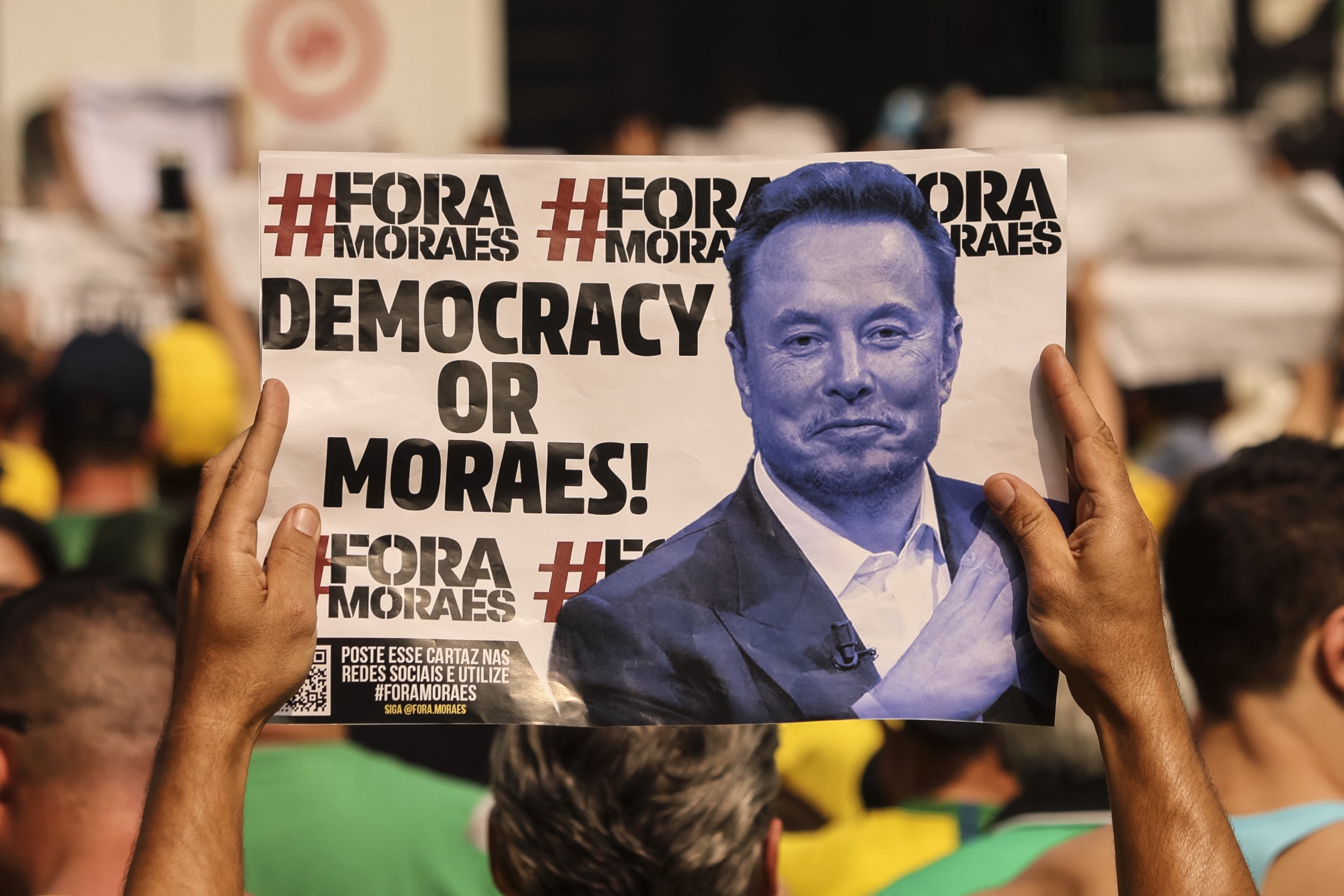
A supporter of former Brazil President Jair Bolsonaro holds a sign that has a picture of Elon Musk and the text,
Enlarge / Supporters of former President Jair Bolsonaro participate in an event in the central area of Sao Paulo, Brazil, on September 7, 2024. Bolsonaro backers called for the impeachment of Supreme Court Justice Alexandre de Moraes.
Getty Images | NurPhoto

Brazil seized about $2 million from a Starlink bank account and another $1.3 million from X to collect on fines issued to Elon Musk’s social network, the country’s Supreme Court announced Friday.

Supreme Court Judge Alexandre de Moraes previously froze the accounts of both companies, treating them as the same de facto economic group because both are controlled by Musk. The Starlink and X bank accounts were unfrozen last week after the money transfers ordered by de Moraes.

Two banks carried out orders to transfer the money from Starlink and X to Brazil’s government. “After the payment of the full amount that was owed, the justice (de Moraes) considered there was no need to keep the bank accounts frozen and ordered the immediate unfreezing of bank accounts/financial assets,” the court said, as quoted by The Associated Press.

The suspension of X’s social platform, formerly named Twitter, remains in place. The dispute began several months ago when Musk said he would disobey an order from de Moraes to suspend dozens of accounts accused of spreading disinformation. De Moraes later ordered the X social platform to be blocked by Internet service providers. X closed its office in Brazil and did not pay the fines.

Starlink initially said it would refuse to block X on its broadband service until the government unfroze its assets. Starlink quickly backtracked, agreeing to block X, but said it would fight the asset freeze in court. The Brazil Supreme Court’s announcement of the money transfers said that Starlink and X missed a deadline to appeal the finding that they are part of the same de facto economic group.

Shotwell accused justice of “harassing Starlink”

Starlink has called the order to freeze its assets “an unfounded determination that Starlink should be responsible for the fines levied—unconstitutionally—against X.” SpaceX President Gwynne Shotwell accused de Moraes of “harassing Starlink.”

X has said that de Moraes targeted the platform “simply because we would not comply with his illegal orders to censor his political opponents.” X also argued that it is not defying Brazilian law.

“We are absolutely not insisting that other countries have the same free speech laws as the United States. The fundamental issue at stake here is that Judge de Moraes demands we break Brazil’s own laws. We simply won’t do that,” X’s Global Government Affairs account wrote.

As noted by CNBC, Brazilian news agency UOL reported last week “that some of the accounts de Moraes ordered Musk to suspend at X belong to users who allegedly threatened federal police officers involved in a probe of former right-wing Brazilian President Jair Bolsonaro.”

Bolsonaro was accused of instigating the January 8, 2023, attack on the Brazilian Congress that occurred after Bolsonaro’s election loss. Bolsonaro and his supporters praised Musk in April of this year after Musk’s decision to defy the orders to block X accounts associated with Bolsonaro supporters.

https://arstechnica.com/?p=2050108


Biden moves to crack down on Shein and Temu, slow shipments into US

Biden moves to crack down on Shein and Temu, slow shipments into US

The Biden administration has proposed rules that could make it more costly for Chinese e-commerce platforms like Shein and Temu to ship goods into the US.

In his announcement proposing to crack down on “unsafe, unfairly traded products,” President Joe Biden accused China-founded e-commerce platforms selling cheap goods of abusing the “de minimis exemption” that makes shipments valued under $800 duty-free.

Platforms taking advantage of the exemption can share less information on packages and dodge taxes. Biden warned that “over the last 10 years, the number of shipments entering the United States claiming the de minimis exemption has increased significantly, from approximately 140 million a year to over 1 billion a year.” And the “majority of shipments entering the United States claiming the de minimis exemption originate from several China-founded e-commerce platforms,” Biden said.

As a result, America has been flooded with “huge volumes of low-value products such as textiles and apparel” that compete in the market “duty-free,” Biden said. And this “makes it increasingly difficult to target and block illegal or unsafe shipments” presumably lost in the flood.

Allowing this alleged abuse to continue would not just hurt US businesses like H&M and Zara that increasingly struggle to compete with platforms like Shein and Temu, Biden alleged. It would also allegedly make it “more challenging to enforce US trade laws, health and safety requirements, intellectual property rights, consumer protection rules, and to block illicit synthetic drugs such as fentanyl and synthetic drug raw materials and machinery from entering the country.”

Raising duties could make cheap goods shipped from China more expensive, potentially raising prices for consumers who clearly flocked to Shein and Temu to fulfill their shopping needs as the pandemic strained families’ wallets and the economy.

Specifically, Biden has proposed to exclude from the de minimis exemption all shipments “containing products covered by tariffs imposed under Sections 201 or 301 of the Trade Act of 1974, or Section 232 of the Trade Expansion Act of 1962.” That would include, Biden specified, “some e-commerce platforms and other foreign sellers” that currently “circumvent these tariffs by shipping items from China to the United States” and “claiming the de minimis exemption.”

New rules would also require e-commerce platforms to share more information on shipments, “including the 10-digit tariff classification number and the person claiming the de minimis exemption.” That would help weed out unlawful de minimis shipments, Biden suggested.

Shein and Temu defend business models

Neither Shein nor Temu seem ready to let the proposed guidance slow down their rapid growth.

“Since Temu’s launch in September 2022, our mission has been to offer consumers a wider selection of quality products at affordable prices,” Temu’s spokesperson told Ars. “We achieve this through an efficient business model that cuts out unnecessary middlemen, allowing us to pass savings directly to our customers.”

Temu’s spokesperson told Ars that the company is currently reviewing the new rule proposals and remains “committed to delivering value to consumers.”

“Temu’s growth does not depend on the de minimis policy,” Temu’s spokesperson told Ars.

Shein similarly does not seem fazed by the announcement. Starting this year, Shein began voluntarily sharing additional information on its low-value shipments into the US as part of a US Customs and Border Protection (CBP) pilot program. That change came after CBP expanded the pilot last year in its mission to test out ways to “identify and target high-risk shipments for inspection while expediting clearance of legitimate trade flows.”

Shein’s spokesperson told Ars that “Shein makes import compliance a top priority, including the reporting requirements under US law with respect to de minimis entries.”

Last year, Shein executive vice chairman Donald Tang proposed what he thought would be good de minimis reforms “to create a level, transparent playing field.” In a letter to an American trade association representing more than 1,000 famous brands, the American Apparel and Footwear Association, Tang called for applying the same rules evenly, no matter where a company is based or ships from.

This would enhance consumer trust, Tang suggested, while creating “an environment that allows companies to compete on the quality and authenticity of their product, the caliber of their business models, and the performance of their customer service, which has always been at the heart of American enterprise.”

https://arstechnica.com/?p=2049791


Boeing risks losing billions as 33,000 workers vote to strike

Union members cheer during a news conference following a vote count on the union contract at the IAM District 751 Main Union Hall in Seattle, Washington, US, on Thursday, Sept. 12, 2024.
Enlarge / Union members cheer during a news conference following a vote count on the union contract at the IAM District 751 Main Union Hall in Seattle, Washington, US, on Thursday, Sept. 12, 2024.

More than 33,000 unionized Boeing workers went on strike Friday, rejecting what they say were unfair terms of a deal the embattled aerospace company tentatively reached with their union.

The rejected deal tried and failed to win over workers by offering a 25 percent wage increase and promised to build Boeing’s next jet in the Puget Sound region in Washington, which Boeing claimed offered “job security for generations to come.”

But after International Association of Machinists and Aerospace Workers (IAM) District 751 president Jon Holden urged the union to accept the deal—which Boeing said was the “largest-ever general wage increase” in the company’s history—hundreds of Boeing employees immediately began resisting ahead of a Thursday vote that ultimately doomed the deal.

Instead of agreeing to a deal that compromised the desired 40 percent wage increases and eliminated workers’ annual bonuses, about 96 percent of workers voted to strike, The Washington Post reported. Rather than take what Boeing offered, workers seized rare leverage amid Boeing’s financial and production woes to pursue better terms.

“We’ve got a lot of leverage—why waste that?” Joe Philbin, a structures mechanic, told the Post ahead of the vote in a Seattle union hall Thursday. Philbin has only been with Boeing for six months but already wants changes in mandatory overtime rules.

An overwhelming majority of the union agreed that the deal was not good enough, so Holden told the gathered workers, “We strike at midnight.”

The statement incited loud cheers from workers who chanted, “Strike! Strike! Strike!”

Boeing workers have not walked out since 2008, when a 57-day strike cost Boeing about $1.5 billion, the Post reported. Analysts told Bloomberg that the current strike is estimated to last about 50 days, too, potentially costing Boeing between $3 billion and $3.5 billion.

The aerospace company cannot afford any work stoppage—let alone a strike from workers playing “a key role in assembling some of the company’s best-selling aircraft,” which the Post said could be the company’s “most disrupting challenge yet.” Analysts told the Post that on top of assembly delays in critical plants in Washington, an extended strike could hurt Boeing suppliers and Boeing’s market share.

Boeing’s spokesperson told Ars that the company is eager to get back to the bargaining table.

“The message was clear that the tentative agreement we reached with IAM leadership was not acceptable to the members,” Boeing’s spokesperson said. “We remain committed to resetting our relationship with our employees and the union, and we are ready to get back to the table to reach a new agreement.”

Why did Boeing workers reject the deal?

Boeing likely anticipated that the deal wasn’t good enough after Holden told The Seattle Times on Wednesday that workers would probably vote to strike.

Two days before that, Holden posted a message to workers after receiving “hundreds of messages and emails” expressing concerns about the tentative deal that he recommended that they accept.

“Emotions are high,” Holden acknowledged.

Holden told workers that it would have been impossible to respond to everyone individually and reassured them that the tentative deal was not binding.

“A Tentative Agreement is not certain or fixed, and it’s certainly not final,” Holden told workers. He further clarified that the deal simply represented the best terms that the union could get Boeing to agree to without a strike.

https://arstechnica.com/?p=2049657


“Fascists”: Elon Musk responds to proposed fines for disinformation on X

A smartphone displays Elon Musk's profile on X, the app formerly known as Twitter.
Getty Images | Dan Kitwood

Elon Musk has lambasted Australia’s government as “fascists” over proposed laws that could levy substantial fines on social media companies if they fail to comply with rules to combat the spread of disinformation and online scams.

The billionaire owner of social media site X posted the word “fascists” on Friday in response to the bill, which would strengthen the Australian media regulator’s ability to hold companies responsible for the content on their platforms and levy potential fines of up to 5 percent of global revenue. The bill, which was proposed this week, has yet to be passed.

Musk’s comments drew rebukes from senior Australian politicians, with Stephen Jones, Australia’s finance minister, telling national broadcaster ABC that it was “crackpot stuff” and the legislation was a matter of sovereignty.

Bill Shorten, the former leader of the Labor Party and a cabinet minister, accused the billionaire of only championing free speech when it was in his commercial interests. “Elon Musk’s had more positions on free speech than the Kama Sutra,” Shorten said in an interview with Australian radio.

The exchange marks the second time that Musk has confronted Australia over technology regulation.

In May, he accused the country’s eSafety Commissioner of censorship after the government agency took X to court in an effort to force it to remove graphic videos of a stabbing attack in Sydney. A court later denied the eSafety Commissioner’s application.

Musk has also been embroiled in a bitter dispute with authorities in Brazil, where the Supreme Court ruled last month that X should be blocked over its failure to remove or suspend certain accounts accused of spreading misinformation and hateful content.

Australia has been at the forefront of efforts to regulate the technology sector, pitting it against some of the world’s largest social media companies.

This week, the government pledged to introduce a minimum age limit for social media use to tackle “screen addiction” among young people.

In March, Canberra threatened to take action against Meta after the owner of Facebook and Instagram said it would withdraw from a world-first deal to pay media companies to link to news stories.

The government also introduced new data privacy measures to parliament on Thursday that would impose hefty fines and potential jail terms of up to seven years for people found guilty of “doxxing” individuals or groups.

Prime Minister Anthony Albanese’s government had pledged to outlaw doxxing—the publication of personal details online for malicious purposes—this year after the details of a private WhatsApp group containing hundreds of Jewish Australians were published online.

Australia is one of the first countries to pursue laws outlawing doxxing. It is also expected to introduce a tranche of laws in the coming months to regulate how personal data can be used by artificial intelligence.

“These reforms give more teeth to the regulation,” said Monique Azzopardi at law firm Clayton Utz.

© 2024 The Financial Times Ltd. All rights reserved. Not to be redistributed, copied, or modified in any way.

https://arstechnica.com/?p=2049624


Court clears researchers of defamation for identifying manipulated data

A formal red brick building on a college campus.
Enlarge / Harvard Business School was targeted by a faculty member’s lawsuit.

Earlier this year, we got a look at something unusual: the results of an internal investigation conducted by Harvard Business School that concluded one of its star faculty members had committed research misconduct. Normally, these reports are kept confidential, leaving questions regarding the methods and extent of data manipulations.

But in this case, the report became public because the researcher had filed a lawsuit that alleged defamation on the part of the team of data detectives that had first identified potential cases of fabricated data, as well as Harvard Business School itself. Now, the court has ruled on motions to dismiss the case. While the suit against Harvard will go on, the court has ruled that evidence-backed conclusions regarding fabricated data cannot constitute defamation—which is probably a very good thing for science.

Data and defamation

The researchers who had been sued, Uri Simonsohn, Leif Nelson, and Joe Simmons, run a blog called Data Colada where, among other things, they note cases of suspicious-looking data in the behavioral sciences. As we detailed in our earlier coverage, they published a series of blog posts describing an apparent case of fabricated data in four different papers published by the high-profile researcher Francesca Gino, a professor at Harvard Business School.

The researchers also submitted the evidence to Harvard, which ran its own investigation that included interviewing the researchers involved and examining many of the original data files behind the paper. In the end, Harvard determined that research misconduct had been committed, placed Gino on administrative leave and considered revoking her tenure. Harvard contacted the journals where the papers were published to inform them that the underlying data was unreliable.

Gino then filed suit alleging that Harvard had breached their contract with her, defamed her, and interfered with her relationship with the publisher of her books. She also added defamation accusations against the Data Colada team. Both Harvard and the Data Colada collective filed a motion to have all the actions dismissed, which brings us to this new decision.

Harvard got a mixed outcome. This appears to largely be the result that the Harvard Business School adopted a new and temporary policy for addressing research misconduct when the accusations against Gino came in. This, according to the court, leaves questions regarding whether the university had breached its contract with her.

However, most of the rest of the suit was dismissed. The judge ruled that the university informing Gino’s colleagues that Gino had been placed on administrative leave does not constitute defamation. Nor do the notices requesting retractions sent to the journals where the papers were published. “I find the Retraction Notices amount ‘only to a statement of [Harvard Business School]’s evolving, subjective view or interpretation of its investigation into inaccuracies in certain [data] contained in the articles,’ rather than defamation,” the judge decided.

Colada in the clear

More critically, the researchers had every allegation against them thrown out. Here, the fact that the accusations involved evidence-based conclusions, and were presented with typical scientific caution, ended up protecting the researchers.

The court cites precedent to note that “[s]cientific controversies must be settled by the methods of science rather than by the methods of litigation” and concludes that the material sent to Harvard “constitutes the Data Colada Defendants’ subjective interpretation of the facts available to them.” Since it had already been determined that Gino was a public figure due to her high-profile academic career, this does not rise to the standard of defamation.

And, while the Data Colada team was pretty definitive in determining that data manipulation had taken place, its members were cautious about acknowledging that the evidence they had did not clearly indicate Gino was the one who had performed the manipulation.

Finally, it was striking that the researchers had protected themselves by providing links to the data sources they’d used to draw their conclusions. The decision cites a precedent that indicates “by providing hyperlinks to the relevant information, the articles enable readers to review the underlying information for themselves and reach their own conclusions.”

So, overall, it appears that, by couching their accusations in the cautious language typical of scientific writing, the researchers ended up protecting themselves from accusations of defamation.

That’s an important message for scientists in general. One of the striking developments of the last few years has been the development of online communities where scientists identify and discuss instances of image and data manipulation, some of which have ultimately resulted in retractions and other career consequences. Every now and again, these activities have resulted in threats of lawsuits against these researchers or journalists who report on the issue. Occasionally, suits get filed.

Ultimately, it’s probably good for the scientific record that these suits are unlikely to succeed.

https://arstechnica.com/?p=2049567


US sting of online gun part sales started with a shipment marked “fidget spinner”

US sting of online gun part sales started with a shipment marked “fidget spinner”

Federal authorities have seized more than 350 websites after an undercover investigation revealed that the sites were used to illegally import gun parts into the US from China. To get the illegal items through customs, the sites described the items as toys, necklaces, car parts, tools, and even a fidget spinner.

The sites violated import bans and the National Firearms Act by selling switches—which are “parts designed to convert semiautomatic pistols into fully automatic machineguns”—and silencers—which “suppress the sound of a firearm when discharged,” a Department of Justice press release said.

Some sites also marketed counterfeit Glock parts, infringing trademark laws, including a phony Glock switch that Glock confirmed to investigators was “never manufactured.”

To mask the illegal sales, some sites used domain names referencing “auto parts,” “fuel filters,” or “solvent traps,” a special agent with Homeland Security Investigations (HSI) assigned to the Boston Field Office, Adam Rayho, wrote in an affidavit supporting the domain seizures. Further, some sites actually sold legitimate merchandise, including car products and home supplies, seemingly to obscure the illegal sales.

Others further infringed on Glock trademarks by including Glock or Glock products in the domain names, Rayho wrote.

“The seizure of these domains is a critical step in disrupting the flow of dangerous contraband that threatens public safety,” Acting US Attorney Joshua S. Levy said in the DOJ’s press release. “Those who attempt to exploit online platforms to traffic in highly lethal firearm parts will be held accountable. We will continue to pursue and dismantle these illicit networks wherever they operate to uphold the integrity of our laws and safeguard our communities.”

Feds increasingly seize sites to stop gun part sales

Rayho’s focus is on investigating “crimes that have a nexus to the clearnet or dark web” as part of HSI’s cybercrimes group. His team’s investigation began in August 2023, when the DOJ said that “federal authorities began targeting multiple websites, businesses, and individuals selling, offering for sale, importing, and exporting machinegun conversion devices in violation of federal law.”

This followed through on a HSI promise in 2020 to continue seizing websites to “suppress illicit commerce.” That’s when HSI first used the “novel approach” to shut down a website “wholly dedicated to illegal arms components.” Like many uncovered by Rayho’s team’s sting, that first site seized was disguised as an auto parts site. Previously, HSI had only been “aggressive in the seizure of Internet sites used to facilitate the sale of counterfeit goods.”

To shut down more sites masking illegal gun part sales, Rayho alleged that “an HSI agent acting in an undercover capacity” began visiting the targeted sites in August 2023. The agent found that some sites clearly marketed illegal gun parts while others used false descriptions with pictures and videos of the illegal merchandise. Many sites prompted users to inquire about illegal items on Telegram or WhatsApp and enabled payments by credit card, Apple Pay, or Google Pay. Some sites asked for payment in bitcoins.

Soon after learning how the websites worked, the agent began ordering gun parts, paying between $30 and $200 for shipments. By September 11, 2023, the agent received the first shipment, which contained a phony Glock switch and a silencer. US Customs and Border Protection confirmed that the cargo description for the package claimed that it contained a fidget spinner. Some sites promoted even faster delivery, promising to ship within 24 hours. Every package used a false description to fool customs, successfully pushing gun parts into the US by simply labeling them as objects unlikely to arouse suspicions, such as a tool, a motor, or a necklace. The most common false label was seemingly “toy.”

Also by September, Rayho wrote that HSI had confirmed that several of the seized domains that had been registered on GoDaddy.com appeared to be linked together, “as they had all been purchased by the same Shopper ID.” The agents “also identified additional domains purchased by the Shopper ID.” Rayho suspected that these additional domains were registered to quickly move sites to prevent forfeitures if the original domains were “seized by law enforcement or otherwise shut down.”

“Neither a restraining order nor an injunction is sufficient to guarantee” that sites would be available for forfeiture, Rayho wrote. The site owners “have the ability to move them to another computer/server or a third-party hosting service outside of the United States beyond this Court’s jurisdiction to anywhere in the world,” Rayho wrote, supporting HSI’s bid to seize the websites to prevent illegal gun part sales.

Federal authorities are unlikely to stop seizing domains, as the tactic has proven successful in improving gun safety in the US. Levy confirmed Wednesday that his office “remains committed to protecting our communities from the dangers posed by illegal firearms and firearm accessories, wherever the evidence takes us.”

Ketty Larco-Ward, the inspector in charge of the Boston division of the US Postal Inspection Service (PIS), promised that the PIS is also “committed” to helping federal authorities to “identify those who use the Postal Service to traffic these weapons, remove these illicit items from the mail, and increase the safety of our communities and the Postal Service employees who serve them.”

https://arstechnica.com/?p=2049393


Google’s ad tech empire may be $95B and “too big” to sell, analysts warn DOJ

A staffer with the Paul, Weiss legal firm wheels boxes of legal documents into the Albert V. Bryan US Courthouse at the start of a Department of Justice antitrust trial against Google over its advertiing business in Alexandria, Virginia, on September 9, 2024. Google faces its second major antitrust trial in less than a year, with the US government accusing the tech giant of dominating online advertising and stifling competition.
Enlarge / A staffer with the Paul, Weiss legal firm wheels boxes of legal documents into the Albert V. Bryan US Courthouse at the start of a Department of Justice antitrust trial against Google over its advertiing business in Alexandria, Virginia, on September 9, 2024. Google faces its second major antitrust trial in less than a year, with the US government accusing the tech giant of dominating online advertising and stifling competition.

Just a couple of days into the Google ad tech antitrust trial, it seems clear that the heart of the US Department of Justice’s case is proving that Google Ad Manager is the key to the tech giant’s alleged monopoly.

Google Ad Manager is the buy-and-sell side ad tech platform launched following Google’s acquisition of DoubleClick and AdX in 2008 for $3 billion. It is currently used to connect Google’s publisher ad servers with its ad exchanges, tying the two together in a way that allegedly locks the majority of publishers into paying higher fees on the publisher side because they can’t afford to drop Google’s ad exchange.

The DOJ has argued that Google Ad Manager “serves 90 percent of publishers that use the ad tech tools to sell their online ad inventory,” AdAge reported, and through it, Google clearly wields monopoly powers.

In her opening statement, DOJ attorney Julia Tarver Wood argued that acquisitions helped Google manipulate the rules of ad auctions to maximize profits while making it harder for rivals to enter and compete in the markets Google allegedly monopolized. The DOJ has argued those alleged monopolies are in markets “for publisher ad servers, advertiser ad networks, and the ad exchanges that connect the two,” Reuters reported.

Google has denied this characterization of its ad tech dominance, calling the DOJ’s market definitions too narrow. The tech company also pointed out that the Federal Trade Commission (FTC) investigated and unconditionally approved the DoubleClick merger in 2007, amidst what the FTC described as urgent “high profile public discussions of the competitive merits of the transaction, in which numerous (sometimes conflicting) theories of competitive harm were proposed.” At that time, the FTC concluded that the acquisition “was unlikely to reduce competition in any relevant antitrust market.”

But in its complaint, the DOJ argued that the DoubleClick “acquisition vaulted Google into a commanding position over the tools publishers use to sell advertising opportunities, complementing Google’s existing tool for advertisers, Google Ads, and set the stage for Google’s later exclusionary conduct across the ad tech industry.”

To set things right, at the very least, the DOJ has asked the court to order Google to spin off Google Ad Manager, which may or may not include valuable products like Google’s Display and Video 360 (DV360) platform. There is also the possibility that the US district judge, Leonie Brinkema, could order Google to sell off its ad tech business entirely.

One problem with those proposed remedies, analysts told AdAge, is that no one knows how big Google’s ad tech business really is or the actual value of Google Ad Manager.

Google Ad Manager could be worth less if Google’s DV360 platform isn’t included in the sale or if selling either the publisher or advertiser side cuts out data allowing Google to set the prices that it wants. The CEO of an ad platform called Permutive, Joe Root, told AdAge that “it is hard to say how much of the value of Google’s ads business is because it has this advertiser product and DV360, versus how much of its value comes from Google Ad Manager alone.”

Root doubts that Google Ad Manager is “on its own that valuable.” However, based on “newly released documents for the trial,” some analysts predict that “any new entity spun out of Google” would be “almost too big for any buyer,” AdAge reported.

One estimate from an ad tech consultant who helms a strategic advisory firm called Luma Partners, Terence Kawaja, suggested that Google’s ad tech business as a standalone company “could be worth up to $95 billion” today, AdAge reported.

“You can’t divest $100 billion,” Kawaja said. “There is no buyer for it. [Google] would have to spin it off to shareholders, that’s how any forced remedy would manifest.”

https://arstechnica.com/?p=2049078


AI ruling on jobless claims could make mistakes courts can’t undo, experts warn

AI ruling on jobless claims could make mistakes courts can’t undo, experts warn

Nevada will soon become the first state to use AI to help speed up the decision-making process when ruling on appeals that impact people’s unemployment benefits.

The state’s Department of Employment, Training, and Rehabilitation (DETR) agreed to pay Google $1,383,838 for the AI technology, a 2024 budget document shows, and it will be launched within the “next several months,” Nevada officials told Gizmodo.

Nevada’s first-of-its-kind AI will rely on a Google cloud service called Vertex AI Studio. Connecting to Google’s servers, the state will fine-tune the AI system to only reference information from DETR’s database, which officials think will ensure its decisions are “more tailored” and the system provides “more accurate results,” Gizmodo reported.

Under the contract, DETR will essentially transfer data from transcripts of unemployment appeals hearings and rulings, after which Google’s AI system will process that data, upload it to the cloud, and then compare the information to previous cases.

In as little as five minutes, the AI will issue a ruling that would’ve taken a state employee about three hours to reach without using AI, DETR’s information technology administrator, Carl Stanfield, told The Nevada Independent. That’s highly valuable to Nevada, which has a backlog of more than 40,000 appeals stemming from a pandemic-related spike in unemployment claims while dealing with “unforeseen staffing shortages” that DETR reported in July.

“The time saving is pretty phenomenal,” Stanfield said.

As a safeguard, the AI’s determination is then reviewed by a state employee to hopefully catch any mistakes, biases, or perhaps worse, hallucinations where the AI could possibly make up facts that could impact the outcome of their case.

Google’s spokesperson Ashley Simms told Gizmodo that the tech giant will work with the state to “identify and address any potential bias” and to “help them comply with federal and state requirements.” According to the state’s AI guidelines, the agency must prioritize ethical use of the AI system, “avoiding biases and ensuring fairness and transparency in decision-making processes.”

If the reviewer accepts the AI ruling, they’ll sign off on it and issue the decision. Otherwise, the reviewer will edit the decision and submit feedback so that DETR can investigate what went wrong.

Gizmodo noted that this novel use of AI “represents a significant experiment by state officials and Google in allowing generative AI to influence a high-stakes government decision—one that could put thousands of dollars in unemployed Nevadans’ pockets or take it away.”

Google declined to comment on whether more states are considering using AI to weigh jobless claims.

https://arstechnica.com/?p=2048889


“HAIL HOLY TERROR”: Two US citizens charged for running online “Terrorgram Collective”

The US government recently announced multiple charges against the alleged leaders of the “Terrorgram Collective,” which does just what it sounds like—it promotes terrorism on the Telegram messaging platform. In this case, the terrorism was white racial terror, complete with a “hit list” of US officials and activists, a homemade “White Terror” video glorifying “saints” who had killed others, and instructions for taking down US infrastructure such as electrical substation transformers. (Read the indictment.)

The group's criteria for "sainthood."
Enlarge / The group’s criteria for “sainthood.”

Chaos was the point. Terrorgram promoted “white supremacist accelerationism,” which believes that society must be incited into a civil war or apocalyptic confrontation in order to bring down the existing system of government and establish a white nationalist state.

The group’s manifestos and chat rooms sometimes felt suffused with the habits of the extremely online: hand-clap emojis between every important word, instructional videos on how to make bombs, the language of trolling, catchphrases so over the top they sound ironic (“HAIL HOLY TERROR” in all caps).

Despite using technology to organize and publicize its ideology, though, the group was skeptical of technology—or at least of certain kinds. “Do not let those technophiles have a day of rest!” said one post encouraging its readers to go after the local power grid.

“LEAVE. YOUR. PHONE. AT. HOME,” said another. “Death to the grid. Death to the System,” concluded a third. The group’s accelerationist manifesto was called “Hard Reset.”

An "encyclopedia" of killers, produced by Terrorgram.
Enlarge / An “encyclopedia” of killers, produced by Terrorgram.

But they were apparently happy to use other tech to spread the word. One Terrorgram publication was called “Do it for the Gram,” and Terrorgram admins created audiobooks of shooter manifestos, such as “A White Boy Summer to Remember.”

But Telegram, which combines the wider reach of channels and chat rooms (unencrypted) with the possibility of direct messaging (which can be encrypted), was a favorite spot for recruiting and sharing information. According to the government, Dallas Humber (34) of Elk Grove, California, and Matthew Allison (37) of Boise, Idaho, were the leaders of Terrorgram, which they appear to have run out in the open.

The group constantly encouraged violence, and it stressed the need for attackers to mentally prepare themselves to kill so as not to chicken out. But neither Humber nor Allison are accused of violence themselves; they seem to have been content to cheer on new martyrs to their cause.

The government traces several real-world killers to the Terrorgram community, including a 19-year-old from Slovakia who, in 2022, killed two people at an LGBTQ+ bar in Bratislava before sending his manifesto to Allison and then killing himself in a park. The manifesto specifically listed “Hard Reset” in its “Recommended Reading” section.

https://arstechnica.com/?p=2048921