Elon Musk’s X defeats Australia’s global takedown order of stabbing video
Elon Musk’s X defeats Australia’s global takedown order of stabbing video

Australia’s safety regulator has ended a legal battle with X (formerly Twitter) after threatening approximately $500,000 daily fines for failing to remove 65 instances of a religiously motivated stabbing video from X globally.

Enforcing Australia’s Online Safety Act, eSafety commissioner Julie Inman-Grant had argued it would be dangerous for the videos to keep spreading on X, potentially inciting other acts of terror in Australia.

But X owner Elon Musk refused to comply with the global takedown order, arguing that it would be “unlawful and dangerous” to allow one country to control the global Internet. And Musk was not alone in this fight. The legal director of a nonprofit digital rights group called the Electronic Frontier Foundation (EFF), Corynne McSherry, backed up Musk, urging the court to agree that “no single country should be able to restrict speech across the entire Internet.”

“We welcome the news that the eSafety Commissioner is no longer pursuing legal action against X seeking the global removal of content that does not violate X’s rules,” X’s Global Government Affairs account posted late Tuesday night. “This case has raised important questions on how legal powers can be used to threaten global censorship of speech, and we are heartened to see that freedom of speech has prevailed.”

Inman-Grant was formerly Twitter’s director of public policy in Australia and used that experience to land what she told The Courier-Mail was her “dream role” as Australia’s eSafety commissioner in 2017. Since issuing the order to remove the video globally on X, Inman-Grant had traded barbs with Musk (along with other Australian lawmakers), responding to Musk labeling her a “censorship commissar” by calling him an “arrogant billionaire” for fighting the order.

On X, Musk arguably got the last word, posting, “Freedom of speech is worth fighting for.”

Safety regulator still defends takedown order

In a statement, Inman-Grant said early Wednesday that her decision to discontinue proceedings against X was part of an effort to “consolidate actions,” including “litigation across multiple cases.” She ultimately determined that dropping the case against X would be the “option likely to achieve the most positive outcome for the online safety of all Australians, especially children.”

“Our sole goal and focus in issuing our removal notice was to prevent this extremely violent footage from going viral, potentially inciting further violence and inflicting more harm on the Australian community,” Inman-Grant said, still defending the order despite dropping it.

In court, X’s lawyer Marcus Hoyne had pushed back on such logic, arguing that the eSafety regulator’s mission was “pointless” because “footage of the attack had now spread far beyond the few dozen URLs originally identified,” the Australian Broadcasting Corporation reported.

“I stand by my investigators and the decisions eSafety made,” Inman-Grant said.

Other Australian lawmakers agree the order was not out of line. According to AP News, Australian Minister for Communications Michelle Rowland shared a similar statement in parliament today, backing up the safety regulator while scolding X users who allegedly took up Musk’s fight by threatening Inman-Grant and her family. The safety regulator has said that Musk’s X posts incited a “pile-on” from his followers who allegedly sent death threats and exposed her children’s personal information, the BBC reported.

“The government backs our regulators and we back the eSafety Commissioner, particularly in light of the reprehensible threats to her physical safety and the threats to her family in the course of doing her job,” Rowland said.

https://arstechnica.com/?p=2029167


GameStop stock influencer Roaring Kitty may lose access to E-Trade, report says

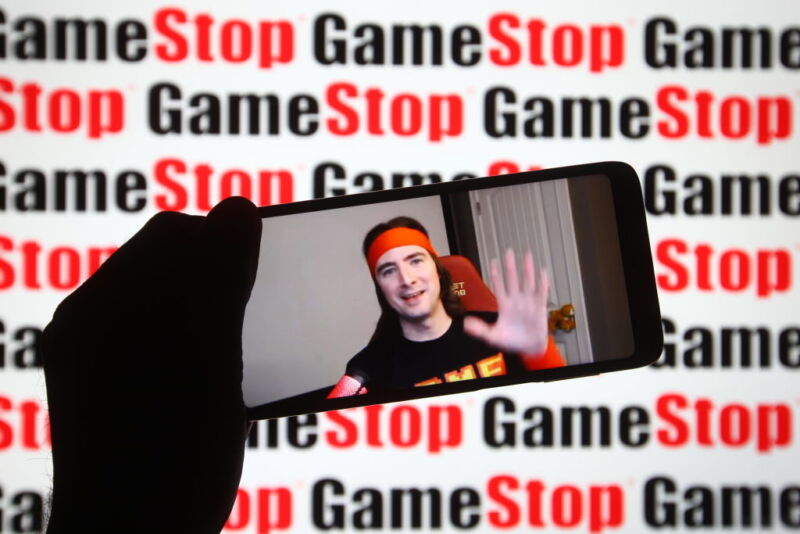
Keith Gill, known on Reddit under the pseudonym DeepFuckingValue and as Roaring Kitty, is seen on a fragment of a YouTube video.
Enlarge / Keith Gill, known on Reddit under the pseudonym DeepFuckingValue and as Roaring Kitty, is seen on a fragment of a YouTube video.

E-Trade is apparently struggling to balance the risks and rewards of allowing Keith Gill to continue trading volatile meme stocks on its platform, The Wall Street Journal reported.

The meme-stock influencer known as “Roaring Kitty” and “DeepF—Value” is considered legendary for instantly skyrocketing the price of stocks, notably GameStop, most recently with a single tweet.

E-Trade is concerned, according to The Journal’s insider sources, that on the one hand, Gill’s social media posts are potentially illegally manipulating the market—and possibly putting others’ investments at risk. But on the other, the platform worries that restricting Gill’s trading could incite a boycott fueled by his “meme army” closing their accounts “in solidarity.” That could also sharply impact trading on the platform, sources said.

It’s unclear what gamble E-Trade, which is owned by Morgan Stanley, might be willing to make. The platform could decide to take no action at all, the WSJ reported, but through its client agreement has the right to restrict or close Gill’s account “at any time.”

As of late Monday, Gill’s account was still active, the WSJ reported, apparently showing total gains of $85 million over the past three weeks. After Monday’s close, Gill’s GameStop positions “were valued at more than $289 million,” the WSJ reported.

Trading platforms unprepared for Gill’s comeback

In 2021, Gill’s social media activity on Reddit helped drive GameStop stock to historic highs. At that time, Gill encouraged others to invest in the stock—not based on the fundamentals of GameStop business but on his pure love for GameStop. The craze that he helped spark rapidly triggered temporary restrictions on GameStop trading, as well as a congressional hearing, but ultimately there were few consequences for Gill, who disappeared after making at least $30 million, the WSJ reported.

All remained quiet until a few weeks ago when Roaring Kitty suddenly came back. On X (formerly Twitter), Gill posted a meme of a man sitting up in his chair, then blitzed his feed with memes and movie clips, seemingly sending a continual stream of coded messages to his millions of followers who eagerly posted about their trades and gains on Reddit.

“Welcome back, legend,” one follower responded.

Once again, Gill’s abrupt surge in online activity immediately kicked off a GameStop stock craze fueling prices to a spike of more than 60 percent. And once again, because of the stock’s extreme volatility, Gill’s social posts prompted questions from both trading platforms and officials who continue to fret over whether Gill’s online influencing should be considered market manipulation.

For Gill’s biggest fans, the goal is probably to profit as much as possible before the hammer potentially comes down again and trading gets restricted. That started happening late on Sunday night, when it became harder or impossible to purchase GameStop shares on Robinhood, prompting some traders to complain on X.

The WallStreetBets account shared a warning that Robinhood sent to would-be buyers, which showed that trading was being limited, but not by Robinhood. Instead, the platform that facilitates Robinhood’s overnight trading of the stock, Blue Ocean ATS, set the limit, only accepting “trades 20 percent above or below” that day’s reference price—a move designed for legal or compliance reasons to stop trading once the stock exceeds a certain price.

These limits are set, the Securities and Exchange Commission (SEC) noted in 2021, partly to prevent fraudsters from spreading misleading tips online and profiting at the expense of investors from illegal price manipulation. A common form of this fraud is a pump-and-dump scheme, where fraudsters “make false and misleading statements to create a buying frenzy, and then sell shares at the pumped-up price.”

https://arstechnica.com/?p=2028866


TikTok vaguely disputes report that it’s making a US-only app

TikTok vaguely disputes report that it’s making a US-only app

TikTok is now disputing a Reuters report that claims the short-video app is cloning its algorithm to potentially offer a different version of the app, which might degrade over time, just for US users.

Sources “with direct knowledge” of the project—granted anonymity because they’re not authorized to discuss it publicly—told Reuters that the TikTok effort began late last year. They said that the project will likely take a year to complete, requiring hundreds of engineers to separate millions of lines of code.

As these sources reported, TikTok’s tremendous undertaking could potentially help prepare its China-based owner ByteDance to appease US lawmakers who passed a law in April forcing TikTok to sell its US-based operations by January 19 or face a ban. But TikTok has maintained that the “qualified divestiture” required by the law would be impossible, and on Thursday, TikTok denied the accuracy of Reuters’ report while reiterating its stance that a sale is not in the cards.

“The Reuters story published today is misleading and factually inaccurate,” the TikTok Policy account posted on X (formerly Twitter). “As we said in our court filing, the ‘qualified divestiture’ demanded by the Act to allow TikTok to continue operating in the United States is simply not possible: not commercially, not technologically, not legally. And certainly not on the 270-day timeline required by the Act.”

It remains unclear precisely which parts of Reuters’ report are supposedly “misleading and factually inaccurate.” A Reuters spokesperson said that Reuters stands by its reporting.

A TikTok spokesperson told Ars that “while we have continued work in good faith to further safeguard the authenticity of the TikTok experience, it is simply false to suggest that this work would facilitate divestiture or that divestiture is even a possibility.”

TikTok is currently suing to block the US law on First Amendment grounds, and this week a court fast-tracked that legal challenge to attempt to resolve the matter before the law takes effect next year. Oral arguments are scheduled to start this September, with a ruling expected by December 6, which Reuters reported leaves time for a potential Supreme Court challenge to that ruling.

However, in the meantime, sources told Reuters that TikTok is seemingly exploring all its options to avoid running afoul of the US law, including separating its code base and even once considering open-sourcing parts of its algorithm to increase transparency.

Separating out the code is not an easy task, insiders told Reuters.

“Compliance and legal issues involved with determining what parts of the code can be carried over to TikTok are complicating the work,” one source told Reuters. “Each line of code has to be reviewed to determine if it can go into the separate code base.”

But creating a US-only content-recommendation algorithm could be worth it, as it could allow TikTok US to operate independently from the China-based TikTok app in a manner that could satisfy lawmakers worried about the Chinese government potentially spying on Americans through the app.

However, there’s no guaranteeing that the US-only version of TikTok’s content-recommendation algorithm will perform as well as the currently available app in the US, sources told Reuters. By potentially cutting off TikTok US from Chinese engineers who developed and maintain the algorithm, US users could miss out on code updates improving or maintaining desired functionality. That means TikTok’s popular For You Page recommendations may suffer, as “TikTok US may not be able to deliver the same level of performance as the existing TikTok,” sources told Reuters.

https://arstechnica.com/?p=2028059


NYT targets Street View Worldle game in fight to wipe out Wordle clones

NYT targets Street View Worldle game in fight to wipe out Wordle clones

The New York Times is fighting to take down a game called Worldle, according to a legal filing viewed by the BBC, in which The Times apparently argued that the geography-based game is “creating confusion” by using a name that’s way too similar to Wordle.

Worldle is “nearly identical in appearance, sound, meaning, and imparts the same commercial impression” to Wordle, The Times claimed.

The Times bought Wordle in 2022, paying software developer Josh Wardle seven figures for the daily word-guessing puzzle game after its breakout success during the pandemic. Around the same time, Worldle was created—along with more than 100 other Wordle spinoffs offering niche alternatives to Wordle, including versions in different languages and completely different games simply using the name construction ending in “-le.” The Times filed for a Wordle trademark the day after buying the game and by March 2022, it started sending takedown requests.

Today, millions visit the Times site daily to play Wordle, but the Times is seemingly concerned that some gamers might be diverted to play Worldle instead, somehow mistaking the daily geography puzzle—where players have six chances to find a Google Street View location on a map—with the popular word game.

This fear seems somewhat overstated, since a Google search for “Worldle” includes Wordle in the top two results and suggests that searchers might be looking for Wordle, but a search for Wordle does not bring up Worldle in the top results.

Despite Google seemingly favoring the popular game in results and likely because of Wordle‘s enormous success, The Times’ litigiousness over the Wordle brand seems to be rising this year as the company looks to rapidly expand its profitable games platform to increase subscriptions. In March, 404 Media reported when The Times began more aggressively taking aim at hundreds of Wordle clones, sending DMCA notices to defend the Wordle trademark.

Some developers, like Chase Wackerfuss, the creator of Reactle, immediately took down their games, feeling it wasn’t worth getting into an intellectual property (IP) battle with the Times, 404 Media reported. The same thing happened with the Wordle Archive, which confirmed in 2022 that access to previous Wordle puzzles was shut down because “sadly, the New York Times has requested that the Wordle Archive be taken down.”

“To me, Wordle is like Tetris or a deck of cards. It’s such a simple premise,” Wackerfuss told 404 Media. He pointed to unique games that wouldn’t exist without building on Wordle‘s premise, including “a Taylor Swift version, a version in all different types of languages. The New York Times would never build those, so I’m not sure why they feel like we’re encroaching on their IP.”

But Worldle’s developer, Kory McDonald, is not backing down just because the Times threatened legal action.

McDonald told the BBC that he was disappointed in the Times targeting Worldle. He runs the game all by himself, attracting approximately 100,000 players monthly, and said that “most of the money he makes from the game goes to Google because he uses Google Street View images, which players have to try to identify.” The game can only be played through a web browser and is supported by ads and annual subscriptions that cost less than $12.

“I’m just a one-man operation here, so I was kinda surprised,” McDonald told the BBC, while vowing to defend his game against the Times’ attempt to take it down.

“There’s a whole industry of [dot]LE games,” McDonald told the BBC. “Wordle is about words, Worldle is about the world, Flaggle is about flags.”

It’s not clear how strong a case the Times would have to enforce the takedown or if it will target other “-le” games next. The list of potential next targets is long and includes a completely different game also called Worldle, where players guess the country based on its outline. Wackerfuss told 404 Media in March that it seemed like the Times was chasing down every lead.

The Times is not commenting on the legal action, the BBC reported, but in the past has targeted Wordle clones that either use the Wordle trademark or its copyrighted gameplay without authorization or permission.

Because McDonald’s game has vastly different gameplay than Wordle, the Times may be limited to only arguing that the similar-sounding names are creating confusion for an average user.

Now it seems possible that McDonald’s fight, if successful, could encourage others to resist takedowns over the Wordle trademark.

McDonald doesn’t think that “world” sounding too much like “word” is an issue, but even if the Times wins the fight, he intends to keep his game online.

“Worst-case scenario, we’ll change the name, but I think we’ll be OK,” McDonald told the BBC.

https://arstechnica.com/?p=2027980


Musk can’t avoid testifying in SEC probe of Twitter buyout by playing victim

Musk can’t avoid testifying in SEC probe of Twitter buyout by playing victim

After months of loudly protesting a subpoena, Elon Musk has once again agreed to testify in the US Securities and Exchange Commission’s investigation into his acquisition of Twitter (now called X).

Musk tried to avoid testifying by arguing that the SEC had deposed him twice before, telling a US district court in California that the most recent subpoena was “the latest in a long string of SEC abuses of its investigative authority.”

But the court did not agree that Musk testifying three times in the SEC probe was either “abuse” or “overly burdensome.” Especially since the SEC has said it’s seeking a follow-up deposition after receiving “thousands of new documents” from Musk and third parties over the past year since his last depositions. And according to an order requiring Musk and the SEC to agree on a deposition date from US district judge Jacqueline Scott Corley, “Musk’s lament does not come close to meeting his burden of proving ‘the subpoena was issued in bad faith or for an improper purpose.'”

“Under Musk’s theory of reasonableness, the SEC must wait to depose a percipient witness until it has first gathered all relevant documents,” Corley wrote in the order. “But the law does not support that theory. Nor does common sense. In an investigation, the initial depositions can help an agency identify what documents are relevant and need to be requested in the first place.”

Corley’s court filing today shows that Musk didn’t even win his fight to be deposed remotely. He has instead agreed to sit for no more than five hours in person, which the SEC argued “will more easily allow for assessment of Musk’s demeanor and be more efficient as it avoids delays caused by technology.” (Last month, Musk gave a remote deposition where the Internet cut in and out, and Musk repeatedly dropped off the call.)

Musk’s deposition will be scheduled by mid-July. He is expected to testify on his Twitter stock purchases prior to his purchase of the platform, as well as his other investments surrounding the acquisition.

The SEC has been probing Musk’s Twitter stock purchases to determine if he violated a securities law that requires disclosures within 10 days from anyone who buys more than a 5 percent stake in a company. Musk missed that deadline by 11 days, as he amassed close to a 10 percent stake, and a proposed class action lawsuit from Twitter shareholders has suggested that he intentionally missed the deadline to keep Twitter stock prices artificially low while preparing for his Twitter purchase.

In an amended complaint filed this week, an Oklahoma firefighters pension fund—which sold more than 14,000 Twitter shares while Musk went on his buying spree—laid out Musk’s alleged scheme. The firefighters claim that the “goal” of Musk’s strategy was to purchase Twitter “cost effectively” and that this scheme was carried out by an unnamed Morgan Stanley banker who was motivated “to acquire billions of dollars of Twitter securities without tipping off the market” to curry favor with Musk.

As a seeming result, the firefighters’ complaint alleged that Morgan Stanley “pocketed over $1,460,000 in commissions just for executing” the “secret Twitter stock acquisition scheme.” And Morgan Stanley’s work seemingly pleased Musk so much that he went back for financial advising on the Twitter deal, the complaint alleged, paying Morgan Stanley an “estimated $42 million in fees.”

Messages from the banker show he was determined to keep the trading “absofuckinglutely quiet” to avoid the prospect that “anyone sniff anything out.”

Because of this secrecy, Twitter “investors suffered enormous damages” when Musk “belatedly disclosed his Twitter interests,” and “the price of Twitter’s stock predictably skyrocketed,” the complaint said.

“Ultimately, Musk went from owning zero shares of Twitter stock as of January 28, 2022 to spending over $2.6 billion to secretly acquire over 70 million shares” on April 4, 2022, the complaint said.

https://arstechnica.com/?p=2027885


Washing machine chime scandal shows how absurd YouTube copyright abuse can get

Washing machine chime scandal shows how absurd YouTube copyright abuse can get

YouTube’s Content ID system—which automatically detects content registered by rightsholders—is “completely fucking broken,” a YouTuber called “Albino” declared in a rant on X (formerly Twitter) viewed more than 950,000 times.

Albino, who is also a popular Twitch streamer, complained that his YouTube video playing through Fallout was demonetized because a Samsung washing machine randomly chimed to signal a laundry cycle had finished while he was streaming.

Apparently, YouTube had automatically scanned Albino’s video and detected the washing machine chime as a song called “Done”—which Albino quickly saw was uploaded to YouTube by a musician known as Audego nine years ago.

But when Albino hit play on Audego’s song, the only thing that he heard was a 30-second clip of the washing machine chime. To Albino it was obvious that Audego didn’t have any rights to the jingle, which Dexerto reported actually comes from the song “Die Forelle” (“The Trout”) from Austrian composer Franz Schubert.

The song was composed in 1817 and is in the public domain. Samsung has used it to signal the end of a wash cycle for years, sparking debate over whether it’s the catchiest washing machine song and inspiring at least one violinist to perform a duet with her machine. It’s been a source of delight for many Samsung customers, but for Albino, hearing the jingle appropriated on YouTube only inspired ire.

“A guy recorded his fucking washing machine and uploaded it to YouTube with Content ID,” Albino said in a video on X. “And now I’m getting copyright claims” while “my money” is “going into the toilet and being given to this fucking slime.”

Albino suggested that YouTube had potentially allowed Audego to make invalid copyright claims for years without detecting the seemingly obvious abuse.

“How is this still here?” Albino asked. “It took me one Google search to figure this out,” and “now I’m sharing revenue with this? That’s insane.”

At first, Team YouTube gave Albino a boilerplate response on X, writing, “We understand how important it is for you. From your vid, it looks like you’ve recently submitted a dispute. When you dispute a Content ID claim, the person who claimed your video (the claimant) is notified and they have 30 days to respond.”

Albino expressed deep frustration at YouTube’s response, given how “egregious” he considered the copyright abuse to be.

“Just wait for the person blatantly stealing copyrighted material to respond,” Albino responded to YouTube. “Ah okay, yes, I’m sure they did this in good faith and will make the correct call, though it would be a shame if they simply clicked ‘reject dispute,’ took all the ad revenue money and forced me to risk having my channel terminated to appeal it!! XDxXDdxD!! Thanks Team YouTube!”

Soon after, YouTube confirmed on X that Audego’s copyright claim was indeed invalid. The social platform ultimately released the claim and told Albino to expect the changes to be reflected on his channel within two business days.

Ars could not immediately reach YouTube or Albino for comment.

Widespread abuse of Content ID continues

YouTubers have complained about abuse of Content ID for years. Techdirt’s Timothy Geigner agreed with Albino’s assessment that the YouTube system is “hopelessly broken,” noting that sometimes content is flagged by mistake. But just as easily, bad actors can abuse the system to claim “content that simply isn’t theirs” and seize sometimes as much as millions in ad revenue.

In 2021, YouTube announced that it had invested “hundreds of millions of dollars” to create content management tools, of which Content ID quickly emerged as the platform’s go-to solution to detect and remove copyrighted materials.

At that time, YouTube claimed that Content ID was created as a “solution for those with the most complex rights management needs,” like movie studios and record labels whose movie clips and songs are most commonly uploaded by YouTube users. YouTube warned that without Content ID, “rightsholders could have their rights impaired and lawful expression could be inappropriately impacted.”

Since its rollout, more than 99 percent of copyright actions on YouTube have consistently been triggered automatically through Content ID.

And just as consistently, YouTube has seen widespread abuse of Content ID, terminating “tens of thousands of accounts each year that attempt to abuse our copyright tools,” YouTube said. YouTube also acknowledged in 2021 that “just one invalid reference file in Content ID can impact thousands of videos and users, stripping them of monetization or blocking them altogether.”

To help rightsholders and creators track how much copyrighted content is removed from the platform, YouTube started releasing biannual transparency reports in 2021. The Electronic Frontier Foundation (EFF), a nonprofit digital rights group, applauded YouTube’s “move towards transparency” while criticizing YouTube’s “claim that YouTube is adequately protecting its creators.”

“That rings hollow,” EFF reported in 2021, noting that “huge conglomerates have consistently pushed for more and more restrictions on the use of copyrighted material, at the expense of fair use and, as a result, free expression.” As EFF saw it then, YouTube’s Content ID system mainly served to appease record labels and movie studios, while creators felt “pressured” not to dispute Content ID claims out of “fear” that their channel might be removed if YouTube consistently sided with rights holders.

According to YouTube, “it’s impossible for matching technology to take into account complex legal considerations like fair use or fair dealing,” and that impossibility seemingly ensures that creators bear the brunt of automated actions even when it’s fair to use copyrighted materials.

At that time, YouTube described Content ID as “an entirely new revenue stream from ad-supported, user generated content” for rights holders, who made more than $5.5 billion from Content ID matches by December 2020. More recently, YouTube reported that figure climbed above $9 billion, as of December 2022. With so much money at play, it’s easy to see how the system could be seen as disproportionately favoring rights holders, while creators continue to suffer from income diverted by the automated system.

https://arstechnica.com/?p=2027752


Amazon execs may be personally liable for tricking users into Prime sign-ups

Amazon execs may be personally liable for tricking users into Prime sign-ups

Yesterday, Amazon failed to convince a US district court to dismiss the Federal Trade Commission’s lawsuit targeting the tech giant’s alleged history of tricking people into signing up for Prime.

The FTC has alleged that Amazon “tricked, coerced, and manipulated consumers into subscribing to Amazon Prime,” a court order said, failing to get informed consent by designing a murky sign-up process. And to keep subscriptions high, Amazon also “did not provide simple mechanisms for these subscribers to cancel their Prime memberships,” the FTC alleged. Instead, Amazon forced “consumers intending to cancel to navigate a four-page, six-click, fifteen-option cancellation process.”

In their motion to dismiss, Amazon outright disputed these characterizations of its business, insisting its enrollment process was clear, its cancellation process was simple, and none of its executives could be held responsible for failing to fix these processes when “accidental” sign-ups became widespread. Amazon defended its current practices, arguing that some of its Prime disclosures “align with practices that the FTC encourages in its guidance documents.”

But the judge apparently did not find Amazon’s denials completely persuasive. Viewing the FTC’s complaint “in the light most favorable to the FTC,” Judge John Chun concluded that “the allegations sufficiently indicate that Amazon had actual or constructive knowledge that its Prime sign-up and cancellation flows were misleading consumers.”

In his order, Chun also denied individual motions to dismiss from Amazon executives Russell Grandinetti, Neil Lindsay, and Jamil Ghani, who oversaw Prime operations.

Executives had urged the court to dismiss the FTC’s claims against them. They argued that the FTC “singled them out ‘for an ‘unprecedented sanction'” when the agency had “only recently started prosecuting companies for using ‘dark patterns'” under Restore Online Shoppers’ Confidence Act (ROSCA) and the FTC Act. They claimed that the FTC never alerted them to any wrongdoing before filing the lawsuit, so how could they have known they were violating the law?

According to Chun, however, the FTC sufficiently alleged that each of these executives knew they were violating consumer protection laws when prioritizing profits over eliminating dark patterns triggering “accidental” or “nonconsensual” Prime sign-ups.

Chun explained that executives may be “personally liable for corporate violations of the FTC Act if the individual ‘participated directly in, or had the authority to control, the unlawful acts or practices at issue.'”

For example, when Lindsay—who in 2016 had the “most responsibility for the Prime subscription program”—was “asked about Amazon’s use of dark patterns during the Prime enrollment process,” Lindsay justified the dark patterns.

“Lindsay explained that once consumers become Prime members—even unknowingly—they will see what a great program it is and remain members, so Amazon is ‘okay’ with the situation,” Chun’s order said.

And when Grandinetti, who “oversaw the Prime subscription program” in 2018, was told that the sign-up process and auto-renew feature frustrated customers, he “vetoed any changes that would reduce enrollment.”

Because executives seemingly prioritized profits over reducing customer friction, the FTC alleged that reasonable customers got sucked into Prime without their consent. Sometimes customers understandably got confused by the “discrepancy in size, location, and color” of Amazon’s disclosures, Chun suggested. Other times, confusion struck when Amazon tried to upsell customers on Prime at checkout—pairing their enrollment with their other shopping experience.

One such trick that Chun called out saw Amazon offering two-day free shipping with the click of a button at checkout that also signed customers up for Prime even if they didn’t complete the purchase.

“With the offer of Amazon Prime for the purpose of free shipping, reasonable consumers could assume that they would not proceed with signing up for Prime unless they also placed their order,” Chun said, ultimately rejecting Amazon’s claims that all of its “disclosures would be clear and conspicuous to any reasonable consumer.”

Responding to Chun’s order, an Amazon spokesperson told Ars that Amazon denies the FTC’s allegations as false.

“The FTC’s claims are false on the facts and the law,” Amazon’s spokesperson told Ars. “The truth is that customers love Prime, and by design we make it clear and simple for customers to both sign up for or cancel their Prime membership. As with all our products and services, we continually listen to customer feedback and look for ways to improve the customer experience, and we look forward to the opportunity to present the real facts in the case.”

https://arstechnica.com/?p=2027607


Google accused of secretly tracking drivers with disabilities

Google accused of secretly tracking drivers with disabilities

Google needs to pump the brakes when it comes to tracking sensitive information shared with DMV sites, a new lawsuit suggests.

Filing a proposed class-action suit in California, Katherine Wilson has accused Google of using Google Analytics and DoubleClick trackers on the California DMV site to unlawfully obtain information about her personal disability without her consent.

This, Wilson argued, violated the Driver’s Privacy Protection Act (DPPA), as well as the California Invasion of Privacy Act (CIPA), and impacted perhaps millions of drivers who had no way of knowing Google was collecting sensitive information shared only for DMV purposes.

“Google uses the personal information it obtains from motor vehicle records to create profiles, categorize individuals, and derive information about them to sell its customers the ability to create targeted marketing and advertising,” Wilson alleged.

According to Wilson, California’s DMV “encourages” drivers “to use its website rather than visiting one of the DMV’s physical locations” without telling drivers that Google has trackers all over its site.

Likely due to promoting the website’s convenience, the DMV reported a record number of online transactions in 2020, Wilson’s complaint said. And people with disabilities have taken advantage of that convenience. In 2023, approximately “40 percent of the 1.6 million disability parking placard renewals occurred online.”

Wilson last visited the DMV site last summer when she was renewing her disability parking placard online. At that time, she did not know that Google obtained her personal information when she filled out her application, communicated directly with the DMV, searched on the site, or clicked on various URLs, all of which she said revealed that either she had a disability or believed she had a disability.

Her complaint alleged that Google secretly gathers information about the contents of the DMV’s online users’ searches, logging sensitive keywords like “teens,” “disabled drivers,” and any “inquiries regarding disabilities.”

Google “knowingly” obtained this information, Wilson alleged, to quietly expand user profiles for ad targeting, “intentionally” disregarding DMV website users’ “reasonable expectation of privacy.”

“Google then uses the personal information and data to generate revenue from the advertising and marketing services that Google sells to businesses and individuals,” Wilson’s complaint alleged. “That Plaintiff and Class Members would not have consented to Google obtaining their personal information or learning the contents of their communications with the DMV is not surprising.”

Congressman James P. Moran, who sponsored the DPPA in 1994, made it clear that the law was enacted specifically to keep marketers from taking advantage of computers making it easy to “pull up a person’s DMV record” with the “click of a button.”

Even back then, some people were instantly concerned about any potential “invasion of privacy,” Moran said, noting that “if you review the way in which people are classified by direct marketers based on DMV information, you can see why some individuals might object to their personal information being sold.”

According to a Google spokesperson, Google does not own or control the data that businesses collect through Google Analytics and Google never uses Google Analytics data for its own ad targeting or profile building. Instead, businesses control the data and are required to alert customers when using Google Analytics and to get consent where legally required. Businesses are prohibited, through Google’s Health Insurance Portability and Accountability Act (HIPAA) policy, from collecting protected health information through Google Analytics.

https://arstechnica.com/?p=2027492


Another US state repeals law that protected ISPs from municipal competition

Illustration of network data represented by curving lines flowing on a dark background.
Getty Images | Yuichiro Chino

Minnesota this week eliminated two laws that made it harder for cities and towns to build their own broadband networks. The state-imposed restrictions were repealed in an omnibus commerce policy bill signed on Tuesday by Gov. Tim Walz, a Democrat.

Minnesota was previously one of about 20 states that imposed significant restrictions on municipal broadband. The number can differ depending on who’s counting because of disagreements over what counts as a significant restriction. But the list has gotten smaller in recent years because states including Arkansas, Colorado, and Washington repealed laws that hindered municipal broadband.

The Minnesota bill enacted this week struck down a requirement that municipal telecommunications networks be approved in an election with 65 percent of the vote. The law is over a century old, the Institute for Local Self-Reliance’s Community Broadband Network Initiative wrote yesterday.

“Though intended to regulate telephone service, the way the law had been interpreted after the invention of the Internet was to lump broadband in with telephone service thereby imposing that super-majority threshold to the building of broadband networks,” the broadband advocacy group said.

The Minnesota omnibus bill also changed a law that let municipalities build broadband networks, but only if no private providers offer service or will offer service “in the reasonably foreseeable future.” That restriction had been in effect since at least the year 2000.

The caveat that prevented municipalities from competing against private providers was eliminated from the law when this week’s omnibus bill was passed. As a result, the law now lets cities and towns “improve, construct, extend, and maintain facilities for Internet access and other communications purposes” even if private ISPs already offer service.

“States are dropping misguided barriers”

The omnibus bill also added language intended to keep government-operated and private networks on a level playing field. The new language says cities and towns may “not discriminate in favor of the municipality’s own communications facilities by granting the municipality more favorable or less burdensome terms and conditions than a nonmunicipal service provider” with respect to the use of public rights-of-way, publicly owned equipment, and permitting fees.

Additional new language requires “separation between the municipality’s role as a regulator… and the municipality’s role as a competitive provider of services,” and forbids the sharing of “inside information” between the local government’s regulatory and service-provider divisions.

With Minnesota having repealed its anti-municipal broadband laws, the Institute for Local Self-Reliance says that 16 states still restrict the building of municipal networks.

The Minnesota change “is a significant win for the people of Minnesota and highlights a positive trend—states are dropping misguided barriers to deploying public broadband as examples of successful community-owned networks proliferate across the country,” said Gigi Sohn, executive director of the American Association for Public Broadband (AAPB), which represents community-owned broadband networks and co-ops.

There are about 650 public broadband networks in the US, Sohn said. “While 16 states still restrict these networks in various ways, we’re confident this number will continue to decrease as more communities demand the freedom to choose the network that best serves their residents,” she said.

State laws restricting municipal broadband have been passed for the benefit of private ISPs. Although cities and towns generally only build networks when private ISPs haven’t fully met their communities’ needs, those attempts to build municipal networks often face opposition from private ISPs and “dark money” groups that don’t reveal their donors.

https://arstechnica.com/?p=2027041


Biden’s new import rules will hit e-bike batteries too

family on cargo e-bike

Last week, the Biden administration announced it would levy dramatic new tariffs on electric vehicles, electric vehicle batteries, and battery components imported into the United States from China. The move kicked off another round of global debate on how best to push the transportation industry toward an emissions-free future, and how global automotive manufacturers outside of China should compete with the Asian country’s well-engineered and low-cost car options.

But what is an electric vehicle exactly? China has dominated bicycle manufacturing, too; it was responsible for some 80 percent of US bicycle imports in 2021, according to one report. In cycling circles, the US’s new trade policies have raised questions about how much bicycle companies will have to pay to get Chinese-made bicycles and components into the US, and whether any new costs will get passed on to US customers.

On Wednesday, the Office of the United States Trade Representative—the US agency that creates trade policy—clarified that ebike batteries would be affected by the new policy, too.

In a written statement, Angela Perez, a spokesperson for the USTR, said that e-bike batteries imported from China on their own will be subject to new tariffs of 25 percent in 2026, up from 7.5 percent.

But it’s unclear whether imported complete e-bikes, as well as other cycling products including children’s bicycles and bicycle trailers, might be affected by new US trade policies. These products have technically been subject to 25 percent tariffs since the Trump administration. But US trade officials have consistently used exclusions to waive tariffs for many of those cycling products. The latest round of exclusions are set to expire at the end of this month.

Perez, the USTR spokesperson, said the future of tariff exclusions related to bicycles would be “addressed in the coming days.”

If the administration does not extend tariff exclusions for some Chinese-made bicycle products, “it will not help adoption” of e-bikes, says Matt Moore, the head of policy at the bicycle advocacy group PeopleForBikes. Following the announcement of additional tariffs on Chinese products earlier this month, PeopleForBikes urged its members to contact local representatives and advocate for an extension of the tariff exclusions. The group estimates tariff exclusions have saved the bike industry more than $130 million since 2018. It’s hard to pinpoint how much this has saved bicycle buyers, but in general, Moore says, companies that pay higher “landed costs”—that is, the cost of the product to get from the factory floor to an owner’s home—raise prices to cover their margins.

The tariff tussle comes as the US is in the midst of an extended electric bicycle boom. US sales of e-bikes peaked in 2022 at $903 million, up from $240 million in 2019, according to Circana’s Retail Tracking Service. Sales spiked as Americans looked for ways to get active and take advantage of the pandemic era’s empty streets. E-bike sales fell last year, but have ticked up by 4 percent since the start of 2024, according to Circana.

In the US, climate-conscious state and local governments have started to think more seriously about subsidizing electric bicycles in the way they have electric autos. States including Colorado and Hawaii give rebates to income-qualified residents. E-bike rebate programs in Denver and Connecticut were so popular among cyclists that they ran out of funding in days.

A paper published last year by researchers with the University of California, Davis, suggests these sorts of programs might work. It found that people who used local and state rebate programs to buy e-bikes reported bicycling more after their purchases. Almost 40 percent of respondents said they replaced at least one weekly car trip with their e-bike in the long-term—the kind of shift that could put a noticeable dent in carbon emissions.

This story originally appeared on wired.com

https://arstechnica.com/?p=2026997