Bumble apologizes for ads shaming women into sex

Bumble apologizes for ads shaming women into sex

For the past decade, the dating app Bumble has claimed to be all about empowering women. But under a new CEO, Lidiane Jones, Bumble is now apologizing for a tone-deaf ad campaign that many users said seemed to channel incel ideology by telling women to stop denying sex.

“You know full well a vow of celibacy is not the answer,” one Bumble billboard seen in Los Angeles read. “Thou shalt not give up on dating and become a nun,” read another.

Bumble intended these ads to bring “joy and humor,” the company said in an apology posted on Instagram after the backlash on social media began.

Some users threatened to delete their accounts, criticizing Bumble for ignoring religious or personal reasons for choosing celibacy. These reasons include preferring asexuality or sensibly abstaining from sex amid diminishing access to abortion nationwide.

Others accused Bumble of more shameful motives. On X (formerly Twitter), a user called UjuAnya posted that “Bumble’s main business model is selling men access to women,” since market analysts have reported that 76 percent of Bumble users are male.

“Bumble won’t alienate their primary customers (men) telling them to quit being shit,” UjuAnya posted on X. “They’ll run ads like this to make their product (women) ‘better’ and more available on their app for men.”

That account quote-tweeted an even more popular post with nearly 3 million views suggesting that Bumble needs to “fuck off and stop trying to shame women into coming back to the apps” instead of running “ads targeted at men telling them to be normal.”

One TikTok user, ItsNeetie, declared, “the Bumble reckoning is finally here.”

Bumble did not respond to Ars’ request to respond to these criticisms or verify user statistics.

In its apology, Bumble took responsibility for not living up to its “values” of “passionately” standing up for women and marginalized communities and defending “their right to fully exercise personal choice.” Admitting the ads were a “mistake” that “unintentionally” frustrated the dating community, the dating app responded to some of the user feedback:

Some of the perspectives we heard were from those who shared that celibacy is the only answer when reproductive rights are continuously restricted; from others for whom celibacy is a choice, one that we respect; and from the asexual community, for whom celibacy can have a particular meaning and importance, which should not be diminished. We are also aware that for many, celibacy may be brought on by harm or trauma.

Bumble’s pulled ads were part of a larger marketing campaign that at first seemed to resonate with its users. Created by the company’s in-house creative studio, according to AdAge, Bumble’s campaign attracted a lot of eyeballs by deleting Bumble’s entire Instagram feed and posting “cryptic messages” showing tired women in Renaissance-era paintings that alluded to the app’s rebrand.

In a press release, chief marketing officer Selby Drummond said that Bumble “wanted to take a fun, bold approach in celebrating the first chapter of our app’s evolution and remind women that our platform has been solving for their needs from the start.”

The dating app is increasingly investing in ads, AdAge reported, tripling investments from $8 million in 2022 to $24 million in 2023. These ads are seemingly meant to help Bumble recover after posting “a $1.9 million net loss last year,” CNN reported, following a dismal drop in its share price by 86 percent since its initial public offering in February 2021.

Bumble’s new CEO Jones told NBC News that younger users are dating less and that Bumble’s plan was to listen to users to find new ways to grow.

https://arstechnica.com/?p=2024917


Concerns over addicted kids spur probe into Meta and its use of dark patterns

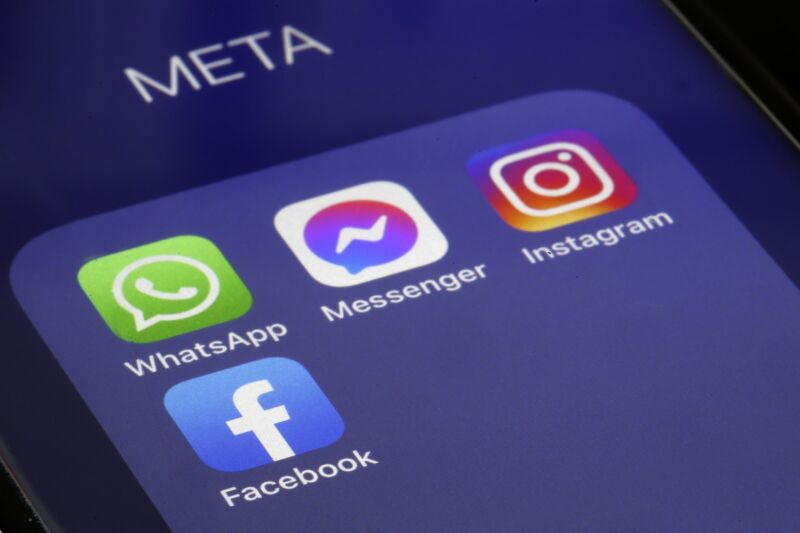
An iPhone screen displays the app icons for WhatsApp, Messenger, Instagram, and Facebook in a folder titled
Getty Images | Chesnot

Brussels has opened an in-depth probe into Meta over concerns it is failing to do enough to protect children from becoming addicted to social media platforms such as Instagram.

The European Commission, the EU’s executive arm, announced on Thursday it would look into whether the Silicon Valley giant’s apps were reinforcing “rabbit hole” effects, where users get drawn ever deeper into online feeds and topics.

EU investigators will also look into whether Meta, which owns Facebook and Instagram, is complying with legal obligations to provide appropriate age-verification tools to prevent children from accessing inappropriate content.

The probe is the second into the company under the EU’s Digital Services Act. The landmark legislation is designed to police content online, with sweeping new rules on the protection of minors.

It also has mechanisms to force Internet platforms to reveal how they are tackling misinformation and propaganda.

The DSA, which was approved last year, imposes new obligations on very large online platforms with more than 45 million users in the EU. If Meta is found to have broken the law, Brussels can impose fines of up to 6 percent of a company’s global annual turnover.

Repeat offenders can even face bans in the single market as an extreme measure to enforce the rules.

Thierry Breton, commissioner for internal market, said the EU was “not convinced” that Meta “has done enough to comply with the DSA obligations to mitigate the risks of negative effects to the physical and mental health of young Europeans on its platforms Facebook and Instagram.”

“We are sparing no effort to protect our children,” Breton added.

Meta said: “We want young people to have safe, age-appropriate experiences online and have spent a decade developing more than 50 tools and policies designed to protect them. This is a challenge the whole industry is facing, and we look forward to sharing details of our work with the European Commission.”

In the investigation, the commission said it would focus on whether Meta’s platforms were putting in place “appropriate and proportionate measures to ensure a high level of privacy, safety, and security for minors.” It added that it was placing special emphasis on default privacy settings for children.

Last month, the EU opened the first probe into Meta under the DSA over worries the social media giant is not properly curbing disinformation from Russia and other countries.

Brussels is especially concerned whether the social media company’s platforms are properly moderating content from Russian sources that may try to destabilize upcoming elections across Europe.

Meta defended its moderating practices and said it had appropriate systems in place to stop the spread of disinformation on its platforms.

© 2024 The Financial Times Ltd. All rights reserved. Not to be redistributed, copied, or modified in any way.

https://arstechnica.com/?p=2024851


Report: Microsoft to face antitrust case over Teams

Report: Microsoft to face antitrust case over Teams

Brussels is set to issue new antitrust charges against Microsoft over concerns that the software giant is undermining rivals to its videoconferencing app Teams.

According to three people with knowledge of the move, the European Commission is pressing ahead with a formal charge sheet against the world’s most valuable listed tech company over concerns it is restricting competition in the sector.

Microsoft last month offered concessions as it sought to avoid regulatory action, including extending a plan to unbundle Teams from other software such as Office, not just in Europe but across the world.

However, people familiar with their thinking said EU officials were still concerned that the company did not go far enough to facilitate fairness in the market.

Rivals are concerned that Microsoft will make Teams run more compatibly than rival apps with its own software. Another concern is the lack of data portability, which makes it difficult for existing Teams users to switch to alternatives.

The commission’s move would represent an escalation of a case that dates back to 2020 after Slack, now owned by Salesforce, submitted a formal complaint over Microsoft’s Teams.

It also would end a decade-long truce between EU regulators and the US tech company, after a series of competition probes that ended in 2013. The EU then issued a 561 million euro fine against Microsoft for failure to comply with a decision over the bundling of the Internet Explorer browser with its Windows operating system.

Charges could come in the next few weeks, said the people familiar with the commission’s thinking. Rivals of Microsoft and the commission are meeting this week to discuss the case, in an indication that the charges are being prepared, the people said.

However, they warned that Microsoft could still offer last-minute concessions that would derail the EU’s case, or the commission might decide to delay or scrap the charges against the company.

Microsoft risks fines of up to 10 percent of its global annual turnover if found to have breached the EU competition law.

The company declined to comment but referred to an earlier statement that said it would “continue to engage with the commission, listen to concerns in the marketplace, and remain open to exploring pragmatic solutions that benefit both customers and developers in Europe.”

The commission declined to comment.

The move against Microsoft comes at a time of heightened scrutiny of its activities. The EU is also investigating whether the tech group’s $13 billion alliance with ChatGPT maker OpenAI breaks competition law.

Microsoft is also part of a handful of tech companies, including Google and Meta, caught as “gatekeepers” under the new Digital Markets Act, meaning it has special responsibilities when trading in Europe.

The tech company has also faced complaints from European cloud computing providers that are concerned that Microsoft is abusing its dominant position in the sector to force users to buy its products and squashing competition from smaller start-ups in Europe.

© 2024 The Financial Times Ltd. All rights reserved. Not to be redistributed, copied, or modified in any way.

https://arstechnica.com/?p=2023756


Elon Musk’s X can’t invent its own copyright law, judge says

Elon Musk’s X can’t invent its own copyright law, judge says

A US district judge William Alsup has dismissed Elon Musk’s X Corp’s lawsuit against Bright Data, a data-scraping company accused of improperly accessing X (formerly Twitter) systems and violating both X terms and state laws when scraping and selling data.

X sued Bright Data to stop the company from scraping and selling X data to academic institutes and businesses, including Fortune 500 companies.

According to Alsup, X failed to state a claim while arguing that companies like Bright Data should have to pay X to access public data posted by X users.

“To the extent the claims are based on access to systems, they fail because X Corp. has alleged no more than threadbare recitals,” parroting laws and findings in other cases without providing any supporting evidence, Alsup wrote. “To the extent the claims are based on scraping and selling of data, they fail because they are preempted by federal law,” specifically standing as an “obstacle to the accomplishment and execution of” the Copyright Act.

The judge found that X Corp’s argument exposed a tension between the platform’s desire to control user data while also enjoying the safe harbor of Section 230 of the Communications Decency Act, which allows X to avoid liability for third-party content. If X owned the data, it could perhaps argue it has exclusive rights to control the data, but then it wouldn’t have safe harbor.

“X Corp. wants it both ways: to keep its safe harbors yet exercise a copyright owner’s right to exclude, wresting fees from those who wish to extract and copy X users’ content,” Alsup wrote.

If X got its way, Alsup warned, “X Corp. would entrench its own private copyright system that rivals, even conflicts with, the actual copyright system enacted by Congress” and “yank into its private domain and hold for sale information open to all, exercising a copyright owner’s right to exclude where it has no such right.”

That “would upend the careful balance Congress struck between what copyright owners own and do not own,” Alsup wrote, potentially shrinking the public domain.

“Applying general principles, this order concludes that the extent to which public data may be freely copied from social media platforms, even under the banner of scraping, should generally be governed by the Copyright Act, not by conflicting, ubiquitous terms,” Alsup wrote.

Bright Data CEO Or Lenchner said in a statement provided to Ars that Alsup’s decision had “profound implications in business, research, training of AI models, and beyond.”

“Bright Data has proven that ethical and transparent scraping practices for legitimate business use and social good initiatives are legally sound,” Lenchner said. “Companies that try to control user data intended for public consumption will not win this legal battle.”

Alsup pointed out that X’s lawsuit was “not looking to protect X users’ privacy” but rather to block Bright Data from interfering with its “own sale of its data through a tiered subscription service.”

“X Corp. is happy to allow the extraction and copying of X users’ content so long as it gets paid,” Alsup wrote.

In a sea of vague claims that scraping is “unfair,” perhaps most deficient in X’s complaint, Alsup suggested, was X’s failure to allege that Bright Data’s scraping impaired its services or that X suffered any damages.

“There are no allegations of servers harmed or identities misrepresented,” Alsup wrote. “Additionally, there are no allegations of any damage resulting from automated or unauthorized access.”

X will be allowed to amend its complaint and appeal. The case may be strengthened if X can show evidence of damages or prove that the scraping overburdened X or otherwise deprived X users of their use of the platform in a way that could damage X’s reputation.

But as it currently stands, X’s arguments in many ways appear rather “bare,” Alsup wrote, while its terms of service make crystal clear to users that “[w]hat’s yours is yours—you own your Content.”

By attempting to exclude Bright Data from accessing public X posts owned by X users, X also nearly “obliterated” the “fair use” provision of the Copyright Act, “flouting” Congress’ intent in passing the law, Alsup wrote.

“Only by receiving permission and paying X Corp. could Bright Data, its customers, and other X users freely reproduce, adapt, distribute, and display what might (or might not) be available for taking and selling as fair use,” Alsup wrote. “Thus, Bright Data, its customers, and other X users who wanted to make fair use of copyrighted content would not be able to do so.”

A win for X could have had dire consequences for the Internet, Alsup suggested. In dismissing the complaint, Alsup cited an appeals court ruling “that giving social media companies “free rein to decide, on any basis, who can collect and use data—data that the companies do not own, that they otherwise make publicly available to viewers, and that the companies themselves collect and use—risks the possible creation of information monopolies that would disserve the public interest.”

Because that outcome was averted, Lenchner is celebrating Bright Data’s win.

“Bright Data’s victory over X makes it clear to the world that public information on the web belongs to all of us, and any attempt to deny the public access will fail,” Lenchner said.

In 2023, Bright Data won a similar lawsuit lobbed by Meta over scraping public Facebook and Instagram data. These lawsuits, Lenchner alleged, “are used as a monetary weapon to discourage collecting public data from sites, so conglomerates can hoard user-generated public data.”

“Courts recognize this and the risks it poses of information monopolies and ownership of the Internet,” Lenchner said.

X did not respond to Ars’ request to comment.

https://arstechnica.com/?p=2023628


Big Three carriers pay $10M to settle claims of false “unlimited” advertising

The word,

T-Mobile, Verizon, and AT&T will pay a combined $10.2 million in a settlement with US states that alleged the carriers falsely advertised wireless plans as “unlimited” and phones as “free.” The deal was announced yesterday by New York Attorney General Letitia James.

“A multistate investigation found that the companies made false claims in advertisements in New York and across the nation, including misrepresentations about ‘unlimited’ data plans that were in fact limited and had reduced quality and speed after a certain limit was reached by the user,” the announcement said.

T-Mobile and Verizon agreed to pay $4.1 million each while AT&T agreed to pay a little over $2 million. The settlement includes AT&T subsidiary Cricket Wireless and Verizon subsidiary TracFone.

The settlement involves 49 of the 50 US states (Florida did not participate) and the District of Columbia. The states’ investigation found that the three major carriers “made several misleading claims in their advertising, including misrepresenting ‘unlimited’ data plans that were actually limited, offering ‘free’ phones that came at a cost, and making false promises about switching to different wireless carrier plans.”

“AT&T, Verizon, and T-Mobile lied to millions of consumers, making false promises of free phones and ‘unlimited’ data plans that were simply untrue,” James said. “Big companies are not excused from following the law and cannot trick consumers into paying for services they will never receive.”

States have options for using money

The carriers denied any illegal conduct despite agreeing to the settlement. In addition to payments to each state, the carriers agreed to changes in their advertising practices. It’s unclear whether consumers will get any refunds out of the settlement, however.

The settlement gives states leeway in how to use the payments from carriers. The payments can be used to cover “attorneys’ fees and other costs of investigation and litigation,” or can go toward “consumer protection law enforcement funds.”

States can use the payments for future consumer protection enforcement, consumer education, litigation, or a consumer aid fund. The money can also be used for “monitoring and potential enforcement” of the settlement terms “or consumer restitution,” the settlement says.

We asked James’ office about whether any consumer restitution is planned and will update this article if we get a response.

Advertising restrictions

The three carriers agreed that all advertisements to consumers must be “truthful, accurate and non-misleading.” They also agreed to the following changes, the NY attorney general’s office said:

  • “Unlimited” mobile data plans can only be marketed if there are no limits on the quantity of data allowed during a billing cycle.
  • Offers to pay for consumers to switch to a different wireless carrier must clearly disclose how much a consumer will be paid, how consumers will be paid, when consumers can expect payment, and any additional requirements consumers have to meet to get paid.
  • Offers of “free” wireless devices or services must clearly state everything a consumer must do to receive the “free” devices or services.
  • Offers to lease wireless devices must clearly state that the consumer will be entering into a lease agreement.
  • All “savings” claims must have a reasonable basis. If a wireless carrier claims that consumers will save using its services compared to another wireless carrier, the claim must be based on similar goods or services or differences must be clearly explained to the consumer.

The advertising restrictions are to be in place for five years.

T-Mobile provided a statement about the settlement to Ars today. “After nine years, we are glad to move on from this industry-wide investigation with this settlement and a continued commitment to the transparent and consumer-friendly advertising practices we’ve undertaken for years,” T-Mobile said.

AT&T and Verizon declined to comment individually and referred us to their lobby group, CTIA. “These voluntary agreements reflect no finding of improper conduct and reaffirm the wireless industry’s longstanding commitment to clarity and integrity in advertising so that consumers can make informed decisions about the products and services that best suit them,” the wireless lobby group said.

https://arstechnica.com/?p=2023535


Studio: Takedown notice for 15-year-old fan-made Hunt for Gollum was a mistake

WETA "Gollum" figure at Arclight at the opening of "The Lord of the Rings: The Return of the King."
Enlarge / WETA “Gollum” figure at Arclight at the opening of “The Lord of the Rings: The Return of the King.”

A day after announcing that the tentatively titled Lord of the Rings: The Hunt for Gollum was scheduled for a 2026 release, Warner Bros. immediately moved to block a beloved 2009 unauthorized fan film with the exact same name on YouTube.

Less than 12 hours later, though, the studio appeared to back down from this copyright fight, reinstating the fan film on YouTube amid fan backlash protesting the copyright strike on Reddit as a “dick move.”

In 2009, director Chris Bouchard—who most recently directed Netflix’s The Little Mermaid—released The Hunt for Gollum through Independent Online Cinema after he claimed to have “reached an understanding” with the rightsholder of The Lord of the Rings books, then called Tolkien Enterprises (now called Middle-earth Enterprises).

Bouchard’s film was developed on a shoestring budget of $5,000, with a 39-minute story based on appendixes that Tolkien wrote for The Lord of the Rings books, The Washington Post reported. Upon its release, the fan film quickly racked up millions of views online, reaching more than 13 million on YouTube before it was suddenly blocked this week.

“Video unavailable,” the video hosted on Independent Online Cinema’s YouTube channel temporarily said. “This video contains content from Warner Bros. Entertainment, who has blocked it on copyright grounds.”

“That’s so lame,” one Reddit user wrote, dissing Warner Bros. as “greedy f**ks” that “can’t help but hoard every penny, like Smaug. The video already had 13 million views and was peacefully existing for all these years.”

By mid-day Friday, however, Independent Online Cinema announced that the video was reinstated, confirming that “we’re back, thanks to WB for being so understanding to us as fans and artists.” In an email, Bouchard told Ars that it’s still unclear what triggered the block, but “we’re just all very happy our small film still is out there, as it was made for love.”

Bourchard’s film was never intended to garner any profits, opening with a disclaimer that openly noted that the fan film was not affiliated with Tolkien, The Lord of the Rings movie director Peter Jackson, or any studio. Produced solely for private use, the movie was made “solely for the personal, uncompensated enjoyment of ourselves and other Tolkien fans,” the disclaimer said.

Bouchard confirmed to Ars that the fan film never made money on YouTube, noting that “there have been no ads or revenue” and “the film is a fan film, non-commercial project, made just for the creative endeavor.”

While the movie was blocked, fans and media outlets speculated that Warner Bros. may have wielded the copyright claim because the major motion picture might tell a similar story as Bouchard’s film or possibly just to ensure that there’s no confusion when movie-goers attempt to search for details about the new movie online. The Hollywood Reporter speculated that the fan film may have even helped inspire the release of the Warner Bros. film.

Some fans agreed that Warner Bros. was acting logically to protect its intellectual property (IP), however, saying that it “makes sense” and “any other company would have done the same.”

Others moved to help fans download the film before it was potentially removed everywhere online, offering to share their own downloads if necessary and pointing out that the film could still be found on at least one unofficial YouTube channel not seemingly associated with Independent Online Cinema.

Bouchard was touched by all the fan outcry, telling Ars that it has “been incredible that plenty of folks out there seemed to remember our project.”

It’s possible the backlash pushed Warner Bros. to reverse the block. In 2019, the Harvard Business Review noted that “until recently, companies have largely tolerated individuals who seek to bring their fictional worlds to life, on the theory that going after one’s fans is not good for business.”

“Overreaching by companies can threaten creativity, competition, fan goodwill, and, more fundamentally, the freedom to play and ‘geek out’ about the stories we love,” HBR warned.

At least one Redditor agreed with this viewpoint, posting, “I will never understand moves like this. Literally no one will pass on watching the movie because some fan film exists. Same with gaming companies that take down every fan project (Nintendo obviously). I‘ve read before, that it is to protect the IP, but other companies encourage that stuff and don’t lose the IP.”

Warner Bros. already faces “heavy skepticism” that a full-length feature seemingly centered on Gollum will be any good—even one directed by and starring original Gollum actor Andy Serkis, The Hollywood Reporter reported. Some Redditors declared that they might boycott the new movie if Bouchard’s film wasn’t reinstated on YouTube.

“This makes me more likely to pass on WB’s movie honestly,” one Reddit user wrote, while another declared, “I already hate their new film now.”

But it’s also just as possible that Warner Bros. did not actively seek to remove the fan film online, instead submitting video files to YouTube that potentially triggered an automated removal. Bouchard told Ars that’s his suspicion.

Ars could not immediately reach Warner Bros. or YouTube for comment.

While some Lord of the Rings fans aren’t sure that the new movie will be as good as the widely acclaimed Jackson trilogy, Bouchard said that his team can’t wait to see Warner Bros.’ version of The Hunt for Gollum.

“We are excited as fans about the new movie” and seeing “how the story will be visualized!” Bouchard told Ars. His film centers Gandalf and Aragorn as they hunt for Gollum, but there’s no telling yet if Warner Bros.’ movie will avoid featuring Gollum as the main character.

On YouTube, the Independent Online Cinema account posted under the video that they’re “glad” that any fans eager to see the Warner Bros. film can, in the “meantime,” enjoy “our low-budget effort at the story.”

https://arstechnica.com/?p=2023504


US Cellular is for sale, reportedly could be “carved up” by major carriers

T-Mobile logo displayed in front of a stock market chart.
Getty Images | SOPA Images

T-Mobile is reportedly close to buying a portion of the regional carrier US Cellular, while Verizon has also held talks about buying some of US Cellular’s assets. “T-Mobile is closing in on a deal to buy a chunk of the regional carrier for more than $2 billion, taking over some operations and wireless spectrum licenses, according to people familiar with the matter,” The Wall Street Journal reported yesterday.

When contacted by Ars today, T-Mobile said it doesn’t “comment on rumors and speculation.” US Cellular also said it doesn’t “comment on rumors or speculation.”

T-Mobile is one of just three major nationwide carriers. There were four until T-Mobile bought Sprint in 2020. T-Mobile also completed an acquisition of prepaid carrier Mint Mobile less than two weeks ago.

The WSJ reports that a T-Mobile/US Cellular “deal could be reached as soon as later this month.” Verizon reaching its own deal with US Cellular could result in “separate transactions that would give both buyers access to valuable airwaves,” the report said.

While the WSJ report said that T-Mobile and Verizon are both “in discussions to carve up US Cellular,” a deal between US Cellular and Verizon appears to be less likely than the proposed T-Mobile transaction. Verizon declined to comment, but a source close to the issue told Ars that Verizon is not currently in talks with US Cellular.

The WSJ report paraphrases sources as saying that US Cellular’s “discussions with Verizon on a separate transaction are expected to take longer or might not result in an agreement.” The news report states that the “split-sale structure is designed to convince antitrust authorities who will review the deal that the tie-up won’t hurt competition.”

US Cellular may survive as smaller company

US Cellular would apparently stick around in some form even if it completes deals with both major carriers, the WSJ report said:

US Cellular offers wireless service to more than four million mostly rural customers across 21 states from Oregon to North Carolina. It also owns more than 4,000 cellular towers that weren’t part of the latest sale talks. The company has a market value of about $3 billion.

Members of the Chicago-based Carlson family control Telephone & Data Systems (TDS), which in turn owns 80 percent of U.S. Cellular. TDS last year put the wireless company’s operations on the block as it struggled with competition from national rivals and cable-broadband providers.

The rising value of wireless licenses is a driving force behind the deal. US Cellular’s spectrum portfolio touches 30 states and covers about 51 million people, according to regulatory filings.

Spectrum has become more valuable partly because Congress let the Federal Communications Commission’s authority to auction spectrum expire in March 2023. FCC Chairwoman Jessica Rosenworcel has urged Congress to restore the spectrum authority the agency held for over 30 years, calling spectrum auctions “an indispensable tool for harnessing the promise of new wireless technologies.”

https://arstechnica.com/?p=2023439


OpenAI’s flawed plan to flag deepfakes ahead of 2024 elections

OpenAI’s flawed plan to flag deepfakes ahead of 2024 elections

As the US moves toward criminalizing deepfakes—deceptive AI-generated audio, images, and videos that are increasingly hard to discern from authentic content online—tech companies have rushed to roll out tools to help everyone better detect AI content.

But efforts so far have been imperfect, and experts fear that social media platforms may not be ready to handle the ensuing AI chaos during major global elections in 2024—despite tech giants committing to making tools specifically to combat AI-fueled election disinformation. The best AI detection remains observant humans, who, by paying close attention to deepfakes, can pick up on flaws like AI-generated people with extra fingers or AI voices that speak without pausing for a breath.

Among the splashiest tools announced this week, OpenAI shared details today about a new AI image detection classifier that it claims can detect about 98 percent of AI outputs from its own sophisticated image generator, DALL-E 3. It also “currently flags approximately 5 to 10 percent of images generated by other AI models,” OpenAI’s blog said.

According to OpenAI, the classifier provides a binary “true/false” response “indicating the likelihood of the image being AI-generated by DALL·E 3.” A screenshot of the tool shows how it can also be used to display a straightforward content summary confirming that “this content was generated with an AI tool” and includes fields ideally flagging the “app or device” and AI tool used.

To develop the tool, OpenAI spent months adding tamper-resistant metadata to “all images created and edited by DALL·E 3” that “can be used to prove the content comes” from “a particular source.” The detector reads this metadata to accurately flag DALL-E 3 images as fake.

That metadata follows “a widely used standard for digital content certification” set by the Coalition for Content Provenance and Authenticity (C2PA), often likened to a nutrition label. And reinforcing that standard has become “an important aspect” of OpenAI’s approach to AI detection beyond DALL-E 3, OpenAI said. When OpenAI broadly launches its video generator, Sora, C2PA metadata will be integrated into that tool as well, OpenAI said.

Of course, this solution is not comprehensive because that metadata could always be removed, and “people can still create deceptive content without this information (or can remove it),” OpenAI said, “but they cannot easily fake or alter this information, making it an important resource to build trust.”

Because OpenAI is all in on C2PA, the AI leader announced today that it would join the C2PA steering committee to help drive broader adoption of the standard. OpenAI will also launch a $2 million fund with Microsoft to support broader “AI education and understanding,” seemingly partly in the hopes that the more people understand about the importance of AI detection, the less likely they will be to remove this metadata.

“As adoption of the standard increases, this information can accompany content through its lifecycle of sharing, modification, and reuse,” OpenAI said. “Over time, we believe this kind of metadata will be something people come to expect, filling a crucial gap in digital content authenticity practices.”

OpenAI joining the committee “marks a significant milestone for the C2PA and will help advance the coalition’s mission to increase transparency around digital media as AI-generated content becomes more prevalent,” C2PA said in a blog.

https://arstechnica.com/?p=2022700


Microsoft launches AI chatbot for spies

A person using a computer with a computer screen reflected in their glasses.

Microsoft has introduced a GPT-4-based generative AI model designed specifically for US intelligence agencies that operates disconnected from the Internet, according to a Bloomberg report. This reportedly marks the first time Microsoft has deployed a major language model in a secure setting, designed to allow spy agencies to analyze top-secret information without connectivity risks—and to allow secure conversations with a chatbot similar to ChatGPT and Microsoft Copilot. But it may also mislead officials if not used properly due to inherent design limitations of AI language models.

GPT-4 is a large language model (LLM) created by OpenAI that attempts to predict the most likely tokens (fragments of encoded data) in a sequence. It can be used to craft computer code and analyze information. When configured as a chatbot (like ChatGPT), GPT-4 can power AI assistants that converse in a human-like manner. Microsoft has a license to use the technology as part of a deal in exchange for large investments it has made in OpenAI.

According to the report, the new AI service (which does not yet publicly have a name) addresses a growing interest among intelligence agencies to use generative AI for processing classified data, while mitigating risks of data breaches or hacking attempts. ChatGPT normally  runs on cloud servers provided by Microsoft, which can introduce data leak and interception risks. Along those lines, the CIA announced its plan to create a ChatGPT-like service last year, but this Microsoft effort is reportedly a separate project.

William Chappell, Microsoft’s chief technology officer for strategic missions and technology, noted to Bloomberg that developing the new system involved 18 months of work to modify an AI supercomputer in Iowa. The modified GPT-4 model is designed to read files provided by its users but cannot access the open Internet. “This is the first time we’ve ever had an isolated version—when isolated means it’s not connected to the Internet—and it’s on a special network that’s only accessible by the US government,” Chappell told Bloomberg.

The new service was activated on Thursday and is now available to about 10,000 individuals in the intelligence community, ready for further testing by relevant agencies. It’s currently “answering questions,” according to Chappell.

One serious drawback of using GPT-4 to analyze important data is that it can potentially confabulate (make up) inaccurate summaries, draw inaccurate conclusions, or provide inaccurate information to its users. Since trained AI neural networks are not databases and operate on statistical probabilities, they make poor factual resources unless augmented with external access to information from another source using a technique such as retrieval augmented generation (RAG).

Given that limitation, it’s entirely possible that GPT-4 could potentially misinform or mislead America’s intelligence agencies if not used properly. We don’t know what oversight the system will have, any limitations on how it can or will be used, or how it can be audited for accuracy. We have reached out to Microsoft for comment.

https://arstechnica.com/?p=2022611


Judge mulls sanctions over Google’s “shocking” destruction of internal chats

Kenneth Dintzer, litigator for the US Department of Justice, exits federal court in Washington, DC, on September 20, 2023, during the antitrust trial to determine if Alphabet Inc.'s Google maintains a monopoly in the online search business.
Enlarge / Kenneth Dintzer, litigator for the US Department of Justice, exits federal court in Washington, DC, on September 20, 2023, during the antitrust trial to determine if Alphabet Inc.’s Google maintains a monopoly in the online search business.

Near the end of the second day of closing arguments in the Google monopoly trial, US district judge Amit Mehta weighed whether sanctions were warranted over what the US Department of Justice described as Google’s “routine, regular, and normal destruction” of evidence.

Google was accused of enacting a policy instructing employees to turn chat history off by default when discussing sensitive topics, including Google’s revenue-sharing and mobile application distribution agreements. These agreements, the DOJ and state attorneys general argued, work to maintain Google’s monopoly over search.

According to the DOJ, Google destroyed potentially hundreds of thousands of chat sessions not just during their investigation but also during litigation. Google only stopped the practice after the DOJ discovered the policy. DOJ’s attorney Kenneth Dintzer told Mehta Friday that the DOJ believed the court should “conclude that communicating with history off shows anti-competitive intent to hide information because they knew they were violating antitrust law.”

Mehta at least agreed that “Google’s document retention policy leaves a lot to be desired,” expressing shock and surprise that a large company like Google would ever enact such a policy as best practice.

Google’s attorney Colette Connor told Mehta that the DOJ should have been aware of Google’s policy long before the DOJ challenged the conduct. Google had explicitly disclosed the policy to Texas’ attorney general, who was involved in DOJ’s antitrust suit over both Google’s search and adtech businesses, Connor said.

Connor also argued that Google’s conduct wasn’t sanctionable because there is no evidence that any of the missing chats would’ve shed any new light on the case. Mehta challenged this somewhat, telling Connor, “We just want to know what we don’t know. We don’t know if there was a treasure trove of material that was destroyed.”

During rebuttal, Dintzer told Mehta that Google’s decision to tell Texas about the policy but not the federal government did not satisfy their disclosure obligation under federal rules of civil procedure in the case. That rule says that “only upon finding that the party acted with the intent to deprive another party of the information’s use in the litigation may” the court “presume that the lost information was unfavorable to the party.”

The DOJ has asked the court to make that ruling and issue four orders sanctioning Google. They want the court to order the “presumption that deleted chats were unfavorable,” the “presumption that Google’s proffered justification” for deleting chats “is pretextual” (concealing Google’s true rationale), and the “presumption that Google intended” to delete chats to “maintain its monopoly.” The government also wants a “prohibition on argument by Google that the absence of evidence is evidence of adverse inference,” which would stop Google from arguing that the DOJ is just assuming the deleted chats are unfavorable to Google.

Mehta asked Connor if she would agree that, at “minimum,” it was “negligent” of Google to leave it to employees to preserve chats on sensitive discussions, but Connor disagreed. She argued that “given the typical use of chat,” Google’s history-off policy was “reasonable.”

Connor told Mehta that the DOJ must prove that Google intended to hide evidence for the court to order sanctions.

That intent could be demonstrated another way, Mehta suggested, recalling that “Google has been very deliberate in advising employees about what to say and what not to say” in discussions that could indicate monopolistic behaviors. That included telling employees, “Don’t use the term markets,” Mehta told Connor, asking if that kind of conduct could be interpreted as Google’s intent to hide evidence.

But Connor disagreed again.

“No, we don’t think you can use it as evidence,” Connor said. “It’s not relevant to the claims in this case.”

But during rebuttal, Dintzer argued that there was evidence of its relevance. He said that testimony from Google employees showed that Google’s chat policy “was uniformly used as a way of communicating without creating discoverable information” intentionally to hide the alleged antitrust violations.

https://arstechnica.com/?p=2021979