TikTok launches new tool to provide more insight into how ads drive conversions

TikTok is rolling out a new measurement tool called Engaged View-through Attribution (EVTA) to provide creators with more insights into conversions.

When a viewer watches a video ad for over six seconds, it counts as an engaged view. EVTA tracks conversions that occur after a user watches an ad for at least six seconds but doesn’t click, and then converts within a seven-day attribution window.

This helps advertisers gauge the impact of these engaged views on conversions.

Why we care. Helping advertisers to make better sense of their data gives them the power to make data-led decisions for maximum campaign performance, leading to less inefficient spend and better returns on investment.

Key benefits. TikTok claims that the new measurement tool provides several key benefits, including:

  • Better understanding of ad impact beyond clicks: Tracking conversions on TikTok goes beyond a simple click-and-convert scenario. By measuring conversions influenced by views lasting six seconds or more, you’ll get a more comprehensive understanding of TikTok’s impact on your business.
  • Fuelling campaign performance with more signals: TikTok Ads Manager will receive more high-quality signals to optimize and enhance the performance of your campaigns over time by showing your ads to users who are more likely to take action.
  • Balanced measurement across different channels: Aligning attribution methods with other platforms allows for a more accurate comparison of performance, ensuring fair measurement of results across different platforms.

Combined measurement approach. TikTok states that combining EVTA with its recently launched Self-Attributing Network (SAN) can provide you with a more complete picture of how users are converting on TikTok. With this enhanced attribution methodology in place, the total conversions reported on TikTok Ads Manager include the following:

  • Click-through (CTA) and view-through (VTA) conversions driven by last click and view that are currently validated and reported by MMPs.
  • Engaged view conversions as measured by our new EVTA touch-point. These conversions are currently reported as Click-through (CTA) conversions on MMP reporting.
  • Additional click-through (CTA) conversions driven by clicks on TikTok ads that are not currently reported in MMP’s last-click attribution model.
SAN Integration And EVTA 800x533

What TikTok is saying. A spokesperson for TikTok said in a statement:

  • “The mobile advertising landscape has evolved. Today’s users encounter a wide variety of ad types across multiple different platforms, each with its own format, flow and level of interactivity.”
  • “Understanding the impact that different touchpoints and marketing channels have on driving user actions, such as app installs or purchases, remains a constant challenge for app advertisers.”
  • “To see the true impact of your TikTok ads, we recommend you turn on VTA, EVTA and CTA with the maximum attribution window and ensure that the attribution windows on TikTok Ads Manager are the same as your MMP setting. Advertisers can customize CTA (1-day or 7-day), VTA (off or 1-day), EVTA (1-day or 7-day) directly on TikTok Ads Manager.”

Get the daily newsletter search marketers rely on.


Deep dive. Read TikTok’s mobile measurement framework announcement in full for more information.


Related stories

New on Search Engine Land

@media screen and (min-width: 800px) { #div-gpt-ad-3191538-7 { display: flex !important; justify-content: center !important; align-items: center !important; min-width:770px; min-height:260px; } } @media screen and (min-width: 1279px) { #div-gpt-ad-3191538-7 { display: flex !important; justify-content: center !important; align-items: center !important; min-width:800px!important; min-height:440px!important; } }

About the author

Nicola Agius

Nicola Agius is Paid Media Editor of Search Engine Land after joining in 2023. She covers paid search, paid social, retail media and more. Prior to this, she was SEO Director at Jungle Creations (2020-2023), overseeing the company’s editorial strategy for multiple websites. She has over 15 years of experience in journalism and has previously worked at OK! Magazine (2010-2014), Mail Online (2014-2015), Mirror (2015-2017), Digital Spy (2017-2018) and The Sun (2018-2020). She also previously teamed up with SEO agency Blue Array to co-author Amazon bestselling book ‘Mastering In-House SEO’.

https://searchengineland.com/tiktok-new-tool-insight-ads-drive-conversions-434834


Instacart unveils new tools to boost discovery for up-and-coming brands

Instacart is rolling out two new tools to help up-and-coming brands connect with retailers:

  • Digital sell sheets: Instacart’s new sell sheets allow brands to easily and automatically showcase their best products (including platform sales data, product information, and key growth insights) to the platform’s extensive network of more than 1,400 retail banners, directly in Ads Manager.
  • Brand Explorer: This new tool allows Instacart’s retail partners to easily search and discover sell sheets, connecting with new products and up-and-coming brands directly in the Instacart Platform Portal.

These tools aim to assist retailers in making informed decisions about stocking shelves with new products, providing benefits to both customers and emerging brands seeking to expand their in-store presence.

Why we care. These new tools can improve a brand’s ability to engage with retailers, increasing the likelihood of having their products stocked. This expanded shelf presence not only amplifies exposure to a broader customer base but also holds the potential to substantially boost sales.

Simplified Ads Manager. Instacart has also simplified Ads Manager, making it easier for advertisers to select objectives and receive personalized recommendations for ad formats, targeting, and bidding that align with their business goals.


Get the daily newsletter search marketers rely on.


What Instacart is saying. Chris Rogers, Chief Business Officer at Instacart, said in a statement:

  • “We know that driving distribution in more stores is a significant challenge for emerging brands. They’re working hard to break into a crowded industry, from attending trade shows to cold-calling retailers.”
  • “Meanwhile, retail category teams are sifting through thousands of new products to find the right fit for their business and customers.”
  • “The process is still fairly manual and time-consuming for everyone involved. Instacart is well positioned to connect innovative brands with retailers looking to expand their selection, empowering everyone with easy-to-access insights directly within Instacart’s self-serve technology.”
  • “Today’s announcement furthers our investment in emerging brands’ success, and our commitment to streamline grocery operations for retailers online and in-store.”

Deep. Read Instacart’s Brand Growth guide for more information on how the company works with emerging brands


Related stories

New on Search Engine Land

@media screen and (min-width: 800px) { #div-gpt-ad-3191538-7 { display: flex !important; justify-content: center !important; align-items: center !important; min-width:770px; min-height:260px; } } @media screen and (min-width: 1279px) { #div-gpt-ad-3191538-7 { display: flex !important; justify-content: center !important; align-items: center !important; min-width:800px!important; min-height:440px!important; } }

About the author

Nicola Agius

Nicola Agius is Paid Media Editor of Search Engine Land after joining in 2023. She covers paid search, paid social, retail media and more. Prior to this, she was SEO Director at Jungle Creations (2020-2023), overseeing the company’s editorial strategy for multiple websites. She has over 15 years of experience in journalism and has previously worked at OK! Magazine (2010-2014), Mail Online (2014-2015), Mirror (2015-2017), Digital Spy (2017-2018) and The Sun (2018-2020). She also previously teamed up with SEO agency Blue Array to co-author Amazon bestselling book ‘Mastering In-House SEO’.

https://searchengineland.com/instacart-new-tolls-boost-discovery-brands-434828


Google admits to paying Apple 36% of Safari revenue – after witness lets figure slip

Google CEO Sundar Pichai has confirmed that the company pays Apple 36% of its Safari search revenue.

The search engine shares this revenue, which is reportedly worth $18 billion, in exchange for default status on all of Apple’s devices.

Pichai made the admission while being cross-examined at the Epic Games antitrust trial, after a Google witness at the federal antirust trial let the statistic slip.

Google’s lead lawyer John Schmidtlein “visibly cringed”  when the exact percentage of ad revenue paid to Apple was revealed – a figure that had previously been a closely-guarded secret, reports Bloomberg.

Why we care.
Google argues in the antitrust trial that it’s the best search engine due to superior quality, not anti-competitive practices. Yet, the question arises: if Google is truly the best, why spend billions to maintain default status? The answer could be pivotal in determining the case’s outcome.

What happened? Google’s final witness at the federal antitrust trial, Kevin Murphy –  an expert economist and semi-retired University of Chicago professor, accidentally disclosed how much Google pays Apple while being questioned on the stand. The number was supposed to remain confidential as both Google and Apple had objected to details of their agreement being shred with the public. Google argued that making this information public “would unreasonably undermine Google’s competitive standing in relation to both competitors and other counterparties.”


Get the daily newsletter search marketers rely on.


Why this matters to Google. The DOJ argues that Google’s agreement with Apple shows it’s unlawfully keeping control over search and advertising. If the DOJ wins its case, a court order could stop Google’s unfair practices, possibly leading to the company’s breakup.

Deep dive. Read our Google antirust trial updates for all the latest developments from the federal court case.


Related stories

New on Search Engine Land

@media screen and (min-width: 800px) { #div-gpt-ad-3191538-7 { display: flex !important; justify-content: center !important; align-items: center !important; min-width:770px; min-height:260px; } } @media screen and (min-width: 1279px) { #div-gpt-ad-3191538-7 { display: flex !important; justify-content: center !important; align-items: center !important; min-width:800px!important; min-height:440px!important; } }

About the author

Nicola Agius

Nicola Agius is Paid Media Editor of Search Engine Land after joining in 2023. She covers paid search, paid social, retail media and more. Prior to this, she was SEO Director at Jungle Creations (2020-2023), overseeing the company’s editorial strategy for multiple websites. She has over 15 years of experience in journalism and has previously worked at OK! Magazine (2010-2014), Mail Online (2014-2015), Mirror (2015-2017), Digital Spy (2017-2018) and The Sun (2018-2020). She also previously teamed up with SEO agency Blue Array to co-author Amazon bestselling book ‘Mastering In-House SEO’.

https://searchengineland.com/google-pay-apple-safari-revenue-antitrust-trial-434775


Apple ‘quietly asked Amazon to block competitor ads on its product pages’

Apple reportedly asked Amazon to stop competitor ads from appearing on its product pages.

In response, the retail giant allegedly agreed to only serve ads and recommendations at the very bottom of Apple product pages – a gesture it doesn’t provide to rival brands like Samsung and Microsoft.

This preferential treatment has supposedly enhanced Apple’s product pages, creating a more streamlined user experience, which has caused frustration amongst the company’s rivals, according to Business Insider.

Why we care. The alleged preferential treatment gives Apple a distinct advantage over rivals, creating an uneven playing field that makes it more difficult for competitors to succeed and realize a return on their investment.

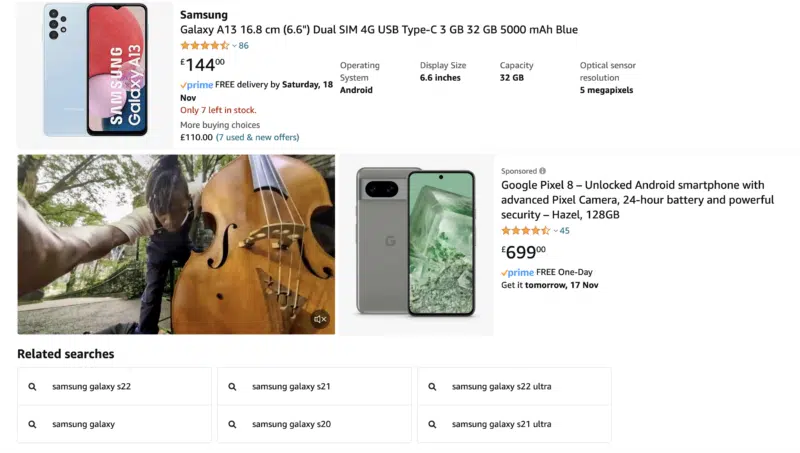
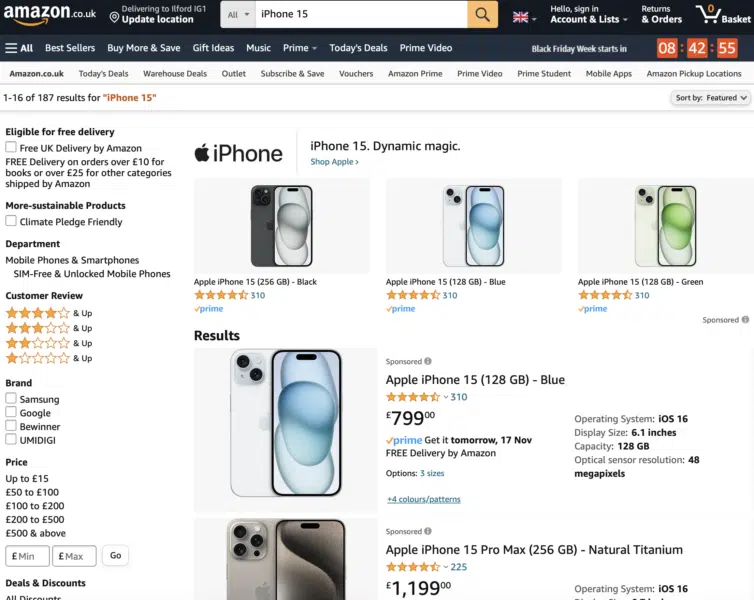
What this means. When you search for Apple products on Amazon, you’ll notice that competing products are still listed, but Amazon restricts the ads placed above, below, and between the results. For instance, a search for an iPhone 15 displays only one Apple product banner at the top of the page and another ad banner at the very bottom:

Screenshot 2023 11 16 At 15.17.05 754x600
Screenshot 2023 11 16 At 15.20.58 800x520

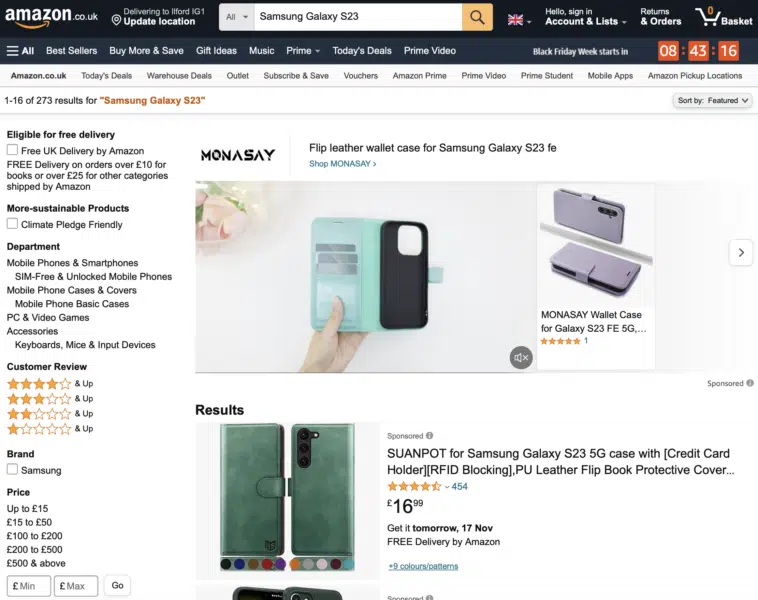
However, searches for competing devices, such as the Samsung Galaxy S23, show ads for various products and services throughout the results page.

Screenshot 2023 11 16 At 15.16.44 758x600
Screenshot 2023 11 16 At 15.21.09 800x453

Special treatment? Juozas Kaziukenas, CEO of e-commerce research firm Marketplace Pulse, told Insider:

  • “It’s clear Apple made a deal with Amazon that is not available to other brands.”
  • “I can’t recall any other brand with the same setup.”

Financial implications. It’s not yet been confirmed whether Apple paid Amazon to block ads by rivals from appearing on its product pages. However, in emails shared by the House Judiciary Committee that date back to 2018, Amazon’s then-retail CEO Jeff Wilke suggested he had initially refused Apple’s request to block rival ads, writing:

  • “We cannot alter our organic search algorithm to return only Apple products in the search results when an Apple team is searched.”

He then appeared to offer an alternative solution for Apple:

  • “Apple would need to purchase these placements or compensate Amazon for the lost ad revenue.”

Amazon’s advertising unit, a significant driver of growth and profit earning over $38 billion last year, has been expanding ads on its platform, as per an FTC lawsuit. Given this context, Amazon’s deal with Apple to limit rival ads on its product pages is particularly noteworthy.

Deep dive. Read our report on Amazon’s ‘secret ad pricing scheme’ for more information.


Related stories

New on Search Engine Land

@media screen and (min-width: 800px) { #div-gpt-ad-3191538-7 { display: flex !important; justify-content: center !important; align-items: center !important; min-width:770px; min-height:260px; } } @media screen and (min-width: 1279px) { #div-gpt-ad-3191538-7 { display: flex !important; justify-content: center !important; align-items: center !important; min-width:800px!important; min-height:440px!important; } }

About the author

Nicola Agius

Nicola Agius is Paid Media Editor of Search Engine Land after joining in 2023. She covers paid search, paid social, retail media and more. Prior to this, she was SEO Director at Jungle Creations (2020-2023), overseeing the company’s editorial strategy for multiple websites. She has over 15 years of experience in journalism and has previously worked at OK! Magazine (2010-2014), Mail Online (2014-2015), Mirror (2015-2017), Digital Spy (2017-2018) and The Sun (2018-2020). She also previously teamed up with SEO agency Blue Array to co-author Amazon bestselling book ‘Mastering In-House SEO’.

https://searchengineland.com/apple-amazon-block-competitor-ads-product-pages-434747


Better, non-programmatic ways to go up the B2B funnel

Nobody likes to be on the receiving end of a good “I told you so,” but at least a couple of times on this fine domain, I’ve warned against reliance on display and programmatic. 

And if you weren’t convinced earlier, the kerfuffles surrounding TrueView and the programmatic ads directing users to AI-generated properties should at least add a healthy dose of skepticism to your POV on programmatic.

In other words, if you are still investing in programmatic, it’s time to consider other, more controllable alternatives for going upper-funnel and building awareness that you can capture later in search campaigns. 

This article looks at some of my favorite demand-creating channels and outlines steps for testing and incorporating them into your media mix.

Non-search channels for upper-funnel B2B engagement

LinkedIn

To hopefully nobody’s surprise, my first choice here is LinkedIn simply because of the quality of its audiences and targeting. 

I don’t have enough data yet on tests with LinkedIn’s new thought leader ads, but they’re worth testing – especially since there are rumblings about organic reach trending down. 

Right-side ads are cheap placements; I’ve frequently enjoyed low enough CPMs to include them as supplements to broader campaigns. 

If you have a POV worth sharing – that is, well articulated and differentiated – test formats like carousel and video ads to see which prove most effective in engaging your ideal customer profile (ICP).

Facebook 

Facebook and Instagram are always worth testing because of their scale and format options.

Since your audiences will be fairly broad, tailor your messaging and creative appeal to the specific needs and challenges of your ICP to help filter out others who don’t fit. 

Note: Advantage+ has potential in the right circumstance, but I wouldn’t recommend trying it for B2B because you can only track online conversions.

You can only do so much to teach the algorithm about quality (which is to say you can upload offline conversion tracking, but you can’t optimize for your down-funnel audience segments like SQLs and opportunities just yet).

Reddit 

This is a much smaller platform than the other two, but SaaS businesses can find high-quality pockets of users at lower engagement costs. 

If you can dial into the edgy Reddit ethos and voice, you can potentially engage with people who wouldn’t be inclined to engage in ads otherwise. 

X

I don’t even understand what’s happening with X, so I advise watching Threads for monetization options as they roll out.

Organic

SEO, organic social, and effective content are all initiatives outside of paid media that will help go up the funnel.

Dig deeper: Building top-funnel content to influence bottom-funnel pages (with real example)


Get the daily newsletter search marketers rely on.


There are plenty of ways to answer this question from an attribution and budgeting standpoint involving GA4 and/or third-party martech tools. 

But if you want to get going now, lock down the following:

  • If your goal is direct response or building awareness to build a pool for remarketing, test various messages and types of content with organic social and limited paid budgets to see what resonates. Focus on high-value content, insights, and data points that will stand out to your audience.
  • Think about audience options, what variable(s) you’ll isolate for testing and in what order.
  • Make sure you understand where you’ll carve out a testing budget, and be prepared to explain any related volume fluctuation to your client or execs if they ask. Setting expectations ahead of time is crucial.
  • Align creative based on your audiences and landing page experience.
  • Identify the KPIs for lower-funnel (e.g., demand capture) campaigns that you’ll monitor to gauge the impact of your demand creation.

Dig deeper: How to use always-on marketing in paid search

Other considerations for the upper funnel

Ultimately, your goal for these campaigns should be to drive efficient revenue (or at least revenue if you’re in big-time growth mode). 

Remember that upper-funnel campaigns will be most effective in helping you build brand and product awareness and demand. 

This doesn’t just apply to businesses creating new markets or big innovations. 

The reality is that most users looking at non-brand terms are already in-market, so the room for growth with those users is in making them aware of your brand and product.

Suppose your near-term goal of upper-funnel campaigns is to build remarketing pools. 

In that case, I recommend starting by driving people to your highest-value content and following up with supporting data and proof points about how your product can help them (case studies of work with similar companies are good here). 

Monitor your impression share of related brand and non-brand queries on Google, and make sure you’ve got enough coverage to support your upper-funnel efforts.

Non-programmatic channels for B2B upper-funnel success

If you still believe that programmatic can deliver efficient results for your campaigns beyond the usual remarketing ads, aiming to bring back visitors to a recently viewed product, I’ll reluctantly admit that it can work, but only in specific situations.

It needs to be in the right context, be highly relevant, and feature a compelling offer – and that really only applies to ecommerce.

Otherwise, remember the last time you were consuming content and were happy to be interrupted by an ad. Whether on mobile or desktop, programmatic ads are usually frustrating and won’t reflect positively on your brand. 

Rather than take your chances and hope some fun creative will do the trick, spend your time and money exploring other channels with more controls and better context. 

Dig deeper: 4 B2B paid media strategies to stay ahead of the curve


Opinions expressed in this article are those of the guest author and not necessarily Search Engine Land. Staff authors are listed here.


Related stories

New on Search Engine Land

@media screen and (min-width: 800px) { #div-gpt-ad-3191538-7 { display: flex !important; justify-content: center !important; align-items: center !important; min-width:770px; min-height:260px; } } @media screen and (min-width: 1279px) { #div-gpt-ad-3191538-7 { display: flex !important; justify-content: center !important; align-items: center !important; min-width:800px!important; min-height:440px!important; } }

About the author

Laura Schiele

Laura Schiele, Head of Paid Acquisition at Jordan Digital Marketing, has nearly a decade of experience in paid media strategy and execution in both agency and in-house accounts and uses advanced analytics skills to scale growth within efficiency goals across Google, LinkedIn, Facebook, and more. Laura manages a large team of paid media experts remotely from her home in Burlington, VT.

https://searchengineland.com/b2b-funnel-non-programmatic-434515


Google Analytics 4 rolls out new Admin experience

Google Analytics 4 (GA4) has launched a new Admin experience for its properties.

The redesign categorizes settings, making it simpler to find and understand each administrative setting.

Now, settings affecting how data appears in your reports are grouped together for greater convenience. This adjustment means you can accomplish your administrative tasks with fewer clicks and increased confidence.

Why we care. The redesigned Admin page is geared towards streamlining administrative tasks, creating a quicker and more efficient workflow for marketers.

First look. Google provided a screenshot of what the updated Admin page now looks like:

Ga4 Admin Redesign 800x580

What Google is saying. A Google spokesperson said in a statement:

  • “The Admin page in Google Analytics gives you access to the Analytics administrative features.”
  • “Use these tools to create new properties, change user permissions, add integrations, set up filters, import data, and more.”

Deep dive. Read Google’s Admin Page guide for more information.


Related stories

New on Search Engine Land

@media screen and (min-width: 800px) { #div-gpt-ad-3191538-7 { display: flex !important; justify-content: center !important; align-items: center !important; min-width:770px; min-height:260px; } } @media screen and (min-width: 1279px) { #div-gpt-ad-3191538-7 { display: flex !important; justify-content: center !important; align-items: center !important; min-width:800px!important; min-height:440px!important; } }

About the author

Nicola Agius

Nicola Agius is Paid Media Editor of Search Engine Land after joining in 2023. She covers paid search, paid social, retail media and more. Prior to this, she was SEO Director at Jungle Creations (2020-2023), overseeing the company’s editorial strategy for multiple websites. She has over 15 years of experience in journalism and has previously worked at OK! Magazine (2010-2014), Mail Online (2014-2015), Mirror (2015-2017), Digital Spy (2017-2018) and The Sun (2018-2020). She also previously teamed up with SEO agency Blue Array to co-author Amazon bestselling book ‘Mastering In-House SEO’.

https://searchengineland.com/google-analytics-4-rolls-out-new-admin-experience-434726


Google testing new SGE ad format

Google appears to have been experimenting with a new ad format within its Search Generative Experience (SGE).

When select users asked the search engine follow-up questions to queries, SGE provided an AI-generated answer alongside sponsored content titled “You May Also Like”.

The feature served a carousel of products, all of which displayed a product title, image and company name.

Why we care. SGE is anticipated to potentially decrease CTR by up to 30% for both organic and sponsored content. However, if brands can secure higher placements within the SGE, it might positively affect CTR. It’s important to note that these ad formats are still in testing, and Google has not confirmed details about potential costs for these placements. Marketers should stay tuned for updates.

Google ‘clearly testing sponsored content’. SEO consultant Glenn Gabe spotted the new ad format test and shared his findings on X. He wrote:

  • “We know Google has explained it wants to test more ads in the SGE answer & possibly sponsored parts of the answer. Well, I saw this sponsored module while testing SGE. The carousel of sponsored content showed up after asking follow-up questions.”
  • “Worth noting I only had these show up for about a day in SGE… then nothing. So Google is clearly testing the module of sponsored content (and it was based on follow-up questions in SGE). If you focus on paid, definitely a big heads-up.”

First look. Gabe also shared a screenshot of what the “You May Also Like” sponsored content carousel looks like within SGE:

SGE Ad You May Also Like 358x600

Deep dive. Read our guide on How Search Generative Experience Works by Search Engine Land contributor Michael King for more information.


Related stories

New on Search Engine Land

@media screen and (min-width: 800px) { #div-gpt-ad-3191538-7 { display: flex !important; justify-content: center !important; align-items: center !important; min-width:770px; min-height:260px; } } @media screen and (min-width: 1279px) { #div-gpt-ad-3191538-7 { display: flex !important; justify-content: center !important; align-items: center !important; min-width:800px!important; min-height:440px!important; } }

About the author

Nicola Agius

Nicola Agius is Paid Media Editor of Search Engine Land after joining in 2023. She covers paid search, paid social, retail media and more. Prior to this, she was SEO Director at Jungle Creations (2020-2023), overseeing the company’s editorial strategy for multiple websites. She has over 15 years of experience in journalism and has previously worked at OK! Magazine (2010-2014), Mail Online (2014-2015), Mirror (2015-2017), Digital Spy (2017-2018) and The Sun (2018-2020). She also previously teamed up with SEO agency Blue Array to co-author Amazon bestselling book ‘Mastering In-House SEO’.

https://searchengineland.com/google-testing-new-sge-ad-format-434722


7 tips to create PPC text ads that are trustworthy and clickworthy

Why will people click on one ad – and not another?

Lots of factors go into the decision. But among the most essential is trust. 

If your ads look slightly “off” or slightly suspicious, people are much less likely to click on them.

When you unintentionally set off internal alarm bells, people will scroll on by in the split second it takes for them to make the click/no click decision. 

So, how can you ensure that your PPC text ads – and your business – look as legit as they actually are? Here are seven things you can follow to inspire greater confidence.

1. Display seller ratings

One of the most obvious things you can do to inspire trust in your text ads is to include seller ratings. These are the one- to five-star ratings that reside at the bottom of ads. 

Text ads on search - seller ratings

This company has a 5-star rating with 133 reviews. This is reassuring to anyone looking for an events company, especially those unfamiliar with the brand. 

Seller ratings are an automated ad asset (formerly extension), so you can’t really control when they’ll show up. (But they won’t show up unless you set them up!) You need a minimum of 100 ratings in the past 12 months for them to get your seller ratings to show up. 

Acquiring 100 ratings isn’t always easy, and you may need to work with an outside vendor to meet that threshold. But the trust and reassurance they convey can be well worth the effort. 

Seller ratings are most common in consumer advertising, but we have some B2B clients that include seller ratings in their advertising – and benefit from them. 

Dig deeper: 5 Google Ads examples with relevant and quality ad copy

2. Ensure messaging is consistent

Inconsistent messaging in your text ad is guaranteed to set off alarm bells. 

Even little things, like a promise of “30% off” in the headline and “33% off” in an ad asset, are enough to deter people from clicking. 

Here’s another example:

Inconsistent messaging on text ad

So how many people can this events company serve? Is it 25-2,500, 25-2,000, or 50-3,000? This inconsistency is a red flag that can deter prospective customers from clicking. 

You can easily introduce inconsistencies in your messaging by accident, especially when multiple people and teams contribute. The best way to catch these errors is to use a messaging roadmap where you can view all of your messaging (including headlines, descriptions, and assets in one place.

3. Craft your own messaging

It’s also important that you craft your own messaging. Avoid relying on Google’s automation. 

Google Ads has many automated messaging options (some turned on by default). We recommend turning them off and checking every quarter to ensure they haven’t been accidentally turned back on.

Why the resistance? Since Google introduced automated messaging, I’ve yet to see it perform better than human-crafted messaging. Instead, I’ve seen many cases where automated messaging misrepresents products, services, and brands – and even more cases where automated messaging is lackluster. 

We shouldn’t be surprised. While Google’s automated messaging is created from the copy on your website, you can’t say where the copy will be picked up or how it will be used. And we don’t want to risk incorporating old blog post content into your messaging.

Still, I try to keep an open mind about automated messaging, but it isn’t easy. Recently, a new client came to us with some automated sitelinks and some hand-crafted sitelinks.

When we analyzed performance over the past year, the human-created sitelinks converted multiple times. The Google-generated sitelinks didn’t convert at all.

Dig deeper: How to dial in your ad messaging in an automated marketing world

4. Get verified

Both Google Ads and Microsoft Ads allow advertisers to be verified on their platforms. You have to go through an application process, which varies depending on the platform and the nature of your business. 

Sometimes verification is required – and you’ll be notified – and sometimes it’s optional (at least for now). 

We generally recommend getting verified, even if it’s not required. It adds another layer of authenticity, even if users have to drill down to find it. 

You can see if an advertiser is verified by clicking the three vertical dots accompanying text search ads. When you do, you see something like this:

Getting verified as a Google advertiser

While verification isn’t immediately evident to users, that could change at any moment (think of X’s blue checkmark). It’s not a bad idea to get ahead of that change, should it happen. 

Further, Google has stated that getting verified gives you access to advanced ad formats and features, which is another reason to do it.


Get the daily newsletter search marketers rely on.


Including your business name and logo in your text ad is another way to build trust and is another perk of becoming a verified advertiser.

Here are two examples from Zoho and Monday.com:

Business name and logo in search ads

Both the logos and company names are clearly communicated at the very top. 

Providing this basic information up front inspires trust. It’s a way for these companies to politely introduce themselves (“Hello, my name is…”). 

It also helps with brand awareness and recognition as prospective customers continue their research. 

6. Provide more information, not less

We follow this general rule: Whenever and wherever Google allows us to provide messaging and assets, we do it. 

Because the more we provide, the more we empower Google to use and display those assets. 

It also allows us to take up more real estate on SERPs and tell prospective customers more about our clients. And the more they know about our clients, the more comfortable they are buying from them. 

This text ad, for example, takes up a lot of space and provides a lot of great info:

Informative text ad

The above ad inspires more trust than this sparse one (which showed up for the same search terms):

Text ad with sparse info

7. Use image assets

You may have noticed the image of the winter tire in the ad above. You may have also noted the image accompanying the Monday.com ad referenced earlier. 

These images come from image assets and are another great way to inspire trust. 

When you’re searching for new winter tires, it’s reassuring to be presented with a picture of a tire. You know that you’re in the right place, and confirm that the company advertised has the product or service that you’re looking for. 

To learn more about image assets and how to set them up, you can check out this detailed video tutorial.

Make all of your digital advertising more trust-inspiring 

Some of the abovementioned trust factors can also be applied to other advertising formats. So don’t stop at your text ads! 

Whether it’s a text ad, Display ad, or YouTube advertising:

  • Make sure your messaging is consistent.
  • Deploy trust scores where you can.
  • Provide prospective customers with the information and confidence they need to click.

Opinions expressed in this article are those of the guest author and not necessarily Search Engine Land. Staff authors are listed here.


Related stories

New on Search Engine Land

@media screen and (min-width: 800px) { #div-gpt-ad-3191538-7 { display: flex !important; justify-content: center !important; align-items: center !important; min-width:770px; min-height:260px; } } @media screen and (min-width: 1279px) { #div-gpt-ad-3191538-7 { display: flex !important; justify-content: center !important; align-items: center !important; min-width:800px!important; min-height:440px!important; } }
About the author

Pauline Jakober

Pauline Jakober is Founder and CEO of Group Twenty Seven, a boutique online advertising agency that provides Google Ads and LinkedIn Ads management, consulting and audits to B2B clients.

https://searchengineland.com/create-ppc-text-ads-trustworthy-clickworthy-434603


Report: Yandex search engine for sale

Yandex N.V., which is now a Dutch holding company, is looking to sell off its search engine and all of its other Russian assets as part of a deal estimated to be between $5 billion and $6 billion, Reuters reported.

Likely sale? A sale could come as early as December. Yandex N.V. might sell 100% of all its Russian assets or hold share options.

  • “Dutch holding company Yandex NV’s planned restructuring is aimed at recouping some shareholder funds with the sale of its main revenue-generating Russian businesses, such as its search and ride-hailing operations. It then plans to develop four other business lines internationally,” Reuters reported.

Yandex also dominates online advertising in Russia.

Why we care. Yandex has been in turmoil since Russia invaded Ukraine in February 2022, though it still has a commanding 65.95% search market share in Russia (only 1.83 globally), in October, per StatCounter, while Yandex announced it had 62.6% market share in its Q3 2023 earnings report. It remains an area international search marketers will want to watch.


Related stories

New on Search Engine Land

@media screen and (min-width: 800px) { #div-gpt-ad-3191538-7 { display: flex !important; justify-content: center !important; align-items: center !important; min-width:770px; min-height:260px; } } @media screen and (min-width: 1279px) { #div-gpt-ad-3191538-7 { display: flex !important; justify-content: center !important; align-items: center !important; min-width:800px!important; min-height:440px!important; } }

About the author

Danny Goodwin

Danny Goodwin has been Managing Editor of Search Engine Land & Search Marketing Expo – SMX since 2022. He joined Search Engine Land in 2022 as Senior Editor. In addition to reporting on the latest search marketing news, he manages Search Engine Land’s SME (Subject Matter Expert) program. He also helps program U.S. SMX events. Goodwin has been editing and writing about the latest developments and trends in search and digital marketing since 2007. He previously was Executive Editor of Search Engine Journal (from 2017 to 2022), managing editor of Momentology (from 2014-2016) and editor of Search Engine Watch (from 2007 to 2014). He has spoken at many major search conferences and virtual events, and has been sourced for his expertise by a wide range of publications and podcasts.

https://searchengineland.com/yandex-search-engine-sale-report-434654


Google Analytics 4 can now be integrated with Salesforce Marketing Cloud

Google Analytics 4 properties can now be connected to Salesforce Marketing Cloud using the Sales Marketing Cloud interface.

Integration is available to both GA4 standard and 360 properties for the first time to anyone who was previously using the same setup with Universal Analytics 360.

Why we care. GA4 integrated with Salesforce Marketing Cloud allows you to sync audiences from Analytics to Marketing Cloud. You can then use these audiences in your Salesforce email and SMS direct-marketing campaigns, offering a smooth and targeted method to reach your audience more effectively.

Synchronize audiences with Marketing Cloud. Once you’ve linked Analytics to Marketing Cloud, you can sync audiences within Marketing Cloud itself. These audiences will be visible in the Audiences list in Analytics under Admin > Audiences. It may take up to 24 hours for the audiences to be visible in Salesforce Marketing Cloud and ready for targeting.

How it works. When a user clicks through to your site from a Marketing Cloud campaign, and the link sends the Marketing Cloud Subscriber ID (SFMC ID), Analytics automatically detects and stores the SFMC ID with your other Analytics first-party data.

Once you complete setup within Salesforce Marketing Cloud, any audiences that you create in Analytics and synchronize with Marketing Cloud are populated in Marketing Cloud as a list of SFMC IDs.


Get the daily newsletter search marketers rely on.


Requirements. Google has stated that there are some criteria in place to enable integration between Salesforce Marketing Cloud and GA4 properties:

  • Create audiences in your Google Analytics property that you want to use in Salesforce.
  • Ensure your URLs are tagged with the Marketing Cloud Subscriber ID.
  • Configure the Google Analytics Integration for Marketing Cloud in Marketing Cloud
  • Marketing Cloud’s Journey Builder

Deep dive. Read our guide on how to set up an offline conversion import from Salesforce into Google Ads for more information.


Related stories

New on Search Engine Land

@media screen and (min-width: 800px) { #div-gpt-ad-3191538-7 { display: flex !important; justify-content: center !important; align-items: center !important; min-width:770px; min-height:260px; } } @media screen and (min-width: 1279px) { #div-gpt-ad-3191538-7 { display: flex !important; justify-content: center !important; align-items: center !important; min-width:800px!important; min-height:440px!important; } }
About the author

Nicola Agius

Nicola Agius is Paid Media Editor of Search Engine Land after joining in 2023. She covers paid search, paid social, retail media and more. Prior to this, she was SEO Director at Jungle Creations (2020-2023), overseeing the company’s editorial strategy for multiple websites. She has over 15 years of experience in journalism and has previously worked at OK! Magazine (2010-2014), Mail Online (2014-2015), Mirror (2015-2017), Digital Spy (2017-2018) and The Sun (2018-2020). She also previously teamed up with SEO agency Blue Array to co-author Amazon bestselling book ‘Mastering In-House SEO’.

https://searchengineland.com/google-analytics-4-properties-salesforce-marketing-cloud-434650