Microsoft and Baidu Global team up for enhanced ad targeting capabilities

Baidu Global is teaming up with Microsoft Advertising to improve the accuracy of its ad targeting capabilities.

The company is set to utilize Microsoft Advertising’s Chat Ads API to offer users of its mobile keyboard, Baidu Global Keyboard, more relevant and engaging sponsored content suggestions.

Microsoft has confirmed the partnership will officially begin in early 2024 in the U.S, Canada, United Kingdom and Australia.

Why we care. The collaboration will enable Baidu Global Keyboard to serve more relevant ads to a high-value audience, improving reach for advertisers, the likelihood of conversions, and return on their investment.

Microsoft Baidu Global Keyboard’s Chat AI

Benefits for advertisers. The collaboration between Microsoft and Baidu Global will reportedly help advertisers to:

  • Target a high-value audience demographic. Baidu Global Keyboard is a popular app among Gen Z. By partnering with Microsoft, advertisers can expect a focused opportunity to connect with this demographic in the US, Canada, UK, and Australia.
  • Enhance reach across multiple environments. Baidu Global Keyboard incorporates customized features that adapt to different app environments — whether a user is browsing the web, on social media or even shopping. This flexibility allows advertisers to reach users in multiple scenarios on different app platforms with relevance to their location as well as topic search interest.
  • Improve the user experience. Keyboards cover digital spaces, giving a more complete view of user interests compared to other mobile apps. In light of this partnership, Baidu Global Keyboard can is able to offer users more relevant content, improving the overall user experience.
Microsoft Advertising partners with Baidu Global

Leveraging this opportunity. You can optimize your Microsoft Advertising campaigns by choosing “The entire Microsoft Advertising Network” for all ad group settings. Additionally, given the mobile opportunity with this partnership, apply positive mobile bid modifiers for maximum campaign performance.


Get the daily newsletter search marketers rely on.


What Microsoft is saying. Lynne Kjolso, VP of Global Partner and Retail Media, Microsoft Advertising, said in a statement:

  • “We’ll continue to identify ways to unlock the potential of generative AI to transform the advertising industry and bring value to advertisers, partners, and most importantly the people who use these transformative services.”
  • “We continue to listen to feedback from our advertisers and partners as we evolve our chat offerings to influence the next waves of innovation in generative AI.”
  • “If you’re interested in partnering, reach out to discuss your chat experience needs. We’re here to help whether you need both algorithmic organic results and ads monetisation or ads monetisation only.”

Deep dive. Read Microsoft’s announcement in full for more information.


Related stories

New on Search Engine Land

@media screen and (min-width: 800px) { #div-gpt-ad-3191538-7 { display: flex !important; justify-content: center !important; align-items: center !important; min-width:770px; min-height:260px; } } @media screen and (min-width: 1279px) { #div-gpt-ad-3191538-7 { display: flex !important; justify-content: center !important; align-items: center !important; min-width:800px!important; min-height:440px!important; } }

About the author

Nicola Agius

Nicola Agius is Paid Media Editor of Search Engine Land after joining in 2023. She covers paid search, paid social, retail media and more. Prior to this, she was SEO Director at Jungle Creations (2020-2023), overseeing the company’s editorial strategy for multiple websites. She has over 15 years of experience in journalism and has previously worked at OK! Magazine (2010-2014), Mail Online (2014-2015), Mirror (2015-2017), Digital Spy (2017-2018) and The Sun (2018-2020). She also previously teamed up with SEO agency Blue Array to co-author Amazon bestselling book ‘Mastering In-House SEO’.

https://searchengineland.com/microsoft-and-baidu-global-team-up-for-enhanced-ad-targeting-capabilities-434640


SearchBot upgraded with 12 new personas, AI image generation

SearchBot – the first generative AI chatbot for search marketers – is now a suite of marketing generative AI tools.

You can now:

  • Access 13 new chatbot personas (each designed to meet a unique marketing use case).
  • Create images using generative AI.
  • Get prompt suggestions and tips.
SearchBot icon

New persona-driven AI chatbots. You can try 13 pre-prompted “personas” that were created to provide help and generate marketing (or complete other generalized tasks – sales, revenue generation, MOps, HR, talent development, etc.):

  • PPC/SEM expert (campaigns, keyword buyer, copywriter, ad optimizer, remarketing)
  • On-page SEO (keyword researcher, link builder, local, content)
  • Technical SEO
  • Marketing manager (content, email, social, digital, events/tradeshows, app)
  • Marketing operations manager (MAP expert)
  • Social media manager
  • Business analyst / analytics expert
  • Productivity expert / motivational coach
  • Senior exec (CEO/CFO/COO, etc.)
  • Email marketing expert
  • Content marketing expert
  • AI expert
  • A snarky marketer who must might make you laugh

SearchBot image generator. You can also use SearchBot to generate AI images. This is powered with DALL-E 3.

It’s free. SearchBot is free but now will require registration. It remains in beta.

What is SearchBot. The arrival of SearchBot was announced in We turned Search Engine Land into a chatbot, May 31. Since then, SearchBot has had more than 15,000 sessions and nearly 4,000 chats with search marketers.

We also publish an editorial series called “Best of the bot,” featuring some interesting prompts and answers, along with an easy framework to understand how to get superior results from chatbots.

What we’re saying. If you’ve been struggling to find value in generative AI tools, this upgraded version of SearchBot is a game-changer for marketers.

  • “SearchBot was built as an experiment, but as it turns out, being able to ‘talk’ to Search Engine Land’s archive of thousands of articles is incredibly valuable,” said Marc Sirkin, EVP of Product and Technology at Third Door Media, parent company of Search Engine Land.

Help SearchBot improve. We’re looking at ways to improve the bot and welcome your feedback. Give SearchBot a shot. We look forward to hearing from you!


Related stories

New on Search Engine Land

@media screen and (min-width: 800px) { #div-gpt-ad-3191538-7 { display: flex !important; justify-content: center !important; align-items: center !important; min-width:770px; min-height:260px; } } @media screen and (min-width: 1279px) { #div-gpt-ad-3191538-7 { display: flex !important; justify-content: center !important; align-items: center !important; min-width:800px!important; min-height:440px!important; } }

About the author

Danny Goodwin

Danny Goodwin has been Managing Editor of Search Engine Land & Search Marketing Expo – SMX since 2022. He joined Search Engine Land in 2022 as Senior Editor. In addition to reporting on the latest search marketing news, he manages Search Engine Land’s SME (Subject Matter Expert) program. He also helps program U.S. SMX events. Goodwin has been editing and writing about the latest developments and trends in search and digital marketing since 2007. He previously was Executive Editor of Search Engine Journal (from 2017 to 2022), managing editor of Momentology (from 2014-2016) and editor of Search Engine Watch (from 2007 to 2014). He has spoken at many major search conferences and virtual events, and has been sourced for his expertise by a wide range of publications and podcasts.

https://searchengineland.com/searchbot-upgraded-personas-ai-image-generation-434593


Lifting the lid on Google’s black box to find growth by Adthena

Adthena SEL Article Image 800x450

So, you headed into 2023 with a new pair of running shoes. You set off for your first run, but the track was much tougher than you first expected. At the end of your run, you realize that your heart rate remained in the red zone throughout, working you harder than you would have done in perfect conditions. 

The moral of the metaphor: When pushed into the unknown, we tend to do quite well.

2023 has been a transformative year despite its many hurdles. We’ve all experienced budget, growth and efficiency pressures amidst the challenging economic outlook. At the same time, we witnessed an upsurge in Performance Max adoption, GA4 updates, the launch of Transparency Center, and the rise of Generative AI.

Despite the transformation, Google’s black box remains tightly shut. 

In this article, we’ll identify some of the common blind spots advertisers are currently experiencing in three specific areas: Performance Max (PMax), managing Cost Per Clicks (CPCs) and affiliate growth.

Push the Performance Max limits

Performance Max campaigns, introduced by Google in 2021, have transformed online advertising, allowing advertisers to reach audiences across Google’s vast network with a single campaign. 

Although Performance Max offers significant benefits, challenges still exist due to limited visibility and tracking. This makes regular monitoring, data analysis and optimization crucial for success.
Here are four tactics to push the Performance Max limits and bring your campaigns to light.

  1. Adopt multi-platform advertising.
    PMax campaigns offer the distinct advantage of cross-platform advertising, enabling advertisers to reach diverse audiences and widen their online presence.
    • Tailor ads for each platform, considering unique format requirements. For instance, YouTube ads demand visual and engaging content, while Google Search ads benefit from keyword-focused, text-heavy approaches. 
    • Customizing ads for specific platforms is key to maximizing the impact of cross-platform advertising efforts.
  1. Leverage Smart Bidding strategies.
    PMax campaigns are intended for pairing with Google’s Smart Bidding techniques, utilizing machine learning to refine your bids and budget in alignment with your campaign objectives.
    • Utilize Smart Bidding strategies like target Cost Per Acquisition (CPA), target Return On Ad Spend (tROAS), or maximize conversions to automatically fine-tune your bids for optimal value within your campaign budget. 
    • Ensure you establish suitable bidding targets and regularly monitor your campaign’s performance to enact essential refinements and enhance your outcomes.
  1. Craft captivating and appropriate ads. 
    Much like any other advertising endeavor, the effectiveness of your PMax campaign hinges on the quality of your ads. Develop alluring and relevant ads that strike a chord with your intended audience. 
    • Use eye-catching visuals, clear messaging, and a compelling Call To Action (CTA) to encourage users to take action. 
    • Ensure that your ads are customized to the particular platform and ad format in use while ensuring alignment with your campaign objectives. 
    • Conduct tests and enhancements on your ads to pinpoint the most resonant content for your audience and refine your messaging.
  1. Monitor and enhance your campaign.
    Actively monitor and refine your PMax campaigns to achieve the best results.
    • Observe your campaign’s performance and scrutinize the data for emerging trends or recurring patterns. 
    • Leverage tools like Whole Market View for a more comprehensive view of your spend across all Google channels, pinpoint underperforming ads, keywords, or placements and apply essential adjustments to fine-tune your campaign for peak optimization.

For proven tactics to improve precision, visibility and control in your Performance Max campaigns, check out our guide Unlock the black box: Four ways to get more from Performance Max.

Ride the CPC surge

Amid Google’s ongoing antitrust trial, there has been a notable spike in CPC rates, causing concern among advertisers. This unanticipated shift in Google’s advertising landscape has raised questions about its implications and the strategies advertisers must employ to adapt. 

Google’s opacity regarding pricing adjustments has added to the uncertainty, leaving advertisers speculating about their motives and objectives. Here are five surefire ways to ensure you ride the CPC surge with certainty.

1. Managing your budget and avoiding wastage.

Advertisers should be ready to adapt their budgets to accommodate increased CPCs. Consistently monitoring and refining budget allocations is crucial for sustaining cost-effective campaigns.

Adthena is a valuable tool for pinpointing areas of budget inefficiency and enhancing spending effectiveness. Brand Activator enables advertisers to detect instances where they’re number one for a term in both paid and organic search without competing bidders yet still incurring costs on the clicks. These savings can either be pocketed or reinvested into generic terms.

By leveraging Brand Activator, Avanti West Coast saved 32.2% on brand spend and grew revenue on generics by 13%. 
Identify your budget wastage in a complimentary brand bidding test.

Adthena Brand Activator 800x495

2. Elevated ad quality.

Google’s commitment to enhancing user experience and ad relevance should encourage advertisers to prioritize the development of quality and relevant ad content. By taking this approach, they have the potential to enhance ad ranking and minimize CPCs.

Adthena’s Creative Insights tool empowers you to monitor the creative language employed by your competitors across all your search term groups, providing comprehensive market visibility. This data is invaluable for in-depth analysis, benchmarking, and optimization of every aspect of your ads.

Adthena Creative Insights 800x453

3. Keyword enhancement.

Advertisers should review their keywords and bidding strategies. Prioritizing long-tail keywords and using negative keywords strategically can help monitor ad costs more effectively.

Adthena’s Search Term Detail feature provides insights into terms with high competitor presence, their volume potential and estimated cost. By recognizing terms that don’t align with your strategy or may conflict with other accounts, you can include them in your negative keyword list.

Adthena Search Term Detail 800x505

4. Market insights.

Through Adthena’s Market Trends report, you can closely monitor trends in CPC, the distribution of spending across different advertising channels and your competitive market share. This not only helps you adapt to Google’s pricing dynamics but also empowers you to seize emerging opportunities.

Adthena Market Trends 800x460

5. Data-powered choices.

Relying on data-driven insights, frequent data analysis and performance monitoring is essential to lowering CPCs. Advertisers must vigilantly oversee their campaigns and adapt strategies as necessary to maximize performance and ROI.

Embrace affiliate growth and guard against ad hijackers 

Ad hijacking, sometimes known as brand poaching, direct linking, or URL jacking, is the practice wherein affiliates try to mimic a brand’s advertising by creating ads that closely resemble the brand’s original advertisements. This deceptive approach results in increased conversions and subsequent sales, allowing the affiliate to earn a commission of 5-10% from these transactions. Ad hijacking presents a twofold financial challenge for brands:

  1. Affiliates dishonestly obtain commissions they have yet to earn from brands.
  2. Affiliates artificially inflate the cost per click (CPC) for brands when bidding on their own branded keywords.

So, if you’re experiencing a sudden dip in brand search volume in Google Ads and no new competitors are appearing in the auction insights report, you may well be a victim of affiliate click fraud.

  • Establishing a robust brand protection strategy involves continuous scrutiny of search results and active collaboration with brand protection platforms like Adthena’s Ad-Hijacking. 
  • By indexing and reporting numerous affiliate networks, advertisers can uncover thousands of instances of affiliate ad hijacking, accompanied by supporting evidence such as ad screenshots and affiliate IDs.

Adthena recently helped one global hotel brand in identifying 50 fraudulent reservations within two months. The responsible publisher was suspended for seven days, and bookings made during that period were canceled, saving on commissions. 

The potential budget losses from such fraudulent activities can be substantial. For context, detecting ten such publishers can prevent nearly $10,000 in budget wastage.

Take a 1-minute self-guided tour of Adthena’s Ad Hijacking solution to see how you can stop click fraud in its tracks.

Lift the lid on Google’s black box

As we navigated the challenges and opportunities of 2023, it’s clear that the digital advertising landscape is ever-evolving. The story of your challenging first run with new running shoes is a metaphor for the transformative year we’ve experienced. Just as you pushed yourself into the unknown and found that you excelled, advertisers must also adapt and push the boundaries of their strategies to thrive in the changing digital marketing environment.

Trust Adthena’s award-winning search intelligence platform to put you in control of your search strategies, helping you to lift the lid on Google’s black box. 

Jump to action and see how Adthena’s award-winning search intelligence platform goes beyond what Google Ads shows you. See every competitor move in turbulent markets and shape your strategy for success. 

Get started with a self-guided tour of Adthena or book a personalized demo.


Related stories

New on Search Engine Land

About the author

Adthena

Founded in 2012, Adthena is an award-winning search intelligence platform. Our unique combination of patented, AI-driven technology and a world-class team of experts helps brands, marketers, and agencies across the globe dominate their competitive landscapes. We provide our customers with a clear view of the paid search landscape, helping them optimize their spend to increase ROI, all while saving them time and better informing their cross-channel strategies. Adthena’s solutions are powered by our market-leading technology: Whole Market View creates a unique market map of a client’s entire search landscape and Smart Monitor automatically detects threats and opportunities every day. Our award-winning Local View product provides the location-based strategic insights that marketers need to dominate at a local level. For more information, visit: www.adthena.com

https://searchengineland.com/lifting-the-lid-on-googles-black-box-to-find-growth-434321


Boosting search conversions: 5 behavioral strategies to test

SEO and PPC professionals are all in the business of driving more traffic to websites.

But are you getting the most out of the visitors you already have?

This is a critical question. And, often, the answer is “no.” 

A solid search marketing strategy requires a customer experience plan as its core. Even if customer experience isn’t your direct responsibility, it should be on your radar. 

Traffic alone is a vanity metric. What truly matters is how that traffic navigates the marketing funnel and converts into valuable customers.

So, where do you begin with enhancing customer experience? 

The starting point is ensuring that your users land on the right page for their intent. Correctly mapping user intent to the most fitting page is critical. 

This article introduces a variety of behavioral nudges and ideas to help you extract more value from the traffic your website is already attracting.

Understanding conversion rate optimization

Before delving into these behavioral nudges, let’s quickly set the stage for those less familiar with conversion rate optimization (CRO). 

In essence, CRO is a process where hypotheses are crafted to make website changes to boost conversions. These actions are vital to your business, such as sales or engagement with content.

Once a hypothesis is formed, you can use tools like VWO or Zoho’s PageSense to create and test new versions of landing pages. No coding skills are needed.

The tool then serves the current and test versions of the page to a set percentage of the traffic and monitors the results. The test duration depends on your site traffic and how fast the tool can get reliable results.

When the test ends, if your idea works, implement it live. If not, tweak and retest.

Testing this way eliminates gut feelings and biases, letting you confidently report what works for your audience.

The challenge? Figuring out what to test.

5 behavioral nudges to elevate your traffic conversions

Below are five behavioral nudges for testing and driving more conversions from your traffic.

1. Social proof and herding

Social proof is the concept that the actions and beliefs of others influence people. Herding is the tendency of humans to follow what others are doing. 

Think about your website and the customer journey toward a conversion – how could you ensure these nudges are included to entice your user to complete the action?

When it comes to social proof, users are looking for signals of trust from others. 

Brand logos and testimonials are nice, but how can you ensure this feels as robust as possible? 

Well-known third-party integration review tools are great because they are independent and recognized, helping users feel they can trust the review’s authenticity. 

Herding might come to life on your website in the form of live messaging such as: 

  • “20 other people bought this item today” (for ecommerce).
  • “Join the thousands of leaders, who were just like you, that have increased their business profit from our training” (for B2B).

You may already have some of these features on your website, but do they stand out enough? Are they in the right position to influence the user in deciding whether to convert? 

Some of these changes are as simple as wording changes. A CRO test is often simple and limited to one change. If you change too much, it is impossible to know what worked. 

Dig deeper: Unleashing the potential of Google reviews for local SEO

2. Cognitive load

Cognitive load relates to our working memory and the amount of information we can hold at one moment. 

Which areas in the conversion path require the most cognitive load for your user? 

  • On an ecommerce website, this is often the checkout.
  • For other business types, this could be a lengthy form or application that needs to be completed.

Is there an opportunity to chunk the process steps up instead of having one long form, making it multiple simpler steps? 

Can the user save and come back? Saving your progress is especially important in processes where the user needs to find information they might not know off the top of their head. 

On the flip side, does your website process have too many steps? 

We recently tested simplifying a three-step personalization process on a client’s website to a two-step process, and the results were phenomenal, with 100% certainty and a material spike in revenue. 

You may have heard of “cognitive strain,” which differs from cognitive load.

Cognitive strain relates to the person having to decode what they are looking at, like trying to decipher a picture or content, or doing mental arithmetic to assess something. 

Used at the right point in a journey, this type of cognitive action can be extremely powerful. 

When we make people think or, ideally, make them feel something, they are more likely to remember it.

This is true of positive and negative feelings, so for any poor user experience, cognitive strain can create a memory you wish the user to forget.

Dig deeper: How to avoid decision fatigue in SEO

3. Scarcity and FOMO

Scarcity is when something is rare and exclusive, such as only a certain amount of tickets, spaces or products available. 

Fear of missing out (FOMO) is the urgency factor, which is time-sensitive or about to expire. 

These nudges can be used on their own or together. 

Most of us have probably been there, in a queue online, trying to buy tickets for a concert or an event that you know only has limited numbers. 

You’ve probably also experienced FOMO in a moment like this when a friend messages telling you they’ve been successful and you know it is only a matter of time before the event is sold out. 

Now, this is not something we can all replicate in the same way a famous artist or show can. But we can take learnings and think about how we frame our products and or services. 

I recently spotted a well-respected business trainer offering a one-time-only masterclass course with only 10 spaces available – an exclusive opportunity. The scarcity was real, and she sold out within hours. 

The FOMO of a time-limited sale is true, although this is easily eroded when some websites are always on sale!

Testing where your messaging sits to highlight the urgency, showing a live countdown or percentage complete bar.

There are many ways to grab attention; don’t assume you’ve already nailed it. Test it to see what has the best effect. 


Get the daily newsletter search marketers rely on.


4. Loss aversion

Psychologically, the pain of losing something can be twice as impactful as the pleasure of gaining something. 

If your website offers a free trial, a sample product or some way of getting your product or service into the customer’s hands, they will be less likely to want to let go. 

As humans, our natural instinct is to avoid losing things. This instinct comes from our evolutionary history, where early humans focused on minimizing the risk of extinction. 

This mindset is deeply ingrained in us. So, when we’re concerned that something might go wrong or we might lose money, we tend to avoid or delay dealing with it.

Most businesses have options to avoid losses and the resultant unhappy customers, such as free returns or money-back guarantees. 

Messaging like this can be extremely important to help a user feel confident to decide, so it needs to be prominent. 

Testing different phrasing and positioning on the page to display this information and even additional links to more detailed explanations can be really helpful in building trust.  

5. Anchoring

Anchoring involves presenting a reference point before sharing your brand’s price, timescale or unique information. 

Examples include: 

  • Quoting a competitor’s price and then showing their cheaper price. 
  • Saying “most businesses take 12 weeks to deliver, we deliver in four weeks.” 
  • Highlighting that “other manufacturers use X, we use Y because…” 

When you present an anchor, you control the reference point. Otherwise, customers rely on their own knowledge for comparisons. Their reference point may be assumed or well-researched, making feedback uncertain.

Playing with anchoring is a great tool to drive conversions and can work for B2C and B2B. As a concept, this needs to be true to the brand.

Uncovering your anchors may take time if you are not using them already. But once you have them, this is a copy and design play from a testing perspective. 

Some anchors have transcended brands, such as your mattress should be changed every eight years or engagement rings should cost three months of your salary. 

Could your brand or product have an anchor like this that may help increase pricing? 

Other brands offer 100-day trials or even 365-day returns. Making these numbers stand out will help the customer see the value your brand brings. 

For a charity, the anchor could work in two ways.

  • Firstly, the Starbucks effect of having three suggested donation amounts, the most expensive being the anchor, will likely result in the selected middle amount. 
  • But also testing text to explain what that donation can do for the charity, “$10 will buy…” 

This framing may not always resonate with your audience, so test it.

Turning clicks into conversions with behavioral strategies

We’ve discussed five strategies you can use on your website to see if they boost conversions. 

Making the most of your current website traffic is a great way to get support for your search strategy. 

If you can show that your efforts are working and there’s potential for even better results with SEO or paid search, it’s tough for a budget decision-maker in a growing business to reject the idea. 

Begin testing today, and remember, even small changes can have a big impact.


Opinions expressed in this article are those of the guest author and not necessarily Search Engine Land. Staff authors are listed here.


Related stories

New on Search Engine Land

@media screen and (min-width: 800px) { #div-gpt-ad-3191538-7 { display: flex !important; justify-content: center !important; align-items: center !important; min-width:770px; min-height:260px; } } @media screen and (min-width: 1279px) { #div-gpt-ad-3191538-7 { display: flex !important; justify-content: center !important; align-items: center !important; min-width:800px!important; min-height:440px!important; } }

About the author

Becky Simms

Becky has spent the last 15 years working in digital marketing, starting Reflect Digital in 2011, which is now a team of over 35 digital specialists. Becky secured a three-year hat-trick in 2023 of being listed in the BIMA 100, a list of the top 100 people shaping the future of the digital industry. Becky’s passion for digital lies within understanding human behaviourand applying behavioural science to digital channels. It is her belief that when you truly understand your audience you unleash a performance potential previously not possible to attain.

https://searchengineland.com/boosting-search-conversions-behavioral-strategies-test-434537


Meta Ads for ecommerce: 7 things to test and iterate

A few years ago, you’d have been laughed out of any room for even insinuating that paid social and paid search had similarities.

Fast forward to the era of automation in PPC advertising, and there’s more in common between Meta and Google’s ad products than you might realize.

For example, both ad platforms:

  • Include algorithm-based campaigns that are heavily promoted by each platform: Advantage+ (Meta) and Performance Max (Google).
  • Allow you only to see data and settings you can control, whether in part or full.
  • Have their biggest growth levers outside the ad account (e.g., business-specific data inputs, ad creative, landing pages, sales experience, etc).

But while there are overlaps, both channels retain the unique characteristics that make them complementary channels rather than contesting ones:

  • Paid search typically has been used to capture demand – though the emergence of campaigns like Demand Generation is moving things in a different direction.
  • Paid social has historically been able to both create and capture demand, creating a true full-funnel approach that modern paid search seeks to replicate.

Think about users’ state of mind when searching for something specific on Google versus the endless scroll associated with social media networks like Facebook or Instagram. 

Search users want to research and/or buy products or services at that moment, while those on social media are open to new and interesting offers.

A 7-point ecommerce framework for Facebook and Instagram

When they’re set up and managed correctly, ecommerce campaigns on Meta can print money for products with market fit.

But what exactly should you be looking at? How do you determine what the best choices are?

Here are the top considerations.

1. Experiment with Advantage+ campaigns

Unlike lead generation, where you don’t really have the option of running purchase-focused campaigns, ecommerce on Meta Ads gives you two options – one of which is the relatively new Advantage+ Shopping.

Meta introduced Advantage+ Shopping during the holiday season of 2022. It’s similar to Performance Max in that it’s a broad-scope campaign that limits your ability to target specific audiences. 

You give it creative assets and messaging, the system looks for buyers, and refine the campaign with parameters and rules (e.g., data inputs, block existing customers, focus x% of budget on existing customers, etc.).

As always, try both and see how it goes before leaning into one or the other.

Dig deeper: Testing Meta’s AI-powered Advantage+ targeting: What we learned and what to expect

2. Test broad targeting on standard Conversion campaigns

If you choose the route of standard Conversion campaigns, you’ll want to pick the right targeting settings. Typically, as long as your pixel has enough data, you’re better off just doing broad targeting.

With lead generation campaigns on Meta, we like to feed them with audiences because you want to be much more nuanced in terms of who you’re going after.

But with ecommerce, because they see the revenues and much of the pixel data, just take away all your audiences. Maybe exclude recent purchasers (people who bought from you in the last 30 days), but otherwise, let the system find new customers.

By giving it limitations, you artificially inflate your CPMs for no reason.


Get the daily newsletter search marketers rely on.


3. Prioritize purchase conversions

Conversion campaigns allow you to focus on different ecommerce goals: purchases, cart adds and clicks. That’s the order of preference you want to pursue.

We will almost always use the purchase conversion as the focus and recommend that as the ideal scenario. Some advertisers like to start with ‘add to cart’ targeting, but I prefer to focus on purchases.

One thing is certain: Meta’s algorithms are powerful and will give you what you ask for.

If you’re not running Advantage+ Shopping and instead use Conversion campaigns with a cart add or click focus, it’ll give you that. 

While it’s nice for someone to add to cart (and certainly has its uses), you usually want and need revenue. So focus on that when it comes time to generate returns.

4. Trust in 7-day click (usually)

Our campaigns on Meta typically use 7-day click attribution, and we don’t like to look at view-throughs. Here’s why.

When it comes to lead generation, 1-day is enough. But with ecommerce, you’re going to want to use 7-day click. Unless you’re selling a product that is more of an impulse purchase (in which case 1-day click is enough), most people take time to make a purchase decision.

At the same time, view-throughs will be inflated because everyone who places an order likely sees an ad. And while there is value to that, I would rely on that data to almost certainly have duplicate attribution.

5. Get creative with your creatives

When it comes to the ads themselves, we advise having a good mix of asset types that you can test, test, and test some more.

  • Image
    • Us vs. them
    • Media mentions
    • Reviews
  • Video
    • High production value
    • UGC or influencer style
    • Testimonials
    • Short-form and longer videos
  • Carousel
    • Dynamic
    • Static
    • Tools like Marpipe and Socioh help build visually attractive catalog creatives

In one instance, a video worked well for a while before performance fell off.

We ran it through the Google Ads trim video tool, which algorithmically cut up the video to tell a different story. You can shorten the output and push that live as an ad in Meta, and it revitalizes and breathes new life into an old asset. That ad is performing really well again.

There’s another tool we use called OpusClip, which you feed with short-form video and it automatically adds subtitles and overlays in the “Hormozi” style that you see often on YouTube Shorts.

You don’t have to use these tools exactly, but take advantage of AI tools like these to keep things fresh and avoid stagnating.

Dig deeper: 4 new rules for PPC ad creative

6. Always test new assets

I’ve been asked multiple times by both clients and advertisers:

  • How often should I test out new creatives?
  • How much should I spend to test a new ad?

Finding the right answer is less about time and budget, and more about how much traffic has flowed through it.

Is the data output set statistically significant enough to base decisions on it? Ideally, you want a few thousand clicks to establish that validity.

In terms of frequency, bigger budgets allow you to get away with more, so you can cycle new ads more often than you can with smaller budgets. Either way, you’ll want to look for the winners and double down on them.

Another important consideration is when ads do well but taper off, like in the scenario I covered earlier. When you see that happen (or have an ad you think should have done better), try editing the first few seconds to present a different hook.

7. Follow a consistent naming pattern

How do you keep track of what’s working?

The only way to do this without tearing your hair out is by using consistent ad naming conventions, which allow you to easily filter and report on things like:

  • How are image ads doing compared to video?
  • Do review ads perform well?
  • Does influencer content get better results?
  • Which of your two CTAs is the winner?

Without this, you’ll have to dig through layers and layers of the Meta UI to figure out what’s performing before you can make decisions. 

Tools like Motion can help you analyze creatives across multiple campaigns, but like all things, this process becomes easier with a consistent naming convention already in place.

What makes running ecommerce ads simple

Unlike lead gen campaigns, where the value of a lead is nebulous and dependent on a host of other factors, a sale is a sale in ecommerce. Currency amounts are consistent and fixed in value, making for easier math around calculating costs and margins.

Unless you have a high volume of fraud – a problem that transcends advertising – there’s little to worry about when it comes to conversion quality. Track returns and chargebacks, and you should clearly know your brand’s true profitability.

At the same time, there’s a world of marketing channels and branding plays beyond the DTC-preferred duopoly of social advertising and email.

No matter how successful your Meta Ads campaigns are, there is always more growth to unlock.


Opinions expressed in this article are those of the guest author and not necessarily Search Engine Land. Staff authors are listed here.


Related stories

New on Search Engine Land

@media screen and (min-width: 800px) { #div-gpt-ad-3191538-7 { display: flex !important; justify-content: center !important; align-items: center !important; min-width:770px; min-height:260px; } } @media screen and (min-width: 1279px) { #div-gpt-ad-3191538-7 { display: flex !important; justify-content: center !important; align-items: center !important; min-width:800px!important; min-height:440px!important; } }

About the author

Menachem Ani

Menachem Ani, Founder of JXT Group, is a digital advertising expert with over a decade of success developing high-impact marketing strategies for online retailers and lead-generation clients.

https://searchengineland.com/meta-ads-for-ecommerce-7-things-to-test-and-iterate-434502


Meta’s new partnership with Amazon streamlines conversion process for advertisers

Meta has rolled out a new feature that simplifies the conversion process for Amazon sellers.

Shoppers in the U.S. can now link their Facebook and Instagram accounts to Amazon, enabling them to buy products advertised in their feeds without having to leave the mobile apps.

Why we care. Maurice Rahmey, co-founder and co-CEO of Disruptive Digital, described the new feature as “the most significant ad product of the year.” Explaining why the rollout is such a big deal, he said on LinkedIn:

  • “Better targeting and optimization: Meta will now be using information sent from Amazon and stores offering Buy with Prime to show consumer’s ads.”
  • “Better conversion rates: Consumers will be able to check out more quickly on ads when they connect their account.”
  • “Better ads creative personalization: Meta will tailor an ad’s messaging and product page based on whether a user is a Prime member or not and alter additional information such as real-time pricing and shipping estimates.”

How it works. Meta users can now click on ads in Facebook or Instagram, taking them to a shop-like experience within the apps for easy purchases. Using their linked Prime accounts, consumers can buy products without entering card details.

Benefits for advertisers. Rahmey explained that this new collaboartion could prove to be a significant revenue opportunity for Meta, Amazon and advertisers:

  • Better ad signals. “Meta gets more ads signal from the top ecommerce store on the web and more attributable conversions to increase client investment.”
  • Increased transaction fees. “Amazon gets more transaction fees driven directly from the greatest discovery ads engine on mobile meaning more sales on their platform vs other retailers.”
  • More conversions. “Merchants get to expand their conversion volume with an additional sales channel and 1:1 measurement between their likely top ad platform and retail partner.”

Why now. Following Apple’s privacy changes in 2021, which made it tougher for social media companies to target users, Meta faced a major hit to its ad revenue. This, combined with a tough digital ad market, caused Meta’s stock to drop by 64% last year.

After three quarter of revenue declines, Meta bounced back in terms of ad revenue earlier this year, which the company attributes to its continued investments in AI. With that in mind, it’s little wonder the tech giant is exploring additional ways to improve ad revenue by collaborating with retail giant Amazon.


Get the daily newsletter search marketers rely on.


What Amazon is saying. A spokesperson for Amazon said in a statement:

  • “For the first time, customers will be able to shop Amazon’s Facebook and Instagram ads and check out with Amazon without leaving the social media apps.”
  • “Customers in the U.S. will see real-time pricing, Prime eligibility, delivery estimates, and product details on select Amazon product ads in Facebook and Instagram as part of the new experience.”

Deep dive. For more information on Meta’s ad revenue performance, read our report on the company’s third-quarter success after it surpassed expectations to increase profit by 23%.


Related stories

New on Search Engine Land

@media screen and (min-width: 800px) { #div-gpt-ad-3191538-7 { display: flex !important; justify-content: center !important; align-items: center !important; min-width:770px; min-height:260px; } } @media screen and (min-width: 1279px) { #div-gpt-ad-3191538-7 { display: flex !important; justify-content: center !important; align-items: center !important; min-width:800px!important; min-height:440px!important; } }

About the author

Nicola Agius

Nicola Agius is Paid Media Editor of Search Engine Land after joining in 2023. She covers paid search, paid social, retail media and more. Prior to this, she was SEO Director at Jungle Creations (2020-2023), overseeing the company’s editorial strategy for multiple websites. She has over 15 years of experience in journalism and has previously worked at OK! Magazine (2010-2014), Mail Online (2014-2015), Mirror (2015-2017), Digital Spy (2017-2018) and The Sun (2018-2020). She also previously teamed up with SEO agency Blue Array to co-author Amazon bestselling book ‘Mastering In-House SEO’.

https://searchengineland.com/meta-partnership-amazon-conversion-process-advertisers-434524


Microsoft’s Audience Network expansion: Higher CPCs, lower CTRs, no added value

In pursuit of “maximizing the power of search intent,” Microsoft Advertising revised its multi-channel strategy in February.

However, not all advertisers have seen a welcome change to their account performance. 

Learn how the mandatory Audience Network expansion impacted this software company, which saw 26% of its budget spent with no added conversions or performance benefits.

What changed and why?

Through their multi-channel studies, Microsoft found that accounts that utilized both the Search and Audience Network performed better than those using only Search.

  • They reported that users who saw a brand’s ads on both networks were 2.6x times more likely to visit the website and 6.6x times more likely to convert than those who had only seen a Search ad.
  • Their beta results also showed that accounts that used this multi-channel strategy had a 14% higher conversion rate at a 21% lower CPA.
  • They stated that the main takeaway from their studies and tests was that the two networks should work together to reach the “best customers wherever they are and meet them in the moments that matter.”

This was the reasoning behind introducing the multi-channel strategy, which means that all Search campaigns are eligible to show on their Audience Network and allows Microsoft to decide where and how your ads should appear. 

While this was something that advertisers could previously opt out of via the audience bid modifiers in campaign settings, this option was removed starting Feb. 23.

Advertisers who wanted to specifically run campaigns targeting only the Audience Network were encouraged to use Audience Ads campaigns, Microsoft’s version of a Google Ads Display campaign.

Microsoft reassured advertisers that this was a step in the right direction and that they were confident that their rich first-party data and AI would help make this approach work. 

Advertisers were also instructed to ensure that they had implemented best practices to their Search campaigns – including tracking conversion goals, using automated bid strategies and adding image extensions – to give the platform the right signals and guide the AI.

Note: Google Ads also does include Display Network as default for all Search campaigns, but this can be turned off at any time via campaign settings.


Get the daily newsletter search marketers rely on.


Case study: Audience Network expansion increases costs, lowers results

Here is an example of how the change has impacted an account for a software company after eight months of the network expansion being introduced. 

This account ran Audience Ads before February (and continues to do so alongside their Search campaigns). It implemented all the best practices, which Microsoft stated would help with efficiency.

Microsoft Advertising’s multi-channel strategy case study

Findings:

  • Between Feb. 23 and Oct. 23, 26.81% of the account’s budget went toward the Audience Network expansion.
  • CPC for the Audience Network expansion was $2.49, $0.71 more expensive per click than the CPC for Search ads during the same period. They were $2.23 more expensive than Clicks for the Audience Ads campaign. 
  • The CTR for the Audience Network expansion was 0.14%, while CTR for Audience Ads running simultaneously was 0.49%. 
  • There were no direct conversions through the Audience Ads Search expansion traffic, and the account did not see any increase in conversion rate for their Search or Audience Ads campaigns. 

With over 26% of the account’s budget being used on the Audience Network expansion and the performance of this expansion being very poor, the business no longer sees Microsoft Advertising as the cost-effective platform it once was. 

In the previous 12 months, the business had decided to shift more of its budget away from Google Ads and onto Microsoft Advertising but is now considering returning to its previous arrangements. 

How have advertisers responded? 

With the poor results from the Audience Network expansion impacting overall account performance, some advertisers have stated that they have had to decrease spend on the platform significantly as they are longer seeing acceptable returns. 

Some have even said that their account performance has been so negatively impacted that they have decided to stop advertising on the platform altogether.

The general consensus seems to be that advertisers are frustrated by this change and the removal of their control to decide where and how their ads appear. 

While they understand the importance of a multi-channel approach and the need to reach potential customers outside search results, it does not appear to work for most accounts. 

They are not seeing the positive results reported from Microsoft’s beta tests, and they do not want to be forced to implement something they do not feel benefits their account.

Simply put, advertisers who want to run Search campaigns do not want them to also show on the Audience Network. 

What can advertisers do? 

Thankfully, advertisers have found workarounds to deal with this forced network expansion over recent months. However, the depth and timeframes of these workarounds differ.

Placement exclusions

The quickest option advertisers have to put some restrictions on the expansion is by using placement exclusions. 

While this will not stop ads from showing on the Audience Network completely, it does give advertisers some control over where their ads are shown and stop them from showing on the URLs they input. 

Advertisers can find and copy a list of placements their ads have shown on by pulling a Website URL report, which can be found under Reports > Performance > Website URL (Publisher).

Above: Accessing the Website URL (Publisher) report in Microsoft Advertising

How to add this to campaigns will depend on whether Audience Ads campaigns are running in the account:

  • If the account does not run Audience Ads campaigns
    • An account-level website exclusion list needs to be added to the account. Advertisers have to add URLs to this exclusion list (which can be found under Tools > Shared Library > Website exclusions list) to stop ads from showing on the website listed.
  • If the account runs Audience Ads campaigns
    • Advertisers will need to apply website exclusions to each individual Search campaign. This is because any account-wide exclusion list added will also affect the Audience Ads campaigns, potentially interfering with their viability and performance.
    • Advertisers must navigate to the settings section of their Search campaign, open up the Exclusions box and add the URLs before clicking save. This will need to be completed for each active Search campaign. 

It is important to remember that these exclusions will only be for the URLs inputted. It will not stop the ads from showing on the Audience Network completely. 

However, it offers advertisers a way to improve performance by excluding placements that have historically performed poorly. 

If they wish to use this method, it should become part of their regular optimizations as the exclusion lists will continuously need to be added to as new placements arise. 

Unfortunately, exclusion lists are limited to 10,000 URLs for account-level exclusions and 2,500 for campaign-level exclusions. Therefore, any advertiser wanting to opt out of the expansion should implement website exclusions while actioning the following solution.

Request to opt-out

While there is no way for advertisers to manually opt out of the Audience Network expansions themselves, they can request Microsoft Advertising to remove them.

This solution is not mentioned anywhere in their help guides, but many users across social media and numerous forums have confirmed that there are two options available:

  • If the account has an assigned Microsoft Advertising representative
    • Advertisers can speak to their representatives to ask for them to turn off the Audience Network expansion. 
  • If the account does not have an assigned Microsoft Advertising representation
    • Advertisers will need to contact customer support to request the change. After discussing why they want to do this, the case will be escalated to the Accounts Specialist Team, who will then action the request. 

This solution is not immediate, so advertisers should make their requests as soon as possible.

In the meantime, look at using placement exclusions to implement some form of control over their campaigns.

Watch your Microsoft Advertising account performance

Regardless of whether there are ways for advertisers to opt out of the Audience Network expansion, the move to make this a default setting and the highly concealed nature of its solutions has understandably not gone over well with advertisers.

Factoring that many small businesses will find it difficult to understand what has changed and how to handle it makes the Audience Network expansion a very questionable choice for Microsoft Advertising.

With more and more advertisers requesting to opt out of Audience Network and some advertisers choosing to stop advertising on the platform altogether, it will be interesting to see if Microsoft Advertising decides to reverse this change in the near future.

Or if Google Ads will take the same approach and remove the option to opt out of the Display Network for their Search campaigns. Only time will tell. 


Opinions expressed in this article are those of the guest author and not necessarily Search Engine Land. Staff authors are listed here.


Related stories

New on Search Engine Land

@media screen and (min-width: 800px) { #div-gpt-ad-3191538-7 { display: flex !important; justify-content: center !important; align-items: center !important; min-width:770px; min-height:260px; } } @media screen and (min-width: 1279px) { #div-gpt-ad-3191538-7 { display: flex !important; justify-content: center !important; align-items: center !important; min-width:800px!important; min-height:440px!important; } }

About the author

Sophie Logan

Sophie is the Head of Paid Media at Victress Digital, a PPC and Social Media agency based in Nottingham, UK. A lover of all things Lead Gen, Sophie has a particular interest in B2B and SaaS brands, and specialises in both Search and Display Campaigns.
Sophie has spoken at numerous conferences and industry events including Hero Conf London, PPC Live UK and brightonSEO’s Search Advertising Show. She is also a Gold Product Expert on the Google Ads Help forum.

https://searchengineland.com/microsofts-audience-network-expansion-higher-cpcs-lower-ctrs-no-added-value-434430


Meta unveils five new lead generation ad tools for Facebook and Instagram

Meta is adding new tools on Facebook and Instagram to help businesses get better leads.

The tech giant is rolling out five lead generation ad tools, AI features, and CRM partnerships, designed to improve campaign performance and save marketers time and money.

Why we care. Quality leads can save businesses time and resources as they have a greater chance of turning interest into actual sales. Given the higher likelihood of conversion, leveraging tools to optimize lead generation is crucial for marketers as this approach not only ensures more efficient campaigns but also maximizes the return on investment.

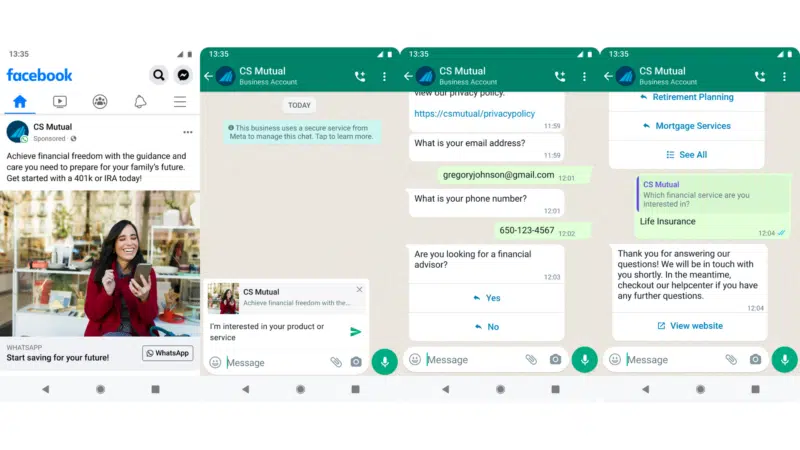
Click to WhatsApp Lead Gen: The lead objective is being extended to Facebook and Instagram ads that click to start a WhatsApp chat to help marketers nurture more quality leads with messaging. Select advertisers will have the option to add a Q&A flow in Ads Manager moving forward

Click To WhatsApp 800x450

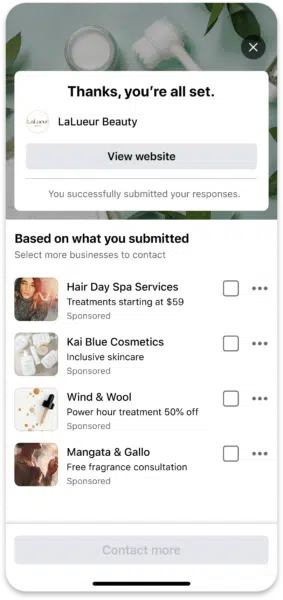
Instant form ad format. This feature lets users explore and connect with multiple businesses at once. For example, after signing up for a bridal hair trial, users can easily share their contact information with other relevant businesses, like a nail salon. It offers added convenience for users and more opportunities for small businesses to be discovered by interested customers.

Submit Multiple Forms 283x600

Calling leads on Facebook. Meta is testing this new feature that allows businesses to call people through Facebook to provide assurance and display their business information, including logo and name.

Advantage+ for Lead Gen: Meta is testing full campaign automation for lead generation campaigns, using Meta Advantage. Advertisers can apply AI to multiple campaign aspects simultaneously to “unlock greater performance while saving time and money.”

Hubspot. To support businesses in generating high-quality leads efficiently, Meta is introducing HubSpot as a new CRM integration partner, offering a straightforward click-through setup. Additionally, Meta is streamlining CRM integration with Zapier.

What Meta is saying. A spokesperson for Meta said in a statement:

  • “Integrating a CRM with the Conversions API, and using the conversion leads performance goalto optimize for lead quality, can boost campaign performance and help a business reach leads more likely to convert.”
  • “In a recent study, ads that used this campaign setup saw an average 16% reduction in cost per quality lead and 21% increase in rate of converting a lead to a quality lead, compared to ads using the leads performance goal.”

Deep dive. Read our 9-step guide on how to use Meta Ads for lead genertion for more information.


Related stories

New on Search Engine Land

@media screen and (min-width: 800px) { #div-gpt-ad-3191538-7 { display: flex !important; justify-content: center !important; align-items: center !important; min-width:770px; min-height:260px; } } @media screen and (min-width: 1279px) { #div-gpt-ad-3191538-7 { display: flex !important; justify-content: center !important; align-items: center !important; min-width:800px!important; min-height:440px!important; } }

About the author

Nicola Agius

Nicola Agius is Paid Media Editor of Search Engine Land after joining in 2023. She covers paid search, paid social, retail media and more. Prior to this, she was SEO Director at Jungle Creations (2020-2023), overseeing the company’s editorial strategy for multiple websites. She has over 15 years of experience in journalism and has previously worked at OK! Magazine (2010-2014), Mail Online (2014-2015), Mirror (2015-2017), Digital Spy (2017-2018) and The Sun (2018-2020). She also previously teamed up with SEO agency Blue Array to co-author Amazon bestselling book ‘Mastering In-House SEO’.

https://searchengineland.com/meta-new-lead-generation-tools-facebook-instgram-434411


Google updates policy to tackle abuse of its ad network

Google Merchant Center is splitting its Shopping Ads and Free Listings Malicious or Unwanted Software Policy into three separate policies:

  • Malicious software.
  • Compromised sites.
  • Unwanted software.

The updated policies will be enforced from October, with full enforcement set to be ramped up over four weeks.

Until then, Google has confirmed that it will continue to enforce its existing malware policy.

Malicious software: The new policy specifically forbids intentionally spreading harmful or unauthorized access-causing software (‘malware’). This rule applies to your ads, listings, and any software your site or app hosts or links to, even if not promoted through the Google Network. Violating this policy is now considered a serious offence.

Compromised sites: A compromised site refers to a site or destination whose code has been hacked to benefit a third party without the owner’s knowledge, often harming users. Ads and listings cannot use compromised destinations. If you violate this, there will be a warning issued at least seven days before any account suspension.

Unwanted software: Ads, listings, and destinations that break Google’s unwanted software policy are not permitted. You will receive a warning at least seven days before any account suspension for violating this policy.

Action required. Take a look at the updated policy to check if any of your ads or listings fall under it. If they do, Google recommends removing them from your feed.


Get the daily newsletter search marketers rely on.


What Google is saying. A Google spokesperson said in a statement:

  • “All of our policies are made to protect a high quality user experience.”
  • “We have enforcement systems and processes to prevent content that falls below these standards from being shown to users.”
  • “We take any attempts to trick or circumvent our review processes very seriously, so play fair.”

Deep dive. Read Google’s policy update in full for more information.


Related stories

New on Search Engine Land

@media screen and (min-width: 800px) { #div-gpt-ad-3191538-7 { display: flex !important; justify-content: center !important; align-items: center !important; min-width:770px; min-height:260px; } } @media screen and (min-width: 1279px) { #div-gpt-ad-3191538-7 { display: flex !important; justify-content: center !important; align-items: center !important; min-width:800px!important; min-height:440px!important; } }

About the author

Nicola Agius

Nicola Agius is Paid Media Editor of Search Engine Land after joining in 2023. She covers paid search, paid social, retail media and more. Prior to this, she was SEO Director at Jungle Creations (2020-2023), overseeing the company’s editorial strategy for multiple websites. She has over 15 years of experience in journalism and has previously worked at OK! Magazine (2010-2014), Mail Online (2014-2015), Mirror (2015-2017), Digital Spy (2017-2018) and The Sun (2018-2020). She also previously teamed up with SEO agency Blue Array to co-author Amazon bestselling book ‘Mastering In-House SEO’.

https://searchengineland.com/google-updates-policy-abuse-ad-network-434464


Instacart ad revenue up 19%

Instacart’s ad revenue was up 19% in the third quarter of 2023 to $222 million.

The online grocery shopping app also reported modest growth in orders, which rose to 66.2 million – a year-on-year increase of 4%, as well as a 6% year-on-year growth in growth transaction value (GTV).

However, despite performing better than analysts had predicted, Instacart still suffered a $2 billion GAAP net loss in its first earnings report since going public.

Why we care. The numbers indicate rising confidence in Instacart among advertisers, implying a favorable return on investment. With the retailer confirming its continued commitment to developing new ad formats, it may be worth exploring this platform as we approach 2024. Just keep in mind that as Instacart becomes more popular, ad prices might go up.

Overcoming net loss. Instacart has attributed its $2 billion GAAP net loss to a significant $2.6 billion stock-based compensation expense during its initial public offering (IPO) period. Despite this setback, the company’s adjusted EBITDA showed strong growth at $163 million, a 120% increase compared to the previous year. The retailers has claimed it currently has around $2.2 billion in cash, and has initiated a new $500 million share repurchase program to strategically buy back shares when opportunities arise.

Takeaways. Additional key findings from the report include:

  • GTV of $7,494 million, up 6% year-over-year.
  • Orders of 66.2 million, up 4% year-over-year.
  • Total revenue of $764 million, up 14% year-over-year, representing 10.2% of GTV.
  • Transaction revenue of $542 million, up 12% year-over-year, representing 7.2% of GTV.
  • Advertising & other revenue of $222 million, up 19% year-over-year, representing 3.0% of GTV.
  • GAAP gross profit of $561 million, up 16% year-over-year, representing 7.5% of GTV and 73% of total revenue.
  • GAAP net loss of $1,999 million, representing 26.7% of GTV and 262% of total revenue, was down $2,035 million year-over-year, reflecting a $2,595 million increase in SBC, which was significantly elevated in the period of our IPO 2 .
  • Adjusted EBITDA of $163 million, up 120% year-over-year, representing 2.2% of GTV and 21% of total revenue

What Instacart is saying. Fidji Simo, Chief Executive Officer, said in a statement:

  • “I continue to be excited about the long-term outlook for online grocery adoption and the growth initiatives we have in place to further expand our category leadership. At the same time, we are staying relentlessly focused on delivering more profitable growth.”
  • “We continue to invest in initiatives that can drive additional fulfillment efficiencies by improving batch rate, average time spent per order, and order quality to reduce appeasements and refunds as well as cancellations and redeliveries.”
  • “We are investing in additional measurement tools, capabilities, and ad formats that can deliver more value to our existing and new brand partners and drive further growth in advertising & other revenue. Finally, we will remain disciplined in how we allocate marketing spend and customer incentives – rather than maximizing near-term orders and GTV, we will continue to prioritize initiatives that we expect will lead to incremental, sustainable gross profit.”
  • “In summary, I am confident in our strategy and our ability to continue delivering strong earnings – all while pursuing growth opportunities that can generate more value for our partners, our team, and our shareholders.”

Get the daily newsletter search marketers rely on.


Deep dive. Read Instacart’s full Q3 2023 earnings report in full for more information.


Related stories

New on Search Engine Land

@media screen and (min-width: 800px) { #div-gpt-ad-3191538-7 { display: flex !important; justify-content: center !important; align-items: center !important; min-width:770px; min-height:260px; } } @media screen and (min-width: 1279px) { #div-gpt-ad-3191538-7 { display: flex !important; justify-content: center !important; align-items: center !important; min-width:800px!important; min-height:440px!important; } }

About the author

Nicola Agius

Nicola Agius is Paid Media Editor of Search Engine Land after joining in 2023. She covers paid search, paid social, retail media and more. Prior to this, she was SEO Director at Jungle Creations (2020-2023), overseeing the company’s editorial strategy for multiple websites. She has over 15 years of experience in journalism and has previously worked at OK! Magazine (2010-2014), Mail Online (2014-2015), Mirror (2015-2017), Digital Spy (2017-2018) and The Sun (2018-2020). She also previously teamed up with SEO agency Blue Array to co-author Amazon bestselling book ‘Mastering In-House SEO’.

https://searchengineland.com/instacart-ad-revenue-q3-2023-orders-434458