The Guardian accuses Microsoft of damaging its reputation with offensive AI-generated poll

The Guardian has accused Microsoft of damaging its brand by adding an offensive AI-generated poll to one of its articles.

In a story reporting on the death of 21-year-old Lilie James, whose body was found with serious head injuries in Australia, the tech giant’s AI asked readers to vote on the cause of her passing, giving them the options of murder, accident or suicide.

Furious readers reacted by describing the poll as “disgusting” and calling for the instant dismissal of the journalist – who had nothing to do with the poll.

Why we care. Microsoft’s decision to use AI instead of human writers is causing problems again. This is a clear reminder of why businesses should utilize AI to support human efforts rather than replace them. Neglecting this approach could damage your brand’s reputation and adversely affect your search rankings.

How this happened. Microsoft has agreements with major news organizations around the world, such as The Guardian and CNN, under which it can republish their articles in return for a portion of ad revenue. However, when the tech giant republished this story, its AI technology automatically added the offensive poll.

What The Guardian is saying. Anna Bateson, chief executive of the Guardian Media Group, wrote to Microsoft’s president, Brad Smith, accusing the company of upsetting James’ family, as well as causing “significant reputational damage” to both the newspaper and the journalist. She said:

  • “This is clearly an inappropriate use of genAI [generative AI] by Microsoft on a potentially distressing public interest story, originally written and published by Guardian journalists.”

Bateson then asked Smith to reassure her that:

  • “Microsoft will not apply experimental AI technology on or alongside Guardian journalism without the news publisher’s approval; and Microsoft will always make it clear to users when AI tools are used to create additional units and features next to trusted news brands like the Guardian.”

What Microsoft is saying. A Microsoft spokesperson said:

  • “We have deactivated Microsoft-generated polls for all news articles and we are investigating the cause of the inappropriate content. A poll should not have appeared alongside an article of this nature, and we are taking steps to help prevent this kind of error from reoccurring in the future.”

Get the daily newsletter search marketers rely on.

<input type="hidden" name="utmMedium" value="“> <input type="hidden" name="utmCampaign" value="“> <input type="hidden" name="utmSource" value="“> <input type="hidden" name="utmContent" value="“> <input type="hidden" name="pageLink" value="“> <input type="hidden" name="ipAddress" value="“>

Processing…Please wait.

function getCookie(cname) { let name = cname + "="; let decodedCookie = decodeURIComponent(document.cookie); let ca = decodedCookie.split(';'); for(let i = 0; i <ca.length; i++) { let c = ca[i]; while (c.charAt(0) == ' ') { c = c.substring(1); } if (c.indexOf(name) == 0) { return c.substring(name.length, c.length); } } return ""; } document.getElementById('munchkinCookieInline').value = getCookie('_mkto_trk');


History repeating itself. This isn't the first time Microsoft's generative AI has landed the tech giant in trouble. In September, the company was heavily criticized after publishing an AI-generated obituary for NBA star Brandon Hunter.

The former Boston Celtics and Orlando Magic player passed away suddenly this week, aged 42, after collapsing during a hot yoga class in Orlando, Fl. Shortly after his passing, fans were shocked to see the father of three described as “useless” in an obituary published on MSN. The headline read:

  • “Brandon Hunter useless at 42."

Readers reacted by branding Microsoft "lazy" for leveraging AI to create articles and urged the company to rehire the editorial staff it replaced with AI.

Deep dive. Read the Guardian's response in full for more information.

The post The Guardian accuses Microsoft of damaging its reputation with offensive AI-generated poll appeared first on Search Engine Land.

https://searchengineland.com/guardian-accuses-microsoft-damaging-its-reputation-offensive-ai-poll-434150


Marketing analytics and generative AI: What’s in store for marketers

Generative AI has emerged as a driving force in the marketing industry. We have already seen many use cases, from content creation to campaign optimization. It is also poised to revolutionize how we gain deeper insights into our marketing data.

In this article, we’ll dive deep into how generative AI is reshaping marketing analytics and uncovering its potential to drive data-driven decisions and insights.

The best place to start is by looking at some built-in tools that currently – or will soon exist – within our data hubs and business intelligence (BI) tools. 

Data analytics platforms powered by generative AI 

Generative AI tools built on large language models (LLMs) explicitly for data analytics are somewhat newer and fairly rudimentary. It’s also important to consider that using an LLM requires a clean and robust underlying data model. 

We will likely see the data analyst’s role shift to account for this, spending less time gathering insights, providing analyses, building dashboards and creating visualizations. 

Instead, the focus will be refining data models to extract these insights using natural language processing. 

Tableau

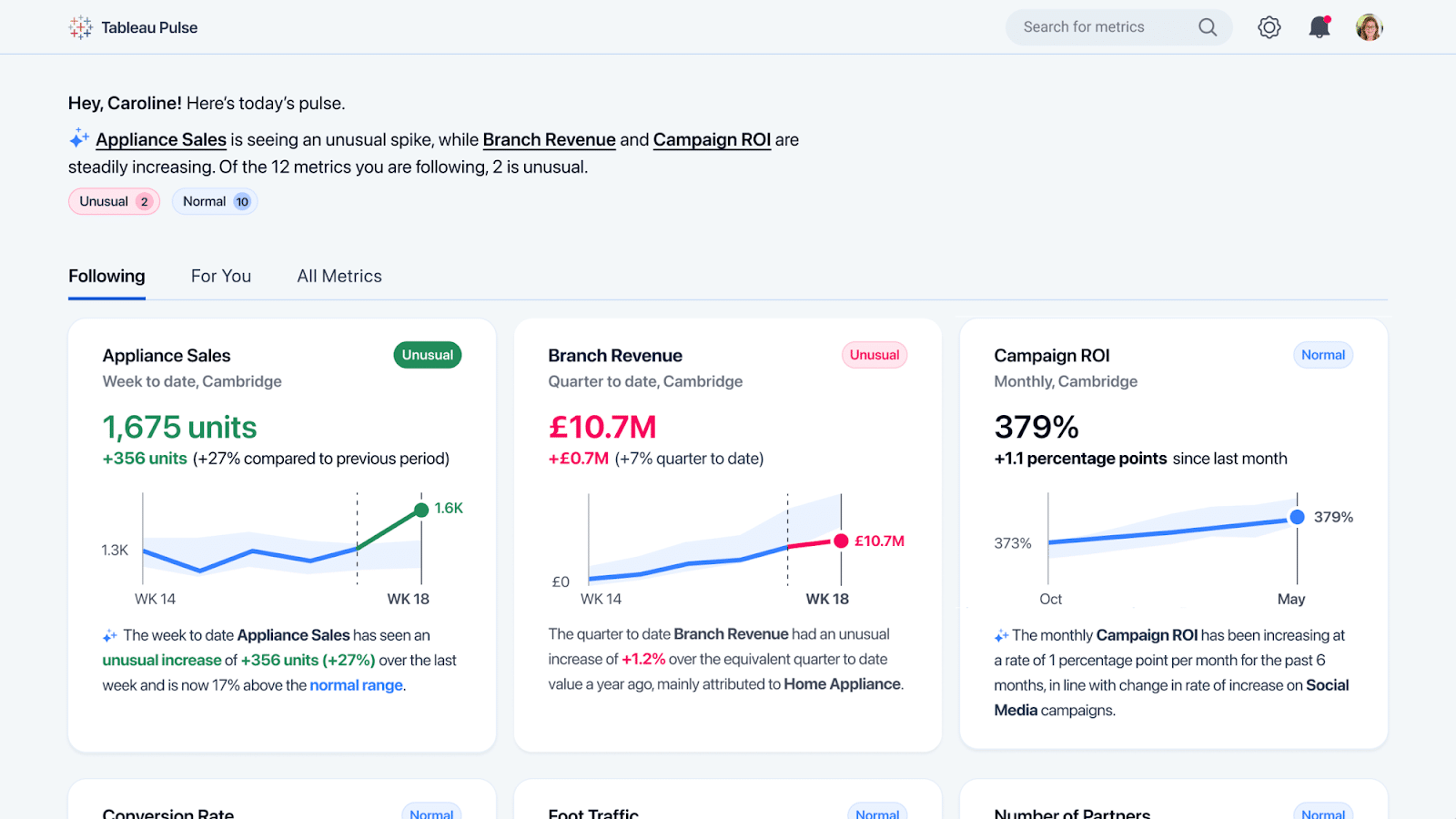
Take Tableau’s newest AI product, Pulse, which is slated for release by the end of 2023. 

The user will select priority KPIs that Tableau will automatically generate visualizations for and alert the user when unusual trends or patterns are detected. 

From there, the user can simply click on the relevant KPI to unearth the “why” behind the change in trend. 

Tableau has stated explicitly that its goal is to “simplify and streamline” the existing workflows of the data analyst, which is a key idea that we will begin to see more and more. 

Generative AI tools will do more of the heavy lifting. Conversely, analysts will shift their focus either to the data model development side or become a power user of a generative AI tool of choice by understanding how to construct and modify natural language queries to extract the most value out of their capabilities. 

Source: Tableau.com 
Source: Tableau.com 

Get the daily newsletter search marketers rely on.

<input type="hidden" name="utmMedium" value="“> <input type="hidden" name="utmCampaign" value="“> <input type="hidden" name="utmSource" value="“> <input type="hidden" name="utmContent" value="“> <input type="hidden" name="pageLink" value="“> <input type="hidden" name="ipAddress" value="“>

Processing…Please wait.

function getCookie(cname) { let name = cname + "="; let decodedCookie = decodeURIComponent(document.cookie); let ca = decodedCookie.split(';'); for(let i = 0; i <ca.length; i++) { let c = ca[i]; while (c.charAt(0) == ' ') { c = c.substring(1); } if (c.indexOf(name) == 0) { return c.substring(name.length, c.length); } } return ""; } document.getElementById('munchkinCookieInline').value = getCookie('_mkto_trk');


Funnel.io

Funnel.io, a popular omnichannel marketing hub, takes a slightly different approach with what they have branded as Funnel AI. 

While I mentioned that generative AI solutions generally require strong data models, users can extract, explore, manipulate and analyze all their marketing data in Funnel AI without leaving the Funnel platform. 

The one-stop-shop data pipeline approach is on the rise, aiming to eliminate data silos and democratize data, making it easily accessible for everyday use, even without the technical skills of a traditional analyst.

Funnel AI and similar tools are extremely useful for on-the-fly ad hoc analysis, rather than having to slice and dice data in an existing dashboard that requires ongoing maintenance. 

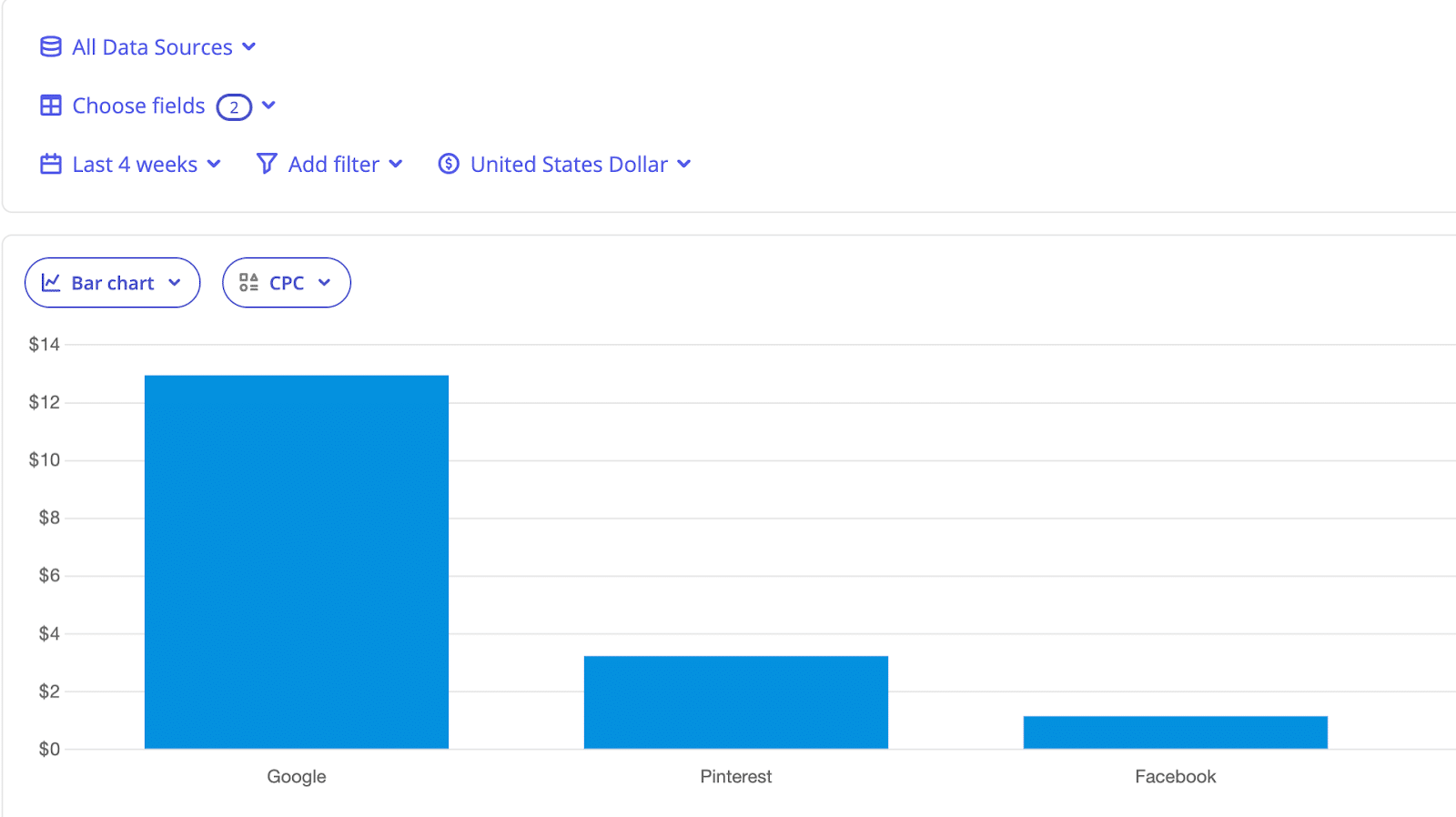
Funnel AI features auto-suggested queries for users unsure where to start, such as "What is the breakdown of CPC per channel in the last four weeks?" 

This query delivers a bar graph of each channel's CPC, which users can refine with additional filters or enter new queries into the search bar. 

Previously, obtaining this basic insight required data analysts to extract, model and visualize data tailored to specific parameters.

With generative AI, what took hours now takes seconds, freeing users for focused analysis and decision-making.

Funnel.io platform

Tellius

Tellius, a similar all-encompassing data platform that is more generalized, takes a similar approach through its generative AI tools to the prior examples. 

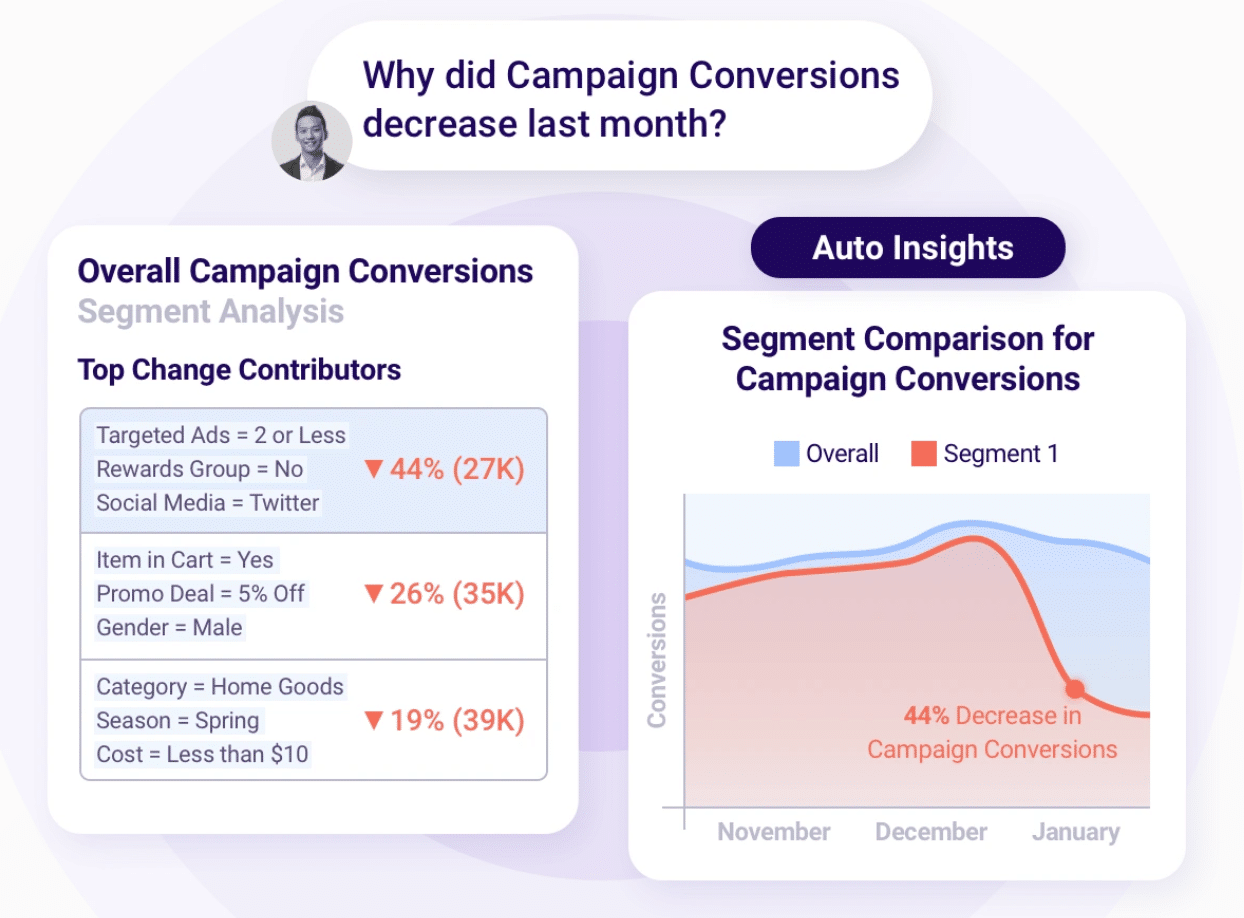
In the example below, their platform automatically detected a decrease in campaign conversions and immediately offered the top contributing points to explain the decrease by creating a segment analysis. 

Typically, this process would consume hours of a marketer's or analyst's time, from identifying the drop-off to digging to determine causation. 

The ability to swiftly uncover such critical insights undoubtedly provides marketers using these tools with a significant advantage, enabling them to take action promptly instead of investing time in searching for this information.

Source: Tellius.com
Source: Tellius.com

Trust and transparency considerations

While we can clearly see the power and value of generative AI tools, getting widespread user adoption and trust in these models is a challenge organizations must overcome. 

Human oversight and data validation will still be required for the foreseeable future. Three in four CEOs believe that competitive advantage will depend on who has the most advanced generative AI, but 48% worry about bias or data accuracy. 

This will require marketers to implement new roles and processes to ensure accountability for the AI models and transparency in AI-based decision-making. 

The future of digital marketing is closely intertwined with the advancement of AI capabilities. Marketers who adapt, understand best practices, and establish effective oversight gain a competitive edge.

The post Marketing analytics and generative AI: What’s in store for marketers appeared first on Search Engine Land.

https://searchengineland.com/marketing-analytics-generative-ai-marketers-434104


How to avoid search marketing burnout

Stress, anxiety and burnout are rampant. With the worries of global conflicts, economic turmoil, and mass layoffs across industries, fear becomes a prominent feeling. 

We’re all a little on edge, waiting for that last-minute meeting invite or the “have a second?” Slack message. We’re worried by all the uncertainty, and it’s impacting our well-being and our work. 

Search marketers have a unique challenge. In addition to the uncertainty and stressors, we are constantly driven by our need to maximize performance, deliver results and cope with ever-changing algorithms and platforms. The demands are exceedingly high. And all of this leads to burnout. 

Understanding burnout

Burnout is not a myth or a sign of weakness. It’s not something we should be ashamed of or hide from. More than 89% of Americans have experienced burnout in the past year. Just because it is common doesn’t mean that it should be ignored. 

What are the signs of burnout?

The signs of burnout can vary from person to person, but common indicators are:

  • Physical and mental exhaustion.
  • Increased negativity and cynicism. 
  • Reduced motivation and productivity.
  • Poor performance and inattention to detail.
  • Emotional and physical detachment from work.
  • Sleep disturbances, headaches, and digestive problems.

Phases of burnout

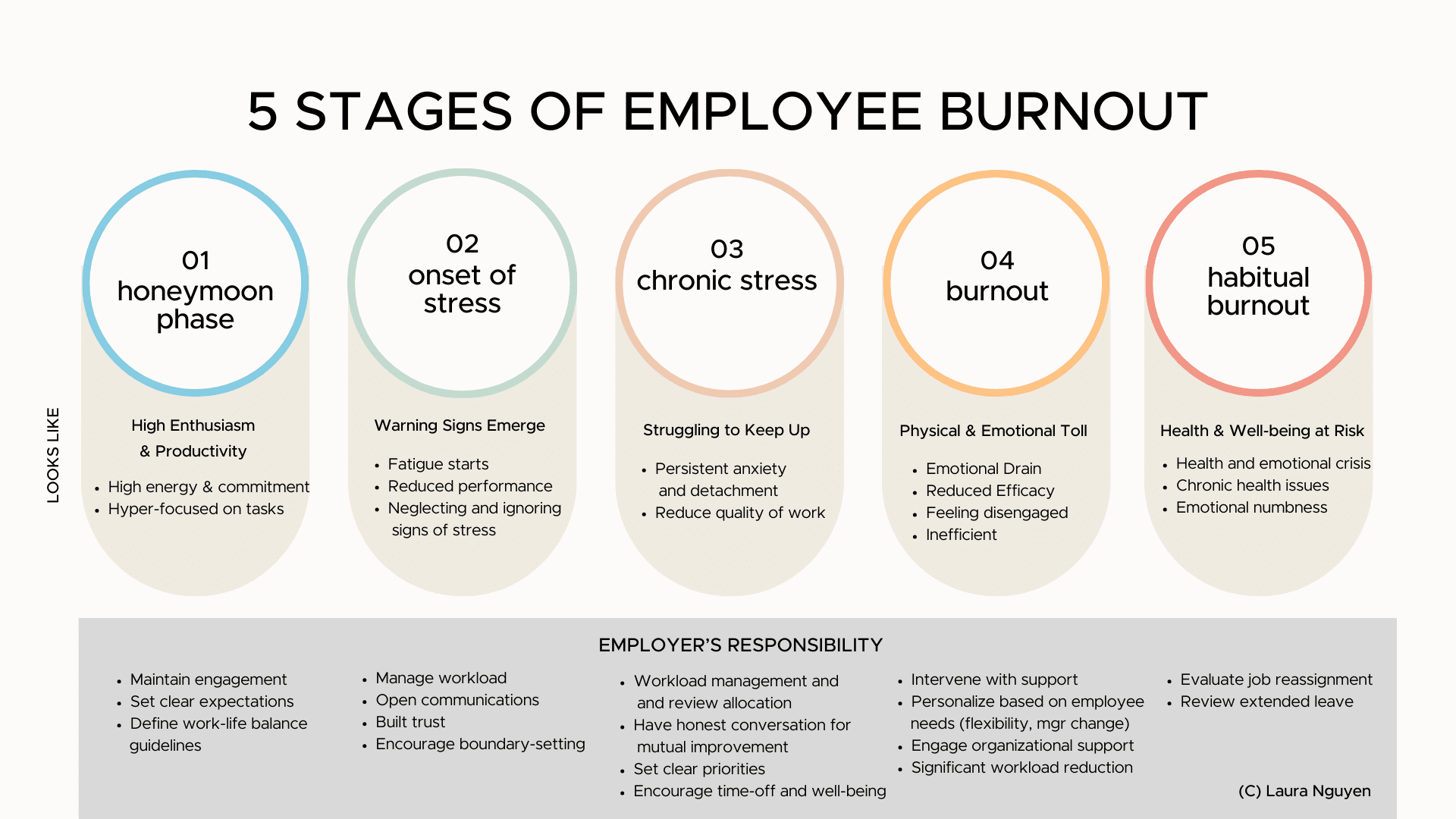
For many who feel burned out, we ask ourselves, “How did we get here?” It was gradual. It was sneaky. It was unmanaged stress. Burnout typically progresses through several phases (see chart). 

If stress is left unaddressed, it can escalate to “burnout,” which feels like extreme physical and emotional exhaustion, detachment from responsibilities, and a significant drop in job performance. 

The shift then moves into chronic or habitual burnout, where health and well-being are at significant risk. Recognizing these phases is crucial for early intervention and prevention of burnout because burnout can have serious consequences for your well-being and professional life.

Stages of employee burnout

The impact of workplace burnout

It’s not just the employee who suffers from burnout; so does the company.

Research consistently shows that workplace burnout has wide-ranging negative consequences for both individual employees and organizations. 

  • Harvard Business Review estimates the annual healthcare spending due to workplace burnout is anywhere from $125 billion to $190 billion. 
  • According to a global study from the Workforce Institute, managers impact employees’ mental health (69%) more than doctors (51%) or therapists (41%) – and even the same as a spouse or partner (69%). 
  • Burned-out employees are 63% more likely to take a sick day and 23% more likely to visit the ER (Gallup study). 
  • More than 80% of employees would rather have good mental health than a high-paying job (WFI). 
  • Two-thirds of employees would take a pay cut for a job that better supports their well-being (WFI). 

These statistics should be a motivator for organizational change. The data is clear and burnout leads to increased absenteeism, reduced job satisfaction, and decreased productivity. 

For individuals, the health and well-being impact is significant. Employees experience anxiety, depression, insomnia and physical health problems such as heart disease, gastrointestinal issues, headaches and more. 


Get the daily newsletter search marketers rely on.

<input type="hidden" name="utmMedium" value="“> <input type="hidden" name="utmCampaign" value="“> <input type="hidden" name="utmSource" value="“> <input type="hidden" name="utmContent" value="“> <input type="hidden" name="pageLink" value="“> <input type="hidden" name="ipAddress" value="“>

Processing…Please wait.

function getCookie(cname) { let name = cname + "="; let decodedCookie = decodeURIComponent(document.cookie); let ca = decodedCookie.split(';'); for(let i = 0; i <ca.length; i++) { let c = ca[i]; while (c.charAt(0) == ' ') { c = c.substring(1); } if (c.indexOf(name) == 0) { return c.substring(name.length, c.length); } } return ""; } document.getElementById('munchkinCookieInline').value = getCookie('_mkto_trk');


Common causes of burnout 

How do you solve burnout and its negative impacts? So often, the response to an employee who shares they are burned out is, “Just take a vacation.” It’s not that simple. 

Reducing an employee's hours will not solve burnout. It’s part of the solution but not the entire solution.

Research from Gallup reveals that how employees experience their workload has a stronger influence on burnout than actual hours worked.

For many marketers, we are always on. To effectively combat burnout, it is important to understand the causes. 

Christina Maslach, a renowned psychology professor emerita at UC Berkeley, has dedicated decades of research to understanding and addressing burnout.

In the book, "The Burnout Challenge," co-written with Michael P. Leiter, Maslach and Leiter offer a solutions-focused approach to combating workplace burnout.

Maslach and Leiter identify mismatches between employees and their jobs that contribute to burnout:

  • Workload: When priorities and demands exceed an individual's capacity, leading to excessive stress and exhaustion.
  • Control: Constant uncertainty, lack of priorities and direction, lack of autonomy and decision-making authority, leave individuals feeling powerless and restricted. 
  • Rewards: Insufficient recognition, appreciation, and compensation for one's efforts, leading to feelings of undervaluation.
  • Community: A lack of social support, collaboration, and positive relationships in the workplace, resulting in feelings of isolation.
  • Fairness: Perceived unfairness, injustice, and inequity in how employees are treated, leading to resentment and cynicism.
  • Values: Conflict between an individual's personal values and the values espoused by the organization, causing a sense of dissonance and moral distress.

These six mismatches can be identified and resolved intentionally by organizations and individual employees. 

Important ways to reduce burnout

Addressing burnout involves solutions and actions from both the employee and the employer. 

Employees

Prioritize self-care and work-life balance

Self-care is crucial for maintaining overall well-being and preventing burnout. Regular exercise, healthy eating, and sufficient sleep are foundational to self-care.

Focus on activities that allow you to play (bring joy) and pause (relaxation). Make a list of these two types of activities, then regularly schedule them.

Don’t overcommit and set boundaries

Stop saying yes to every project, task or committee if it impedes your ability to recharge and prioritize self-care. It’s important to set clear boundaries that allow you not to feel overworked and out of control.

This may include turning off notifications on weekends and after-hours, not vacationing with your work laptop, or ensuring you are present at family events and activities. By setting boundaries, you are allowing yourself time to recharge.

Gain clarity on personal values and goals

Dedicate time to contemplate and ask yourself meaningful questions about what truly matters to you, what brings you joy, and what your aspirations are.

Having an understanding of your values and strengths enables you to understand how you can leverage those in your work. Complete a value exercise. If you need extra support, work with a coach to help guide you through the process. 

Employers and leaders

First, companies and leaders need to recognize and acknowledge the impact of burnout. One of the key ways to address burnout is to ensure that managers are trained and supported. A Gallup study shows that in most situations of burnout, a good manager was missing.

Organizations need to upskill and invest in developing good managers. Second, it’s important to remove managers who fail to trust, respect, or intimidate their employees. These behaviors will lead to increased burnout and poor company culture. 

To be a great manager for your marketing teams, here are six ways to combat burnout that address Maslach’s misalignments.

Conduct regular assessments

Create feedback mechanisms to gauge employee burnout levels and identify areas of mismatch in the workplace. Use surveys, one-on-one meetings and other mechanisms to gather feedback.

Establish realistic workloads and prioritize tasks

Ensure that workloads are manageable and realistic, and provide resources and support to help employees meet their job demands.

Managers should set reasonable and clear expectations and deadlines. Help teams delegate tasks, outsource when necessary, and effectively use project management tools to distribute work. 

Foster a supportive community

Encourage and reward teamwork, collaboration, and open communication. Be sure to create a positive and inclusive work environment where employees feel valued and supported.

Prioritize time for team-building, celebration, reflection and feedback. These all contribute to a healthier workplace. 

Promote fairness and equity

Be clear about responsibilities and fairly reward employees for their contributions. When employees perceive unfair treatment, it dramatically impacts morale and motivation.

This may mean giving credit to one person for a team’s efforts or extending deadlines for certain employees over others. Be sure to address unfair treatment quickly and without judgment. 

Align values and organizational culture

Creating and fostering a shared sense of purpose and values between the organization and the individual are important.

For leaders, it’s important to understand the value of your employees and what motivates them. Then, be sure to articulate the company’s values clearly. 

Encourage work-life integration

A sense of control over someone’s day is important, and flexible work arrangements are critical. By offering flexible work arrangements, such as remote work options or flexible hours, leaders can help alleviate stress and promote work-life balance.

Leaders and individuals have an important role in reducing burnout at work. So often, the ownership of burnout is placed on the individual. The burned-out individual needs to do more to reduce burnout – prioritize self-care, sleep more, exercise more, meditate more. 

Although there are actions individuals can take, it’s important to recognize the systems we all operate in. Companies must start listening to their employees and responding to their needs with flexibility. As leaders, evaluate how you can help address Maslach’s six mismatches that lead to burnout. 

The post How to avoid search marketing burnout appeared first on Search Engine Land.

https://searchengineland.com/avoid-search-marketing-burnout-434111


Yelp’s 12% rise in ad revenue drives record-breaking profit

Yelp has reported record-breaking profits driven by a sharp rise in ad revenue in the third quarter of 2023.

The company’s total net revenue increased 12% year-on-year to $345 million, comprising of:

  • $330 million in advertising revenue.
  • $3 million in transactions revenue.
  • $12 million in other revenue.

The Q3 earnings marked a 12% rise in ad revenue, along with a 9% increase in ad clicks year-on-year..

Why we care. Advertisers are increasingly placing their trust in Yelp, and the platform’s rising number of ad clicks indicates a positive return on investment. This success is likely to pique the interest of other marketers, potentially leading them to consider shifting their advertising budgets towards Yelp. However, with Yelp’s expanding popularity, it’s important to be mindful that ad prices are likely to escalate.

Breaking down the numbers. Yelp’s sharp rise in advertising revenue was driven by ad spend in its services category, which was up 14% year on year to $206 million. Meanwhile, ad spend in Yelp’s restaurants, retail and other category was up 10% to $124 million.


Get the daily newsletter search marketers rely on.


What Yelp is saying. Jeremy Stoppelman, Yelp’s co-founder and chief executive officer, said in a statement:

  • “We continued to see strong momentum from our product-led strategy as our team delivered another quarter with a number of record-breaking results.”
  • “Third quarter net revenue reached a new high, driven by record advertising revenue in our services category as service pros spent more on Yelp than ever before, 25% growth in our self-serve channel and a 9% increase in ad clicks year over year.”
  • “As we continue to execute on our robust product roadmap to make Yelp the go-to platform for services, deliver more value to advertisers, and enhance the overall consumer experience, I’m excited about the opportunities ahead to drive profitable growth and long-term shareholder value.”

Deep dive. Read Yelp’s full Q3 2023 earnings report in full for more information.


Related stories

New on Search Engine Land

@media screen and (min-width: 800px) { #div-gpt-ad-3191538-7 { display: flex !important; justify-content: center !important; align-items: center !important; min-width:770px; min-height:260px; } } @media screen and (min-width: 1279px) { #div-gpt-ad-3191538-7 { display: flex !important; justify-content: center !important; align-items: center !important; min-width:800px!important; min-height:440px!important; } }

About the author

Nicola Agius

Nicola Agius is Paid Media Editor of Search Engine Land after joining in 2023. She covers paid search, paid social, retail media and more. Prior to this, she was SEO Director at Jungle Creations (2020-2023), overseeing the company’s editorial strategy for multiple websites. She has over 15 years of experience in journalism and has previously worked at OK! Magazine (2010-2014), Mail Online (2014-2015), Mirror (2015-2017), Digital Spy (2017-2018) and The Sun (2018-2020). She also previously teamed up with SEO agency Blue Array to co-author Amazon bestselling book ‘Mastering In-House SEO’.

https://searchengineland.com/yelp-rise-profit-q3-ernings-2023-434134


5 ways Google and YouTube advertisers can protect their brands

Google has introduced several updates to assist advertisers in maintaining brand safety and suitability on YouTube and the Google Display Network.

Danielle Wolinsky, Google’s Global Lead for Advertiser Trust and responsibility, presented various options for brand protection, such as a new feature that enables marketers to easily select topics they want to exclude on both YouTube and the Google Display Network.

Below, is a roundup of the five new ways advertisers can safeguard their brands on YouTube.

1. Simplified ability to exclude themes

Now, worldwide, you can easily filter out themes on YouTube and the Google Display Network that don’t fit your brand, offering more precision and clarity. These filters offer more accuracy and clarity when removing specific content types.

2. Estimated Impact in Google Ads

This tool helps you assess the impact of your settings on inventory, impressions, and costs. – and it is now accessible to all YouTube advertisers. You can use this tool to analyze how excluding certain content may affect ad reach and performance. It can also be used to help agencies can assist clients in making informed choices.

3. Leveraging AI for ad safety

YouTube’s AI technology can now spot patterns that help the platform to detect similar content that’s previously been removed – sometimes even before it’s seen. It’s also used to automatically identify and remove spam and content that has already violated YouTube’s rules. The same approach is applied to YouTube comments and ads as well.

4. Content-level brand safety accreditation

YouTube has received content-level brand safety accreditation from the Media Rating Council for the third year in a row following an extensive audit. YouTube advertising is 99% effective in ensuring brand safety for in-stream, livestream, Shorts, and Watch Next/Home feed content, meeting GARM brand safety standards.

5. Tailoring YouTube ad placements

YouTube now offers expanded suitability inventory types to more areas, including YouTube Shorts, allowing marketers to align their campaigns with specific content categories. The recommended choice for most advertisers is the standard inventory, ensuring adherence to YouTube’s advertiser-friendly guidelines. Depending on your brand, you can opt for either limited or expanded inventory, giving you flexibility in reaching your target audience.


Get the daily newsletter search marketers rely on.


What Google is saying. Danielle Wolinsky, Google’s Global Lead, Advertiser Trust & Responsibility, said in a statement:

  • “In our dynamic industry, one thing won’t ever change: marketers and users alike need to trust the entire ad ecosystem. That’s how we can keep the web open and free.”
  • “Brand safety and suitability are top priorities for us. We actively enforce our publisher policies and work to ensure your ads on YouTube don’t appear next to harmful content.”
  • “Because there is no one-size-fits-all approach, we’re prioritizing transparency and control for marketers of all sizes.”

Deep dive. Read Google’s announcement in full for more information.


Related stories

New on Search Engine Land

@media screen and (min-width: 800px) { #div-gpt-ad-3191538-7 { display: flex !important; justify-content: center !important; align-items: center !important; min-width:770px; min-height:260px; } } @media screen and (min-width: 1279px) { #div-gpt-ad-3191538-7 { display: flex !important; justify-content: center !important; align-items: center !important; min-width:800px!important; min-height:440px!important; } }

About the author

Nicola Agius

Nicola Agius is Paid Media Editor of Search Engine Land after joining in 2023. She covers paid search, paid social, retail media and more. Prior to this, she was SEO Director at Jungle Creations (2020-2023), overseeing the company’s editorial strategy for multiple websites. She has over 15 years of experience in journalism and has previously worked at OK! Magazine (2010-2014), Mail Online (2014-2015), Mirror (2015-2017), Digital Spy (2017-2018) and The Sun (2018-2020). She also previously teamed up with SEO agency Blue Array to co-author Amazon bestselling book ‘Mastering In-House SEO’.

https://searchengineland.com/5-ways-google-and-youtube-advertisers-can-protect-their-brands-434110


Google AdSense unveils major changes to how it pays publishers

Google AdSense is rolling out two new changes for publishers which will come into effect early next year:

  • Moving to pay publishers per impression. 
  • Splitting the AdSense revenue-share into separate rates for buying and selling.

The platform has said that these changes offer publishers a consistent way to compare fees across different monetization technologies and will enhance transparency in the media-buying process.

Publishers are unlikely to see a difference in their earnings following these updates, according to Google’s research.

Why we care. These changes will help publishers to better understand their earnings from Google products and third-party platforms, allowing them to make more informed data-driven decisions based on what works best.

What separate rates mean for publishers. Publishers using AdSense for content will receive 80% of the revenue after any fees are deducted, whether from Google or third-party platforms.

For instance, if Google Ads buys display ads on AdSense, they usually retain 15% of the advertiser’s spend, though it can vary since they charge based on user actions. In the end, publishers typically get about 68% of the revenue.

When advertisers use third-party platforms to buy display ads on AdSense, publishers still get 80% of the revenue after the third-party platform takes its fee. Google doesn’t control or see the third-party platform fees.

Paying per-impression. Google AdSense is switching from paying publishers based on clicks to paying them per-impression. This change makes it easier for publishers to compare earnings across Google’s products and other technology providers they use. It won’t affect the types or number of ads that publishers can show on their websites.

AdSense rules. Publishers must follow the AdSense policies and the Better Ads Standards, which prohibit things like pop-up ads or disruptive ads that cover most of the screen.


Get the daily newsletter search marketers rely on.


What Google is saying. Dan Taylor, VP of Global Ads, Google, said:

  • “Advertising technology helps fund the creative and diverse content we all enjoy online.”
  • “That’s why we’ve spent years investing in AdSense to help publishers of all sizes easily make money and grow.”
  • “As the internet evolves, we will continue our work to contribute to the open web and the access to content that advertising supports, while continuing to simplify and provide transparency into the process.”

Deep dive. Read Google AdSense’s announcement in full for more information.


Related stories

New on Search Engine Land

@media screen and (min-width: 800px) { #div-gpt-ad-3191538-7 { display: flex !important; justify-content: center !important; align-items: center !important; min-width:770px; min-height:260px; } } @media screen and (min-width: 1279px) { #div-gpt-ad-3191538-7 { display: flex !important; justify-content: center !important; align-items: center !important; min-width:800px!important; min-height:440px!important; } }

About the author

Nicola Agius

Nicola Agius is Paid Media Editor of Search Engine Land after joining in 2023. She covers paid search, paid social, retail media and more. Prior to this, she was SEO Director at Jungle Creations (2020-2023), overseeing the company’s editorial strategy for multiple websites. She has over 15 years of experience in journalism and has previously worked at OK! Magazine (2010-2014), Mail Online (2014-2015), Mirror (2015-2017), Digital Spy (2017-2018) and The Sun (2018-2020). She also previously teamed up with SEO agency Blue Array to co-author Amazon bestselling book ‘Mastering In-House SEO’.

https://searchengineland.com/google-adsense-changes-pays-publishers-434055


How to optimize your product feeds with ChatGPT and FeedGen

Feed management in PPC, especially within platforms like Google Ads and Microsoft Ads, is crucial for organizing and updating product or service data. It serves as the foundation of Shopping Ads, ensuring that viewers are presented with relevant results and accurate information. 

With AI tools like ChatGPT and Google’s FeedGen, you can enhance your product or service data to deliver more relevant and accurate information to your audience. 

This article will explore the core principles of product feed optimization and the capabilities of AI-driven tools, including the benefits and limitations compared to traditional feed management tools.

What is product feed optimization?

At its core, product feed optimization in PPC is about creating keyword-rich titles and descriptions that:

  • Match search queries.
  • Show information.
  • Categorize products properly.
  • Add additional information like color, size, etc. 

In more advanced optimizations, you also consider optimizing images, adjusting prices, using performance labels and conducting A/B tests. 

While the best practices can vary depending on the product category, a common approach for creating effective product titles is with the following structure:

Apparel

  • Brand + Gender + Product Type + Attributes (color, size, material)

Consumable

  • Brand + Product Type + Attributes (weight, count)

Hard goods

  • Brand + Product + Attributes (size, weight, quantity)

Electronics

  • Brand + Attribute + Product Type

Books

  • Title + Type + Format (hardcover, ebook) + Author

To effectively optimize product titles for online retail, here are some best practices: 

  • Adopt a customer-centric approach.
    • Think from the perspective of your target audience and understand their shopping behavior.
    • Include key attributes in titles (i.e., color, size, material, and specifications) as customers often use them to refine their searches. 
  • Adhere to platform-specific guidelines, especially Google’s strict rules regarding using capitals and exclamation marks. 
  • Use data from Google Ads search terms reports, Google Trends, and tools like Semrush or Ahrefs to identify high-performing queries and relevant keywords. 
  • Tailor your titles based on the product vertical, considering how customers in that industry typically search. 
  • Include brand names in titles if they are well-recognized and relevant, but exclude lesser-known brands that might not resonate with shoppers.

Optimizing a product feed with ChatGPT

To begin with AI-based feed optimization, starti with ChatGPT. 

You can input your feed and optimize the title and description, gradually adding more information. 

This approach provides a foundational understanding of feed optimization’s capabilities and allows you to focus on significant improvements.

An example optimization with ChatGPT and Google Sheets

You can use popular plugins like ChatGPT in Google Sheets and Docs, or you can use App Scripts to let the ChatGPT API work on that sheet.

A sample query could be: 

  • “Write a Google Shopping optimized product title with a maximum of 150 characters using the [title], [description], [category], [color], [size] and [gender].” 

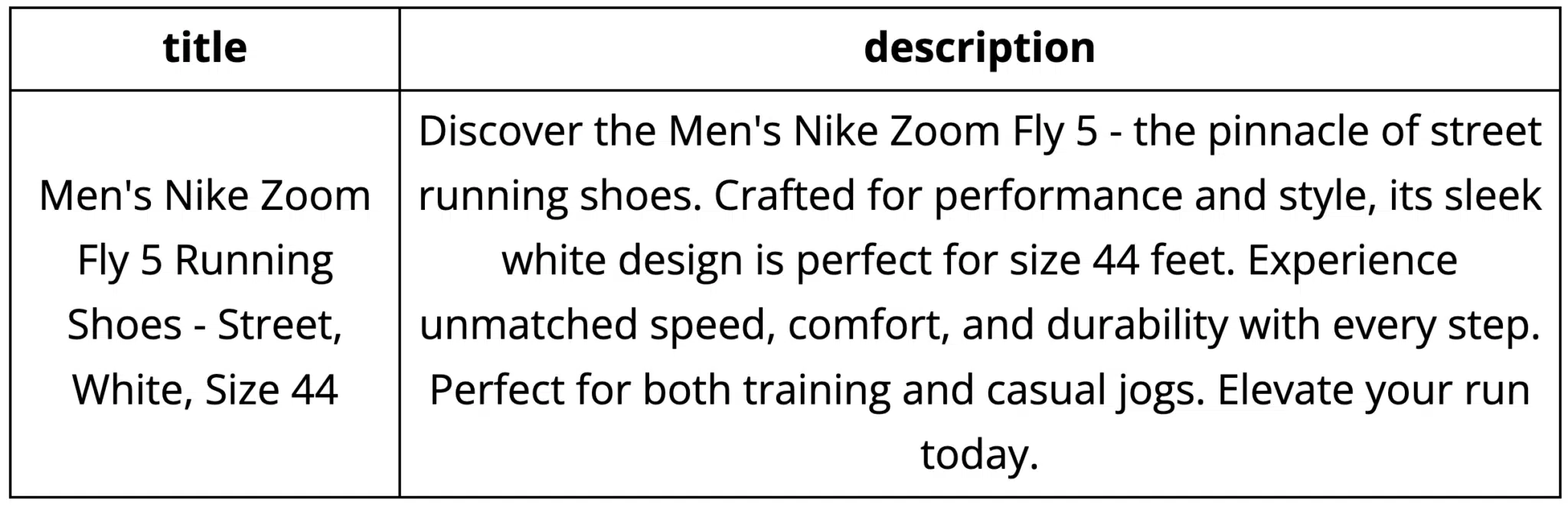
The input feed:

sample input feed for nike zoom fly 5

The result:

results for nike zoom fly 5

While this is not an all-time peak performance of product feed optimization, it’s an improvement of the input feed and a good base to work with.

Setting up ChatGPT + Google Sheet is easily done in 15-30 minutes, including a Plugin or AppScripts setup on this basic level.

A more advanced approach can include special input fields to prompts, Google Shopping guidelines and optimization best practices that ChatGPT can use. 

ChatGPT is a cost-effective way to begin feed optimization for quick title and description improvements. However, if you need a more polished and advanced solution, consider FeedGen.


Get the daily newsletter search marketers rely on.


Optimizing a product feed with Google FeedGen

Powered by Google Cloud’s advanced large language models, FeedGen is an open-source tool designed to: 

  • Enhance product titles.
  • Craft detailed descriptions.
  • Supplement missing attributes in product feeds. 

Its main purpose is to aid merchants and advertisers in detecting and rectifying quality shortcomings in their feeds using generative AI presented in an accessible and adjustable manner. 

By leveraging Google Cloud Platform’s Vertex AI API, FeedGen offers both zero-shot and few-shot inference capabilities. 

The few-shot prompting feature, in particular, allows users to incorporate the best samples from their Shopping feed, thus tailoring the model’s output for consistency and elevated quality.

This can be further refined by adjusting the foundational models with proprietary data.

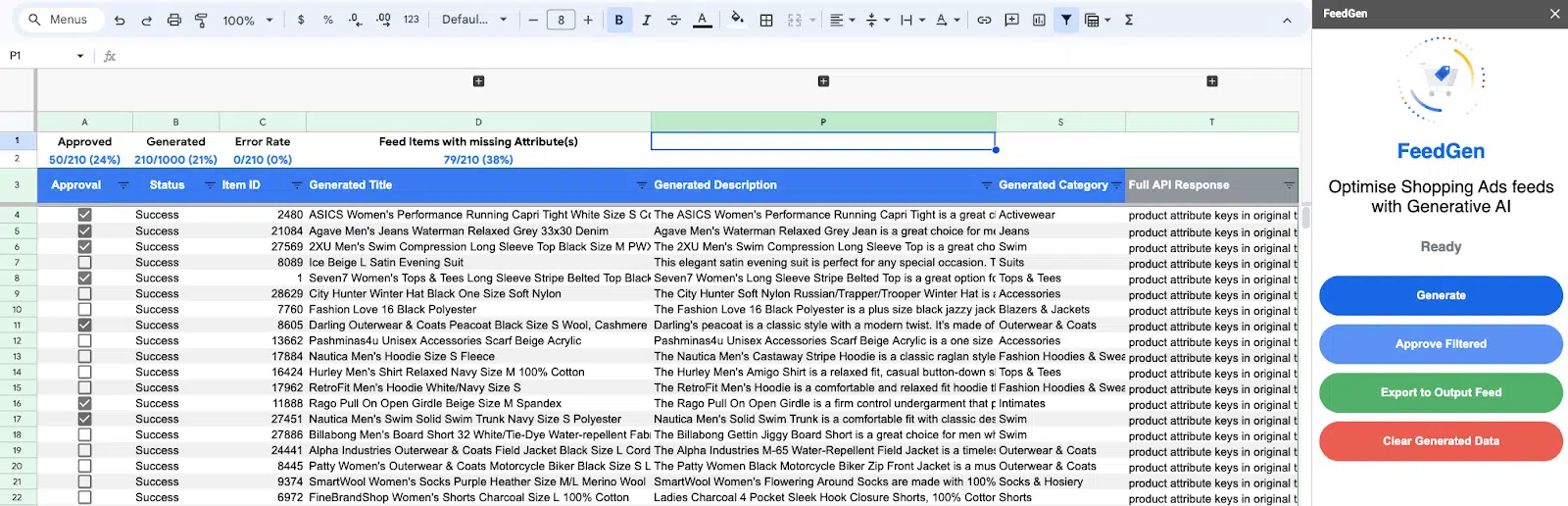
FeedGen tool for optimizing Shopping ads feeds

FeedGen presents many advantages, notably its proficiency in swiftly refining product titles and descriptions in large volumes. 

It’s especially beneficial when depending on third-party data and ensures the integrity of titles and descriptions by avoiding fabricated additions. 

Furthermore, users can effortlessly select their preferred titles and descriptions and transform them into a supplemental feed, ready for integration into their Google Merchant Center.

However, using FeedGen can be challenging as it requires the creation of a Google Cloud Project, Vertex API activation, and a solid understanding of Vertex AI for machine learning operations.

The outcome’s quality is contingent upon the quality of your prompts, requiring expertise in defining the optimal prompting examples. Setting up examples for each product category can be time-consuming, and meticulously reviewing all products remains imperative to ensure top-notch quality. 

Currently, only English is supported, although there’s a potential for expansion into other languages through discussions with Google representatives.

Dig deeper: Top 5 data feed errors that can sabotage your ecommerce campaigns

What to expect when working with FeedGen

Marketers use AI for feed optimization to find scalable and valuable solutions. FeedGen fits this need, working well for both small and large feeds. It fills in missing data and produces detailed descriptions. Its setup can be complex, but its potential is vast.

I’ve tested FeedGen and found it reliable. Agencies might even use it for multiple clients. Setup takes under an hour, but choosing the right prompts can take longer, depending on the industry and desired outcomes.

Monitoring FeedGen is essential. I’ve seen errors, ranging from wrong descriptions to titles losing key details. It’s important to ensure good input, as poor data gives poor results. FeedGen isn’t perfect. 

FeedGen has a rating system for products, from -1 to +1, to help review. Still, I recommend checking each product manually. As for costs, FeedGen is affordable. Bigger feeds might cost more, but smaller feeds should stay around or below $100.

From my experience, you can get up to 80% of properly optimized products after finding your ideal prompts and settings, however until I got to 80% it took me a few tries.

That said, if you manually optimize a larger feed or try to cover it based on static optimization rules, the results would take significantly longer or be worse. From this perspective, FeedGen is already a game-changer on scaling feed optimization.

Marketers often use tools like ProductsUp, Channable, DataFeedWatch and more to optimize product feeds. 

With the rise of AI tools like FeedGen, it’s natural to ask: can FeedGen replace these popular tools? 

The straight answer is no. 

While FeedGen is great for enhancing product details, it doesn’t handle the structural tasks that traditional tools do, such as: 

  • Linking data.
  • Setting up rules for information mapping.
  • Working more high-level optimization of titles and descriptions. 

The ideal workflow might be to:

  • Use FeedGen to enrich your product feed with details.
  • Then, rely on a conventional feed management tool to get everything organized and ready for marketing platforms.

Dig deeper: How to set up feed rules in Google Merchant Center and ensure quality product data

ChatGPT and FeedGen: Your gateway to well-optimized product feeds 

AI-driven tools like ChatGPT and FeedGen can significantly boost your product feed optimization efforts, offering scalability and improved data quality. 

These tools are valuable additions to your PPC toolkit, but it’s important to recognize their specific strengths and limitations. 

Consider how they can work alongside traditional feed management tools to achieve the best results for your advertising campaigns.


Opinions expressed in this article are those of the guest author and not necessarily Search Engine Land. Staff authors are listed here.


Related stories

New on Search Engine Land

@media screen and (min-width: 800px) { #div-gpt-ad-3191538-7 { display: flex !important; justify-content: center !important; align-items: center !important; min-width:770px; min-height:260px; } } @media screen and (min-width: 1279px) { #div-gpt-ad-3191538-7 { display: flex !important; justify-content: center !important; align-items: center !important; min-width:800px!important; min-height:440px!important; } }

About the author

Benjamin Wenner

Benjamin Wenner is a growth hacker primarily working on search marketing platforms like Google Ads and Microsoft Ads. With over 11 years of marketing and e-commerce experience, Benjamin is consulting clients on growth- and retention strategies, with a focus on technical solutions such as individualized tracking solutions, the use of cloud applications for deeper analyses or a close interlinking of marketing analytics and corporate performance indicators and reports. Besides regular product updates, Benjamin shares strategies and ideas on his LinkedIn, but also his blog. He also speaks at local and international trade fairs such as DMEXCO, SMX and MBSummit, among others.

https://searchengineland.com/optimize-product-feeds-chatgpt-feedgen-434020


Google rolls out generative AI tools for product images in the U.S.

Google has released a range of new generative AI product imagery tools for advertisers in the U.S.

Merchants can leverage these capabilities to create product imagery simply by using text prompts, completely free of charge in Product Studio.

Why we care. These tools have the potential to save advertisers significant time through instant product image creation and recreation, and they may also cut costs by reducing the necessity of hiring professional picture editors. However, the quality of Product Studio’s AI-generated images is still unverified, and copyright issues related to AI-generated content should be considered.

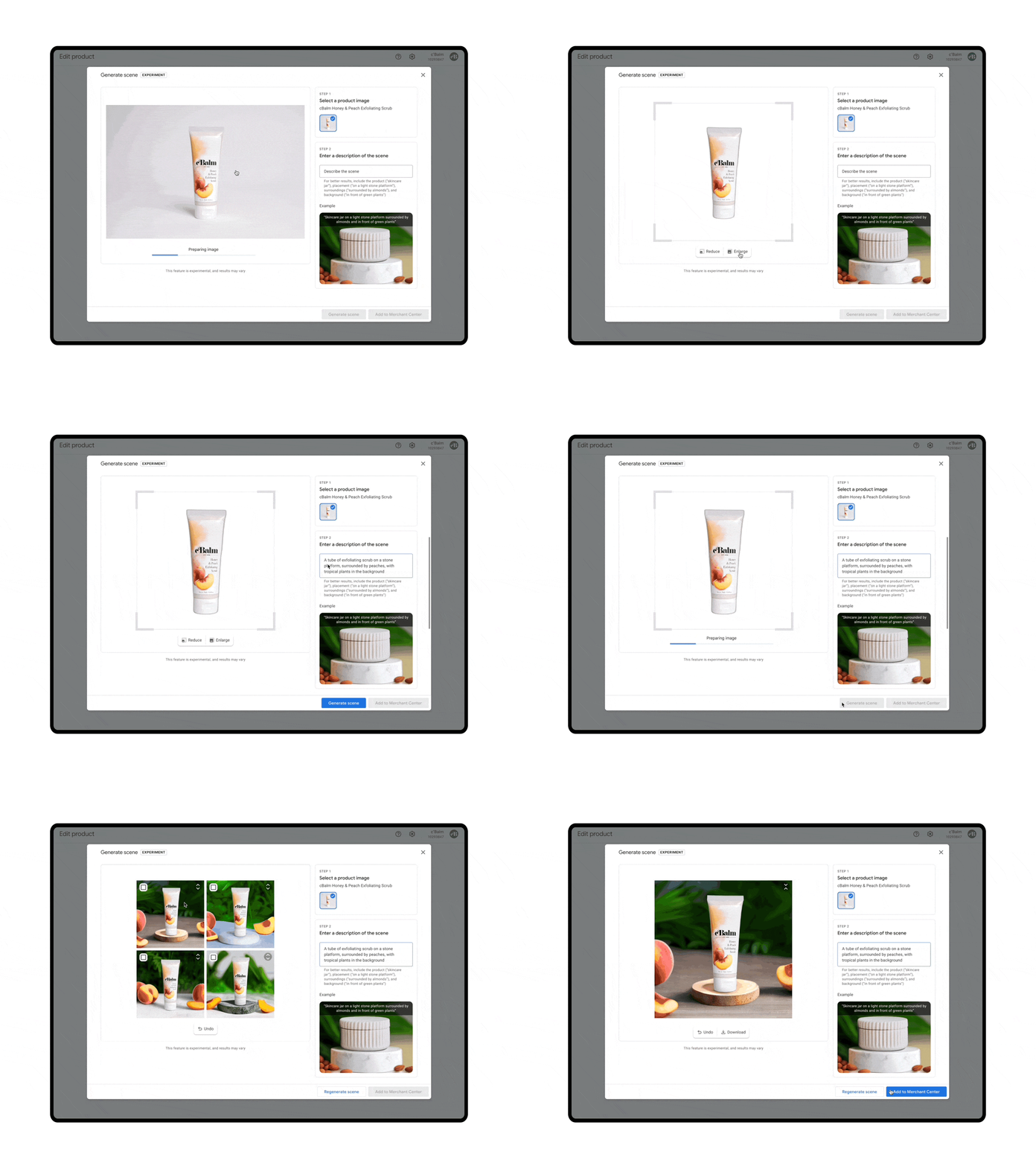
Generate Scene In Merchant Center

Capabilities. Advertisers can leverage these new features for various purposes, from basic tasks like altering the background color behind product images or creating a solid background, to more advanced jobs such as customizing product placement within specific scenes. The tools can also be used to enhance low-quality images without the need for a reshoot.

Availability. The new tools have already started being rolled out to all Merchant Center Next users in the U.S, as well as users of the Google and YouTube apps on Shopify.

Metadata AI label. The AI-generated images won’t have a clear tag or watermark to inform users that they were manipulated, however, Google states that this information will be stored in the image’s metadata.


Get the daily newsletter search marketers rely on.


What Google is saying: Matt Madrigal, Vice President, GM, Merchant Shopping, said in a statement:

  • “In e-commerce, eye-catching images are a business’s digital window displays — and merchants with the right mix of imagery online can get better results. In fact, while many product offers on Google have just one image, we see an increase in both impressions (+76%) and clicks (+32%) for product offers that include more than one image.”
  • “It’s not always easy to get a range of high-quality images, though. Businesses tell us creating lifestyle images gets expensive and time-consuming.”
  • “Our new Product Studio, designed with Google’s Ai Principles top of mind, brings the benefits of generative AI to businesses of all sizes, helping them easily create unique and tailored product imagery for free and get more value from the images they already have.”

Deep dive. Read Google’s original Product Studio tools announcement for more information.


Related stories

New on Search Engine Land

@media screen and (min-width: 800px) { #div-gpt-ad-3191538-7 { display: flex !important; justify-content: center !important; align-items: center !important; min-width:770px; min-height:260px; } } @media screen and (min-width: 1279px) { #div-gpt-ad-3191538-7 { display: flex !important; justify-content: center !important; align-items: center !important; min-width:800px!important; min-height:440px!important; } }

About the author

Nicola Agius

Nicola Agius is Paid Media Editor of Search Engine Land after joining in 2023. She covers paid search, paid social, retail media and more. Prior to this, she was SEO Director at Jungle Creations (2020-2023), overseeing the company’s editorial strategy for multiple websites. She has over 15 years of experience in journalism and has previously worked at OK! Magazine (2010-2014), Mail Online (2014-2015), Mirror (2015-2017), Digital Spy (2017-2018) and The Sun (2018-2020). She also previously teamed up with SEO agency Blue Array to co-author Amazon bestselling book ‘Mastering In-House SEO’.

https://searchengineland.com/google-product-studio-ai-generated-images-advertisers-434056


Ex-Google Search head worried his team was ‘too involved with ads’

Google declared a “Code Yellow” after user queries slowed in February 2019 to find out why. Ben Gomes, then the head of Google Search, became concerned about a thinning firewall between Search and Ads, according to emails revealed during the ongoing U.S. vs. Google antitrust trial.

Why we care. We’ve been concerned to learn Google has increased ad prices to meet quarterly revenue goals and Ads, Search and Chrome teams working to boost ad revenue. While Google talks about always doing what’s best for users, clearly it also has done what’s best for Google revenue and profits.

The emails. In one 2019 email, a “frustrated” Gomes told other executives that the Search team was “getting too close to the money,” Bloomberg reported:

  • “I think it is good for us to aspire to query growth and to aspire to more users. But I think we are getting too involved with ads for the good of the product and company.”
  • “I am getting concerned that growth is all we are thinking about.”
  • “We could increase queries quite easily in the short term in user negative ways (turn off spell correction, turn off ranking improvement, place refinements all over the page).”

However, Gomes said during his testimony that he was “discussing things we would never do,” in that last bullet.

Code Yellow aftermath. The “emergency” lasted seven weeks, after which Google created a new metric to measure groups of queries, rather than user queries as a metric (“I think this metric of just using queries is not one that optimizes appropriately,” Gomes explained.).

Gomes left his role about a year later, when Prabhakar Raghavan became the new head of Google Search.


Related stories

New on Search Engine Land

@media screen and (min-width: 800px) { #div-gpt-ad-3191538-7 { display: flex !important; justify-content: center !important; align-items: center !important; min-width:770px; min-height:260px; } } @media screen and (min-width: 1279px) { #div-gpt-ad-3191538-7 { display: flex !important; justify-content: center !important; align-items: center !important; min-width:800px!important; min-height:440px!important; } }

About the author

Danny Goodwin

Danny Goodwin has been Managing Editor of Search Engine Land & Search Marketing Expo – SMX since 2022. He joined Search Engine Land in 2022 as Senior Editor. In addition to reporting on the latest search marketing news, he manages Search Engine Land’s SME (Subject Matter Expert) program. He also helps program U.S. SMX events. Goodwin has been editing and writing about the latest developments and trends in search and digital marketing since 2007. He previously was Executive Editor of Search Engine Journal (from 2017 to 2022), managing editor of Momentology (from 2014-2016) and editor of Search Engine Watch (from 2007 to 2014). He has spoken at many major search conferences and virtual events, and has been sourced for his expertise by a wide range of publications and podcasts.

https://searchengineland.com/ex-google-search-head-worried-his-team-was-too-involved-with-ads-434050


20 most profitable Google queries revealed during antitrust trial

Ever wondered which search queries drive the most revenue for Google? It turns out that iPhone, insurance and cheap flight queries drove the most revenue for Google in the U.S., at least for one week in September 2018.

The list of search terms appeared on a heavily redacted slide that was included in a PDF released this week as a trial exhibit during the ongoing U.S. vs. Google antitrust trial.

Why we care. We know Google makes a lot of money (a modest $116.46 billion in 2018, when compared to the $224.47 billion Google made in 2022) and know which CPCs are most expensive. But we’ve never known which search terms were the most lucrative for Google because Google has never before revealed this information.

The 20 most profitable Google searches. The top search terms for the week of Sept. 22, 2018 in the U.S., ordered by revenue, were:

  1. iPhone 8
  2. iPhone 8 plus
  3. auto insurance
  4. car insurance
  5. cheap flights
  6. car insurance quote
  7. direct tv
  8. online colleges
  9. at&t
  10. hulu
  11. iPhone
  12. uber
  13. spectrum
  14. comcast
  15. xfinity
  16. insurance quotes
  17. free credit report
  18. cheap car insurance
  19. aarp
  20. lifelock

All other information was redacted on the slide – specifically:

  • Revenue (how much Google made off each search term).
  • Queries (number of).
  • RPM (ad revenue per thousand impressions).

The slide. It appears in this PDF. Here is a screenshot:

Top Us Queries Google Revenue Sept 2018 1

Related stories

New on Search Engine Land

@media screen and (min-width: 800px) { #div-gpt-ad-3191538-7 { display: flex !important; justify-content: center !important; align-items: center !important; min-width:770px; min-height:260px; } } @media screen and (min-width: 1279px) { #div-gpt-ad-3191538-7 { display: flex !important; justify-content: center !important; align-items: center !important; min-width:800px!important; min-height:440px!important; } }

About the author

Danny Goodwin

Danny Goodwin has been Managing Editor of Search Engine Land & Search Marketing Expo – SMX since 2022. He joined Search Engine Land in 2022 as Senior Editor. In addition to reporting on the latest search marketing news, he manages Search Engine Land’s SME (Subject Matter Expert) program. He also helps program U.S. SMX events. Goodwin has been editing and writing about the latest developments and trends in search and digital marketing since 2007. He previously was Executive Editor of Search Engine Journal (from 2017 to 2022), managing editor of Momentology (from 2014-2016) and editor of Search Engine Watch (from 2007 to 2014). He has spoken at many major search conferences and virtual events, and has been sourced for his expertise by a wide range of publications and podcasts.

https://searchengineland.com/most-profitable-google-search-queries-434035