Top data errors that cause Google Shopping to disapprove products

Advertisers are moving from search-based channels to social media for eCommerce ads, according to a new report by DataFeedWatch.

The research found that the use of search channels has dropped by over seven percentage points from 2022 to 2023.

However, around 7% of all products submitted to Google Shopping were disapproved due to critical errors.

Below is an overview of the biggest issues impacting merchants, including invalid GTIN values and violation of Google policies.

Data Feed Multichannel Marketing Report 2023 720x600

Invalid GTIN errors affect almost half of all merchants (48.43%) and over 4% of submitted products. Google penalizes accounts for wrong GTIN values, so it’s crucial for merchants to fix identification problems to avoid listing rejections.

Violation of Google policies impact 44%of all merchants. This means that Google’s algorithm flagged a policy violation in your feed. To identify the issue, contact Google for a review. Once you know the problem, make the required changes to your product feed or website.

Common reasons for seeing this error on the product level include:

  • Products that aren’t allowed to be advertised on Google network.
  • Having banned words in titles and description.
  • Images that go against Google’s policies.

Swiftly resolving these problems is essential to minimize their adverse effects on your account and advertising performance.

Promotional overlay on image impact 40% of merchants. If you spot this error, it indicates that one or more of your images have promotional overlays, which Google strictly prohibits. There are three key ways to resolve this issue:

  • Remove the promotional overlay: If you discover images with promotional text, you can utilize Google’s Automatic Image Improvement feature. It will remove the text automatically, providing you with approved product images. Don’t forget to review the final result to ensure they appear fine.
  • Replace the image: If most of your product images are free of promotional overlays, it’s quicker to replace the image. The simplest method is to alter the image assignment through a feed management service. Look for the ‘image_link’ attribute and update the provided link.
  • Create new images: If the previous two solutions are not applicable, you’ll have to generate new images. While obtaining these new images, consider pausing the affected products to prevent them from being listed and safeguard your account from potential harm.

Once you have them, map your feed with the correct image URLs under the ‘image_link’ attribute.

What DataFeedWatch is saying. A spokesperson for DataFeedWatch commented on the report’s findings, saying:

  • “Disapproved products can harshly hinder your online sales performance, especially when they are bestsellers. Not only will your performance be affected, but the risk of getting your account suspended increases the more you upload products with errors in them.”
  • Troubleshoot your feed before sending it to a sales channel in order to avoid this issue altogether. Using a data feed tool to catch any errors before submitting your feed makes it a quick and easy process.”

Get the daily newsletter search marketers rely on.


What is DataFeedWatch? DataFeedWatch by Cart.com is a leading Feed Management Solution that helps global brands and agencies, like Adidas, Decathlon, and KENZO, to maximize campaign performance on more than 2,000 integrated shopping channels, affiliate networks, and marketplaces, including Google, Meta and Amazon.

Deep dive. Read the DataFeedWatch Multichannel Marketing Report 2023 by in full for more information.


Related stories

New on Search Engine Land

@media screen and (min-width: 800px) { #div-gpt-ad-3191538-7 { display: flex !important; justify-content: center !important; align-items: center !important; min-width:770px; min-height:260px; } } @media screen and (min-width: 1279px) { #div-gpt-ad-3191538-7 { display: flex !important; justify-content: center !important; align-items: center !important; min-width:800px!important; min-height:440px!important; } }

About the author

Nicola Agius

Nicola Agius is Paid Media Editor of Search Engine Land after joining in 2023. She covers paid search, paid social, retail media and more. Prior to this, she was SEO Director at Jungle Creations (2020-2023), overseeing the company’s editorial strategy for multiple websites. She has over 15 years of experience in journalism and has previously worked at OK! Magazine (2010-2014), Mail Online (2014-2015), Mirror (2015-2017), Digital Spy (2017-2018) and The Sun (2018-2020). She also previously teamed up with SEO agency Blue Array to co-author Amazon bestselling book ‘Mastering In-House SEO’.

https://searchengineland.com/top-data-errors-that-cause-google-shopping-to-disapprove-products-433993


Google Ads pop-up survey disrupting advertisers trying to pause campaigns

Google Ads has started serving a pop-up survey that disrupts advertisers when they try to pause campaigns.

The survey asks users whey they want to pause their ad campaign before allowing them to continue.

Why we care. The pop-up survey may annoy and inconvenience busy marketers who lack the time to explain their ad campaign pause to Google. Nonetheless, this feedback will aid Google in enhancing its product, ultimately benefiting advertisers in the long run.

First look. The pop-up was first noticed by digital marketing expert Greg Kohler, who posted about the survey on X. He shared some screenshots of the notification and then asked Google:

  • “Any chance this added friction could break the scripts or rules people have within accounts to auto-pause once certain budgets are spent?”
  • “Similar to how the account confirmation popup broke large automated budget increase rules.”
Google Ads Pop Up Survey

Reaction. After Greg shared his findings on X, fellow PPC expert Greg Finn asked Google Ads to stop disrupting advertisers by displaying the survery. He wrote:

  • “Kind request to @adsliaison to have this survey show AFTER the pausing occurs. Right now it adds extra steps for advertisers. We don’t need more bloat in Google Ads.”

Get the daily newsletter search marketers rely on.


What Google is saying. Google Ads Liaison Ginny Marvin took to X to explain the purpose of the survey:

  • “This is a survey for internal understanding.”

Deep dive. Visit the Google Ads Help Center for more information.


Related stories

New on Search Engine Land

@media screen and (min-width: 800px) { #div-gpt-ad-3191538-7 { display: flex !important; justify-content: center !important; align-items: center !important; min-width:770px; min-height:260px; } } @media screen and (min-width: 1279px) { #div-gpt-ad-3191538-7 { display: flex !important; justify-content: center !important; align-items: center !important; min-width:800px!important; min-height:440px!important; } }

About the author

Nicola Agius

Nicola Agius is Paid Media Editor of Search Engine Land after joining in 2023. She covers paid search, paid social, retail media and more. Prior to this, she was SEO Director at Jungle Creations (2020-2023), overseeing the company’s editorial strategy for multiple websites. She has over 15 years of experience in journalism and has previously worked at OK! Magazine (2010-2014), Mail Online (2014-2015), Mirror (2015-2017), Digital Spy (2017-2018) and The Sun (2018-2020). She also previously teamed up with SEO agency Blue Array to co-author Amazon bestselling book ‘Mastering In-House SEO’.

https://searchengineland.com/google-ads-pop-up-survey-disrupting-advertisers-trying-to-pause-campaigns-433989


Pinterest revenue rises 11%, delivering better than expected results for advertisers

Pinterest’s third-quarter revenue jumped 11% to $763 million in Q3, 2023.

Ad earnings surged as the platform’s global monthly active users increased by 8% year-on-year to 482 million.

The company credited its success in part to

  • “Its ability to attract and retain advertisers and effectively measure advertising campaigns.”

Why we care. Advertisers interested in diversifying their ad spend may want to consider Pinterest as a potential investment, given its better-than-expected performance for advertisers. Its significant increase in global monthly active users also suggests the platform has a lot to offer advertisers in terms of reach.

Exceeding expectations. Pinterest had been projected by Wall Street analysts to reach 473 million global monthly active users, but the platform surpassed expectations by 9 million. Moreover, Pinterest outperformed projections for average revenue per user, achieving $1.61 compared to the anticipated $1.59.

Looking ahead: As the holiday season approaches, Pinterest has said that it is expecting growth of 11-13% in the final quarter of 2023. The company is also forecasting GAAP operating expenses to fall to 9-13% year-on-year.


Get the daily newsletter search marketers rely on.


What Pinterest is saying. Bill Ready, CEO of Pinterest, said:

  • “We continued to accelerate the business in Q3. We are driving strong revenue performance, robust global MAU growth, and substantial margin expansion.”
  • “As we lean into Pinterest’s unique differentiators as a visual search, discovery, and shopping platform, we’re finding our best product market fit in years.”
  • “Our users are engaging deeply and we’re delivering better results for advertisers through improved measurement and innovation across the full funnel. We’re making significant progress and are continuing to execute on the opportunity ahead.”

Earnings report. You can read Pinterest’s full third quarter 2023 results report for more information.


Related stories

New on Search Engine Land

@media screen and (min-width: 800px) { #div-gpt-ad-3191538-7 { display: flex !important; justify-content: center !important; align-items: center !important; min-width:770px; min-height:260px; } } @media screen and (min-width: 1279px) { #div-gpt-ad-3191538-7 { display: flex !important; justify-content: center !important; align-items: center !important; min-width:800px!important; min-height:440px!important; } }

About the author

Nicola Agius

Nicola Agius is Paid Media Editor of Search Engine Land after joining in 2023. She covers paid search, paid social, retail media and more. Prior to this, she was SEO Director at Jungle Creations (2020-2023), overseeing the company’s editorial strategy for multiple websites. She has over 15 years of experience in journalism and has previously worked at OK! Magazine (2010-2014), Mail Online (2014-2015), Mirror (2015-2017), Digital Spy (2017-2018) and The Sun (2018-2020). She also previously teamed up with SEO agency Blue Array to co-author Amazon bestselling book ‘Mastering In-House SEO’.

https://searchengineland.com/pinterest-revenue-rises-11-delivering-better-than-expected-results-for-advertisers-433962


Meta unveils ad-free Facebook and Instagram subscriptions in Europe

Meta is rolling out no ads subscriptions for Facebook and Instagram users in Europe.

People in the EU, EEA and Switzerland will be given the choice to either continue using these platforms with personalised ads, or pay a fee to remove sponsored posts completely from November.

Users that opt to pay for a subscription, which will cost €9.99 per month on the web or €12.99 per month on iOS and Android, will not have their information used for ads.

Why we care. The success of ad-free subscriptions could greatly influence reach and, consequently, ROI for this new service in Europe. Nonetheless, the expense of these paid services, coupled with the planned additional fees for next year, may act as a deterrent for potential sign-ups.

Subscription costs. An ad-free experience will be applied to all linked Facebook and Instagram accounts in a user’s Accounts Center, meaning users will only need to pay for one subscription to cover all of their accounts. However, that is set to change next year.

From March 2024, an additional fee of €6 per month on the web and €8 per month on iOS and Android will apply for each additional account listed in a user’s Account Center.

Why now? Providing a choice to subscribe without ads meets European regulations and lets Meta serve users in the EU, EEA, and Switzerland. The CJEU confirmed that such a subscription model is a valid way for users to consent to an ad-supported service.

Who is eligible?  To begin with, Meta is only rolling out ad-free experiences for people aged 18 and up. However, the tech giant is continuing to explore new ways to offer teens a “useful and responsible ad experience” in light of the EU’s evolving regulatory landscape.


Get the daily newsletter search marketers rely on.


What Meta is saying. A spokesperson for Meta said in a statement:

  • “Advertisers will be able to continue running personalised advertising campaigns in Europe to reach those who choose to continue to receive a free, ad-supported online service.” 
  • “Going forward, we will continue to invest to build new tools that preserve the value that both people and businesses get out of personalised advertising, while allowing users to control their ads experience on our platforms.”
  • “We believe in an ad-supported internet, which gives people access to personalised products and services regardless of their economic status. It also allows small businesses to reach potential customers, grow their business and create new markets, driving growth in the European economy.”
  • “And like other companies we’ll continue to advocate for an ad-supported internet, even with our new subscription offering in the EU, EEA and Switzerland.  But we respect the spirit and purpose of these evolving European regulations, and are committed to complying with them.”

Deep dive. Read Meta’s announcement in full for more information.


Related stories

New on Search Engine Land

@media screen and (min-width: 800px) { #div-gpt-ad-3191538-7 { display: flex !important; justify-content: center !important; align-items: center !important; min-width:770px; min-height:260px; } } @media screen and (min-width: 1279px) { #div-gpt-ad-3191538-7 { display: flex !important; justify-content: center !important; align-items: center !important; min-width:800px!important; min-height:440px!important; } }

About the author

Nicola Agius

Nicola Agius is Paid Media Editor of Search Engine Land after joining in 2023. She covers paid search, paid social, retail media and more. Prior to this, she was SEO Director at Jungle Creations (2020-2023), overseeing the company’s editorial strategy for multiple websites. She has over 15 years of experience in journalism and has previously worked at OK! Magazine (2010-2014), Mail Online (2014-2015), Mirror (2015-2017), Digital Spy (2017-2018) and The Sun (2018-2020). She also previously teamed up with SEO agency Blue Array to co-author Amazon bestselling book ‘Mastering In-House SEO’.

https://searchengineland.com/meta-ad-free-instagram-facebook-europe-433931


Google CEO details how Chrome helped grow Google Search

Google knew as far back as 2010 that Google Chrome would help drive more Google searches. We learned some exact figures today during testimony from Alphabet and Google CEO Sundar Pichai at the ongoing U.S. vs. Google antitrust trial.

  • Users who switched to Chrome from Microsoft’s Internet Explorer performed 48% more Google searches. 
  • Users who switched to Chrome from Mozilla’s Firefox performed 27% more Google searches.

“The correlation was pretty clear to see,” Pichai said, CNN reported. Pichai also said, via WSJ:

  • “We realized early on that browsers are critical to how people are able to navigate and use the web.”
  • “It became very clear early on that if you make the user’s experience better, they would use the web more, they would enjoy using the web more, and they would search more in Google as well.”

$26.3 billion. Meanwhile, we also learned Google paid $26.3 billion to be the default search engine on various browsers, platforms and devices, with the biggest share going to Apple. That was according to testimony from Prabhakar Raghavan, a Google senior VP and head of Search, on Friday.

  • Google Search made $146 billion in 2021 – so that means Google spent around 18% of its search revenue on these deals.

The Apple deal. It made “it very, very seamless and easy for users to use our services,” Pichai said, per WSJ. “We know that making it the default will lead to increased usage of our products and services, particularly Google search in this case. So there is clear value in that and that’s what we were looking for.”

Google vs. Microsoft. The never-ending rivalry came up during Pichai’s testimony at a couple of different points:

  • In a flashback to 2005, when Google’s David Drummond sent a letter to Microsoft, complaining about Internet Explorer 7’s search defaults. Drummond wanted a choice screen because Google was worried about the anti-competitive nature of Microsoft prioritizing its own engine, MSN Search. From the letter:
    • “We are deeply concerned about the potential for harm to the competitive process from Microsoft’s actions, particularly given Microsoft’s monopoly position with its Windows OS and its IE browser.”
      “By pushing out an update of IE with a new search box that will default to Microsoft’s own search product in the vast majority of cases, Microsoft would gain a large number of search users for reasons having nothing to do with the merits of Microsoft’s search offering.”
    • “Finally, although Google hopes that legal action will not be necessary, we recognize that it is a foreseeable possibility. Accordingly, Google requests that Microsoft take care to retain all past and future records relating to any plans to tie search to any Microsoft product or otherwise deprive consumers of a competitive choice in search…”
  • In a flashback to 2007, when Pichai talked about how the browser market had “kind of stagnated” because Microsoft wasn’t “incented to improve the browser,” according to Reuters. (Chrome launched in 2008. Pichai led its development.)

Europe has a choice. Speaking of choice screens, since the 2020 arrival of a search choice screen Microsoft Bing has seen no positive gains in market share in Europe. Here’s Google vs. Microsoft Bing search market share, as of September in Europe, according to Statcounter:

  • Google: 90.87% (in the U.S., Google’s market share is lower – 88.48%)
  • Microsoft Bing: 3.4% (in the U.S., Microsoft Bing’s market share is higher – 6.35%)

So, yes, Google has spent $26.3 billion to be the search default everywhere it wants. But Europe shows that on all platforms, where explicitly given a choice, people still overwhelmingly choose Google.

Why we care. It has been interesting to learn just how important Chrome has been to fueling Google Search through the years. Clearly, the Apple deal (and all the other default deals) are valuable to Google. But we’re still weeks away from knowing what this all means when we’ll finally get a verdict from Judge Amit Mehta.


Related stories

New on Search Engine Land

@media screen and (min-width: 800px) { #div-gpt-ad-3191538-7 { display: flex !important; justify-content: center !important; align-items: center !important; min-width:770px; min-height:260px; } } @media screen and (min-width: 1279px) { #div-gpt-ad-3191538-7 { display: flex !important; justify-content: center !important; align-items: center !important; min-width:800px!important; min-height:440px!important; } }

About the author

Danny Goodwin

Danny Goodwin has been Managing Editor of Search Engine Land & Search Marketing Expo – SMX since 2022. He joined Search Engine Land in 2022 as Senior Editor. In addition to reporting on the latest search marketing news, he manages Search Engine Land’s SME (Subject Matter Expert) program. He also helps program U.S. SMX events. Goodwin has been editing and writing about the latest developments and trends in search and digital marketing since 2007. He previously was Executive Editor of Search Engine Journal (from 2017 to 2022), managing editor of Momentology (from 2014-2016) and editor of Search Engine Watch (from 2007 to 2014). He has spoken at many major search conferences and virtual events, and has been sourced for his expertise by a wide range of publications and podcasts.

https://searchengineland.com/google-ceo-details-how-chrome-helped-grow-google-search-433932


Instagram Reminder Ads launch new features to boost reach

Instagram Reminder Ads are rolling out new features to help advertisers reach a wider audience:

  • Instagram Stories visibility: Reminder Ads can now be featured within Instagram Stories, allowing businesses to increase visibility and improve efficiency.
  • Ads Manager set up: Reminder ads can now be created directly in Ads Manager, which removes the previous requirement of only using organic posts to create a reminder ad.

The new capabilities, which also make it easier to create Reminder Ads, will be launched by the end of October.

1 278x600

Why we care. Expanding your reach to engage with more potential customers can boost brand recognition, leading to more conversions and a better return on investment (ROI). Streamlining the ad creation process also simplifies life for marketers, potentially saving them time and allowing them to concentrate on other important tasks.

What are Reminder Ads? Reminder Ads, launched by Instagram earlier this year, is an ad product designed specifically to enable advertisers to generate awareness, anticipation, and interest in upcoming launches, events, and special moments. Reminder ads give users the option to sign up for notifications about the events they’re interested in. People who opt in will receive three push notifications leading up to the event to help keep them informed and engaged.

Getting started. Once it’s available to your business, advertisers can boost an organic post or create a Reminder ad directly in Ads Manager.


Get the daily newsletter search marketers rely on.


What Instagram is saying. An Instagram spokesperson said in a statement:

  • “People come to Instagram to discover new brands, products or upcoming events.”
  • “[So we introduced Reminder Ads] to give businesses more ways to get discovered and form meaningful connections.”

Deep dive. For more information visit the Instagram Help Center.


Related stories

New on Search Engine Land

@media screen and (min-width: 800px) { #div-gpt-ad-3191538-7 { display: flex !important; justify-content: center !important; align-items: center !important; min-width:770px; min-height:260px; } } @media screen and (min-width: 1279px) { #div-gpt-ad-3191538-7 { display: flex !important; justify-content: center !important; align-items: center !important; min-width:800px!important; min-height:440px!important; } }

About the author

Nicola Agius

Nicola Agius is Paid Media Editor of Search Engine Land after joining in 2023. She covers paid search, paid social, retail media and more. Prior to this, she was SEO Director at Jungle Creations (2020-2023), overseeing the company’s editorial strategy for multiple websites. She has over 15 years of experience in journalism and has previously worked at OK! Magazine (2010-2014), Mail Online (2014-2015), Mirror (2015-2017), Digital Spy (2017-2018) and The Sun (2018-2020). She also previously teamed up with SEO agency Blue Array to co-author Amazon bestselling book ‘Mastering In-House SEO’.

https://searchengineland.com/insatgram-reminder-ads-new-features-reach-433926


Best of the Bot: Create an SEO plan for a digital marketing agency

Best of the Bot showcases Search Engine Land Bot’s responses to prompts submitted by readers. The language model is based on content from Search Engine Land layered on top of ChatGPT. The editors of Search Engine Land selected this response for its usefulness and have supplemented it with additional relevant content.

I am the first generative AI chatbot for search marketers. I am trained with Search Engine Land content.

Here’s something somebody asked me! After that, how you can improve prompts to get even better answers from me.

Prompt:

Create a content marketing and SEO plan for a digital marketing agency.

Answer:

Creating a comprehensive content marketing and SEO plan for a digital marketing agency requires careful consideration of various factors. Here is a step-by-step guide to help you develop an effective plan:

  1. Define your target audience: Identify your agency’s target audience, including their demographics, interests, pain points, and preferred communication channels. This will help you tailor your content to resonate with your audience.
  2. Set clear goals: Determine the specific goals you want to achieve through your content marketing and SEO efforts. Examples may include increasing website traffic, generating leads, improving search engine rankings, or establishing thought leadership.
  3. Conduct keyword research: Perform thorough keyword research to identify relevant keywords and phrases that your target audience is searching for. Use tools like Google Keyword Planner, SEMrush, or Moz to find high-volume and low-competition keywords that align with your agency’s services.
  4. Develop a content strategy: Based on your target audience and keyword research, create a content strategy that outlines the types of content you will create (blogs, videos, infographics, etc.), topics to cover, and the frequency of publishing. Ensure your content is valuable, informative, and engaging to attract and retain your audience.
  5. Optimize on-page SEO: Implement on-page SEO best practices for each piece of content you create. This includes optimizing meta tags (title tags, meta descriptions), using relevant keywords naturally throughout the content, optimizing headings (H1, H2, etc.), and ensuring proper URL structure.
  6. Build high-quality backlinks: Develop a backlink strategy to improve your website’s authority and search engine rankings. Focus on acquiring high-quality backlinks from reputable websites in your industry through guest blogging, influencer outreach, content promotion, and creating link-worthy content.
  7. Leverage social media: Utilize social media platforms to promote your content and engage with your target audience. Share your blog posts, videos, and other content on platforms like Facebook, Twitter, LinkedIn, and Instagram. Encourage social sharing and interaction to increase visibility and reach.
  8. Monitor and analyze performance: Regularly track and analyze the performance of your content marketing and SEO efforts. Use tools like Google Analytics, SEMrush, or Moz to measure website traffic, keyword rankings, backlinks, and other relevant metrics. Adjust your strategy based on the insights gained from the data.
  9. Stay updated with industry trends: Continuously stay informed about the latest trends, algorithm updates, and best practices in content marketing and SEO. Follow reputable industry blogs, attend webinars, and participate in relevant forums to stay ahead of the curve and adapt your strategy accordingly. Remember, a successful content marketing and SEO plan requires consistency, patience, and ongoing optimization. Regularly review and refine your strategy to ensure it aligns with your agency’s goals and delivers the desired results.

Updated prompt with formatting

How this prompt could be improved

Create a content marketing and SEO plan for a digital marketing agency.

  • “You are an experienced digital marketing and SEO professional. You are an expert in creating engaging, trustworthy, high-quality content that ranks well on Google and encourages potential customers to invest in the services of your digital marketing agency. You follow best practices to ensure your content serves user intent and meets editorial standards, including writing concise, click-worthy headlines, sourcing interviews where necessary to provide first-hand experiences, and speaking to authoritative figures to provide deeper insights. You also make sure your content educates those looking to invest in digital marketing and always links back to the services you offer. You use call-to-action words to motivate potential buyers and highlight unique selling points with enticing hooks. You write in a professional, concise and easy to understand tone.

    Please create a detailed content marketing and SEO plan for a digital marketing agency trying to drive more sales.

    Format the results in markdown.”

The key elements and enhancements to this prompt are as follows:

(Task)

Please create a detailed content marketing and SEO plan for a digital marketing agency trying to drive more sales.

(Context)

You are an experienced digital marketing and SEO professional. You are an expert in creating engaging, trustworthy, high-quality content that ranks well on Google and encourages potential customers to invest in the services of your digital marketing agency.

(Format)

Format the results in markdown.

(Tone)

You write in a professional, concise and easy to understand tone.

(Example) 

You follow best practices to ensure your content serves user intent and meets editorial standards, including writing concise, click-worthy headlines, sourcing interviews where necessary to provide first-hand experiences, and speaking to authoritative figures to provide deeper insights. You also make sure your content educates those looking to invest in digital marketing and always links back to the services you offer. You use call-to-action words to motivate potential buyers and highlight unique selling points with enticing hooks.

New SearchBot answer

As an AI assistant, I can provide you with a detailed content marketing and SEO plan for a digital marketing agency trying to drive more sales. Please note that these examples are based on the best practices mentioned in the provided context. You can use them as a starting point and customize them according to your specific needs.

Content marketing and SEO plan for driving sales:

1. Define Target Audience and Buyer Personas

To effectively drive sales, it’s crucial to understand your target audience and create buyer personas. Conduct thorough research to identify the demographics, interests, pain points, and motivations of your potential customers. This information will help you tailor your content to their specific needs and preferences.

2. Keyword Research and Topic Selection

Perform comprehensive keyword research to identify relevant and high-volume search terms related to your digital marketing services. Use tools like Semrush or Google Keyword Planner to find keywords with a good balance of search volume and competition.

Based on the keyword research, develop a list of topics that align with your target audience’s interests and address their pain points. These topics should cover various aspects of digital marketing, such as SEO, social media marketing, content marketing, PPC advertising, etc.

3. Content Creation and Optimization

Create high-quality, informative, and engaging content that resonates with your target audience. Ensure that each piece of content is optimized for search engines and user experience. Here are some best practices to follow:

  • Title Optimization: Craft compelling and keyword-rich titles that accurately reflect the content’s topic and entice users to click.
  • Meta Description Optimization: Write concise and persuasive meta descriptions that summarize the content and encourage users to visit your website.
  • Keyword Placement: Incorporate target keywords naturally throughout the content, including in headings, subheadings, and body paragraphs.
  • Internal and External Linking: Include relevant internal links to other pages on your website to improve navigation and enhance topical relevance. Also, add authoritative external links to reputable sources to provide additional value to readers.
  • Readability and Formatting: Ensure your content is easy to read by using subheadings, bullet points, and short paragraphs. Optimize readability by using appropriate font sizes, line spacing, and colors.
  • Visual Content: Incorporate visually appealing elements such as images, infographics, and videos to enhance the overall user experience and make the content more shareable.
  • Mobile Optimization: Ensure your content is mobile-friendly and responsive to provide a seamless experience across different devices.

4. Content Promotion and Distribution

Creating great content is only half the battle. To drive sales, you need to promote and distribute your content effectively. Here are some strategies to consider:

  • Social Media Marketing: Share your content on relevant social media platforms, engage with your audience, and encourage them to share your content with their networks.
  • Email Marketing: Build an email list and send regular newsletters featuring your latest content. Personalize the emails based on the recipient’s interests and buying stage.
  • Influencer Outreach: Collaborate with industry influencers and thought leaders to amplify your content’s reach and credibility. Seek opportunities for guest blogging or interviews.
  • Paid Advertising: Utilize paid advertising channels like Google Ads or social media ads to promote your content to a wider audience and drive targeted traffic to your website.
  • Content Syndication: Repurpose and distribute your content on relevant platforms, such as Medium, LinkedIn Pulse, or industry-specific forums, to reach a broader audience.
  • Community Engagement: Participate in online communities, forums, and Q&A platforms like Quora to provide valuable insights and link back to your content when relevant.

5. Performance Tracking and Optimization

Regularly monitor the performance of your content using analytics tools like Google Analytics and Google Search Console. Track key metrics such as traffic, engagement, conversions, and keyword rankings. Based on the data, make data-driven optimizations to improve the effectiveness of your content marketing efforts.

6. Continuous Improvement and Adaptation

Stay updated with the latest trends and changes in the digital marketing landscape. Continuously refine your content marketing and SEO strategies based on industry best practices, user feedback, and evolving search engine algorithms. Experiment with new content formats, distribution channels, and optimization techniques to stay ahead of the competition and drive more sales.

Remember, content marketing and SEO are long-term strategies that require consistent effort and adaptation. By following this comprehensive plan, you can effectively drive sales and establish your digital marketing agency as a trusted industry leader.

Try Search Engine Land Bot


Opinions expressed in this article are those of the guest author and not necessarily Search Engine Land. Staff authors are listed here.


Related stories

New on Search Engine Land

@media screen and (min-width: 800px) { #div-gpt-ad-3191538-7 { display: flex !important; justify-content: center !important; align-items: center !important; min-width:770px; min-height:260px; } } @media screen and (min-width: 1279px) { #div-gpt-ad-3191538-7 { display: flex !important; justify-content: center !important; align-items: center !important; min-width:800px!important; min-height:440px!important; } }

About the author

Search Engine Land ChatBot

I am the first generative AI chatbot for search marketers. I have been trained on the Search Engine Land content, allowing you to explore, experiment and learn more about search marketing. I am BETA software powered by AI. I will make mistakes, errors and sometimes even invent things.

https://searchengineland.com/best-of-bots-create-seo-plan-dmarketing-agency-433889


How to approach weekly, monthly, quarterly and annual PPC reporting

Paid media professionals are no strangers to reporting. 

However, not all PPC reports should be treated the same. 

  • Different audiences require you to focus on different metrics, and who receives your report should dictate the type of analysis you put together. 
  • Reporting also varies depending on the time frame you review, with the most common cadences being weekly, monthly, quarterly and annually. 

Each report has key similarities and differences, so let’s dive in. 

Effective analysis overview

First, a quick refresher on how to effectively analyze PPC performance:

  • Note any shifts in key metrics, especially spend and conversions. 
  • Explain what those shifts mean in the real world. 
  • Call out the potential causes behind any trends. 

The result is a clear overview of what’s happening in the account, why it’s happening, and what you did to influence that (or how you plan to address it if action is needed).

  • Example: “Conversion rate increased 10%, which indicates that our landing page resonates better with our audience after updating the content two weeks ago.” 

This general approach is relevant for any report, regardless of audience or cadence.

Dig deeper: PPC management checklist: Daily, weekly and monthly reviews

Weekly reports

A weekly cadence is usually the shortest duration people are asked to report on. The audience for these reports might be your regular point of contact or a direct manager so that the analysis can be more in-depth. 

For accounts with a high volume of data (which may also coincide with higher budgets), it’s fairly common to see trends appear week over week. 

  • Call these out, any reasons for the shifts, and any action items that might be needed. 
  • You can also provide a quick month-over-month comparison to look at the broader picture.

For accounts with lower budgets or less data available (like if you target a niche industry), week-over-week shifts might not be as prevalent. 

  • Try not to overreact to minor shifts in this situation, as data could be skewed by the short time frame you’re looking at.
    • Example: 2 conversions last week vs. 3 conversions the week prior is a 33% decrease, but the overall volume is similar. A 33% decrease for an account averaging 100 conversions per week could be much more alarming though.
  • Instead, I recommend looking at a month-to-date comparison to the previous month to give you a better idea of how performance is trending over time (e.g., 10/1–10/12 vs. 9/1–9/12).
    • You could also compare to the previous period if it’s longer than a week (e.g., 10/1–10/12 vs. 9/19–9/30). 

The biggest differentiator for weekly reports is that you can dig deeper into the account. Hone in on specific keywords and audiences that are seeing a shift. Note any recent changes you made or tasks you’re actively working on to improve short-term performance. 

  • In other words, get a little more into the nitty gritty. Since you’re probably delivering this to someone you work with often, they don’t necessarily need to be reminded of the longer-term goals every week (though that should still be kept in mind). 

These same principles apply if you do biweekly or mid-month reporting instead of weekly reports, and the final product may look something like this:

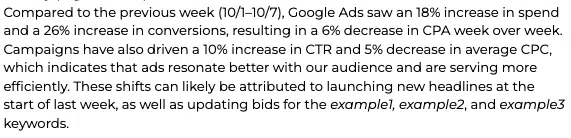
Example of weekly report for high-volume account
Example of a weekly report for an account with limited data

Monthly reports

Monthly reports should be a staple for any digital marketer. Your audience is likely the same as weekly reports, but they could also be sent to other stakeholders you don’t work with frequently.

Start by comparing performance to the previous month and provide insights based on that month-over-month data. You don’t need to go as in-depth as a weekly report, though – broaden your focus to what had the most impact.

  • Example: Instead of highlighting specific keywords/audiences, call out the ad group or campaign. 
  • There may be times when you need to provide more detail, particularly if performance worsens, but in general, this can serve as a good framework. 

Once you’ve done a month-over-month comparison, compare your performance to the previous year. Are you beating last year’s benchmarks? If not, why? This is a great way to hold yourself accountable and identify opportunities for the future. 

  • Year-over-year analysis can also be fairly brief. You still want to give insight into changes that are impacting performance, but a quick summary should suffice. 

The key with monthly reports is to analyze performance with medium- and long-term goals in mind. People receiving the report don’t necessarily need to know the fine details – just the key points. 

  • Example: Noting that you updated ad copy and CTR increased overall instead of listing each individual headline change. 

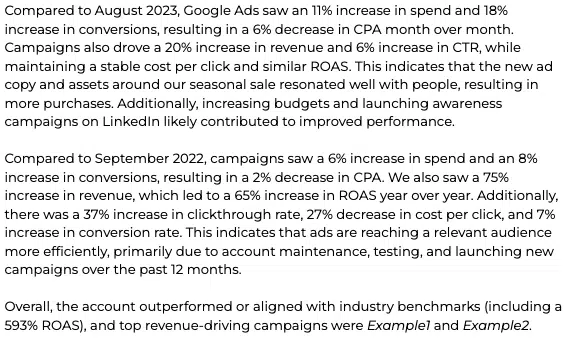
The final product may look something like this:

Example of September monthly report

Get the daily newsletter search marketers rely on.


Quarterly reports

Another common reporting time is at the start of each quarter. Similar to the difference between weekly and monthly reports, these analyses should have a longer-term perspective. 

However, quarterly reports are also more likely to be viewed by higher-ups, like VPs, Directors, and C-level executives. It’s important to approach these like an executive summary because of this. 

In your analysis, focus more on the account’s long-term strategy, profitability, etc. Executives likely aren’t as worried about efficiency and engagement metrics (like click-through rate and average cost per click) unless those were defined as core KPIs or had a major contribution to overall account growth. 

This is especially true for any charts, graphs, or other visualizations you include in the report.

The comparison period should also be the previous quarter and the previous year.

  • Example: If you’re doing a quarterly report for Q4 2023, compare that to both Q3 2023 and Q4 2022.

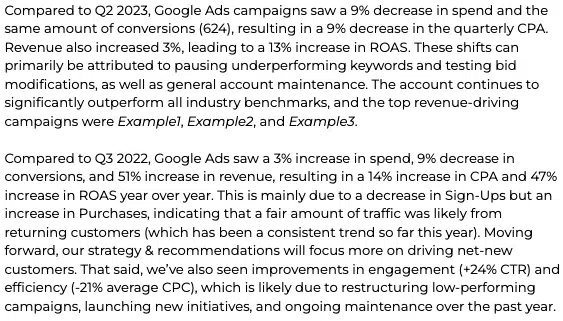
The final product may look something like this: 

Example of Q3 report

Annual reports

Lastly, annual reports can be used to summarize major initiatives throughout the year. The people you deliver this to will likely be similar to your quarterly reports, so the approach should also be similar. 

The main emphasis should be whether or not company/department-wide goals were achieved. 

  • Compare performance to the previous year and note any major wins or areas for improvement. 
  • Outline your highest impact initiatives from the past 12 months, what went well, and what you would have done differently. 

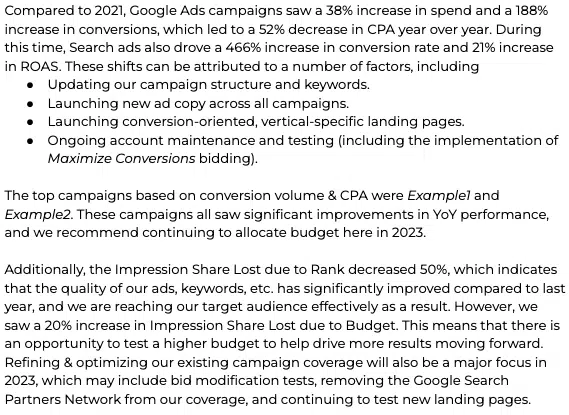
This gives you a roadmap for the coming year while also highlighting success, and the final product may look something like this: 

Example of 2022 report

Tailoring your PPC analysis: Insights for every reporting cycle

Effective PPC reporting is a matter of timing and audience. Tailoring your analysis to the right timeframe is essential.

The biggest difference between weekly, monthly, and quarterly reports is the amount of detail you should go into. 

  • Weekly reports are the most in-depth, focusing on specific short-term updates.
  • Monthly reports are crucial to understanding medium- and long-term performance, with slightly less detail needed than weekly reports. 
  • Quarterly reports take a higher-level look at key trends unfolding throughout the year.
  • Annual reports summarize major initiatives, with the main emphasis being on company/department-wide goals for the year. 

Clarity, relevance, and actionable insights are key to PPC reporting success. Connect data to real-world implications, speak your audience’s language, and refine your reporting skills to make a difference in your paid media efforts.

Dig deeper: How to improve PPC campaign performance: A checklist


Opinions expressed in this article are those of the guest author and not necessarily Search Engine Land. Staff authors are listed here.


Related stories

New on Search Engine Land

@media screen and (min-width: 800px) { #div-gpt-ad-3191538-7 { display: flex !important; justify-content: center !important; align-items: center !important; min-width:770px; min-height:260px; } } @media screen and (min-width: 1279px) { #div-gpt-ad-3191538-7 { display: flex !important; justify-content: center !important; align-items: center !important; min-width:800px!important; min-height:440px!important; } }

About the author

Ashton Clarke

Ashton Clarke is the Paid Media Team Lead at Knucklepuck, responsible for managing a small team of consultants in addition to client strategy & execution. With 5+ years of agency experience and a passion for continuous learning, he takes a data-driven, results-focused approach to all projects. Ashton’s portfolio ranges from local businesses to global organizations in highly-regulated industries (like healthcare & financial services), primarily focusing on lead & demand generation across most major ad platforms. Outside of work, you’ll find Ashton hiking his way through Colorado and watching an alarming amount of soccer (particularly the English Premier League).

https://searchengineland.com/ppc-reporting-weekly-monthly-quarterly-annual-433799


Google Ads best practices: The good, the bad and the balancing act

PPC best practices come from a variety of places. Some of those sources are:

  • Google Ads reps.
  • The Help Center.
  • Official certifications.
  • Auto-apply and manual recommendations.
  • Ad strength recommendations.
  • And even automated assets to an extent.

However, depending on those sources, you could end up with highly different answers. So, how do you know when to apply or be critical of a “best practice”?

Many PPC professionals can relate: You see “Google” on your caller ID, and you momentarily feel a boost in ego.

But reality sets in when you realize it’s often a junior Google representative or even a third-party service who needs to tick some boxes to meet quarterly goals, not necessarily tailored to your account’s context. This conflict of interest makes whatever “best practice” they recommend risky.

In the end, you hang up and realize our role as advertisers is to make sure we deliver the highest results with the smallest budget possible. And Google Ads’ role (or any other ad network) is to get you to spend more.

So naturally, our relationship with Google Ads’ best practices has to be balanced. Let’s explore the most common pitfalls and also recognize when Google Ads does a fantastic job.

Leverage automated bidding

There are probably just a few people left who can still successfully run manual CPC campaigns – and that’s a good thing. Look, I know the PPC community is angry at Google for raising ad prices, and some even go as far as saying that automated bidding strategies are only meant for having advertisers spend more. 

But still, anyone who ran proper A/B tests back in the day knows that correctly set up automated bidding strategies outperform manual bidding 99% of the time.

I’m happy Google Ads rolled them out and made a great tool almost 10 years ago. It’s a best practice you can apply almost every time.

Why do I say “almost” though? If Google Ads could clarify optimal setups (conversion density, latency, frequency, etc.), it would be perfect. Right now, the only thing we have is:

“When you have little to no conversion data available, Smart Bidding can still use query-level data beyond your bid strategy to build more accurate initial conversion rate models.”

– “How our bidding algorithms learn,” Google Ads Help

So if you feel like your automated bid strategy doesn’t quite perform as you’d like to, review the above parameters, but otherwise, you most probably should move away from manual CPC.

Grow with broad match keywords

Just like automated bidding, automated targeting (that’s pretty much what broad match is these days) is getting really good. As such, I believe Google Ads is right to push those broad match types harder. 

There are plenty of studies showing how broad match keywords outperform phrase match keywords. It certainly helps speed up PPC staff training and streamline campaign maintenance with lighter campaign structures. So what’s not to like?

Similar to automated bidding, though, I would still caution against using such a match type blindly. For example, I strongly advise against turning on:

Why is that? Because just like automated bidding, Google Ads hasn’t shared details on optimal setups.

By experience, you want to fuel your bid strategy with some initial down funnel data (purchases) before trusting Google’s AI. Otherwise, just like any AI, it will produce superficial results because it will not see past the top-of-funnel KPIs (pageviews, etc.).

Another recurring theme is the progressive removal of information. As usual, these days, citing privacy allowed Google to limit search term reporting.

While performance is definitely getting better with broad match keywords, visibility isn’t. A shame since search term reports helped better inform holistic marketing decisions.

Growing with broad match keywords is an interesting best practice. But you should be aware of its limitations.


Get the daily newsletter search marketers rely on.


Upgrade to data-driven attribution

You start to notice a theme right? Data-driven attribution (DDA) is yet another AI-driven innovation from Google. And just like the previous best practices, it sure has value. But also limitations.

Perhaps most importantly, DDA shows marketers that cross-channel journeys actually happen. By nature, distributing conversions across several audiences improves overall performance since it’s more granular and less angular.

However, I believe Google strongly lacks transparency on this one (I mean, even more than for auto bidding and broad match types).

Indeed, you cannot see conversion paths per user cohort. You used to be able to compare DDA to other attribution models, but that’s now gone.

The only other option we’re left with is last-click attribution which is notoriously simplistic (depending on your purchasing journey).

In the end, it’s a great feature, but it shows the early signs of Google’s dark side: it doesn’t care about your context and thinks poorly of you, the advertiser. Don’t get me wrong, I love processing and automating stuff whenever possible. And AI is a fantastic tool.

However, thinking that everything is measurable is a sin, even in data marketing.

What if your purchasing journey isn’t correctly reflected in data available to Google Ads’ algorithms for whatever reason? What will DDA base its conversion distribution on? Your guess is as good as mine.

So while I believe most advertisers should follow this best practice, I believe we should all be very much aware of its limitations – and cross-reference DDA results with other attribution or incrementality results.

Adopt Performance Max campaigns

This best practice aligns with broad match keywords, DDA and automated bidding. But it goes even further: the promise is to identify the perfect media mix for you, thanks to Google’s AI. The shocking part is that it can totally deliver.

So why am I ranking that best practice with an orange traffic light?

Because:

  • Most advertisers are simply not ready to embrace such a tool.
  • Tracking is too often limited to revenue for ecommerce clients and MQLs for lead gen clients – no sense of LTV or profits.

Another hole in advertisers’ toolkits often can be found in data pipelines:

  • Conversion volumes are too weak.
  • Freshness doesn’t mean a thing to traffic managers.
  • Frequency is a nice-to-have instead of a must-have.

Ultimately, Google Ads’ Performance Max algorithms will deliver impressions approximately.

Remember: their output can only be as good as the input you feed it. Do you think your setup is strong enough to feed such a beast?

So when your favorite Google Ads’ rep tells you to switch everything to Performance Max, think again. Do you tick all these boxes:

  • Do I feed Google Ads with revenue data, at the very least?
  • Do I have a purchasing journey that’s short enough?
  • Is my business’ current media mix mostly based on non-branded and non-retargeting traffic?
  • Am I ready to give up on lots of valuable marketing insights?

There are naturally a lot of other questions you could ask yourself, but those are the main ones to me. Adopting Performance Max is not a straightforward best practice, as you can see.

Being critical: Best practices vs. context

Best practices work most of the time, but not all the time. Just like averaged metrics, they can hide crazy standard deviations.

So remain critical with best practices depending on your account knowledge. More often than not, that context is challenging, if not impossible, for AI to grasp fully. And here lies your true value.

Let me give a few examples. Let’s say you run a gift card business. You probably know that it’s a very seasonal market, and the customer journey is crazy fast.

People who are late buying Christmas gifts will Google “gift card” a couple of days before Christmas – and buy straight away.

Gift card - Google Trends

In that case, does it make sense to use DDA? Probably not.

Does it make sense to use Performance Max? Probably not, either.

Those prospects will use search mainly. That’s it. That’s the context driving your marketing strategy. It’s not a one-size-fits-all best practice telling you to act blindly.

Here’s another example: say you run a subscription-based business. Would it make sense to retarget Website visitors and saturate branded keywords?

Probably not. Those users will mostly be paying customers already.

So, would it make sense to use Performance Max with a bottom-of-funnel goal (something like a subscription)? Probably not, because Performance Max would go crazy on branded and retargeting campaigns. And those would not have great incremental value.

It’s crucial for advertisers to critically assess PPC strategies. Running a data marketing agency, I emphasize that strategies shouldn’t rely solely on data.

Don’t feel obligated to strictly follow Google Ads or other ad networks’ best practices, especially if their main pitch is being “AI-infused.”


Opinions expressed in this article are those of the guest author and not necessarily Search Engine Land. Staff authors are listed here.


Related stories

New on Search Engine Land

@media screen and (min-width: 800px) { #div-gpt-ad-3191538-7 { display: flex !important; justify-content: center !important; align-items: center !important; min-width:770px; min-height:260px; } } @media screen and (min-width: 1279px) { #div-gpt-ad-3191538-7 { display: flex !important; justify-content: center !important; align-items: center !important; min-width:800px!important; min-height:440px!important; } }

About the author

Rémi Kerhoas

Rémi is an internationally recognized digital marketing expert and co-founder of Quantads, a data & growth marketing agency. Since 2011, he has successfully directed teams and grown ad accounts for clients ranging from Uber, Salomon or Asana to SMBs.

https://searchengineland.com/google-ads-best-practices-good-bad-balancing-act-433821


Amazon’s ad services revenue rises 26%, bringing in more than $12 billion in Q3

Amazon generated $12.06 billion from its advertising services in the third quarter of 2023.

The figure marks a 26.3% increase from the same period in 2022 – a result significantly better than forecasts predicted by Wall Street.

Screenshot 2023 10 26 At 21.26.42 800x292

Why we care. Amazon’s exceptional performance serves as a powerful signal that the digital advertising industry is experiencing a robust resurgence following on from the economic downturn. This promising trend should instill confidence among cautious marketers, ultimately rekindling their trust in the sector. As trust is rebuilt, experts anticipate a surge in ad spend during the all important holiday season in Q4.

Exceeding expectations. Financial analysts had predicted that ad revenue would generate $11.6 billion in Q3 – which would have marked a 21% year-on-year increase. However, Amazon’s ad sales surpassed this by $460 million. The segment includes:

  • Sales of advertising services to sellers
  • Vendors
  • Publishers
  • Authors
  • Third parties through programs like sponsored ads, display ads and video advertising.

Ad partners. In the third quarter of this year, Amazon teamed up with a number of publishers and brands to serve ads on their apps and websites for products that are sold via Amazon in the US, including:

  • BuzzFeed
  • Hearst Newspapers
  • Pinterest, Raptive
  • Ziff Davis’ Lifehacker
  • Mashable

The retail giant suggested these collaborations played an important role in its success in Q3.

Leveraging AI. Amazon also attributed its successful third quarter to rolling out new AI capabilities for brands and advertisers. In India, Amazon introduced a generative AI digital assistant to assist small businesses in setting up an online store, offering support with registration, listing, and advertising.

Other AI announcements included Amazon’s Supply Chain, a fully automated service for sellers to efficiently transport products from manufacturers to customers.


Get the daily newsletter search marketers rely on.


What has Amazon said? Andy Jassy, Amazon CEO, described Q3 as another “strong quarter”. He said:

  • “We had a strong third quarter as our cost to serve and speed of delivery in our Stores business took another step forward, our AWS growth continued to stabilize, our Advertising revenue grew robustly, and overall operating income and free cash flow rose significantly.”
  • “The benefits of moving from a single national fulfillment network in the U.S. to eight distinct regions are exceeding our optimistic expectations, and perhaps most importantly, putting us on pace to deliver the fastest delivery speeds for Prime customers in our 29-year history.”
  • “The AWS team continues to innovate and deliver at a rapid clip, particularly in generative AI, where the combination of our custom AI chips, Amazon Bedrock being the easiest and most flexible way to build and deploy generative AI applications, and our coding companion (CodeWhisperer) allowing enterprises to have the equivalent of an experienced engineer who understands all of their proprietary code is driving momentum with customers, including:
    • Adidas
    • Booking.com
    • GoDaddy
    • LexisNexis, Merck
    • Royal Philips
    • United Airlines.”

Earnings report. You can read Amazon’s full third quarter 2023 results report for more information


Related stories

New on Search Engine Land

@media screen and (min-width: 800px) { #div-gpt-ad-3191538-7 { display: flex !important; justify-content: center !important; align-items: center !important; min-width:770px; min-height:260px; } } @media screen and (min-width: 1279px) { #div-gpt-ad-3191538-7 { display: flex !important; justify-content: center !important; align-items: center !important; min-width:800px!important; min-height:440px!important; } }

About the author

Nicola Agius

Nicola Agius is Paid Media Editor of Search Engine Land after joining in 2023. She covers paid search, paid social, retail media and more. Prior to this, she was SEO Director at Jungle Creations (2020-2023), overseeing the company’s editorial strategy for multiple websites. She has over 15 years of experience in journalism and has previously worked at OK! Magazine (2010-2014), Mail Online (2014-2015), Mirror (2015-2017), Digital Spy (2017-2018) and The Sun (2018-2020). She also previously teamed up with SEO agency Blue Array to co-author Amazon bestselling book ‘Mastering In-House SEO’.

https://searchengineland.com/amazon-ad-services-q3-earnings-2023-433803