Meta ad revenue fuels blowout Q3, $11.6 billion in profits

Meta’s third-quarter revenue jumped 23% to $34.15 billion, the latest indicator of a rebound in digital advertising.

Meta, the parent company of Instagram, WhatsApp, Threads and Messenger, reported that:

  • Ads viewed in the quarter increased by 31% from a year earlier.
  • Average price per ad decreased by 6%, the smallest decline in seven quarters.

The company reported $11.6 billion in profit, more than twice the $4.4 billion from a year earlier. Its operating income of $13.7 billion also more than doubled year-over-year.

  • “The year-over-year decline in pricing was driven by strong impression growth, especially from lower monetizing surfaces and regions. While overall pricing remains under pressure from these factors, we believe our ongoing improvements to ad targeting and measurement are continuing to drive improved results for advertisers,” said Meta CFO Susan Li said in an analyst call yesterday.

Cost cutting. Earnings were also helped by its cost cuts, with expenses falling 7% from a year earlier to $20.4 billion. In the past year, Meta has reduced its workforce by roughly a third and flattened its organizational structure.

User growth. This continued in some of Meta’s key markets, including the United States and Canada.

  • About 3.14 billion people use one or more of the company’s apps every day, up 7% from last year.
  • Nearly 4 billion people, about half the world’s population, use at least one of Meta’s apps each month.

Prioritizing AI. AI has been and will continue to be a big part of Meta’s drive to increase efficiency and lower costs. The company has depended on AI-powered marketing planning and ad measurement in particular in recent years to drive growth.

Customer use of chatbots is still in its infancy, said Meta CEO Mark Zuckerberg.

  • “It’s going to take time to tune all of these experiences before hundreds of millions or billions of people are going to use them,” he said on the earnings call.

Hiring to increase. Zuckerberg said Meta plans to start hiring more AI-focused technologists for that and that the will increase headcount overall as it works through its “sizable hiring backlog.”

In the current quarter, the company expects to do well but warned of volatility because of events in the Middle East. Li said the company has “seen broader demand softness follow other regional conflicts in the past, such as in the Ukraine war” after Russia invaded in 2022.

  • “We have observed softer ads in the beginning of the fourth quarter, correlating with the start of the conflict, which is captured in our Q4 revenue outlook. It’s hard for us to attribute demand softness directly to any specific geopolitical event,” Li said.

Related stories

New on Search Engine Land

@media screen and (min-width: 800px) { #div-gpt-ad-3191538-7 { display: flex !important; justify-content: center !important; align-items: center !important; min-width:770px; min-height:260px; } } @media screen and (min-width: 1279px) { #div-gpt-ad-3191538-7 { display: flex !important; justify-content: center !important; align-items: center !important; min-width:800px!important; min-height:440px!important; } }

About the author

Constantine von Hoffman

Constantine von Hoffman is managing editor of MarTech. A veteran journalist, Con has covered business, finance, marketing and tech for CBSNews.com, Brandweek, CMO, and Inc. He has been city editor of the Boston Herald, news producer at NPR, and has written for Harvard Business Review, Boston Magazine, Sierra, and many other publications.

https://searchengineland.com/meta-ad-revenue-fuels-blowout-q3-11-6-billion-in-profits-433830


How to improve PPC campaign performance: A checklist

With the busy season upon us, you want your PPC campaigns to be in the best shape possible.

Whether you’re getting great results, struggling to perform or somewhere in between, below is a checklist of 13 features to help set your campaigns up for success.

1. Align and reassess client objectives 

Campaign performance is only as good as its ultimate objective. Just because you see year-over-year (YoY) revenue growth or improved return on ad spend (ROAS) doesn’t mean you can get the party poppers out. 

What is the client’s priority objective? Has this changed? Is it still revenue growth? Or has it shifted more toward lifetime value (LTV) or profitability? 

This is the first point because it’s the most important point. Get this right, and everything else will follow. 

2. Enable Google Ads conversion tracking

In the age of AI and automation, accurate data tracking is more important than ever. Without the correct data, what are we even doing here? 

Google Ads conversions are preferred over Google Analytics imported conversions because the former provides better integration (more conversions), cross-device or view-through conversion capabilities and advanced features. 

Dig deeper: PPC Guide: Conversion tracking and what you can measure

3. Layer on Enhanced Conversions

Once you’re happy with the Google Ads tracking foundations, go to the next step and layer on Enhanced Conversions. 

This feature helps improve the accuracy of Google Ads tracking by sending hashed first-party conversion data from your website to Google in a privacy-safe way.

Google boasts it can increase your conversion coverage by 15% (I’ve seen a few numbers here, so I’m going for average).

Consent mode is similar to Enhanced Conversions, as it’s another feature to improve your conversion coverage. With third-party cookies on the way out, conventional Google Ads tracking struggles to track all conversions. With this turned on, Google has the capability to use consent signals to model and recover any lost conversions.

Dig deeper: A PPC guide to permission-based audiences

5. Use offline conversion tracking

Offline conversion tracking (OCT) solves my most common problem with my lead gen clients. Looking at our PPC reports, lead numbers are good, but the client’s feedback is that the quality is low. 

What else am I supposed to do? This feature enables you to give a specific value to a lead.

This can be done by manually importing data directly into Google from your CMS or through integration options for automatic imports. 

Successful implementation will then give you the ability to leverage value-based bidding strategies to take full advantage of the advanced data.

Dig deeper: Offline conversion tracking to boost lead gen strategies

6. Configure dynamic remarketing parameters

While an afterthought for most advertisers, properly configuring the dynamic remarketing element of your Performance Max campaigns will show the right products to users, enhancing campaign performance. 

It’s worth checking your data sources in your audience manager to see what is and isn’t configured. “Id” or “Ecomm_prodid” are the big ones here and need to be getting hits.

I know a lot of the tracking implementation best practices are outside the majority of PPC marketers’ comfort zones. 

Have limited access to developers to help you? I’d highly recommend the Conversion Tracking Mastery course from Miles McNair and Bob Meijer over at PPC Mastery. They go into detail on how to implement all of the above.


Get the daily newsletter search marketers rely on.


7. Optimize ad creative 

While we’re now in a Responsive Search Ads (RSAs) era, don’t overlook your ad creative. Try to keep things refreshed. 

Use the Ad strength feature as a basic guide, which will focus on a combination of relevancy and uniqueness in the ad copy, more from a mechanical viewpoint. 

Layer on some creative messaging to stand out from your competitors, too. Keep an eye on individual title and description performance within the Asset detail report (linked just below each Search ad), where Google highlights the best and worst performers. Swap out the bad performers for new variations of the best.

At a broader level, test out two or three variations in each ad group; one with no pins and the others using a mixture.

Google will optimize its RSA copy to get the best CTR, but sometimes, that CTR doesn’t mean a higher conversion rate or ROAS.

So, even if you generally trust Google to show the best copy and ads, keep that in mind and continue to test.

Dig deeper: Why strong Google Ads creative is THE priority for advertisers

8. Embrace broad match 

Two or three years ago, the thought of including broad match in this checklist would be laughable, but here we are. 

Combined with smart bidding, using broad match is a very effective way to scale your campaigns for success. 

Personally, I would still start off any new campaign with a mixture of phrase and exact match, but when a campaign has enough conversion data to utilize (30 in 30 days is a good place to start), start testing broad match variations. 

Just don’t forget to keep an eye on those search terms and look to bulk them out as much as you can before using broad.

9. Run campaign experiments

Experiments are a personal favorite of mine, and clients love them. I regularly A/B test different landing pages, bidding strategies, broad match variations and ad creative using this feature. 

They are quick and easy to set up within the Google platform and will keep your campaigns on their toes. 

The important thing to remember is to give them time. Google recommends a six-week period plus a conversion cycle, so the time lag is considered. When analyzing performance, bypass the first two weeks (learning period) and focus on the next four weeks. 

When setting up the custom experiment, you will be asked your two primary objectives.

Once the experiment has started, you can keep track of how things are going with the experiment summary report, which breaks the A/B test into a base and trial arm, so you can monitor the statistical significance of the main KPI (Again, clients love this!).

If you are a data nerd, this is the place to be.

10. Test asset groups (for Performance Max campaigns)

It’s not strictly the A/B testing setup we just discussed, but it’s essentially the same concept. 

Create multiple asset groups targeting the same shopping products but test different assets, audience signals, landing pages and so on. 

This is recommended before segmenting your asset groups further into different categories or branded assets. Get the fundamentals right first before expanding.

People are still unsure about Google’s golden goose, so much so that there has been a recent increase in standard Shopping adoption. 

Performance Max is certainly not perfect, and although Google continues to roll out the upgraded features, it’s not for everyone. To see if this is the case for your products, run both campaign types against each other within Performance Max experiments. 

12. Consolidate campaigns

Single-keyword ad groups (SKAGs) are no longer your friend. Simplifying your campaign structure is another secret key that will unlock the power of success. 

Smart bidding isn’t as efficient with multiple campaigns or ad groups with limited keywords in each. It likes its consolidated structures with centralized conversion data to sink its teeth into. 

This is because our Search ads now have so many more copy variations than they used to (15 titles compared to only three pre-RSA).

At the same time, increased broad match coverage and phrase/exact match targeting expansion make it nearly impossible to contain specific search terms with an expansive structure. 

So, if you can’t beat them, consolidate them!

Dig deeper: The Hagakure method for Google Ads management

13. Consider running Microsoft Advertising campaigns

Although some of the above can (and should) be actioned in Microsoft ads, I feel the need to give them a special mention as the little brother to Google. Microsoft advertising is often overlooked because of its smaller scale than Google. 

I often see better results on this platform because less competition means smaller than average CPCs in many verticals. Now, this isn’t as pronounced as it was a few years ago, but it’s still there to be taken advantage of. 

It is far from perfect (its smart bidding and Performance Max offerings are less superior to Google’s). Still, because of its first-to-market AI offering, the platform is increasing in popularity. 

The little brother is growing up fast, and 2024 could be a big year for them, so don’t miss out on the opportunity it brings.

Maximizing your PPC campaign performance: 13-point checklist

Incorporating these strategies and regularly reassessing your campaign’s performance will help you stay competitive and make the most of your PPC efforts. 

Keep in mind that the digital advertising landscape is ever-evolving, and adapting to new trends and technologies is crucial for long-term success.


Opinions expressed in this article are those of the guest author and not necessarily Search Engine Land. Staff authors are listed here.


Related stories

New on Search Engine Land

@media screen and (min-width: 800px) { #div-gpt-ad-3191538-7 { display: flex !important; justify-content: center !important; align-items: center !important; min-width:770px; min-height:260px; } } @media screen and (min-width: 1279px) { #div-gpt-ad-3191538-7 { display: flex !important; justify-content: center !important; align-items: center !important; min-width:800px!important; min-height:440px!important; } }

About the author

Kevin Rea

Kevin Rea is an Agency Digital Consultant for the performance team at Incubeta. Kevin has worked on the agency side for 8 and a half years. He has managed paid advertising accounts and provided digital consultancy for clients across multiple sizes, sectors and regions. He specialises in performance driven and strategic advertising solutions across multiple paid channels. Kevin is from Belfast and earned his Master degree in Marketing from John Moores University.

https://searchengineland.com/improve-ppc-campaign-performance-checklist-433712


Google Ads testing new overview dashboard for advertisers

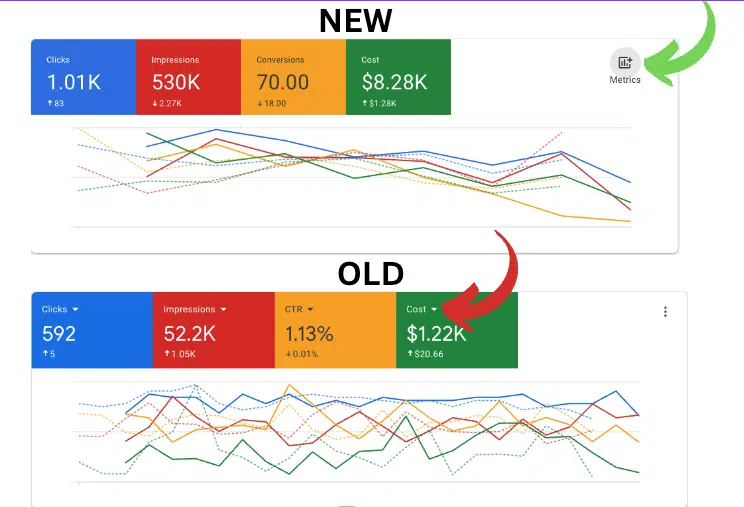
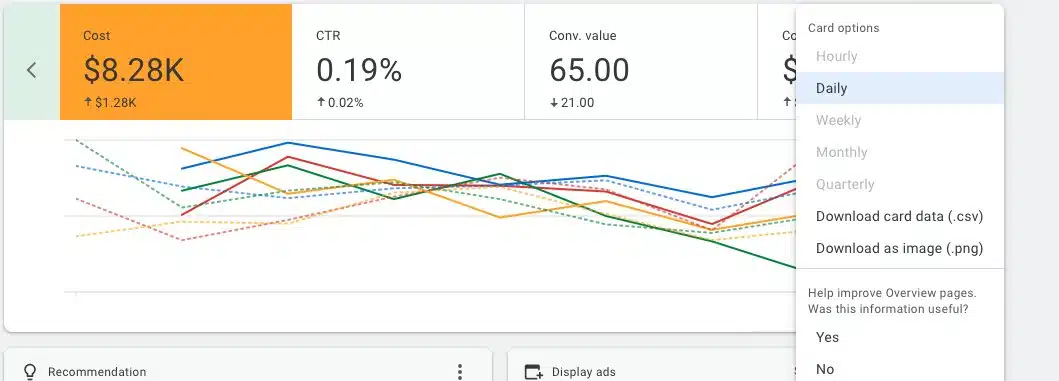
Google is currently testing a new overview dashboard within the Google Ads console. This new dashboard looks similar to the existing one but it gives you the ability to customize what data you see in the dashboard and also let’s you scroll through more data in a carousel format.

More details. Anthony Higman spotted this change and posted some screenshots of this. He said on X “it lets select ALL the metrics and then click through on the right to see other things in the overview slide.” He added, “Also looks like they are working on you being able to segment by time right from the overview slide.” He said he loves site!

What it looks like. Here are some screenshots he posted:

Google Ads Overview Carousel Customize
Google Ads Overview Carousel Customize Detail

Confirmed. Ginny Marvin, Google’s Ads Liaison, confirmed this feature this morning saying on X, “We’re currently running an experiment with a limited number of advertisers to offer more flexibility from the overview page.”

Why we care. This new feature, if rolled out, can be a huge time saver for advertisers using Google Ads. While the standard data in this Google Ads dashboard is useful, each advertiser may want to see the data that is important to them, the way they want to see it. So this should be a welcomed addition to Google Ads, if it rolls out more widely.


Related stories

New on Search Engine Land

@media screen and (min-width: 800px) { #div-gpt-ad-3191538-7 { display: flex !important; justify-content: center !important; align-items: center !important; min-width:770px; min-height:260px; } } @media screen and (min-width: 1279px) { #div-gpt-ad-3191538-7 { display: flex !important; justify-content: center !important; align-items: center !important; min-width:800px!important; min-height:440px!important; } }

About the author

Barry Schwartz

Barry Schwartz is a Contributing Editor to Search Engine Land and a member of the programming team for SMX events. He owns RustyBrick, a NY based web consulting firm. He also runs Search Engine Roundtable, a popular search blog on very advanced SEM topics. Barry can be followed on Twitter here.

https://searchengineland.com/google-ads-testing-new-overview-dashboard-for-advertisers-433777


Snap revenue up 5%, promises better ROI for advertisers

Snap, the parent company of Snapchat, reported its revenue rose 5% in the latest quarter after two straight quarters of declines on a rebound in the digital advertising market.

Advertising is the biggest source of Snap’s revenue – and the company cautioned the ad market remains volatile, pointing to the impact of war in the Middle East:

  • “We have had a number of primarily brand-oriented campaigns pause spending in the early period, I will say that we have seen a lot of those campaigns resume spending and the impact to our daily run rate has reduced significantly as a result of that but we also have seen a very small amount of incremental campaign pauses trickle in more recently,” said Snap CFO Derek Andersen said in an analyst call yesterday.

Revenue for the third quarter was $1.19 billion, up from $1.13 billion a year ago. In the previous two quarters, Snap’s revenue had fallen between 4% and 7%.

The company remains unprofitable – its net loss of $368 million for the third quarter is wider than a loss of $360 million a year ago.

Ad platform improvements. In a letter to investors, Snap said the company has “focused on improving our advertising platform” to generate higher returns for advertisers.

  • “We continue to make really significant investments in the ad ranking and optimization of creating a much broader range of signals into the ad platform and driving much larger models. And we’ve also instituted a much faster pace of experimentation. All of that’s leading to more precise conversion predictions, improved ROI for advertisers,” Andersen said.

Snap invested in improving ad ranking and optimization using ML models. This has led to a significant improvement in ROI for advertisers and an increase in lower-funnel revenue year-over-year and quarter-over-quarter. Also, its 7/0 Pixel Purchase optimization now lets advertisers bid for attributed seven-day clickthrough conversions.

Snapchat also reported working with advertisers to improve the effectiveness of their privacy-centric integrations with the ad platform. This resulted in significantly higher signal quality for those advertisers.

Last quarter, Snapchat introduced the Event Quality Score (EQS) system for advertisers to measure the quality and integrity of their data and identify opportunities to optimize their integrations with the ad platform. 

Increase in paid subscribers. Daily active users for the third quarter were 406 million, up 12% from a year ago. Last month, Snap said it had reached five million users for its paid subscription services, up from 4 million in June.

Because Snap is primarily used as a messaging platform – and doesn’t run ads in those messages – it’s had a hard time monetizing its users.

To rectify that it has ads in features like Stories and Spotlight, scrollable feeds of photos and videos from creators. Last month, Snap partnered with Microsoft to include sponsored links in Snap’s AI chatbot My AI.

Snap reported more than 200 million people have used My AI, sending more than 20 billion messages. CEO Evan Spiegel said in yesterday’s analyst call that while My AI is just getting started, it will eventually be a revenue driver.

  • “Our primary focus right now is just improving response quality. We’re seeing some of the work we’re doing to improve those responses lead to higher retention with the product overall. There’s certainly plenty of commercial intent. We are taking steps to integrate into our models to help folks see more relevant content and advertising,” Spiegel said.

Related stories

New on Search Engine Land

@media screen and (min-width: 800px) { #div-gpt-ad-3191538-7 { display: flex !important; justify-content: center !important; align-items: center !important; min-width:770px; min-height:260px; } } @media screen and (min-width: 1279px) { #div-gpt-ad-3191538-7 { display: flex !important; justify-content: center !important; align-items: center !important; min-width:800px!important; min-height:440px!important; } }

About the author

Constantine von Hoffman

Constantine von Hoffman is managing editor of MarTech. A veteran journalist, Con has covered business, finance, marketing and tech for CBSNews.com, Brandweek, CMO, and Inc. He has been city editor of the Boston Herald, news producer at NPR, and has written for Harvard Business Review, Boston Magazine, Sierra, and many other publications.

https://searchengineland.com/snap-revenue-up-5-promises-better-roi-for-advertisers-433753


Amazon Ads launches AI image generation

Select Amazon advertisers can now create AI-generated images to use in ad campaigns.

Essentially, what the tool offers advertisers is the ability to add backgrounds or scenery to plain product images.

Why we care. Amazon said its tool could lead to better ad performance. Products shown within a “lifestyle scene” can get 40% higher click-through rates, the company said.

How it works. Head to Amazon Ad Console, select your product, then click Generate. Using generative AI, Amazon will show you various “lifestyle and brand-themed images, based on product details, in a matter of seconds,” Amazon explained.

You can then further customize your AI-generated images using short text prompts or “enhance” them with a pre-set theme. You can save multiple versions to test and optimize performance, the company said.

You can add up to five images in your Amazon ad. Choosing multiple images will automatically create a looping slideshow.

Here’s a video showing it in action:

[embedded content]

Limited availability. AI-generated images is only available to “select” advertisers now. But Amazon said it will “expand availability over time.”

What Amazon is saying. The image generation tool is easy to use and requires no technical expertise, according to Amazon.

  • “This solution is helpful for advertisers of all sizes—enabling those that do not have in-house capabilities or agency support to more easily create brand-themed imagery, while also supporting bigger brands, who are constantly looking for ways to be more efficient around creative development,” the company wrote in its announcement.

This was expected. Like most ad platforms, Amazon has been working to add generative AI capabilities. We reported that Amazon was working on AI tools to generate images for advertisers in May. Now it’s finally here, nearly six months later.


Related stories

New on Search Engine Land

@media screen and (min-width: 800px) { #div-gpt-ad-3191538-7 { display: flex !important; justify-content: center !important; align-items: center !important; min-width:770px; min-height:260px; } } @media screen and (min-width: 1279px) { #div-gpt-ad-3191538-7 { display: flex !important; justify-content: center !important; align-items: center !important; min-width:800px!important; min-height:440px!important; } }
About the author

Danny Goodwin

Danny Goodwin has been Managing Editor of Search Engine Land & Search Marketing Expo – SMX since 2022. He joined Search Engine Land in 2022 as Senior Editor. In addition to reporting on the latest search marketing news, he manages Search Engine Land’s SME (Subject Matter Expert) program. He also helps program U.S. SMX events. Goodwin has been editing and writing about the latest developments and trends in search and digital marketing since 2007. He previously was Executive Editor of Search Engine Journal (from 2017 to 2022), managing editor of Momentology (from 2014-2016) and editor of Search Engine Watch (from 2007 to 2014). He has spoken at many major search conferences and virtual events, and has been sourced for his expertise by a wide range of publications and podcasts.

https://searchengineland.com/amazon-ads-launches-ai-image-generation-433747


Google AR beauty ads now let brands promote lip, eye products

Google is expanding its AR Beauty ads to let brands showcase lip and eye products, with plans to soon add foundation.

This augmented reality experience for cosmetic products (lipstick and eyeshadow) was initially launched in 2020.

Why we care. Beauty brands may want to experiment with Google’s virtual try-on experience to see whether the AR Beauty ads help increase product purchases.

New beauty features for shoppers. In addition to bringing its AR beauty features to mobile browsers, Google also announced new ways for shoppers to shop:

  • Hair color. Consumers can now try out different at-home hair colors from the L’Oreal suite of brands using Google’s AR technology. The platform will soon be adding more brands to its roster, including Splat and Revlon.
  • Foundation. Google will soon roll out the ability for consumers to virtually try on different shades of foundation to help them decide their best match before making a purchase. Shoppers will just need to search for a foundation type or name, select the product that they are interested in and tap “try on”. 

How it works. The new try-on experience will replace the ad product image in eligible Shopping ads. It will feature alongside relevant product information to help beauty brands showcase their products in a more interactive way to capture demand.


Get the daily newsletter search marketers rely on.


Uptake. More than 50 beauty brands have already started using AR on Google, including:

  • Covergirl
  • Dior Beauty
  • Fenty Beauty
  • Laura Mercier
  • Makeup by Mario

For those interested in following suit, Google is now accepting AR assets from a variety of data providers, including PulpoAR and Perfect Corp. 


Related stories

New on Search Engine Land

@media screen and (min-width: 800px) { #div-gpt-ad-3191538-7 { display: flex !important; justify-content: center !important; align-items: center !important; min-width:770px; min-height:260px; } } @media screen and (min-width: 1279px) { #div-gpt-ad-3191538-7 { display: flex !important; justify-content: center !important; align-items: center !important; min-width:800px!important; min-height:440px!important; } }
About the author

Nicola Agius

Nicola Agius is Paid Media Editor of Search Engine Land after joining in 2023. She covers paid search, paid social, retail media and more. Prior to this, she was SEO Director at Jungle Creations (2020-2023), overseeing the company’s editorial strategy for multiple websites. She has over 15 years of experience in journalism and has previously worked at OK! Magazine (2010-2014), Mail Online (2014-2015), Mirror (2015-2017), Digital Spy (2017-2018) and The Sun (2018-2020). She also previously teamed up with SEO agency Blue Array to co-author Amazon bestselling book ‘Mastering In-House SEO’.

https://searchengineland.com/google-ar-beauty-ads-lip-eye-products-433650


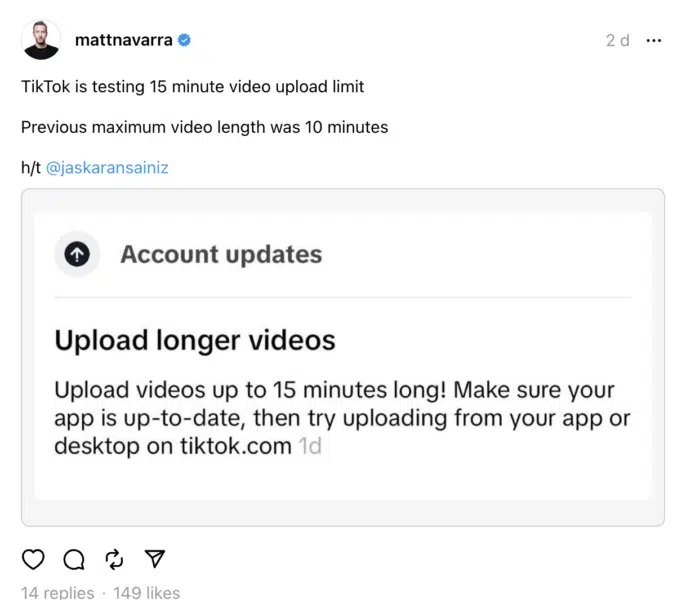
TikTok is piloting 15-minute video upload limits for select users

TikTok is testing increasing its video upload limit to 15 minutes.

Previously, creators could only share videos that were a maximum of 10 minutes.

The social platform is currently trialling this experiment with select users in select markets on its app.

Why we care. Brands collaborating with influencers may now have the opportunity to work on longer creatives together. Meanwhile, the extended video format offers increased potential for integrating in-video ads.

YouTube comparisons. The 15-minute experiment was first flagged by social media consultant Matt Navarra on Threads:

Screenshot 2023 10 24 At 16.29.22 695x600

Responding to his post, several followers suggested the platform’s model is growing increasingly similar to YouTube.

Why now? TikTok has been gradually increasing its video upload limit over the years, starting with 15 seconds, moving up to 60 seconds to three minutes to five minutes. Last year, the platform rolled out 10 minute videos, so it comes as little surprise than it is now increasing this period to 15 minutes.

Looking ahead. In 2022, Douyin, the Chinese version of TikTok, increased its maximum video upload limit to 30 minutes per clip. So many are expecting that TikTok will look at increasing its video upload limit once again after rolling out its 15 minute capacity.

Deep dive. Read TikTok’s top tips on how to create successful content for the platform, including guidance on video length, for more information.


Related stories

New on Search Engine Land

@media screen and (min-width: 800px) { #div-gpt-ad-3191538-7 { display: flex !important; justify-content: center !important; align-items: center !important; min-width:770px; min-height:260px; } } @media screen and (min-width: 1279px) { #div-gpt-ad-3191538-7 { display: flex !important; justify-content: center !important; align-items: center !important; min-width:800px!important; min-height:440px!important; } }

About the author

Nicola Agius

Nicola Agius is Paid Media Editor of Search Engine Land after joining in 2023. She covers paid search, paid social, retail media and more. Prior to this, she was SEO Director at Jungle Creations (2020-2023), overseeing the company’s editorial strategy for multiple websites. She has over 15 years of experience in journalism and has previously worked at OK! Magazine (2010-2014), Mail Online (2014-2015), Mirror (2015-2017), Digital Spy (2017-2018) and The Sun (2018-2020). She also previously teamed up with SEO agency Blue Array to co-author Amazon bestselling book ‘Mastering In-House SEO’.

https://searchengineland.com/tiktok-pilot-15-minute-video-upload-limits-433640


Yelp unveils enhanced ad targeting capabilities

Yelp has announced improvements to its ad-targeting capabilities through the expansion of its neural network usage.

The search engine announced that this strategy would also improve:

  • The quality of its search results.
  • Its photo classification abilities.
  • The accuracy of the Yelp Waitlist.

Why we care. Serving ads to high-value customers at optimal moments significantly enhances the probability of conversion, engagement, and potential sales. Advertisers can leverage these new capabilities to maximize the cost-effectiveness and performance of their campaigns.

Improved ads package. Yelp can now better identify suitable pictures for a brand’s local business profile by leveraging neural networks to intelligently identify the content in images. It then makes a decision based on a range of factors that will appeal to consumers and match their search intent.

Enhanced search and photo relevance. Yelp is now using a range of AI tools to understand users’ search intent better, enabling the search engine to serve photos from businesses that are more relevant to search queries.

Accuracy of Yelp Waitlist time estimates. Yelp added that the increased usage of neural networks has significantly improved wait time accuracy, which not only benefits diners with regard to planning their restaurant visits but also helps enhance restaurant efficiency.

Why now. Yelp started implementing neural networks earlier this year to improve its ability to match ads to relevant consumers based on the context of their search query. By leveraging neural networks further, the company has said that it’s been able train the model with exponentially more data to drive more accurate matching. Now, it can process years’ worth of data as opposed to just months.

What Yelp is saying. A Yelp spokesperson told Search Engine Land:

  • “For local advertising businesses, our photo selector tool for ads has resulted in a significant increase in clickthrough rates for advertisers, as well as decreases in cost per click across the board.”
  • “With these new models, we’re able to more clearly understand consumer intent and optimize ad
    placement for businesses, in turn surfacing more relevant ads for consumers.”
  • “We see neural networks driving even more growth for Yelp, as we continue to invest in new capabilities, like an even more accurate search experience that understands the nuance of language, and more advanced ad systems that drive relevant leads to advertisers.”

Deep dive. Read Yelp’s announcement in full for more information.


Related stories

New on Search Engine Land

@media screen and (min-width: 800px) { #div-gpt-ad-3191538-7 { display: flex !important; justify-content: center !important; align-items: center !important; min-width:770px; min-height:260px; } } @media screen and (min-width: 1279px) { #div-gpt-ad-3191538-7 { display: flex !important; justify-content: center !important; align-items: center !important; min-width:800px!important; min-height:440px!important; } }

About the author

Nicola Agius

Nicola Agius is Paid Media Editor of Search Engine Land after joining in 2023. She covers paid search, paid social, retail media and more. Prior to this, she was SEO Director at Jungle Creations (2020-2023), overseeing the company’s editorial strategy for multiple websites. She has over 15 years of experience in journalism and has previously worked at OK! Magazine (2010-2014), Mail Online (2014-2015), Mirror (2015-2017), Digital Spy (2017-2018) and The Sun (2018-2020). She also previously teamed up with SEO agency Blue Array to co-author Amazon bestselling book ‘Mastering In-House SEO’.

https://searchengineland.com/yelp-unveils-enhanced-ad-targeting-capabilities-433605


Search Engine Land Awards 2023: And the winners are…

Every year, we are delighted to celebrate the best of search marketing by rewarding the individuals, agencies and in-house teams around the world that deliver exceptional results.

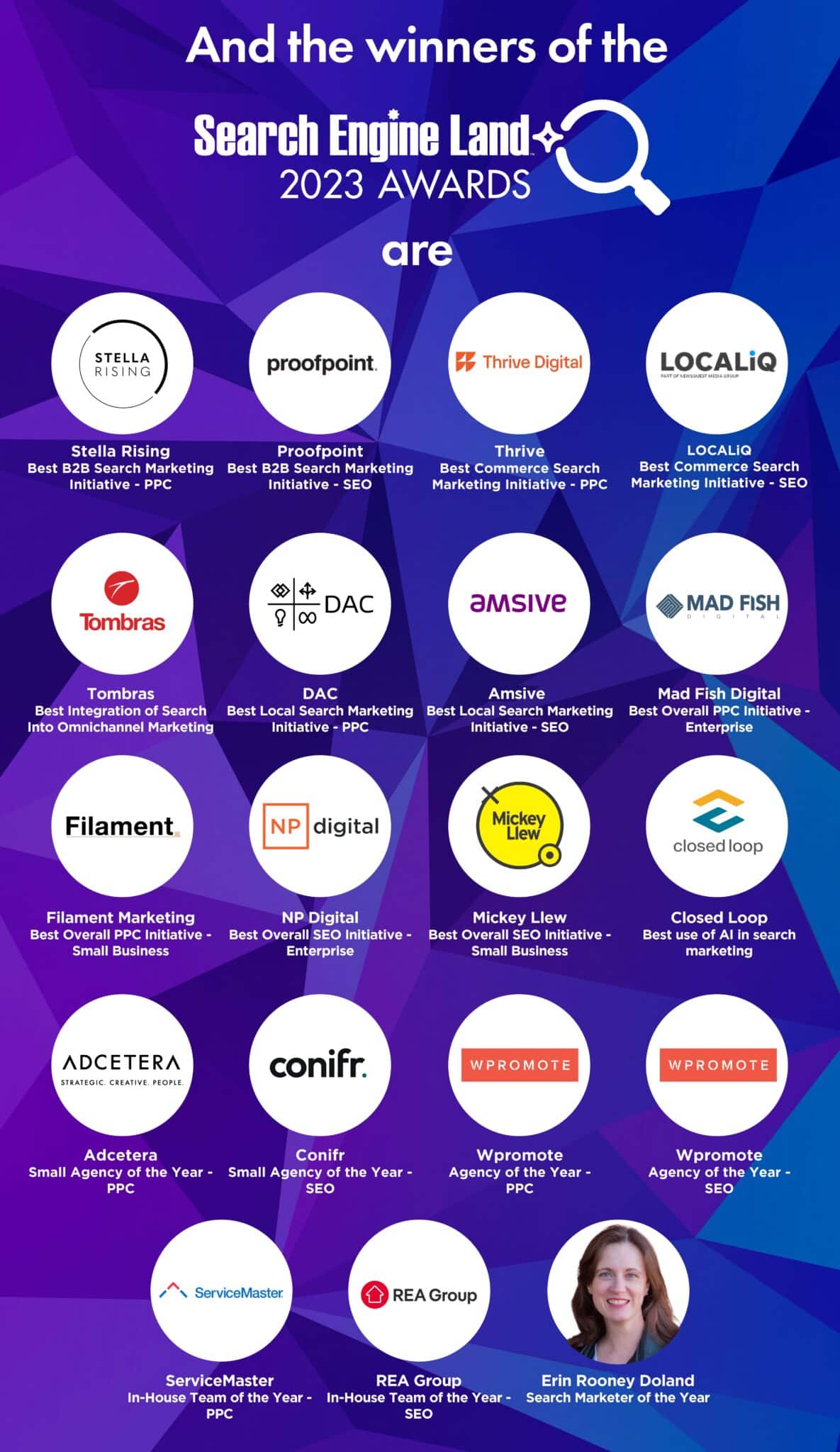
On behalf of Search Engine Land and everyone at Third Door Media, we’re excited to announce all 19 winners of the ninth annual Search Engine Land Awards.

Here are the 2023 Search Engine Land Awards winners:

Sela23 Winners Final 1 Scaled

Best use of AI technology in search marketing

  • Closed Loop – How Google’s AI Powered Bidding Drove International Growth for Calendly

Best overall PPC initiative – Small business

  • From Awareness to Sales Surge: Filament Marketing’s Strategy Delivers 23.08% ROAS Boost for Udder Tech

Best overall PPC initiative – Enterprise

  • Mad Fish Digital Increases Revenue by 71.44% with Google Search Ads for Park City Lodging

Best commerce search marketing initiative – PPC

  • How Thrive helped Branch Basics drive a 102% increase in YoY ROAS through strategic restructures, creative testing, and optimized media mix.

Best local search marketing initiative – PPC

  • DAC & The Fresh Market – The anti-inflation recipe that brought customers back into the stores

Best B2B search marketing initiative – PPC

  • Stella Rising & Optimizely – Driving DXP Globally

Best integration of search into omnichannel marketing

  • Tombras & Orangetheory Fitness – Revolutionizing Reach: Full-Funnel Success with Innovative Funding

Best overall SEO initiative – Small business

  • Mickey Llew & Uniquely Creative – Getting Crafty with a Small Budget Leaves a Big Mark

Best overall SEO initiative – Enterprise

  • Rendering a leader in digital 3D solutions. How NP Digital increased Adobe Substance 3D non-branded traffic by 494%.

Best commerce search marketing initiative – SEO

  • How LOCALiQ Helped Ultimate Gaming Paradise Achieve 600% YOY Revenue Growth with SEO

Best local search marketing initiative – SEO

  • Amsive – Transforming Trust: A Journey from Doubt to Triumph in Local SEO for American Savings Bank

Best B2B search marketing initiative – SEO

  • Menerva Digital Increased Proofpoint’s B2B Sales Pipeline by +$40.7 Million Via SEO

Agency of the year – PPC

  • How Wpromote transformed REEF’s paid search strategy to embrace PMax and increase revenue by 131%

Agency of the year – SEO

  • How Wpromote helped Peacock build a dynamic search strategy to win big with The Traitors

In-house team of the year – PPC

  • ServiceMaster Brands In-House Digital Ads team focuses on the ABCs to improve performance for their franchisees.

In-house team of the year – SEO

  • REA Group – High-performing SEO team keeps Australia’s market-leading property brands at the top of Google
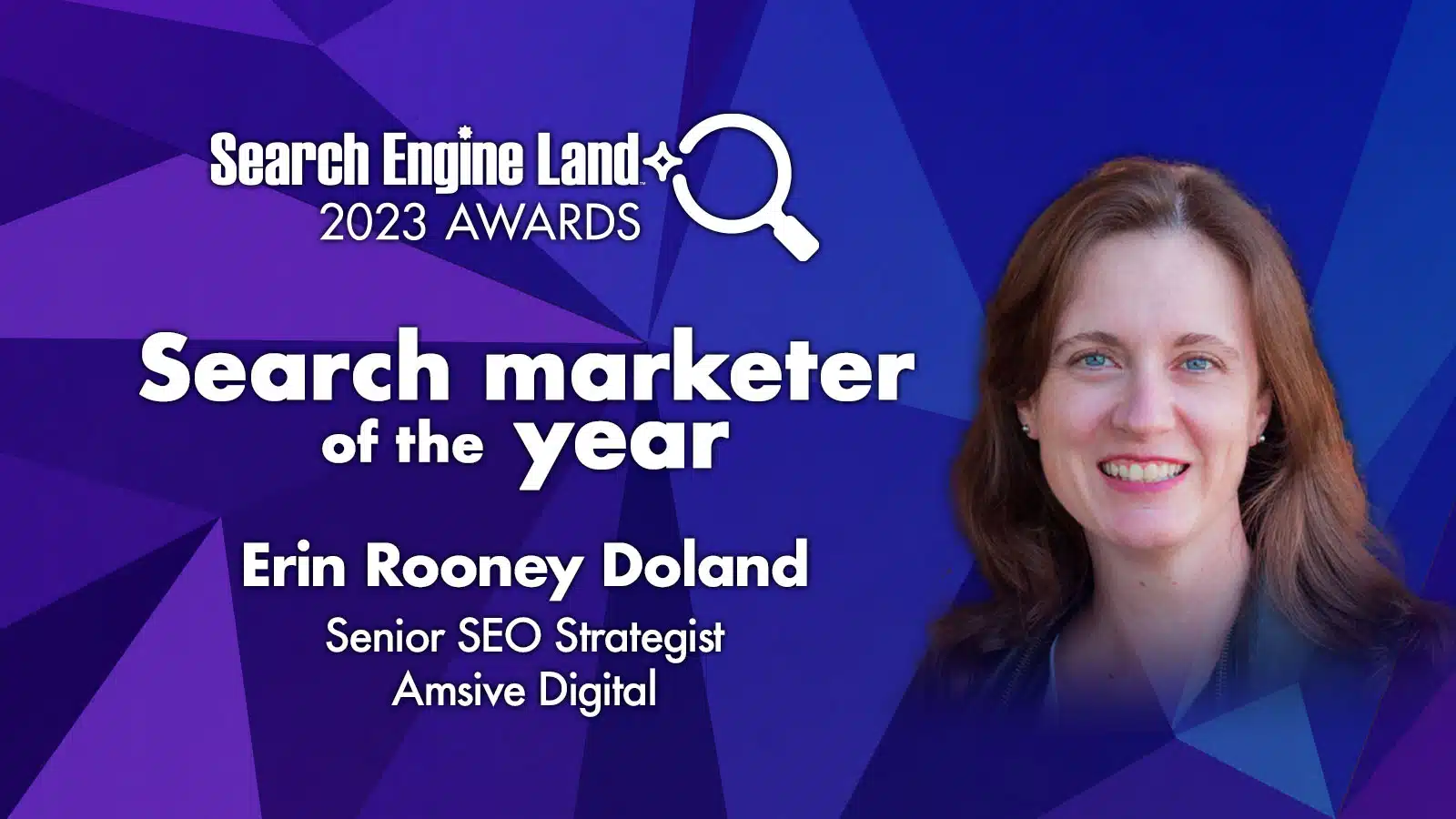
Erin Rooney Doland, Search Engine Land Awards's 2023 Search marketer of the year

Search Marketer of the Year

  • Erin Rooney Doland (Amsive)

Small agency of the year – PPC

  • How Adcetera Reduced CPA by 71.9% — and Saved a Multi-Location Business

Small agency of the year – SEO

  • How Conifr Surpassed Traffic Forecasts by 950% Within 10 Months

“I’m going to SMX Next!”

Select winners of the 2023 Search Engine Land Awards will be invited to speak live at SMX Next during our two ask-me-anything-style sessions. Bring your burning SEO and PPC questions to ask this award-winning panel of search marketers!

Register here for SMX Next (it’s free) if you haven’t yet.

Congrats again to all the winners. And huge thank yous to everyone who entered the 2023 Search Engine Land Awards and our fantastic panel of judges for this year’s awards.


Related stories

New on Search Engine Land

@media screen and (min-width: 800px) { #div-gpt-ad-3191538-7 { display: flex !important; justify-content: center !important; align-items: center !important; min-width:770px; min-height:260px; } } @media screen and (min-width: 1279px) { #div-gpt-ad-3191538-7 { display: flex !important; justify-content: center !important; align-items: center !important; min-width:800px!important; min-height:440px!important; } }

About the author

Danny Goodwin

Danny Goodwin has been Managing Editor of Search Engine Land & Search Marketing Expo – SMX since 2022. He joined Search Engine Land in 2022 as Senior Editor. In addition to reporting on the latest search marketing news, he manages Search Engine Land’s SME (Subject Matter Expert) program. He also helps program U.S. SMX events. Goodwin has been editing and writing about the latest developments and trends in search and digital marketing since 2007. He previously was Executive Editor of Search Engine Journal (from 2017 to 2022), managing editor of Momentology (from 2014-2016) and editor of Search Engine Watch (from 2007 to 2014). He has spoken at many major search conferences and virtual events, and has been sourced for his expertise by a wide range of publications and podcasts.

https://searchengineland.com/search-engine-land-awards-2023-winners-433536


X is launching two new tiers of Premium subscription

Elon Musk has announced that two new tiers of X Premium subscriptions will be launching soon.

One of the options will cost less than the current $8 per month plan but will not have a reduction in ads, while the other will be more expensive and will block all ads.

The exact costs of each tier are yet to be confirmed.

Why we care. This move could potentially have a significant impact on advertisers who invest ad spend in X, depending on the uptake of the zero-ad subscription.

Why now. Since Musk took-over X last year, ad revenue has dropped 59% and the company has been eagerly exploring new ways to generate revenue.

What X is saying. Musk revealed last month that he was planning to make X a paid-for platform for all users. During a conversation with Israeli Prime Minister, Benjamin Netanyahu, he claimed this was the most effective way to tackle the issue of rampant bot activity. He said:

  • “The single most important reason that we’re moving to having a small monthly payment for use of the X system is that it’s the only way I can think of to combat vast armies of bots.”
  • “Because a bot costs a fraction of a penny, or a tenth of a penny, but if somebody even has to pay a few dollars or something, some minor amount, the effective cost of bots is very high, and then you also have to get a new payment method every time you have a new bot.”
  • “We’re actually going to come out with lower tier pricing. We want it to be just a small amount of money [and] in my view, this is actually the only defense against vast armies of bots.”

Get the daily newsletter search marketers rely on.


Deep dive. Read our previous report on X’s ad revenue performance for more information.


Related stories

New on Search Engine Land

@media screen and (min-width: 800px) { #div-gpt-ad-3191538-7 { display: flex !important; justify-content: center !important; align-items: center !important; min-width:770px; min-height:260px; } } @media screen and (min-width: 1279px) { #div-gpt-ad-3191538-7 { display: flex !important; justify-content: center !important; align-items: center !important; min-width:800px!important; min-height:440px!important; } }

About the author

Nicola Agius

Nicola Agius is Paid Media Editor of Search Engine Land after joining in 2023. She covers paid search, paid social, retail media and more. Prior to this, she was SEO Director at Jungle Creations (2020-2023), overseeing the company’s editorial strategy for multiple websites. She has over 15 years of experience in journalism and has previously worked at OK! Magazine (2010-2014), Mail Online (2014-2015), Mirror (2015-2017), Digital Spy (2017-2018) and The Sun (2018-2020). She also previously teamed up with SEO agency Blue Array to co-author Amazon bestselling book ‘Mastering In-House SEO’.

https://searchengineland.com/x-is-launching-two-new-tiers-of-premium-subscription-433524