YouTube Spotlight Moments lets brands align ads with cultural moments
YouTube today introduced Spotlight Moments – a new advertising package that will serve your brand’s videos next to “the most relevant and engaging content associated with the moment.”
How it works. Using, AI, YouTube can identify popular videos around cultural moments. For example, with Halloween coming up, Spotlight Moments:
Lets advertiser serve ads across Halloween-related content on YouTube.
Curates YouTube videos into dynamically updated playlists on a sponsored hub.
YouTube Culture Hub. All the videos will live on the sponsored YouTube Culture Hub. This hub will include the advertiser’s logo. Here’s what that looks like:
Why we care. YouTube’s new advertising offering has the potential to give your brand visibility during key cultural moments and help you reach your target audience. The big question to be determined is what kind of ROI your brand with this ad format.
@media screen and (min-width: 800px) { #div-gpt-ad-3191538-7 { display: flex !important; justify-content: center !important; align-items: center !important; min-width:770px; min-height:260px; }
}
@media screen and (min-width: 1279px) { #div-gpt-ad-3191538-7 { display: flex !important; justify-content: center !important; align-items: center !important; min-width:800px!important; min-height:440px!important; }
}
About the author
Danny Goodwin has been Managing Editor of Search Engine Land & Search Marketing Expo – SMX since 2022. He joined Search Engine Land in 2022 as Senior Editor. In addition to reporting on the latest search marketing news, he manages Search Engine Land’s SME (Subject Matter Expert) program. He also helps program U.S. SMX events. Goodwin has been editing and writing about the latest developments and trends in search and digital marketing since 2007. He previously was Executive Editor of Search Engine Journal (from 2017 to 2022), managing editor of Momentology (from 2014-2016) and editor of Search Engine Watch (from 2007 to 2014). He has spoken at many major search conferences and virtual events, and has been sourced for his expertise by a wide range of publications and podcasts.
Google posted an update at 5:28 pm ET today saying, “The problem with Google Ads has been resolved. We apologize for the inconvenience and thank you for your patience and continued support.”
The issue started on October 11th at 12:59 am ET.
What has Google said? A Google spokesperson said in a statement:
“We are aware of an issue affecting serving/spending for campaigns running on Google Ads.”
“This is an acknowledgement note to assure you that the issue is being actively investigated.”
Why we care. You may want to check your Google Ads account to see if there are any anomalies with your account and speak to Google with any necessary refunds or adjustments.
@media screen and (min-width: 800px) { #div-gpt-ad-3191538-7 { display: flex !important; justify-content: center !important; align-items: center !important; min-width:770px; min-height:260px; }
}
@media screen and (min-width: 1279px) { #div-gpt-ad-3191538-7 { display: flex !important; justify-content: center !important; align-items: center !important; min-width:800px!important; min-height:440px!important; }
}
About the author
Barry Schwartz is a Contributing Editor to Search Engine Land and a member of the programming team for SMX events. He owns RustyBrick, a NY based web consulting firm. He also runs Search Engine Roundtable, a popular search blog on very advanced SEM topics. Barry can be followed on Twitter here.
What is RGSP? Google’s Randomized Generalized Second-Price ad auctions explained
The concept of randomized generalized second-price (RGSP) auctions sent shockwaves through the PPC community after the subject took center stage at the Google antitrust trial.
While some digital marketers agreed with Google that the practice provides a better user experience, others sided with the Department of Justice (DOJ), arguing that it makes ad auctions unfair and purely helps line Google’s extremely deep pockets.
But what is RGSP, why does the DOJ think it’s problematic for ad auctions and how exactly does it impact Google’s ad revenue? Here’s everything you need to know.
How does Google pick an ad auction winner?
Dr. Adam Juda, Google’s Vice President of Product Management in Search Ads Quality Systems, explained at the federal antitrust trial:
The highest bidder doesn’t automatically win the ad auction.
A campaign’s long-term value (LTV) is instead given more weight.
This means Google sometimes loses out financially in the short term.
When advertisers bid on keywords, instead of determining an ad auction winner purely by bid amount, Google uses a metric called Ad Rank to decide how and if your campaign should rank. This collective score is calculated by examining:
Bid amount
Auction-time ad quality (including expected click-through rate, ad relevance and landing page experience)
Ad Rank threshold
Competitiveness of an auction
Context of a search query
Expected impact of assets and other ad formats
Your Ad Rank is recalculated every time time your campaign becomes eligible to compete in an auction, meaning your ad’s ranking may vary each time depending on competition, quality and search context.
Campaigns that don’t meet Google’s minimum Ad Rank threshold are automatically eliminated from the auction.
How does Ad Rank work?
Imagine five advertisers competing against each other in an ad auction with the respective Ad Rank scores of 80, 50, 30, 10 and 5. For this particular auction, Google requires a minimum Ad Rank threshold of 40 to rank above organic search results. This means that only the first two campaigns (with scores of 80 and 50) are eligible to show above organic search results.
In this instance, for an ad to be shown below organic search results, Google requires a minimum Ad Rank of 8. This mean that the campaigns with Ad Rank scores of 30 and 10 would qualify.
However, the campaign with the Ad Rank score of 5 does not meet the minimum criteria to appear above or beneath the search results and so will be eliminated from the auction, as shown in the table below:
Why doesn’t the highest bidder win?
If the highest bidder automatically won every Google ad auction, there is a risk the search engine could be left serving poor-quality ads. Poor-quality ads may not be relevant to a searcher’s query, which would likely result in a poor:
Click-through rate.
Conversion rate.
User experience.
This would decrease the overall value of Google’s product.
“Overall, higher quality ads typically lead to lower costs and more advertising success.”
“The Google Ads system works best for everybody when the ads we show are relevant and closely match what customers are searching for.”
It is also in Google’s best interest to serve high-quality ads that satisfy user intent because advertisers only pay Google when someone clicks on your ad, visits your site or calls your business.
An ad that meets all minimum criteria required by a Google auction can sometimes still rank below an ad that fails some criteria, he wrote. Vallaeys went further by using an example of an ad auction that had a 4% threshold for predicted CTR. The details of the competing bids are listed in the table below:
In the example listed above, Ad 2 meets the threshold because its predicted CTR is 5% – 1% higher than the 4% required by Google. However, because Ad 1 has a higher Ad Rank score (30), Ad 2 would rank further down the page to maintain auction fidelity, and only be displayed when Ad 1 is allowed.
“This is not a great scenario for advertisers or Google, so they address this by allowing ads to be shown in a different order than what ad rank would normally dictate,” Vallaeys wrote.
This “different order” refers to the concept of RGSP.
What is RGSP and how does it affect auctions?
RGSP is a practice leveraged by Google that picks the winner of an ad auction at random from the top bidders as long as their long-term values (LTVs – a Google calculation that is essentially the same as Ad rank) are close enough.
The top bidder then “pays the price of the bid equal to the next-highest bid plus one cent,” according to Big Tech on Trial.
The Department of Justice argued at the federal antitrust trial that this practice creates an unfair competition for bidding advertisers as the winner of an auction should always be the highest bidder.
Why is RGSP unfair?
Advertisers have two options if they want to avoid their potential winning bid from being demoted at random to runner-up:
Improve their campaign’s LTV.
Increase their bid amount.
The issue here is that Google hasn’t specified exactly how advertisers can increase their campaign’s LTV, which leaves them with one option if they wish to avoid RGSP – increase their bid amount.
To avoid RGSP, the bid amount would have to be significantly higher than the runner-up (as mentioned before, winners and runners-up can only be swapped via the RGSP process if the LTV and bid amounts are close enough). This has resulted in advertisers having to raise their bid 3.7 times higher, reports This Week In Google Antitrust.
What are the issues with RGSP?
Jay Friedman, CEO of advertising agency Goodway Group, highlighted the reasons RGSP could prove problematic for advertisers:
“Imagine you want to buy a ticket to a concert. Not everyone who wants a ticket can get a ticket, so there is an auction. You submit your bid and it’s not a first-price auction (highest bidder wins, pays what they bid,) and not even a second-price auction (highest bidder wins, pays a nominal amount [i.e. $1] over the second-highest biddger.) Instead, the concert venue holds an RGSP – a ‘randomized general second-price auction.’”
“Let’s say the the top two bidders submit bids of $100 and $95. In RGSP, the concert venue takes the top two bidders and, ‘as long as the long-term value of each of the bidders to the concert venue is pretty close,’ there is a chance the concert venue randomly swaps the top two bidders and awards the seat to the second highest bidder instead. Sounds like a deal if you randomly get the ticket for $95, and I guess frustrating for the highest bidder.”
“EXCEPT – the concert venue tells you there are two ways to make sure you don’t get randomly swapped out as the highest bidder. One, increase your long-term value to the venue. They don’t tell you how to do this and note it may include your behavior, referrals, your bid amounts, bid frequency, ‘and other bidder quality elements.’ You decide that’s pretty vague. The second is to increase your bid! And, as it turns out, you’d have to increase your $100 bid to $370 to get sufficient confidence you wouldn’t be outbid.”
What has the DOJ said about RGSP?
The DOJ has argued at the federal antitrust trial that rather than resulting in higher-quality ads, RGSP is being used by Google to boost ad revenue. In putting forward its case, the department shared an email Juda sent to his team at Google acknowledging the difficulty the search engine would have in selling this practice to advertisers. It read:
“[I]f I have to say, ‘[W]e randomly disable you if you don’t bid high enough,’ then I’m going to have another bad year at [Google Marketing Next] ;).”
There was debate at the trial as to what was implied by the use of a winking emoji in Juda’s message.
Does RGSP increase Google’s revenue?
Google vice president and general manager of ads Jerry Dischler testified at the federal antitrust trual that while he was unsure if RGSP resulted in advertisers increasing their ad auction bids, he could confirm that the practice increases Google’s ad revenue.
Dischler went on to tell the court that the search engine “frequently” changes the auctions it uses to sell search ads, increasing the cost of ads and reserve pricing by as much as 5% for the average advertiser. For some queries, the tech giant may have even raised prices by as much as 10%. However, Google tends “not to tell advertisers about pricing changes.”
The Department of Justice shared an email sent by Dischler back in 2018 to highlight the pressure his team were under to meet revenue targets given to Wall Street by Ruth Porat, Google’s Chief Financial Officer. In the documents, he claimed his team were “shaking the cushions” to increase revenue. He wrote:
“If we don’t meet quota for the second quarter in a row and we miss the street’s expectations again, which is not what Ruth signalled to the street, so we will get punished pretty bad in the market.”
“I care more about revenue than the average person but think we can all agree that for our teams trying to live in high cost areas another $100,000 in stock price loss will not be great for morale, not to mention the huge impact on our sales team.”
Is RGSP new?
Practices like RGSP are not new. In fact, Yahoo! gave an interview to The Register back in 2010 explaining it had been using “squashing” and second price auctions since 2007 to increase revenue. Yahoo!’s then chief economist, Preston McAfee (who now works for Google as a Distinguished Scientist) told the publication at the time:
“When someone has a really high ad click probability, they’re very hard to beat, so it’s not a really competitive auction. So that they don’t just win [every auction], we do squashing. This makes the auction more competitive.”
“The bidders respond by bidding higher. The one who was destined to lose is now back in the race, so they bid higher trying to displace the number one, and the number one is trying to fend them off so they bid higher too.”
“We can make the competition a bit more fierce using squashing, even on keywords where there’s not much bidding.”
McAfee did not confirm how much squashing Yahoo! does but did say it was constantly changing and “resetting the parameters”.
What has Google said about RGSP?
Google uses RGSP to prevent a bias where one winner takes all, Juda said at the federal antitrust trial. Commenting on the practice, he told the court “we flip [the winners of auctions with runners-up], otherwise Amazon always shows up on top,” Bloomberg reported.
Another reason for selecting winners at random is so that advertisers don’t need to worry that they may be bidding too much in ad auctions, which could result in them constantly feeling the need to adjust their bid amounts, according to Google.
With RGSP, the price advertisers pay is determined by the bid amount put forward by the next highest-ranked bid. Juda described this method as “advertiser-friendly.”
How has the PPC community reacted?
The concept of RGSP appears to have divided the paid search community, with many criticizing the lack of transparency around it.
“So much for giving advertisers transparency, right? What does this mean for advertisers? Does ad rank even matter? I personally hope that Google will get more than a fine and a ‘slap on the wrist’ for this.”
Mike Ryan, Head of Ecommerce Insights at Smarter Ecommerce, commented
“Is this behavior ethical? No. Whatever the initial motivation, this is auction manipulation that appears to harm Google’s competitor set and yield undue revenues by increasing costs for everyone else.”
“All digital marketers need to be aware that Google’s bid auction is no longer an auction. A real auction’s outcomes are dictated by supply and demand, but we just learned from the horse’s mouth there are other factors in play.
“I’m sure Google is working on making its advertising product more effective – at least for retail advertisers, since that was certainly the focus of Dischler’s quotes. What I’m sure of is that continuing to game its own system at the expense of its customers is not a long-term strategy for success. I’ve got plenty of ideas for ways Google can get better for #b2b advertisers if they’re open to a more honest way forward.”
“Google, we genuinely love the product you first introduced. We are the ones who had told clients for years why Search is one of the best marketing channels of all time (what incredible marketing intent there is in a search term!!). Stop the money grab and start rebuilding trust. For the sake of the industry. Please! :( #ppc #googleads #adwords #ecommerce #RGSP.”
However, others have argued that “out-of-order” ranking changes can help improve the user experience, as pointed out by Vallaeys:
“While out-of-order promotion changes the typical auction dynamics, Google believes it ultimately improves the search experience, and I tend to agree with that. For advertisers, it highlights the need to focus both on bidding strategically and optimizing for relevance and Quality Score.”
Content marketer Goutham Veerabathini shared this notion, commenting on LinkedIn:
“The introduction of randomness might help create a more dynamic and unpredictable auction environment to prevent strategic strict deterministic ranking of bids that gives top position always to only one player who bids the highest after mastering all the other factors.”
Why we care. Fair ad bidding is essential for advertisers to achieve their marketing objectives efficiently, maintain trust in the advertising ecosystem, and foster long-term relationships with advertising platforms and publishers. It contributes to a healthy and competitive marketplace where advertisers can optimize their strategies for better outcomes.
@media screen and (min-width: 800px) { #div-gpt-ad-3191538-7 { display: flex !important; justify-content: center !important; align-items: center !important; min-width:770px; min-height:260px; }
}
@media screen and (min-width: 1279px) { #div-gpt-ad-3191538-7 { display: flex !important; justify-content: center !important; align-items: center !important; min-width:800px!important; min-height:440px!important; }
}
About the author
Nicola Agius is Paid Media Editor of Search Engine Land after joining in 2023. She covers paid search, paid social, retail media and more. Prior to this, she was SEO Director at Jungle Creations (2020-2023), overseeing the company’s editorial strategy for multiple websites. She has over 15 years of experience in journalism and has previously worked at OK! Magazine (2010-2014), Mail Online (2014-2015), Mirror (2015-2017), Digital Spy (2017-2018) and The Sun (2018-2020). She also previously teamed up with SEO agency Blue Array to co-author Amazon bestselling book ‘Mastering In-House SEO’.
5 reasons Amazon Ads is better than Google Ads for ecommerce
Nine out of 10 ecommerce businesses I’ve come across have run Google Ads at some point, but few have considered Amazon Ads despite the significant opportunities it offers.
I believe that Amazon Ads has the potential to be far more effective than Google Ads for ecommerce PPC as it offers higher quality traffic, higher conversion rates, easier tracking, more long-term value and more lenient policies.
In this article, I unpack these advantages and explain why your ecommerce business should be running Amazon Ads over Google Ads.
Why is Amazon Ads undervalued?
There are several reasons that Amazon Ads has not been as popular as Google Ads, even for ecommerce businesses. Let’s get these out of the way.
While Google commands the majority of global search engine usage, boasting over 90% market share, a 2021 survey by Jumpshot revealed that Amazon’s search volume comprises 54% of all product-related searches in the United States.
Google may have a broader reach, but Amazon provides a more relevant targeting opportunity, a nuance often missed by ecommerce advertisers.
Another blocking factor is that Amazon is a stand-alone ecommerce platform. To list a product on Amazon, advertisers are required to invest in the Amazon ecosystem and build a product listing.
The startup cost and learning curve with Google Ads are lower as traffic can be run directly to your ecommerce website. It’s not widely known that Amazon has a program called Fulfilled by Merchant (FBM), where sellers can fulfill products themselves and not use Amazon’s fulfillment centers.
While there might be hesitation to join the Amazon marketplace, the advantage in building another sales channel and gaining access to Amazon’s network of customers and their ad platform is huge.
Lastly, the costs associated with Amazon Ads on face value appear higher than Google Ads. Amazon Ads, like Google Ads, is a CPC platform, which means advertisers are charged for each click on their ads.
However, Amazon also charges a percentage sale commission for any product sold on their platform. This commission varies depending on the product parameters.
Despite this added commission, Amazon Ads is still likely to be more cost-effective than Google Ads, considering that the CPCs are far lower and the conversion rates far higher on Amazon.
1. Amazon has higher conversion rates
Most U.S. product searches happen on Amazon, resulting in significantly higher conversion rates than Google Ads.
While Google Ads offers effective targeting capabilities, Amazon’s advantage lies in its product-focused intent.
Additionally, Amazon provides advertisers with other tools, like advertising products on competitor product listings.
It’s not uncommon for Amazon listings to have conversion rates of 10 to 15% and beyond. Prime members have even higher conversion rates. Compare this to Google Ads, which usually have conversion rates under 5%.
Even considering the 15% commissions on products, the ROAS from Amazon Ads are usually more cost-effective than Google Ads.
2. Amazon makes attribution and tracking easier
Google Ads tracking has come a long way with Google Analytics 4 and Google Tag Manager. But even with these advancements, it’s still difficult to master attribution and understand the true value of Google Ads all the way down to a keyword or product listing.
This is not the case with Amazon Ads. Amazon’s approach is different because all of the product information is housed within the Amazon platform.
Product information, buyer reviews, influencer videos, long-form content and similar products can all be found on the platform connected to the listing.
Add to that the buyer trust that Amazon provides with its reputation of fast fulfillment and free returns. Most of the research and sale is completed on the platform, and all of this information is retained.
As an advertiser, it becomes very easy to understand the customer journey from keyword to sale and the revenue value behind each ad campaign and down to keyword and product target.
Amazon’s Brand Analytics and Ad platform provide ecommerce businesses with a flywheel to constantly improve products and make great marketing decisions. It also means Amazon Ads become highly effective over time, while you may still be guessing at the true performance of Google Ads.
Get the daily newsletter search marketers rely on.
3. Amazon Ads drive rankings
When it comes to how ads affect organic rankings, Google and Amazon have distinct policies. The difference creates an interesting opportunity for Amazon advertisers.
“Investment in paid search has no impact on your organic search ranking. Google maintains a strict separation between our search business and our advertising business.”
Amazon has the exact opposite policy. While they don’t officially state this, it is common knowledge in the industry that Amazon Sponsored Ads drive organic rankings.
In practice, Amazon Sponsored Ads drive more buyers to listings and increase sales. Subsequently, sell-through-rates increase and Amazon uses this trust factor to rank products organically for those keywords.
I’m not judging which policy is better; both make sense in their own way. However, the outcome is that Amazon’s policy enables newer entrants to rank products quickly and get a foothold in the Amazon Marketplace. With Google, investing in SEO can be a slow process.
Similar to the above point, SEO on Google is time-consuming and resource-intensive. Building links and content and optimizing websites to rank on Google takes time and money.
It’s also unclear exactly what works and what doesn’t. It can sometimes feel like trying to catch a falling knife, with the parameters around SEO constantly in flux.
On the other hand, we know that investment in Amazon Ads has a value-added effect on Amazon SEO. As discussed above, more ads mean more sales, which means higher sell-through rates and better rankings.
But also, more ads = more sales = more reviews. Reviews on Amazon are likened to Links to your website on Google. They are the lifeblood of rankings.
Investing in Ads influences your rankings and is a direct investment in your Amazon presence. These reviews are tangible and real. You don’t get the same effect when you invest in Google Ads, which Google specifically states is a siloed platform.
5. The Amazon marketplace is easier to dominate
Not only do Amazon ads make it easier to compete, but it is also far easier to dominate the entire marketplace with Amazon than it is with Google Ads.
Consider Google’s policy of “Unfair Advantage.” You cannot advertise two listings for the same keyword. There are only four ad spots, and Google does not want any advertiser to control all the real estate.
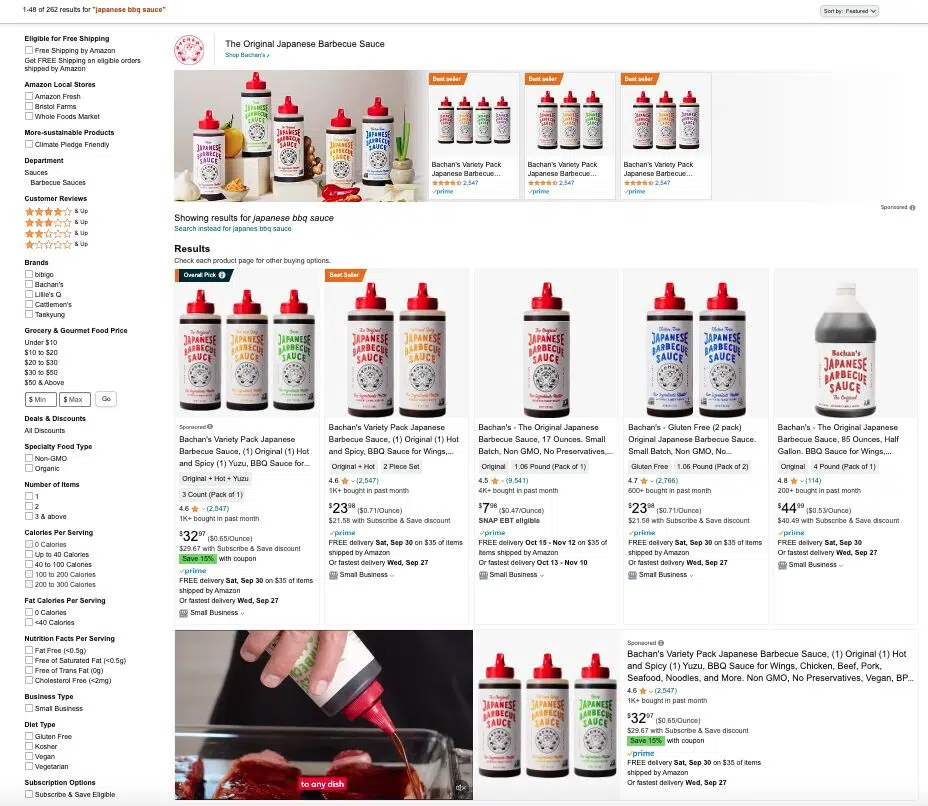
With Amazon, one advertiser can easily dominate a vast amount of real estate on the search results page.
Check out this search for “Japanese BBQ sauce” on Amazon.com. One advertiser controls the whole page:
This kind of dominance of the SERP could never be achieved with Google Ads today.
While there are ways to game this with Google, such as opening multiple accounts, this violates Google’s policy, and if caught, an advertiser risks having all their accounts closed down.
Whereas with Amazon, this allowed and even encouraged. Your ecommerce brand can own the entire SERP if it wants to.
Amazon presents a better opportunity for ecommerce advertisers
While Google has more search volume and can be an effective platform, for a savvy ecommerce business Amazon Ads presents more opportunities. The key reasons in favor of Amazon Ads are:
@media screen and (min-width: 800px) { #div-gpt-ad-3191538-7 { display: flex !important; justify-content: center !important; align-items: center !important; min-width:770px; min-height:260px; }
}
@media screen and (min-width: 1279px) { #div-gpt-ad-3191538-7 { display: flex !important; justify-content: center !important; align-items: center !important; min-width:800px!important; min-height:440px!important; }
}
About the author
Mark is a Director and Head of Paid Media at One Egg Digital. He has 15 years’ experience specializing in marketing strategy and advanced campaign implementation. He is experienced in growth marketing, building eCommerce brands and guiding start-ups through rapid growth. Mark teaches 3 best-selling Udemy courses on these topics and consults for major brands in Australia and Asia.
AI-powered marketing in 2024: A playbook for success by Cynthia Ramsaran
It’s no secret that B2B marketers have a challenging task in front of them: a niche audience, an often technical offering and tighter budgets than their B2C counterparts. However, a recent survey has found that over 50% of B2B marketers have plans to increase their marketing budget over the next year – and they are looking to AI to help them succeed.
Join MNTN as they walk through how B2B marketers can utilize the rapidly evolving AI technology.
@media screen and (min-width: 800px) { #div-gpt-ad-3191538-7 { display: flex !important; justify-content: center !important; align-items: center !important; min-width:770px; min-height:260px; }
}
@media screen and (min-width: 1279px) { #div-gpt-ad-3191538-7 { display: flex !important; justify-content: center !important; align-items: center !important; min-width:800px!important; min-height:440px!important; }
}
About the author
Cynthia Ramsaran is director of custom content at Third Door Media, publishers of Search Engine Land and MarTech. A multi-channel storyteller with over two decades of editorial/content marketing experience, Cynthia’s expertise spans the marketing, technology, finance, manufacturing and gaming industries. She was a writer/producer for CNBC.com and produced thought leadership for KPMG. Cynthia hails from Queens, NY and earned her Bachelor’s and MBA from St. John’s University.
Google Ads rolls out new tool for centralized access to all first-party data
Google Ads is rolling out a new tool that allows businesses to manage their first-party data in one place.
With Google Ads Data Manager, marketers can analyze and use consented first-party data from different sources without needing to to look elsewhere in a privacy-centric way.
The feature will initially launch in Google Ads to make it easier to use enhanced conversions and customer match, but will be expanded to additional ads products over the coming months and years.
Why we care. Prioritizing first-party data is crucial for optimizing and measuring campaign success. Google Ads Data Manager simplifies access to this data, making it more seamless to integrate into your marketing strategy, enhancing your ability to drive incremental revenue, generate more leads and achieve better outcomes for your business.
Multiple data source connections. With Google Ads Data Manager, you can connect to a variety of different data sources, such as customer relationship management (CRM) and customer data platforms (CDPs). This includes data sources like ActiveCampaign and Pipedrive, as well as marketing technologies like Shopify Audiences. Common cloud-based enterprise data storage systems, including CDPs such as Lytics, will be available too, in addition to data sources through Zapier.
Launch date. Google Ads Data Manager will become generally available in Google Ads in early 2024.
Feedback. During the initial testing of this tool, Google found that Ads customers who efficiently onboarded their first-party data achieved improved lead conversions and enhanced measurement accuracy. The new onboarding pathway contributed to a significant 43% increase in qualified leads for property developer, Sansiri.
Get the daily newsletter search marketers rely on.
What has Google said? Kamal Janardhan, Google’s Senior Director of Product Management, Measurement, said in a statement:
“Implementing a first-party data strategy requires thoughtful communication with your customers. This data is a unique advantage that you can create by investing now and developing a deeper understanding of your customers.”
“Less than a third of marketers consistently and effectively access and integrate first-party data across channels. Google Ads Data Manager solves this by simplifying the management of first-party data connections and the process of using that data for your teams.”
“Through one collaborative interface, analysts can create new data connections while marketers can apply discrete data to measure conversions or reach people with relevant ads. Up until now, creating these connections could mean engineers or analysts duplicating tasks, including custom queries.”
“Google Ads Data Manager does not change the way our products work today, but rather simplifies the way you use them. It requires minimal or no code knowledge, reducing the workload to use your data in marketing.”
@media screen and (min-width: 800px) { #div-gpt-ad-3191538-7 { display: flex !important; justify-content: center !important; align-items: center !important; min-width:770px; min-height:260px; }
}
@media screen and (min-width: 1279px) { #div-gpt-ad-3191538-7 { display: flex !important; justify-content: center !important; align-items: center !important; min-width:800px!important; min-height:440px!important; }
}
About the author
Nicola Agius is Paid Media Editor of Search Engine Land after joining in 2023. She covers paid search, paid social, retail media and more. Prior to this, she was SEO Director at Jungle Creations (2020-2023), overseeing the company’s editorial strategy for multiple websites. She has over 15 years of experience in journalism and has previously worked at OK! Magazine (2010-2014), Mail Online (2014-2015), Mirror (2015-2017), Digital Spy (2017-2018) and The Sun (2018-2020). She also previously teamed up with SEO agency Blue Array to co-author Amazon bestselling book ‘Mastering In-House SEO’.
Cracking the code on accurate attribution for connected TV by MNTN
In the old world of TV advertising, accurate attribution was all but mythological, so much so that many marketers seem to be under the impression that the same is true for newer solutions like connected TV. A survey from eMarketer found that of all the ways marketers want to see CTV improve, attribution is at the top of the list.
And we get it — attribution is important. Without dependable attribution, brands can’t accurately measure the success of their campaigns. But what these marketers may not realize is that we’re already long past the days of guesstimating success. Reliable attribution on CTV does exist — after all, connected TV is, first and foremost, a performance marketing channel.
The key is finding the right CTV attribution model for your goals. Of course, not every attribution model is created equal. Some models give CTV credit for performance driven by other marketing channels; others don’t give CTV enough credit. Some attribution models estimate the credit CTV may have earned.
Nailing cross-device attribution is table stakes for CTV
In today’s interconnected world, where consumers can be found across a multitude of devices, marketers need an attribution model that follows viewers across each touchpoint through conversion. Of course, that level of cross-device attribution should be the bare minimum expected of a robust CTV attribution model.
To really ensure you’re measuring CTV-driven outcomes, successful CTV attribution will deduplicate other traffic sources. MNTN’s Verified Visits uses source validation to check the traffic for other media sources, ensuring the CTV campaign only takes credit when it’s due. To get a better sense of what an attribution model that gets it right might look like, let’s run through how Verified Visits works:
Ad is served to the viewer: First, a user views your CTV ad, served on premium streaming networks.
Cross-device tracking: The platform tracks user visits to a brand’s site on any household device within a customizable window after viewing the ad, whether the visit occurs organically or directly from the ad.
Source validation: A diagnostic check is run to confirm that the visit wasn’t driven by another marketing channel, such as paid search, social media, or emails.
By following this process, Verified Visits ensures that the CTV campaign only takes credit for the visits it actually drove, giving brands complete insight into a consumer’s path to conversion and deduplication with other channels in real-time. While this level of transparency is not a common practice in the industry just yet, marketers should be looking for a partner that aims to achieve it with their own attribution models.
Accurate attribution means better performance
The benefits of accurate attribution doesn’t stop at measuring the success of CTV campaigns. It’s a compass that can help guide marketers when optimizing their culture campaigns. Clean performance data helps marketers refine their overall strategies based on the outcomes of their CTV ads. In other words, accurate attribution on CTV translates to better performance across the board, allowing brands to reach their audiences at scale and generate measurable results. After all, attribution isn’t just important for peace of mind — research shows that it can improve efficiency by 15-30%. Ultimately, using an attribution model like Verified Visits and ensuring credit is given where it’s due paves the way to more effective, data-driven, and impactful advertising campaigns.
MNTN builds advertising software for brands to drive measurable conversions, revenue, site visits and more through the power of television. MNTN Performance TV is the world’s first and only Connected TV advertising platform optimized for direct-response marketing goals. It redefines what advertisers can do with television, giving them the power to tie performance directly to their TV campaigns.
Meta rolls out new features for Facebook and Instagram Reels ads
Meta is updating the capabilities of Reels to help improve the performance of ad creatives.
The tech giant has announced a string of new features designed to boost engagement and optimize campaign performance, including:
Collection ads
Multi-destination Reels carousel ads
Swipe left functionality
Why we care. Meta’s new functionalities for Facebook and Instagram Reels ads can help simplify the campaign creation process, saving time and potentially resulting in a higher-quality, more engaging ad. The new tools have also been designed to improve the user experience, increasing the likelihood of potential customers making purchases by ensuring a seamless and easy shopping process.
Collection ads. This ad type, which is already available on Instagram, is now being tested on Facebook Reels. The format consists of one large video or image, alongside smaller images. Users can swipe through these images to find out more about the products they’re interested in.
As it’s still being piloted, Collection ads is not available to all marketers just yet – but Meta has confirmed plans for a wider release imminently.
Multi-destination Reels carousel ads. Meta has rolled out multi-destination call-to-action features for Reels carousel ads on Facebook and Instagram across iOS and Android devices. This allows brands to direct potential customers to multiple product pages via the images displayed, helping them people to find items they’re looking for more easily, which could potentially increase sales.
Swipe left functionality: This feature, which is now available on Facebook and Instagram Reels ads, enables people to swipe to find out more about potential products they’re interested in, making shopping easier and improving the user experience, which again could help boost sales.
Advantage+ creative suite. Meta also announced that is has been investing in its Advantage+ creative suite with the introduction of new automation solutions for Reels ads, such as:
Creative optimizations: Meta has added several new automation elements to it Advantage+ creative in Ads Manager, including:
Automatic templates that convert non-9:16 media to 9:16 media.
3D motion and depth.
Aspect ratio variance.
Image and video enhancements, including filters to sharpen color and improve video resolution.
Music: All Facebook and Instagram advertisers now have the ability to source, select, and add music to their single image Reels ads during the campaign creation process to help improve engagement and conversions.
Brand suitability. Finally, Meta is also rolling out its brand suitability Inventory Filter control and its third-party brand suitability verification solution with Meta Business Partner, Zefr, to Facebook and Instagram Reels. This tool will give advertisers an extra layer of reassurance that their campaigns will not be placed next to offensive content that does not align with its brand values on these platforms.
What has Meta said? A Meta spokesperson said in a statement:
“As people spend more time watching Reels on Facebook and Instagram — Reels plays exceed 200 billion per day across Facebook and Instagram — we are building ways to make Reels ads more engaging for people and more effective for advertisers.”
“Ads using creative built for Reels see better campaign performance. For direct response campaigns, Reels ad sets including vertical sound on video creative had 4.8% lower cost per action, 5.1% higher click-through rate and 2.9% higher conversion rate compared to other types of video.”
Get the daily newsletter search marketers rely on.
Deep dive. Read Meta’s Reels ads update announcement in full for more information.
@media screen and (min-width: 800px) { #div-gpt-ad-3191538-7 { display: flex !important; justify-content: center !important; align-items: center !important; min-width:770px; min-height:260px; }
}
@media screen and (min-width: 1279px) { #div-gpt-ad-3191538-7 { display: flex !important; justify-content: center !important; align-items: center !important; min-width:800px!important; min-height:440px!important; }
}
About the author
Nicola Agius is Paid Media Editor of Search Engine Land after joining in 2023. She covers paid search, paid social, retail media and more. Prior to this, she was SEO Director at Jungle Creations (2020-2023), overseeing the company’s editorial strategy for multiple websites. She has over 15 years of experience in journalism and has previously worked at OK! Magazine (2010-2014), Mail Online (2014-2015), Mirror (2015-2017), Digital Spy (2017-2018) and The Sun (2018-2020). She also previously teamed up with SEO agency Blue Array to co-author Amazon bestselling book ‘Mastering In-House SEO’.
AdMob policy update: Indirect monetary items can now be offered as rewards
Google AdMob is updating its ads that offer reward policies to include indirect monetary items.
From 31 October 2023, the Policies for Ads that Offer Rewards will become the Policies for Ad Units that Offer Rewards, and will include any reward with monetary value that doesn’t have a direct mode of payment in the real world, such as:
Discounts
Loyalty rewards or points
Free shipping
Free trials for products and services
An extra life for a game character
A new game character’s skin
Why we care. Advertisers now have the option to request a review or appeal for ad units that were previously disapproved under the former Google AdMob policy. The updated policy not only facilitates a reconsideration process but also offers advertisers increased flexibility in selecting rewards for their ad units. This expanded choice could potentially enhance the appeal of ad campaigns to a broader audience.
How it works. Under the updated policy, indirect or non-monetary items can now be offered as rewards, provided that:
The reward is only redeemable and usable for an item or service within the publisher’s platform, website or app.
The reward is non-transferable – for example, a discount code.
Rewards that are a discount or voucher for physical items must not exceed 25% of the item’s total value.
Direct monetary items, such as cash, cryptocurrency and gift cards, remain disallowed as rewards under any circumstance.
Additional update. Following on from the reward policy update, Google AdMob is also updating its editorial policy for better clarity and readability. However, these editorial updates will not change the scope of the policies.
Get the daily newsletter search marketers rely on.
What has Google said? A Google spokesperson said in a statement:
“Please review the update to determine if it affects your ad units that offer rewards.”
“If your ad units that offer rewards were previously disapproved, but you believe they should no longer be disapproved following the update, you may request a review or appeal on or after 31 October 2023.”
@media screen and (min-width: 800px) { #div-gpt-ad-3191538-7 { display: flex !important; justify-content: center !important; align-items: center !important; min-width:770px; min-height:260px; }
}
@media screen and (min-width: 1279px) { #div-gpt-ad-3191538-7 { display: flex !important; justify-content: center !important; align-items: center !important; min-width:800px!important; min-height:440px!important; }
}
About the author
Nicola Agius is Paid Media Editor of Search Engine Land after joining in 2023. She covers paid search, paid social, retail media and more. Prior to this, she was SEO Director at Jungle Creations (2020-2023), overseeing the company’s editorial strategy for multiple websites. She has over 15 years of experience in journalism and has previously worked at OK! Magazine (2010-2014), Mail Online (2014-2015), Mirror (2015-2017), Digital Spy (2017-2018) and The Sun (2018-2020). She also previously teamed up with SEO agency Blue Array to co-author Amazon bestselling book ‘Mastering In-House SEO’.
Google Ads is investigating problem affecting a ‘significant subset of users’
Google Ads has confirmed it is experiencing a technical issue impacting a “significant subset of users.”
The problem is specifically affecting spending controls and the delivery of active campaigns on the platform.
A Google spokesperson has confirmed that the matter is being investigated and is hoping to provide an update detailing when the issue will be resolved later today.
Why we care. Advertisers can rest assured that if they are experiencing problems, like ads being disapproved, that they have not done anything wrong and a fix is on the way.
Expected update. Google said it was hoping to provide an update at 6am EST, but noted that this resolution time is an estimate and may change. The platform has yet to provide any additional updates regarding a fix.
The issue started impacting users yesterday at approximately 11.47pm EST, according to Google.
Get the daily newsletter search marketers rely on.
What has Google said? A Google spokesperson said in a statement:
“We are aware of an issue affecting serving/spending for campaigns running on Google Ads.”
“This is an acknowledgement note to assure you that the issue is being actively investigated.”
Deep dive. Visit the Google Ads Help Center for more information.
@media screen and (min-width: 800px) { #div-gpt-ad-3191538-7 { display: flex !important; justify-content: center !important; align-items: center !important; min-width:770px; min-height:260px; }
}
@media screen and (min-width: 1279px) { #div-gpt-ad-3191538-7 { display: flex !important; justify-content: center !important; align-items: center !important; min-width:800px!important; min-height:440px!important; }
}
About the author
Nicola Agius is Paid Media Editor of Search Engine Land after joining in 2023. She covers paid search, paid social, retail media and more. Prior to this, she was SEO Director at Jungle Creations (2020-2023), overseeing the company’s editorial strategy for multiple websites. She has over 15 years of experience in journalism and has previously worked at OK! Magazine (2010-2014), Mail Online (2014-2015), Mirror (2015-2017), Digital Spy (2017-2018) and The Sun (2018-2020). She also previously teamed up with SEO agency Blue Array to co-author Amazon bestselling book ‘Mastering In-House SEO’.