Amazon planning major AI revamp that will change the search experience

Amazon is gearing up for a significant overhaul that will transform the search experience across both its website and app.

The retail giant is set to roll out upgraded generative AI capabilities that offer a more conversational, detailed, and personalized user experience in the US from January.

Shoppers will be able to use this new technology for real-time product comparisons and to seek additional details, reviews, and recommendations tailored to their search context, reports Business Insider.

Why we care. Advertisers should closely monitor these developments to gauge their impact on ad visibility. Should the changes prove to be as substantial as claimed, digital marketers may need to reassess their campaign strategies accordingly.

A new world. The decision to revamp Amazon, which has been codenamed Project Nile, reportedly comes from new VP Joseph Sirosh, a former Microsoft AI executive. During a company-wide presentation, he told his team:

  • “We have a big task ahead of us. We need to orient everyone towards this new world.”

The new Amazon is allegedly already being tested internally with plans for a US roll out in the New Year, however, an insider confirmed these plans could change. The project is a top priority for the company and is being supported by Amazon CEO Andy Jassy.

Why now? Amazon bosses are hoping that building an AI-powered conversational shopping agent will help improve the user experience, helping shoppers to find the products they’re looking for more easily by providing search results, expert answers and product suggestions. The company is hoping this will lead to more sales and a higher ROI – particularly on mobile.

How it works. Amazon’s new generative AI tool will be developed using human AI trainers, who will continuously review the quality of answers the bot provides. Additionally, the tool will have access to proprietary shopping data sourced from Amazon’s extensive product catalog, complemented by user behavior data, and purchase and review information.


Get the daily newsletter search marketers rely on.


What has Amazon said? During a company-wide town hall meeting, Sirosh told Amazon staff that the website’s new AI feature should be seen as a deeply knowledgable in-store salesperson. He said:

  • “Before e-commerce, the salesperson in the store was your search engine. And that individual knew everything about the products…they would look at you and know what you might want because customers like you have been to that store before.”
  • “They may have known you in person, so may know your preferences, and then they can synthesize all of that information together in natural language conversation with you and help you in your shopping mission. And if you can scale that up to everything in Amazon, that would be the future mission we want to aspire to.”
  • “If we can increase the conversion on mobile, because we provide great experiences, great expert answers, then that could be a potentially significant lift to Amazon.”

Deep dive. Read the Amazon Ads blog to catch up on the company’s latest news.


Related stories

New on Search Engine Land

@media screen and (min-width: 800px) { #div-gpt-ad-3191538-7 { display: flex !important; justify-content: center !important; align-items: center !important; min-width:770px; min-height:260px; } } @media screen and (min-width: 1279px) { #div-gpt-ad-3191538-7 { display: flex !important; justify-content: center !important; align-items: center !important; min-width:800px!important; min-height:440px!important; } }

About the author

Nicola Agius

Nicola Agius is Paid Media Editor of Search Engine Land after joining in 2023. She covers paid search, paid social, retail media and more. Prior to this, she was SEO Director at Jungle Creations (2020-2023), overseeing the company’s editorial strategy for multiple websites. She has over 15 years of experience in journalism and has previously worked at OK! Magazine (2010-2014), Mail Online (2014-2015), Mirror (2015-2017), Digital Spy (2017-2018) and The Sun (2018-2020). She also previously teamed up with SEO agency Blue Array to co-author Amazon bestselling book ‘Mastering In-House SEO’.

https://searchengineland.com/amazon-revamp-change-search-experience-432913


Testing Meta’s AI-powered Advantage+ targeting: What we learned and what to expect

If there is one thing Meta has been pushing on paid social practitioners over the past couple of years, it’s automation.

From automatically “enhancing” creative to fit the needs of the different placements (and people) on the platform to suggesting copy for your ads, Meta is making its ad platform as approachable as possible.

And that’s the goal. Not just to encourage digital laypersons to strike out solo and start spending ad dollars on it’s simple self-service platform but to make the ongoing tweaks necessary to keep the results flowing.

Their ambitions for turning ads manager into a paid social autopilot have reached a new altitude with AI-powered Advantage+ audience targeting.

A new addition to the ‘Advantage+’ suite

Advantage+ targeting is the latest in Meta’s suite of (rebranded) automation products aimed at helping advertisers achieve better results.

Advantage+ targeting joins older products like Advantage+ shopping and Advantage+ creative to automate many of the setup and optimization needs of campaigns. 

The goal is to achieve better results by “trusting the algorithm” and giving it the freedom and flexibility to make certain decisions without manual intervention – specifically: 

  • What ads to serve.
  • What creative to use.
  • And now, what people to target.

When you see “Advantage+” on the Meta platform, you can easily replace that term with “Automated” and get the gist.

Dig deeper: Meta advertising: 5 best practices

How does Advantage+ targeting work?

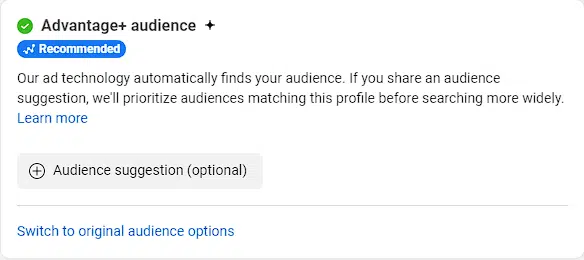
Put simply, you’re letting Meta determine who should see your ads. You can (optional) provide “suggestions” on who to target. But Meta will use AI and performance data to determine who the right audience is.

Advantage Plus Audience

If you would like to provide input, advertisers have two options: 

  • Audience controls.
  • Audience suggestions.

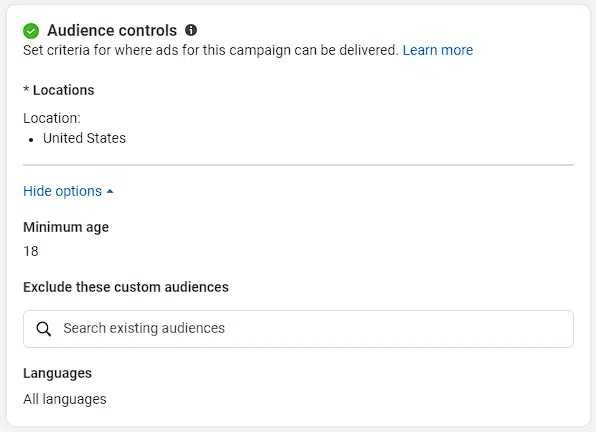
Audience controls set the must-have criteria for your campaigns. Advertisers can select geographic locations, minimum age, custom audiences (lists) to exclude, and language. These are requirements, and Meta will not ignore them.

Advantage Plus Audience Controls

Advantage+ audience suggestions can also be made. By selecting custom audiences, age ranges, genders and even detailed (interests and behaviors) targets, you can help point Meta’s AI in the right direction to get things started.

Anything in the Advantage+ section will be treated as a suggestion but should help with the initial testing.


Get the daily newsletter search marketers rely on.


How are Advantage+ audiences different?

Functionally, Advantage+ audiences are essentially the same as broad or open targeting.

With open targeting, you leave the detailed audience targeting blank (open) and give Meta the option to target anyone within the geo and age range you selected. 

This has been a viable targeting option on Meta for a few years, given the platform’s ability to react quickly based on data. With open targeting, you’re essentially telling Meta that you don’t care who sees your ads as long as you get the result you’re looking for.

Advantage+ targeting is largely the same. Instead of telling them who to target, you’re telling them who not to target, and letting the machine test its way into the ideal audience.

Fewer restrictions = better results. At least, in theory.

Testing Advantage+ audience

We approached one of our clients, a major B2B company, with a proposal to test Advantage+ audiences with the goal of reducing average CPLs. 

The company uses Meta lead generation forms to collect potential handraisers, who are then contacted by an internal sales team.

Meta is one of the company’s highest-volume channels, but quality is an ongoing issue. CPLs are cheaper than just about any other channel, but conversion rates pale in comparison to paid search, which is higher intent.

Our goal was to test Advantage+ audiences in as much of an optimal “real-world” scenario, not as a strict A/B test.

So, we added an Advantage+ audience to an existing campaign that contained an interest-based audience (based on the client’s target customer profile) and a website and engagement retargeting audience. 

Over the next week, we let Meta (through Campaign Budget Optimization) decide how much to spend on what audience, using only the goal of maximum leads as our KPI.

Advantage+ targeting test results

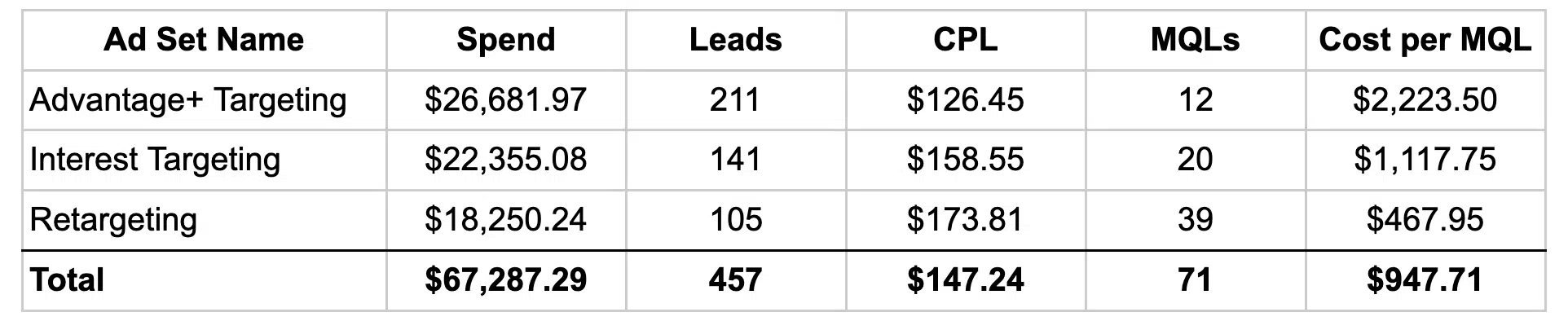
After a week’s worth of data and following the completion of the learning phase, performance patterns started to emerge. Here’s what we observed:

  • Advantage+ targeting spent slightly more than our interest-based audience as a percentage of daily spend.
    • CBO allocated nearly 40% of the budget to Advantage+ vs. 33% to the Interest-based audience.
  • The leads generated from Advantage+ were less expensive compared to both the interest-based prospecting audience and our retargeting audience.
    • Advantage+ leads drove a 20% lower CPL compared to interest targeting.
  • Despite the less-expensive CPLs, Advantage+ leads did not convert to MQLs as efficiently as other audiences.
    • Cost per MQL for leads driven from Advantage+ targeting were nearly 2x higher than interest.
Advantage plus targeting test results

Efficiency at the expense of quality

The poorer post-lead conversion of the Advantage+ audience is sadly consistent with similar tests we’ve run for different clients.

Open targeting has also delivered poorer-performing B2B leads than even slightly targeted (but still large) audiences.

With its lack of business firmographic targeting, B2B lead generation is already a tough enough proposition on Meta.

And while Meta has clearly made big strides in reducing costs, if the lead quality issue isn’t seriously addressed, it will continue to lose ad revenue from B2B advertisers in favor of LinkedIn.

Being successful at driving quality B2B leads on Meta requires you to craft a strategy that exploits the platform’s advantages while protecting yourself from the inevitable poor-quality leads you’ll likely get. 

Resist the temptation to go too narrow

  • Meta’s B2B targeting is pretty lackluster, especially on dimensions like job title and seniority.
  • Continue testing broader audiences and use lead filtering techniques to help weed out unqualified leads.

Filter and qualify within the form

  • Use lead filtering questions within the Meta lead form to automatically disqualify leads that don’t fit your ideal customer profile.
  • It’s counterintuitive, but creating more friction in the conversion process can actually improve quality by weeding out low-effort submitters.
    • Ask more questions. Use manual inputs. Always use “high intent” lead forms.

Use Meta’s Conversions API whenever you can

  • This allows advertisers to stop optimizing towards just the completion of a lead form and instead optimize towards behind-the-scenes quality metrics that really make a difference.

Meta’s new Advantage+ targeting is a useful tool to help less experienced and/or lower intensity advertisers drive get better cost pers. But if lead and conversion quality is a big concern, you’ll need to be deliberate and careful with your testing.

Using Advantage+ targeting will likely get you cheaper upfront leads but with a lower likelihood for them to convert. But that doesn’t mean you shouldn’t test it. Instead, you must develop strategies to remove lower-quality leads before they are submitted.

On Meta, the front line of the quality battle needs to be the form itself, not the targeting. If you’re fighting against what makes Meta great, you’ll lose.


Opinions expressed in this article are those of the guest author and not necessarily Search Engine Land. Staff authors are listed here.


Related stories

New on Search Engine Land

@media screen and (min-width: 800px) { #div-gpt-ad-3191538-7 { display: flex !important; justify-content: center !important; align-items: center !important; min-width:770px; min-height:260px; } } @media screen and (min-width: 1279px) { #div-gpt-ad-3191538-7 { display: flex !important; justify-content: center !important; align-items: center !important; min-width:800px!important; min-height:440px!important; } }

About the author

Sean Johnston

As a digital marketing veteran since 2007, Sean Johnston, a Detroit native has developed and executed paid social media strategies across various verticals, including financial services, automotive and CPG. He is currently VP, Digital Advertising at Closed Loop. His expertise includes lead generation, strategy development, analytics, testing, and campaign optimization across companies like Intercom, Yext and Clover. Bringing a breadth of experience from both the agency and client side, Sean enjoys fostering customer growth and professional development for budding practitioners. When Sean isn’t driving innovation across client accounts or dispelling the myths about Facebook B2B advertising, you can find him working on his latest science fiction novel or playing the drums.

https://searchengineland.com/testing-meta-ai-powered-advantage-targeting-432797


LinkedIn unveils AI-powered tool that can create optimized ads in minutes

LinkedIn has started rolling out a new tool that leverages AI to simplify ad creation.

The new feature, called Accelerate, has been designed to help advertisers execute optimized campaigns in Campaign Manager in under five minutes.

Why we care. LinkedIn’s Accelerate campaigns can help streamline the ad creation process, saving time and resources, while also enhancing ad performance through data-driven insights and optimization. These tools enable advertisers to create more effective and targeted campaigns, ultimately improving the return on investment

Getting started. If Accelerate is available in your market, log into Campaign Manager and then follow these simple steps:

  • Select your campaign objective and decide if you want to use Accelerate or LinkedIn’s classic experience to build your campaign.
  • Provide a URL for the product you’re advertising.
  • LinkedIn will then use AI to analyze the website you shared, your company’s LinkedIn Page and your account’s prior LinkedIn ads to recommend a campaign.
  • Using this customer data, LinkedIn will build creatives and an audience, allowing you to adjust copy, images and refine targeting parameters by adding inclusion and exclusions, like geography.

How it works. Accelerate uses AI models to autonomously adjust bids and shift budget to the best performing placements and creatives. The technology integrates multiple automation features, including Predictive Audiences, to dynamically refine campaign targeting and facilitate effective outreach to high-value consumers within the LinkedIn community of more than 950 million members.

Additional help. Advertisers can click on the “Assist” button to get recommendations to improve campaign performance. You can also ask questions directly to get insights into how to improve your campaign, such as:

  • Why was this budget recommended?
  • What are some best practices for targeting?

In addition, you will be able to connect to a live support agent for further support.

Testing. LinkedIn has confirmed that the Accelerate feature is currently only available in limited markets. The platform is testing the tool in English with a small group of B2B advertising agencies, including Brainlabs, Closed Loop, Lewis, Speedwork and WebFX in the US.


Get the daily newsletter search marketers rely on.


What has LinkedIn said? A LinkedIn spokesperson said in a statement:

  • “For B2B marketers, creating campaigns that reach and influence the right buying committee is no easy task, especially when resources are tight. And creating campaigns can often take hours from developing creatives, to determining targeting, placement and bidding strategies.”
  • “We know that 84% of marketers believe artificial intelligence (AI) will support them with their work, and saving time in the campaign creation process is a great place to start.”
  • “Accelerate, builds on our other AI features, such as automated placement, which is delivering a 47% improvement in cost per conversion, and Predictive Audiences, which is improving cost per lead by 21%.”

Deep dive. Read LinkedIn’s Predictive Audiences guidelines for more information.


Related stories

New on Search Engine Land

@media screen and (min-width: 800px) { #div-gpt-ad-3191538-7 { display: flex !important; justify-content: center !important; align-items: center !important; min-width:770px; min-height:260px; } } @media screen and (min-width: 1279px) { #div-gpt-ad-3191538-7 { display: flex !important; justify-content: center !important; align-items: center !important; min-width:800px!important; min-height:440px!important; } }

About the author

Nicola Agius

Nicola Agius is Paid Media Editor of Search Engine Land after joining in 2023. She covers paid search, paid social, retail media and more. Prior to this, she was SEO Director at Jungle Creations (2020-2023), overseeing the company’s editorial strategy for multiple websites. She has over 15 years of experience in journalism and has previously worked at OK! Magazine (2010-2014), Mail Online (2014-2015), Mirror (2015-2017), Digital Spy (2017-2018) and The Sun (2018-2020). She also previously teamed up with SEO agency Blue Array to co-author Amazon bestselling book ‘Mastering In-House SEO’.

https://searchengineland.com/linkedin-ai-powered-ad-creation-tool-campaign-manager-432849


Meta’s first generative AI-powered tools for advertisers are here

Meta Ads Manager has started rolling out its first generative AI-powered features for advertisers.

The new tools, which have been designed to maximize productivity, personalization and performance, include:

  • Background Generation
  • Image Expansion
  • Text Variation

Global roll out is expected to be completed by next year.

Screenshot 2023 10 03 At 18.04.26 E1696361338244 800x377

Background generation. This new feature creates multiple backgrounds to complement the advertiser’s product images, allowing advertisers to tailor their creative assets for different audiences.

Image expansion. This tool can be used to adjust creative assets to fit different aspect ratios across multiple surfaces, like Feed or Reels, allowing advertisers to spend less time and resources on repurposing creative assets.

Text variation. Advertise can utilize this new feature to generate multiple versions of ad texts based on their original copy, and to highlight the selling points of their products/services. The tool provides multiple text options to help advertisers better reach their specific target audience.

Why we care. The ability to instantaneously create multiple asset variations will reduce time spent going back and forth between creative and media teams on editing tasks, allowing for more investment on strategic work like audience analysis.


Get the daily newsletter search marketers rely on.


What has Meta said? A spokesperson for Meta said in a statement:

  • “Today’s generative-AI powered ad features are just a start. We plan to offer advertisers more ways to generate ad copy to highlight product selling points or generate background images in minutes with tailored themes, like outdoor images for an athleisure brand.”
  • “As we shared at Connect, businesses will soon be able to use AI for business messaging on Messenger and WhastApp to engage with customers – helping with commerce, engagement and support, unlocking instant conversational responses. We’re testing with a small number of businesses in Alpha and plan to scale it further next year.”
  • “With millions of businesses advertising on our platform, we will continue to take a collaborative approach in developing these features and experiences so that they provide value to businesses and people.”

Deep dive. Read Meta’s announcement in full for more information.


Related stories

New on Search Engine Land

@media screen and (min-width: 800px) { #div-gpt-ad-3191538-7 { display: flex !important; justify-content: center !important; align-items: center !important; min-width:770px; min-height:260px; } } @media screen and (min-width: 1279px) { #div-gpt-ad-3191538-7 { display: flex !important; justify-content: center !important; align-items: center !important; min-width:800px!important; min-height:440px!important; } }

About the author

Nicola Agius

Nicola Agius is Paid Media Editor of Search Engine Land after joining in 2023. She covers paid search, paid social, retail media and more. Prior to this, she was SEO Director at Jungle Creations (2020-2023), overseeing the company’s editorial strategy for multiple websites. She has over 15 years of experience in journalism and has previously worked at OK! Magazine (2010-2014), Mail Online (2014-2015), Mirror (2015-2017), Digital Spy (2017-2018) and The Sun (2018-2020). She also previously teamed up with SEO agency Blue Array to co-author Amazon bestselling book ‘Mastering In-House SEO’.

https://searchengineland.com/meta-generative-ai-powered-tools-advertisers-432827


Top 5 ways to stay up to date on paid search trends

Paid search changes quickly. A single announcement from Google Ads or Microsoft Ads can cause drastic changes in the way advertisers promote their products and services.

Changes can be subtle, like moving functions around in the online user interface. Or they can be massive, like deprecating expanded text ads, launching Performance Max, or dumping Universal Analytics for Google Analytics 4.

It’s imperative that PPC practitioners stay up to date on new developments in the industry. Not only do changes impact performance, but they affect marketing strategy and the way we interact with clients or internal marketing departments.

Staying current on new developments in paid search is so crucial that I always ask potential new hires, “What publications or websites do you read to stay up to date on paid search trends?”

If they can’t answer, or say “Uh, none?” then they don’t move on to the next interview stage.

Here are the top five ways to stay updated on paid search trends.

1. Industry news sites

If you’re reading this article, you’re already reading one of the best news sites for paid search news. Search Engine Land prides itself on sharing the news as it breaks. 

The blogs for the major search engines are also important reading for new feature announcements and other important updates. Both the Google Ads blog and the Microsoft Ads blog are excellent sources for new releases and features.

If you are looking for retail-specific news, the Tinuiti blog is a great resource on all things retail ads, especially Amazon.

2. Email newsletters

What better way to get the latest news than to have it delivered to your inbox every morning? 

Several news sites and organizations have daily or weekly newsletters that round up all the important PPC news.

  • Search Engine Land has its own newsletter. It’s how I start each weekday.
  • MarTech, also a Third Door Media publication, has a daily newsletter, focused on marketing technology news that’s often relevant for PPC professionals.
  • The Paid Search Association sends out daily news links. Membership to the PSA is free.
  • WordStream, a digital marketing solution, has a newsletter covering PPC and SEO.  
  • Doing retail PPC? Check out the Retail Brew newsletter covering all things retail. 
  • If you’re looking for general news on a variety of business topics, including the business of advertising and marketing, SmartBrief offers multiple newsletters to which you can subscribe. 
  • Interested in AI? Who in paid search isn’t? TLDR offers an AI newsletter.

Most marketing agencies offer newsletters, too, giving their own take on the latest PPC and digital advertising news. There are too many to list here.


Get the daily newsletter search marketers rely on.


3. Online chats

I’ve found the best way to keep up with fast-changing PPC news is by following online chats.

PPCChat, which started on Twitter (now known as X) in 2011 by Matt Umbro and is now run by Julie Bacchini, is one of the most active online chats on paid search.

Follow the #ppcchat hashtag on X to read up-to-the-minute news from PPC professionals.

PPCChat also hosts a weekly chat on a topic every Tuesday at noon Eastern time. The chats have recently moved to Slack due to challenges with X. Anyone can join the lively discussion.

The Paid Search Association also has a Slack channel where PPC news is shared. It’s free to all members of the PSA.

Other X hashtags to follow:

  • #marketingtwitter, covering general marketing topics.
  • #dtctwitter, focused on direct-to-consumer marketing.

4. Follow thought leaders online

Social media channels are full of PPC thought leaders who share news regularly. Let’s start with the major PPC engines.

Google’s Ginny Marvin shares Google Ads updates almost daily on X and LinkedIn.

If you’re running LinkedIn ads, you should also follow AJ Wilcox, the founder of B2LinkedIn, on X or LinkedIn. He shares incredibly helpful tips on how to be successful on LinkedIn Ads. 

Barry Schwartz is one of the OG search news reporters. He covers both PPC and SEO here on Search Engine Land and his own site, Search Engine Roundtable. If there is news out there, Schwartz will report on it via X, LinkedIn, Threads, BlueSky, and probably a bunch more that I didn’t know about.

One of my favorite ways to find PPC thought leaders to follow is to follow conference speakers whose talks I’ve enjoyed. Most speakers will include their social handles in their presentations; if not, search for them.

Some great conference speakers to follow are:

This is by no means a comprehensive list – go find your favorite speakers and give them a follow.

As to where to find influencers, both X and LinkedIn are great places to start. X tends to have more breaking news, while LinkedIn is full of great long-form content, including interpretations of breaking news. Check out both social channels to find great influencers.

5. Marketing podcasts

I love to listen to podcasts while I’m walking or exercising. It’s a great way to absorb news without having to work hard at it.

My all-time favorite PPC news podcast is Marketing O’Clock, hosted by Greg Finn, Christine Zirnheld, Jess Budde, and Nicole Waddington. It’s a weekly podcast covering paid, organic, and social marketing news. The team shares insight into the latest industry news.

The Paid Search Podcast is another source of PPC news. While their schedule isn’t as regular as Marketing O’Clock, it’s still a worthy listen.

Anu Adegbola does a wrap of the weekly PPCChat on the PPCChat Roundup podcast. 

Wilcox hosts a LinkedIn Ads podcast called The LinkedIn Ads Show, where he brings energy and excitement to the topic of LinkedIn Ads.

Bonus: Conferences

Paid search and search industry conferences happen nearly year-round. While they don’t happen frequently enough to be the only source of PPC news, they’re still a great place to hear about the latest updates in depth.

  • The SMX conference series, hosted by Third Door Media, is one of my favorites. (Disclosure: I’m on the SMX programming committee.)
  • Pubcon hosts events across the U.S. with a PPC track and great speakers.
  • Brighton SEO is probably the best-known search conference in the UK. In November, they’re bringing the show to San Diego for the first time. There are always great PPC sessions at this conference.
  • PPC Live UK, founded by Anu Adegbola, hosts regular networking events for PPC pros in London. 

The Paid Search Association also puts on conferences and webinars on newsworthy topics.

Hopefully, you’ve found some new places to get the latest PPC news. Time to start reading, listening and engaging! 


Opinions expressed in this article are those of the guest author and not necessarily Search Engine Land. Staff authors are listed here.


Related stories

New on Search Engine Land

@media screen and (min-width: 800px) { #div-gpt-ad-3191538-7 { display: flex !important; justify-content: center !important; align-items: center !important; min-width:770px; min-height:260px; } } @media screen and (min-width: 1279px) { #div-gpt-ad-3191538-7 { display: flex !important; justify-content: center !important; align-items: center !important; min-width:800px!important; min-height:440px!important; } }

About the author

Melissa Mackey

Melissa Mackey is Director of Paid Search at Compound Growth Marketing. A veteran PPC marketer, she helps clients achieve maximum ROI from paid search. Mackey contributes regularly to several industry publications, writing on PPC strategy. Mackey has spoken at industry conferences such as SMX Advanced, SMX Create and HeroConf.

https://searchengineland.com/paid-search-trends-stay-up-to-date-432771


6 Microsoft Audience Ads product updates

Microsoft Audience Ads has kicked off the fall with a series of new product updates.

The tech giant said the purpose of these updates is to help advertisers achieve more results with less effort by helping them to create more engaging ads that are served to a higher-value audience.

Here’s a breakdown of the latest developments in Microsoft Audience Ads:

1. New markets

Microsoft Audience Ads has been rolled out to 58 new markets, meaning it is now available in 187 markets in total across the globe.

2. Casual games expansion

Microsoft is rolling out Audience Ads to new placements, such as home, menu, and game screens across games that come defaulted onto Windows computers. Currently, Audience Ads are served in Treasure Hunt and Jigsaw but the tech giant has confirmed it is expanding reach to all Casual Games by 2024.

3. Microsoft 365 expansion

This month, Microsoft is planning to roll out Audience Ads to new markets of the free consumer version of the Microsoft 365 mobile app in the US. The tech giant will then expand further to EU markets on Android in January.

4. Predictive targeting

Microsoft Audience Ads recently launched predictive targeting, enabling advertisers to leverage the platform’s AI to identify relevant high-value audiences that they may previously not have considered targeting.

5. Video and CTV ads

Video and CTV Ads were recently launched to help advertisers reach large-scale and high-value audiences across Microsoft and publisher partner platforms in online video and CTV placements.

6. New AI bid strategies

Microsoft has launched two new automated bid strategies to help “advertisers reach their target audience with minimal effort” – Maximize conversion and Target CPA. The two new offerings are currently in pilot with a general roll out planned for later this month.

Why we care. The latest Microsoft Audience Ads updates were designed to help advertisers create more engaging campaigns that reach their target audience. Engaging ads capture attention, foster brand connection, and drive customer interest while reaching the target audience ensures that the message resonates with the right demographic, increasing the likelihood of conversion and maximizing the return on investment.

New travel lodging UI enhancements. The Microsoft Advertising platform is expanding its terminology for Lodging Solutions beyond just “hotels” to embrace all types of accommodation. With this in mind, Hotel Campaigns have been renamed to Lodging Campaigns, and all the “hotel” nomenclature has been updated to “property” nomenclature.

Vertical ads. Microsoft is also expanding vertical ads across the search partner network to enable advertisers to broaden the impact of their campaigns, including the introduction of Credit Card and Property Promotion ads, alongside existing offerings like Automotive & Tours and Activities ads.


Get the daily newsletter search marketers rely on.


What has Microsoft said? Product marketing manager, Kevin Salat, said in a statement:

  • “With Microsoft Audience Ads, you can target your ideal audience based on Microsoft’s understanding of their interests and consumer intent signals. These high quality, cross-device ads show on sites like MSN, Microsoft Edge (the Microsoft browser), Outlook.com, and publisher placements.”
  • “Leveraging rich consumer intent signals, which include searches, web activity, profile data, and more, brands can serve highly relevant messages to an audience who’s ready to convert and reach them in beautiful placements across the web.”

Don’t forget. Microsoft Advertising’s Performance Max is still in open beta and available to start testing for your campaigns.

Deep dive. Read Microsoft’s announcement in full for more information.


Related stories

New on Search Engine Land

@media screen and (min-width: 800px) { #div-gpt-ad-3191538-7 { display: flex !important; justify-content: center !important; align-items: center !important; min-width:770px; min-height:260px; } } @media screen and (min-width: 1279px) { #div-gpt-ad-3191538-7 { display: flex !important; justify-content: center !important; align-items: center !important; min-width:800px!important; min-height:440px!important; } }

About the author

Nicola Agius

Nicola Agius is Paid Media Editor of Search Engine Land after joining in 2023. She covers paid search, paid social, retail media and more. Prior to this, she was SEO Director at Jungle Creations (2020-2023), overseeing the company’s editorial strategy for multiple websites. She has over 15 years of experience in journalism and has previously worked at OK! Magazine (2010-2014), Mail Online (2014-2015), Mirror (2015-2017), Digital Spy (2017-2018) and The Sun (2018-2020). She also previously teamed up with SEO agency Blue Array to co-author Amazon bestselling book ‘Mastering In-House SEO’.

https://searchengineland.com/microsoft-audience-ads-product-updates-432791


Offline conversion tracking to boost lead gen strategies

Ever get the feeling you’re reporting on – or your agency or marketing team is reporting on – the wrong metrics?

Put another way, how high is your frustration level that your marketing team is bringing in hundreds of leads without any noticeable effect on your pipeline?

Smart marketers are using offline conversion tracking to solve the issues I just laid out. If you missed my SMX Advanced session, keep reading to learn:

  • What offline conversion tracking is.
  • Why it matters for lead gen campaigns.
  • When and how to use it. 
  • Success stories for implementation. 

This article will give you some to-dos that have helped many of my PPC clients get more revenue from their marketing spend.

What is offline conversion tracking?

Offline conversion tracking, or OCT, is a discipline that incorporates offline data to help marketers measure how their ads contribute to real business outcomes, not just marketing metrics (e.g., closed revenue, not just vanity leads). 

The data includes actions that users take somewhere other than your website, such as:

  • In-store purchases.
  • Visits to car dealerships that end in sales.
  • Visits to a local college to register for a course promoted online. 

In B2B, this often takes the form of lead nurturing and qualification – a lead may register immediately as an MQL upon filling out a form (which all marketers should be able to track).

But from there, progression through your CRM from MQL to SQL to opportunity to closed-won all happens outside of your website property.

Dig deeper: 5 best practices for tracking offline conversions in Google Ads

Why is OCT important in lead gen campaigns?

We don’t have as many controls at our disposal today as everything’s moving hard toward AI and machine learning. 

Without OCT, your advertising campaigns simply let increasingly powerful algorithms (Google, Facebook, and LinkedIn) find audiences likely to take a conversion action.

As most of us have seen, the combination of automation and basic form fills typically equals a lot of low-quality leads. 

With OCT data fed back into those algorithms, you can teach the platforms to find the right leads – those most likely to move along the customer journey and become customers or clients. 

One note here: incorporating OCT means there’s a good possibility that you’ll:

  • End up paying more per lead. 
  • Have to do the extra math of calculating cost per SQL or cost per opp to show the value of OCT. 

Still, it won’t take long to see the efficiency in action.


Get the daily newsletter search marketers rely on.


When should you incorporate OCT?

Essentially, everyone should be testing offline conversion tracking. 

That said, the best use cases for implementation are if you’re seeing lead quality issues or if your account is experiencing performance plateaus, meaning performance is consistent but the account growth is stagnant. 

There are a few considerations to keep in mind, including:

Data density

  • Consider how many actions are taken within a 30-day time period when deciding how to optimize. 
  • If the number is too low, you might need to get creative or move back up the funnel a step (e.g., optimize for opportunities instead of closed-won or SQLs instead of opportunities). 
  • The best metric is always the one closest to the revenue (e.g., closed/won), but you’ll need to balance quality with enough volume to truly train the algorithms.

Data delays

  • Some offline actions (including closed/won deals if the sales cycle is too long) may fall out of the usability window. 
  • Google, Facebook, and LinkedIn all have a 90-day window to get data back to the platforms (Google’s window starts at the time of the click. Facebook and LinkedIn start at the time of the impression). 

Current performance

  • If your account’s current performance is strong, you’ll want to take a conservative approach to testing (test one campaign to start).
  • Remember that some metrics can look worse in the early stages.

How do you get started with incorporation?

In general, there are two ways that ad platforms connect your data back to their platforms. Google uses click ID (every click from your ad gets a unique click ID), and you’ll need to ensure that the click ID is associated with the lead info passed through your website. 

Some CRMs, notably HubSpot, absorb this information automatically, but if you’re working with one that doesn’t, you’ll want to use hidden form fields to ensure the information is being passed to your CRM.

Facebook and LinkedIn, meanwhile, rely on customer data to tie conversions back to ad spend. Information like name, email, and company is uploaded and then hashed by the platforms. 

Though the data connections differ, all the platforms have multiple options for OCT setup. Google and Facebook have robust partner connection options, including Zapier, and both offer automated upload options. 

Of the two, Google makes it simpler as you only need to set up a Google Sheets connection. Facebook runs this setup through its conversions API, which requires developer resources.

LinkedIn is newer to the OCT game. They rolled out the functionality in 2022, and I anticipate their partner list will continue to grow.

Each platform offers manual upload through CSV files, but that introduces more time and the possibility of user omission or error – this is something you’ll want to use in your platforms over the long haul, so invest in automation early.

Dig deeper: How to set up an offline conversion import from Salesforce into Google Ads

OCT success stories

By simply incorporating OCT into client accounts, we’ve seen results in a range of accounts:

  • 1% lift in pipeline with a 43% decrease in spend.
  • 55% decrease in cost per subscriber (as opposed to users signing up for free trials) with 185% increase in subscriber volume.
  • Improved conversion rates throughout the funnel, notably improving the “sign up to install” rate from 14% to 35%.

The common thread here is that each client is spending more effectively to engage the right users. 

In many cases, the first step is to realize that much of the marketing budget can be reduced in some areas with minimal growth impact – and reallocated to more impactful placements.

Maximize lead quality and ROI with offline conversion tracking

In this day and age of digital marketing, advertisers have fewer controls than ever to leverage in their campaigns. When done right, OCT is a powerful tool that can teach the algorithms to work more effectively toward your real business goals. 

As you incorporate OCT to improve your down-funnel metrics, ensure you’re also reflecting your work in a reporting narrative of how your marketing campaigns directly contribute to business growth and performance. 

In very little time, you’ll be able to spot more areas where an added layer of data can make the difference between vanity metrics and business success.

Watch: Offline conversion tracking to boost lead gen strategies

Below is the complete video of my SMX Advanced presentation.

[embedded content][embedded content]

Opinions expressed in this article are those of the guest author and not necessarily Search Engine Land. Staff authors are listed here.


Related stories

New on Search Engine Land

@media screen and (min-width: 800px) { #div-gpt-ad-3191538-7 { display: flex !important; justify-content: center !important; align-items: center !important; min-width:770px; min-height:260px; } } @media screen and (min-width: 1279px) { #div-gpt-ad-3191538-7 { display: flex !important; justify-content: center !important; align-items: center !important; min-width:800px!important; min-height:440px!important; } }

About the author

Laura Schiele

Laura Schiele, Head of Paid Acquisition at Jordan Digital Marketing, has nearly a decade of experience in paid media strategy and execution in both agency and in-house accounts and uses advanced analytics skills to scale growth within efficiency goals across Google, LinkedIn, Facebook, and more. Laura manages a large team of paid media experts remotely from her home in Burlington, VT.

https://searchengineland.com/offline-conversion-tracking-boost-lead-gen-strategies-432706


Webinar: Advanced Google Performance Max strategies by Cynthia Ramsaran


Related stories

New on Search Engine Land

@media screen and (min-width: 800px) { #div-gpt-ad-3191538-7 { display: flex !important; justify-content: center !important; align-items: center !important; min-width:770px; min-height:260px; } } @media screen and (min-width: 1279px) { #div-gpt-ad-3191538-7 { display: flex !important; justify-content: center !important; align-items: center !important; min-width:800px!important; min-height:440px!important; } }

About the author

Cynthia Ramsaran

Cynthia Ramsaran is director of custom content at Third Door Media, publishers of Search Engine Land and MarTech. A multi-channel storyteller with over two decades of editorial/content marketing experience, Cynthia’s expertise spans the marketing, technology, finance, manufacturing and gaming industries. She was a writer/producer for CNBC.com and produced thought leadership for KPMG. Cynthia hails from Queens, NY and earned her Bachelor’s and MBA from St. John’s University.

https://searchengineland.com/webinar-advanced-google-performance-max-strategies-432747


TikTok set to trial ad-free subscription for $4.99

TikTok may soon pilot an ad-free subscription service on its app.

Code within the social platform suggests that subscribers may soon be able to access content with no interruptions from adverts for $4.99 a month.

Screenshots of TikTok asking users if they’d like to upgrade to an ad-free experience were shared by Android Authority.

Why we care. If sign-ups for TikTok’s ad-free subscription tier prove to be popular, then this could have a significant impact on reach for the platform’s advertisers, which will ultimately lower the product’s value.

What ads will be excluded? Influencer marketing one-offs or campaigns will still appear on the paid-for version of the app – it’s only ads that are served by TikTok that will be excluded. This means the change is unlikely to help combat the issue of TikTok influencers not disclosing brand partnerships.


Get the daily newsletter search marketers rely on.


Why now? TikTok generates most of its profits from ad revenue – which came to $9.4 billion in 2022. That number is expected to quadruple by 2026. However, in a bid to mitigate financial risk, the platform’s executives are exploring the diversification of revenue streams, with the potential introduction of paid subscriptions not coming as a surprise.

Deep dive. Check out TikTok’s newsroom for more information on the platform’s latest developments.


Related stories

New on Search Engine Land

@media screen and (min-width: 800px) { #div-gpt-ad-3191538-7 { display: flex !important; justify-content: center !important; align-items: center !important; min-width:770px; min-height:260px; } } @media screen and (min-width: 1279px) { #div-gpt-ad-3191538-7 { display: flex !important; justify-content: center !important; align-items: center !important; min-width:800px!important; min-height:440px!important; } }

About the author

Nicola Agius

Nicola Agius is Paid Media Editor of Search Engine Land after joining in 2023. She covers paid search, paid social, retail media and more. Prior to this, she was SEO Director at Jungle Creations (2020-2023), overseeing the company’s editorial strategy for multiple websites. She has over 15 years of experience in journalism and has previously worked at OK! Magazine (2010-2014), Mail Online (2014-2015), Mirror (2015-2017), Digital Spy (2017-2018) and The Sun (2018-2020). She also previously teamed up with SEO agency Blue Array to co-author Amazon bestselling book ‘Mastering In-House SEO’.

https://searchengineland.com/tiktok-trial-ad-free-subscription-432735


Microsoft CEO: AI will make Google more dominant

“Bogus.” That’s what Microsoft CEO Satya Nadella thinks about Google’s argument that there is actual choice in the search engine market. And artificial intelligence will provide zero advantage or hope for any companies that hope to enter web search – the “biggest no-fly zone of all,” Nadella said.

Why we care. The ongoing U.S. vs. Google antitrust trial has already unearthed troubling behavior from Google, including raising ad prices to meet revenue targets. If Google is found to have abused its monopoly position in search, it could potentially reshape the company and the search landscape.

Exclusive rights. To further enhance its dominance in AI Search, Google plans to pay publishers for “exclusive” content rights, Nadella testified. If only Google could access this data, it would essentially make every other search engine irrelevant, Nadella said.

  • “When I am meeting with publishers now, they say Google’s going to write this check and it’s exclusive and you have to match it,” Nadella said.
  • “What is publicly available today, will it be publicly available tomorrow? That’s the issue.”
  • “Is this going to be even more of a nightmare to make progress in search?” Nadella added.

Search engines have been “the organizing layer of the internet” Nadella said. But publishers are concerned over the rise of large language models (LLMs) – many popular websites have blocked GPTBot – and using their content/data for training and profit, without compensation.

Google has not commented on this accusation about exclusive deals.

Google’s Search Ads 360 dispute. One of the key issues of interest to paid search marketers is Google Search Ads 360. The platform has not kept up with new Microsoft ad features and types and Nadella said Microsoft wanted to make it easy for advertisers to transfer ad campaigns from Google to Microsoft with the click of a button. That didn’t happen.

  • “We keep asking for them to add some features we want. They’ve asked us to go pound sand,” Nadella said.

A vicious cycle. With nearly 90% market share, Google is able to improve its search results and bottom line, Nadella said, and has nothing to do with product quality.

  • “The distribution advantage Google has today doesn’t go away. In fact, if anything, I worry a lot that – even in spite of my enthusiasm that there is a new angle with AI – this vicious cycle that I’m trapped in could become even more vicious because the defaults get reinforced.”

All hope is gone? The launch of the new Bing and Bing Chat, powered by OpenAI’s technology that powers ChatGPT, came with a lot of hype and excitement, especially from Nadella, who said he may have been over-enthusiastic.

  • “Yeah, I mean, look, that’s called exuberance of someone who has like 3% share, that maybe I’ll have 3.5% share,” Nadella said.

So far, Bing Chat has failed to take market share away from Google. Yusuf Mehdi, Microsoft’s corporate VP and consumer CMO, claimed the opposite, but to date has not shared any of the company’s data showing this. In fact, Microsoft Bing’s market share is lower than it was a year ago, as we reported in August.

No breaking the Google habit. Default search agreements, such as the one Google has with Apple, have cemented Google’s dominance, Nadella said.

  • “You get up in the morning, you brush your teeth, and you search on Google. With that level of habit forming, the only way to change is by changing defaults,” Nadella said.
  • “Defaults are the only thing that matter in terms of changing user behavior.”
  • “It would be a game changer (for Bing) to be a default on Safari,” Nadella added.

But. On laptop devices where Microsoft’s operating systems are used, and Bing is the default search engine, Bing’s market share is still below 20%, Nadella admitted. That means a lot of people have figured out how to switch their default search engine.

$100 billion. That’s how much Microsoft has invested in Bing, according to Nadella. Why?

  • “I see search or internet search as the largest software category out there. We are a very, very low share player. But we continue to persist in it because we think of it as a software category we can contribute to.”

Leading with pessimism. It surprised me to see such bleak quotes today from Nadella, who has typically been an optimistic leader with all things Bing. He never argued that Microsoft Bing Search is better than Google Search. It seemed more like a concession that Microsoft Bing Search could never be better because of Google’s monopoly position.

Is this Nadella simply telling it as he sees it? That he knows Microsoft Bing will never be a true contender (which is true).

It’s likely he views this antitrust trial as a last-ditch moment to stop Google – a monopolistic rival that could do real damage to consumers, competitors and the entire ecosystem that relies on Google advertising and traffic. The $244 billion question is whether Google will be forced to change how it operates.


Related stories

New on Search Engine Land

@media screen and (min-width: 800px) { #div-gpt-ad-3191538-7 { display: flex !important; justify-content: center !important; align-items: center !important; min-width:770px; min-height:260px; } } @media screen and (min-width: 1279px) { #div-gpt-ad-3191538-7 { display: flex !important; justify-content: center !important; align-items: center !important; min-width:800px!important; min-height:440px!important; } }

About the author

Danny Goodwin

Danny Goodwin has been Managing Editor of Search Engine Land & Search Marketing Expo – SMX since 2022. He joined Search Engine Land in 2022 as Senior Editor. In addition to reporting on the latest search marketing news, he manages Search Engine Land’s SME (Subject Matter Expert) program. He also helps program U.S. SMX events. Goodwin has been editing and writing about the latest developments and trends in search and digital marketing since 2007. He previously was Executive Editor of Search Engine Journal (from 2017 to 2022), managing editor of Momentology (from 2014-2016) and editor of Search Engine Watch (from 2007 to 2014). He has spoken at many major search conferences and virtual events, and has been sourced for his expertise by a wide range of publications and podcasts.

https://searchengineland.com/microsoft-ceo-ai-will-make-google-more-dominant-432733