Why it’s time to reevaluate your match type and bidding strategy

Advertisers have been encouraged to reevaluate their match type and bidding strategies to effectively optimize costs and maximize campaign performance.

The advice was published in a new report conducted by Optmyzr that investigated broad match type vs exact match type.

Although researcher and Optmyzr evangelist Navah Hopkins previously strongly supported broad match in favor of exact match type, the study found that exact match outperformed broad match for the majority of accounts in terms of:

  • Cost Per Click.
  • Click Through Rate.
  • Cost Per Acquisition.
  • Return On Ad Spend.
  • Conversion rate.

The report also found that the majority of accounts performed better with Maximize Conversion Value than Maximize Conversions, and the median percentage gains were better as well.

Why we care. For advertisers, it’s crucial to test new strategies in your campaigns before making decisions. This ensures enhanced performance. Evaluate costs and adjust your approach based on budget and targeting goals, exploring more cost-effective networks or top-of-funnel options to optimize spending.

The study. The Optmyzr report analyzed 2637 accounts to compare the effectiveness of broad match type versus exact match type. Additionally, we examined Maximize Conversions against Maximize Conversion Value in 1,334 accounts due to their close association with smart bidding.

The results. Key findings from the study reveal:

  • Broad vs. Exact Match:
    • In most cases, exact match performed better in terms of CPC, CTR, CPA, ROAS, and conversion rate.
    • Conversion-oriented metrics like CPA and ROAS also favored exact match.
    • If broad match is doing well, it’s advisable not to make major changes. However, testing for potential benefits is worth exploring.
  • Maximize Conversions vs. Maximize Conversion Value:
    • Maximize Conversion Value performed better in terms of CPC, CTR, CPA, and ROAS for most accounts.
    • Max Conversion Value had cheaper CPC, possibly due to bid caps and practical ROAS goals.
    • CPA was generally better with Max Conversion Value, challenging the belief that higher CPA can lead to higher-value customers.
    • The data also recommends using Max Conversion Value and determining conversion value based on customer value and channel conversion rates.

Key takeaways. The study concluded by advising advertisers to:

  • Test your assumptions and don’t just accept common wisdom without questioning it.
  • Make sure you’re always checking in on your accounts and tweaking your bidding strategies to get the most bang for your buck.
  • Ensure you’ve got your safety nets in place and budget set aside for data acquisition, if you’re going to give broad testing a shot.

Get the daily newsletter search marketers rely on.


What has Optmyzr said? Navah Hopkins, Optmyzr Evangelist, said in a statement:

  • “The biggest takeaway from looking at the data is not taking anything for granted. Just because we’re told X is true, it’s important to test and prove whether it’s viable in our accounts before committing to it or discarding it.”
  • “Additionally, given that the conventional wisdom of Exact and Max Conversion Values are more expensive because they provide more value that didn’t play out at scale, it’s worth doing a deep dive into your accounts if they are driving up your costs.”
  • “Consider being more aggressive with negatives and exclusions, as well as owning whether you have the budget to go after desired transactional traffic or if you’d be better served leveraging your budgets on cheaper networks (Microsoft) or top of the funnel (PMax, social, video).”

Deep dive. Read the Optmyzr report in full for more information.


Related stories

New on Search Engine Land

@media screen and (min-width: 800px) { #div-gpt-ad-3191538-7 { display: flex !important; justify-content: center !important; align-items: center !important; min-width:770px; min-height:260px; } } @media screen and (min-width: 1279px) { #div-gpt-ad-3191538-7 { display: flex !important; justify-content: center !important; align-items: center !important; min-width:800px!important; min-height:440px!important; } }

About the author

Nicola Agius

Nicola Agius is Paid Media Editor of Search Engine Land after joining in 2023. She covers paid search, paid social, retail media and more. Prior to this, she was SEO Director at Jungle Creations (2020-2023), overseeing the company’s editorial strategy for multiple websites. She has over 15 years of experience in journalism and has previously worked at OK! Magazine (2010-2014), Mail Online (2014-2015), Mirror (2015-2017), Digital Spy (2017-2018) and The Sun (2018-2020). She also previously teamed up with SEO agency Blue Array to co-author Amazon bestselling book ‘Mastering In-House SEO’.

https://searchengineland.com/optmyzr-reevaluate-match-type-bidding-strategy-432601



What to do when performance tanks in PPC

In any PPC campaign, the ultimate goal is to improve and deliver better results year after year. Ideally, trendlines in your performance charts are going up and to the right.

Yet, despite the best of intentions, an account can hit the skids. Results tank and you might not be exactly sure why. 

I’ve seen this happen too many times:

  • From falling victim to a hacking incident and having a $100,000 budget blown up even before the workday started.
  • To Google shutting down an account due to a sudden spike in holiday spending, resulting in a $150,000 loss in sales.

In this article, you’ll learn some steps to address PPC mistakes, missteps and errors that have helped my team get things back on track. 

What to do when your PPC campaigns perform poorly

When your account starts performing poorly, you need to take swift action. There are two main factors at play here: internal and external.

Internal issues are essentially problems we create ourselves – mistakes that could have been avoided with different choices or actions.

On the other hand, external issues are events or changes beyond our control, like the emergence of new competitors, economic conditions or search engine updates.

When things go south unexpectedly, our first step is to investigate internal factors because these are within our control and can often be fixed.

Dig deeper: PPC management checklist: Daily, weekly and monthly reviews

Internal PPC checkpoints

Change history report in Google Ads or Bing Ads

This tool is invaluable in these situations. The change history report contains the footprints and fingerprints you need to solve the crime of poor performance. 

This is the place to start understanding if someone tripped a wire that can quickly be fixed. 

Some questions to look for and ask yourself:

  • Was a daily budget set to be a lifetime budget, causing an overspend? 
  • Was a broad match keyword that should have been an exact match uploaded to the system? Now there is unwanted traffic to the site? 
  • Was a landing page uploaded incorrectly?
  • Has anyone new been added to the account?
  • Were any bid strategy changes made or CPA targets changed that would alter performance?

Development changes

Different teams may not have a clear understanding of each other’s actions. For instance, your development team might implement changes without fully grasping the overall impact.

To address this, it’s crucial to establish an early checkpoint with other teams and thoroughly review their release notes. This ensures everyone is on the same page and understands the changes being made.

Some of the things to look for and ask about:

  • Were any tags or conversion events removed from the site? Probably the number one most common self-inflicted wound. 
  • Were any CAPTCHA changes made on the site? This is a good example of something well-intentioned, but can create issues for conversion rates, even if the quality of leads increases. 
  • Were any new experience elements added? Think about chatbots popping up, call-to-action banners, or anything else that might be altering the consumer experience

Dig deeper: 3 ways to stay on top of PPC performance

External checkpoints

Competitors

Did a new competitor come out of the blue and start spending aggressively? 

You can use the auction insights report in Google Ads to monitor this.

You should be doing some regular competitive monitoring, but that doesn’t mean that sometimes other brands just do something that is out of the normal, and it impacts your results. 

Seasonality or promotions

This seems obvious, but sometimes the simplest reason is the answer. 

  • Looking back before things broke, were there any promotions with your brand or around you?
  • Has your business had any seasonality that you might not have accounted for? 

Many of these things are pretty knowable (Prime Day, Labor Day, Back-to-School), but too often, we don’t appreciate these events’ influence on our business. 

Analyzing historical data can help you identify such trends. For instance, we had a business heavily tied to the holiday season, where we significantly increased ad spend for a specific day. It was intentional, but we failed to notify Google Ads about this expected surge. 

This lack of communication led the platform to suspect fraud, shutting our account and causing substantial losses.

This situation is similar to calling your credit card company when traveling abroad. 

While it may seem unnecessary, it’s a precaution that can prevent potential issues. In our case, it could have saved us from the account shutdown and the associated revenue loss.

External events

Have unexpected events like wars, natural disasters, or interest rate hikes affected your account? You might think these events are irrelevant to you, but they can substantially impact PPC performance.

For example, we experienced a 40% decrease in CPCs for one client, which was closely linked to inflation and CPI numbers. While this worked in our favor, it caught us off guard, and explaining it using other data points was challenging.

In another case, one client saw a 15% drop in conversion rates year over year due to factors related to the war in Ukraine. Although it’s not a positive development for the business, it underscores how geopolitical events can profoundly influence the economy and consumer behavior.

Dig deeper: How to keep up with macro trends that impact PPC performance


Get the daily newsletter search marketers rely on.


Tips for tackling PPC performance issues proactively

To prevent problems and make it easier to spot issues, consider these three tips:

Report annotations for key changes

Create a process to add annotations to your reports when significant changes are made to your website. 

Often, issues may not be immediately apparent and could take days or weeks to surface. 

Annotations serve as breadcrumbs to help you trace your steps and identify the cause of problems over time.

Quality assurance (QA) process

Implement a QA process, which can involve using a buddy system to review changes before they go live. 

While it may not always be necessary, the principle of “measure twice, cut once” applies here. Taking extra care to review changes can prevent errors from occurring.

Strong password security and avoiding shared accounts

Ensure strong password practices and avoid shared accounts. Shared accounts can make it challenging to pinpoint who made specific changes. 

Strong password security, including two-factor authentication, is crucial to prevent unauthorized access to your account. 

Bouncing back from PPC setbacks

While nobody wants their account to experience a decline, it’s a situation most PPC marketers will have encountered at some point. 

This article provides a roadmap to swiftly identify issues and steer your campaign toward profitability and growth.


Opinions expressed in this article are those of the guest author and not necessarily Search Engine Land. Staff authors are listed here.


Related stories

New on Search Engine Land

@media screen and (min-width: 800px) { #div-gpt-ad-3191538-7 { display: flex !important; justify-content: center !important; align-items: center !important; min-width:770px; min-height:260px; } } @media screen and (min-width: 1279px) { #div-gpt-ad-3191538-7 { display: flex !important; justify-content: center !important; align-items: center !important; min-width:800px!important; min-height:440px!important; } }

About the author

Jason Tabeling

Jason Tabeling is the CEO of Airtank and is an accomplished marketing executive and proven leader with over 20 years of experience growing strong and profitable teams, working for and with Fortune 500 companies in a variety of industries.
Prior to AirTank, Jason served as Executive Vice President of Product for BrandMuscle, an enterprise software and services company focused on Fortune 1,000 brands, where he led product innovation and strategy. He earned the company a Leadership Ranking in the Forrester 2020 Through-Channel Marketing Automation Wave. He also spent 16 years working with Rosetta, Razorfish and Progressive Insurance, leading Paid, Earned and Owned media teams across health care, financial services and retail verticals. He was named a “40 under 40” by Direct Marketing News, has been a judge for the AMA Reggie Awards, and has been published in Forbes and many other publications as a subject matter expert.

https://searchengineland.com/what-to-do-when-performance-tanks-in-ppc-432558


Reminder – Google Optimize sunsets this weekend

Google Optimize will not be available after Sept. 30.

This means you will no longer be able to create or edit experiments, personalizations, or view experiment reports after this date.

However, you will still be able to run A/B tests in Google Analytics 4.

Why we care. Moving forward, you will need to use GA4 to conduct A/B testing and optimize your website or app’s user experience. This may prove problematic for some marketers as many are still grappling with the navigation of the new analytics platform following the sunset of Universal Analytics.

Why is Google Optimize sunsetting? Google explained that although Optimize is a longstanding product, the platform does not have features and services that customers need for experimentation testing. The search engine therefore decided to invest in solutions that will be more effective for customers instead.

Access your data. You can still access your data. Be sure to download it from the Optimize user interface before September 30.

Testing in GA4. Google has been working on integrations with the following A/B testing providers:

  • AB Tasty
  • Optimizely
  • VWO

The search engine is making its APIs publicly available so that anyone can integrate their A/B testing tool with GA4 in the coming months.


Get the daily newsletter search marketers rely on.


What has Google said? A Google spokesperson said in a statement:

  • “We launched Google Optimize over 5 years ago to enable businesses of all sizes to easily test and improve your user experiences.”
  • “We remain committed to enabling businesses of all sizes to improve your user experiences and are investing in third-party A/B testing integrations for Google Analytics 4.”
  • “Your experiments and personalizations can continue to run until Sept. 30 Any experiments and personalizations still active on that date will end”

Dig deeper. Read Google’s announcement in full for more information.


Related stories

New on Search Engine Land

@media screen and (min-width: 800px) { #div-gpt-ad-3191538-7 { display: flex !important; justify-content: center !important; align-items: center !important; min-width:770px; min-height:260px; } } @media screen and (min-width: 1279px) { #div-gpt-ad-3191538-7 { display: flex !important; justify-content: center !important; align-items: center !important; min-width:800px!important; min-height:440px!important; } }

About the author

Nicola Agius

Nicola Agius is Paid Media Editor of Search Engine Land after joining in 2023. She covers paid search, paid social, retail media and more. Prior to this, she was SEO Director at Jungle Creations (2020-2023), overseeing the company’s editorial strategy for multiple websites. She has over 15 years of experience in journalism and has previously worked at OK! Magazine (2010-2014), Mail Online (2014-2015), Mirror (2015-2017), Digital Spy (2017-2018) and The Sun (2018-2020). She also previously teamed up with SEO agency Blue Array to co-author Amazon bestselling book ‘Mastering In-House SEO’.

https://searchengineland.com/reminder-google-optimize-sunsets-432537


YouTube relaxes controversial topic guidelines to boost ad revenue opportunities

YouTube is updating its Advertiser-Friendly Content guidelines regarding controversial issues.

Under the new best practice recommendations, creators will be able to earn ad revenue on content discussing topics such as:

  • Sexual and domestic abuse.
  • Abortions.
  • Eating disorders.

This means content that addresses these topics without going into graphic detail can now be fully monetized.

Why we care. YouTube is expanding advertising avenues, providing advertisers with more opportunities to showcase their campaigns. However, brands should carefully weigh ad placement decisions, and consider whether they wish to have their products or services promoted alongside content discussing controversial issues – even if it doesn’t go into graphic detail.

Why now? YouTube confirmed the change was prompted by feedback from creator communities claiming that they receive “more yellow icons” than others when their content simply references controversial topics. The platform is hoping the update to its guidelines will enable more communities to discuss controversial topics for educational purposes while maintaining the opportunity to monetize their content.

What else is changing? YouTube is aligning its Advertiser-Friendly Content guidelines on eating disorders with the YouTube community guidelines. Content that focuses on eating disorders and shares triggers will not receive ad revenue, such as:

  • Binge eating
  • Hiding and hoarding
  • Abusing laxatives

However, content that references an eating disorder but does not promote it will be eligible for monteization, such as:

  • Educational
  • Documentary
  • Survivor content

A YouTube spokesperson added: “This change will ensure that this content isn’t incentivised with ads, and that our monetization and community guidelines continue to be in sync.”


Get the daily newsletter search marketers rely on.


What has YouTube said? Conor Kavanagh, YouTube monetization policy lead, said in a video statement:

  • “We know that covering topics like these can be a helpful resource to users, so we want to ensure that, wherever possible, controversial issues discussed in a non-descriptive and non-graphic way aren’t disincentivized through demonetization.”
  • “We’re also keenly aware that some creator communities feel like they get more yellow icons because they’re uploading content about topics that disproportionately impact them.”
  • “We hope these changes can give all creators more space to discuss these topics with eligibility fo rad revenue.”

Deep dive. Read YouTube’s Advertiser-Friendly Content guidelines in full for more information.


Related stories

New on Search Engine Land

@media screen and (min-width: 800px) { #div-gpt-ad-3191538-7 { display: flex !important; justify-content: center !important; align-items: center !important; min-width:770px; min-height:260px; } } @media screen and (min-width: 1279px) { #div-gpt-ad-3191538-7 { display: flex !important; justify-content: center !important; align-items: center !important; min-width:800px!important; min-height:440px!important; } }

About the author

Nicola Agius

Nicola Agius is Paid Media Editor of Search Engine Land after joining in 2023. She covers paid search, paid social, retail media and more. Prior to this, she was SEO Director at Jungle Creations (2020-2023), overseeing the company’s editorial strategy for multiple websites. She has over 15 years of experience in journalism and has previously worked at OK! Magazine (2010-2014), Mail Online (2014-2015), Mirror (2015-2017), Digital Spy (2017-2018) and The Sun (2018-2020). She also previously teamed up with SEO agency Blue Array to co-author Amazon bestselling book ‘Mastering In-House SEO’.

https://searchengineland.com/youtube-relaxes-controversial-topic-guidelines-to-boost-ad-revenue-opportunities-432529


Has Google Ads lost all credibility? Why one advertiser says it’s time to leave

Google stunned the PPC community after openly admitting to quietly adjusting ad prices to meet targets. The confession comes eight years after Google Ad executive Jerry Dischler denied the search engine manipulates ad auctions at SMX Advanced in 2015.

The backtracking has infuriated digital marker Gregg Finn – so much so that he now believes advertisers should consider leaving Google. But will others follow?

Here’s a recap of Greg’s comments from the Marketing O’Clock podcast.

Google has lost all trust and credibility

  • “This is disheartening. First of all, the biggest detriment is that Google has lost all trust and credibility.”
  • “All you have in life is your word.”
  • “Google has admitted to trying to hit quarterly numbers so that the morale of its people living in high-cost areas is up – but that’s at the expense of the small businesses that it pretends to care about.”
  • “Money doesn’t just appear, it comes out of every small business and big business’ pocket that is using Google’s platform.”

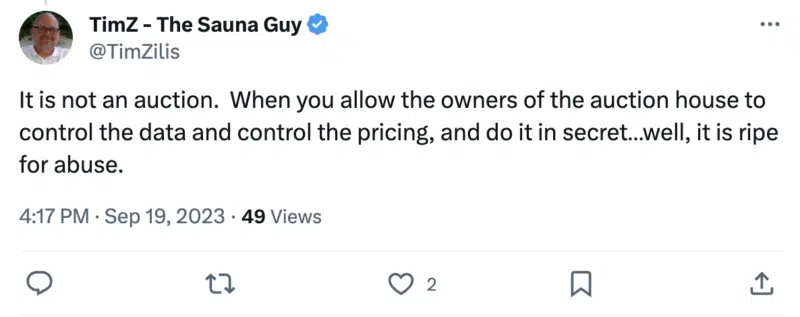
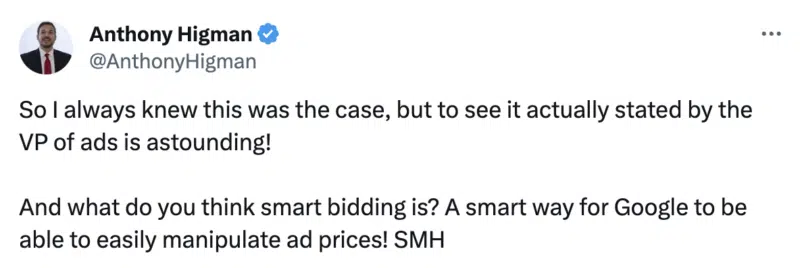
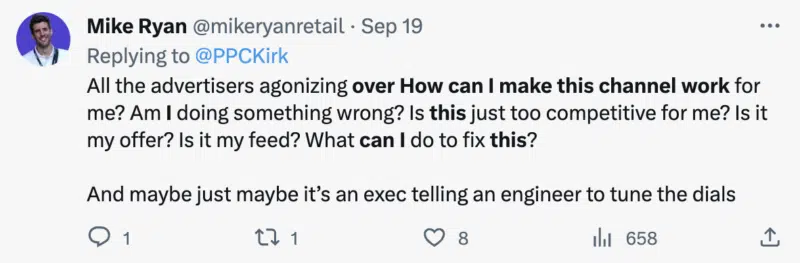
Stop calling it an auction

  • “We all knew this was going on, but you want to give people the benefit of the doubt.”
  • “Google says it cares about advertisers and all these other marketing lies, but the minute it has to hit these marks, the staff ratchet up the spend, and they ratchet the revenue up to 5% or 10%.”
  • Greg went on to share some of the reactions he’d seen from the PPC community on X (formerly known as Twitter), which he appeared to support:
Screenshot 2023 09 26 At 21.19.43 800x300
Screenshot 2023 09 26 At 21.20.11 800x317
Screenshot 2023 09 26 At 21.20.59 800x268
Screenshot 2023 09 26 At 21.22.24 800x263

Stop lying

  • Greg read out a post on X (formerly known as Twitter) from ex Googler Ben Kruger, which read:
    • “Guys they are running a business, they can do whatever they want with their prices just like you and your clients can.”
  • Greg called Ben’s words “fair” in parts, but called Google out for its lack of transparency. with advertisers
  • “You can do whatever you want [with your prices], but just don’t tell me that you’re doing things in my best interests.”
  • “You can no longer say that, and I can no longer trust you on anything that you say or do because you’re out here, tuning up, and shaking the cushions to hit quarterly profit numbers.”

Google’s terminology is ‘misleading at best’

  • “It’s fine if retailers increase their margin on the backend, but in Google’s case, this is marketed as auctions with bids and bid strategies.”
  • “That terminology is increasingly misleading at best.”
  • “There are factors outside of your control and factors that only matter to the sales team that live in high-income areas that are going to hurt your campaign.”
  • “I guarantee Google has never moved costs down 5%.”

RGSP is ‘ridiculous’

  • Google Ad executive, Jerry Dischler, said during the federal antitrust trial that RGSP boosted Google’s revenue by switching the auction so that the second-place bidder was in the top advertiser slot and the initial winner was in the second position.
  • Dischler told the court: “We flip them, otherwise Amazon would always show up on top.”
  • Greg branded this approach “ridiculous”. He added: “People are out here bidding. What world are we living in? What world is this? It’s ridiculous.”

People should leave!

  • “This whole thing just makes me so unbelievably sad. I’ve read everything and heard all the reactions – and I know it’s going to get progressively worse as the years come by.”
  • “People should leave. There should not be one ounce of trust that any advertiser has in Google Ads or in any of its platforms, speech, any of its propaganda or anything it puts out.”
  • “Google has lost all credibility with this. There is nothing left.”
  • “Everyone thinks I’m a Google conspiracist, and everyone thinks I’m nuts – but I’m not. I’m right on this. And that’s why everyone is so hesitant to switch to auto-applied recommendations or use AI or PMax. Google is doing these things to make more money, and they’re admitting it in court. Sad.”

Deep dive. Read our Google antitrust trial updates for all the latest developments from the federal trial.


Related stories

New on Search Engine Land

@media screen and (min-width: 800px) { #div-gpt-ad-3191538-7 { display: flex !important; justify-content: center !important; align-items: center !important; min-width:770px; min-height:260px; } } @media screen and (min-width: 1279px) { #div-gpt-ad-3191538-7 { display: flex !important; justify-content: center !important; align-items: center !important; min-width:800px!important; min-height:440px!important; } }

About the author

Nicola Agius

Nicola Agius is Paid Media Editor of Search Engine Land after joining in 2023. She covers paid search, paid social, retail media and more. Prior to this, she was SEO Director at Jungle Creations (2020-2023), overseeing the company’s editorial strategy for multiple websites. She has over 15 years of experience in journalism and has previously worked at OK! Magazine (2010-2014), Mail Online (2014-2015), Mirror (2015-2017), Digital Spy (2017-2018) and The Sun (2018-2020). She also previously teamed up with SEO agency Blue Array to co-author Amazon bestselling book ‘Mastering In-House SEO’.

https://searchengineland.com/google-ads-credibility-greg-finn-advertiser-432503


Facebook can be sued over biased ad algorithm claims, court rules

Facebook can be sued over claims its advertising algorithm is biased, a California State Court of Appeals has ruled.

The decision reverses a previous ruling from 2020 that stated Facebook was protected from accountability under Section 230 – a law that shields online platforms from legal action when users share illegal material.

Why we care. Brands utilizing Facebook’s ad tools may unintentionally be engaging in discriminatory practices if the platform’s algorithm is found to be biased.

Biased ad algorithm? Facebook was originally taken to court in 2020 for violating civil rights laws. The social platform was accused of not showing insurance ads to women and older people after 48-year-old Samantha Liapes tried to use Facebook to find an insurance provider. Liapes claimed she wasn’t shown insurance ads due to her age and gender.

2020 outcome. The case was originally dismissed by the court after it found Facebook’s tools “neutral on their face and concluding that Facebook was immune under the Communications Decency Act, 47 U.S.C. 230.” However, Liapes appealed the decision.


Get the daily newsletter search marketers rely on.


Appeal. The decision was reversed on 21 September 2023 after the appeals court found that the case “adequately” alleges that Facebook “knew insurance advertisers intentionally targeted its ads based on users’ age and gender” – which is in violation of the Civil Rights Act.

The court concluded: “Facebook does not merely proliferate and disseminate content as a publisher … it creates, shapes, or develops content” with the tools.

Deep dive. Read the Liapes v. Facebook, Inc. case in full for more information.


Related stories

New on Search Engine Land

@media screen and (min-width: 800px) { #div-gpt-ad-3191538-7 { display: flex !important; justify-content: center !important; align-items: center !important; min-width:770px; min-height:260px; } } @media screen and (min-width: 1279px) { #div-gpt-ad-3191538-7 { display: flex !important; justify-content: center !important; align-items: center !important; min-width:800px!important; min-height:440px!important; } }

About the author

Nicola Agius

Nicola Agius is Paid Media Editor of Search Engine Land after joining in 2023. She covers paid search, paid social, retail media and more. Prior to this, she was SEO Director at Jungle Creations (2020-2023), overseeing the company’s editorial strategy for multiple websites. She has over 15 years of experience in journalism and has previously worked at OK! Magazine (2010-2014), Mail Online (2014-2015), Mirror (2015-2017), Digital Spy (2017-2018) and The Sun (2018-2020). She also previously teamed up with SEO agency Blue Array to co-author Amazon bestselling book ‘Mastering In-House SEO’.

https://searchengineland.com/facebook-legal-action-ad-algorithm-discriminates-432479


Apple has 19 billion reasons not to build a Google Search rival

Apple is not planning to create its own search engine to rival Google.

Eddy Cue, Apple’s senior vice president of services, is expected to testify at the federal antitrust trial that there are no plans for an “Apple Search” model because its partnership with Google works better for its customers, Bloomberg reported.

Cue notably helped negotiate Apple’s multibillion-dollar deal with Google, which took four months “working every single day” to finalize.

Why we care. The U.S. Justice Department argues that Google’s deal with Apple to become the default search engine on its products has played a major role in creating an unfair search landscape as it’s prevented rival search engines from being able to compete seriously. The testimony from Cue, which Apple tried to block per Reuters, provides a significant insight into Google’s relationship with Apple.

Apple’s deal with Google. Google has a financial agreement in place with Apple to be the default search engine on its products at a cost of around $10 billion a year. In addition, Google pays Apple advertising revenue – which is one of the search engine’s biggest costs. See also: Report: Google sharing Chrome iOS search revenue with Apple.

Apple reports its income from Google as advertising revenue, which is categorized under its services division. This amounted to $78.1 billion in sales during Apple’s fiscal year 2022.

Google could pay Apple as much as $19 billion this fiscal year, according to an estimate from Bernstein analyst Toni Sacconaghi.

Why Google is Apple’s default search engine. Cue is expected to testify that Apple chose Google as the default search engine for its product because it is the best search engine. He will also state that Apple has financial deals with other search engines such as Yahoo, Microsoft Bing, DuckDuckGo and Ecosia, as well as Google.

In addition, Cue is set to testify that Apple customers with Google as their default search engine can easily change it, echoing comments made by Google’s lead lawyer, John Schmidtlein.

However, DuckDuckGo founder and CEO Gabriel Weinberg told the court last week that changing a default search engine is “way harder than it needs to be.” He said:

  • “If you switch some of these defaults eventually you’re just going to be switched back to Google if you do nothing.”

Who else has testified? Cue will be the second executive from Apple to testify, following Apple AI head (and former Google executive) John Giannandrea last week. However, most of Giannandrea’s testimony was given in a closed courtroom, so the details are not publicly available.


Get the daily newsletter search marketers rely on.


What Google is saying. Schmidtlein said Google dominates the search market with a 90% share because it is a superior product – not because it has financial deals that give its rivals an unfair advantage.

In contrast, Google highlights the default inclusion of Microsoft’s Bing on the Windows operating system, which has not significantly helped Bing’s market position.

Years of Apple Search rumors. Every couple of years, it seems we hear rumors about Apple getting serious about search or even that the company is ready to debut its own search engine – most recently in May 2022. Maybe it’s correlation, but it’s entirely possible Apple uses this to negotiate better financial terms with Google. Either way, last we heard it will be at least four years before we see an Apple search engine.

Dig deeper. Read our Google antitrust trial updates for all the latest developments in this landmark case.


Related stories

New on Search Engine Land

@media screen and (min-width: 800px) { #div-gpt-ad-3191538-7 { display: flex !important; justify-content: center !important; align-items: center !important; min-width:770px; min-height:260px; } } @media screen and (min-width: 1279px) { #div-gpt-ad-3191538-7 { display: flex !important; justify-content: center !important; align-items: center !important; min-width:800px!important; min-height:440px!important; } }

About the author

Nicola Agius

Nicola Agius is Paid Media Editor of Search Engine Land after joining in 2023. She covers paid search, paid social, retail media and more. Prior to this, she was SEO Director at Jungle Creations (2020-2023), overseeing the company’s editorial strategy for multiple websites. She has over 15 years of experience in journalism and has previously worked at OK! Magazine (2010-2014), Mail Online (2014-2015), Mirror (2015-2017), Digital Spy (2017-2018) and The Sun (2018-2020). She also previously teamed up with SEO agency Blue Array to co-author Amazon bestselling book ‘Mastering In-House SEO’.

https://searchengineland.com/apple-has-no-plans-to-make-a-google-rival-432474


Microsoft Advertising Network for retail launches in the US

Microsoft Advertising Network for retail has been rolled out in the US.

The network has been designed to simplify the process of creating retail media campaigns, making it easier for brands to launch their retail media programs faster by:

  • Connecting retailers with a large, relevant pool of demand.
  • Expanding their reach offsite, driving traffic to their websites at no cost through co-branded ads.
  • Providing an additional buying path.

Microsoft has not yet confirmed when the network will be expanded to additional markets.

Why we care. Creating a retail media program is typically time-consuming and resource-intensive, involving multiple teams and can take a long time to become profitable. The Microsoft Advertising Network for retail streamlines this process, enabling retailers to launch profitable programs quickly and access relevant advertiser budgets from Microsoft Advertising’s extensive network.

What is Microsoft Advertising Network for retail? Microsoft Advertising Network for Retail is a new program that lets advertisers use Microsoft’s wide-reaching ad resources and access high-intent shoppers to boost their business. By joining the network, you can potentially increase sales and retail media revenue with quality ads, even if you have a private retail media platform.


Get the daily newsletter search marketers rely on.


What has Microsoft said? Paul Longo, Global Head of Retail Media Sales at Microsoft, said in a statement:

  • “We have deep learning of the retailer experience across Microsoft, so with Microsoft Advertising Network for retail, we minimized the efforts for retailers of all sizes to begin immediately generating retail media revenue and increasing their onsite sales.”

Deep dive. Read the Microsoft Advertising blog for more information.


Related stories

New on Search Engine Land

@media screen and (min-width: 800px) { #div-gpt-ad-3191538-7 { display: flex !important; justify-content: center !important; align-items: center !important; min-width:770px; min-height:260px; } } @media screen and (min-width: 1279px) { #div-gpt-ad-3191538-7 { display: flex !important; justify-content: center !important; align-items: center !important; min-width:800px!important; min-height:440px!important; } }

About the author

Nicola Agius

Nicola Agius is Paid Media Editor of Search Engine Land after joining in 2023. She covers paid search, paid social, retail media and more. Prior to this, she was SEO Director at Jungle Creations (2020-2023), overseeing the company’s editorial strategy for multiple websites. She has over 15 years of experience in journalism and has previously worked at OK! Magazine (2010-2014), Mail Online (2014-2015), Mirror (2015-2017), Digital Spy (2017-2018) and The Sun (2018-2020). She also previously teamed up with SEO agency Blue Array to co-author Amazon bestselling book ‘Mastering In-House SEO’.

https://searchengineland.com/microsoft-advertising-network-retail-launches-us-432469


Microsoft signs deal to serve sponsored links in Snapchat’s My AI

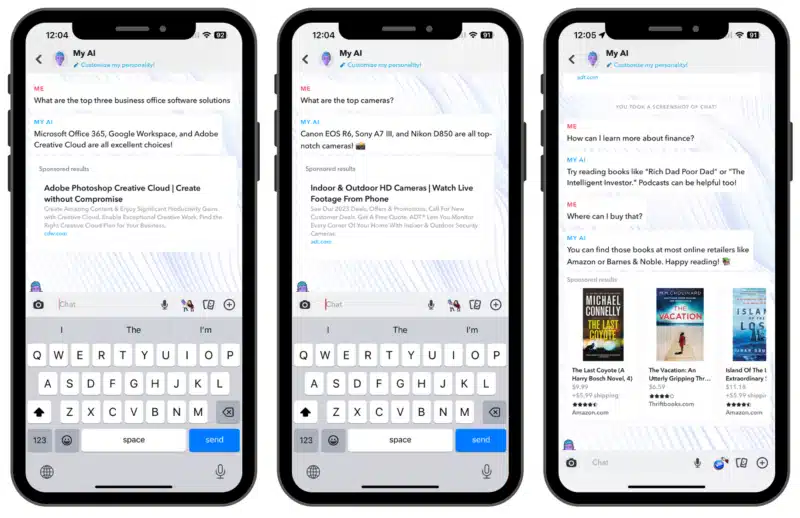
Snapchat’s My AI is going to start serving sponsored links using Microsoft’s Chat Ads API.

The social app posted a screenshot demonstrating how the “highly relevant” ads will be displayed when users interact with its chatbot for relevant queries under the tech giants’ partnership:

1 2 800x518

Why we care. Snapchat’s My AI has a global community of more than 750 million monthly users, making it one of the most widely used consumer chatbots available. The ability to advertise on this platform through Sponsored Links is a huge opportunity in terms of reach, ROI and connecting with its core audience, Gen Z.

Getting started. Advertisers simply need to maximize the mobile coverage within their Microsoft Advertising campaigns. Then, in your Device targeting settings, check to make sure you’re prioritizing mobile traffic by having positive mobile bid modifiers across all your ad groups.

Measuring performance. To measure the impact of Snap traffic to your campaign, use the Microsoft Advertising publisher report. This can be found under the “Microsoft sites and select traffic” category. This traffic has Microsoft properties as the benchmark.

Results so far. Advertisers reported seeing a significant year-on-year increase in mobile traffic across the Microsoft network during the testing phase. On average, they saw over 15% more mobile impressions from Microsoft sites.

What’s next? Microsoft is hoping to roll out its latest advertising feature to more partners soon. The tech giant is encouraging companies interested parties to complete a partnership application form for assistance with either “algorithmic organic results and ads monetization” or “ads monetization”.


Get the daily newsletter search marketers rely on.


What has Snapchat said? A spokesperson for Snapchat said in a statement:

  • “Powered by Microsoft’s Advertising’s Ads for Chat API, Sponsored Links connect our community with partners relevant to their conversation, while helping partners reach Snapchatters at the moment they have indicated potential interest in their offering.”
  • “Microsoft Advertising’s clients in the U.S. and select markets can now engage with Snapchatters through My AI to seamlessly deliver links that are relevant to the conversation. “

Deep dive. Read Snapchat’s official Sponsored Links announcement in full for more information.


Related stories

New on Search Engine Land

@media screen and (min-width: 800px) { #div-gpt-ad-3191538-7 { display: flex !important; justify-content: center !important; align-items: center !important; min-width:770px; min-height:260px; } } @media screen and (min-width: 1279px) { #div-gpt-ad-3191538-7 { display: flex !important; justify-content: center !important; align-items: center !important; min-width:800px!important; min-height:440px!important; } }

About the author

Nicola Agius

Nicola Agius is Paid Media Editor of Search Engine Land after joining in 2023. She covers paid search, paid social, retail media and more. Prior to this, she was SEO Director at Jungle Creations (2020-2023), overseeing the company’s editorial strategy for multiple websites. She has over 15 years of experience in journalism and has previously worked at OK! Magazine (2010-2014), Mail Online (2014-2015), Mirror (2015-2017), Digital Spy (2017-2018) and The Sun (2018-2020). She also previously teamed up with SEO agency Blue Array to co-author Amazon bestselling book ‘Mastering In-House SEO’.

https://searchengineland.com/microsoft-sponsored-links-snapchat-my-ai-432424


Trends in paid search to watch in 2024 by Cynthia Ramsaran

Pay Per Click Paid Search Ss 1920 800x450

The digital marketing landscape continues to evolve rapidly as new technologies and platforms emerge, allowing marketers to innovate and adapt their strategies to meet the changing demands of consumers. Amid this shift, marketers rely heavily on search engine marketing to become efficient and drive higher ROI.

So, what is 2024 shaping up to be, and what top trends in paid search advertising are expected to gain traction?

Learn more by registering and attending “Trends in Paid Search: Navigating the Digital Landscape in 2024,” presented by iQuanti.


Click here to view more Search Engine Land webinars.


Related stories

New on Search Engine Land

@media screen and (min-width: 800px) { #div-gpt-ad-3191538-7 { display: flex !important; justify-content: center !important; align-items: center !important; min-width:770px; min-height:260px; } } @media screen and (min-width: 1279px) { #div-gpt-ad-3191538-7 { display: flex !important; justify-content: center !important; align-items: center !important; min-width:800px!important; min-height:440px!important; } }

About the author

Cynthia Ramsaran

Cynthia Ramsaran is director of custom content at Third Door Media, publishers of Search Engine Land and MarTech. A multi-channel storyteller with over two decades of editorial/content marketing experience, Cynthia’s expertise spans the marketing, technology, finance, manufacturing and gaming industries. She was a writer/producer for CNBC.com and produced thought leadership for KPMG. Cynthia hails from Queens, NY and earned her Bachelor’s and MBA from St. John’s University.

https://searchengineland.com/trends-in-paid-search-to-watch-in-2024-432388