ChatGPT rolls out voice and image prompts

OpenAI is adding new voice and image capabilities to ChatGPT. 

The new features will allow you to either engage in voice conversations with the chatbot or share images to express your thoughts, rather than relying solely on typing out prompts.

ChatGPT’s new voice and image functionalities will be rolled out to paying subscribers over the next two weeks, with plans to expand these services to the free version of the app “soon after”.

Why we care. ChatGPT’s ability to create synthetic voices and images spell huge creative opportunities, however, they also have some concerning potential uses, such as impersonation and fraud, according to OpenAI. These risks could have huge implications for advertisers.

Speak with ChatGPT

ChatGPT’s new chat functionality allows you to have dynamic conversations with it using just your voice.

Getting started. To get started with voice, follow these simple steps:

  • Head to “Settings”.
  • Scroll down and click on “New Features” on the mobile app.
  • Opt into voice conversations.
  • Tap the headphone button located in the top-right corner of the home screen.
  • Choose your preferred voice out of five different voices.

How it works. To use the Chat functionality, you simply press a button, ask your question aloud, ChatGPT turns it into text, sends it to the big language model, gets a response, changes it back into speech, and then vocalizes the answer. It should be as smooth as having a conversation with Alexa.

You’ll will then be able to choose from five different voices for ChatGPT, although OpenAI believes the model has much greater potential beyond just these options.

Chat about images

You can now show ChatGPT one or more images to communicate a query. You can also focus on a specific part of the image by using the drawing tool in our mobile app.

Getting started. To get started with image prompts, follow these simple steps:

  • Tap the photo button to capture or choose an image.
  • If you’re on iOS or Android, tap the plus button first.
  • You can also discuss multiple images or use our drawing tool to guide your assistant.

How it works. Image search will work in a similar way to Google Lens. Users simply take a photo, upload it, then ChatGPT will try to figure out your query and provide an answer.

To clarify your intent, you will also be able to use the app’s drawing tool, as well as speak or type questions to go with your uploaded image.

If ChatGPT provides an answer you’re not happy with, instead of doing another search, you can talk with the bot and fix the answer as you chat. It’s similar to what Google does with their multimodal search.


Get the daily newsletter search marketers rely on.


What has Open AI said? An Open AI spokesperson said in a statement:

  • “Voice and image give you more ways to use ChatGPT in your life. Snap a picture of a landmark while traveling and have a live conversation about what’s interesting about it. When you’re home, snap pictures of your fridge and pantry to figure out what’s for dinner (and ask follow up questions for a step by step recipe).”
  • “After dinner, help your child with a math problem by taking a photo, circling the problem set, and having it share hints with both of you.”
  • “We’re rolling out voice and images in ChatGPT to Plus and Enterprise users over the next two weeks. Voice is coming on iOS and Android (opt-in in your settings) and images will be available on all platforms.”

Deep dive. Read Open AI’s announcement in full for more information.


Related stories

New on Search Engine Land

@media screen and (min-width: 800px) { #div-gpt-ad-3191538-7 { display: flex !important; justify-content: center !important; align-items: center !important; min-width:770px; min-height:260px; } } @media screen and (min-width: 1279px) { #div-gpt-ad-3191538-7 { display: flex !important; justify-content: center !important; align-items: center !important; min-width:800px!important; min-height:440px!important; } }

About the author

Nicola Agius

Nicola Agius is Paid Media Editor of Search Engine Land after joining in 2023. She covers paid search, paid social, retail media and more. Prior to this, she was SEO Director at Jungle Creations (2020-2023), overseeing the company’s editorial strategy for multiple websites. She has over 15 years of experience in journalism and has previously worked at OK! Magazine (2010-2014), Mail Online (2014-2015), Mirror (2015-2017), Digital Spy (2017-2018) and The Sun (2018-2020). She also previously teamed up with SEO agency Blue Array to co-author Amazon bestselling book ‘Mastering In-House SEO’.

https://searchengineland.com/chatgpt-rolls-out-voice-and-image-prompts-432418


5 outdated marketing KPIs to toss and what to reference instead

Moving away from conventional KPIs and toward a more advanced understanding of your campaigns gives you real competitive advantages. 

I could have written about this topic years ago, but it’s especially important as engagement costs on major advertising channels continue to increase, and an unpredictable economy puts a premium on efficiency. 

Ready to change the way you measure your campaigns? In this article, I’ll look at five KPIs I still hear clients reference and explain: 

  • Why it’s past time to replace them.
  • What they should analyze instead.
  • Why it matters.

Bad KPI 1: Spend

What to use instead: Profit

I’m not saying the concept of a budget is moot, but spend should not be the starting point or goal for campaigns unless:

  • You’re just beginning and have no CRM data to reference.
  • You’re going for scale without regard to efficiency. 

That said, we still get companies coming to us frequently and saying, “We’d like to spend this.”

Even more off-base, “We’d like to spend {x} on Google, {y} on Facebook, and {z} on LinkedIn.”

A better approach is to aim for efficiency goals, agnostic of channel. 

If you start with an ROI goal of 3.0, good analytics folks will be able to crunch numbers and tell you how much you can spend and stay within that goal – no matter which channel you spend it on. 

Referencing spend without tracking efficiency is how you hit growth walls (and get on the wrong side of your CFO).

Specifying spend across channels is a good way to doom yourself to the fate of spending too much on certain channels and not enough on other, more incremental sources of revenue. 

If you are going for scale without regard to efficiency, metrics like conversions, spending, revenue, and visitors do become more important, while CPA and ROAS (efficiency metrics) will take a hit. 

A core tenet of digital marketing is that the more conversions you get, the more expensive they are, so you’ll have to decide whether your first goal is improving efficiency or driving scale. 

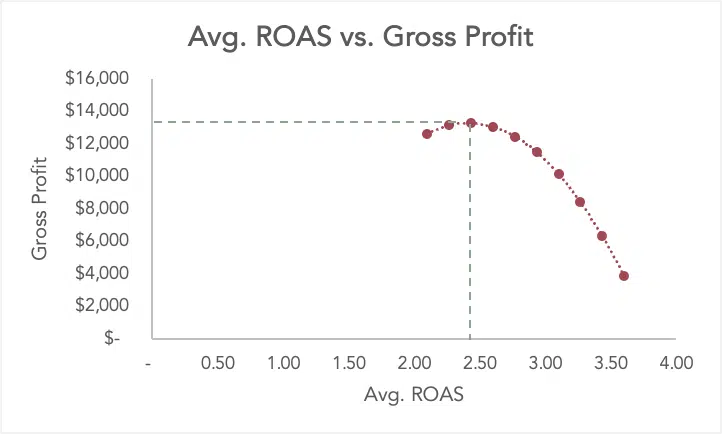
Avg. ROAS vs. Gross Profit
Avg. ROAS vs. Gross Profit: There is an optimal efficiency target where gross profit is maximized.

Bad KPI 2: Platform-provided CPA

What to use instead: CRM-based CPA

Relying solely on CPAs delivered by Google Ads, Facebook and LinkedIn without assessing the quality of those acquisitions (leads in B2B, purchases in ecommerce) makes it likely you’re spending too much on the wrong leads.

(Note: Google Search Partners and display campaigns produce particularly weak lead quality.)

Instead, integrate your CRM data to understand cost per down-funnel metrics (for B2B) or cost per CLTV (B2C and ecommerce). 

This is especially important for B2B, given its long sales cycles and purchase stages.

Knowing what you’d like to pay for opportunities and understanding what you have to pay to acquire them on certain channels is more important than straight-up lead acquisition.

And it’ll make you more likely to swallow high CPCs (hello, LinkedIn) if the resulting leads carry enough value. 

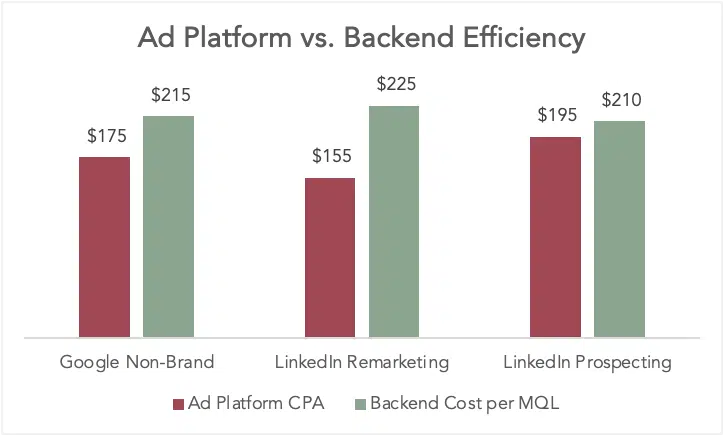
Ad Platform vs. Back-end Efficiency
Ad Platform vs. Back-end Efficiency: In this example, ad platform efficiency without further analysis suggests that you should dial up LinkedIn Remarketing. In contrast, analysis that incorporates back-end efficiency suggests you should dial up LinkedIn Prospecting instead.

Dig deeper: 3 steps for effective PPC reporting and analysis


Get the daily newsletter search marketers rely on.


Bad KPI 3: Click-based CPA

What to use instead: Incrementality-based CPA

Click-based CPA (think first-click, last-click, or cookie or UTM-based MTA) ignores the contributions of impressions-based advertising campaigns, whether it’s a YouTube a, a programmatic ad or a billboard you sponsored on a highway near one of your target geos. 

True CPA is based on incrementality, which implements things like the halo effect, brand lift testing, geo lift testing, etc. 

It means being agnostic to clicks vs. impressions and understanding the true effect of any advertising interaction. 

This can be relatively complex to set up. Still, there are native tools, like Facebook lift tests and Google’s CausalImpact R package using Bayesian structural time-series models, that can be a good starting point. 

I recommend figuring out how much data you need to draw a statistically significant conclusion and only running these initiatives in test locations so you’re not curtailing entire campaigns while you assess their effects.

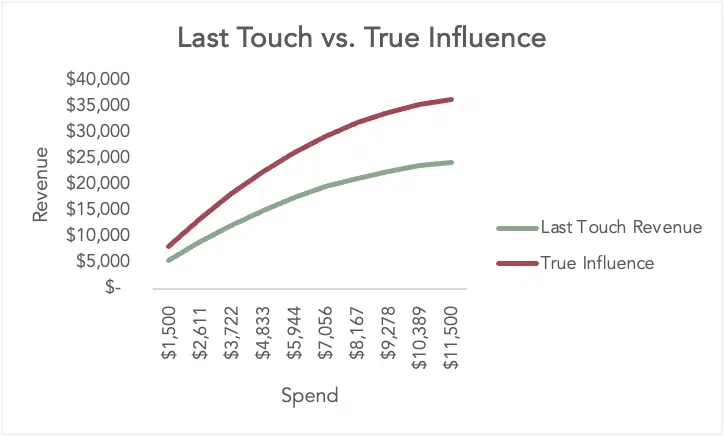
Image 91
Last Touch vs. True Influence: Advanced measurement methods such as geo lift testing or media mix modeling (MMM) can help estimate the true influence of your initiatives and enrich traditional last-touch reporting.

Bad KPI 4: Average CPA/Average ROAS

What to use instead: Marginal CPA/Marginal ROAS

When you’re using Marginal CPA, you’re really trying to figure out what you paid to acquire marginal returns – which means you’re calculating the return on each conversion, not just assuming you pay the same or get the same for all new customers. 

Let’s illustrate this with a simple scenario: say you’re taking an average CPA from Facebook ads, which brought in a mix of expensive and cheaper customers, all worth roughly the same revenue amount. 

If you take the average CPA, you might see that you spent $2 to acquire a new customer, whereas marginal CPA might show that you converted a bunch of new customers at $1.50 and a handful at $8.

Rather than turn up the dial across the board, it’d be smarter to keep finding more cost-effective customers like the first bunch. Don’t spend more to reach more expensive customers who provide no additional value.  

What to use instead: Impression share lost to budget (search)

If you are running search campaigns and want to lower spend, there are two main ways to do it.  

  • You drop bids or targets to decrease CPCs.
  • You lower the campaign’s daily budget, which forces the campaign to turn off for portions of the day. 

When you drop bids or targets and lose impression share, a lower CPC will help produce more clicks and conversion opportunities for the same budget. 

I’ve seen brands use bidding strategies with goals of capturing something like 90% of available impression share (IS), which gives Google the green light to overcharge.

In these scenarios, switching to manual CPC targets and aiming lower (thereby losing some impression share) immediately tunes up performance and efficiency.

When you drop your budget, the campaign will hit the daily budget and turn off. This will lower overall spend and impression share but keep the same efficiency. So keep budgets up and control spend using bids and efficiency targets!

There are far-reaching implications when you embrace this “scale vs. efficiency” mindset.

Let’s say you are a B2B company that always sees poor performance on weekends. Instead of turning the weekends off, lower the bids/targets until the traffic is profitable.  

Next steps

Some of these – especially the first and last – should be easy to implement right away. Others may need you to find a trusted analytics resource to help you sketch out some models and integrate the right data. 

But by reading this far, you’ve already taken the first step: casting a critical eye on boilerplate KPIs that aren’t helping you truly optimize the effectiveness of your marketing campaigns. 

One word to the wise: make sure you’re getting the right people on board before you pull the switch on any of these since people leaning on the old KPIs to gauge your work should be in alignment with what success looks like going forward. 

Dig deeper: Tracking and measurement for PPC campaigns


Opinions expressed in this article are those of the guest author and not necessarily Search Engine Land. Staff authors are listed here.


Related stories

New on Search Engine Land

@media screen and (min-width: 800px) { #div-gpt-ad-3191538-7 { display: flex !important; justify-content: center !important; align-items: center !important; min-width:770px; min-height:260px; } } @media screen and (min-width: 1279px) { #div-gpt-ad-3191538-7 { display: flex !important; justify-content: center !important; align-items: center !important; min-width:800px!important; min-height:440px!important; } }

About the author

Ben Vigneron

Ben Vigneron is a seasoned marketing analyst and product analytics leader with a startup culture. Ben was listed as one of the best eCommerce PPC Experts by PPC Hero in September 2014, and spoke multiple times at the Search Marketing Expo (SMX) in Europe and the USA. With a vision to change the way marketers think and operate, Ben and his team work with leaders and organizations to bring data to the center stage, and help make more informed decisions. After more technical training at Adobe, and years of experience with advertisers in the Bay Area at Blackbird PPC, Ben has uncovered remarkable patterns about the incremental effectiveness of paid advertising through search, programmatic, and social initiatives.

https://searchengineland.com/outdated-marketing-kpis-432359


Google accused of downplaying ad price manipulation

Google has been accused of downplaying how much it quietly increases ad auctions.

The search engine admitted at the federal antitrust trial that it “frequently” inflates ad prices by as much as 5% without telling advertisers – sometimes 10%.

But marketers are calling the search engine out for being too “conservative” with these figures as they believe the real number is significantly higher.

Why we care. Advertisers are becoming increasingly frustrated with Google due to long-held suspicions around ad price manipulation and a lack of transparency. Although the industry accepts the search engine has a right to set minimum pricing thresholds, the lack of transparency regarding how those thresholds change over time and can directly impact advertiser performance

Shady business. Christine Yang, vp of media at Iris, told Ad Week that she believes the real range of fluctuation can sometimes be as much as 100%. She said:

  • ““[Google] claiming 5% is a more conservative number to make it sound like the natural ebb and flow of a marketplace,” said Christine Yang, vp of media at Iris.”
  • “The level to which [price manipulations] happens is what we don’t know. It’s shady business practices because there’s no regulation. They regulate themselves.”

Why quietly inflating ad prices matters. Google’s ability to increase ad prices, especially without facing strong competition, could potentially bolster the Justice Department’s claim that Google maintains an unlawful monopoly. While this argument doesn’t apply to Google’s free search engine, it can be used to address concerns like privacy standards that might have been mitigated in a more competitive search industry.


Get the daily newsletter search marketers rely on.


What has Google said? Following Dischler’s comments, a Google spokesperson told Search Engine Land:

  • “Search ads costs are the result of a real-time auction where advertisers never pay more than their maximum bid. We’re constantly launching improvements designed to make ads better for both advertisers and users.”
  • “Our quality improvements help eliminate irrelevant ads, improve relevance, drive greater advertiser value, and deliver high quality user experiences.”

Deep dive. Read our Google search antitrust trial updates article for all the latest news from the courtroom.


Related stories

New on Search Engine Land

@media screen and (min-width: 800px) { #div-gpt-ad-3191538-7 { display: flex !important; justify-content: center !important; align-items: center !important; min-width:770px; min-height:260px; } } @media screen and (min-width: 1279px) { #div-gpt-ad-3191538-7 { display: flex !important; justify-content: center !important; align-items: center !important; min-width:800px!important; min-height:440px!important; } }
About the author

Nicola Agius

Nicola Agius is Paid Media Editor of Search Engine Land after joining in 2023. She covers paid search, paid social, retail media and more. Prior to this, she was SEO Director at Jungle Creations (2020-2023), overseeing the company’s editorial strategy for multiple websites. She has over 15 years of experience in journalism and has previously worked at OK! Magazine (2010-2014), Mail Online (2014-2015), Mirror (2015-2017), Digital Spy (2017-2018) and The Sun (2018-2020). She also previously teamed up with SEO agency Blue Array to co-author Amazon bestselling book ‘Mastering In-House SEO’.

https://searchengineland.com/google-accused-downplaying-ad-price-manipulation-432353


Google denies manipulating ad auctions in resurfaced SMX Advanced clip

Google denied manipulating ad auctions at SMX Advanced 2015 – eight years before admitting it actually does.

During the conference’s keynote speech, Google Ad executive Jerry Dischler told the audience:

  • “Full stop, we are not manipulating search results or manipulating the ad auction in order to increase profits. That’s just not what we do.”

Fast-forward to the 2023 federal antitrust trial, Dischler completely backtracked and told Judge Amit Mehta that the search engine “frequently” changes the auctions it uses to sell search ads without telling advertisers, increasing the cost of ads and reserve pricing by as much as 10%.

Why we care. This complete U-turn will likely raise doubts over Google’s reliability at a time when its trustworthiness is already being questioned.

How the tables have turned. The SMX Advanced 2015 clip was resurfaced by Tinuiti’s VP of Research, Andy Taylor, who claims Dischler made the denial in response to a presentation he had just given. Reacting to Google’s U-turn, he told Search Engine Land:

  • “It seemed pretty clear back in 2015 that [Google was manipulating ad prices]. The trends we were seeing weren’t just a result of the typical reasons Google might offer up; like shifts in competition or changes in search behavior in particular categories. Even the data points we could find from other sources also seemed to be tracking in the same direction with our own.”
  • “Sadly, it wasn’t all that surprising [when Dischler denied my claims], but I knew he wasn’t being transparent. Still, it was really disappointing to have to have client conversations proving out what I saw happening while at the same time acknowledging that Google was publicly contradicting my findings.”
  • “I was really glad that someone put [Dischler] under oath [at the antitrust trial], and that this issue was made crystal clear for all of the search marketers out there.”
  • “I do believe Google is well within its rights to establish minimum pricing thresholds that advertisers have to pay in order to appear in its search results, but the issue over the years has been the reluctance to be transparent with how those thresholds change over time and how they directly impact advertiser performance. I hope we’ll see greater transparency from Google moving forward.”

Get the daily newsletter search marketers rely on.


Why has Google been tweaking search ad prices? Dischler claimed that staff were “shaking the cushions” to find ways to ensure his team met revenue targets given to Wall Street by Ruth Porat, Google’s Chief Financial Officer. In an email he sent to his team back in May 2019, he wrote:

  • “If we don’t meet quota for the second quarter in a row and we miss the street’s expectations again, which is not what Ruth signalled to the street, so we will get punished pretty bad in the market.”
  • “I care more about revenue than the average person but think we can all agree that for our teams trying to live in high cost areas another $100,000 in stock price loss will not be great for morale, not to mention the huge impact on our sales team.”

What has Google said? Following Dischler’s comments, a Google spokesperson told Search Engine Land:

  • “Search ads costs are the result of a real-time auction where advertisers never pay more than their maximum bid. We’re constantly launching improvements designed to make ads better for both advertisers and users.”
  • “Our quality improvements help eliminate irrelevant ads, improve relevance, drive greater advertiser value, and deliver high quality user experiences.”

Deep dive. Watch the SMX Advanced 2015 keynote speech to hear Dischler’s comments in full, and read our Google antitrust trial updates for all of the latest developments in this case.


Related stories

New on Search Engine Land

@media screen and (min-width: 800px) { #div-gpt-ad-3191538-7 { display: flex !important; justify-content: center !important; align-items: center !important; min-width:770px; min-height:260px; } } @media screen and (min-width: 1279px) { #div-gpt-ad-3191538-7 { display: flex !important; justify-content: center !important; align-items: center !important; min-width:800px!important; min-height:440px!important; } }
About the author

Nicola Agius

Nicola Agius is Paid Media Editor of Search Engine Land after joining in 2023. She covers paid search, paid social, retail media and more. Prior to this, she was SEO Director at Jungle Creations (2020-2023), overseeing the company’s editorial strategy for multiple websites. She has over 15 years of experience in journalism and has previously worked at OK! Magazine (2010-2014), Mail Online (2014-2015), Mirror (2015-2017), Digital Spy (2017-2018) and The Sun (2018-2020). She also previously teamed up with SEO agency Blue Array to co-author Amazon bestselling book ‘Mastering In-House SEO’.

https://searchengineland.com/google-denies-manipulating-ad-auctions-in-resurfaced-smx-advanced-clip-432345


How to increase LTV with PPC

Lifetime value, or LTV, averages the total revenue generated by a customer during the entirety of your relationship.

While the KPI often sounds cool and dandy, it can be difficult to improve. Doing so requires long term thinking, commitment and a deep understanding of your customer database.

This article will dive into concrete ways PPC marketers can improve LTV using four levers. 

Why is LTV important?

Customer lifetime value is an essential metric for businesses across various industries for several reasons,

LTV evaluates your potential

Even before starting any business, LTV has value. It allows you to understand your average customer in greater depth, which can basically be translated into your growth potential.

For example, let’s say you want to start a business. And you hesitate between a real estate agency and selling coffee machines. (It’s quite a split but that’s just to make my point.) 

You could assume that the LTV of a customer for a real estate agency is significantly higher than that of a coffee machine seller. 

But let’s say your average client buys one coffee machine for 50 employees, each taking two coffees a day (at $0.20 per coffee because you price them that low). Say that such clients last for 30 years (with 228 working days per year). That means your LTV is close to $137,000. Not bad right?

Unfortunately, for real estate agencies, clients “only” buy a primary residence once in a lifetime (on average). And since real estate agent commissions are not extravagant enough, you can bet you will not exceed $137,000.

Bottom line: LTV just helped you gauge two different markets’ value.

LTV paves the way for growth

LTV basically helps you steer away from transaction-based thinking to the long-term value of repeat customers.

Higher LTV = higher profits (in the medium and long term). A higher customer value directly impacts the bottom line. 

But it also means peaceful, long-lasting business relationships. And those are less costly for tons of departments (HR, finance, logistics, customer support, etc.).

At an audience level, you can use LTV to identify structural weaknesses.

For example, if customer type A churns faster than customer type B, it’s likely that your service (or product) is not competitive/good enough for type A. Why is that?

Conversely, LTV can also help you find your best customers, which can translate into your best services/products. Is there any best practice to take away from this insight?

Finally, LTV helps determine your target customer acquisition cost (tCAC). If you know how much revenue you will generate with an average client, you can easily derive that into a target CAC. You “only” need to subtract the cost of goods sold (COGS) and so on. 

How to calculate LTV

If you Google “LTV formula”, you’ll probably see something related to customer lifetime. 

This makes sense but is harder to find in a marketer’s usual datasets (analytics, CRM, etc.). 

So let’s start with basic KPIs we all understand:

Lifetime value (LTV) = average order value x total transactions / unique customers

As you can see, it’s fairly simple to start with. (It’s also worth looking up “LTV enhancements” as they provide interesting additional value.)

‘LTB’: Benefits instead of revenue

LTV is interesting. But if you ask CFOs, they will tell you that benefits trump revenue any day. 

With benefits, you can understand the “real” value of each new customer, product line, etc. 

Here is the formula to turn LTV into what I call LTB, or lifetime benefits (not a real KPI name, just my take on it):

Lifetime benefits (LTB) = LTV – CAC – COGS

With CAC being your average cost to acquire one net new customer. And COGS being your cost of goods sold.

Define customer relationship length

You may be asking yourself how to define “lifetime.”

In other words, when do you stop counting “total transactions”? When can you confidently consider a customer churned? 

Just like for churn rate, you have several options:

  • If you’ve been around long enough: Use historical data and remove those outliers. That will give you the average lifetime of an average customer.
  • If you haven’t been around long enough or you lack the data: Use scenarios based on whatever you have. It’s a bit rough, but at least it’s a starting point.

Get the daily newsletter search marketers rely on.


4 levers PPC pros can use to improve LTV

You can now use your LTV formula to come up with creative ways PPCs can improve overall business performance. Let’s break those formulas into four elements:

  • Average order value (AOV)
  • Total transactions per unique customer
  • Lifetime
  • Costs (CAC and COGS)

By pulling and pushing those levers, you can improve your LTV. So let’s explore them one by one:

1. Improve AOV

Too many marketers want to slash prices, thinking it will improve conversion rates and revenue. 

It can be true in some cases, but often, it simply decreases AOV, which hurts businesses’ bottom line. Remember: benefits trump revenue every single day.

How can you know if you could make improvements here? 

One way to do so is to use your historical data to map sales periods (lower AOV) with conversion rates. 

In some extreme cases, I observed flat conversion rates and lower AOVs, which should make you question sales’ relevance. 

If that’s your case, you have all the data you need to make CMOs and CFOs understand they need to switch strategies.

Reviewing account basics

Another operational alternative is to review media spend with an AOV lens:

  • How does performance look for search terms containing “bargain,” “discount,” “cheap” and so on?
  • Are low-cost products cannibalizing your Shopping budget?
  • Does your copy include pricing terms? If so, how does it perform against other copies?
  • Could you AB test landing pages? Single product against bundles, for example.
  • Is your purchase value tracking taking into account discounts and taxes? Or are you inflating your results?

About price increases

Another very obvious way to increase AOV is to increase prices. Don’t go all out at once; a 5% increase will probably go unnoticed by your customers. At the very least, you want to align your prices with inflation.

And if you don’t control prices, try removing those Shopping SKUs priced slightly lower than similar products so you can focus your budget only on the slightly more expensive ones.

Ultimately, don’t think that low-priced items don’t have their place in your product mix. But make sure they don’t steal higher-priced items’ thunder.

2. Improve conversion rate

Upselling existing customers

PPC marketers often skim customer retention because their management pushes them to acquire new customers. Forgetting that existing customers are often much easier to sell to.

To fix this, you can target existing customers using a Customer List in Google Ads, Meta Ads, etc. and provide additional value to them:

  • A different ad copy that highlights deeper features
  • A different landing page that makes them convert faster
  • Maybe a different product, one that features extra accessories they haven’t purchased yet

Here, be creative: you have so much more transactional data it simply can be a goldmine for PPC marketers.

Cross-selling to warm prospects

Use similar tactics with cart abandoners. For example, are you using dynamic retargeting campaigns?

You know, those campaigns basically use your shopping feeds to display the exact products people added to cart.

It’s an interesting feature for sure but it provides very little value to your customers other than staying top of mind. 

Instead, try cross-selling and advertise additional products that fit the product category your prospects visited or added to cart.

3. Review your customer journey

Another tactic is to review your purchasing journey and spot if you could shorten it. 

Are you sending your PPC traffic to the best landing pages for example? 

Could you send those same people to a page further down the funnel or more specific to your keywords / audiences / products / etc.?

In the end, there are plenty of ways to improve conversion rate. Here are other Search Engine Land articles to dig deeper:

Make clients come back

I’ve written a short guide on retention so make sure to check it out. In more general terms, retention directly correlates with your product (or service) and its perceived quality.

One very operational thing you can do is to review the churn rate per product line. 

If most of your media spend is directed at high-churn product lines, you might want to adjust your campaign structure or product feed to redirect more of your budget toward higher revenue in the long term.

Another tactic you can use is ensuring that extensive PPC data flows through to your CRM (or your ERP if you can).

That way, you can identify what product, audience, copy or landing page generates repeat customers and fuel those insights into your operational strategies.

Ultimately, this is about identifying your best customers and your worst ones. You want to steer away from the latter and find more people who enjoy doing business with you.

4. Lower your costs

Here, you improve LTV by reducing CAC. There are several options, but the easiest and most impactful is probably to review your media mix.

I have onboarded many clients who used costly channels without measuring incrementality. 

In a nutshell, it means they didn’t “really” measure their marketing’s impact. Since it’s quite a topic, here are additional resources to get you going with incrementality measurement:

Simply put, you want to review acquisition sources and reduce or even cut budgets that have a negative impact and fuel more budget to top-performing channels obviously.

Another straightforward tactic I recommend is to review Quality Score (and its equivalent in Meta Ads: Ad Relevance). The higher those metrics, the lower your CPC (and CAC).

Here are further articles to dig further:

I’m not talking about COGS since it’s a much wider topic than just PPC. But it naturally fits in the discussion.

Maximize customer lifetime value and drive profitability with PPC

LTV is a moving target but is critical for any business. If you want to gauge the skill level of a marketing team, ask them about their LTV. 

If they talk to you about OLED displays and 4K screens, you’ll know where you stand! 😉

I strongly recommend setting up a dedicated LTV dashboard with its various factors: average order value, transactions per customer, retention, and CAC. 

This way, you can easily prioritize your efforts and make LTV improvement a recurring theme for your marketing team.


Opinions expressed in this article are those of the guest author and not necessarily Search Engine Land. Staff authors are listed here.


Related stories

New on Search Engine Land

@media screen and (min-width: 800px) { #div-gpt-ad-3191538-7 { display: flex !important; justify-content: center !important; align-items: center !important; min-width:770px; min-height:260px; } } @media screen and (min-width: 1279px) { #div-gpt-ad-3191538-7 { display: flex !important; justify-content: center !important; align-items: center !important; min-width:800px!important; min-height:440px!important; } }
About the author

Rémi Kerhoas

Rémi is an internationally recognized digital marketing expert and co-founder of Quantads, a data & growth marketing agency. Since 2011, he has successfully directed teams and grown ad accounts for clients ranging from Uber, Salomon or Asana to SMBs.

https://searchengineland.com/increase-ltv-ppc-432257


Microsoft unveils new AI tools as it looks to ‘transform search and advertising’

Microsoft Advertising has unveiled a series of new generative AI tools for advertisers.

The new features, Conversational Ad experiences, Ads for Chat API, and Copilot, are part of the tech giant’s mission to transform search and advertising with generative AI.

Here’s a recap of the big announcements to come from Microsoft’s Surface and Copilot event in New York…

1. Compare and Decide Ads

Microsoft is rolling out a series of fresh ad formats tailored specifically to the Bing Chat experience, starting with its newest ad product, Compare and Decide Ads.

The new format will allow online shoppers to compare different products using criteria they find most valuable.

Compare and Decide Ads will run across all verticals that have relevant feed data, including retail, travel and auto.

Microsoft is planning to launch Compare and Decide Ads in close beta in early 2024.

1 3 466x600

2. Ads for Chat API

Microsoft has announced the first partners fir its new product, Ads for Chat API; Snapchat and Axel Springer.

Snapchat’s My AI chatbot, which has been used by more than 150 million people worldwide, leverages the tech to serve Sponsored Links in relevant content and experiences that “feel natural to the content flow”.

Meanwhile, Axel Springer’s Hey_ product on BILD.de, powered by Microsoft Azure Open AI Services and supported by Microsoft Advertising’s Ads for Chat API, helps advertisers connect with up to 17 million daily BILD.de users.

Microsoft has said it will continue evolving its API offering based on the feedback of its advertisers and partners. Looking to the future, the tech giant is planning to welcome more partners and support their chat experience needs.

2 291x600

3. Copilot for Microsoft Ads

Specifically designed for advertisers and agencies, Copilot is a new tool that leverages AI to generate recommendations for product images, headlines, and descriptions.

To use it, simply describe the content you need, like an image, and Copilot will generate suggestions based on your description.

Microsoft is currently testing the new tool on a handful of advertisers but plans to bring it to open beta in the next few months.


Get the daily newsletter search marketers rely on.


Why we care. It’s important to keep up-to-date with new ad products and targeting tools to ensure you are delivering the best possible user experience and reaching high-value customers.

What has Microsoft said? Kya Sainsbury-Carter, VP Global Partner & Retail Media, Microsoft Advertising, said in a statement:

  • “With Copilot in the Microsoft Advertising Platform, Compare & Decide Ads, and new Chat Ads partners, we are making progress in this new era of generative AI.”
  • “Over the coming months we will share more functionality for Copilot in the Microsoft Advertising Platform and new Conversational Ad formats, as well as continuing to identify ways to democratize this incredible technology to transform the advertising industry.”
  • “Generative AI represents a massive opportunity for all. It creates new value with real purpose. It creates opportunities for advertisers, drives traffic for publishers, and delights consumers. The era of AI is here, and we’re just getting started.”

Deep dive. Read Microsoft’s Transforming Search and Advertising with Generative AI announcement in full for more information.


Related stories

New on Search Engine Land

@media screen and (min-width: 800px) { #div-gpt-ad-3191538-7 { display: flex !important; justify-content: center !important; align-items: center !important; min-width:770px; min-height:260px; } } @media screen and (min-width: 1279px) { #div-gpt-ad-3191538-7 { display: flex !important; justify-content: center !important; align-items: center !important; min-width:800px!important; min-height:440px!important; } }

About the author

Nicola Agius

Nicola Agius is Paid Media Editor of Search Engine Land after joining in 2023. She covers paid search, paid social, retail media and more. Prior to this, she was SEO Director at Jungle Creations (2020-2023), overseeing the company’s editorial strategy for multiple websites. She has over 15 years of experience in journalism and has previously worked at OK! Magazine (2010-2014), Mail Online (2014-2015), Mirror (2015-2017), Digital Spy (2017-2018) and The Sun (2018-2020). She also previously teamed up with SEO agency Blue Array to co-author Amazon bestselling book ‘Mastering In-House SEO’.

https://searchengineland.com/microsoft-unveils-new-ai-tools-as-it-looks-to-transform-search-and-advertising-432312


Google is planning to update its Misleading Representation policy

Google is going to update its Misleading Representation policy on 21 November 2023.

The search engine is planning to remove non-fulfillment of a product or service due to lack of qualifications under Misrepresentation and file it under the Unacceptable Business Practices policy instead.

Why we care. It’s vital to keep up-to-date with policy changes as violations can result in the suspension of your Google Ads account, meaning you can no longer advertise on Google.

What is the Misleading Representation policy? This policy prohibits ads or websites that mislead users by omitting important product details or presenting false information about products, services, or businesses.

The Misleading Representation policy was created to crackdown on unacceptable business practices, such as tricking users by hiding or distorting information about the advertiser’s business, product, or service. Other violations include:

  • Phising techniques.
  • Dishonest pricing practices.
  • Clickbait tactics.
  • Misleading ad designs.
  • Making unproven or inaccurate claims.

What is the Unacceptable Business Practices policy? The Google Ads Unacceptable Business Practices policy was created to make online shopping safe. The policy forbids the following:

  • Impersonating other brands.
  • Enticing users to part with money or information through a fictitious business.
  • False advertising of services that could endanger a user’s health, life, or safety.

Get the daily newsletter search marketers rely on.


What has Google said? A Google spokesperson said in a statement:

  • “We take violations of the Unacceptable Business Practices policy very seriously and consider them egregious.”
  • “If we find violations of this policy, we will suspend your Google Ads accounts upon detection and without prior warning, and you will not be allowed to advertise with us again.”
  • “If you believe there’s been an error, and that you haven’t violated our policy, submit an appeal and explain why.”
  • “We only reinstate accounts in compelling circumstances, and when there is good reason so it’s important that you take the time to be thorough, accurate, and honest.”

Deep dive. Read Google’s Misrepresentation policy update in full for more information.


Related stories

New on Search Engine Land

@media screen and (min-width: 800px) { #div-gpt-ad-3191538-7 { display: flex !important; justify-content: center !important; align-items: center !important; min-width:770px; min-height:260px; } } @media screen and (min-width: 1279px) { #div-gpt-ad-3191538-7 { display: flex !important; justify-content: center !important; align-items: center !important; min-width:800px!important; min-height:440px!important; } }

About the author

Nicola Agius

Nicola Agius is Paid Media Editor of Search Engine Land after joining in 2023. She covers paid search, paid social, retail media and more. Prior to this, she was SEO Director at Jungle Creations (2020-2023), overseeing the company’s editorial strategy for multiple websites. She has over 15 years of experience in journalism and has previously worked at OK! Magazine (2010-2014), Mail Online (2014-2015), Mirror (2015-2017), Digital Spy (2017-2018) and The Sun (2018-2020). She also previously teamed up with SEO agency Blue Array to co-author Amazon bestselling book ‘Mastering In-House SEO’.

https://searchengineland.com/google-update-misleading-representation-policy-432304


Department of Justice removes key Google evidence from its website

Crucial evidence from the Google antitrust trial has been removed from the US Department of Justice (DOJ) website.

The DOJ had been publishing key documents, including Google’s private emails, memos, charts and internal presentations as it presented its case – without informing Judge Amit Mehta first.

When the search engine raised a complaint, the judge was sympathetic and ordered the DOJ to remove key documents from the public domain, reports Bloomberg.

Why we care. Now that access to vital evidence has been taken away, it’s going to be a lot tougher for the public to keep up with this landmark case, which could shape the future of the Internet. This stance presents a huge contrast to the widely followed Microsoft Corp. antitrust case back in the 1990s.

What was Google’s objection? Google lawyer John Schmidtlein argued that sharing all evidence with the public was not relevant to the case. He said:

  • “Just so we understand what’s at stake here, every document they push into evidence they post on their website, and it gets picked up far and wide.”
  • “This isn’t a business record, and it’s totally irrelevant to these proceedings.”

Get the daily newsletter search marketers rely on.


What influenced the Judge’s decision? The judge told the court he was surprised to learn that the DOJ had published evidence on its website without telling him first. He said:

  • ““That’s something I wish I’d been told.”
  • “I think a judge is told before evidence in the record is actually put on a publicly available website.”

Government attorney Kenneth Dintzer then quickly apologized and ensured all exhibits previously published on the DOJ website were taken down immediately.

Deep dive. Keep up-to-date with all the latest developments in the Google antitrust trial by reading our trial updates article.


Related stories

New on Search Engine Land

@media screen and (min-width: 800px) { #div-gpt-ad-3191538-7 { display: flex !important; justify-content: center !important; align-items: center !important; min-width:770px; min-height:260px; } } @media screen and (min-width: 1279px) { #div-gpt-ad-3191538-7 { display: flex !important; justify-content: center !important; align-items: center !important; min-width:800px!important; min-height:440px!important; } }

About the author

Nicola Agius

Nicola Agius is Paid Media Editor of Search Engine Land after joining in 2023. She covers paid search, paid social, retail media and more. Prior to this, she was SEO Director at Jungle Creations (2020-2023), overseeing the company’s editorial strategy for multiple websites. She has over 15 years of experience in journalism and has previously worked at OK! Magazine (2010-2014), Mail Online (2014-2015), Mirror (2015-2017), Digital Spy (2017-2018) and The Sun (2018-2020). She also previously teamed up with SEO agency Blue Array to co-author Amazon bestselling book ‘Mastering In-House SEO’.

https://searchengineland.com/department-of-justice-removes-google-evidence-432271


Google rolls out automatically created assets to all advertisers

Google has rolled out automatically created assets (ACA) for general availability.

The search engine has also expanded the feature to seven new languages:

  • Dutch
  • French
  • German
  • Italian
  • Japanese
  • Portuguese
  • Spanish

Previously, ACAs were only available for advertisers running campaigns in English in open beta.

What are automatically created assets? Automatically created assets is a campaign-level setting that enhances the relevance of your Search ads by generating custom headlines and descriptions based on your ad’s context.

Why we care. ACAs can boost ad relevance by matching ads and landing pages better, however, it means ceding control to Google’s AI. This might not be suitable for highly regulated industries or brands with strict compliance standards, as you won’t have full control over the ad’s message.

Getting started. To begin using automatically created assets, you have two options:

  • You can opt in from your campaigns’ settings, where you’ll find the relevant setting to enable this feature.
  • Alternatively, keep an eye out for the “Enable automatically created assets” recommendation on the Recommendations page, and simply follow the prompts provided there to get started.

What has Google said? A Google spokesperson said in a statement:

  • “Once enabled, ACAs can improve the Ad Strength of your responsive search ads and show new assets alongside assets you’ve already provided.”
  • “If there are any automatically created assets you’d prefer to stop using, you can remove them from your ads.”
  • “In the coming months, for advertisers with English assets in the US and UK, automatically created assets will start using generative AI to help advertisers create even more assets and make them better tailored to people’s search queries.”

Get the daily newsletter search marketers rely on.


Campaign level. Generative AI for ACAs will be implemented at a campaign-level opt-in setting only. It is not available at account level. The advantage here is as you can control which campaigns are powered by AI when testing.

Deep dive. Read Google’s responsive search ad guide for best practices on creating responsive search ads.


Related stories

New on Search Engine Land

@media screen and (min-width: 800px) { #div-gpt-ad-3191538-7 { display: flex !important; justify-content: center !important; align-items: center !important; min-width:770px; min-height:260px; } } @media screen and (min-width: 1279px) { #div-gpt-ad-3191538-7 { display: flex !important; justify-content: center !important; align-items: center !important; min-width:800px!important; min-height:440px!important; } }

About the author

Nicola Agius

Nicola Agius is Paid Media Editor of Search Engine Land after joining in 2023. She covers paid search, paid social, retail media and more. Prior to this, she was SEO Director at Jungle Creations (2020-2023), overseeing the company’s editorial strategy for multiple websites. She has over 15 years of experience in journalism and has previously worked at OK! Magazine (2010-2014), Mail Online (2014-2015), Mirror (2015-2017), Digital Spy (2017-2018) and The Sun (2018-2020). She also previously teamed up with SEO agency Blue Array to co-author Amazon bestselling book ‘Mastering In-House SEO’.

https://searchengineland.com/google-rolls-out-automatically-created-assets-to-all-advertisers-432224


Meta Verified is rolled out to brands on Instagram and Facebook

Meta Verified is being rolled out to businesses on Instagram, Facebook and WhatsApp. 

Mark Zuckerberg announced that testing will begin in select counties on Facebook and Instagram in the coming weeks, with WhatsApp trials planned at a later date.

What is Meta Verified? Meta Verified is a monthly subscription package designed to help creators and brands establish their presence on Instagram and Facebook more easily. This bundle includes exclusive benefits and perks – but it’s only available to eligible profiles.

Why we care. Meta Verified is a way for brands to provide more authenticity and credibility, which can ultimately lead to increased trustworthiness among followers, and confidence when it comes to making purchases.

How much does Meta Verified cost? Monthly subscriptions begin at $21.99 per month for a single Facebook page or Instagram account, or $34.99 per month for both.

What does a Meta Verified subscription include? Businesses will get a toolkit for their subscribed Facebook page, Instagram business account or WhatsApp phone number that includes:

  • A verified badge confirming your business is validated and authentic
  • Proactive impersonation monitoring for added brand protection
  • Access to support and help troubleshooting account issues²
  • New ways to be discovered:
    • On Instagram and Facebook, subscribers will be featured as a Meta Verified business, including appearing at or near the top of search results and as a recommended verified business to follow in feed.³ 
    • WhatsApp business subscribers will receive additional premium features including the ability to create a custom WhatsApp page that is easily discoverable via a web search, and multi-device with chat assignment support so multiple employees can respond to customers.

Who is eligible? To be eligible for Meta Verified, you need:

  • To be at least 18 years old.
  • A public or private profile that’s associated with your full name, aligns with naming standards and has a profile picture that includes your face.
  • To meet minimum activity requirements, such as prior posting history.
  • A valid photo ID that matches your profile name and profile picture.
  • Two-factor authentication enabled on your profile.
  • To follow Meta’s Terms of Use and Community Guidelines.

Get the daily newsletter search marketers rely on.


What has Meta said? A Meta spokesperson said in a statement:

  • “We’re starting with subscription features that help small businesses achieve what they want most on the platform: to establish their brand and be discovered by new customers.”
  • “As we learn from initial testing, we’ll continue to evolve our business offerings to add more value for businesses of all sizes, such as more tools for people to easily discover and engage with verified businesses on our apps.”

Deep dive. Read Meta’s Verified Business announcement in full for more information.


Related stories

New on Search Engine Land

@media screen and (min-width: 800px) { #div-gpt-ad-3191538-7 { display: flex !important; justify-content: center !important; align-items: center !important; min-width:770px; min-height:260px; } } @media screen and (min-width: 1279px) { #div-gpt-ad-3191538-7 { display: flex !important; justify-content: center !important; align-items: center !important; min-width:800px!important; min-height:440px!important; } }

About the author

Nicola Agius

Nicola Agius is Paid Media Editor of Search Engine Land after joining in 2023. She covers paid search, paid social, retail media and more. Prior to this, she was SEO Director at Jungle Creations (2020-2023), overseeing the company’s editorial strategy for multiple websites. She has over 15 years of experience in journalism and has previously worked at OK! Magazine (2010-2014), Mail Online (2014-2015), Mirror (2015-2017), Digital Spy (2017-2018) and The Sun (2018-2020). She also previously teamed up with SEO agency Blue Array to co-author Amazon bestselling book ‘Mastering In-House SEO’.

https://searchengineland.com/meta-verified-brands-instagram-facebook-432206