Suspended Google Ads advertisers may be required to pass advertiser verification
Google will soon require some suspended advertisers to go through the advertiser verification process to be reinstated. This will start to roll out on October 10, 2023 to some advertisers.
Who is impacted. This new policy will impact “selected advertisers whose accounts were suspended,” but will not impact advertisers who are on on monthly invoicing, Google explained.
What is changing. Instead of simply submitting a suspension appeal, some advertisers will first need to go through the verification process to be allowed to submit an appeal. Google wrote, “In October 2023, selected advertisers whose accounts were suspended due to a violation of our Google Ads policies must complete Advertiser verification first to be able to appeal their account suspension.”
“Advertisers on monthly invoicing are not required to complete Advertiser verification and may directly appeal their account suspension.”
When is this happening. Google said it will roll out this process on October 10, 2023 with full enforcement ramping up over approximately four weeks.
What verification is required. Google said that advertisers may be required to provide the following information for advertiser verification for the account suspension appeals process:
D-U-N-S number if the advertiser is an organization
US Social Security Number or phone number if the advertiser is an individual
Why we care. This will likely cause a bit of a headache to some advertisers who had their accounts suspended. At the same time, this may reduce issues with ad quality, and ad fraud on the Google Ads network.
@media screen and (min-width: 800px) { #div-gpt-ad-3191538-7 { display: flex !important; justify-content: center !important; align-items: center !important; min-width:770px; min-height:260px; }
}
@media screen and (min-width: 1279px) { #div-gpt-ad-3191538-7 { display: flex !important; justify-content: center !important; align-items: center !important; min-width:800px!important; min-height:440px!important; }
}
About the author
Barry Schwartz is a Contributing Editor to Search Engine Land and a member of the programming team for SMX events. He owns RustyBrick, a NY based web consulting firm. He also runs Search Engine Roundtable, a popular search blog on very advanced SEM topics. Barry can be followed on Twitter here.
Google search antitrust trial ready to begin: What’s at stake
The Justice Department’s antitrust case against Google and its search engine dominance is set to begin Tuesday.
The case, U.S. et al v. Google, focuses on the company’s popular search engine, alleging Google used its 90% market share to illegally throttle competition in both search and search advertising.
This is one of several antitrust cases against the company. In January, the DOJ filed an antitrust case against it concerning Google’s role as an advertising broker, publisher and auctioneer.
The charges. The federal government alleges Google is harming consumers by stifling innovation in online search tools and limiting choice.
The DOJ also says Google has been able to maintain its monopoly over online search through exclusive agreements that preinstall its search application on devices. This, the government alleges, allowed Google to become the dominant search engine over its rivals and stifle competition.
Federal prosecutors are likely to argue that Google is not allowing a free market of rivals who could offer search choices with better technical perks — such as the speed at which search results are presented — and on policy choices, such as more stringent data privacy practices.
The defense. Google has pushed back strongly on the allegations of anticompetitive behavior. Its products and services are more popular because they are simply better, not because Google has tilted the playing field away from potential rivals, the company will argue.
Google is also expected to argue that their contracts to be default search engines on browsers are not exclusive and do not limit competition. The company argues that users can easily set a new default search engine and that their contracts do not limit access to other search options.
Why we care. A big change at Google could cause big changes throughout the digital marketing ecosystem. If the DOJ proves its case and somehow alters Google’s search stranglehold it might mean lower costs for advertisers. If Google wins more tech regulation may be harder to achieve. Time, as always, will tell.
What’s at stake. The U.S. and state allies are not seeking a monetary penalty, but rather an injunction barring Google from continuing the alleged anticompetitive practices. Such an order could have significant business implications for Google. For example:
The government said in its lawsuit that the court could break up the company as a fix.
More broadly, the Justice Department may argue it wants to stop Google from leveraging its alleged search monopoly to make exclusive deals in newly emerging markets, including artificial intelligence.
The case is widely seen as one of the biggest challenges to tech industry power since the DOJ sued Microsoft in 1998 over its market dominance for personal computers. The trial court in that case found Microsoft unlawfully tried to block rival browser Netscape Navigator. Microsoft later reached a settlement that left the company intact.
@media screen and (min-width: 800px) { #div-gpt-ad-3191538-7 { display: flex !important; justify-content: center !important; align-items: center !important; min-width:770px; min-height:260px; }
}
@media screen and (min-width: 1279px) { #div-gpt-ad-3191538-7 { display: flex !important; justify-content: center !important; align-items: center !important; min-width:800px!important; min-height:440px!important; }
}
About the author
Constantine von Hoffman is managing editor of MarTech. A veteran journalist, Con has covered business, finance, marketing and tech for CBSNews.com, Brandweek, CMO, and Inc. He has been city editor of the Boston Herald, news producer at NPR, and has written for Harvard Business Review, Boston Magazine, Sierra, and many other publications.
Target return on ad spend (ROAS) is heralded as the holy grail of PPC advertising.
In contrast to click-based and conversion-based bidding, this strategy is designed to optimize financial business outcomes.
While undoubtedly high on the Google Ads evolutionary scale, Target ROAS requires a rigorous setup before realizing its full potential.
Advertisers who switched from Target CPA to Target ROAS saw a 14% increase in conversion value at a similar return on ad spend, per Google’s internal data from March 2021.
Google claims that advertisers who upgraded from Smart Shopping to Maximize Conversion Value and Target ROAS achieved as much as a 30% uplift in conversion value.
Results can vary from one business to another and across different sectors of the economy.
Your success with value-based bidding depends on how well it aligns with your business model and implementation quality.
This article outlines the key considerations in adopting Target ROAS to help you evaluate whether value-based bidding is a good fit for your business.
Target ROAS: An overview
Target ROAS, or tROAS, is a Google Ads value-based bidding strategy designed to maximize conversion value within your targeted return on ad spend.
As a Smart Bidding strategy, Target ROAS leverages a multitude of contextual and audience signals in combination with historical first-party data.
Google uses its advanced predictive modeling to estimate the prospective conversion value of users and automatically adjusts your bids in line with your ROAS target.
The higher you set your target, the lower the AI will bid and vice versa.
In practice, some conversions will yield a higher ROAS than others. Google then factors that into its calculations and recalibrates bidding to maintain your desired ROAS.
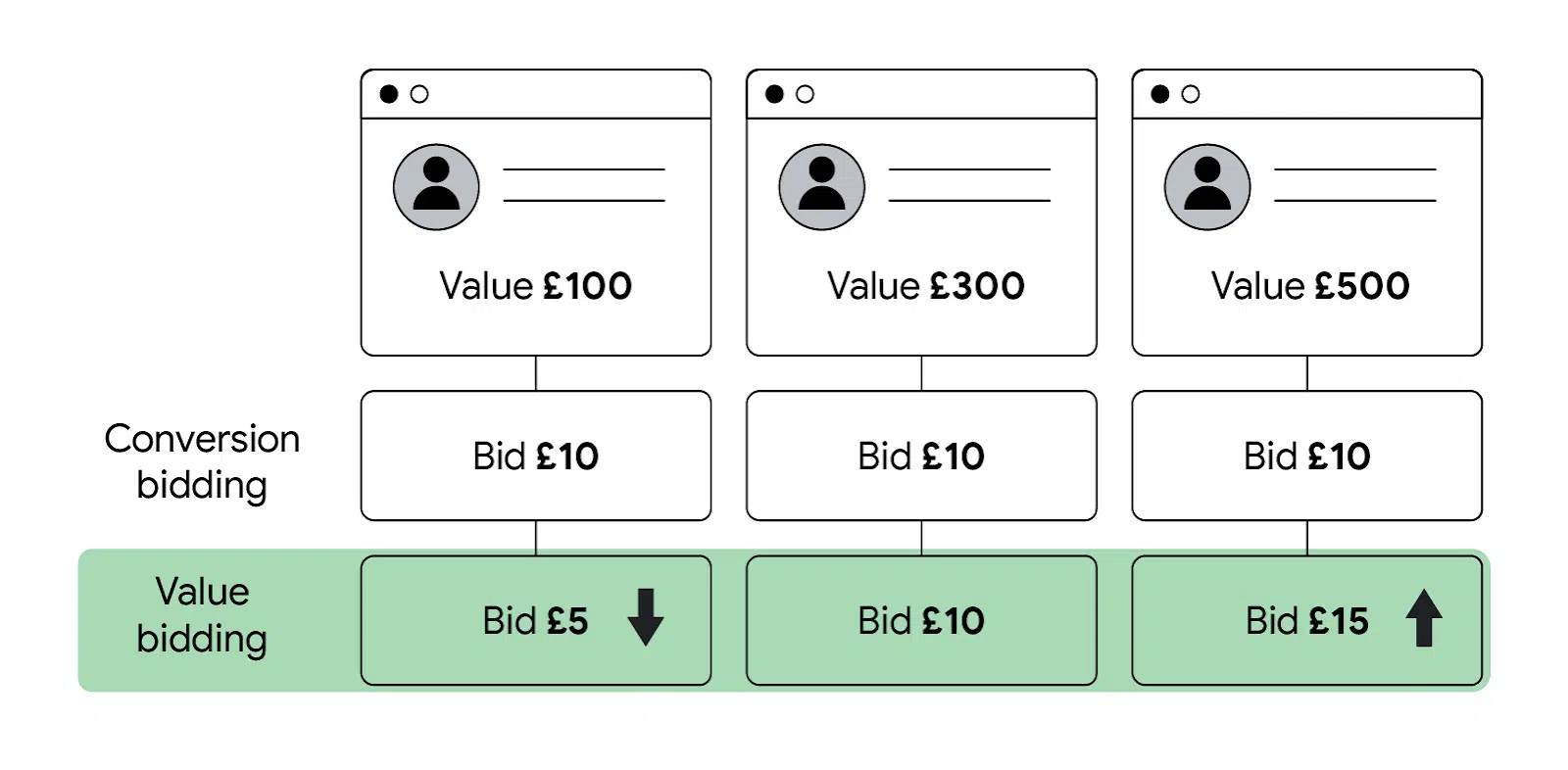
Bidding based on potential customer value
Source: Think with Google
Upgrading from a conversion-based to a value-based strategy represents a shift from optimizing for the highest number of conversions to prioritizing the most valuable customers, according to Ginny Marvin, Ads Product Liaison at Google.
As a consequence of this shift, advertisers should anticipate a trade-off between volume and value.
Therefore, Target ROAS is generally more likely to return a higher total conversion value but lower conversion volume than Target CPA.
Here are five key considerations to help assess your business readiness for tROAS in Google Ads.
1. Variability in sales value
Before delving into the more technical requirements of value-based bidding, it might be useful to weigh up the size of the opportunity.
Considering the variability in sales value will give you some indication of the potential upside that Target ROAS could bring to your business.
At its core, value-based bidding aims to optimize toward high-value conversion outcomes and away from low-value conversion outcomes.
If your business has high variability in sales value within the same product or service category, you’re better placed to reap the rewards of Target ROAS.
Consider an ecommerce store selling products worth $20, $50 and $100.
All things being equal, this store is more likely to benefit from value-based bidding than a store that only sells products worth $50. That’s because the algorithm can drive more $100 sales and fewer $20 sales.
The disparity in value creates the opportunity to optimize for more valuable conversion outcomes.
Conversely, the store in the second example lacks the same capacity for optimization as all products are worth the same.
Value-based bidding is further amplified by greater variance or spread in conversion value.
In our initial example, there’s a moderate level of variance. For instance, the variance would be considerably higher if the products were worth $5, $50 and $500.
A broader distribution in conversion values gives the AI more room to find efficiencies and maximize overall conversion value.
The principle of variability applies to any assigned conversion value, be it revenue, gross profit, or another value estimate unique to your business.
Using value-based bidding in low variability scenarios
What if your products or services are priced similarly? Could you still benefit from value-based bidding?
Even if your prices are uniform, the profit margins may differ. Different customers may buy varying quantities at different frequencies and repeat rates.
In other words, if conversion value variability is low from a revenue perspective, it may not be through the lens of gross profit or customer lifetime value (CLV). We’ll explore the implications of each of these options shortly.
Suppose every sale in your business generates the same conversion value, irrespective of the financial measure you associate with it.
In this scenario, you would assign an identical value to each conversion.
This is similar to Target CPA, but instead of telling Google what you’re willing to pay for a conversion, you’re defining how much a conversion is worth and using the ROAS target as your lever.
The main difference is that with value-based bidding, your bids are pegged to your returns.
The AI will automatically adjust bids with the conversion value against your ROAS target.
Therefore, Target ROAS provides an automation benefit, even when conversions don’t fluctuate in value.
2. Sales volume
Another key consideration is the number of sales your business generates each month.
This will tell you whether you can accumulate sufficient conversion data on an ongoing basis to meet the minimum conversion thresholds.
Target ROAS requires minimum conversion thresholds to provide Google with adequate data to make statistically reliable bidding decisions.
This data allows the AI to spot patterns, establish correlations, and draw meaningful insights that fuel machine learning.
Without sufficient conversion data, the AI would base its analyses on smaller and potentially unrepresentative samples, which could compromise its predictive capabilities.
Larger data sets provide Google more opportunities to learn and bid more effectively.
Most campaign types require at least 15 conversions per campaign in the previous 30 days to run Target ROAS.
However, minimum thresholds can vary by campaign type, as shown in the table below. Note that your conversions must include valid values to qualify toward the threshold.
Minimum Target ROAS conversion thresholds by campaign type
Campaign type
Minimum conversions
Qualification period
Search campaigns
At least 15 conversions
Last 30 days
Shopping campaigns
At least 15 conversions
Last 30 days
Display campaigns
At least 15 conversions
Last 30 days
Video action campaigns
At least 30 conversions
Last 30 days
Discovery campaigns
At least 75 conversions
Last 30 days
App campaigns
At least 300 conversions
Last 30 days
Please refer to the latest guidelines for the most up-to-date information.
For new or small campaigns with insufficient conversion data, you can start with Maximize Conversion Value, which has no minimum requirements.
Then upgrade to Target ROAS once you reach the required threshold for your respective campaign type.
An important decision is what conversion event to use as your primary conversion action.
When deciding, you must consider your sales volume in conjunction with the length of your sales cycle.
Get the daily newsletter search marketers rely on.
3. Sales cycle length
The duration of your business cycle will dictate the speed at which you can assign values to different conversions and feed those back into Google.
The faster you can import conversion values, the sooner the AI can factor that data into its computations.
Sales cycles can vary significantly depending on the industry you’re in.
In lead gen, the B2B sales cycle is typically between 60 to 90 days due to the cost, complexity and multiple decision-makers involved.
B2C tends to have a much shorter cycle, ranging from a few minutes to a few weeks.
In contrast, B2B ecommerce generally has a shorter cycle than traditional B2B sales.
Finally, B2C ecommerce would see the shortest sales cycle due to its direct-to-consumer transactions and relatively lower cost.
Consider the average time your prospect clicked your ad and the conversion event. Note that the conversion needs to occur within 90 days of the click. Otherwise, it would fall outside the lookback window, and Google won’t be able to attribute that value back to the original click.
You must choose the primary conversion action most likely to drive optimal performance.
As a rule of thumb, Google recommends optimizing for the conversion event that occurs furthest down your marketing funnel and meets the minimum eligibility criteria.
Here are some general guidelines to inform your decision
Scenario 1: High sales volume, short sales cycle
If your sales cycle is around two weeks or less and you generate at least 100 sales a month, then you’re in a position to optimize for sales or closed deals.
If you’re running lead gen campaigns, consider secondary observational conversion actions, such as:
Sales Qualified Leads (SQLs).
Marketing Qualified Leads (MQLs).
Form submissions.
Calls.
Alternatively, if you’re running ecommerce campaigns, consider including begin checkout, add to cart, or newsletter subscriptions as secondary conversions.
Scenario 2: Low sales volume, long sales cycle
If your lead gen sales cycle is up to three months and you generate at least 30 sales a month, consider using either SQLs or MQLs as your primary conversion action.
It may also be worthwhile to include sales, form submissions, and calls as secondary conversions for enhanced visibility of your funnel.
In ecommerce, consider using either begin checkout or add to cart as your primary conversion action, while adding sales and subscriptions as secondary conversions.
Scenario 3: Low sales volume, long sales cycle, and long lead qualification time
If your lead qualification time takes more than 30 days:
Use form submissions and calls as primary conversions.
Consider importing sales, SQLs, MQLs, and page interactions as secondary conversions.
Recommended conversion actions in lead generation
Scenario
Sales Cycle
Sales vol.
Primary
Secondary
High sales volume, short sales cycle
~2 weeks
100/month
Closed deals
SQLs/MQLs, form subs. and calls
Low sales volume, long sales cycle
3 months
30/month
SQLs/MQLs
Closed deals, form subs. and calls
Low sales volume, long sales cycle + long lead qual. time (~30 days)
3 months
30/month
Form subs. and calls
SQLs/MQLs, closed deals, page engagement
Recommended conversion actions in ecommerce
Scenario
Sales Cycle
Sales vol.
Primary
Secondary
High sales volume, short sales cycle
~2 weeks
100/month
Sales
Add to cart, begin checkout
Low sales volume, long sales cycle
3 months
30/month
Begin checkout, add to cart
Sales, newsletter subscriptions
Google recommends importing your entire conversion funnel for improved visibility while focusing on a single primary conversion action for bid optimization.
An exception to this could be using both form submissions and calls as primary conversion actions, provided there is no duplication
Mapping your marketing funnel can be a good starting point to visualize your prospects’ key actions along their conversion path.
Google’s conversion value calculator provides a quick way to calculate the average values of the conversion actions at every stage of your customer journey.
4. Data accuracy
So far, we’ve emphasized the importance of variability, volume, and frequency. However, the quality of your data will determine the degree of your success.
In the context of Target ROAS, data quality is the extent to which your conversion values accurately reflect their economic worth to your business.
Target ROAS relies on accurate input to deliver your target return on ad spend.
If your conversion values don’t correspond to their true monetary value, neither will the AI’s bidding nor your campaign results.
The “garbage in, garbage out” principle firmly applies here. No matter how advanced the algorithm, a low-quality input is unlikely to produce a high-quality output.
This leads us to the next important decision: What conversion values do you feed the AI?
As a general rule, your acquisition strategy should align with your business goals. Here are several approaches you could take:
Optimizing for proxy values
If you can’t measure or assign transaction-specific values, you can still run Target ROAS using static proxy values.
This is straightforward as it doesn’t necessitate a complex conversion tracking configuration.
Instead, you assign a fixed value to your primary conversion actions, meaning every conversion will account for the same value.
However, you can dynamically adjust your values using rules based on criteria such as location, device, or audience.
If your sales values typically fluctuate, proxy values won’t accurately reflect the true economic value of your conversions.
As such, using proxies is the simplest but most limiting way to go about value-based bidding.
Optimizing for revenue
If your business goal is to maximize the gross value of sales, consider using revenue conversion values. This will require importing dynamic conversion values and an accurate estimate of the revenue driven by each conversion.
By aligning your value-based bidding with revenue, the AI will aim to maximize the total revenue generated within your ROAS target.
Besides driving top-line growth, this may also be suitable for market share expansion or promoting a new product.
A drawback of revenue optimization is its neglect of profitability. They will likely have different profit margins if you offer a wide range of products or services.
However, this difference will not be considered by the AI, which could lead to an overemphasis on high-revenue but low-margin products or services.
Optimizing for profit
If your business prioritizes the bottom line, consider assigning values that closely mirror your gross profit. To calculate gross profit, deduct the cost of goods sold from your sales revenue.
Since ad spend is also a cost of sale, you can use custom columns in your Google Ads account to subtract ad spend from your conversion value (i.e., All conversion value – Cost).
Note that Target ROAS will still optimize for the value in the All conversion value column.
By optimizing for profit, the AI will deploy your budget towards the most financially favorable outcomes.
In the short term, this should yield the highest total gross dollar amount, assuming accurate values, sufficient volume, and timely data imports.
Remember that optimizing for profit could come at the expense of lower conversion volumes.
Moreover, focusing on profit may overlook potential opportunities to grow your customer base or expand your reach.
Lastly, measuring and tracking the true profitability of each conversion can be especially challenging due to the various cost factors at play.
Optimizing for customer lifetime value (CLV)
If you’re aiming to maximize long-term profitability, consider using predicted customer lifetime value (CLV).
This requires assigning a forecasted value to each conversion based on the total expected value over the entire course of the customer relationship.
CLV generally incorporates average order value, purchase frequency, retention rate, and customer acquisition and retention costs. The relative weighting and exact calculation methods can vary across industries.
Like optimizing for short-term profit, this will also likely limit your reach to a smaller conversion pool. Furthermore, accurately estimating long-term profit can be exponentially more complex.
Over the long run, CLV optimization has the potential to deliver the highest return on investment.
But tread carefully. This strategy banks on spending money today and recovering it years into the future.
The delay in feedback on financial performance could prove costly should your initial projections turn out to be incorrect.
While CLV offers significant potential upside, it also comes with considerable uncertainty and upfront costs, making it something of a leveraged bet.
Given these risks, it may be prudent to test CLV-based bidding only after successfully validating a proof of concept using Target ROAS aligned with revenue or profit.
5. Data infrastructure
Hopefully, by now, you have an idea of how to tackle value-based bidding for your specific use case. Assuming your business ticks all the boxes, the next key consideration is data logistics.
More specifically, what systems will you need in place to streamline your marketing data and does your business have the capacity to accommodate your requirements?
Implementing Target ROAS will require a reliable way to collect, store and import data back into Google regularly. You can do this manually, automatically, or combine the two depending on your strategy.
Here are the three main tracking options available:
Manual conversion tracking
Manual conversion tracking allows you to assign a static conversion value for each conversion action inside Google Ads.
This can easily be set and modified on the platform without the need for technical expertise or third-party software.
As noted earlier, this is an imprecise way to track value since static conversion values don’t account for variations in purchase value.
Assuming that your conversion values fluctuate, this is why it’s a suboptimal conversion tracking method.
Tag-based conversion tracking
Tag-based conversion tracking relies on a Google-generated JavaScript code snippet (the “tag”) embedded on your website.
When a user completes a conversion action, the tag captures the associated conversion value and sends it back to Google.
Ecommerce businesses most commonly use this tracking method as it provides a way to dynamically adjust the conversion value to match the actual order value.
This usually means that the conversion values correspond to revenue rather than profit, as the tag pulls the monetary amount the customer spent on a transaction.
It’s also possible to track profit using the tag-based method as long as the profit value is known and accessible when the tag fires.
This may require deep integration with your inventory systems and third-party software to accurately calculate the profit for every sale in real time.
So, while it’s possible to track profit, it may not be practical or feasible for most businesses due to the added complexity involved.
Setting up tag-based conversion tracking requires technical proficiency and can be challenging for businesses with various products or services.
Another limitation of tag-based tracking is its dependence on cookies to attribute conversions back to the ad click.
When a user rejects, blocks, or deletes cookies, this can result in data gaps, negatively impacting your optimization.
Offline conversion tracking uses a Google Click Identifier (GCLID) to track offline conversion outcomes following a user’s interaction with your ad.
The GCLID is a unique string of characters that Google automatically appends to your destination URLs.
This tracking method requires that you capture the GCLID parameter alongside the lead or customer’s details and store them in your CRM database.
You can import that data back to the platform once a conversion value is assigned. Google will then use the GCLID to associate the conversion value back to the correct click.
You can import offline conversions manually inside the Google UI or schedule a recurring upload via Google Sheets, HTTPS or SFTP.
Alternatively, you can automate this process using Google Ads API, which would require developer input.
It’s worth checking whether your existing CRM can be directly integrated with Google Ads, as this could save you significant time and effort.
Offline conversion tracking can be a reliable and comprehensive way to track conversion outcomes.
It also offers flexibility when assigning values that best align with your business objectives.
Moreover, it allows you to retract and restate values you’ve already uploaded to reflect returned orders, canceled bookings, or failed deals.
Depending on the degree of complexity, you may require technical resources to get this up and running.
A downside of this approach is its reliance on a clear connection between the ad click and the offline conversion.
In practice, this will not always be possible due to the length of the customer journey or the nature of the conversion itself.
Regardless of the tracking method you choose, it’s important to ensure that your processing of user and customer data complies with local and international data protection and privacy laws in your jurisdictions.
The primary purpose of importing first-party conversion data into the platform is to guide the AI’s bidding decisions.
However, linking the conversion value to the exact click that drove it also unlocks Google Ads’ full reporting capabilities.
This allows you to track profitability down to granular details such as search terms, ads, or placements, to name a few.
Assessing your business’s readiness for Target ROAS
A successful value-based bidding strategy comes down to your data’s variability, volume, speed, and accuracy and the infrastructure needed to support your marketing operation.
Variability is the degree to which your conversions fluctuate in value.
Volume refers to the amount of conversion data that you generate.
Speed measures how promptly you can feed the data back to the AI.
While accuracy is the extent to which your data reflects the true economic value to your business.
Your infrastructure represents the technical foundation to collect, store, and import conversion data to the Google Ads platform.
We’ve established that AI thrives on data, but to fully harness Target ROAS, it’s vital to strike the right balance between quality and quantity.
While Google recommends optimizing for the conversion furthest down your funnel that meets the eligibility criteria, that may not always be the best approach.
Depending on the quality of your data, you may see better results by optimizing for a conversion higher up the funnel that provides the AI with more data points.
Sometimes, feeding the AI with a lot of ‘good’ data can outweigh feeding it the bare minimum of “great” data.
Equally, a smaller pool of accurately calculated conversion values may outperform a larger pool of less accurately calculated ones. It’s up to you to adapt your strategy to your unique business circumstances and test your way to success.
So, to ROAS or not to ROAS? That is the question only you can answer.
Theoretical evaluation is a good place to start. But to know how effective value-based bidding can be, you’d have to press that live button and find out.
Opinions expressed in this article are those of the guest author and not necessarily Search Engine Land. Staff authors are listed here.
@media screen and (min-width: 800px) { #div-gpt-ad-3191538-7 { display: flex !important; justify-content: center !important; align-items: center !important; min-width:770px; min-height:260px; }
}
@media screen and (min-width: 1279px) { #div-gpt-ad-3191538-7 { display: flex !important; justify-content: center !important; align-items: center !important; min-width:800px!important; min-height:440px!important; }
}
About the author
George Prodanov is the Head of Paid Media at Love Energy Savings, the UK’s leading utilities marketplace. He is a performance marketing expert with over 10 years of experience in-house, agency-side, and as a consultant. George’s core expertise lies in paid search, where he’s delivered highly profitable campaigns across 27 countries and 18 languages for private equity-backed businesses, FTSE 100 brands, and SMBs. He has successfully managed large-scale marketing budgets in various sectors including energy, financial services, technology, supply chain & logistics, and telecommunications.
Threads users can now search through posts on the platform.
Meta CEO Mark Zuckerberg announced the new functionality has now been rolled out to most English and Spanish-speaking countries, including the US and UK.
The new search feature is available on both the Threads mobile app and web app.
Why we care. Potential customers now have a new way to search for and discover brands on Threads, which could result in increased visibility.
Get the daily newsletter search marketers rely on.
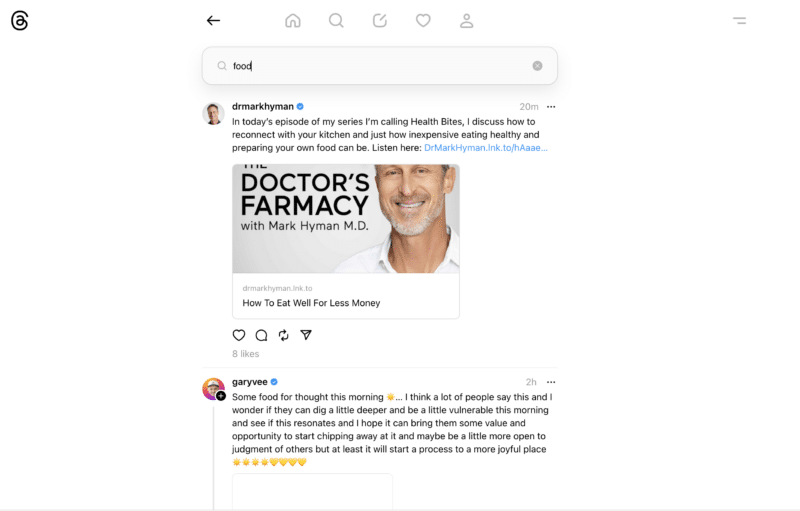
What’s new? Threads did have a search feature when it first launched back in July, however, this only provided the ability to search through users – not posts.
Following testing in Australia and New Zealand last month, Threads’ new search functionality allows users to browse posts using keywords. Below is a screenshot of the new feature in action:
Deep dive. Read our Threads FAQ guide for more information.
@media screen and (min-width: 800px) { #div-gpt-ad-3191538-7 { display: flex !important; justify-content: center !important; align-items: center !important; min-width:770px; min-height:260px; }
}
@media screen and (min-width: 1279px) { #div-gpt-ad-3191538-7 { display: flex !important; justify-content: center !important; align-items: center !important; min-width:800px!important; min-height:440px!important; }
}
About the author
Nicola Agius is Paid Media Editor of Search Engine Land after joining in 2023. She covers paid search, paid social, retail media and more. Prior to this, she was SEO Director at Jungle Creations (2020-2023), overseeing the company’s editorial strategy for multiple websites. She has over 15 years of experience in journalism and has previously worked at OK! Magazine (2010-2014), Mail Online (2014-2015), Mirror (2015-2017), Digital Spy (2017-2018) and The Sun (2018-2020). She also previously teamed up with SEO agency Blue Array to co-author Amazon bestselling book ‘Mastering In-House SEO’.
Influencer ad spend is now growing faster than traditional ad investment
Influencer ad spend is accelerating faster than investment in traditional adverts.
Brands were advised to consider adjusting their campaign strategies to align with the rising popularity of influencers after this finding was revealed in Insider Intelligence’s Influencer Marketing 2023 report.
Why we care. As more businesses embrace influencer marketing, the way people consume ads is shifting. This suggests that traditional ads might not work as well anymore. Advertisers should stay updated on these changes to ensure they get the most out of their ad investments.
Income breakdown. The report included a detailed breakdown of how influencers are generating incomes on their platforms (% of respondents):
Sponsored content – 82%
Affiliate – 56%
Advertising revenue – 33%
Creatore funds – 25%
Paid content subscriptions – 16%
Selling merchandise – 15%
Influencer opportunities on the rise. The Hollywood writers’ strike could create more chances for influencer marketing, which may accelerate influencer ad spend even further, according to the report. This is because content creators are likely to seek alternative ways to make money during the strike. Additionally, social platforms are actively trying to attract top creative talent, which is likely to open up more possibilities for brand partnerships.
Get the daily newsletter search marketers rely on.
What has Insider Intelligence said? A spokesperson from Insider Intelligence said in the report:
“The time to act is now. Influencer marketing spending will rise roughly 3.5 times faster in 2023 than social ad spending will. That’s a testament to the resilience of creators, even amid economic concerns and major competition.”
Deep dive. Download the complete Insider Intelligence report and read it in full for more information.
@media screen and (min-width: 800px) { #div-gpt-ad-3191538-7 { display: flex !important; justify-content: center !important; align-items: center !important; min-width:770px; min-height:260px; }
}
@media screen and (min-width: 1279px) { #div-gpt-ad-3191538-7 { display: flex !important; justify-content: center !important; align-items: center !important; min-width:800px!important; min-height:440px!important; }
}
About the author
Nicola Agius is Paid Media Editor of Search Engine Land after joining in 2023. She covers paid search, paid social, retail media and more. Prior to this, she was SEO Director at Jungle Creations (2020-2023), overseeing the company’s editorial strategy for multiple websites. She has over 15 years of experience in journalism and has previously worked at OK! Magazine (2010-2014), Mail Online (2014-2015), Mirror (2015-2017), Digital Spy (2017-2018) and The Sun (2018-2020). She also previously teamed up with SEO agency Blue Array to co-author Amazon bestselling book ‘Mastering In-House SEO’.
How to use PPC advertising to attract top talent in any industry
Economic uncertainty and evolving employee preferences have transformed hiring dynamics. This makes recruiting top talent challenging for businesses and even agency partners supporting these efforts.
While skilled recruiters excel in traditional hiring methods, digital marketers can also contribute to ensuring the recruitment process’s efficiency and effectiveness.
PPC advertising can be hugely impactful for attracting and recruiting talent across any industry. In this article, we’ll discuss PPC strategies and tactics you can try to support your talent acquisition efforts.
Make sure you’re there before you need to be
Potential candidates often casually browse rather than actively search for a new job.
Traditional job postings are effective at attracting those actively seeking opportunities. However, they often don’t communicate why joining your team would be a compelling career move.
You can capture that passive audience using paid ads by including broader, awareness-based coverage focusing on branding your company as a potential employer.
This strategy could encompass a variety of ad types targeted toward your preferred geography, relevant audiences (industries, interests) and keywords. It should showcase information about the company and what it’s like to work there.
Consider what you care about as an employee when developing this kind of paid ad coverage. Is it the benefits? Growth opportunity? Work arrangement?
Whatever it may be, ensure you include it front and center in your targeting, ad copy, and graphics.
Stay front and center
Gaining awareness is essential, but it will be for naught if people don’t remember you when it counts.
Once you’ve broadened your coverage to meet the passive market, you also want to remain top of mind when a potential candidate moves into the “actively seeking” mindset. This is possible with retargeting.
You’ll want to capture users as they gain initial awareness by browsing the website or engaging with your ads, then create audiences based on these actions.
When the audience list is large enough, you can target them across various ad types and platforms. Your messaging should feature more specifics on open positions, the company values/culture, and why someone would want to join the team.
Maintaining a consistent and customized retargeting strategy keeps you relevant and highlights desired qualities as potential applicants transition from passive browsing to active job seeking.
Get the daily newsletter search marketers rely on.
Work smarter, not harder
When it comes to recruiting, PPC advertising enables us to “work smarter” in a couple of ways.
Use the targeting options you know to qualify candidates
Keywords, audiences, career demographics and geographical targeting are useful to ensure that you’re showing the “We’re Hiring” message to a prequalified group of potential candidates.
This will ideally increase the quality of candidates and decrease the quantity of less desirable applications that the recruiting team has to sort through.
For example, consider targeting by:
Job and company industry, seniority, and company size on LinkedIn.
Job title, employer, or interest on Facebook and Instagram.
Keywords and in-market audiences on Google Ads.
Adjust your strategy as needed
Dig deeper into what is and is not working and adjust strategy using robust analytics and reporting for your paid ad campaigns.
Through a combination of platform and analytics tool data, you can paint a fairly clear picture of your potential applicant’s journey.
With this information, the recruiting teams can improve the hiring process by removing friction points and quickly giving candidates what they’re looking for.
This can help increase the efficiency of the recruiting process as a whole, not just improve the experience for your potential employees.
Test tactics and platforms to see what works for you
The ability to test different strategies and tactics in an agile way is at the core of what makes PPC advertising so impactful.
There is a seemingly endless list of ad platforms to choose from these days, each with its own pros and cons, so it’s crucial to strategically test different ones to find what works best for you.
Here are some platforms to consider and their main advantages and disadvantages. (Remember to conduct your own research to find the best starting point for your needs.)
Paid search
Google Ads
Pros
Keyword targeting and audience targeting, particularly in-market audiences, can be great for honing in on active job seekers.
Cons:
The audience targeting here can be too broad sometimes, meaning you may experience lower efficiency.
Microsoft Ads
Pros
Has all the same benefits as Google Ads, plus the ability to get even more specific with a handful of LinkedIn-based targeting options like company, industry, and job function.
These additional layers can help you more efficiently allocate recruiting resources.
Cons
There is a smaller audience on Microsoft Ads than on other channels, which may make this channel less attractive than others.
Paid social
LinkedIn Ads
Pros
Has the most robust career-related targeting options out of all ad platforms, including job title, job function, company, company industry, company size, seniority, past employers, etc.
There are also ad formats available specifically geared towards promoting job postings and the ability to boost already posted job listings to the LinkedIn Jobs section.
Cons
Volume is typically a bit lower on this platform due to the high level of specificity in targeting, and costs can skew higher than other platforms.
Facebook or Instagram Ads
Pros
This is where people spend the majority of their time online, making the potential available audience very large.
Targeting options include highly relevant categories like job title and employer that are based, in part, on self-reported profile information.
Cons
It can be difficult to get highly specific on this platform due to the nature of how the audiences work.
You may capture users who are less desirable than you would on other platforms.
Display
Programmatic advertising
Pros
There is the opportunity for robust targeting across first-party, third-party, keyword and contextual theme audiences via programmatic platforms like The Trade Desk, StackAdapt, etc.
You can hone in even further by selecting individual websites to show ads on via domain or private marketplace placements, where you can select only specific sites to show ads on.
For example, if you’re trying to recruit for a healthcare business, you can target only a list of industry-specific job board websites, providing a hyper-specific audience.
This type of targeting can increase the number and quality of applicants and is often more cost-effective than other platforms.
Cons:
Programmatic ads are mainly display-based, so you must ensure that you have the resources to create high-quality, impactful graphics.
Using PPC to attract and recruit top talent
Attracting and recruiting highly qualified talent can be challenging.
By diversifying your company’s efforts to include PPC advertising, you can expand your reach and improve the efficiency and effectiveness of the entire process.
Opinions expressed in this article are those of the guest author and not necessarily Search Engine Land. Staff authors are listed here.
@media screen and (min-width: 800px) { #div-gpt-ad-3191538-7 { display: flex !important; justify-content: center !important; align-items: center !important; min-width:770px; min-height:260px; }
}
@media screen and (min-width: 1279px) { #div-gpt-ad-3191538-7 { display: flex !important; justify-content: center !important; align-items: center !important; min-width:800px!important; min-height:440px!important; }
}
About the author
Jenny has years of experience in paid digital marketing strategy and execution across in-house, agency, and consulting settings. She is currently an Associate Director of Paid Media within a large international digital marketing agency, where she manages a team of paid media experts to support their professional development, while also using her skills and experience to scale growth and efficiency for client accounts. If Jenny’s not working, she’s probably out on the water enjoying the outdoors and the beaches of North Carolina, where she lives.
Google Chrome persists with targeted ads that use your browser history
Google has slowly been rolling out its Enhanced Ad Privacy functionality in Chrome.
This technology allows websites to serve ads based on your browser history – unless you manually turn it off.
Why we care. Some folks are worried that this tech might invade their privacy. More and more people are speaking up, saying they don’t like the idea of their online actions being watched for ads. Using this method could harm a brand’s image, so it might be a good idea to look into other options that won’t upset your potential target audience.
The roll-out. People started receiving popups about this new feature in July following the release of Chrome 115 – which supports Google’s Topics API (part of its Privacy Sandbox project). However, recently, an increasing number of people have reported seeing the popup because those who don’t like Chrome mining their browsing history for Google’s ads have been speaking out.
How it works. Instead of tracking your interests through cookies and the websites you visit, websites can directly ask Chrome what you’re interested in using its Topics JavaScript API.
Chrome figures out your interests by studying your browsing history. For example, if you often visit financial websites, Chrome might label one of your interests as “investing”.
When a website checks with the Topics API, it can learn about your interests and show you ads related to it, like bonds or retirement funds. This way, websites can get your online interests directly from your browser.
The technology has been rolling this out to a small percentage of Chrome users at a time, so you might not have seen it or been notified yet. How Google asks for your agreement on this ad targeting depends on where you live and the local laws.
Get the daily newsletter search marketers rely on.
What has Google said? A Google spokesperson said in a statement:
“With Topics, your browser determines a handful of topics, like fitness or travel and transportation, that represent your top interests for that week based on your browsing history. Topics are kept for only three weeks and old topics are deleted.”
“Topics are selected entirely on your device without involving any external servers, including Google servers. When you visit a participating site, Topics picks just three topics, one topic from each of the past three weeks, to share with the site and its advertising partners.”
“Topics enables browsers to give you meaningful transparency and control over this data, and in Chrome, we’re building user controls that let you see the topics, remove any you don’t like or disable the feature completely.”
@media screen and (min-width: 800px) { #div-gpt-ad-3191538-7 { display: flex !important; justify-content: center !important; align-items: center !important; min-width:770px; min-height:260px; }
}
@media screen and (min-width: 1279px) { #div-gpt-ad-3191538-7 { display: flex !important; justify-content: center !important; align-items: center !important; min-width:800px!important; min-height:440px!important; }
}
About the author
Nicola Agius is Paid Media Editor of Search Engine Land after joining in 2023. She covers paid search, paid social, retail media and more. Prior to this, she was SEO Director at Jungle Creations (2020-2023), overseeing the company’s editorial strategy for multiple websites. She has over 15 years of experience in journalism and has previously worked at OK! Magazine (2010-2014), Mail Online (2014-2015), Mirror (2015-2017), Digital Spy (2017-2018) and The Sun (2018-2020). She also previously teamed up with SEO agency Blue Array to co-author Amazon bestselling book ‘Mastering In-House SEO’.
Google will soon require political ads to disclose when AI-generated images, videos and audio have been used.
From November, political adverts must clearly feature a disclaimer when “synthetic content” is used to depict “realistic-looking people or events”, reports Bloomsberg.
Why we care. Tackling fake news and enhancing online safety could boost people’s trust in the internet, which could ultimately give them more confidence to shop online.
How will it work? Political ads must feature labels to act as red flags when AI content has been used, such as:
“This image does not depict real events.”
“This video content was synthetically generated.”
“This audio was computer generated.”
“This image does not depict real events.”
Campaigns that use AI for “inconsequential” tweaks, such as small edits to photos like the removal of red eye, will not need to feature a disclaimer.
Why now? The new rules are coming into force one year ahead of the next US Presidential election. A Google spokesperson told the BBC that the move was in response to “the growing prevalence of tools that produce synthetic content”.
The news also comes one week after X (the platform formerly known as Twitter) announced that it is bringing back political ads ahead of the 2024 US election.
Get the daily newsletter search marketers rely on.
What has Google said? The search engine explains the consequences of not adhering to its rules in the Google political content policy:
“Non-compliance with our political content policies may result in information about your account and political ads being disclosed publicly or to relevant government agencies and regulators.”
@media screen and (min-width: 800px) { #div-gpt-ad-3191538-7 { display: flex !important; justify-content: center !important; align-items: center !important; min-width:770px; min-height:260px; }
}
@media screen and (min-width: 1279px) { #div-gpt-ad-3191538-7 { display: flex !important; justify-content: center !important; align-items: center !important; min-width:800px!important; min-height:440px!important; }
}
About the author
Nicola Agius is Paid Media Editor of Search Engine Land after joining in 2023. She covers paid search, paid social, retail media and more. Prior to this, she was SEO Director at Jungle Creations (2020-2023), overseeing the company’s editorial strategy for multiple websites. She has over 15 years of experience in journalism and has previously worked at OK! Magazine (2010-2014), Mail Online (2014-2015), Mirror (2015-2017), Digital Spy (2017-2018) and The Sun (2018-2020). She also previously teamed up with SEO agency Blue Array to co-author Amazon bestselling book ‘Mastering In-House SEO’.
YouTube is removing individual ad controls on new videos
YouTube is binning individual ad controls for newly uploaded videos in November for the following ad types:
Pre-roll
Post-roll
Skippable
Non-skippable
Moving forward, creators will only be able to decide between displaying ads before or after a video, and whether to have this option on or off. If they turn this option on, YouTube will automatically decide which ad type to display as appropriate.
Creators will still have complete control over mid-roll ads, however, with the option to manually select ad breaks or turn on automatic ad breaks.
Why we care. Simplifying ad management with automation could save time and reduce the risk of human error. However, some advertisers might find it frustrating to have less control, as it could negatively impact the user experience and potentially increase the use of ad blockers.
Why now? Google is making changes based on feedback that making individual selections was confusing for both newly monetizing and existing creators. The search engine explained it is making changes to:
“Extend best practices within the creator community and optimize creator revenue.”
This decision follows YouTube’s announcement about running 30-second non-skippable ads and exploring the possibility of longer but less frequent ads on connected TVs.
Get the daily newsletter search marketers rely on.
What has YouTube said? A YouTube spokesperson said:
“This change is happening in order to extend best practices within the creator community and optimize creator revenue.”
“Our goal is to help creators earn more, while making the ad experience as simple as possible so creators can do what they do best, and that’s creating great content.”
“Most creators shouldn’t notice a change as they already have many of these ad formats turned on by default.”
“In the last year, for long-form videos that were enabled for monetization at time of publishing, more than 90% of videos had pre-roll, post-roll, skippable, and non-skippable ads turned on.”
Deep dive. Read YouTube’s Simplifying Ad Controls announcement in full for more information.
@media screen and (min-width: 800px) { #div-gpt-ad-3191538-7 { display: flex !important; justify-content: center !important; align-items: center !important; min-width:770px; min-height:260px; }
}
@media screen and (min-width: 1279px) { #div-gpt-ad-3191538-7 { display: flex !important; justify-content: center !important; align-items: center !important; min-width:800px!important; min-height:440px!important; }
}
About the author
Nicola Agius is Paid Media Editor of Search Engine Land after joining in 2023. She covers paid search, paid social, retail media and more. Prior to this, she was SEO Director at Jungle Creations (2020-2023), overseeing the company’s editorial strategy for multiple websites. She has over 15 years of experience in journalism and has previously worked at OK! Magazine (2010-2014), Mail Online (2014-2015), Mirror (2015-2017), Digital Spy (2017-2018) and The Sun (2018-2020). She also previously teamed up with SEO agency Blue Array to co-author Amazon bestselling book ‘Mastering In-House SEO’.
As the PPC landscape continues to evolve, having the ability to predict future campaign performance is invaluable.
This article will cover some of my favorite PPC forecasting techniques using Google Sheets and Vertex AI that paint a clearer picture of the future and empower clients with actionable insights.
While no tool or technique can provide a 100% accurate picture of the future, the methods outlined here can show us a glimpse into the potential trajectories of PPC campaigns.
Google Sheets FORECAST function: The basics
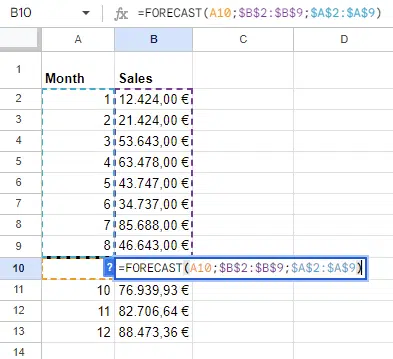
Google Sheets offers an easy-to-use and reliable forecasting function using the formula:
=FORECAST(z, known_y values, known_x values)
Where:
z is the data point for which you want to predict a corresponding y-value.
known_y's is the range of dependent data points (usually your past results or outcomes).
known_x's is the range of independent data points (usually the variable you think might influence your outcomes).
This function is a great tool if you only have two dimensions.
However, it uses linear regression, which is fine for a quick forecasting sneak peek but nothing too advanced to account for external circumstances or other data sources.
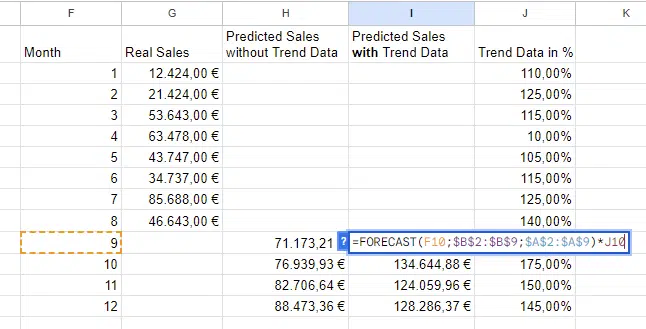
Let’s say you have historical data from the last year and want to forecast future budget predictions to have some numbers to plan with.
In this example, we have the current year’s sales data up to August and want to forecast future sales from September to December.
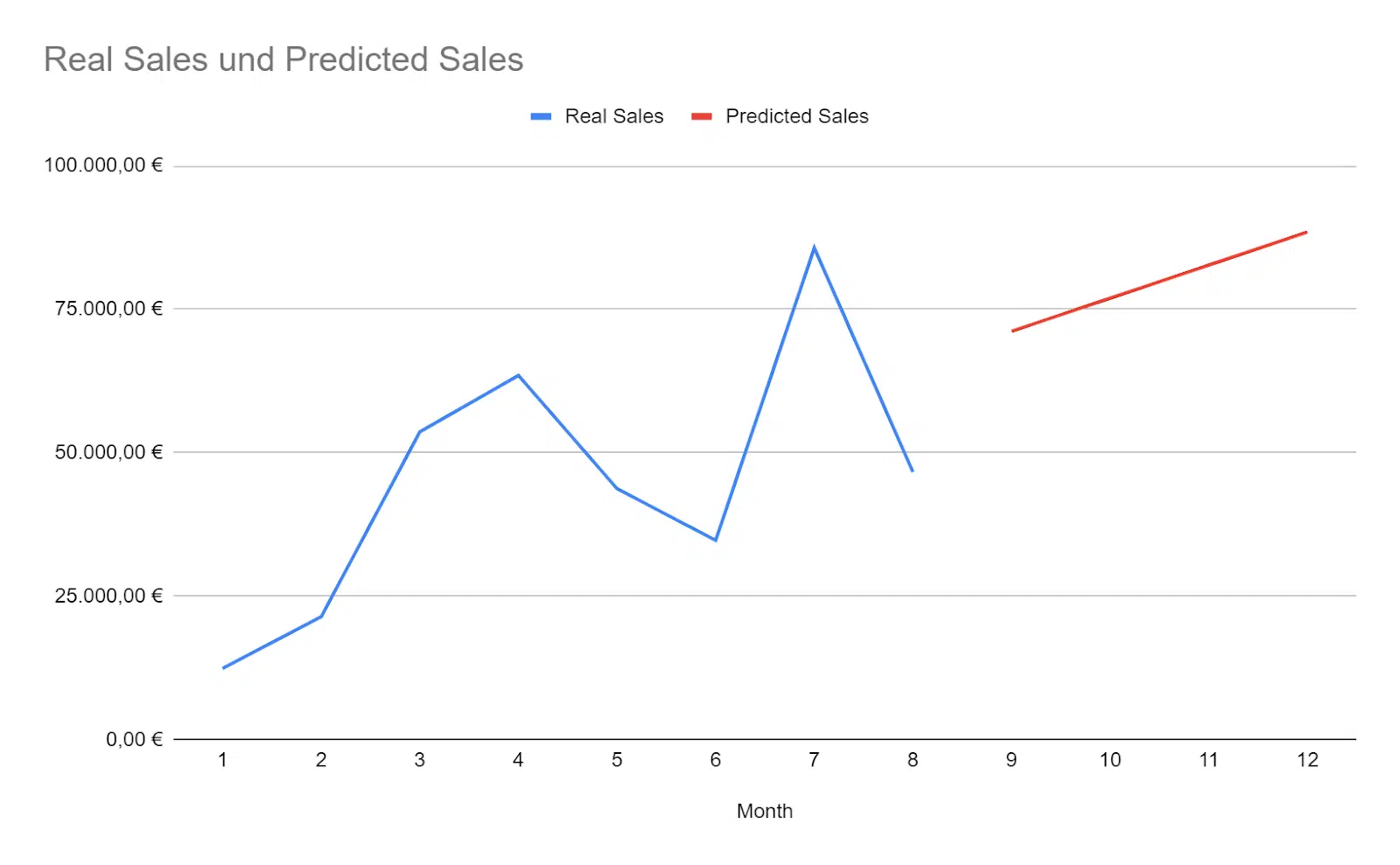
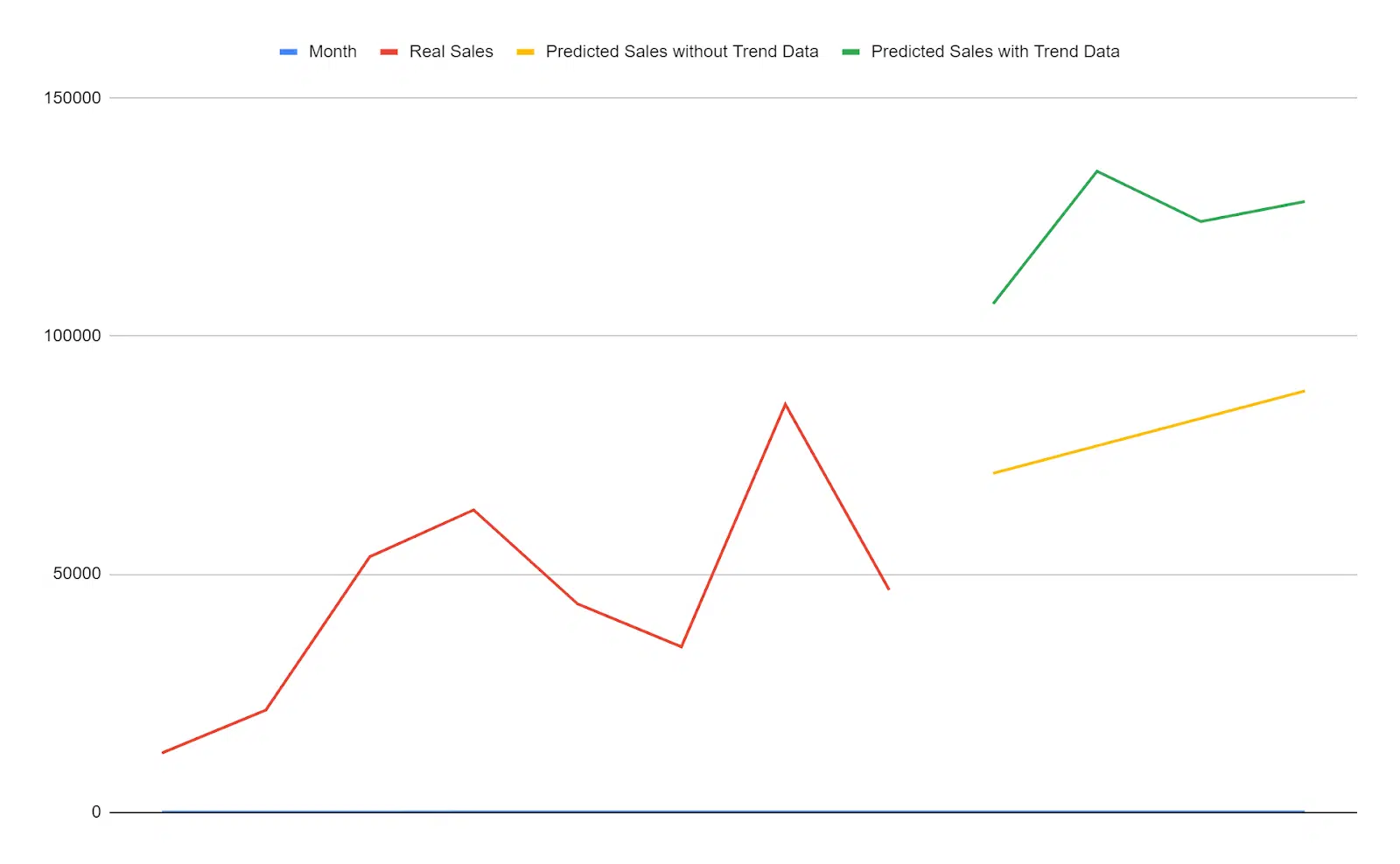
If we visualize those forecasts, you’ll quickly see the drawbacks of using this method.
The blue line represents the known sales data up to August, and the red line represents the predicted sales data.
The prediction is not more than a trendline, which might help to get a high-level look at something but is nothing compared to the blue line, which is basically how real business data will look like.
Supercharging the Google Sheets FORECAST function
To fix the issue of linear regression, there are multiple ways to approach the forecast formula with advanced methods.
Instead of just using the linear =FORECAST() function, you can add a little twist by adding trend data or other market predictions into the forecast formula, as in:
=FORECAST()*3rdParty_Trend_Data
You can grab trend data from public sources like Google Trends, Google Keyword Planner, Dataset Search by Google or industry reports (from PwC, EY, McKinsey, etc.) and export it into a CSV or any other format you’re used to working with.
Clean up those datasets to match your original sheet’s structure, like data on a day-to-day, week-to-week or month-to-month basis,
Next, supplement the FORECAST function to get a more realistic prediction rather than just a straight line going up or downwards.
In this example, we have used additional trend data, which shows an increased trend toward Q4 of the year. The numbers are, therefore, different from the predicted sales without trend data.
If we visualize those new data, we can see that the trend data gives us better insights and more detail compared to a flat trend line.
As a rule of thumb, it is almost always a good idea to support those forecasts with as much data as possible and supply data on more detailed timeframes like day-to-day or week-to-week.
Get the daily newsletter search marketers rely on.
Advanced forecasting with Vertex AI
If your PPC campaigns involve large datasets with multiple variables, turning to Google’s Vertex AI could be a game-changer for your forecasting needs.
Unlike simpler tools, Vertex AI allows for more complex models that can take numerous factors into account, such as seasonality, different ad platforms, or even global market trends.
To get started, you’ll first need to upload your historical PPC data to Google Cloud Storage.
From there, you can access Vertex AI’s AutoML Tables to build a machine learning model tailored to your dataset automatically.
After training the model, you can evaluate its performance using built-in metrics to ensure it meets your forecasting requirements. Once you’re satisfied, deploying the model is easy.
Now, you can use this model to predict future outcomes, such as clicks, impressions, or conversions, based on varying levels of ad spend, ad placements, or any other variable you deem important.
And the best part? You don’t need to be a machine learning expert to do this. With a bit of setup and some fine-tuning, you’ll be on your way to more accurate and insightful PPC forecasts.
The capabilities of Vertex AI are sheer endless, but let’s look at a simple framework to start with.
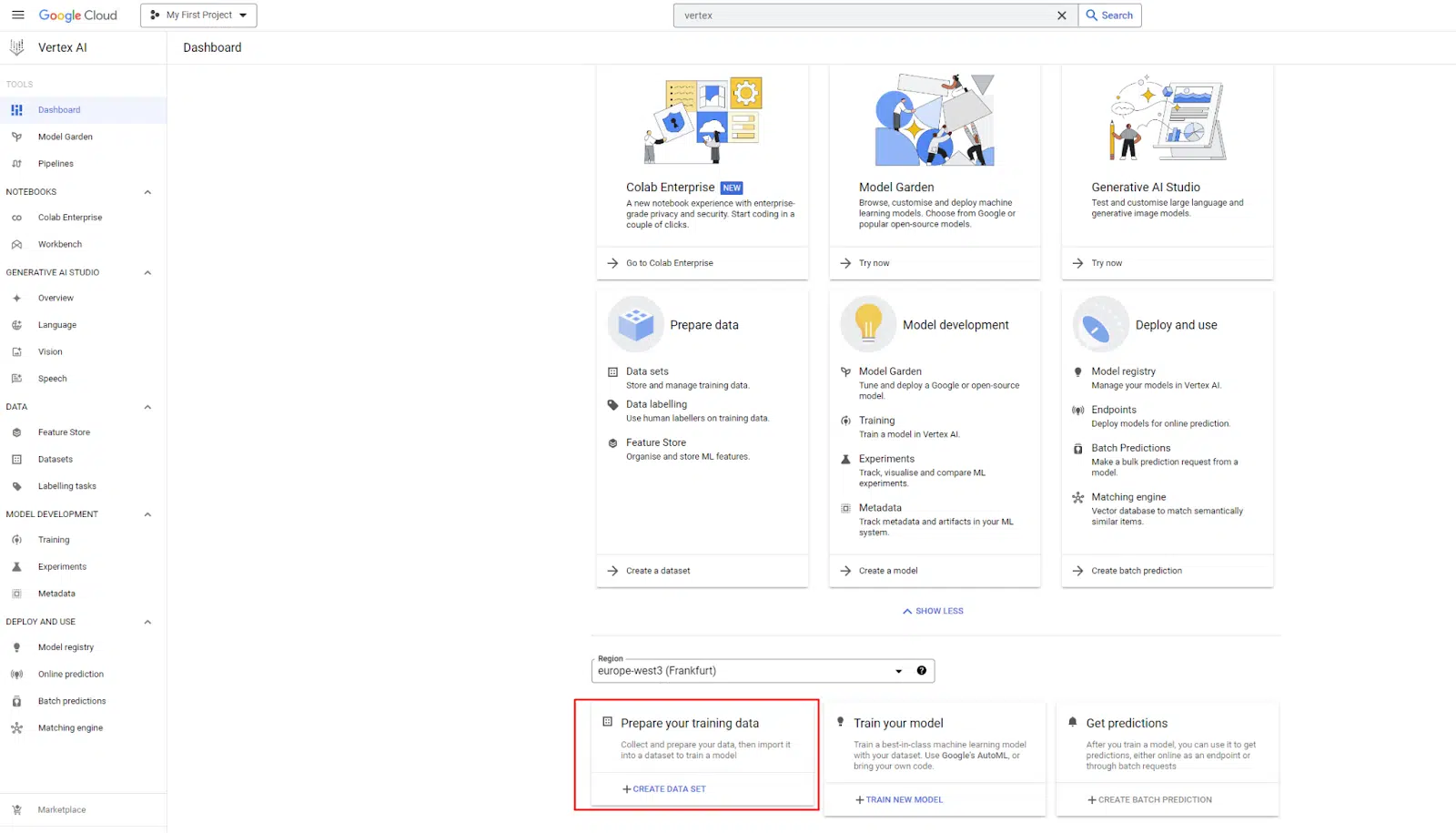
Once your Google Cloud account is set up and you’ve created a project within Vertex AI, you should start by creating a data set.
A data set is basically the collection of data points you want to use for your forecasting.
The data set contains a time dimension and some budget and revenue dimensions. Depending on your goal, the data sets might contain different data points.
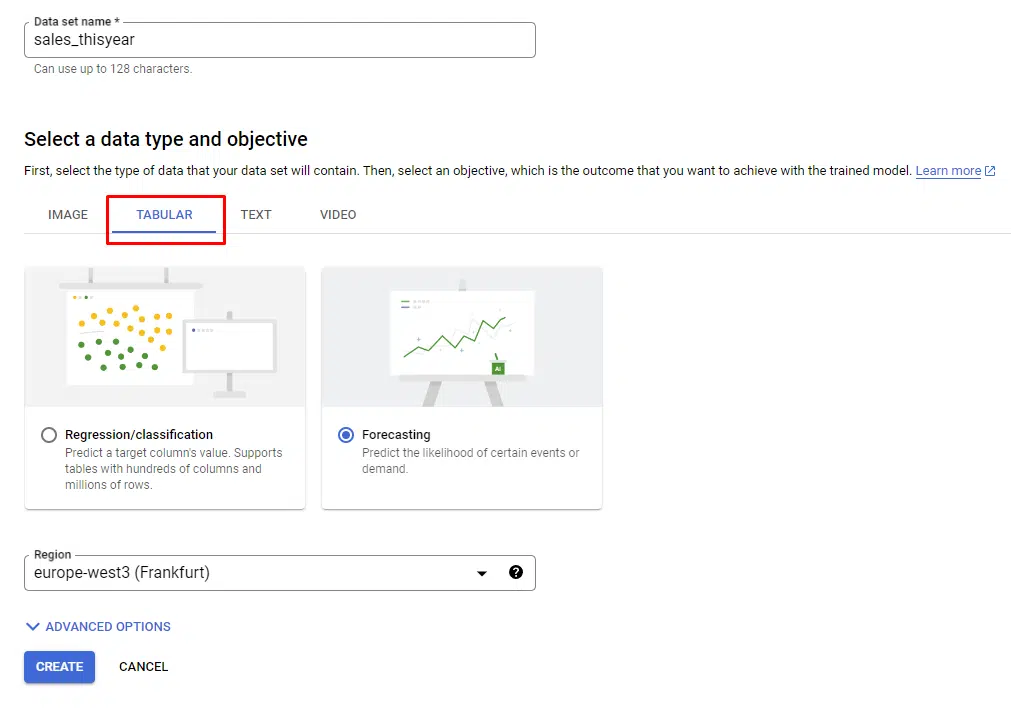
Name your data set, select Tabular as your data type and Regression or Forecasting as your objective.
While regression is often used to understand relationships and can be applied to various data types, forecasting focuses more on predicting future points in a time series.
Both are essential tools in data science and are used for different types of decision-making and analysis. You will be fine with forecasting in most of your cases.
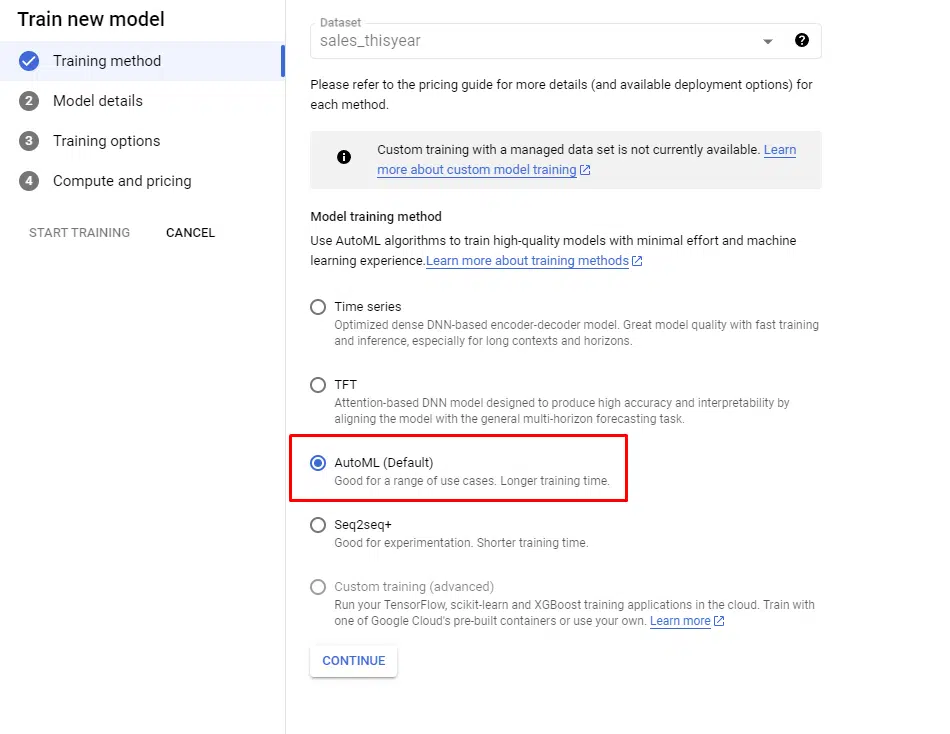
Now it’s time to train a new model. For beginners, the AutoML training method is always a good choice. Next, you must set some settings on the forecast period, the target, and data granularity.
Once done, set the training duration and budget, and you’re ready. The model will now learn, and you’ll receive a notification once it’s finished.
The last step is to get predictions from the ML model. This option is only available once the training is done.
To create a forecast, you need to submit data that the forecast will be based on. It’s ideal to use more recent data.
The model will predict future target values learned on the training data set and based on your forecast data set.
Depending on the data volume, the job will take a while. But you shouldn’t wait more than 5-10 minutes for PPC tasks.
Once finished, Vertex AI will supply an output file that contains new columns with predicted values that you can use for further decision-making.
Vertex AI might seem a little much for some forecasting tasks, but remember that you can submit years of historical data, inventory insights and more to train the model.
With Vertex AI, you can build a machine learning forecasting model tailored to your business, which is much stronger than any static forecasting formula.
PPC forecasting for better campaign performance
Ultimately, the choice between these tools depends on your goals and the complexity of your PPC campaigns.
Google Sheets offers a straightforward and accessible way to dip your toes into PPC forecasting. While it may have limitations, it’s a valuable starting point for many advertisers.
On the other hand, Vertex AI takes your PPC forecasting capabilities to the next level with its ability to handle large datasets and complex models. You can now factor in seasonality, global trends, and various variables to make accurate predictions tailored to your business.
Whether you opt for the simplicity of Google Sheets or the sophistication of Vertex AI, forecasting in PPC advertising is no longer a guessing game.
You can now equip yourself with actionable insights and make data-backed decisions on your PPC campaigns.
@media screen and (min-width: 800px) { #div-gpt-ad-3191538-7 { display: flex !important; justify-content: center !important; align-items: center !important; min-width:770px; min-height:260px; }
}
@media screen and (min-width: 1279px) { #div-gpt-ad-3191538-7 { display: flex !important; justify-content: center !important; align-items: center !important; min-width:800px!important; min-height:440px!important; }
}
About the author
Benjamin Wenner is a growth hacker primarily working on search marketing platforms like Google Ads and Microsoft Ads. With over 11 years of marketing and e-commerce experience, Benjamin is consulting clients on growth- and retention strategies, with a focus on technical solutions such as individualized tracking solutions, the use of cloud applications for deeper analyses or a close interlinking of marketing analytics and corporate performance indicators and reports. Besides regular product updates, Benjamin shares strategies and ideas on his LinkedIn, but also his blog. He also speaks at local and international trade fairs such as DMEXCO, SMX and MBSummit, among others.