7 LinkedIn advertising pitfalls: Where your B2B ads setup might stumble

LinkedIn is a powerful way to connect with a targeted B2B audience through its advertising capabilities.

However, LinkedIn ad campaigns can sometimes stumble even with the best intentions. If you’re puzzled by your LinkedIn Ads setup going awry, you’re not alone.

This article will dissect the critical factors that can undermine your once-promising ad setup, leading it down an unfortunate path. 

By identifying these pitfalls, you’ll uncover the challenges and actionable solutions to steer your campaign back on track. 

1. Insufficient audience targeting

If you’re new to B2B marketing or used to seeing Meta’s audience sizes of millions of people, you may be surprised to learn that audience size is way too broad for anything on LinkedIn – even if you’re aiming for pure awareness.

The beauty of LinkedIn is that you can get very specific while casting a wider net that extends beyond your buying committee.

Ultimately, your target should encompass anyone capable of interacting with your business, whether directly or indirectly.

As a general rule, anything greater than 300,000 is too broad.

LinkedIn won’t show you all the job titles, job functions, or seniorities that genuinely engage with your content unless you have API access, making it even more crucial to apply filters for effective targeting.

2. Restrictive audience targeting

Following the last point, the opposite is also true: avoid creating hyper-restrictive campaigns. If you have an audience of only 15,000, you might only receive 10 clicks daily.

LinkedIn’s algorithm and ad placement optimization rely on volume to work effectively.

A small audience might not provide enough data for the algorithm to gauge user preferences and behaviors, resulting in underwhelming performance – even if your content is highly relevant.

Striking the right balance between specificity and audience size is key. This can help you achieve the twin goals of reaching the right people while driving the desired level of interaction with your business.

Don’t rely solely on job titles as the primary targeting criterion. This approach is expensive and unreliable, as LinkedIn often faces challenges in accurately categorizing numerous common job titles. 

Instead, consider utilizing job seniorities and job functions and employ job titles to exclude irrelevant categories.

You could also explore leveraging seniority levels and member skills to achieve a higher level of specificity.

3. Neglected mobile optimization

With the growth of mobile device usage, a seamless and user-friendly mobile experience is paramount. 

If your ads and landing pages are not optimized for mobile devices, you risk alienating a substantial portion of your target audience.

A clunky or unresponsive mobile interface discourages users from engagement, leading to a higher bounce rate and lower conversion rates. 

An engaging mobile experience ensures your ads reach your target audience and deliver a positive interaction that fosters meaningful engagement and drives conversions.

A common pitfall many marketers encounter today is the use of lead generation forms pointing to PDFs. 

Traditionally formatted PDFs are challenging to read on mobile devices, often necessitating constant zooming in and out.

Create content within HTML pages that offer a comfortable reading experience while on the go.


Get the daily newsletter search marketers rely on.


4. The audience is not in-market

Up to 95% of your B2B audience is consistently out of the market, per a LinkedIn B2B Marketing Institute report. 

So, why do we continually focus on features or merely ‘solving’ someone’s workplace problems?

Instead of dismissing those not yet in the right funnel stage, focus on cultivating potential relationships and staying top of mind. 

This will organically put your products in a prospect’s consideration set when they are ready to buy. 

The essence lies in crafting connections that transcend the transactional and embrace the emotional, using memory metrics to leave an indelible imprint on the B2B users you’re targeting.

5. Poor ad creative

When designing creative for your campaigns, follow the well-studied best practices. 

Visual appeal is paramount, so ensure your images are high-quality, relevant, and aligned with your brand’s identity. 

Images that include real people or showcase your product/service in action tend to have a stronger impact.

Pair your visuals with concise, compelling messaging. Your ad copy should be succinct yet persuasive, addressing your audience’s pain points and presenting a clear value proposition. 

Remember: LinkedIn users swiftly scroll through their feeds, so your ad must grab their attention swiftly and effectively.

Per the previous pitfall, stop focusing on features or ease of use. Instead, create a valuable relationship and show that you know and understand them. This will help your brand stand out.

6. Inadequate budgeting and bidding strategy

The most common issue I see in companies determining a LinkedIn Ads budget is simply allocating “leftovers” after budgeting all other channels. 

This undercuts LinkedIn’s potential, as it often represents the most cost-effective way to reach a B2B audience effectively.

While LinkedIn Ads’ CPCs can be expensive (as high as $11.03, per a 2021 Metadata study), they carry substantial value. 

The cost per opportunity and pipeline tends to be lower than any other advertising channel. 

LinkedIn continues to be a dependable source for industry-related information, according to an eMarketer report. 

In North America, 91% of marketers stated that the platform is the most effective channel for their brand this month. Let’s allocate an adequate and appropriate budget for it.

7. Lack of continuous monitoring and optimization

Creating and launching a compelling ad campaign is just the beginning – long-term success comes from its subsequent monitoring, analysis, and optimization. 

Setting a static budget without periodic review hampers your campaign’s effectiveness.

The B2B world is ever-evolving, with audience behaviors, trends, and competition shifting rapidly. Neglecting to adapt your strategy can lead to underperformance.

Regularly reassess your budget allocation, refine targeting parameters, and fine-tune your ad content. 

The power of LinkedIn’s platform lies in its audience reach and robust tools for analysis and refinement. 

Leveraging these tools and committing to an ongoing optimization process ensures that you’re capitalizing on the full potential of your investment.

My favorite LinkedIn report is the Website Demographic report, which offers an insightful analysis of the audience engaging with your ads. It’s essentially the Google Ads search term report equivalent for LinkedIn. 

Have you ever wondered whether the job functions or skills mentioned at the top of the article effectively target the right personas? This report will provide you with an answer.

Avoiding the common pitfalls of LinkedIn ad campaigns

Recognizing and addressing the potential pitfalls that can undermine your campaigns is essential for connecting with your B2B audience. 

Each aspect shapes an effective LinkedIn Ads strategy, from audience targeting and mobile optimization to thoughtful budgeting and monitoring.

Applying these tips to your LinkedIn Ads strategies will help you avoid common pitfalls and leverage this powerful platform’s full potential to foster meaningful connections, drive conversions and ultimately achieve your B2B marketing goals. 


Opinions expressed in this article are those of the guest author and not necessarily Search Engine Land. Staff authors are listed here.


Related stories

New on Search Engine Land

@media screen and (min-width: 800px) { #div-gpt-ad-3191538-7 { display: flex !important; justify-content: center !important; align-items: center !important; min-width:770px; min-height:260px; } } @media screen and (min-width: 1279px) { #div-gpt-ad-3191538-7 { display: flex !important; justify-content: center !important; align-items: center !important; min-width:800px!important; min-height:440px!important; } }

About the author

Andrea Cruz

Andrea Cruz is a Director of Client Strategy at Tinuiti. She has a decade of experience in driving and implementing SEM, Social Media, ABM, and content syndication campaigns on platforms including Google Ads, Microsoft Ads, Meta, LinkedIn, and more. Beyond paid search and social platforms, Cruz is proficient in Google Analytics, Google Tag Manager, various CRMs and has previous experience in operations and B2B purchasing.
Originally from Venezuela, Cruz earned a master’s degree in international business. She has spoken at numerous industry events, including SMX Advanced.

https://searchengineland.com/7-linkedin-advertising-pitfalls-where-your-b2b-ads-setup-might-stumble-431267


The secrets behind Performance Max and Google’s Black Box: Decoding the future of digital advertising by Adthena

Adthena SEL Sponsored Post PMax 1 800x450

Two groundbreaking developments have taken center stage in the ever-evolving digital advertising landscape: Performance Max and Google’s Black Box. These innovations are reshaping how businesses approach online marketing and redefining the boundaries of success in an increasingly competitive digital realm. In this article, we delve into the intricacies of these game-changing concepts, exploring their significance and potential impact on the advertising industry.

Elevating advertising effectiveness

Performance Max is a revolutionary ad campaign type introduced by Google, designed to maximize the efficiency of advertisers’ efforts while minimizing the complexities associated with campaign management. 

The essence of Performance Max lies in its ability to streamline and synergize the advertising process across multiple Google networks, including Search, Display, YouTube and Discover. Advertisers provide the creative assets, goals and budget, and machine-learning algorithms manage the rest, dynamically allocating the budget across various networks, formats and devices.

The enigma of Google’s Black Box

In parallel with Performance Max, Google’s Black Box has emerged as an enigmatic concept with far-reaching implications for advertisers. The term refers to the intricate algorithms and machine-learning models that power Google’s ad platform. While advertisers can interact with the platform and set parameters, the inner workings of these algorithms remain hidden, locked within the “black box.”

This opaqueness has sparked debates about transparency and control. Advertisers are left to trust that Google’s algorithms will optimize their campaigns effectively without a clear understanding of the decision-making process.

The symbiotic relationship

While Performance Max and Google’s Black Box may appear to be separate concepts, they share a symbiotic relationship that underscores the future of digital advertising. 

Performance Max leverages the power of Google’s advanced algorithms housed within the black box to optimize campaign performance across various networks. This integration highlights the role of machine learning in driving advertising success while raising questions about the balance between automation and transparency.

As the advertising landscape evolves, marketers must adapt strategies to leverage these innovations effectively. While the black box remains a mysterious element, embracing Performance Max as a tool for harnessing its capabilities can propel brands to new heights of online visibility and engagement.

Navigating the uncharted territory

Performance Max and Google’s Black Box represent a compelling convergence of technology and marketing. While Performance Max empowers advertisers with a simplified and holistic approach to campaign management, the black box introduces an element of uncertainty and trust in algorithmic decision-making.

The key to success lies in finding a balance between embracing the power of automation and maintaining a degree of control, visibility and understanding. As the industry continues to grapple with these advancements, marketers must navigate this uncharted territory with a willingness to experiment, adapt, and innovate. Only by doing so can they truly unlock the potential of Performance Max and Google’s Black Box and chart a course toward a future of advertising excellence.

For proven tactics to improve precision, visibility, and control in your Performance Max campaigns, check out Adthena’s guide Unlock the black box: Four ways to get more from Performance Max.


Related stories

New on Search Engine Land

About the author

Adthena

Founded in 2012, Adthena is an award-winning search intelligence platform. Our unique combination of patented, AI-driven technology and a world-class team of experts helps brands, marketers, and agencies across the globe dominate their competitive landscapes. We provide our customers with a clear view of the paid search landscape, helping them optimize their spend to increase ROI, all while saving them time and better informing their cross-channel strategies. Adthena’s solutions are powered by our market-leading technology: Whole Market View creates a unique market map of a client’s entire search landscape and Smart Monitor automatically detects threats and opportunities every day. Our award-winning Local View product provides the location-based strategic insights that marketers need to dominate at a local level. For more information, visit: www.adthena.com

https://searchengineland.com/the-secrets-behind-performance-max-and-googles-black-box-decoding-the-future-of-digital-advertising-431038


X (Twitter) is bringing back political ads

X, formerly known as Twitter, is lifting its ban on political advertising in the US.

The Elon Musk-owned platform famously banished political ads back in 2019 when former CEO Jack Dorsey was still in charge.

Explaining his decision at the time, Dorsey posted: “This isn’t about free expression. This is about paying for reach. And paying to increase the reach of political speech has significant ramifications that today’s democratic infrastructure may not be prepared to handle. It’s worth stepping back in order to address.”

However, less than a year after taking over the platform, Musk has reversed that decision as part of his “commitment to free speech”.

Why we care. If you’re part of a cause-driven organization, this might be good news. But if your brand has nothing to do with politics, it might give you a reason to worry – as you probably wouldn’t want your products and services to be associated with a platform that spreads political messages conflicting with your business’s principles and values.

Why now? The announcement comes after X announced it was relaxing its policy for cause-based ads in the US back in January, hinting that a policy change was on the horizon. Notably, this policy adjustment is occurring slightly over a year ahead of the upcoming US Presidential election.


Get the daily newsletter search marketers rely on.


What has X said? A spokesperson for X said in a statement:

  • “Building on our commitment to free expression, we are going to allow political advertising.”
  • “Starting in the US, we’ll continue to apply specific policies to paid-for promoted political posts. This will include prohibiting the promotion of false or misleading content, including false or misleading information intended to undermine public confidence in an election, while seeking to preserve free and open political discourse.”
  • “We’ll also provide a global advertising transparency center so that everyone can review political posts being promoted on X, in addition to robust screening processes to ensure only eligible groups and campaigns are able to advertise.”

Deep dive. Read X’s Safe Political Discourse blog for more information.


Related stories

New on Search Engine Land

@media screen and (min-width: 800px) { #div-gpt-ad-3191538-7 { display: flex !important; justify-content: center !important; align-items: center !important; min-width:770px; min-height:260px; } } @media screen and (min-width: 1279px) { #div-gpt-ad-3191538-7 { display: flex !important; justify-content: center !important; align-items: center !important; min-width:800px!important; min-height:440px!important; } }

About the author

Nicola Agius

Nicola Agius is Paid Media Editor of Search Engine Land after joining in 2023. She covers paid search, paid social, retail media and more. Prior to this, she was SEO Director at Jungle Creations (2020-2023), overseeing the company’s editorial strategy for multiple websites. She has over 15 years of experience in journalism and has previously worked at OK! Magazine (2010-2014), Mail Online (2014-2015), Mirror (2015-2017), Digital Spy (2017-2018) and The Sun (2018-2020). She also previously teamed up with SEO agency Blue Array to co-author Amazon bestselling book ‘Mastering In-House SEO’.

https://searchengineland.com/x-twitter-bringing-back-political-ads-431320


Google Ads fixing Discovery campaign technical issue

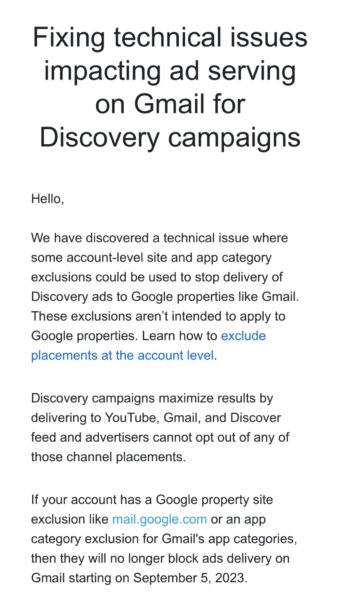
Google Ads has confirmed a technical issue that is impacting Discovery campaigns.

The platform is in the process of trying to resolve the error, which is causing some account-level site and app category exclusions to prevent the delivery of Discovery ads to Google properties such as Gmail.

A spokesperson explained that these exclusions “aren’t intended to apply to Google properties”.

The notification from Google Ads was shared on X (formerly known as Twitter) by digital advertising expert, Menachem Ani:

1 2 343x600

Why we care. Discovery campaigns maximise results by delivering ads to YouTube, Gmail, and the Discover feed. If an error is preventing the tool from delivering ads to Google properties, it will negatively impact reach, which will subsequently affect conversion and ROI.

When will the problem be fixed? Google Ads has not yet shared when a fix can be expected, however, we’ll be keeping an eye on things.

Deep dive. Read Google’s Excluding Placements at Account Level guide for more information.


Related stories

New on Search Engine Land

@media screen and (min-width: 800px) { #div-gpt-ad-3191538-7 { display: flex !important; justify-content: center !important; align-items: center !important; min-width:770px; min-height:260px; } } @media screen and (min-width: 1279px) { #div-gpt-ad-3191538-7 { display: flex !important; justify-content: center !important; align-items: center !important; min-width:800px!important; min-height:440px!important; } }

About the author

Nicola Agius

Nicola Agius is Paid Media Editor of Search Engine Land after joining in 2023. She covers paid search, paid social, retail media and more. Prior to this, she was SEO Director at Jungle Creations (2020-2023), overseeing the company’s editorial strategy for multiple websites. She has over 15 years of experience in journalism and has previously worked at OK! Magazine (2010-2014), Mail Online (2014-2015), Mirror (2015-2017), Digital Spy (2017-2018) and The Sun (2018-2020). She also previously teamed up with SEO agency Blue Array to co-author Amazon bestselling book ‘Mastering In-House SEO’.

https://searchengineland.com/google-ads-fixing-discovery-campaign-technical-issue-431312


Majority of Gen Z teens watch YouTube ads – almost half can recall campaigns

Gen Z aren’t just tuning into YouTube for the videos – they’re also watching the ads.

Six in 10 teens would watch a YouTube ad rather than skip it, while almost half can recall an ad they’ve seen on the platform. That’s according to Precise TV and Giraffe Insights research.

The news comes after YouTube reported a 4.4% increase in ad revenue for the second quarter of 2023.

Why we care. Brands wishing to connect with Gen Z (people born between 1997 and 2012) may want to consider transitioning their ad spend away from traditional TV and into YouTube for stronger engagement, recall and purchase influence.

Interesting stats. The research identified several findings that may be of interest to advertisers hoping to target the Gen Z audience, including:

  • Almost eight in 10 teens watch YouTube, making it the number one platform in this market.
  • 45% of teens are likely to recall an ad they’ve seen on YouTube.
  • Gen Z teens are twice as likely to recall an ad on YouTube than TikTok.
  • YouTube is where teens see the best and most engaging ads.
  • One in five Gen Z teens said YouTube is part of their daily routine.

Get the daily newsletter search marketers rely on.


A shift in ad spend. Precise TV’s Chief Commercial Officer. Denis Crushell, explained that advertisers are now shifting budgets from traditional TV to YouTube ads. He said:

  • “These findings are already convincing many of our advertising partners — agencies, media companies and brands — to double down on YouTube as their top video advertising channel.”
  • “Additionally, we’re experiencing more media buyers coming to us who were historically reluctant to target teens and families because Precise TV can uniquely deliver video-level targeting and performance — all in a completely COPPA-compliant way. As a result, expect more advertisers to move their ad buys from linear TV to YouTube.”

Deep dive. Read the Precise Advertiser Report in full for more information.


Related stories

New on Search Engine Land

@media screen and (min-width: 800px) { #div-gpt-ad-3191538-7 { display: flex !important; justify-content: center !important; align-items: center !important; min-width:770px; min-height:260px; } } @media screen and (min-width: 1279px) { #div-gpt-ad-3191538-7 { display: flex !important; justify-content: center !important; align-items: center !important; min-width:800px!important; min-height:440px!important; } }

About the author

Nicola Agius

Nicola Agius is Paid Media Editor of Search Engine Land after joining in 2023. She covers paid search, paid social, retail media and more. Prior to this, she was SEO Director at Jungle Creations (2020-2023), overseeing the company’s editorial strategy for multiple websites. She has over 15 years of experience in journalism and has previously worked at OK! Magazine (2010-2014), Mail Online (2014-2015), Mirror (2015-2017), Digital Spy (2017-2018) and The Sun (2018-2020). She also previously teamed up with SEO agency Blue Array to co-author Amazon bestselling book ‘Mastering In-House SEO’.

https://searchengineland.com/gen-z-teens-youtube-ads-recall-431301


Last call for Google Ads API v12

Google Ads API v12 will sunset on September 27, 2023.

Developers are being advised to migrate to a newer version before then to ensure API access is not affected.

Why we care. API updates have a direct impact on how advertising campaigns work. When an older version is no longer supported, requests using it will fail, which can disrupt campaign management. To prevent this, it’s important to keep using the latest API version. This way, advertisers and developers can access new features, ensuring campaigns run smoothly and perform well.

Depreciation and sunset timetable. Typically, three major versions are available at any one time with a lifespan of around 12 months, while minor versions have a support lifespan of 10 months. Developers have to perform a maximum of two upgrades per year, but you do not have to upgrade in strict sequential order.

The table below lists the specific deprecation and sunset dates for each available version, and projected release dates for future versions.

Screenshot 2023 08 29 At 14.24.10 800x266

Migrate asap. To migrate to the newest version, visit the Google Ads API documentation here.


Get the daily newsletter search marketers rely on.


Dig deeper. Read the announcement from Google here.


Related stories

New on Search Engine Land

@media screen and (min-width: 800px) { #div-gpt-ad-3191538-7 { display: flex !important; justify-content: center !important; align-items: center !important; min-width:770px; min-height:260px; } } @media screen and (min-width: 1279px) { #div-gpt-ad-3191538-7 { display: flex !important; justify-content: center !important; align-items: center !important; min-width:800px!important; min-height:440px!important; } }

About the author

Nicola Agius

Nicola Agius is Paid Media Editor of Search Engine Land after joining in 2023. She covers paid search, paid social, retail media and more. Prior to this, she was SEO Director at Jungle Creations (2020-2023), overseeing the company’s editorial strategy for multiple websites. She has over 15 years of experience in journalism and has previously worked at OK! Magazine (2010-2014), Mail Online (2014-2015), Mirror (2015-2017), Digital Spy (2017-2018) and The Sun (2018-2020). She also previously teamed up with SEO agency Blue Array to co-author Amazon bestselling book ‘Mastering In-House SEO’.

https://searchengineland.com/google-ads-api-v12-sunset-431291


Instacart IPO: 7 key takeaways for advertisers

Grocery delivery service and advertising platform Instacart filed for its IPO on Friday.

Why we care. Instacart Ads is an emerging platform where CPG (consumer packaged goods) brands can advertise products (via sponsored product ads, display ads, coupons) to 7.7 million “monthly active orderers” as they shop.

1. Instacart’s 2023 ad revenue. Instacart reported $406 million in ad revenue for the six months of 2023, a year-on-year increase of 24%.

  • This increase was driven by an increase in advertising volume and increased adoption of new advertising features and products – despite decreases in ad spend by brand partners due to “macroeconomic uncertainty” and changes in “brand partners’ businesses and performance.”
  • Ad revenue was $327 million for the same period in 2022.

2. Instacart’s 2022 ad revenue. Instacart’s full-year advertising revenue hit $740 million in 2022, a 29% YoY increase. Advertising was 29% of Instacart’s total revenue.

  • Ad revenue was $572 million in 2021, which was 31% of total revenue, and $295 million in 2020.

3. How many brands use Instacart Ads. Intacart had more than 5,500 “active brand partners” using Instacart Ads as of June 30. This number has grown of “over five times” since December 2019.

4. New Instacart Ads offerings coming. Instacart has plans to add new display advertising offerings, specifically mentioning “shoppable products brand pages to serve as destinations for on- and offsite media,” according to the S-1.

5. Instacart plans to expand its ad tech to more retailers. The company plans to invest in and grow the Instacart Enterprise Platform, according to the S-1 filing:

  • “In 2021, we launched Carrot Ads, which helps our retail partners capture new monetization opportunities while broadening advertiser reach to millions of new customers via additional relevant placements on retailers’ owned and operated online storefronts.”

6. Instacart is impacted by seasonality. Instacart expects seasonality to cause fluctuations in its quarterly financial results.

  • “Our advertising and other revenue has historically been seasonally high in the fourth quarter and seasonally low in the first quarter in a given year as a result of how advertisers deploy their budgets,” according to the filing.

7. Instacart Ads growth strategy. Here’s how Instacart said it plans to increase its advertising revenue:

  • “Capture More Ad Spend and Add New Brands on Instacart Ads. We intend to earn a greater portion of brands’ spend across digital marketing as well as other data and customer insights. Growing the number of active brand partners and their spend will depend on our ability to grow the size and engagement of our customer base to create more clicks and impressions and to innovate on our ads offerings to deliver attractive ROI to our brand partners.”
  • “Grow Sales for Emerging Brands and Non-Food Categories. We intend to grow sales for emerging brands and non-food categories that have higher advertising budgets, such as household products, pet items, and personal care. As we grow sales for emerging brands and these categories, we expect to experience a mix shift towards GTV with higher advertising and other investment rate.”

What Instacart said. The company’s filing also touted its high ROI and ability to drive purchases:

  • “Our grocery expertise has enabled us to build differentiated advertising solutions and tools that allow CPG brands to reach and engage with high-intent customers at the point of purchase and within minutes of delivery and consumption. With our unique customer data and insights, we provide differentiated analytics for brands, allowing them to better optimize their advertising spend and grow their wallet share.”

The filing. Instacart’s Form S-1.


Related stories

New on Search Engine Land

@media screen and (min-width: 800px) { #div-gpt-ad-3191538-7 { display: flex !important; justify-content: center !important; align-items: center !important; min-width:770px; min-height:260px; } } @media screen and (min-width: 1279px) { #div-gpt-ad-3191538-7 { display: flex !important; justify-content: center !important; align-items: center !important; min-width:800px!important; min-height:440px!important; } }

About the author

Danny Goodwin

Danny Goodwin has been Managing Editor of Search Engine Land & Search Marketing Expo – SMX since 2022. He joined Search Engine Land in 2022 as Senior Editor. In addition to reporting on the latest search marketing news, he manages Search Engine Land’s SME (Subject Matter Expert) program. He also helps program U.S. SMX events. Goodwin has been editing and writing about the latest developments and trends in search and digital marketing since 2007. He previously was Executive Editor of Search Engine Journal (from 2017 to 2022), managing editor of Momentology (from 2014-2016) and editor of Search Engine Watch (from 2007 to 2014). He has spoken at many major search conferences and virtual events, and has been sourced for his expertise by a wide range of publications and podcasts.

https://searchengineland.com/instacart-ipo-key-takeaways-advertisers-431242


TikTok Smart Performance Campaigns: What you should know

TikTok’s Smart Performance Campaign (SPC) is a fully automated solution that lets advertisers target their audience automatically using the platform’s machine learning-based system.

On TikTok, ad content matters more than targeting. 

TikTok’s algorithm is incredibly powerful in matching content to user activity for organic and paid content. 

If your content isn’t adapted to the platform, precise targeting in an ad set won’t achieve the desired results.

Why should you try TikTok’s Smart Performance Campaigns?

With this campaign, you have more time to focus on creating the ad content – optimizing the time spent creating one or more ad sets. 

SPC reduces campaign creation time by 26%, according to TikTok.

The campaign is available for website conversions or app-install campaigns, focusing entirely on the conversion objective.

TikTok campaign type

Tips for setting up a TikTok Smart Performance Campaign

Start with installing TikTok pixel on your website for proper tracking. This will help the platform’s algorithms move from quantity to quality.

Implementing just the Complete Payment or Complete Registration event is not enough.

The more events you implement correctly, the greater the chances the Smart Performance Campaign will bring you more valuable results. 

When it comes to audience targeting, you don’t have many options aside from Location and Preferred Language. However, you can only exclude audiences when you click Advanced Settings. 

Many advertisers prefer to target broad audiences. We decided to do the opposite and excluded buyers from the last 30 days in one campaign. After doing so, its conversion rate increased by over 1.4%.

Selecting the creative is a crucial element of your SPC. You can add up to 30 TikTok ads. Test the format, which can be a Spark Ad or a Video Ad. 

From our tests, Spark Ads perform over 72% better than regularly uploaded videos, and they also help boost the client’s organic TikTok account.


Get the daily newsletter search marketers rely on.


The Call-to-Action tab is set to dynamic by default. TikTok even suggests keeping this setting to maximize campaign performance. 

But for many businesses, some calls to action may be completely irrelevant, so you should eliminate those unsuitable for your client.

The last important setting is choosing the destination, either a website URL or a TikTok Instant Page, where you can create a more creative design for your client’s product.

Once you’re done setting up your SPC, make sure it collects enough data – after 3-4 weeks, you can start drawing conclusions. 

From the Campaigns tab, select your Smart Performance Campaign, and then click on View Data. 

There, you will find useful advertising data, such as key metrics (conversions, cost/conversions, conversion rate, and more). 

While you can’t exclude certain age segments in SPC, TikTok will push your ads toward the most suitable users in each segment.

In the case study below, you’ll see that results were similar in terms of CPA for more age segments, although the volume was different.

SPC Detailed Analysis 800x261

How to optimize your TikTok Smart Performance Campaign

While there are fewer levers to pull, you still have the option to:

  • Optimize at the ad content level.
  • Eliminate underperforming videos.
  • Test new ones. 
  • Add negative keywords to your campaign (soon).

Never leave just one video in your Smart Performance Campaign. The more content you have, the longer you can extend its lifespan.

You can include up to 30 videos in one SPC, but pay attention to the budget. If you’re running on a limited budget, you may want to reduce the number of creatives to allow your videos to gather enough data. 

While SPC performed better than regular campaigns in 80% of the accounts we tested, that doesn’t mean you should give up on standard campaigns. SPC also provides good insights that you can use in standard campaigns for more testing.

The Audience tab provides enough data for you to create a buyer persona to target in other types of campaigns. 

TikTok - Purchase intention

You might want to keep your eyes on the View Data tab because you can optimize based on search keywords. 

Tiktok Search ads

TikTok search ads are now available, and the SPC is the first type of campaign to share insights about keywords used by your audience to interact with your brand. 

Even though this is not yet available for all TikTok Ads accounts, you will soon have the option to add irrelevant keywords as negative keywords.

Build your historical conversion data to make the most of TikTok Smart Performance Campaigns

Accounts without a significant conversion tracking history may find it hard to see results with SPC. 

TikTok’s algorithms are powerful but need time to understand audiences who converted, what content they consume, and so on. 

SPC yielded good results on accounts with a history of at least 100-200 conversions in the last 30 days before campaign creation. 

So don’t rush! Grow your account with regular conversion campaigns, then test the Smart Performance Campaign.


Opinions expressed in this article are those of the guest author and not necessarily Search Engine Land. Staff authors are listed here.


Related stories

New on Search Engine Land

@media screen and (min-width: 800px) { #div-gpt-ad-3191538-7 { display: flex !important; justify-content: center !important; align-items: center !important; min-width:770px; min-height:260px; } } @media screen and (min-width: 1279px) { #div-gpt-ad-3191538-7 { display: flex !important; justify-content: center !important; align-items: center !important; min-width:800px!important; min-height:440px!important; } }

About the author

Andrei Manole

Andrei Manole is Owner & General Manager of Another Agency. He is a digital marketer who specializes in PPC & Social Media Advertising with over 7 years of experience in the industry. After both agency & in-house client experiences, he founded his own performance marketing agency, helping businesses achieve their goals by having a multi-channel approach on more than 10 advertising platforms. Andrei is a creative and strategic thinker, having focus not only on audience targeting but also on ad content creation.

https://searchengineland.com/tiktok-smart-performance-campaigns-430303


First look at Google Ads’ enhanced customer service for small businesses

Google Ads has started rolling out its paid customer support service for small businesses.

PPC expert Natasha Kaurra spotted the new feature on her account for the first time and decided to provide a sneak preview of what it looks like on X (formerly known as Twitter).:

1 1 800x464

As you can see in the image above, the enhanced customer service pilot is located in a box to the right of the Google Ads screen.

To book a one-on-one consultation with a Google Ads rep, you simply need to click on the icon and pay a fixed fee of $50 per call.

However, the new tool is still in beta and so is not yet available to everyone.

Why we care. Small business owners using the program can get specialized advice faster by using this premium service, which has historically only been accessible to Google Ads’ biggest clients.

What’s next? Google will collect feedback from participants. In time, Google hopes to roll the service out to more small- and medium-sized businesses. A Google spokesperson said:

  • “These changes are part of a long-term strategy that we’ll be building on over time, testing, and learning as we go.”

Related stories

New on Search Engine Land

@media screen and (min-width: 800px) { #div-gpt-ad-3191538-7 { display: flex !important; justify-content: center !important; align-items: center !important; min-width:770px; min-height:260px; } } @media screen and (min-width: 1279px) { #div-gpt-ad-3191538-7 { display: flex !important; justify-content: center !important; align-items: center !important; min-width:800px!important; min-height:440px!important; } }

About the author

Nicola Agius

Nicola Agius is Paid Media Editor of Search Engine Land after joining in 2023. She covers paid search, paid social, retail media and more. Prior to this, she was SEO Director at Jungle Creations (2020-2023), overseeing the company’s editorial strategy for multiple websites. She has over 15 years of experience in journalism and has previously worked at OK! Magazine (2010-2014), Mail Online (2014-2015), Mirror (2015-2017), Digital Spy (2017-2018) and The Sun (2018-2020). She also previously teamed up with SEO agency Blue Array to co-author Amazon bestselling book ‘Mastering In-House SEO’.

https://searchengineland.com/first-look-google-ads-enhancec-customer-service-small-business-431197


5 essential PPC skills every agency pro must have

Most digital agencies today are willing to hire beginner marketers.

Unfortunately, many do not provide meaningful training on pay-per-click (PPC) marketing. Even worse, some colleagues might hide or misrepresent essential information.

While you can find much of that information online for free, it’s often a complicated mess.

To address this, here is a basic five-step growth plan to become a PPC expert as fast as possible.

1. Master client relationship

I realize it may sound cliché for the top skill. 

But after over a decade working in PPC (and training hundreds of specialists), it’s by far the primary reason for PPC people to climb the agency ladder.

Why? Because you’re responsible for driving your client’s growth – and that’s a people-first business.

Be aware PPC expectations are high, and performance is never a straight, easy line. 

You’ll have to fix stuff that people think is critical or convince those same people not to touch anything despite what they perceive as red flags. 

And that can quickly become stressful, getting in your way when it comes to handling relationships.

To go through these relatively tough times all while keeping your client happy and on board, you’ll need to display composure, explain technical and analytical concepts in plain English – and remain patient!

So how do you master client relationships, you ask? It’s a deep topic to unpack in a few lines, but here are some pointers to get you started.

Build trust

Trust comes with time. Whenever your client needs you for real, make sure to be the one person your client knows he or she can rely on. 

Let’s take an example: picture a last-minute project that really matters to your client but not so much to you. (Not to mention that it’s slightly out of your scope.) 

An untrustworthy agency point of contact would not support this client. But you should.

With trust comes long-term, impactful achievements.

Show expertise

Believe it or not, I’ve seen plenty of agency people not preparing for client meetings. Some don’t anticipate questions and can only respond with “I’ll get back to you.”

Do not be that person. Send meeting agendas in advance.

Provide meeting notes, action points, and deadlines. 

In short, be reliable.

Be empathetic

Not everybody behaves the same way. And not every meeting has to be sunshine and flowers. 

You don’t like your client that much? 

Guess what, that’s OK. 

Give them a break: not everybody likes you either, anyway. 

Make sure to be the person in the room who makes the project go forward, even if times are tough and people are getting rigid. 

2. Think strategically

OK, I know. Strategy is one of those buzzwords, along with cloud computing, innovation, big data and blockchain. However, it remains absolutely vital for successful agency PPC specialists.

What does it mean to be strategic? It varies a lot based on the field you work in.

Just read this HBR strategy article, and you’ll see it doesn’t quite apply to day-to-day PPC work.

So, with all its flaws, allow me to provide a very PPC-centric, operational strategy definition: 

  • “Strategy is a combination of items that allow long-term, significant business growth. Significant being at least 30% of your top KPI.”

In other words, thinking strategically means prioritizing your efforts based on the outcome. 

Here is an example to help make it clearer. Next time you want to run an A/B test, go through the following steps:

  • Take a hard look in the mirror.
  • Identify if your A/B test doesn’t drive a 30% growth in your top KPI.
  • Reprioritize using higher-impact items.

PPC beginners will rarely work on operational strategy. However, if you can understand the above, it’s a great starting point. 

To help you get to the next step, here is a media plan-like framework to structure your strategy thinking:

Goals

For ecommerce clients, it will often be revenue paired with return on ad spend (ROAS). 

With lead gen clients, marketing qualified leads (MQLs) will be paired with cost per MQL. 

Can you challenge those? 

For example, include margin to improve ROAS. Or MQL value instead of simply MQL volume.

Budget

It will either be “unlimited as long as you hit a specific ROAS target” or a specific $ number per month/year. Can you challenge that? 

For example, is the budget allocated to the right product line or geo to maximize your goal? Is seasonality taken into consideration?

Targeting

You want to reach a target audience. To do that, you will want to use ad networks and channels. Sometimes, those items aren’t set up to maximize your goals. 

When you find such pockets of growth, you can think strategically.

Messaging, landing page and CTA

Now, that seems like an obvious one, right? 

Careful, though, since there’s never just one way to talk to prospects and have them act to reach your goal. 

Use your critical thinking and Ads Libraries to develop other (hopefully better!) ways to address your target audience.


Get the daily newsletter search marketers rely on.


3. Navigate data with precision

Isn’t data another buzzword? Sorry about that! 😀 

Let me break down that data skill set and provide PPC beginners a clear path.

There are lots of data-related roles, but as a PPC beginner, you should think about data in three ways:

  • Data analysis: Do you understand each KPI in-depth? For example, do you know how CTR impacts CPC?
  • Data generation: Do you understand what a conversion is, how it’s triggered and how to check these parameters are OK?
  • Data visualization: This is a tiny bit more advanced, but can you tell a story from the data you gathered?

Again, that can sound a little out of touch so here are real-world tools to get you started:

In PPC, you must build reports to understand traffic sources, conversion attribution, conversion rates per funnel stage, product-level performance, etc. 

So get busy learning GA4 and other related analytics tools.

Dig deeper: Google Analytics 4 guide for PPC

At the very least, you want to understand what event triggers your conversions. 

More often than not, that means using GTM’s preview mode and testing your client’s website live. Make sure you understand how it works.

Don’t make the rooky mistake of throwing lots of KPIs at your clients who will not understand a thing you just said because they hate Excel. 

Spend time vulgarizing your data to craft a compelling story that’s both easy to understand and impactful. 

And to do that, you can use powerful visualization graphs and tables within tools such as Looker Studio.

Dig deeper: 5 things your Google Looker Studio PPC Dashboard must have

4. Commit to learning every day

This is the skillset where I’ve seen tons of PPC people skip steps, unable to fix that later down the road. This paves the way for poor operational and managerial performance. 

Take your time; no rush here.

Primary PPC channels are undoubtedly Google Ads and Meta Ads. Most clients will use either or both of these ad networks. What’s the issue with that, you ask?

It’s the Dunning-Kruger effect.

Too many people handle a few campaigns in Meta Ads and believe they know the platform inside out. 

Some others will run SKAG campaigns in Google Ads their whole life without realizing there’s a whole world outside of this structure.

In short: you want to build a solid foundation of technical knowledge for those primary ad networks (at least) but also be open to challenge that foundation now and then. 

Don’t believe the hype that says PPC changes every few days, but don’t get stuck in your old habits either!

So, how can you get started as a PPC beginner? Here are some pointers:

Get certified

Google Ads certifications aren’t very useful. 

But they have a great advantage: they provide an equal starting point for PPCs, vocabulary, perspectives and more. 

Similarly, Meta offers training and certifications, so be sure to use those.

Read news

If you’re reading this, then you know Search Engine Land is a great resource to stay up to date and learn new stuff. 

Make sure to follow other content creators. For example, you can read Jon Loomer for everything Meta Ads or follow agencies’ blogs.

Test on your own

Google Ads and Meta Ads offer ad credits for new advertisers. And it’s never been easier to set up a shop since Shopify started out. 

Don’t be afraid to run your side project. It will be a safe place to experiment with and learn.

Network

All projects are different and you will never be able to master them all on your own. 

By talking to other PPC peers, you will basically take shortcuts to PPC mastery. 

And did I mention it’s super cool to talk to people who understand what you’re going through?

5. Get organized

Am I stating the obvious? PPC is a detail-oriented world, so you will quickly realize you need a second brain to keep up with everything without going crazy (or destroying an account). 

Even the tiniest hiccup can have dramatic repercussions on performance. Good luck finding that needle in the haystack six months later!

So as a PPC specialist, you should be comfortable with:

Project management

Do you know tools like Monday.com, Asana, Notion, and so on? If not, use them. 

You want to organize your projects and tasks using priorities, deadlines, dependencies, etc. 

It will provide you with a clearer view on your schedule and work.

Documentation tools

Like project management tools, you want to remember and understand what happened on specific dates for future reference. 

For example, do you know what happened on Nov. 29, 2019? 😉

Templatize your work

Running into the same task over and over again? It sounds like a perfect case study to templatize. 

This way, you won’t have to reinvent the wheel every time. And you’ll be able to delegate that easily when the day comes up, paving the way for a great managerial career.

Essential PPC skills that every agency pro should master

PPC is about more than choosing the right keyword match type or writing ad copy. 

Once you layer the above skills on top of the technical nitty-gritty, you are ready to move up the agency ladder.


Opinions expressed in this article are those of the guest author and not necessarily Search Engine Land. Staff authors are listed here.


Related stories

New on Search Engine Land

@media screen and (min-width: 800px) { #div-gpt-ad-3191538-7 { display: flex !important; justify-content: center !important; align-items: center !important; min-width:770px; min-height:260px; } } @media screen and (min-width: 1279px) { #div-gpt-ad-3191538-7 { display: flex !important; justify-content: center !important; align-items: center !important; min-width:800px!important; min-height:440px!important; } }

About the author

Rémi Kerhoas

Rémi is an internationally recognized digital marketing expert and co-founder of Quantads, a data & growth marketing agency. Since 2011, he has successfully directed teams and grown ad accounts for clients ranging from Uber, Salomon or Asana to SMBs.

https://searchengineland.com/5-essential-ppc-skills-every-agency-pro-must-have-431139