3 steps for effective PPC reporting and analysis

How you provide performance reports or insights can impact the rest of your project. 

If a client or boss doesn’t understand your analysis of what’s happening in their PPC accounts, that can lead to more questions and stress for all parties – even if you’re doing great work.

The three steps outlined below will give you a solid foundation for PPC reporting that keeps everyone on the same page, establishes trust and makes your job easier in the long run. 

Common metrics and trends to focus on

The first step is easy. Simply review the account’s performance metrics, add a comparison date range and note any significant trends. 

What someone thinks is “significant” may vary depending on who the report is delivered to. 

It’s best to focus on the most relevant metrics before highlighting anything else and tailor your approach as needed. 

Example 1: The main goal for a B2B software client is to drive leads efficiently. 

  • All your reports should start by highlighting conversion-oriented metrics, such as form submissions, cost per conversion, conversion rate, etc. 

Example 2: The main goal for your ecommerce company is to drive sales.

  • All reports should start by highlighting sales-based metrics, such as revenue, purchases, return on ad spend, etc.

Secondary metrics (for any account) might include click-through rate, cost per click, cost per thousand impressions (CPM), or search impression share. These give you a sense of overall visibility, efficiency and engagement. 

While clicks and impressions can help identify trends in traffic and search volume, the focus should be on actual results – especially if you’re presenting to people at the executive or C-suite level. 

This means that clicks and impressions may not be the best metrics to hone in on in your analysis.

It’s also important to highlight negative trends in addition to positive ones. 

Transparency builds trust, prevents stakeholders from getting caught off guard by lower performance and helps you better control the narrative and next steps. 

Dig deeper: 3 ways to stay on top of PPC performance

The next step is to define what your highlighted metrics actually mean. 

Many people forget to do this because they know the terms. But not everyone knows as much as you do! 

Providing that extra context ensures all parties interpret the data properly and prevents people from drawing inaccurate conclusions or focusing on things that might not matter in the long run. 

Some common metrics and what they translate to in real terms include:

Overall volume

  • Impressions: How much search volume there is or how large your audience may be.
  • Clicks: How much traffic is driven to your website.

Reach / visibility

  • Search impression share: How much coverage/visibility you have.
  • Cost per thousand impressions (CPM): How efficiently you reach the target audience.

Efficiency

  • Cost per click (CPC): How efficiently you drive traffic/engagement.
  • Cost per conversion action (CPA): How efficiently you drive results.

Engagement

  • Click-through rate (CTR): How effective/relevant your ad copy and creative is.
  • Conversion rate: How effective/relevant your landing page or targeting is. 
  • View rate: How effective/relevant your video is.

Get the daily newsletter search marketers rely on.


Step 3: Identify reasons for performance shifts

The last step is to note any potential causes behind the trends you called out. This is where you can flex your expertise and let people know the value you bring to their organization. 

  • Did the click-through rate increase after you recommended and launched new ad copy? 
  • Are you seeing a jump in conversion rate after updating your landing pages? 
  • Did lead quality improve after adding negative keywords and placement exclusions in the previous month? 

Give yourself some credit and highlight those changes in the report!

It’s also important to do this for negative trends because identifying the cause of a decline will help you determine the next best course of action. 

For example, you see a decrease in impression share and an increase in average CPC. 

You review the Auction Insights and notice a new competitor has entered your market. 

Now you can strategize an approach to the situation and present a solution before it causes a bigger dent in performance.

That said, there might not always be a clear-cut reason for performance shifts. 

In this situation, taking a step back and looking at the industry at a macro level can be helpful. 

  • If you’ve seen a drop in conversions, conversion rate, and impressions (i.e., search volume) for seemingly no reason, you might be experiencing seasonality. One way to verify this would be to check Google Trends data for your top terms. Another option is to meet with the sales team (or ask your client to meet with theirs) to discuss whether other channels are also seeing a dip in performance. 
  • The same applies when you see an unexpected improvement in account performance. This can also be a good time to ask about testing additional budget so that you can take advantage of high conversion intent. 
  • If you still aren’t sure what might be causing a shift (like dealing with conflicting data points), check how you compare to industry benchmarks. You might find that you don’t stack up well compared to others. In this case, you can determine the next steps as needed (e.g., below-average CTR means you should test new ad copy or creative). If you’re above average, you may see a short-term trend that isn’t a huge cause for concern.

Putting it all together

By approaching reports using the process above, your analysis should end up looking something like this:

Sample PPC report analysis

The result is a clear overview of:

  • What’s happening in the account.
  • Why it’s happening.
  • What you plan to do next if action is needed. 

In turn, clients and stakeholders typically feel more comfortable with the numbers they see and hear. 

They may then have a greater appreciation and understanding of your work, leading to more trust and a willingness to test more. And that’s a win for everyone!

Dig deeper: How to deliver PPC results to executives: Get out of the weeds


Opinions expressed in this article are those of the guest author and not necessarily Search Engine Land. Staff authors are listed here.


Related stories

New on Search Engine Land

@media screen and (min-width: 800px) { #div-gpt-ad-3191538-7 { display: flex !important; justify-content: center !important; align-items: center !important; min-width:770px; min-height:260px; } } @media screen and (min-width: 1279px) { #div-gpt-ad-3191538-7 { display: flex !important; justify-content: center !important; align-items: center !important; min-width:800px!important; min-height:440px!important; } }

About the author

Ashton Clarke

Ashton Clarke is the Paid Media Team Lead at Knucklepuck, responsible for managing a small team of consultants in addition to client strategy & execution. With 5+ years of agency experience and a passion for continuous learning, he takes a data-driven, results-focused approach to all projects. Ashton’s portfolio ranges from local businesses to global organizations in highly-regulated industries (like healthcare & financial services), primarily focusing on lead & demand generation across most major ad platforms. Outside of work, you’ll find Ashton hiking his way through Colorado and watching an alarming amount of soccer (particularly the English Premier League).

https://searchengineland.com/effective-ppc-reporting-analysis-431134


Threads is widely rolling out on the web

Meta is widely rolling out its web version of Threads.

This move is aligned with the company’s goal of introducing fresh features to tackle its retention challenges.

Why we care. The expansion to the web could potentially enhance Threads’ active user count and provide a solution to its retention issue. While Threads currently doesn’t display ads, brands utilizing its paid promotion options might experience substantial growth in reach and potentially higher conversions.

How it works. The web version of Threads, threads.net, works in a similar way to the app. Upon visiting the website, users are asked to provide:

  • A username, phone number or email address
  • A password

The log-in details are the same that you use to log into Instagram.

Upon accessing the web app, the homepage layout closely mirrors that of the mobile version, showcasing an app bar with identical tabs. Notably, the Threads web homepage includes a dropdown menu allowing users to toggle between light and dark themes, report issues, access the about page, or log out.

Usability. Web users are currently able to post a thread, scroll through their feed and interact with others in the same way that they are on mobile. However, there are certain mobile-specific functionalities that are yet to be introduced to the web version. For instance, profile editing is currently unavailable.

Meta is currently addressing these issues and expects a fix to be implemented in the coming weeks.


Get the daily newsletter search marketers rely on.


What has Threads said? Mark Zuckerberg announced on Thread that the web version would be rolling out “over the next few days”.

Screenshot 2023 08 24 At 21.34.37 612x600

Deep dive. Read our Threads FAQ for more information on the platform.


Related stories

New on Search Engine Land

@media screen and (min-width: 800px) { #div-gpt-ad-3191538-7 { display: flex !important; justify-content: center !important; align-items: center !important; min-width:770px; min-height:260px; } } @media screen and (min-width: 1279px) { #div-gpt-ad-3191538-7 { display: flex !important; justify-content: center !important; align-items: center !important; min-width:800px!important; min-height:440px!important; } }

About the author

Nicola Agius

Nicola Agius is Paid Media Editor of Search Engine Land after joining in 2023. She covers paid search, paid social, retail media and more. Prior to this, she was SEO Director at Jungle Creations (2020-2023), overseeing the company’s editorial strategy for multiple websites. She has over 15 years of experience in journalism and has previously worked at OK! Magazine (2010-2014), Mail Online (2014-2015), Mirror (2015-2017), Digital Spy (2017-2018) and The Sun (2018-2020). She also previously teamed up with SEO agency Blue Array to co-author Amazon bestselling book ‘Mastering In-House SEO’.

https://searchengineland.com/threads-widely-rolling-out-web-meta-431176


Meta rolls out new search tool to track branded content campaigns

Meta has launched a new search tool that tracks branded content campaigns.

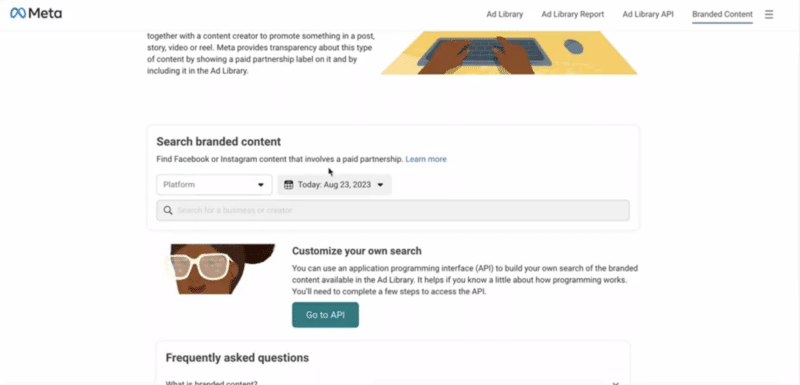
The feature, titled “Search Branded Content”, is located in the Ads Library and gives users the option to filter the database by platform, date range (currently, only the previous seven days is available) and username.

From here, you’ll get deeper insights into competitor strategies, including details on their approach, creator-business relationships and campaign frequency.

Why we care. Gaining insights into the influencers your competitors collaborate with and staying informed about rival campaigns can serve as valuable inspiration. This information can influence your brand’s decisions regarding partnership choices.

How it works. Social media expert, Lindsey Gamble, shared a screenshot of what the new search tool looks like on X (formerly known as Twitter):

Screenshot 2023 08 24 At 20.31.50 800x385

Within the post, Gamble shared a video demonstration illustrating the new feature’s navigation. The video showcases how users can use the tool to gain insights into campaigns involving specific influencers and brands.

When applying the influencer filter, the tool presents an overview of their ongoing campaigns and brand collaborations. Conversely, users can also opt to filter results by brand, revealing the influencers associated with their current campaigns.

Why now? Meta’s decision to improve transparency around branded content campaigns comes as the European Union brings the Digital Services Act into force on Friday – a regulation that puts more onus on large platforms with more than 45 million regional users to create safer digital spaces.


Get the daily newsletter search marketers rely on.


What has Meta said? Commenting on the new Branded Content search feature, Meta said:

  • “Ads are just one way for businesses to promote a product or service on Facebook and Instagram. They can also work together with a content creator to promote something in a post, story, video or reel. Meta provides transparency about this type of content by showing a paid partnership label on it and by including it in the Ad Library.”
  • “Use the branded content search to find posts, stories, videos and reels on Facebook and Insatgramt that involved a Paid Partnership. You can filter by app and date.”
  • “[This tool] is for anyone who wants to see content from a creator who has worked together with a business.”

Deep dive: Check out Meta’s new Branded Content search tool in the Ads Library to see how it works.


Related stories

New on Search Engine Land

@media screen and (min-width: 800px) { #div-gpt-ad-3191538-7 { display: flex !important; justify-content: center !important; align-items: center !important; min-width:770px; min-height:260px; } } @media screen and (min-width: 1279px) { #div-gpt-ad-3191538-7 { display: flex !important; justify-content: center !important; align-items: center !important; min-width:800px!important; min-height:440px!important; } }

About the author

Nicola Agius

Nicola Agius is Paid Media Editor of Search Engine Land after joining in 2023. She covers paid search, paid social, retail media and more. Prior to this, she was SEO Director at Jungle Creations (2020-2023), overseeing the company’s editorial strategy for multiple websites. She has over 15 years of experience in journalism and has previously worked at OK! Magazine (2010-2014), Mail Online (2014-2015), Mirror (2015-2017), Digital Spy (2017-2018) and The Sun (2018-2020). She also previously teamed up with SEO agency Blue Array to co-author Amazon bestselling book ‘Mastering In-House SEO’.

https://searchengineland.com/meta-search-tool-branded-content-campaigns-431164


Google is upgrading Vehicle Ads to Performance Max

Google will automatically upgrade vehicle ad campaigns to Performance Max (PMax) from September.

PMax with vehicle feeds uses Google AI to help marketers “reach their conversion goals, including qualified leads and dealership visits.”

Why we care. The upgrade will enable car advertisers to reach customers across more touchpoints in their research and shopping journey, such as YouTube, Display, Gmail and Discover.

How it works. Your campaign settings, structure, audience signals, vehicle feeds, and assets will automatically be transferred over to this new campaign to maintain consistent performance. Afterwards, you will no longer be able to create additional campaigns for vehicle ads through Smart Shopping campaigns.

For advertisers not already using vehicle ads, PMax with vehicle feeds will be available in open beta in the US and Canada, and closed beta in Australia.

Why now? Vehicle Ads, which are only available in open betas in the US and Canada, and a closed beta in Australia, are currently running on Smart Shopping campaigns. Since they were upgraded to PMax last year, Google has said it is “following suit” for this format.


Get the daily newsletter search marketers rely on.


What has Google said? A spokesperson for the search engine said:

  • “Automotive advertisers are turning to Performance Max to unlock new Google Ads channels, reach more customers, and drive more qualified leads and visits.”
  • “Performance Max unlocks new Google Ads channels and inventory for your campaign, including Search, YouTube, Display, Discover, and Gmail.”
  • “Through Performance Max, you can now optimize for both online conversions (leads) and offline conversions (store visits) within a single campaign, enabling strong omnichannel bidding optimization.”
  • “With the Insights page for Performance Max, you will now have access to new insights that can help inform your business and marketing strategy. These include insights about your audience and current search trends that relate to your business.”

Deep dive. Read Google’s Vehicle Ads announcement in full for more information.


Related stories

New on Search Engine Land

@media screen and (min-width: 800px) { #div-gpt-ad-3191538-7 { display: flex !important; justify-content: center !important; align-items: center !important; min-width:770px; min-height:260px; } } @media screen and (min-width: 1279px) { #div-gpt-ad-3191538-7 { display: flex !important; justify-content: center !important; align-items: center !important; min-width:800px!important; min-height:440px!important; } }

About the author

Nicola Agius

Nicola Agius is Paid Media Editor of Search Engine Land after joining in 2023. She covers paid search, paid social, retail media and more. Prior to this, she was SEO Director at Jungle Creations (2020-2023), overseeing the company’s editorial strategy for multiple websites. She has over 15 years of experience in journalism and has previously worked at OK! Magazine (2010-2014), Mail Online (2014-2015), Mirror (2015-2017), Digital Spy (2017-2018) and The Sun (2018-2020). She also previously teamed up with SEO agency Blue Array to co-author Amazon bestselling book ‘Mastering In-House SEO’.

https://searchengineland.com/google-upgrading-vehicle-ads-performance-max-431160


Google will provide more targeted ad data to comply with new EU rules

Google plans to share more insights into how targeted ads are served to users in the European Union.

The search engine is going to provide access to additional data and also roll out a new transparency center in a bid to comply with evolving EU online content rules.

Under the new regulations that roll out on Friday, known as the Digital Services Act (DSA), more onus is being put on large platforms that have more than 45 million regional users, such as Google and Meta.

Platforms that don’t adhere to the rules and violate EU regulations could face significant financial penalties of up to 6% of their worldwide annual turnover.

Why we care. Improved insights into targeted ad performance enables advertisers to optimise campaigns more efficiently, leading to an increased ROI, and also provides reassurance that campaigns are being served in brand-safe environments, boosting trust and potential ad spend as a result.

What’s new? Google is taking the following actions to ensure its programs are in line with the DSA’s specific requirements:

  • Increased ads transparency: The search engine is expanding its Ads Transparency Center to provide additional information on targeted ads served in the European Union.
  • Improved data access: Google is expanding data access for marketers to provide more insight into how Google Search, YouTube, Google Maps, Google Play and Shopping operate.
  • Policy transparency: The search engine is introducing a new Transparency Center to provide information on its policies on a product-by-product basis. This tool will also enable people to easily access:
    • Google reporting
    • Google appeals tools
    • Transparency Reports
    • Policy development process information
  • Increased transparency reporting: Google is set to expand the scope of its transparency reports in the coming months, by including information about how it handles content moderation across services like Google Search, Google Play, Google Maps and Shopping.
  • Risk analysis reports: Google will analyze risks to its platforms (such as illegal content and dissemination) and then file reports of its findings to regulators in the EU, and independent auditors, before going on to publish a public summary.

Get the daily newsletter search marketers rely on.


What has Google said? A spokesperson for Google said:

  • “We will be expanding the Ads Transparency Center, a global searchable repository of advertisers across all our platforms, to meet specific DSA provisions and providing additional information on targeting for ads served in the European Union. These steps build on our many years of work to expand the transparency of online ads.”
  • “As with any new regulation, this is only the beginning of the road. We will continue our conversations with the European Commission, Coimisiún na Meán (Ireland’s media commission) and other regulators, as well as with technical, policy and online safety experts. And in line with Google’s founding goal of using technology to benefit the lives of people around the world, we will continue working to make the internet more transparent and helpful for all of us.”

Deep dive. Read Google’s Digital Services Act announcement in full for further information.


Related stories

New on Search Engine Land

@media screen and (min-width: 800px) { #div-gpt-ad-3191538-7 { display: flex !important; justify-content: center !important; align-items: center !important; min-width:770px; min-height:260px; } } @media screen and (min-width: 1279px) { #div-gpt-ad-3191538-7 { display: flex !important; justify-content: center !important; align-items: center !important; min-width:800px!important; min-height:440px!important; } }

About the author

Nicola Agius

Nicola Agius is Paid Media Editor of Search Engine Land after joining in 2023. She covers paid search, paid social, retail media and more. Prior to this, she was SEO Director at Jungle Creations (2020-2023), overseeing the company’s editorial strategy for multiple websites. She has over 15 years of experience in journalism and has previously worked at OK! Magazine (2010-2014), Mail Online (2014-2015), Mirror (2015-2017), Digital Spy (2017-2018) and The Sun (2018-2020). She also previously teamed up with SEO agency Blue Array to co-author Amazon bestselling book ‘Mastering In-House SEO’.

https://searchengineland.com/google-targeted-ad-data-eu-rules-431153


Using the ChatGPT code interpreter plugin for PPC

Code Interpreter in ChatGPT has been a game-changer for many search marketers since its launch in March.

John Mcalpin has recently covered how the native OpenAI plugin can be used for several SEO use cases.

Code Interpreter also holds significant potential for aiding PPC marketers in swiftly revealing actionable insights. Let’s explore how.

Getting started with Code Interpreter

Code Interpreter is “an experimental ChatGPT model that can use Python, handle uploads and downloads,” according to OpenAI. 

Essentially, you can upload a file of various formats:

  • Text (.txt, .csv, .json, .xml, etc.) 
  • Image (.jpg, .png, .gif, etc.)
  • Document (.pdf, .docx, .xlsx, .pptx, etc.)
  • Code (.py, .js, .html, .css, etc.)
  • Data (.csv, .xlsx, .tsv, .json, etc.)
  • Audio (.mp3, .wav, etc.) 
  • Video (.mp4, .avi, .mov, etc.)

Once you’ve uploaded one of these file types, you can perform various tasks. 

You can merge and change file types, ask questions about the data and, most importantly, perform analytics and visualization tasks. 

That’s where the magic happens for paid search marketers.

Too often, we spend our time combing through mounds of data, ad copy, landing pages, and search query reports. 

We are looking for insights and opportunities to improve our performance. 

We spend time trying to put these into graph form to communicate what we’ve found to a client or our leadership teams.

All these can be done very quickly and efficiently without much knowledge of math or Excel. 

Code Interpreter

Note: As of writing, it’s available to ChatGPT Plus users as a beta feature.


Get the daily newsletter search marketers rely on.


Code Interpreter for PPC

You can use Code Interpreter to analyze and visualize your campaign datasets.

Run any report from any dataset you like (Google Ads, Google Analytics, etc.). Upload that file in the message box and request the action you would like ChatGPT to take. 

ChatGPT-file-upload

If you upload a Google Ads report, the data doesn’t start until line 3. 

I found that ChatGPT sometimes could recognize this, and sometimes it did not. 

If it does not recognize the data starting on row 3, you can include this in the prompt, “Start the dataset on row 3.” (This worked every time!) 

ChatGPT - Code Interpreter 1

Here are some basic examples from keyword reports. 

Prompt: “Can you graph the spend by day for the top 5 keywords?”

ChatGPT - Code Interpreter 1

You can also be more specific in the type of graph. Below are examples of requests for different data views but with different graph types.

This example requests a bar chart for conversion rates by day of the week. 

ChatGPT Code Interpreter - CVR day of week

You can have it organize the data from highest to lowest or request that the data stay in order of the week. 

In this case, I can see that our weekend conversion rates are ~50% lower than Thursday and Wednesday. I can use this data to help me determine my budget allocation and inventory needs.

I also pulled a conversion-by-hour report and asked Code Interpreter to create a heatmap of the data. This allows me to quickly understand the best-performing days of the week. 

Heatmap conversions by hour of the day

Previously, I would have to pull the data down and know how to conditionally format the data. 

Let’s do a bit more analysis along with data visualization. 

Below, I uploaded a file with over 1 million rows and asked Code Interpreter to create a scatter plot with a trendline showing the relationship between the two metrics. 

It noted the dataset’s large size and created a way to simplify the results through sampling. 

ChatGPT Code Interpreter - Large dataset sampling

This would have taken a long time with this much data, and I’m unsure how I would have created a “random sample” of 5% of the data. 

With Code Interpreter, the output was all done in less than a minute.

Another example is correlation analysis. I wanted to understand if there was a correlation between conversion and cost or conversions and CTR by day. You can see the output of this request below. 

For this data set, there wasn’t much of a correlation (1 = perfectly correlated). However, it shows you the data quickly and helps you interpret it and understand that this correlation isn’t very high.  

ChatGPT Code Interpreter - Correlation analysis

The final example I’ll share is a request from a search terms report with over a million rows about what keywords I should add to the negative list because they had high CPA and low CTR. 

One of this plugin’s most impressive features is how quickly and well it understands what’s in the dataset. 

For example, in this dataset, we have two custom columns for different conversion events.

I asked ChatGPT to show me the highest CPA. It understood and added the two conversion columns together to give total conversions.

This is exactly what I wanted it to do, but it did it without me having to prompt it or help explain the data. 

ChatGPT Code Interpreter - CSV inspection

I then asked it to show me the bottom 10% based on that criteria. It provided a bulleted list to extract and upload into Google Ads. 

ChatGPT Code Interpreter - CSV inspection 1

Finding ways to analyze your PPC data quickly and efficiently allows you to get insights and optimization faster. 

These insights drive the optimizations that differentiate the winners and losers in the auctions. 

As this tool evolves and more data gets migrated in and connected, you can see the overall impact for search marketers and businesses.

I’m excited about the opportunities this provides and look forward to how this evolves over the next few months. 


Opinions expressed in this article are those of the guest author and not necessarily Search Engine Land. Staff authors are listed here.


Related stories

New on Search Engine Land

@media screen and (min-width: 800px) { #div-gpt-ad-3191538-7 { display: flex !important; justify-content: center !important; align-items: center !important; min-width:770px; min-height:260px; } } @media screen and (min-width: 1279px) { #div-gpt-ad-3191538-7 { display: flex !important; justify-content: center !important; align-items: center !important; min-width:800px!important; min-height:440px!important; } }

About the author

Jason Tabeling

Jason Tabeling is the CEO of Airtank and is an accomplished marketing executive and proven leader with over 20 years of experience growing strong and profitable teams, working for and with Fortune 500 companies in a variety of industries.
Prior to AirTank, Jason served as Executive Vice President of Product for BrandMuscle, an enterprise software and services company focused on Fortune 1,000 brands, where he led product innovation and strategy. He earned the company a Leadership Ranking in the Forrester 2020 Through-Channel Marketing Automation Wave. He also spent 16 years working with Rosetta, Razorfish and Progressive Insurance, leading Paid, Earned and Owned media teams across health care, financial services and retail verticals. He was named a “40 under 40” by Direct Marketing News, has been a judge for the AMA Reggie Awards, and has been published in Forbes and many other publications as a subject matter expert.

https://searchengineland.com/ppc-chatgpt-code-interpreter-plugin-431103


5 things ecommerce advertisers can do with first-party data

First-party data is a valuable and essential resource to leverage across PPC ad platforms. 

It used to be a “nice-to-have,” particularly in Google Ads for ecommerce advertisers with limited value in using interest audiences or audiences generated from these lists.

But in this automation era, data enriches the quality of your targeting, whether you use it directly or not.

Below are five fundamental actions you can take to improve the quality of your ad account with first-party data strategies. 

1. Get your data directly integrated into all of your ad platforms 

It’s no longer just about getting first-party data added, but how. 

Exporting and uploading your data is a good starting point. 

But your audiences will change over time, so the best way to get the most updated list is by integrating your web platform with your ad accounts. 

With the recent deprecation of similar audiences in Google Ads, first-party audience segments will be added as a signal to optimized targeting as a targeting criterion for audience expansion.

This increases the importance of high-quality first-party audience data. 

All the top ecommerce platforms provide direct integrations into the main advertising channels. 

Some involve more attention than others to set up and can be temperamental and drop off occasionally.

Still, most are straightforward and worth any hassle in the long run.

Dig deeper: The search marketer’s new imperative: Capturing first-party data

2. Turn on conversion-based customer lists in Google Ads

Technically, this counts as integrating first-party into Google. This time, rather than your web platform feeding Google the data, they generate it through the enhanced conversion tag.

A new added benefit to enhanced conversions is that Google automatically creates a conversion-based customer list with the correct tag implementation. 

You can opt into this feature at an account level.

As with integrating your first-party data, this will further enrich your audience data. 

Depending on how your enhanced conversions are set up, you can bring in additional data that your platform integration won’t. 

Even if it’s not, it’s good to have a fail-safe in case of any platform integration issues. (Beware of the bespoke platform!)


Get the daily newsletter search marketers rely on.


Google might no longer have similar audiences, but Meta still has its lookalike audience feature. 

These lookalike audiences are more important with audience reductions post-iOS 14. 

With fewer interest audiences to choose from, I’ve been relying on them more in the past year or two than ever.

I was always more inclined to use interest audiences over all variations of lookalikes.

Still, the main thing I’ve noticed post-iOS 14 with lookalike targeting is that the best performers come from customer list audiences. 

The bigger the customer list audience, the more reliable the lookalike audience will be. 

4. Test first-party audience signals in your Performance Max campaigns 

I’ve tested this successfully with my clients with big enough audiences (minimum 10,000 per list before importing into Google Ads). 

Essentially, I combine their first-party data audiences with their third-party remarketing audiences and only run with these combined in the audience signal. 

No custom intent. No in-market, affinity or demographic audiences.

Just your own data.

Results are far from conclusive, but around 60% of my asset groups running alongside an existing asset group with a more stacked audience signal perform better in terms of ROAS and revenue (which I can see because of Mike Rhodes’ wonderful Performance Max insights script).

I’ve not seen any issues with fewer impressions or clicks, so the smaller audiences don’t seem to be impacted on reach.

It remains to be seen how impactful audience signals are in Performance Max campaigns, especially those with Shopping feeds, as the product feed attributes such as titles and descriptions are the primary targeting weapons. 

We have been told they are used to help kickstart a campaign and guide the algorithm. 

Even if it gains that extra 1% in performance, I’d suggest testing out some first- and third-party data audience signals – and not just in PMax campaigns.

Dig deeper: How to track Performance Max campaigns with Google Apps Script

5. Segment your data for different user intent

If you have access to multiple lists with significant numbers, you need to segment and tailor toward your campaign objectives.

It will depend on what type of data you have at your disposal. But you should be able to filter based on user quality (i.e., users who have bought more than X amount or have spent more than X amount). 

VIP lists or segments can be created with these parameters in mind within your ecommerce platform. This lets you create high-quality, high-intent lists that can be utilized for lookalike audience creation or Performance Max audience signals at the very least. 

How about users who have bought your product but haven’t returned to buy again for X months? 

Create a bespoke remarketing campaign with a promo code to re-engage with the brand and make them an active customer again. 

How about users who have requested a product sample but haven’t bought yet? 

Create some tailored creative and some unique incentives to grab their attention. 

These high-intent audiences must be separated from the crowd and cultivated with different strategies if you want retention rate and lifetime value to grow. 

You are likely already showing users in the upper funnel different messaging and different creative based on what stage they are in within the purchase funnel.

Extra care and attention must be taken at the bottom of the funnel, where intent is much higher. 

If you have large enough data points to work from, don’t waste it. 

Your data will only grow, so ensure a data funnel is in place to match your retention strategies. 

You’ve more than likely paid for the customer acquisition via paid traffic, so squeeze the true value out of it.

Outside of ad campaigns, you can use these different data profiles to reach out to users via email with surveys on your customer service, product offering or anything else. 

Maybe find out why they’ve bought an often replenished product once but never returned to buy again. 

Even if the lists are small and you have their phone numbers and a quality sales team, go old school and follow up if the average order value is worth the chase. 

The advantages are far beyond tailored targeting for your ad campaigns.


Opinions expressed in this article are those of the guest author and not necessarily Search Engine Land. Staff authors are listed here.


Related stories

New on Search Engine Land

@media screen and (min-width: 800px) { #div-gpt-ad-3191538-7 { display: flex !important; justify-content: center !important; align-items: center !important; min-width:770px; min-height:260px; } } @media screen and (min-width: 1279px) { #div-gpt-ad-3191538-7 { display: flex !important; justify-content: center !important; align-items: center !important; min-width:800px!important; min-height:440px!important; } }

About the author

Kevin Rea

Kevin Rea is an Agency Digital Consultant for the performance team at Incubeta. Kevin has worked on the agency side for 8 and a half years. He has managed paid advertising accounts and provided digital consultancy for clients across multiple sizes, sectors and regions. He specialises in performance driven and strategic advertising solutions across multiple paid channels. Kevin is from Belfast and earned his Master degree in Marketing from John Moores University.

https://searchengineland.com/ecommerce-advertisers-first-party-data-431090


Reddit launches its first-ever first-party measurement tools

Reddit has launched first-party measurement tools for the first time.

The new features, Reddit Brand Lift and Reddit Conversion Lift, will enable advertisers to monitor campaign performance on the platform more efficiently.

Why we care. Advertisers can now access improved campaign performance data, empowering them to validate investments, optimize strategies more efficiently, and enhance their attribution models. Ultimately, this could lead to maximizing impact and achieving higher returns on ad spend (ROAS).

Reddit Brand Lift. Utilizing a randomized controlled survey overseen by Reddit’s in-house Marketing Science team, this tool gauges the added effect of Reddit Ads on brand perception. The survey examines campaign particulars, including:

  • Ad format, creative
  • Audience targeting
  • As Placement
  • Engagement prompts
  • Audience calls to action

It also analyses campaign objectives, such as:

  • Awareness
  • Favorability
  • Recall
  • Consideration

The study looks at all of the above to understand overall brand perception after people see a campaign on Reddit.

Reddit Conversion Lift. This tool analyzes the next steps taken by users after viewing a campaign on Reddit, using the Reddit Pixel, Conversions API and/or Mobile Measurement Partner (MMP) integration. It analyzes campaign conversion metrics such as:

  • App install
  • Page visits
  • Leads
  • Add-to-carts
  • Purchases

How it works. The new features work in conjunction with Reddit’s existing third-party measurement tools to give advertisers a more detailed insight into the performance of their campaign.

Reddit Brand Lift and Reddit Conversion lift are available to all Reddit managed advertisers based in the following countries:

  • Australia
  • Canada
  • Germany
  • UK
  • US

Reddit Conversion Lift is only compatible with the Reddit Pixel, Conversions API, or Mobile Measurement Partners.


Get the daily newsletter search marketers rely on.


What has Reddit said? Jim Squires, Reddit EVP of Business Marketing and Growth, said:

  • “The way advertisers and marketers measure success is constantly evolving, and understanding impact beyond traditional signals like clicks has become increasingly important to understanding campaign effectiveness.”
  • “Through Reddit Brand Lift and Reddit Conversion Lift, we’re proving what we’ve long known to be true: that advertising on Reddit is highly measurable and highly effective, and when paired with our comprehensive suite of third party measurement tools, our advertisers have access to holistic insights that support their investment on Reddit.”

Deep dive. Advertisers can contact Reddit Ads for further information about Reddit Brand Lift and Reddit Conversion Lift.


Related stories

New on Search Engine Land

@media screen and (min-width: 800px) { #div-gpt-ad-3191538-7 { display: flex !important; justify-content: center !important; align-items: center !important; min-width:770px; min-height:260px; } } @media screen and (min-width: 1279px) { #div-gpt-ad-3191538-7 { display: flex !important; justify-content: center !important; align-items: center !important; min-width:800px!important; min-height:440px!important; } }

About the author

Nicola Agius

Nicola Agius is Paid Media Editor of Search Engine Land after joining in 2023. She covers paid search, paid social, retail media and more. Prior to this, she was SEO Director at Jungle Creations (2020-2023), overseeing the company’s editorial strategy for multiple websites. She has over 15 years of experience in journalism and has previously worked at OK! Magazine (2010-2014), Mail Online (2014-2015), Mirror (2015-2017), Digital Spy (2017-2018) and The Sun (2018-2020). She also previously teamed up with SEO agency Blue Array to co-author Amazon bestselling book ‘Mastering In-House SEO’.

https://searchengineland.com/reddit-launches-its-first-ever-first-party-measurement-tools-431120


Reddit doubles interest targeting categories for ads

Reddit is significantly expanding its interest targeting categories for advertisers.

The platform is increasing its current offering from 66 to 152, with additional topics and subjects also set to be rolled out in the coming weeks.

Why we care. The expansion will create more opportunities for brands to serve ads to relevant audiences, which could improve reach and campaign performance. With the holiday season on the horizon, now may be the ideal time to start experimenting and see which interest categories are most effective for your ads.

What is interest targeting? Reddit interest targeting shows your ads to people based on what they are interested in. Instead of you having to figure out what Reddit communities or subreddits are relevant to your ads, the platform does that work for you.

Simply pick interests from Reddit’s list that match what your ad is about, and the platform will automatically serve your campaign to relevant audiences based on that data.

When is the expansion happening? Reddit has not given a specific timeframe but has confirmed that the update is being rolled out to advertisers over the next few weeks. When granted access, you should see the update in new and existing ad groups.


Get the daily newsletter search marketers rely on.


What has Reddit said? A spokesperson for Reddit explained:

  • “Interest targeting is our most popular form of targeting. That’s why we’re providing you with more control and transparency of your ad targeting and expanding the number of interests available to target.”
  • “We have made interests more granular, and broke many interests into multiple new interests. These new interests shouldn’t have any significant effect on your targeting, but if you want to revisit your targeting, you can edit your ad groups.
  • “For additional reach, consider enabling expansion, increasing bids, or pairing with additional relevant interest groups or communities.”

Deep dive. Read Reddit’s announcement in full for more information.


Related stories

New on Search Engine Land

@media screen and (min-width: 800px) { #div-gpt-ad-3191538-7 { display: flex !important; justify-content: center !important; align-items: center !important; min-width:770px; min-height:260px; } } @media screen and (min-width: 1279px) { #div-gpt-ad-3191538-7 { display: flex !important; justify-content: center !important; align-items: center !important; min-width:800px!important; min-height:440px!important; } }

About the author

Nicola Agius

Nicola Agius is Paid Media Editor of Search Engine Land after joining in 2023. She covers paid search, paid social, retail media and more. Prior to this, she was SEO Director at Jungle Creations (2020-2023), overseeing the company’s editorial strategy for multiple websites. She has over 15 years of experience in journalism and has previously worked at OK! Magazine (2010-2014), Mail Online (2014-2015), Mirror (2015-2017), Digital Spy (2017-2018) and The Sun (2018-2020). She also previously teamed up with SEO agency Blue Array to co-author Amazon bestselling book ‘Mastering In-House SEO’.

https://searchengineland.com/reddit-interest-targeting-categories-ads-431085


Google sending notifications that UA has stopped processing data

Google has been busy sending notifications that Universal Analytics properties have stopped processing data

Third Door Media, the parent company of Search Engine Land, received one such notification for a UA property – and several other search marketers also confirmed they have received a notice for websites they work on or own within the past 24 hours.

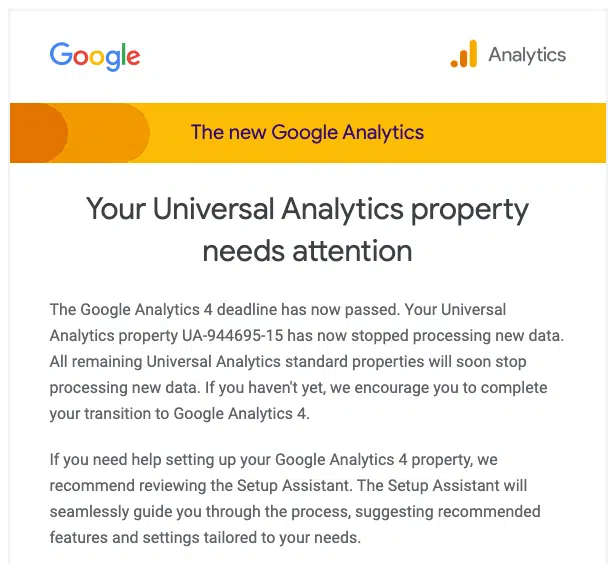
The notification. Google’s email started with “Your Universal Analytics property needs attention” and went on to say:

“The Google Analytics 4 deadline has now passed. Your Universal Analytics property [UA property number] has now stopped processing new data. All remaining Universal Analytics standard properties will soon stop processing new data. If you haven’t yet, we encourage you to complete your transition to Google Analytics 4.

If you need help setting up your Google Analytics 4 property, we recommend reviewing the Setup Assistant. The Setup Assistant will seamlessly guide you through the process, suggesting recommended features and settings tailored to your needs.”

Here’s a screenshot:

Google Ua Property Needs Attention

Several people also sharing their notifications on social media:

Why we care. Multiple polls have shown that the majority of search marketers hate Google Analytics 4 – especially GA4’s user interface. Even though many marketers have set up GA4, they will likely continue using UA until the bitter end.

53 days later. It’s now been 53 days since July 1, the date on which we were told – repeatedly – that Google would stop processing data on Universal Analytics properties as part of the forced switch to Google Analytics 4. To our surprise that didn’t happen.

  • UA continued to process data on July 1. This despite a year-long multichannel assault of switch-or-else warnings (blog posts, emails, social media, etc.) and that super annoying red intrusive interstitial countdown clock every time you logged into GA.
  • UA properties were still processing data on Aug. 1.
  • And it continues to process data on many UA properties today – though Google once again promises that will end “soon.”

When is soon? We’ll find out soon. In Google’s world, that could mean your property is collecting data for weeks or even months from now.


Related stories

New on Search Engine Land

@media screen and (min-width: 800px) { #div-gpt-ad-3191538-7 { display: flex !important; justify-content: center !important; align-items: center !important; min-width:770px; min-height:260px; } } @media screen and (min-width: 1279px) { #div-gpt-ad-3191538-7 { display: flex !important; justify-content: center !important; align-items: center !important; min-width:800px!important; min-height:440px!important; } }

About the author

Danny Goodwin

Danny Goodwin has been Managing Editor of Search Engine Land & Search Marketing Expo – SMX since 2022. He joined Search Engine Land in 2022 as Senior Editor. In addition to reporting on the latest search marketing news, he manages Search Engine Land’s SME (Subject Matter Expert) program. He also helps program U.S. SMX events. Goodwin has been editing and writing about the latest developments and trends in search and digital marketing since 2007. He previously was Executive Editor of Search Engine Journal (from 2017 to 2022), managing editor of Momentology (from 2014-2016) and editor of Search Engine Watch (from 2007 to 2014). He has spoken at many major search conferences and virtual events, and has been sourced for his expertise by a wide range of publications and podcasts.

https://searchengineland.com/google-sending-notifications-that-ua-has-stopped-processing-data-431074