5 ways to improve PPC lead quality

Online leads are not all equal. The quality of those leads ultimately matters in driving meaningful business outcomes.

Focusing on high-quality leads in your PPC campaigns increases your return on investment for your marketing dollars. 

Additionally, improving lead quality allows salespeople to focus on more promising opportunities, streamline their sales process, and cultivate a loyal customer base. 

Here are the tools and strategies you can employ to drive better leads and more ideal customers to your doorstep:

Key 1: Teach Google what a good lead looks like

Google’s ad bidding algorithm is a sophisticated system determining whom to target and how much to pay for a click. 

The algorithm considers many factors, such as the bid, the ad and landing page quality, the expected click-through rate, and other historical performance data. 

The better quality data you can provide to Google, the better the algorithms will do your bidding (literally). 

You can do this by providing Google the following:

  • Clean conversion tracking, depending on what clean means for you.
  • Customer lists that are filtered for your highest-quality customers while meeting the 1,000-user threshold.
  • Conversion values for designating more highly profitable leads from others.

Positive feedback loops

Algorithms like Google’s ad bidding system are designed to continuously improve performance by leveraging a feedback loop. This loop allows the algorithm to learn from past decisions and adjust its strategies for better outcomes. 

When the algorithm receives accurate and high-quality initial inputs, it establishes a strong foundation for this learning process. The algorithm can make increasingly precise bidding decisions as it refines its understanding of user behaviors and preferences. 

Fueled by the right inputs, this positive feedback loop results in more accurate learnings and better bidding decisions, enhancing campaign effectiveness and improving return on investment.

Key 2: Don’t neglect offline conversion tracking

One of the best practices for improving your PPC lead quality is offline conversion tracking or Enhanced Conversions for Leads.

Offline conversion tracking in Google Ads lets you link online ad interactions with offline actions, like in-store purchases or phone orders.

Doing so better informs Google’s bidding algorithms on what and who to optimize for increased profits and offline sales. 

Here’s how it works:

High-quality lead data curation

Compile your online leads that generated revenue offline with an average volume of 30 or more per month and an average lag of 90 days or less.

Consider creating a database of all of the high-quality leads generated, whether they purchased or not. This is recommended because we aim to inform Google of the ideal lead candidates and to generate more of these, whether they become customers or not.

Integration with CRM or database

Next, integrate your offline data with Google Ads. This can be done by collecting and associating a Google Click ID (GCLID) with your leads.

Alternatively, consider using Enhanced Conversions for Leads for less technical and more streamlined implementation.

Ideally, you will have an automatic upload of this data into Google Ads regularly. If you use Salesforce or HubSpot, Google Ads has an easy and direct integration for uploading these offline sales conversions.

Attribution and reporting

Once Google matches the lead with the originating click ID, it can attribute the ads, keywords, campaigns, etc., that drive these valuable offline actions. 

You can see reporting on the associated metrics like conversion value, conversion rate, and return on ad spend (ROAS).

Identify optimization opportunities

This data lets you understand which keywords, ads, or campaigns drive the most valuable offline conversions. 

These insights will help you to make informed decisions about budget allocation, keywords, ad creatives, and targeting to optimize your campaigns.

Google Ads conversion tracking

Key 3: Exclude low-quality lead sources

Once you can identify what is generating your best-quality leads, you want to use these insights to pull spending away from your low-quality lead sources. 

Audience demographics such as age and household income levels will come to light.

For example, you could discover that conversions are from 18- to 24-year-olds but not revenue. Use this discovery to exclude those age demographics from accruing ad spending in your campaigns. 

Placement exclusions

Regularly check your placements report for low-quality websites, apps, and YouTube channels where your ads showed. 

This can be tedious, but it will allow you to exclude placements that do not align with your brand or match your targeting. This is a great strategy to exclude low-quality lead sources. 

Google Ads placement exclusions

Turn off demographics expansion

If you use demographic exclusions to improve lead quality, it is crucial to understand that Video Action campaigns using optimized targeting will ignore these exclusions. 

Be sure to submit a request to your Google rep for whitelisting to turn off the demographics expansion.  


Get the daily newsletter search marketers rely on.


Key 4: Attract high-quality leads who want to do business with you.

How good is your brand at attracting your ideal prospects, and does this high-caliber lead want to work with you? 

If you’re facing challenges in attracting quality leads to your brand or would like to improve overall, start by evaluating and enhancing your brand strategy. 

Consider refreshing your brand identity, including your website, ads, logos, and colors. Be sure these are all effectively resonating with your desired customers.

Revisit your target audience and ensure your brand’s messaging aligns with their preferences and needs. Clarify your value proposition, highlighting how your brand addresses users’ specific problems. 

Last, embrace personalization to connect with different segments of your audience and resonate more deeply. 

Examples include personalized landing pages, dynamic website content based on the visitor’s preferences and behavior-based retargeting ads.

Key 5: Disqualify leads before they reach a salesperson

I learned this from Perry Marshall, who has a story from John Paul Mendocha about “racking the shotgun,” and it’s about applying the 80/20 rule to your prospecting.

Ideally, you would disqualify folks before they click on your ad, costing you money. You can apply these other techniques after excluding your low-quality lead sources.

Use price as a disqualifier

Some prospecting strategies include concealing the price. I recommend using it as a disqualifier. You will likely prevent the leads from entering your funnel who cannot afford what you offer. 

Disqualify leads with your online form

If displaying your price doesn’t make sense, use your online form to ask a qualifying question about the budget or how much they plan to invest. Doing so allows you to route leads with more profitable follow-up tactics based on their response.

Urgency is another qualifier that can be asked online, such as how significant is this problem they are trying to solve? One way would be to ask for their timeframe. 

Alternatively, they can rank the importance of finding a solution from one to five. 

Disqualify leads over chat

Similarly to the online form, use chat to help disqualify potential leads just as much as you would try to convert them. Ask the same qualifying questions to identify if your solution doesn’t fit their needs.

Bonus key: Get targeting feedback directly from salespeople

One bonus point for improving your PPC lead quality is getting targeted feedback directly from salespeople.

As PPC marketers, we tend to work in a black box. Getting insights directly from salespeople can help inform our targeting and exclusion strategies. 

Not only can this make our direct campaigns more profitable, but sending through more highly qualified leads improves the results for the salespeople, increases retention, enhances your brand reputation, and reduces wasted resources. 

Increase lead quality to increase your resources

Improving lead quality can significantly impact a business across various aspects. This impact will be more significant if most of your leads come from PPC sources. 

Ultimately, focusing on lead quality can lead to more efficient resource allocation, better customer relationships, increased conversion rates, higher revenue and overall business success. 


Opinions expressed in this article are those of the guest author and not necessarily Search Engine Land. Staff authors are listed here.


Related stories

New on Search Engine Land

@media screen and (min-width: 800px) { #div-gpt-ad-3191538-7 { display: flex !important; justify-content: center !important; align-items: center !important; min-width:770px; min-height:260px; } } @media screen and (min-width: 1279px) { #div-gpt-ad-3191538-7 { display: flex !important; justify-content: center !important; align-items: center !important; min-width:800px!important; min-height:440px!important; } }

About the author

Chelsea So

Chelsea So is the Founder of Leadocity, a Google Ads consulting firm that supports agencies and clients with high-growth performance strategies and services. Chelsea started running PPC for her own e-commerce store back in 2004 and has been addicted ever since.

https://searchengineland.com/improve-ppc-lead-quality-431009


YouTube trials smaller ‘Skip Ads’ button

YouTube has confirmed that it is trialling a redesigned, smaller ‘Skip Ads’ button.

The CTA button’s new look features:

  • Smaller text
  • A background with reduced opacity
  • A curved border
  • No capital letters in the word ‘Ads’

Here is a preview of the new button:

Screenshot 2023 08 21 At 19.48.11 598x600

In comparison to the older version:

Screenshot 2023 08 21 At 19.48.23 800x445

What has YouTube said? A YouTube spokesperson exclusively told Search Engine Land:

  • “We’re testing an update to the design of the ‘Skip Ads’ button across all platforms.”
  • “Our goal is to provide a more consistent user experience in line with the updated look and feel on YouTube we announced last year.”

Why we care. Users will naturally be less inclined to skip ads if the ability to do so isn’t brought to their attention, leading to a boost in view rate, reach, conversions, and, potentially, an increase in ad spend on the platform. However, marketers should be mindful that forcing adverts on users may have a negative impact.

Reaction. The new design was noticed by Google Ads expert, Thomas Eccel, who shared his thoughts on X (Twitter). He wrote:

  • “Spotted this really small ‘Skip ads’ button, seems like Google is testing this new button. It has a new format and is way smaller than the normal ‘skip’ box. If this gets rolled out, it will affect the view rate and the spend of the campaigns.”

Meanwhile, others also flagged the redesigned button and questioned if the platform was also simultaneously making adverts longer.

Why now? The redesigned skip button was launched to help align it with the new look and feel of YouTube, while maintaining a comparable level of prominence with the current skip button.

The platform announced last year that it was planning to undergo a small makeover, amid calls from users to make the UI “cleaner” and “more lively”.


Get the daily newsletter search marketers rely on.


Deep dive. Read YouTube’s blog for more information on its new design elements and product features.


Related stories

New on Search Engine Land

@media screen and (min-width: 800px) { #div-gpt-ad-3191538-7 { display: flex !important; justify-content: center !important; align-items: center !important; min-width:770px; min-height:260px; } } @media screen and (min-width: 1279px) { #div-gpt-ad-3191538-7 { display: flex !important; justify-content: center !important; align-items: center !important; min-width:800px!important; min-height:440px!important; } }

About the author

Nicola Agius

Nicola Agius is Paid Media Editor of Search Engine Land after joining in 2023. She covers paid search, paid social, retail media and more. Prior to this, she was SEO Director at Jungle Creations (2020-2023), overseeing the company’s editorial strategy for multiple websites. She has over 15 years of experience in journalism and has previously worked at OK! Magazine (2010-2014), Mail Online (2014-2015), Mirror (2015-2017), Digital Spy (2017-2018) and The Sun (2018-2020). She also previously teamed up with SEO agency Blue Array to co-author Amazon bestselling book ‘Mastering In-House SEO’.

https://searchengineland.com/youtube-trials-smaller-skip-ads-button-430998


CTV ad spend hits record-breaking $1 billion in June

Connected TV advertising broke records after ad spend reached $1 billion in June, according to a report by ad-research company Vivvix (formerly known as Kantar).

The research investigated how ad dollars are spent across a growing list of streaming platforms, such as Discovery+, Max (formerly HBOMax), Roku, and YouTube.

Growth categories included household supplies and beverages – which rocketed by more than 300% year-over-year. However, verticals like pets, as well as cosmetics and beauty didn’t trend as highly.

The industry milestone, which supports Vivvix’s predictions for the first half of 2023, comes at a time when digital formats account for 70% of total ad spend, in which video is the fastest growing format.

Why we care. This report highlights that the advertising industry recognizes the importance of running campaigns on CTV platforms, and which sectors in particular are increasing their ad spend. It’s important to monitor competitors’ strategies so that you can make informed decisions, respond to trends, capitalize on market opportunities, and maintain a competitive edge in your industry.

Promising forecast for YouTube. YouTube also experienced significant growth in the digital ecosystem, according to the Vivvix report. In June, the Google-owned platform generated $1.4 billion in ad spend across it properties. Based on this performance, Vivvax predicts that ad spend will continue to grow, particularly as non-linear properties continue to capture more viewership.

Looking ahead. CTV advertising is expected to grow by 13.2% globally in 2023 to $25.9 billion, according to GroupM’s mid-year forecast. In the US specifically, CTV advertising is expected to grow by 21.2% year-on-year this year as the majority of Americans continue spending so much time streaming TV every day, reports Insider Intelligence.


Get the daily newsletter search marketers rely on.


What has Vivvix said? Andrew Feigenson, CEO of Vivvix, said:

  • “This milestone validates the projections on CTV’s ascendency from experimental to a ‘table stakes’ medium. It’s where viewers are increasingly spending their time, and in order to be competitive, brands must play ball on those fields, and understand what competitors are doing on these platforms.”
  • “The data really informs brands where the white space is within the video journey as well. We noticed, for example, a dearth of pet brands advertising on Disney+ in June. That signals a real opportunity.”
  • “Being able to take a broader view of the video landscape helps advertisers see the strategy their competitors are using across various channels. The shift of ad dollars between new and emerging platforms can make it difficult for advertisers to connect the dots, so it’s important for brands to have access to a wider lens. We are confident that more brands will continue to allocate more of their advertising budgets to CTV and other digital media, which will affect traditional TV advertising.”
  • “To give brands the deepest, richest and fullest picture of advertising spend, Vivvix is purpose-built to look across the full spectrum of ad platforms, from linear to digital. We are continually investing in expanding our coverage across all digital media, including CTV, and social video like YouTube. Vivvix gives advertisers a view into more than $162 billion worth of digital ad spend which translates to a deep level of competitor ad campaign visibility.”

Deep dive. Read the Vivvix report in full for more information.


Related stories

New on Search Engine Land

@media screen and (min-width: 800px) { #div-gpt-ad-3191538-7 { display: flex !important; justify-content: center !important; align-items: center !important; min-width:770px; min-height:260px; } } @media screen and (min-width: 1279px) { #div-gpt-ad-3191538-7 { display: flex !important; justify-content: center !important; align-items: center !important; min-width:800px!important; min-height:440px!important; } }

About the author

Nicola Agius

Nicola Agius is Paid Media Editor of Search Engine Land after joining in 2023. She covers paid search, paid social, retail media and more. Prior to this, she was SEO Director at Jungle Creations (2020-2023), overseeing the company’s editorial strategy for multiple websites. She has over 15 years of experience in journalism and has previously worked at OK! Magazine (2010-2014), Mail Online (2014-2015), Mirror (2015-2017), Digital Spy (2017-2018) and The Sun (2018-2020). She also previously teamed up with SEO agency Blue Array to co-author Amazon bestselling book ‘Mastering In-House SEO’.

https://searchengineland.com/ctv-ad-aprnd-record-breaking-month-june-430957


IPG Mediabrands tells clients to temporarily pause Google Performance Max campaigns

IPG Mediabrands advised its clients to temporarily pause campaigns using Google’s Performance Max.

The company issued a “privacy alert” email in response to allegations in a new report that YouTube ads may have led to improperly tracking children.

Brands using PMax may inadvertently violate the Children’s Online Privacy Protection Act (COPPA) as a result, according to the study conducted by Adalytics.

Why we care. If brands are found to be in violation of COPPA, they may have to pay a significant financial penalty just as YouTube did in 2019 when it spent a record $170 million to settle similar charges.

Have any laws been broken? Under COPPA, online services must get parental consent before collecting data for targeted advertising purposes from children under the age of 13.

Adalytics researchers found the platform serving personalized ads from more than 300 brands on “made for kids” videos. When viewers clicked on these campaigns, they were redirected to the brand’s website, which sometimes resulted in dropping cookies on the user’s browser.

IPG Mediabrands investigates. In response to the findings, IPG Mediabrands conducted its own investigation. They reportedly found that at least one of its clients, which was running an adult-targeted campaign, had its ad feature on a “made for kids” channel.

If a child had clicked on the ad, tracking pixels from the brand’s website would have gathered data from the child as well as their associated ID. This data would then have been shared with Google’s PMax.

IPG Mediabrands, which manages $40 billion in marketing investment worldwide, reportedly concluded that a full investigation was needed to identify the full extent of the impact on its clients.

What has IPG Mediabrands said? A spokesperson for IPG Mediabrands told Search Engine Land that the email was an “early, unapproved draft of an internal-only note that was not reflective of our broader organizational POV. This was retracted. This was not sent to clients.”

The email in question – which was obtained by Business Insider – read:

  • “Because placement reporting is not available for PMAX, we recommend that clients temporarily pause PMAX until the efficacy of the above controls are validated on non-PMAX campaigns where placement reporting is available.”
  • “Clients should consult with their legal, privacy/infosec, website, and data teams to consider potential exposure, and determine the appropriate process for identifying and removing data potentially collected from children.
    For example, advertisers may assess data in their CDPs that originated from YouTube as a traffic source.”
  • “These recommendations are being made on the basis of the probability of FTC scrutiny, as well as in light of the evidence of waste in advertising investment against unintended audiences.”

What has Google said? Dan Taylor, Google’s Vice President of Global Ads, said the Adalytics study was “flawed”. Addressing the report in a post on X (formerly known as Twitter), he stated:

  • “[This is the] 2nd time [Adalytics has] produced faulty research about Google advertising this summer. Here are 6 facts about how we protect kids on YouTube that Adalytics gets completely wrong or ignores.”
  • “#1 We don’t personalize ads to kids, ever. And we treat everyone who watches Made for Kids content as a child, regardless of their age.”
  • “#2 We built YouTube Kids as a dedicated app designed from the ground up to be a safer experience for kids to explore, with tools for parents and caregivers to guide their journey. The YouTube Kids app has never had personalized ads either.”
  • “#3 Made for Kids content has ads but we restrict the types of products that can be advertised: e.g. no ads for video games or media unsuitable for children, no ads about dating and relationship, no ads for food and beverage.”
  • “#4 Google does not share with advertisers what content/video a person was watching when they click on an ad. That means advertisers never know if a click came from someone watching Made for Kids content, regardless of their age.”
  • “#5 Advertisers, with a single click, can choose to opt out of Made for Kids content. The opt-out, called Content Suitable for Families, prevents advertisers from having their ads run alongside Made for Kids content. Adalytics doesn’t appear to know this.”
  • “#6 Cookies ≠ ad personalization. Cookies are permitted under COPPA for statistical reporting, for spam and fraud detection and for frequency capping. They are critical to YouTube creators’ monetization which encourages a rich diversity of content on YouTube.”
  • “#7 Though we only just received the report, what we have reviewed shows no violations of our commitments nor privacy policies. Given Adalytics’ last report was debunked by 2 independent organizations, we do not put much stock in the accuracy of their research.”
  • “#8 The NYTimes, who was given early access to the report, couldn’t even verify the bulk of Adalytics’ claims. It does not corroborate Adalytics’ accusations and in fact found the opposite: no violation of COPPA, no personalization of ads to kids, and no improper use of cookies.”
  • “#9 Adalytics’ report has no substance and tries to make a gotcha when there is none. We offered to meet with them weeks ago and heard crickets. Do they have the credentials and expertise to publish these reports?”

Deep dive. Read Adalytics’ YouTube study in full for more information on its research. Read Google’s official documentation on how ads work on YouTube for supervised accounts for more information.


Related stories

New on Search Engine Land

@media screen and (min-width: 800px) { #div-gpt-ad-3191538-7 { display: flex !important; justify-content: center !important; align-items: center !important; min-width:770px; min-height:260px; } } @media screen and (min-width: 1279px) { #div-gpt-ad-3191538-7 { display: flex !important; justify-content: center !important; align-items: center !important; min-width:800px!important; min-height:440px!important; } }

About the author

Nicola Agius

Nicola Agius is Paid Media Editor of Search Engine Land after joining in 2023. She covers paid search, paid social, retail media and more. Prior to this, she was SEO Director at Jungle Creations (2020-2023), overseeing the company’s editorial strategy for multiple websites. She has over 15 years of experience in journalism and has previously worked at OK! Magazine (2010-2014), Mail Online (2014-2015), Mirror (2015-2017), Digital Spy (2017-2018) and The Sun (2018-2020). She also previously teamed up with SEO agency Blue Array to co-author Amazon bestselling book ‘Mastering In-House SEO’.

https://searchengineland.com/ipg-mediabrands-pause-google-pmax-campaigns-430937


Amazon Sponsored Product ads will now appear on Pinterest, Buzzfeed, and more

Amazon Sponsored Product ads will now appear on third-party premium apps and websites.

Pinterest, BuzzFeed, Hearst Newspapers, Raptive and Ziff Davis brands like Lifehacker and Mashable are among the brands that are partnering up with the retail giant to increase reach for its Sponsored Product ad product.

The news comes after Amazon announced a multi-year collaboration with Pinterest to become its first ever third-party advertising partner back in April.

Why we care. Expanding the reach of Amazon Sponsored Product ads means marketers can potentially achieve higher conversion rates and increased return on ad spend, positioning their brands for success in a dynamic digital landscape. The new feature could also help address the attribution issue on Pinterest, which has proved to be a budget-limiting factor for advertisers, as huge discrepancies have previously been reported between the Pinterest dashboard and Google Analytics.

1 277x600

How it works. Amazon will identify users on the third-party platforms that are likely to be interested in your product by analyzing relevant page context, the campaign and cost-per-click parameters that you have already established. It will then display your campaign to this audience.

All ads on the third-party platforms will link back to your Amazon product page, enabling potential customers to easily make a purchase in just a couple of clicks.

Eligibility. Sponsored Products will only appear on third party premium apps and websites if they meet the following criteria:

  • The product must be in stock.
  • The product includes trusted Amazon shopping attributes such as Prime delivery promise, ratings and accurate pricing information.

Next steps. You don’t need to take any action for your Sponsored Products to appear on third-party premium apps or websites – Amazon will enable this feature automatically for you.

Campaign reporting will be available n the Sponsored Products placement report, which can be downloaded in the report centre.

What has Amazon said? Colleen Aubrey, senior vice president, Amazon Ads Products and Technology, said:

  • “Sponsored Products has always been about helping customers discover products they may love.”
  • “We’ve been building and evolving Sponsored Products in our store for more than 10 years, leveraging advanced machine learning algorithms to show advertising that’s highly relevant for customers, and therefore highly effective for the advertisers that choose to use it.”
  • “We are excited to now apply what we’ve learned about connecting customers and products in meaningful ways to a range of great websites and apps.”

Get the daily newsletter search marketers rely on.


What has Pintrest said? Martha Welsh, Chief Strategy Officer at Pinterest, told Search Engine Land:

  • “We’re excited to enter this next phase of our third-party partnership with Amazon Ads to bring more shoppable content onto the platform along with a great consumer buying experience. Shopping on Pinterest has never been easier.”
  • “Now through our partnership, advertisers on Amazon are able to have their products appear in our search results, making ads on Pinterest even more relevant and actionable.”
  • “Shopping is one of the top requests we receive from our users – more than 50% of users say they come to Pinterest to shop – and we’re continuing to deliver more ways to go from inspiration to action. We’re in the early stages of testing right now and seeing encouraging results.”

Deep dive. Read Amazon’s Sponsored Products announcement in full for more information.


Related stories

New on Search Engine Land

@media screen and (min-width: 800px) { #div-gpt-ad-3191538-7 { display: flex !important; justify-content: center !important; align-items: center !important; min-width:770px; min-height:260px; } } @media screen and (min-width: 1279px) { #div-gpt-ad-3191538-7 { display: flex !important; justify-content: center !important; align-items: center !important; min-width:800px!important; min-height:440px!important; } }

About the author

Nicola Agius

Nicola Agius is Paid Media Editor of Search Engine Land after joining in 2023. She covers paid search, paid social, retail media and more. Prior to this, she was SEO Director at Jungle Creations (2020-2023), overseeing the company’s editorial strategy for multiple websites. She has over 15 years of experience in journalism and has previously worked at OK! Magazine (2010-2014), Mail Online (2014-2015), Mirror (2015-2017), Digital Spy (2017-2018) and The Sun (2018-2020). She also previously teamed up with SEO agency Blue Array to co-author Amazon bestselling book ‘Mastering In-House SEO’.

https://searchengineland.com/amazon-sponsored-product-ads-pinterest-430907


The new Bing has failed to take any market share from Google after six months

It’s been just over six months since the new AI-powered Bing with Bing Chat launched – but its overall search engine market share remains virtually unchanged globally and in the U.S.

Why we care. When the new Bing launched, it felt like the dawn of an exciting new era in search. Microsoft seemed to have a legitimate chance to erode some of Google’s dominance and become a truly worthy competitor to Google, thanks to its new conversational and generative AI take on search. Unfortunately, that hasn’t happened.

By the numbers. Bing’s U.S. search market share was 6.47% in July, per web analytics service  StatCounter.

Us Search Market Share July2023 Statcounter
  • In February, when new Bing launched, it’s market share was 6.35%. Bing’s market share peaked at 6.61% in March.
  • But Bing’s U.S. market share was typically over 7% in 2022, with a high of 7.82% in November.

Bing’s global search market share was 2.99% in July, per StatCounter.

Global Search Market Share July2023 Statcounter
  • The highest Bing’s global search market share has been this year was in January, at 3.03%, a month before new Bing was announced. In 2022, Bing was consistently over 3%.

Microsoft disputes these numbers. A WSJ article today (paywalled, so I’m not linking to it) noted that:

  • “[Microsoft] disputed outside data, saying third-party data companies aren’t measuring all the people who are going directly to Bing’s chat page.”

StatCounter said its data takes traffic to and from Bing’s chat into account. Here’s what digital intelligence platform SimilarWeb told me:

  • “It’s possible that we’re missing some of the Bing Chat interactions that use an Edge sidebar / extension, but I don’t know how significant that is in the grand scheme of things.”

Yusuf Mehdi, Microsoft’s corporate VP and consumer CMO, told WSJ the company’s internal data shows Bing taking market share from Google, but failed to provide any figures.

  • “We’ve made more progress in the last six months than we have in the previous decade or two combined. We’re delighted with our start,” Mehdi said.

This claim seems a bit odd, considering around this time 10 years ago, Bing’s search market share was 17.9%, per comScore.

How Microsoft celebrates six months. Microsoft’s Aug. 7 blog post highlighting the number of chats (1 billion) and images created (750 million), as well as nine quarters of growth for Edge. And it earned them a surprising amount of PR thanks to many publications covering the launchiversary (Search Engine Land was not among those, because there was nothing new to report to you).

More data. I also checked with SimilarWeb and comScore for their latest data on Bing’s lack of growth. Here’s what a SimilarWeb spokesperson told me:

  • “We can see a little bit of growth for Bing, but it’s incremental. According to our official rankings for the search engine category, they were the #2 search engine with a little over 2% traffic share in the U.S. as of July, but still at about 1% worldwide.”
Bing Worldwide Us July Similarweb 800x209

Meanwhile, Bing saw a 6% decline in unique visitors and total visits from February to July, according to data from analytics firm comScore. Bing’s unique visitors and total visits also declined 2% year on year in July.

Dig deeper. Here’s some of our previous coverage of the AI search engine arms race that never actually became a race:


Related stories

New on Search Engine Land

@media screen and (min-width: 800px) { #div-gpt-ad-3191538-7 { display: flex !important; justify-content: center !important; align-items: center !important; min-width:770px; min-height:260px; } } @media screen and (min-width: 1279px) { #div-gpt-ad-3191538-7 { display: flex !important; justify-content: center !important; align-items: center !important; min-width:800px!important; min-height:440px!important; } }

About the author

Danny Goodwin

Danny Goodwin has been Managing Editor of Search Engine Land & Search Marketing Expo – SMX since 2022. He joined Search Engine Land in 2022 as Senior Editor. In addition to reporting on the latest search marketing news, he manages Search Engine Land’s SME (Subject Matter Expert) program. He also helps program U.S. SMX events. Goodwin has been editing and writing about the latest developments and trends in search and digital marketing since 2007. He previously was Executive Editor of Search Engine Journal (from 2017 to 2022), managing editor of Momentology (from 2014-2016) and editor of Search Engine Watch (from 2007 to 2014). He has spoken at many major search conferences and virtual events, and has been sourced for his expertise by a wide range of publications and podcasts.

https://searchengineland.com/new-bing-google-market-share-six-months-430840


Instagram tests Multi-Advertiser ads, cramming four ads into one screen

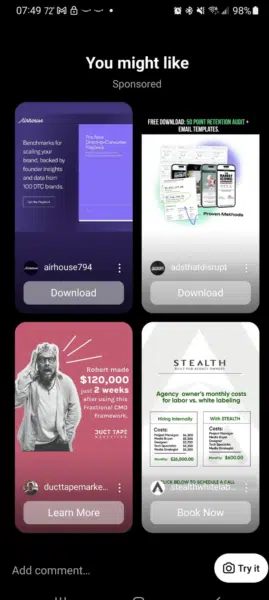
Instagram is piloting a new ad layout that crams four sponsored posts into one screen.

It’s the platform’s latest take on Multi-Advertiser ads, which groups together related sponsored posts from different businesses and serves them to people who have recently shown an interest in related products or services.

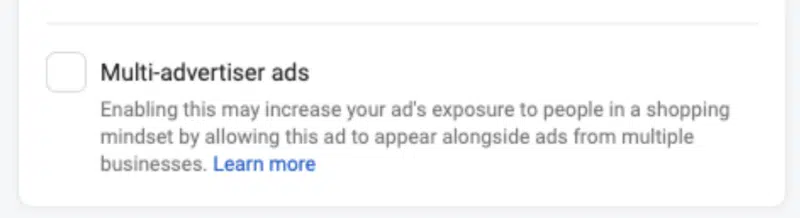
The new layout is being displayed between Reels. Advertisers can disable this feature by opting out in Settings.

Why we care. Bombarding Instagram users with so many ads at once may keep CPMs low. However, it could also potentially annoy users, making it harder for brands to capture consumers’ attention, which will negatively impact CTR and ROI.

Screenshot 2023 08 17 At 14.26.23 1 269x600

Not all impressions are equal. While brands may initially see some success with this new ad format, the novelty will wear off and users will eventually opt to skip the content, said Barry Hott, Growth Marketing Consultant and Advisor:

  • “Meta’s getting greedy here and trying to squeeze more ad impressions out of their users, particularly on Reels. Great reminder of how all impressions are not equal. I would consider this impression much lower value than a full Reels or Feed ad placement, but it can be used to serve cheap CPMs, more like a right column placement.
  • “Lower CPMs on an optimized platform with multiple varied placements are not better for you. When you see lower CPMs, don’t celebrate it, question it.
  • “If your attribution setting includes 1-day view, this placement can be used by the system to get more cheap (non-incremental) 1-day view conversions.
  • “My bet is this placement will work well for a couple of months before the novelty wears off and users catch on that this interface is solely for them to be served ads and they’ll learn to subconsciously block and skip them.”
Screenshot 2023 08 17 At 14.17.12 800x218

The risk of annoying users. Katharine Mckee, digital commerce consultant, raised her concerns over the ad product interrupting the user experience:

  • “I would assume that some of this is driven by customer interest. The example may be throwing it off, but all of those [ads in the example] are cheesy/spammy and highly likely to be skipped.
  • “It may make sense from a UX perspective to put the seemingly identical things together in one skippable bomb rather than irritating users.
  • “Put all the skippable rubbish into one easy-to-ignore slot. I cannot wait to see the ugly reel!”

Get the daily newsletter search marketers rely on.


What Instagram is saying. Instagram announced its multi-advertiser format via an announcement in its Help Center:

  • “Multi-advertiser ads help people discover and compare products from multiple businesses. This ad unit, available for selected placements on Facebook and Instagram, gives advertisers the opportunity to be discovered by people who have recently shown an interest in related products or businesses.”
  • “In the multi-advertiser ad unit, personalized ads from different businesses are shown in a carousel format beneath an ad that a shopper has recently engaged with. An ad for a wedding dress might appear beside another brand’s ad for a wedding cake, for example.”
  • “The advertiser decides where the action button within their multi-advertiser ad takes people. At the end of the carousel, an action button links to a feed of ads, where shoppers can explore more related products or services (currently only available on Instagram).”
  • “This feature is being gradually introduced and may not be available to you yet.”

Related stories

New on Search Engine Land

@media screen and (min-width: 800px) { #div-gpt-ad-3191538-7 { display: flex !important; justify-content: center !important; align-items: center !important; min-width:770px; min-height:260px; } } @media screen and (min-width: 1279px) { #div-gpt-ad-3191538-7 { display: flex !important; justify-content: center !important; align-items: center !important; min-width:800px!important; min-height:440px!important; } }

About the author

Nicola Agius

Nicola Agius is Paid Media Editor of Search Engine Land after joining in 2023. She covers paid search, paid social, retail media and more. Prior to this, she was SEO Director at Jungle Creations (2020-2023), overseeing the company’s editorial strategy for multiple websites. She has over 15 years of experience in journalism and has previously worked at OK! Magazine (2010-2014), Mail Online (2014-2015), Mirror (2015-2017), Digital Spy (2017-2018) and The Sun (2018-2020). She also previously teamed up with SEO agency Blue Array to co-author Amazon bestselling book ‘Mastering In-House SEO’.

https://searchengineland.com/instagram-multi-advertiser-ads-four-reels-430837


Only 23% of digital marketers will invest in X in the next 12 months

Less than a quarter of digital marketers plan to invest in X, formerly known as Twitter, during the next 12 months, according to a Search Engine Land survey.

And, the percentage of digital marketers investing in X continues to fall rapidly, down from 27% of marketers in Q1 to 17% in Q3 to date. 

Digital Marketers Invest X

Where marketers plan to invest. Google (including YouTube) and Meta properties Facebook and Instagram are the platforms most digital marketers will invest in during the next 12 months, 81% and 57%, respectively.

  • Forty percent of marketers said they will invest in Microsoft’s LinkedIn business-to-business social media network. Other Microsoft properties, including Bing, will be getting investments from 31% of digital marketers. 
  • Among the retail media networks tracked, 27% said they planned to invest in Amazon and 11% in Walmart. 
Digital Ad Platforms Search Engine Land Survey

About the data. The survey was conducted from January to August 2023. Nearly 1,000 people responded after signing up for the Search Engine Land newsletter. 


Related stories

New on Search Engine Land

@media screen and (min-width: 800px) { #div-gpt-ad-3191538-7 { display: flex !important; justify-content: center !important; align-items: center !important; min-width:770px; min-height:260px; } } @media screen and (min-width: 1279px) { #div-gpt-ad-3191538-7 { display: flex !important; justify-content: center !important; align-items: center !important; min-width:800px!important; min-height:440px!important; } }

About the author

Chris Elwell

Chris is a founding partner and CEO of Third Door Media, the publisher of MarTech and Search Engine Land, and producer of the MarTech Conference and Search Marketing Expo – SMX. TDM accelerates customer acquisition for its clients by providing trusted content and targeted marketing programs that deliver qualified prospects. You can reach Chris at chris[at]thirddoormedia.com.

https://searchengineland.com/digital-marketers-invest-next-12-months-430826


Brands pause X ad spending after ads serve with pro-Nazi content

Ads from at least 19 brands appeared alongside a pro-Hitler account on X, formerly known as Twitter. Two of those brands have now suspended advertising on the platform. X has now deleted the account.

Why we care. X’s new CEO Linda Yaccarino told CNBC just last week that brands are “protected from the risk of being next to” potentially toxic content and “your ads will only air next to content that is appropriate for you.” Clearly, that’s not the case. X may say its platform is committed to brand safety, but it still has work to do.

What happened. Media Matters for America published this report detailing how X has been placing ads for brands on a verified pro-Adolf Hitler account with thousands of followers. The nonprofit watchdog group also included multiple screenshots showing the promoted posts.

  • “The company continues to monetize the openly antisemitic account despite reportedly acknowledging it had violated the platform’s ‘rules against violent speech,’” Media Matters reported.

Unsafe brands. Ads from the following brands were shown alongside the pro-fascist content:

  • Action Network 
  • Adobe
  • Amazon
  • Atlanta Falcons
  • BritBox
  • Corn Nuts / Hormel Foods
  • FIFA Women’s World Cup
  • Fortune
  • Gallup
  • Gilead Sciences 
  • MLB
  • NCTA-The Internet and Television Association
  • Office Depot 
  • Regal
  • Samsung
  • Sports Illustrated
  • The Athletic / The New York Times Co. 
  • The Herd with Colin Cowherd / Fox Sports
  • USA Today

X loses more brands. Two of these brands – NCTA and Gilead – “immediately paused their ad spending on X,” CNN reported. A spokesperson for NCTA said the company “had opted into X’s brand safety measures including keyword restrictions and limiting its ad placement to the ‘home feed of target audiences.’”

  • “We take the responsible placement of NCTA ads very seriously and are concerned that our post about the future of broadband technology appeared next to this highly disturbing content.
  • “Brand safety will remain an utmost priority for NCTA, which means suspending advertising on Twitter/X for the foreseeable future and heavily limiting NCTA’s organic presence on the platform.”

Related stories

New on Search Engine Land

@media screen and (min-width: 800px) { #div-gpt-ad-3191538-7 { display: flex !important; justify-content: center !important; align-items: center !important; min-width:770px; min-height:260px; } } @media screen and (min-width: 1279px) { #div-gpt-ad-3191538-7 { display: flex !important; justify-content: center !important; align-items: center !important; min-width:800px!important; min-height:440px!important; } }

About the author

Danny Goodwin

Danny Goodwin has been Managing Editor of Search Engine Land & Search Marketing Expo – SMX since 2022. He joined Search Engine Land in 2022 as Senior Editor. In addition to reporting on the latest search marketing news, he manages Search Engine Land’s SME (Subject Matter Expert) program. He also helps program U.S. SMX events. Goodwin has been editing and writing about the latest developments and trends in search and digital marketing since 2007. He previously was Executive Editor of Search Engine Journal (from 2017 to 2022), managing editor of Momentology (from 2014-2016) and editor of Search Engine Watch (from 2007 to 2014). He has spoken at many major search conferences and virtual events, and has been sourced for his expertise by a wide range of publications and podcasts.

https://searchengineland.com/brands-pause-x-ad-spending-ads-pro-nazi-content-430833


X (Twitter) paywalls XPro (TweetDeck)

X (Twitter) has paywalled XPro (TweetDeck) for both brand and personal accounts.

Users now need to be Blue subscribers to access the tool, which has been rebranded as XPro under Elon Musk’s reign.

Why we care. Some people will feel disgruntled about paying for a tool that has historically been free, so may leave the platform and look for alternatives. This is likely to negatively impact the discoverability of content.

Disappointing. Julie F Bacchini, PPC expert and managing director of PPC Chat, told Search Engine Land that the move would have a significant impact on the marketing community:

  • “For Twitter based communities, like PPC Chat, it is a serious blow to community interactivity. PPC Chat has historically been a Twitter based community with lots of activity centered on our community hashtag.”
  • “Unfortunately, due to changes in the past six months and culminating with making XPro a paid only feature, we have had to move our weekly chats off of Twitter and onto our other channels.”
  • “It also potentially really hampers discoverability of content and like minded follows as it is a lot more difficult to follow lists without a tool like XPro. I get that X is trying to increase its revenue, but putting a historically free tool that really enhanced the Twitter user experience behind a paid subscription is disappointing.”
Screenshot 2023 08 16 At 18.03.08 800x331

Final nail in the coffin. Anu Adegbola, PPC expert and founder of PPC Live UK, told Search Engine Land that this change was a disappointing move for the marketing community. She said:

  • “TweetDeck was a platform X offered for free – and it didn’t make many updates to it whilst it was free. Yet now they are going to make it a paid service? That is not on!”
  • “It was a nice way to organise follows and see multiple groups of follows at once without actually having to follow people – for example, you could just view by lists. This change is going to mean a lot less time on X and people seeing important tweets a lot less.”
  • “X has really become a mess lately and this is the final nail in the coffin for me. TweetDeck was essential for me to drown out troll noise and only pay attention to people who I thought were worth paying attention to. This now goes away.”

Why now? X announced that it was going to paywall XPro after rolling out several improvements to its functionality last month. Following the modifications, the platform now supports:

  • Full composer functionality
  • Spaces
  • Video docking
  • Polls
  • And more

Get the daily newsletter search marketers rely on.


How to switch over. X explained that all your saved searches, lists, and columns will carry over to the new XPro. You’ll be prompted to import your columns when you load the application for the first time. However, in order to access the new platform, you will need an X Premium subscription, which starts at $8 a month.

Teams functionality in XPro is still temporarily unavailable, however, X has confirmed that the service will be restored in the coming weeks.

What has X said? X is yet to comment on putting TXPro behind a paywall since initially announcing its plans to do so back in July.

Deep dive. Visit the X Help Center for more information.


Related stories

New on Search Engine Land

@media screen and (min-width: 800px) { #div-gpt-ad-3191538-7 { display: flex !important; justify-content: center !important; align-items: center !important; min-width:770px; min-height:260px; } } @media screen and (min-width: 1279px) { #div-gpt-ad-3191538-7 { display: flex !important; justify-content: center !important; align-items: center !important; min-width:800px!important; min-height:440px!important; } }

About the author

Nicola Agius

Nicola Agius is Paid Media Editor of Search Engine Land after joining in 2023. She covers paid search, paid social, retail media and more. Prior to this, she was SEO Director at Jungle Creations (2020-2023), overseeing the company’s editorial strategy for multiple websites. She has over 15 years of experience in journalism and has previously worked at OK! Magazine (2010-2014), Mail Online (2014-2015), Mirror (2015-2017), Digital Spy (2017-2018) and The Sun (2018-2020). She also previously teamed up with SEO agency Blue Array to co-author Amazon bestselling book ‘Mastering In-House SEO’.

https://searchengineland.com/tweetdeck-is-no-longer-free-430811