X (Twitter) unveils new features to boost control and safety for advertisers

X, formerly known as Twitter, has launched two new features to improve brand safety and control for advertisers.

Sensitivity Settings and Enhanced Blocklist will be rolled out for all customers over the next few weeks in the X Ads Manager.

Managing Director of X, Linda Yaccarino, said:

  • “This announcement completely reinforces our commitment to brand safety. X has built all its advertiser controls and third-party partnerships in just the last nine months. Thank you to our teams and our partners! More progress to come.”

Why we care. Ensuring your ad appears in the right place is important not only in terms of reach, but also for your brand’s reputation. If your ad appears alongside something inappropriate or a message that contradicts your brand’s beliefs and values, the damage could be hard to repair and impact sales.

What are Sensitivity Settings? This automated solution helps brands to find the right balance between reach and suitability, enabling them to select their preferred environment for ad placement. The tool uses machine learning to reduce adjacency to different types of content according to a brand’s sensitivity threshold.

What is an Enhanced Blocklist? This automated feature is designed to help protect advertisers from appearing next to unsafe keywords in the Home Timeline – for example ‘You’ and ‘Following’.


Get the daily newsletter search marketers rely on.


What has X said? X announced the new features via an announcement on its blog. A spokesperson said:

  • “we are expanding our industry-leading partnerships and capabilities of Adjacency Controls to help all advertisers achieve their unique suitability needs in a more scaled and automated way. These new capabilities will work together to unlock an extended level of adjacency protection for X advertisers.”
  • “Our work is ongoing and these new solutions are important milestones in our continued brand safety and suitability efforts. X is committed to giving advertisers more control and transparency, and we’ll continue to keep building new capabilities for advertisers.”

Deep dive. Visit X’s blog to read its announcement in full to learn more.


Related stories

New on Search Engine Land

@media screen and (min-width: 800px) { #div-gpt-ad-3191538-7 { display: flex !important; justify-content: center !important; align-items: center !important; min-width:770px; min-height:260px; } } @media screen and (min-width: 1279px) { #div-gpt-ad-3191538-7 { display: flex !important; justify-content: center !important; align-items: center !important; min-width:800px!important; min-height:440px!important; } }

About the author

Nicola Agius

Nicola Agius is Paid Media Editor of Search Engine Land after joining in 2023. She covers paid search, paid social, retail media and more. Prior to this, she was SEO Director at Jungle Creations (2020-2023), overseeing the company’s editorial strategy for multiple websites. She has over 15 years of experience in journalism and has previously worked at OK! Magazine (2010-2014), Mail Online (2014-2015), Mirror (2015-2017), Digital Spy (2017-2018) and The Sun (2018-2020). She also previously teamed up with SEO agency Blue Array to co-author Amazon bestselling book ‘Mastering In-House SEO’.

https://searchengineland.com/x-twitter-sensitivity-settings-enhanced-blocklist-430482


Google says all online content should be available for AI training unless publishers opt out

Google wants AI to be able to mine all digital content unless publishers opt out.

The search engine has put forward this proposal in a submission to the Australian government, calling on policymakers to change current copyright laws.

Why we care. If copyright laws do change, the onus will be on brands and publishers to stop AI from mining their content. If they fail to do so, they run the risk of rivals potentially generating very similar content and not being able to do anything about it, which could cause substantial damage to a campaign in terms of brand and identity.

What is happening? Google wrote to the Australian government, stating:

  • “Copyright systems that enable appropriate and fair use of copyrighted content to enable the training of AI models in Australia on a broad and diverse range of data, while supporting workable opt-outs for entities that prefer their data not to be trained in using AI systems.”

The search engine has of course put forward similar cases to the Australian government before, arguing that AI should have fair use over online content for training purposes. However, this is the first time that Google has suggested an opt-out clause as a solution to address past concerns.

How would it work? Google does not have a specific plan in place as of yet, however, the search engine has suggested it wants to hold discussions about setting up a community-developed web standard that works in a similar way to the robots.txt system, which enables publishers to opt out of search engines crawling their content.


Get the daily newsletter search marketers rely on.


What has Google said? Danielle Romain, ,vice president of trust at Google search, touched on this topic in a press release last month. She said:

  • “We believe everyone benefits from a vibrant content ecosystem. Key to that is web publishers having choice and control over their content, and opportunities to derive value from participating in the web ecosystem. However, we recognize that existing web publisher controls were developed before new AI and research use cases.
  • “As new technologies emerge, they present opportunities for the web community to evolve standards and protocols that support the web’s future development. One such community-developed web standard, robots.txt, was created nearly 30 years ago and has proven to be a simple and transparent way for web publishers to control how search engines crawl their content. We believe it’s time for the web and AI communities to explore additional machine-readable means for web publisher choice and control for emerging AI and research use cases.”

Deep dive. Read Google’s ‘Evolving Choice and Control for Web Content‘ announcement in full for more information.


Related stories

New on Search Engine Land

@media screen and (min-width: 800px) { #div-gpt-ad-3191538-7 { display: flex !important; justify-content: center !important; align-items: center !important; min-width:770px; min-height:260px; } } @media screen and (min-width: 1279px) { #div-gpt-ad-3191538-7 { display: flex !important; justify-content: center !important; align-items: center !important; min-width:800px!important; min-height:440px!important; } }

About the author

Nicola Agius

Nicola Agius is Paid Media Editor of Search Engine Land after joining in 2023. She covers paid search, paid social, retail media and more. Prior to this, she was SEO Director at Jungle Creations (2020-2023), overseeing the company’s editorial strategy for multiple websites. She has over 15 years of experience in journalism and has previously worked at OK! Magazine (2010-2014), Mail Online (2014-2015), Mirror (2015-2017), Digital Spy (2017-2018) and The Sun (2018-2020). She also previously teamed up with SEO agency Blue Array to co-author Amazon bestselling book ‘Mastering In-House SEO’.

https://searchengineland.com/google-content-available-ai-training-publishers-opt-out-430475


Google Ads scripts usher in a new era with API access

For nearly a decade, Google Ads scripts have been the unsung heroes for advertisers aiming to automate their accounts. 

Initially created to empower users with JavaScript-driven automation capabilities, these scripts can now use the Google Ads API’s “mutate” function. 

This means advertisers can directly integrate with the myriad capabilities in the Ads API. They are no longer limited to working with ads entities and functions that the scripts team has enabled.

Google Ads scripts bridge the gap to the Ads API

Initially introduced as a tool that allowed users to harness the power of JavaScript for automating repetitive tasks, scripts have continually evolved, mirroring the dynamic digital advertising landscape. 

The recent addition of the mutate function bridges the capability gap between Google Ads scripts and the Google Ads API.

With this integration, advertisers can now directly manipulate and control virtually any component of their Google Ads account, achieving a level of sophistication previously reserved for those interfacing directly with the API. 

This evolution embodies how Google seeks to democratize powerful advertising tools, making them accessible to a broader spectrum of users.

The landscape of PPC automation options

The new mutate capability in scripts changes how we should think of automation options in search marketing. 

Google Ads scripts are just one of several automation options for PPC advertisers who can also choose to use a third-party PPC management tool, the Ads API, or simpler built-in mechanisms for automation like those in the Google Ads frontend. 

Let’s take a look at the advantages and potential drawbacks of each.

Third-party PPC management tools

These are typically comprehensive platforms that provide end-to-end campaign management and features such as:

  • Bulk editing.
  • Performance reporting.
  • Sophisticated automation capabilities. 

These tools handle API calls and manage the complexities of maintaining code, making them user-friendly even for non-technical marketers. 

However, these tools can have a learning curve and potentially higher costs than in-house solutions.

Google Ads API

The Google Ads API provides robust, granular control over campaigns, allowing for custom automation and integration with other systems. It offers access to all of Google Ads functionalities, including the mutate function. 

However, it’s the most technical option, requiring understanding API calls, authentication, and maintaining a server environment. 

It’s typically best suited for larger teams with dedicated developers or businesses with highly specific needs that off-the-shelf tools can’t meet.

Google Ads Scripts

Scripts allow for custom automation without the heavy technical lifting of the API. 

They’re JavaScript-based and run within the Google Ads platform, alleviating the need for external servers or complex setups. 

The recent addition of mutate function support has substantially boosted their capabilities. However, they have execution time limits and aren’t suited for large-scale, complex operations.

Built-in automation in Google Ads frontend

The most straightforward method, this includes features like automated bidding strategies and rules. 

These tools are excellent for simple automation tasks and are easily accessible to all advertisers, regardless of technical ability. 

However, they lack the customization and control provided by the other methods.


Get the daily newsletter search marketers rely on.


Google Ads scripts use cases

Below are some of the typical things advertisers have automated with scripts:

Bid management

  • Scripts can automate bidding based on a set of predefined rules. This saves time and ensures bids are always optimized for the best performance. 

Reporting

  • Custom scripts can be created to generate reports that matter to the advertiser. These could range from keyword performance reports to cost analysis and more. (e.g. Reporting + GPT script)

Budget management

  • Scripts can help automatically adjust campaign budgets based on performance or external factors like seasonality. 

Keyword and ad management

Alerts and notifications

  • Advertisers can create scripts to alert them about significant changes or potential issues in their account.

These applications of scripts enable advertisers to streamline their operations, focusing on strategic tasks while the scripts take care of these routine activities.

Why the addition of the ‘mutate’ capability in scripts is a game changer

Historically, the Google Ads API has been a stronghold of tool developers, large in-house ad teams, and those with a more profound technical prowess. 

Interfacing with the API required a myriad of technical intricacies, including authentication, managing developer tokens, and other nuances not directly tied to ad management.

However, with the recent updates to scripts, the Ads API is no longer the exclusive domain of seasoned developers. 

The new capabilities of Google Ads Scripts pave the way for advertisers to transcend the limitations of what was directly supported by the scripts, giving them unprecedented access to the API’s capabilities.

Because scripts handle the technicalities of authentication, tokens, and server management, marketers can focus on what they do best: optimizing ad campaigns and creating value for their brands. 

And now, the types of optimizations they can do with scripts are much more extensive.

What does the ‘mutate’ function do?

The mutate capability is a big improvement for scripts users because of its breadth and depth of capabilities. 

This feature facilitates most resource modifications, be it creating, updating, or removing things from an ads account. 

Here’s a closer look at each one:

Creating resources

The “create” operation is all about giving life to new entities within Google Ads. 

Users provide a full JSON representation of the resource they intend to create. 

Upon a successful API call, the system response includes the name of the freshly minted object, which can then be further worked with.

Updating existing resources

The API’s “update” operation brings an intuitive approach to making modifications. 

Users can perform sparse updates instead of reiterating every detail about a resource. 

This means pinpointing only the fields they want to be changed. 

The use of the updateMask attribute allows for this selectivity, ensuring that only specified fields are altered, which becomes especially handy when dealing with objects like campaigns with many settings. 

For instance, changing the name and status of a campaign can be done easily without having to know or affecting its other attributes.

Removing resources 

Sometimes, decluttering and simplifying are just as vital as creating and updating. 

The “remove” operation in the mutate function is geared for this purpose. It doesn’t permanently delete an object but changes its Google Ads status to “REMOVED.” 

Another benefit of the “mutate” function is its ability to bundle these operations. 

Advertisers can send a single API call encompassing multiple actions across different resources, optimizing efficiency. 

Moreover, the Google Ads API ensures atomicity – meaning that within a single API request, actions are seen as a set, either entirely succeeding or entirely failing, guaranteeing the consistency of operations.

A few use cases of the ‘mutate’ capability

Making bulk changes across your Google Ads campaigns

One of the standout use cases for the mutate capability in the Google Ads API is to implement bulk changes across campaigns in a single action. 

Imagine wanting to adjust bidding strategies for multiple campaigns during high-traffic periods like Black Friday or Christmas. 

With the mutate function, advertisers can make sweeping changes across hundreds of campaigns, ad groups, or even keywords, ensuring they maximize their ROI during these crucial periods. 

Before this, using only Ads Scripts required crafting more complex, iterative codes and potentially running into execution time limits.

Comprehensive campaign setup processes

Another transformative use case is the holistic creation of campaigns. 

Before the mutate capability, setting up a new campaign involved multiple distinct steps: creating the campaign, adding ad groups, assigning keywords, and more. Each of these steps would be its own script function. 

Now, with the mutate function, advertisers can design a comprehensive campaign setup where they create the campaign, its associated ad groups, the relevant ads, and the targeted keywords all in a single API call. 

This speeds up the process and ensures no element is left out or mistakenly overlooked.

In this example from the Google Developers site, a single call creates a shared budget, a new campaign and a new ad group and places the campaign in the shared budget.

Single API call - Google Ads script

Error-checking

The mutate function offers an integrated error-checking mechanism. 

When one element (like an ad group) encounters an error when creating interlinked components, the entire operation can be halted. 

This ensures that advertisers don’t end up with half-completed campaigns or structures. 

Without the mutate function, scripts would execute sequentially without such an integrated fail-safe, possibly leading to incomplete campaign structures that would require manual checks and corrections.

These are just a few instances that underscore the transformative potential of the mutate function, streamlining processes and ensuring more robust ad campaign management.

A few caveats to consider

While adding “mutate” capabilities to Google Ads scripts opens up new avenues of automated account management, they’re not without limitations. 

For example, ad scripts come with a runtime cap of 30 minutes.

Direct API integrations or third-party tools could remain better solutions for intricate tasks that might exceed this time frame.

Revolutionizing Google Ads management

With their newfound capabilities, Google Ads scripts are ushering in a new era of advertising automation. 

By bridging the gap between the average advertiser and the once-arcane Google Ads API, they’re making sophisticated ad management more accessible and democratized.

It’s an exciting time for advertisers. Whether you’re a novice venturing into the realm of Google Ads or a seasoned professional, these advancements promise to redefine what’s possible. 

Stay informed, experiment, and harness these tools to their full potential!


Opinions expressed in this article are those of the guest author and not necessarily Search Engine Land. Staff authors are listed here.


Related stories

New on Search Engine Land

@media screen and (min-width: 800px) { #div-gpt-ad-3191538-7 { display: flex !important; justify-content: center !important; align-items: center !important; min-width:770px; min-height:260px; } } @media screen and (min-width: 1279px) { #div-gpt-ad-3191538-7 { display: flex !important; justify-content: center !important; align-items: center !important; min-width:800px!important; min-height:440px!important; } }

About the author

Frederick Vallaeys

Frederick (“Fred”) Vallaeys was one of the first 500 employees at Google where he spent 10 years building AdWords and teaching advertisers how to get the most out of it as the Google AdWords Evangelist.
Today he is the Cofounder of Optmyzr, an AdWords tool company focused on unique data insights, One-Click Optimizations™, advanced reporting to make account management more efficient, and Enhanced Scripts™ for AdWords. He stays up-to-speed with best practices through his work with SalesX, a search marketing agency focused on turning clicks into revenue. He is a frequent guest speaker at events where he inspires organizations to be more innovative and become better online marketers. His latest book, Digital Marketing in an AI World, was published in May 2019.

https://searchengineland.com/google-ads-scripts-usher-in-a-new-era-with-api-access-430413


Why search marketing education is a MUST within companies

There’s an overlooked problem in many of today’s companies and their marketing departments: a lack of education and leadership in search marketing. 

It’s something that could be improved and has caused me a bit of angst when working at a new company for the first time. 

Addressing this issue can improve search marketers’ job satisfaction and career growth for search marketers and drive growth in marketing teams, ultimately benefiting the company’s or clients’ success.

In this article, I’ll explain why there needs to be more education about search marketing within companies today and how to make it happen.

Why we need more executive education and leadership in today’s companies

I’ve worked as an SEO professional in-house and at several agencies. I also ran my own digital marketing consultancy for several years, where I did SEO, analytics and reporting, web development, Google Ads, and email marketing. 

In the last 13 years, I’ve experienced various work environments and had my fair share of bosses. 

Some companies are better than others at training, teaching and mentoring – that’s to be expected. 

However, one issue has been consistently apparent throughout my career: the urgent need for enhanced education and leadership in search marketing.

Here are a couple of reasons why enhancing education and leadership across your organization can profoundly impact search marketing in today’s corporate world:

You’re killing your search marketing team’s morale (and retention)

No search marketer wants to work in a place where their efforts are constantly undermined and their presence is a source of annoyance. Your search marketing team’s morale can get lost quickly if you don’t have the leadership to move things along. 

In agency life, account managers can easily become bottlenecks if they don’t align with the search marketing team’s goals. 

I once worked at an advertising agency that ran each account through an account manager who managed the client relationship. If the account director didn’t want to do something, they didn’t – especially when sharing the relationship with the client. And with that goes the growth of that account for PPC or SEO.

When working in-house, it can be difficult to get other teams on your side or to help you achieve your goals unless you have a higher-up who can help bridge that gap. 

Due to more bureaucracy, unless it’s coming from the top, a lot of what you might want to accomplish is going to fall on deaf ears or is going to be met with heavy pushback leading to a standstill or going back to business as usual.

You’re slowing down company growth by making SEO an afterthought

You know what can lead to suboptimal results?

  • Inefficient processes.
  • Lack of communication.
  • Low buy-in. 

The company growth you’re trying hard to achieve might not be a lack of competence and skill but rather a lack of communication, process development and cross-departmental training.

Search marketing isn’t going away anytime soon. 

It’s time to stop thinking of SEO as an afterthought and give it the attention it deserves, which is just as much as paid search or any other marketing channel, for that matter.

We still find ourselves arguing with web development teams and other marketing/web teams to secure a seat at the table and fight for the budget, especially for SEO given its volatile and slow-moving nature.

While some degree of conflict between teams or team members within organizations is inevitable, I’ve observed recurring issues. Typically, one or more of the following problems emerge:

  • The SEO team is left out of key web dev-related meetings.
  • The web team usually finds the SEO team annoying.
  • The SEO team usually finds the web team annoying.
  • PPC usually always gets more budget.
  • The SEO team needs more budget.

Many organizations also do not meet this unique specialization’s hiring and management needs.

In my experience, while there have been very well-meaning and capable people managing search marketing, the question remains whether they should be the ones doing so. 

Search marketing shouldn’t just be put under public relations or a web developer/operation director’s job. It’s an established enough profession.

Would you want a general practitioner doing your brain surgery? I don’t think so.

While not as life-threatening as brain surgery, it’s essentially what you’re gambling, but with your company’s money.


Get the daily newsletter search marketers rely on.


How to champion SEO education and leadership within your organization 

The following solutions can help:

Invest in executive education programs and ongoing training in search marketing 

Companies need to set aside budget and time to train their employees when it comes to search marketing and where it fits into the bigger picture. 

Doing so will pay dividends and help with your retention. 

This should also include executives, account managers, and anyone that leads teams so they don’t become the bottleneck for lack of progress and hitting company goals.

Improve recruiting and hiring choices

Let’s stop making other departments run the search marketing department. 

There are plenty of SEO and PPC professionals with a ton of experience to run your search marketing team. 

Invest in them like you would any other department.

Give search marketers a real seat at the table

Ensure your search marketing team has a voice in decision-making processes, strategy development, and resource allocation.

Though we have work ahead of us, addressing the problems and implementing the solutions in this article can pioneer a brighter future for this exciting profession.

Dig deeper: How to use SEO education for stakeholder management


Opinions expressed in this article are those of the guest author and not necessarily Search Engine Land. Staff authors are listed here.


Related stories

New on Search Engine Land

@media screen and (min-width: 800px) { #div-gpt-ad-3191538-7 { display: flex !important; justify-content: center !important; align-items: center !important; min-width:770px; min-height:260px; } } @media screen and (min-width: 1279px) { #div-gpt-ad-3191538-7 { display: flex !important; justify-content: center !important; align-items: center !important; min-width:800px!important; min-height:440px!important; } }

About the author

Rachel Fredrickson (Howe)

Rachel Fredrickson (Howe) is a Search Engine Land contributing writer and is based out of Milwaukee, Wisconsin. She has been in the digital marketing space for over ten years working with Fortune 500 brands to mom and pop shops helping them with all things digital with a focus on SEO. In 2017, she was a runner-up and finalist for the Brightedge SEO & Content Award for her work on OfficeChairs.com. She currently works as an SEO Contractor at Milwaukee Tool and is looking for a full-time gig (shameless plug). When not working, she enjoys spending time with her husband and their four fur babies and working on home DIY projects.

https://searchengineland.com/search-marketing-education-within-companies-430427


Judge: No evidence Google harmed competitors by limiting search visibility

The U.S. District Court for the District of Columbia failed to find evidence that Google harmed rivals by limiting their search visibility.

While Google was cleared in this aspect of a DOJ antitrust lawsuit that began in 2020, Google will still be in court starting Sept. 12. Google will defend claims relating to its Search Ads 360 product, as well as deals the company has struck to ensure it is the default search engine on mobile devices and browsers.

Why we care. It will be worth watching to see whether Google is found guilty of stifling competition in ad buying or in its mobile phone and browser deals – and whether any of this ultimately leads to any changes for search marketers.

Claim: Google weakened Specialized Vertical Providers (SVPs). Google was accused of harming niche companies (e.g., Expedia or TripAdvisor in travel; OpenTable in restaurant reservations; Amazon or eBay in shopping). Specifically by:

  • Limiting the visibility of SVPs in Google’s search results.
  • Demanding that SVPs make their data available to Google on terms no less favorable than it does to others.
  • “With respect to those allegations, Plaintiffs have not demonstrated the requisite anticompetitive effect in the relevant markets to make out a Section 2 prima facie case,” wrote judge Amit P. Mehta.

Claim: Google uses Search Ads 360 to thwart competitors. Google remains accused of “harming competition by delaying the implementation of various SA360 product features for Microsoft Ads that have long been available for Google Ads, thus harming Microsoft’s ability to compete.” Other rival tools mentioned were Skai, Marin and Adobe.

Google launched a new version of SA360 in February 2022, which added four features (call extensions, dynamic search ads, responsive search ads and local inventory ads), and said it was testing a fifth missing feature (auction-time bidding) at issue.

  • “…there remains a genuine dispute of material fact with regard to the anticompetitive effect of Google’s disparate development of SA360’s ad-buying features. Summary judgment is therefore denied as to that part of the Attorneys General’s claims,” Mehta wrote.

What Google is saying. Google published the following statement via Court dismisses state AG claims about Google Search:

  • “We appreciate the Court’s careful consideration and decision to dismiss claims regarding the design of Google Search. Our engineers build Search to provide the best results and help you quickly find what you’re looking for. People have more ways than ever to access information, and they choose to use Google because it’s helpful. We look forward to showing at trial that promoting and distributing our services is both legal and pro-competitive,” said Kent Walker, Google’s President of Global Affairs & Chief Legal Officer.

Related stories

New on Search Engine Land

@media screen and (min-width: 800px) { #div-gpt-ad-3191538-7 { display: flex !important; justify-content: center !important; align-items: center !important; min-width:770px; min-height:260px; } } @media screen and (min-width: 1279px) { #div-gpt-ad-3191538-7 { display: flex !important; justify-content: center !important; align-items: center !important; min-width:800px!important; min-height:440px!important; } }

About the author

Danny Goodwin

Danny Goodwin has been Managing Editor of Search Engine Land & Search Marketing Expo – SMX since 2022. He joined Search Engine Land in 2022 as Senior Editor. In addition to reporting on the latest search marketing news, he manages Search Engine Land’s SME (Subject Matter Expert) program. He also helps program U.S. SMX events. Goodwin has been editing and writing about the latest developments and trends in search and digital marketing since 2007. He previously was Executive Editor of Search Engine Journal (from 2017 to 2022), managing editor of Momentology (from 2014-2016) and editor of Search Engine Watch (from 2007 to 2014). He has spoken at many major search conferences and virtual events, and has been sourced for his expertise by a wide range of publications and podcasts.

https://searchengineland.com/judge-no-evidence-google-harmed-competitors-by-limiting-search-visibility-430451


Google Ads launches several new features ahead of holiday season

Google Ads is rolling out several new features ahead of the holiday season.

The platform has made the changes in a bid to improve insights, expand access to the Search top slot, reduce onboarding time for local inventory ads, and enable marketers to quantify the impact of online-only bidding vs. Smart Bidding for store visits.

Why we care. It’s important to stay up-to-date with Google’s latest features, and test them, so that you can gain early learnings to help shape your campaigns and bidding strategies.

What’s new? Google Ads is launching several new features to help drive efficiency for digital marketers, including:

  • Enhanced insights – Google Ads is updating its product page with more details regarding product issues, for example, stock inventory, missing feed information and high bidding targets (like ROAS). This is to help you better understand the performance of categories, brands, product types, and custom labels, giving you the power to make smarter, data-driven decisions.
  • Local inventory ads update – Google Ads is cutting down the average onboarding time for local inventory ads and has also introduced a new local store unit ad format. You can use this new format to better showcase your brand to potential customers as it combines inventory data from your local product feeds with imagery and information from your business profile.
  • New A/B experiments – You will now be able to quantify the impact of online-only bidding vs. Smart Bidding for store visits and store sales by running A/B experiments. This feature is currently available for Standard Shipping campaigns but is also being rolled out to search campaigns in the near future.
  • Expanded access to the Search top slot – Google Ads has implemented a new interactive ad format that shows business information, such as opening hours, and prompts customers who have shown explicit local shopping intent (like searching “near me”) with productive business actions, such as directions or calls.

What has Google said? The changes to Google Ads were unveiled via an announcement on its blog. A spokesperson said:

  • “This holiday season is just around the corner, which means one thing: shoppers and retailers alike are working on their checklists. In fact, today’s shoppers are being more intentional with their holiday purchases, with 74% planning their shopping ahead of time.”
  • “AI-powered tools are transforming businesses’ ability to move faster, better understand the intent of their customers, and engage them in new ways across the path to purchase.”
  • “Today, we’re excited to share new tools to generate insights and new features to help you do more with Google AI.”

Deep dive. Read Google’s new ads and insights features announcement for more information.


Related stories

New on Search Engine Land

@media screen and (min-width: 800px) { #div-gpt-ad-3191538-7 { display: flex !important; justify-content: center !important; align-items: center !important; min-width:770px; min-height:260px; } } @media screen and (min-width: 1279px) { #div-gpt-ad-3191538-7 { display: flex !important; justify-content: center !important; align-items: center !important; min-width:800px!important; min-height:440px!important; } }

About the author

Nicola Agius

Nicola Agius is Paid Media Editor of Search Engine Land after joining in 2023. She covers paid search, paid social, retail media and more. Prior to this, she was SEO Director at Jungle Creations (2020-2023), overseeing the company’s editorial strategy for multiple websites. She has over 15 years of experience in journalism and has previously worked at OK! Magazine (2010-2014), Mail Online (2014-2015), Mirror (2015-2017), Digital Spy (2017-2018) and The Sun (2018-2020). She also previously teamed up with SEO agency Blue Array to co-author Amazon bestselling book ‘Mastering In-House SEO’.

https://searchengineland.com/google-ads-new-features-major-update-430450


From SERPs to CHERPs: Generative AI results need their own name

Search results are not chat results. 

In search, the input is a query. The output is what we have called a SERP, or search engine results page. 

A SERP is full of answers and ads. It has links to websites, text, images, featured snippets, and videos. “SERP” has been used in search marketing for more than two decades. 

In chat, an input is a prompt. The output is text, ads, images, videos (and sometimes clear links, in the form of small citations) – often trained on or powered by search results.

But what’s that page of results called, exactly? 

We at Search Engine Land believe that this LLM-fueled, generative AI, end user-facing output – whether it’s Google’s Search Generative Experience, the new Bing or another search/AI platform – needs a name. 

“Kein ding sei wo das wort gebricht,” my colleague Kim Davis put it recently. Translation: “No thing can be where the word is lacking.”

So we are introducing a neologism into the search marketing lexicon: CHERP for Chat Experience Result Page.

Search vs. chat experience: The distinction is needed

There’s a fine line between language that clarifies concepts and jargon that unnecessarily clouds issues and creates confusion. 

We are at one such crossroads right now with generative AI. Specifically: the results pages various chatbot interfaces produce. 

We expect Google and Microsoft Bing to continuously update and test the various elements, just as they continue to tinker with the traditional search results pages.

The search marketing industry currently lacks the precise language needed to distinguish between traditional search results pages and the results produced by generative AI. 

Google and Bing have referred to their generative AI offerings as “experiences.” So that’s why we’re suggesting a new acronym for the results by those experiences be dubbed Chat Experience Results Pages or CHERPs. 

What is a SERP?

The term SERP stands for “search engine results page.” In simple terms, it’s a page of search results you see after you enter a query on Google, Microsoft BIng or any other platform.

Origins of SERP

The origin of the term “SERP” can be traced to 2000 in a forum post by Webmaster World founder Brett Tabke. 

The earliest SERPs typically consisted of 10 blue links and endless pagination of search results. PPC ads were also present, usually above organic search results and on the right rail.

Evolution of SERPs

Google began reimagining the SERP with Universal Search in 2007, blending Search with news, video, images, local, maps and more. And as 2010 approached, Google was introducing a variety of instant answers, including weather and sports scores. 

Big Google SERP changes continued in the 2010s, most notably with the integration of the Knowledge Graph into Google Search and seen on the SERPs via knowledge panels. In 2014, Search Engine Land reported on a new type of detailed answer that would later become known as featured snippets.

Now, in 2023, we have seen a massive change to Search: generative AI. Microsoft calls it the new Bing, or Bing Chat. Google calls it a Search Generative Experience. 

As of this writing, both experimental experiences are not fully rolled out. But it’s only a matter of weeks or months before that happens.

What is a CHERP?

The term CHERP stands for “chat experience results page.” In simple terms, it’s the generative AI result you see after you enter a prompt on Google, Microsoft Bing, ChatGPT or any other generative AI platform.  

Let’s illustrate with an example prompt – “what is a SERP” – using Google, Microsoft and ChatGPT.

Google

Google What is a SERP

The chat results page consists of:

  • Two paragraphs of text (one dedicated to a Search Engine Results Page; the other to a Supplemental Executive Retirement Plan). This includes two citations (the clickable quotation marks) that, when clicked, result in a dropdown, which lets you click on three sources, which are brand names. 
  • Three links (with images) in the Snapshot, which in this case are duplicative.
  • Suggestions to Ask a follow up.

New Bing

Bing what is SERP

The chat results page consists of:

  • One paragraph of text (only discussing a Search Engine Results Page). This includes three visible numbered citations (plus two that are not visible, you have to click on the +2 more). The sources are domains. 
  • No other links or images.
  • Two suggested follow-up question bubbles.

ChatGPT

ChatGPT what is a SERP

The chat results page consists of:

  • Nine paragraphs of text, including an ordered list of six items (only discussing a Search Engine Results Page).
  • No citations, links or images. 
  • No suggested follow-up questions.

All of these results minimize traditional search and are based on answering questions – and encouraging users to ask more questions. They are results pages unto themselves.

Search engines have SERPs. Answer engines have CHERPs.

Language must change to reflect new realities

Why is coining the term CHERPs necessary? Do search marketers really need another acronym?

Yes. It’s necessary for accurate communication and to provide clarity for clients or stakeholders when explaining whether you have visibility in the search or chat experience. 

Just on Google, since it continues to be, by far, the biggest player:

  • Is your ad appearing above, within or beneath SGE?
  • Even if you have strong organic visibility in search results, will that matter if your competitors are getting cited (and potentially clicks from) the chat results above the organic search results?

Hopefully, Google and Bing will provide us with the data we need to understand and report on how people are getting to our websites. 

Search continues to evolve. As it does, our language also must evolve.

CHERPs, as a new term, is familiar, while also being different enough to create a clear distinction.

Did you ever used to say or write, “rank on Page 1 of Google”? Well, you can’t do that anymore, thanks to Continuous Scroll. Google evolved. Our language must evolve with the platforms. 

There has also been a push within tech to make terms more inclusive. That may be why Google renamed its Webmaster Guidelines to Search Essentials. The term “webmaster” has become a relic of an earlier era. 

Thankfully, we hear the terms “white hat” and “black hat” a lot less. I’ve always found these to be cartoony (see also: link juice) and undermine all the great and professional work we do that drives billions of dollars in revenue every month for brands and businesses of all sizes.

Words matter. Clarity matters. 

SERPs and CHERPs will co-exist

To be clear, SERPs will continue to exist – as long as Google and Bing serve search results. We’re not suggesting CHERP as a replacement for SERP, like how many have tried to “rebrand” SEO over the years.

No, we think of SERPs and CHERPs as two unique entities that may or may not occupy the same space on a platform that produces content using generative AI.

The purpose of introducing CHERPs as a new term is so that we, as an industry, can clearly distinguish between results pages from search versus chat. 

We think it’s needed. We hope you agree. 


Related stories

New on Search Engine Land

@media screen and (min-width: 800px) { #div-gpt-ad-3191538-7 { display: flex !important; justify-content: center !important; align-items: center !important; min-width:770px; min-height:260px; } } @media screen and (min-width: 1279px) { #div-gpt-ad-3191538-7 { display: flex !important; justify-content: center !important; align-items: center !important; min-width:800px!important; min-height:440px!important; } }

About the author

Danny Goodwin

Danny Goodwin has been Managing Editor of Search Engine Land & Search Marketing Expo – SMX since 2022. He joined Search Engine Land in 2022 as Senior Editor. In addition to reporting on the latest search marketing news, he manages Search Engine Land’s SME (Subject Matter Expert) program. He also helps program U.S. SMX events. Goodwin has been editing and writing about the latest developments and trends in search and digital marketing since 2007. He previously was Executive Editor of Search Engine Journal (from 2017 to 2022), managing editor of Momentology (from 2014-2016) and editor of Search Engine Watch (from 2007 to 2014). He has spoken at many major search conferences and virtual events, and has been sourced for his expertise by a wide range of publications and podcasts.

https://searchengineland.com/cherps-serps-generative-ai-search-430436


X (Twitter) fails to send ad revenue sharing payouts on time

X, formerly known as Twitter, has been failing to pay content creators that signed up for its ad revenue sharing offer.

The Elon Musk-owned platform claims it underestimated how popular the program would be, and so needs more time to review things before processing payments.

An estimated payout date has not yet been confirmed, however, X originally said it would occur the week of July 31.

Why we care. X launched its ad revenue-sharing program to entice marketers back to the platform after advertising revenue plummeted 59% in the US when Musk took over last year. Failing to keep to its word is likely to negatively impact trust amongst advertisers and may also cause reputational damage. Given that the strict criteria to qualify for revenue sharing is so high, more clarification may needed to explain why X is struggling with the volume of sign-ups.

Who is eligible? To be considered for the ads revenue sharing program, your account must meet the following criteria:

  • Subscribed to Blue or Verified Organizations.
  • Have at least 15 million impressions on cumulative posts within the last three months.
  • Have at least 500 followers.

If your account meets these conditions, you must have a Stripe account – X’s payment processor. You’ll also need to follow X’s Ads Revenue Share Terms (e.g., the Creator Monetization Standards and the X Rules). 

How it works. If your account is eligible, this is how to get started:

  • Join and set up payments from within the Monetization section of the app, which can be found in the side menu on iOS and Android, and the overflow menu on web.
  • Click on Join and setup payouts, which will redirect you to Stripe.
  • Setup a Stripe account to receive your share – this is the account you will need to transfer funds to your external bank account. 
  • Once you opt in, you will receive payouts at a regular cadence, so long as you have generated more than $50.

What if you don’t meet the criteria? Musk has said that X will keep ad revenue generated by content creator who don’t have premium subscriptions. He wrote in a post:

  • “The ad money will otherwise be kept by X if you are not an X Premium (Blue) subscriber.”

Get the daily newsletter search marketers rely on.


What has X said? A message was posted on the X Help Center to inform content creators that their payout would be delayed. It read:

  • “The volume of people signing up for revenue sharing has exceeded our expectations.”
  • “We previously said that payments would occur the week of July 31st.”
  • “We need a bit more time to review everything for the next payout and hope to get all eligible accounts paid as soon as possible. Thank you for your patience!”

Deep dive. Read X’s Ads Revenue Sharing guide for more information.


Related stories

New on Search Engine Land

@media screen and (min-width: 800px) { #div-gpt-ad-3191538-7 { display: flex !important; justify-content: center !important; align-items: center !important; min-width:770px; min-height:260px; } } @media screen and (min-width: 1279px) { #div-gpt-ad-3191538-7 { display: flex !important; justify-content: center !important; align-items: center !important; min-width:800px!important; min-height:440px!important; } }

About the author

Nicola Agius

Nicola Agius is Paid Media Editor of Search Engine Land after joining in 2023. She covers paid search, paid social, retail media and more. Prior to this, she was SEO Director at Jungle Creations (2020-2023), overseeing the company’s editorial strategy for multiple websites. She has over 15 years of experience in journalism and has previously worked at OK! Magazine (2010-2014), Mail Online (2014-2015), Mirror (2015-2017), Digital Spy (2017-2018) and The Sun (2018-2020). She also previously teamed up with SEO agency Blue Array to co-author Amazon bestselling book ‘Mastering In-House SEO’.

https://searchengineland.com/x-twitter-fails-ad-revenue-sharing-payouts-delay-430430


Yelp ad revenue rises 14% as advertisers ‘shift towards performance marketing’ 

Yelp has reported better-than-expected advertising revenue in the second quarter of 2023, year on year.

Advertising revenue reached just shy of $322 million, which is a 14% increase from the second quarter of 2022.

The strong performance helped boost total net revenue up 13% year-on-year to $337 million, ahead of the Street consensus at $325 million. 

Why we care. The increase in ad spend is positive news for the digital marketing sector as it shows that trust and stability is returning faster than was forecast following the slump triggered by the economic downturn.

Breaking down the numbers. Yelp’s strong performance in advertising has been attributed to a higher average cost per click (CPC), which was up 14% year-on-year. Higher average revenue per location across services and RR&O categories was also credited for driving the company’s success by Yelp bosses.

A change in behaviour. A shift away from brand advertising and towards performance marketing was noted by Yelp bosses. This is because the latter provides marketers a more efficient way to track and monitor ROI, according to the company.


Get the daily newsletter search marketers rely on.


What has Yelp said? Jeremy Stoppelman, Yelp’s co-founder and chief executive officer, praised the company’s performance in a statement:

  • “Yelp’s record-breaking top-line second quarter results are a testament to our increased product velocity and consistent execution across the company. For the ninth consecutive quarter, we delivered double-digit growth.
  • “Net revenue reached a new high driven by record advertising revenue across categories. Self-serve and multi-location accounted for more than half of our advertising revenue for the first time, reaching a milestone that reflects our long-term strategy to drive growth through our most efficient advertising channels.”
  • “As we remain focused on enhancing our already strong product pipeline, we’re confident in our ability to gain market share and deliver long term shareholder value.”

Deep dive. Read Yelp’s full Q2 2023 earnings report in full for more information.


Related stories

New on Search Engine Land

@media screen and (min-width: 800px) { #div-gpt-ad-3191538-7 { display: flex !important; justify-content: center !important; align-items: center !important; min-width:770px; min-height:260px; } } @media screen and (min-width: 1279px) { #div-gpt-ad-3191538-7 { display: flex !important; justify-content: center !important; align-items: center !important; min-width:800px!important; min-height:440px!important; } }

About the author

Nicola Agius

Nicola Agius is Paid Media Editor of Search Engine Land after joining in 2023. She covers paid search, paid social, retail media and more. Prior to this, she was SEO Director at Jungle Creations (2020-2023), overseeing the company’s editorial strategy for multiple websites. She has over 15 years of experience in journalism and has previously worked at OK! Magazine (2010-2014), Mail Online (2014-2015), Mirror (2015-2017), Digital Spy (2017-2018) and The Sun (2018-2020). She also previously teamed up with SEO agency Blue Array to co-author Amazon bestselling book ‘Mastering In-House SEO’.

https://searchengineland.com/yelp-ad-revenue-performance-marketing-430420


How to use Meta Ads for lead generation: A 9-step guide

When you think of Facebook and Instagram Ads, you tend to think of ecommerce.

Snacks, beverages, gadgets, lifestyle products, apparel – cool stuff that catches people’s attention, sold directly to consumers.

But that doesn’t mean you can’t use Meta Ads for lead generation.

From B2B tech companies to professional and local services, there’s no reason you can’t use the world’s largest social network to generate a pipeline for your business.

Here are nine things to consider when running a paid social media campaign on Facebook and Instagram.

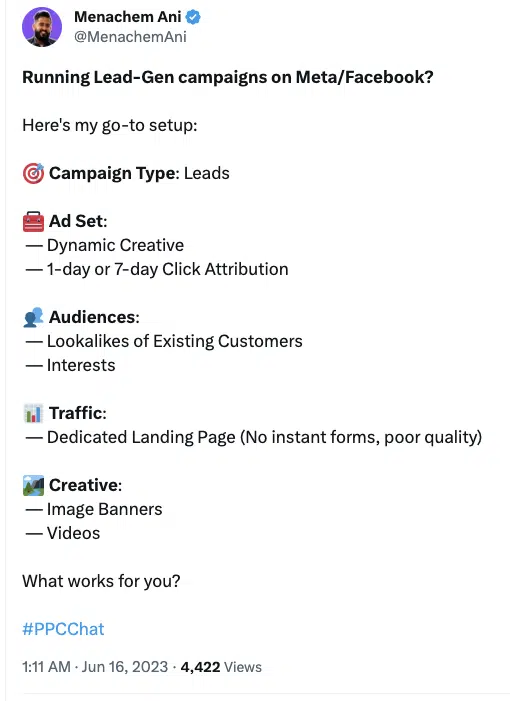
1. Campaign type

Every seasoned advertiser knows you’ll get visitors, and not many conversions, if you run traffic campaigns on Meta. 

So the first step is basic but critical: Make sure you opt into a conversion campaign with the pixel firing if you want to generate leads. 

The conversion action should be set to target “Leads.”

Meta’s algorithm may not be as complex as Google’s, but it’s still incredibly sophisticated and will find conversions based on your targeting.

Meta For Lead Gen

2. Standard vs. dynamic creative

You can run a standard creative campaign, which includes several ads within one ad set. The system then decides which ad to serve at a given moment. 

In our experience, toggling dynamic creative is the way to go.

It works much like Google’s responsive search ads in that it’s a single ad unit, but you’re adding many image, video and copy assets. 

The system then mixes and matches these to find winning combinations.

This approach is far better in bringing down your cost per lead and increasing your conversion rate, so there are a few situations where we don’t recommend dynamic creative.

Facebook Ads Standard Vs Dynamic Creative

3. Attribution

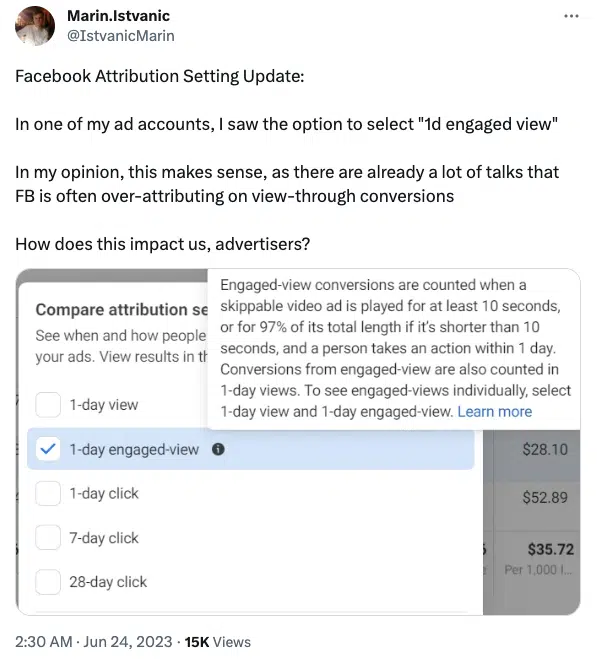
In terms of attribution, you want to avoid view-through conversions. Typically, one day is enough with lead generation on Meta because you ask them to fill out a form. 

It’s unlike ecommerce, where it could take another 10+ days until that person decides to purchase. You can also use a seven-day click model.

View-through conversions tend to over-report, in general, because everyone will see the ad. (This is not as much of a problem for lead-gen as with ecommerce.)

Facebook Ads Attribution

4. Audiences

For Facebook lead generation campaigns, there are some considerable differences for audiences.

With ecommerce nowadays, all the “gurus” will tell you to go broad, allow the system to do the targeting, and avoid using audiences. 

That does work well, and we have seen success with that approach in lead-gen, too – if the account has a healthy amount of data on the pixel and the system knows who to target.

But if you’re starting from scratch or work in B2B where the audience segmentation can be very nuanced, I find that using lookalikes of your existing customers works extremely well. So upload your customer list and target 1-3% lookalikes.

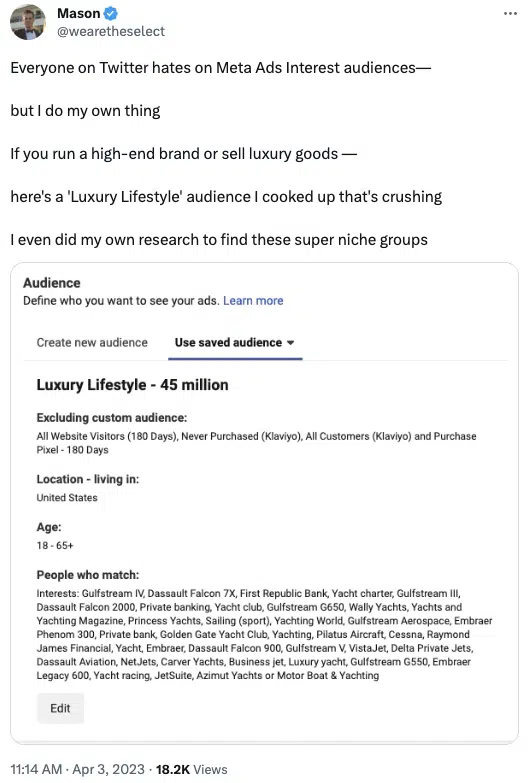
If you don’t have even that – say the company is new in addition to the ad account – interest stacking works well.

We’ll create one ad set and layer on many specific interests. 

In the case of a business that insures expensive home fixtures, we might target people ages 21-60 (layer one) who work in contracting or interior design (layer 2) and are interested in certain trade publications (layer 3).

So you’re helping the system find those people. Again, if you have a lot of data on your pixel, you could let go of this and allow the system to target freely. 

But I find that for lead-gen, that’s not as easy as ecommerce because there’s no clear conversion value. In a new account, you don’t have that data right away.

Facebook Ads Audiences

Get the daily newsletter search marketers rely on.


5. Forms and landing pages

I recommend having a dedicated landing page rather than instant forms because the latter typically generates poorer leads. But that’s not a hard and fast rule. 

For our clients, we’ll use a dedicated landing page or an instant form but add qualifying questions.

So don’t limit yourself to the questions that Meta gives you the ability to have pre-filled. 

Those would be fields like name, email or phone number. If somebody clicks on an embedded form, all that stuff is pre-filled. 

All they need to do is hit the CTA button and you’ve collected their lead, and those tend to be quite low in quality.

But if you can throw in a question or two to increase the information exchange, you increase the barrier of interest and weed out anyone who doesn’t want to make an effort. 

Fields that need to be filled out (i.e., timeline to purchase and budget) improve lead quality considerably. This is what we do when we choose to use embedded instant forms.

Another thing to remember about instant forms is that you need to have a CRM integration established with Meta so that you can get the leads they don’t deliver via email. 

There is a lead center where you can manage submissions within Meta itself.

Facebook Ads Forms And Landing Pages

6. Creative approach

Creative… can be tricky.

In ecommerce, many advertisers throw themselves into video, video, video. We find that image banners work really well for lead-gen. 

The most important piece to call out here is to use your creative to further isolate your audience.

Think about the service or product you’re selling and the people who will notice that ad, not everybody who scrolls past it. 

Will the ad resonate with them? 

You want the copy in your post and on the image to speak to a specific type of person in a way that compels them to stop scrolling and start clicking.

Be very direct in your headline; use bold lettering on the banner. 

Because whichever audience you do choose, chances are it’s going to go a lot wider than that specific targeting. 

But if the right people see a message that speaks to them, it’ll pull them in pretty quickly.

Make it easy to grab their attention.

Facebook Ads Creative Approach

7. Facebook vs. Instagram

The short answer: Not really. We’ll usually allow the campaigns to go where they go. 

The algorithm does a great job of finding who will convert.

The only time I would advise people to re-examine things or do them differently is when it comes to vertical video, specifically for Instagram Stories. 

Otherwise, I allow Meta to use its entire inventory to find people wherever they may be.

Meta Ads Facebook Vs Instagram

8. Intent and funnel targeting

One last caveat: It’s hard to reach people at a specific stage of the buying process, as you can do with SEO. This applies to your audiences but also your creative.

Ever since the release of iOS 14, we generally don’t segment retargeting and prospecting into separate campaigns. 

It is almost impossible to achieve and makes the system work harder (read: spend more money). It’s not as efficient in terms of performance.

We’ll typically have retargeting and prospecting in one campaign and let the messaging speak to the full funnel as best as possible.

Again, that’s sort of where the dynamic creative kicks in. 

Meta should be able to pick and choose which copy speaks to which consumer personally. 

The system uses signals we don’t have access to, so a certain degree of trust is required to make this work.

Facebook Ads Intent And Funnel Targeting

9. Following up

Just because you can’t accurately and specifically target prospective customers by funnel stage doesn’t mean you shouldn’t be ready when those conversions start rolling in.

Someone converting through your landing page is just another step in what should be a great experience until the final conversion or sale. This is where businesses feel the value of having marketing and sales teams in harmony.

Here are some of the things we recommend:

  • Thank you message displayed after submission.
  • Email confirmation so that there’s a trail they can access anytime.
  • Nurture sequence to keep people engaged and find opportunities for engagement.
Facebook Ads Following Up

Don’t treat it like ecommerce

Lead generation advertising has always been trickier than ecommerce. 

Because an exchange of money so easily tracks the latter, it’s fairly straightforward – either you make the sale, or you don’t.

With leads, multiple factors can affect whether a “conversion” is even worth anything:

  • Spam leads are much more common than fraudulent purchases.
  • Lead count does not correlate with lead quality.
  • Often, a sales team is responsible for turning leads into actual sales.

All this makes the performance marketer’s job more challenging, but it can be done. 

Thousands of brands use Facebook Ads to run successful lead generation campaigns, and it’s all down to a deep understanding of their audiences.

Get back to the marketing fundamentals, develop excellent creative assets and relevant landing pages, and your job will be much easier whether you advertise on Meta (or any other platform).


Opinions expressed in this article are those of the guest author and not necessarily Search Engine Land. Staff authors are listed here.


Related stories

New on Search Engine Land

@media screen and (min-width: 800px) { #div-gpt-ad-3191538-7 { display: flex !important; justify-content: center !important; align-items: center !important; min-width:770px; min-height:260px; } } @media screen and (min-width: 1279px) { #div-gpt-ad-3191538-7 { display: flex !important; justify-content: center !important; align-items: center !important; min-width:800px!important; min-height:440px!important; } }

About the author

Menachem Ani

Menachem Ani, Founder of JXT Group, is a digital advertising expert with over a decade of success developing high-impact marketing strategies for online retailers and lead-generation clients.

https://searchengineland.com/facebook-ads-lead-generation-guide-430339