TikTok rolls out major Ads changes to meet EU regulations

TikTok is implementing major changes to its ad products in Europe to ensure it meets EU regulations.

The platform plans to significantly reduce targeted advertising capabilities, while ads that violate its rules will be put on global bans.

Under the Digital Services Act, the platform is also going to provide users with additional reporting options and give more clarity to creators about its content moderation decisions.

Why we care. It’s more important than ever for marketers to keep up-to-date with TikTok’s policies as an ad being banned worldwide would be disastrous; reach and conversions would plummet, ROI would fall and it could also cause reputational damage. The changes to targeted advertising could also have a negative impact on reach, which may make you want to consider if ad space on an alternative platform would be more profitable.

Updates. TikTok announced several changes to its platform that will impact the user experience int he EU. These include:

  • Additional reporting – TikTok users in the EU will now be able to report ads they believe are illegal. The platform is rolling out new features to simplify this process, including introducing complaint categories such as hate speech, harassment and financial crimes.
  • Global bans – If content is found to break TikTok’s Community Guidelines, it will be removed from the platform globally. Content that doesn’t break its guidelines but does violate the law will be taken down in that country only.
  • Ban on targeted ads for teens – Teenagers in Europe aged 13-17 will now no longer see personalised advertising based on their activities, whether that is on or off TikTok.
  • Option to turn off personalisation – When personalisation is turned off by users in the EU, the ‘For You’ and ‘LIVE’ feeds will show popular videos from both where live and around the world – as opposed to content based on their personal interests. Similarly, when using non-personalised search, they will see results made up of popular content from their region and in their preferred language.
  • More transparency – TikTok is planning to share more detail about its content moderation decisions with creators, including whether AI decided the action taken.

Get the daily newsletter search marketers rely on.


What has TikTok said? TikTok confirmed the updates via an announcement on its blog. A spokesperson said:

  • “The European Union has set a clear vision for platform regulation with the Digital Services Act (DSA). Following our updates in July about our Research API and Commercial Content Library, we are providing more information about the work that we are doing to meet our obligations under the Act by the August 28 deadline.”
  • “Our mission is to inspire creativity and bring joy. We know that ensuring the safety, privacy, and security of our European community is critical to achieving that goal.”
  • “We will continue to not only meet our regulatory obligations, but also strive to set new standards through innovative solutions and by working with our industry partners, regulators, lawmakers, and civil society.”

Deep dive. Read TikTok’s Digital Service Act announcement in full for more information.


Related stories

New on Search Engine Land

@media screen and (min-width: 800px) { #div-gpt-ad-3191538-7 { display: flex !important; justify-content: center !important; align-items: center !important; min-width:770px; min-height:260px; } } @media screen and (min-width: 1279px) { #div-gpt-ad-3191538-7 { display: flex !important; justify-content: center !important; align-items: center !important; min-width:800px!important; min-height:440px!important; } }

About the author

Nicola Agius

Nicola Agius is Paid Media Editor of Search Engine Land after joining in 2023. She covers paid search, paid social, retail media and more. Prior to this, she was SEO Director at Jungle Creations (2020-2023), overseeing the company’s editorial strategy for multiple websites. She has over 15 years of experience in journalism and has previously worked at OK! Magazine (2010-2014), Mail Online (2014-2015), Mirror (2015-2017), Digital Spy (2017-2018) and The Sun (2018-2020). She also previously teamed up with SEO agency Blue Array to co-author Amazon bestselling book ‘Mastering In-House SEO’.

https://searchengineland.com/tiktok-major-ads-changes-eu-regulations-430387


Google Merchant Center sending ‘inappropriate title’ warning

Google Merchant Center has been issuing a new warning – for “inappropriate titles.”

The message appears to apply to Google Discover and Demand Gen ads within Google Merchant Center.

Product titles that fail to meet Google’s criteria face being penalized with restricted visibility in the U.S., according to a screenshot of the warning:

1 800x340

Why we care. A drop in visibility means your campaign will be seen by fewer potential customers, which could harm your revenue and ROI. In addition, getting Google to lift a penalty can be a lengthy process and, depending on how long it takes, this has the potential to have a long-term impact on your account, negatively affecting your visibility.


Get the daily newsletter search marketers rely on.


Google’s requirements. How can you avoid this kind of Google penalty? Your product title must meet the following requirements:

  • Assets must meet the Discovery and Demand Gen product ads quality requirements
  • Assets can’t contain obscene or offensive language, including but not limited to profanity and sexual innuendos
  • Assets can’t use placeholder text, distasteful formatting such as nonsensical punctuation or capitalization or incomplete sentences.
  • Assets can’t be longer than 10 words before a delimiter
  • Asserts can’t contain excessive details like product codes, SKUs or part numbers that aren;’t part of the product name.

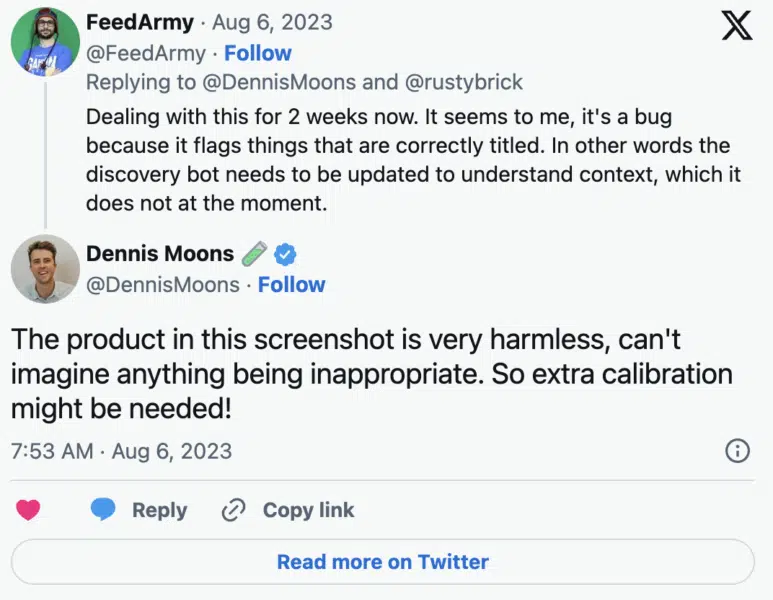
Reaction. Google Ads ecommerce expert Dennis Moons, flagged the issue on X, prompting several other marketers to report similar experiences.

Some have commented that there may be a “bug” with the warning as it is being issued to product titles that are “harmless.” However, Google is yet to respond.

Screenshot 2023 08 07 At 15.47.20 773x600

Deep dive. Read Google’s Discovery and Demand Gen Campaigns guide for more information.


Related stories

New on Search Engine Land

@media screen and (min-width: 800px) { #div-gpt-ad-3191538-7 { display: flex !important; justify-content: center !important; align-items: center !important; min-width:770px; min-height:260px; } } @media screen and (min-width: 1279px) { #div-gpt-ad-3191538-7 { display: flex !important; justify-content: center !important; align-items: center !important; min-width:800px!important; min-height:440px!important; } }

About the author

Nicola Agius

Nicola Agius is Paid Media Editor of Search Engine Land after joining in 2023. She covers paid search, paid social, retail media and more. Prior to this, she was SEO Director at Jungle Creations (2020-2023), overseeing the company’s editorial strategy for multiple websites. She has over 15 years of experience in journalism and has previously worked at OK! Magazine (2010-2014), Mail Online (2014-2015), Mirror (2015-2017), Digital Spy (2017-2018) and The Sun (2018-2020). She also previously teamed up with SEO agency Blue Array to co-author Amazon bestselling book ‘Mastering In-House SEO’.

https://searchengineland.com/google-merchant-center-inappropriate-titles-warning-430372


Google Analytics 4 Reports get Match Types, including regex

Google Analytics 4 Reports has added support for match types.

Report Filters now supports:

  • ‘begins with’
  • ‘exactly matches’
  • ‘regrex’

Why we care. Filters help ensure that your GA4 reports only show the data you care about, saving you time. Clearer, more concise reports results in easier-to-understand data, making it easier to identify trends and reducing decision-making complexities.

Adding report filters. Filters can be created to select dimension values using exact matches, partial match phrases, or regular expressions (regex). The option to add a filter to a report is displayed above the charts.

Once you add a filter to a report, both the chart and table in the selected report will be updated.

Screenshot 2023 08 07 At 13.43.43 800x355

However, filters can only be applied to Detail Reports.

What has Google said? Google explained the advantages of implementing filters into reports via a statement on the Analytics Help Center. A spokesperson said:

  • “Report filters allow you to control what data is shown in your detail reports.”
  • “They can help you understand your data, find trends, and drill into the details you care about.”
  • “For example, you can use a report filter to look at specific regions, app versions, and ad units. You can add multiple filters to further refine your analysis.”

Get the daily newsletter search marketers rely on.


Deep dive. read Google’s Reports guide for more information on how to apply filters.


Related stories

New on Search Engine Land

@media screen and (min-width: 800px) { #div-gpt-ad-3191538-7 { display: flex !important; justify-content: center !important; align-items: center !important; min-width:770px; min-height:260px; } } @media screen and (min-width: 1279px) { #div-gpt-ad-3191538-7 { display: flex !important; justify-content: center !important; align-items: center !important; min-width:800px!important; min-height:440px!important; } }

About the author

Nicola Agius

Nicola Agius is Paid Media Editor of Search Engine Land after joining in 2023. She covers paid search, paid social, retail media and more. Prior to this, she was SEO Director at Jungle Creations (2020-2023), overseeing the company’s editorial strategy for multiple websites. She has over 15 years of experience in journalism and has previously worked at OK! Magazine (2010-2014), Mail Online (2014-2015), Mirror (2015-2017), Digital Spy (2017-2018) and The Sun (2018-2020). She also previously teamed up with SEO agency Blue Array to co-author Amazon bestselling book ‘Mastering In-House SEO’.

https://searchengineland.com/google-analytics-4-reports-further-customized-match-types-430365


Google releases Responsive Search Ads guide

Google has released a Responsive Search Ads guide to help marketers improve their campaign performance.

The new RSA guide includes Google’s advice and information on how:

  • To write ads for maximum conversions.
  • RSAs use Google AI to generate ad copy.
  • To evaluate a campaign’s effectiveness.

Why we care. You may find this guide to be a helpful resource, especially if you’re newer to working with RSAs. It may give you a better understanding of how RSAs work and how to optimize for maximum performance and potentially increase conversions and ROI.

A comprehensive guide. Google’s new document contains seven sections:

  • The challenge with delivering the right ads.
  • Why responsive search ads
  • How responsive search ads select combinations to generate Search ads
  • Ad Strength: a feedback mechanism for creative content
  • Tools to help create high quality assets
  • Evaluate the effectiveness of responsive search ads
  • AI-ready account structure: Smart Bidding, broad match, & responsive search ads

Get the daily newsletter search marketers rely on.


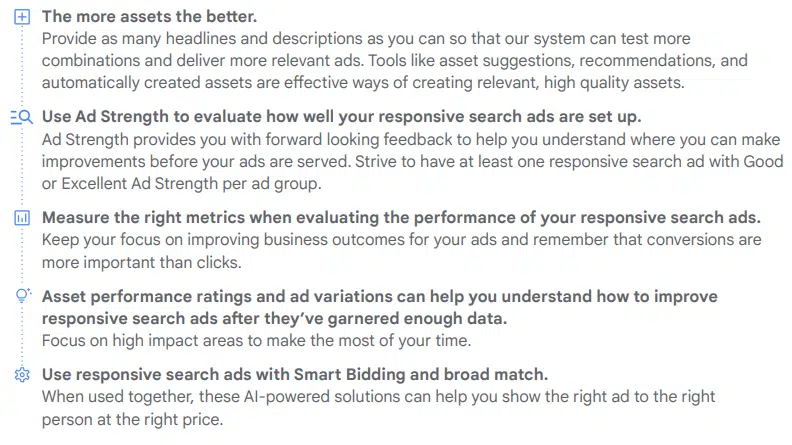
Google also provided five key takeaways to get the most out of RSAs:

Google Rsa Takeaways

What has Google said? A Google spokesperson said:

  • “Our goal is to simplify the work it takes to create high-quality ads that achieve your business objectives at scale.”
  • “To do this, we’re hard at work applying the newest AI-powered innovations across asset generation, customizing assets for relevance, and both simplifying and improving tools for managing ads.”

Deep dive. Read Google’s Responsive Search Ads guide (PDF) for more information.


Related stories

New on Search Engine Land

@media screen and (min-width: 800px) { #div-gpt-ad-3191538-7 { display: flex !important; justify-content: center !important; align-items: center !important; min-width:770px; min-height:260px; } } @media screen and (min-width: 1279px) { #div-gpt-ad-3191538-7 { display: flex !important; justify-content: center !important; align-items: center !important; min-width:800px!important; min-height:440px!important; } }

About the author

Nicola Agius

Nicola Agius is Paid Media Editor of Search Engine Land after joining in 2023. She covers paid search, paid social, retail media and more. Prior to this, she was SEO Director at Jungle Creations (2020-2023), overseeing the company’s editorial strategy for multiple websites. She has over 15 years of experience in journalism and has previously worked at OK! Magazine (2010-2014), Mail Online (2014-2015), Mirror (2015-2017), Digital Spy (2017-2018) and The Sun (2018-2020). She also previously teamed up with SEO agency Blue Array to co-author Amazon bestselling book ‘Mastering In-House SEO’.

https://searchengineland.com/google-responsive-search-ads-guide-430296


TikTok pilots new ad-targeting tech that offers improved data security

TikTok is trialling a new ad-targeting tool that reportedly offers improved data privacy protection.

PrivacyGo operates like a data clean room, where separate parties can input multiple sets of data and find commonalities without sharing the original source.

Why we care. If PrivacyGo works as expected, this tool will provide marketers with deeper insights into who their target audience is, enabling them to make more efficient data-led decisions to improve campaign performance. The technology will also enhance TikTok’s ad-targeting capabilities, helping brands to reach the right people as well as previously untapped audiences. If TikTok is able to achieve these goals while adhering to evolving data privacy regulations, advertisers’ trust and confidence in the platform will inevitably increase, which will likely lead to more ad spend.

How it works. PrivacyGo functions by implementing a type of cryptography known as multi-party computation, or MPC, reports Business Insider. This technology is able to identify common audiences between multiple sets of data, while ensuring none of the parties have access to it. The US Government uses a similar approach to review census data, according to TikTok, and so the platform is hoping this will reassure officials that its data privacy protection is sufficient.

Why now? TikTok is still under investigation by the CFIUS over data privacy concerns and allegations it has been leaking data to the Chinese government. If the platform is found to be violating any data privacy regulations, it faces a full ban in the US. With that in mind, it’s little wonder TikTok is exploring different methods to improve its data privacy capabilities.


Get the daily newsletter search marketers rely on.


General roll out. TikTok is in the process of piloting this new technology with select marketers. Once it gets the green light, the company has said that it is planning to make it more broadly available in the not-too-distant future.

Deep dive. Read our article about the moment TikTok’s CEO Shou Zi Chew testified before Congress over data privacy concerns for more insight into why pressure is on the company to improve its data privacy security.


Related stories

New on Search Engine Land

@media screen and (min-width: 800px) { #div-gpt-ad-3191538-7 { display: flex !important; justify-content: center !important; align-items: center !important; min-width:770px; min-height:260px; } } @media screen and (min-width: 1279px) { #div-gpt-ad-3191538-7 { display: flex !important; justify-content: center !important; align-items: center !important; min-width:800px!important; min-height:440px!important; } }

About the author

Nicola Agius

Nicola Agius is Paid Media Editor of Search Engine Land after joining in 2023. She covers paid search, paid social, retail media and more. Prior to this, she was SEO Director at Jungle Creations (2020-2023), overseeing the company’s editorial strategy for multiple websites. She has over 15 years of experience in journalism and has previously worked at OK! Magazine (2010-2014), Mail Online (2014-2015), Mirror (2015-2017), Digital Spy (2017-2018) and The Sun (2018-2020). She also previously teamed up with SEO agency Blue Array to co-author Amazon bestselling book ‘Mastering In-House SEO’.

https://searchengineland.com/tiktok-ad-targeting-tool-privacygo-data-privacy-430283


Trivago blames profit drop on opting out of new Google Ads product

Trivago’s decision to opt out of Google’s new property promotion ads was apparently a costly mistake.

Revenue was down 14% year-on-year to $137 million in the second quarter of 2023, following a decrease in website traffic, Trivago reported.

Meanwhile, revenue for Expedia, which did advertise with on the search engine’s new ad unit, reported a record second quarter with revenue up 6%.

A regretful data-led decision. Trivago did not to advertise with Google’s new ad product because it is part of Google hotel ads – which historically hasn’t performed well for the company, Skift reported. However, this soon became a decision the team would regret.

  • “We did not participate in this ad format prior to this rollout, and when this got more visibility [at the expense of] traditional advert placements, we lost traffic volumes,” said Trivago Chief Financial Officer Matthias Tillmann.

Why we care. When new ad products are launched, particularly by industry giants like Google, brands should make sure they are paying close attention and not be so quick to dismiss the possible potential. If financial risk is a concern, perhaps it may make more sense to trial a new product on a smaller scale rather than to disregard it all together. It’s also important that marketers ensure they are constantly monitoring the performance of their websites and campaigns. If you have noticed a drop in traffic, address it sooner rather than later to control financial losses.

Drop in ad spend. In its Q2 results, Trivago also announced that ad spend in the US had decreased by 10% to $32.9 million. The company spent 4% less on advertising in Europe, compared to the same period in 2022, as well. Commenting on the results, a company spokesperson said:

  • “Our reliance on search engines, particularly Google, which promote their own product and
    services that compete directly with our accommodation search and may negatively impact our
    business, financial performance and prospects.”

Get the daily newsletter search marketers rely on.


What has else Trivago said? Trivago addressed its Q2 results in a statement published on its website. A spokesperson said:

  • “We observed increased volatility in the results of our performance marketing campaigns. As we continued to be disciplined with Return on Advertising Spend (ROAS) targets, we experienced significant declines in performance marketing traffic volumes coupled with decreases in profit contribution.”
  • “Despite these headwinds, we ramped up our brand marketing investments as planned. While these expenditures had a negative impact on our profitability in the second quarter of 2023, we believe they will have a long-term positive impact on the volume of direct traffic to our platform and our financial performance.”

Deep dive. Read Trivago’s Q2 2023 Earnings Release statement in full for more information.


Related stories

New on Search Engine Land

@media screen and (min-width: 800px) { #div-gpt-ad-3191538-7 { display: flex !important; justify-content: center !important; align-items: center !important; min-width:770px; min-height:260px; } } @media screen and (min-width: 1279px) { #div-gpt-ad-3191538-7 { display: flex !important; justify-content: center !important; align-items: center !important; min-width:800px!important; min-height:440px!important; } }

About the author

Nicola Agius

Nicola Agius is Paid Media Editor of Search Engine Land after joining in 2023. She covers paid search, paid social, retail media and more. Prior to this, she was SEO Director at Jungle Creations (2020-2023), overseeing the company’s editorial strategy for multiple websites. She has over 15 years of experience in journalism and has previously worked at OK! Magazine (2010-2014), Mail Online (2014-2015), Mirror (2015-2017), Digital Spy (2017-2018) and The Sun (2018-2020). She also previously teamed up with SEO agency Blue Array to co-author Amazon bestselling book ‘Mastering In-House SEO’.

https://searchengineland.com/trivago-profits-drop-opt-out-google-ad-product-430227


Margin-based tracking: 3 advanced strategies for Google Shopping profitability

Are your Google Shopping campaigns profitable? 

Tracking your PPC performance will help you make better business decisions. 

You can unlock data beyond basic revenue metrics by implementing margin-based structures and advanced tracking methods. 

This article discusses three strategies to approach profitability-based tracking and campaign structuring methods.

1. Profitability-based account structures

The easiest and fastest way to start is with margin- or inventory-based structures. 

They revolve around three key concepts:

  • Product profitability.
  • Inventory status.
  • Campaign segmentation. 

These elements work together to drive profitability in Google Ads.

Product profitability

When you know the profitability of individual products, you can prioritize efforts and allocate budgets more effectively. 

Start by analyzing the cost of goods sold (COGS) and factoring in other costs associated with production, packaging and shipping. 

Transferring the COGS or product margin into a custom label enables you to segment Performance Max campaigns in margin-based clusters.

Inventory status

The inventory should be clustered in priority or inventory status on a scale like low, medium or high to make it useful.

Campaign segmentation

Segmenting your Performance Max campaigns based on product profitability and inventory status is the final and crucial step in margin-based structures. 

You can now:

  • Create a product scoring out of the profitability and inventory custom label.
  • Or use them separately and build campaigns like “high margin – high inventory status” to push certain products. 

This segmentation lets you apply different bidding strategies and budgets to each group and allocate resources where they will generate the highest returns.

Google frames this approach as “Shopping for Business Objectives.” 

Theoretically, this should lead to profitable campaigns because the bidding strategy can focus on one goal, which should work for most products in that cluster. 

While it works great for advertisers with few margin clusters and simple product structures, it has a few flaws. 

It’s impossible to visualize which products were bought, and hard to see how the gross profit of a campaign looks because you just throw similar margins into one basket. 

This strategy is a decent solution for starters, but should be improved to get more leverage.


Get the daily newsletter search marketers rely on.


2. Tracking cost of goods sold (COGS) and reporting conversion with cart data

Cost of goods sold (COGS) tracking and conversions with cart data reporting are among the most overlooked built-in features of Google Ads. 

COGS is an optional value that can be passed to the Merchant Center in the data feed for Google Shopping. 

The attribute [cost_of_goods_sold] represents the cost price at the product level and must be specified as a monetary value (i.e., not as a percentage). 

Since purchase prices can change more quickly depending on the industry, working with an approximate guideline at the beginning is advisable.

Most companies have their COGS stored in their enterprise resource planning (ERP) software, while some might also store it in their shop backend. 

It’s ideal to dynamically export those values into your feed management application of choice. However, you can start out with a static export if automation is out of the question. 

For example, you could create a sub-feed with a Google Sheet. 

Just fill in the item id [id] and cost of goods sold [cost_of_goods_sold] in the first two columns and then import it as a supplemental feed into Merchant Center.

Implementing COGS in the product data and cart data reporting in the GTAG also lets you use additional metrics like gross profit, COGS, product gross profit, etc. They are a great addition to the basic revenue pixel that most advertisers optimize on.

From a technical perspective, it might look a bit complex to implement. But all variables needed are within the analytics dataLayer and can easily be used when using a Google Tag Manager (GTM) setup.

3. Custom margin tracking

The most advanced and complex solution is to use custom margin tracking and set up a dedicated pixel. 

Some tools integrate with shop systems, but setting up your own tracking offers independence and customization options. 

But if you’re looking for a quick and easy solution to implement, profitability tracking tools might be enough to do the job.

Many shop systems enable setting the COGS or item cost for internal reporting reasons. You can transmit the value into the data layer, which you can later use for conversion tracking.

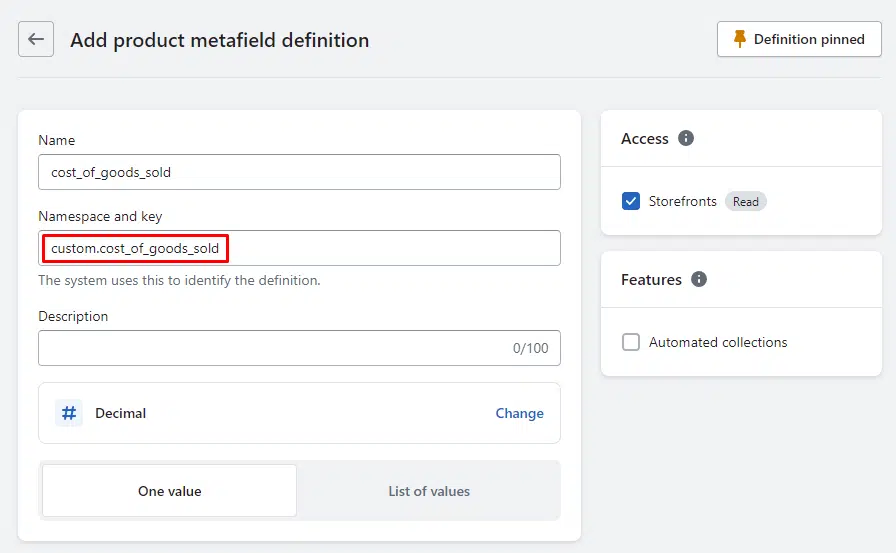
For instance, Shopify allows you to set metafields, which you can use to set the COGS on a product level. 

Below, you’ll find an example metafield used to capture the product costs.

Product metafield in Shopify

Luckily, Shopify allows us to read the metafield value on the storefront, which we can use to transmit it into the dataLayer. 

Depending on the dataLayer, the specific code must be individualized. 

Here’s sample data that we could use with a dataLayer.push command

<script>
window.dataLayer = window.dataLayer || [];
window.dataLayer.push({
 'COGS': '{{custom.cost_of_goods_sold}}'
 });
</script>

We can make it available for further use GTM.

We can now calculate our profit using a custom JavaScript snippet or any other way depending on the technical circumstances.

var costOfGoodsSold = {{custom.cost_of_goods_sold}}; 
var revenue = {{revenue}}; 
// Calculate profit 
var profit = revenue - costOfGoodsSold;
console.log(profit);

Using the profit variable as a revenue variable in the GTAG lets us purely track profit on our marketing activities. 

Tip: This setup opens the risk of competitors spying on our dataLayer. 

To address this, you can build in a factor of the gross profit. 

This cloaks cost data from competitors and makes it easier for your account managers to work with bidding strategies.

So instead of reporting back a gross profit of $20 from a $100 order, you could factor it by 5 and report back a $100 order. 

If you know about the factor of 5, you can now easily calculate the true gross profit by dividing numbers by 5 or whatever factor you’d like to use.

Profit-driven strategies for better advertising ROI

Profitability-based tracking in Google Ads offers advanced insights into campaign and product performance. 

Whether it’s structuring campaigns with inventory and margin data, implementing COGS tracking, or using custom margin tracking pixels, there’s a solution for every situation. 

Standard GTAG pixel and revenue tracking are not enough for data-driven decisions. 

Advanced reporting and analysis enable you to:

  • Identify high-profit opportunities.
  • Optimize bidding and budgeting strategies.
  • Enhance overall campaign profitability. 

Embrace margin-based tracking to push your ecommerce business forward.


Opinions expressed in this article are those of the guest author and not necessarily Search Engine Land. Staff authors are listed here.


Related stories

New on Search Engine Land

@media screen and (min-width: 800px) { #div-gpt-ad-3191538-7 { display: flex !important; justify-content: center !important; align-items: center !important; min-width:770px; min-height:260px; } } @media screen and (min-width: 1279px) { #div-gpt-ad-3191538-7 { display: flex !important; justify-content: center !important; align-items: center !important; min-width:800px!important; min-height:440px!important; } }

About the author

Benjamin Wenner

Benjamin Wenner is a growth hacker primarily working on search marketing platforms like Google Ads and Microsoft Ads. With over 11 years of marketing and e-commerce experience, Benjamin is consulting clients on growth- and retention strategies, with a focus on technical solutions such as individualized tracking solutions, the use of cloud applications for deeper analyses or a close interlinking of marketing analytics and corporate performance indicators and reports. Besides regular product updates, Benjamin shares strategies and ideas on his LinkedIn, but also his blog. He also speaks at local and international trade fairs such as DMEXCO, SMX and MBSummit, among others.

https://searchengineland.com/margin-based-tracking-advanced-strategies-google-shopping-profitability-430162




8 new Google Analytics 4 features to enhance app measurement and performance

Google Analytics 4 has unveiled eight new features to improve app campaign measurement and performance.

The additional AI-powered insights have been set up to give marketers a better understanding of how users behave across both web and app – all in one place.

Why we care. The more insights you have into who your target audience is, the more effectively you can optimize campaigns and ensure content is as engaging as possible. The better a campaign can connect with its target audience, the more conversions a brand will likely see, leading to a higher ROI.

What are the new features? Google has spent the last few months working on new GA4 tools to give marketers improved audience insights. Here are eight new features that are available to use right now:

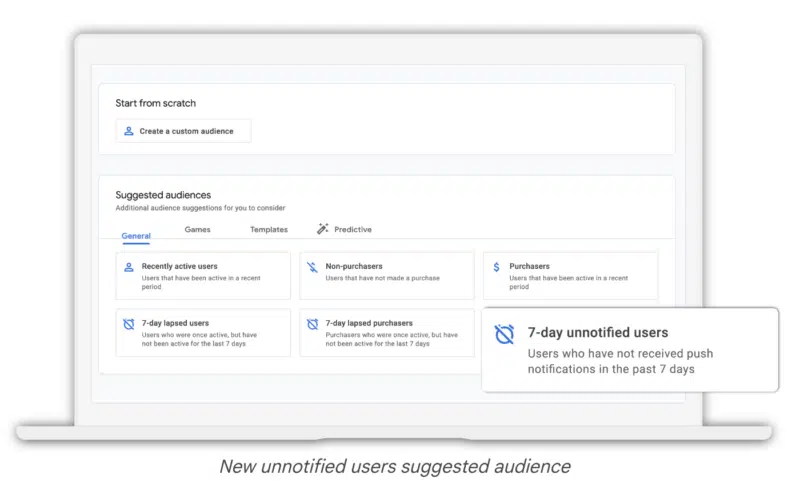
Screenshot 2023 08 02 At 20.59.40 800x491
  1. New unnotified users suggested audience – This feature enables brands to engage more easily with existing app users who may not have yet been reached via push notifications. Considering only 37% of customers enable push notifications, this tool could prove particularly useful for improving reach.
  2. Seamlessly re-use app and web audiences – Once you have created an audience in GA4, this feature will ensure only relevant app users will be targeted for your app campaigns.
  3. Access  GA4 Audience Builder in Google Ads – You will be able to build audiences directly in GA4 in the coming weeks, which will simplify the setting up and managing campaigns process.
  4. Additional performance uplift – This tool automatically optimizes App campaign performance. In order to get started, ensure you activate Google signals in your linked GA4 property.
  5. Comprehensive web-to-app conversion measurement – Google’s new privacy-safe URL parameter enables better iOS app conversion measurement for web campaigns which deep link users into an app.
  6. Integrations with SKAdNetwork – You can configure your SKAdNetwork conversion value schema using this tool for improved in-app event measurement and optimization.
  7. On-device conversion measurement – GA4 has rolled out additional support for more types of consented user sign-ins, such as phone numbers. This solution works without any user-identifying information ever leaving a user’s device or being disclosed to external parties, including Google.
  8. Geo-based conversion lift measurement – This tool, which is currently available in beta, gives marketers the ability to run controlled experiments to more accurately understand the causal, incremental effects of your iOS App campaigns.

Get the daily newsletter search marketers rely on.


What has Google said? Google announced its latest GA4 feature updates via a post on its official blog, which read:

  • “As an app marketer, you want to not only find, but also keep, your highest-value app users. Google Analytics 4 provides robust audience management tools to reach the right users. And you now have access to new audience features.”
  • “Many businesses are seeing performance success with using Google Analytics 4, particularly on iOS. For example, knowing its iOS users were some of its most profitable users, Revolut, a United Kingdom-based banking technology company, wanted to scale its iOS campaigns in its top markets. After implementing and beginning to bid on Google Analytics 4 events, Revolut saw a 12.5% increase in additional first-opens and achieved a 11.2% decrease in its CPI.”
  • “These are just a few of the newest features available to app marketers who use Google Analytics 4. There is a full suite of App campaign measurement and performance features you can access with Google Analytics 4 to help you drive business growth.”

Deep dive. Read Google’s full announcement for more information about its latest features.


Related stories

New on Search Engine Land

@media screen and (min-width: 800px) { #div-gpt-ad-3191538-7 { display: flex !important; justify-content: center !important; align-items: center !important; min-width:770px; min-height:260px; } } @media screen and (min-width: 1279px) { #div-gpt-ad-3191538-7 { display: flex !important; justify-content: center !important; align-items: center !important; min-width:800px!important; min-height:440px!important; } }

About the author

Nicola Agius

Nicola Agius is Paid Media Editor of Search Engine Land after joining in 2023. She covers paid search, paid social, retail media and more. Prior to this, she was SEO Director at Jungle Creations (2020-2023), overseeing the company’s editorial strategy for multiple websites. She has over 15 years of experience in journalism and has previously worked at OK! Magazine (2010-2014), Mail Online (2014-2015), Mirror (2015-2017), Digital Spy (2017-2018) and The Sun (2018-2020). She also previously teamed up with SEO agency Blue Array to co-author Amazon bestselling book ‘Mastering In-House SEO’.

https://searchengineland.com/google-analytics-4-new-features-app-measurement-performance-430201


Meta launches new AI tool that creates music using text prompts

Meta has rolled out a new AI tool that enables marketers to create music using text prompts.

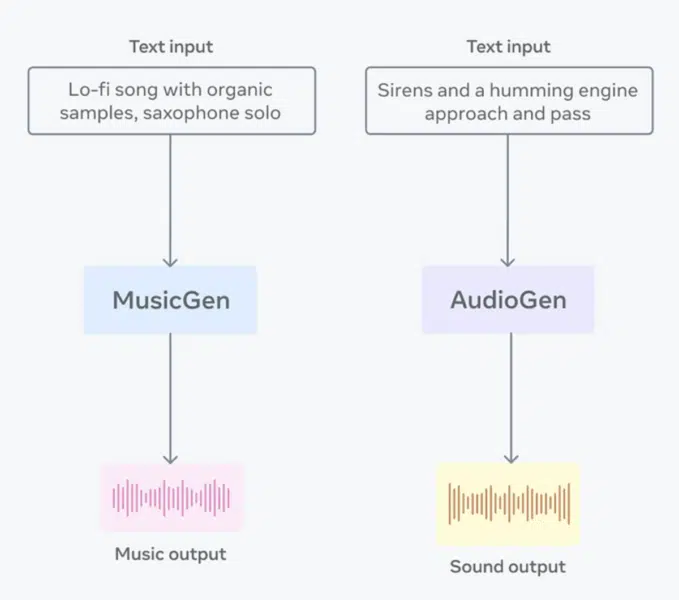
The new system, which is called AudioCraft, uses three models, AudioGen, EnCodec and MusicGen to produce high-quality, realistic sound effects, compression and generation, in addition to music.

All music used to train MusicGen is owned by Meta and is specifically licensed for this purpose, the company added.

Why we care. Background music and sound effects can help bring an advert to life, significantly enhancing engagement, making it a vital aspect of any campaign. If marketers use AI to create music, they will have access to an unlimited number of samples that can be created instantly, potentially saving them a significant amount of time. This also means that marketers will no longer need to hire and pay for musicians, saving them money.

Screenshot 2023 08 02 At 18.19.13 679x600

Cause for concern. While the thought of saving time and money will undoubtedly appeal to advertisers, there are some issues to consider before relying on AI for music and sound creation. Artists have previously accused tech giants of copyright violations when training their AI. In fact, Google was sued just last month for allegedly stealing content for AI training. If there are copyright complications, this could be seriously problematic for advertisers with financial consequences.

It’s also worth noting that if all brands were to suddenly rely on AI for music and sound creation, there is a risk that music won’t sound original, making it harder for campaigns to stand out. Issues like this can negatively impact engagement, which in turn will affect conversions.

What has Meta said? Meta posted a statement on its official blog to unveil its new technology. It read:

  • “While we’ve seen a lot of excitement around generative AI for images, video, and text, audio has seemed to lag a bit behind. There’s some work out there, but it’s highly complicated and not very open, so people aren’t able to readily play with it.”
  • “Generating high-fidelity audio of any kind requires modeling complex signals and patterns at varying scales. Music is arguably the most challenging type of audio to generate as it’s composed of local and long-range patterns, from a suite of notes to a global musical structure with multiple instruments.”
  • “Having a solid open source foundation will foster innovation and complement the way we produce and listen to audio and music in the future. With even more controls, we think MusicGen can turn into a new type of instrument — just like synthesizers when they first appeared.”

Deep dive. Read Meta’s statement in full for more information about AudioCraft.


Related stories

New on Search Engine Land

@media screen and (min-width: 800px) { #div-gpt-ad-3191538-7 { display: flex !important; justify-content: center !important; align-items: center !important; min-width:770px; min-height:260px; } } @media screen and (min-width: 1279px) { #div-gpt-ad-3191538-7 { display: flex !important; justify-content: center !important; align-items: center !important; min-width:800px!important; min-height:440px!important; } }

About the author

Nicola Agius

Nicola Agius is Paid Media Editor of Search Engine Land after joining in 2023. She covers paid search, paid social, retail media and more. Prior to this, she was SEO Director at Jungle Creations (2020-2023), overseeing the company’s editorial strategy for multiple websites. She has over 15 years of experience in journalism and has previously worked at OK! Magazine (2010-2014), Mail Online (2014-2015), Mirror (2015-2017), Digital Spy (2017-2018) and The Sun (2018-2020). She also previously teamed up with SEO agency Blue Array to co-author Amazon bestselling book ‘Mastering In-House SEO’.

https://searchengineland.com/meta-audiocraft-ai-music-text-prompts-430185


YouTube Shorts launches six new features to improve content creation

YouTube Shorts has rolled out a range of new tools to encourage and inspire content creation.

The six new features give creators a range of new capabilities on the platform, such as the ability to go live with Shorts, remix footage, add effects to videos and use stickers.

In addition, the social platform is trialling a new mobile-first vertical live experience that aims to improve reach by giving visibility to live creators in the Shorts feed.

Why we care. Brands will have the opportunity to get even more creative with their content output as they experiment with different features, which could help to improve engagement. The new mobile-first vertical pilot could also help brands to improve their reach by sharing live videos in the Shorts feed. Improved reach and engagement should in practice help brands to achieve more conversions and therefore a better ROI.

What’s new? The six new features rolled out on YouTube Shorts are:

  • Collab – This new feature allows creators to film a Short alongside other YouTube or Short videos in a side-by-side format. Multiple layout options are available.
  • Q&A stickers – Content creators can use this new feature to ask viewers questions. The audience can then leave their replies in the comments section, enabling creators to give them a shoutout as they can see who left the response.
  • Mobile-first vertical live – This new feature is what will allow live creators to get discovered in the Shorts feed. YouTube is hoping this will enable creators to connect live with a new audience and build communities in a more modern way.
  • Creation suggestions – YouTube can now automatically bundle the audio and effects from a Short you may be remixing. The platform can surface the same audio time stamp from the Short you just watched, and add the same effect as a creation suggestion. Content creators also have the option to mix and match.
  • Shorts playlist – Creators can now save Shorts to playlists directly onto YouTube.
  • Transform horizontal videos to Shorts – This new feature is being trialled in the coming weeks. Users will now be able to choose a video to remix and adjust the layout, zoom and crop to turn it into a Short.

Why now? YouTube Shorts are now viewed by more than 2 billion logged-in users a month. Given its sharp rise in popularity, it’s little surprise that Google is acting to improve the YouTube Shorts experience, as it seeks to make it a rival to TikTok and Instagram Reels – both of which recently launched new features to improve the user experience for its content creators.


Get the daily newsletter search marketers rely on.


What has YouTube said? YouTube posted a statement announcing the new tools on its official blog. A spokesperson said:

  • “We introduced Shorts to give creators a lightweight and fun way to create and share short-form videos on YouTube, and continue to expand on the ways that creators can easily tap into their creativity.”
  • “From remixing tools that help creators leverage content from across YouTube’s billions of videos worldwide in new, original content to expanding the YouTube Partner Program so creators can join and earn money from their Shorts, we want to make it easier for anyone to join in and create what they love.”
  • “YouTube Shorts are now being watched by over 2 billion logged-in users every month, and today we’re introducing new ways to spark imagination and creativity.”

Deep dive. Read YouTube’s blog post in full for more information about its new tools.


Related stories

New on Search Engine Land

@media screen and (min-width: 800px) { #div-gpt-ad-3191538-7 { display: flex !important; justify-content: center !important; align-items: center !important; min-width:770px; min-height:260px; } } @media screen and (min-width: 1279px) { #div-gpt-ad-3191538-7 { display: flex !important; justify-content: center !important; align-items: center !important; min-width:800px!important; min-height:440px!important; } }

About the author

Nicola Agius

Nicola Agius is Paid Media Editor of Search Engine Land after joining in 2023. She covers paid search, paid social, retail media and more. Prior to this, she was SEO Director at Jungle Creations (2020-2023), overseeing the company’s editorial strategy for multiple websites. She has over 15 years of experience in journalism and has previously worked at OK! Magazine (2010-2014), Mail Online (2014-2015), Mirror (2015-2017), Digital Spy (2017-2018) and The Sun (2018-2020). She also previously teamed up with SEO agency Blue Array to co-author Amazon bestselling book ‘Mastering In-House SEO’.

https://searchengineland.com/youtube-shorts-new-features-content-creation-430175