Google fixing bug that shows 5 ads on top of SERPs

An issue is causing too many ads to show at the top of Google’s search results.

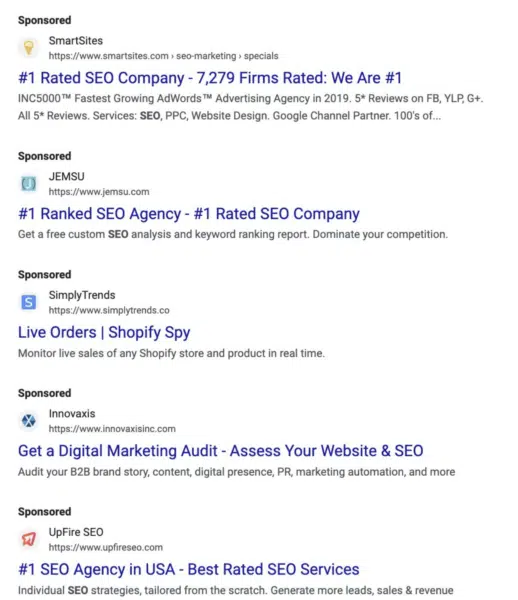
The issue. The search engine is showing five sponsored posts at the top of SERPs, when there should only be four, for some queries. For example:

Screenshot 2023 08 01 At 20.00.48 518x600

SERPs error. Marketers raised the ads display issue on X (the platform previously known as Twitter), noting that Google has historically said that it only displays four ads at the top of search results pages.

Is Google showing five ads now? No.

Google’s policy hasn’t changed. Something is wrong on Google’s end, according to Ginny Marvin, ads product liaison at Google.

Why we care. We wondered whether Google had increased the number of ads at the top of SERPs, from four to five, on purpose. But now we know that isn’t the case. Rather, it is just the latest stumble for the Google Ads platform.

What has Google said? Marvin said the error is being addressed, via X:

  • “Thanks for bringing it to my attention. This is is not working as intended and we’re working to address it.”

Get the daily newsletter search marketers rely on.


Related stories

New on Search Engine Land

@media screen and (min-width: 800px) { #div-gpt-ad-3191538-7 { display: flex !important; justify-content: center !important; align-items: center !important; min-width:770px; min-height:260px; } } @media screen and (min-width: 1279px) { #div-gpt-ad-3191538-7 { display: flex !important; justify-content: center !important; align-items: center !important; min-width:800px!important; min-height:440px!important; } }
About the author

Nicola Agius

Nicola Agius is Paid Media Editor of Search Engine Land after joining in 2023. She covers paid search, paid social, retail media and more. Prior to this, she was SEO Director at Jungle Creations (2020-2023), overseeing the company’s editorial strategy for multiple websites. She has over 15 years of experience in journalism and has previously worked at OK! Magazine (2010-2014), Mail Online (2014-2015), Mirror (2015-2017), Digital Spy (2017-2018) and The Sun (2018-2020). She also previously teamed up with SEO agency Blue Array to co-author Amazon bestselling book ‘Mastering In-House SEO’.

https://searchengineland.com/google-fixing-ad-error-serps-430122


Microsoft rolls out code-free conversions for all Smart Campaigns

Microsoft has enabled code-free conversion goals across all Advertising Smart Campaigns globally.

Instead of manually adding code snippets to a website, marketers can now simply select the relevant buttons and leverage conversion tracking in a matter of minutes.

Check the Enable Microsoft Clarity box in the goal setup workflow to set up this feature.

Why we care. Until now, marketers were required to manually input code snippets for campaigns to websites, which allowed room for human error. Code-free conversions provide a possible solution to that problem, as a once time-consuming task can now be completed in a few clicks. This gives marketers back time that could be better spent elsewhere.


Get the daily newsletter search marketers rely on.


Deep dive. Read Microsoft’s code-free conversion goal guide for more information.


Related stories

New on Search Engine Land

@media screen and (min-width: 800px) { #div-gpt-ad-3191538-7 { display: flex !important; justify-content: center !important; align-items: center !important; min-width:770px; min-height:260px; } } @media screen and (min-width: 1279px) { #div-gpt-ad-3191538-7 { display: flex !important; justify-content: center !important; align-items: center !important; min-width:800px!important; min-height:440px!important; } }

About the author

Nicola Agius

Nicola Agius is Paid Media Editor of Search Engine Land after joining in 2023. She covers paid search, paid social, retail media and more. Prior to this, she was SEO Director at Jungle Creations (2020-2023), overseeing the company’s editorial strategy for multiple websites. She has over 15 years of experience in journalism and has previously worked at OK! Magazine (2010-2014), Mail Online (2014-2015), Mirror (2015-2017), Digital Spy (2017-2018) and The Sun (2018-2020). She also previously teamed up with SEO agency Blue Array to co-author Amazon bestselling book ‘Mastering In-House SEO’.

https://searchengineland.com/microsoft-rolls-out-code-free-conversions-across-all-smart-campaigns-globally-430044


Google Analytics launches new Audience report

Google Analytics 4 has rolled out a new Audience report.

Marketers can use this new feature to identify their most engaged and profitable audiences.

The report includes any audience that has at least one user in the specified time period.

Why we care. Finding out who is engaging most with their campaigns and websites will enable marketers to better understand who their target audience is. They can then use this data to make informed decisions on improving their marketing, which could increase conversions and ROI.

How to access it. In order to view the report, follow these simple steps:

  1. Sign into your Google Analytics account. 
  2. Select the ‘Reports’ button on the menu located on the left-hand side.
  3. Select ‘User’, then scroll down to ‘User Attributes’.
  4. Click on ‘Audiences’

If you cannot see the report, ask an administrator or editor to add the report through the report library.


Get the daily newsletter search marketers rely on.


Metrics. The Audiences report will include the following metrics – which can be added or removed by an editor or administrator:

  • Active users
  • Average session duration
  • New users
  • Sessions
  • Views per session
  • Total revenue

Dimensions. The new report currently includes one dimension:

Deep dive. Read Google’s Audience report guide for more information..


Related stories

New on Search Engine Land

@media screen and (min-width: 800px) { #div-gpt-ad-3191538-7 { display: flex !important; justify-content: center !important; align-items: center !important; min-width:770px; min-height:260px; } } @media screen and (min-width: 1279px) { #div-gpt-ad-3191538-7 { display: flex !important; justify-content: center !important; align-items: center !important; min-width:800px!important; min-height:440px!important; } }

About the author

Nicola Agius

Nicola Agius is Paid Media Editor of Search Engine Land after joining in 2023. She covers paid search, paid social, retail media and more. Prior to this, she was SEO Director at Jungle Creations (2020-2023), overseeing the company’s editorial strategy for multiple websites. She has over 15 years of experience in journalism and has previously worked at OK! Magazine (2010-2014), Mail Online (2014-2015), Mirror (2015-2017), Digital Spy (2017-2018) and The Sun (2018-2020). She also previously teamed up with SEO agency Blue Array to co-author Amazon bestselling book ‘Mastering In-House SEO’.

https://searchengineland.com/google-analytics-new-audiences-report-430116


Meta’s new chatbots set to improve targeted ad capabilities

Meta is launching a range of AI-powered chatbots that could improve its targeted advertising capabilities.

The chatbots, which could come as early as September, reportedly have the ability to collect large amounts of data regarding users’ interests.

It’s expected that the new technology will also boost engagement across Meta’s platforms, as the chatbots, which all exhibit different personalities, will be able to have humanlike conversations with Meta’s 4 billion users, reports the Financial Times.

Why we care. Improved targeted advertising could enable marketers to increase conversions by helping their campaigns reach the right audiences. It could also help brands connect with previously untapped markets, improving overall reach.

However, there is a but… This new technology has raised concerns about data privacy. If a brand inadvertently violates people’s privacy rights, it could suffer reputational damage that is difficult to repair, and also create distrust amongst potential customers, which could be harmful to ROI in the long-term.

Why now? Despite getting off to an impressive start and becoming the fastest growing social media platform in history, Meta’s Threads has now lost half of its users less than a month after it launched. Meta is now trying to attract more users and retain current ones as it faces competition from rival platforms like TikTok. The company is reportedly hoping that its new AI chatbots will help retain users by increasing engagement.

It’s worth noting that Snap rolled out its My AI chatbot back in February and so far, 150 million users have interacted with it.

Meta’s chatbots with character. During an earnings call on Wednesday, Meta CEO Mark Zuckerberg said the company doesn’t think people will interact with one single AI. So, to improve engagement for its users, Meta has created a range of characters for its chatbots, which insiders have nicknamed “personas”.

Some of the characters created include former US President Abraham Lincoln. Another prototype includes a surfer persona, which advises users on travel options.


Get the daily newsletter search marketers rely on.


What has Meta said? Mark Zuckerberg is expected to give an update on Meta’s chatbot plans next month. However, back in February, he opened up about the company’s AI targets in a Facebook post, which read:

  • “We’re creating a new top-level product group at Meta focused on generative AI to turbocharge our work in this area. We’re starting by pulling together a lot of the teams working on generative AI across the company into one group focused on building delightful experiences around this technology into all of our different products.”
  • “In the short term, we’ll focus on building creative and expressive tools. Over the longer term, we’ll focus on developing AI personas that can help people in a variety of ways. We’re exploring experiences with text (like chat in WhatsApp and Messenger), with images (like creative Instagram filters and ad formats), and with video and multi-modal experiences.”
  • “We have a lot of foundational work to do before getting to the really futuristic experiences, but I’m excited about all of the new things we’ll build along the way.”

Deep dive. Read our article on why chatbots launched by other platforms such as Google and Microsoft have been causing concern amongst advertisers.


Related stories

New on Search Engine Land

@media screen and (min-width: 800px) { #div-gpt-ad-3191538-7 { display: flex !important; justify-content: center !important; align-items: center !important; min-width:770px; min-height:260px; } } @media screen and (min-width: 1279px) { #div-gpt-ad-3191538-7 { display: flex !important; justify-content: center !important; align-items: center !important; min-width:800px!important; min-height:440px!important; } }

About the author

Nicola Agius

Nicola Agius is Paid Media Editor of Search Engine Land after joining in 2023. She covers paid search, paid social, retail media and more. Prior to this, she was SEO Director at Jungle Creations (2020-2023), overseeing the company’s editorial strategy for multiple websites. She has over 15 years of experience in journalism and has previously worked at OK! Magazine (2010-2014), Mail Online (2014-2015), Mirror (2015-2017), Digital Spy (2017-2018) and The Sun (2018-2020). She also previously teamed up with SEO agency Blue Array to co-author Amazon bestselling book ‘Mastering In-House SEO’.

https://searchengineland.com/meta-chatbot-improve-targeted-ad-430090


7 reports SEO and PPC can use to help each other succeed

Is anyone still creating artificial opposition between SEO and PPC (e.g., “We rank first organically, so we don’t need to pay for an ad”)?

How about hiring a PPC- or SEO-only agency or keeping in-house teams in silos?

I know you’re out there. I still encounter these situations more frequently than I’d like to admit.

The truth is, any brand or agency marketer not fully committed to using SEO and PPC to make each other stronger is doing their organization (or client) a disservice. 

It can be as simple as looking at certain metrics and communicating the takeaways to your colleagues.

This article covers seven reports your paid and SEO teams can run – and how your colleagues on the other side can help act on the findings.

Paid reports and what they mean for SEO

1. Top-performing keywords

PPC teams have a list of top keywords that get extra-special love in the form of exact match, single or small keyword ad groups, custom landing pages, etc.

Your SEO team should be updated on that list, including new additions and drop-offs.

No matter how good paid performance is, many people still don’t trust ads (only 38% of people trusted ads on search engines, according to Statista). They will be looking for other relevant listings to click on.

And for many keywords, folks are looking for more awareness-based or educational information that direct-response ads won’t provide as reliably as SEO content.

In other words, top-performing keywords are fertile ground for SEOs to lean in and add incremental value.

The bonus is that folks with conversion intent for the keywords and going through the SEO listing to convert will help burnish SEO’s lower-funnel metrics.

2. Highest-CPC keywords

This one’s a key metric to share with SEO, especially if the costs prohibit PPC scale.

For keywords that are getting too expensive for competitive PPC campaigns, SEO teams can lean in and prioritize driving value in an otherwise inaccessible space.

3. Monthly drops in impression share and search top impression share

This can indicate increased competition for both parties. Increased competition will lead to higher costs on the PPC side.

While it might make it harder for SEO to compete in the short term, it’s an indicator that (for high-priority queries) it’s time to focus on new or optimized pages, content and metadata.

Dig deeper: Your 2023 guide to SEO reporting and tracking


Get the daily newsletter search marketers rely on.


SEO reports and what they mean for PPC

4. Keyword performance dips

The same principle as above applies here, but in reverse: sharp dips in keyword performance are likely indicative of increased competition. 

This should spark a conversation with the PPC team about whether they should prioritize those keywords in their campaigns.

It is also a signal for both teams to dig in and see who’s competing for that traffic and what kind of messaging they’re using.

5. High-priority keywords

Suppose SEOs are focused on a particular set of keywords. In that case, they’ll likely have valuable audience and behavioral data to share with the PPC team that can help refine messaging, targeting, CTAs and conversion types.

Note: Good SEO teams will be able to identify levels of intent for their priority keywords.

Are the keywords not focused on conversion or direct response but more on engagement and awareness?

PPC folks should consider creating keyword-based custom audiences for channels like GDN and YouTube to cast a wide net with lower costs.

6. Keyword difficulty

SEOs will often study a wishlist of high-priority keywords and find steep levels of competition and ranking difficulty.

This isn’t an indicator that SEOs should throw up their hands and look elsewhere, but it does mean any quick gains will be the provenance of the PPC team.

If the teams are aligned on a growth focus for certain keywords, this is where the PPC team can take a little liberty with budget and CPC caps and open the spigot for engagement. 

7. Top-performing pages and content

Pages and pieces of content ranking well and driving significant traffic have a couple of common factors:

  • There’s a good amount of demand.
  • Google thinks the property is high quality.

For webpages, there may be good learnings from the page that PPC folks can use to optimize their own landing pages.

Successful pieces of content, meanwhile, can be assets for PPC teams to employ for gated content – or even for ungated content that can help build retargeting audiences.

Suppose SEOs are already driving traffic to pages that are getting conversion activity (i.e., blog subscriptions, demo sign-ups, click-throughs to product pages, etc.).

In that case, the PPC team should be all over this data to:

  • Drive their own traffic to those pages.
  • Or pull a short list of messaging elements and value propositions to test in their landing pages or ad copy.

Dig deeper: Using search query reports to optimize PPC campaigns

Intentional communication to unlock growth

The best way to ensure these insights get to the other teams, and to hold teammates accountable for the takeaways, is to set up a cadence of regular meetings and/or reports once you’ve built a framework of analysis.

At a minimum, each team should be aware of: 

  • The other team’s top growth priorities.
  • The other team’s key campaigns.
  • Strategic content and landing page development in the pipeline.

The benefits of this level of communication can be surprising. We’ve had some great brainstorms between teams simply from being introduced to the other team’s initiatives. 

And whether you’re at an agency or in-house, you can combine for some compelling storytelling for clients or your executive team when you understand the broader picture and the interplay between channels.


Opinions expressed in this article are those of the guest author and not necessarily Search Engine Land. Staff authors are listed here.


Related stories

New on Search Engine Land

@media screen and (min-width: 800px) { #div-gpt-ad-3191538-7 { display: flex !important; justify-content: center !important; align-items: center !important; min-width:770px; min-height:260px; } } @media screen and (min-width: 1279px) { #div-gpt-ad-3191538-7 { display: flex !important; justify-content: center !important; align-items: center !important; min-width:800px!important; min-height:440px!important; } }

About the author

Laura Schiele

Laura Schiele, Head of Paid Acquisition at Jordan Digital Marketing, has nearly a decade of experience in paid media strategy and execution in both agency and in-house accounts and uses advanced analytics skills to scale growth within efficiency goals across Google, LinkedIn, Facebook, and more. Laura manages a large team of paid media experts remotely from her home in Burlington, VT.

https://searchengineland.com/seo-ppc-reports-data-sharing-430022


X launches creator ads revenue sharing program

X has officially rolled out its creator ads revenue sharing program.

The new feature enables users to share revenue from verified content creators’ impressions of ads in replies to content posted on the social networking platform.

Elon Musk’s platform, previously known as Twitter, has introduced this new tool as part of X’s mission to enable people to “earn a living” by posting on its site.

Why we care. Musk is in the midst of trying to rebrand Twitter to X following a plummet in ad revenue after his takeover last year – and this new feature comes at a huge turning point for the platform. The program has already helped creators secure substantial early payouts, which is helping to generate interest in the brand again. However, while the payouts so far have been impressive, the eligibility qualifications are pretty high. Perhaps too high for people to realistically earn a living through X.

Who is eligible? In order to be considered for the creator ads revenue sharing program, your account must meet the following criteria:

  1. Subscribed to Blue or Verified Organizations.
  2. Have at least 15M impressions on cumulative posts within the last three months.
  3. Have at least 500 followers

If your account meets these conditions, you’ll then need to ensure you have an account with Stripe – X’s payment processor. You’ll then need to ensure that X’s Ads Revenue Share Terms are adhered, for example, the Creator Monetization Standards and the X Rules. 

How it works. If your account is eligible, you’ll need to follow these simple steps to get started:

  1. Join and set up payments from within the Monetization section of the app, which can be found in the side menu on iOS and Android, and the overflow menu on web.
  2. Click on ‘Join and setup payouts’, which will redirect you to X’s payment processor, Stripe.
  3. Setup a Stripe account to receive your share – this is the account you will need to transfer funds to your external bank account. 
  4. Once you opt in, you will receive payouts at a regular cadence, so long as you have generated more than $50 USD.

Get the daily newsletter search marketers rely on.


What has X said? X announced the rollout via a statement posted in its Help Center. It read:

  • “We want the process to be as simple as possible, so all eligible X Blue and Verified Organizations subscribers are entitled to revenue share so long as they meet the eligibility criteria and join.”
  • “Users will be able to apply for both Creator Subscriptions and Ads Revenue Sharing by accessing Monetization in settings.”
  • “While all eligible users may choose to participate, if you are found to breach the Ads Revenue Share Terms, which include, for example, Creator Monetization Standards and the X Rules, you may be excluded from the program.”

Deep dive. Read Twitter’s full announcement for more information on how its ad revenue-sharing program works.


Related stories

New on Search Engine Land

@media screen and (min-width: 800px) { #div-gpt-ad-3191538-7 { display: flex !important; justify-content: center !important; align-items: center !important; min-width:770px; min-height:260px; } } @media screen and (min-width: 1279px) { #div-gpt-ad-3191538-7 { display: flex !important; justify-content: center !important; align-items: center !important; min-width:800px!important; min-height:440px!important; } }

About the author

Nicola Agius

Nicola Agius is Paid Media Editor of Search Engine Land after joining in 2023. She covers paid search, paid social, retail media and more. Prior to this, she was SEO Director at Jungle Creations (2020-2023), overseeing the company’s editorial strategy for multiple websites. She has over 15 years of experience in journalism and has previously worked at OK! Magazine (2010-2014), Mail Online (2014-2015), Mirror (2015-2017), Digital Spy (2017-2018) and The Sun (2018-2020). She also previously teamed up with SEO agency Blue Array to co-author Amazon bestselling book ‘Mastering In-House SEO’.

https://searchengineland.com/x-creator-ads-revenue-sharing-430053


Reminder – Google’s similar audiences are being removed

This is a gentle reminder that on August 1, Google will remove similar audiences (or segments) from all ad groups and campaigns. Please have a look at the full announcement here.

Campaigns using similar audiences will automatically get opted into optimised targeting and audience expansion moving forward.

Marketers who would rather avoid this can go to the audiences tab in the Google Ads settings page and manually turn off the campaigns instead.

It’s important to note that historical similar audiences data from past campaigns will still be accessible despite the transition.

Why we (still) care. When marketers use first-party data (for example, customer lists) to create a similar audience segment, this data can generate a hugely influential performance driver for new customers within Google Ads. By combining similar segments with display ad campaigns, marketers can achieve 41% more conversions, according to Google. So losing this data will be of concern to users

The new automation features set out to help marketers better connect with relevant audiences, measure results and unlock growth even more so than before, resulting in better reach and ROI. But whether they agree with Google remains to be seen.

What has Google said? Google told marketers that its new features encourage an audience strategy anchored in automation, which it claims makes it easier to market at the speed of consumers. A statement posted on the Google Ads Help Center read:

  • “For Discovery, Display and Video action campaigns on Google Ads and Display & Video 360, optimised targeting can help you find new and relevant audiences that are likely to convert without relying on third-party cookies. In fact, advertisers who use optimised targeting on Display & Video 360 can see, on average, a 55% improvement when using first-party audiences.”
  • “For Video reach or consideration campaigns, audience expansion makes it easier to reach more people that matter to your business. By leveraging machine learning, audience expansion helps marketers incrementally grow reach with new relevant audiences. This solution is already available in Google Ads and will be launched for Display & Video 360 in the first half of 2023.”
  • “For Search and Shopping campaigns, advertisers can reach your most valuable customers using the predictive power of Smart Bidding that automatically leverages signals from your first-party data. More than 80% of Google advertisers are already using automated bidding. So even as observable data may become less available, you can trust that automation can help you drive strong results.”
  • “To understand how these automated solutions work towards your marketing objectives, advertisers can use audience-insights – a new feature on the insights page that helps brands learn more about customers’ interests and how they engage with ads – at an aggregated level – so that you can connect with them in more meaningful ways.”

Get the daily newsletter search marketers rely on.


Why now? Google announced in November 2022 that similar audiences would sunset in August following the phasing out of third-party cookies and the ongoing need to increase user privacy. The search engine explained:

  • “The ongoing uncertainty we see today challenges us as an advertising industry to re-evaluate established formulas for success and find more immediate ways to drive business growth. Moreover, as common online marketing approaches evolve and new privacy-preserving alternatives develop, growing your business requires new, more durable strategies.” 
  • “That’s why, starting in 2023, we’ll gradually transition similar audiences to more powerful and durable automated solutions to help you connect with relevant audiences and unlock growth – while meeting people’s expectations for privacy.”
  • “An audience strategy anchored in automation will make it easier for you to market at the speed of consumers. And in an ever-evolving privacy environment, it will bring you one step closer to meeting people’s expectations and multiplying your results.”

Deep dive. Read Google’s Audience Insights guide for more information on how automated solutions help advertisers achieve their marketing objectives. You can also check out our top tips on how to move away from similar audience segments and what action you should be taking next.


Related stories

New on Search Engine Land

@media screen and (min-width: 800px) { #div-gpt-ad-3191538-7 { display: flex !important; justify-content: center !important; align-items: center !important; min-width:770px; min-height:260px; } } @media screen and (min-width: 1279px) { #div-gpt-ad-3191538-7 { display: flex !important; justify-content: center !important; align-items: center !important; min-width:800px!important; min-height:440px!important; } }

About the author

Nicola Agius

Nicola Agius is Paid Media Editor of Search Engine Land after joining in 2023. She covers paid search, paid social, retail media and more. Prior to this, she was SEO Director at Jungle Creations (2020-2023), overseeing the company’s editorial strategy for multiple websites. She has over 15 years of experience in journalism and has previously worked at OK! Magazine (2010-2014), Mail Online (2014-2015), Mirror (2015-2017), Digital Spy (2017-2018) and The Sun (2018-2020). She also previously teamed up with SEO agency Blue Array to co-author Amazon bestselling book ‘Mastering In-House SEO’.

https://searchengineland.com/reminder-google-similar-audiences-removed-430041


Universal Analytics still processing data one month after ‘sunset’

Universal Analytics is still processing data one month after Google advised it would sunset.

The search engine had warned that everyone would be forced to migrate over to Google Analytics 4 by 30 June 2023 or else they would lose the ability to track the performance of their websites and campaigns.

However, a month later, it looks like many marketers can still use their UA accounts as usual.

Why we care. The majority of marketers did not embrace the enforced migration to GA4 and many have found the new system difficult to use with complaints raised around its user interface, a lag in data and data discrepancies. Being able to still monitor campaign and website performance in UA will come as a huge relief to those that have been struggling with GA4. However, as tempting as it may be, it would be unwise for marketers to rely on UA for analytics purposes as it could stop processing data at any minute.

What’s the latest? Shopify’s official support channel was asked by a marketer to comment on when UA data would stop processing data on its merchant platform on Friday. A spokesperson said on X:

  • “While the Universal Analytics properties will no longer process data on July 1st, merchants will still be able to see UA reports and historical data for the time being.”
  • “We don’t have a set date on when the feature will be completely removed from the admin. – Dirk.”

Word of warning. Although it does appear to be business as usual for many using UA, a warning that started appearing on the tool at the start of the month is still there, warning users to migrate to GA4. It reads:

  • “This property is scheduled to stop processing data very soon.”
  • “Any conversions and audiences you use with Google Ad campaigns will stop working.”
  • “To avoid serious disruption to your ads, book a free support session to to complete your move to Google Analytics 4 today.”
Screenshot 2023 07 31 At 15.46.04 800x26

UA sunsets for some. While many marketers can still access their data on UA, others have confirmed to Search Engine Land that their accounts have stopped processing data. James Brockbank, managing director of Digitaloft, told us:

  • “I can still see realtime for this UA property but it’s no longer tracking data as of today.
  • “This has been showing as 0 (same across a few different sites’ properties) since midnight in the properties’ time zone. Was all showing up to today.”

For marketers still using UA as opposed to GA4, it looks as though their accounts may very well be on borrowed time.


Get the daily newsletter search marketers rely on.


What has Google said? Google has confirmed that the sunset of UA has already begun but that properties are being removed in stages. All access to UA will be completely be gone by 1 July 2024. The search engine confirmed on the Analytics Help Center:

  • “Universal Analytics properties will stop processing hits, including standard properties in accounts that also contain 360 properties starting 1 July 2023.”
  • “Some properties will continue to process data for a short period after this as we stage the shutdown of Universal Analytics.”
  • “You’ll be able to access your previously processed data in your Universal Analytics property until July 1, 2024.”
  • “Starting on 1 July 2024, all users, including those accessing 360 properties, will lose access to the Universal Analytics user interface and API.”
  • “We know your data is important to you, and we recommend that you export your historical reports before this date.”

Deep dive: For more information on how to migrate to GA4, read Google’s ‘Learn how to make the switch‘ guide.


Related stories

New on Search Engine Land

@media screen and (min-width: 800px) { #div-gpt-ad-3191538-7 { display: flex !important; justify-content: center !important; align-items: center !important; min-width:770px; min-height:260px; } } @media screen and (min-width: 1279px) { #div-gpt-ad-3191538-7 { display: flex !important; justify-content: center !important; align-items: center !important; min-width:800px!important; min-height:440px!important; } }

About the author

Nicola Agius

Nicola Agius is Paid Media Editor of Search Engine Land after joining in 2023. She covers paid search, paid social, retail media and more. Prior to this, she was SEO Director at Jungle Creations (2020-2023), overseeing the company’s editorial strategy for multiple websites. She has over 15 years of experience in journalism and has previously worked at OK! Magazine (2010-2014), Mail Online (2014-2015), Mirror (2015-2017), Digital Spy (2017-2018) and The Sun (2018-2020). She also previously teamed up with SEO agency Blue Array to co-author Amazon bestselling book ‘Mastering In-House SEO’.

https://searchengineland.com/universal-analytics-processing-data-one-month-on-430025


5 tips for a successful programmatic ad campaign

Programmatic advertising enables digital marketers to buy advertising space through automated technology and machine learning, typically using a demand-side platform (DSP).

Leaning on automation is nothing new to most marketers.

Programmatic advertising streamlines the process of buying ad inventory across a huge network of platforms. It also gives advertisers greater control and granularity over placements, budgets and creative assets. 

Yet, automating the media buying process has its downside: it’s easy to let the system take over without considering what’s best for your agency.

With many targeting, creative, and optimization options, determining the right approach for each client can be overwhelming.

Here are five tips to ensure your programmatic campaign is as successful as possible.

1. Know your objective

A clear purpose is key to your programmatic strategy.

Clearly focusing on your client’s objectives will inform almost everything about how you set up your programmatic activity. 

Is your client looking to:

  • Drive traffic to their site?
  • Increase conversions?
  • Increase brand awareness around their product?

They might want to do all three (in our experience, this is often the case).

Knowing these objectives will help you allocate budget accordingly and make a bigger impact where it matters most. 

To put this in perspective, if your goal is to build brand awareness, you can opt for a CPM bid, prioritizing impressions, or a CPE (cost per engagement) model, where you pay for the impression only when the user clicks and stays on the site for more than 15 seconds.

Alternatively, a lower funnel objective will probably involve implementing a CPC bid strategy. Aligning your objectives with your campaign strategy from the outset is key.

2. Plan your approach

As with most digital advertising channels, programmatic is designed to reach the right people at the right time. 

And, as with most digital advertising channels, programmatic performs best when you give it a clear steer on which audiences to go after. 

Thankfully, programmatic advertising can be a powerful forecasting tool, providing valuable insights into campaign performance and scalability. 

You can use this immediately before putting a campaign live or even to get an idea of how a campaign would perform if you were to launch an activity in the future.

You can gain a forecast of how your campaign will perform by defining several parameters, such as:

  • Budget.
  • Audience.
  • Goal.
  • Geography.
  • And more. 

This is valuable, as it helps you identify which levers will improve performance.


Get the daily newsletter search marketers rely on.


3. Go multi-channel

In today’s online ecosystem, consumers have more touch points than ever when interacting with a brand. 

It’s wise to adopt a strategy that will reach those users across platforms, channels and devices. 

Programmatic advertising has a multichannel approach advantage over the Google Display Network. You can target potential customers across the following channels:

Using multiple channels in your programmatic strategy will help you capture the attention of consumers active on different platforms and create a consistent message for those across multiple channels.

4. Target the right people 

Targeting relevant audiences is crucial for a successful programmatic campaign. 

Experienced marketers familiar with paid search and social campaigns will find some familiar targeting options in programmatic, with some offering even more control.

Page Context AI (PCAI) advertising

Page Context AI (PCAI) advertising leverages artificial intelligence to place your ads in the right place in the right context, using keywords that you give it to determine where ads are placed. 

For example, if you give the system a keyword such as “surfboard,” PCAI will look for available placements on sites where the content relates to surfboards and surfboarding. 

You can also determine the extent to which the system expands its reach.

You can keep it hyper-relevant and appear only on specialist sites related to your keyword or broaden the targeting by using it as a starting point.

Lookalike audiences

Lookalike audiences enable you to create a list of users whose online behaviors closely match those who have visited your site previously. (This can then be expanded to lookalikes of users who purchased from your site.)

Lookalike audiences ensure your campaigns reach relevant users with characteristics that align with your existing customers. 

Deals

Many programmatic DSPs will offer deals.

Deals are custom-built packages that target specific inventory based on device and audience targeting previously used by other advertisers.

Want to run a cannabis advertising campaign in the USA on Connected TV? Check.

A Spotify-only audio campaign for pet products in France? There’s a deal for that.

Deals have the advantage of being highly specific and having built-in forecasts, making them a powerful all-in-one option when it comes to targeting. 

5. Use data to optimize 

Once your campaign is live, reviewing and optimizing your campaign performance is crucial in ensuring a successful programmatic campaign. 

Ideally, once your campaign is live, you should optimize throughout its duration.

There are two main ways to optimize your programmatic campaigns:

Against objectives

Consider your campaign KPIs and how you are performing against them. 

Is your average CPC much higher than the CPC bid you originally opted for when setting up the campaign? 

Certain devices or audiences could be driving that up. You might want to consider pausing them. 

Is your campaign budget being eaten up by targeting users on tablets? 

You could set a negative bid adjustment, telling the system to bid, let’s say 75% less, for users who are on tablets. 

Identifying which devices, audiences or placements are the outliers in terms of your KPIs is key to meeting your overall campaign objectives.

Placement analysis

Programmatic advertising reaches approximately 95% of the web, so it’s natural that some placements will outperform others.

Analyze your placement reports to get a sense of the quality of the site your ads appear on and which supply sources are performing the best. 

If there’s a certain niche placement that’s relevant to your campaign that has a really strong CTR and conversion rate, adjust your bids so that it’s able to perform. 

If certain supply sources tend to eat up the budget but have a low conversion rate, consider lowering their bids or excluding them altogether.

Your campaigns will usually improve over time by default. Still, you can speed up this process by reviewing your campaign data and prioritizing the areas driving the best performance.

Maximize programmatic advertising with these tips

There’s much more to programmatic than can be explained in a single article.

However, sticking to these five tips will give you and your campaigns a great chance of success.


Opinions expressed in this article are those of the guest author and not necessarily Search Engine Land. Staff authors are listed here.


Related stories

New on Search Engine Land

@media screen and (min-width: 800px) { #div-gpt-ad-3191538-7 { display: flex !important; justify-content: center !important; align-items: center !important; min-width:770px; min-height:260px; } } @media screen and (min-width: 1279px) { #div-gpt-ad-3191538-7 { display: flex !important; justify-content: center !important; align-items: center !important; min-width:800px!important; min-height:440px!important; } }

About the author

Andrew Lemon

Andrew sits within the team at Built For Growth Digital, and is responsible for managing client’s paid marketing channels and ensuring a profitable return on ad spend, specialising in PPC, Paid Social, and Programmatic advertising. Andrew’s approach is to treat each pound of marketing spend as if it were his own, and aims to maximise results for his clients in order to succeed in an increasingly competitive and saturated marketplace. Andrew has over 8 years’ experience in the digital landscape across varied roles in analytics, consulting, PR and digital marketing. With a background in Psychology, Andrew is always aiming to find ways to turn data into information and insight, to support better decision-making and improve business performance.

https://searchengineland.com/programmatic-ad-campaign-tips-success-429975


Ad spend up across Google, Meta, Amazon, Walmart in Q2

Ad spend increased across Google, Meta, Amazon and Walmart during the first two quarters of 2023.

Another major advertising platform on the grow in Q2: fashion brand Temu.

The company became a major player in the Google Shopping race, so much so that it is now competing against 82% of US advertisers – to put this percentage into perspective, this is a higher share than Walmart, according to Tinuiti’s latest Digital Ads Benchmark Report.

Why we care. An increase in ad spend is fantastic news for marketers as it shows that stability and trust in the digital ad space is finally returning following the economic downturn. The more brands are willing to spend, the more opportunities that are created for advertisers – not just in terms of campaign volume, but bigger budgets will give advertisers access to more resources to improve engagement, conversions and ROI.

The business’ strong performance will also be of interest to marketers previously thinking of buying ad space with Walmart, as Temu may now be considered a serious alternative.

What has Tinuiti said? Andy Taylor, vice president of research at Tinuiti, suggested Temu’s success was unexpected:

  • “It’s pretty shocking to see a new player – one that many are not aware of – rise to become a bigger advertiser in the space than Walmart, in terms of the companies we support.”

Get the daily newsletter search marketers rely on.


By the numbers. Among the most interesting stats highlighted in the 31-page report:

  • YouTube ad-impression growth remained strong at 34% year-over-year (YoY), while the average CPM fell 18%.
  • YouTube spending on connected TVs (CTVs) shot up 31% YoY, however, desktop spending fell.
  • Desktop YouTube spend dropped by 27% YoY in Q2 2023, with the desktop share of YouTube spending falling from 20% to 14% during the same period. 
  • Reels ads now account for 11% of Instagram ad impressions. 
  • Advertisers grew investment in Meta properties 9% year-over-year in Q2 — the strongest quarter since Q1 2022.
  • Walmart Sponsored Products spend rose 39% year-over-year in Q2, as ad pricing declined just 4% in the second quarter compared to a 41% decline in Q1. 

The report. You can download Tinuiti’s latest Digital Ads Benchmark Report to dive deeper into all the numbers and trends.


Related stories

New on Search Engine Land

@media screen and (min-width: 800px) { #div-gpt-ad-3191538-7 { display: flex !important; justify-content: center !important; align-items: center !important; min-width:770px; min-height:260px; } } @media screen and (min-width: 1279px) { #div-gpt-ad-3191538-7 { display: flex !important; justify-content: center !important; align-items: center !important; min-width:800px!important; min-height:440px!important; } }

About the author

Nicola Agius

Nicola Agius is Paid Media Editor of Search Engine Land after joining in 2023. She covers paid search, paid social, retail media and more. Prior to this, she was SEO Director at Jungle Creations (2020-2023), overseeing the company’s editorial strategy for multiple websites. She has over 15 years of experience in journalism and has previously worked at OK! Magazine (2010-2014), Mail Online (2014-2015), Mirror (2015-2017), Digital Spy (2017-2018) and The Sun (2018-2020). She also previously teamed up with SEO agency Blue Array to co-author Amazon bestselling book ‘Mastering In-House SEO’.

https://searchengineland.com/ad-spend-increases-google-meta-amazon-walmart-430012