Google’s attribution model shake-up: 3 solutions for advertisers

You’ve probably heard the news: Google Ads and Google Analytics 4 will completely retire first-click, linear, time decay, and position-based attribution models in September.

Last-click and data-driven attribution models will remain available, along with external attribution.

What some PPC marketers don’t realize is that Google won’t just discontinue these attribution models from a bidding standpoint. They will also be removed from the reporting and comparison features.

This means you can no longer analyze your customer journeys within Google Ads and Google Analytics using attribution models. You need alternatives.

A look at attribution models

Attribution models help connect a conversion (i.e., a sale or a lead) to an ad click or impression. It’s a way to determine which ads, audiences or networks perform best. 

Historically, we’ve used several attribution models with different rules to make that connection.

Using football analogy, here’s what each model represents:

  • Last click: The goal scorer deserves all the credit.
  • First click: The first player who touched the ball during the action leading to a goal deserves all the credit.
  • Linear: All players who touched the ball during the action leading to a goal deserve an equal share of the credit.
  • Time decay: The last players who touched the ball during the action leading to a goal deserve more credit than the first players.
  • Position-based: The goal scorer and the first player who touched the ball during the action leading to a goal deserve 40% of the credit each. Other players will get the remaining 20% evenly.

Get the daily newsletter search marketers rely on.


The issue with Google’s preferred attribution model

This shift leaves data-driven attribution (DDA) as the default attribution model in Google Ads.

Google doesn’t share the rules that decide what ads to link to a conversion. I personally assume DDA utilizes a combination of the aforementioned attribution models.

There’s one very cool bit, though: DDA is tailored to your account.

  • “Data-driven attribution is different from the other attribution models because it uses your conversion data to calculate the actual contribution of each ad interaction across the conversion path. Each data-driven model is specific to each advertiser,” according to Google.

Theoretically, this is perfect. 

An attribution model custom-made just for you. And you didn’t even have to bother thinking about those rules! 

Yet, it sounds too good to be true. 

DDA is tailored to your account. But based on what criteria? We don’t know.

This shouldn’t matter as long as it works. 

And we could make sure it does by comparing it to other models.

But what happens now that Google will discontinue “old” attribution models from the reporting section?

Does fewer attribution models necessarily mean poorer performance?

Now that’s the real question. 

While we probably all hate to lose more control with every year that passes by, that shouldn’t be an issue as long as performance keeps on increasing. 

And as we saw earlier, the impact is minor in terms of bid management (3% of all conversions).

The real issue lies elsewhere – at the strategic level.

As Google states:

“On the path to conversion, customers may interact with multiple ads from the same advertiser… Attribution models can give you a better understanding of how your ads perform and can help you optimize across conversion journeys.”

So how do we optimize across conversion journeys if we lack visibility? Let’s walk through an example first:

Analyzing customer journeys in action

One of our clients has a relatively simple media mix, so I’ll use that as an example to illustrate my point. 

Like in football, that client has different tactics: defenders, midfielders and strikers. It takes that whole team to score a goal.

Tactic Last-click purchases First-click purchases Difference
Organic search 2,478 1,579 57%
Email 1,978 1,184 67%
Paid search 1,621 2,796 -42%

Notice that paid search “scores” pretty well when using the first click attribution model. However, not so much when using last click. Organic search and email marketing steal the show when using that attribution model.

This is as expected, though, because:

  • The conversion journey starts with non-branded paid search. They generate leads.
  • Lead nurturing is necessary to mature prospects. That is mainly done through email marketing.
  • Qualified prospects eventually buy through organic and paid branded search.

Or, to put it in football terms:

  • Non-branded paid search = Defenders
  • Email = Midfielders
  • Organic and paid branded search = Strikers

Is DDA enough? 

Would you have understood this conversion funnel without those attribution models? 

Probably. This example is quite straightforward. 

But what if we start working on a B2B project where sales take months or a B2C project where repeat purchases are important?

Now that’s another story. I have seen plenty of examples where DDA did not perform well. 

I think validating DDA conclusions with old and rigid attribution models still has value. Without such benchmarks, you expose yourself to potential harm.

After all, machine learning is only as intelligent as the data we feed it.

Here are three solutions for advertisers looking to adapt to the changes.

Solution 1: Next-level tagging plan

Developing a solid data program is your first step to identifying customer journey interactions. 

Through complete tracking, you can use DDA or last click attribution models confidently… but with all those customer journey steps to replace first click and so on.

I know it’s not ideal but this is a first step. If we use my example above, you’d attribute last click leads to non-branded search and last click sales to branded search. Not ideal, but it works.

Naturally, this requires tracking the entire customer journey. You can’t rely on your old simplistic tagging plan. You need micro-conversions.

Solution 2: Integrating CRM data

When tracking conversions, do you stop at sales? 

Now you need to track and feed the entire customer journey (yes, including post-sale) back into ad platforms through external attribution. 

You can then use that tool for increased visibility – like lead scoring but with client scoring this time.

If you spot performance discrepancies, this should enable you to influence your bids differently from the “data-driven” model.

In short, the CRM must become (if it isn’t already) a central tool for advertisers to better understand and inform the customer journey – and, consequently, the appropriate media mix.

Solution 3: Other attribution methods

I’m venturing into more sophisticated grounds here, which doesn’t apply to all projects. 

Basically, incrementality means exposing an audience to your ad and purposefully hiding that same ad from a similar audience, and then comparing both audiences’ performance levels.

As you can imagine, this method is very cool but prone to errors. (Not to mention only available if you have big budgets in the first place for data reliability purposes.)

Your next best bet is with customer surveys. 

For example, you can use an exit-intent popup (asking leaving visitors where they came from, what they didn’t like, etc.) or additional fields in your purchase/lead journey to capture additional information.

Naturally, be careful with such declarative data since they are often skewed to an extent.

There’s no perfect attribution model

Throughout this article, I’ve been chasing the perfect way to measure performance.

But don’t get lost in the rabbit hole. There is no such thing as perfect attribution. 

What you want is a reliable yet directional input to your strategy.

Getting past that stage is for ad geeks like me, but not useful for business decision-making. Prioritize accordingly.


Opinions expressed in this article are those of the guest author and not necessarily Search Engine Land. Staff authors are listed here.


Related stories

New on Search Engine Land

@media screen and (min-width: 800px) { #div-gpt-ad-3191538-7 { display: flex !important; justify-content: center !important; align-items: center !important; min-width:770px; min-height:260px; } } @media screen and (min-width: 1279px) { #div-gpt-ad-3191538-7 { display: flex !important; justify-content: center !important; align-items: center !important; min-width:800px!important; min-height:440px!important; } }

About the author

Rémi Kerhoas

Rémi is an internationally recognized digital marketing expert and co-founder of Quantads, a data & growth marketing agency. Since 2011, he has successfully directed teams and grown ad accounts for clients ranging from Uber, Salomon or Asana to SMBs.

https://searchengineland.com/googles-attribution-model-shake-up-3-solutions-for-advertisers-429937


Google Merchant Center adds customer support feature

Google has launched a new customer support feature on Merchant Center.

The new tool enables retailers to input their customer support information and returns policy.

Merchant Center is then able to share these details with shoppers without them ever having to leave the program.

Why we care. Consumers often feel frustrated and dissatisfied when they can’t easily access customer support and returns-related information while shopping online. Giving them the ability to quickly and easily search for these details within Merchant Center can improve the user experience and help build trust. The more shoppers trust a brand, the more likely is is they will buy and become loyal customers.

Setting up customer support information. Here’s how Google said retailers can add their customer support information:

  1. Log into Merchant Center.
  2. Once on the Home page, navigate to the Add customer support info card.
  3. Select Add info.
  4. Input the following customer support information:
    1. Customer service telephone number
    2. Customer service email address
    3. Customer service web page URL (i.e. link to a customer service form)
    4. Select the “Live chat support available” toggle if your business supports this
    5. Select the “Chat bot support available” toggle if your business supports this
    6. After providing the relevant information, select your preferred contact method.
  5. Once these steps are complete, scroll down to the bottom of the page and click  ‘Save’.

Get the daily newsletter search marketers rely on.


What has Google said? Google explained the importance of providing customer service information via a statement issued on Merchant Center:

  • “Customer service is important for your business and your customers because it allows you to help customers solve any issues with your product or service.
  • “It also helps you build trust with your customers. So it’s important that your customers know how they can reach you for support.”

Deep dive. Read Google’s Merchant Center customer support guide for more information.


Related stories

New on Search Engine Land

@media screen and (min-width: 800px) { #div-gpt-ad-3191538-7 { display: flex !important; justify-content: center !important; align-items: center !important; min-width:770px; min-height:260px; } } @media screen and (min-width: 1279px) { #div-gpt-ad-3191538-7 { display: flex !important; justify-content: center !important; align-items: center !important; min-width:800px!important; min-height:440px!important; } }

About the author

Nicola Agius

Nicola Agius is Paid Media Editor of Search Engine Land after joining in 2023. She covers paid search, paid social, retail media and more. Prior to this, she was SEO Director at Jungle Creations (2020-2023), overseeing the company’s editorial strategy for multiple websites. She has over 15 years of experience in journalism and has previously worked at OK! Magazine (2010-2014), Mail Online (2014-2015), Mirror (2015-2017), Digital Spy (2017-2018) and The Sun (2018-2020). She also previously teamed up with SEO agency Blue Array to co-author Amazon bestselling book ‘Mastering In-House SEO’.

https://searchengineland.com/google-merchant-center-customer-support-429957


GA4 audiences can now be used with third-party segments in Ad Manager

Google Analytics 4 audiences can now be used with third-party segments in Ad Manager.

By accepting a third-party segment (cookies matching the demographics of your visitors bought via a third-party data provider), marketers can target line items to it, perform reports and run forecasts.

Meanwhile, audiences can also be used as-is for targeting or, marketers can combine this data with other audiences to perform analyses.

Why we care. This additional data provides valuable insights to marketers about their customer-base and how effective their campaigns are at reaching them.

It’s vital that advertisers understand their customers the best they can so that they can make data-driven decisions to not just target the right people, but to ensure that the content they create will engage them – which is likely result in higher conversions and ROI.


Get the daily newsletter search marketers rely on.


How it works. To access GA4 audiences in Ad Manager you need to follow these simple steps:

  • Link your Analytics property to Google Ad Manager.
  • Activate Google signals.
  • Enable Ads personalization in the link settings.
  • GA4 audience should then automatically be exported to Ad Manager.

Deep dive. Read Google’s ‘Sharing Audiences in Google Analytics‘ guide for more information.


Related stories

New on Search Engine Land

@media screen and (min-width: 800px) { #div-gpt-ad-3191538-7 { display: flex !important; justify-content: center !important; align-items: center !important; min-width:770px; min-height:260px; } } @media screen and (min-width: 1279px) { #div-gpt-ad-3191538-7 { display: flex !important; justify-content: center !important; align-items: center !important; min-width:800px!important; min-height:440px!important; } }

About the author

Nicola Agius

Nicola Agius is Paid Media Editor of Search Engine Land after joining in 2023. She covers paid search, paid social, retail media and more. Prior to this, she was SEO Director at Jungle Creations (2020-2023), overseeing the company’s editorial strategy for multiple websites. She has over 15 years of experience in journalism and has previously worked at OK! Magazine (2010-2014), Mail Online (2014-2015), Mirror (2015-2017), Digital Spy (2017-2018) and The Sun (2018-2020). She also previously teamed up with SEO agency Blue Array to co-author Amazon bestselling book ‘Mastering In-House SEO’.

https://searchengineland.com/ga4-audiences-third-party-segments-ad-manager-429954


X (Twitter) slashes video ad prices to lure back advertisers

Elon Musk has significantly discounted ad prices on X – the social networking platform previously known as Twitter.

For a limited time only, select marketers in the U.S. and UK can save up to 50% off of new bookings until July 31.

The platform reportedly claims it is running these promotions to boost reach for marketers during high-traffic periods, such as the Women’s World Cup, in an email seen by the Wall Street Journal.

Why we care. Whether you’re a marketer that has taken a step back from X or you’ve never purchased ad space from the platform before, now may be a good time to reconsider and start making it part of your advertising strategy as the financial risk has been significantly reduced. X also still has 450 million daily active users worldwide, so reach potential is huge and could hep brands connect with previously untapped audiences, which could lead to improved ROI.

How it works. The discounts are only being offered to select marketers that are running video ads alongside trending topics in X’s ‘Explore’ tab. These ads provide brands with a 24-hour placement at the top of X’s trending topics list. A spokesperson reportedly said:

  • “The goal of these discounts is to help our advertisers gain reach during crucial moments on Twitter such as the Women’s World Cup.”

The catch. In addition to offering marketers a range of ad discounts, X has warned that they will risk losing their verified status if they do not reach minimum spending thresholds.

Brands are expected to spend at least:

  • $1,000 on ads in the previous 30 days
  • $6,000 on ads in the previous 180 days.

This new rule goes into effect Aug. 7. Brands that lose their verified status are vulnerable to impersonation attacks, which can cause damage to a business’s reputation.


Get the daily newsletter search marketers rely on.


Why now? Twitter’s ad revenue has recently plummeted by 59%, following an exodus of big spending advertisers after Musk took over Twitter.

  • Although the ad industry, in general, has taken a hit on ad spend, Twitter appears to be more impacted than others – with many blaming Musk for marketers’ reluctance to invest in its ad space.

A race to the bottom? Following Twitter’s rebrand to X, the company is now trying to rectify the situation by tempting advertisers back to the site via discounted rates.

  • With Musk aiming to make the platform cash-flow positive again by as early as Q3 2023, luring advertisers back with such huge discounts at this point isn’t surprising.

Deep dive. Read Twitter’s Ad Pricing policy for more information on its ad prices.


Related stories

New on Search Engine Land

@media screen and (min-width: 800px) { #div-gpt-ad-3191538-7 { display: flex !important; justify-content: center !important; align-items: center !important; min-width:770px; min-height:260px; } } @media screen and (min-width: 1279px) { #div-gpt-ad-3191538-7 { display: flex !important; justify-content: center !important; align-items: center !important; min-width:800px!important; min-height:440px!important; } }

About the author

Nicola Agius

Nicola Agius is Paid Media Editor of Search Engine Land after joining in 2023. She covers paid search, paid social, retail media and more. Prior to this, she was SEO Director at Jungle Creations (2020-2023), overseeing the company’s editorial strategy for multiple websites. She has over 15 years of experience in journalism and has previously worked at OK! Magazine (2010-2014), Mail Online (2014-2015), Mirror (2015-2017), Digital Spy (2017-2018) and The Sun (2018-2020). She also previously teamed up with SEO agency Blue Array to co-author Amazon bestselling book ‘Mastering In-House SEO’.

https://searchengineland.com/x-twitter-videoad-ad-prices-slashed-429929


Microsoft Ads pilots UET Insights dashboard with new traffic data

Microsoft Ads is trialling a new dashboard for advertisers called UET Insights.

The new feature, which will display data collected through its Universal Event Tracking Tag, aims to help marketers better understand their campaign’s performance in terms of engagement.

The dashboard. Data will be available in near real-time and won’t be sampled on the new dashboard. It will include the following metrics:

  • Session count.
  • Popular pages.
  • Device breakdown.
  • Country breakdown.
  • Quick backs (the number of sessions where a visitor navigated to a page, then quickly returned to the previous page during the selected time period).
  • Average active time.

New data signals. Additional website performance signals captured by the UET Tag will include:

  • Page latencies (speed and load times).
  • Click and scroll interactions.
  • Purchase cart details.
  • Cart abandonment details.
  • Browser-based signals.
  • JavaScript browser errors.

Awaiting feedback. Microsoft had originally planned to automatically roll out the new dashboard to all advertisers on June 29. However, the tech giant instead decided to launch the new feature in beta on July 25 and give advertisers the choice of whether to opt in. A spokesperson said:

  • “Given that we want to gather more user feedback, we’ll first pilot this directly in Microsoft Advertising online as a beta for advertisers to manually self opt-in.”
  • “Auto-enablement of this feature will happen at a later undetermined time based on the success of the pilot.”

Get the daily newsletter search marketers rely on.


Why we care. Microsoft has said that it is trialling the new dashboard to give advertisers more insights into their campaign’s performance. If advertisers are able to better understand what’s working and what’s not working in terms of engagement, then they can make better, data-led decisions to implement improvements moving forward. This could result in a better ROI and potentially generate more traffic and conversions.

About UET Tags. Launched (then on Bing Ads) in 2014, a site-wide UET tag powers conversion tracking, remarketing and automated bidding strategies on Microsoft Ads.


Related stories

New on Search Engine Land

@media screen and (min-width: 800px) { #div-gpt-ad-3191538-7 { display: flex !important; justify-content: center !important; align-items: center !important; min-width:770px; min-height:260px; } } @media screen and (min-width: 1279px) { #div-gpt-ad-3191538-7 { display: flex !important; justify-content: center !important; align-items: center !important; min-width:800px!important; min-height:440px!important; } }

About the author

Nicola Agius

Nicola Agius is Paid Media Editor of Search Engine Land after joining in 2023. She covers paid search, paid social, retail media and more. Prior to this, she was SEO Director at Jungle Creations (2020-2023), overseeing the company’s editorial strategy for multiple websites. She has over 15 years of experience in journalism and has previously worked at OK! Magazine (2010-2014), Mail Online (2014-2015), Mirror (2015-2017), Digital Spy (2017-2018) and The Sun (2018-2020). She also previously teamed up with SEO agency Blue Array to co-author Amazon bestselling book ‘Mastering In-House SEO’.

https://searchengineland.com/microsoft-ads-piloting-uet-insights-dashboard-429943


Google is updating its Shocking Content policy to exclude gameplay imagery

Google will exclude gameplay imagery from its Shocking Content policy next month.

The Publisher Restrictions guidelines will be updated to include the exception on August 30, the Ads Manager team has confirmed to Search Engine Land.

Why we care. It’s important for marketers to ensure they are staying compliant with Google policy changes to avoid potential penalties and exclusions.

What’s new? Once the new updates are rolled out, gameplay content will only be excluded if it contains gruesome, graphic or disgusting accounts or imagery and depicts acts of:

  • Torture.
  • Sexual violence.
  • Violence against minors.
  • Violence against prominent real-name persons.
  • Violence against an individual or group on the basis of a characteristic that is associated with systemic discrimination or marginalization.

Get the daily newsletter search marketers rely on.


What has Google said? Google is advising brands to review the update to check how their site or app will be impacted.

If a brand would like to challenge previous content exclusions based on this update, they have the right to appeal. A spokesperson said:

  • “If your site or app received restricted ad serving previously due to Shocking content but you believe ad serving should no longer be restricted following the update, you may request a review or appeal of your site or app on or after 30 August 2023.”

Deep dive. Read Google’s ‘Shocking content‘ rules for more information on what content exclusions apply to. For more information on appealing content exclusion decisions, read Google’s Policy Center guidelines.


Related stories

New on Search Engine Land

@media screen and (min-width: 800px) { #div-gpt-ad-3191538-7 { display: flex !important; justify-content: center !important; align-items: center !important; min-width:770px; min-height:260px; } } @media screen and (min-width: 1279px) { #div-gpt-ad-3191538-7 { display: flex !important; justify-content: center !important; align-items: center !important; min-width:800px!important; min-height:440px!important; } }

About the author

Nicola Agius

Nicola Agius is Paid Media Editor of Search Engine Land after joining in 2023. She covers paid search, paid social, retail media and more. Prior to this, she was SEO Director at Jungle Creations (2020-2023), overseeing the company’s editorial strategy for multiple websites. She has over 15 years of experience in journalism and has previously worked at OK! Magazine (2010-2014), Mail Online (2014-2015), Mirror (2015-2017), Digital Spy (2017-2018) and The Sun (2018-2020). She also previously teamed up with SEO agency Blue Array to co-author Amazon bestselling book ‘Mastering In-House SEO’.

https://searchengineland.com/google-shocking-content-policy-exclude-gameplay-imagery-429935


Google Ads broad match: What the data reveals for PPC marketers

“Broad match gives you the most relevant reach and conversions within your performance goals.”

– Google Marketing Live 2023

This is how Google describes broad match in their Google Marketing Live 2023 recap.

Wait, what? Broad match gives the most relevant reach? 

PPC marketers know it inherently can’t be the most relevant – or at least that was the conversation within our team at the time. 

Our team and clients extensively discussed the idea of a “keywordless” future heading our way, especially in the context of Performance Max campaigns. 

We’ve also observed that the exact match type has become more lenient with “close variants.”

This made me want to uncover how paid search accounts perform at the match-type level. Here are some key observations and what they mean for PPC marketers.

Looking at Google Ads account performance per match type 

Performance metrics indexed agains the average by match type
Since these cross a variety of brand/non-brand campaigns in various verticals, I indexed the results against the average. Therefore, a 1 = the average, anything greater than 1 is above the average, etc.

I pulled data across our client accounts for the past 12 months. Here are four key takeaways from my analysis.

Broad match has the lowest CPC

This is expected. The theory is that the less targeted you are, the less competition and the lower the cost. 

The data confirmed this theory, showing that the least expensive match type was nearly a dollar cheaper than others.

Exact match drives the highest click-through rate

This data point matches the theory that the more specific you are, the more relevant the ad. 

The more relevant the ad copy is for consumers, the higher the response rate.

Phrase match is the worst performing match type with a slight exception for CTR 

Poor phrase match. This one seems just trapped like a middle child. 

It can’t seem to do anything right. It had the highest CPC and cost per conversion. 

It was only slightly better in CTR than broad match, which isn’t really much of an endorsement. 

Broad match has the lowest cost per conversion 

This one was the most surprising. 

However, if broad match has the lowest cost per click, it can have a lower conversion rate and still have the lowest cost per conversion. 

That is exactly what the data suggests. Broad match has the lowest conversion rate, but the cost to acquire the traffic offsets the lower conversion rates.

Conversion rate by match type

Get the daily newsletter search marketers rely on.


The data suggests that performance has remained fairly consistent with the introduction of more AI tools. There’s no clear indication that users or advertisers use these match types differently over time. 

Although I only share CPC data, the other graphs for different data points show similar patterns.

Cost per click by match type

The data showed that only ~11% of the total impression volume accounted for just 8% of the clicks. 

Interestingly, exact match had the highest volume of both impressions and clicks. 

Considering that broad match had the lowest cost per conversion, I’m keen to analyze the entire data set to identify potential opportunities for performance improvement.

Percentage of clicks and impressions by match type

How to use broad match in Google Ads effectively

Broad match can be a great way to reach a wider audience with your ads, but it’s important to use it carefully. 

If you use broad match extensively, your ad could show for irrelevant searches, and you could end up wasting money.

Here are some tips for using broad match effectively:

  • Use negative keywords to exclude irrelevant searches. For example, if you sell running shoes, you could add “basketball shoes” as a negative keyword to prevent your ad from showing for searches related to basketball shoes.
  • Use ad extensions to make your ads more relevant to the searches they show for. For example, if you sell running shoes, you could add an ad extension that shows the different types of running shoes you sell.
  • Monitor your results and adjust your campaigns as needed. Keep an eye on your click-through rate (CTR) and cost-per-click (CPC) to see how your ads are performing. You may need to adjust your keyword match types if your CTR is low or your CPC is high.

Make data-driven decisions in your Google Ads account

Broad match can be a powerful tool, but it’s important to use it wisely. 

By following these tips, you can leverage broad match to reach a wider audience with your ads and achieve better results in your Google Ads campaigns. 

As we move toward a “keywordless” future, the fate of various match types remains to be seen.

For now, data-driven decisions are crucial so we can make smarter optimizations.


Opinions expressed in this article are those of the guest author and not necessarily Search Engine Land. Staff authors are listed here.


Related stories

New on Search Engine Land

@media screen and (min-width: 800px) { #div-gpt-ad-3191538-7 { display: flex !important; justify-content: center !important; align-items: center !important; min-width:770px; min-height:260px; } } @media screen and (min-width: 1279px) { #div-gpt-ad-3191538-7 { display: flex !important; justify-content: center !important; align-items: center !important; min-width:800px!important; min-height:440px!important; } }

About the author

Jason Tabeling

Jason Tabeling is the CEO of Airtank and is an accomplished marketing executive and proven leader with over 20 years of experience growing strong and profitable teams, working for and with Fortune 500 companies in a variety of industries.
Prior to AirTank, Jason served as Executive Vice President of Product for BrandMuscle, an enterprise software and services company focused on Fortune 1,000 brands, where he led product innovation and strategy. He earned the company a Leadership Ranking in the Forrester 2020 Through-Channel Marketing Automation Wave. He also spent 16 years working with Rosetta, Razorfish and Progressive Insurance, leading Paid, Earned and Owned media teams across health care, financial services and retail verticals. He was named a “40 under 40” by Direct Marketing News, has been a judge for the AMA Reggie Awards, and has been published in Forbes and many other publications as a subject matter expert.

https://searchengineland.com/google-ads-broad-match-data-ppc-marketers-429885


Meta’s ad revenue up 12% in Q2, exceeding expectations

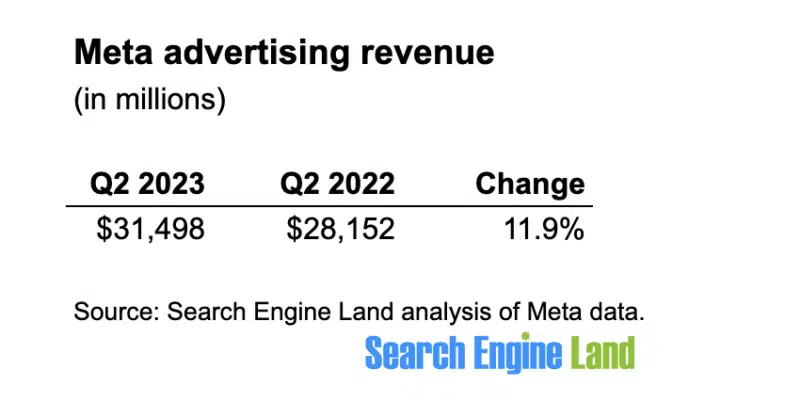
Meta’s ad revenue increased by 12% in the second quarter of 2023 compared to the year-earlier period, surpassing expectations.

Advertising revenue for Q2 2023 was $31.5 billion compared to $28.2 billion in the same period in 2022. This success helped drive total Meta revenue to grow 11% year-on-year from $28.8 billion in Q2 2022 to $32 billion in Q2 2023.

Screenshot 2023 07 26 At 21.13.27 800x418

Daily active users. Meta’s Q2 2023 performance also showed impressive growth in user engagement.

  • Facebook’s daily active user count increased by 5% to reach 2.06 billion.
  • The number of monthly active users was 3.03 billion, up 3% year-on-year.
  • The “family of apps” category, which includes Instagram and WhatsApp, saw a 7% year-over-year rise in daily active users, totalling 3.07 billion.
  • The number of monthly active users in this category also increased by 6% to 3.88 billion.

“Year of efficiency”. Meta’s strong performance comes after Zuckerberg implemented a string of cost-cutting measures across the business, including laying off more than 21,000 staff members. He also cut spending in some divisions and restructured the hierarchy of the company.

Why we care. This is the first time that Meta has achieved double-digit growth since the fourth quarter of 2021, with much of its strong performance driven by growth in ad revenue. This sends a clear message that digital advertising is bouncing back after it took a setback due to the economic downturn. Now, forecasters are predicting increased ad spend for later on in the year, which will create more opportunities for marketers.

Earnings report. You can review Meta’s full report here.


Related stories

New on Search Engine Land

@media screen and (min-width: 800px) { #div-gpt-ad-3191538-7 { display: flex !important; justify-content: center !important; align-items: center !important; min-width:770px; min-height:260px; } } @media screen and (min-width: 1279px) { #div-gpt-ad-3191538-7 { display: flex !important; justify-content: center !important; align-items: center !important; min-width:800px!important; min-height:440px!important; } }

About the author

Nicola Agius

Nicola Agius is Paid Media Editor of Search Engine Land after joining in 2023. She covers paid search, paid social, retail media and more. Prior to this, she was SEO Director at Jungle Creations (2020-2023), overseeing the company’s editorial strategy for multiple websites. She has over 15 years of experience in journalism and has previously worked at OK! Magazine (2010-2014), Mail Online (2014-2015), Mirror (2015-2017), Digital Spy (2017-2018) and The Sun (2018-2020). She also previously teamed up with SEO agency Blue Array to co-author Amazon bestselling book ‘Mastering In-House SEO’.

https://searchengineland.com/meta-ad-revenue-up-q2-2023-429918


Microsoft Search and Advertising revenue up 3% amid ad spend drop

Microsoft’s advertising business failed to perform as well as expected in the second quarter of 2023. 

Advertising and news search revenue rose by $86 million – an increase of 3% – including traffic acquisition costs that Microsoft pays to publishers. Meanwhile search and news advertising revenue – excluding traffic acquisition costs – was up by 8%.

The company attributed the increase to higher search volume and its acquisition of Xandr, the ad-buying platform it acquired from AT&T.

However, despite signs of growth, Microsoft noted that these figures are “a bit behind expectations” due to lower ad spend.

Microsoft didn’t report its revenue in dollars (although we will update this article as soon as it does), but did confirm that LinkedIn revenue surpassed $15 billion for the first time in Microsoft’s 2023 fiscal year, following a 5% increase and 7% increase in constant currency.

The company attributed the increase in revenue to growth in Talent Solutions, with some continued bookings impacted from the weaker hiring environment in key verticals.

However, despite the increases, these numbers were still below what had been forecast for Q2 as growth was partially offset by a decline in Marketing Solutions, again, due to lower ad spend.

  • “Advertising spend was slightly lower than anticipated which impacted Search and news advertising and LinkedIn Marketing Solutions. For LinkedIn, we expect revenue growth in the low to mid-single digits. Even with share gains in our hiring business, growth will continue to be impacted by the overall markets for recruiting and advertising, especially in the technology industry where we have significant exposure,” said Amy Hood, executive vice president and chief financial officer at Microsoft.

Why we care. Following a slump in demand for digital advertising earlier on in the year, analysts had predicted that Q2 would be a more successful quarter due to continued investment in AI. However, the company’s latest results show that growth was slower than anticipated due to a drop in ad spend. Perhaps those expecting AI investment to deliver instant, more significant revenue results have been too presumptuous.

Earnings report. Read Microsoft’s full Q2 performance report for more information.


Related stories

New on Search Engine Land

@media screen and (min-width: 800px) { #div-gpt-ad-3191538-7 { display: flex !important; justify-content: center !important; align-items: center !important; min-width:770px; min-height:260px; } } @media screen and (min-width: 1279px) { #div-gpt-ad-3191538-7 { display: flex !important; justify-content: center !important; align-items: center !important; min-width:800px!important; min-height:440px!important; } }

About the author

Nicola Agius

Nicola Agius is Paid Media Editor of Search Engine Land after joining in 2023. She covers paid search, paid social, retail media and more. Prior to this, she was SEO Director at Jungle Creations (2020-2023), overseeing the company’s editorial strategy for multiple websites. She has over 15 years of experience in journalism and has previously worked at OK! Magazine (2010-2014), Mail Online (2014-2015), Mirror (2015-2017), Digital Spy (2017-2018) and The Sun (2018-2020). She also previously teamed up with SEO agency Blue Array to co-author Amazon bestselling book ‘Mastering In-House SEO’.

https://searchengineland.com/microsoft-search-advertising-revenue-up-q2-429874


3 ways PPC campaign management could soon change

Search marketing has evolved rapidly in the past 12 months. This trend will likely continue to accelerate over the next two years. 

Automation and AI have already revolutionized the search industry, and it’s worth considering what other changes could be coming our way in the future. 

Based on recent history and other indications from platforms like Google and Microsoft, here’s what might be in store for our PPC campaigns.

1. Match type consolidation into broad

Google and Microsoft want advertisers to migrate to broad match. It’s no secret.

Eventually, phrase and exact match will likely be phased out in favor of broad match.

PPC platforms have augmented these match types’ functionality in the last three years. No longer the stalwart of search query control, the operation of exact match may show on searches that have the same meaning or same intent as the keyword.

When Google retired modified broad match in 2021, it also augmented the functionality of phrase match. Phrase match may show on searches that include the meaning of your keyword. The purpose of the keyword can be implied, and user searches can be a more specific form of the meaning, according to Google. 

The changes to exact and phrase have weaned advertisers away from the theory of total control. Advertisers now use a broader range of queries matching their targeted terms.

Historically, advertisers have not preferred the lack of query control with broad match. Google has updated its broad match keyword program for 12-18 months. 

Automation is changing everything in paid search, and match types will be impacted. Within the next 12 months, Google will announce the retirement of another match type. 

Given the advancement in automated bidding and the pairing of “Search + Performance Max,” I think phrase match is the next to go the match-type graveyard. When making large-scale changes, Google will give advertisers 8-12 months to adjust their accounts. We still have time before this change, but time is not on our side. 

Exact match may survive the consolidation steamroller. Advertisers will still have control over their high-value, mission-critical keywords.

Dynamic search ads (DSAs) will eventually migrate to Performance Max. Their functions overlap and may deliver against each other, especially when advertisers run broad match, PMax and DSAs. One of them will have to go. 

This evolution will continue as we march toward a broad-match-focused world. 


Get the daily newsletter search marketers rely on.


2. Channel consolidation into blended campaigns

Performance Max has been a hot topic in the PPC industry since its launch in 2021. 

However, many search marketers have hesitated to adopt this new campaign type due to valid reasons:

Despite these challenges and concerns, Google remains committed to improving its capabilities and offering advertisers more control and options. Microsoft has announced its own version. 

Many advertisers need help optimizing their campaigns and achieving better results due to cross-channel attribution and optimization challenges. 

Google recognized this and has addressed the issue by increasing investment throughout the marketing funnel and introducing data-driven attribution.

In September 2021, Google launched data-driven attribution (DDA) for Google Ads. It is an intelligent machine-learning system that analyzes historical data to determine how much credit each ad interaction should get for a conversion. Google Ads has made DDA the default attribution setting for new conversion actions since October 2021. 

DDA is the key to unlocking the power of Performance Max. By taking into account all ad interactions before a conversion, DDA provides a more accurate understanding of how your ads impact conversions.

This new approach to measurement will also lead to the consolidation of channels across the Google ecosystem. Performance Max is just the start of a new era of blended campaign types.

Google Marketing Live unveiled exciting developments in their ongoing efforts to consolidate channels. Two new blended campaigns, demand gen campaigns and video view campaigns, are now available to cover the entirety of the buyer’s journey. 

Video views campaigns are designed to increase brand awareness, while demand gen is focused on driving mid-funnel consideration and discovery through discovery and YouTube placements. 

Finally, PMax will capture demand at the bottom of the funnel, generating sales across all Google properties. These new campaigns and Google’s data-driven attribution system are ushering in a new era of more intelligent, more effective advertising.

While discovery campaigns are a separate product, their inventory delivers across all three blended campaign types. This suggests it may eventually become integrated into the broader campaign structure, streamlining the process further.

Google’s commitment to consolidating channels and optimizing its data-driven attribution system is paving the way for more effective and efficient advertising strategies.

As a result of consolidation, campaign types may eventually look like this: 

  • Video views to drive upper-funnel awareness.
  • Demand gen to drive mid-funnel consideration.
  • Performance to drive bottom-funnel performance.
  • Search (broad match only) to cover Google’s largest property.
  • Universal app campaigns because this network is unique.

3. Optimization score suggestions into auto-applied recommendations

The last area of disruption due to automation and AI is optimization scores (or OptiScore) within Google Ads.

Currently, Google provides auto-generated optimization ideas within the Recommendations sections of their ad platform. Advertisers can choose which recommendations they want to activate or dismiss these suggestions. 

In April 2021, Google Ads launched auto-apply recommendations (AAR). This feature allows advertisers to automatically apply recommendations to their accounts without manually reviewing and approving each. 

Advertisers remain mixed on AAR. Advertisers I’ve spoken with do not want to relinquish even more control to automation. We’ve heard stories of when AAR changes resulted in accounts going haywire in some fashion.

Google continues to invest in and promote the AAR product. It’s only a matter of time before AAR is folded into the core automation feature set for Google Ads. By this, elements of AAR may apply directly to accounts without being able to turn them off. 

This prediction is based mainly on the fact that Google promotes AAR frequently, often indicating their focus and direction. They may not require every AAR feature, but a subset of features could exist. 

Automation and AI will continue to transform PPC campaign management

Automation and AI are driving significant evolution in the industry, potentially leading to the consolidation of broad match and the retirement of other match types like phrase match. 

Additionally, Google’s commitment to optimizing its data-driven attribution system is fueling channel consolidation into blended campaigns like Performance Max, which provides advertisers with more control and options. 

As automation progresses, auto-applied recommendations may become mandatory in Google Ads, further altering the dynamics of paid search. The continuous integration of automation and AI technologies will undoubtedly shape the future of PPC campaigns.


Opinions expressed in this article are those of the guest author and not necessarily Search Engine Land. Staff authors are listed here.


Related stories

New on Search Engine Land

@media screen and (min-width: 800px) { #div-gpt-ad-3191538-7 { display: flex !important; justify-content: center !important; align-items: center !important; min-width:770px; min-height:260px; } } @media screen and (min-width: 1279px) { #div-gpt-ad-3191538-7 { display: flex !important; justify-content: center !important; align-items: center !important; min-width:800px!important; min-height:440px!important; } }

About the author

Joseph Kerschbaum

Joseph Kerschbaum is Senior Vice President of Search & Growth Labs for 3Q/DEPT. During his 20 years of experience in digital marketing, Joseph has worked with businesses of every size from SMBs to enterprise-scale. Joseph has been a regular speaker at digital marketing conferences for over a decade. Joseph is a regular contributor to Search Engine Land. He is co-author of the Wiley/Sybex book, “Pay-Per-Click SEM: One Hour a Day,” which was published long enough ago to be outdated but that is a good thing because SEM is such a dynamic industry.

https://searchengineland.com/ppc-campaign-management-changes-429819