How to use always-on marketing in paid search

At any one time, 95% of your potential customers are not in the market looking to buy, according to research by the Ehrenberg-Bass Institute and LinkedIn’s B2B Institute.

Only 5% of your audience is “in-market” now looking to buy, so your advertising largely hits buyers who will not buy anytime soon. 

How can marketers be top-of-mind for buyers at whatever point they decide to buy? 

One great way to do this is through always-on marketing, which seeks to build awareness and create brand-relevant memories through messaging.

Here’s what you need to know about always-on marketing and how to apply it in your search marketing campaigns.

What is always-on marketing?

Always-on marketing is a strategy that aims to keep your brand consistently visible in the market through ongoing campaigns. 

The main objective is to ensure your target audience knows your brand and its solutions even before they are ready to purchase. 

Always-on marketing enhances brand awareness and boosts brand equity. It uses metrics from the full marketing funnel to judge performance, from reach all the way down to revenue. 

Why always-on marketing matters

Short-term lead generation campaigns continue to dominate the marketing landscape. 

These campaigns result in brief revenue spikes, followed by stagnant revenue growth. 

So, why do most marketers prioritize these short-term strategies? 

That’s because they often respond to the immediate revenue needs of businesses, which demand quick results. 

In recent times, marketing, particularly on the digital side, has leaned heavily toward strict “performance-based” campaigns, expecting rapid results within just two weeks. 

Success is then solely measured based on lead generation.

Instead, marketers should use always-on marketing programs incorporating full-funnel campaigns for long-term durations.

If embraced, this approach can elevate marketers from reactive short-term campaign executors to strategic long-term builders of brands and drivers of revenue.

Always-on marketing requires more planning, content, creativity, budget and time over standard short-term lead generation campaigns. 

All of this should be exciting to any marketer, but it will take time and persuasion to convince your company, especially your finance team, to approve. 

Testing new marketing approaches is key to learning and growth. Making big bets can yield big returns.  

Always-on marketing for paid search runs across the entire marketing funnel from top of funnel (TOFU), middle of the funnel (MOFU) to bottom of the funnel (BOFU) to ensure your brand is always in the marketing funnel while your target audience searches. 

This approach moves well beyond traditional paid search campaigns that are conversion focused with target cost-per-conversions or conversion volume goals. 

Always-on paid search campaigns include optimizing for those “performance marketing” metrics.

Still, they also include optimizing your campaigns for TOFU awareness metrics like impression share and MOFU engagement metrics like click-through rate. 

An always-on approach to paid search involves a full-funnel execution of:

  • Content strategy.
  • Messaging alignment.
  • Ad creation.
  • User-journey development.
  • Lead nurturing.
  • Metric identification/measurement.
  • Budget allocation.
  • Keyword selection.  

From a content strategy perspective, TOFU and MOFU landing pages should have ungated content that:

  • Speaks to your brand.
  • Describes high-level category offerings.
  • Displays data that addresses customer pain points.
  • Provides social proof. 

BOFU content should only be gated if it is extremely high-value. Examples are signature research reports or annual surveys with valuable and original data. 

Gone are the days of gating standard ebooks, whitepapers, checklists, etc. Give that type of content away without gating it during the TOFU and MOFU stages. 

Budget allocation is another important consideration. When allocating your budget between funnel stages, 60-40 is a good rule of thumb.

  • 60% should go to keywords within TOFU and MOFU.
  • 40% of your budget should go to BOFU keywords. 

This allocation ensures your brand has visibility across the entire search journey to build awareness and drive revenue.      


Get the daily newsletter search marketers rely on.


Always-on paid search keywords

Dividing keywords into TOFU, MOFU and BOFU is not an exact science. 

There are keyword research tools that can help aid in this process and complement your knowledge of your audience and your experience as a paid search marketer.

After initial testing, you should always re-evaluate the stratification of your keywords and make adjustments as needed. 

Below are practical recommendations on how to begin to segment your keywords by stage of the funnel.

TOFU keywords

  • Branded keywords
    • Your brand is your most important asset. Promote and protect it as competitors bid. 
  • Competitor keywords
    • The searcher might be your competitor’s customer now, but that does not mean they will always be. Competitive conquest can increase your brand awareness to relevant prospects. Remember, we’re judging TOFU on awareness metrics like impression share, not conversions.
  • Industry-level keywords
    • Find and bid on industry-level terms. For example, a cybersecurity firm could bid on terms such as “cybersecurity” or “cybersecurity solutions.” Judge performance on impressions and impression share. 

MOFU keywords 

  • Category-level keywords
    • Building on the cybersecurity example, go one level down and bid on terms like “threat intelligence.” Judge the performance of these keywords on engagement metrics such as click-through rate and website engagement metrics. Do not judge these keywords on conversions, leads or revenue. 
  • Comparison keywords
    • Bid on terms aimed at searchers comparing companies or solutions within your space. For example, “top cybersecurity companies.”

BOFU keywords

  • Product-level keywords
    • Product-level keywords are traditional lead generation-focused keywords that are transactional and product-driven. For a cybersecurity firm, an example would be “managed detection and response (MDR) software.” Judge these types of keywords on revenue generation.  

Always-on duration and budget

The always-on marketing approach needs to be both full funnel and long duration to be impactful to your brand. 

That said, always-on paid search can be costly, so be strategic. When the budget is limited, cut back based on the performance metrics relevant to each funnel stage. 

Do not just cut the budget of TOFU and MOFU keywords. Focusing just on BOFU keywords will land you again in the cycle of short bursts of revenue followed by flat growth. 

Push back, say “no,” and advocate for strategic budget allocations based on long-term brand building and revenue growth.    

Champion always-on marketing 

Now that you have an understanding of always-on marketing, test it. Give it a try at your organization via a six-month or nine-month-long paid search pilot. 

Move beyond short-term campaigns promoting a webinar or a gated whitepaper. Embrace a full-funnel, long-term view of paid search. 

Implementing such a trial will not be easy but begin with socializing and advocating for the idea. 

Paid search marketers can and should be more than reactive campaign executioners, so champion always-on marketing and become a strategic brand builder and revenue driver.


Opinions expressed in this article are those of the guest author and not necessarily Search Engine Land. Staff authors are listed here.


Related stories

New on Search Engine Land

@media screen and (min-width: 800px) { #div-gpt-ad-3191538-7 { display: flex !important; justify-content: center !important; align-items: center !important; min-width:770px; min-height:260px; } } @media screen and (min-width: 1279px) { #div-gpt-ad-3191538-7 { display: flex !important; justify-content: center !important; align-items: center !important; min-width:800px!important; min-height:440px!important; } }

About the author

Scott Garrett

Scott is a digital marketing leader with more than a decade of experience developing and executing multi-channel marketing programs to build brands and drive growth. Scott currently serves as the Director of Digital Marketing at Aprio, a premier CPA and business advisory firm. Prior to Aprio, Scott spent time in various digital marketing roles both agency-side and client-side working for small businesses to multinational corporations. Scott is a graduate of James Madison University (BBA, Marketing) and the University of Denver (MBA).

https://searchengineland.com/always-on-marketing-paid-search-429826


Google search revenue rises 5%, slight increase in total ad revenue

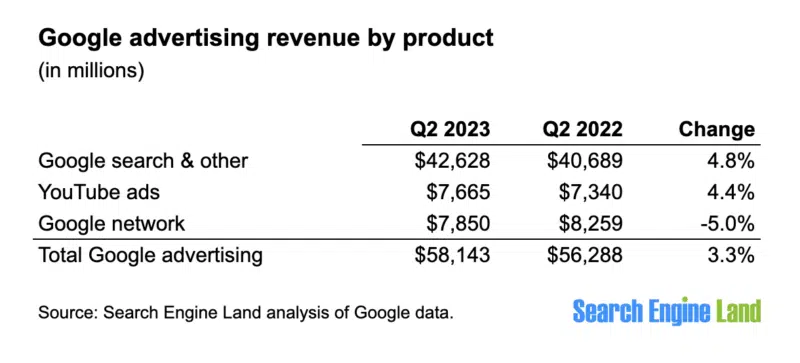
Alphabet Inc., Google’s parent company, reported higher advertising revenue in the second quarter of 2023, year on year.

A 2% gain in search revenue was accompanied by an increase in revenue for YouTube ads (4.4%).

However, Google’s advertising network was down 5%.

Screenshot 2023 07 25 At 21.14.24 800x363
  • “Our financial results reflect continued resilience in Search, with an acceleration of revenue growth in both Search and YouTube,” said Alphabet Chief Financial Officer Ruth Porat.

Although results surpassed expectations, the single-digit growth percentages suggest that digital ad spend has yet to fully recover to its former glory. Experts predict that this should happen in Q4 of 2023.

Why we care. The better-than-expected performance might suggest that confidence and trust in digital advertising is finally stabilizing following the economic downturn. This is great news for digital advertisers as it suggests ad spend is set to grow as we look toward the hugely important holiday period in Q4.

Leadership in AI. Google’s ad revenue increased by $1.85 billion from the previous year, while YouTube ad revenue was $7.67 billion, up from $7.34 billion in 2022.

Google’s Chief Business Officer, Philipp Schindler, added that the company will continue to invest heavily into AI as the business enters into its seventh year as an AI-first company.

  • “Generative Ai is supercharging new and existing ad products. We’re helping advertisers to make better decisions, solve problems and enhance creativity. I’m very excited about AI,” Schindler said.

Stepping down. Alphabet confirmed in its Q2 financial announcement that Porart, who has been with Google for eight years, will be stepping down as CFO. On September, she will take on the newly-created position of president and chief investment officer.

In her new role, Porart will be responsible for Alphabet’s “other bets” and will continue working closely with CEO Pichai. She will be responsible for strengthening the company’s relationships with policy-makers and helping shape its corporate investments to have a maximum economic impact.

Earnings report. You can read Alphabet’s full second quarter 2023 results report for more information.


Related stories

New on Search Engine Land

@media screen and (min-width: 800px) { #div-gpt-ad-3191538-7 { display: flex !important; justify-content: center !important; align-items: center !important; min-width:770px; min-height:260px; } } @media screen and (min-width: 1279px) { #div-gpt-ad-3191538-7 { display: flex !important; justify-content: center !important; align-items: center !important; min-width:800px!important; min-height:440px!important; } }

About the author

Nicola Agius

Nicola Agius is Paid Media Editor of Search Engine Land after joining in 2023. She covers paid search, paid social, retail media and more. Prior to this, she was SEO Director at Jungle Creations (2020-2023), overseeing the company’s editorial strategy for multiple websites. She has over 15 years of experience in journalism and has previously worked at OK! Magazine (2010-2014), Mail Online (2014-2015), Mirror (2015-2017), Digital Spy (2017-2018) and The Sun (2018-2020). She also previously teamed up with SEO agency Blue Array to co-author Amazon bestselling book ‘Mastering In-House SEO’.

https://searchengineland.com/google-search-revenue-rises-5-slight-increase-total-ad-revenue-429861


Instagram rolls out subscription feature to 10 more countries

Instagram will be expanding its subscription feature outside the U.S. for the first time in the coming weeks.

After successfully rolling out this capability in America last year, the social platform has announced plans to roll it out in 10 more countries, including:

  • Australia
  • Brazil
  • Canada
  • France
  • Germany
  • Italy
  • Japan
  • Mexico
  • Spain
  • United Kingdom

Instagram will then continue to expand access to this feature globally over the next few months, enabling content creators worldwide to earn more money from their followers.

Why we care. Through paid subscription services, brands and influencers can develop deeper connections with their most engaged followers, which could result in more conversions and a higher ROI. In addition, it’s also an opportunity for brands and individuals to boost their monthly incomes by granting subscribers access to exclusive content and benefits for a monthly fee.

How it works. Brands and influencers have the freedom to set their own monthly price. In return for paying this fee, fans unlock a Subscribe button on the content creator’s profile. Unlocking that door will give them access to an array of benefits which can include:

  • Subscriber Posts, Stories, Reels and Lives: As well as posting on their main channel, content creators can share bonus material in the form of reels, posts and stories, which is only accessible to paying subscribers. 
  • Subscriber Highlights: Any new content a creator shares is automatically saved to a highlight that is only visible to subscribers. This makes it super easy for subscribers to keep up-to-date. 
  • Subscriber Broadcast and Social Channels: Fee-paying followers can also be given exclusive access or information in subscriber-only channels.
  • Subscriber Badges: Subscribers will appear with badges next to their name when they comment on posts, making them easier to identify so that content creators can prioritize interacting with these accounts in particular. 

Get inspired. If you’re thinking about setting up a subscription on your Instagram account, the social platform suggested looking at the following profiles to see what “a successful subscription looks like”:

What Instagram has said. The social platform announced the extension of its subscription feature via a statement on its official blog. A spokesperson said:

  • “Sharing exclusive content with subscribers across multiple formats helps build community with your subscribers in different ways.”
  • “We will continue to invest in tools that help creators earn money and will have more updates to share in the coming months.”

Deep dive. Read the Instagram Subscriptions Creator Playbook for tips, advice and best practices on setting up a successful subscription service and keeping subscribers interested.


Related stories

New on Search Engine Land

@media screen and (min-width: 800px) { #div-gpt-ad-3191538-7 { display: flex !important; justify-content: center !important; align-items: center !important; min-width:770px; min-height:260px; } } @media screen and (min-width: 1279px) { #div-gpt-ad-3191538-7 { display: flex !important; justify-content: center !important; align-items: center !important; min-width:800px!important; min-height:440px!important; } }

About the author

Nicola Agius

Nicola Agius is Paid Media Editor of Search Engine Land after joining in 2023. She covers paid search, paid social, retail media and more. Prior to this, she was SEO Director at Jungle Creations (2020-2023), overseeing the company’s editorial strategy for multiple websites. She has over 15 years of experience in journalism and has previously worked at OK! Magazine (2010-2014), Mail Online (2014-2015), Mirror (2015-2017), Digital Spy (2017-2018) and The Sun (2018-2020). She also previously teamed up with SEO agency Blue Array to co-author Amazon bestselling book ‘Mastering In-House SEO’.

https://searchengineland.com/instagram-subscriptions-feature-globally-429848


Google Display Ads and Dynamic Search Ads upgrades rolled out in PMax

Google is rolling out two new upgrades to Performance Max.

Dynamic Search Ads (DSA) and Google Display Ads (GDA) campaign upgrades are now available to all advertisers. Opting in is voluntary.

If you decide to upgrade, you can do so via a self-serve tool that will appear in their accounts.

A new, separate PMax campaign will be created for each upgraded campaign, using a combination of settings and learnings from existing campaigns to maintain consistent performance, Google said.

Why we care. The DSA and GDA upgrades give advertisers the tools they need to shift single-channel campaigns to a unified campaign strategy in PMax. This should in turn help improve ROI and give marketers the ability to fully optimize performance across channels.

What’s new. Advertisers who decide to opt into the upgrades will have access to a range of tools and capabilities aimed at improving campaign performance and user experience. This includes:

  • Inventory-aware ad serving: This feature ensures that out-of-stock product pages do not appear in Search by automatically factoring in product inventory, with no work required on your end.
  • More converting search queries: PMax’s AI uses a campaign’s creative assets as a helpful signal to detect more converting search queries. This is particularly beneficial for brands that may have landing pages with thin or minimal content.
  • Enhanced control: Google has confirmed that created text assets are about to begin appearing in the asset reporting table. This is beneficial to advertisers as they will have the ability to delete text assets as they so wish.
  • Serving user intent more effectively: Using automatically created assets, PMax can customize Search ads to better match consumer intent.
  • Better insights: Google is introducing more search categories and the ability to apply date ranges. Advertisers will also soon be able to download these insights via the Google Ads API.

Get the daily newsletter search marketers rely on.


What Google has said. Google announced the PMax upgrades via a statement on its blog. A spokesperson said:

  • “To help you guide Google AI, we want to make it easy for you to provide inputs that tell Performance Max what matters – or doesn’t matter – to your business.”
  • “Today, we’re introducing additional ways to multiply your results across channels. With these improvements, more advertisers are shifting single-channel campaigns to a unified campaign strategy in Performance Max to improve ROI and fully optimize performance across channels.”
  • “For advertisers who are interested and eligible, self-upgrade tools are also rolling out now to easily upgrade Dynamic Search Ads (DSA) campaigns and Google Display campaigns to Performance Max.”
  • “Performance Max will help you reach valuable audiences more effectively across channels – including Display and beyond. You can fine-tune performance by using audience signals to share your understanding of the most important audiences to engage, while still allowing Google AI to expand beyond these to help you find new audiences.”

The reaction. Menachem Ani, founder and CEO of boutique digital marketing agency JAXT Group, told Search Engine Land that although these upgrades are voluntary now, it’s unlikely this is permanent. He said:

  • “I think DSA will be depreciated eventually, and all campaigns will be upgraded to Performance Max.”
  • “The primary difference between Performance Max and Dynamic Search is that optimization is more algorithmic. There are no negative keywords or direct audience targeting. Instead, the algorithm optimizes based on your bid strategy and audience signals.”
  • “Additionally, I believe Discovery campaigns will eventually be rolled into Demand Gen campaigns which are currently in beta.”

By the numbers. Advertisers who upgrade DSA campaigns to PMax see an average increase of more than 15% in conversions and conversion value at a similar CPA/ROAS, Google said.

  • Advertisers who upgrade Google Display campaigns to PMax see an average increase of over 20% in conversions, Google said. This performance holds even if a brand already has an existing PMax campaign.

Related stories

New on Search Engine Land

@media screen and (min-width: 800px) { #div-gpt-ad-3191538-7 { display: flex !important; justify-content: center !important; align-items: center !important; min-width:770px; min-height:260px; } } @media screen and (min-width: 1279px) { #div-gpt-ad-3191538-7 { display: flex !important; justify-content: center !important; align-items: center !important; min-width:800px!important; min-height:440px!important; } }

About the author

Nicola Agius

Nicola Agius is Paid Media Editor of Search Engine Land after joining in 2023. She covers paid search, paid social, retail media and more. Prior to this, she was SEO Director at Jungle Creations (2020-2023), overseeing the company’s editorial strategy for multiple websites. She has over 15 years of experience in journalism and has previously worked at OK! Magazine (2010-2014), Mail Online (2014-2015), Mirror (2015-2017), Digital Spy (2017-2018) and The Sun (2018-2020). She also previously teamed up with SEO agency Blue Array to co-author Amazon bestselling book ‘Mastering In-House SEO’.

https://searchengineland.com/google-display-ads-dynamic-search-ads-upgrade-pmax-429775


How to unlock new efficiency and results with process automation by Fluency

Fluency FLC03623 INSIGHT AugmentingReality ThirdDoorMedia 1920x1080 2 800x450

Are traditional tools and processes limiting your ability to deliver against growing demands for efficiency and performance? Across the digital advertising space, it’s becoming more difficult than ever for agency professionals to:

  • Keep pace with the ever-changing demands of your digital-first campaign strategies
  • De-risk your agency from overspend liabilities
  • Retain top talent and specialists in a tight—and expensive—labor market

Whether your organization is lacking because of a technical shortcoming, a creative gap, or a weakness in the client relationship, it offers advertising leaders a roadmap to unlocking new efficiency and results through process automation—all while highlighting some of the new products and features that enable transformative results.

Automation already delivers transformative results to many of the world’s most sophisticated agencies and in-house teams. If you want to learn more about how it can help establish new efficiencies and performance across your organization, download Fluency’s latest ebook today.


Related stories

New on Search Engine Land

About the author

Fluency

Fluency is the premier provider of enterprise-level campaign software to the advertising industry. The company’s platform is built around Robotic Process Automation—a technology application unique in advertising—that delivers unparalleled efficiency, accuracy and quantity capabilities for digital marketers working in both agencies and brands. Based in Burlington, Vermont, with team members in 11 states, Fluency’s founders and staff leverage a singular combination of expertise, talent and inventiveness in their efforts to sustainably, collaboratively and enjoyably transform their clients’—and their own—businesses.

https://searchengineland.com/how-to-unlock-new-efficiency-and-results-with-process-automation-429634


TikTok launches text posts

TikTok is rolling out text posts for the first time.

Historically, brands and influencers have been able to create content across a variety of formats such as live videos, photos, Duets, Stitch and more – but text was never an option.

Now, creators have that additional resource to connect with their audiences, enabling them to spread their messages through poems, lyrics and any other written content on TikTok.

Why we care. Providing brands with the ability to share text posts is another method in which they can reach and engage their audience. While some TikTok users may be responsive to live videos, others are more likely to connect with text posts. Giving marketers this additional resource is helping them to draw in an audience that may have previously been untapped. The bigger the audience a brand is able to reach and engage with, the higher the possible ROI.

New features. To make text posts as engaging as possible, TikTok has also launched a number of features for content creators to experiment with when posting text, including:

  • Stickers: TikTok has a range of stickers that creators can use to enhance their text posts.
  • Tags and hashtags: In the same way that you can with video and photo posts, tags and hashtags can also be used with text posts.
  • Background colors: Content creators can choose a color to layer behind their text to make their message pop.
  • Sound: TikTok has stressed that sound is a vital part of the user experience, so it has given brands the option to add sound to their text posts.
  • Draft and discard: If a creator doesn’t want to publish a text post they’ve been working on, they can save it in drafts to return to later, or discard it.

How it works. TikTok has rolled out the new text post feature to simplify the content creation process. Simply follow these steps to publish your first text post:

  • Create a text post: Go to your camera page and you’ll be greeted with three options; photo, video and text. Choose text and you’ll be taken to the text creation page where you can start typing.
  • Enhance your text post: After writing out your text post, enhance it by using some of the features mentioned earlier, such as stickers, hashtags and sound, to make it as engaging for the user as possible.
  • Publish: Once you’re happy with your end product, share your message with your followers.

Get the daily newsletter search marketers rely on.


What has TikTok said? TikTok announced its text post expansion via a statement published in its newsroom. A spokesperson said: 

  • “We’re thrilled to announce the expansion of text posts on TikTok, a new format for creating text-based content that broadens options for creators to share their ideas and express their creativity.” 
  • “With text posts, we’re expanding the boundaries of content creation for everyone on TikTok, giving the written creativity we’ve seen in comments, captions, and videos a dedicated space to shine.”
  • “We’re excited to see what our community will create with text posts, a new way to express and share your creativity on TikTok.”

Related stories

New on Search Engine Land

@media screen and (min-width: 800px) { #div-gpt-ad-3191538-7 { display: flex !important; justify-content: center !important; align-items: center !important; min-width:770px; min-height:260px; } } @media screen and (min-width: 1279px) { #div-gpt-ad-3191538-7 { display: flex !important; justify-content: center !important; align-items: center !important; min-width:800px!important; min-height:440px!important; } }

About the author

Nicola Agius

Nicola Agius is Paid Media Editor of Search Engine Land after joining in 2023. She covers paid search, paid social, retail media and more. Prior to this, she was SEO Director at Jungle Creations (2020-2023), overseeing the company’s editorial strategy for multiple websites. She has over 15 years of experience in journalism and has previously worked at OK! Magazine (2010-2014), Mail Online (2014-2015), Mirror (2015-2017), Digital Spy (2017-2018) and The Sun (2018-2020). She also previously teamed up with SEO agency Blue Array to co-author Amazon bestselling book ‘Mastering In-House SEO’.

https://searchengineland.com/tiktok-launches-text-posts-429765


Twitter is now brand X

Twitter is the past. X is the future.

The iconic blue bird icon has been removed from the desktop version of Twitter – replaced by a stark, monochromatic letter X. The same change will shortly be made on the mobile version, the company confirmed.

The change is also said to signal an evolution for the brand beyond social media, to an “everything app” best compared to WeChat:

  • “It’s an exceptionally rare thing – in life or in business – that you get a second chance to make another big impression. Twitter made one massive impression and changed the way we communicate. Now, X will go further, transforming the global town square,” tweeted Twitter CEO Linda Yaccarino – or rather “x’ed” Yaccarino, as we must learn to say.
  • “X is the future state of unlimited interactivity – centered in audio, video, messaging, payments/banking – creating a global marketplace for ideas, goods, services, and opportunities. Powered by AI, X will connect us all in ways we’re just beginning to imagine.”

Why we care. For users of X, the rebranding will indeed require sweeping changes to familiar vocabulary. People will “x” rather “tweet.” Presumably, on the mobile device, we will now see a list of users who recently “x’ed.” TweetDeck will surely become XDeck, although that has yet to be confirmed.

For marketers and advertisers, the change will underline questions already raised about brand safety. Last year, many sources noted a significant rise in hate speech on the platform. While Meta’s Zuckerberg has spoken about X competitor Threads as being “friendly,” the aesthetic of X inevitably comes across as minimalist, even brutalist — for example when the new logo is projected on the exterior of their headquarters like a sinister version of the Bat-signal.

Gone, advertisers, gone. Many big-spending advertisers abandoned or reduced spending on the platform since Musk bought it, resulting in an estimated 59% drop in Twitter’s U.S. ad revenue.

X. X.com now points to twitter.com, as Musk tweeted.

Musk has a long history with the letter X. He’s clearly fond of it; it remains to be seen whether a wider audience will find the name and logo relatable.

Breaking Twitter? Lots of speculation among the SEOs that this change could result in embedded tweets breaking – among other SEO impacts. Whether these things will actually happen remains to be seen. But here are a few embedded tweets (we’re living dangerously) discussing how Twitter/X may soon break (or not):


Related stories

New on Search Engine Land

@media screen and (min-width: 800px) { #div-gpt-ad-3191538-7 { display: flex !important; justify-content: center !important; align-items: center !important; min-width:770px; min-height:260px; } } @media screen and (min-width: 1279px) { #div-gpt-ad-3191538-7 { display: flex !important; justify-content: center !important; align-items: center !important; min-width:800px!important; min-height:440px!important; } }

About the author

Kim Davis

Kim Davis is the Editorial Director of MarTech Today. Born in London, but a New Yorker for over two decades, Kim started covering enterprise software ten years ago. His experience encompasses SaaS for the enterprise, digital- ad data-driven urban planning, and applications of SaaS, digital technology, and data in the marketing space. He first wrote about marketing technology as editor of Haymarket’s The Hub, a dedicated marketing tech website, which subsequently became a channel on the established direct marketing brand DMN. Kim joined DMN proper in 2016, as a senior editor, becoming Executive Editor, then Editor-in-Chief a position he held until January 2020. Prior to working in tech journalism, Kim was Associate Editor at a New York Times hyper-local news site, The Local: East Village, and has previously worked as an editor of an academic publication, and as a music journalist. He has written hundreds of New York restaurant reviews for a personal blog, and has been an occasional guest contributor to Eater.

https://searchengineland.com/twitter-is-now-brand-x-429760


GA4 custom report builder adds 33 ecommerce dimensions, metrics

Google Analytics 4 has added dozens of new dimensions and metrics that should help marketers this coming holiday shopping season.

The new capabilities were rolled out as part of the latest GA4 update, which saw new ecommerce dimensions and metrics added to the custom reports builder.

In addition to being able to create reports from scratch, this new feature means that you can now edit standard ecommerce reports too.

Why we care. Adding these new GA4 dimensions and metrics should help you better understand the performance of campaigns, extract insights and make data-informed decisions – and potentially lead to improved more revenue.

New ecommerce dimensions. GA4 now has the following ecommerce dimensions available in the custom report builder:

  • Item affiliation
  • Item brand
  • Item category
  • Item category 2
  • Item category 3
  • Item category 4
  • Item category 5
  • Item ID
  • Item list ID
  • Item list name
  • Item list position
  • Item location ID
  • Item name
  • Item promotion creative name
  • Item promotion creative slot
  • Item promotion name
  • Item variant
  • Shipping tier

New ecommerce metrics. GA4 now has the following ecommerce metrics available in the custom report builder:

  • Gross item revenue
  • Gross purchase revenue
  • Item refund amount
  • Item revenue
  • Items added to cart
  • Items checked out
  • Items clicked in promotion
  • Items purchased
  • Items viewed
  • Items viewed in list
  • Items viewed in promotion
  • Purchase revenue
  • Refund amount
  • Shipping amount
  • Tax amount

New revenue metrics. GA4 has also introduced the following new revenue metrics in explorations:

  • Gross item revenue (The total revenue from items only, excluding tax and shipping).
  • Gross purchase revenue (The total revenue from purchases made on your website or app).
  • Refund amount (The total amount from refunds given on your website or app).

Get the daily newsletter search marketers rely on.


Duplicative revenue metrics removed. In addition to the introduction of new metrics and dimensions, Google has removed the following duplicative revenue metrics

  • Ecommerce revenue.
  • Event revenue.

What has Google said? In a GA4 update posted to the Google Analytics announcement page, a statement read:

  • “We recommend updating any explorations that use the Ecommerce revenue or Event revenue metric to now use the Purchase revenue metric.”
  • “To create explorations and see revenue from ecommerce transactions, use Purchase revenue. Existing explorations that use these removed metrics will continue to work, but new explorations should use the new revenue metrics instead.”

Deep dive. Read Google’s official announcement on its Analytics blog for more information.


Related stories

New on Search Engine Land

@media screen and (min-width: 800px) { #div-gpt-ad-3191538-7 { display: flex !important; justify-content: center !important; align-items: center !important; min-width:770px; min-height:260px; } } @media screen and (min-width: 1279px) { #div-gpt-ad-3191538-7 { display: flex !important; justify-content: center !important; align-items: center !important; min-width:800px!important; min-height:440px!important; } }

About the author

Nicola Agius

Nicola Agius is Paid Media Editor of Search Engine Land after joining in 2023. She covers paid search, paid social, retail media and more. Prior to this, she was SEO Director at Jungle Creations (2020-2023), overseeing the company’s editorial strategy for multiple websites. She has over 15 years of experience in journalism and has previously worked at OK! Magazine (2010-2014), Mail Online (2014-2015), Mirror (2015-2017), Digital Spy (2017-2018) and The Sun (2018-2020). She also previously teamed up with SEO agency Blue Array to co-author Amazon bestselling book ‘Mastering In-House SEO’.

https://searchengineland.com/google-analytics-4-custom-ecommerce-reports-429735


Google Performance Max now lets you create product collections

A new Google Performance Max feature lets you combine products and create collections – for ads or free product listings.

Collections allow you to associate products with your creative assets – images, videos and text.

Why we care. The ability to associate different products and assets simplifies the product listing experience, saving you time and money. Collections can also enrich product data, which could result in enhanced product performance, increased engagement and a richer customer experience.

How it works. Collections can include up to 100 products. They are only available for local products sold within Performance Max for store goals.

Here’s how you can set up a collections feed in Merchant Center:

  • Sign into your Merchant Center account.
  • Select Products.
  • Click on Feeds.
  • Selection the Collections Feeds tab.
  • Click the + (plus) button.
  • Select the destinations in which you would like your collection to appear.
  • Give your collection feed a name.
  • Choose an upload method, then follow the instructions for the method you have selected.

Get the daily newsletter search marketers rely on.


Next steps. Google is yet to roll out its Collections feature for wider-scale or international promotions.

Google has yet to confirm its future plans for this feature. For now, it’s a great opportunity for local marketers to maximize their local outreach.


Related stories

New on Search Engine Land

@media screen and (min-width: 800px) { #div-gpt-ad-3191538-7 { display: flex !important; justify-content: center !important; align-items: center !important; min-width:770px; min-height:260px; } } @media screen and (min-width: 1279px) { #div-gpt-ad-3191538-7 { display: flex !important; justify-content: center !important; align-items: center !important; min-width:800px!important; min-height:440px!important; } }

About the author

Nicola Agius

Nicola Agius is Paid Media Editor of Search Engine Land after joining in 2023. She covers paid search, paid social, retail media and more. Prior to this, she was SEO Director at Jungle Creations (2020-2023), overseeing the company’s editorial strategy for multiple websites. She has over 15 years of experience in journalism and has previously worked at OK! Magazine (2010-2014), Mail Online (2014-2015), Mirror (2015-2017), Digital Spy (2017-2018) and The Sun (2018-2020). She also previously teamed up with SEO agency Blue Array to co-author Amazon bestselling book ‘Mastering In-House SEO’.

https://searchengineland.com/google-performance-max-product-collections-429728


Google updates Misrepresentation policy with key information on building trust

Google has updated its Misrepresentation policy with detailed information on how marketers can build trust.

The document advises what steps and precautions brands should take to make sure their products and offers are eligible to be served in Search.

Why we care. The updated policy provides specific criteria for brands. This level of detail will also prove useful for anyone struggling with a misrepresentation suspension or warning.

Building trust. In its updated policy, Google explained that there are four issues you need to address to build trust. For each issue specified, Google provided specific instructions that brands should follow:

  • Business Identity
    • Ensure that the official business name is provided and that there is consistency across the registered business name and domain name.
    • Make sure a brand’s website features an ‘About Us’ page as this establishes authenticity and helps customers to understand their unique journey.
    • Link out to the brand’s social media profiles from the website so that customers can follow those accounts should they so wish.
  • Transparency
    • Make sure website content and messaging is completely clear and include details regarding shipping, returns and privacy policies.
    • Ensure honesty and transparency about the brand’s business model and how the company operates.
  • Online reputation
    • Display honest reviews and testimonials about a brand’s products and services to help customers understand how to use them.
    • Feature any badges or seals of approval from official third-party sources.
    • Clearly display how customers can get in touch.
    • Be sure to tell customers if the brand publishes a blog post.
    • Make sure customers know if the brand was mentioned in a third-party article.
  • Professional design
    • Make sure that the brand’s website has an SSL certificate to reassure customers that their sensitive data is stored securely.
    • The brand’s website should be easy to navigate and shouldn’t contain any unnecessary redirects or redirects to broken links.
    • Try to avoid placeholders where possible as this gives Google and the customer the impression that the website is still under construction and not yet ready for SERPs.

Assisting Google. Google explained that there are several steps brands can take to help it to understand their business faster and more accurately:

  • Create and verify a Google Business Profile.
  • Share up-to-date information in the Merchant Center under the Business information settings.
  • Link relevant third-party platforms to Merchant Center.
  • Follow Google’s SEO guidelines to ensure a strong customer experience is provided.
  • Opt into the Google Customer Reviews or other third-party review services to improve eligibility for seller ratings.
  • Match product data in the product feed with your website to make sure that customers are seeing the same information across both platforms.

What has Google said? Google said via a statement posted on its Merchant Center:

  • “We want Google to be a safe and trustworthy place for both our customers and retailers.”
  • “Customers should feel confident about the offers they are browsing and the businesses they are purchasing from.”
  • “Sometimes it can take some time before a sufficient level of trust is established and before we consider it safe to display your offers to customers.”
  • “This assessment is an ongoing process and since we know that customers are likely to do research about your products and business, we may review multiple signals from across the web.”
  • “The more we know about your business, the better we are able to represent you.”

Deep dive. Read Google’s Building Trust with your Customers guide for more information on its Misrepresentation policy.


Related stories

New on Search Engine Land

@media screen and (min-width: 800px) { #div-gpt-ad-3191538-7 { display: flex !important; justify-content: center !important; align-items: center !important; min-width:770px; min-height:260px; } } @media screen and (min-width: 1279px) { #div-gpt-ad-3191538-7 { display: flex !important; justify-content: center !important; align-items: center !important; min-width:800px!important; min-height:440px!important; } }

About the author

Nicola Agius

Nicola Agius is Paid Media Editor of Search Engine Land after joining in 2023. She covers paid search, paid social, retail media and more. Prior to this, she was SEO Director at Jungle Creations (2020-2023), overseeing the company’s editorial strategy for multiple websites. She has over 15 years of experience in journalism and has previously worked at OK! Magazine (2010-2014), Mail Online (2014-2015), Mirror (2015-2017), Digital Spy (2017-2018) and The Sun (2018-2020). She also previously teamed up with SEO agency Blue Array to co-author Amazon bestselling book ‘Mastering In-House SEO’.

https://searchengineland.com/google-misrepresentation-policy-update-building-trust-429706