Google Ads fixes missing data issue

Marketers could not access their latest campaign data in Google Ads earlier today. That issue has now been resolved, Google said.

The issue first started to affect advertisers on June 23 at 4:26 a.m. ET, according to Google.

In response, Google Ads said in a statement today at 7:13 am ET that it is looking into the matter to try and find a solution, with an update expected shortly.

1 1 800x346

Why we care. Marketers impacted by the problem can still sign into their Google Ads account, however, they can’t retrieve their campaign’s latest data, meaning they can’t accurately monitor performance or produce up-to-date reports.

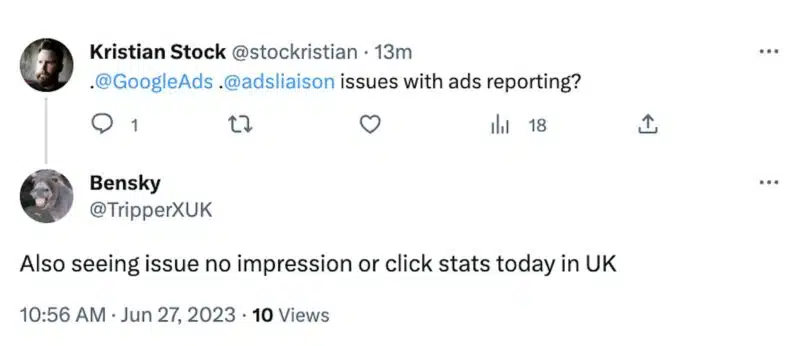
The issue. Ads are running but no performance data is showing within the Google Ads interface. This issue also is affecting GA4 reporting, according to tweets in this Twitter thread.

What has Google said? Google confirmed, via the Google Ads Status Dashboard, that it is investigating reports of an issue:

  • “We will provide more information shortly. The affected users are able to access Google Ads but may not have access to the most recent data.”

Google Ads Liaison tweeted a similar message.

Update. The problem with Google Ads has now been fixed. Marketers that were affected by the issue are now able to access the most recent data for their campaigns. Google confirmed that it had solved the problem via the Google Ads Status Dashboard:

  • “The problem with Google Ads has been resolved. We apologize for the inconvenience and thank you for your patience and continued support.”

Related stories

New on Search Engine Land

@media screen and (min-width: 800px) { #div-gpt-ad-3191538-7 { display: flex !important; justify-content: center !important; align-items: center !important; min-width:770px; min-height:260px; } } @media screen and (min-width: 1279px) { #div-gpt-ad-3191538-7 { display: flex !important; justify-content: center !important; align-items: center !important; min-width:800px!important; min-height:440px!important; } }
About the author

Nicola Agius

Nicola Agius is Paid Media Editor of Search Engine Land after joining in 2023. She covers paid search, paid social, retail media and more. Prior to this, she was SEO Director at Jungle Creations (2020-2023), overseeing the company’s editorial strategy for multiple websites. She has over 15 years of experience in journalism and has previously worked at OK! Magazine (2010-2014), Mail Online (2014-2015), Mirror (2015-2017), Digital Spy (2017-2018) and The Sun (2018-2020). She also previously teamed up with SEO agency Blue Array to co-author Amazon bestselling book ‘Mastering In-House SEO’.

https://searchengineland.com/google-ads-investigating-reports-data-428694


Why strong Google Ads creative is THE priority for advertisers

Automation in digital advertising has become a lifeline. If you’re thinking of the latter without the former, you’re falling behind competitors. 

While the idea of robots stealing marketing jobs plagues worriers and late-embracers, automation frees up time for advertising teams to focus more on branding, strategy, data and, in turn, creative.

PPC advertisers must embrace machine learning and feed it the right data to improve performance. 

You vs. AI is a fight you won’t win. AI is at the heart of all of Google’s decisions, and creative is driving automation. 

Google’s new ad type announcements at Google Marketing Live (i.e., video views and demand gen campaigns) and products like the Ads Creative Studio have made it clear that strong creative must become a priority. 

Here’s why and how advertisers can hone in on PPC ad creative to drive better results in Google Ads.

PPC ad creative front and center

The explosion of TikTok has inspired other platforms to create similar products and changed the format and frequency in which content is consumed. 

Vertical videos with a real-life look and feel and trendy audio is the direction that ads must follow to stay relevant and keep users engaged. 

This means less text, more visuals and more motion. 

Consumers are exposed to thousands of ads per day. Advertisers are battling with their competitors for attention and going against all other advertisers for digital ad space. 

When Google is deciding when to show your display ad, it is taking into account the following:

  • Your bid in the auction.
  • How relevant your ad is to the user.
  • How likely the user is to click on it.

After all, Google makes money off of clicks. 

The importance of relevant, eye-catching ads means there is a need for more assets than ever before. The more asset options that machine learning is fed, the better. 

The algorithms decide which to show your audience based on asset strength ratings. 

Creative should be tailored to the personas you’re trying to reach, be consistent with brand messaging and contain an enticing offer for increased engagement.

Streamlining creative production

Unsurprisingly, Google would make it easy for advertisers to produce creative content to support this push. 

  • “Ads Creative Studio is a creative management platform designed for creative teams. You can use it to build ads, manage creative assets, and share them with media teams. Ads Creative Studio can improve collaboration and transparency between your creative and media teams and help you create effective ads with more efficiency and scale,” according to Google. 

Google’s Bumper Machine is also an easy way to turn your video or image assets into a 6-second video asset for YouTube Bumper Ads.

While these tools make it easy for teams to create and collaborate, the end product will only be as good as what you feed it. 

The Ads Creative Studio nor Performance Max’s use of generative AI should not replace a creative team as unique, high-quality creative generates a better user experience that is more on-brand and relevant to users. 

Ads Creative Studio

Varying creative ad types and formats unlock more placements for your brand to make an impact.

While generating copious amounts of visuals can be overwhelming, scalable creative doesn’t have to break the bank. 

Some simple ideas for leveling up your creative offerings include:

  • Adding motion to an existing static banner.
  • Chopping an existing video to test shorter lengths.
  • Test various CTAs.
  • Analyze variables such as color, headlines, and dimensions for learnings and optimizations.

Brands are often scared by the high price tag of video production. However, depending on budget one production can create 50 to 100 different assets or more, ultimately saving money and staying ahead of creative refresh needs.

Video-first mindset

The two new video campaign types announced at Google Marketing Live are video views and demand gen. 

Video view campaigns are intended to drive down the cost of video views by combining skippable in-stream, in-feed, and YouTube Shorts ads. 

Demand gen campaigns will also show across YouTube, Discover, and Gmail to drive conversions using lookalike audiences.

As Google rolls out more video-first campaign types, advertisers must keep up. 

In addition to the increase in video content consumption, there are numerous upsides to leveraging video, including:

  • Ad formats to modernize your brand.
  • Video allows for more information than static banners to overcome purchase barriers.
  • This format is great for education, use cases and demos. 
  • Videos can be used across several platforms (and your website) without duplicating efforts.
  • View rates can tell how creative is performing, a data point that static imagery can’t tell you.

Always tailor your creative to your audience. The more relevant and useful content is, the more engagement it will receive. 

Consider where a user is in the buyer journey and decide what messaging fits their needs. Use a strong call to action at each stage of the funnel and test sequenced messaging. 

Video ad sequencing allows you to tell your brand story with multiple ads shown in a specific order to get a message across or achieve a conversion goal.

Measuring success

Testing is critical when it comes to feeding AI new creative. Gaining insights from creative variations helps advertisers strengthen optimizations and machine learning. 

Determining creative success isn’t always as simple as looking at conversion metrics, even if conversions are your ultimate goal. 

KPIs like CTR, CPC, views, CPV, video completion rates, YouTube earned actions and more can tell a complete story about how creative is performing before the user gets to your landing page or form. 

Keep in mind that bid strategies can influence performance. For example, if you’re on a conversion-optimized strategy, you might see fewer impressions and clicks.

Measuring success - 1

Setting up an experiment is an easy way for Google to do the work for you. There are several experiment options available in-platform.

Performance Max test uplift can help you understand the impact of running PMax alongside your existing campaigns. Video experiments identify which of your video ads drives the strongest performance. 

Lastly, custom experiments can test any variable you’d like. The custom experiment duplicates your existing campaign and allows you to change the campaign without adjusting the original. 

You must only test one variable at a time (i.e., creative color) so the experiment remains a true A/B test without any other factors influencing the results. 

All experiments run for a set time and measure success outcomes to determine a winner. From there, you can decide how to proceed with the account. 

Measuring success - 1

Advertisers should never become complacent with the number of assets they run and the messaging they drive. A never-stop-learning attitude makes a successful marketer and helps AI drive the strongest results. 

Always test the latest tools and features to see what works for your brand and learn to embrace the changes in the ad industry. It’s just the beginning!


Opinions expressed in this article are those of the guest author and not necessarily Search Engine Land. Staff authors are listed here.


Related stories

New on Search Engine Land

@media screen and (min-width: 800px) { #div-gpt-ad-3191538-7 { display: flex !important; justify-content: center !important; align-items: center !important; min-width:770px; min-height:260px; } } @media screen and (min-width: 1279px) { #div-gpt-ad-3191538-7 { display: flex !important; justify-content: center !important; align-items: center !important; min-width:800px!important; min-height:440px!important; } }

About the author

Kerri Amodio

Kerri Amodio is a Senior Digital Advertising Manager at Closed Loop. A specialist in B2B SaaS marketing, she became well-versed in executing digital advertising strategies across social, search and display while working in-house for B2B tech companies. Kerri has been on the agency side at Closed Loop for nearly four years, working with clients such as Slack, Netskope, Outreach, xMatters, Podium and Corporate Visions.

https://searchengineland.com/strong-google-ads-creative-428665


Do your SEO and PPC teams need upskilling or reskilling?

If you looked over the agenda at SMX Advanced, held June 13-14, you probably spotted this trend:

“AI” appears in the titles of 11 sessions, including “How generative AI will change SEO as a profession.”

And this doesn’t include the titles of four other sessions on related topics like “Revolutionize your PPC game with GPT.”

Hey, I get it. Marketers and executives attended their industry’s most important events to:

  • Keep up to date with industry trends.
  • See new products and services.
  • Maintain and build relationships.

In short, attending leading conferences and trade shows keeps you informed and competitive.

And there’s no question that generative AI will change SEO as a profession and revolutionize your PPC game.

But whether you attended SMX Advanced or not, it is time to ask yourself a different question: “Do your SEO and PPC teams need upskilling or reskilling?”

Upskilling and reskilling, defined 

According to LinkedIn Learning:

“When an employee undertakes learning to expand their existing skill set, that learning is known as upskilling. These additional skills enhance the worker’s performance in their current role, potentially advancing them along their career path.”

“Employee reskilling involves learning new skills outside of the worker’s existing skillset. These skills are often closely adjacent to their current function, but may sometimes be geared toward a different path entirely.”

Why do 80% of PPC specialists need upskilling?

Based on my experience, about 80% of the PPC specialists at brands or agencies will probably need upskilling this summer and around 20% will need reskilling.

Why? 

When Google announced it was “Supercharging Search with generative AI,” Elizabeth Reid, the Vice President and GM of Search, said, “In this new generative experience, Search ads will continue to appear in dedicated ad slots throughout the page.”

And Google’s primary source of revenue is advertising, which makes up around 80% of the company’s total revenue.

So, approximately 80% of PPC specialists will need some upskilling to take advantage of the advent of Google’s search generative experience (SGE).

Suppose brands and agencies want to stay two steps ahead of competitors.

In that case, they should also provide their PPC specialists with some upskilling workshops or courses to seize the opportunities offered by the migration to Google Analytics 4 (GA4).

For example, if you link your GA4 property to Google Ads, Display & Video 360, or Search Ads 360, then you can re-engage GA4’s predictive audiences – like “Likely 7-day purchasers” and “Predicted 28-day top spenders” – with a remarketing campaign. 

These additional skills enhance a worker’s performance in their current role.

So, why will roughly 20% of your PPC team need reskilling?

Well, you already know that AI can scale asset production to serve the most relevant version of an ad across channels via Performance Max, App, and Video action campaigns.

But AI-powered solutions will soon play a pivotal role in creative development – from campaign planning to creative testing to media planning.

And that will involve learning new skills outside of a PPC manager’s existing skillset.


Get the daily newsletter search marketers rely on.


Why do 80% of SEO specialists need reskilling?

Based on my experience, about 20% of the SEO specialists at brands or agencies will probably need upskilling this summer, but around 80% will need reskilling. And it’s probably time for a reorg, too. 

Yes, I realize Reid said, “As we bring generative AI into Search, we’re committed to continue sending valuable traffic to sites across the web.” 

So, SEO is still alive. And it has survived several major Google algorithm updates since the Panda update back in 2011. So, it should survive the advent of SGE in 2023.

But SEO should become part of a Venn diagram that includes the closely adjacent disciplines of content marketing and social media marketing to maintain or improve search rankings, drive website traffic, and generate conversions.

Why?

Because Google’s continued existence in this new era of Search doesn’t depend on the success or even the survival of SEO. So, many SEOs will need to learn new skills outside of their existing skillset. 

In a post entitled, “Learn from others’ experiences with more perspectives on Search,” Lauren Clark, the Product Manager at Google Search, said:

“In the coming weeks, when you search for something that might benefit from the experiences of others, you may see a Perspectives filter appear at the top of search results. Tap the filter, and you’ll exclusively see long- and short-form videos, images, and written posts that people have shared on discussion boards, Q&A sites, and social media platforms.”

Fortunately, GA4 has some new default channels that enable SEOs to monitor the performance of organic social, organic video, and organic shopping as well as organic search. And the referral channel still lets you see which users arrive at your site via non-ad links on other sites/apps (e.g., blogs, news sites).

Plus, new research by Rand Fishkin of SparkToro found, “A substantial portion of social referral traffic comes without proper, accurate referral data, and is misclassified as ‘direct.’” Fishkin adds, “For those investing in pro-active social media marketing, we recommend using unique URLs to track activity to social promotions.”

And many brands and agencies should consider adopting new organizational structures.

For example, the SEO, content marketing, and social media marketing teams need to be integrated to survive or even thrive when long- and short-form videos, images, and written posts start to appear in the Perspectives filter.

Plus, creating at least a dotted line reporting structure with the digital PR team makes sense.

In June 2023, Think with Google published “Does your marketing have the essentials to succeed with AI?” which included this line:

  • “Silos can be kryptonite for AI, limiting its ability to optimize and maximize performance.”

It also quotes Alex Clemente, managing director of Harvard Business Review Analytic Services, who explained:

  • “Cross-functional teams will need to nurture a test-and-learn culture where leaders can quickly adjust the plan when results don’t come in as expected, or double down on what works.”

Hey, this reorg is long overdue. Google has blended video, news, images, maps and webpages since they announced universal search in 2007.

Brands and agencies have had 16 years to get around to putting everyone involved in creating content on the same team.

So, if it takes the advent of generative AI to finally get marketers and executives to restructure their teams, then it’s about time.

As Benjamin Franklin said at the time of the signing of the Declaration of Independence, “We must all hang together, or, most assuredly, we shall all hang separately”.

What should marketers and executives do next?

So, what should you do next?

Well, after you learn as much as you can about generative AI and other related topics, you should also set aside some time to think about the difference between upskilling and reskilling your employees.

Figure out if most of your PPC specialists need the former while many of your SEO specialists need the latter.

Now, brands and agencies may want to encourage their existing employees to check out the free online courses that are available in the Google Digital Garage. Some courses are provided by Google, and others from their partner universities or institutions.

Marketers and executives may also want to reimburse their employees for getting certification from a reputable institution.


Opinions expressed in this article are those of the guest author and not necessarily Search Engine Land. Staff authors are listed here.


Related stories

New on Search Engine Land

@media screen and (min-width: 800px) { #div-gpt-ad-3191538-7 { display: flex !important; justify-content: center !important; align-items: center !important; min-width:770px; min-height:260px; } } @media screen and (min-width: 1279px) { #div-gpt-ad-3191538-7 { display: flex !important; justify-content: center !important; align-items: center !important; min-width:800px!important; min-height:440px!important; } }

About the author

Greg Jarboe

Greg Jarboe is the president and co-founder of SEO-PR, which has generated award-winning results for Southwest Airlines, the Search Engine Strategies (SES) Conference & Expo series, and Rutgers University. He is the author of YouTube and Video Marketing and a co-author of Digital Marketing Fundamentals. In addition, he is one of the 25 successful gurus profiled in Michael Miller’s book, Online Marketing Heroes. Since 2003, Jarboe has written more than 1,600 articles for Search Engine Watch, Tubular Insights, Search Engine Journal, and other online publications. Over that time, he has also spoken at more than 80 industry conferences. In addition, Jarboe is an instructor at the New Media Academy in the UAE and for Rutgers, the State University of New Jersey, on Coursera.

https://searchengineland.com/seo-ppc-teams-upskilling-reskilling-428675


YouTube Ads: Unlocking high impact at minimal cost

Advertisers were shown how to improve their YouTube marketing strategies with cost-efficient, high-impact, tried and tested methodologies at SMX Advanced.

The secret to creating high-reach, low-cost environments and making campaigns more effective lies within four specific variables, according to digital advertising expert Corey Henke.

Unlocking high-impact, low-cost campaigns

The four variables marketers need to look into as a top priority are:

  • Ad type / bid type: Henke advised that these fields are the most important variables and specifically encouraged marketers to take advantage of new ad types, noting that he personally has seen tremendous success with YouTube’s recently-launched in-feed video ads. He also stressed the importance of choosing the right bid type for your campaign for optimal conversions.
  • Creative variation: There are many creative variables, so advertisers must test wisely. Length of videos is always a great way to start, but creative variables must also be considered. Henke advised looking at factors such as male versus female, different actors, different intros, different music, product demonstration versus funny, and so on.
  • Target with intent: Research and strategize with custom audiences, target with intent and grow your YouTube audiences with optimized detailed demographics. Henke said this approach should help marketers achieve significant performance improvement.
  • Data analysis (attribution): To measure the success of your campaign, review multiple areas of importance and make sure that they are the right areas.

Henke added:

  • “I think this approach is the best opportunity for high-reach, low-cost campaigns.”

Ad types – how to get the best bang for your buck

Researchers have studied the effectiveness of various ad types. The most scalable solutions:

  • Skippable video ads: Play before, during or after videos. Viewers can skip the video after five seconds.
  • Non-skippable video ads: These ads are 15 seconds or shorter, and play before, after or during the video. Viewers can’t skip this content.
  • Bumper video ads: Six seconds or shorter and play before, during or after another video. Viewers can’t skip this ad type.

YouTube has recently prioritized these ad formats, while longer forced content has been deprioritized. They also have the most inventory, according to Henke, meaning:

  • “Marketers can get the best bang for their buck on YouTube.”

Get the daily newsletter search marketers rely on.


Bid types – getting TV-level results from YouTube

Choosing the right bid type can help marketers achieve TV-level volume success within YouTube. However, the bid type that is best for your campaign will depend on your brand’s goals and objectives. The two bid types Henke put forward for comparison were:

  • Direct response bid types: Primarily desktop
  • Branding bid types: Minimal desktop

The big difference between the two options lie within the CPM (cost per mile), view rate and conversion rate – but not the CPC (cost per click). Henked added:

  • “If you want somebody to fill out a form or buy a product, you will definitely use a conversion campaign.
  • “There are a variety of ways to reach users at scale for minimal cost inside of CPM and cost per view campaigns. So you have your bumpers, your non-skippables, your in-stream which will be your skippables – and how those compare.
  • “Non-skippables don’t come with any views and that’s because nobody’s making it past 30 seconds. It’s either 15 seconds or below. So they really only have the advantage of impressions at a lower CPM. Whereas if you’re doing in stream, which is skippable, you are going to get the app the upside of views and also the amount of people which make it past 30 seconds.
  • “I think YouTube has a good understanding of who is going to convert.”

Creative variation for optimal impact

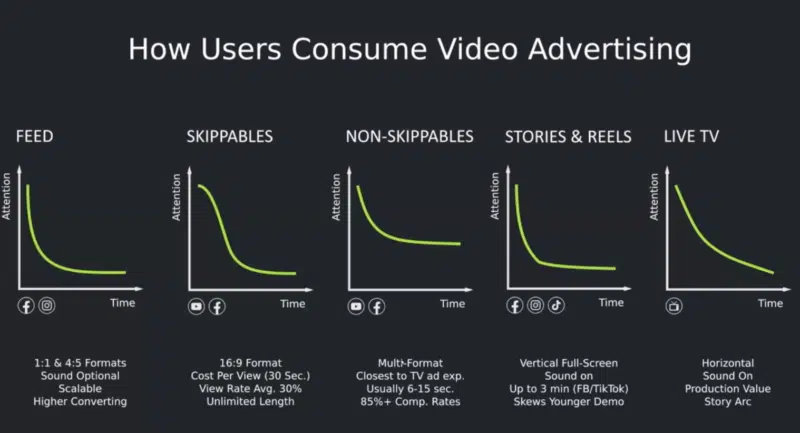
Marketers have multiple ad types to choose from and users consume these various formats in different ways. Henke discussed the advantages of feed ads, skippables, non-skippables, stories, reels and live TV. He noted that skippable and non-skippable ads are great options because of the attention they attain – but skippable is his favorite go-to because of the unlimited link feature.

  • “With unlimited link, you have a huge opportunity to engage a user over a long period of time. What we’re seeing is more users want to spend more time within their platforms as opposed to brands’ websites. That’s where we have the biggest advantage with unlimited link and being able to optimize creative for view rate,” Henke said.

To determine whether this is the right option for your campaign, Henke encouraged advertisers to test the different video ad options. Henke noted that 2 minutes 24 ads have more people completing the ads than other options.

  • “This is a huge opportunity. It’s close to one minute of time with a user and your ad on average – some spend more, some spend less. But then also being able to have a competitive CPC along with a great view rate really shows that the long form is going to be the best value,” Henke added.
Screenshot 2023 06 23 At 07.31.55 800x433

Targeting and retargeting are ‘huge opportunities’

Thorough research to identify user intent will give marketers an important advantage when it comes to understanding consumers who are relevant to your product or service. Retargeting is another necessary and big opportunity for brands wanting to expand their reach.

Reflecting on his own approach to targeting and retargeting, Henke revealed his favorite targeting tool is the detailed demographic combination report, which focuses on age, gender, parental status and household income.

Looking at demographics, in combination with the creative, will help drive maximum success, he said:

  • “These variables when combined together give you a unique look at which specific audience might be converting the best and being able to segment this audience. When you can segment immediately you should see results faster. So that’s why this is so important, the targeting, the creative, the bid type and the ad type to create this high reach, low-cost environment,” Henke said.

Success with in-feeds

In-feeds are a new ad product launched by Google Ads and one of the biggest changes to the system since bumpers rolled out five years ago.

In-feed ads appear on YouTube’s personalized feed and allow users to click the ad thumbnail, while the video is simultaneously autoplaying. Some key benefits to in-feed ads as opposed to shorts include:

  • More impressions
  • Increased views
  • Higher spend
  • Longer ad length
  • Unique call to action
  • Authority of face to camera
  • Auto-play in the feed
  • Premium placement at top of feed
  • “I think the value really is that you’re getting more earned views. That’s a clear indicator that that is a quality audience that we have here,” Henke said.
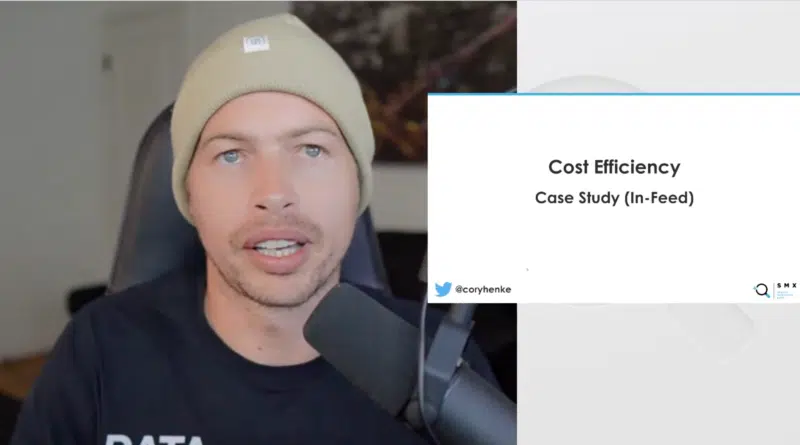
Corey Henke, founder of Variable Media

YouTube attribution tips

It’s important to be able to identify the causes of wins and losses in your campaign in order to make informed decisions and necessary adjustments.

Think about the Halo Effect. Henke offered some implementation strategies here:

  • Precision targeting: “When I talk about precision targeting, that means really looking at that detailed demographic and dialing in almost immediately because if you’re hitting your target audience, they’re going to make those Halo effect type of user behaviors, meaning they’re going to go and search,” he explained. “They’re going to go to another platform and find your brand on Instagram or LinkedIn. They’re going to make these other things that don’t necessarily involve a direct click. And that’s important. You want your quality audience to be there. Another thing is checking your placement report to make sure your ads aren’t running on kids’ channels and that they’re mostly running in the places that you want them to run.”
  • Trend analysis: This will be different for every advertiser. The big question here is what is this experience with creative competitive to a website’s first visit? And secondly, how does your video compare to somebody coming to your website for the first time? Henke added:
    • “I believe that your video should be competitive and it should possibly give a better experience because it’s in platform and it’s long form.”

Getting started

Ready to get started with Henke’s high-reach low-cost approach to YouTube Ads? Here’s what he suggested:

  • Targeting: “Dialing into those combination audiences out the gate,” he said.
  • Device: For high reach, it’s advised to exclude computers and tablets – but keep these options in if you’re trying to convert a user immediately. “Ultimately, this is a high reach low-cost strategy and we’re going to probably be paying a premium for those devices,” he said.
  • Bid type: This should be either CPV or CPM.
  • Ad length and variation: As a general rule, the longer the ad length, the better it is for your campaign. However, Henke emphasized that you should do your own research and find out what works best for your brand. “It could potentially unlock some really good cost,” he said.
  • Ad type: Keep your ad types to in-feed, skippable, non-skippable or shorts.

Related stories

New on Search Engine Land

@media screen and (min-width: 800px) { #div-gpt-ad-3191538-7 { display: flex !important; justify-content: center !important; align-items: center !important; min-width:770px; min-height:260px; } } @media screen and (min-width: 1279px) { #div-gpt-ad-3191538-7 { display: flex !important; justify-content: center !important; align-items: center !important; min-width:800px!important; min-height:440px!important; } }

About the author

Nicola Agius

Nicola Agius is Paid Media Editor of Search Engine Land after joining in 2023. She covers paid search, paid social, retail media and more. Prior to this, she was SEO Director at Jungle Creations (2020-2023), overseeing the company’s editorial strategy for multiple websites. She has over 15 years of experience in journalism and has previously worked at OK! Magazine (2010-2014), Mail Online (2014-2015), Mirror (2015-2017), Digital Spy (2017-2018) and The Sun (2018-2020). She also previously teamed up with SEO agency Blue Array to co-author Amazon bestselling book ‘Mastering In-House SEO’.

https://searchengineland.com/youtube-ads-unlocking-high-impact-minimal-cost-428567


YouTube Test & Compare helps you pick the best video thumbnail

YouTube is piloting a new feature to help marketers pick the perfect thumbnail for their videos.

The Test & Compare tool, also known as A/B thumbnail testing, will provide performance data, revealing which designs drive the highest click through rates (CTRs).

Why we care: This new feature will help advertisers better understand the behaviour of their audience, so that they can create a winning thumbnail, potentially resulting in a higher CTR and improved engagement.

How it works: Marketers will be able to upload a maximum of three thumbnails per video using the Test & Compare tool. YouTube bots will then run experiments on these images to identify which one is the strongest performer, allowing advertisers to make an informed decision when selecting which thumbnail they’d like to accompany their video.

What’s new? Currently, the pilot is only being tested on a few hundred creators, however, YouTube is planning to launch a beta version in the coming months to expand the scheme to thousands more. Next year, the video platform is planning to the feature more broadly available next year.

Why now? According to YouTube, the Test & Compare tool has been one of its most top requested features and so it is responding to consumer demand.


Get the daily newsletter search marketers rely on.


What has YouTube said? “The team is working to make the tool available more broadly starting next year, but we wanted to share that testing is officially underway because we know that this is a top requested feature and it will help you make more data driven decisions about your thumbnail strategy,” a YouTube spokesperson said. “We know that you have been anxiously waiting this capability so thank you to our community for your patience and feedback along the way.”

What’s next? According to YouTube, there will be more announcements as testing gets underway later this year with regards to a more general roll out in 2023. A spokesperson added: “If you’d like to help us test features like this in the future, you can sign up to be considered on our Creator Research page.”

Deeper dive: For more information from the YouTube Creator technical team and the wider Creator community, check out Creator Insider’s YouTube channel.


Related stories

New on Search Engine Land

@media screen and (min-width: 800px) { #div-gpt-ad-3191538-7 { display: flex !important; justify-content: center !important; align-items: center !important; min-width:770px; min-height:260px; } } @media screen and (min-width: 1279px) { #div-gpt-ad-3191538-7 { display: flex !important; justify-content: center !important; align-items: center !important; min-width:800px!important; min-height:440px!important; } }

About the author

Nicola Agius

Nicola Agius is Paid Media Editor of Search Engine Land after joining in 2023. She covers paid search, paid social, retail media and more. Prior to this, she was SEO Director at Jungle Creations (2020-2023), overseeing the company’s editorial strategy for multiple websites. She has over 15 years of experience in journalism and has previously worked at OK! Magazine (2010-2014), Mail Online (2014-2015), Mirror (2015-2017), Digital Spy (2017-2018) and The Sun (2018-2020). She also previously teamed up with SEO agency Blue Array to co-author Amazon bestselling book ‘Mastering In-House SEO’.

https://searchengineland.com/youtube-test-compare-video-thumbnail-tool-428672


A PPC marketer’s guide to retail media

Most people know that Amazon, Walmart and Instacart have paid search placements on their websites. However, you may not know about their involvement in programmatic, display, social media and Google Shopping.

It is crucial for PPC marketers to understand this because retail media (a.k.a. commerce media) is driving customers to retail sites that can transact multiple brands and items in a single transaction.

This is especially true at retailers that hold everyday essential items, providing a path to regular visits, both online and offline.

Elizabeth Marsten, VP of commerce strategic services at marketing firm Tinuiti, shared her insights on the 2023 retail media landscape and all the need-to-know essentials in her session at SMX Advanced.

Retail media is basically a type of paid search. Every business has some sort of paid search offering in which they are able to harvest existing demand.

However, retail media differs from paid search in the sense that it is split into two categories, onsite and offsite:

  • Onsite
    • Sponsored search (product ads)
    • Display banners
    • Browse, category pages
    • Coupons
    • Offers
  • Offsite
    • Programmatic display (ideally through a curated network)
    • Social media
    • Email / newsletters
    • SMS / push notifications
    • Google Shopping PLAs
    • OTT

How does retail marketing work?

Retail marketing is rooted in first-party data that’s been collected by companies for the last three decades. This data has been enabling marketers to better understand customers, how they behave and molded the shape of what we know to be retail marketing.

  • “Just think about how much, for example, Kroger knows about you if you are someone who buys groceries on a pretty regular basis from a Kroger. Maybe you started your loyalty card program with your phone number, which you still enter every time you check out. Whether or not that’s through an app or a self-checkout stand,” Marsten said.
  • “At the checkout stand itself, you have been entering that phone number for probably a good 20 years maybe. So even when you were getting cash back in those early 2000s and you bought a pack of gum or a Twix, you entered that phone number just in case. Well, technically, that data is what has led us to much better-targeted advertising for things you might actually want.”

Get the daily newsletter search marketers rely on.


What do paid search marketers need to know?

Marketers have been collecting data on consumers for 30 years and during that time, the industry has seen three big digital waves.

  • The first big wave came in approximately 2002 when Google Ads started rolling out, along with similar products from companies like Microsoft and Yahoo. It took tech giants 14 years to reach $30 billion in advertising revenue.
  • The second big wave started gaining traction in 2008 with the rise of social media. Brands like Meta, Twitter and Reddit took 11 years to achieve $30 billion in advertising revenue.
  • The third wave began in 2016 with the arrival of retail media. This sector took just five years to hit the $30 billion goal.
Screenshot 2023 06 23 At 14.07.59 800x444

Explaining why retail media has evolved so quickly, Marsten said:

  • “If you worked for Google or Microsoft in the last 10 years or so, you probably have noticed that there aren’t a lot of big changes – for example, some of you may remember when Google renamed the Content Network to the Display Network. Those are pretty monumental changes that happen over time relative to digital advertising.
  • “Now, when it comes to retail media, we are experiencing one of these every six months or so. So that is how fast things are coming up and changing and pivoting as we go on.”

Why in-store still matters

In store is still hugely important to retail media because this sector operates differently to D2C websites.

  • “I care about in-store sales, I care about sales at the shelf and I care about sales at the self-checkout because I care about those digital touch points. “They tell us how we’re going to engage with the customer over and over again,” Marsten said

Marsten went on to talk about Walmart, which made $3 billion in advertising revenue last year. The company has huge retail media expansion plans in the future, and one significant advantage it has over competitors like Amazon its stores.

  • “That’s 4,700 plus touch points in the United States alone. Think about how often folks go to get the essentials – I will be there every time outside and inside with my digital capabilities,” she said.

Retail marketers have the option of purchasing Google Shopping ads via Target Roundel, which appear in Google SERPs. Customers who click through will be taken to the target.com experience – but this is funded by you.

So you can essentially work with Target Roundel to boost in-store sales via Google searches in order to fill out your marketing budget. It’s a popular choice with many major retailers such as Best Buy and Home Depot, but there are details to consider:

  • The product you’re selling must be in store.
  • Run through Roundel so limited reporting mid-flight (monthly only).
  • In store sales included.
  • Could be complementary or competitive.
  • “It does take a minute in terms of reporting. But you do get in store sales. If someone searches local inventory, then they go in the store and they buy it because they see online that it’s in stock, they just go in the store and buy it. And you will get credit for that. It is pretty cool. It is something that I would say keep an eye on in terms of capabilities and what it could be. I’m pretty excited about what their roadmap looks like for next year.”

Retail media has multiple connections to Microsoft, including:

  • Hardware: In-store screens and Xbox
  • Activation: Promote IQ, Microsoft Ads, Xander and Netflix
  • Automation / Research: ChatGBT
  • Insights: PowerBI
  • Data: Azure / Project Oakes
  • CDP: Dynamics 365 Customer Insights

Not to be outdone by Microsoft, retail media also works closely with Google in the following ways:

  • Hardware: Pixel and Nest.
  • Activation: DV360, YouTube, Google Ads and SA360.
  • Automation / Research: Bard and Trends.
  • Insights: Google Analytics and Looker.
  • Data: Google Cloud and Pair.
  • CDP: Customer Data Platforms and Google Cloud.

Commenting on retail media’s relationship with Google, Masrten added:

  • “Similar to Microsoft, if you were a retailer and perhaps you had a Google stack, working with a whole bunch of different capabilities at Google, you can make it really easy for a brand to come in and activate across multiple channels or multiple platforms. But also, hopefully, eventually, we’ll get to a spot where insights can come forward in a way that is digestible and actionable. I would say we’re still working on that. This is a big wave and we’re still going!”

Key takeaways

Marsten concluded her talk by outlining the four key points she would like marketers to keep in mind when it comes to retail media:

  • Lots of similar options: There are a lot of similarities in terms of who’s working with who.
  • A bit jumbled: We’re still building out and there are similarities with Google and Microsoft regarding how they built out their capabilities.
  • Stores. Stores. Stores: A lot of opportunity left to tie together. Think about how much money transacts through a store and potential capabilities from an in-store experience perspective.
  • Watch the intersection of PPC (Google and Microsoft) and retail media for overlap: You better believe that they’re not going to be left out when it comes to retail media.

Related stories

New on Search Engine Land

@media screen and (min-width: 800px) { #div-gpt-ad-3191538-7 { display: flex !important; justify-content: center !important; align-items: center !important; min-width:770px; min-height:260px; } } @media screen and (min-width: 1279px) { #div-gpt-ad-3191538-7 { display: flex !important; justify-content: center !important; align-items: center !important; min-width:800px!important; min-height:440px!important; } }

About the author

Nicola Agius

Nicola Agius is Paid Media Editor of Search Engine Land after joining in 2023. She covers paid search, paid social, retail media and more. Prior to this, she was SEO Director at Jungle Creations (2020-2023), overseeing the company’s editorial strategy for multiple websites. She has over 15 years of experience in journalism and has previously worked at OK! Magazine (2010-2014), Mail Online (2014-2015), Mirror (2015-2017), Digital Spy (2017-2018) and The Sun (2018-2020). She also previously teamed up with SEO agency Blue Array to co-author Amazon bestselling book ‘Mastering In-House SEO’.

https://searchengineland.com/ppc-marketers-guide-retail-media-428579


ChatGPT for Google Ads: How to enhance campaign creation

Using ChatGPT can transform how PPC marketers design their Google Ads campaigns through enhanced strategy development, time and cost savings, customized ad creation, and improved efficiency.

This article will explore how you can harness ChatGPT to create better Google Ads campaigns. 

Target audience insights

Understanding your target audience is paramount to running successful Google Ads campaigns.

ChatGPT can provide valuable insights into your target audience, helping you refine your campaign targeting and reach the right people at the right time. 

Here are some ways ChatGPT can assist you:

Demographics and interests

Sample prompts:

  • “What are the characteristics of my ideal target audience?”
  • “Which demographics and interests should I focus on for better engagement?” 

ChatGPT will analyze data and provide valuable insights about your target audience.

You can then use this information to refine your targeting criteria and create more effective campaigns that resonate with your audience.

Audience segmentation

Sample prompts:

  • “How can I segment my audience for better targeting?”
  • “Which audience segments are most likely to convert?” 

ChatGPT can suggest how to segment your audience based on factors such as demographics, interests, or buying behavior.

This segmentation enables you to create personalized campaigns that speak directly to the needs and preferences of each segment.

Competitor research

Sample prompts:

  • “What are my competitors’ target audience demographics?”
  • “How can I differentiate my ad campaigns from my competitors?” 

Understanding your competitors’ strategies and audience targeting is crucial for gaining a competitive edge. 

ChatGPT can give you valuable insights into your competitors’ target audience, allowing you to identify gaps and opportunities in the market.

These insights can inform your campaign strategy and help you create unique and compelling ads that set you apart.

ChatGPT - Target audience insights

By leveraging ChatGPT’s ability to provide target audience insights, you can better understand your ideal customers, the competitive landscape, and the opportunities to differentiate your campaigns.

This empowers you to refine your campaign targeting, distinguish your ads, and create personalized campaigns that resonate with your audience, increasing the chances of driving engagement and conversions.

Keyword research and ad group creation

Choosing the right keywords and organizing them into well-structured ad groups is crucial for campaign success.

ChatGPT can assist you in generating relevant keywords and structuring your ad groups effectively. Here’s how ChatGPT can help:

Top keywords for your industry

Sample prompts:

  • “What are the top keywords for my industry?”
  • “Which keywords have the highest search volume and relevance?”

ChatGPT will analyze industry data and provide you with keyword suggestions that can drive valuable traffic to your website.

Keyword grouping and organization

Sample prompts:

  • “How should I group my keywords for better organization?”
  • “What is the most effective way to structure my ad groups?” 

ChatGPT can offer suggestions on grouping keywords based on themes, relevance, or search intent, helping to ensure your ads are highly targeted and relevant to the keywords you’re bidding on.

Negative keyword identification

Sample prompts:

  • “Which keywords should I exclude to prevent my ads from showing for irrelevant searches?”
  • “How can I identify negative keywords that can help improve the quality and relevance of my ads?” 

ChatGPT can suggest negative keywords based on your industry, target audience, and campaign goals.

By incorporating negative keywords, you can prevent your ads from showing for irrelevant searches, improve ad targeting, and increase the quality and relevancy of your campaigns.

ChatGPT - Keyword research and ad group creation

ChatGPT’s ability to analyze data and generate suggestions can help you optimize your keyword selection, refine your audience targeting, and create well-structured ad groups.

These enhancements will ultimately lead to improved campaign performance, higher click-through rates (CTR), and lower costs per acquisition (CPA). 


Get the daily newsletter search marketers rely on.


Ad copy generation

Compelling ad copy is essential for capturing the attention of your target audience and driving conversions.

ChatGPT can assist you in generating ad copy, headlines, and descriptions that target specific audiences. Here’s how ChatGPT can help with ad copy generation:

Responsive search ads (RSAs) 

Sample prompts:

  • “Generate variations for my RSA headlines based on my target keywords”
  • “Create descriptions that highlight the unique features of my product or service.” 

Responsive search ads allow you to write up to 15 headlines and 4 descriptions. Google will then optimize each ad by showing the headlines and descriptions likely to perform the best. 

ChatGPT will generate headline options and descriptions, saving you time and effort crafting compelling ad copy. However, ChatGPT may not always accurately count the character limits, so it’s important to review and ensure that the generated headlines and descriptions comply with Google’s requirements.

Dig deeper: A Google Ads script that uses GPT to write RSAs

Audience-specific messaging 

Sample prompts:

  • “Create ad copy for a luxury travel audience.”
  • “Generate headlines that appeal to a tech-savvy demographic.” 

ChatGPT leverages its understanding of your target audience to generate ad content that resonates with them. Tailoring your ad copy to specific audiences can help create more personalized and engaging ads that increase the likelihood of conversions.

Language optimization

Sample prompts:

  • “What language should I use to create a sense of urgency in my ads?”
  • “How can I make my ad copy more persuasive?”

ChatGPT suggests wording, phrases, and calls to action that align with your audience’s language and preferences.

Incorporating ChatGPT’s language optimization suggestions can improve the effectiveness of your ad content and strengthen your brand’s connection with potential customers.

ChatGPT - Ad copy generation

Using ChatGPT for ad copy generation can help you create compelling and tailored ads that resonate with your target audience and increase the chances of capturing their attention and driving conversions.

ChatGPT for Google Ads success

Using ChatGPT for Google Ads campaigns can streamline your workflow, save time, and improve advertising effectiveness. It empowers marketers to create compelling campaigns that resonate with their target audience.

While ChatGPT is a powerful AI model, it may not always give the perfect answer immediately. You might need to refine your questions and provide clarifications for more accurate suggestions.

Iteration and fine-tuning are crucial for optimizing ChatGPT’s results. Experimenting with different prompts and adding context can also enhance the quality and relevance of the insights it provides.

It’s important to exercise critical thinking when reviewing ChatGPT’s outputs. Always evaluate and validate the suggestions to align them with your goals and brand identity.


Opinions expressed in this article are those of the guest author and not necessarily Search Engine Land. Staff authors are listed here.


Related stories

New on Search Engine Land

@media screen and (min-width: 800px) { #div-gpt-ad-3191538-7 { display: flex !important; justify-content: center !important; align-items: center !important; min-width:770px; min-height:260px; } } @media screen and (min-width: 1279px) { #div-gpt-ad-3191538-7 { display: flex !important; justify-content: center !important; align-items: center !important; min-width:800px!important; min-height:440px!important; } }

About the author

Léo Pinon

Léo Pinon is an International Marketing Specialist at Go Fish Digital. Léo specializes in pay-per-click and social media advertising for local and global businesses. With a passion for driving results, his expertise ranges from developing lead generation strategies for B2B companies to maximizing online sales for e-commerce stores. You can connect with Léo on Twitter and LinkedIn for industry insights and updates.

https://searchengineland.com/chatgpt-google-ads-campaign-creation-428533


Google updates when 4 attribution models will be retired

Google will start to retire four rules-based attribution models in Ads and Analytics from mid-July:

  • First-click.
  • Linear.
  • Time decay.
  • Position-based.

Marketers still using these attribution models will be able to continue doing so until September, when they will be removed completely.

Why we care: This update will affect the Google Ads accounts of all marketers still using these attribution models. Moving forward, any model that isn’t last-click will prove more difficult to monitor as every marketer has different data-driven attribution formulas.

  • “In the past, you could use linear and give each touch the same credit. You will no longer be able to do so. There will be no impact on last touch, as that is still available. But finding some of the first-touch information will be much muddier because there will no longer be a way to see the formulas that compute the attribution scores.”

How will marketers be impacted? If your account has conversions using these models, you can continue to use them until September, but after that deadline, the models will be removed and data may be lost. If you are working on conversions not using these models, you will not have the option to switch over after mid-July. In addition, newly created conversions will no longer have the option of even choosing these four models.

Why now? Google has taken the decision to retire the four attribution models because of “increasingly low adoption rates, with fewer than 3% of conversions in Google Ads using these models” according to a Google spokesperson.

  • “For these reasons, first click, linear, time decay, and position-based attribution models across Google Ads and Google Analytics 4 will be going away. Data-driven attribution, last click, and external attribution won’t be impacted.”

Dig deeper: Data-driven attribution: How to think about Google’s default attribution model


Related stories

New on Search Engine Land

@media screen and (min-width: 800px) { #div-gpt-ad-3191538-7 { display: flex !important; justify-content: center !important; align-items: center !important; min-width:770px; min-height:260px; } } @media screen and (min-width: 1279px) { #div-gpt-ad-3191538-7 { display: flex !important; justify-content: center !important; align-items: center !important; min-width:800px!important; min-height:440px!important; } }

About the author

Nicola Agius

Nicola Agius is Paid Media Editor of Search Engine Land after joining in 2023. She covers paid search, paid social, retail media and more. Prior to this, she was SEO Director at Jungle Creations (2020-2023), overseeing the company’s editorial strategy for multiple websites. She has over 15 years of experience in journalism and has previously worked at OK! Magazine (2010-2014), Mail Online (2014-2015), Mirror (2015-2017), Digital Spy (2017-2018) and The Sun (2018-2020). She also previously teamed up with SEO agency Blue Array to co-author Amazon bestselling book ‘Mastering In-House SEO’.

https://searchengineland.com/google-when-retire-attribution-models-ads-analytics-428541


GA4 gives marketers choice in Google Ads conversion credit eligibility

Google is rolling out changes that will give advertisers better insights into conversion performance.

For the first time, marketers working with GA4 will be able to choose which of their channels should be eligible to get conversion credit for web conversions shared with Google Ads. This applies to Google paid channels (formerly, Ads-preferred) and Paid and organic channels (formerly, Cross-channel).

Why we care. This new capability will tell you which channels contribute to a conversion, helping you better understand and measure the impact of your campaigns. This data will prove incredibly useful to advertisers as they’ll be able to create new strategies to increase conversions and revenue with more confidence and certainty.

How it works. Advertisers can view which of their channels are eligible for credit for each conversion in Google Ads, under the Conversions summary, Conversions detail, and Campaigns tabs. In Google Analytics, this information can be found in the Attribution settings page.

Which channels are eligible. There are two channels to be considered in this insatnce:

  • Google paid channels: Only Google Ads paid channels are eligible to receive conversion credit.
  • Paid and organic channels: Paid and organic channels are eligible to receive conversion credit, but only credit assigned to Google Ads channels will appear in your Google Ads accounts.

Advertisers should note the default channel is Google paid channels, however, marketers do have the option to choose PPC and organic channels instead.


Get the daily newsletter search marketers rely on.


How to change the setting. In Google Analytics, this set-up can be edited at any time by going to the Admin > Attribution settings page. Once you have updated your preferences, changes will take effect on conversions moving forward.

What Google has said. The search engine explained in a statement:

  • “You can now select which channels are eligible for conversion credit for web conversions shared with Google Ads: Google paid channels (formerly, Ads-preferred) or Paid and organic channels (formerly, Cross-channel).”

Deep dive: Click here for more information about what channels are eligible to receive credit for conversions and how to import conversion into Google Ads.


Related stories

New on Search Engine Land

@media screen and (min-width: 800px) { #div-gpt-ad-3191538-7 { display: flex !important; justify-content: center !important; align-items: center !important; min-width:770px; min-height:260px; } } @media screen and (min-width: 1279px) { #div-gpt-ad-3191538-7 { display: flex !important; justify-content: center !important; align-items: center !important; min-width:800px!important; min-height:440px!important; } }

About the author

Nicola Agius

Nicola Agius is Paid Media Editor of Search Engine Land after joining in 2023. She covers paid search, paid social, retail media and more. Prior to this, she was SEO Director at Jungle Creations (2020-2023), overseeing the company’s editorial strategy for multiple websites. She has over 15 years of experience in journalism and has previously worked at OK! Magazine (2010-2014), Mail Online (2014-2015), Mirror (2015-2017), Digital Spy (2017-2018) and The Sun (2018-2020). She also previously teamed up with SEO agency Blue Array to co-author Amazon bestselling book ‘Mastering In-House SEO’.

https://searchengineland.com/ga4-ads-conversion-credit-eligibility-428531


Microsoft rolls out predictive targeting to all advertisers

The Microsoft Audience Network has moved predictive targeting to general availability.

Following a successful pilot, all advertisers will now be able to use the feature in their campaigns.

Why we care: Predictive targeting can help advertisers easily find new audiences that they may not have previously considered targeting. Not only are the identified audience relevant, but they are viewed by bots are more likely to convert, which could result in a higher ROI for marketers.

Successful trial. Microsoft has been trialing this tool for 10 months and has reported that advertisers on average have seen a 46% increase in conversion rates.

How it works. Microsoft bots examine ads along with the landing pages associated with them, before using its audience intelligence signals to match that content with relevant audiences. The bots have been designed to help marketers deliver the right message at the right time to drive better performance.

How to set it up. In order to integrate predictive targeting into your marketing campaign, you need to toggle on an ad group setting in the audience campaigns. You can do this in two different ways:

  • Option A: When setting up an audience campaign, predictive targeting will now be the default targeting option. If you want to use predictive targeting, simply leave the settings as they are.
  • Option B: If you want to expand your reach beyond targeted audiences for your campaign, you can choose to apply a marketing list or an in-market audience. To do this, simply toggle on predictive targeting and the Microsoft bot will serve to your targeted audience while simultaneously using predictive targeting to find users outside of that audience who are still relevant.

Is it the same as optimized targeting? It is similar in the sense that this tool can help marketers reach their ideal audience with little to no input. However, this tool was designed specifically to assist marketers using the Microsoft Audience Network using a combination of existing advertiser assets and Microsoft Audience Intelligence.

Microsoft shares best practices. The tech giant has identified best practices to help marketers achieve the best results:

  • Microsoft bases its decisions and algorithms on ad content and landing page.
    • Use clear and descriptive ad copy.
    • Make sure your landing page provides a good user experience.
  • Use predictive targeting in combination with automated bidding across all campaigns.
    • “In terms of automated bidding strategies, we have a pilot target for CPA and maximum target conversion which are launching in the summertime. So the recommendation for now is to use it with enhanced CPC,” according to Microsoft.
  • Apply predictive targeting to all of your campaigns to see how it performs.
    • “You’ll also have a reporting line item in the campaigns grid and the audiences tab – that will show you exactly what predictive targeting is delivering for your campaigns.
    • “Don’t just set audience targeting and forget about it. Report, review and adjust as necessary, keeping an eye on budgets and making sure you’re staying competitive,” Microsoft said.

Deeper dive: For more information on Microsoft’s predictive targeting feature, read its complete guide here.


Related stories

New on Search Engine Land

@media screen and (min-width: 800px) { #div-gpt-ad-3191538-7 { display: flex !important; justify-content: center !important; align-items: center !important; min-width:770px; min-height:260px; } } @media screen and (min-width: 1279px) { #div-gpt-ad-3191538-7 { display: flex !important; justify-content: center !important; align-items: center !important; min-width:800px!important; min-height:440px!important; } }

About the author

Nicola Agius

Nicola Agius is Paid Media Editor of Search Engine Land after joining in 2023. She covers paid search, paid social, retail media and more. Prior to this, she was SEO Director at Jungle Creations (2020-2023), overseeing the company’s editorial strategy for multiple websites. She has over 15 years of experience in journalism and has previously worked at OK! Magazine (2010-2014), Mail Online (2014-2015), Mirror (2015-2017), Digital Spy (2017-2018) and The Sun (2018-2020). She also previously teamed up with SEO agency Blue Array to co-author Amazon bestselling book ‘Mastering In-House SEO’.

https://searchengineland.com/microsoft-predictive-targeting-all-advertisers-428467