Google Ads is changing how it processes trademark complaints

Google will only consider trademark complaints against specific advertisers and ads starting July 24. That’s the date when Google Ads will roll out global changes to its Trademark Policy.

Google is notifying advertisers about these trademark policy changes today.

Why we care. Google said this will policy update should make resolutions faster and easier and reduce industry-wide restrictions, which can be frustrating for advertisers.  

Why the change. Under the current Google Ads Trademarks policy, all ads in an entire industry can be restricted from using trademarked material when complaints are filed. This has resulted in over-flagging and industry-wide blocks, causing major problems for advertisers.

Google hopes its new policy will reduce these issues and give advertisers more clarity and transparency. The updated policy should also help Google respond to advertisers’ trademark complaints more quickly.

What Google is saying. A Google spokesperson told Search Engine Land: 

  • “To address feedback from advertisers, we are updating ourTrademark Policy to focus solely on complaints against specific advertisers in order to simplify and speed up resolution times, as opposed to industry-wide blocks that were prone to over-flagging.”
  • “We believe this update best protects our partners with legitimate complaints while still giving consumers the ability to discover information about new products or services.”

Timeline. Trademark restrictions implemented before July 24 under its current policy will continue to apply. Google will gradually phase out these limitations for most advertisers over the next 12-18 months.

The policy. You can see the Google Ads Trademarks policy here.


Related stories

New on Search Engine Land

@media screen and (min-width: 800px) { #div-gpt-ad-3191538-7 { display: flex !important; justify-content: center !important; align-items: center !important; min-width:770px; min-height:260px; } } @media screen and (min-width: 1279px) { #div-gpt-ad-3191538-7 { display: flex !important; justify-content: center !important; align-items: center !important; min-width:800px!important; min-height:440px!important; } }

About the author

Nicola Agius

Nicola Agius is Paid Media Editor of Search Engine Land after joining in 2023. She covers paid search, paid social, retail media and more. Prior to this, she was SEO Director at Jungle Creations (2020-2023), overseeing the company’s editorial strategy for multiple websites. She has over 15 years of experience in journalism and has previously worked at OK! Magazine (2010-2014), Mail Online (2014-2015), Mirror (2015-2017), Digital Spy (2017-2018) and The Sun (2018-2020). She also previously teamed up with SEO agency Blue Array to co-author Amazon bestselling book ‘Mastering In-House SEO’.

https://searchengineland.com/google-ads-trademark-policy-change-advertisers-ads-428001


Top 10 insights for SEO and PPC success in China

Over the last 20 years, I have implemented campaigns with hundreds of global businesses and learned about Baidu and other Chinese platforms. 

Here are key insights to help set your search campaigns for success in this market.

1. Understand the Chinese market and audience

Gaining insight into the Chinese market and its audience should be your goal to succeed in China.

Remember that this country has a distinct customer base with its own language, culture, customs and habits which need careful consideration for effective campaigns that will strike home with them.

Getting off on the right foot means you’ll need to research what’s happening locally thoroughly. Discern between different kinds of buyers, from tech-savvy people active on social platforms such as WeChat, Taobao or Weibo to those who aren’t. 

The country and its population are massive, and the behavior and dialects can change from one region to the next, to one city to the next. 

Shanghai vs. Beijing, for example, is about as different as London is vs. San Francisco. Take note of seasonal trends and special occasions like Chinese New Year and Singles Day.

Knowing when these happen can really give you an edge over competitors so your efforts are at maximum potential during key parts throughout the year.

Finally, cultural awareness must also apply when making up marketing materials. Navigating sensitive subjects like politics, religion, etc., remains a central factor here lest any negative reception could arise.

Keeping an appropriate tone free from contentious topics helps ensure we get our message heard. The Chinese mostly have a very “collective” behavior. That means they often work together, socialize more to help and learn from their broader community.

2. Know the importance of Baidu and the other platforms in China’s digital landscape

Gaining success in the Chinese market requires recognizing the significance of Baidu.

The search engine remains the most popular in China and is many steps ahead compared to its rivals such as 360 Search or Sogou. 

Baidu has about a 75% share of desktop search engines’ market. Similar to Google’s guidelines, researching Baidu’s own algorithm guidelines, such as:

  • Avoiding keyword stuffing.
  • Forming captivating titles and descriptions along with internal links.
  • Applying tags and meta-data features correctly so bots can effortlessly crawl pages.
  • Optimizing images for faster load speed on mobile devices.

Additionally, those living in this country opt more for social media websites and apps like WeChat, Weibo, Xiaohongshu, Zhihu and Douyin (TikTok).

Thus, you will want to ensure these channels are integrated seamlessly while planning your SEO and PPC initiatives.

3. Compliance and licensing are critical

Compliance

China has stringent policies regarding what they may consider unhealthy to their culture and laws. This includes nothing politically sensitive (i.e., gambling and pornography) and the types of advertisers, what they sell, and how they sell it. 

You may not think it’s fair, but voicing or appealing your own idea of fairness based on Western culture will get you nowhere in China, at worst, banned forever.  

You might not try to get into the Chinese search space if you are not compliant.

ICP licensing

Your advertising agency or partner should be able to apply for you to get hosting in China. Depending on meeting all of the requirements, the license should take anywhere from two weeks to three months. 

There are two different types of licenses: 

  • ICP filing: For non-commercial websites.
  • ICP commercial license: For commercial websites. 

Without hosting your site in China, you lose credibility with your users and risk devaluation with search. This devaluation comes from slower levels of access (stuck behind the Chinese Firewall) and not being local. 

If the advertiser doesn’t have a registered office in China, they can’t get a .cn domain. And without a .cn domain, they are not qualified to get an ICP.

However, there are ways around this, for example, getting a sub-ICP license from a CDN provider. The rules here change a lot. Your Chinese partner should help navigate your case, especially if it’s unique.

Additional regulations, such as the 2017 Cybersecurity Law and the Personal Information Protection Law, are similar to GDPR and require all sites to protect user data and obtain user consent before collecting and using any personal data.

Some ecommerce laws cover aspects such as ecommerce platform responsibilities, contracts, dispute resolution, and more. Baidu’s policies will mirror the government policies, so remember that it is not as easy as it is to get on Google as it is with Baidu—the same with other platforms in China.

4. Analytics and your data 

Set up Baidu Analytics. If you depend on Google Analytics and other Western analytic software, you may risk inaccuracy as the signals fired may never be recorded. 

Baidu Analytics will allow you to evaluate discrepancies between analytic tech stacks. However, they may not have the deeper level’s of attribution and data that Google and others may have.

5. Design toward the market 

When designing your website and display ads, remember that the images used should also follow cultural appropriateness standards.

Ensure they do not contain offensive symbols from different countries and that they are mirroring established customs (where possible). This gives an added level of confidence and trust by showing Chinese cultural understanding and respect.


Get the daily newsletter search marketers rely on.


6. Payment gateways are different here 

Payment gateways must also be carefully considered when building sites here. 

Even though PayPal works fine overseas due to its global acceptance, inside the Chinese Mainland, web payment systems such as Alipay and WeChat Pay remain more popular.

Implementing them into the design will help establish trust outside of just the obvious, sales. 

7. Social in China is a must for building credibility and trust

Social in China should also be in your strategy to help both paid and organic’s credibility and elevate your brand. 

Social is crucial because Chinese users often use social media to discuss offers with others. This enables Chinese users to further their research and provides you with the trust and credibility points you need to establish yourself in the market. The two most critical social sites are WeChat and Weibo.

WeChat, developed by Tencent, is an all-in-one app widely used for various purposes. It’s aa social media app that also serves as a platform for instant messaging, voice and video calls, moments sharing (similar to Facebook’s news feed), mobile payments (WeChat Pay), shopping, ride-hailing, and much more. 

Its comprehensive features make it integral to daily life in China. WeChat is also very easy to advertise on and highly recommended as soon as you launch your search campaigns.

Weibo, often called China’s Twitter, is a microblogging platform where users can post, share, and comment on short messages or “weibos.” 

It’s popular for news dissemination, public discussions, and celebrity updates. It allows users to follow individuals, companies, and topics of interest.

8. Translating and localizing 

Be very attentive with your translation. “Simplified Chinese” is what is used.

Do not use automatic translation without a true local optimizing it appropriately. 

Colors, fonts and other nuances may limit your success in the market if it’s not designed with the Chinese user in mind. Also, do not use it unless you have someone who is Chinese who can review, adjust and correct it. 

This is the simplest thing to get right, yet many companies try to take shortcuts and fail miserably in China.

Before jumping into SEO, paid search provides some important starting points critical to learning your market. Most importantly, you will be able to identify what works and what doesn’t regarding your keyword research, conversions, issues with your website (site structure, speed, analytics), etc.

The keyword research process holds immense importance here. Before jumping onto creating campaigns, you will need to conduct comprehensive analyses to identify those words most likely leading towards conversions. 

Moreover, having a good understanding of the different types of keywords available via Baidu (brand-specific ones alongside generic terms and long-tail phrases) will ensure you maximize reachability while getting the highest defined ROI possible from your ad campaign. 

When launching Intel into the Chinese market in the early days, we identified 15 different dialect characters per keyword. This was while employing a strategy around targeting and treating every region of China and major metropolitan area as its own country. (When you add the behaviors, context, keywords and monstrous populations, you’d see why that was a smart strategy.) 

It is also not uncommon for you to find or even get to use English keywords. A form of “Chenglish” in major sophisticated metro areas such as Shanghai and Beijing, where the population has more Western influences integrated into the culture, may mix English and Chinese search terms while searching.

Another key aspect lies with creative optimization too. Unlike Google Ads or Bing Ads, where certain standards apply across all ad copies alike regardless of which region is targeted. 

Things are not really cut and dry when dealing with Chinese audiences through paid search with Baidu. Thus, extra precaution must be taken into account during crafting such display/textual titles or descriptions accurately encapsulating what each respective service offers customers-wise.

Simultaneously, making sure images used comply by set standards within given regions helps maintain high clickthrough rates (CTRs).

Let me be clear here, brand strength, trustability and CTR are more critical than conversions.

It’s not uncommon for your Chinese user to use your website as an infomercial, buying from other trusted portals after they are convinced your site is not a scam.

Budget allocations

Due consideration must be made based on factors like seasonal competition levels, industry demand trends, competitive demand trends etc., to determine your budget.

Like any platform worldwide, it does take time, money and a lot of patience to see things work.

Allocate your beginning campaigns high with the expectation that the trial period is not to make sales but rather to find what is failing to succeed. Starting with simple PPC campaigns makes sense before diving into other Baidu ad products or off Baidu.

Long-tail and sentences

Chinese users often use Baidu as step one in their research for a product or service. Especially if they are not very familiar with the brand. Therefore, do not just translate your English keywords into Chinese; expect those to work. 

Instead, pay attention to the questions asked about your product and services, making them your priority keywords and also employing the same factors as you would with Google (i.e., quality, relevance, intent, local signals, ad extensions, negatives).

Ensure the landing page content is also relevant to the question and response you are addressing.

10. Getting started on Baidu SEO

As you can see from reading the paid search tips, gaining visibility in the Chinese market is obviously not easy.

However, they are necessary for you to build the data from your keywords to know what you will be optimizing organic for.

The good news is that Baidu’s organic works in many ways, like Google. Here are some useful pointers and similarities when optimizing for the Baidu search engine:

Localizing your content

Customize your content by translating it into Mandarin. Tailoring it according to different regions of China that speak various dialects will help make sure that users who use Baidu as their main search engine get what they’re looking for quickly. 

Having dialect versions is nice to have, not a must-have. So unless it’s not Cantonese, you will be fine running in China with Mandarin. 

I know I am being repetitive here, but if there is anything you get out of this article, it’s critical that it’s written so well that a Chinese person would feel you are a Chinese company.

Structure your URLs

Structuring your URL properly can benefit crawling and indexing. 

All links should lead back to valid pages with canonical tags so there won’t be any broken ones or redirect loops, which could negatively affect rankings in SERPs. 

Internal linking is very crucial to the search engine for it to understand what your website is about and to be able to crawl and index appropriately.

Optimize page titles and meta descriptions

Similar to other SEO strategies, page titles and meta descriptions need optimization too. 

The title needs relevant keywords but we recommend not more than 50 characters, including spaces.

The meta description shouldn’t exceed 160 characters with important words related to its topic. Getting truncated within SERPs would bring down click-through rates drastically. 

Click-through rate is critical to ranking well. Baidu wants to see users clicking through to your website as it signals to them that it’s relevant and has the speed levels to give Chinese users the experience they want and expect. 

’d recommend also following Baidu’s editorial guidelines. For example, they don’t use pipes (|) as separators but recommend using a dash(-). 

Building quality backlinks from authoritative websites alongside having attention to both do-follow/no-follow links matters when executing a link building campaign here.

Furthermore, working together with local influencers or bloggers would be great since opinion leaders have a massive influence over audiences all across China.

Other important factors

Make sure your site is optimized for mobile. With the high rate of mobile internet usage in China (by the end of 2022, the mobile penetration is 99.8%), ensure your website is mobile-friendly. Baidu values quick loading speeds. Optimize your website’s load speed by reducing image sizes, using caching, and minimizing JavaScript and CSS. 

Finally, fresh and “helpful” content is crucial. Regularly update your site with fresh, original content relevant to what you provide. Baidu values content that is unique and provides value to its users. 

The key to running successful search campaigns in China

Running SEO and PPC campaigns in China is no easy task.

That said, with some knowledge on your side, you can substantially enhance your chances of success. 


Opinions expressed in this article are those of the guest author and not necessarily Search Engine Land. Staff authors are listed here.


Related stories

New on Search Engine Land

@media screen and (min-width: 800px) { #div-gpt-ad-3191538-7 { display: flex !important; justify-content: center !important; align-items: center !important; min-width:770px; min-height:260px; } } @media screen and (min-width: 1279px) { #div-gpt-ad-3191538-7 { display: flex !important; justify-content: center !important; align-items: center !important; min-width:800px!important; min-height:440px!important; } }

About the author

Michael Bonfils

Michael Bonfils specializes in providing multinational search marketing services for agencies and in-house search marketing professionals. Since 1996, Michael has helped pioneer best practices in global search engine marketing and innovations in technology advertising.

https://searchengineland.com/seo-ppc-insights-success-china-427954


Microsoft Advertising is updating its Cross-Device attribution model

Microsoft Advertising will soon roll out a new Cross-Device attribution model.

What Microsoft is saying. The news about the conversion attribution update was announced in Microsoft’s June roundup of product updates:

  • “The new Cross-Device attribution model allows us to better track and connect your customers’ conversion journeys across different devices and sessions. For example, if a user clicks on an ad using their laptop but converts on their phone, we’ll now credit that conversion to the initial ad click on the laptop.”

Why we care. Microsoft said you may see a small increase in conversions in your performance reports. So watch your reports. If you see an increase in conversions, this may be the reason why.

When. The update will roll out later this month.

No other changes. No new features or settings are coming as part of this cross-device attribution update.


Related stories

New on Search Engine Land

@media screen and (min-width: 800px) { #div-gpt-ad-3191538-7 { display: flex !important; justify-content: center !important; align-items: center !important; min-width:770px; min-height:260px; } } @media screen and (min-width: 1279px) { #div-gpt-ad-3191538-7 { display: flex !important; justify-content: center !important; align-items: center !important; min-width:800px!important; min-height:440px!important; } }

About the author

Danny Goodwin

Danny Goodwin has been Managing Editor of Search Engine Land & Search Marketing Expo – SMX since 2022. He joined Search Engine Land in 2022 as Senior Editor. In addition to reporting on the latest search marketing news, he manages Search Engine Land’s SME (Subject Matter Expert) program. He also helps program U.S. SMX events. Goodwin has been editing and writing about the latest developments and trends in search and digital marketing since 2007. He previously was Executive Editor of Search Engine Journal (from 2017 to 2022), managing editor of Momentology (from 2014-2016) and editor of Search Engine Watch (from 2007 to 2014). He has spoken at many major search conferences and virtual events, and has been sourced for his expertise by a wide range of publications and podcasts.

https://searchengineland.com/microsoft-advertising-is-updating-its-cross-device-attribution-model-427963


TikTok opens its premium content feature, Series, to more creators

Creators who meet certain eligibility requirements can now apply to join TikTok’s premium content feature, Series.

Who is now eligible. Creators must be at least 18 years old and have:

  • An account that is at least 30 days old.
  • Posted four or more public videos in the last 30 days.
  • At least 1,000 “authentic” video views in the last 30 days.
  • 10,000 or more followers.
    • If you have less than 10,000 followers but meet the other criteria, you can apply by providing a link to premium content you’ve previously sold on other platforms via TikTok’s Creator Center.

The announcement. It was added today as an update to TikTok’s original announcement of Series.

What is Series. One TikTok Series can consist of up to 80 videos, each up to 20 minutes long. TikTok creators can set their own prices, anywhere from $1 to $190. All the content in a TikTok Series is behind a paywall.

Why we care. Creators now potentially have a new revenue stream, that rewards them for creating higher-quality content that attracts more viewers.

Dig deeper in TikTok introduces a “Series” feature enabling creators to sell premium episodes.


Related stories

New on Search Engine Land

@media screen and (min-width: 800px) { #div-gpt-ad-3191538-7 { display: flex !important; justify-content: center !important; align-items: center !important; min-width:770px; min-height:260px; } } @media screen and (min-width: 1279px) { #div-gpt-ad-3191538-7 { display: flex !important; justify-content: center !important; align-items: center !important; min-width:800px!important; min-height:440px!important; } }

About the author

Danny Goodwin

Danny Goodwin has been Managing Editor of Search Engine Land & Search Marketing Expo – SMX since 2022. He joined Search Engine Land in 2022 as Senior Editor. In addition to reporting on the latest search marketing news, he manages Search Engine Land’s SME (Subject Matter Expert) program. He also helps program U.S. SMX events. Goodwin has been editing and writing about the latest developments and trends in search and digital marketing since 2007. He previously was Executive Editor of Search Engine Journal (from 2017 to 2022), managing editor of Momentology (from 2014-2016) and editor of Search Engine Watch (from 2007 to 2014). He has spoken at many major search conferences and virtual events, and has been sourced for his expertise by a wide range of publications and podcasts.

https://searchengineland.com/tiktok-opens-series-more-creators-427959


Microsoft will only show ads from verified advertisers starting Aug. 1

Microsoft Advertising will only show ads from verified advertisers, starting Aug. 1, the company announced.

Why we care. If you haven’t completed the Microsoft Ads verification requirements, you’ll need to do so before Aug. 1 to avoid any ad delivery interruptions.

Timeline. The Microsoft Ads Advertiser Identity Verification program was announced in June 2022. Key upcoming dates to know:

  • July 1: New advertisers must be verified before Microsoft will serve any ads.
  • July 15: Contact Microsoft support if your account isn’t verified and you haven’t received an email from Microsoft about account verification.
  • Aug. 1: Microsoft Advertising will only serve ads from verified advertisers.

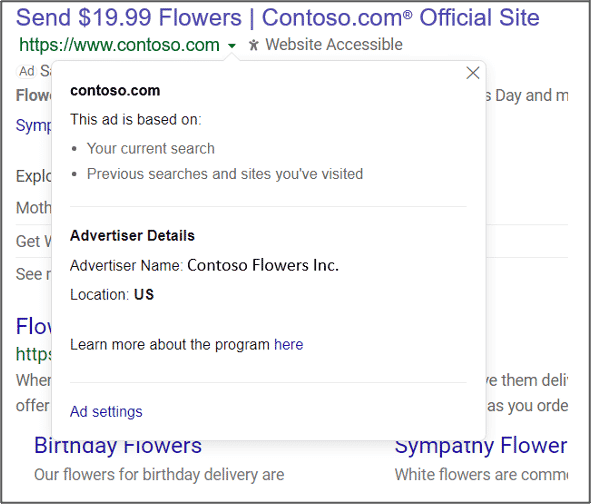
What users will see. All ads will show:

  • The advertiser’s name and location.
  • The business or individual paying for the ad.
  • Information about why they’re seeing an ad (e.g., targeting parameters).

Here’s what it looks like:

Image 6

New Ad Library. Microsoft Advertising also announced it is launching a new Ad Library:

  • “All users will be able to view ads shown on Bing which have any impressions in the European Union. Users can search for ads in the Ad Library via the advertiser’s name or words in the ad creative. The advertiser’s details will be displayed in the Ad Library.”

Identity verification help. You can read the official help documentation here.


Related stories

New on Search Engine Land

@media screen and (min-width: 800px) { #div-gpt-ad-3191538-7 { display: flex !important; justify-content: center !important; align-items: center !important; min-width:770px; min-height:260px; } } @media screen and (min-width: 1279px) { #div-gpt-ad-3191538-7 { display: flex !important; justify-content: center !important; align-items: center !important; min-width:800px!important; min-height:440px!important; } }

About the author

Danny Goodwin

Danny Goodwin has been Managing Editor of Search Engine Land & Search Marketing Expo – SMX since 2022. He joined Search Engine Land in 2022 as Senior Editor. In addition to reporting on the latest search marketing news, he manages Search Engine Land’s SME (Subject Matter Expert) program. He also helps program U.S. SMX events. Goodwin has been editing and writing about the latest developments and trends in search and digital marketing since 2007. He previously was Executive Editor of Search Engine Journal (from 2017 to 2022), managing editor of Momentology (from 2014-2016) and editor of Search Engine Watch (from 2007 to 2014). He has spoken at many major search conferences and virtual events, and has been sourced for his expertise by a wide range of publications and podcasts.

https://searchengineland.com/microsoft-advertising-show-ads-only-from-verified-advertisers-427936


Google fixes issue that took down Ads for about 2 hours

Google Ads advertisers were unable to access Google Ads for nearly two hours today, starting around 9:10 am ET. (This issue has now been fixed and our story updated, see our Postscripts.)

The issue Advertisers who were trying to log in to manage their accounts saw a 500 server status error.

That’s an error. A flurry of complaints on Twitter are collected here. Here’s a screenshot of the error advertisers saw when trying to access their accounts:

Google Ads Advertiser Console Is Down

ETA. Frustratingly, the Google Ads status dashboard showed no issues during the outage. So advertisers never got an estimated time for a fix from Google.

Why we care. If you are worried, just know, you are not alone. Everyone cannot access the Google Ads system. Try back in an hour or so and hopefully access will be restored.

Postscript. Ginny Marvin, Google’s Ad Liasion, tweeted about the issue at 10:15 am ET:

  • “We’re investigating reports of an issue with Google Ads. We will provide more information shortly. The affected users are unable to access Google Ads.”

There also appear to be issues with Google Merchant Center, according to Google, probably related to this.

Postscript 2. Update at 10:50am ET: Google seems to have fixed the issue, I am now able to log in.

Postscript 3. At 12:20 p.m. ET, The following was posted on the Google Ads Status Dashboard:

  • “This issue has now been fully mitigated as of 8AM PST June 6th 2023. At this time, we do not have additional details to provide, but our teams are working to identify impact with high priority and will provide more details when available.”

Related stories

New on Search Engine Land

@media screen and (min-width: 800px) { #div-gpt-ad-3191538-7 { display: flex !important; justify-content: center !important; align-items: center !important; min-width:770px; min-height:260px; } } @media screen and (min-width: 1279px) { #div-gpt-ad-3191538-7 { display: flex !important; justify-content: center !important; align-items: center !important; min-width:800px!important; min-height:440px!important; } }

About the author

Barry Schwartz

Barry Schwartz a Contributing Editor to Search Engine Land and a member of the programming team for SMX events. He owns RustyBrick, a NY based web consulting firm. He also runs Search Engine Roundtable, a popular search blog on very advanced SEM topics. Barry can be followed on Twitter here.

https://searchengineland.com/google-ads-system-is-down-advertisers-cannot-access-the-interface-427931


4 Google Ads Custom Columns you need to use – and why

If you’re a control-loving performance marketer like me, Google hasn’t given you many reasons to smile lately in its headlong rush toward an AI-driven world. 

But there is one that has the potential to provide incredibly helpful PPC reporting nuance and customization for marketers who know how to use it.

Yup, I’m talking about Custom Columns, my favorite Google update of 2022.

In this article, you’ll learn:

  • What Custom Columns are.
  • Why marketers should use Custom Columns.
  • The four most important use cases I’ve seen in action.

What are Custom Columns?

Custom Columns are reporting columns you can create in the Google Ads UI to provide metrics and calculations important to your specific business.

They allow you to expand reporting outside of what’s pre-built in Google Ads. They’ve existed for almost 10 years, but they got a big upgrade about a year ago that Search Engine Land contributor Greg Finn covered in good depth.

Why marketers should use Custom Columns

There are hundreds, if not thousands, of possible use cases for Custom Columns.

I’ve found Custom Columns particularly useful for businesses with more than one conversion type because you can associate a variety of metrics according to different conversions. 

With Google (along with Microsoft, Meta and everyone else) moving hard toward AI and automation, one of the few remaining controls marketers have is feeding offline conversion data into Google’s system to improve the precision of bidding, targeting, etc. Custom Columns reporting is key to this functionality.

For businesses with a single conversion type, though, Custom Columns can be used to set up quicker and more efficient trend recognition that can help give marketers a competitive edge. It can even keep Google from getting overaggressive on budgets, as we’ll show in one use case.

Use case 1: Segmenting by conversions

I most frequently use Custom Columns to analyze different conversion types – lead, MQL, SQL, opp, trial, subscriber, etc.

This custom column type can be used for any industry and any business using multiple conversion actions.

Custom columns example

The above data gives you extremely useful insights into each conversion stage.

You can also look at different views to see which search terms, keywords, and ads drive them, which lets you get very specific about places you need to optimize, cut, or increase budget.

If you’re not using this functionality, you’re making any optimization decisions based on one roll-up view. This doesn’t matter if you only have one conversion type, but it means you lose lots of precision if you have more than one. 

Let’s say, for example, that a campaign is driving high volumes of leads and MQLs but rarely driving SQLs. 

This may mean that you’re pouring money into audiences that may love what you offer and are taking the initial desired actions but can’t move past the sales qualification stage because of size or budget. 

Knowing this would help you scale back spend without any revenue impact – and would be great information to feed back to the Product team.

Use case 2: Average conversion costs for specific time periods

Another favorite use case of mine is analyzing average conversion cost for a certain time period, whether that’s yesterday, last week, the last 30 days, etc. 

I’ve used this for all conversions and by conversion type – it’s useful for all scenarios. 

Use case 2: Average conversion costs for specific time periods

Whatever your time period, fixing the range and comparing metrics to historical data is a great way to see where costs are significantly above or below average. 

This enables adjustments to budgets and bidding and helps you catch issues before they can snowball. The comparison columns align much more cleanly than Google’s general UI.


Get the daily newsletter search marketers rely on.


Use case 3: Competitive analysis

Want to look good for your client or exec team? 

Build a custom column that looks at decreases in click-through rate and increases in CPC to gauge potential market competition and activity. 

Flagging data here can help indicate when to look into Auction Insights to see what’s going on externally. 

Use case 3: Competitive analysis

This is extremely helpful for monitoring activity on brand keywords (e.g., competitor poaching), but it’s valuable information for key non-brand terms as well.

Increased costs and competition could be a great trigger for testing new ad copy and differentiators (or taking on competitors directly in ad copy). And it’s great information to relay to higher-ups who crave information on what competitors are up to.

If you’re not using this column set-up, you’re likely over-reliant on Auction Insights to catch competitor activity. Auction Insights are helpful, but they leave much to be desired in recognizing trends – a gap that Custom Columns can close for you.

Use case 4: Spend anomalies

How many of us (raises hand) have seen Google take liberties with budget caps? 

To combat this, I like to build a column to identify spend anomalies. It essentially flags instances where yesterday’s spend was more than 120% of the average spend over the last seven days. 

Use case 4: Spend anomalies

These fluctuations are important to spot and diagnose in touchy accounts, especially bigger-budget accounts. Adding this column means you won’t have to rely on your normal reporting cadence to catch them. 

Assess irregularities at the campaign, ad, and keyword levels, and make sure performance is justifying reasons for increased spend and that Google’s not just going a little rogue. 

Whether the performance is or isn’t the reason for the spend increases, calling out the alerts and subsequent findings is great EQ for your client or manager. In extreme cases, it can cause you to engage your Google rep for some make-good requests.

Using Google Ads’ full functionality

The 2022 updates added tons of agility to Custom Columns. If I had a wish list for other reporting features, it’d be short. (But since I mentioned it, I’d love to see competitive metrics like top-of-page and absolute top-of-page rates, plus a less glitchy UI that helps troubleshoot formula errors.)

At this point, it falls on marketers to learn to use the tool’s full functionality, which shortens the analysis/action loop by keeping everything directly in Google’s UI.

Custom Columns can help you surface trends and insights to answer some of your most important account-related questions. 

Even for the most straightforward ad campaigns, the different views available by date range and formula functionality represent a chance for you to go from Google Ads Data 101 to EQ and analytics powerhouse – all for the cost of a little elbow grease.


Opinions expressed in this article are those of the guest author and not necessarily Search Engine Land. Staff authors are listed here.


Related stories

New on Search Engine Land

@media screen and (min-width: 800px) { #div-gpt-ad-3191538-7 { display: flex !important; justify-content: center !important; align-items: center !important; min-width:770px; min-height:260px; } } @media screen and (min-width: 1279px) { #div-gpt-ad-3191538-7 { display: flex !important; justify-content: center !important; align-items: center !important; min-width:800px!important; min-height:440px!important; } }

About the author

Laura Schiele

Laura Schiele, Head of Paid Acquisition at Jordan Digital Marketing, has nearly a decade of experience in paid media strategy and execution in both agency and in-house accounts and uses advanced analytics skills to scale growth within efficiency goals across Google, LinkedIn, Facebook, and more. Laura manages a large team of paid media experts remotely from her home in Burlington, VT.

https://searchengineland.com/google-ads-custom-columns-use-why-427868


Google Analytics 4 audience builder gains six new dimensions and metrics

Google has added six new dimensions and metrics in the new Google Analytics 4 audience builder. These metrics should help you track your website metrics and goals in more detail using the audience builder tool.

New metrics and dimensions. The five new dimensions added to the audience builder in Google Analytics 4 include:

  • Country
  • Manual term (UTM Term)
  • Mobile device info
  • Minute
  • New vs Returning

The new metric added to the audience builder in Google Analytics 4 include:

  • Session duration

Why we care. As we get closer to the deadline when Universal Analytics 3 will stop collecting data and Google Analytics 4 will replace it, we see Google continue to bring more and more features to GA4. We are only a few weeks away from that deadline now.


Related stories

New on Search Engine Land

@media screen and (min-width: 800px) { #div-gpt-ad-3191538-7 { display: flex !important; justify-content: center !important; align-items: center !important; min-width:770px; min-height:260px; } } @media screen and (min-width: 1279px) { #div-gpt-ad-3191538-7 { display: flex !important; justify-content: center !important; align-items: center !important; min-width:800px!important; min-height:440px!important; } }

About the author

Barry Schwartz

Barry Schwartz a Contributing Editor to Search Engine Land and a member of the programming team for SMX events. He owns RustyBrick, a NY based web consulting firm. He also runs Search Engine Roundtable, a popular search blog on very advanced SEM topics. Barry can be followed on Twitter here.

https://searchengineland.com/google-analytics-4-audience-builder-gains-six-new-dimensions-and-metrics-427926


Twitter’s U.S. ad revenue drops 59%

Linda Yaccarino today became Twitter CEO – and she’s got some hard work ahead of her. That’s because Twitter’s advertising revenue has declined 59% year on year, according to an internal presentation acquired by The New York Times.

Despite Elon Musk’s recent optimism about Twitter’s advertising progress, stating that “almost all advertisers have returned” and predicting profitability for the platform, the situation remains uncertain.

Something doesn’t add up. During the five weeks from April 1 to the first week of May, Twitter’s U.S. advertising revenue was $88 million. Twitter frequently fell short of its weekly sales forecasts, sometimes by as much as 30%, The Times reported.

Why advertisers are fleeing. A surge in hate speech and explicit content, along with an increase in advertisements for online gambling and marijuana products, caused concern. 

Twitter’s U.S. ad revenue is projected to drop by at least 56% each week compared to the previous year, according to the internal document.

Twitter’s advertising sector is crucial to its success and value, accounting for 90% of its revenue.

When he acquired Twitter for $44 billion in October and privatized the company, Musk pledged to create “the most respected ad platform.” However, he soon strained relationships with advertisers by terminating key sales executives, promoting a conspiracy theory on the platform and reinstating previously banned Twitter users.

How brands reacted. Several major ad agencies and brands, including General Motors and Volkswagen, suspended their Twitter ad investments. Musk had projected that Twitter’s revenue for 2023 will reach $3 billion, a reduction from $5.1 billion in 2021 when Twitter was a publicly-traded company.

Several of Twitter’s major advertisers, such as Apple, Amazon, and Disney, have reportedly reduced their spending on the platform compared to the previous year, according to three former and current Twitter employees. They also noted that high-value banner ads on Twitter’s trends page, typically purchased by large brands for promotional purposes, are frequently remaining unsold.

Twitter has faced public relations issues with major advertisers, including Disney. In April, Twitter mistakenly gave a gold checkmark, indicating a paying advertiser, to an unaffiliated account called @DisneyJuniorUK. The account then posted offensive content, causing Disney to demand an explanation and assurances from Twitter to prevent such errors in the future.

Why we care. Despite its challenges, Twitter is still a powerful platform that reaches a vast, global audience. The platform still has a user base of millions who engage daily, offering unique opportunities for brand visibility and interaction. 

Changes are starting. Yaccarino, the NBCUniversal executive recently appointed as Twitter’s CEO by Musk, is inheriting several challenges. She has taken over as CEO today – weeks earlier than expected, BBC reported.

Damage done? The new leadership under Yaccarino could signal upcoming changes in their approach to problematic content, potentially improving the advertising environment. Twitter has also added Joe Benarroch, formerly NBCUniversal’s senior vice president of communications, advertising and partnerships.

Advertisers should watch Twitter’s changes, as it may continue to be a potential key player in digital marketing strategies.


Opinions expressed in this article are those of the guest author and not necessarily Search Engine Land. Staff authors are listed here.


Related stories

New on Search Engine Land

@media screen and (min-width: 800px) { #div-gpt-ad-3191538-7 { display: flex !important; justify-content: center !important; align-items: center !important; min-width:770px; min-height:260px; } } @media screen and (min-width: 1279px) { #div-gpt-ad-3191538-7 { display: flex !important; justify-content: center !important; align-items: center !important; min-width:800px!important; min-height:440px!important; } }
About the author

Nicole Farley

Nicole Farley is the founder of Web Sprout, an inbound marketing agency. She formerly was PPC Editor for Search Engine Land (from 2022-2023), covering paid search, paid social, Google Analytics and more. In addition to being a Marine Corps veteran, she has an extensive background in digital marketing, an MBA and a penchant for true crime, podcasts, travel, and snacks.

https://searchengineland.com/twitters-u-s-ad-revenue-drops-59-427883


Netflix tops list of YouTube’s top 10 most popular video ads

With 39 million views, Netflix’s “Wednesday” earned the top spot on YouTube’s Cannes Ads Leaderboard 2023, a roundup of the top global video ads since last year’s festival.

Leading video ads trends. Music (Telecom Egypt, Qatar Airways, Orange Egypt, Burger King), authenticity (Peacock, Netflix, HBO Max/The Last of Us), cross-generational appeal (Bulgari, Peacock) and emotion (HBO Max, Bulgari and Qatar Airways) were the hooks that elevated the most popular video ads to earn more than 214 million video views, according to YouTube.

Why we care. YouTube is the most popular U.S. streaming service on TV screens, with an estimated 150 million unique viewers. It is also a profitable platform for creators. Video ads continue to be a great way to drive views by telling stories that connect with your target audience.

YouTube’s top 10 most popular global video ads

These were the top 10 most popular video ads globally from June 2022 to May 2023, along with how many views they have as of publishing.

  • “The ad ranking is determined using some of YouTube’s strongest signals of viewer choice – including factors like organic and paid views, watch time and audience retention (i.e. how much of a video people watched),” YouTube noted.

10. Burger King: Whopper Whopper (Extended)

9.3 million views

[embedded content]

9. Peacock: Kevin Hart can’t stop attacking ‘old’ celebrities #shorts

9.1 million views

[embedded content]

8. Bulgari: Unexpected Wonders – a movie by Paolo Sorrentino

9.3 million views

[embedded content]

7. Orange Egypt: World Cup 2022 campaign – Crazy about Football

19 million views.

[embedded content]

6. Galaxy S23 Ultra: Official Introduction Film

23 million views

[embedded content]

5. Qatar Airways: C.H.A.M.P.I.O.N.S – official FIFA World Cup song featuring DJ Rodge and Cheb Khaled

23 million views

[embedded content]

4. Max: The Last of Us

24 million views

[embedded content]

3. Apple: Introducing iPhone 14 Pro

26 million views

[embedded content]

2. Telecom Egypt: WE Summer Campaign 2022 – Akram Hosny

33 million views

[embedded content]

1. Netflix: Wednesday Releases Thing In New York

39 million views

[embedded content]

Dig deeper. YouTube year in review: The top 10 ads of 2022


Related stories

New on Search Engine Land

@media screen and (min-width: 800px) { #div-gpt-ad-3191538-7 { display: flex !important; justify-content: center !important; align-items: center !important; min-width:770px; min-height:260px; } } @media screen and (min-width: 1279px) { #div-gpt-ad-3191538-7 { display: flex !important; justify-content: center !important; align-items: center !important; min-width:800px!important; min-height:440px!important; } }

About the author

Danny Goodwin

Danny Goodwin has been Managing Editor of Search Engine Land & Search Marketing Expo – SMX since 2022. He joined Search Engine Land in 2022 as Senior Editor. In addition to reporting on the latest search marketing news, he manages Search Engine Land’s SME (Subject Matter Expert) program. He also helps program U.S. SMX events. Goodwin has been editing and writing about the latest developments and trends in search and digital marketing since 2007. He previously was Executive Editor of Search Engine Journal (from 2017 to 2022), managing editor of Momentology (from 2014-2016) and editor of Search Engine Watch (from 2007 to 2014). He has spoken at many major search conferences and virtual events, and has been sourced for his expertise by a wide range of publications and podcasts.

https://searchengineland.com/youtube-ads-leaderboard-0622-0523-427874