7 new Google Ads features include Brand restrictions in broad match, AI in Smart Bidding

A handful of tactical search features were announced in conjunction with the other AI-driven announcements from Google Marketing Live. Yes, there is more AI coming to elements within search campaigns, but advertisers should look fondly at additional elements like better brand controls for broad match and better asset insights.

Brand restrictions for broad match. Google has been quickly improving broad match over the past few years and a new brand restriction feature should help advertisers feel more comfortable with the match type.

Similar to the announcement with Performance Max last year, this feature will help to leverage broad match with the brand traffic specified by the advertiser.

This feature will be applied at the campaign level which should make testing a breeze.

Google AI in Smart Bidding. Smart Bidding has always been, well, smart. It is getting even smarter by implementing a deeper integration of large language models (LLMs)into bidding, according to Google.

This will allow systems to use LLMs to better understand searcher intent and according to Google “optimize more intelligently for search queries it’s never seen before.”

Top search categories for RSAs. A new feature will allow advertisers to review the top categories at the RSA level. According to Google this will give a deeper transparency into what is driving performance while also giving advertisers better ideas for optimizing ads.

This may be beneficial to those advertisers with few campaigns as they may be able to see segmentation ideas for better campaign construction.

Campaign prefils. Don’t know what budget to start with for a campaign? New campaign prefills will give suggestions on budgets and even assets sourced from your website, past campaigns and Google AI predictions.

If you are a fan of Recommendations, they are coming to the setup flow as well.

Creative Studio 800x430

New tools for Ads Creative Studio. You’ll soon be able to preview and export Performance Max assets straight into Google Ads in the specifications required for the campaigns.

A new trends explorer will also be added to Ads Creative Studio to help aid creative teams in finding current search trends and getting better ideas for creative.

New Asset Insights. Advertisers have been hungry for better data on which assets work in order to get the best messaging for their campaigns. Better asset insights will allow advertisers to understand which creatives aren’t resonating with certain audiences. Additionally, recommendations will be presented to guide advertisers on what AI-generated assets or stock photography may get better results.

Improved search terms on the Insights page. Coming soon, you’ll be able to find more search term categories within the Insights page. These will be able to be sorted by custom date ranges and will have historical insights that can be downloaded. These insights will be on the web interface as well as accessible in the Google Ads API.

Why we care. More data? Yes, please. Better bidding and targeting. Thank you much. These appear to be big improvements for advertisers that will help guide all the new AI to deliver better results. Additional brand restrictions alone should be a big win for those that are cautious with broad match and if LLMs can make Smarter Bidding smarter, that would be a win for all advertisers.


Opinions expressed in this article are those of the guest author and not necessarily Search Engine Land. Staff authors are listed here.


Related stories

New on Search Engine Land

@media screen and (min-width: 800px) { #div-gpt-ad-3191538-7 { display: flex !important; justify-content: center !important; align-items: center !important; min-width:770px; min-height:260px; } } @media screen and (min-width: 1279px) { #div-gpt-ad-3191538-7 { display: flex !important; justify-content: center !important; align-items: center !important; min-width:800px!important; min-height:440px!important; } }

About the author

Greg Finn

Greg Finn is the Director of Marketing for Cypress North, a company that provides digital marketing and web development. He is a co-host of Marketing O’Clock and has been in the digital marketing industry for nearly 20 years. You can also find Greg on Twitter (@gregfinn) or LinkedIn.

https://searchengineland.com/google-ads-improvements-brand-restrictions-smart-bidding-rsa-427445


Google Product Studio brings AI-generated images to advertisers

Merchants will soon have a new tool in their advertising toolbelt: Google’s Product Studio.

With the help of generative AI, Product Studio will help merchants create unique product imagery.

Here’s what was announced today at Google Marketing Live.

Generate Scene In Merchant Center

With this tool, advertisers can lean on Google’s generative AI to help enhance their creative in a handful of new ways:

Product Studio Generate Scene In Merchant Center 1 800x569

Custom Product Scenes. With this feature, a product can be uploaded without a background, and AI will do the rest. With a few prompts, backgrounds can be added to the product to make it more eye-catching.

In one example, a skincare company used Product Studio to add AI-generated peaches with tropical plants in the background to a plain product photo.

This will be rolling out in the U.S. later this year.

Background Editing In Merchant Center 1

Removal of backgrounds. Product Studio can also flip it and reverse it. If you have a background that you think is too distracting, the generative AI can remove the content within Product Studio without ever leaving Google. 

Product Studio Increase Resolution In Merchant Center 800x600

Increased resolution. If your assets aren’t up to par from a pixel standpoint, Product Studio can help you with that, too. Using generative AI models, merchants can create cleaner, crisper creative from lower-resolution images. 

AI-generated images won’t have a distinct tag or watermark to tell that they were manipulated, but according to Google, that data will live within the image metadata.

Why we care: Creative is a huge pain point for many SMBs, and according to Google, product offers with more than one image see an increase in impressions (+76%) and clicks (+32%). Assuming this technology works as well as the demos show, advertisers can spin up and test far more creatively faster than ever. The custom product scenes alone should be a reason to rejoice as it integrates real product photos with near-unlimited opportunities. This should be a massive win in both time-savings and volume for advertisers that love testing creative.


Opinions expressed in this article are those of the guest author and not necessarily Search Engine Land. Staff authors are listed here.


Related stories

New on Search Engine Land

@media screen and (min-width: 800px) { #div-gpt-ad-3191538-7 { display: flex !important; justify-content: center !important; align-items: center !important; min-width:770px; min-height:260px; } } @media screen and (min-width: 1279px) { #div-gpt-ad-3191538-7 { display: flex !important; justify-content: center !important; align-items: center !important; min-width:800px!important; min-height:440px!important; } }

About the author

Greg Finn

Greg Finn is the Director of Marketing for Cypress North, a company that provides digital marketing and web development. He is a co-host of Marketing O’Clock and has been in the digital marketing industry for nearly 20 years. You can also find Greg on Twitter (@gregfinn) or LinkedIn.

https://searchengineland.com/google-product-studio-generative-ai-images-427429


Google: Merchant Center Next to replace Merchant Center

Goodbye Merchant Center, hello Merchant Center Next.

Today at Google Marketing Live, Google officially unveiled a new, simplified version of Merchant Center, called Merchant Center Next.

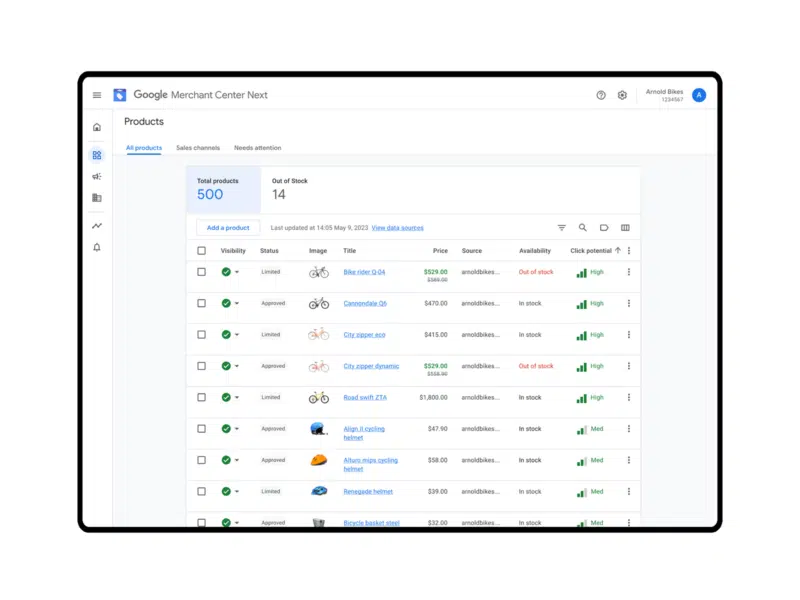
More than just the look and feel of Merchant Center Next will change. For example, products can be automatically populated from a merchant’s website.

Merchant Center Next Product List 800x600

Why we care. This new change should remove the headaches from less technical folks struggling with feeds while also bringing better insights for those data-hungry retailers. The Insights within the Performance tab look promising, especially for those prioritizing product error fixes.

Merchant Center Next vs. Merchant Center. Merchant Center has been a manual process consisting of setting up a product feed along with all required products, pricing, imagery, descriptions and more.

Merchant Center Next will detect all of this from your website and pull it in automatically. There’s good news, though: merchants can edit said products or turn the feature off entirely.

While the experience is dubbed as a “simplified one,” according to Google, “the features of Merchant Center that larger retailers know and love won’t be going anywhere either.”

Google is “committed to rolling out the new version at a responsible pace that brings users over when they can expect feature parity that meets their expectations.” 

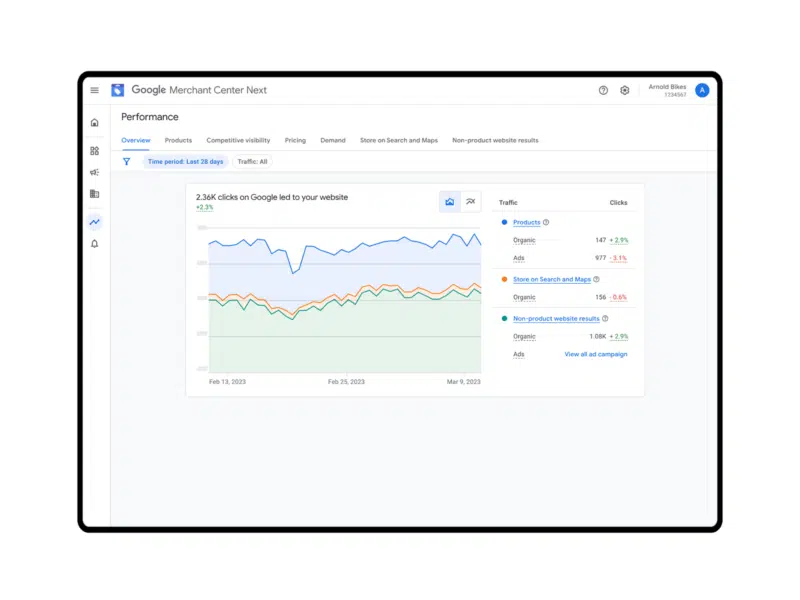
Merchant Center Next Performance Tab 800x600

Better Insights. One significant change will be to the user interface. A streamlined view will bring insight reports directly into the Performance tab.

This appears to contain more data with new tabs shown that include:

  • Overview
  • Products (existed previously)
  • Competitive visibility
  • Pricing
  • Demand
  • Store on Search and Maps
  • Non-product website results

Merchant Center Next will show all those merchants with online and brick-and-mortar locations all products in one view to help manage online and in-store product inventory in one destination, according to Google.

New insights will also be displayed on the benefits of fixing product errors within Merchant Center Next.

When Merchant Center Next will replace Merchant Center. The plan is for the rollout to be completed in 2024. Merchants will be notified when Merchant Center Next is ready for them.

Many new users have already seen Merchant Center Next rolled out to them. Smaller businesses will be upgraded in the coming months.


Opinions expressed in this article are those of the guest author and not necessarily Search Engine Land. Staff authors are listed here.


Related stories

New on Search Engine Land

@media screen and (min-width: 800px) { #div-gpt-ad-3191538-7 { display: flex !important; justify-content: center !important; align-items: center !important; min-width:770px; min-height:260px; } } @media screen and (min-width: 1279px) { #div-gpt-ad-3191538-7 { display: flex !important; justify-content: center !important; align-items: center !important; min-width:800px!important; min-height:440px!important; } }

About the author

Greg Finn

Greg Finn is the Director of Marketing for Cypress North, a company that provides digital marketing and web development. He is a co-host of Marketing O’Clock and has been in the digital marketing industry for nearly 20 years. You can also find Greg on Twitter (@gregfinn) or LinkedIn.

https://searchengineland.com/google-merchant-center-next-replace-merchant-center-427437


Google Ads lets you create campaigns using conversational AI

A unique new tool – chat – will let you create Google Ads campaigns.

Using Google AI, a new interface will help users set up campaigns directly within the online editor in a conversational format, Google announced today at Google Marketing Live 2023.

The best part: it’s optional, not required. Chat or not, it’s entirely up to you and your accounts.

Google Ads Generative Chat Helping Create My Ad 800x580

How it works. To get started, users can simply respond to a prompt for a preferred landing page. Google AI will generate the following for that campaign:

  • Keywords.
  • Headlines.
  • Descriptions.
  • Images.
  • Assets.

The process isn’t fully automated. Users can still edit all the suggestions before pushing them live to the world.

Google Ads Generative Chat Writing Headlines 800x580

Google Ads has already leveraged AI and machine learning for campaign help. But this interface is more of an integrated experience.

In the demos, the Google Ads AI shows that it generated a specific number of keywords/headlines/descriptions or other assets for review and cues up alongside the chat for easy editing.

Users can also prompt Google Ads AI for more specific detail on those assets. For example, a prompt for a beauty brand could include asking for anti-aging copy:

Google Ads Generative Chat Writing Description 800x580

Why we care. Advertisers across the board should be celebrating this news due to the intrinsically cooperative experience it brings to the campaign creation process. This tool will help give advertisers ideas, save time and build faster instead of automating the entire process. 


Opinions expressed in this article are those of the guest author and not necessarily Search Engine Land. Staff authors are listed here.


Related stories

New on Search Engine Land

@media screen and (min-width: 800px) { #div-gpt-ad-3191538-7 { display: flex !important; justify-content: center !important; align-items: center !important; min-width:770px; min-height:260px; } } @media screen and (min-width: 1279px) { #div-gpt-ad-3191538-7 { display: flex !important; justify-content: center !important; align-items: center !important; min-width:800px!important; min-height:440px!important; } }

About the author

Greg Finn

Greg Finn is the Director of Marketing for Cypress North, a company that provides digital marketing and web development. He is a co-host of Marketing O’Clock and has been in the digital marketing industry for nearly 20 years. You can also find Greg on Twitter (@gregfinn) or LinkedIn.

https://searchengineland.com/google-ads-lets-you-create-campaigns-using-conversational-ai-427411


Google Search Generative Experience integrates Search, Shopping ads

Google Ads have entered the chat – the Google Search Generative Experience (SGE) conversational chat, that is.

On the heels of the AI-powered enhancements announced at Google I/O earlier this month, Google gave advertisers a slightly more precise picture of the ads plans within SGE today at Google Marketing Live:

Google is experimenting with directly integrating Search and Shopping ads within the AI snapshot and conversational mode.

Ad In SGE

There will also be the experimentation of newer native formats that leverage generative AI for ad creation customized to the user journey.

Sge 2 Desktop 467x600

How it looks. Just two weeks ago at Google I/O we saw ad units living above the SGE experience in a different colored section that was clearly labeled “Sponsored.” The new ads will have a bold “Sponsored” identifier but are mixed in with the results provided in the conversational chat. 

For example (cover your eyes SEOs), Google displays a sponsored listing as the top result for a conversational query of [hiking backpack for kids]:

Sge 2 Mobile 800x542

Google has yet to reveal any SGE ad metrics data (e.g., CTR) because it is still an experiment. Additionally, being in such an early stage, there is no way to opt in or out of ads showing in SGE.

Why we care. This move will likely please advertisers while simultaneously upsetting those seeking more organic traffic. The implementation at Google I/O seemed slightly disjointed, with the ad results up and away from the chat. Still, we are starting to see a fuller picture of not only what SGE will be and how Google can monetize it by bringing ads into the chat in a native fashion.


Opinions expressed in this article are those of the guest author and not necessarily Search Engine Land. Staff authors are listed here.


Related stories

New on Search Engine Land

@media screen and (min-width: 800px) { #div-gpt-ad-3191538-7 { display: flex !important; justify-content: center !important; align-items: center !important; min-width:770px; min-height:260px; } } @media screen and (min-width: 1279px) { #div-gpt-ad-3191538-7 { display: flex !important; justify-content: center !important; align-items: center !important; min-width:800px!important; min-height:440px!important; } }

About the author

Greg Finn

Greg Finn is the Director of Marketing for Cypress North, a company that provides digital marketing and web development. He is a co-host of Marketing O’Clock and has been in the digital marketing industry for nearly 20 years. You can also find Greg on Twitter (@gregfinn) or LinkedIn.

https://searchengineland.com/google-search-generative-experience-search-shopping-ads-427424


Nearly 30% of Instacart’s revenue is from advertising

Instacart made $740 million in ad revenue in 2022, a 30% increase over 2021.

Surging ad business. The Information reported:

“The grocery-delivery firm’s ad revenue totaled about $740 million last year, up 30% from 2021, according to a person familiar with the matter. That’s a striking increase, given that the digital ad market was largely stagnant last year. Nearly 30% of Instacart’s 2022 revenue came from selling advertising rather than actually delivering groceries.”

Ads accounted for about 20% of Instacart’s $1.5 annual revenue in 2021 – about $300 million – according to a June 2021 Insider report.

For comparison. Advertising accounted for about 10% of Amazon’s revenue in 2022, according to The Information. Meanwhile, Amazon made $37.7 billion in revenue through advertising last year.

Why we care. Instacart remains a viable alternative for brands to promote products directly to consumers. And the company has updated its platform to attract more advertisers.

The bigger picture. In 2022, Google and Meta’s advertising market share dropped below 50%. This trend is expected to continue in 2023, in part, due to the rise of emerging ad platforms like Instacart.

The rise of retail media networks. Retail media search spend is forecast to be near $30 billion this year – and RMN digital ad revenue is expected to hit $45 billion. Dig deeper in U.S. paid search spend forecast to hit $110 billion in 2023.


Related stories

New on Search Engine Land

@media screen and (min-width: 800px) { #div-gpt-ad-3191538-7 { display: flex !important; justify-content: center !important; align-items: center !important; min-width:770px; min-height:260px; } } @media screen and (min-width: 1279px) { #div-gpt-ad-3191538-7 { display: flex !important; justify-content: center !important; align-items: center !important; min-width:800px!important; min-height:440px!important; } }

About the author

Danny Goodwin

Danny Goodwin has been Managing Editor of Search Engine Land & Search Marketing Expo – SMX since 2022. He joined Search Engine Land in 2022 as Senior Editor. In addition to reporting on the latest search marketing news, he manages Search Engine Land’s SME (Subject Matter Expert) program. He also helps program U.S. SMX events. Goodwin has been editing and writing about the latest developments and trends in search and digital marketing since 2007. He previously was Executive Editor of Search Engine Journal (from 2017 to 2022), managing editor of Momentology (from 2014-2016) and editor of Search Engine Watch (from 2007 to 2014). He has spoken at many major search conferences and virtual events, and has been sourced for his expertise by a wide range of publications and podcasts.

https://searchengineland.com/instacart-ad-revenue-2022-427360


YouTube to offer unskippable 30-second ads on connected TV

Non-skippable ads are coming to YouTube Select on connected TV. This means that viewers will see one 30-second ad instead of two consecutive 15-second ads.

Why we care. YouTube was the most popular U.S. video streaming platform in April and watch time increased, according to Nielsen. It remains to be seen whether a non-skippable 30-second format provides a good advertising ROI.

What YouTube said. YouTube explained in a blog post:

“We know that running longer-form creative on the big screen aligns with your objectives, and allows for richer storytelling. YouTube Select is now landing over 70% of impressions on the TV screen, so we’re making it easier for you to use existing assets in front of the most-streamed content.”

YouTube Select is the top 5% of the most-viewed and most-engaging content.

U.S. first. YouTube’s new ad type will initially be available only in the U.S., with plans to expand availability internationally later this year.

Pause Ads. YouTube also announced it will be testing “Pause experiences” on CTV. This experimental feature will allow viewers to pause videos, to potentially help drive awareness or an action – perhaps via a QR code.


Related stories

New on Search Engine Land

@media screen and (min-width: 800px) { #div-gpt-ad-3191538-7 { display: flex !important; justify-content: center !important; align-items: center !important; min-width:770px; min-height:260px; } } @media screen and (min-width: 1279px) { #div-gpt-ad-3191538-7 { display: flex !important; justify-content: center !important; align-items: center !important; min-width:800px!important; min-height:440px!important; } }

About the author

Danny Goodwin

Danny Goodwin has been Managing Editor of Search Engine Land & Search Marketing Expo – SMX since 2022. He joined Search Engine Land in 2022 as Senior Editor. In addition to reporting on the latest search marketing news, he manages Search Engine Land’s SME (Subject Matter Expert) program. He also helps program U.S. SMX events. Goodwin has been editing and writing about the latest developments and trends in search and digital marketing since 2007. He previously was Executive Editor of Search Engine Journal (from 2017 to 2022), managing editor of Momentology (from 2014-2016) and editor of Search Engine Watch (from 2007 to 2014). He has spoken at many major search conferences and virtual events, and has been sourced for his expertise by a wide range of publications and podcasts.

https://searchengineland.com/youtube-unskippable-ads-connected-tv-427344


New Google AI tools will let advertisers generate media assets

Advertisers and YouTube creators may benefit from new AI solutions Google is reportedly working on.

Google Ads. Generative AI tools, powered by PaLM 2, will help advertisers create media assets, CNBC reported, based on internal Google documents. Unfortunately, that’s as much detail as we know for now.

We’ve previously reported that generative AI is coming to Google Ads. However, that seemed more about “remixing” existing assets into ads, whereas this report is more about Google actually generating those assets.

YouTube. According to CNBC:

Google has also been testing PaLM 2 for YouTube youth content for things like titles, and descriptions. For creators, the company has been using the technology to experiment with the idea of providing five video ideas based on topics that appear relevant.

Why we care. Amazon and Meta are also testing generative AI for advertisers or will be soon. Google’s integration of generative AI will be worth testing to see if it helps improve performance – especially with conversion rates down and CPLs up.

Will we learn more this Tuesday? This year’s Google Marketing Live takes place May 23. We expect it to be heavy on AI announcements. Could these – or other AI solutions – be officially announced next week? We’ll be watching and reporting on all the news from the event.


Related stories

New on Search Engine Land

@media screen and (min-width: 800px) { #div-gpt-ad-3191538-7 { display: flex !important; justify-content: center !important; align-items: center !important; min-width:770px; min-height:260px; } } @media screen and (min-width: 1279px) { #div-gpt-ad-3191538-7 { display: flex !important; justify-content: center !important; align-items: center !important; min-width:800px!important; min-height:440px!important; } }

About the author

Danny Goodwin

Danny Goodwin has been Managing Editor of Search Engine Land & Search Marketing Expo – SMX since 2022. He joined Search Engine Land in 2022 as Senior Editor. In addition to reporting on the latest search marketing news, he manages Search Engine Land’s SME (Subject Matter Expert) program. He also helps program U.S. SMX events. Goodwin has been editing and writing about the latest developments and trends in search and digital marketing since 2007. He previously was Executive Editor of Search Engine Journal (from 2017 to 2022), managing editor of Momentology (from 2014-2016) and editor of Search Engine Watch (from 2007 to 2014). He has spoken at many major search conferences and virtual events, and has been sourced for his expertise by a wide range of publications and podcasts.

https://searchengineland.com/google-generative-ai-advertising-assets-youtube-creators-427095


U.S. paid search spend forecast to hit $110 billion in 2023

Paid search spend is expected to reach $110 billion this year, according to a new eMarketer forecast.

Search and retail media. Paid search represents 41.8% of total digital spending. If it reaches $110 billion, its growth will remain slightly higher (at 8.2%) than overall U.S. digital ad spend, which is expected to increase by 7.8%.

Within search, retail media networks (RMNs) are a rising star, with 18.7% growth in retail media search. This segment is projected to be near $30 billion in spending in 2023.

RMN digital ad revenue (not just in search) is on course to rise from $31 billion in 2021 to $45 billion this year. If spending continues at its current rate it should surpass $106 billion in 2027.

Us Display Search Ad Spending 2023
Image source: eMarketer

Why we care. We expect 2023 to be a challenging year in search. There have been many changes related to generative AI and chat in search (both on Google and Microsoft Bing), and we’re hoping to get more clarity soon about what these changes will mean in terms of engagement and ad performance. Until then, it’s good to see overall paid search spend growth rising – especially in retail.

More on U.S. search ad revenue. It hit a record $84.4 billion in 2022, according to IAB.

U.S. digital ad spend. While it’s dropping below 10% for the first time in 14 years, digital ad spending is projected to rebound to 11.2% growth in 2024, the forecast said. Yearly increases are predicted to hover around 10% through 2027.

Digital ad spend saw a dramatic rebound in 2021 following the initial wave of the COVID pandemic — when it saw growth of 37.6%. In 2022, the numbers fell dramatically, with 10.6% growth.

Us Digital Ad Spending 2021 2027
Image source: eMarketer

Digital slice of the pie. Overall media spending is expected to increase 3.8% this year as traditional media investments continue to migrate to digital.

Digital media should make up 74.6% of total U.S. media spend, which is expected to reach nearly $264 billion in 2023. The digital slice of total media spending is projected to grow about 2% annually in the coming years.

Display and CTV. Connected TV (CTV) advertising keeps charging ahead.

For some perspective, over half (55%) of digital spending is in display ads whose revenue is expected to grow 7.9% this year. CTV’s projected growth for 2023, however, is 21.2% – nearly triple digital’s growth.

CTV ad spend is on pace to hit $25 billion this year and account for 9.5% of total digital ad revenue, according to eMarketer.

Social display, on the other hand, is projected to only see a growth increase of 3.4% in 2023. Social network display advertising is about a quarter of total digital spending.


Related stories

New on Search Engine Land

@media screen and (min-width: 800px) { #div-gpt-ad-3191538-7 { display: flex !important; justify-content: center !important; align-items: center !important; min-width:770px; min-height:260px; } } @media screen and (min-width: 1279px) { #div-gpt-ad-3191538-7 { display: flex !important; justify-content: center !important; align-items: center !important; min-width:800px!important; min-height:440px!important; } }

About the author

Chris Wood

Chris Wood draws on over 15 years of reporting experience as a B2B editor and journalist. At DMN, he served as associate editor, offering original analysis on the evolving marketing tech landscape. He has interviewed leaders in tech and policy, from Canva CEO Melanie Perkins, to former Cisco CEO John Chambers, and Vivek Kundra, appointed by Barack Obama as the country’s first federal CIO. He is especially interested in how new technologies, including voice and blockchain, are disrupting the marketing world as we know it. In 2019, he moderated a panel on “innovation theater” at Fintech Inn, in Vilnius. In addition to his marketing-focused reporting in industry trades like Robotics Trends, Modern Brewery Age and AdNation News, Wood has also written for KIRKUS, and contributes fiction, criticism and poetry to several leading book blogs. He studied English at Fairfield University, and was born in Springfield, Massachusetts. He lives in New York.

https://searchengineland.com/us-paid-search-spend-forecast-2023-427066


Google Chrome will soon add 6 relevance and measurement APIs

The Privacy Sandbox initiative, a project led by Chrome, is introducing new key relevance and measurement APIs to Chrome Stable. This move is scheduled for the third quarter of 2023, with the spotlight focused on Chrome Stable 115 as the specific launch pad.

Unveiling the specifics. The APIs set to go live are:

  • Topics: Generate signals for interest-based advertising without third-party cookies or other user identifiers that track individuals across sites.
  • Protected Audience: Select ads to serve remarketing and custom audience use cases, designed to mitigate third-party tracking across sites. (This API was previously named FLEDGE. As we head towards launch, we’ve updated the name to better reflect the functionality.)
  • Attribution Reporting: Correlate ad clicks or ad views with conversions. Ad techs can generate event-level or summary reports.
  • Private Aggregation: Generate aggregate data reports using data from Protected Audience and cross-site data from Shared Storage.
  • Shared Storage: Allow unlimited, cross-site storage write access with privacy-preserving read access.
  • Fenced Frames: Securely embed content onto a page without sharing cross-site data.

The APIs will gradually roll out to all users. The Chrome team to closely monitor for issues to ensure a seamless integration.

Why we care. The six new relevance and measurement APIs will deliver tools to generate interest-based advertising signals and correlate ad clicks or views with conversions, all without the use of third-party cookies. This approach not only offers more privacy-focused methods for ad targeting and measurement but also prepares advertisers for a future where third-party cookies may no longer be viable.

Updated user controls. A major improvement with this launch is the addition of advanced Ad privacy controls. These controls offer users more granular management of the new APIs, providing an extra layer of privacy and giving users control over their browsing experience.

Here’s what the new user controls may look like:

Test version of an updated Chrome Ad privacy interface
Test version of an updated Chrome Ad privacy interface.

Open application dates. To handle the expected developer interest, an enrollment process has been created. Starting in June, developers can apply for API access, which will be granted in August. This ensures a controlled and organized introduction of the APIs to the wider developer community.

General Availability (GA), as it’s referred to in the project timeline, implies that these APIs will become available by default in Chrome. However, immediate availability in all Chrome browsers is not guaranteed. The gradual rollout strategy will allow users to directly control the activation of these APIs.

Providing feedback. Feedback can be shared here. The Chrome team also has created this feedback form.

Read the announcement. Preparing to ship the Privacy Sandbox relevance and measurement APIs. 


Opinions expressed in this article are those of the guest author and not necessarily Search Engine Land. Staff authors are listed here.


Related stories

New on Search Engine Land

@media screen and (min-width: 800px) { #div-gpt-ad-3191538-7 { display: flex !important; justify-content: center !important; align-items: center !important; min-width:770px; min-height:260px; } } @media screen and (min-width: 1279px) { #div-gpt-ad-3191538-7 { display: flex !important; justify-content: center !important; align-items: center !important; min-width:800px!important; min-height:440px!important; } }

About the author

Nicole Farley

Nicole Farley is the founder of Web Sprout, an inbound marketing agency. She formerly was PPC Editor for Search Engine Land (from 2022-2023), covering paid search, paid social, Google Analytics and more. In addition to being a Marine Corps veteran, she has an extensive background in digital marketing, an MBA and a penchant for true crime, podcasts, travel, and snacks.

https://searchengineland.com/google-chrome-privacy-sandbox-relevance-measurement-apis-426996