Google Analytics 4 audience builder gets a refresh
Google Analytics 4 (GA4) has made significant enhancements to the audience builder. New dimensions and metrics, enhanced alternatives for manipulating event value and event count, and a novel option to match dates have been added.
Here’s what’s new.
New Dimensions and Metrics in the Audience Builder. The GA4 audience builder now supports the creation of audiences via new dimensions and metrics. The following dimensions and metrics are freshly introduced in the audience builder:
Item-Scoped Dimensions
Item ID
Item affiliation
Item brand
Item category
Item category 2
Item category 3
Item category 4
Item list name
Item name
Item promotion ID
Item variant
Item-Scoped Ecommerce Metrics
Item revenue
Items added to cart
Items checked out
Items purchased
Items viewed in list
Event-Scoped Ecommerce Metrics
Item-list click events
Session-Based Metrics
Low engagement sessions
Low engagement sessions help identify users showing low engagement with a website or app. For instance, it allows the creation of an audience segment of users having more than three low-engagement sessions within the past five days.
Once you’ve identified such users, you can then target them with ads to prompt them to return (e.g., retailers highlighting upcoming sales or events).
Independent Use of Event Value. Event value can now be used independently without associating it with a specific event.
In earlier versions, the event value parameter was only used to modify specific events, such as locating users who completed “event X” where the event value exceeded 50.
An example of this would be creating an audience of users who have any event with a value above 50.
Expanded Operators for Event Count. The update also expands the operators that can be used when creating audiences using the event count metric. While earlier only greater than (>), less than (<), and equals to (=) were available, and only when selecting “the most recent time period,” the update introduces a complete set of operators.
These include:
Greater than or equal to (>=)
Less than or equal to (<=)
Not equal to (!=)
These operators are available when choosing “at any point in time” and “most recent time period.”
Matching Between Dates. A new “between match types” option has been introduced for dates.
This feature could be used to, for example, build an audience of users who visited a website during Black Friday and target them with ads in the run-up to Black Friday the following year. The selected range, such as November 24 to November 26, would include all three days.
Why we care. These new dimensions and metrics, more robust manipulation of event value and event count, and being able to match dates can all lead to more targeted and effective advertising. Being able to identify users with low engagement sessions, or matching event value across various events, can help you create more nuanced and relevant audience segments.
What’s new in GA4. These updates were announced via the Google Analytics Help page, which you can find here.
Opinions expressed in this article are those of the guest author and not necessarily Search Engine Land. Staff authors are listed here.
@media screen and (min-width: 800px) { #div-gpt-ad-3191538-7 { display: flex !important; justify-content: center !important; align-items: center !important; min-width:770px; min-height:260px; }
}
@media screen and (min-width: 1279px) { #div-gpt-ad-3191538-7 { display: flex !important; justify-content: center !important; align-items: center !important; min-width:800px!important; min-height:440px!important; }
}
About the author
Nicole Farley is the founder of Web Sprout, an inbound marketing agency. She formerly was PPC Editor for Search Engine Land (from 2022-2023), covering paid search, paid social, Google Analytics and more. In addition to being a Marine Corps veteran, she has an extensive background in digital marketing, an MBA and a penchant for true crime, podcasts, travel, and snacks.
Search ad conversion rates down, cost per lead up in 2023
Paid search advertising conversion rates have decreased across nearly all industries year over year. Meanwhile, the cost of generating leads through search ads continues to increase, although not as drastically as in prior years.
That’s according to a new 2023 search advertising benchmark report from LocalIQ’s WordStream. It features data on the average conversion rate, cost per lead (CPL), click-through rate (CTR) and cost per click (CPC), compared to 2022.
Why we care. It’s good to understand whether you doing better or worse than your competitors in paid search so you can optimize for better results, at a lower cost. As always, in PPC, you want to always strive to be better than average.
Conversion rate: 7.04%. Only two industries (Beauty and Personal Care, Education and Instruction) avoided a decrease in conversion rate from search ads. Some of the decreases were significant, WordStream reported (e.g., Arts & Entertainment was down 36.2% YoY and Apparel, Fashion and Jewelry was down 34.9% YoY).
Industries with the highest conversion rates:
Animals and Pets: 13.41%
Physicians and Surgeons: 13.12%
Automotive Repair, Service, and Parts: 12.61%.
Industries with the lowest average conversion rates:
Apparel, Fashion, and Jewelry: 1.57%
Furniture: 2.57%
Real Estate: 2.88%
CPL: $53.52. The only two industries to see a CPL decrease were Automotive Sales (-8.6%) and Beauty and Personal Care (-3.9%).
91% of industries saw an increase in CPL as well as a decrease in conversion rate, WordStream reported.
Industries with the highest CPLs:
Career and Employment: $132.95
Attorneys and Legal Services: $111.05
Furniture: $108.85
Industries with the lowest CPLs:
Automotive Repair, Services and Parts: $21.12
Animals and Pets: $23.57
Shopping, Collectibles and Gifts: at $31.50.
CTR: 6.11%. CTR increased for all but two of the industries, according to the report. Only Business Services and Industrial and Commercial industries decreased, but WordStream noted these “weren’t as significant as the increases other industries faced.”
Industries with the highest click-through rates:
Arts and Entertainment: 11.78%
Sports and Recreation: 10.53%
Travel: 10.03%.
Industries with the lowest click-through rates:
Attorneys and Legal Services: 4.76%
Home and Home Improvement: 4.80%
Business Services: 5.11%.
CPC: $4.22. CPC increased for 14 industries, decreased for 8 industries, and stayed the same in Apparel, Fashion, and Jewelry.
The industries with the highest costs per click:
Attorneys and Legal services: $9.21
Dentists and Dental Services: $6.69
Home and Home Improvement: $6.55.
The industries with the lowest CPC:
Arts and Entertainment: $1.55
Real Estate: $1.55
Travel: $1.63
2023 search advertising benchmarks. Here’s the data, broken down by category:
About the data. A total of 17,253 U.S.-based search advertising campaigns in 23 industries, running between April 1, 2022, and March 31, 2023, were analyzed. The search ad benchmarks are based on Google Ads 80% as well as Microsoft Ads (20%).
@media screen and (min-width: 800px) { #div-gpt-ad-3191538-7 { display: flex !important; justify-content: center !important; align-items: center !important; min-width:770px; min-height:260px; }
}
@media screen and (min-width: 1279px) { #div-gpt-ad-3191538-7 { display: flex !important; justify-content: center !important; align-items: center !important; min-width:800px!important; min-height:440px!important; }
}
About the author
Danny Goodwin has been Managing Editor of Search Engine Land & Search Marketing Expo – SMX since 2022. He joined Search Engine Land in 2022 as Senior Editor. In addition to reporting on the latest search marketing news, he manages Search Engine Land’s SME (Subject Matter Expert) program. He also helps program U.S. SMX events. Goodwin has been editing and writing about the latest developments and trends in search and digital marketing since 2007. He previously was Executive Editor of Search Engine Journal (from 2017 to 2022), managing editor of Momentology (from 2014-2016) and editor of Search Engine Watch (from 2007 to 2014). He has spoken at many major search conferences and virtual events, and has been sourced for his expertise by a wide range of publications and podcasts.
Elon Musk today announced that Linda Yaccarino will be the next Twitter CEO.
The announcement. Musk tweeted the news, adding that Yaccarino would “focus primarily on business operations.” Musk will focus on product design and new technology. Musk added:
“Looking forward to working with Linda to transform this platform into X, the everything app.”
Twitter technically is no longer a company. It is officially known as X Corp. But we don’t yet know exactly what the X platform will be.
Why we care. Twitter under Musk has been a trainwreck at times. It will be worth watching whether having a new Twitter CEO may help repair some of the damage done and lure back advertisers, marketers and brands.
About Yaccarino. Most recently, Yaccarino was chairman of global advertising and partnerships at NBCUniversal Media. Yaccarino had been at NBC for more than 11 years in various roles.
Watch Yaccarino interview Musk.Yaccarino recently interviewed Musk about the future of marketing on Twitter at MMA’s POSSIBLE Miami Event 2023.
Gaining Twitter followers. When Yaccarino last tweeted on May 10, she had 7,187 Twitter followers, as Dan Barker tweeted. After Musk announced Yaccarino as CEO, she started gaining hundreds of followers per minute. As of publishing, she had more than 150,000 followers.
@media screen and (min-width: 800px) { #div-gpt-ad-3191538-7 { display: flex !important; justify-content: center !important; align-items: center !important; min-width:770px; min-height:260px; }
}
@media screen and (min-width: 1279px) { #div-gpt-ad-3191538-7 { display: flex !important; justify-content: center !important; align-items: center !important; min-width:800px!important; min-height:440px!important; }
}
About the author
Danny Goodwin has been Managing Editor of Search Engine Land & Search Marketing Expo – SMX since 2022. He joined Search Engine Land in 2022 as Senior Editor. In addition to reporting on the latest search marketing news, he manages Search Engine Land’s SME (Subject Matter Expert) program. He also helps program U.S. SMX events. Goodwin has been editing and writing about the latest developments and trends in search and digital marketing since 2007. He previously was Executive Editor of Search Engine Journal (from 2017 to 2022), managing editor of Momentology (from 2014-2016) and editor of Search Engine Watch (from 2007 to 2014). He has spoken at many major search conferences and virtual events, and has been sourced for his expertise by a wide range of publications and podcasts.
Meta advertisers will soon get access to generative AI tools
Meta has introduced the AI Sandbox, which will bring generative AI to its advertisers.
Meta’s three new generative AI features. Select Meta advertisers can now create text variations, generate images from prompts and adjust image sizes – all with the ultimate goal of making the ads more engaging.
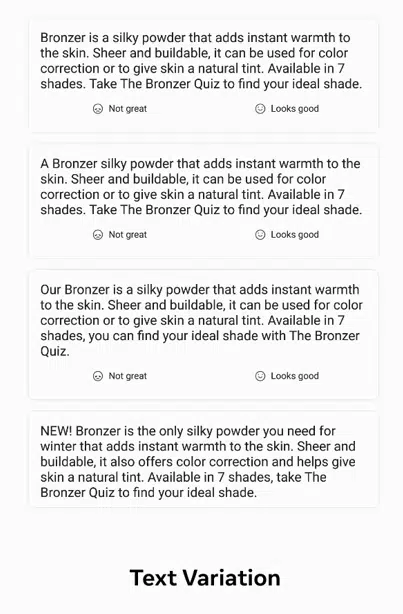
Text variation. Simply enter your ad copy and Meta will suggest several ad copy variations to test. You can click decide whether the suggestions are “Not Great” or “Looks Good.”
What it looks like:
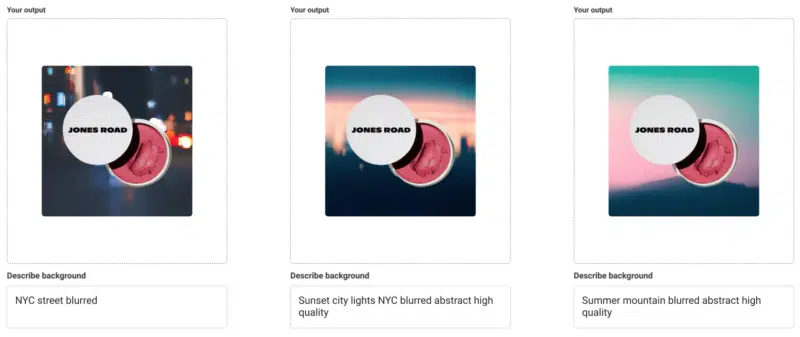
Background generation. You can use text prompts to describe the background appearance or style you want. This would allow you to test various images and test their impact on performance.
Image outcropping. This tool will let you adjust your assets to fit different aspect ratios across Facebook and Instagram surfaces (e.g., Stories, Reels).
Why we care. These generative AI tools could potentially improve the performance of your Facebook advertising and save you time. But, as with any tool, it will be important to test and monitor the outputs, as we all know generative AI is far from perfect.
More access in July. These new generative AI features are only available to a small group of advertisers. That will change in July, which is when Meta said it will expand access to more advertisers.
@media screen and (min-width: 800px) { #div-gpt-ad-3191538-7 { display: flex !important; justify-content: center !important; align-items: center !important; min-width:770px; min-height:260px; }
}
@media screen and (min-width: 1279px) { #div-gpt-ad-3191538-7 { display: flex !important; justify-content: center !important; align-items: center !important; min-width:800px!important; min-height:440px!important; }
}
About the author
Danny Goodwin has been Managing Editor of Search Engine Land & Search Marketing Expo – SMX since 2022. He joined Search Engine Land in 2022 as Senior Editor. In addition to reporting on the latest search marketing news, he manages Search Engine Land’s SME (Subject Matter Expert) program. He also helps program U.S. SMX events. Goodwin has been editing and writing about the latest developments and trends in search and digital marketing since 2007. He previously was Executive Editor of Search Engine Journal (from 2017 to 2022), managing editor of Momentology (from 2014-2016) and editor of Search Engine Watch (from 2007 to 2014). He has spoken at many major search conferences and virtual events, and has been sourced for his expertise by a wide range of publications and podcasts.
These 2 charts show Microsoft Bing’s search market share problem
Despite having gotten the jump on Google when it launched the new Bing, featuring its own generative search experience fueled by GPT-4, data shows Microsoft has failed to gain market share.
In fact, if the latest numbers from StatCounter are directionally accurate, it appears Bing is actually losing market share to Google.
Why we care. It would be nice to live in a world where we didn’t have to rely so heavily on Google. It was encouraging to see Bing making some small gains. But we later learned the New Bing attracted new Edge users who then used Google Search. And now that Google has unveiled its Search Generative Experience, Bing has lost its first-mover advantage and it seems we won’t see a true search competitor anytime soon.
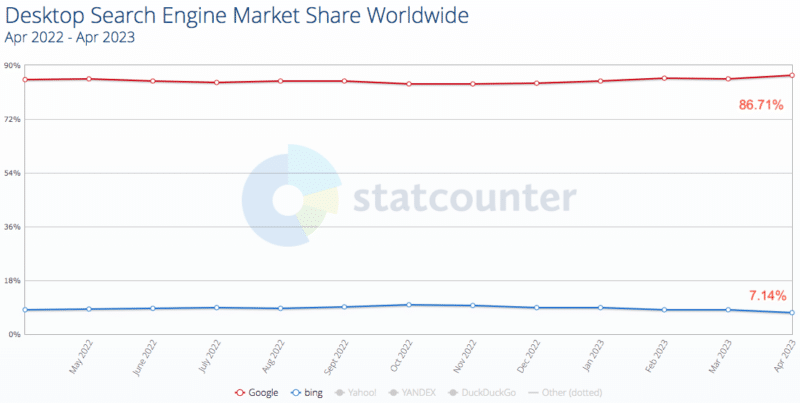
7.14%. That’s Microsoft Bing’s worldwide desktop market share as of April, according to Statcounter. The new Bing launched in February.
Why this number is a problem: Bing’s market share peaked in October 2022, at 9.92%. And the 7.14% figure is actually lower than April 2022 (8.05%).
Meanwhile, Google’s desktop search market share is 86.71%.
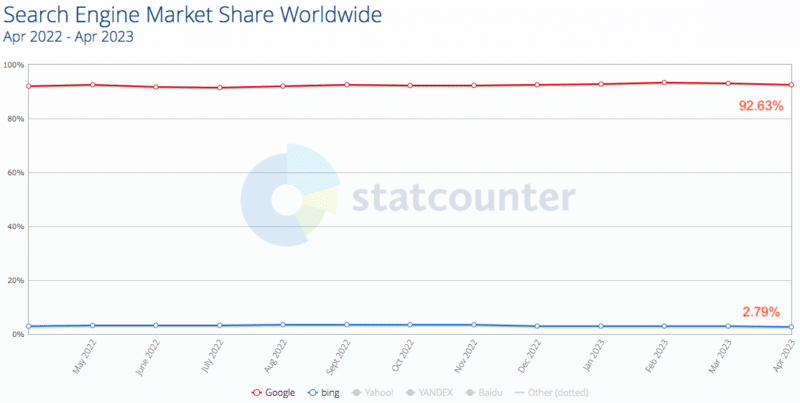
2.79%. The picture gets even bleaker for Microsoft Bing when you look at search engine market share worldwide, across all devices (desktop, mobile, tablet), also via Statcounter. While Bing is at just 2.79%, Google is at 92.63%.
Why this number is a problem: Bing’s market share peaked in October 2022, at 3.59%. And the 2.79% figure is actually lower than April 2022 (3.02%).
Google isn’t vying with Microsoft Bing. News headlines discussing the AI search competition between Google and Bing tend to focus on the rivalry element instead of simply admitting the reality. Which is that these two charts show Microsoft’s problem: even with the new Bing and all the investments Microsoft has made in search – they’re still not making meaningful gains on Google.
@media screen and (min-width: 800px) { #div-gpt-ad-3191538-7 { display: flex !important; justify-content: center !important; align-items: center !important; min-width:770px; min-height:260px; }
}
@media screen and (min-width: 1279px) { #div-gpt-ad-3191538-7 { display: flex !important; justify-content: center !important; align-items: center !important; min-width:800px!important; min-height:440px!important; }
}
About the author
Danny Goodwin has been Managing Editor of Search Engine Land & Search Marketing Expo – SMX since 2022. He joined Search Engine Land in 2022 as Senior Editor. In addition to reporting on the latest search marketing news, he manages Search Engine Land’s SME (Subject Matter Expert) program. He also helps program U.S. SMX events. Goodwin has been editing and writing about the latest developments and trends in search and digital marketing since 2007. He previously was Executive Editor of Search Engine Journal (from 2017 to 2022), managing editor of Momentology (from 2014-2016) and editor of Search Engine Watch (from 2007 to 2014). He has spoken at many major search conferences and virtual events, and has been sourced for his expertise by a wide range of publications and podcasts.
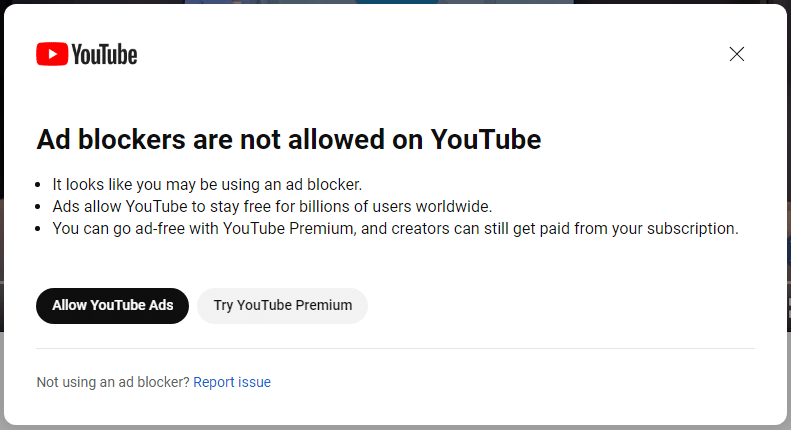
“Ad blockers are not allowed on YouTube.” That’s the message YouTube may show to some users who use ad blockers. It’s part of what appears to be a small experiment the platform is running.
Why we care. In theory, this could mean more views for YouTube Ads. The question is whether those users will be at all receptive to YouTube Ads – they may simply choose to abandon watching a video or, more drastically, ditch the entire platform.
Ad blockers are not allowed on YouTube. Here’s what the message looks like, as shared via Reddit:
It says:
It looks like you may be using an ad blocker.
Ads allow YouTube to stay free for billions of users worldwide.
You can go ad-free with YouTube Premium, and creators can still get paid from your subscription.
It then offers users two choices: Allow YouTube Ads or Try YouTube Premium.
How this message is triggered. This screen could appear whenever a user who has installed an ad blocker tries to view YouTube content.
Interesting timing? Google yesterday unveiled its new Search Generative Experience. It’s too early to know the impact SGE may have on your paid and organic search performance (not to mention Google’s ad business).
But video content and video ads may become more valuable for some brands that need visibility as a result of lost traffic or clicks in search. This would also mean YouTube wants to make sure its users are seeing as many ads as possible.
@media screen and (min-width: 800px) { #div-gpt-ad-3191538-7 { display: flex !important; justify-content: center !important; align-items: center !important; min-width:770px; min-height:260px; }
}
@media screen and (min-width: 1279px) { #div-gpt-ad-3191538-7 { display: flex !important; justify-content: center !important; align-items: center !important; min-width:800px!important; min-height:440px!important; }
}
About the author
Danny Goodwin has been Managing Editor of Search Engine Land & Search Marketing Expo – SMX since 2022. He joined Search Engine Land in 2022 as Senior Editor. In addition to reporting on the latest search marketing news, he manages Search Engine Land’s SME (Subject Matter Expert) program. He also helps program U.S. SMX events. Goodwin has been editing and writing about the latest developments and trends in search and digital marketing since 2007. He previously was Executive Editor of Search Engine Journal (from 2017 to 2022), managing editor of Momentology (from 2014-2016) and editor of Search Engine Watch (from 2007 to 2014). He has spoken at many major search conferences and virtual events, and has been sourced for his expertise by a wide range of publications and podcasts.
Amazon working on AI tools to generate videos, images for advertisers
Amazon advertisers may soon gain the ability to create AI-generated image and video assets to use in ad campaigns.
The company has confirmed it is now building a team to provide those tools, The Information reported. There is no estimated timeline for when this will become available.
Why we care. The ability to natively create image and video assets could help Amazon advertisers improve their listings, leading to more sales and greater ROI on the platform.
Amazon is diversifying its growing ad business. Amazon advertising accounted for $38 billion in revenue in 2022. Its biggest offering is letting merchants get greater visibility in search results. Amazon’s other advertising efforts include:
Videos ads on Freevee, its video-streaming service, and Thursday Night Football on Prime Video.
@media screen and (min-width: 800px) { #div-gpt-ad-3191538-7 { display: flex !important; justify-content: center !important; align-items: center !important; min-width:770px; min-height:260px; }
}
@media screen and (min-width: 1279px) { #div-gpt-ad-3191538-7 { display: flex !important; justify-content: center !important; align-items: center !important; min-width:800px!important; min-height:440px!important; }
}
About the author
Danny Goodwin has been Managing Editor of Search Engine Land & Search Marketing Expo – SMX since 2022. He joined Search Engine Land in 2022 as Senior Editor. In addition to reporting on the latest search marketing news, he manages Search Engine Land’s SME (Subject Matter Expert) program. He also helps program U.S. SMX events. Goodwin has been editing and writing about the latest developments and trends in search and digital marketing since 2007. He previously was Executive Editor of Search Engine Journal (from 2017 to 2022), managing editor of Momentology (from 2014-2016) and editor of Search Engine Watch (from 2007 to 2014). He has spoken at many major search conferences and virtual events, and has been sourced for his expertise by a wide range of publications and podcasts.
Not truly search and not fully social, it’s a platform where you compete against organic content for attention and time.
The same keyword can have a dozen different intents or none at all. And the placement of your ad is more critical than ever.
To master YouTube takes a deep understanding of your audience’s challenges and desires, plus how, when and why they use the platform.
Here are seven important YouTube Ads lessons I had to learn the difficult – and expensive – way so you hopefully don’t need to.
1. YouTube is not truly social
Facebook and Instagram spoiled advertisers by letting them show ads, get clicks, and make sales. The targeting was effective, highly condensing the sales cycle.
But I think it is mainly driven by a consumer’s frame of mind while on these platforms.
You’re bored, scrolling and looking to be entertained.
So when you see an ad that catches your attention, you’ll likely run through a checkout process quickly. Perhaps right away or within 24 hours – typically within seven days.
On the other hand, YouTube users are more in a Netflix or fix-it mode. You’re watching content or learning how to do things.
And with Shorts, there’s an endless scrolling component like TikTok. (But even TikTok doesn’t convert as well as Facebook and Instagram.)
With YouTube Ads, you’re feeding the funnel and creating awareness.
Your ads put your brand on people’s radars but are much less likely to convert immediately. It can take a while and require larger budgets.
2. YouTube is also not fully search
When people think of YouTube Ads, they typically think of the videos that appear before, during and after content.
There are also text ads that appear above a YouTube search results page, which come from Search campaigns that have opted into Search Partners targeting, as well as Discovery and Performance Max campaigns. They aren’t the focus of this article, but their presence is relevant.
Unlike other paid social channels, YouTube allows you to target people based on something they searched for recently.
You can create an audience around keywords, and anybody who searches for a certain keyword will be placed into that audience.
However, they’re not searching for that thing right then. Yes, they might be interested, but they’re not in-market or actively searching. This means search intent on YouTube carries lag or has even expired.
That’s to say nothing of the risk of intent being off.
When someone searches for [marathon training plan] in Google, keyword intent indicates there’s a good chance they will need products such as running shoes, compression garments, fitness wearables, etc.
Instead, the same query on YouTube might lead to a Shorts link about what a creator ate in preparation for their marathon, or it might be for a specific video based on its title or content.
There’s no way to be sure of intent. This is why I suggest you view YouTube as a consideration and awareness channel rather than a conversion-focused one.
In other words, the “next step” from YouTube has to be compelling.
3. Don’t neglect the organic side
I’m bullish on digital advertising, but I believe the best results come from brands with strong organic presence.
A strong organic YouTube presence across Shorts and standard videos means there’s something for people to enjoy if they end up on your channel.
Answering questions, partnering with influencers in your product space, and seeding your Shorts with semi-promotional content can shorten that funnel instead of just running ads and nothing else.
🚨PSA: Launching Today 🚨
The DTC Brand Index 📋
900+ Brands 30+ Categories
Featuring link to their: Site FB Ad Library TikTok & IG Profiles YouTube Channels
Your ad campaign’s views and metrics also count toward your overall channel metrics.
It works together, and sometimes, when you run an ad campaign, it helps you increase your organic lift because people watch your other content.
They subscribe to your channel and share your videos, which feed the algorithm.
Get the daily newsletter search marketers rely on.
4. Do everything to safeguard your brand
One of the biggest concerns for any advertiser on YouTube is maintaining brand integrity.
How do we make sure our client and employer brands don’t show up on content or channels they don’t want to be associated with?
In the settings, you can choose “sensitive categories” of content to exclude at the campaign level.
For standard video action campaigns, you can provide targeting for audiences and interests – content-based targeting using keywords, topics, and placements has been discontinued.
But you can create audience exclusions for those who should not see your ads based on several qualifiers.
For example, you might want to exclude recent purchasers or a cohort by age or gender.
5. Never set it and forget it
I find Google’s automation largely beneficial, but I always monitor my campaigns so nothing’s left to chance.
Even with targeting set up perfectly, you might get in front of people with no interest in your offering. Any additional information I can provide will improve the system.
PPC agency Leadocity recently ran a video campaign that bypassed some of their targeting exclusions.
[embedded content]
It only occurred on their video campaigns and only with optimized targeting enabled.
App and display campaigns were unaffected, as were video campaigns that weren’t opted in to optimized targeting.
The only way to opt out was to contact their Google Ads rep and be whitelisted from the program.
This is another example where Google and advertisers might come into conflict. Google knows its product well, but advertisers know what our accounts and clients need.
With several changes to how video targeting and placements work, I know a lot of folks will miss those capabilities – myself included.
But it is what it is. We have to adapt if we want to keep running profitable campaigns.
My advice: Use bulk app exclusions if you need to. Enter “mobileappcategory::69500” in placement exclusions.
6. Take advantage of clear and useful data
Even as someone who doesn’t like to complain about Google’s choices, I admit the shortage of data in the search terms report is limiting.
That’s why I truly appreciate the level of detail available in video campaign analytics.
Video assets served through a Performance Max campaign won’t have this much detail, but regular YouTube campaigns show detailed placement reports, consumer audiences, gender and demographics.
It’s more robust than many other campaign reports and quite detailed. You can see what app a user was on when they clicked your ad and what video or channel they watched on YouTube.
Use that data to make better decisions on creative, placements, budgets, and more.
Like all channels, YouTube deserves a place in your marketing strategy that’s more nuanced than “we can spend money here.”
Not only does it function best as part of a wider mix, it rarely does well by itself.
Running ads on YouTube without presence anywhere else will probably achieve very little.
Even a major brand with incredibly good SEO can count those two assets in their favor.
If all other things equal between two products, people will probably buy the one they’ve seen in other places (paid and organic).
Once you’ve saturated those other channels – Search, Shopping, Performance Max, paid social – you’ll probably start looking for a new place to spend your budget.
A “social style” campaign uses only creative assets with no feed.
You can use your high-performing ads on Facebook, Instagram, and TikTok to advertise on:
For ecommerce, that will typically revolve around your top products and bestsellers.
Building on something at that stage means you know what you want to promote based on what’s been selling elsewhere.
When YouTube does more harm than good
There are two scenarios where I would classify YouTube Ads as more risk than reward.
When your budget is small. You’re probably better off waiting until you get a larger amount to work with. You will get limited results on YouTube and spread the other campaign types too thin, restricting yourself on two fronts.
When you don’t have the right type and quality of creatives. Remember, the consumer is in “entertain me” or “teach me” mode, so your ad needs to have the same pattern interrupt.
It’s like the video hook that you push for on paid social but even stronger because you have three seconds until they skip it.
Often, even long-form videos can work well – if you can capture and sustain their attention with a good story or content.
Compellingly capturing an audience’s attention requires knowing what they’re watching and what works.
Until you know what that looks like, focus your budget on where it can best impact your business.
Opinions expressed in this article are those of the guest author and not necessarily Search Engine Land. Staff authors are listed here.
@media screen and (min-width: 800px) { #div-gpt-ad-3191538-7 { display: flex !important; justify-content: center !important; align-items: center !important; min-width:770px; min-height:260px; }
}
@media screen and (min-width: 1279px) { #div-gpt-ad-3191538-7 { display: flex !important; justify-content: center !important; align-items: center !important; min-width:800px!important; min-height:440px!important; }
}
About the author
Menachem Ani, Founder of JXT Group, is a digital advertising expert with over a decade of success developing high-impact marketing strategies for online retailers and lead-generation clients.
Microsoft Advertising launches chat API to monetize AI chat
Microsoft Advertising today announced a new API – ads for chat API – which will allow publishers, online services and apps to deliver ads through chat.
The new Chat API will allow sites and apps to customize their chat experience, choose ad formats that work best for them and incorporate relevant ads for their audiences, according to Microsoft.
Ads for chat API. The new chat API allows publishers to build their own chat experiences on sites and apps serving ads either from Microsoft or other companies:
“We’ve designed a solution that gives publishers, apps, and online services the flexibility to customise their experience with ads and create more economic value through their chat investments. Nobody knows their audience better than they do, so our API allows publishers, apps, and online services to choose the ad formats that they believe are optimal for their audience in a way that feels natural to their native experience. Our ads for chat API can serve ads on chat platforms from Microsoft or other companies.
Monetizing chat experiences. The new API gives publishers who build chat into their site or app an opportunity to monetize using the learnings from Microsoft Advertising on how to serve relevant ads in the chat.
“Our goal is really to focus with [publishers] on the monetization piece and to be the expert there, and for them to bring to the table what’s going to be best for their audiences and create the best overall experiences,” said Kya Sainsbury-Carter, corporate vice president, Microsoft Advertising.
Why we care. The integration of AI-powered chat experiences is a new way for advertisers to reach and engage with audiences in a way that’s organic, personalized and contextually relevant. Microsoft is reaching out to publishers and other partners with the API in order to build this next wave of chat experiences together.
By leveraging these advanced chat systems, advertisers can create meaningful connections with users, enhance brand perception and ultimately drive better ROI. Furthermore, the flexibility offered by APIs allows for customized ad formats, enabling advertisers to optimize their campaigns based on their target audience and native experience, ensuring that advertising efforts remain effective and non-intrusive.
What remains unclear. Despite publishing a blog post and holding a press briefing about the API, we have many outstanding questions that Microsoft has not answered. We have asked Microsoft for more details or screenshots of what this will look like. We’re also uncertain whether this is only open to Start Program partners or what exactly they mean by “partners.”
Verticals for new Bing. In February, Microsoft launched the new Bing, which added chat to search. Microsoft Bing now has 100 million daily active users and has powered over half a billion chats so far.
Microsoft is slowly serving ads in these chats, vertical by vertical, so they aren’t disruptive.
They’re currently introducing hotel ads. Next, they’ll focus on verticals like travel and real estate.
“Integrating [ads] into chat and into the conversation flow when you’re specifically asking about these things is pretty powerful,” Sainsbury-Carter said. “We’re also very focused on just getting the basics right. As you can imagine with new technology, we’re paying close attention to overall optimization in the ads experience and really finetuning the marketplace to ensure we’re showing the right, relevant ads relative to this much deeper context that we are able to gain through the conversational mode.”
Additional reporting by Chris Wood
Opinions expressed in this article are those of the guest author and not necessarily Search Engine Land. Staff authors are listed here.
@media screen and (min-width: 800px) { #div-gpt-ad-3191538-7 { display: flex !important; justify-content: center !important; align-items: center !important; min-width:770px; min-height:260px; }
}
@media screen and (min-width: 1279px) { #div-gpt-ad-3191538-7 { display: flex !important; justify-content: center !important; align-items: center !important; min-width:800px!important; min-height:440px!important; }
}
About the author
Nicole Farley was an editor for Search Engine Land covering all things PPC. In addition to being a Marine Corps veteran, she has an extensive background in digital marketing, an MBA and a penchant for true crime, podcasts, travel, and snacks.
PPC is getting more complex, and so does paid search terminology.
Consider the change from “audiences” to “segments” which has a much more broad definition.
We also have “Segment” as a segmenting feature to analyze data sets further by devices, conversion actions, networks, and the like.
Then, Google brought back the terminology for “audiences” to describe targeting groups for Performance Max campaigns. Insert spiral-eyed emoji here.
The most frustrating to me is taking “ad extensions,” a perfectly acceptable and understandable concept, and changing this to “ad assets.” To make matters worse, Performance Max was rolled out, and its version of ad groups also became “ad assets.”
The ones that confuse everyone, however, are the terms that have existed forever: search keywords, search terms, and search queries.
Let’s put this confusion to rest since we have to live with all of the others.
Paid search terminology defined
Confused about how search keywords, search terms and search queries differ? Here’s what each one means for paid search.
Search keyword
A search keyword is a targeting tool used to inform the ad platforms, such as Google and Microsoft, to show your ads.
An example of a search keyword would be “fluoride water filters.”
Search term
Search terms are reported to you in the ad platform (if they meet privacy standards) when your ad was shown for a search on Google.
Examples of search terms for the keyword above are:
“best fluoride water filter”
“water filters that remove fluoride”
“fluoride water filter shower head.”
Search terms from search partners will also be reported. These may be formatted differently or appear longer than normal search terms.
Search query
Search queries are the typed, spoken, or tapped phrases a user gives to Google to return search results.
Get the daily newsletter search marketers rely on.
Improving your search keyword to search query relevancy
Understanding the difference between these phrases is crucial.
The better you match keywords to search queries, the better your quality scores, click-through rates, and conversion performance will be.
Relevancy has always been the name of the game in PPC advertising, and it starts with matching keywords and search queries.
Search terms are beneficial for learning what search queries are eligible for triggering your ad and how those search queries perform.
Aside from finding new words for negative keyword exclusions, use these learnings for creating new keywords, new ads, and landing pages to better closely match what your customers are looking for.
Match types
How can we discuss search keywords and queries and not talk about match types?
Since I started running Google Ads in 2004, I have seen match types come and go and morph into what we have today, which significantly differ from their predecessors.
Let’s eliminate confusion and clarify how match types work today with your search keywords for targeting search queries.
Exact match
Google claims that exact match keywords still give you the most control over who your ad is served to. This also makes it the most restrictive.
However, instead of exactly matching a user’s search query, exact match will expand to searches that have the same meaning or intent as your keyword.
Google uses natural language understanding technologies such as BERT to understand the intent of a search query.
Exact match keywords are designated with square brackets, such as [fluoride water filter]. They will match to search queries that match the words in your exact match keyword along with:
Misspellings (“flouride water filter”)
Singular or plural forms (“fluoride water filters”)
Stemming such as floor and flooring (“filtering fluoride from water”)
Abbreviations (“NaF water filters”)
Exact match keywords will also show for close variants. Close variants are search queries similar to the search keywords but not identical. There is no option to opt out of close variant matching.
Some example close variants for exact match keywords are:
Reordered phrasing (“water filter for fluoride”)
Adding or removing function words (“filter fluoride from water”)
Implied words (“fluoride filter” – water is implied)
Synonyms and paraphrases (“pitchers that remove monofluorophosphate”)
Same search intent (“fluoride removal”)
Years ago, you needed to build out exhaustive keyword lists for exact match. Today, that has become unnecessary.
Phrase match
When you use a phrase match type, you specify the meaning of the search queries you would like to target based on the order of the words used.
For example, Google understands that if your phrase match keyword is “fluoride water filter,” your intended meaning is not “remove water from fluoride” (if that was even a real thing), so it won’t show your ad for that.
Google gives the example of a moving service with the search keyword “moving services NYC to Boston.” Google understands the intended meaning does not match “moving services Boston to New York City.”
Phrase match keywords are designated with quotation marks and will show for close variants similar to exact match close variants.
Examples search queries eligible to match the search keyword “fluoride water filter” include:
Fluoridated water purification stations near me
Commercial fluoride filtration products
Fluoride removal for home
Shower filters that remove chemicals
Broad match
Broad match keywords do match their definition of being broad. They can show your ads for search queries that do not contain the direct meaning of your search keyword.
Broad match uses signals other match types do not understand, such as previous searches, user location, landing page content, and other keywords.
In a nutshell, broad match keywords will match the same search queries as exact match and phrase match, but they can also match phrases that don’t contain the keyword terms.
Examples of search terms for the broad match keyword “fluoride water filter” include:
Chorine water filtration
Activated alumina water filter
Reverse osmosis
Bone char filter cleaning
Broad match keywords are expected to help smart bidding perform better due to the increased flexibility to optimize against your goals and the ability to find additional conversion opportunities.
Keeping up with keyword match type changes
If you are still using multiple match types or segmenting match types in separate campaigns, I would encourage you to read Google’s Search Automation technical guide, Unlock the Power of Search. It contains information and case studies on the benefits of supporting Google’s ability for signals and smart bidding. It also presents a solid case on why there is no performance benefit from using multiple match types for the same keyword if you use smart bidding.
Your best strategy is to monitor your search terms closely. This will help you to evaluate their performance and take action. Add negative keywords for irrelevant queries and adjust match types as needed.
Opinions expressed in this article are those of the guest author and not necessarily Search Engine Land. Staff authors are listed here.
@media screen and (min-width: 800px) { #div-gpt-ad-3191538-7 { display: flex !important; justify-content: center !important; align-items: center !important; min-width:770px; min-height:260px; }
}
@media screen and (min-width: 1279px) { #div-gpt-ad-3191538-7 { display: flex !important; justify-content: center !important; align-items: center !important; min-width:800px!important; min-height:440px!important; }
}
About the author
Chelsea So is the Founder of Leadocity, a Google Ads consulting firm that supports agencies and clients with high-growth performance strategies and services. Chelsea started running PPC for her own e-commerce store back in 2004 and has been addicted ever since.