Google Ads errors and issues reported

The Google Ads Status Dashboard has indicated that there have been error messages, high latency, and/or other unexpected behavior today.

Screenshot 2023 04 25 At 10.20.08 AM 800x146
What’s happening. We’re not sure what the issues are or when they’ll be resolved. But keep checking the status dashboard for updates.

Update. The status has been resolved.

Screenshot 2023 04 25 At 12.25.48 PM 800x159

Why we care. If you’re seeing errors or unexpected issues in your Ads dashboard, be aware that they may be related to this latest issue. Monitor your campaigns closely and be on the lookout for overspending, ad disapprovals, or even suspensions.


Related stories

New on Search Engine Land

@media screen and (min-width: 800px) { #div-gpt-ad-3191538-7 { display: flex !important; justify-content: center !important; align-items: center !important; min-width:770px; min-height:260px; } } @media screen and (min-width: 1279px) { #div-gpt-ad-3191538-7 { display: flex !important; justify-content: center !important; align-items: center !important; min-width:800px!important; min-height:440px!important; } }

About the author

Nicole Farley

Nicole Farley is an editor for Search Engine Land covering all things PPC. In addition to being a Marine Corps veteran, she has an extensive background in digital marketing, an MBA and a penchant for true crime, podcasts, travel, and snacks.

https://searchengineland.com/google-ads-errors-and-issues-reported-396081


A catastrophic Meta bug caused overspending, higher-than-average CPA’s

On Sunday, multiple Meta advertisers noticed their accounts had spent up to four times their daily budget in a matter of hours. Advertisers also noticed their average CPA’s (cost per acquisition) had nearly tripled in the same time period.

What happened. Meta has been quiet on the issue. They have not addressed the issue publicly or made a statement.

However, Search Engine Land contributor Curt Maly, who is in a Meta group for Facebook advertisers, said that Meta had posted the following statement inside the group:

“Earlier yesterday, beginning at 1AM PT, an issue caused some ads, primarily on Facebook (and to a lesser extent on Instagram) to have higher variability in spend and delivery.

This issue has since been resolved, and you should see that your campaign delivery has returned to normal across platforms, including on Audience Network. If you paused your campaigns as a result of this issue, you should now unpause them.

We’ve identified the root cause of this issue — which was a problem with an automated system — and we’ve put measures in place to improve our systems moving forward.

We sincerely apologize for any inconvenience this may have caused, and appreciate your understanding and patience during this time.

We are still investigating the overall impact of this issue, including the possibility of refunds for advertisers.”

Meta spokesperson

So, a few things with this statement, Maly says:

  1. Facebook automates everything, so this does not come as a surprise
  2. I am surprised how this was a global issue, seen world wide. Typically, Meta tests new automation in small batches, something broke.
  3. Meta automates everything from ad review, ad account review, customer service and so much more. At this point, the only way for META to scale and be more profitable with ads, is to automate, automate, automate.
  4. Meta used automation to turn back on paused ads, how did Meta know what ads to turn back on globally? I am sure there were lots of people who paused ads and wanted them to remain paused.

Crickets from Meta. Meta has not made a public statement or addressed the issue on Twitter or any other platform (open to the general public). At least when Google has issues, Ads Liaison Ginny Marvin is on top of it.

Meta does have an outage tool you can use to see if there are any known glitches. On Sunday it showed that there was a “Major Disruption” in the Ads Delivery category. Now, that status is back to normal.

Screenshot 2023 04 25 At 9.35.43 AM 800x384

What a mess. Here’s what other advertisers are experiencing.

Why we care. This is a major glitch that could affect any Facebook advertiser. Check your ad campaigns and pause any that are overspending. We don’t know for sure if Facebook is going to issue refunds, what caused the issue, if it’s fixed, and how they’re going to make it right, but check back for more info.


Related stories

New on Search Engine Land

@media screen and (min-width: 800px) { #div-gpt-ad-3191538-7 { display: flex !important; justify-content: center !important; align-items: center !important; min-width:770px; min-height:260px; } } @media screen and (min-width: 1279px) { #div-gpt-ad-3191538-7 { display: flex !important; justify-content: center !important; align-items: center !important; min-width:800px!important; min-height:440px!important; } }

About the author

Nicole Farley

Nicole Farley is an editor for Search Engine Land covering all things PPC. In addition to being a Marine Corps veteran, she has an extensive background in digital marketing, an MBA and a penchant for true crime, podcasts, travel, and snacks.

https://searchengineland.com/a-catastrophic-meta-bug-caused-overspending-higher-than-average-cpas-396035


Google announces new validations for ad account names

Beginning in June 2023, new Google Ads accounts will no longer be able to include a URL in their account names.

What’s changed. Specifically, when creating a new Google Ads account through the Google Ads API or updating an existing one, if a URL is found in the descriptive_name field, an ACTION_NOT_PERMITTED error will be generated, causing the operation to fail. This change, however, will not impact the descriptive_name field of existing accounts.

Dig deeper. You can read more about the change on the Google Ads Developer Blog.

Why we care. Adhering to new naming conventions is crucial to maintaining a seamless ad experience. By adhering to the new rules, advertisers can avoid encountering errors when creating or updating their accounts, thus ensuring a smooth account setup process, preventing potential delays in launching campaigns, and fostering a more organized and consistent naming convention across the platform.


Related stories

New on Search Engine Land

@media screen and (min-width: 800px) { #div-gpt-ad-3191538-7 { display: flex !important; justify-content: center !important; align-items: center !important; min-width:770px; min-height:260px; } } @media screen and (min-width: 1279px) { #div-gpt-ad-3191538-7 { display: flex !important; justify-content: center !important; align-items: center !important; min-width:800px!important; min-height:440px!important; } }
About the author

Nicole Farley

Nicole Farley is an editor for Search Engine Land covering all things PPC. In addition to being a Marine Corps veteran, she has an extensive background in digital marketing, an MBA and a penchant for true crime, podcasts, travel, and snacks.

https://searchengineland.com/google-announces-new-validations-for-ad-account-names-395951


Twitter introduces mandatory verification for advertisers

Starting April 21, verified check marks will be necessary for brands running ads on Twitter. Unless they’re spending over $1,000 a month, that is.

A copy of the email was posted on Twitter by Matt Navarra.

Why we care. To avoid paying the $8 a month for verification, your business will either need to spend $1,000 a month in ads or have a gold checkmark (which also costs $1,000 a month and indicates that you’re a “verified business”). Either way, Mush really wants his $1,000 a month from you.

IMO, it’s a confusing mess for businesses and advertisers trying to navigate Twitter’s new verification requirements, potentially deterring smaller advertisers and reducing the platform’s overall appeal. As if that was even possible at this point.

Not totally unreasonable. There is no official information on Twitter’s ad account pages indicating that only verified accounts can advertise, but it is reasonable to require verification for advertisers if it helps reduce spam or discourage malicious actors from using the platform. For this to be genuinely effective, however, a more rigorous vetting process beyond requiring a credit card and phone number would be necessary, as the $8 monthly fee alone is not a significant deterrent for scammers.

Going forward, it appears that those wishing to post an ad or promote a tweet must pay either $8/month for Twitter Blue or $1,000 per month to be recognized as a verified organization. An exception may be made for accounts with a grey checkmark, designated for official government-related accounts such as agencies, embassies, parliaments, and the like.


Related stories

New on Search Engine Land

@media screen and (min-width: 800px) { #div-gpt-ad-3191538-7 { display: flex !important; justify-content: center !important; align-items: center !important; min-width:770px; min-height:260px; } } @media screen and (min-width: 1279px) { #div-gpt-ad-3191538-7 { display: flex !important; justify-content: center !important; align-items: center !important; min-width:800px!important; min-height:440px!important; } }

About the author

Nicole Farley

Nicole Farley is an editor for Search Engine Land covering all things PPC. In addition to being a Marine Corps veteran, she has an extensive background in digital marketing, an MBA and a penchant for true crime, podcasts, travel, and snacks.

https://searchengineland.com/twitter-introduces-mandatory-verification-for-advertisers-395877


4 new Google Analytics 4 Home page features

Google has announced four new enhancements for the GA4 homepage:

  1. New welcome tutorial
  2. New banner along the top of the Home page
  3. Improvements to the Suggested for you section
  4. Dismiss suggestions, insights, and recommendations

New welcome tutorial. Google Analytics has incorporated a brief tutorial for new Google Analytics 4 users on the Home page. This tutorial introduces essential concepts and settings to help users get started with their new property.

New banner at the top of the Home page. Editors and Administrators who utilize Google Ads in conjunction with Google Analytics data will now see a banner titled “Verify your Google Ads settings” at the top of the Home page. The banner outlines key tasks that must be completed to bid against Google Analytics 4 data. The banner disappears once all tasks are marked as complete in Setup Assistant.

Enhancements to the “Suggested for you” section. This section now offers users cards that are popular across all Analytics properties (to aid new Google Analytics 4 users) and cards that users frequently return to.

Dismissal of suggestions, insights, and recommendations. Users can now dismiss irrelevant cards in the “Suggested for you” or “Insights & recommendations” sections by clicking the thumbs-down button. Google Analytics will use this input to better curate the Home page for users in the future.

Upon clicking the thumbs-down button, Analytics will remove the card from the Home page, and the card will not reappear for the next 30 days. However, if users do not submit the feedback form that appears after clicking the feedback button, the card will remain in view for the remainder of the session but will be removed in future sessions.

Users can still access all insights and recommendations from the Insights Hub, including dismissed ones.

Open the setup assistant. GA4 properties now include an action button at the bottom right of each page. Hovering over the button reveals the number of tasks marked as complete in Setup Assistant. Clicking the button opens the Setup Assistant, allowing users to continue completing essential setup tasks.

Why we care. The new enhancements to the GA4 Home page provide a more user-friendly experience, enabling users to quickly grasp essential concepts and settings through the welcome tutorial. Furthermore, the integration of a banner for verifying Google Ads settings ensures a seamless connection between Google Ads and Analytics data, while the improved “Suggested for you” section offers tailored content based on user preferences.

The ability to dismiss irrelevant insights and recommendations ensures a personalized Home page experience, and the easily accessible Setup Assistant helps users efficiently complete key setup tasks. Overall, these updates significantly streamline the process of utilizing Google Analytics data to inform and optimize advertising strategies.

The announcement You can read more about the new features on Google’s Analytics Help page.


Related stories

New on Search Engine Land

@media screen and (min-width: 800px) { #div-gpt-ad-3191538-7 { display: flex !important; justify-content: center !important; align-items: center !important; min-width:770px; min-height:260px; } } @media screen and (min-width: 1279px) { #div-gpt-ad-3191538-7 { display: flex !important; justify-content: center !important; align-items: center !important; min-width:800px!important; min-height:440px!important; } }

About the author

Nicole Farley

Nicole Farley is an editor for Search Engine Land covering all things PPC. In addition to being a Marine Corps veteran, she has an extensive background in digital marketing, an MBA and a penchant for true crime, podcasts, travel, and snacks.

https://searchengineland.com/4-new-ga4-home-page-features-395838


Instagram now allows up to 5 “links in bio”

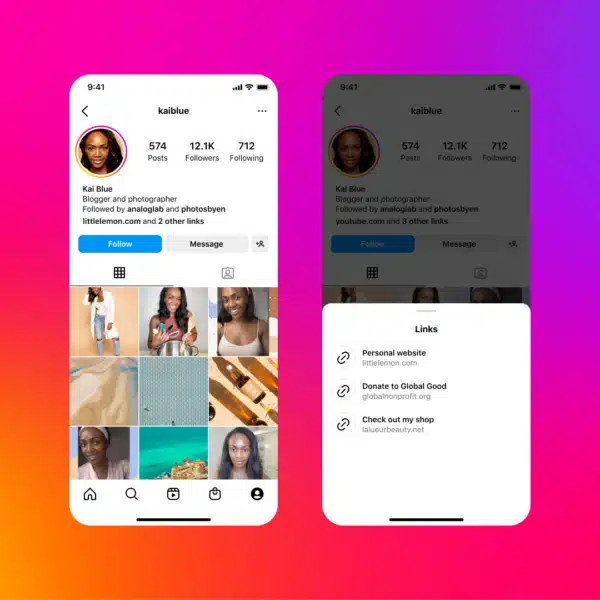
Instagram users can now add up to five links to their profile bios.

This new feature was announced in a brief post on Mark Zuckerberg’s broadcast channel, a relatively new feature that lets creators send messages to their entire community. Zuckerberg said that support for multiple links in the bio was “probably one of the most requested features we’ve had.”

How it works. The ability to add multiple links to a profile is available to all accounts, including business and creator accounts. To use the feature, users must go through the Edit profile, Links, and Add external link options, and then arrange the links in their desired order.

This feature directs followers to various content (e.g., online businesses, promoted brands, supported causes, profiles on rival social platforms), Instagram said.

Early testing. In initial tests, there were no issues linking to competing platforms like TikTok or YouTube. Instagram also offers users the option to link their Facebook profiles using a dedicated linking option, which displays a professional-looking rounded Facebook icon and accompanying text. However, external links do not include any special customizations, such as small icons.

The links do not open in a separate browser window but within the Instagram app itself. Users who want to switch to their built-in browser, like Safari or Chrome, must tap the three-dot menu at the top of the page and select open in system browser.

Competition with third-party tools. The emergence of Linktree, Beacons, and other “link in bio” solution providers can be attributed to platform restrictions on Instagram and other networks that have long prevented users from adding multiple links to external sites, fearing the potential loss of user engagement. By allowing expanded access to links, Instagram could potentially draw creators back to its platform.

Multiple Links 2 600x600

Trailing behind TikTok, again. Instagram is not the only platform to make this choice; TikTok currently only allows clickable links in bios for business accounts, making it difficult for regular users and creators to direct followers to other websites. Instagram’s decision to finally address the demand for increased access to bio links may be a response to criticism of TikTok’s stricter limitations.

Why we care. The new feature provides advertisers and brands an opportunity to increase traffic to their websites, ecommerce stores, and other online platforms. With the ability to add multiple links, businesses can more effectively promote their brand, products and services to potential customers, and can potentially increase engagement and conversions.


Related stories

New on Search Engine Land

@media screen and (min-width: 800px) { #div-gpt-ad-3191538-7 { display: flex !important; justify-content: center !important; align-items: center !important; min-width:770px; min-height:260px; } } @media screen and (min-width: 1279px) { #div-gpt-ad-3191538-7 { display: flex !important; justify-content: center !important; align-items: center !important; min-width:800px!important; min-height:440px!important; } }

About the author

Nicole Farley

Nicole Farley is an editor for Search Engine Land covering all things PPC. In addition to being a Marine Corps veteran, she has an extensive background in digital marketing, an MBA and a penchant for true crime, podcasts, travel, and snacks.

https://searchengineland.com/instagram-now-allows-up-to-5-links-in-bio-395742


9 more states join federal antitrust lawsuit against Google

A group of nine states, comprising Michigan, Nebraska, Arizona, Illinois, Minnesota, New Hampshire, North Carolina, Washington, and West Virginia, have become part of a U.S. Department of Justice lawsuit against Alphabet’s (GOOGL.O) Google. The suit contends that the search and advertising giant violated antitrust regulations while operating its digital advertising business, according to the department’s statement on Monday.

What’s happening. Initially filed in January by the government and eight states, the ad tech lawsuit has sought to compel Google to divest its ad manager suite, citing the company’s unlawful exploitation of its online advertising dominance. Google, however, has refuted these allegations and requested Judge Leonie Brinkema in the Eastern District of Virginia to dismiss the case. This ad tech lawsuit comes on the heels of a separate 2020 lawsuit, filed during the Trump administration, which accused Google of breaching antitrust law in order to sustain its search supremacy. The trial for this case is scheduled for September.

Google’s history of trouble. Lawsuits have plagued Google for years.

Why we care. Antitrust lawsuits against Google could reshape the digital advertising ecosystem, fostering a more competitive market with fairer pricing, increased transparency, and better control over campaigns.

Additionally, the resulting changes could promote innovation, leading to new tools and strategies for reaching target audiences, and address data privacy concerns, ensuring consumer trust and legal compliance. The potential implications of these lawsuits may directly impact advertisers’ strategies, costs, and overall effectiveness of their digital campaigns.


Related stories

New on Search Engine Land

@media screen and (min-width: 800px) { #div-gpt-ad-3191538-7 { display: flex !important; justify-content: center !important; align-items: center !important; min-width:770px; min-height:260px; } } @media screen and (min-width: 1279px) { #div-gpt-ad-3191538-7 { display: flex !important; justify-content: center !important; align-items: center !important; min-width:800px!important; min-height:440px!important; } }

About the author

Nicole Farley

Nicole Farley is an editor for Search Engine Land covering all things PPC. In addition to being a Marine Corps veteran, she has an extensive background in digital marketing, an MBA and a penchant for true crime, podcasts, travel, and snacks.

https://searchengineland.com/9-more-states-join-federal-antitrust-lawsuit-against-google-395740


Google’s interest-based ad experiments show ad spend, click-through rates down slightly

Results from a Google experiment showed that interest-based audience solutions performed reasonably well compared to third-party cookies.

The results. The results were compared using interest-based audience (IBA) solutions with privacy-preserving signals on the display network, Google Display Ads advertiser spending on IBA, as a proxy for scale reached (meaning that a particular metric or value is being used to estimate or represent the extent or level of impact achieved in a specific context. In this case, it indicates that the given metric serves as an indirect measure to help understand the overall reach or success of a particular aspect being discussed).

  • Advertiser spending on interest-based audiences (IBA) decreased by 2-7%, compared to third-party-cookie-based results.
  • For conversions per dollar, the decrease was 1-3%.
  • Click-through rates remained within 90% of the status quo.
  • Campaigns using optimized targeting or Maximize conversions bid strategies were less impacted by the removal of third-party cookies, indicating that machine learning can play a significant role in driving results.

The experiment. Google Ads and Display & Video 360 have been conducting experiments with interest-based audience solutions ahead of Chrome’s deprecation of third-party cookies.

In the first quarter of 2023, Google Ads platforms ran an experiment to determine the effectiveness of IBA solutions when relying on a combination of privacy-preserving signals, including contextual information, first-party identifiers, and the Topics API from the Privacy Sandbox.

Why it matters. Google believes that ad tech platforms can set a new standard for privacy that meets consumers’ expectations while giving businesses the tools they need to grow through innovation. Over the coming months, Google will continue to run more rounds of testing and provide regular feedback to Chrome and the broader industry. As an advertiser, it is important to adopt innovative ad solutions that protect people’s privacy and drive performance.

Dig deeper. You can read the full results of Google’s study here.

Why we care. The shift towards privacy-preserving interest-based audience solutions represents the future of digital advertising. As third-party cookies are being deprecated, embracing innovative ad solutions that protect user privacy is crucial to maintaining ad performance, meeting consumer expectations, and supporting business growth. By adopting these new solutions, advertisers can ensure continued effectiveness in targeting and conversion rates while upholding privacy standards and staying ahead in a rapidly changing industry landscape.


Related stories

New on Search Engine Land

@media screen and (min-width: 800px) { #div-gpt-ad-3191538-7 { display: flex !important; justify-content: center !important; align-items: center !important; min-width:770px; min-height:260px; } } @media screen and (min-width: 1279px) { #div-gpt-ad-3191538-7 { display: flex !important; justify-content: center !important; align-items: center !important; min-width:800px!important; min-height:440px!important; } }
About the author

Nicole Farley

Nicole Farley is an editor for Search Engine Land covering all things PPC. In addition to being a Marine Corps veteran, she has an extensive background in digital marketing, an MBA and a penchant for true crime, podcasts, travel, and snacks.

https://searchengineland.com/googles-interest-based-ad-experiments-show-ad-spend-click-through-rates-down-slightly-395734


SEO vs. PPC: Differences, pros, cons & an integrated approach

SEO or PPC? 

Like everything in marketing, it would be great if there was a simple answer to the SEO vs. PPC question. 

Unfortunately, despite the human temptation to simplify this into a binary answer, the answer is complicated. 

SEO helps your webpages rank higher on the non-paid search results by improving the quality and relevance of the content on your website. This improved visibility comes without the expensive costs per click of PPC. 

PPC ads are paid online advertisements that are laser targeted by demographics and keywords to get in front of the right people at the right time.

Typically, PPC ads show in highly prominent positions on the search results and hoover up the majority of clicks for highly commercial terms.

What is right for you?

This article will provide an overview of the search landscape and the two key search engine marketing (SEM) tactics, plus five simple questions you can ask yourself to determine where your efforts should be spent. 

Defining SEO and PPC

In a nutshell, SEO stands for “search engine optimization” and is the process of improving your website to increase its visibility on Google, Bing and other search engines.

PPC, or pay-per-click, are the ads that appear on a page of search results (typically in premium positions). 

The search landscape

The key to making an educated SEO vs. PPC decision is understanding the makeup of the search engine result pages (SERPs) for the keywords that matter to you. 

While the search results were once just “10 blue links,” modern search engines provide a rich array of page features, all designed to provide comprehensive answers along with the means to dig further into a topic. 

Modern SERPs feature: 

  • Ads 
  • Knowledge panels.
  • Featured snippets.
  • Maps.
  • Images. 
  • Videos.
  • Top stories (news).
  • People Also Ask.
  • Carousels.
  • Organic listings.
  • Search tools (related searches, etc.)
  • And more ads.

Search results are complex and diverse and each of these areas offers an opportunity for keen-eyed search marketers.

Now we understand the search landscape, we can dig into the relative merits of SEO and PPC and how these apply to your situation. 

SEO: The pros

How can you benefit from SEO? How do the organic listings differ from the paid listings that sit above the organic listings?

Awareness

Visibility in search engines for your targeted keywords drives awareness of your business. 

Branding

Visibility around commercial search terms and informational queries related to your business area can have a positive branding benefit. 

Your brand can become associated with and trusted by searchers asking questions as they conduct the research that will lead to a purchase. 

Credibility and trust

Having your site return in the organic results can influence your perceived credibility with an audience looking for your services. 

Many users skip ads and trust organic results more highly, particularly in the research stage of a purchase. Being visible gives your business that all-important stamp of approval.

Versatility

As we covered in our review of the search landscape, organic search results are highly varied and versatile. 

As such, there is a range of opportunities to present your business to your prospective clients as they research a purchase. 

Reputation and reviews

Search results include reviews from several sources and having strong review and reputation signals in place further boosts trust signals. 

Website traffic

Increasing website traffic gives you more opportunities to engage and educate a prospect as to why they would buy from you.

Cost per click

Traffic from organic search is free – sort of. Developing that visibility will take time and effort (money), but there is no direct charge for each impression or click. 

Return on investment (ROI)

As paid clicks continue to get ever more expensive, smart SEO can provide an improved ROI over paid clicks. 

Cost

While SEO is neither cheap nor easy, it will generally be more cost-effective than other marketing tactics for delivering brand awareness and relevant traffic to your website.

Sustainability

Unlike PPC, organic traffic does not dry up when you stop paying. As such, efforts to develop organic traffic can sustain a business when marketing budgets are tight.

Not paying for every click

Not all keywords convert the same and SEO can help you target users earlier in the purchase cycle without paying for those low conversion rate clicks. 

Scope

There are so many new queries every day that to maximize scope, you will need strong organic visibility. You will not want to pay for all kinds of clicks or advertise every piece of content on your website.

Strategic advantage

Visibility in organic search is not quick or easy – which is a good and a bad thing. 

Once you have established yourself in the organic results, your competitors can’t simply buy their way in (assuming you have done things the right way). 

This can provide a strategic advantage over the competition if they rely on paid search.

80/20 rule

With modern CMS platforms, SEO is simplified, and you can often generate 80% of the possible SEO results with only 20% of the work. 

SEO: The cons

SEO has many benefits, but it is not without its challenges. 

  • Highly competitive.
  • Search results can be very busy with several types of results.
  • Ads dominate the top of the search results.
  • Many search results are dominated by titans (Amazon, eBay, etc.).
  • Local results can be hyperlocalized resulting in poor organic radius.
  • Content development is tricky for smaller businesses.
  • Tactics like link building are difficult and shrouded in bad information online.
  • Algorithm changes can create turbulence and unexpected change.
  • Lots of bad information out there that can waste your time.

One of the key problems with SEO is that it is just so easy to spend a lot of time and effort on SEO tasks that do little or nothing to help. 

Blog posts that will never rank, meta descriptions that don’t matter, technical SEO – the list goes on. 

SEO tools, which are supposed to help with this problem, tend to make matters worse and generate endless lists of SEO tasks that are essentially just busy work. 

These tools have utility, but they require experience to know what should be done and what can be ignored. 

While highly valuable, SEO can be tricky to implement and highly competitive. 

It is important to develop realistic goals and measurements.  


Get the daily newsletter search marketers rely on.


PPC: The pros

How does paid search differ from organic search? If SEO provides free traffic, why would a business consider paid search?

Targeting

PPC provides a laser-targeted way to get in front of potential customers. 

Ads can be targeted by search keywords, time of day, day of the week, geography, language, device and audiences based on previous visits. Organic traffic, by comparison, is far more scattershot.

Speed

While developing organic visibility can take time, a PPC campaign can be created in days and ramped up in weeks. There is no faster way to get in front of customers when they are primed to buy than paid search engine advertising.

Position on the page

Paid search dominates above-the-fold content. 

With typically four ads on desktop and three on mobile, a user will always see the paid search ads, even if they choose to scroll past them.

Improved ads

PPC ads are just that: advertisements. You have far more granular control and more space for delivering your marketing messages. 

Calls, locations, site links, pricing and bullet points (callouts) are just some of the options for creating ads that dominate the page.

Dynamic ad copy

Google’s responsive search ads have 15 titles and four descriptions providing over 30,000 variations with built-in split testing. This ensures your ads are customized to help generate clicks. 

Visual product ads

Where you sell a product, Google provides the option of visual shopping ads (product listing ads, or PLAs) that can help a user see what they will be clicking on. 

Brand visibility

Running paid search advertisements gets you seen by the right people. Even if they back off and conduct a brand search before clicking on your site, that visibility will pay dividends to your marketing.

Budget

While costly, PPC allows for budget control. Determine how much you are willing to spend per day (ideally with some initial and ideal ideas of returns), and set that fixed limit.

Agile

Speed provides agility. Want to test a new product? A new marketing message? 

You can get rapid feedback on a new product launch (or minimum viable product) by running a short PPC ad campaign.

Marketing intelligence

Where organic largely hides keyword data in the name of privacy, there is no such restriction with paid search. 

With integration with analytics software (like Google Analytics), we can determine what keywords convert and at what percentage and cost. 

This intelligence can be fed directly into SEO and inform all other advertising to improve results across the board.

A/B testing

Easily split-test ads, landing pages, and even call-to-action buttons to determine where the very best results lie. 

Again, this information can be fed back into all other digital (and traditional) marketing endeavors.

Stability

Despite the competition, paid search does not typically suffer the same turbulence as organic. 

There are changes, but they tend to have a far lower impact and are more easily managed. 

Careful use of match types and analysis of the search term reports allow for the removal of junk searches and an increase in ROI over time.

Cost

Despite what many advertisers believe, a PPC account that’s set up and managed well can be a low-cost way to generate leads for your business. 

If you are a local business targeting a small geographic area and a small set of keywords, you may find that you can generate more than enough leads without breaking the bank. 

Additionally, over time, accounts can be further optimized to reduce costs and increase returns.

PPC: The cons

There are clearly many benefits to PPC. However, there are also some pitfalls advertisers must be wary of.

  • PPC can be expensive.
  • PPC can be highly competitive for commercial terms.
  • PPC requires constant investment. Stop spending and traffic dries up
  • Strategically easy to copy.
  • Easy to start, difficult to master.

PPC on search engines is a highly powerful, and quite possibly the most powerful marketing system that has ever existed. 

To succeed in a highly competitive environment, everything must be set up correctly: keywords, ads, landing pages and analytics. 

It is not unusual to get into bidding wars with other advertisers, which can drive costs up. 

As you start to run your ads, you are often taking a bite out of other advertisers’ digital apple. Doing so can result in spiraling costs (or revising your strategy). 

Successful PPC needs skilled management and optimization – from monitoring bids, Quality Scores, positions and click-through rates. 

Some of this can be done with scripts, but if you are too busy to do this properly, ensure you have an expert on hand to take care of keeping your account in tip-top shape.

PPC is incredibly powerful, but you must ensure all aspects are optimized to maximize results while keeping costs reasonable. 

Hopefully, you have an idea of the pros and cons of SEO and PPC now and are better positioned to review the landscape.

The next step is to work through a series of questions to determine the correct approach based on your target keywords and current situation.

SEO or PPC: 5 questions to ask

The following are five simple questions you can ask to help determine where you should spend your time and resources.

1. What keywords are you targeting? 

This question is crucial as your target keywords will strongly influence your choice between SEO and PPC. 

A useful exercise here to aid keyword research is to create a persona and answer the who, why and how customer questions.

  • Who are your customers?
  • Why do they buy? (Is something broken?)
  • How do they buy? (What is the search journey?)

This can be a useful framework to help with the keyword research process (in addition to any tools you may want to use).   

2. What do the results look like for each keyword?

Google each keyword and summarize the search results for each.

This does not need to be complicated; some simple bullets will do the job. 

Keyword: “Plumber”

  • 3 x local service ads
  • 1 x text ad
  • Find results on links (3 x external sites)
  • Local pack
    • Local listing 
    • Local listing
    • Local listing
  • People also ask
    • Question
    • Question
    • Question 
    • Question 
  • Organic 1: Directory
  • Organic 2: Wikipedia 
  • Organic 3: Directory
  • Organic 4: Government careers site
  • Organic 5: Portal
  • Organic 6: Local business

Here we see that the three-pack has good organic visibility right at the top of the page so SEO is likely useful if targeting a small geographic area. 

However, if you are targeting a larger area and can’t likely rank in the pack then the first non-directory or portal listing is the position 6 organic listing. 

This is around the 22nd link on the page (so unlikely to generate significant organic traffic). 

By conducting this relatively simple analysis for your keywords and reviewing the landscape you can make some estimates regarding whether ad coverage or SEO will generate the required results. 

3. How do the results vary by location?

There is a common mistake that a lot of local businesses make, which is to assume that what they see when they Google their target keywords at their location is what everyone sees. 

It is important to track your results from different locations as the ads, local pack and organic results (typically localized) will vary. 

What we recommend here is that you either conduct manual rank reports from different locations or ideally, use a rank tracking tool that will show you your rankings at various points across the geography you cover.

Note: You may see that your results are strong within a given distance of your location but drop off further away from your location. Sometimes, a combined SEO and PPC approach can be useful.

4. How much business do you need?

This is an important question and where we start to see some intersectionality from these questions. 

If you are a small business servicing a local area and need maybe one or two good leads a week, then SEO may give you more than you need. 

We have helped hundreds of small businesses that fall into this category, and once SEO is dialed in, they never spend a penny on PPC. 

If you are a larger business, have multiple teams and service a large city or geographic area, you may also need some coverage with PPC on top of SEO to ensure you generate enough work. 

5. What do you have more of – time or money?

An important difference between SEO and PPC is that you can do SEO yourself or within your business without any real costs. 

All the information you need is out there to improve your visibility. 

Time is money. So, if you have a larger team costing you money, then spending money to generate leads quickly makes sense.

This is where we have to consider the pros and cons we discussed earlier, as improving SEO can take a while, whereas PPC can be almost instant. 

It is important to determine what is right for your completely unique situation and objectives and lean in that direction. 

SEO vs. PPC: Your unique roadmap 

Hopefully, you can see it is impossible to answer this question in a generic way. You really have to consider all the variables.

A hyper-local business with little competition and a requirement for just a few leads per week could likely develop good visibility in the local and organic search results with a little spend or some DIY SEO.

A new ecommerce store that is competing with a page of results from Amazon, eBay and other major department stores and online retailers is likely going to struggle in organic search (in the short term, at least).

Do you need leads now? Are you looking at the long game? Do you have much in the way of website authority? What is the competition like in organic search? What is the cost per click in paid search?

A clear digital marketing strategy and short- and long-term goals are essential in making an SEO or PPC decision.

The third option: SEO and PPC

In most cases, the right approach will not be either SEO or PPC. It will be a holistic SEM strategy that combines both.

SEO and PPC work best when they are strategically aligned to work together. 

A blended approach will typically drive overall results greater than their parts.

The benefits of running SEO and PPC together include:

  • Keyword and conversion data from PPC can be fed into organic search (SEO).
  • Geographic areas with weaker SEO coverage can be covered by PPC. 
  • The total traffic volume can be increased by targeting clicks in paid and organic for high-performing keywords.
  • High-cost, high-volume or low-converting (yet still important) keywords can be moved from PPC to organic search.
  • A/B testing of ad copy and landing pages can be fed into your organic listing and landing pages.
  • Remarketing allows you to stay in front of visitors after an initial touch via organic search and customize messaging around their engagement with your site.
  • Test your keyword strategy in PPC before committing to long-term SEO strategies.
  • Target users at all customer journey stages, from research to comparison to purchase with commercial keywords.
  • Increase confidence and awareness by having both strong organic and paid visibility.

In our experience with thousands of businesses, an integrated search strategy that looks at both SEO and PPC is the optimal approach. 

We may often start with heavy PPC while organic is built up and then dial that back a little. Alternatively, PPC may be the icing on the cake to bag sales that were set up with SEO traffic. 

What is right will always depend on your situation and goals, but the smart mindset is to look at how to get these two titans of modern marketing working together. 


Opinions expressed in this article are those of the guest author and not necessarily Search Engine Land. Staff authors are listed here.


Related stories

New on Search Engine Land

@media screen and (min-width: 800px) { #div-gpt-ad-3191538-7 { display: flex !important; justify-content: center !important; align-items: center !important; min-width:770px; min-height:260px; } } @media screen and (min-width: 1279px) { #div-gpt-ad-3191538-7 { display: flex !important; justify-content: center !important; align-items: center !important; min-width:800px!important; min-height:440px!important; } }

About the author

Marcus Miller

Marcus Miller is an experienced SEO & PPC consultant based in Birmingham, UK. Marcus focuses on search marketing strategy and helping businesses cut through the smoke and mirrors of SEO, PPC and search marketing. Marcus is managing director of the UK SEO and digital marketing company Bowler Hat that focuses on helping businesses with their SEO & PPC, but also on training internal staff to help empower businesses to manage their own search destiny.

https://searchengineland.com/seo-vs-ppc-pros-cons-integrated-approach-274643


Google implements a new GA4 fractional, cross-channel web conversions feature

Google Ads has recently implemented a new feature that allows the platform to import fractional, cross-channel web conversion credits from Google Analytics 4 properties.

How it works. In the past, web conversions were imported from Google Analytics 4 using a cross-channel last click approach and then assigned in Google Ads based on the chosen attribution model in the user’s Google Ads account. This meant that if the final click did not originate from Google advertising, the conversion would not be imported into Google Ads.

With the latest update, Google Ads now imports fractional cross-channel conversion credits, even when the last non-direct click was not from Google advertising. For instance, if data-driven attribution is chosen for an imported conversion action, all fractional, attributed Google credits visible in Google Analytics 4 reporting will be imported into Google Ads, irrespective of the last touchpoint.

Dig deeper. Read the announcement from Google here.

Why we care. This upgrade allows advertisers to make better-informed decisions when optimizing their ad spend, leading to improved ROI and increased campaign effectiveness. By considering all touchpoints in the customer journey, advertisers gain a holistic view of their marketing efforts, ensuring they allocate resources efficiently and ultimately achieve better results.


Related stories

New on Search Engine Land

@media screen and (min-width: 800px) { #div-gpt-ad-3191538-7 { display: flex !important; justify-content: center !important; align-items: center !important; min-width:770px; min-height:260px; } } @media screen and (min-width: 1279px) { #div-gpt-ad-3191538-7 { display: flex !important; justify-content: center !important; align-items: center !important; min-width:800px!important; min-height:440px!important; } }

About the author

Nicole Farley

Nicole Farley is an editor for Search Engine Land covering all things PPC. In addition to being a Marine Corps veteran, she has an extensive background in digital marketing, an MBA and a penchant for true crime, podcasts, travel, and snacks.

https://searchengineland.com/google-implements-a-new-ga4-fractional-cross-channel-web-conversions-feature-395730