How to glean insights from impression share to boost PPC performance

Search marketers have a bevy of metrics at their disposal. It can be difficult to know exactly how to react when we’re analyzing all these metrics simultaneously.

I’m a proponent of leveraging impression share metrics to identify meaningful optimizations for my paid search campaigns.

The insights don’t necessarily come from the impression share itself, but the impression share lost due to rank or budget. 

This article we’ll cover:

  • What each metric represents.
  • Tips for calculating these metrics at scale in a spreadsheet.
  • How to take action based on the results of your analysis. 

Here’s what each metric means:

  • Impression share (IS): The percentage of impressions your ads receive compared to the total number of impressions your ads could get.
  • Impression share lost due to budget: The percentage of impressions your ad would have received if you had an unlimited budget. 
  • Impression share lost due to rank: The percentage of impressions your ad would have received if your ad had the highest rank. 
Optimization opportunities

Though it might be obvious, note that the sum of these three metrics is 100%.

This is important because it can help you identify the potential impact of different optimizations. If one is significantly higher than the other, you know where to exert your energy.

Calculating impression share at scale

If you are familiar with my content, you are likely aware that I minimize my time on activation platforms and focus my energy on number crunching. (Surprise, surprise!) It’s no different with impression share metrics.  

Understanding that the sum of these three metrics equals 100% also gives you the tools needed to aggregate impression share calculations at scale. It’s simply a math formula that we can replicate in a spreadsheet using basic calculations.

Before jumping into the technique, I will note that using filters in the platform should always be the source of truth, especially if you frequently see the infamous impression share of “<10%” in your account. 

The below is meant to provide mathematically-backed estimates and enhance your analytical abilities, especially when dealing with a lot of data. Always go with what you see in the platform if you’re reporting to your stakeholders. 

When I do see “<10%” in my analysis, I first attempt to subtract the IS Lost (Rank) and IS Lost (Budget) from 1. If either of those metrics shows as “>90%,” I use an assumption of 5%. If you include the 5% estimate, this will inherently expose you to slight accuracy risks. 

The first step is calculating what I refer to as the “Universe of Impressions,” or UoI, which represents the total possible number of impressions. (I’m unsure if this metric has an official name.)

Since we know how many impressions our campaign generated and that impression share represents the proportion of the total possible impressions you showed, we can simply divide the impressions by the impression share to know the total possible impressions or UoI. 

Impression share and UoI calculation

Now that we know the total number of impressions, we can calculate the estimated impressions we lost due to budget constraints by multiplying the UoI by the IS Lost (Budget).

We replicate this same calculation using IS Lost (Rank) to calculate the estimated number of impressions we’re losing to poor ranking in the auctions. I’ve combined those steps in the next screenshot.

IS lost to budget and IS lost to rank

You can always check your math by summing your impressions, estimated impressions lost (budget), and estimated impressions lost (rank) and comparing them to the UoI.

If your math is right, they should be identical.

IS lost to budget and rank - calculation checks

The final step is creating a pivot table with calculated fields representing our three impression share metrics using the column titles above.

  • Estimated impression share:
    • [Impr.] / [Est. UoI]
  • Estimated impression share lost due to budget:
    • [Est. Impr. Lost (Budget)] / [Est. UoI]
  • Estimated impression share lost due to rank:
    • [Est. Impr. Lost (Rank)] / [Est. UoI]

With this approach, you can now adjust your pivot table and see a dynamic calculation of impression share based on the filters and inputs you include. 

To illustrate this, I’ve included the highlighted campaign totals across the two weeks. Feel free to use the screenshots above to check my math.

Est IS pivot table

If you find tips like these useful, I encourage you to check out my previous article on Excel pivot table best practices for search marketers. 


Get the daily newsletter search marketers rely on.


Optimizing based on your impression share insights

Now that you’ve done all your number crunching, it’s time to turn the analysis into action.

You know what is best for your business, and many optimizations are at our disposal.
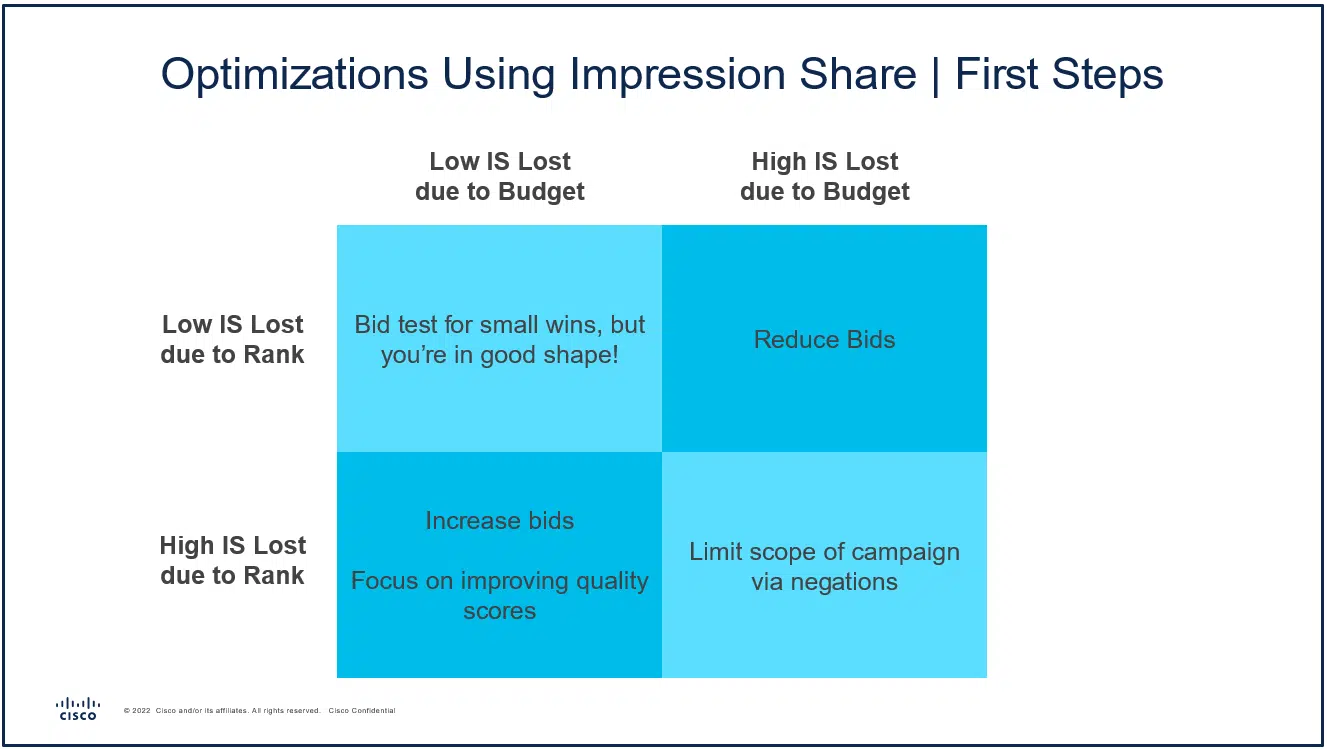
Optimizations using impression share

I’ve attempted to summarize how I approach optimizations based on what I see in the impression share metrics. But in reality, the lines blur between these boxes. 

For example, you could increase your bids to help improve the bottom right corner scenario (high IS lost due to rank and high IS lost due to budget).

One tip I’d encourage you to implement within your campaigns is to focus on driving down impression share lost due to budget, even if that means shifting the IS lost from budget to rank.

Most advertisers can’t make budget magically appear to solve the “IS lost due to budget” problem. 

This mindset will generally lead to more effective performance, as shifting the IS lost from budget to rank likely means you are culling down your campaigns or getting “stingier” about spending the budget. 

To finish, here are some of my favorite approaches to limit the scope of campaigns, if that’s the optimization that makes the most sense:

  • Dayparting.
  • Keyword pauses.
  • Segment-based negations. (Audiences, geos, devices… you name it!)
  • Negative keywords.

If we’re focused on improving quality scores, here are the ways I typically try to approach this:

  • Ad copy refreshes.
  • Increasing the number of extensions in use.
  • Negative keywords.
  • Landing page testing.

It should be noted that there are other impression share metrics, such as top IS and absolute top IS.

The good news is that the calculations highlighted in this article apply to those metrics, too. They can be leveraged with general IS metrics to create more informed insights.


Opinions expressed in this article are those of the guest author and not necessarily Search Engine Land. Staff authors are listed here.


Related stories

New on Search Engine Land

@media screen and (min-width: 800px) { #div-gpt-ad-3191538-7 { display: flex !important; justify-content: center !important; align-items: center !important; min-width:770px; min-height:260px; } } @media screen and (min-width: 1279px) { #div-gpt-ad-3191538-7 { display: flex !important; justify-content: center !important; align-items: center !important; min-width:800px!important; min-height:440px!important; } }

About the author

Anthony Tedesco

Anthony Tedesco is a search engine marketing professional based in Boston, Massachusetts. He started his career at Red Ventures in Charlotte, North Carolina, where he learned the impact of data-driven performance optimization and full-funnel marketing strategies. He then returned to his native Boston, where he joined DWA/Merkle B2B, working with Fortune 100 brands to maximize the value of their SEM investments. In 2021, Anthony joined the global paid media team at Cisco Systems, Inc., where he orchestrates high-impact tactics at scale and helps solve the complex challenges marketers face in the evolving digital landscape. Anthony is an avid Tar Heel and Boston sports fan. If not watching his favorite teams, he enjoys traveling throughout New England with family and friends or catching up on old seasons of Survivor.

https://searchengineland.com/impression-share-ppc-performance-395509


Connected TV’s results transcend the TV screen by MNTN

MNTN TDM Sponsored Article Featured Image 1920x1080 1 800x450

The tides of paid search and other performance channels seem to be shifting rapidly these days. Companies are changing hands, algorithms are updating and transparency is diminishing. With marketers looking for ad channels that they can consider both reliable and effective, this is where connected TV can enter the scene and support an already successful search strategy.

CTV is not just a brand awareness tool like its linear television predecessor, but it can also help advertisers achieve their performance goals, becoming the third pillar of performance marketing. Not only does it deliver performance results in its own right, but it also boosts the results of other paid channels, creating a halo effect.

Connected TV generates new demand

Connected TV is an essential tool for advertisers looking to generate new demand and avoid a dreaded performance plateau on your existing channels. There comes a time, after all, when adding more budget offers diminishing returns and the need for a new channel is necessary. 

Paid search relies on a self-identifying audience–a user’s interest and intent are clear based on their search. This makes them easy to target and capture. This audience is the low-hanging fruit. What happens when these leads have all been captured? The ease of identifying this powerful audience also means that it’s ripe with competition; your competitor is likely bidding on the same inventory.

Connected TV, on the other hand, creates and captures an incremental audience. CTV ads are precisely targeted to an audience that may benefit from a product or service but may not be in-market quite yet, thus creating new demand. Why is this important? The Harvard Business Review found 90% of B2B decision-makers purchase from companies they already knew at the start of the buying process. CTV allows advertisers to put themselves in this initial consideration set with TV ads that are high-impact, memorable, and carry the prestige generated by TV advertising.

From an SEO perspective, there is also the benefit of direct search. Connected TV puts the advertiser’s name out there, increasing the likelihood that they are searching directly for the company name itself and not just a product or service that you offer. These direct searches have a positive impact on your SEO efforts, underscoring the credibility of your brand and ultimately raising your ranking within the search results.

Paid search results skyrocket when CTV is added

Connected TV helps generate new traffic, which in turn, paid search and other paid channels can help capture. However, the benefits of adding CTV to the ad mix don’t stop there. When added to the ad mix, CTV actually creates a halo effect around paid search, social, and email, increasing their performance results in their own right.

A review of MNTN clients running paid search, social, and/or email before adding connected TV showed this trend across the board.

MNTN Research Advertiser Trends Halo Effect Graph 2 800x557

Only 30 days after adding connected TV to their strategy, MNTN clients saw an increase in conversion rates for both paid search and social, with increasing results over the next two months. When looking at email trends, these also showed a similar trend, with the conversion rates increasing 17.58% thirty days after adding CTV and 37.35% ninety days after. The first-party data was clear; Connected TV drives strong performance in its own right and makes other performance channels perform better too.

Video doesn’t need to be a barrier to reap the rewards of CTV

A key to success with connected TV is having video content–and enough of it–for regular refreshes. But before you worry that this is a blocker to adding CTV to your strategy, it’s not as hard (or costly) as you may think.

If you are already running social videos, this can be the perfect place to start. You can repurpose those same videos on the TV screen. CTV’s real-time reporting will help provide insights into what’s working and what’s not so you can make the appropriate adjustments before your next round of creative development.

If you don’t have video available to you, there are non-agency solutions that don’t cost an arm and a leg to make video creative. For example, at MNTN, we offer Creative-as-a-Subscription (CaaS) that bundles your media spend with creative development, so you don’t have to choose between spending on making ads or running them.

CaaS offers regular video refreshes, which deliver better results over time. Relying on the same video ads can result in ad fatigue or ad blindness. Regular refreshes disrupt this process and capture viewers’ attention. From our first-party data, we’ve seen that advertisers who regularly refresh creative have a 49.71% higher conversion rate and a 14.74% higher return on ad spend. Amazing what you can accomplish when creative fatigue isn’t a concern, right?

While spending time and money on the TV screen may feel counterproductive to a robust search strategy, Connected TV can actually help your search results thrive and reach new heights. You’ll be generating both brand awareness and key performance metrics with CTV while also boosting the impact of your already successful search strategy.


Related stories

New on Search Engine Land

About the author

MNTN

MNTN builds advertising software for brands to drive measurable conversions, revenue, site visits and more through the power of television. MNTN Performance TV is the world’s first and only Connected TV advertising platform optimized for direct-response marketing goals. It redefines what advertisers can do with television, giving them the power to tie performance directly to their TV campaigns.

https://searchengineland.com/connected-tvs-results-transcend-the-tv-screen-395432


Microsoft Ads introduces PLA Extensions

PLA Extensions are the first fully integrated retail media solution from Microsoft allowing brands to serve product ads both onsite and offsite with a single budget while automatically optimizing for the best balance of performance and reach.

How it works. Previously limited by ad supply constraints onsite (advertising products on a retailer’s website), brands will now be able to reach a significantly larger number of in-market shoppers offsite. By displaying highly relevant product ads to shoppers and directing them back to the retailer’s website for purchase, brands can adopt a more unified approach to their retail media investments.

Onsite vs. offsite ads. PLA Extensions enable brands to measure the impact of their onsite and offsite ads and gain a more comprehensive view of the shopper’s journey.

With PLA Extension, brands can access more ad supply offsite and also activate the retailer’s first-party data and Microsoft’s audience intelligence to target highly relevant shoppers through offsite channels—including new buyers.

When brands choose to use PLA Extension, if an onsite campaign is underspending, the feature will automatically extend their product listing ad to offsite product placements powered by the Microsoft Search Network and the Microsoft Audience Network, optimizing performance and reach across on- and offsite product ad placements.

Functionality explained. For example, suppose a shopper, John, is searching for a new pair of boots on his favorite retailer’s website. He sees an ad for a specific brand of boots but gets distracted before adding them to his cart and leaves the website without making a purchase. Later that evening, he sees the ad again on Bing, clicks it, and is directed to the product page on the retailer’s website, where he completes his purchase. Meanwhile, another shopper, Sandra, who is unfamiliar with the brand, sees the ad on DuckDuckGo and clicks through to make a purchase. Thanks to PLA Extension, the brand has reached in-market shoppers both on and off the retailer’s site with a single PLA campaign.

PLA Extension increases brand awareness and directs potential customers back to the product landing page, expanding the audience and raising the likelihood of sales.

Try it out. Brands currently working with one or more retailers powered by Microsoft PromoteIQ and interested in leveraging this new feature should contact their PromoteIQ account representatives and inform their retailers.

Dig deeper. Read the announcement from Microsoft here.

Why we care. PLA Extension enables advertisers to expand their reach by serving product ads both onsite and offsite with a single budget. This approach allows brands to target a larger number of potential customers and drive more traffic to their product pages.


Related stories

New on Search Engine Land

@media screen and (min-width: 800px) { #div-gpt-ad-3191538-7 { display: flex !important; justify-content: center !important; align-items: center !important; min-width:770px; min-height:260px; } } @media screen and (min-width: 1279px) { #div-gpt-ad-3191538-7 { display: flex !important; justify-content: center !important; align-items: center !important; min-width:800px!important; min-height:440px!important; } }

About the author

Nicole Farley

Nicole Farley is an editor for Search Engine Land covering all things PPC. In addition to being a Marine Corps veteran, she has an extensive background in digital marketing, an MBA and a penchant for true crime, podcasts, travel, and snacks.

https://searchengineland.com/microsoft-ads-introduces-pla-extensions-395491


Google Ads API is removing ad group and keyword forecasts

Google will be deprecating the “Keyword Plan Ad Group Forecast” and “Keyword Plan Keyword Forecast” functionalities. This change is slated to take effect on June 1, 2023.

Changes to the GenerateForecast Metrics Request. Beginning June 1, the “Generate Forecast Metrics Request” will continue to be the method for obtaining forecast data. However, the “Keyword Plan Ad Group Forecast and Keyword Plan Keyword Forecast” components will no longer be populated and will instead return empty results. The “Keyword Plan Campaign Forecast,” on the other hand, will remain functional and be returned as usual.

Updating Your Applications. If your applications rely on the “Keyword Plan Ad Group Forecast” or “Keyword Plan Keyword Forecast” features, it is critical that you update them to accommodate the upcoming changes. Make sure your applications are prepared to handle empty responses from these components.

Recommendation and Resources. Google encourages you to start updating your applications as soon as possible to ensure a seamless transition. For guidance on how to effectively use the “Keyword Plan Campaign Forecast,” you should refer to the Google Ads API documentation.

Why we care. If advertisers or publishers rely on these features in their applications, they need to update their systems to ensure continued functionality. Failing to do so may lead to disruptions or inaccuracies in their forecasting and ad performance management.


Related stories

New on Search Engine Land

@media screen and (min-width: 800px) { #div-gpt-ad-3191538-7 { display: flex !important; justify-content: center !important; align-items: center !important; min-width:770px; min-height:260px; } } @media screen and (min-width: 1279px) { #div-gpt-ad-3191538-7 { display: flex !important; justify-content: center !important; align-items: center !important; min-width:800px!important; min-height:440px!important; } }

About the author

Nicole Farley

Nicole Farley is an editor for Search Engine Land covering all things PPC. In addition to being a Marine Corps veteran, she has an extensive background in digital marketing, an MBA and a penchant for true crime, podcasts, travel, and snacks.

https://searchengineland.com/google-ads-api-is-removing-ad-group-and-keyword-forecasts-395525


Google Ads tests new verification badge

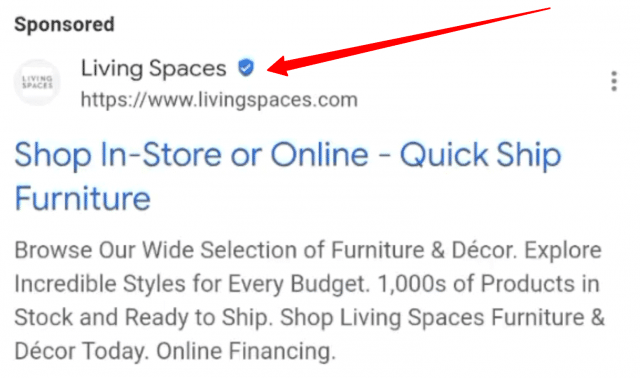
A new-look verification badge is starting to appear in Google Ads for verified advertisers.

What the verified badge looks like. This new-look badge takes the form of a blue shield with a white check mark, as shared by Saad AK on Twitter:

Google Badge Livingspaces

Clicking on the badge takes you to My Ad Center, where Google tells you the advertiser’s name, that it’s verified by Google and its location.

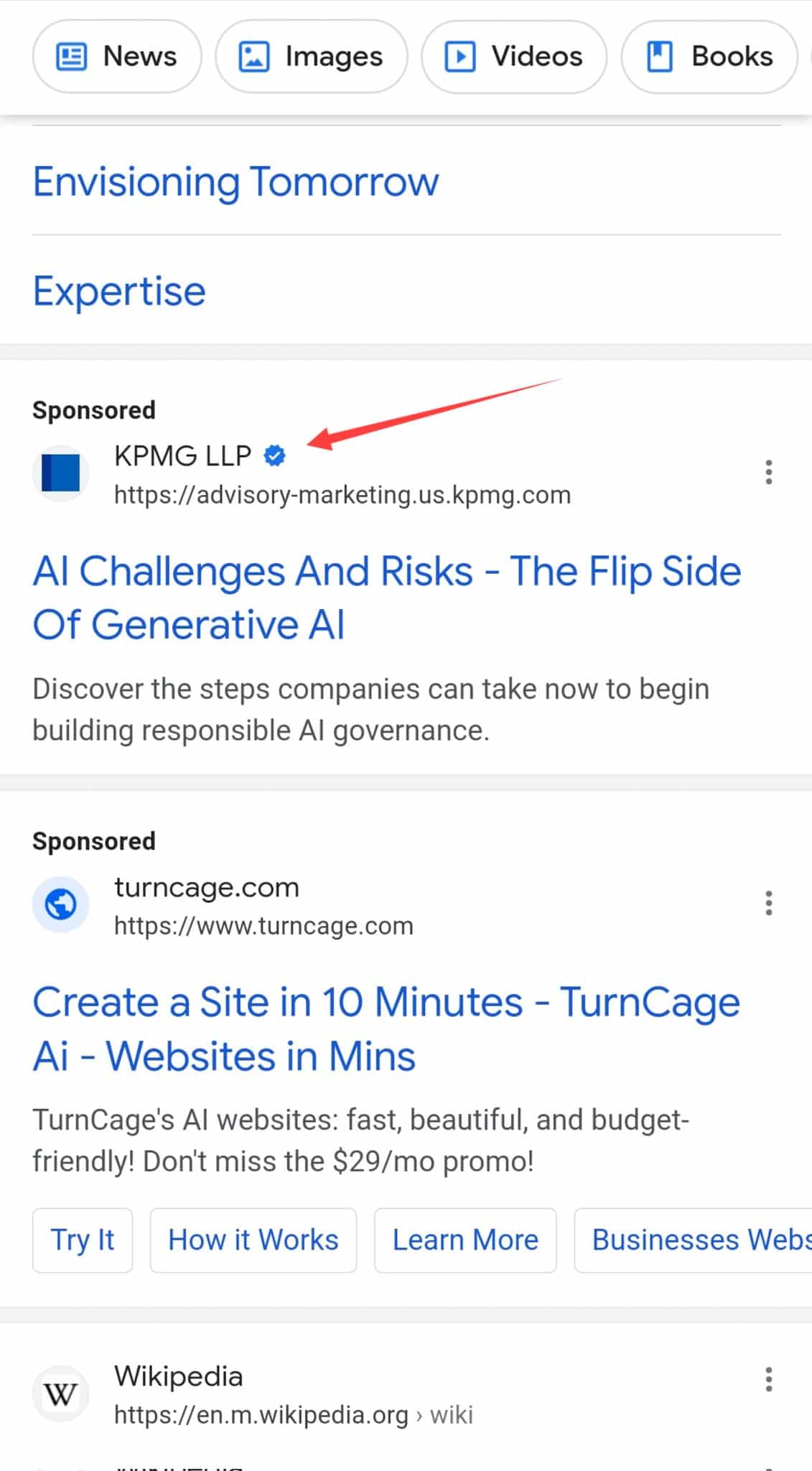
Previous badge design. Google has been experimenting with blue badge icons and labels in recent weeks. In Google Ads testing verification badges, we reported on a badge spotted and shared by Khushal Bherwani on Twitter.

The blue label featured a blue circle with ridges and a checkmark inside it. Here’s what that looked like:

Google Badge Kpmg

Why we care. Verification badges are typically seen by consumers as a trust symbol. This small addition could impact potentially lead to more clicks, higher click-through rates and conversions for those advertisers who have it.

Advertiser verification program update. Separately, Google also posted this update on its business information beta:

  • A subset of advertisers may qualify to voluntarily submit their identity verification to access the Business Information feature which allows advertisers to use a business name and business logo in their search ads. Advertisers who are qualified for this program, will see an option in their Google Ads account to complete advertiser verification to unlock this feature. There will be no deadline and no adverse consequences for failing to complete or meet the requirements of this advertiser verification program.

Google rolled out the site name, favicons, and sponsored label to desktop in March, after launching them on mobile last October.


Related stories

New on Search Engine Land

@media screen and (min-width: 800px) { #div-gpt-ad-3191538-7 { display: flex !important; justify-content: center !important; align-items: center !important; min-width:770px; min-height:260px; } } @media screen and (min-width: 1279px) { #div-gpt-ad-3191538-7 { display: flex !important; justify-content: center !important; align-items: center !important; min-width:800px!important; min-height:440px!important; } }

About the author

Danny Goodwin

Danny Goodwin has been Managing Editor of Search Engine Land & Search Marketing Expo – SMX since 2022. He joined Search Engine Land in 2022 as Senior Editor. In addition to reporting on the latest search marketing news, he manages Search Engine Land’s SME (Subject Matter Expert) program. He also helps program U.S. SMX events. Goodwin has been editing and writing about the latest developments and trends in search and digital marketing since 2007. He previously was Executive Editor of Search Engine Journal (2017 to 2022), managing editor of Momentology (from 2014-2016) and editor of Search Engine Watch (from 2007 to 2014). He has spoken at many major search conferences and virtual events, and has been sourced for his expertise by a wide range of publications and podcasts.

https://searchengineland.com/google-ads-tests-new-verification-badge-395510


10 minute TikTok videos are gone

A little over a year ago, TikTok allowed users to upload videos up to 10 minutes long. Now, users have noticed that option is gone.

User reactions. Several TikTok users have posted videos speculating on why the change happened, asking TikTok to bring back the longer format, and venting about TikTok releasing the update seemingly out of nowhere without warning.

Why we care. If TikTok frequently makes unannounced changes to its platform, it could potentially create an impression of inconsistency. Users and advertisers might perceive the platform as less stable or reliable, which could impact their long-term trust and engagement with TikTok.


Related stories

New on Search Engine Land

@media screen and (min-width: 800px) { #div-gpt-ad-3191538-7 { display: flex !important; justify-content: center !important; align-items: center !important; min-width:770px; min-height:260px; } } @media screen and (min-width: 1279px) { #div-gpt-ad-3191538-7 { display: flex !important; justify-content: center !important; align-items: center !important; min-width:800px!important; min-height:440px!important; } }

About the author

Nicole Farley

Nicole Farley is an editor for Search Engine Land covering all things PPC. In addition to being a Marine Corps veteran, she has an extensive background in digital marketing, an MBA and a penchant for true crime, podcasts, travel, and snacks.

https://searchengineland.com/10-minute-tiktok-videos-are-gone-395487


How to think about brand exclusions for Performance Max

Sometimes, the disconnect between Google Ads and the primary user base is so strong that you can almost feel it.

A perfect example is how advertisers have constantly asked for the option to exclude branded traffic from Performance Max campaigns. Google remained non-committal for over a year, except to suggest account-level negative keywords (not the same thing at all).

Until the announcement of campaign-level brand exclusions earlier this year, you couldn’t go a single day without someone sharing a real example where excluding branded queries would have allowed them to maintain a certain degree of performance. This evidence is what made Google’s silence feel truly deafening.

While I don’t doubt that many of my peers wanted this ability for the right reasons, it’s not fair to assume that our little corner of Twitter – where many of us have been doing Google Ads for well over a decade – is an accurate reflection of the PPC industry as a whole.

I fully support PPC marketers having control over critical decisions. Still, I also encourage each of us to make decisions in the best interest of our accounts, not because everyone else is doing it a certain way or because you’ve always done it that way.

In some situations, brand exclusion makes sense. Yet, in others, it might not be the right move. Below, I’ll share how I’m making these decisions for the accounts I manage, which might be helpful if you’re facing similar concerns.

The case for excluding branded queries from Performance Max

Advertisers who want to exclude branded queries from specific Performance Max campaigns typically want to do so for one of two reasons:

  • Inflated cost per click for branded terms.
  • Google’s inability to differentiate between branded and generic conversions.

When using bid strategies such as Target CPA/ROAS or even Maximize conversions, Google’s system will try to find additional search volume after capturing all available brand searches.

Because no broad keywords replace a brand name and retain the same intent, all this does is artificially inflate your CPC. And as a second-order effect, it undoes much of the work we put into optimizing acquisition costs.

We typically use the Target impression share bidding strategy for branded search queries paired with Exact or Phrase match keywords. This allows us to show up close to 100% of the time without inflating CPCs.

Given that you lose the ability to set different bids or targets for branded vs. generic terms in Performance Max, removing branded traffic from Performance Max makes sense if cost optimization is a priority (which it is for any brand that doesn’t spend millions a month).


Get the daily newsletter search marketers rely on.


The case against brand exclusions in Performance Max

At the same time, it’s essential to recognize that excluding branded traffic is not always the right play to make.

I wonder how many people look forward to brand exclusions simply because of old habits. In other words, how many people try to run Performance Max the same way they run single-network campaigns like Search or Shopping?

Unlearning old habits for new technology is a tough thing to do. I see it often, particularly on social media. People try to set up and run Performance Max like a Search or Shopping campaign and then blame Google when it doesn’t pan out.

By design, Performance Max is a full-funnel campaign type. Removing branded queries means you deny it data on an essential layer of the lower funnel, thus depriving Performance Max of a chance to understand how people go from awareness to purchase.

How to decide on individual PPC accounts

So many factors influence the choice to exclude branded traffic in Performance Max, from campaign type to budget to audiences. This framework is not exhaustive, but it will allow you to account for some of the bigger factors.

Ecommerce

Branded terms in ecommerce can be complicated depending on what you sell.

A DTC brand with a line of proprietary or private-label products will approach this decision differently than a retailer selling shoes or electronics from a dozen globally recognized brands.

For smaller campaigns with fewer products or modest ad spend, it’s better to leave branded traffic in. At that spend, it’s probably not worth the added complexity needed to make a branded exclusion work.

You may feel differently if you have an in-house PPC team that doesn’t need to worry about other accounts.

For larger campaigns with a wider range of products and significant ad spend, you can exclude branded traffic if you wish to. There’s no fixed threshold for this, but you might consider it around $20,000 per month in spend.

If you do, run standalone brand campaigns for Search and Shopping (at the very least), or you risk losing out on potential conversions deep into the purchase funnel.

Lead generation

The success of Performance Max for lead generation depends largely on three factors:

  • Quality of your audience signals.
  • Completeness of your offline conversion data.
  • Security measures in place to combat spam and bot traffic.

Taking branded traffic out of the picture when your offline conversion data is incomplete puts audience signals at risk for all future campaigns.

Given how critical the purchase funnel is to understanding final conversions (the action where leads become paying customers), excluding branded traffic deprives Google of much-needed visibility into how the deal concludes.

While it’s true of ecommerce, it’s especially relevant to lead generation.

Google can see whether people are more likely to purchase from you if they start searching for you by name at some point. And it can find similar users who are likely to follow that same path to profit.

That said, you may not always want it to do that.

When it makes sense to exclude brand traffic completely

There is one situation where excluding branded search may be warranted for any campaign, irrespective of other factors.

If most of your traffic or conversions come from branded search, you are likely paying higher CPCs than necessary for those queries through Performance Max.

In these situations, exclude branded queries from Performance Max. Instead, target them (and only them) through other campaign types with a Target impression share bid strategy. You’ll avoid paying over the odds and keep acquisition costs at the level you’re used to.

  • For ecommerce, you’ll need to exclude some products from Performance Max for this to work and instead target them through Search and Shopping.
  • For lead generation, you may wish to discontinue Performance Max altogether until you have more traffic and conversions coming from non-branded terms.

Check the Insights tab in Google Ads to see the split for an account between branded and generic terms. If more than 50% of your traffic or conversions come from queries that include brand names, you’ll want to explore brand exclusions.

One other way to approach this is to retain branded queries in Performance Max but to have it focus solely on new customer acquisition.

By using your customer list as an audience exclusion, you’ll still pay higher than usual CPCs for branded terms.

But you’ll only target people who still need convincing to give you their money rather than someone familiar with your product who may be looking for support, FAQs, or community – all easily discoverable through organic means.

Start thinking about your decision now

I understand why people are happy to have the option to exclude branded queries from Performance Max. That said, I suggest we take the path of cautious optimism, given our limited information.

So far, all we know comes from this one screenshot:

Performance max - brand exclusions

That’s not a lot of information on how the brand list is populated.

My guess is that it will come from the Merchant Center, using the Store Name and brand names from your data feed, the Business Name in Google Business Profiles, or Google Ads assets.

But that’s all it is – a guess. I’m not even going to hypothesize how it would work for a service or SaaS brand with no data feed but multiple offerings.

At this time, we should be focused on gathering the information we need to weigh up the decision:

  • Are branded search terms a path to profit for our account?
  • If yes, how lucrative are they compared to non-branded queries?
  • Do we have the resources to capture that traffic through other campaigns?

Do this now so that when this feature is usable, all you’ll need to do is fill in the gaps to create a more profitable Google Ads program.


Opinions expressed in this article are those of the guest author and not necessarily Search Engine Land. Staff authors are listed here.


Related stories

New on Search Engine Land

@media screen and (min-width: 800px) { #div-gpt-ad-3191538-7 { display: flex !important; justify-content: center !important; align-items: center !important; min-width:770px; min-height:260px; } } @media screen and (min-width: 1279px) { #div-gpt-ad-3191538-7 { display: flex !important; justify-content: center !important; align-items: center !important; min-width:800px!important; min-height:440px!important; } }

About the author

Menachem Ani

Menachem Ani, Founder of JXT Group, is a digital advertising expert with over a decade of success developing high-impact marketing strategies for online retailers and lead-generation clients.

https://searchengineland.com/performance-max-brand-exclusions-395439


Google CEO: Search will evolve substantively in next 10 years

The Google search experience “will evolve substantively over the next decade,” according to Google CEO Sundar Pichai in a wide-ranging interview with The Wall Street Journal.

Why we care. AI has already changed Google search – and continues to do so. The question is how much Google search will change in the coming years and what it all means for the organic and paid channels.

Google Search in 10 years. How will large language models (LLMs) and chat (e.g., Bard) change search in the next decade? Is this the end of link-based search? Pichai said it’s tough to predict, but ultimately it will be about understanding what users want and helping them accomplish it:

  • “I think the experience will evolve substantively over the next decade. We have to meet users in terms of what they are looking for.”

Pichai was also asked whether the future Google Search may look more like “the original” Google (“10 blue links”) or Bard:

  • “It may look like neither, or it will have elements of all that. I think we’ll be able to help users in much deeper ways. If I take a 10-year outlook, this will all be more ambiently available to users in radically different ways than we use them today. I think you’ll be able to do all of this in a much more personalized way, which means by nature we’ll be able to impact users in a deeper, meaningful way.”

The role of AI chatbots in search. Google has been using LLMs to improve search quality and the search experience. Pichai wants to bring the modern LLM capabilities into search – but stopped just short of saying “search” will evolve into “conversation”:

  • “We are testing a variety of approaches so I don’t want to comment on the future iterations of it yet, but yes at a high level people come to Google to ask follow-up questions. We’ll be able to give them more powerful tools to be able to do that.”

Commercial potential. Pichai was elusive when asked what kind of commercial potential (e.g., Google Ads) he saw for LLMs and LLM search:

  • “It’s tough to carve it out that way. You may be interested in ideas for how to celebrate a birthday, and at some point aspects of it become more commercial. We don’t come into it with the view of, we want to give you this commercial journey. It’s important to get the order right.”

Bard vs. Search overlap. Pichai once again made the point that Bard is not a search product. But, ultimately, Google Search and Bard are searching the web to provide users with answers:

  • “Would there be queries which are overlapping? Absolutely. There are things we can do in Bard which may be difficult to do in search, or vice versa. I don’t view this as a constraint. I view this as a great opportunity to innovate.”

He also said Bard was an example of a time when being first “doesn’t matter”:

  • “Throughout our history, there are many areas where we haven’t been the first to market something. We didn’t develop the first search engine. We didn’t develop the first browser or the first email product or the first mapping product, and so on.”

From from Pichai. Conversational AI ‘absolutely’ coming to Google Search, says CEO Sundar Pichai.

The interview. You can read edited excerpts from Pichai’s interview with The Wall Street Journal.


Related stories

New on Search Engine Land

@media screen and (min-width: 800px) { #div-gpt-ad-3191538-7 { display: flex !important; justify-content: center !important; align-items: center !important; min-width:770px; min-height:260px; } } @media screen and (min-width: 1279px) { #div-gpt-ad-3191538-7 { display: flex !important; justify-content: center !important; align-items: center !important; min-width:800px!important; min-height:440px!important; } }

About the author

Danny Goodwin

Danny Goodwin has been Managing Editor of Search Engine Land & Search Marketing Expo – SMX since 2022. He joined Search Engine Land in 2022 as Senior Editor. In addition to reporting on the latest search marketing news, he manages Search Engine Land’s SME (Subject Matter Expert) program. He also helps program U.S. SMX events. Goodwin has been editing and writing about the latest developments and trends in search and digital marketing since 2007. He previously was Executive Editor of Search Engine Journal (2017 to 2022), managing editor of Momentology (from 2014-2016) and editor of Search Engine Watch (from 2007 to 2014). He has spoken at many major search conferences and virtual events, and has been sourced for his expertise by a wide range of publications and podcasts.

https://searchengineland.com/google-ceo-search-will-evolve-substantively-in-next-10-years-395437


5 tips for creating a high-converting PPC landing page

So much time, attention, and strategy go into optimizing traffic.

Search marketers work hard on perfecting ad copy or bidding strategies to squeeze another drop of efficiency out of already fine-tuned traffic machines. 

However, your ad campaigns’ landing pages have tremendous advantages and are easier to implement and optimize.  

The time you spend improving your landing page conversion rates will compound into better sales, higher profitability, and stronger digital marketing campaign results. 

Tip 1: Create unique landing pages for unique audiences

This is not a suggestion to use a unique landing page for every keyword. However, you may consider using designated pages if you have high-performing, high-traffic keywords. 

This high-relevancy tactic can improve conversion rates by providing a better scent trail for users so they understand they are in the right place.

Remarketing vs. first-time visitors

However, if you are sending your remarketing traffic to the same landing page as first-time visitors, this should be reconsidered. 

What objections, obstacles, or questions did your visitors encounter the first time they visited your site? How can you address these more directly? 

Can you offer a special incentive to get the person over the hump to take action? 

You can address these items on your designated landing pages for retargeting audiences. 

Segment by traffic source

Segmenting your landing pages by traffic source can improve your results even more. 

This will allow you to tailor your page content, call to action, and even policy compliance for each medium, such as Google Ads, Google Display, Facebook, Reddit, etc. 

For example, your Reddit landing page can have significantly more text than your Facebook landing page to allow this audience to learn and engage. 

Depending on each audience’s funnel stage, you can then modify the call to action for the most appropriate stage.

For example, a free guide may be most appropriate for a visitor from a display ad before asking them to commit to scheduling a consultation. 

Tip 2: Test smarter

With enough testing, you begin to learn that most thoughtful and researched hypotheses for improvement tend to be duds or will actually lower conversion rates.

Also, it is easy to overly focus on buttons and page colors and lose focus on the items that make big impacts. 

Here are some recommendations to help you decrease your rate of failures and/or lackluster results from landing page testing.

Increase their desire to take action before anything else

When someone arrives on your page, their desire to take action is forged almost immediately.

A visitor will judge if they are at the right place and if they found what they want within the first few seconds of a page view.

When conducting a split test, isolate items such as the unique selling proposition, your elements of trust, and how both are perceived.

Focus on the page features with high visibility above the fold, such as headlines, hero images, and the call to action.

For example, we increased a client’s form submissions by over 30% by testing the page subheadline with a trust element versus focusing on relevancy to the target market. 

It would be hard to achieve this performance by changing the button color. 

Test layouts, not elements

Remember that if you are marketing to people in North America or similar areas, they are generally conditioned to enter from the left and exit from the right. 

So, as a standard practice for these audiences, you should keep introduction elements on the left, such as your logo, and exit elements on the right, such as the phone number. 

With that insight in mind, it is essential to understand that a page’s layout can significantly impact how users perceive and interact with the content.

Changing a single element may not lead to a significant improvement in conversions.

Testing drastically different designs and layouts will reap much better results and learnings that will help you further improve your performance. 

In one test, we used a center-aligned form with a single field against a standard form with three fields aligned to the right. The center form produced a 105% improvement in conversion rates for initiating a multi-step form completion. 

The big wins are what you are after.

Tip 3: Begin with the end in mind

If your goal is more leads, the best next step is to analyze your visitor’s goals and how you can help them achieve this on your page. 

Eliminate distractions from the goal

The first thing to acknowledge is that people online can be easily distracted. This is why landing pages without navigation will usually perform better. 

Typically, you want your landing pages to have one call to action and zero options for clicking away to a different webpage. 

Make it easy, fast and convenient

Secondly, and most importantly for mobile users, most users scan and do not read webpage content after clicking on an ad. 

Online visitors also do not typically scroll down; if they do, they don’t scroll far. 

When someone does scroll, it is best to follow them with a sticky bar so that the call to action stays with them down the page. This prevents them from having to scroll even more once they are ready to act. 

Rely more on bullets and pictures than descriptions and content for communicating benefits and establishing trust. Ensure these items are above the fold and little scrolling is required. 

Tip 4: Less is more

Mark Twain is quoted as saying, “I didn’t have time to write you a short letter, so I wrote you a long one.” 

It takes much more time and effort to write concisely. The conversion rate improvements are worth it, however. 

Write clearly and concisely

High-converting landing pages are concise and communicate necessary information with brevity. Well-designed icons, images, and headlines are great at assisting with this. 

The easier your content is to understand, the higher your conversion rates will be. The readability of your landing page text should be at a 3rd to 5th-grade level for most industries. 

Use readability tools and improve your content so that it is easy to read and understand. 

Did you know Ernest Hemingway’s writing score is at grade level 5? As such, your goal is to write intelligently and clearly simultaneously. 

User experience trumps design

One major learning we experienced was after designing our best and most beautiful landing page to date.

It was exceptional, and everyone was impressed with the outcome of the design. We launched it, and the lead conversions dropped to zero shortly after.

This is an extreme case, and after we eliminated all other possible explanations, we reverted to the original website. The conversions improved. 

Page speed and usability will always beat a great-looking design for conversions. It doesn’t matter how impressive you look.

If users’ needs aren’t served immediately, or they can’t load the page quickly, they won’t convert. 

The same is true for legibility. Black text on a white background provides the best contrast for optimum readability. 

Accommodate for impairments

It is also true that some users have vision or other impairments and require screen readers and other technology when using the internet. 

There are website accessibility and compliance checkers that will scan and score your landing pages. These tools identify issues for screen readers and other assistive technologies to help ensure your content is accessible and usable for everyone. 

Test your landing page with color filters to be sure those with color blindness can view and read your page elements.

There are also apps for accessibility adjustments that you can add to your pages that assist with WCAG (Web Content Accessibility Guidelines) and ADA (Americans With Disabilities Act) compliance. 

Tip 5: Nothing beats a great offer, if it’s believable

The number one way to win in the marketplace is to advertise a better offer. As long as the offer is believable. 

A great offer consists of the following:

  • Scarcity and urgency.
  • Immediate bonus or benefit.
  • Uniqueness and believability.

Providing a great offer is the best and easiest way to improve your landing page conversion rates. 

Scarcity and urgency

A great offer incentivizes visitors to take action and is a reason to convert now rather than later.

Having limited availability is an effective way to get someone to act. This is also known as FOMO (fear of missing out).

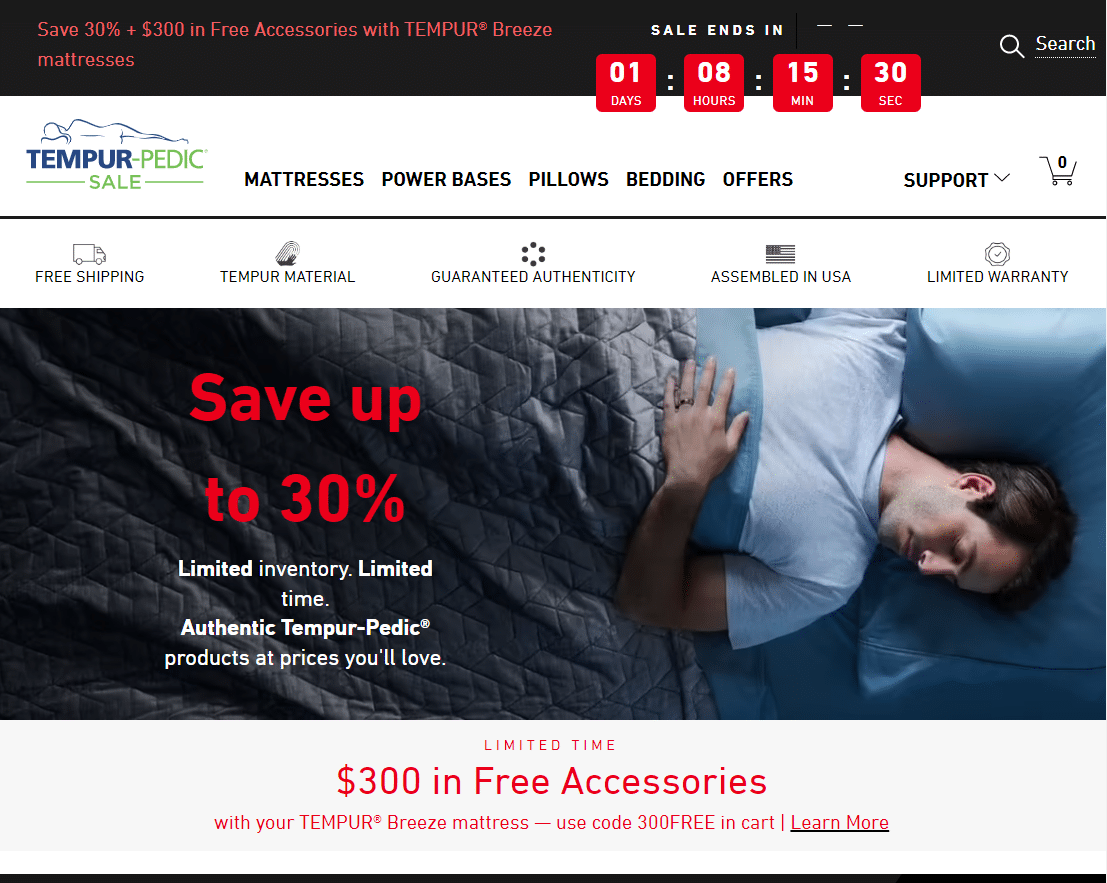
Brainstorm ways to incorporate FOMO and a sense of urgency into your offer on your landing page with legitimate scarcity, such as with limited availability and countdown timers. 

Scarcity and urgency can be powerful tools for improving your conversion rates. It’s essential to use them responsibly and ethically, however.

The more legitimate, the more impactful and believable it will be. 

Tempur-Pedic landing page

Immediate bonus or benefit

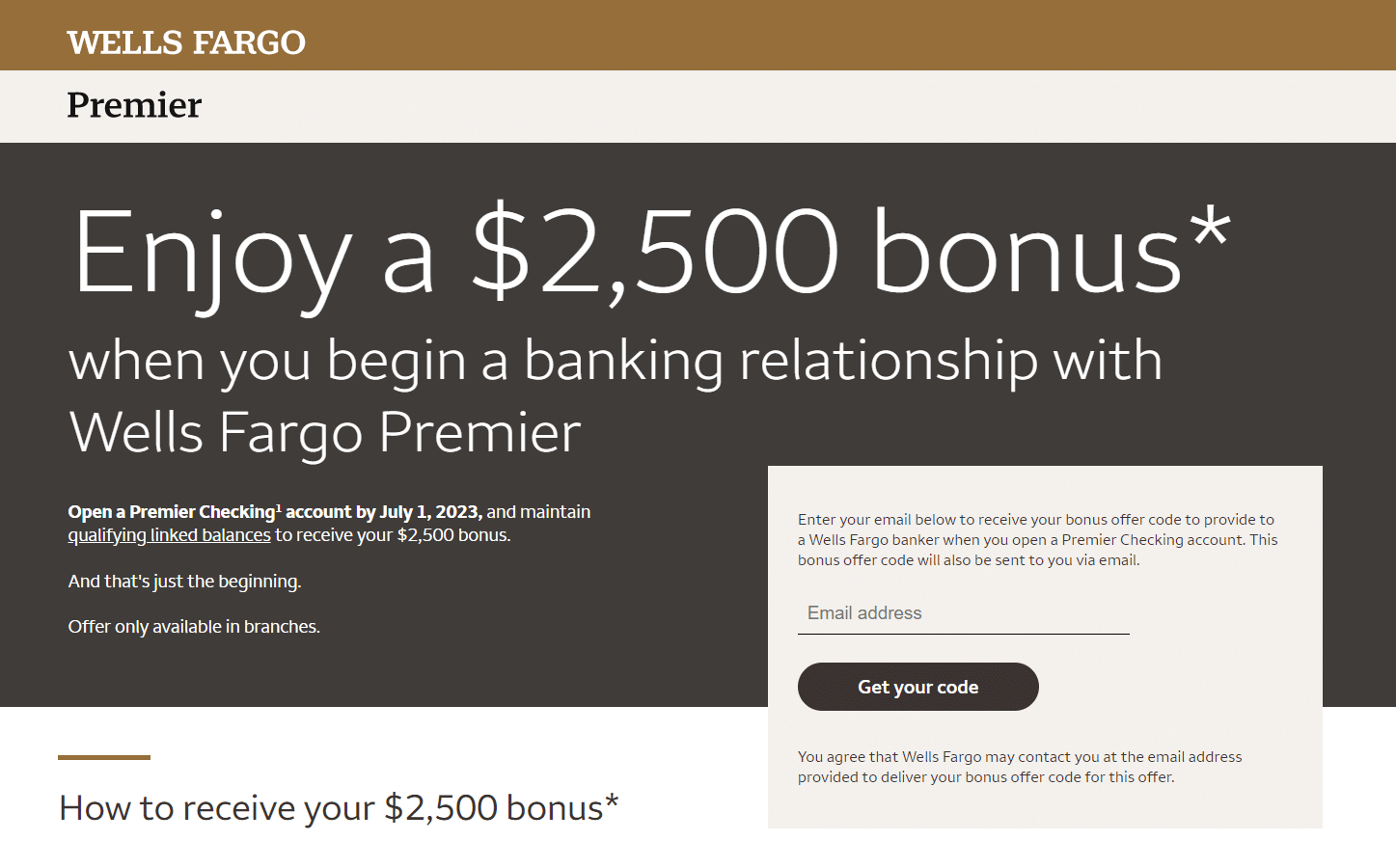
When landing page visitors are offered a free gift or bonus, the overall value of the offer is perceived to be higher.

This can make someone more likely to act and do it now, even if initially hesitant. This is true even with a small item, such as a free gift. 

Additionally, providing a free gift or bonus can create a sense of reciprocity and enhance the overall customer experience. This helps to create goodwill for your brand and potentially more referrals. 

Wells Fargo landing page

Uniqueness and believability

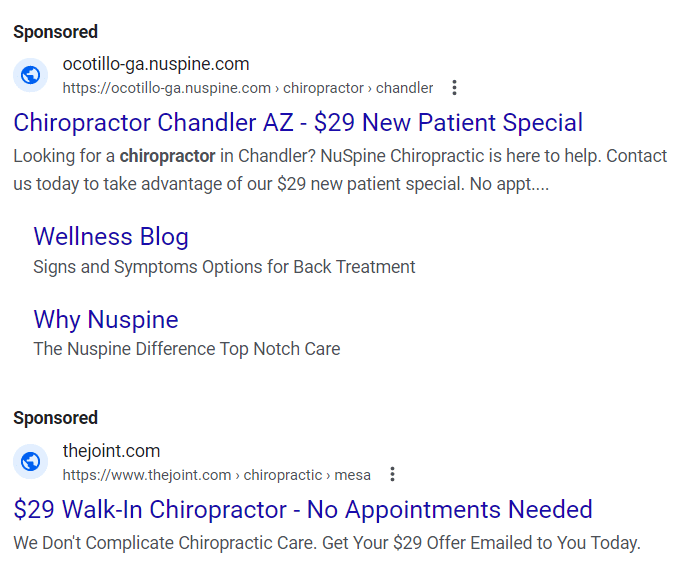
If your offer is amazing and hits all the important points, but your competitors are using the same offer, the effectiveness of that offer is going to diminish. 

The same is true for your unique selling proposition. If everyone has the same selling proposition, you are not unique.

PPC ad offerings

Get a good sense of what your competitors are offering and go bigger. 

Believability is another important factor. Outlandish claims and offers can appear too good to be true. If you are making an incredible offer and people reject it, it is likely not believable. 

Legitimate social proof is a great way to make your offer more believable and improve conversion rates overall. Ensure your landing page includes social proof through testimonials, case studies, and reviews.

Embedded and verified reviews are recommended versus the typical website testimonials anyone can add to a webpage. This helps to add credibility and trust. Video testimonials and audio testimonials are great at achieving this, too. 

Improve your PPC landing pages for compounding wins

Your landing page conversion rates directly correlate to your customer’s ability to perceive that you are the answer to their needs and desires. 

The better you can accomplish this while guiding your landing page users to take action, the better your outcomes will be. 

This compounding impact leads to lower acquisition costs, increased investment for more traffic, and scaled growth over time. 


Opinions expressed in this article are those of the guest author and not necessarily Search Engine Land. Staff authors are listed here.


Related stories

New on Search Engine Land

@media screen and (min-width: 800px) { #div-gpt-ad-3191538-7 { display: flex !important; justify-content: center !important; align-items: center !important; min-width:770px; min-height:260px; } } @media screen and (min-width: 1279px) { #div-gpt-ad-3191538-7 { display: flex !important; justify-content: center !important; align-items: center !important; min-width:800px!important; min-height:440px!important; } }

About the author

Chelsea So

Chelsea So is the Founder of Leadocity, a Google Ads consulting firm that supports agencies and clients with high-growth performance strategies and services. Chelsea started running PPC for her own e-commerce store back in 2004 and has been addicted ever since.

https://searchengineland.com/high-converting-ppc-landing-page-tips-395393


Twitter: Blue subscribers will now see ‘approximately’ 50% fewer ads

Twitter is now delivering on its promise to show less ads to Twitter Blue subscribers. The company has added details of how “Half ads” will work to its Help Center.

Why we care. If you’re advertising on Twitter or thinking about it, this change could have a minor impact on ad reach. “Minor” because the total number of Twitter Blue subscribers is less than 1% of its overall user base.

What’s changed. Twitter has added this information:

“See approximately 50% fewer ads in the For You and Following timelines. As you scroll, you will see approximately twice as many organic or non-promoted Tweets placed in between promoted Tweets or ads. There may be times when there are more or fewer non-promoted Tweets between promoted Tweets.”

– Twitter Blue Help Center document

Clearly, “Half ads” won’t actually be “half ads” on Twitter. It will be approximately 50% fewer, and limited to the For You and Following feeds.

Where “Half ads” doesn’t apply. Twitter specifically mentioned it won’t apply to the following areas, but noted it’s not “limited to” these:

  • Ads on profiles.
  • Ads in Tweet replies.
  • Promoted events in Explore.
  • Promoted trends.
  • Promoted accounts to follow.

Updated Twitter Blue subscribers count. Twitter now has 498,117 Blue subscribers as of April 2, according to this analysis.


Related stories

New on Search Engine Land

@media screen and (min-width: 800px) { #div-gpt-ad-3191538-7 { display: flex !important; justify-content: center !important; align-items: center !important; min-width:770px; min-height:260px; } } @media screen and (min-width: 1279px) { #div-gpt-ad-3191538-7 { display: flex !important; justify-content: center !important; align-items: center !important; min-width:800px!important; min-height:440px!important; } }

About the author

Danny Goodwin

Danny Goodwin has been Managing Editor of Search Engine Land & Search Marketing Expo – SMX since 2022. He joined Search Engine Land in 2022 as Senior Editor. In addition to reporting on the latest search marketing news, he manages Search Engine Land’s SME (Subject Matter Expert) program. He also helps program U.S. SMX events. Goodwin has been editing and writing about the latest developments and trends in search and digital marketing since 2007. He previously was Executive Editor of Search Engine Journal (2017 to 2022), managing editor of Momentology (from 2014-2016) and editor of Search Engine Watch (from 2007 to 2014). He has spoken at many major search conferences and virtual events, and has been sourced for his expertise by a wide range of publications and podcasts.

https://searchengineland.com/twitter-blue-fewer-ads-395426