Google to sunset 4 attribution models in Ads and Analytics

Google will soon retire four rules-based attribution models in Google Ads and Google Analytics:

  • First-click.
  • Linear.
  • Time decay.
  • Position-based.

Why we care. This will impact anyone who still uses these models in Google Ads. Anything that isn’t last-click will be much harder to track because the data-driven attribution formula is different for each advertiser – and not visible.

  • “In the past, you could use linear and give each touch the same credit. You will no longer be able to do so. There will be no impact on last touch, as that is still available. But finding some of the first-touch information will be much muddier because there will no longer be a way to see the formulas that compute the attribution scores,” said Greg Finn, director of marketing for Cypress North.

Why the change. These attribution models will be sunset due to “increasingly low adoption rates, with fewer than 3% of conversions in Google Ads using these models” according to a Google spokesperson.

  • Switching to the data-driven attribution model typically results in a 6% increase in conversions for advertisers, Google said.

Sunset timeline. The first-click, linear, time decay and position-based models will all sunset in Google Ads and Google Analytics beginning in September. Before that, for newly created conversion actions, these attribution models will no longer be available in:

  • GA4 starting in May.
  • Google Ads starting in June.

Data-driven attribution as the default attribution model. Google announced its shift to data-driven attribution in September 2021. For advertisers who didn’t want to use data-driven attribution, Google had continued to support open attribution models:

  • First click (100% of conversions go to first click).
  • Linear (all conversions split across all clicks).
  • Time decay (conversions based on a half-life formula).
  • Position based (40% to first and last click and 20% to others).

Data-driven attribution does not share any percentages or formulas on how the clicks are counted for conversions, but is rather custom-built based on account history.

Now the only way that advertisers will be able to credit all clicks will be with data-driven attribution. This model will vary by the advertiser, as it leverages conversion data from the account to determine which touches have the most impact.

Dig deeper. Data-driven attribution: How to think about Google’s default attribution model


Related stories

New on Search Engine Land

@media screen and (min-width: 800px) { #div-gpt-ad-3191538-7 { display: flex !important; justify-content: center !important; align-items: center !important; min-width:770px; min-height:260px; } } @media screen and (min-width: 1279px) { #div-gpt-ad-3191538-7 { display: flex !important; justify-content: center !important; align-items: center !important; min-width:800px!important; min-height:440px!important; } }

About the author

Danny Goodwin

Danny Goodwin has been Managing Editor of Search Engine Land & Search Marketing Expo – SMX since 2022. He joined Search Engine Land in 2022 as Senior Editor. In addition to reporting on the latest search marketing news, he manages Search Engine Land’s SME (Subject Matter Expert) program. He also helps program U.S. SMX events. Goodwin has been editing and writing about the latest developments and trends in search and digital marketing since 2007. He previously was Executive Editor of Search Engine Journal (2017 to 2022), managing editor of Momentology (from 2014-2016) and editor of Search Engine Watch (from 2007 to 2014). He has spoken at many major search conferences and virtual events, and has been sourced for his expertise by a wide range of publications and podcasts.

https://searchengineland.com/google-sunsets-attribution-models-395297


5 mobile B2B advertising mistakes and how to correct them

For the first time, more than half of B2B ads will be placed on mobile this year, according to Insider Intelligence.

It’s a good time to address the most persistent mistakes B2B advertisers continue to make with mobile ads, particularly nit-picky to holistic customer understanding.

Yes, B2B marketers should nail the desktop experience first since it’s still where we see most quality conversions happen. But neglecting to optimize over half of their opportunities to engage users has ripple effects down the funnel.

User flow and UX on mobile are different than it is on desktop. Layout, sizing, attention span, intent and ease of use fundamentally differ on mobile. Yet, B2B advertisers often forget this when they build mobile flows.

Let’s jump into the specific mistakes I see and how marketers should recalibrate their thinking.

Mistake 1: Failing to consider mobile user intent

B2B audiences are more available and engaged on mobile, but it’s still essential to assess intent and attention span and incorporate that into UX.

Users probably aren’t making big business decisions on their phones, but they might be open to good, quick messaging that offers insight into their challenges. 

Too often, many marketers echo what they’re doing on desktop. Consider mobile intent to inform everything from your content and channel selection to call to action. 

For instance, if you’re pushing a signature, long-form piece of content on mobile, try “read later” or “send to email” or promote a shorter blog post that entices the user to download the full file.

Instead of “book a demo,” which might open a calendaring function that mobile users aren’t quite ready to use, try “ask us for a demo,” which puts the onus on your business development team to follow up.

Mistake 2: Not dialing in creative specifically for mobile

Creative, in this instance, includes everything from landing page layout to ad sizing to video. 

First, marketers can’t simply re-calibrate page dimensions to fit on a mobile screen without assessing what users see above the fold. 

  • Is it the most impactful message you can deliver? 
  • Does it give the users a clear CTA or a path forward? 

You have much less room to work with on mobile, so put a premium on using it effectively.

Ad sizing is still ripe with opportunities to improve. Especially for social ads, marketers often stick to squares/rectangles and ignore larger mobile sizes. 

Some big brands use square or rectangle creative on LinkedIn for mobile sponsored content instead of going vertical and commanding more attention, as the below creative does well.

Sample vertical creative

As for video, shorter attention span matters. Getting to the point in the first three seconds of a video is critical on mobile. 

Video content can still be challenging to produce so B2B brands might have one or two long-form pieces. 

That’s fine, but the art will be in the edit. Use text overlay, include your brand logo up front, and reach the point immediately. 

Consider the platform through both an intent and sizing lens. If you’ve got user-generated content to promote, would it be a better fit for YouTube, LinkedIn, or #tiktokforbusiness?


Get the daily newsletter search marketers rely on.


Mistake 3: Looking at the wrong data

Most marketers have taken the step of segmenting conversions by device and allocating spend appropriately. But too many have yet to take the next step: tracking CRM data to gauge the quality of conversions by device.

With rare exceptions, mobile conversions tend to be higher funnel than desktop conversions. Still, marketers need to be able to gauge the truth and extent of conversion value and bid accordingly. 

If you’re adjusting mobile campaigns for upper-funnel conversions, integrate CRM data to ensure they’re worth what you’re paying.

Mistake 4: Failing to balance quantity and quality with lead forms

Whether you’re using direct lead gen forms on paid social or simply sending users to a direct-response landing page, finding a balance between quantity and quality with your forms is a good idea.

Most form integrations allow for auto-fill, which is great for the user – and may allow marketers to include a couple of extra fields for additional qualification (making it too easy may lead to excessive spam).

The best balance is to get the info you need to assess whether the lead is qualified but not to ask for any more info than that.

Among the many incremental improvements Facebook has made to its B2B functionality, its lead gen forms now allow marketers to add custom questions. This raises the barrier to entry a bit but can serve nicely to eliminate spam. 

LinkedIn also has the custom question and custom check-box functionality and the option of asking for a business email, which will help you refine quality.

Whatever your approach, even if it’s to open the faucet as wide as possible and filter spam as you go, make sure to track conversion rates, corresponding lead quality, and significant differences in mobile and desktop behavior.

Mistake 5: Replicating desktop channel strategies

While some channels – search and social, primarily – offer plenty of value on both desktop and mobile, don’t simply assume that every channel that performs on desktop should be part of your mobile mix.

Unless you have a truly disruptive, thought-provoking message, display is a channel you should think twice about using for mobile audiences. 

It can work if you have a fully fleshed-out ABM strategy with clearly defined companies, messaging, and goals, plus the sales team is fully bought in. But it has to be part of a bigger puzzle.

Otherwise, you’re relying on your users to take actions other than instinctively clicking out of annoying ads that block them from their desired content – which I rarely do as a user myself and don’t often recommend to my clients as a strategy.

Make your mobile B2B marketing campaigns better

As you read this, you’re probably thinking of dozens of other nuances distinguishing the mobile B2B advertising experience from its desktop counterpart. 

Keep thinking that way, and before long, you’ll condition yourself to build separate strategies for your mobile and desktop audiences and reap the rewards along the full customer journey.


Opinions expressed in this article are those of the guest author and not necessarily Search Engine Land. Staff authors are listed here.


Related stories

New on Search Engine Land

@media screen and (min-width: 800px) { #div-gpt-ad-3191538-7 { display: flex !important; justify-content: center !important; align-items: center !important; min-width:770px; min-height:260px; } } @media screen and (min-width: 1279px) { #div-gpt-ad-3191538-7 { display: flex !important; justify-content: center !important; align-items: center !important; min-width:800px!important; min-height:440px!important; } }

About the author

Laura Schiele

Laura Schiele, Head of Paid Acquisition at Jordan Digital Marketing, has nearly a decade of experience in paid media strategy and execution in both agency and in-house accounts and uses advanced analytics skills to scale growth within efficiency goals across Google, LinkedIn, Facebook, and more. Laura manages a large team of paid media experts remotely from her home in Burlington, VT.

https://searchengineland.com/mobile-b2b-advertising-mistakes-395154


Microsoft Advertising professional service ads go global, broad match modifier changes rolling out and more

The expansion of professional service ads, broad match modifier changes, and much more updates were announced today in the Microsoft Advertising April newsletter.

Professional service ads. Microsoft Advertising’s professional service ads are now available globally. Microsoft first released professional service ads as a beta about a year ago, saying:

“To help champion these professionals and better connect them to consumers with engaging ad experiences, Microsoft Advertising is developing a new ad solution called Professional Service Ads to make these connections more effective than ever.”

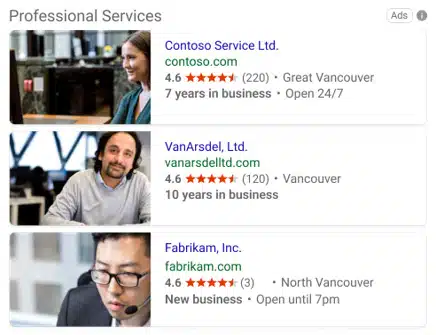
This is what it looks like:

Microsoft Professional Service Ads

Broad match modifier changes. Broad match modifier was deprecated in 2021 and with that, Microsoft said it is “rolling out gradually over the next several weeks, all broad match modifier keywords for search ads now serve as broad match keywords instead of phrase match.”

Microsoft added:

  • “No action is required from you on this, as we expect this change to be beneficial to advertisers’ conversions and cost per acquisition (CPA) overall. There won’t be any impacts to bidding strategies or third-party bidding.”

Recently we reported Microsoft Advertising broad match modifier keywords are now serving ad broad match.

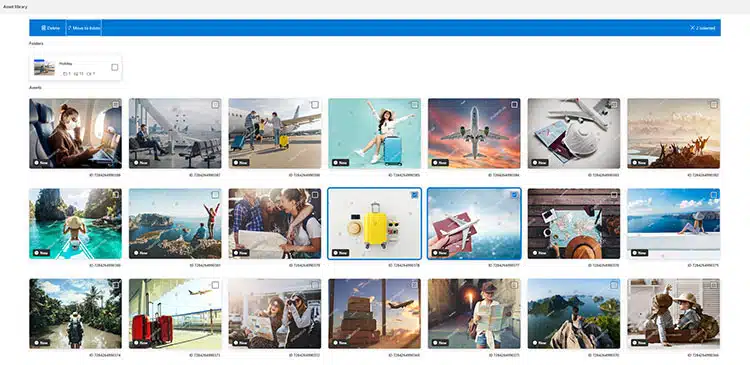
Bulk operations in Asset Library. Advertisers in Microsoft Advertising can now organize your assets with bulk operations. This can allow you to bulk delete folders and assets, and move multiple items in bulk to your target folder or subfolder.

Microsoft Asset Library

Target bid value. Microsoft also announced that within Target CPA, Target return on ad spend (ROAS), or Target Impression Share bid strategies you can now view and edit the current target bid value within the campaign grid in Microsoft Advertising online.

This applies for both standalone bid strategies and also for portfolio bidding. You can add this column via the “modify column” command in Microsoft Advertising online.

Why we care. Advertising is changing rapidly, more so in search and display markets. Make sure to stay on top of these latest changes by subscribing to our newsletter and reading out site.

Read Microsoft’s full announcement. Professional Service Ads and other product updates for April.


Related stories

New on Search Engine Land

@media screen and (min-width: 800px) { #div-gpt-ad-3191538-7 { display: flex !important; justify-content: center !important; align-items: center !important; min-width:770px; min-height:260px; } } @media screen and (min-width: 1279px) { #div-gpt-ad-3191538-7 { display: flex !important; justify-content: center !important; align-items: center !important; min-width:800px!important; min-height:440px!important; } }

About the author

Barry Schwartz

Barry Schwartz a Contributing Editor to Search Engine Land and a member of the programming team for SMX events. He owns RustyBrick, a NY based web consulting firm. He also runs Search Engine Roundtable, a popular search blog on very advanced SEM topics. Barry can be followed on Twitter here.

https://searchengineland.com/microsoft-advertising-profession-service-ads-go-global-changes-to-broad-match-modifier-rolling-out-and-more-395194


Google Analytics 4 now lets you modify and create events using regular expressions

Google Analytics 4 now supports creating and/or modifying events using regular expressions, regex. This can help you migrate destinations and event goals from Universal Analytics to Google Analytics 4 in a more programmatic fashion.

More details. Google said the new feature and options enable you to define conversions using regular expressions (regex) for web data streams. Just be careful with regex, it can get technical and it is very picky.

Why we care. As we approach the deadline for the GA4 migration from UA3, which is now 87 days away, some are now rushing to migrate not just to GA4 but also to migrate all their goals and events. This may help some of you with that migration since regex can be a super powerful way to match old events and migrate them in a more programmatic manner.

How it works. Google explained that to avoid using malformed regex that may impact your site performance, follow these best practices:

  • Before you use regex, use other operators where possible (e.g., exact matches, contains).
  • Test your regex against expected inputs and ensure that it’s matching what you expect.
  • If case sensitivity is important, specify your regex to be case sensitive. Use the option that doesn’t say “(ignore case)”.

Google notes you should avoid unbounded or nested repetitions where matching time can increase exponentially. Also make sure to define a maximum number of expected repetitions.

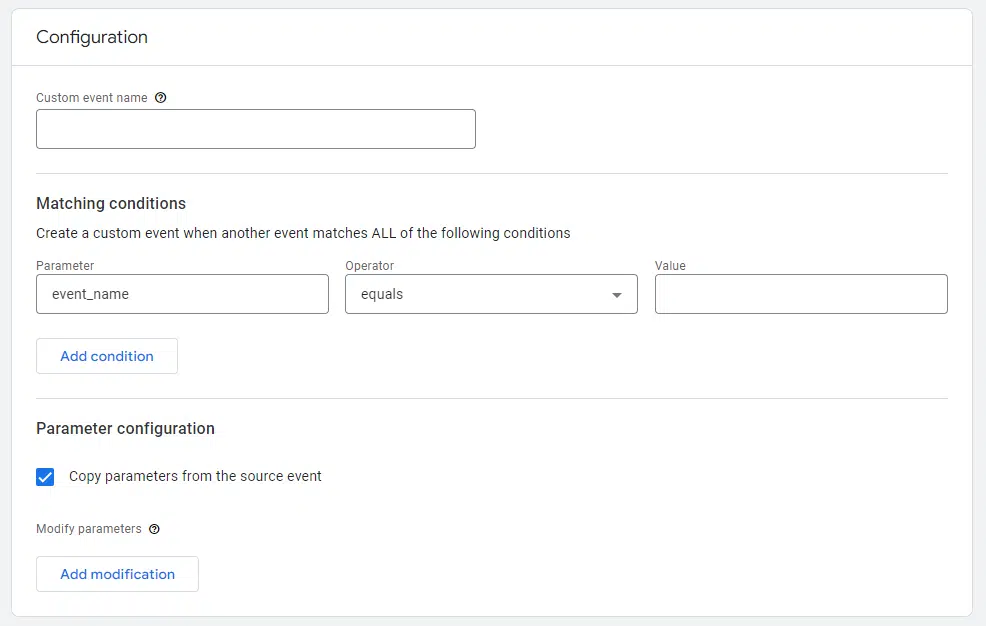
What it looks like. Here is a screenshot of this interface for using regular expressions:

Google Analytics Regex 800x503


Related stories

New on Search Engine Land

@media screen and (min-width: 800px) { #div-gpt-ad-3191538-7 { display: flex !important; justify-content: center !important; align-items: center !important; min-width:770px; min-height:260px; } } @media screen and (min-width: 1279px) { #div-gpt-ad-3191538-7 { display: flex !important; justify-content: center !important; align-items: center !important; min-width:800px!important; min-height:440px!important; } }

About the author

Barry Schwartz

Barry Schwartz a Contributing Editor to Search Engine Land and a member of the programming team for SMX events. He owns RustyBrick, a NY based web consulting firm. He also runs Search Engine Roundtable, a popular search blog on very advanced SEM topics. Barry can be followed on Twitter here.

https://searchengineland.com/google-analytics-4-now-lets-you-modify-and-create-events-using-regular-expressions-395191


UK publishers sue Google for $4.2 billion in lost ad revenue

A new lawsuit alleges that Google abused its dominance in display advertising since 2014 and seeks £3.4 billion ($4.2 billion) in damages for all UK publishers.

The bigger picture. Google is facing similar scrutiny in the U.S. The Department of Justice and eight states sued Google in an effort to dismantle its ads division. Google had hoped to avoid that by offering to restructure its ad tech business. And due to EU scrutiny, Google offered to show ad rivals on YouTube.

Why we care. The outcomes of ongoing lawsuits and antitrust investigations could eventually result in meaningful changes for online advertisers, impacting publishers (ad revenue) and advertisers (reach). So we will continue to watch as these developments unfold.

The lawsuit. It was filed by journalist Charles Arthur, a former technology editor for UK news publisher The Guardian on behalf of all UK publishers of websites and apps in the UK’s Competition Appeal Tribunal (CAT). At issue:

Charles claims that Google has breached competition law by abusing its dominant position in online advertising through Google, for example, giving preferential treatment to its own ad tech products (e.g. Google Ad Manager). As a result, market-wide prices for all ad tech services were increased and businesses and individuals who sold ad impressions on websites and apps using these services received less compensation than they would have absent Google’s breaches of competition law.

– FAQ, Google Ad Claim.

Google’s response. The company called the lawsuit “speculative and opportunistic,” adding that “those of our many adtech competitors, help millions of websites and apps fund their content, and enable businesses of all sizes to effectively reach new customers,” the BBC reported.

The second such lawsuit. Ofcom director Claudio Pollack filed a similar lawsuit, seeking up to £13.6bn in damages, in November 2022.

Opt-out. Because both of these lawsuits are collective claims (the equivalent of a U.S. class action lawsuit), “both legal claims ask the court – the Competition Appeal Tribunal – to certify their claims as “opt-out”, meaning every relevant publisher would be automatically included in the case unless they choose otherwise,” according to the BBC.


Related stories

New on Search Engine Land

@media screen and (min-width: 800px) { #div-gpt-ad-3191538-7 { display: flex !important; justify-content: center !important; align-items: center !important; min-width:770px; min-height:260px; } } @media screen and (min-width: 1279px) { #div-gpt-ad-3191538-7 { display: flex !important; justify-content: center !important; align-items: center !important; min-width:800px!important; min-height:440px!important; } }

About the author

Danny Goodwin

Danny Goodwin has been Managing Editor of Search Engine Land & Search Marketing Expo – SMX since 2022. He joined Search Engine Land in 2022 as Senior Editor. In addition to reporting on the latest search marketing news, he manages Search Engine Land’s SME (Subject Matter Expert) program. He also helps program U.S. SMX events. Goodwin has been editing and writing about the latest developments and trends in search and digital marketing since 2007. He previously was Executive Editor of Search Engine Journal (2017 to 2022), managing editor of Momentology (from 2014-2016) and editor of Search Engine Watch (from 2007 to 2014). He has spoken at many major search conferences and virtual events, and has been sourced for his expertise by a wide range of publications and podcasts.

https://searchengineland.com/uk-publishers-sue-google-for-4-2-billion-in-lost-ad-revenue-395166


Search marketing: Evolving roles, responsibilities, challenges

Search marketers design, run and optimize campaigns – and rely heavily on spreadsheets to successfully do their jobs, according to a new Search Engine Land survey.

Why we care. Although search marketers have several responsibilities and face a variety of challenges related to their roles and the technology they use, our survey shows that the majority of search marketers are satisfied with their work.

The biggest responsibilities for search marketers. Designing, running and optimizing campaigns is the responsibility that falls onto most search marketers, either directly or through their team, according to our survey.

At the director level and higher, 81% of marketers said designing, running and optimizing campaigns was their top responsibility. For managers/staff, the number was 67%.

The next three responsibilities for all respondents were the same (though the percentages varied based on the role):

  • Designing and managing internal workflows and processes.
  • Researching and recommending new marketing technology products.
  • Training and supporting marketing staff on using marketing technology products.

Here’s the full list of responsibilities we asked about:

Search Marketer Responsibilities

Search marketers live in spreadsheets. The overwhelming answer: spreadsheets. The question: Which marketing technology tools, if any, do you spend at least 10 hours a week working in?

Clearly, the higher you go in an organization, the more time you’ll find yourself spending in spreadsheets:

  • 87% for directors or higher roles.
  • 77% for managers/staff.

Spreadsheets beat out analytics, project management, content management, marketing automation and other types of marketing tools. Most of the tools were used similarly by both groups.

Marketing Tools 10 Hours Week

67% said churn increased. Remember the Great Resignation (a.k.a., the Great Reshuffle) of 2021? It was real. LinkedIn was inundated with updates about people moving onto their latest and greatest career opportunities. 

While career moves are great for the individual, they proved challenging for 67% of organizations in 2022.

Churn 2022

Churn increased significantly (31%) or moderately (36%), according to our respondents. 

Luckily, 33% of survey respondents said they didn’t notice an increase in churn in their organizations in 2022 compared to 2021.

Job satisfaction is high. Despite challenges and the ever-increasing complexity of search, 76% of search marketers are satisfied with their roles:

  • 25% said they are “extremely” satisfied.
  • 51% said they are “somewhat” satisfied. 
Search Marketer Role Satisfaction 800x390

Part of this satisfaction may tie into our previous section – several marketers have changed jobs in the past two years. You would hope those who have changed jobs (or those who haven’t) are currently satisfied where they work and find their day-to-day duties rewarding.

Meanwhile, 13% were either “somewhat” or “not” satisfied with their current role. The remaining 11% were neutral.

Methodology. We surveyed 510 marketers between Jan. 11 to 23; 413 of those provided salary information. Invitations to take the survey were amplified on and by Search Engine Land.

Nearly 67% of the 510 respondents live in North America; 20% live in Western Europe. The conclusions in this report are limited to responses from those individuals only. Others were excluded due to the limited number.

The survey had more than 20 questions related to career roles, salary, technology, job satisfaction and challenges/frustrations. Respondents were given the opportunity to reveal their age and gender.


Related stories

New on Search Engine Land

@media screen and (min-width: 800px) { #div-gpt-ad-3191538-7 { display: flex !important; justify-content: center !important; align-items: center !important; min-width:770px; min-height:260px; } } @media screen and (min-width: 1279px) { #div-gpt-ad-3191538-7 { display: flex !important; justify-content: center !important; align-items: center !important; min-width:800px!important; min-height:440px!important; } }
About the author

Danny Goodwin

Danny Goodwin has been Managing Editor of Search Engine Land & Search Marketing Expo – SMX since 2022. He joined Search Engine Land in 2022 as Senior Editor. In addition to reporting on the latest search marketing news, he manages Search Engine Land’s SME (Subject Matter Expert) program. He also helps program U.S. SMX events. Goodwin has been editing and writing about the latest developments and trends in search and digital marketing since 2007. He previously was Executive Editor of Search Engine Journal (2017 to 2022), managing editor of Momentology (from 2014-2016) and editor of Search Engine Watch (from 2007 to 2014). He has spoken at many major search conferences and virtual events, and has been sourced for his expertise by a wide range of publications and podcasts.

https://searchengineland.com/search-marketing-evolving-roles-responsibilities-challenges-395045


How paid placements will evolve alongside AI-powered search

Google’s ad business will celebrate its 23rd year this fall, but not before paid search undergoes massive changes. As traditional search evolves with the advent of AI-powered functionality, so will pay-per-click (PPC) advertising.

It’s unlikely Google will sit idly by and take massive revenue hits as paid placements decline. We don’t yet know what they will roll out to capitalize on AI-powered search – or when exactly users will see ads in this AI-powered experience.

We do know there will be fewer advertising opportunities, increased competition and higher costs. But AI will also help advertisers better target consumers – and it could help them optimize campaigns, too.

Here’s a closer look at how paid search will remain relevant, but advertisers must adjust their strategies to reach their targets in this new era.

AI assistants like Google Bard will help search evolve from transactional to conversational, according to Aaron Levy, vice president of paid search at performance marketing firm Tinuiti.

“Historically, each query would yield a series of answers and that’d be the end of the relationship,” he said. 

“ChatGPT/Bard is asking that we shift from repeating and tweaking searches toward refining with a human-esque conversation. It’s the same task, but a different way of getting there.”

In other words, there’s a new UI on the horizon for search.

“The usual list of links you get will be replaced by a chat box where you can converse with an AI bot and get direct responses to your queries,” said Trifon Tsvetkov, head of growth at online code interview tool CodeInterview. 

“To an extent, this will be similar to the featured snippet functionality we can see now, but with a lot more detail.”

To what extent this experience will overtake traditional search remains to be seen.

Nevertheless, Tsvetkov noted that some portion of traditional search will decline, so businesses should expect their paid search acquisition channels to be negatively impacted in at least some capacity.

That means brands that rely on paid search should also be prepared to evolve.


Get the daily newsletter search marketers rely on.


This could theoretically be troublesome for search giant Google, which Jon Clark, managing partner of digital agency Moving Traffic Media, noted has built its entire model around paid search.

“But I can’t imagine Google’s just going to blow up their ad model tomorrow,” he added.

Indeed, Tsvetkov noted the odds are good Google will instead create new offering(s) to capitalize on AI-powered search functionality. 

“Fundamentally, these will still be driven by the user’s input and online behavior, just like it is now,” he added. “One example is referring products and services related to your AI-powered search, such as attraction tickets when asking the AI bot to create a travel itinerary.”

Levy, however, questioned at what point a query will be refined enough to deliver a relevant ad experience.

“Are platforms going to deliver an ad on the first question, embed it in the conversation … or as part of a conclusion?” he asked.

“My expectations are they’ll be interspersed but closer toward the ‘conclusion’ of the chat experience.”

That means ChatGPT/Bard will spend time understanding a consumer’s preferences and budget before presenting sponsored ads.

“This, to me, feels natural and won’t be too ‘in your face,'” Levy added.

In a similar vein, Eduard Dziak, CMO of B2B marketing site B2BDigitalMarketers, pointed to potential in “a more sophisticated version of pay-per-click (PPC) advertising” that is more natural and interactive and presents “a list of organizations that have paid to be featured, along with relevant information such as reviews, testimonials and experience.”

With more graphics and information, he said, “I believe it will provide an even better return on investment (ROI) than the current version of paid search ads, which can only provide information formatted in a limited way.”

He also envisions search engines incorporating display ads into search results to compensate for the loss of revenue from decreased web traffic.

“These display ads can be seamlessly integrated with chatbots, using images, animations and even pre-selected frequently asked questions by advertisers,” Dziak said. 

“This will make the search experience more interactive and natural for less technical users, such as my grandma, who can simply talk to chatbots about PPC or display ads.”

The new paid ads

That said, fewer links mean fewer ads.

“Companies need to recognize that if AI is driving more efficient search results that deliver more accurate results to consumers, fewer searches will be necessary, leading to less overall ad exposure,” said Rob Silver, executive vice president and head of media at interactive agency Razorfish. 

“This could lead to higher ad costs for sponsored listings and more competition for fewer placements.”

Hamza Hanif, SEO executive at web design agency Objects, agreed costs might increase as competition for top results intensifies.

“Advertisers may need to pay more to achieve the same level of visibility on search engine results pages, especially if AI-powered algorithms favor organic search results over paid ads,” he added. 

“This is because AI algorithms may be better at matching user intent with organic search results, making it more difficult for paid search ads to compete for visibility.”

Zaira Céspedes, junior SEO executive at digital marketing firm GA Agency, agreed.

“Due to the improvement in the accuracy and relevance of organic search results that appear for users, it will become more challenging for paid search ads to stand out,” she said. “This can lead to higher costs for PPC campaigns.”

Iu Ayala, founder of AI consulting company Gradient Insight, pointed out the potential for greater competition from larger companies with more resources and “an advantage in developing and implementing AI-powered strategies.”

At the same time, Silver noted this evolution makes SEO even more important since AI chatbot results increase the prominence of organic search results.

As consumers interact with fewer links, Casey Jones, head of marketing at digital marketing company CJ&CO, expects to see an increased focus on upper-funnel ads in particular.

When planning a trip, for example, AI-powered search will eliminate many necessary queries from traditional search.

“This means businesses will need to invest heavily in building brand awareness so that when AI serves options, people will choose what they’re already familiar with,” Jones added. 

“When people know what your products and services are about, they’ll be able to distinguish and make an informed choice while buying.”

Silver agreed.

“Companies need to prioritize brand awareness through elevated content that showcases the benefits and differentiation of their offerings,” he said. 

“When one of their ads does appear, it will be that much more important for it to resonate and have an impact with the consumer who sees it.”

Meanwhile, because AI-powered search better understands user intent, it will prioritize ads that are even more relevant to a given query. It may even become more selective about which ads to display.

“This means that advertisers will need to create more targeted ads tailored to specific user needs and interests,” said Syed Sameem Rizvi, a data scientist at IT company Code Avenue. 

“[And] advertisers may need to create a variety of ad formats in order to optimize their visibility on SERPs.”

The new targeting

On the plus side, AI-powered search should yield better targeting.

“AI can analyze large sets of data more efficiently than humans can, without compromising accuracy or relevance,” said Oskar Nowik, head of SEO at point of sale software company Epos Now. 

“With this capability, search marketers are able to more accurately predict what their consumers want when they make their queries – resulting in more targeted ads that generate higher engagement rates and improved conversions.”

In addition, AI-powered search can yield more accurate insights into search behavior, which will also help target consumers, personalize content and increase efficiency/ROI from paid search campaigns, said Søren Lassen Jensen, a junior digital marketer at cybersecurity firm CyberPilot.

The new optimization

In addition, Hanif expects AI-powered algorithms will help advertisers better optimize their paid placements. 

“By analyzing user behavior and search patterns, AI algorithms can identify which ads are most likely to resonate with users and which ones are not,” Hanif said. 

“Advertisers can then use this data to tweak their ad copy, keywords and targeting parameters, improving their ad performance over time.”

Ayala agreed.

“One of the main advantages of using AI in paid search is its ability to identify the most effective keywords, ad placements and targeting strategies,” he said.

“By analyzing consumer behavior and historical data, AI-powered tools can provide recommendations on how to optimize campaigns and improve conversion rates.”

In addition, Nowik noted that AI-powered algorithms could quickly determine the best possible ad placements and the optimal time for consumers to view ads to maximize conversions and minimize cost.

Céspedes said some AI-powered search tools might not provide full transparency into how results are generated, which could be an optimization challenge. 

Meanwhile, Jensen warned algorithms and AI-powered search might not be able to capture all of the nuances within a query, which could lead to inaccurate results or costly mistakes if not monitored closely.

He expects results will be difficult to replicate and monitor due to the complexity of the AI algorithms. 

“This can also lead to skewed data insights, which can then lead to inappropriate decision-making,” Jensen added. 

“Also, how will it be facilitated? We already know that the AI bots learn from the previous chats that you have with them.”

Levy, however, noted tracking is already “very broken” and he expects it will only get muddier as cookies finally pass and Google rolls out its version of Safari’s Intelligent Tracking Prevention (ITP).

“Things will get more complicated and, if anything, rely more on AI modeling to present the most correct view of performance,” he added. 

The new keywords/bidding

Finally, expect changes in the backbone of PPC campaigns: keywords.

Nowik believes AI-powered algorithms will help automate the bidding process by detecting which keywords are most relevant so marketers don’t have to test combinations themselves manually.

“This helps save time and money since prices for each keyword need not be adjusted based on trial-and-error tests,” he said.

In the meantime, Jones expects broad match – which helps advertisers reach wider audiences without extensive keyword lists – will be more relevant than ever. 

This, he said, is good news for Bing because it uses Microsoft’s AI model, which prioritizes relevancy and will enhance the performance of broad match in paid search. 

“In the present scenario, Microsoft’s language model is better equipped to make Bing’s broad match more effective and improve paid search traffic to advertisers,” he said.

“This means Bing will have a larger paid search budget compared to Google, which will be a big positive for advertisers.”

Levy questioned whether AI-powered search will change auction dynamics from a bidding model to a commission-based/affiliate model, like Microsoft’s Hotel Price Ads and Google’s Local Services Ads.

“I envision more payment options for advertisers, which could throw things for a loop,” he added.

But, Kacper Rafalski, demand generation team leader at software development company Netguru, said it could also lead to increased reliance on automated systems and decreased control over ad targeting and bidding. 

For his part, John McGhee, owner of digital agency Webconsuls, believes keywords will become obsolete in their current form as Google Ads and Microsoft Ads migrate to a conversion-based system.

“Currently, adjusting keyword match types, keyword bids and adding negative keywords are still the primary way to improve relevancy and get your ads in front of the right users,” he said.

“In the future, those tasks will move over to adjusting various conversion actions and their values.”

That means PPC will use ROI-based bid strategies – and instead of raising a keyword bid, advertisers will adjust the value of a conversion action. 

“With AI expanding touch points massively, signals will replace search queries as the primary method of gauging user intent,” he added.


Opinions expressed in this article are those of the guest author and not necessarily Search Engine Land. Staff authors are listed here.


Related stories

New on Search Engine Land

@media screen and (min-width: 800px) { #div-gpt-ad-3191538-7 { display: flex !important; justify-content: center !important; align-items: center !important; min-width:770px; min-height:260px; } } @media screen and (min-width: 1279px) { #div-gpt-ad-3191538-7 { display: flex !important; justify-content: center !important; align-items: center !important; min-width:800px!important; min-height:440px!important; } }
About the author

Lisa Lacy

Lisa Lacy is a reporter who has covered advertising, technology and retail for publications like Adweek, TechCrunch, Digiday, CMO.com and VentureBeat.

https://searchengineland.com/ai-powered-search-paid-placements-395084


Gender pay gap persists: Men earn 26% more than women in search marketing

In (not) a shocking twist, men earn an average of 26% more than women in search marketing, according to a new Search Engine Land survey.

In particular, men earn significantly more than women in senior positions. 

Additionally, the data revealed that women were more likely to have changed jobs or received promotions more recently than men, highlighting the ongoing churn in the job market. 

This article will dive deeper into the survey’s key findings, examining the implications for professionals and organizations in the surveyed regions.

Overall, men earned 26% more than women. Despite advances in gender equality and the growing number of highly competent and qualified female marketing professionals, it remains a pervasive problem. 

Men earn 26% more than women
  • Men: $105,250
  • Women: $83,265 

These results, based on a sample size of 267 individuals, suggest that gender pay inequality remains a persistent issue in the surveyed regions.

This pay gap can be attributed to a combination of factors, including:

  • Systemic biases.
  • A lack of transparency in compensation policies.
  • The underrepresentation of women in senior leadership roles.

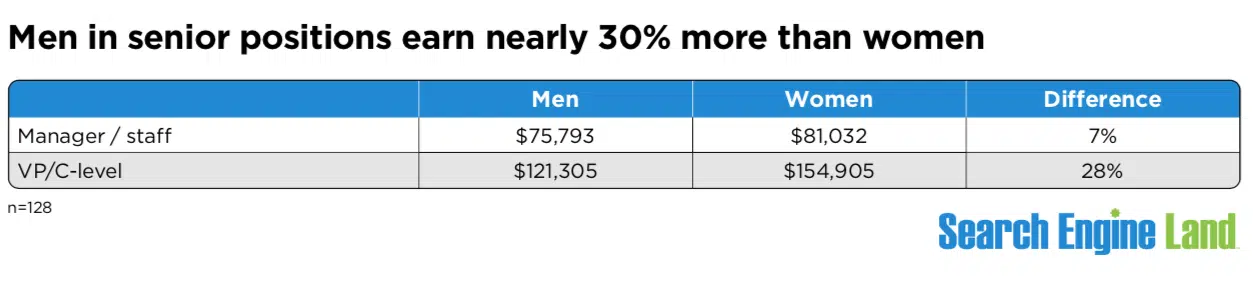
Men in senior positions earn nearly 30% more than women. Continuing on the last result, we found that men in senior positions earn nearly 30% more than women in similar roles. 

Men in senior positions earn nearly 30% more than women.

For senior and management positions, the average salary for men was 7% more than women, the data revealed:

  • Men: $81,032
  • Women: $75,793

However, the gap widened significantly in the average salary for VP/C-level positions:

  • Men: $154,905
  • Women: $121,305

That’s a 28% difference. 

Why the disparity? These findings, based on a sample size of 128 individuals, highlight that income inequality often stems from deep-rooted systemic biases, workplace discrimination, and entrenched cultural norms that favor men in leadership roles. 

It can also be exacerbated by the “glass ceiling” effect, where women face invisible barriers to advancement and are consequently underrepresented in top management positions. 

As a result, the gender pay gap in senior roles perpetuates the gender power imbalance within organizations, undermining the principles of fairness and equal opportunity.

55% of women were promoted or changed jobs in the last 12 months, vs. 47% of men. The survey results indicate that women were more likely to have changed jobs or received promotions more recently than men.

Women changed jobs / promoted more recently than men.

The data showed that among the respondents, 55% of women had received a promotion or switched jobs within the last year, compared to 47% of men. 

Specifically, 20% of women had done so within the last 6 months, while 33% had done so within the last 6-12 months. In contrast, only 19% of men had done so within the last 6 months, and 28% had done so within the last 6-12 months. 

These results are based on a sample size of 267 individuals and suggest that women may be more proactive in seeking career growth opportunities or may be experiencing turnover at a higher rate than men. 

However, there are also several reasons that could support women changing jobs at a faster rate than men. 

  • Work-life balance: Women often bear a disproportionate share of caregiving responsibilities for children and elderly family members. As a result, they may need to leave jobs in search of more flexible working conditions or to focus on their families.
  • The gender pay gap: Women may become frustrated by the persistent wage gap and leave their jobs to pursue better, more equitable opportunities elsewhere.
  • Lack of advancement opportunities: The “glass ceiling” effect can limit women’s career progression, leading to frustration and a decision to seek better prospects in other companies or industries.
  • Workplace discrimination and harassment: Experiences of gender-based discrimination, bias, or harassment can create a hostile work environment, prompting women to leave their jobs in search of more inclusive and supportive workplaces.
  • Career breaks: Women are more likely to take career breaks for family reasons, such as maternity leave, which can impact their long-term job stability and tenure.
  • Insufficient support systems: Many workplaces lack adequate policies and support systems that address the unique challenges faced by women, such as maternity leave, childcare assistance, and flexible working arrangements.

Men are slightly more satisfied with their current roles. Both women and men reported high levels of satisfaction with their current roles, according to the survey results. However, women reported slightly higher when it came to “extreme satisfaction” levels compared to men:

  • Extremely satisfied in their roles: 27% of women; 24% of men.
  • Somewhat satisfied: 45% of women; 56% of men.

The proportion of women and men who were neutral or somewhat unsatisfied was similar: 

  • Women: 11% and 14%, respectively.
  • Men: 10% and 9%, respectively. 

Only a small percentage of both men and women reported being not satisfied with their current roles. 

Women and men are satisfied with their current roles, men slightly more so.

These results, based on a sample size of 267 individuals, suggest that overall, professionals in the surveyed regions are content with their current positions, although there may be some slight differences between genders.

Why men may be more satisfied. A few possible reasons:

  • Higher pay: Men tend to earn more than women on average due to the existing gender pay gap. This financial advantage can lead to increased job satisfaction, as they may feel fairly compensated for their work.
  • Career advancement opportunities: Men are often more likely to be promoted and hold leadership positions within organizations, which can lead to increased job satisfaction due to greater decision-making power, autonomy, and a sense of accomplishment.
  • Lower caregiving responsibilities: In many societies, men have traditionally had fewer caregiving responsibilities, allowing them to focus more on their careers. This can lead to a greater sense of professional achievement and satisfaction.
  • Greater representation: Men often see more representation in their respective industries, which can contribute to a sense of belonging and validation, thus enhancing job satisfaction.
  • Workplace culture: Men may experience fewer instances of gender-based discrimination or harassment in the workplace, which can create a more comfortable and supportive environment, leading to increased job satisfaction.
  • Societal expectations: Men may experience less pressure to balance work and family life, as societal norms have historically assigned primary caregiving roles to women. This may allow them to focus more on their careers, leading to higher job satisfaction.

About the data. The data was collected between Jan. 11 and 23:

  • 510 total responses – most did not answer all questions.
  • 65% from North America, 20% from Western Europe and 13% from elsewhere.
  • All salary results were based on data from individuals in North America/Western Europe.

Related stories

New on Search Engine Land

@media screen and (min-width: 800px) { #div-gpt-ad-3191538-7 { display: flex !important; justify-content: center !important; align-items: center !important; min-width:770px; min-height:260px; } } @media screen and (min-width: 1279px) { #div-gpt-ad-3191538-7 { display: flex !important; justify-content: center !important; align-items: center !important; min-width:800px!important; min-height:440px!important; } }

About the author

Nicole Farley

Nicole Farley is an editor for Search Engine Land covering all things PPC. In addition to being a Marine Corps veteran, she has an extensive background in digital marketing, an MBA and a penchant for true crime, podcasts, travel, and snacks.

https://searchengineland.com/gender-pay-gap-search-marketing-394861


Meta introduces AI-powered brand suitability controls and third-party verification for feeds

Meta has just unveiled new inventory filters for Facebook and Instagram Feeds, now accessible to advertisers in English- and Spanish-speaking markets.

In partnership with Zefr, the third-party verification solution for Facebook Feed is also available, with more Meta Business Partners set to join in the coming months.

Why we care. Ensuring that ads appear next to suitable content helps maintain a positive brand image. Associating with inappropriate or controversial content can harm a brand’s reputation and, in some cases, lead to public backlash or loss of consumer trust.

Additionally, by placing ads in suitable contexts, advertisers can better connect with their target audience, increasing the likelihood of successful engagement, higher click-through rates, and improved conversion rates.

AI-powered solutions. Meta has also developed a multi-stage AI review system to classify content for advertisers, ensuring brand suitability controls are implemented. This system complements existing technology that identifies content that violates or potentially violates Meta’s Community Standards and Guidelines.

How it works. The AI system classifies content, including text, video, and images, within Facebook and Instagram Feeds to determine if it complies with monetization policies. If the content does not comply, ads will not appear above or below it. The models then assign eligible content a suitability category.

Partnership collaborations. Meta has collaborated with industry partners, such as the Global Alliance for Responsible Media (GARM), to create controls that align with GARM’s Suitability Framework, which categorizes content as high, medium, or low risk.

Advertisers now have three options to control the types of monetizable content that can appear above and below their ads:

  1. Expanded inventory: This default setting displays ads alongside content that adheres to Meta’s Community Standards and meets monetization eligibility criteria.
  2. Moderate inventory: This option is designed for advertisers seeking a moderately conservative approach and excludes high-risk content, in accordance with the GARM Brand Suitability Framework.
  3. Limited inventory: This option is for advertisers preferring the most conservative approach, excluding content considered high and medium risk, following the GARM Suitability Framework.

In the future, Meta plans to extend these controls to support more languages and make them available to advertisers in additional countries. They will also begin testing these controls on other placements, such as Reels, Stories, Video Feeds, and other surfaces across Facebook and Instagram, to further understand advertiser preferences and improve the technology.

Third-party brand suitability verification. Meta has collaborated with Zefr to develop and test an independent AI-powered solution that reports the context in which ads appear on Facebook Feed.

During early testing, it was discovered through third-party verification with Zefr that less than one percent of the content on Facebook Feed falls into the high-risk GARM suitability category.

Zefr’s AI product evaluates video, image, text, and audio to categorize Feed content based on GARM suitability standards. This solution empowers advertisers to measure, verify, and comprehend the suitability of content near their ads, enabling them to make well-informed decisions to achieve their marketing objectives.

Later this year, Meta plans to extend this verification and measurement solution to more badged Meta Business Partners.

Dig deeper. You can read the announcement from Meta here.


Related stories

New on Search Engine Land

@media screen and (min-width: 800px) { #div-gpt-ad-3191538-7 { display: flex !important; justify-content: center !important; align-items: center !important; min-width:770px; min-height:260px; } } @media screen and (min-width: 1279px) { #div-gpt-ad-3191538-7 { display: flex !important; justify-content: center !important; align-items: center !important; min-width:800px!important; min-height:440px!important; } }

About the author

Nicole Farley

Nicole Farley is an editor for Search Engine Land covering all things PPC. In addition to being a Marine Corps veteran, she has an extensive background in digital marketing, an MBA and a penchant for true crime, podcasts, travel, and snacks.

https://searchengineland.com/meta-introduces-ai-powered-brand-suitability-controls-and-third-party-verification-for-feeds-395080


Event tracking in Google Analytics 4: What marketers need to know

Google Analytics 4 (GA4) rebuilt the platform from the ground up with a new central focus on events, enhancing users’ ability to customize tracking for specific actions across websites and apps.

To set up GA4 properly, you should think through the events that make sense to track for your site.

This article covers the events you can track by default and how to set up custom events, along with suggested use cases for each.

Built-in events

Out of the box, GA4 includes events for several categories that can be automatically collected, including the following as of the time of this article.

Page view

The page_view event fires whenever a page is loaded or the browser history state changes. This can’t be disabled.

Scroll tracking

The scroll event fires when a user scrolls 90% of the way through a page.

Outbound click tracking

The click event only fires for clicks leading to separate domains.

This tracks internal search activity if you have the option included on your site. 

The view_search_results event fires every time someone completes a search. 

The search_term parameter will include the actual term that was searched.

Form interaction

This fires form_start at the start of an interaction with a form (i.e., the user clicks inside a text field) and when the form is submitted (form_submit). 

You can fire additional parameters to show form_id, form_name, and form_destination to delineate interactions with specific forms.

Video engagement

Video engagement tracks starts (video_start), completions (video_complete), and watch duration (video_progress) for embedded videos. 

Parameters within the events can indicate the specific percentage or timestamp within the video when an action occurs and the video title and URL, regardless of its visibility on the page.

File downloads

This fires the file_download event for clicks leading to several common file formats, such as text documents, spreadsheets, presentations, executable files, compressed files, video, and audio

Note that, apart from page views, you need to manually enable these events via Enhanced Event Measurement for them to fire. 

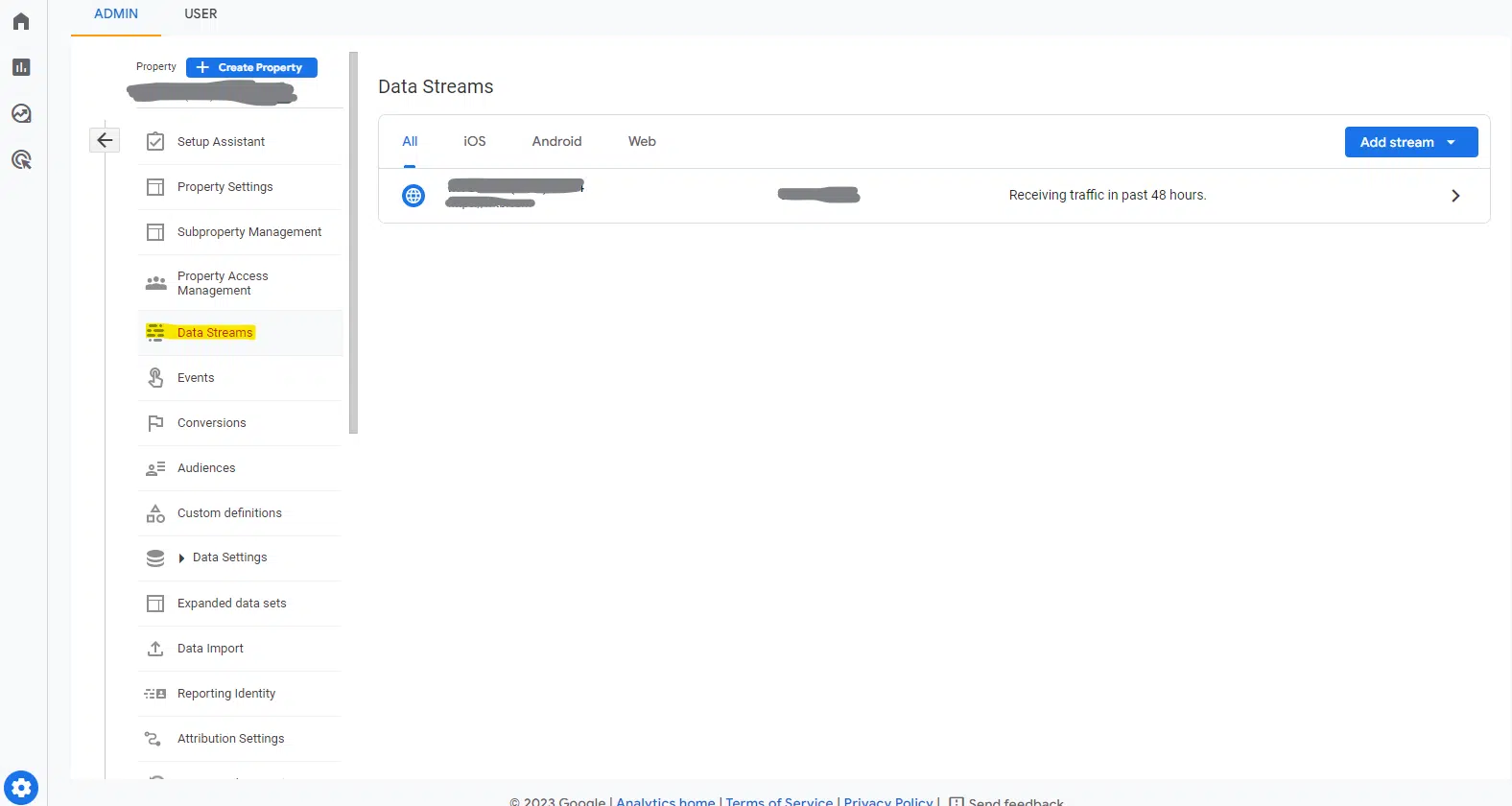
To do so, from within the Admin section of your GA4 account, go to Data Streams under your GA4 property and select the stream you’re working from. 

GA4 Data Streams

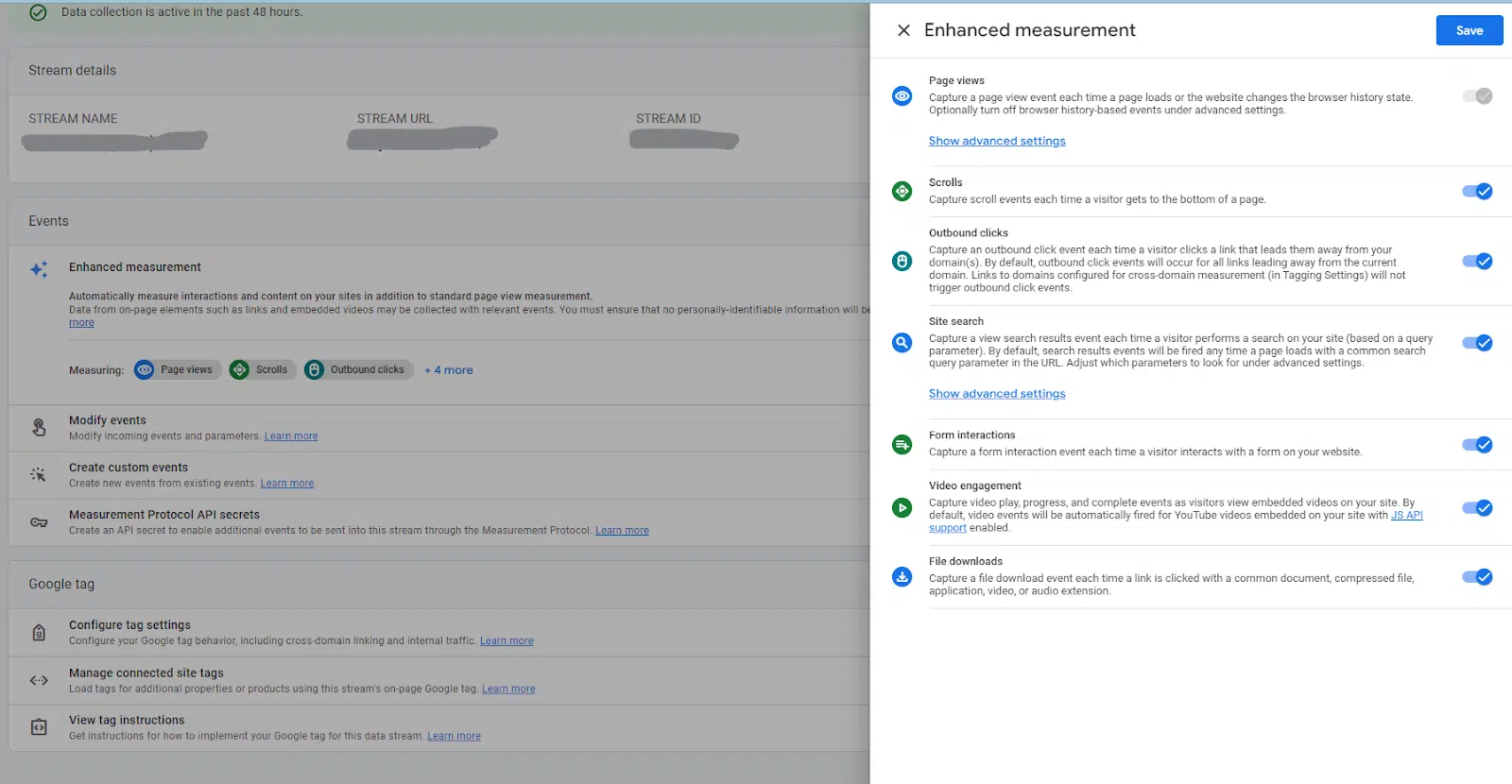
From here, you’ll see the Enhanced measurement option near the top.

Toggle the switch on and select the gear to see the options for measuring specific events. You can then toggle on all the events you’d like to include.

GA4 - Enhanced measurement

Of course, these built-in events have limitations and barely scratch the surface of GA4’s capabilities. Before discussing other uses for events, let’s cover how you can create new events.


Get the daily newsletter search marketers rely on.


Creating custom events

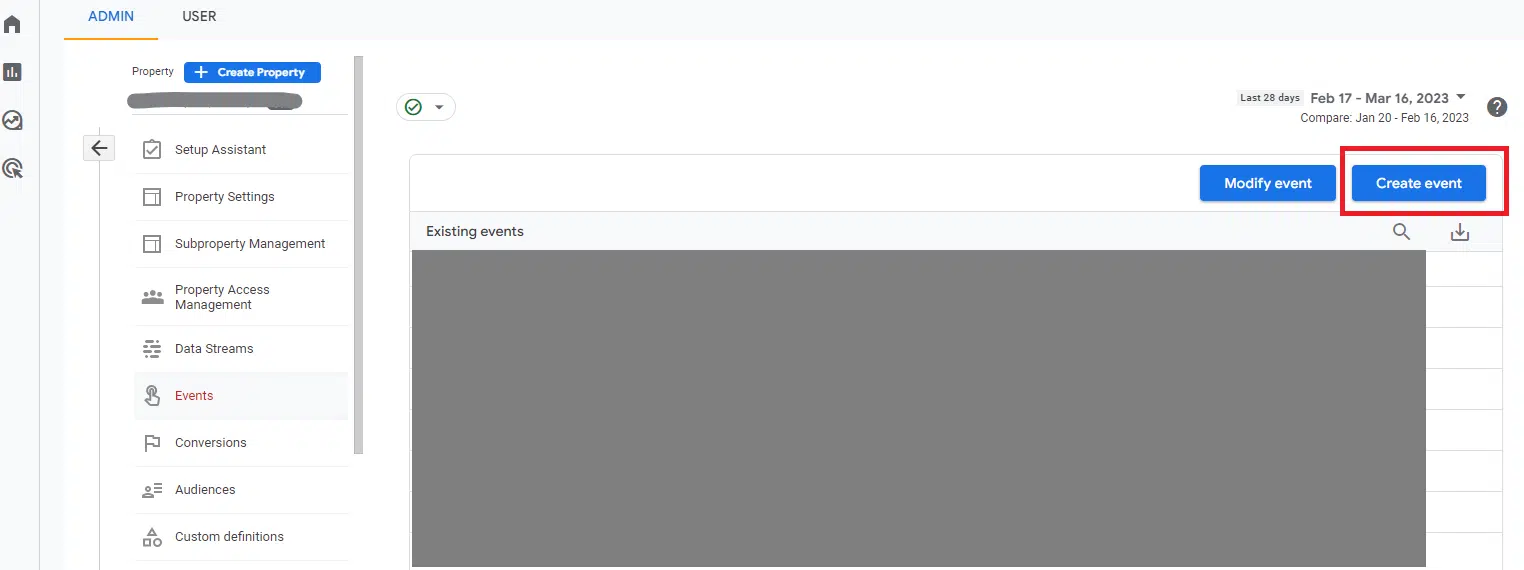
From within the Admin section for your GA4 property, navigate to Events. You’ll see a Create event button, which you can click to begin the process.

GA4 - Create event

Next, you’ll see a Create event screen from which you can click the Create button. 

From here, you can add the event name and customize any parameters to pass additional information through to Google Analytics.

GA4 - Event configuration

If you want to use an event as a conversion, you’ll see a Mark as conversion option next to existing events listed in the Events section. 

Toggle this to include the event in the Conversions report for the future and lump it together with metrics such as Conversion and Conversion Rate when creating custom explorations.

Let’s look at a few practical uses for custom events on your website or app.

Internal click tracking

While GA4 records events for outbound clicks by default, internal clicks leading to the same domain or domains included in cross-domain measurement are not tracked. 

However, you may want to track these clicks to answer questions such as:

  • How many people click an Apply Now button that leads from a landing page to an application process?
  • How many people click a link to a store locator, indicating interest in visiting a location?
  • Are people engaging with a carousel on your homepage that links to various internal pages?

Using Google Tag Manager, you can set up an event to target a click on a specific element within your site. 

While the exact approach may vary depending on the site, you could set up a trigger based on an HTML ID, a link URL, object text, or other criteria to ensure you’re picking up on the correct click.

Logged-in activity

If applicable to your site, you can fire a sign_up event when users register or login when current users log into their accounts. 

This tracking could help answer questions such as:

  • What sources have the highest conversion rate for user registrations?
  • How often are existing users logging into their accounts?
  • What devices are users most likely to use for accessing their accounts?

Beyond setting up these events, explore setting up user ID tracking, in which you assign a unique ID to each individual and can connect future sessions to the same user when they log in down the road.

Ecommerce events

For ecommerce sites, be sure to incorporate tracking for cart, checkout, and purchase-related activities. 

GA4 recommends the following events which are relevant for common ecommerce actions you’d want to record:

  • view_item
  • select_item
  • select_promotion
  • add_to_cart
  • remove_from_cart
  • view_cart
  • begin_checkout
  • purchase 
  • refund

App engagement

GA4 can track several events related to app interactions, such as when users:

  • Update an app.
  • Activate in-app purchases.
  • Open the app via a dynamic link.
  • Click in-app ads.
  • Interact with notifications within the app. 

These examples and others are automatically collected, but additional recommended events can be included, depending on the type of app.

For instance, a game may include tutorials to teach new users how to play. 

You can fire events for people working their way through the tutorial, showing how many individuals start the process and how many finish without dropping out. 

Other in-game events can track starting/ending levels, spending virtual currency, unlocking achievements, and posting scores.

Start creating events

This is just an initial list of potential events to create for your site or app, but the possibilities are endless for tracking your particular setup. 

Consider the user actions crucial to your business or clients and how you can correlate events with these activities. 

The sooner you gather historical events, the more robust data you’ll have for future analysis.


Opinions expressed in this article are those of the guest author and not necessarily Search Engine Land. Staff authors are listed here.


Related stories

New on Search Engine Land

@media screen and (min-width: 800px) { #div-gpt-ad-3191538-7 { display: flex !important; justify-content: center !important; align-items: center !important; min-width:770px; min-height:260px; } } @media screen and (min-width: 1279px) { #div-gpt-ad-3191538-7 { display: flex !important; justify-content: center !important; align-items: center !important; min-width:800px!important; min-height:440px!important; } }

About the author

Tim Jensen

Tim Jensen is a Sr. Search Engine Marketing Specialist at M&T Bank. With over a decade of experience in the digital marketing industry, Tim has worked with both B2B and B2C brands in a wide variety of industries. While comfortable managing ads across all major platforms, he’s particularly intrigued with the crossover between analytics and PPC.

https://searchengineland.com/event-tracking-google-analytics-4-395023