How to build a values-based agency that drives results

One of the best things about starting your own business is that you can set it up to reflect your values.

As a leader, you set the stage for:

  • How the company will operate.
  • The types of people you will hire.
  • The clients you choose.
  • How you partner with clients.

Our mission is centered on a fierce commitment to our values and passion for inspiring others. We are committed to earning the trust of our colleagues, communities, and clients by serving them authentically, graciously and humbly. Generosity is so central to who we are that we recently started a nonprofit.

It’s very different than many agencies that focus on creativity and “the work” in their purpose or mission statements – we want to be known for who we are more than what we do.

Want to build your own values-based agency?

Here’s how to ensure the values you set are infused within your organization.

Behavioral interviewing paired with insights

A solid values-based agency starts with hiring the right people and asking them the right questions.

My team asks questions about the candidate’s aptitude, abilities, and client management skills. 

As the person ultimately responsible for culture, I like to ask questions that give me a sense of who the person is. 

These include: “Have you ever been asked to do something that went against your sense of ethics?” and “What’s a common misconception about you?”

  • We also use tools like StrengthsFinder to understand what makes the person tick and how they will fit with the rest of our team.

Protecting our values and shared culture means thinking more broadly than just who the prospective employee is. 

New hires must share the team’s values, complement our existing skillset and enhance the overall team and client experience.

In other words, we want people who can elevate culture while adding new skills to the team.

Having an infinite mindset

Short-term – or finite – thinking can lead people to compromise values they may otherwise hold strongly. 

As an agency leader, you must sometimes focus on short-term needs, like ensuring you have enough money for payroll. But if you’re the type of finite leader who hires and fires based on short-term needs, you’ll build a different culture than you might intend.

Ethical fading, or losing sight of ethical connotations of decisions, can creep in when people are only focused on the near term. Use an infinite mindset whenever possible to build a strong, high-performing, values-based agency.

An infinite mindset means focusing on a greater purpose and acknowledging that the goal of a business is to keep playing the game. The priority is building high-trust teams, understanding that you’ll often need to flex and adapt to stay in business, and respecting your worthy rivals.

Agencies may exhibit finite thinking when they lay people off quickly after losing a client or are solely focused on selling the agency.

Investing in leadership training and development

Most agencies ensure their people are great marketers and are up to speed on the latest tactics. That’s a given and should certainly be part of the marketing training curriculum.

However, investing in leadership training and development at all levels helps ensure your team knows what you truly value. As an agency leader, I see my role as developing the next generation of great leaders, not just the next generation of great marketers.


Get the daily newsletter search marketers rely on.


Now that you know how to ensure values are engrained within your organization, how do you ensure that you’re driving and getting the results for your agency by leading with values? 

It comes through receiving benefits in three key areas.

1. Employee retention

Digital marketers have a lot of choices regarding where to work. While the old perks like pool tables or happy hours used to matter, remote work has changed what drives employee satisfaction and retention.

The ability to leave home to pick up kids and perform some work off-hours. Believing in the company’s values and having systems that allow employees to feel connected to their colleagues. These are all important.

Employee turnover is disruptive both to the company and its clients.

Our turnover is less than half of the norm. I attribute this to leading our people with clarity of our values and setting them up as best as possible to lean into them. 

Are we perfect? No. But with values and purpose as a focus, it helps keep employees around longer than the norm.

The alignment of values is key to building a mutual foundation of trust between employees and an agency. It also helps make bonding easier among employees.

2. Client satisfaction

Clients appreciate values such as transparency, humility, and gratitude.

Building trusted relationships and managing their accounts by a strong values-based group leads to higher client satisfaction and retention.

Of course, the marketers must be managing accounts well – that’s table stakes. 

Building deep relationships builds a shared commitment and vision. It helps create an “us” mentality with the client and agency as a team, as opposed to the common “them” or “vendor” relationship.

One other benefit of building deep relationships? As your client partners leave for other companies, there’s a good chance they will bring you.

3. Increased innovation

Values-led organizations tend to create psychological safety. This means a safe environment exists for individuals to share their thoughts and ideas with leaders. 

Innovation must not be limited to new strategies and tactics – it can be new processes or feedback on what types of services the agency should start or stop offering.

Innovation can be team-based, as well. This can lead to employees being heard and feeling valued, something which will also play into retention

I hope that these views on building a strong values-based culture help you strengthen your agency to drive the results you seek.


Opinions expressed in this article are those of the guest author and not necessarily Search Engine Land. Staff authors are listed here.


Related stories

New on Search Engine Land

@media screen and (min-width: 800px) { #div-gpt-ad-3191538-7 { display: flex !important; justify-content: center !important; align-items: center !important; min-width:770px; min-height:260px; } } @media screen and (min-width: 1279px) { #div-gpt-ad-3191538-7 { display: flex !important; justify-content: center !important; align-items: center !important; min-width:800px!important; min-height:440px!important; } }

About the author

Antonella Pisani

Antonella Pisani is CEO and founder at Eyeful Media, where she leads a team of passionate & talented marketers. Over the course of her career, she’s held senior digital marketing & eCommerce leadership positions with Fossil, JCPenney, Guitar Center, and Proflowers but began her career as a web designer in 1996. Antonella is based in Dallas, and her trusty sidekick, Riley (a rescue pup who also serves as the company’s Chief Security Officer), is often sleeping by her desk. She’s been to 37 countries and loves to travel any chance she gets.

https://searchengineland.com/how-to-build-a-values-based-agency-that-drives-results-395018


Microsoft explores sharing Bing Chat ad revenue with publishers

Microsoft is exploring ways to share ad revenue it generates through the new Bing, Bing Chat, with select publishers.

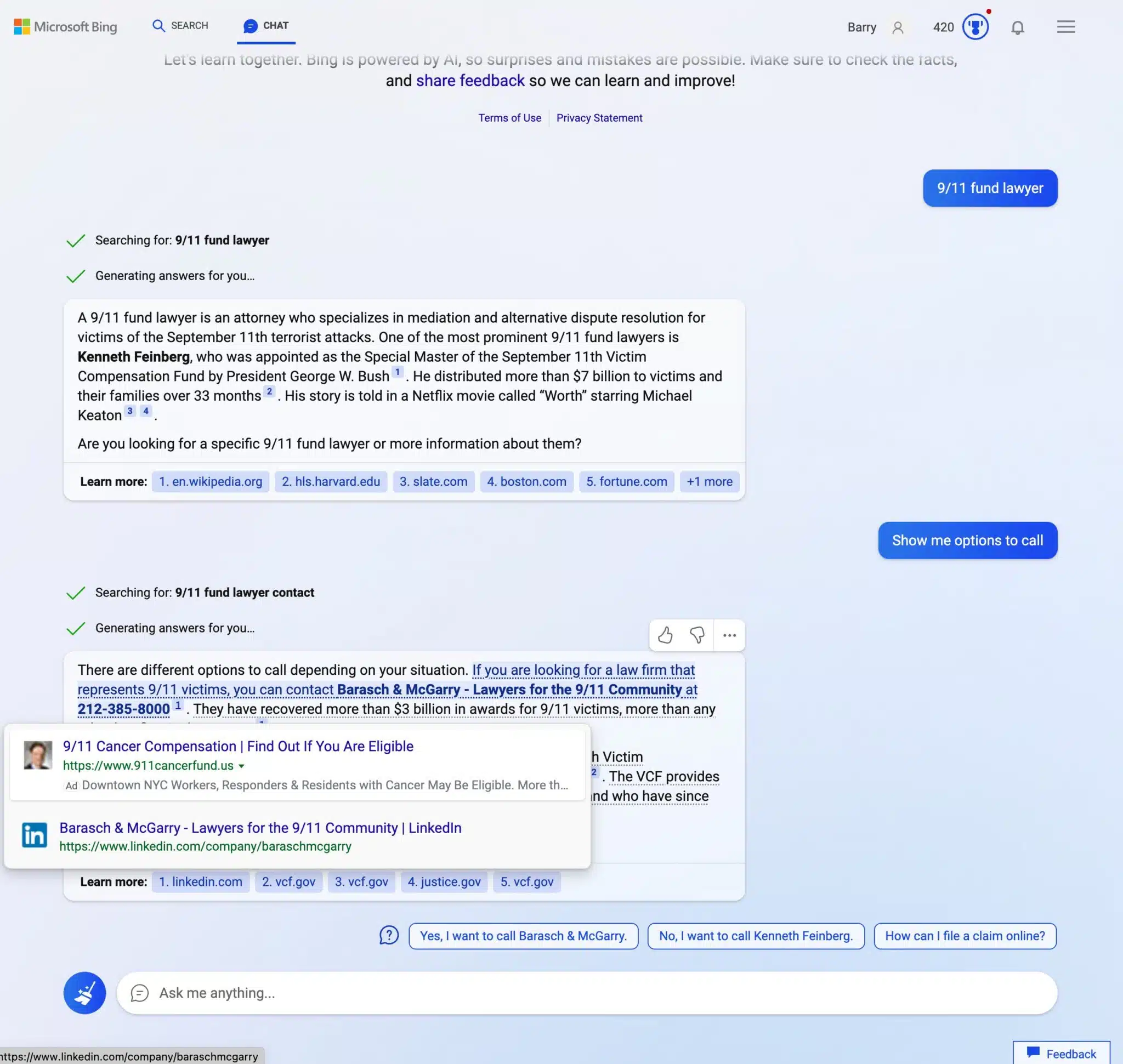
Bing Chat has had ads since it launched on Feb. 7. Now, Microsoft says it will look to “share the ad revenue with partners whose content contributed to the chat response.”

What’s new. “We’re also exploring placing ads in the chat experience to share the ad revenue with partners whose content contributed to the chat response,” Microsoft vice president Yusuf Mehdi wrote. “We recently met with some of our partners to begin exploring ideas and to get feedback on how we can continue to distribute content in a way that is meaningful in traffic and revenue for our partners.”

Microsoft Start partners. This seems to be something that Microsoft is conducting through its Microsoft Start partners program.

“For our Microsoft Start partners, placing a rich caption of Microsoft Start licensed content beside the chat answer helping to drive more user engagement with the content on Microsoft Start where we share the ad revenue with the partner.”

– Yusuf Mehdi, Driving more traffic and value to publishers from the new Bing

Microsoft introduced Microsoft Start in 2021. It is a personalized news feed that aggregates content from about 7,500 participating “premium publishers.” Start is available via desktop and mobile devices.

Microsoft gets publishers. Mehdi acknowledged the value of publishers:

“The Internet works because of an important ecosystem which starts with publishers creating great content which drives traffic and interest by people to consume that content, and then ultimately advertisers that want to reach people in a high quality and targeted environment.”

Without publishers, search and chat would not function as well and Microsoft wants to make sure that at least some publishers are compensated so they can continue to generate quality content.

“For the most part this dynamic has worked well as publishers get paid for their content through advertising which enables people to access the content for free,” he added.

Ads in Bing Chat are not new. Many reports have been published in the past 24 hours claiming Bing Chat is just now adding ads. (You can see many of them on Techmeme.) Those reports are simply incorrect.

In fact, on Feb. 7, Microsoft demonstrated ads in Bing Chat. We also reported on meetings Microsoft had with advertisers and brands about the future of ads in Bing Chat.

Here are some of those ad formats (more details from Search Engine Roundtable here). Click to enlarge any of these images:

Why we care. While Google Bard seems to have turned a blind eye to publishers, Microsoft is looking for ways to not just link and drive traffic to publishers but also help them earn revenue from the responses provided by Bing Chat.

It is nice to see one big search engine outwardly talking about compensating publishers for the answers it generates through the content produced by hard-working publishers.

That said, the term “premium publishers” concerns us. It’s nice that ABC News, The Wall Street Journal, New York Times, HuffPost, CNN and 7,500 other publishers may get paid, but there are nearly 2 billion websites producing content on the internet. As a percentage, 7,500 isn’t even detectable.

Additional reporting on this story from Chris Elwell.


Related stories

New on Search Engine Land

@media screen and (min-width: 800px) { #div-gpt-ad-3191538-7 { display: flex !important; justify-content: center !important; align-items: center !important; min-width:770px; min-height:260px; } } @media screen and (min-width: 1279px) { #div-gpt-ad-3191538-7 { display: flex !important; justify-content: center !important; align-items: center !important; min-width:800px!important; min-height:440px!important; } }

About the author

Barry Schwartz

Barry Schwartz a Contributing Editor to Search Engine Land and a member of the programming team for SMX events. He owns RustyBrick, a NY based web consulting firm. He also runs Search Engine Roundtable, a popular search blog on very advanced SEM topics. Barry can be followed on Twitter here.

https://searchengineland.com/microsoft-explores-sharing-bing-chat-ad-revenue-with-publishers-395056


2023 Salary & Career guide: How much search marketers make

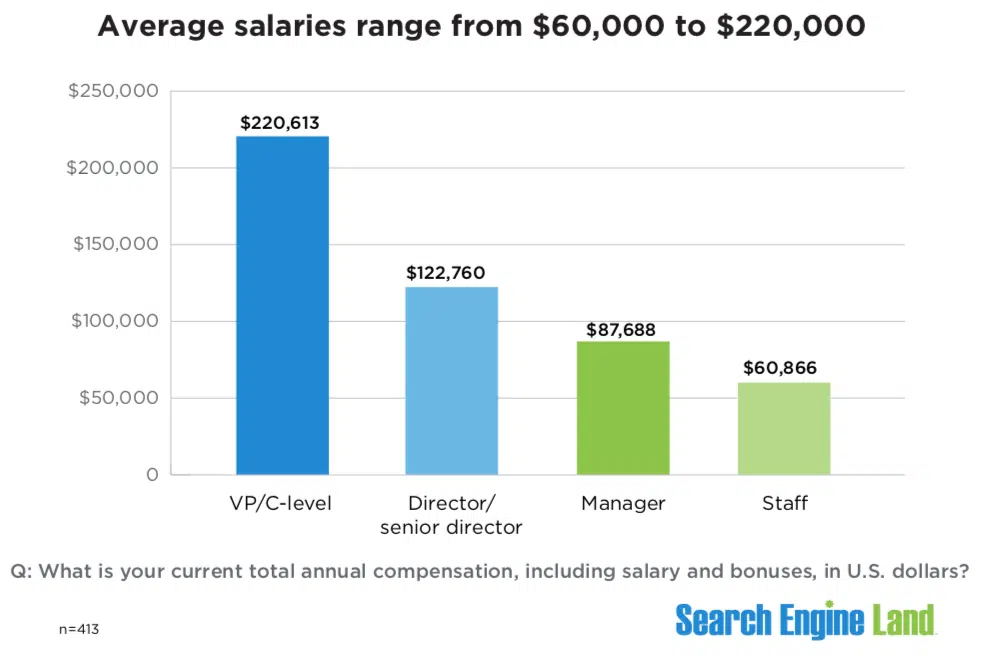
Search marketers earn anywhere from $60,000 to $220,000 in annual compensation (salary and bonuses), on average, according to a new Search Engine Land survey. 

Why we care. Search marketing is an attractive and satisfying career choice that can, over time, become increasingly lucrative. The keys to earning that higher compensation? Seniority, role and the size of the company or organization you work for.

By the numbers. VP and C-level positions earn the most – $220,613 in annual compensation, on average. Directors and senior directors earn $122,760; managers $87,688; and staff $60,866, all on average.

Average search marketer salaries in U.S. dollars.
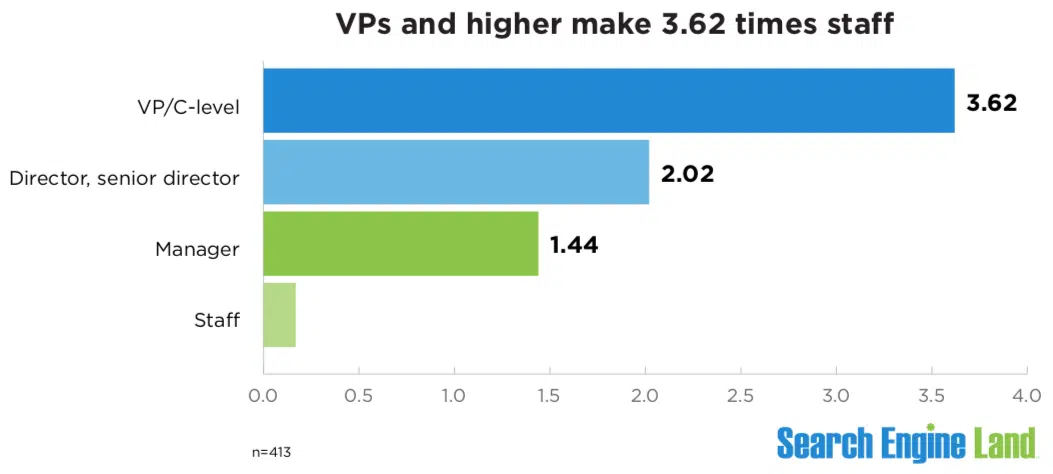
  • Those who hold the position of VP or higher make 3.62 times more than their staff, according to our survey. 
VPs and higher make 3.62 times staff

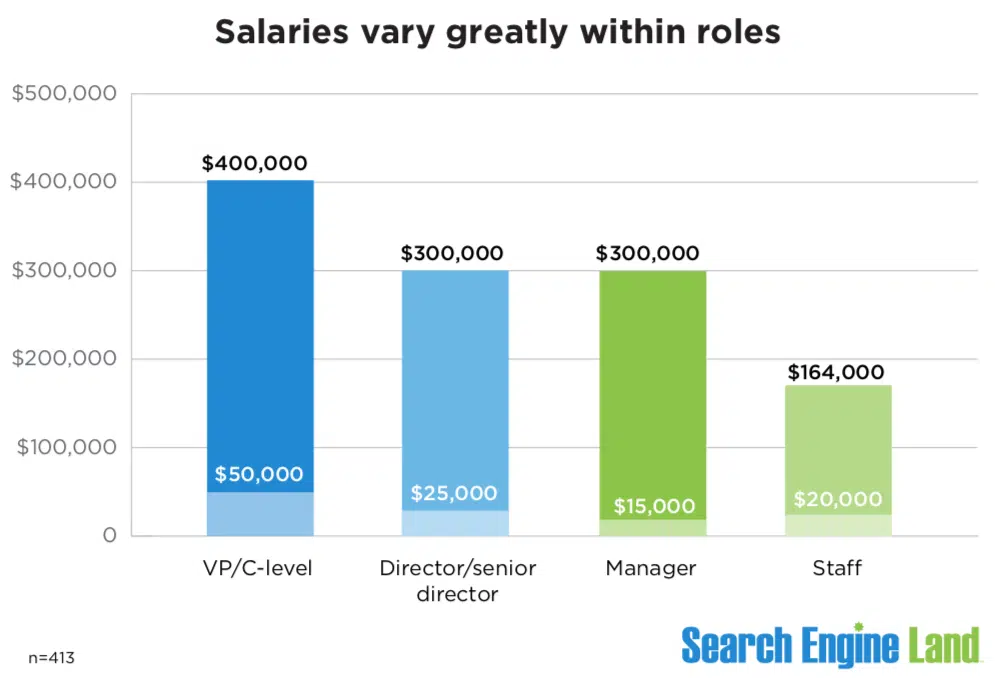
Salaries vary greatly within roles. Averages sometimes can be misleading. So let’s break that down a bit further to get a more nuanced view:

  • VP and C-level positions range from $50,000 to $400,000.
  • Director and senior director-level salaries range from $25,000 to $300,000.
  • Manager-level salaries range from $15,000 to $300,000.
Salaries vary greatly within roles

Why the variance? Location is one big reason (see our Methodology section below). But there are more factors, such as the size of the organization and years of experience.

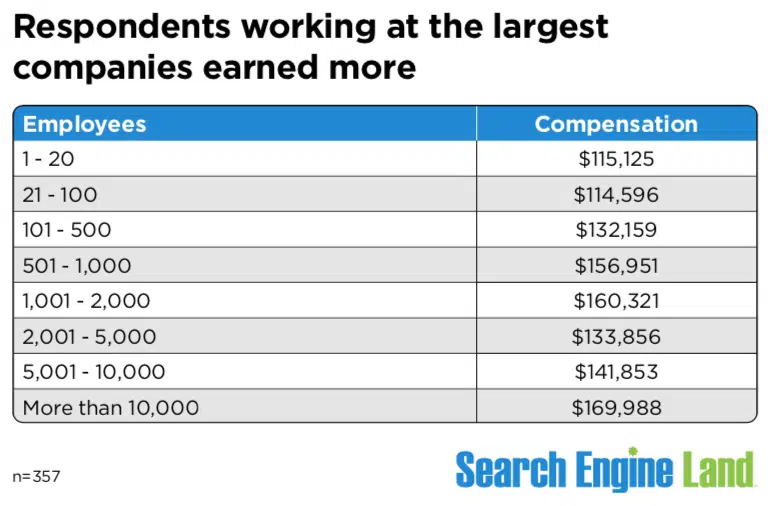
Case in point. Respondents who work at the largest companies get greater compensation. Search marketers at organizations with more than 10,000 employees earned $169,988, on average.

Respondents who work at the largest companies get greater compensation.
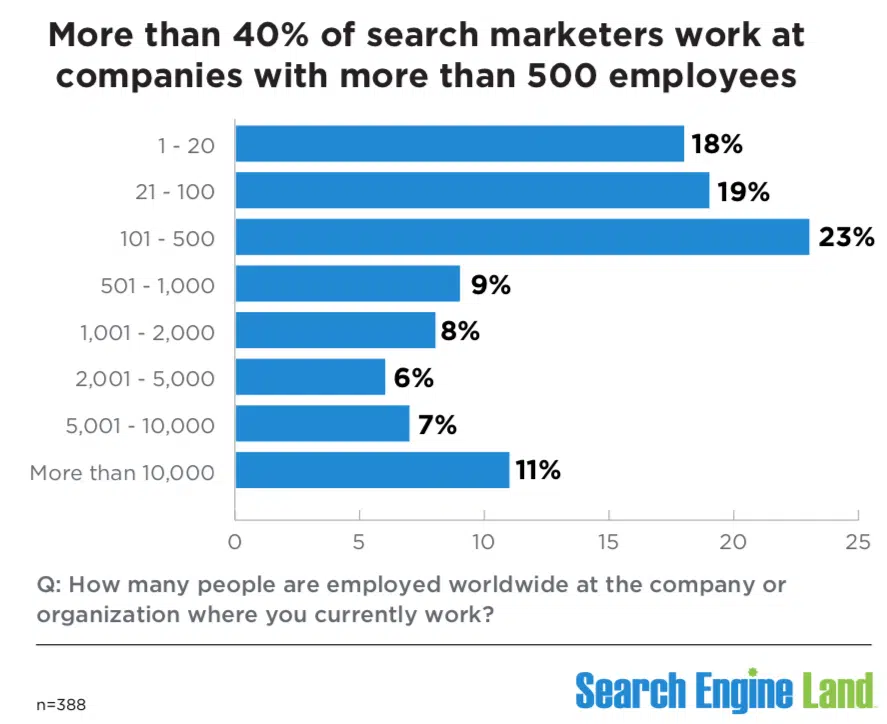
  • 41% of the search marketers in our survey work at companies with more than 500 employees.
More than 40% of search marketers work at companies with more than 500 employees.

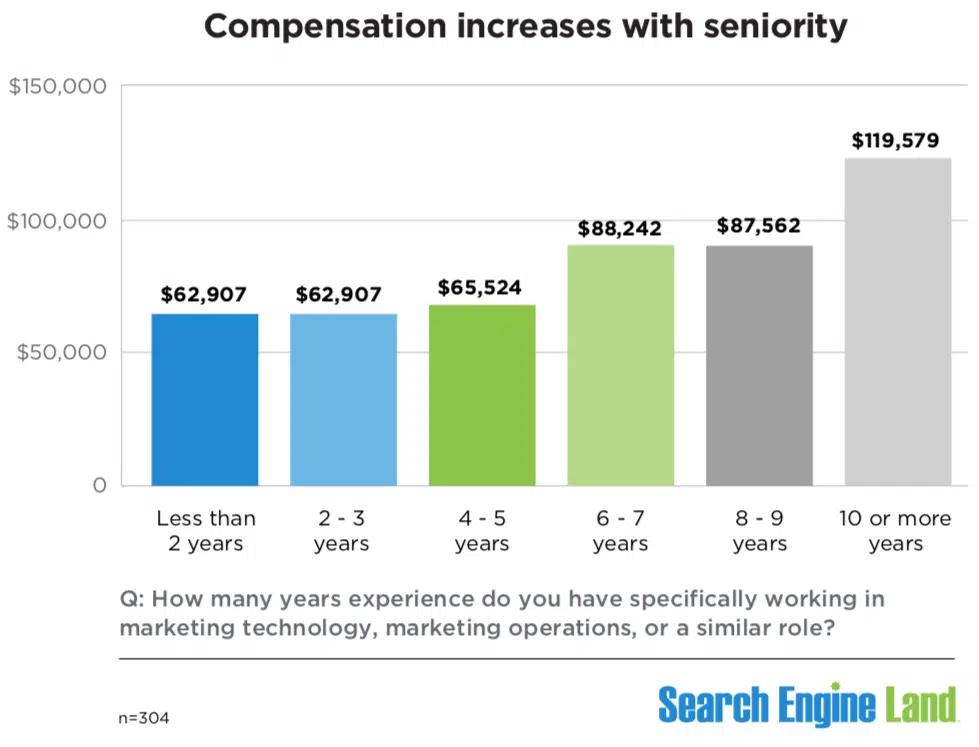
Compensation increases with seniority. Years of experience typically translate into higher compensation.

The first jump in salary comes around year six or seven (~$66,000 to ~$88,000), and the second salary jump comes when you reach year 10 (~$88,000 to ~$120,000), our data showed:

Compensation increases with seniority.

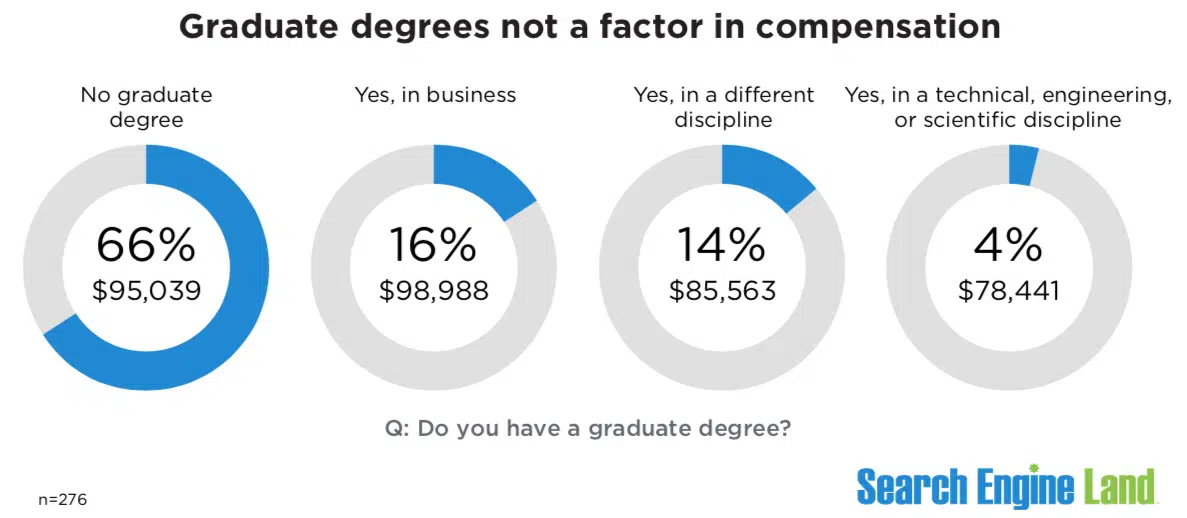
Graduate degrees don’t factor in compensation. Of the 276 respondents who answered this question, 66% said they did not have a graduate degree and earned $95,039, on average.

Meanwhile, 16% reported having a graduate degree in business, but their average salary was only slightly higher at $98,988, on average.

Graduate degrees not a factor in compensation
  • Context: In the U.S., 14.4% of those age 25 and older hold an advanced degree (master’s, professional or doctoral), according to U.S. Census Bureau data.

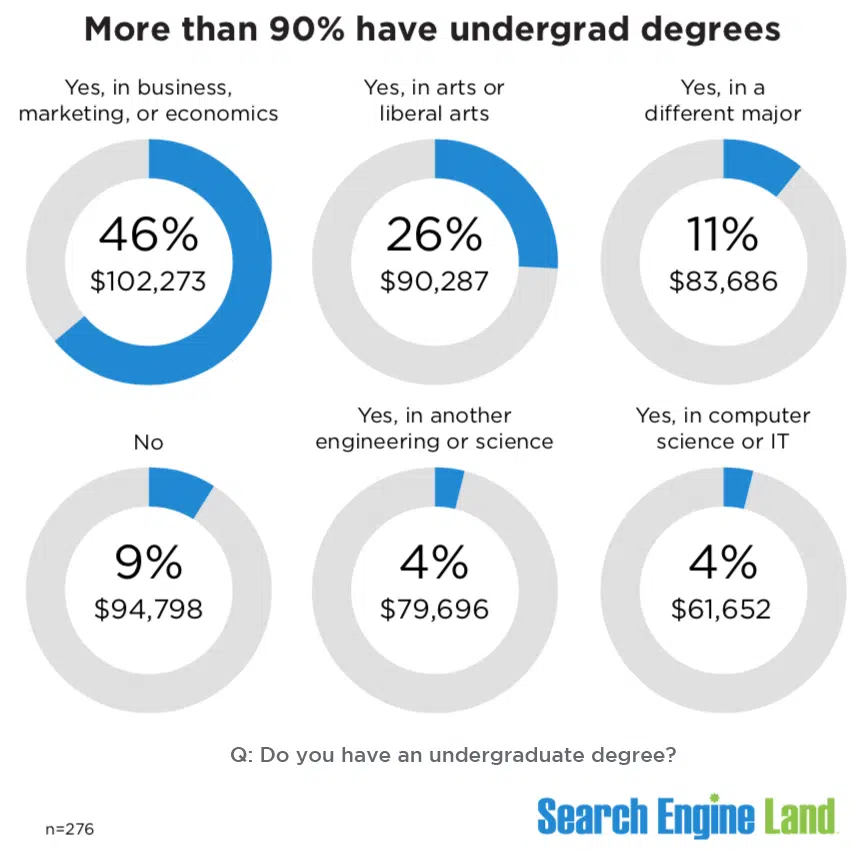
Meanwhile, more than 90% of search marketers have an undergraduate degree.

More than 90% of search marketers have an undergraduate degree.

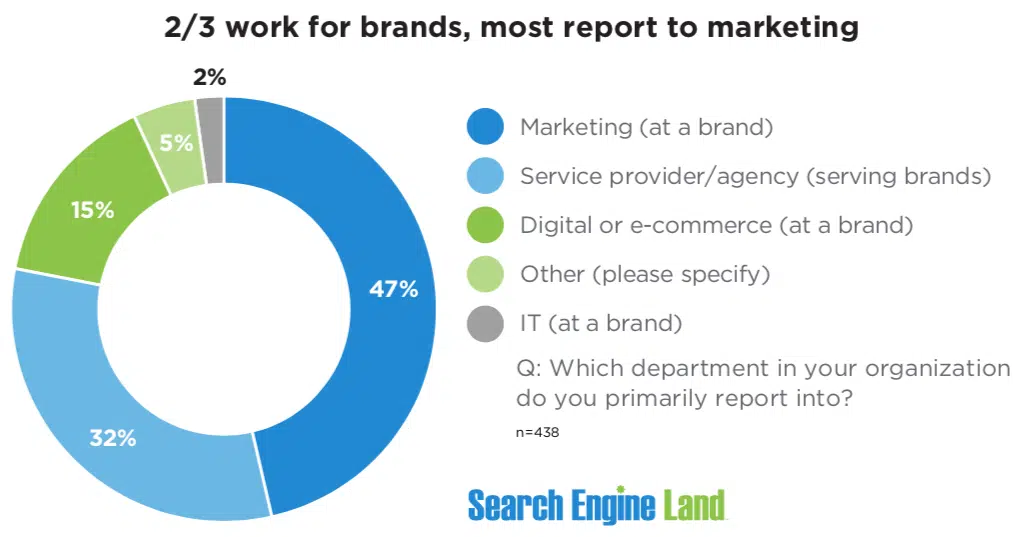
64% work at brands; 32% at agencies. Nearly two-thirds of respondents worked at brands. 

Nearly two-thirds of respondents worked at brands. 
  • Almost half (47%) of those working at brands primarily reported into marketing, while 15% reported to digital or ecommerce.

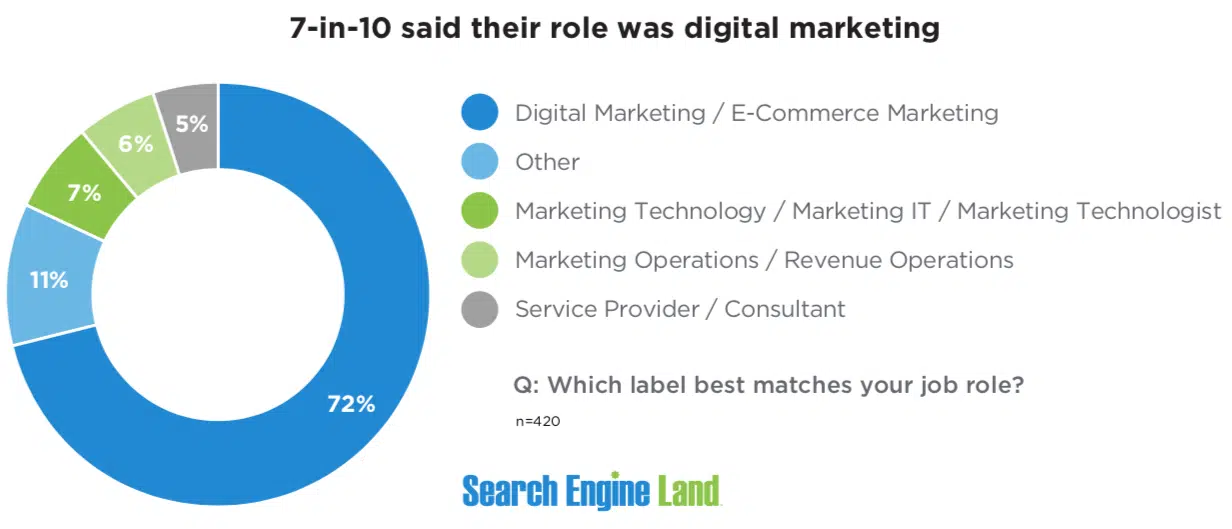
The majority (72%) of respondents said their role was digital marketing.

7 in 10 said their role was digital marketing.

Of the 11% who answered “other,” more than half had “SEO” in their title.

Methodology. We surveyed 510 marketers between Jan. 11 to 23; 413 of those provided salary information. Invitations to take the survey were amplified on and by Search Engine Land.

Nearly 67% of the 510 respondents live in North America; 20% live in Western Europe. The conclusions in this report are limited to responses from those individuals only. Others were excluded due to the limited number.

The survey had more than 20 questions related to career roles, salary, technology, job satisfaction and challenges/frustrations. Respondents were given the opportunity to reveal their age and gender. 

More to come. Over the next two days, we’ll look at the differences in salaries and careers of women and men, and also dig deeper into roles and responsibilities.


Related stories

New on Search Engine Land

@media screen and (min-width: 800px) { #div-gpt-ad-3191538-7 { display: flex !important; justify-content: center !important; align-items: center !important; min-width:770px; min-height:260px; } } @media screen and (min-width: 1279px) { #div-gpt-ad-3191538-7 { display: flex !important; justify-content: center !important; align-items: center !important; min-width:800px!important; min-height:440px!important; } }

About the author

Danny Goodwin

Danny Goodwin has been Managing Editor of Search Engine Land & Search Marketing Expo – SMX since 2022. He joined Search Engine Land in 2022 as Senior Editor. In addition to reporting on the latest search marketing news, he manages Search Engine Land’s SME (Subject Matter Expert) program. He also helps program U.S. SMX events. Goodwin has been editing and writing about the latest developments and trends in search and digital marketing since 2007. He previously was Executive Editor of Search Engine Journal (2017 to 2022), managing editor of Momentology (from 2014-2016) and editor of Search Engine Watch (from 2007 to 2014). He has spoken at many major search conferences and virtual events, and has been sourced for his expertise by a wide range of publications and podcasts.

https://searchengineland.com/search-marketer-salary-career-guide-2023-394881


5 must-know Reddit Ads tactics for B2B marketers

Millennials and Gen Zers are set to dominate B2B buying committees this year, so keeping up with them is a must.

More than knowing the latest trends, we must continually assess:

  • Where this target audience is. (What platforms are they on?)
  • Where they are engaging with content.
  • What type of material they are consuming.
  • And most importantly, how to win their trust and keep it. 

On the flip side, all marketers know many platforms today are overcrowded with advertisers.

This is an uphill battle for B2B marketers competing against the often punchier and eye-grabbing creative for B2C brands. 

Enter Reddit Ads. B2B marketers can leverage Reddit to stand out from the crowd and stay in front of target audiences.

This article will outline tactical recommendations if you want to test the platform for the first time or need help to improve current campaigns.

1. Conversation placement ads > standard ads

Why use standard promoted ads when you can engage prospects when they are the most engaged? 

Conversation placement ads, positioned immediately after the original post and before the first comment, were created in 2021 to get brands where users spend most of their time – in a conversation thread.

Picture this. You’re a business interested in placing an ad on Reddit.

You go to the platform, learn about “Google Ads” and navigate to a conversation thread comparing three solutions you believe are right for your business.

Surprise, you can place your ad right there to add more information about your business. 

Reddit conversation placements

Since Reddit ranks organically, this increases your chances of showing up at the right time, especially when prospects are actively researching – particularly important for niche searches or verticals.

2. Instead of uploading emails lists, create website remarketing pools

B2B marketers love good email remarketing. While it’s available on Reddit, match rates for business emails are very low. 

Since email domains are not a popular option – unless you are paying for a solution like Liveramp – there is only one other alternative.

Set up the Reddit pixel across your website. You only need 50 users to start promoting your ads, and you can say hello to untapped niche audiences. 

The Reddit pixel is also a great window to confirm your best audience, whether it’s your current customers (if you have a login section on your website) or customers who land on your confirmation page (if you are a B2B ecommerce site).

Other advantages of using the Reddit pixel include:

  • Ability to set up lookback windows between 1 and 90 days.
  • Option to include and exclude pixel events to make sure you are not overlapping audiences
  • Flexible conversion events ranging from pageviews and view content to lead and purchase.

Get the daily newsletter search marketers rely on.


3. Find the right subreddits to target

Reddit is formed by communities called subreddits, typically denoted by a “r/” prefix preceding the category’s name. 

Subreddits can also be bucketed into larger topics, for example, gaming, crypto, or television, among many others.

You might be wondering how to find the best subreddits to place your ads.

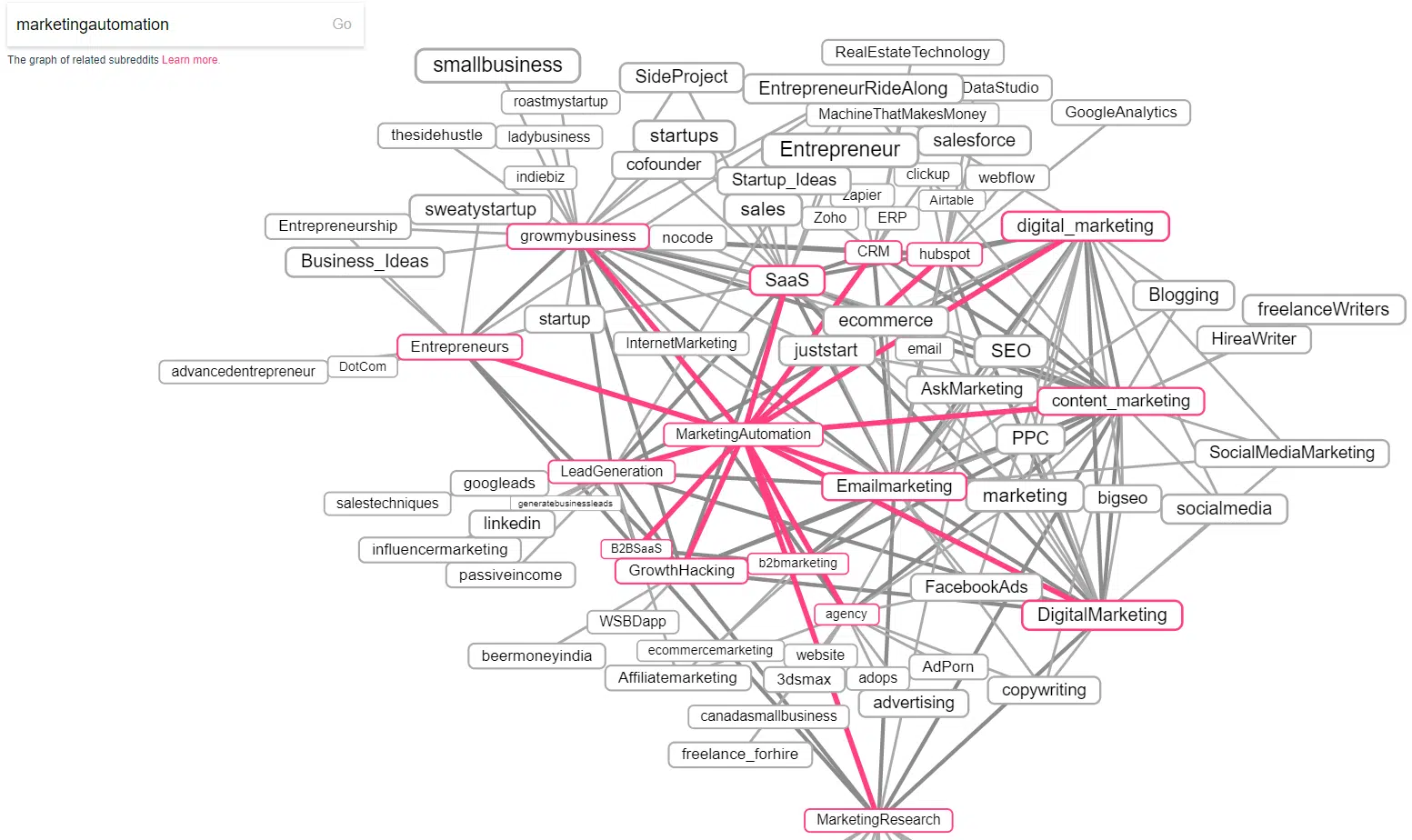
This interactive tool allows users to map out subreddits and see how they connect to other related or more specific subreddits. 

For example, you can start by searching for the r/emailmarketing subreddit, and the tool will auto-generate a web of related subreddits, which you can then sort by category (i.e., new, hot, rising, and top). 

For marketers, this means easily finding niche audiences that fall under subreddits you may otherwise not have known existed.

Related subreddits

On the map above, the starting category is marketing automation which is highly correlated to other big categories such as digital marketing, email marketing, content marketing, and growth hacking. 

But the map indicates that marketing automation can also be tied to more niche subreddits such as CRM, B2B SaaS, B2B marketing, and HubSpot, to name a few.

4. Content is king

While all the tactics we’ve reviewed are very helpful performance drivers, at the end of the day, a truly successful Reddit ad is contingent upon content quality.

Reddit users visit the platform to find “their people” – communities with a shared interest. 

These communities are the lifeblood of the platform and the source of the raw, honest information users seek. 

As marketers, we simply can’t use the same whitepaper or demo we might leverage on Google or LinkedIn Ads. 

This doesn’t mean advertising on Reddit or creating powerful content for Reddit has to cost you a lot of money. 

Rather, we need to shift our mindset to creating content that will be engaging and interactive, such as: 

  • Free trials: The Reddit community is all about learning about new products or brands, so let them try you for free! No strings attached. This will boost conversion rates and puts you in a position to target niche communities and untapped audiences.
  • Alphas or betas: Get honest feedback you can then upsell. This is magic content for B2B promotions via Reddit Ads. You can also set up a sales nurture track with your business development and product teams (it wins you points internally, too!) to automate follow-up time and get prospects on the phone engaged with the right stakeholders, which makes the prospect feel like a partner versus just another lead. Win-win! 

5. Control is key: Inventory types for sensitive B2B markets

Some industries are deemed sensitive within the B2B umbrella (i.e., healthcare, government, and pharmaceutical). 

Controlling where your content might appear is of the utmost importance if you’re part of one of these industries. 

To address this, Reddit released a feature called “inventory type” in 2020, which allows you to control your reach within the platform.

There are three inventory types on Reddit:

  • Expanded inventory.
  • Standard inventory.
  • Limited inventory.

The limited inventory category, created in partnership with Oracle Data Cloud’s contextual intelligence, goes through Reddit rules and systems and third-party filtering, thanks to Oracle. This ensures advertisers can strengthen their brands through a regulated approach.

Many marketers have also expressed concerns about brand safety on Reddit, which often stem from a lack of understanding and the misconception that Reddit ads can appear almost anywhere and in any community. 

This isn’t true. Ads on Reddit can only appear in hand-picked communities, and you can even enable or disable comments on your ads. 

For even more control, marketers can include or exclude audiences so only the right people to see your ads.

Your target audience is very likely on Reddit! 

Sometimes an overlooked platform, Reddit is a great opportunity for B2B advertisers to reach niche communities while strategically diversifying media plans. 

Wondering if your audience is on the platform? Reddit is the fifth most visited website in the U.S., according to Semrush.

Follow the tactics outlined above and experiment with what’s possible on Reddit. It just may be the opportunity you’ve been looking for to fuel your marketing efforts.


Opinions expressed in this article are those of the guest author and not necessarily Search Engine Land. Staff authors are listed here.


Related stories

New on Search Engine Land

@media screen and (min-width: 800px) { #div-gpt-ad-3191538-7 { display: flex !important; justify-content: center !important; align-items: center !important; min-width:770px; min-height:260px; } } @media screen and (min-width: 1279px) { #div-gpt-ad-3191538-7 { display: flex !important; justify-content: center !important; align-items: center !important; min-width:800px!important; min-height:440px!important; } }

About the author

Andrea Cruz

Andrea Cruz is a Director of Client Strategy at Tinuiti. She has a decade of experience in driving and implementing SEM, Social Media, ABM, and content syndication campaigns on platforms including Google Ads, Microsoft Ads, Meta, LinkedIn, and more. Beyond paid search and social platforms, Cruz is proficient in Google Analytics, Google Tag Manager, various CRMs and has previous experience in operations and B2B purchasing.
Originally from Venezuela, Cruz earned a master’s degree in international business. She has spoken at numerous industry events, including SMX Advanced.

https://searchengineland.com/reddit-ads-tactics-b2b-marketers-394963


Google Ads Editor version 2.3 is out with 12 new features

Google has just released its Ads Editor version 2.3, advertisers can take advantage of several new features and updates. Let’s see what’s new.

New Features:

  1. File support for image assets: Advertisers can now conveniently import and export image assets as files in addition to using URLs.
  2. Card view for image assets: Image assets can now be viewed as cards in addition to the table view.
  3. Asset support: Full support is now available for upgraded assets such as image assets, automatically created assets, location assets, and business information assets. Legacy data will be deprecated when assets are upgraded.
  4. Primary Display Status buttons: Certain Primary Display Status (PDS) reasons are now clickable buttons, allowing advertisers to quickly fix issues that may prevent campaigns from serving.
  5. More PDS reasons: More PDS reasons are now available, including “Limited by bidding target” and “Limited by budget soon.”
  6. Performance Max text asset automation: Advertisers can now opt-in or opt-out of text asset automation for Performance Max campaigns.
  7. Add Google video partners recommendation: Editor now shows recommendations to add Google video partners, allowing advertisers to use the same targeting options across video partners for their video campaigns.
  8. Bid explorer: Editor now shows several recommended bids for Target CPA and Target ROAS bid strategies, including projected improvements for each option.
  9. Location targeting: Editor now has location targeting for “radius around location groups” and “radius around all locations in linked feed.”
  10. Discovery ads and campaigns with product feeds support: Editor now supports Discovery ads and campaigns with product feeds, allowing advertisers to show their products in Discovery ads.
  11. Proper pluralization in messages: Messages are now updated with the correct form of pluralization, which supports other languages.
  12. Notifications: More notification types are now available in Editor 2.3, allowing users to be more fully informed about the status of their accounts.

Deprecated Features:

  1. Top content bid adjustment: The “top content bid adjustment” setting is no longer supported and has been removed in Editor 2.3.
  2. Create Dynamic Search Ads recommendation: Editor version 2.3 no longer shows recommendations to create Dynamic Search Ads.

Dig deeper. Read the announcement from Google here.

Why we care. The new features can help improve the efficiency and effectiveness of your Google Ads campaigns. For example, the support for Discovery ads and campaigns with product feeds can help you expand your reach and show products to more potential customers. The notifications feature can keep you informed about the status of your accounts and allow you to take immediate action to resolve any issues.


Related stories

New on Search Engine Land

@media screen and (min-width: 800px) { #div-gpt-ad-3191538-7 { display: flex !important; justify-content: center !important; align-items: center !important; min-width:770px; min-height:260px; } } @media screen and (min-width: 1279px) { #div-gpt-ad-3191538-7 { display: flex !important; justify-content: center !important; align-items: center !important; min-width:800px!important; min-height:440px!important; } }

About the author

Nicole Farley

Nicole Farley is an editor for Search Engine Land covering all things PPC. In addition to being a Marine Corps veteran, she has an extensive background in digital marketing, an MBA and a penchant for true crime, podcasts, travel, and snacks.

https://searchengineland.com/google-ads-editor-version-2-3-is-out-with-12-new-features-394878


Manual CPC campaigns on the Microsoft Audience Network will be transitioning to Enhanced CPC

Manual bidding will be discontinued for new campaigns on the Microsoft Audience Network beginning April 24th. From this date, all current image and feed campaigns employing a manual cost per click (CPC) bid strategy will be transitioned to Enhanced CPC (eCPC). This shift is expected to be finalized by April 28th.

Timeline for the transition. The shift from manual bidding to eCPC starts on April 24th. New campaigns on the Microsoft Audience Network will no longer have the option for manual bidding. Starting April 24th, Microsoft will begin upgrading all existing campaigns on the network to eCPC. By April 28th, the transition will be complete, and throughout this week, campaigns using manual CPC will be converted to eCPC.

Good to know. This modification only affects image and feed campaigns with manual CPC and does not impact video campaigns using manual CPC or campaigns with manual cost per view (CPV) or cost per mille (CPM) bid strategies. The migration applies to standalone audience campaigns featuring image and feed ads.

Search campaigns extended to the Microsoft Audience Network, which already utilize eCPC and our comprehensive range of automated bidding solutions, will not be affected by this change.

Best practices. Microsoft says there’s no action required from you to prepare for this change. However, there are some areas that you can optimize to ensure you’re set up for success:

  • Conversion tracking: Microsoft recommends implementing eCPC alongside conversion tracking. Ensure that your Universal Event Tracking (UET) tag is present on all pages of your website and that your conversion goals are properly set up. Although not required, this approach can enhance performance by providing additional signals.
  • Offline conversions: If your strategy depends on offline conversions, Microsoft advises uploading your offline conversion data daily. This can be accomplished through a scheduled recurring import.
  • Attribution model: Try switching your conversion goal attribution to “last touch.” This adjustment enables you to optimize automated bidding based on both click-based and view-through conversions (conversions resulting from ad impressions). Users don’t always click on native ads immediately; however, seeing the ad significantly influences their behavior and journey toward conversion.

Dig deeper. You can review the announcement from Microsoft here.

Why we care. Adopting eCPC and following the suggested practices can lead to better campaign performance. Automated bidding strategies, such as eCPC, use machine learning to optimize bids in real-time, resulting in more efficient ad spend and potentially higher return on investment (ROI).


Related stories

New on Search Engine Land

@media screen and (min-width: 800px) { #div-gpt-ad-3191538-7 { display: flex !important; justify-content: center !important; align-items: center !important; min-width:770px; min-height:260px; } } @media screen and (min-width: 1279px) { #div-gpt-ad-3191538-7 { display: flex !important; justify-content: center !important; align-items: center !important; min-width:800px!important; min-height:440px!important; } }

About the author

Nicole Farley

Nicole Farley is an editor for Search Engine Land covering all things PPC. In addition to being a Marine Corps veteran, she has an extensive background in digital marketing, an MBA and a penchant for true crime, podcasts, travel, and snacks.

https://searchengineland.com/manual-cpc-campaigns-on-the-microsoft-audience-network-will-be-transitioning-to-enhanced-cpc-394848


This day in search marketing history: March 27

Google research: PPC ads drive 50% incremental clicks

In 2012, Google released a study, Impact Of Ranking Of Organic Search Results On The Incrementality Of Search Ads. It looked at whether clicks from organic search results substituted for ad clicks when PPC ads were turned off.

Google found that, on average:

  • 81% of ad impressions and 66% of ad clicks occurred in the absence of an associated organic result on the first page of search results.
  • 50% of the ad clicks that occurred with a Position 1 organic result were incremental.
  • 82% of the ad clicks were incremental when the associated organic search result ranked between Position 2 and 4.
  • 96% of the ad clicks were incremental when the advertiser’s organic result ranked in Position 5 or lower.

In short, Google’s research indicated that even a website ranking in Position 1 could benefit from an accompanying PPC ad.

Read more about it in Google Research: Even With A #1 Organic Ranking, Paid Ads Provide 50% Incremental Clicks.


Also on this day


Google pledges $340 million in Google Ads credits for SMBs

2020: The credits would become available for eligible active advertisers “in the coming months.” Google was also expanding ad grants for COVID-19 public service announcements. 


Search marketers are volunteering services, support to help small businesses get through COVID-19

2020: Consulting, web hosting, budget coaching – marketers were extending help to ease the strain on businesses.


Will Facebook’s massive usage increases (eventually) turn into revenue?

2020: Facebook was experiencing new records in usage almost every day.


Apple extends Search Ads support to 46 more countries

2019: Apps marketers also got the ability to group multiple regions into one campaign.


Ahrefs, SEO toolset provider, to build their own search engine to compete with Google

2019: “Ahrefs is working on general purpose search engine to compete with Google,” said Dmitry Gerasimenko, the founder of Ahrefs. (Yep launched in 2022.)


Hijacking Google search results for fun, not profit: UK SEO uncovers XML sitemap exploit in Google Search Console

2018: SEO wins bug bounty from Vulnerability Reward Program, Google search team confirms the exploit no longer works


Google Maps adds 39 new languages supporting over 1B people

2018: Google Maps now supported an additional estimated 1.25 billion people worldwide with new languages.


Google Search Analytics bug drops some image search traffic from reports

2017: Google was working on a fix.


Update: Google Says Big AdWords Quality Score Bug Is Fixed

2015: There were widespread reports from Google AdWords users that their keyword quality scores had fallen significantly.


Goodbye Blekko: Search Engine Joins IBM’s Watson Team

2015: Quiet for nearly two years, Blekko’s home page said its team and technology were now part of IBM’s Watson technology.


Search In Pics: Google Cardboard Cubicles, Watch Store & The Founders In 1999

2015: The latest images showing what people eat at the search engine companies, how they play, who they meet, where they speak, what toys they have, and more.


Car Makers Drove 14.4 Million Clicks From Google Ads In 2 Months (And That Doesn’t Include Mobile)

2014: Of those 177 advertisers, the top 20 advertisers (roughly 11%) accounted for 81% of the paid search clicks in the two month period.


Author Rank, Authorship, Search Rankings & That Eric Schmidt Book Quote

2013: Schmidt’s speculative world of some governments requiring verified profiles, if authors wanted to rank well in search engines, wasn’t a reality. Neither was Author Rank at Google. But authorship as a ranking factor seemed likely.


As News Publications Experiment With Sponsored Content, Google Says Keep It Out Of Google News

2013: News publications having “sponsored content” deals were on the rise, so Google issued a reminder/warning that publishers should keep such content out of Google News.


Bing Adds Search Filter To Sort Results By Time Period

2013: You could limit search results by the past 24 hours, week and month.


Search On Smartphones Up 26%, On Tablets Up 19% In 2012 [Study]

2013: Desktop searches, meanwhile, were down 6% between November 2011 and November 2012.


Google Testing Toggle For Search Options & Tools In Search Results

2012: Google search was testing a new user interface feature where they hid the search tools and options from the left side and let you toggle them open and close with a click of a mouse.


App Search Engine Appolicious Introduces “AdWords For Apps”

2012: Appolicious, an independent apps marketplace and search engine, introduced “AdWords for Apps” – a new PPC advertising system for app developers and publishers.


Google Blog Search Fixing Blogroll Indexing Bug

2009: The Google Blog Search team was rolling out fixes to how it separates blogrolls from actual blog posts.


Google Expands AdWords Interface Beta Test

2009: Plus, new features including Performance graphs on every campaign management page.


Google “TV Ads Online” Dangles Multi-Platform Lure For Brand Advertisers

2009: Google was testing a program that let advertisers make a single buy that ran ads on conventional TV as well as online at YouTube and potentially across the internet on other sites.


The Google Wonder Wheel & Other Search Refinement Features Get Live Test

2009: After Wonder Wheel, Google offered two further refinement options: Timeline and Search Suggestions.


How Google Shot Microsoft After It Took A Knife To A Gunfight

2009: While Google wants to be seen as weak in the search marketplace, that playbook gets tossed aside if you question its technical abilities.


Celebrities, TV, & Taxes: Hottest Search Terms In February

2009: The terms “rihanna” and “chris brown” are Nos. 1 and 3 according to their data, with “irs.gov,” “hulu,” and “american idol” rounding out the top five.


Google Offers Robots.txt Generator

2008:  It was designed to allow site owners to easily create a robots.txt file, one of the two main ways (along with the meta robots tag) to prevent search engines from indexing content.


Drilling Into Google’s Decline In Paid Clicks

2008: comScore once again reported a drop in sponsored clicks from January to February, something that also happened in the prior period. 


YouTube Insight: View Your YouTube Video Statistics

2008: You could get stats on the number of views per day your video received, where those viewers were in the world, and how popular your video was compared to other videos in a given period of time.


Don’t Expect A Magic Flash Solution For Search Engines

2007: Things weren’t going to change soon.


Google Upgrades Mobile Search With More Content

2007: Google upgraded its WAP-based search to incorporate more data and information into results.


Google’s Orkut Gets Polls; Answers Next?

2007:  Google’s social networking site Orkut allowed people to post polls.


Yahoo Launches Mobile Ad Network & Mobile Publisher Services

2007: Yahoo launched a new Yahoo Mobile Publisher Services site designed to offer one-stop shopping for publishers that wanted to get mobile content into Yahoo in various ways.


Yahoo Click Fraud Settlement Approved

2007: A settlement in the Checkmate click fraud action against Yahoo received final approval by the judge overseeing the case. 


Mobile News From CTIA And Beyond: InfoSpace, V-Enable, ZenZui

2007: InfoSpace launched a direct-to-consumer version of its mobile local-search application Find It! for Blackberry devices.


Play The Search Engine Smackdown Flash Game

2007: You were asked a series of questions. If you got it wrong – then you got smacked!


From Search Marketing Expo (SMX)


Past contributions from Search Engine Land’s Subject Matter Experts (SMEs)

These columns are a snapshot in time and have not been updated since publishing, unless noted. Opinions expressed in these articles are those of the author and not necessarily Search Engine Land.


< March 26 | Search Marketing History | March 28 >


Related stories

New on Search Engine Land

@media screen and (min-width: 800px) { #div-gpt-ad-3191538-7 { display: flex !important; justify-content: center !important; align-items: center !important; min-width:770px; min-height:260px; } } @media screen and (min-width: 1279px) { #div-gpt-ad-3191538-7 { display: flex !important; justify-content: center !important; align-items: center !important; min-width:800px!important; min-height:440px!important; } }

About the author

Danny Goodwin

Danny Goodwin has been Managing Editor of Search Engine Land & Search Marketing Expo – SMX since 2022. He joined Search Engine Land in 2022 as Senior Editor. In addition to reporting on the latest search marketing news, he manages Search Engine Land’s SME (Subject Matter Expert) program. He also helps program U.S. SMX events. Goodwin has been editing and writing about the latest developments and trends in search and digital marketing since 2007. He previously was Executive Editor of Search Engine Journal (2017 to 2022), managing editor of Momentology (from 2014-2016) and editor of Search Engine Watch (from 2007 to 2014). He has spoken at many major search conferences and virtual events, and has been sourced for his expertise by a wide range of publications and podcasts.

https://searchengineland.com/search-marketing-history-march-27-394837


This day in search marketing history: March 26

More sites move to Google mobile-first indexing

In 2018, Google announced it had enabled mobile-first indexing for more websites.

This was the first time Google had confirmed it was moving a large number of sites to this mobile-first indexing process. Google told us in October 2017 that a limited number of sites had been moved over.

Websites that were migrated in this batch were following mobile-first indexing best practices and were notified of the change via a Google Search Console message.

Read all about it in Google begins rolling out mobile-first indexing to more sites.


Also on this day


Now, analyze more accounts in Google Ads Report Editor

2020: Advertisers could run reports for up to 200 accounts in a Manager account.


The new contextual ad targeting works, study says

2020: A new study looks at how contextual relevance of ads to content influences consumers.


EU Android search choice screen’s impact delayed due to COVID-19

2020: Engagement with the search choice screen had been slowed by stifled smartphone supply and decreased demand. 


Small agencies brace for impact, but say remote work isn’t slowing them down

2020: Many expected client budget and project changes would have a negative effect on their businesses.


Businesses should limit, not disable, their sites during temporary closures, Google says

2020: A full takedown could result in losing Search Console data and make it more difficult to ramp back up.


Pinterest rolls out new commerce features for retailers as search volume climbs

2020: Upgrades included the new Verified Merchant Program, new conversion reporting opportunities, and updates to Catalogs and dynamic retargeting.


SEOs show mixed results following Google March 2019 core update

2019: The data was not conclusive on any specific tactic or type of site impacted by the algorithm change.


Google to retire the info: command, adds canonical information to URL Inspection Tool

2019: Google was retiring the info command because it “was relatively underused” and said the new URL inspection tool gave users much of that data now anyway.


Google Ads Keyword Planner gets new (and old) features

2019: Seed your keyword ideas with more terms, add keywords to existing campaigns and more.


Google adds vacation rentals to Hotel Search

2019: Increased competition between hotels and vacation rentals could increase visibility for rental providers and boost Google Hotel Ads revenue.


Europeans again raise the specter of breaking up Google

2018: More of a bargaining position, it was extremely unlikely to actually happen.


Bing begins removing sidebar text ads on desktop

2018: Starting in the US, text ads would show only in the mainline at the top and bottom of search results pages.


Bing ‘intelligent search’ capabilities continue to expand, include facts from multiple sources

2018: Bing also shared more about the platform it built to power intelligent search.


Google Testing Removing Line Separator Between Search Ads & Organic Search Results

2015: Google was testing removing the divider between the ads and free listings in the search results. Would it lead to more searcher confusion?


Google News Ranking Won’t Be Impacted By The New Mobile-Friendly Algorithm

2015: Google News ranking algorithm would not (yet) factor in if a publisher was mobile-friendly.


Google Expands Product Rating Stars In Google Shopping Ads To UK, France, Germany

2015: Star ratings for specific products appeared in product listing ads.


WSJ Report Suggests Intervention In FTC’s Google Investigation By White House

2015: Google lobbying reportedly affected agency’s decision in antitrust case.


Report: Mobile Search Queries 29% Of Total But Growth Modest

2015: Search query percentages didn’t line up with overall usage trends.


Google Says Don’t Delete Your Disavow File Prior To Uploading A New One

2014: He said instead, upload the new one, which will replace the old disavow file.


New AdWords For Video Reporting Now Rolling Out In Google Analytics

2014: Video Campaigns report in Google Analytics gave advertisers more insights into the performance of their YouTube TrueView ads that are managed through AdWords for Video campaigns.


How A Single Guest Post May Have Gotten An Entire Site Penalized By Google

2014: Another case of Google failing to keep its promise to provide more examples relating to penalties.


Bing Ads Launches Product Ads In U.S., Mobile Version Now In Beta

2014: After months of testing.


Microsoft “Research” Discovers The Obvious In Renewed Anti-Trust Attack On Google

2013: Indeed, Google displayed links to its own vertical search results differently. But so did Bing.


Google Gets Trademark Reprieve In Sweden Over Definition Of ‘Ungoogleable’

2013: “Ungoogleable” would not become an official word in Sweden.


CheapAir.com Mobile Voice Search Not Very “Natural”

2013: Its voice search fell quite short of expectations. 


Google Eliminates Another Link Network, BuildMyRank.com – Just One Of Several?

2012: BuildMyRank.com confirmed Google had deindexed an “overwhelming majority” of their network as of March 19, 2012.


In Japan, Google Ordered To Remove Some Autocomplete Suggestions

2012: A man lost his job several years ago and was rejected for new jobs due to the suggestions offered by Google.


Report: 25% Of Paid-Search Clicks Will Come From Mobile By December

2012: Marin also estimated that 23% of Google’s US paid-search spend [by December 2012] would come from mobile campaigns.


Rumor: Apple To Add Baidu To iPhone Search Options

2012: It would have been strange for Apple to exclude China’s most popular search engine from the default options.


Survey: 87% Of iPhone 4S Owners Use Siri Monthly

2012: Roughly one third of iPhone 4S owners used Siri “almost daily.”


UBL And Yext Join Forces To Offer More Complete Local Data Syndication

2012: The combination offered convenience for local marketers who might have been trying to choose between Yext and UBL.


Google Fights “Pogostick Searchers” With New “Get More” Option

2010: “Get More” links appeared when a searcher came back to the search results page.


Does CEO Coffee Summit Equal Détente For Apple, Google?

2010: Did this meeting signal that both men (and both sides) were interested in some sort of “healing” or rapprochement?


Facebook Nabs Google’s David Fischer & Google Nabs Oracle’s Amit Singh

2010: Fischer would be the VP of Advertising and Global Operations at Facebook.


Google Pushing Hard(er) To Get Webmaster Products Adopted

2009: The Google Webmaster Tools Access Provider Program was renamed Google Services for Websites and expanded to include AdSense, Custom Search and Site Search.


Google To Cut 200 Sales & Marketing Staffers

2009: The affected employees would be given time to find new positions at Google and/or help in locating a job elsewhere.


Ask.com Shows Display Ads On Home Page

2009: Ask.com was the only “search engine” to have display ads on their search home page at the time.


Long Time Yahoo Search Scientist Jan Pedersen Joins Microsoft

2009: He was the latest in a string of ex-Yahoos to start working for Microsoft.


Yahoo Not Focused On MSFT Sale, Rather On Mobile & 141 Home Page Variations

2009: Yahoo had “tested 141 different versions of the homepage in search of one that will get users to stick around for longer.”


Yahoo – But Not Yahoo Search – Headed To TV

2009: Yahoo was making a move onto television screens with the Yahoo Widget Engine (YWE), but its first iteration wouldn’t include a Yahoo search box.


What Israeli SEMs Want

2009: To see Yahoo and Microsoft set up offices in Israel and for Yahoo to fix its search marketing platform.


Google AdWords Video Ads Now Live & In the Wild

2008: Announced in February, BlackBerry and AT&T were testing the ads.


Google Founders Take $1 Salaries Again; Tell Investors To Say No On Anti-Censorship Proposal

2008: Google’s founders Larry Page and Sergey Brin, along with CEO Eric Schmidt, renewed their contracts again at a $1 per year salary.


Report: Microsoft To Up Bid For Yahoo To $34 Per Share

2008: It might have pleased Yahoo’s shareholders and put more pressure on Yahoo management to negotiate in earnest with Microsoft.


Google Continues Testing Navigational Link Placement

2007: More sightings of Google experimenting with additional navigational link placement ideas.


Google Gives Seminar On Google for Politics

2007: Google showed off how to use Alerts, AdWords, Analytics and AdSense. They also discussed YouTube and how that can impact an election.


Logo Bomb: Google Maps Returns Anti-Microsoft Logo For Microsoft Listing

2007: Here’s how it happened.


Yahoo Removes Directory Links From Individual Search Results

2007: Yahoo removed the links from the individual search listings to the Yahoo Directory because they caused “clutter.”


Yahoo Releases Greatly Simplified “SiteBuilder” Tool

2007: Yahoo created a “starter” tool that was extremely simple to use (template driven) and offered enough design choices to make it viable and interesting.


Travelocity: Non-Branded Terms Convert Nearly 25% But “Assists” Might Be Less Than Assumed

2007: Travelocity clarified that 20% of its bookings came from non-branded terms. When Travelocity bought a branded term, 4% of those got an “assist” or a click that converted after someone made an earlier visit via a non-branded term.


Rebranded Canadian Local Search Site ZipLocal Launches

2007: ZipLocal was a consolidated “Web 2.0” local search destination growing out of a number of earlier local search sites including Zip411.net and redToronto.com.


Live.com Link Command Currently Offline

2007: It had been offline for over 24 hours.


Yell.com Launches PPC On UK Directory Site

2007: UK yellow pages publisher and local search purveyor, Yell.com announced that it launched PPC ads on its site as well as targeted banner inventory.


No SEO Bull: Calacanis Challenge Sees Traffic Rise 21%

2007: Using “white hat” recommendation, Neil Patel increased Jason Calacanis’s search traffic by 21%.


From Search Marketing Expo (SMX)


Past contributions from Search Engine Land’s Subject Matter Experts (SMEs)

These columns are a snapshot in time and have not been updated since publishing, unless noted. Opinions expressed in these articles are those of the author and not necessarily Search Engine Land.


< March 25 | Search Marketing History | March 27 >


Related stories

New on Search Engine Land

@media screen and (min-width: 800px) { #div-gpt-ad-3191538-7 { display: flex !important; justify-content: center !important; align-items: center !important; min-width:770px; min-height:260px; } } @media screen and (min-width: 1279px) { #div-gpt-ad-3191538-7 { display: flex !important; justify-content: center !important; align-items: center !important; min-width:800px!important; min-height:440px!important; } }

About the author

Danny Goodwin

Danny Goodwin has been Managing Editor of Search Engine Land & Search Marketing Expo – SMX since 2022. He joined Search Engine Land in 2022 as Senior Editor. In addition to reporting on the latest search marketing news, he manages Search Engine Land’s SME (Subject Matter Expert) program. He also helps program U.S. SMX events. Goodwin has been editing and writing about the latest developments and trends in search and digital marketing since 2007. He previously was Executive Editor of Search Engine Journal (2017 to 2022), managing editor of Momentology (from 2014-2016) and editor of Search Engine Watch (from 2007 to 2014). He has spoken at many major search conferences and virtual events, and has been sourced for his expertise by a wide range of publications and podcasts.

https://searchengineland.com/search-marketing-history-march-26-394833


This day in search marketing history: March 25

Google Panda patent granted

In 2014, a patent (Ranking search results) written by Google’s Navneet Panda and Vladimir Ofitserov – possibly describing the Google Panda algorithm update, or parts of it – was granted.

However, the fact that Google was granted this patent didn’t necessarily mean it was being used by Google at the time, or that it hadn’t been modified since the application was filed. 

Read all about it in Google Granted Patent For Panda Algorithm and dive deeper into Bill Slawski’s Google’s Panda Granted a Patent on Ranking Search Results and Is Ranking Search Results the Panda Patent? on SEO by the Sea. And here’s the patent.

In short, it was about looking at inbound links and how many search queries were made about a particular page/resource, and it modified the “initial scores” for the pages/resources being ranked.

Slawski explained the patent had many parts that worked together:

  • Determining, for many groups of resources, a count of independent incoming links to help in the group
  • Deciding, for each of the plurality of groups of resources, a count of reference queries
  • Choosing, for each of the plurality of groups of resources, a respective group-specific modification factor, wherein the group-specific modification factor for each group get based on the count of independent links and the count of reference queries for the group
  • Associating, with each of the plurality of groups of resources, the respective group-specific modification factor for the group, wherein the respective group-specific modification for the group modifies initial scores generated for help in the group in response to received search queries

Also on this day


Google Search rolls out a more visual search interface on mobile with grid format

2022: Were both top results position one or did Google count the one on the right as position two?


Google Search Console users experience crawl stats report data issue

2021: Between March 10 and 23 there was a data issue with the crawl stats report, no Google Search performance issues were associated with this data bug.


Google adds practice problems and math solver structured data and Search Console reports

2021: Google came up with new structured data and Search Console reporting to help educational websites understand which pages had these content types.


Microsoft proposes method to automatically submit URLs from WordPress to search engines

2021: Microsoft wanted to build into the core of WordPress the ability to automatically push new and updated URLs to Bing and other search engines.


Microsoft Advertising introduces more automation via ad suggestions with auto-apply

2021: Ad suggestions marked as auto-apply would start serving after 14 days if no action was taken.


Google Podcasts gets a redesign and iOS rollout

2020: The new design featured an Explore tab with recommendations based on the listener’s interests.


Google turns on ‘mark a business temporarily closed’ for business owners on GMB

2020: The tool was under ‘Close this business on Google.’


SEOs talk pivoting and planning for a future after COVID-19

2020: What veteran SEOs were doing to help clients adapt to business during and after the pandemic.


COVID-Consumers: Pessimistic, but spending more online

2020: A large majority of consumers expected a recession next year but were spending up to 30% more online, according to a survey.


Social platforms cut streaming quality as ‘social distancing’ wages on

2020: The push to downgrade streaming quality was primarily focused in Europe with regulatory mandates to reduce network strain.


Video: Hamlet Batista on scaling and automating SEO with code

2020: And a bit about using Python.


Google webspam report: Hacked sites, user-generated spam, bad linking topped 2018 priorities

2019: Google released its annual webspam report last week to highlight advances against content that seeks to manipulate ranking algorithms and harm users.


Google AMP, mobile-friendly testing tools support code editing

2019: Google announced that its AMP and mobile-friendly test tools supported the ability to edit code and rerun the test, live.


Bing Ads bad account takedowns doubled in 2018

2019: Third-party tech support scams, cryptocurrency and weapons ad content topped the areas of attention.


TravelTime maps API lets users search by time rather than distance

2019: Users could search by time and make travel or transportation decisions accordingly.


AdWords now applies recommended bids to new DSA categories automatically

2016: The feature was designed to help managers set up a lot of dynamic search ad categories quickly.


Contradicting other data, Compete says search traffic growing on the desktop

2016: Firm argued number of searchers and searches per user have grown significantly on the PC since last year.


Search in Pics: Google hammocks, “Star Wars” wall stickers & Matt Cutts playing with pandas

2016: The latest images showing what people eat at the search engine companies, how they play, who they meet, where they speak, what toys they have and more.


Google Adds Subdomain Support To Change Of Address Tool In Google Webmaster Tools

2015: You could now communicate subdomain moves in Google Webmaster Tools Change of Address tool.


Google Clarifies “Mobile Friendly Update” Will Roll Out Over A Week, Be Yes/No Response & More

2015: There were no degrees of mobile-friendliness in this algorithm.


Google Launches Major Push To Get Local Businesses Online, Improve Data

2015: New site offered tools, content and solicited business owners to update information.


Google Misattributing Content From Major News Publishers

2014: It was unclear if the issue was with Google or with the publishers.


Five Days Later, It Looks Like Google Has Penalized Web Design Library For Selling Links

2014: A website that was using Twitter to renew paid links appeared to have earned a Google penalty.


BrandVerity Offers Feedback From Google, Bing On Paid Search Trademark Complaints

2014: BrandVerity added a process to its paid search ad monitoring system to give clients direct feedback from Google and the Yahoo Bing Network on trademark violation complaints.


Apple Broadening App-Store Search With Related Keywords

2014: While this wasn’t entirely helpful it did offer some discovery potential.


Google Finally Discontinues The Blocked Sites Feature

2013: After over a year of the blocked sites feature not working (and two months after Google promised it would return) Google officially declared they were discontinuing the feature.


Google Streamlines AdWords Rules On Using Trademark Keywords

2013: Google announced an update to its AdWords trademark policy that streamlined the rules on using third-party trademark keywords in campaigns.


Google Adds Publisher Opt-Out Tool For Shopping, Flights, Hotels & Local Search

2013: Google’s tool was a result of an agreement with the US Federal Trade Commission over antitust charges.


Bing Offers Recommendations for SEO-Friendly AJAX: Suggests HTML5 pushState

2013: Bing announced support for HTML5 pushState as a way to implement AJAX on a site in a way that helped Bing crawl and index the URLs and content.


Facebook Graph Search Now Passing Keyword Data To Webmasters

2013: The keyword data was passed from Facebook with a query string [q={keyword}] appended to the end of the referring URL. 


LinkedIn Is Getting Smarter With Enhanced Search Features & Improved Query Results

2013: LinkedIn launched a new unified search feature and a smarter query intent algorithm that continuously served up more relevant results.


Apple Buys Indoor Location Company, What’s It Up To?

2013: Did Apple see indoor location as a future part of the iOS platform?


Was Android Tablet OS (Honeycomb) Rushed to Market?

2011: “To make our schedule to ship the tablet, we made some design tradeoffs,” said Andy Rubin, vice-president for engineering at Google and head of its Android group.


Updated: Is “FaceSense” Forthcoming?

2011: Facebook was testing new ad targeting options that displayed creative beside content that was contextually relevant, similarly to Google’s AdSense.


Zuckerberg In Zion: Speaks To Senator Hatch, Students At BYU

2011: He spent a fair amount of time talking about the “misconception” that advertisers can access your personal information, but rather, that Facebook does the targeting based on advertiser selection.


Search In Pics: Yahoo Purple Door, Bus Stop & Google Honeycomb

2011: The latest images showing what people eat at the search engine companies, how they play, who they meet, where they speak, what toys they have, and more.


Google Bug & Slow PR Leads To Chinese Hack Rumors

2010: Google executives page was showing up in Chinese language.


Google Now Offering “Remarketing” To All AdWords Advertisers

2010: Google had initiated a trial of remarketing for display and text ads throughout its content network in March 2009.


Google China: Congressional Praise; Microsoft Supports Tyranny & Google Eats Poo Cartoon

2010: The reactions to Google’s partial withdrawal from China continued. 


Microsoft Announces Raft Of New Bing Features: Improved UI, More “Answers” And Of Course Foursquare

2010: Many of the improvements were focused on the UI, richer vertical experiences, maps and real-time information.


The State Of Search Engine Marketing 2010

2010: The North American search engine marketing industry was expected to grow 14% from $14.6 billion in 2009 to $16.6 billion by the end of 2010.


The Things That Facebook Causes, According To Google, Yahoo & Bing

2010: Divorce, depression, jealousy, cancer and more.


SES New York 2010 Day 3 Live Coverage


Google Voice Search & My Location Now On Blackberry

2009: The My Location feature let you search without needing to input a city name or some other geographic modifier.


Yahoo Closes The Cabin Door On FareChase

2009: An alert on the FareChase website indicated it was the service’s final day and encouraged users to instead use Yahoo Travel.


Google’s Search Box Grows As Needed: Yahoo & Live Search Don’t

2008: Google would increase the width of the search box if a query was long enough to warrant a wider search box.


White Spaces: Google’s Second Bite At The Wireless Apple

2008: Google did not win any of the 700MHz bandwidth, although it secured the right of open access for third-party devices and software on the C Block.


Is Yahoo Hoping For Justice Department Intervention To Stop MicroHoo Merger?

2008: Was government intervention the secret hope of Yahoo management?


OpenSocial Becomes More Open, Facebook Says No; AOL Flamed By Mag; Court Rules Against Clicking Minors

2008: Google, Yahoo, and News Corp.’s MySpace joined forces to announce that OpenSocial, the social networking platform alternative to Facebook’s platform, was going to become a non-profit foundation.


From Search Marketing Expo (SMX)


Past contributions from Search Engine Land’s Subject Matter Experts (SMEs)

These columns are a snapshot in time and have not been updated since publishing, unless noted. Opinions expressed in these articles are those of the author and not necessarily Search Engine Land.


< March 24 | Search Marketing History | March 26 >


Related stories

New on Search Engine Land

@media screen and (min-width: 800px) { #div-gpt-ad-3191538-7 { display: flex !important; justify-content: center !important; align-items: center !important; min-width:770px; min-height:260px; } } @media screen and (min-width: 1279px) { #div-gpt-ad-3191538-7 { display: flex !important; justify-content: center !important; align-items: center !important; min-width:800px!important; min-height:440px!important; } }

About the author

Danny Goodwin

Danny Goodwin has been Managing Editor of Search Engine Land & Search Marketing Expo – SMX since 2022. He joined Search Engine Land in 2022 as Senior Editor. In addition to reporting on the latest search marketing news, he manages Search Engine Land’s SME (Subject Matter Expert) program. He also helps program U.S. SMX events. Goodwin has been editing and writing about the latest developments and trends in search and digital marketing since 2007. He previously was Executive Editor of Search Engine Journal (2017 to 2022), managing editor of Momentology (from 2014-2016) and editor of Search Engine Watch (from 2007 to 2014). He has spoken at many major search conferences and virtual events, and has been sourced for his expertise by a wide range of publications and podcasts.

https://searchengineland.com/search-marketing-history-march-25-394830


This day in search marketing history: March 24

Google’s top 3 search ranking factors

In 2016, Google’s Andrey Lipattsev revealed that links, content and RankBrain were the top three ranking signals in Google’s search algorithm.

RankBrain was the third most important ranking factor. Google told us so in 2015.

As for the other two? Lipattsev revealed them during a Q&A and said: “I can tell you what they are. It is content. And it’s links pointing to your site.”

Read about it in Now we know: Here are Google’s top 3 search ranking factors.


Also on this day


Google Maps blocked 100 million abusive business profile edits in 2021

2022: Less than 1% of the content viewed on Google Maps was fraudulent or abusive, Google said.


Google Search adds booking and appointment availability for healthcare providers

2022: This was a pilot with a limited number of providers, including MinuteClinic at CVS.


Twitter adds keyword search to Direct Messages

2022: Twitter announced it was giving users a long-requested feature – the ability to search the direct messages (DM) inbox by keyword.


Google announces global launch of property promotion ads for hotels

2021: Property promotion ads helped hotels capture demand from users looking for places to stay.


Microsoft Advertising blocks 1.6 billion ads while dealing with the pandemic, says annual ad quality review

2021: Microsoft said it was committed to keeping the ads in Microsoft Bing fair and in compliance with its ad policies.


Summer Olympics postponement further shakes 2020 ad spending expectations

2020: The postponement would impact digital as well as TV ad spending plans.


Winners and losers: How COVID-19 is affecting search behavior

2020: Social distancing resulted in wild click behavior swings across sectors including grocers, productivity tools, restaurants and hotels.


Yelp announces fundraising partnership with GoFundMe to support local businesses

2020: Donate buttons appeared on profiles in selected categories by default.


Bing Ads Editor now supports Enhanced CPC, exports to create expanded text ads

2017: Version 11.9 offered support for Enhanced CPC bidding and the ability to export standard text ads to a spreadsheet formatted for enhanced text ads.


Search in Pics: Google aquarium bathtub room, hanging bubbles & sports court

2017: The latest images showing what people eat at the search engine companies, how they play, who they meet, where they speak, what toys they have and more.


French privacy regulator fines Google for not removing RTBF links outside of Europe

2016: CNIL in France refused to compromise on its demand for Google to remove all Right to Be Forgotten content from its entire index.


YouTube reports 224% jump in refugee-related searches since start of elections

2016: Refugee, immigration, gun control, economy and health care-related searches on YouTube had risen during the past year.


Bing May Remove Navigation To Additional Search Result Pages

2015: Bing was so confident in some of their search results that they would remove the pagination to additional search result pages.


Yahoo Asking Firefox Users To Make Yahoo Search Their Default Search Engine

2015: After Yahoo lost some Firefox users to Google, Yahoo began notifying these users to switch back to Yahoo Search as their default search provider.


Google Slaps Greek Sites With Penalties

2014: Matt Cutts, Google’s head of search spam, responded on Twitter to someone who noticed that many websites in Greece received penalties.


Nearly A Year Later, Google’s Penalty Notices Remain Confusing

2014: Notifications continued to be confusing when they should have been getting easier to understand.


Google’s Matt Cutts: Determining If Your Site Ranking Is Result Of A Penalty Is “Tricky”

2014: Cutts answers: How can you tell if your site is suffering from an algorithmic penalty, or you are simply being outgunned by better content?


Google Now Comes To Chrome For Desktops & Laptops

2014: It had only been available through mobile devices or to those using beta versions of Chrome.


New Google Search App Feature Creates Radio Station Based On Recently Played Music

2014: Saying “Play some music” after tapping the Google search mic or saying “Ok Google” would prompt the app to create an “I’m feeling lucky” radio station.


Quora Kicks Off Verified Profiles With Spotlight On President Barack Obama

2014: Quora announced new Verified Profiles, adding a checkmark to profile pictures of public figures and writers deemed worthy by the site.


Open Letter To EU Competition Commissioner Exerts Pressure For Tougher “Vertical Search” Settlement With Google

2013: Letter asserts that the EU must address “Google’s search manipulation practices” in the form of “the systematic promotion of Google’s own services, and the systematic demotion or exclusion of its competitors’ services.”


Wait… Google Banned BeatThatQuote Again!

2011: To recap: Google bought a website, penalized it a day later, then removed the penalty two weeks later and now a day after the penalty was removed, they penalized it again!


New Reports Aim To Add Value To AdWords Campaign Experiments

2011: Google provided new reporting for its AdWords Campaign Experiments (ACE), which allowed advertisers to test keyword, bids, placements and other variables.


Google Wants TV Show Owners To Start Tagging Video

2011: Google encouraged TV show owners/providers to begin tagging their online videos with several new fields that could be used in both video sitemaps and mRSS feeds.


Google Morphs AdWords Offering For Major Motion Picture Studios

2011: Google announced a new version of AdWords called Media Ads, aimed initially at marketers of major motion pictures with new releases.


Report: Google Most Valuable Brand Of 2011

2011: Brand Finance said, “the world’s increasing dependence on the internet is reflected by Google’s position at no. 1.” 


Italians Issue Another Dubious Anti-Search Decision

2011: Yahoo (in its capacity as a search engine) was found liable for helping facilitate copyright infringement by indexing and linking to sites that allowed the unauthorized download of an Iranian film.


Everyone Wants A Piece Of Google: More Antitrust Saber-Rattling By States Attorneys General

2011: Ohio was the latest considering an antitrust investigation against Google, joining Wisconsin and Texas.


Google Settles & Wins Lawsuit Against ‘Google Cash’ Scammers

2011: Google won a $1.6 million settlement against five defendants that it sued in December 2009 over the use of Google’s name in what the company called “a widespread Internet advertising scam.”


Official: Facebook Not Testing Web Search Box, Says Malware Might Be To Blame

2011: A Facebook spokesperson said a second search box was not a Facebook test and was likely caused by some third-party action or tool.


“Anti-Search Engine” FindTheBest Adds Buying Guides, Top 10 Slideshows

Year: There was a “consumer reports”-like angle here except that the content was from a range of third-party sources and all free.


European Advocate General Finds Against Trademark Bidding in Interflora Case

2011: The European Advocate General recommended that the Court of Justice of the European Union rule against retailer Marks & Spencer for bidding on the trademarked terms of the flower delivery network company.


The Yahoo Search Direct Alphabet: Where Every Letter Starts With Yahoo

2011: In Yahoo’s Search Direct feature, 21 of the 26 one-letter alphabet queries showed a Yahoo property as the first “answer.”


Google Gains Try Again Button For Discussion Results

2010: Google said it was “meant to give users who click on a result, visit a web page, then click back, the opportunity to discover more information of that same type.”


Google Maps Finally Welcome To Home-Based & Service-Based Businesses

2010: A Google spokesperson called it a limited test, though “many” business owners were able to see the new options.


So Now Google Thinks Everyone Should Care About Chinese Censorship?

2010: Google’s Sergey Brin wanted the US government to make fighting Chinese censorship a high priority and was disappointed with Microsoft for continuing to censor.


Google’s Lobbying Spend Up 1,500% Since 2005

2010: Google’s spend on lobbying went from $260,000 in 2005 to more than $4 million in 2009.


Google Bookmarks Lists

2010: Google updated Google Bookmarks to allow you to create lists and share those bookmark lists with others.


Bing Offers Free T-Shirts … For Your Xbox Avatar

2010: They took their Bing promotional efforts inside Microsoft’s own Xbox gaming platform with free codes that let Xbox Live users outfit their avatars in Bing T-shirts.


SES New York 2010 Day Two Coverage


Google Insights For Search Adds Valuable New Features

2009: New data sources, category suggestions and U.S. metros.


Google Implements ‘Orion’ Technology, Improves Search Refinements & Adds Longer Snippets

2009: Refinements were improved and would appear more frequently, and more often, at the top of pages.


Microsoft Taking On Google Street View With “GeoSynth”?

2009: Microsoft was planning to compete more aggressively with Google StreetView by soliciting user-generated photos and then geotagging and Photosynthing them.


Search Veteran Gerry Campbell Becomes CEO Of “Real-Time” Search Engine Collecta

2009: Campbell was at Alta Vista and later spent several years in the search unit of AOL.


BioNumbers – Specialty Biology Answer Search Engine

2009: BioNumbers was a collection of common biological numbers that was useful for scientists and researchers.


Google Deemphasizes Search In Experimental Mobile Interface

2008: Google quietly introduced a new, experimental mobile interface called “LCB” that emphasized browsing instead of search.


Google AdWords Officially Launches Demographic Bidding? Maybe Not

2008: Demographic bidding allowed advertisers to show their ads to specific age groups and genders.


Google News Makes Commenting More Visible

2008: Google added a link to the home page of Google News that says “Comments by People in the News” and made it easier to comment on an article.


Court: Use Of Trademark In AdWords Copy Is An Infringement

2008: One of the first times the plaintiff won in a case between advertisers over trademarks in search ads.


From Search Marketing Expo (SMX)


Past contributions from Search Engine Land’s Subject Matter Experts (SMEs)

These columns are a snapshot in time and have not been updated since publishing, unless noted. Opinions expressed in these articles are those of the author and not necessarily Search Engine Land.


< March 23 | Search Marketing History | March 25 >


Related stories

New on Search Engine Land

@media screen and (min-width: 800px) { #div-gpt-ad-3191538-7 { display: flex !important; justify-content: center !important; align-items: center !important; min-width:770px; min-height:260px; } } @media screen and (min-width: 1279px) { #div-gpt-ad-3191538-7 { display: flex !important; justify-content: center !important; align-items: center !important; min-width:800px!important; min-height:440px!important; } }

About the author

Danny Goodwin

Danny Goodwin has been Managing Editor of Search Engine Land & Search Marketing Expo – SMX since 2022. He joined Search Engine Land in 2022 as Senior Editor. In addition to reporting on the latest search marketing news, he manages Search Engine Land’s SME (Subject Matter Expert) program. He also helps program U.S. SMX events. Goodwin has been editing and writing about the latest developments and trends in search and digital marketing since 2007. He previously was Executive Editor of Search Engine Journal (2017 to 2022), managing editor of Momentology (from 2014-2016) and editor of Search Engine Watch (from 2007 to 2014). He has spoken at many major search conferences and virtual events, and has been sourced for his expertise by a wide range of publications and podcasts.

https://searchengineland.com/search-marketing-history-march-24-394706