This day in search marketing history: March 22

Google Search Console to show event rich results errors for missing locations

2022: Google Search Console’s rich results report could now show you more warnings for event structured data markup if the event is missing a location.


Merchant Center can now be linked to Google Analytics 4

2022: Plus, you could now “see your conversions from free product listings by connecting your Merchant Center and Google Analytics property.”


Microsoft Advertising updates reporting dashboard with recent reports, real-time previews and more

2022: The new reporting dashboard was aimed at streamlining workflows by making reports easier to customize and access.


Instagram product tags rolling out to all U.S. users

2022: Product tagging would make it easy for people to discover and buy your products via Instagram Shopping.


Zero-click Google searches rose to nearly 65% in 2020

2021: Study found that on desktop, 46.5% of searches were zero-click, compared to 77.2% on mobile devices.


Video: Dan Toplitt, SVP, Head of US SEO at Reprise Digital, on enterprise SEO

2021: Other topics discussed: Google My Business, Google Shopping, passage ranking and more.


Google apologizes for rel=next/prev mixup

2019: Related: SEOs frustrated by Google’s belated pagination announcement


New personalized, Shopping Actions-enabled Google Shopping debuts in France

2019: Personalized recommendations and universal checkout were front and center in the update.


AdWords now shows ad version history

2018: Advertisers could compare old ad variations in the new AdWords interface.


Google Posts now gives museums, movies, musicians & sports groups dedicated space in search

2017: The program opened in US and Brazil. The expansion was a sign Google no longer saw it as just an experiment.


Data show that search query volumes on the PC peaked in 2013

2016: 2013 was the high-water mark for desktop search.


Google Webmaster Tools Improves Verification Reporting & Process

2013: Google announced three improvements to the Google Webmaster Tools verification system.


Google Says No To Phone Numbers In PPC Ads, Forcing The Use Of Call Extensions

2013: Starting in April, AdWords ads with phone numbers in the text would be disapproved.


Google Pushes Google Search App With Commercials

2013: Despite the ads, which were clever and cute, they didn’t seem to help uptake on iOS. 


Microsoft Shows Off Coming Improvements To Bing App’s Voice Search

2013: Microsoft shared video of what was a confidential, employee-only demonstration of new voice search capabilities in its Bing app for Windows Phones.


Search In Pics: Google Wonder Girls, Fish, Cylon & Seniors Workshop

2013: The latest images showing what people eat at the search engine companies, how they play, who they meet, where they speak, what toys they have, and more.


Display Gets Its Own Interface, New Keyword Targeting In AdWords

2012: The new interface was built to run display campaigns and enable advertisers to bid, target and optimize display campaigns in one place.


Two Weeks Later, Google Lifts Ban On BeatThatQuote

2011: A search for their name in Google once again returns them at the top result.


The Leaky New York Times Paywall & How “Google Limits” Led To “Search Engine Limits”

2011: How we went from the New York Times seeming to single out visitors from Google with a “5 free visit per day” policy to supposedly all search engines being limited in such a way.


Goodbye “Ads By Google” & Hello “AdChoices” As Google’s Backs Industry Label Effort

2011: Google was moving to comply with an industry initiative from the Self-Regulatory Program for Online Behavioral Advertising.


Google Touts Conversion Boost With Call Tracking Solution

2011: Use of Call Metrics helped one client increase response rates by almost 30% and conversions by nearly 20%.


DoubleClick Updates Somewhat Neglected Search Management Tool

2011: DoubleClick unveiling DoubleClick for Search version 3, only the third major update in the campaign management tool’s five-year history.


Googlers: Single With No Kids & Drinking Mountain View

2011: A report matched 6,000 Google employees and 16,000 Microsoft employees email addresses with grocery purchase behavior in partnership with a loyalty card aggregator to determine differences.


Google Book Search Settlement Rejected By Court

2011: Judge found that the proposed settlement terms were not “fair, adequate, and reasonable.”


Survey: Android Most Desired OS By Non-iPhone Users

2011: “A whopping 40% of consumers across our survey suggested their next handset would be an Android phone vs only 17.9% going for iPhone.”


Google Stops Censoring In China, Hopes Using New Domain Meets Legal Requirements

2010: Rather than the expected “pullout” from China, Google hoped to continue operating within the country.


Bing Updates iPhone App

2010: Including private search option as well as search history options, and more.


Magnetic Brings Search Re-Targeting To The Masses

2010: Newly launched company wanted to make search retargeting available to potentially any publisher, ad network or ad exchange that wanted to buy the query data.


For Your Sunday Bullshit Reading: Search Ads Are “Misdirection” Advertising

2009: Search advertising – the biggest form of online advertising – was all about misdirection? Really? (A rant.)


Google Adds Related Phrases To Definitions

2007: Google added “related phrases” to the Google definitions feature.


Yahoo Says 12 to 15 Percent Of Clicks Are Discounted

2007: 12 to 15 percent of Yahoo’s search ad clicks were filtered out due to being fraud, invalid or for other reasons.


Yahoo Appoints New Click Quality Czar

2007: Related: Yahoo Appoints New Click Quality Czar


Microsoft Appoints New Head Of Search & Ads

2007: Microsoft appointed Satya Nadella to head the newly formed Search and Ad Platform Group.


News Corp. & NBC To Launch YouTube Competitor

2007: News Corp. and NBC Universal planned to announce an online video site stocked with TV shows and movies, plus clips that users can modify and share with friends.


From Search Marketing Expo (SMX)


Past contributions from Search Engine Land’s Subject Matter Experts (SMEs)

These columns are a snapshot in time and have not been updated since publishing, unless noted. Opinions expressed in these articles are those of the author and not necessarily Search Engine Land.


< March 21 | Search Marketing History | March 23 >


Related stories

New on Search Engine Land

@media screen and (min-width: 800px) { #div-gpt-ad-3191538-7 { display: flex !important; justify-content: center !important; align-items: center !important; min-width:770px; min-height:260px; } } @media screen and (min-width: 1279px) { #div-gpt-ad-3191538-7 { display: flex !important; justify-content: center !important; align-items: center !important; min-width:800px!important; min-height:440px!important; } }

About the author

Danny Goodwin

Danny Goodwin has been Managing Editor of Search Engine Land & Search Marketing Expo – SMX since 2022. He joined Search Engine Land in 2022 as Senior Editor. In addition to reporting on the latest search marketing news, he manages Search Engine Land’s SME (Subject Matter Expert) program. He also helps program U.S. SMX events. Goodwin has been editing and writing about the latest developments and trends in search and digital marketing since 2007. He previously was Executive Editor of Search Engine Journal (2017 to 2022), managing editor of Momentology (from 2014-2016) and editor of Search Engine Watch (from 2007 to 2014). He has spoken at many major search conferences and virtual events, and has been sourced for his expertise by a wide range of publications and podcasts.

https://searchengineland.com/search-marketing-history-march-22-394552


PPC salaries 2023: How much do in-house, self-employed, and agency search marketers make

Determining how much you should be compensated can be challenging, awkward, and sometimes even intimidating, as it requires balancing personal expectations with industry standards and organizational constraints. However, a recent PPC salary survey might offer some insights, enabling you to decide whether to negotiate a pay raise or explore new opportunities.

Duane Brown, CEO & Head of Strategy at Take Some Risk, has compiled and published his yearly examination of PPC salaries. The comprehensive report, featuring 112 slides, is based on data from 902 participants and conveniently breaks down gross salaries by country and region.

While the survey is packed with information, we’ll concentrate on a few key aspects: agency, freelancer, and in-house salaries for male and female PPC specialists in the U.S. For a more in-depth analysis, view the full PDF report here.

Brown acknowledges in the report that some data may be skewed due to respondents with only 1-3 years of PPC experience but who have been working for a decade or longer.

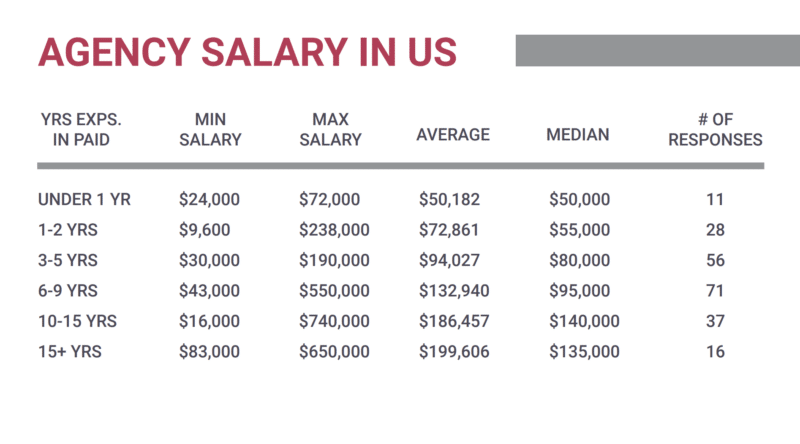
Agency PPC salaries. The median salary ranged from $50,182 $47,500 (less than one year of experience) to $199,000 (15+ years of experience).

These figures are up significantly from the 2022 report that showed $47,500 (less than one year of experience) to $139,000 (15+ years of experience)

This was based on 219 responses from people who work for an agency. Here’s the chart:

Screen Shot 2023 03 21 At 2.26.22 PM 800x444

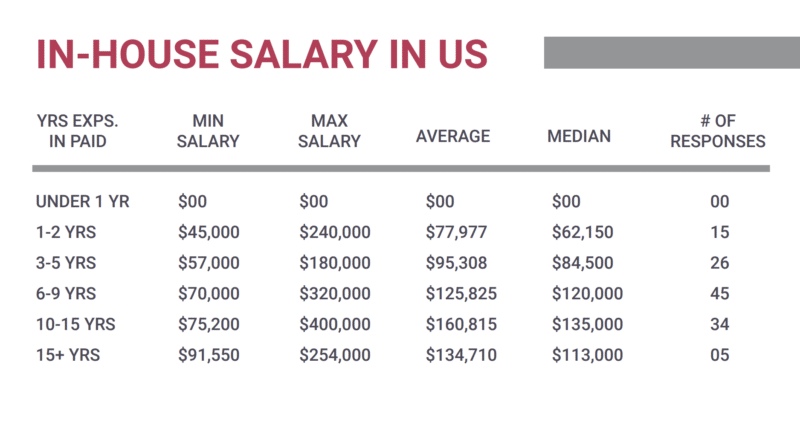
In-house PPC salaries. The median salary ranged from $62,150 (one to two years of experience) to $124,000 (15+ years of experience). This was based on 125 responses from people who work for a client or brand.

There weren’t enough participants working in-house with under 1 year of experience to survey.

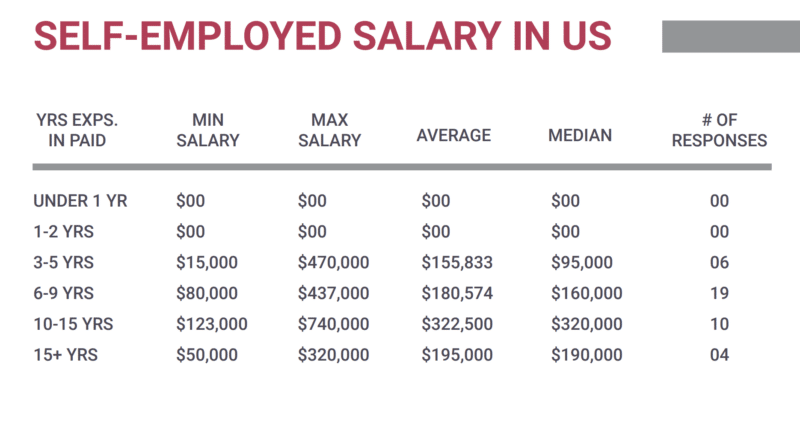
Self-employed. The median salary for self-employed people is $155,833 for those with 3-5 years of experience. The highest compensation for this category occurred in those with 10-15 years of experience, coming in at $322,500.

Screen Shot 2023 03 21 At 2.27.14 PM 800x444
Screen Shot 2023 03 21 At 2.26.47 PM 800x446

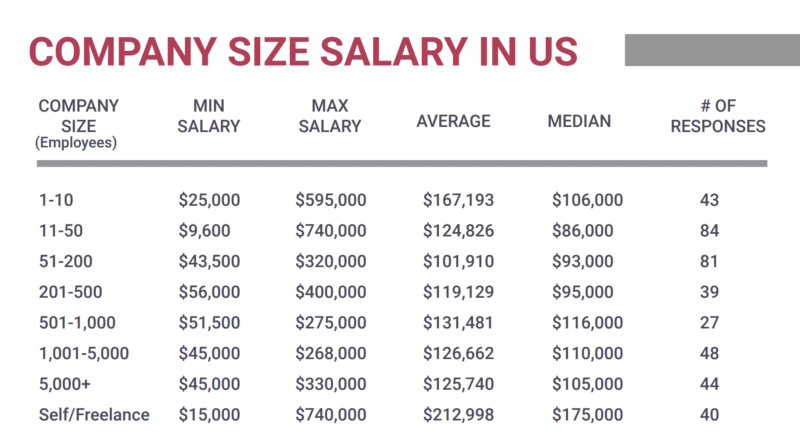
Company size. The survey also looked at salaries by company size. If you’re looking to get a six-figure salary, your best chances will be working at a company with 1-10 employees.

This is a stark contrast to the 2022 report, where the highest median salaries reported were at companies of 200+ employees. 

Screen Shot 2023 03 21 At 2.26.56 PM 800x443

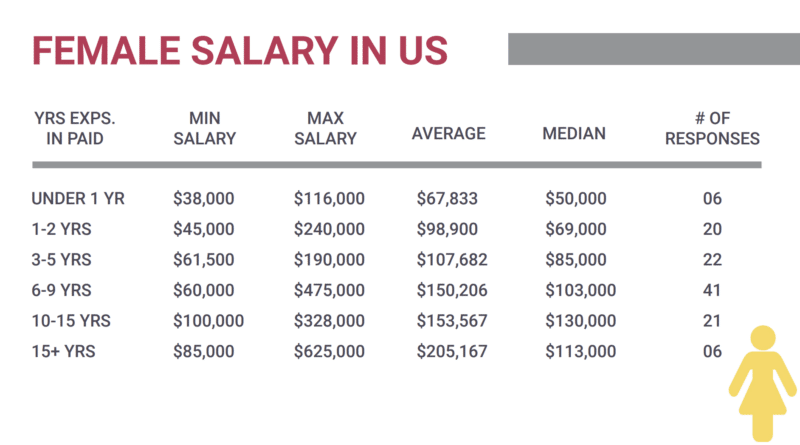
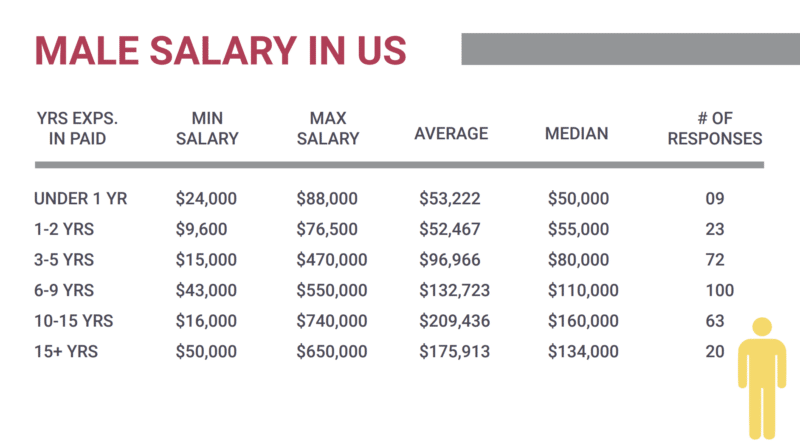
Male vs. female. In a shocking twist, females with 9 years of experience or less were paid more than their male counterparts. However, for those who have 10 years or more of experience, males earn more on average.

The most significant disparity comes in at the 10-15 year range, where females earn $130,000 and makes $160,000.

Screen Shot 2023 03 21 At 2.27.24 PM 800x445
Screen Shot 2023 03 21 At 2.27.35 PM 800x446

Why we care. Understanding your worth and appreciating the work you do is crucial. Whether you’re in-house, a freelancer, or at an agency, multiple factors affect your salary, including your location, experience, gender, and negotiation skills. Keeping informed about PPC salary trends and industry benchmarks can empower you during negotiations for your next role or salary increase. Recognizing your value will not only help you secure fair compensation but also contribute to overall career satisfaction and success.


Related stories

New on Search Engine Land

@media screen and (min-width: 800px) { #div-gpt-ad-3191538-7 { display: flex !important; justify-content: center !important; align-items: center !important; min-width:770px; min-height:260px; } } @media screen and (min-width: 1279px) { #div-gpt-ad-3191538-7 { display: flex !important; justify-content: center !important; align-items: center !important; min-width:800px!important; min-height:440px!important; } }

About the author

Nicole Farley

Nicole Farley is an editor for Search Engine Land covering all things PPC. In addition to being a Marine Corps veteran, she has an extensive background in digital marketing, an MBA and a penchant for true crime, podcasts, travel, and snacks.

https://searchengineland.com/ppc-salaries-2023-how-much-do-in-house-self-employed-and-agency-search-marketers-make-394601


What is quality score and how to use it in PPC

Quality score is one of the few constants in PPC marketing. It is a score calculated by Google and Microsoft alongside your bid to determine your ad rank.

Yet, the factors of quality score and how much each lever impacts them is often a subject of debate. 

We will dive into each quality score factor and explore how they impact your overall campaign and account success.

This article is written from a Google-first perspective. However, many of the strategies and mechanics carry over to Microsoft Ads. 

What are the factors used to calculate quality score?

Google calculates quality score based on the combined performance of three components:

  • Expected click-through rate (CTR): The anticipated CTR of the ad against what the ad platform considers similar ads.
  • Ad relevance: How well does the keyword that triggered the ad relate to the query? How well does the landing page follow through on the ad’s promise?
  • Landing page experience: Does the keyword to ad to landing page relevance carry through? Does the page provide a good experience for the user (easy to navigate, limited pop-ups, fast load time, etc.)? 
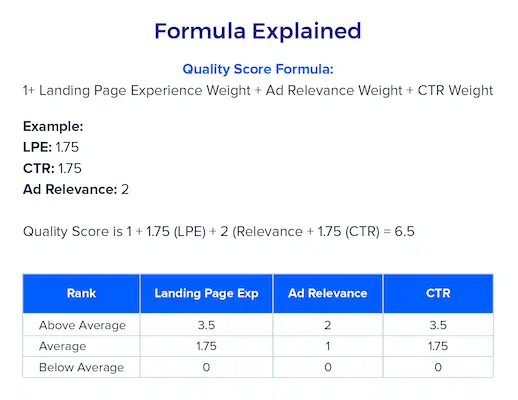
PPC quality score formula
Image source: Instapage.com

Important note: Quality score is calculated based on the exact impressions of your keyword’s search terms. If you decide to test a new match type, the quality score data won’t be lost.

However, if you change a keyword without copying it over and making the change in the copy, you will remove the original keyword (which can stunt performance).

Be careful when making any adjustments to keyword match types or syntax. 

Expected CTR: How it is calculated and its impact

Expected CTR is tough because it’s a third of quality score but out of your control. Google gives the keyword a score based on how it performed previously, which can either be:

  • Above average.
  • Average.
  • Below average.

These scores are determined based on how your campaign did against comparable advertisers. However, depending on the advertisers Google chooses compare you with, it is possible for a good CTR sometimes to get downgraded to average (or even below average).

This is why focusing on the other two quality score criteria is much more critical. Optimizing for good CTR is more important than optimizing for good expected CTR. 

If you’re curious how your account is faring on this metric, you can pull the expected CTR column in Google Ads’ UI and sort keywords by their status. (Remember not to discount keywords with a lower expected CTR, they might be winning in other ways.) 

A higher expected CTR indicates that you are good at getting people to engage with your brand – and making the ad network money.

The discounted costs per click (CPCs) are a way to reward you for the volume you’ll represent in the auction. This is why lower search volume industries can struggle to achieve above-average CTR (and shouldn’t let that influence their opinions on the campaign). 

Ad relevance: How it is calculated and its impact

Ad relevance is the easiest lever to control and influences the other two quality score factors.

Here, Google examines how well keywords are featured in the ad copy and how closely the keyword idea matches the query. The closer the match, the better the score. 

Moreover, it’s vital to differentiate ad strength from ad relevance. 

Ad strength is a score given to the creative quality of the ad and does not impact quality score. It is calculated based on:

  • Top keywords used in the ad copy.
  • Uniqueness of headlines/descriptions.
  • Using as many of the headlines/descriptions as possible. 

Ad relevance looks at the relevancy between the keyword, ad, and landing page. This is calculated by assessing:

  • Keyword density on the landing page and ads.
  • How closely the keyword that triggered the ad matches the query.
  • Whether the query’s intent meets the ad text and is captured by the keyword. 

As match types relaxed to cover intent over exact spellings and order, the rules of engagement shifted. It’s no longer important to have every single keyword to ensure ad relevance matching. 

Even though broad match keywords struggle a bit more with getting higher quality scores, they also have an easier time securing cheaper spots in the auction. 

Row Labels Average of Quality Score Sum of Conversions Average of Avg. cost
Cape Cod 5.540540541 22 13.43923077
Connecticut 4.949152542 87.34 6.308888889
Maine 5.411764706 65.88 12.04962963
Massachusetts 5.142857143 54 5.325890411
New Hampshire 5.452380952 13 8.412142857
Rhode Island 4.666666667 31 7.80925
Vermont 5.2 5 9.5252
(blank) 905.97 3.932
Grand Total 5.182926829 1184.19 8.459032258
February 2023 performance for an account only running broad match.

Essentially, these campaigns target the same keywords and use the same ads. What’s different is the localization of search, search volume in these locations, and auction prices. 

Phrase and exact will enable a more specific matching (and typically higher match types). However, the search volume and actual conversions might drop. 

Landing page experience: How it is calculated and its impact

Landing page experience is the closest PPCs will get to technical SEO. Both digital marketing channels must use this metric as a guide. Google crawls the page and looks for the following:

  • Load time: Does the page load in two seconds or faster?
  • Cumulative layout shift (CLS): Does the page honor the CLS rules of engagement, that is, no changes to the layout within 5 seconds of rendering?
  • Layout: Is the page easy to access and navigate for a human user? 
  • Keyword relevance: Is the intent implied in the ad represented by the page’s content? 

The ad bot must be able to access the page to calculate this component of quality score (i.e., crawl budget is allocated for it). 

However, PPC landing pages are not required to be followed and indexed. More often than not, it is ideal that paid landing pages are no-indexed and no-followed so they can use templatized content and not be forced to carry through the navigation bar. 

Typically a good landing page experience is where a high conversion rate comes from, so you will naturally see conversion rates improve with this score. 


Get the daily newsletter search marketers rely on.


5 tips to get the most out of quality score

Generally, quality score is more of a health indicator than a KPI. That said, it unlocks meaningful workflows and data in accounts. 

Here are five tactics to get the most out of quality score:

  • Use branded campaigns to lift the equity of the account.
  • Focus on conversational keyword champions over search volume.
  • Use behavior analytics to improve landing page experience.
  • Allow for fluctuation in quality scores as keywords age.
  • Partner with your SEO team on quality score insights.

1. Use branded campaigns to lift the equity of the account

Part of the reason Performance Max campaigns perform so well is they blend branded and non-branded search. Branded terms will have higher conversion rates, cheaper CPCs, higher CTRs, and near-perfect keyword to ad to landing page relevance. 

Building a branded campaign allows your account to achieve a few important things:

  • Sequester branded traffic from non-branded. 
  • Provide data points to the algorithm that you have high-converting terms. 
  • Communicate meaningfully to your warm audience.

Having this campaign in the account will allow net-new campaigns/ad groups/keywords to benefit from the halo effect of your branded campaign (starting from an average of 6-7 instead of 5). 

2. Focus on conversational keyword champions over search volume

With the rise of ChatGPT and AI in search, search patterns have evolved beyond formulaic queries. While it’s true that broad and simple queries might have search volume, they also represent quality score traps due to auction price and expected CTR. This is because:

  • Underbidding means you’ll get impressions on low-value SERP placements that don’t lead to clicks. This, in turn, lowers your actual CTR, which is the seed data for the expected CTR. 
  • Bidding on broad concepts (like “attorney”) will catch a lot of random intent instead of the intent you need/want. Even if you rank well for it, there’s no ensuring your ad will speak to a broad audience. 

By investing in conversational terms, you’ll ensure:

  • You’re optimizing for conversational voice search and the intended transactional intent. 
  • Safety from voluminous cheap clicks clogging up your budget or unintended expensive auctions.  

3. Use behavior analytics to improve landing page experience

Behavioral analytics is one of the easiest ways to understand what is causing joy and despair for your users. Struggling with landing page experience, but you’re not sure why? Tools like Microsoft Clarity (free) or Hotjar (paid) can tell you exactly what is causing the friction. 

Whether it’s a slow load due to a big image/video or a “hidden” form, these insights will help you fix the user experience issues getting in the way. 

One of the most common reasons for friction is cookie consent modules not jiving with the rest of the page. This can mean the module is too big, or it’s hard to see how to get out of it once completed. Adjusting for this will improve the landing page experience score and help the customer experience. 

4. Allow for fluctuation in quality scores as keywords age

A good keyword with data typically will settle between 7-9.

While it might maintain a high score throughout its existence, it’s also normal for a keyword to get closer to the 5-6 average score as it gains thousands of impressions and clicks. 

This is also why low search volume industries tend to struggle to get out of low quality score land if they can’t establish high equity through branded campaigns. 

A keyword can drop a point or two and be okay. If it’s going from 5 to 2, that likely speaks to an underlying problem to fix.

5. Partner with your SEO team on quality score insights

Your SEO team must be part of your quality score conversation.

Between enabling quality score via crawl budget for the ad bot to the foundation for the landing page structure, SEO is integral to a healthy PPC performance – and a holistic search marketing strategy.

At the onset of the campaigns, discuss whether your brand will be better served by using a subdomain, the same pages as organic or no-follow/no-index pages on the main site. 

Quality score is still here and a viable account optimization guide.

While it should never be treated as a KPI, the rules of engagement must be factored into account management. 


Opinions expressed in this article are those of the guest author and not necessarily Search Engine Land. Staff authors are listed here.


Related stories

New on Search Engine Land

@media screen and (min-width: 800px) { #div-gpt-ad-3191538-7 { display: flex !important; justify-content: center !important; align-items: center !important; min-width:770px; min-height:260px; } } @media screen and (min-width: 1279px) { #div-gpt-ad-3191538-7 { display: flex !important; justify-content: center !important; align-items: center !important; min-width:800px!important; min-height:440px!important; } }

About the author

Navah Hopkins

A veteran of the digital marketing industry and “Top 25 PPC Expert,” she began as an SEO in 2008, transitioning to PPC in 2012. She manages the strategy and execution of paid media campaigns, as well as helping brands build relationships with profitable partners and customers. Throughout her career, Navah makes a point to give back and loves sharing lessons learned on the international speaking circuit as well as local universities. She is a frequent contributor to several publications and in 2019, she became a founding member of the Paid Search Association.

https://searchengineland.com/quality-score-ppc-394513


This day in search marketing history: March 21

rel=next/prev was not found on Google. That’s an error.

In 2019, we learned Google had stopped supporting the rel=next/prev markup it had introduced in 2011.

Worse than that, Google hadn’t been using it for indexing for a “number of years,” according to Google’s John Mueller.

All the while, Google continued to recommend using it, so SEOs, publishers and developers invested resources into implementing and maintaining the markup – all for no benefit.

Google apologized for the “oversight” a day later.


Also on this day


Google Ads Editor version 2.0 supports Performance Max campaigns

2022: The update also included support for custom actions and action triggers, conversion goals, shared audiences and more.


Patent suggests how CTR, time on page could be used in search rankings (if Google did that sort of thing)

2019: But no, this didn’t confirm Google was using engagement metrics in rankings.


Google’s neural matching versus RankBrain: How Google uses each in search

2019: Neural matching helped Google better relate words to searches, while RankBrain helped Google better relate pages to concepts.


Google launches News Initiative subscriptions lab for publishers

2019: The company also announced new fact-checking tools and other efforts to stop the spread of ‘misinformation.’


Bing upgrades text-to-speech, expands intelligent answers, improves visual search

2019: The latest upgrades made to Bing around voice, image and answer search.


Survey finds Google Home users do more, have ‘far higher’ satisfaction than Alexa owners

2019: Alexa devices dominated, but higher Google Home NPS scores suggested it would have better word of mouth and could gain market share.


Amazon to introduce video ads in mobile-app search results — report

2019: The buy reportedly required a minimum $35,000 budget.


Google: Using non-English URLs for non-English websites is fine

2018: Google was able to crawl, index and rank them.


Google News Initiative kicks off with Subscribe With Google, other efforts

2018: Subscribers would see articles from their subscribed publications higher in the search results and be logged in to those publications across devices.


Google’s new tappable shortcuts eliminate the need to search on mobile

2017: The shortcuts offered quick answers on weather, sports and entertainment info.


AdWords Brings Keyword Bid Simulator Estimates Into Reporting Columns

2014: From the keyword tab, advertisers could add several columns to their reporting from the Bid simulator section offered in the Customize Columns menu.


What Do Users Really Think Of The New Google Design?

2014: 33 of 50 participants in a usability study preferred the “clean,” “fresh” and “uncluttered” new version.


Google Alerts Adds Filters For Regions & Languages

2014: You could tell Google you only wanted alerts for specific keyword phrases within a specific region or country or a specific language.


Part Two: If Google Was A Guy (Video)

2014: It mocked searchers, Google Doodles, Google Glass and Bing.


Search In Pics: Sergey Brin With Ed Snowden, Google Water Balloon Launcher & More

2014: The latest images showing what people eat at the search engine companies, how they play, who they meet, where they speak, what toys they have, and more.


Topless Nude Photo Makes It Way To The Google Knowledge Graph

2013: When you searched for [Angel Tompkins], the image shown for her was from a site that appeared to be a spam blog with nude images of people.


Google Alerts: Still Broken

2013: Another open letter about how poorly the service was working.


Bing Snapshot Grows To Understand People, Places & Things With “Satori” Expansion

2013: Bing expanded Satori to include more people, places and things.


Firefox To Use Google Secure Search By Default; Expect More “Not Provided” Keywords To Follow

2012: It would further reduce the ability for publishers to know how people find their sites in Google — except for Google advertisers.


New Ad Status Info Added To AdWords

2012: Google gave AdWords users a new way to figure out whether their ads are approved, or not, and why.


Microsoft’s adCenter Improvements Rolling Out Fast And Furiously

2012: Enhancements would include broad match modifier, AdCenter Express and more.


Report: Google Still Top Desired Place To Work

2011: An annual study ranked Google the top place for young working professionals to work at.


Report: Google Still Web’s Dominant Traffic Driver, But Some Niches See Facebook Gaining

2011: Google was the No. 1 source of traffic for 26 of the 35 properties analyzed (74%), and Google traffic had increased or stayed the same since last July for 24 of them (69%).


Google Plays More Involved Matchmaker Between Advertisers And Agencies

2011: Google implemented changes to Google Partner Search to make it easier for the two parties to get in contact.


Google Fined 100,000 Euros By French Privacy Regulator

2011: This was the first fine/penalty any country had levied against Google over the WiFi data collection.


German Court OKs Google Street View Imagery In “Landmark Decision”

2011: A Berlin court vindicated Google Street View operation in Germany.


Kadafi, Gaddafi, Qaddafi: In The Age Of Search, News Publications Still Struggle With Libya Leader’s Name

2011: Use the wrong spelling, and your story might go missing. Could search tell us the “right” one?


Chinese Hacking Google Again To Stop “Jasmine Revolution”

2011: Google blamed the Chinese government for “politically motivated attacks” that had disrupted Gmail service for some Chinese users.


AT&T-Mobile Makes Google-ITA Antitrust Issue Look Trivial

2011: If approved by US regulators, AT&T would have become the largest wireless carrier by a wide margin.


Twitter Celebrates 5th Birthday With Conan Show Appearance, New Video & More

2011: The company shared a new video, new website, blog posts, and had a national TV appearance on tap.


Google Analytics Benchmarking Data Now Live

2008: The reports within the benchmarking feature included visits, pageviews, pages/visits, bounce rates, average time on site and new visits.


Google Suggest Becoming A Default Feature?

2008: Google had implemented this feature as a default on other non-U.S. based search engine home pages but never as the default at Google.com. 


LinkedIn Adds New Company Directory

2008: LinkedIn, with help from BusinessWeek’s CapitalIQ, added a company directory and related factual information to its business network.


Search Biz: Probing Wikipedia’s Finances, Facebook Toast?, & Google Denies Evading Chinese Taxes

2008: A fascinating inside glimpse into Wikipedia’s finances, and the people responsible for both raising money and spending it. And more.


Search In Pictures: Snoop Dogg, St. Patrick’s Day, & Danny Exposed

2008: The latest images showing what people eat at the search engine companies, how they play, who they meet, where they speak, what toys they have, and more.


Google Wins KinderStart Case Over Site Penalty

2007: Google won the case brought against them by KinderStart over Google downgrading their rankings.


Google CSE Adds Show Popular Queries

2007: You could add a snippet of code on your site to show off the most popular queries performed by your readers.


No Google Phone But Instead Mobile Software, Says Google

2007: Google pushed back on earlier reports of building its own cell phone.


Yahoo’s Semel Says Panama Will Show “Exciting Numbers” In 1st Quarter

2007: “I’m totally all smiles,” Semel said about Panama.


Local Search News: BooRah, Oodle and Rao

2007: A quick roundup of some local search news.


Q&A With François Bourdoncle, CEO Of Exalead

2007: Bourdoncle co-founded Exalead with the goal of revolutionizing the search engine software market by providing users with a unified technology platform to access information in the enterprise.


PreFound Relaunches, Tries To Rise Above Social Search Din

2007: Rebranding itself somewhat as a “community” search engine, PreFound, like others, was trying to build a human-edited layer on top of general (in this case Google) search results.


From Search Marketing Expo (SMX)


Past contributions from Search Engine Land’s Subject Matter Experts (SMEs)

These columns are a snapshot in time and have not been updated since publishing, unless noted. Opinions expressed in these articles are those of the author and not necessarily Search Engine Land.


< March 20 | Search Marketing History | March 22 >


Related stories

New on Search Engine Land

@media screen and (min-width: 800px) { #div-gpt-ad-3191538-7 { display: flex !important; justify-content: center !important; align-items: center !important; min-width:770px; min-height:260px; } } @media screen and (min-width: 1279px) { #div-gpt-ad-3191538-7 { display: flex !important; justify-content: center !important; align-items: center !important; min-width:800px!important; min-height:440px!important; } }

About the author

Danny Goodwin

Danny Goodwin has been Managing Editor of Search Engine Land & Search Marketing Expo – SMX since 2022. He joined Search Engine Land in 2022 as Senior Editor. In addition to reporting on the latest search marketing news, he manages Search Engine Land’s SME (Subject Matter Expert) program. He also helps program U.S. SMX events. Goodwin has been editing and writing about the latest developments and trends in search and digital marketing since 2007. He previously was Executive Editor of Search Engine Journal (2017 to 2022), managing editor of Momentology (from 2014-2016) and editor of Search Engine Watch (from 2007 to 2014). He has spoken at many major search conferences and virtual events, and has been sourced for his expertise by a wide range of publications and podcasts.

https://searchengineland.com/search-marketing-history-march-21-394551


PPC is a tough game – you have to accept it

To get results from paid search, you’ll need to deliver better campaigns and increase your bids, which drives costs up.

However, increasing your bids won’t always mean more clicks. Eventually, you’ll reach a point where increased bids will only return little to no gain.

This is the law of diminishing returns at play. When running PPC campaigns, you are contending with this concept and many other factors outside your control.

In this article, we’ll explore the law of diminishing returns and various factors making paid search even more demanding today. This will help you set better expectations when assessing your PPC performance.

The law of diminishing returns

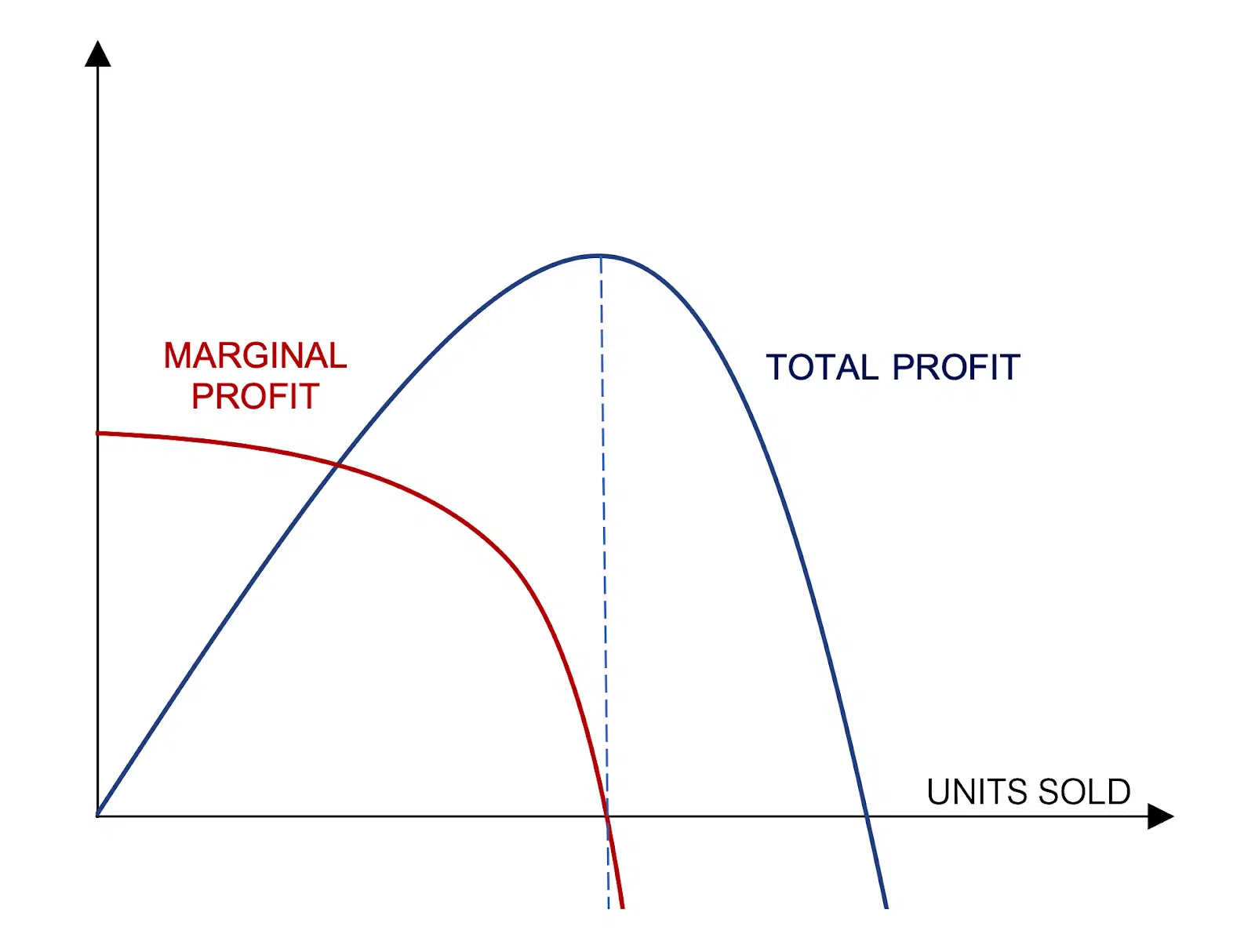
In economics, the law of diminishing returns states that as an organization increases its investment in a specific area, the rate of profit generated by that investment will eventually reach a point where it cannot continue to rise, assuming that all other variables remain constant. 

For this reason, additional investment in that area will result in a decreased rate of return. At a certain stage of expansion, the return on investment that applies to additional units produced (marginal ROI) reaches a negative value.

Beyond this point, the total outcome will start declining. Even if it remains positive, it is not as high as the maximum.

Law of diminishing returns

This principle highlights the importance of finding the optimal level of investment to maximize the overall profit. The “sweet spot” is where the marginal ROI changes from positive to negative, specifically where the marginal return equals zero.

As every resource is limited, we observe that the supply shows decreasing responsiveness to the price change, and eventually does not matter how high the price is. The supply won’t be higher. This phenomenon is described as the law of diminishing elasticity.

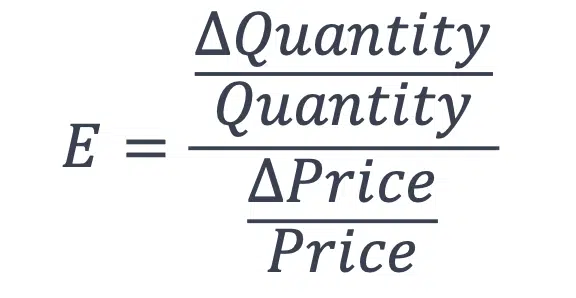
Price elasticity (E) measures the responsiveness of the demand or supply to a change in the price of a good or service. It is calculated as the percentage change in the quantity of a good or service demanded or supplied in response to a percentage change in its price. 

Prce elasticity
Sometimes the symbol of increase “∆” is replaced by “d” to indicate that it refers to a small change.

If the price elasticity is greater than one, the demand or supply is said to be elastic, meaning that a slight change in price leads to a relatively larger change in the demand or supply. If the price elasticity is less than one, the demand or supply is said to be inelastic. 


Get the daily newsletter search marketers rely on.


Why are CPCs so high?

The laws of diminishing returns and elasticity apply to advertising.

To generate more traffic and conversions through PPC, you have to be more aggressive and competitive, increasing bids and, in turn, accepting higher conversion costs.

Increasing cost per click (CPC), however, leads to smaller and smaller increases in traffic. Eventually, you’ll reach a point when there’s no chance to get more traffic from a specific keyword (i.e., if the ad ranks #1 for all searches with 100% impression share). 

PPC rising clicks and CPCs

The law on diminishing returns is also reflected in the total budget. You can see how these costs can change in the Google Ads Performance Planner, as shown in the illustration below.

Google Ads Performance Planner

In most cases, the relationship will be fairly straightforward for campaigns that are not under or overinvested. To get 10% more traffic, you need to accept a ~10% higher conversion cost or a ~10% lower return on ad spend (ROAS).

This means that Google’s typical price elasticity of supply (the relative ratio of traffic increase to CPC increase) is 1.

Why is this the case? If a vendor increases their margin by 10% and loses 20% of their customers, this operation will result in a loss, and prices will likely be too high.

If a 10% increase in margin only causes 5% of customers to leave, the seller will increase their profits, and previous prices were too low.

The point at which the price is most optimal for the seller is where a 10% increase in margin results in a 10% decrease in the sales volume, making the change neutral for profits. In other words, the sales profits are highest if the price elasticity of demand is 1.

For Google, the sales margin virtually equals advertising revenue because the variable costs of the ad impression and click are negligible.

To maximize their profits, they should maintain a price elasticity of 1 – which explains how the auction algorithm works and why this regularity exists on the market.

Why does it cost so much?

In PPC, the natural consequence of the law of diminishing returns is a non-linear increase in budget to scale the campaign.

With elasticity E=1, which is typical for the market, doubling the traffic and sales volume is associated with doubling the CPC, resulting in a four-fold increase in budget.

PPC increased budget

At other levels of elasticity, these proportions will be different. But it is unrealistic to think that doubling the budget will lead to doubling sales in a given channel.

Marketing and business plans often reflect such expectations, only to fall through later. Expansion is costly, and the truth is even more bitter than this. 

Google and Meta are here to do business

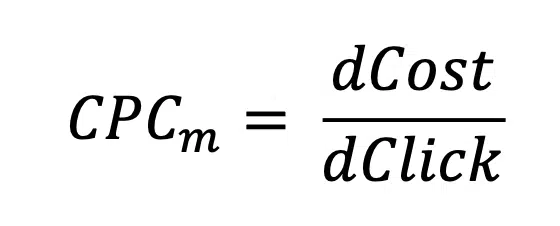
The cost of acquiring an additional click (i.e., the marginal cost per click or CPCm) is almost always higher than the actual CPC. By definition:

Marginal CPC

Also, by definition, the elasticity: 

Elasticity

Therefore:

Elasticity

It means that at E=1, buying additional clicks is twice more expensive than the current cost per click. The same calculations apply to Effective Revenue Share (ERS = Cost / Revenue)

Effective revenue share

Advertisers benefit from investing in advertising as long as the marginal cost is lower than their profit margin (i.e., they get additional profit through advertising).

When the marginal effective revenue share reaches ERSm=1, advertising costs consume the entire revenue. Further, expansion will have negative marginal revenue and the total revenue will start to decrease. Thus, the campaign generates maximum total profit when:

ERSm

That is:

ERS

As ROAS = 1/ERS = ROI + 1, this formula can be written as ROAS = 1 + 1/E or ROI = 1/E. 

A simple formula can define the areas of under and overinvestment and the optimum level.

Law of diminishing returns in PPC

If E = 1 (the typical market elasticity), the maximum total profits from advertising occur when ROI = 100% or ERS = 0.5. 

It means that, on average, advertisers increase their profits until they spend 50% of their profit (without considering fixed costs) on PPC ads. 

Of course, particular advertisers who advertise more or less aggressively may be in a different area of elasticity than E=1. Therefore, the ERS/ROAS/ROI maximizing advertiser profits will be higher or lower. 

For every $1 invested in Google search, U.S. companies earn $2. This is how Google wants to see it, but it also means that companies give half their profits to these tech giants.

There’s no way around it

The laws of economics and the free market put businesses in a situation where Google, Meta and other ad platforms get half their sales margin before fixed cost.

Whether we like it or not, these are the rules of advertising. Understanding how the system works makes it easier to create realistic expansion plans and avoid disappointments.


Opinions expressed in this article are those of the guest author and not necessarily Search Engine Land. Staff authors are listed here.


Related stories

New on Search Engine Land

@media screen and (min-width: 800px) { #div-gpt-ad-3191538-7 { display: flex !important; justify-content: center !important; align-items: center !important; min-width:770px; min-height:260px; } } @media screen and (min-width: 1279px) { #div-gpt-ad-3191538-7 { display: flex !important; justify-content: center !important; align-items: center !important; min-width:800px!important; min-height:440px!important; } }

About the author

Witold Wrodarczyk

Founder and CEO of Adequate Interactive Boutique, awards-winning marketing consultancy. Certified Google Ads and Analytics specialist since 2007. Author of numerous publications, conference speaker, and university lecturer. Expert in measurement, attribution, and profit-driven media optimization.

https://searchengineland.com/ppc-tough-game-394477


This day in search marketing history: March 18

Google Business Profiles new emergency help attributes for Ukraine support

2022: Google also added hotel attributes to define if hotels offered support to those displaced from Ukraine.


Brands, especially restaurants, need FAQs and ‘coronapages’ fast

2020: It was critical that precautions being taken were discoverable in search results.


Video: Martha van Berkel talks about structured data

2020: Does adding schema help improve your search rankings? Google said no but…


Google on the March 2019 core update: This is not the biggest update we’ve released

2019: Related: Early data on Google March 2019 Core Update show an interesting pattern


Google Ads now makes reporting column recommendations

2019: With this update, Bid Strategy Type was no longer a required column.


Waze conquers ‘digital dark zone’ with in-car, out-of-home ad coordination

2019: McDonald’s campaign showed drivers in-car ads that mirrored billboards.


Google Image Search launches colored filter buttons

2016: After testing various combinations, Google launched new filter buttons in the image search results.


Bing Ads testing Social Extensions: Link search ads to Facebook, Twitter, Instagram, Tumblr

2016: The ad extension was in beta in the U.S.


Bing partners with US National Park Service for #FindYourPark photo contest

2016: The winning photo would be featured on Bing’s home page during National Park Week and used as Bing’s Facebook and Twitter cover photo in April.


Search in Pics: Google Analytics With NASA, Google buffalo & Fiber office

2016: The latest images showing what people eat at the search engine companies, how they play, who they meet, where they speak, what toys they have and more.


Yahoo Loses Market Share As Some Firefox Users Return To Google

2015: Google had become increasingly aggressive in trying to lure back users.


EU Antitrust Chief Says Google Settlement Essentially Done

2014: Amid criticism from politicians and Google’s critics, EU antitrust chief Joaquín Almunia essentially said that Google’s antitrust settlement proposal was a done deal. 


Bing Ads Starts Allowing Keyword Variations Once Flagged As Duplicate

2014: Advertisers were able to start including multiple versions of keywords through Bing Ads Editor and the Bing Ads Upload API.


Yandex Buys Israeli Geo-Location Platform KitLocate

2014: The chief virtue of KitLocate was that it provided location to apps without using much power – unlike GPS or triangulation, which could drain mobile batteries.


GetListed Tool Relaunches As Moz Local

2014: Agencies and business owners could use the tool to research where their listings appeared online, manage claiming and verification and listings submission.


A Dilbert On Search Engine Keyword Research

2014: There was a fun search marketing-related Dilbert strip on the topic of doing and presenting your keyword research to your boss.


Google Penalized One Article On BBC’s Web Site

2013: Google’s John Mueller: “We found unnatural links to an individual article, and took a granular action based on that.”


Bing Webmaster Tools Adds Site Move Tool

2013: The tool let you move from one domain to another domain as well as from within a site; URLs to URLs.


Google Goes Beyond Answers, Starts Guessing Release Dates

2011: Google added a one box even when it only had a “best guess” at the answer to a search.


Yahoo’s AllTheWeb To Redirect To Yahoo Search April 4th

2011: AllTheWeb one of the search engines Yahoo acquired in 2003 to help build Yahoo Search, would sunset April 4, 2011.


SEO Held Liable, Fined In Counterfeiting Case

2011: A website builder and SEO firm was held liable in federal court in a case in which it was accused of enabling the sale of counterfeit goods.


Search In Pics: YouTube Socks, Yahoo Bowlers & Bing Armbands

2011: The latest images showing what people eat at the search engine companies, how they play, who they meet, where they speak, what toys they have, and more.


Google Tests “Sponsored Map Icons”

2010: The Sponsored Map Icons were a new way to promote your business within Google Maps.


Google Will Let Web Users Avoid Analytics Tracking

2010: The company said it would soon let web users opt-out of being tracked by its popular Google Analytics software.


Google-Viacom Court Documents Out; Google Says Viacom ‘Secretly’ Uploaded Videos

2010: YouTube’s chief counsel accused Viacom of “continuously and secretly” putting its content on YouTube, and “deliberately” making the material look amateur.


Google Updated Maps For Mobile For Android

2010: An updated interface and some feature changes to help improve usability.


Google’s Matt Cutts On Keywords In The URL

2009: Cutts answers: “Does the position of keywords in the URL affect ranking?”


Twitter Search: Not Your Friend If You Tweet Something Bad

2009: Be careful what you say in a public setting and use social media tools to help you, not hurt you.


Financial Times Launches Newssift, A Business News Search Engine

2009: Newssift aimed to bring context and meaning that its creators said was missing from traditional keyword-based business news search engines.


Google Maps Opens Up Editing To Everyone

2008: Users would now be able to edit any details about a business or location, or add new businesses, even if they weren’t the business owner.


Yahoo Expects To Double Cash Flow In Three Years & Reaffirms 2008 Outlook

2008: Yahoo expected to double its operating cash flow in three years from $1.9 billion to $3.7 billion.


Search Biz: Alibaba Gains, Google Loses, & Eric Schmidt Says Don’t Call Me Daddy Anymore

2008: China’s Alibaba.com, in which Yahoo was a significant minority shareholder, enjoyed a massive 340% gain in net profit tied to China’s fast-growing economy.


SES NY 2008 Day Two Live Coverage Recap


From Search Marketing Expo (SMX)


Past contributions from Search Engine Land’s Subject Matter Experts (SMEs)

These columns are a snapshot in time and have not been updated since publishing, unless noted. Opinions expressed in these articles are those of the author and not necessarily Search Engine Land.


< March 17 | Search Marketing History | March 19 >


Related stories

New on Search Engine Land

@media screen and (min-width: 800px) { #div-gpt-ad-3191538-7 { display: flex !important; justify-content: center !important; align-items: center !important; min-width:770px; min-height:260px; } } @media screen and (min-width: 1279px) { #div-gpt-ad-3191538-7 { display: flex !important; justify-content: center !important; align-items: center !important; min-width:800px!important; min-height:440px!important; } }

About the author

Danny Goodwin

Danny Goodwin has been Managing Editor of Search Engine Land & Search Marketing Expo – SMX since 2022. He joined Search Engine Land in 2022 as Senior Editor. In addition to reporting on the latest search marketing news, he manages Search Engine Land’s SME (Subject Matter Expert) program. He also helps program U.S. SMX events. Goodwin has been editing and writing about the latest developments and trends in search and digital marketing since 2007. He previously was Executive Editor of Search Engine Journal (2017 to 2022), managing editor of Momentology (from 2014-2016) and editor of Search Engine Watch (from 2007 to 2014). He has spoken at many major search conferences and virtual events, and has been sourced for his expertise by a wide range of publications and podcasts.

https://searchengineland.com/search-marketing-history-march-18-2-394506


Meta rolls out paid verification

Mark Zuckerberg, CEO of Meta, just announced on his Instagram channel that the company’s paid verification program, Meta Verified, is now available in the United States.

How it works. The program is designed to provide users with a blue verification badge on both Facebook and Instagram, as well as “proactive impersonation protection” and direct access to customer support. Meta Verified costs $12 per month if accessed via the web, and $15 per month if accessed through iOS or Android to account for those platforms’ cuts of in-app payments. In addition, subscribers will receive stars that can be used to tip Facebook creators, as well as extra stickers for Stories and Reels.

Initial testing. Meta initially launched the program in Australia and New Zealand last month. Verified differs from Twitter Blue, a similar program that allows users to pay for a blue checkmark and other perks, as Meta Verified requires users to provide a piece of government ID that matches the name and photo on their account.

Once a user is verified, they cannot change their profile name or photo, username, or date of birth without going through the verification process again. Accounts that were previously verified on Instagram or Facebook will keep their blue checkmark.

What Meta says. The launch of Meta Verified is part of Meta’s effort to enhance security and transparency on its platforms. By providing users with a blue verification badge and proactive impersonation protection, Meta aims to reduce the number of fake accounts and impersonations that occur on Facebook and Instagram.

Sure, Meta could be rolling out this program to enhance security. Another reason could be to generate additional or diversify their revenue streams. They did, after all, blame weak ad demand for their recent decrease in revenue, an area that makes up 97% of their overall revenue.

For reference. Not sure if the $12-$15 a month is worth it? Here are other monthly subscription services you can get for $15 a month or less:

  • YouTube: Free (with ads), or $11.99/month for YouTube Premium (ad-free, includes YouTube Music Premium)
  • Spotify: Free (with ads), or $9.99/month for Spotify Premium (ad-free, unlimited skips, offline listening)
  • Pandora: Free (with ads), or $4.99/month for Pandora Plus (ad-free, unlimited skips, offline listening)
  • Apple Music: $9.99/month for an individual subscription (ad-free, unlimited skips, offline listening)
  • Amazon Music: $7.99/month for Prime members (ad-free, unlimited skips, offline listening), or $9.99/month for non-Prime members
  • Hulu: $5.99/month for the basic plan (with ads), or $11.99/month for the ad-free plan
  • Disney+: $7.99/month or $79.99/year
  • Netflix: $8.99/month for the basic plan (SD, one screen at a time), $13.99/month for the standard plan (HD, two screens at a time), or $17.99/month for the premium plan (Ultra HD, four screens at a time)
  • HBO Max: $14.99/month

Why we care. The new verification could help to improve the quality and authenticity of the platform’s user base. By requiring government ID verification, Meta may be able to ensure that users are who they say they are and reduce the incidence of fake accounts and bots on its platforms. This could result in a more engaged and authentic user base, which could in turn lead to more effective advertising.


Related stories

New on Search Engine Land

@media screen and (min-width: 800px) { #div-gpt-ad-3191538-7 { display: flex !important; justify-content: center !important; align-items: center !important; min-width:770px; min-height:260px; } } @media screen and (min-width: 1279px) { #div-gpt-ad-3191538-7 { display: flex !important; justify-content: center !important; align-items: center !important; min-width:800px!important; min-height:440px!important; } }

About the author

Nicole Farley

Nicole Farley is an editor for Search Engine Land covering all things PPC. In addition to being a Marine Corps veteran, she has an extensive background in digital marketing, an MBA and a penchant for true crime, podcasts, travel, and snacks.

https://searchengineland.com/meta-rolls-out-paid-verification-394469


New Google Analytics item-scoped custom dimensions

Google Analytics has introduced the capability to process item-specific custom parameters from ecommerce events occurring on your website or app. These parameters can be registered as custom dimensions and utilized in exploratory analysis.

What they do. Custom parameters on an item-level grant you the opportunity to gather more data about products on your website or app, extending beyond the standard parameters provided by default. For instance, item-specific custom parameters can be employed to obtain information about a product’s color, size, customer rating, and availability status.

How it works. When establishing a custom dimension or metric, you need to supply the name of the custom event parameter or custom user property that Analytics will link to the new dimension or metric. Subsequently, Analytics fills the newly created dimension or metric with values gathered from the respective event parameter or user property.

Best practices. Prior to creating custom dimensions and metrics, Google recommends utilizing the default dimensions and metrics.

Screen Shot 2023 03 17 At 8.10.21 AM 800x251

For advertisers with a standard property, refrain from generating excessive high-cardinality custom dimensions, as they can adversely affect your reports and lead to data aggregation under the (other) row.

Additionally, it is not considered best practice to register a custom dimension for a parameter already defined as a dimension, such as page and screen dimensions or transaction ID. While this won’t influence cardinality, it will consume part of your custom dimension quota.

Limits. Google suggests that if you reach the following limits, to archive the ones you do not use and create new ones.

Screen Shot 2023 03 17 At 8.12.40 AM 800x258

Dig deeper. To learn how to archive or set up custom dimensions, visit the Analytics Help guide.

Why we care. Custom dimensions and metrics provide valuable insights that can enhance ad campaign performance, improve targeting, and ultimately boost return on investment (ROI).


Related stories

New on Search Engine Land

@media screen and (min-width: 800px) { #div-gpt-ad-3191538-7 { display: flex !important; justify-content: center !important; align-items: center !important; min-width:770px; min-height:260px; } } @media screen and (min-width: 1279px) { #div-gpt-ad-3191538-7 { display: flex !important; justify-content: center !important; align-items: center !important; min-width:800px!important; min-height:440px!important; } }

About the author

Nicole Farley

Nicole Farley is an editor for Search Engine Land covering all things PPC. In addition to being a Marine Corps veteran, she has an extensive background in digital marketing, an MBA and a penchant for true crime, podcasts, travel, and snacks.

https://searchengineland.com/new-google-analytics-item-scoped-custom-dimensions-394461


This day in search marketing history: March 17

Google AdWords further dilutes exact match

In 2017, Google announced a change to how exact match targeting would work in AdWords.

Matching for close variants – plurals, typos, abbreviations, adverbs, etc. – would be broadened to include variations in word order and function words in the coming months.

With this change, Google would ignore word order and function words when determining whether an ad should trigger for an exact match keyword.

Google introduced close variants in 2012 to broaden reach and coverage and save time building out keyword lists.

Read all about it in Google to further dilute exact match in AdWords; will ignore word order & function words.


Also on this day


Google blocks 3.1 billion ads in a tumultuous 2020, says annual Ads Safety Report

2021: The report listed misinformation around COVID-19 and the political climate, as well as ad fraud, as top concerns.


Schema.org adds coronavirus-related structured data types in version 7.0

2020: “SpecialAnnouncement” and “eventAttendanceMode” could help businesses provide event updates in the search results.


Yahoo and other Verizon-owned search sites favor Verizon media properties [Study]

2020: Study compared rankings for the same queries across six Bing-powered search sites, including Bing itself.


Sellers start feeling the strains on Amazon’s fulfillment systems amid coronavirus buying frenzy

2020: The company had halted shipments of non-essential items to its warehouses and stopped most of its ads on Google. 


Google receives search warrant for identities of everyone who searched crime victim’s name

2017: Police in Minnesota obtained a court order requiring Google to divulge the identities of people who searched for the name or images of the local victim of financial fraud.


DMOZ has officially closed after nearly 19 years

2017: The closure marked the final end of a chapter of humans trying to organize the web.


Search in Pics: Green GoogleBot, Google swings & hammock & a mini Google pool

2017: The latest images showing what people eat at the search engine companies, how they play, who they meet, where they speak, what toys they have and more.


Google Strongly Encouraging Webmasters To Adopt Autocomplete On Forms For Mobile

2015: Google said webmasters should implement autocomplete markup to improve mobile user conversions but didn’t say it would be a ranking factor.


How Big Will Google’s Mobile-Friendly Update Be? Bigger Than Panda Or Penguin

2015: Google’s Zineb Ait Bahajji said the mobile-friendly algorithm would impact more sites than the Panda or Penguin algorithms.


AdWords Top Movers Report Gets A Makeover

2015: Google updated the Top Movers report with a summary to make it easier to spot areas for improvement.


Play The Google Feud Game & I Bet You’ll Lose

2015: Google Feud adapted the popular game show, Family Feud, by using Google autocomplete suggestions.


Ranking Benefit To Making Your Site SSL? Not Yet But Google’s Cutts Would Like To Make It Happen.

2014: Cutts did not say this was or would be a ranking factor. He said that he would like to see it become a ranking factor.


Matt Cutts: Google Mobile Queries May Surpass PC Search This Year

2014: Google’s Matt Cutts said he “wouldn’t be surprised” if mobile search exceeded desktop queries by the end of the year.


Google Testing New Sponsored Shopping Boxes, With 3D View

2014: Google continued to experiment with Google Shopping displays beyond the traditional thumbnail box panel of Product Listing Ads.


Google’s Matt Cutts Gives SEO Advice For Times When Your Products Go Out Of Stock

2014: Cutts answers: “What should sites do with pages for products that are no longer available?”


Study: Researchers Blame Google Flu Trends Inaccuracies On Ongoing Algorithm Updates

2014: Researchers claimed the problem revolved around Google’s constantly updated algorithms and the inability of big data to produce, “Valid and reliable data amenable for scientific analysis.”


Bing Ads Now Shows Zero-Click Search Queries, Offers 20 To 40X More Data Than Before

2014: Bing Ads updated the Search Term Report (formerly known as the Search Query Report), which housed the data on the terms users actually typed before clicking on an ad.


Google Webmaster Tools Crawl Errors: How To Get Detailed Data From the API

2012: The data was tricky to get to and the specifics of what was available varied based on how you retrieved it. 


Hidden In Google Profiles: More Social Network Connections On The Way?

2011: Was Google readying several new “connect an account” options in Google Profiles?


Google Tweaks AdSense Code To Speed Loads

2011: The company estimated that its helping pages load faster by a half a second or more, when, previously, Google acknowledged that its code could delay page loads by 12% on average.


YouTube Down, But Still Dominates Online Video; Netflix Owns Movie Watching

2011: Video watching was down on YouTube during February, but it still held a seemingly unsurmountable lead in viewers, video views, and time spent per viewer.


Pew: Yahoo And Google Rank High On List Of Online Political News Sources

2011: Of the 24% of Americans who got most of their political news from the Internet, 20% cited Yahoo as their main source of news. Google came in next at 13%.


Microsoft More “Ethical” Than Apple, Google, Yahoo, Facebook

2011: That was according to the Ethisphere Institute, which produced an annual list of “world’s most ethical companies.”


Facebook Asking App Developers To Stop Using Google AdSense

2011: Some Facebook developers were receiving emails from Facebook to remove the Google AdSense ads they had on their apps.


FTC Commissioner: Google’s Buzz Launch Was ‘Irresponsible Conduct’

2010: “Google consistently tells the public to ‘just trust us.’ But based on my observations, I do not believe consumer privacy played any significant role in the release of Buzz.”


Google TV Platform In Testing, Says New York Times

2010: More details on Google’s plans to gain a stronger foothold in people’s living rooms.


Now View The Night Sky In Bing Maps

2010: Microsoft’s “WorldWide Telescope” was integrated into the Silverlight version of Bing Maps.


Facebook Adds Auto-Suggest To Search Box

2010: You would see results of the people, events, groups and Pages you were connected to plus the connections of your friends and globally relevant results.


How Many 301s Are Too Many?

2009: Google’s Matt Cutts answers “Is redirecting a large number of domains suspicious?”


Google AdSense Ads Making Their Way To iPhone Apps?

2009: The Urbanspoon iPhone app had what looked like Google AdSense ads on them.


Twitter Adding Advertisements?

2009: Twitter was promoting Twitter Search.


Making Sense Of All The Data: Google, Hadoop & Cloudera

2009: The very interesting history behind Hadoop – an open-source version of proprietary software developed by Google to process and analyze massive volumes of data for search.


Dennis Woodside Fills Tim Armstrong’s Position At Google

2009: Woodside, a Googler for five years, was previously Google’s Vice President for the UK, Ireland and Benelux.


Early Yahoo Postmortem And Google CEO Eric Schmidt On The Prospect Of MicroHoo

2008: Yahoo’s failure to recognize Google as a threat was partly responsible for the company’s predicament.


Yahoo Partners With 3rd Party Click Fraud Company, Click Forensics

2008: Yahoo and Click Forensics partnered to combat click fraud together.


Microsoft Launches New adCenter Community Site

2008: Features included product/service specific blogs, categorized user forums and more.


The State Of Search Engine Marketing 2007

2008: The future looks bright for search, according to SEMPO’s annual State of Search Engine Marketing report.


Search Biz: Google Pays More For DoubleClick, Benefits More From Online Ad Shift, AOL’s Platform A Coming Together, & More

2008: Google’s acquisition of DoubleClick closed at $3.24 billion, a mere $140 million more. 


SES NY 2008 Day One Live Coverage Recap


From Search Marketing Expo (SMX)


Past contributions from Search Engine Land’s Subject Matter Experts (SMEs)

These columns are a snapshot in time and have not been updated since publishing, unless noted. Opinions expressed in these articles are those of the author and not necessarily Search Engine Land.


< March 16 | Search Marketing History | March 18 >


Related stories

New on Search Engine Land

@media screen and (min-width: 800px) { #div-gpt-ad-3191538-7 { display: flex !important; justify-content: center !important; align-items: center !important; min-width:770px; min-height:260px; } } @media screen and (min-width: 1279px) { #div-gpt-ad-3191538-7 { display: flex !important; justify-content: center !important; align-items: center !important; min-width:800px!important; min-height:440px!important; } }

About the author

Danny Goodwin

Danny Goodwin has been Managing Editor of Search Engine Land & Search Marketing Expo – SMX since 2022. He joined Search Engine Land in 2022 as Senior Editor. In addition to reporting on the latest search marketing news, he manages Search Engine Land’s SME (Subject Matter Expert) program. He also helps program U.S. SMX events. Goodwin has been editing and writing about the latest developments and trends in search and digital marketing since 2007. He previously was Executive Editor of Search Engine Journal (2017 to 2022), managing editor of Momentology (from 2014-2016) and editor of Search Engine Watch (from 2007 to 2014). He has spoken at many major search conferences and virtual events, and has been sourced for his expertise by a wide range of publications and podcasts.

https://searchengineland.com/search-marketing-history-march-17-394379


Microsoft Doctor and Clinic ads are now in open beta

Microsoft has just launched a new set of tools and services designed to help healthcare professionals grow their businesses and reach more patients.

These services include:

  • Microsoft Advertising
  • Microsoft Audience Network
  • Microsoft Dynamics 365 Marketing

Doctor and clinic ads. Healthcare providers can create targeted ads based on location, demographics, and search keywords. They can also track the performance of their ads and adjust their campaigns to improve their results.

Doctor and Clinic Ads are intent-triggered based on search for conditions, symptoms, specialists, and many more. These rich placements provide real-time information to consumers and inspire action, all with no keywords required.

Audience network. With Microsoft Audience Network, healthcare providers can display their ads on a network of trusted websites, apps, and social media platforms. They can also target their ads to specific audiences, such as people interested in health and wellness, or people searching for healthcare services.

Microsoft Dynamics 365. With Microsoft Dynamics 365 Marketing, healthcare providers can create personalized marketing campaigns based on patient data, such as their medical history, preferences, and demographics. They can also track the performance of their campaigns and adjust their messaging to improve their results.

Blog 12937 Image01

Other partnerships. In addition to these services, Microsoft is also offering healthcare providers access to its extensive network of partners and resources. Microsoft has partnered with leading healthcare organizations, such as the American Medical Association and the American Hospital Association, to provide healthcare providers with the resources they need to grow their businesses and reach more patients.

Good to know. Microsoft suggests the following best practices for running doctor and clinic ads.

  • The open beta is available in United States, Australia, India, Germany, France, Canada, and the United Kingdom.
  • The auction for Doctor and Clinic Ads is independent from Text Ads. You can participate in the Doctor and Clinic Ads auction with the campaign associated to your feed file and also participate in the Text Ad auction with your regular campaigns.
  • The Doctor and Clinic Ads auction is cost-per-click (CPC)-based.
  • Feed automation is supported through scheduling to easily keep up with any changes you make.
  • It’s Recommend that you start with $100–$500 per day.
  • Set location targeting in campaign settings as “United States”, “Canada”, or any other available markets. This will ensure ads are eligible to serve all users searching from within these countries.
  • You can bring your own data in the form of audience lists.

Why we care. By utilizing the new tools, advertisers can reach a growing market and reach a new set of potential customers. Microsoft has also partnered with leading healthcare organizations, providing advertisers with access to an extensive network of resources and expertise. This can help advertisers create more effective campaigns and reach a wider audience.


Related stories

New on Search Engine Land

@media screen and (min-width: 800px) { #div-gpt-ad-3191538-7 { display: flex !important; justify-content: center !important; align-items: center !important; min-width:770px; min-height:260px; } } @media screen and (min-width: 1279px) { #div-gpt-ad-3191538-7 { display: flex !important; justify-content: center !important; align-items: center !important; min-width:800px!important; min-height:440px!important; } }

About the author

Nicole Farley

Nicole Farley is an editor for Search Engine Land covering all things PPC. In addition to being a Marine Corps veteran, she has an extensive background in digital marketing, an MBA and a penchant for true crime, podcasts, travel, and snacks.

https://searchengineland.com/microsoft-doctor-and-clinic-ads-are-now-in-open-beta-394211