This day in search marketing history: March 12

Google publishes video of search quality meeting

In 2012, Google shared a video from one of its search quality meetings – something that few outsiders had ever seen.

Google annotated the video to make the conversation more understandable to the general public, as well as explain more about the particular feature that was being discussed, a change to how it handles spelling corrections.

“I got to attend one last October, and it was one of the most fascinating, interesting things I’ve witnessed in my nearly 16 years of covering search,” wrote Search Engine Land’s Editor-in-Chief Danny Sullivan. “I watched many different features get evaluated, with discussion and debate flying back-and-forth among those gathered in the crowded room as well as those interacting through video conference…”

Read all about it in An Unprecedented Video Glimpse Into How Google Crafts Its Search Results.


Also on this day


Google pushes out deadline parallel tracking for Video due to ‘global events’

2020: The mandatory deadline was extended into June.


Ecosia to join Chrome v81 default search engine choices

2020: The not-for-profit search engine joined Google, Bing, Yahoo and DuckDuckGo as an option in 47 markets.


Google Ads rolling out Budget Planner forecasting tool

2019: Designed to show how changes in spend could impact campaign performance.


What will Google Hotels mean for online booking sites?

2019: The new site mirrored the UI of Google Flights – would it have a similar impact on the hotel booking market?


Bing Ads brings 3D ads to Search with Samsung

2019: Users could interact with the desktop ad format to inspect product features and details.


DuckDuckGo CEO testifies: Privacy legislation isn’t ‘anti-advertising’

2019: Gabriel Weinberg also believed that privacy legislation could make the internet more competitive.


Google confirms core search ranking algorithm update

2018: Google acknowledged the suspected update but said there was nothing webmasters can do to fix their sites if they dropped in rankings.


Google tests rounded mobile search design without full Google logo

2018: This new interface used a more rounded design and boldly omitted the full Google logo at the top of the search results page.


AdWords custom columns now available at keyword and ad levels

2018: You could track and optimize to custom metrics tailored to your goals at all levels of your campaigns.


Chat rate is the new CTR for AdWords message extensions

2018: Google would roll out message reporting metrics in the next few weeks for the US, the UK, Canada and other countries.


Google Local Pack Displaying Logos In Web Search Results

2015: Google was testing a new local pack in the web search results that displayed maps plus logos and pictures of the business listing.


Google Mobile Multi-Colored Line Separators Now Live

2015: Google seemed to be rolling out the new mobile interface where they showed Googley colored line separators in the mobile search results.


Google, Wal-Mart Breakup Suggests Problems Ahead For Local Inventory Ads

2015: Wal-Mart reportedly had plans to offer inventory data directly to its shoppers through Wal-Mart.com and its mobile app, rather than through an intermediary.


Google To Publishers Concerned Over The Knowledge Graph; Searchers Still Need Your Content

2014: While Google’s goal is to give searchers a quick answer, there is no substitute for the searcher to do deeper research by clicking into the sources provided in the Google search results.


Google’s New Look Search Results: Still An Experiment

2014: Google’s head of search, Amit Singhal, said “we’re always experimenting” and this design test was just that, one of Google’s experiments.


Google Reviewing “Not Provided,” Withholding Keywords From Organic But Not Paid Search Clicks

2014: Google said it was reexamining the issue and seeking a better solution.


Google Confirms Giant Banner Ad Test Is Dead

2014: The test only ran in the U.S. and was small with about 30 advertisers participating and banners showing on about 5% of search queries.


Google Adds Concert Dates To Knowledge Graph

2014: Concert information for a musician would be pulled from the artist’s official website if the site included structured data markup.


Yahoo Goes Live With Yelp Local Reviews

2014: When you clicked on “read all  . . .  reviews” or “write a review” you were taken to the Yelp profile or review page for the specific business.


Google Launches Help Center For Hacked Sites

2013: Complete with step-by-step instructions and videos that outlined each part of the process. 


Will Google Now For iPhone & iPad Boost Google Search App Usage?

2013: A promotional video suggested the Google Search App for iOS may be gaining Google Now support.


It’s Official: Google Settles “WiSpy” Case For $7 Million

2013: Google had to take additional measures to educate employees and consumers about data privacy.


Facebook: No Plans For An External Search Engine

2013: Facebook was focused on improving search from within Facebook through Graph Search.


Google Webmaster Tools Revamps Crawl Errors, But Is It For The Better?

2012: Unfortunately, several pieces of important functionality were lost with this change.


Survey Paradox: People Like Google But Not What It’s Doing

2012: Survey respondents had a very positive view of search and the quality of search results. Yet the majority gave an unequivocal thumbs down to search personalization (and behavioral targeting).


Google’s Easter Eggs For Binary, Octal & Hexadecimal

2012: The easter egg showed the value of the results in those number systems.


Microsoft’s Photosynth App Goes Worldwide After 6 Million US Downloads

2012: Photosynth made it simple to create photo panoramas without any additional stitching/editing required.


Four Sites Impacted By Google’s “Farmer Update” Speak Out

2012: Reactions from local community directory AmericanTowns.com; product reviews site Buzzillions; small business networking site MerchantCircle; and product search engine TheFind.


Bing Apologizes For Japan Quake Tweet

2011: In the controversial tweet, Bing promised to donate $1 to quake relief for every retweet, up to a maximum $100,000 donation.


Google Adds Microdata Support For Rich Snippets

2010: In addition to microformats and RDFa support, Google had added microdata support, which was part of the HTML5 specification.


Can Google Stay In China And Still Save Face?

2010: China’s no-compromise-on-censorship position was reiterated by a top-level Chinese minister.


Yahoo Goes Hollywood With New TV, Celebrity Shortcuts

2010: The TV shortcut showed the title and a short synopsis of the next episode, along with video clips and links to see photos, the show’s schedule and an episodes list.


Google Explains How Search Ads Rank & Cost

2009: A video showed how Google prices and ranks search ads in the AdWords system based on quality and bid.


Google Improves Image Search For iPhone & Android

2009: You could see up to 20 images on a single page. When you clicked on the details of that image you could view a larger thumbnail, visit the web page, or view it in full size.


Google Voice: Next Generation Telco?

2009: Google announced a wide range of new services under the banner of Google Voice.


Yahoo SearchMonkey Accepts Videos, Games & Documents – No Application Required

2009: Flash video, games, and documents could now be embedded into Yahoo search results with only a few lines of code.


Twitter’s Traffic Growth & The Rise Of Social Search

2009: There were a lot of stats and analyses about Twitter’s traffic, how it compared to other social search sites, and who benefited from all the traffic Twitter can send.


Google Exec Tim Armstrong Named New AOL Chairman & CEO

2009: One of Google’s longest serving executives, Tim Armstrong, was departing the company to become AOL’s new chairman and CEO, replacing existing chair and CEO Randy Falco.


Open Letter To Google: Do The Right Thing, Divest Yourself Of Performics

2008: Why spinning off Performics needed to be a priority.


Message In A Bottle: Google Now Stores Messages For Unverified Webmaster Central Users

2008: Google announced it would have webmaster communication messages waiting for webmasters even if they have not yet verified their site in Google Webmaster Tools.


“Google Earth Town” Nanaimo Wires Self To Google Maps To Drive Tourism

2008: Nanaimo, a British Columbia town on Vancouver Island, was also known as “Google Earth Town” or “the capital of Google Earth.”


News Corp. Appears To Close Door As AOL Opens One To A Potential Deal With Yahoo

2008: Were the stars aligning for a potential Yahoo-AOL alliance in an effort to address both companies’ woes?


Health Insurance Carrier Aetna Introduces Personalized Health Search From Healthline

2008: Vertical health destination and search engine Healthline teamed up with US health insurance carrier Aetna to offer what the company called Aetna SmartSource – customized health search.


Search Biz: Google’s Project Management Tools, Iowa Seeks Microsoft, & More

2008: Click Forensics got $10 million in funding; an early Googler donated money to San Jose State; the fight to control IAC carried on and more.


Google Warning Against Letting Your Search Results Get Indexed

2007: The days of doing a Google search that brought up results leading to search results from other sites were heading for a close.


Google Rumored To Have Dish Networks TV Ads Deal

2007: Google and Dish Networks were reportedly going to sign a TV ad deal.


Google Print & Radio Ads A Success All Around

2007: Advertisers and publishers were happy with early tests from Google’s Print Ads and Audio Ads.


How Much Is ‘Local Search’ Really Worth?

2007: A roundup of various local online advertising forecasts and some perspective on what the “local search market” may be worth.


From Search Marketing Expo (SMX)


Past contributions from Search Engine Land’s Subject Matter Experts (SMEs)

These columns are a snapshot in time and have not been updated since publishing, unless noted. Opinions expressed in these articles are those of the author and not necessarily Search Engine Land.


< March 11 | Search Marketing History | March 13 >


Related stories

New on Search Engine Land

@media screen and (min-width: 800px) { #div-gpt-ad-3191538-7 { display: flex !important; justify-content: center !important; align-items: center !important; min-width:770px; min-height:260px; } } @media screen and (min-width: 1279px) { #div-gpt-ad-3191538-7 { display: flex !important; justify-content: center !important; align-items: center !important; min-width:800px!important; min-height:440px!important; } }

About the author

Danny Goodwin

Danny Goodwin is Managing Editor of Search Engine Land & SMX. In addition to writing daily about SEO, PPC, and more for Search Engine Land, Goodwin also manages Search Engine Land’s roster of subject-matter experts. He also helps program our conference series, SMX – Search Marketing Expo. Prior to joining Search Engine Land, Goodwin was Executive Editor at Search Engine Journal, where he led editorial initiatives for the brand. He also was an editor at Search Engine Watch. He has spoken at many major search conferences and virtual events, and has been sourced for his expertise by a wide range of publications and podcasts.

https://searchengineland.com/search-marketing-history-march-12-394185



This day in search marketing history: March 11

Google officially acquires DoubleClick

In 2008, the European Commission approved Google’s acquisition of DoubleClick, valued at $3.1 billion.

The commission found that the “transaction would be unlikely to have harmful effects on consumers, either in ad serving or in intermediation in online advertising markets.”

The deal was first announced April 13, 2007. The EU began its investigation in November 2007. The US Federal Trade Commission approved the purchase in December 2007.

In 2008, display advertising represented about 32% of total US online advertising (roughly $6.7 billion), according to the IAB.

Read all about it:


Also on this day


Google launches automated vehicle ads

2022: This format used vehicle data feeds in Google Merchant Center to match users’ searches with ads.


Google Search Console rich results report updated

2021: Google tweaked some of the job posting structured data requirements and also how it checked the validity of FAQ and Q&A structured data.


Static headlines now available for DSAs in Microsoft Advertising

2021: Marketers could now have full control over their ad text with Dynamic Search Ads.


Google bans face mask ads globally due to misleading coronavirus claims

2020: The face mask ban came amid a rise in false claims around coronavirus prevention and price gouging.


Google signals stricter enforcement of GMB image guidelines

2020: Google wanted to ensure all content that appeared in the Business Profile was “relevant, high quality, and appropriate.”


Video: Detlef Johnson on SEO for developers

2020: The long-time developer and SEO was working to bring the disciplines together.


Google explains how dates within search results snippets work

2019: Google also offered a few best practices for helping it find the right date for that snippet. 


Google showing image thumbnails in mobile search results snippets more often

2019: RankRanger said the average number of thumbnails per search result page jumped from 4 to 5.


Google launches marketer-friendly Google Ads API query builder

2019: The interface made it easy to build queries for reporting.


Report: 65 million US smart speaker owners, smart displays quickly gaining traction

2019: Surveys suggested there was still considerable room for growth.


Google to bloggers: Disclose & nofollow links when reviewing gifted products

2016: Google issued new best practices to bloggers who received free products.


Search in Pics: Google Dance with Matt Cutts, Google’s ice rink & Zootopia

2016: The latest images showing what people eat at the search engine companies, how they play, who they meet, where they speak, what toys they have and more.


Google Webmaster Tools Adds Blocked Resources Report & Updates Fetch & Render Tool

2015: Google added a report that showed which resources you were blocking GoogleBot from by host name and updated the fetch and render tool.


Study: Growing “Mobile Fanatics” Segment Search More, Increasingly Shun PCs

2015: Just over 40% of the U.S. smartphone population, these mobile users searched more and relied more on their mobile devices than conventional smartphone users.


Report: Brands May Lose 10K to 60K Visitors Per Month To PPC Trademark Bidding

2015: Study looked at trademark usage in paid search across 10 industry verticals.


Yoast WordPress SEO Plugin Vulnerable To Hackers

2015: The Yoast WordPress SEO Plugin was open to an exploit where hackers could do a Blind SQL injection. 


Google Now Targeting Italian & Spanish Link Spammers

2014: Google’s Matt Cutts announced warnings to Spanish and Italian webmasters and SEOs not to use unnatural links to promote their sites.


Yahoo Search App Gets iOS 7 Design Upgrade & More

2014: The updated iOS Yahoo Search app got a new minimalistic design.


Better Data, Public Transit Coming To Apple Maps In iOS 8

2014: Apple’s iOS 8 would see a number of improvements, including better and more complete points of interest and business data.


Survey: Consumers Blame Brands For Bad Location Data

2014:  71% said they were most likely to be home when they research and confirm a business location before visiting the business for the first time.


Google’s Matt Cutts On Upcoming Penguin, Panda & Link Networks Updates

2013: Google’s head of search spam, Matt Cutts, announced new updates with Google’s Penguin and Panda algorithms and new link network targets in 2013.


Google Wins Lawsuit Over Monetizing Your Name With Ads

2013: Google has won a lawsuit filed by a Wisconsin woman over Google Instant suggestions leading to a search result set that had ads.


Google Experimenting With Search-History “Topics” In Google Now Cards

2013: Feature clustered users’ search histories into topics that can easily be searched again.


“Better Than Google” Claims: Why Doesn’t Anyone Believe Them?

2013: Despite the commercials and despite Microsoft reporting that after extensive testing users preferred Bing 2:1, people generally expressed skepticism.


Google’s Mayer Envisions Future Of Location-Based Services At SXSW

2011: Mayer shared her vision for a future enabled by the search company’s technologies.


Google Enables Negative Keywords For Product Listing Ads

2011: Google announced the new targeting capability, saying it was the first of more extensive targeting features it was working on.


Google Set For US Senate Committee Antitrust Investigation

2011: Google’s inevitable encounter with a formal antitrust inquiry in the US took a step closer.


Major Earthquake Hits Japan, Google Launches Person Finder Tool

2011: Related: Internet Lowlifes Already Targeting Japan Quake Search Results


Hitwise, comScore Show New Highs For Bing

2011: Bing saw its largest share to date – 13.6%.


Facebook Place Page Owners Get Reports On Check-Ins And Deals

2011: The new reports could help business owners refine the deals they were offering and track foot traffic from Facebook users over time.


Google Is Bing’s 4th Largest Referring Source

2010: MSN was by far the top source, the last site visited by 42.7% of Bing users before they went to Bing. 


Google Goes Live With “In-Stock, Nearby” Mobile Shopping

2010: Google was working with a limited number of retailers but was inviting others to apply to become part of the program.


US Regulators May Be Gearing Up For Google-AdMob Challenge

2010: It appears that there were some problems for the acquisition.


Bing’s Market Share Up For Third Straight Month: Hitwise

2010: Hitwise showed Bing gaining share for the third straight month, and its 9.7% share of searches in February was up 4% over its January numbers.


March 2010 Yahoo Search Update

2010: The update included possible updates to Yahoo’s crawling, indexing, and ranking algorithms.


Facebook Search Gains Boost Bing & Motorola Puts Bing On Chinese Android Handsets

2010: Facebook saw 10% search query growth in the past month.


Chomp: An Apps Search Engine Or “Yelp For The App Store”

2010: Its objective was to enable people to more easily discover and review iPhone apps.


Google Gets Into Behavioral Targeting, Launches “Interest-Based Advertising” Beta

2009: Interest-Based Advertising allowed advertisers to deliver ads based on hundreds of interest categories and previous interactions with those users.


Google’s Matt Cutts Talks About Redirected Links & Nofollowed Links

2009: He answers how Google handles links that are 301 redirected and how Google handles nofollowed links from authority sources.


Create Custom Driving Directions With Google Maps Maker

2009: Google said this tool was not perfect but it did make for a new way of creating driving directions.


Hitwise: Visits To Gmail Surpass YouTube

2009: Gmail was second only to Google.com in terms of visits among Google’s properties.


Fortune 500 Still ‘Largely Invisible’ In Natural Search, Study Says

2009: The companies were spending $51 million per day on PPC for primary keywords, but they only ranked in the Top 100 natural search ranking for 21% of the keywords.


Judge Denies Punitive Damages In Viacom Vs. YouTube Case

2008: Judge said “common-law punitive damages cannot be recovered under the Copyright Act,” and denied Viacom’s action against Google and YouTube.


Search Biz: DoubleClick To See Layoffs? Walmart Drops The “Google PC,” & More

2008: Those Linux-based “Google PCs” didn’t sell like hotcakes, said Walmart; Yahoo got a small paid search distribution deal with LiveDeal and more.


From Search Marketing Expo (SMX)


Past contributions from Search Engine Land’s Subject Matter Experts (SMEs)

These columns are a snapshot in time and have not been updated since publishing, unless noted. Opinions expressed in these articles are those of the author and not necessarily Search Engine Land.


< March 10 | Search Marketing History | March 12 >


Related stories

New on Search Engine Land

@media screen and (min-width: 800px) { #div-gpt-ad-3191538-7 { display: flex !important; justify-content: center !important; align-items: center !important; min-width:770px; min-height:260px; } } @media screen and (min-width: 1279px) { #div-gpt-ad-3191538-7 { display: flex !important; justify-content: center !important; align-items: center !important; min-width:800px!important; min-height:440px!important; } }

About the author

Danny Goodwin

Danny Goodwin is Managing Editor of Search Engine Land & SMX. In addition to writing daily about SEO, PPC, and more for Search Engine Land, Goodwin also manages Search Engine Land’s roster of subject-matter experts. He also helps program our conference series, SMX – Search Marketing Expo. Prior to joining Search Engine Land, Goodwin was Executive Editor at Search Engine Journal, where he led editorial initiatives for the brand. He also was an editor at Search Engine Watch. He has spoken at many major search conferences and virtual events, and has been sourced for his expertise by a wide range of publications and podcasts.

https://searchengineland.com/search-marketing-history-march-11-394160


Meta pauses bonus payouts to Reels creators

Meta has announced that it will temporarily halt bonus payouts for creators on its video-sharing platform, Reels. The decision is due to the company’s effort to invest more in building features and tools that will improve the overall experience for Reels users.

What’s happening. The pause on bonus payouts will affect Reels creators who have received payments for reaching specific milestones or for producing content that resonates with audiences. However, this does not mean that creators will not be able to earn money on Reels. Meta will continue to pay creators for the content they produce through its existing revenue-sharing program.

What meta says. According to a statement released by Meta, the company is focused on creating new features and tools that will make it easier for creators to build and grow their audience. These efforts include improving discovery and monetization tools and launching new creator-focused programs.

Meta’s broader focus. The company’s decision to pause bonus payouts comes as part of a broader effort to invest in the creator community on Reels. Meta has previously announced plans to invest $1 billion in the creator community across its platforms, including Reels, Instagram, and Messenger.

A positive move for Reels content consumers. While the pause on bonus payouts may be disappointing for some creators, it is ultimately a positive step for the Reels community. By investing in new features and tools, Meta is showing its commitment to building a platform that provides creators with the resources they need to succeed. As the company continues to innovate and improve Reels, creators can expect to see more opportunities to earn money and grow their audience on the platform in the future.

Not new. The move to pause bonus payouts for Reels creators is not unusual. In fact, many platforms have made similar decisions in the past as they invest in new features and tools to improve the overall user experience. For example, YouTube recently announced that it would temporarily pause its YouTube Preferred program, which provides additional revenue to creators who meet certain criteria, in order to focus on developing new features and tools.

Despite the temporary pause on bonus payouts, Reels creators still have the opportunity to earn money through the platform’s revenue-sharing program. This program allows creators to earn a portion of the revenue generated by ads that run on their content. In addition, creators can also earn money through sponsored content and product placements.

While the pause on bonus payouts may be disappointing for some Reels creators, it is ultimately a positive step for the platform and the creator community as a whole. By investing in new features and tools, Meta is showing its commitment to providing creators with the resources they need to succeed and grow their audience. As the platform continues to evolve, creators can expect to see more opportunities to earn money and build their brand on Reels.

Why we care. For advertisers, this means that Reels is becoming an increasingly important platform for reaching target audiences through short-form video content. With over 1 billion active users on the platform, Reels offers a large and engaged audience that advertisers can tap into to promote their products or services.

In addition, the pause on bonus payouts does not mean that creators will stop producing content on Reels. Instead, the revenue-sharing program remains in place, providing advertisers with the opportunity to partner with creators and sponsor their content. This presents a valuable opportunity for advertisers to reach new audiences and build brand awareness through sponsored content.


Related stories

New on Search Engine Land

@media screen and (min-width: 800px) { #div-gpt-ad-3191538-7 { display: flex !important; justify-content: center !important; align-items: center !important; min-width:770px; min-height:260px; } } @media screen and (min-width: 1279px) { #div-gpt-ad-3191538-7 { display: flex !important; justify-content: center !important; align-items: center !important; min-width:800px!important; min-height:440px!important; } }

About the author

Nicole Farley

Nicole Farley is an editor for Search Engine Land covering all things PPC. In addition to being a Marine Corps veteran, she has an extensive background in digital marketing, an MBA and a penchant for true crime, podcasts, travel, and snacks.

https://searchengineland.com/meta-pauses-bonus-payouts-to-reels-creators-394173


This day in search marketing history: March 10

Google and Bing “exception lists”

In 2011, Google and Bing revealed at SMX West that they have “exception lists” for websites that might get hit by some algorithm signals.

Neither search engine suggested that these lists were used to boost sites in their search results or exempt them from any overall algorithm changes.

However, some sites might be excluded from the impact of particular ranking signals on Google, according to its spam chief, Matt Cutts.

Google followed up with a longer statement that read, in part:

  • “Like other search engines (including Microsoft’s Bing), we also use exception lists when specific algorithms inadvertently impact websites, and when we believe an exception list will significantly improve search quality. We don’t keep a master list protecting certain sites from all changes to our algorithms.”

Read all about it in Google & Bing Have Whitelists – “Exception Lists” – For Some Algorithm Signals and dig deeper in Transcript: Google & Bing On Whitelists & Exception Lists.


Also on this day


Russia-based advertisers can no longer reach global audiences on Google properties and networks

2022: This policy change took widespread ad suspensions from platforms across the industry into new territory by targeting businesses in Russia.


Twitter Shops lets brands showcase 50 products

2022: It was only available to select merchants in the U.S.


Pinterest adds in-app checkout and personalized shopping recommendations

2022: Billed as a “personal shopping concierge, powered by a taste-driven algorithm,” the “Your Shop” feature was a recommendations engine designed to suggest products, brands and creators to users based on their activities and preferences.


Google showing ‘key moments’ feature on multiple videos in search results

2020: The video timeline feature was getting more visibility in mobile search.


Coronavirus disrupts search, digital ad budgets

2020: With ad spend expected to fall in many sectors, media buyers shared what they were seeing on the ground.


Yelp to Congress: Don’t investigate Google without looking at search

2020: The reviews site wanted to stop Google’s “self-preferencing” in the local SERP.


Search in Pics: Android ice sculpture, AMP team & cloud balloons

2017: The latest images showing what people eat at the search engine companies, how they play, who they meet, where they speak, what toys they have and more.


Searchmetrics study shows most apps are not utilizing Google App Indexing

2016: While most top websites had apps, only 30% of those Android apps and 19% of those iOS apps had deployed App Indexing.


Google PLAs: Testing scrollable carousel on desktop & numbered rankings for “best” products go live

2016: The desktop carousel test simulated mobile. A new ranking treatment for “top-rated” products was live on mobile and desktop.


Google Analysis Shows Over 80% Of HTTPS URLs Not Displaying In Google’s Search Results

2015: Despite many sites already supporting HTTPS, 80% of those URLs did not show in the Google search results because the webmaster was communicating to Google to display the HTTP version.


Patrick Pichette, Google’s CFO, To Retire

2015: Google’s long-term CFO told the company he wanted to retire over the next six months and would help the company find a replacement.


Prediction: Apple Will Not Renew Google As Safari Default Search Engine

2015: Spoiler alert: Wrong.


Bing Partners With NCAA, Will Predict March Madness Games & Help Fans Complete Brackets

2015: Bing turned its predictive science smarts toward the unpredictable college basketball tournament.


Google Sees Deeper App Content As Key To Mobile Usage

2014: Google had been indexing deep links for Android apps, though not iOS.


Google Debuts AdWords Consumer Ratings Annotations In US, UK & Canada

2014: The annotations spotlighted strongly rated aspects of an advertiser’s business such as customer service, a rewards program or shipping practices in search ads.


Growth Of Mobile Search “Like Seeing My Second Child Grow” Says Google Search Chief At #SXSW

2013: Also, SEO isn’t bull and the biggest challenges in search were the knowledge graph, speech recognition and natural language.


Google On Bing Attack Ads: “Others Should Focus On Building Good Products”

2013: “We focus on our users. Others should focus on building good products, too.”


New: Google Lets You Block Any Site From Search Results

2011: Google announced that you could hide or block certain sites from showing up in search results.


Google Tests “Check-in Offers” At SXSW

2011: Latitude check-ins would bring offers from local businesses in Austin, Texas (for SXSW).


Eye-Tracking Study: Everybody Looks At Organic Listings, But Most Ignore Paid Ads On Right

2011: Whether using Google or Bing, all 24 participants looked at the organic search results for their queries, but between 70% and 80% ignored the paid ads on the right side of the page.


US Commerce Secretary Eric Schmidt?

2011: Spoiler alert: No.


LinkedIn Lauches a Social News Site

2011: LinkedIn Today was totally algorithmically generated. Users could follow news publications/blogs or industries. 


Foursquare Upgrades Its Business Tools With New Specials, Better Analytics

2011: Foursquare’s new specials management system would give business owners more control and new options for rewarding customers who checked in.


Whrrl Upgrades Personalization Engine To Fuel Discovery

2011: Through a system of rewards and by encouraging social behavior, Whrrl enabled people to check-in, make a list of things they wanted to do locally and join affinity groups of people with similar interests.


Ride Don’t Drive: Google Adds Bike Directions To Maps

2010: This was one of the most requested missing features on Google Maps.


Google Apps Marketplace Opens For B2Business

2010: it allowed companies and developers to gain access and sell into Google’s “2 million businesses and 25 million Google Apps users.” 


Video: Does Google Own Us?

2010: A short but well-done video on how much Google knows about us, possibly implying that Google owns its users.


comScore Search Share For February: Bing Grows (Yet Slows) And Yahoo Declines Again

2010: Google regained some share “lost” in January and Bing’s gains continued, albeit at a somewhat slowing pace.


comScore: Android Shows Strength As Mobile Web Usage Grows

2010: Quarterly mobile data showed strong growth for Android handsets in the U.S. and an increase in mobile web usage.


Watch The New Bing UK Commercial

2010: The new UK ad blitz by Microsoft was aimed at capturing market share from Google in that region.


Collecta Launches Mobile Version Of Real-Time Search Engine

2010: Collecta mobile included real-time news, photos, and status updates from more than 10 million content sources – from Twitter to Flickr and CNN and blogs.


Yahoo Remains Big In Japan (& Beating Google)

2009: Yahoo held over 51% of search market share in Japan, whereas Google only held 38%.


Wolfram Alpha To Challenge Google?

2009: A secret search engine named Wolfram Alpha was being designed by Stephen Wolfram, a British mathematician.


SEMPO Report Cuts Search Ads Forecast

2009: Search marketing spending would increase only 9% to $14.7 billion in 2009 from $13.5 billion in 2008, SEMPO said.


Google Pitches Media Buying “Dashboard” To Skeptical Ad Agencies

2008: Google’s Tim Armstrong outlined a provocative and much larger vision for the company that would incorporate it more centrally into major ad agencies’ media buying and planning processes.


Search Engine Billionaires & Yahoo’s Decker Boosts Her Salary

2008: Sergey Brin ranked at number 32 with $18.7 billion, Larry Page at number 33 with $18.6 billion, and CEO Eric Schmidt was ranked 142 with $6.6 billion.


Search Biz: Google Stock Hits New Low; News Corp Says No On Yahoo

2008: News Corp wasn’t throwing Yahoo a life preserver to fend off Microsoft; Mark Zuckerberg said maybe Facebook was “ahead of itself” in calling its ads so revolutionary; and more.


February 2008: Search Engine Land’s Most Popular Stories


WSJ: Google Testing TV Ads

2007: The effort, conducted with a small group of advertisers, was aimed at testing the computer and network infrastructure needed for Google to broker and deliver commercials to cable systems more widely.


From Search Marketing Expo (SMX)


Past contributions from Search Engine Land’s Subject Matter Experts (SMEs)

These columns are a snapshot in time and have not been updated since publishing, unless noted. Opinions expressed in these articles are those of the author and not necessarily Search Engine Land.


< March 9 | Search Marketing History | March 11 >


Related stories

New on Search Engine Land

@media screen and (min-width: 800px) { #div-gpt-ad-3191538-7 { display: flex !important; justify-content: center !important; align-items: center !important; min-width:770px; min-height:260px; } } @media screen and (min-width: 1279px) { #div-gpt-ad-3191538-7 { display: flex !important; justify-content: center !important; align-items: center !important; min-width:800px!important; min-height:440px!important; } }

About the author

Danny Goodwin

Danny Goodwin is Managing Editor of Search Engine Land & SMX. In addition to writing daily about SEO, PPC, and more for Search Engine Land, Goodwin also manages Search Engine Land’s roster of subject-matter experts. He also helps program our conference series, SMX – Search Marketing Expo. Prior to joining Search Engine Land, Goodwin was Executive Editor at Search Engine Journal, where he led editorial initiatives for the brand. He also was an editor at Search Engine Watch. He has spoken at many major search conferences and virtual events, and has been sourced for his expertise by a wide range of publications and podcasts.

https://searchengineland.com/search-marketing-history-march-10-394116


Global Head of Microsoft Advertising steps down

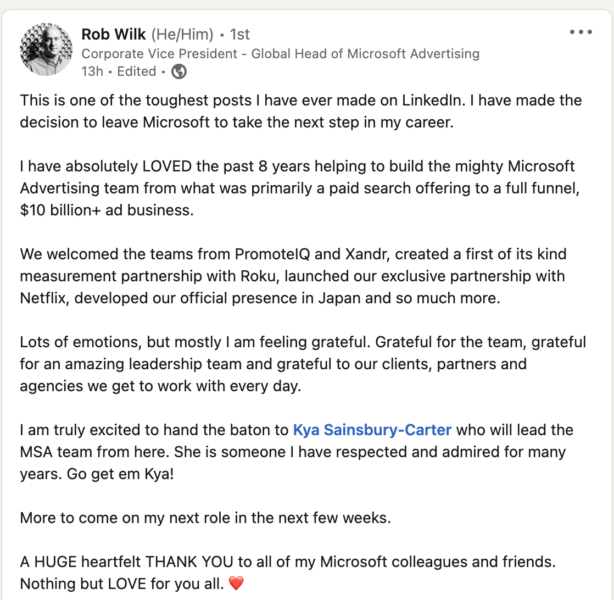
In a LinkedIn announcement, Rob Wilk, Corporate Vice President – Global Head of Microsoft Advertising, announced he was stepping down from his post.

“This is one of the toughest posts I have ever made on LinkedIn. I have made the decision to leave Microsoft to take the next step in my career.”

Screen Shot 2023 03 09 At 9.04.38 AM 614x600

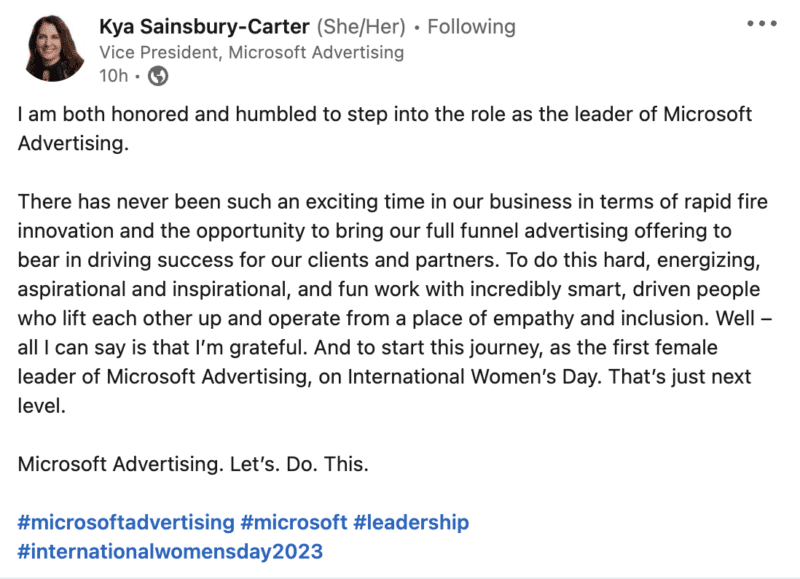
Enter Kya Sainsbury-Carter. Taking over for Wilk is Kya Sainsbury-Carter, Vice President, Microsoft Advertising.

Screen Shot 2023 03 09 At 9.08.46 AM 800x579

Why we care. In pure “International Women’s Day” fashion, a new woman leader could have a significant impact on the company’s strategy, product offerings, and overall direction. Sainsbury-Carter could bring in fresh ideas and perspectives, which can lead to changes in the company’s marketing approach and target audience.

Sainsbury-Carter is well-respected and has a strong track record with Microsoft Advertising. Ideally, this change could improve consumer trust in Microsoft and make it a more attractive partner for advertisers.


Related stories

New on Search Engine Land

@media screen and (min-width: 800px) { #div-gpt-ad-3191538-7 { display: flex !important; justify-content: center !important; align-items: center !important; min-width:770px; min-height:260px; } } @media screen and (min-width: 1279px) { #div-gpt-ad-3191538-7 { display: flex !important; justify-content: center !important; align-items: center !important; min-width:800px!important; min-height:440px!important; } }

About the author

Nicole Farley

Nicole Farley is an editor for Search Engine Land covering all things PPC. In addition to being a Marine Corps veteran, she has an extensive background in digital marketing, an MBA and a penchant for true crime, podcasts, travel, and snacks.

https://searchengineland.com/global-head-of-microsoft-advertising-steps-down-394125


TikTok enters the search ad market, challenging Google and Microsoft

TikTok is reportedly expanding its offerings by entering the search ads market, putting it in direct competition with Google and Microsoft.

TikTok is preparing to launch its own search ads platform, which will allow advertisers to bid on specific keywords and phrases related to their products or services. During the beta test rollout last year, testers confirmed that when search ads were enabled, advertisers could gather the search terms responsible for conversions and leverage those high click-through rate search terms as headlines for their best-performing TikTok videos, resulting in additional benefits.

What’s happening. So why is TikTok making this move, and what does it mean for advertisers and consumers alike? Let’s take a closer look.

Google has long been the dominant player in this market, thanks to its massive user base and sophisticated advertising platform. However, TikTok has been making strides in the advertising space in recent years, and its user base is rapidly expanding.

By entering the search ads market, TikTok is looking to capitalize on this growth and provide a new advertising platform for businesses looking to reach younger, more engaged audiences. TikTok’s user base is largely comprised of Gen Z and millennial users, who are notoriously difficult to reach through traditional advertising channels.

Studies suggest “almost 40%” of young people searching for a lunch spot would do so on TikTok or Instagram rather than Google Maps or Search, Prabhar Raghavan, svp for Google’s knowledge and information division, said last year

How it works. TikTok’s search ads platform will allow businesses to bid on specific keywords and phrases related to their products or services, just like they would on Google. However, TikTok’s platform will likely offer some unique features and targeting options that Google does not.

For example, TikTok’s platform may offer more robust audience targeting options, allowing advertisers to reach users based on their interests, behaviors, and demographics. This could make TikTok’s platform more appealing to advertisers looking to reach specific audiences.

For consumers, TikTok’s entry into the search ads market could mean more relevant and targeted ads. If advertisers are able to more effectively target their ads to specific audiences, consumers may be more likely to engage with those ads and find products and services that are relevant to their interests.

Not so fast. However, it’s important to note that TikTok’s foray into the search ads market is not without risks. Google has a massive head start in this market, and TikTok will need to offer compelling features and competitive pricing in order to attract advertisers away from Google’s platform.

Additionally, TikTok will need to ensure that its search ads platform is user-friendly and does not detract from the user experience on the app. If users feel inundated with ads or if the ads are not relevant to their interests, they may be less likely to engage with the platform overall.

Why we care. TikTok’s entry into the search ads market represents a new opportunity to reach younger, more engaged audiences. TikTok’s user base is largely made up of Gen Z and millennial users, who are difficult to reach through traditional advertising channels. By offering a new advertising platform with robust audience targeting options and unique features, TikTok may be able to provide advertisers with a more effective way to reach these valuable demographics.

Additionally, TikTok’s platform may offer more competitive pricing and better ROI than Google’s platform, making it an attractive option for advertisers looking to stretch their advertising dollars.


Related stories

New on Search Engine Land

@media screen and (min-width: 800px) { #div-gpt-ad-3191538-7 { display: flex !important; justify-content: center !important; align-items: center !important; min-width:770px; min-height:260px; } } @media screen and (min-width: 1279px) { #div-gpt-ad-3191538-7 { display: flex !important; justify-content: center !important; align-items: center !important; min-width:800px!important; min-height:440px!important; } }

About the author

Nicole Farley

Nicole Farley is an editor for Search Engine Land covering all things PPC. In addition to being a Marine Corps veteran, she has an extensive background in digital marketing, an MBA and a penchant for true crime, podcasts, travel, and snacks.

https://searchengineland.com/tiktok-enters-the-search-ad-market-challenging-google-and-microsoft-394121


This day in search marketing history: March 9

Happy Frediversary

In 2017, there were strong signs of a Google algorithm ranking update that had actually started on March 7.

At first, it seemed to be a spam algorithm update related to links. However, a later Search Engine Land analysis of Fred indicated that the update targeted low-value content sites that put revenue above helping their users – and that many affected sites saw up to a 90% drop in traffic.

Many called this the Fred Update, which came from Google’s Gary Illyes, who had jokingly suggested that all updates be named “Fred.” It stuck with this update.

Illyes wouldn’t confirm Fred until SMX West on March 23, when he said the update targeted specific techniques that were well-documented within the Google webmaster guidelines. Though he didn’t elaborate on which guidelines specifically were targeted by the Fred update.

Read about it in New, unconfirmed Google ranking update ‘Fred’ shakes the SEO world.


Also on this day


How Google search personalization works: Professors and politicians just don’t understand

2022: Google has told us how search works. We know plenty about how it works. But a professor seemed confused about search personalization.


Google Hotel search showing free listings in results

2021: Google opened the door to more hotels by offering free hotel listings, separate from paid results. 


Google My Business tells businesses affected by the coronavirus to update listings

2020: You could update your business hours, description, phone number and even add Google Posts.


Google people also ask boxes not showing as often now?

2020: RankRanger said the people also ask was showing for 40% of queries, down from 52% of queries.


Google Search is showing YouTube Music links on album queries

2020: On mobile, the link appeared in the “Listen” carousel of streaming music services; on desktop, it appeared within a list of streaming services in the album’s knowledge panel.


Reddit’s new ‘Trending Takeover’ ad unit lets brands appear on top of Popular feed, Search tab

2020: The ad unit had a campaign life of 24 hours and was designed to align brands with the most popular and relevant trends of the day.


Video: Fili Wiese, an SEO that used to work in Google search quality

2020: A number of topics were discussed, including managing Google penalties, how Google penalizes websites, the disavow link tool and nofollow link attribute.


Google My Business adds ‘women-led’ icon & attribute to business listings

2018: After adding the attribute, a “women-led” icon would appear in the business attributes section of their business listing.


Google tests showing answers under ‘people also ask’ feature

2018: Instead of just showing additional questions people might ask around a query you entered into the search results, Google was testing showing a snippet of the answer directly below the question.


Search in Pics: Craig Newmark at Google, Snow at NYC office & Women @ Google cupcake

2018: The latest images showing what people eat at the search engine companies, how they play, who they meet, where they speak, what toys they have and more.


Google adds emoji & GIF suggestions, translations & more to GBoard for Android

2017: Android users gained access to emoji and GIF suggestions as they typed and the ability to share GIFs in supported apps.


RIP Google PageRank score: A retrospective on how it ruined the web

2016: While Google would remove PageRank scores from public view in the coming weeks, the way those scores dramatically reshaped the web remained.


Google begins massive migrations of their blogs from blogspot.com to googleblog.com

2016: The reason: to help users understand that these were official blogs managed and operated by Google.


Destinations on Google delivers new travel planning experience for mobile users

2016: A mobile search for a continent, country or state, along with the word “destination” or “vacation,” would return a series of travel options.


Google Says They May Flag Broken Security Certificates In The Search Results

2015: Google’s Gary Illyes also said that Google was working on possibly boosting the ranking of secure login pages even more than they did with the normal HTTPS ranking boost.


EU Settlement Nearly Done, Google Antitrust Drama Shifts To India

2014: The Competition Commission of India (CCI) had the power to impose a fine of up 10% annual revenues, averaged over a three year period.


Bad Merchant? Google May Drop Your Rankings Later This Year

2013: Google didn’t want low-quality experience merchants to be ranking in the search results.


“Trulia Suggests” Search Results Without Searching

2013: Trulia Suggests took a range of data from users’ interactions with the site and to offer personalized home recommendations.


Pew Report: 65% View Personalized Search As Bad; 73% See It As Privacy Invasion

2012: Even though personalized search had been the norm at Google for over two years and at Bing for just over a year.


Search In Pics: Google Fish, Yahoo 17th Birthday & Googlighting Tie

2012: The latest images showing what people eat at the search engine companies, how they play, who they meet, where they speak, what toys they have and more.


Federal Appeals Court Allows Keyword Bidding On Competitor’s Names

2011: A California federal court ruled that it is allowed to bid on a competitor’s name for search ads.


Microsoft AdCenter Intros Quality Score That Mimics Google’s

2011: Microsoft said scores wouldn’t directly influence how ads were ranked – it was more of a reflection of how well the ads were performing in the marketplace.


Blekko Blocks More “Spam” Domains: 1.1 Million Of Them

2011: Search engine was using a new system it called “AdSpam.”


Twitter Awareness At 92%, But Usage Just A Fraction Of That

2011: Research suggested that most Americans were well aware of Twitter … they just weren’t using it.


Search Technology Behind iPad Magazine “Zite”

2011: The iPad app used the same search and machine learning capabilities developed by Worio to create a personalized magazine that got “smarter” as you used it.


Twitter Gets Its Own URL Shortener To Stop Scams; Good Marketers Need Not Fear

2010: Twitter: “routing all links submitted to Twitter through this new service, we can detect, intercept, and prevent the spread of bad links across all of Twitter.”


New MSN Out Of Beta, Driving Nearly 50 Percent Of Bing Queries

2010: Microsoft formally launched its much improved MSN portal.


Math Engines: For Multiplying Mixed Fractions, It’s Wolfram Alpha Over Google & Bing

2010: Wolfram Alpha proved useful for the multiplication of fractions.


Google Image Search Adds “Exact Size” Advanced Search Option

2009: Google Image search added an option to the advanced search page to enter in the exact image size you are looking for.


Google Searching For Energy Solutions Because “It’s The Right Thing To Do”

2009: “It’s also good for our business because we’re in the information business. And a lot of the energy solutions involve a lot of information…”


California State Legislator Wants To Limit Info On Maps To Block Terrorists

2009: Satellite images of schools, places of worship, government buildings and medical facilities would need to be blurred.


Former Yahoo Engineer Charged As Alleged Terrorist In India

2009: He was allegedly the “media chief” of the Indian Mujahideen, a terror group charged with the September 2008 bombings in Delhi.


Stealth Tour Of Google Audio’s Dallas Office

2007: Documenting an undercover tour of a Google office in Dallas, Texas that appeared to be the new home of the Google Audio group.


Google Asked To Remove “Mount Hitler” From Google Maps

2007: Google Germany called this a “technical accident.”


Former Microsoft Search Chief Bill Bliss On Early Search Missteps

2007: “Microsoft could have been the one to buy Inktomi and Overture instead of Yahoo, and the world would be much different now for both companies.”


Revamped My Yahoo Launches Amid Intensifying Competition

2007: There were a number of improvements and upgrades.


Nokia Jumps Into Mobile Ads With “Nokia Ad Service” Program

2007: Plus a “white label” Nokia Advertising Connector a program for others who want to run mobile ad programs.


UFO Crawler: The Truth Is Out There & Searchable

2007: IBM and Yahoo teamed up on UFOCrawler, a search engine about finding sources on “UFO Sightings, time travel, conspiracy theories and anomalies.”


From Search Marketing Expo (SMX)


Past contributions from Search Engine Land’s Subject Matter Experts (SMEs)

These columns are a snapshot in time and have not been updated since publishing, unless noted. Opinions expressed in these articles are those of the author and not necessarily Search Engine Land.


< March 8 | Search Marketing History | March 10 >


Related stories

New on Search Engine Land

@media screen and (min-width: 800px) { #div-gpt-ad-3191538-7 { display: flex !important; justify-content: center !important; align-items: center !important; min-width:770px; min-height:260px; } } @media screen and (min-width: 1279px) { #div-gpt-ad-3191538-7 { display: flex !important; justify-content: center !important; align-items: center !important; min-width:800px!important; min-height:440px!important; } }

About the author

Danny Goodwin

Danny Goodwin is Managing Editor of Search Engine Land & SMX. In addition to writing daily about SEO, PPC, and more for Search Engine Land, Goodwin also manages Search Engine Land’s roster of subject-matter experts. He also helps program our conference series, SMX – Search Marketing Expo. Prior to joining Search Engine Land, Goodwin was Executive Editor at Search Engine Journal, where he led editorial initiatives for the brand. He also was an editor at Search Engine Watch. He has spoken at many major search conferences and virtual events, and has been sourced for his expertise by a wide range of publications and podcasts.

https://searchengineland.com/search-marketing-history-march-9-393984


Why a Google search revolution never happened

Did Google move too slowly with AI? Is that why Google is now scrambling to put AI into everything? Two new reports paint two entirely different pictures of Google before – and since – the launch of ChatGPT.

The Google search revolution that never happened. Two Google researchers created a chatbot that supposedly would “revolutionize the way people searched the internet and interacted with computers,” more than two years ago, as reported by The Wall Street Journal.

But executives were reportedly risk-averse, fearing putting out the AI product could hurt its $200 billion+ search advertising business and its reputation. And sure enough, Google took a significant reputational hit with its rushed Bard debut.

What are Google’s AI principles? One reason for Google’s slow approach could be due to its AI principles. Google believes AI applications should:

  1. Be socially beneficial.
  2. Avoid creating or reinforcing unfair bias.
  3. Be built and tested for safety.
  4. Be accountable to people.
  5. Incorporate privacy design principles.
  6. Uphold high standards of scientific excellence.
  7. Be made available for uses that accord with these principles.

So if Google had this AI technology ready more than two years ago, perhaps Google’s leadership felt it wasn’t as ready as those researchers did.

And along came OpenAI’s ChatGPT and Google’s Code Red. Google co-founder Larry Page, a decade ago, warned that “incrementalism leads to irrelevance over time, especially in technology, because change tends to be revolutionary, not evolutionary.”

Love it or hate it, ChatGPT was revolutionary technology. Shortly after the launch of ChatGPT in late November, Google declared a “code red” and sought help from Page and co-founder Sergey Brin. This was part of an effort to add chatbot features to Google Search this year.

Then, Google rushed to introduce Bard, it’s answer to ChatGPT, on Feb. 6. That was one day before Microsoft had planned to unveil the new Bing with ChatGPT.

Since that announcement, Google has tried to clarify that Bard is not search. The AI-powered chatbot features coming to search are based on similar technology, but Bard is a standalone product.

Google AI = the new Google Plus? Google is now reportedly “stuffing” generative AI into more products, according to Bloomberg:

“Some Google alumni have been reminded of the last time the company implemented an internal mandate to infuse every key product with a new idea: the effort beginning in 2011 to promote the ill-fated social network Google+. It’s not a perfect comparison—Google was never seen as a leader in social networking, while its expertise in AI is undisputed. Still, there’s a similar feeling.”

Google pushed back on this, saying much of Google’s internal efforts involve having Googlers test and improve Bard. One Googler also told Bloomberg:

  • “There is an unhealthy combination of abnormally high expectations and great insecurity about any AI-related initiative.”

Why we care. Is Google panicking or moving too slowly? Both could be true – or the actual truth may be somewhere more in the middle, where Google is really living by its AI principles. Call it a slow rush – as Google can afford to sit back right now and watch and learn from Microsoft and other generative AI players and avoid any (further) costly mistakes.


Related stories

New on Search Engine Land

@media screen and (min-width: 800px) { #div-gpt-ad-3191538-7 { display: flex !important; justify-content: center !important; align-items: center !important; min-width:770px; min-height:260px; } } @media screen and (min-width: 1279px) { #div-gpt-ad-3191538-7 { display: flex !important; justify-content: center !important; align-items: center !important; min-width:800px!important; min-height:440px!important; } }

About the author

Danny Goodwin

Danny Goodwin is Managing Editor of Search Engine Land & SMX. In addition to writing daily about SEO, PPC, and more for Search Engine Land, Goodwin also manages Search Engine Land’s roster of subject-matter experts. He also helps program our conference series, SMX – Search Marketing Expo. Prior to joining Search Engine Land, Goodwin was Executive Editor at Search Engine Journal, where he led editorial initiatives for the brand. He also was an editor at Search Engine Watch. He has spoken at many major search conferences and virtual events, and has been sourced for his expertise by a wide range of publications and podcasts.

https://searchengineland.com/google-ai-search-stalling-scrambling-394051


Maximizing your website tracking with Google’s Tag coverage summary

Google’s “Tag Coverage” feature now allows you to see which tags are firing on your website and which ones are not. You can access this summary from the Google tag sections of both Google Ads and Google Analytics, and through Google Tag Manager.

What Tag Coverage is. Tag Coverage is a feature within Google Tag Manager that allows you to see a summary of which tags are firing and which ones are not. This feature is especially useful if you’re working with a complex website that has multiple tags or if you’ve recently made changes to your website’s tags and want to make sure everything is working correctly.

The Tag Coverage summary displays the following information:

  1. Total number of tags on the website
  2. Number of tags that are currently firing
  3. Number of tags that are not firing
  4. Number of tags that have no data
  5. Number of pages with no tags

How to Use Tag Coverage. To access the Tag Coverage feature in GTM, follow these steps:

  1. Sign in to your GTM account.
  2. Select the container you want to view.
  3. Click “Tags” from the left-hand navigation menu.
  4. Click “Tag Coverage” from the sub-menu.

Once you’ve accessed the Tag Coverage summary, you can start using it to analyze your tags. Here are a few ways you can use this feature:

  1. Identify which tags are not firing: The Tag Coverage summary will show you which tags are not firing. If you notice that a tag isn’t firing, you can troubleshoot the issue to make sure that the tag is configured correctly.
  2. Analyze the data: The summary will also show you which pages have tags and which ones don’t. You can use this information to identify pages that may need additional tracking or to optimize your tags for certain pages.
  3. Optimize your tags: If you notice that certain tags are not firing on your website, you can use this information to optimize your tags. This may involve tweaking the tag configuration or adding additional triggers to ensure that the tag is firing correctly.

Dig deeper. Read the full article on Google’s Tag Manager Help documentation.

Why we care. The Tag Coverage feature in Google Tag Manager is an essential tool for advertisers who wants to ensure that their tags are firing correctly on their website. By using this feature, you can identify issues with your tags and optimize your tracking to ensure that you’re getting the data you need.


Related stories

New on Search Engine Land

@media screen and (min-width: 800px) { #div-gpt-ad-3191538-7 { display: flex !important; justify-content: center !important; align-items: center !important; min-width:770px; min-height:260px; } } @media screen and (min-width: 1279px) { #div-gpt-ad-3191538-7 { display: flex !important; justify-content: center !important; align-items: center !important; min-width:800px!important; min-height:440px!important; } }

About the author

Nicole Farley

Nicole Farley is an editor for Search Engine Land covering all things PPC. In addition to being a Marine Corps veteran, she has an extensive background in digital marketing, an MBA and a penchant for true crime, podcasts, travel, and snacks.

https://searchengineland.com/maximizing-your-website-tracking-with-googles-tag-coverage-summary-394068


YouTube overlay ads are going away

YouTube has announced that it will remove overlay ads from the platform starting on April 6. According to the company, the move is in response to feedback from viewers who find these ads disruptive. The removal of overlay ads will undoubtedly enhance the viewer experience, making YouTube a more enjoyable platform for all.

Why the change. The move is also a significant win for YouTube creators. Overlay ads are known to be less effective than other ad formats, such as pre-roll ads, which play before a video begins. As a result, creators often earn less revenue from overlay ads, despite their videos receiving a high number of views. By removing these ads, Google is creating an opportunity for creators to earn more revenue from other ad formats, ultimately benefiting the YouTube creator community.

Increased competition and pressure. This announcement comes at a time when YouTube is facing intense competition from other video-sharing platforms such as TikTok and Instagram. These platforms have gained popularity, especially among younger audiences, with their short-form videos and algorithmic content discovery features. By enhancing the viewing experience on its platform, YouTube is ensuring that it remains competitive and continues to attract viewers and creators alike.

What YouTube says.

“Starting on April 6th, 2023, the “Overlay ads” ad format will no longer appear on YouTube to help improve the viewer experience and shift engagement to higher performing ad formats on desktop and mobile devices. Overlay ads are a legacy ad format that only served on desktop and are disruptive for viewers. We expect to see limited impact for most Creators as engagement shifts to other ad formats.” 

Why we care. Advertisers who rely on this ad format may be affected by this move. Overlay ads are known for their affordability, making them a popular option for advertisers with smaller budgets. By removing them, Google is creating a gap in the market that may lead to increased competition and pricing for other ad formats. This may not be an issue for larger brands, but smaller businesses may struggle to compete for ad space on the platform.


Related stories

New on Search Engine Land

@media screen and (min-width: 800px) { #div-gpt-ad-3191538-7 { display: flex !important; justify-content: center !important; align-items: center !important; min-width:770px; min-height:260px; } } @media screen and (min-width: 1279px) { #div-gpt-ad-3191538-7 { display: flex !important; justify-content: center !important; align-items: center !important; min-width:800px!important; min-height:440px!important; } }

About the author

Nicole Farley

Nicole Farley is an editor for Search Engine Land covering all things PPC. In addition to being a Marine Corps veteran, she has an extensive background in digital marketing, an MBA and a penchant for true crime, podcasts, travel, and snacks.

https://searchengineland.com/youtube-overlay-ads-are-going-away-394049