Pinterest is experimenting a new premium video ad format

Pinterest is currently conducting alpha testing of a new ad offering that enables companies to reach customers from a more prominent location within the mobile app.

The new format, tentatively named the “Premiere Spotlight” ad, gives advertisers access to a premium placement on the Pinterest app’s search page for a 24-hour period. As a result, they can reach Pinterest users while they utilize one of the app’s critical features: searching for pins, inspiration, and concepts.

Early testing. The latest version of the Pinterest mobile app features the new ad style with a Kohl’s promotion. The ad includes a brief video with overlaid text and a button that directs users to Kohl’s website, which opens within the Pinterest app, rather than a separate tab.

Pinterest users can then view the retailer’s product recommendations, search for additional items, add them to their shopping cart, and complete the purchase, just as they would if they visited Kohl’s website directly.

IMG 5038 277x600

How it works. As an alpha test, the pricing for the ad is not presently available as it may alter before a more widespread release. Pinterest will probably select specific brands and creative types for this feature. Additionally, all ads will employ Pinterest’s maximum-width video format.

Pinterest did not say when the new ad format would be available more broadly.

What Pinterest says.

“We’re constantly looking for ways for advertisers to reach the people who come to Pinterest with commercial intent,” a spokesperson said. “As we continue to build a suite of products to drive performance across the full funnel, we’re exploring a new takeover feature that showcases a brand in a new premium, exclusive placement.”

Keeping up with demand. In recent years, Pinterest has been adjusting to the increasing demand for video content from both advertisers and users. Initially a platform for sharing image-based collections, the company transitioned to video with the introduction of Idea Pins in 2021, which provides creators with a TikTok-like experience. In 2022, the platform allowed marketers to transform their Idea Pins into advertisements. Additionally, Pinterest expanded its short-form video offerings this year by partnering with Condé Nast to produce 160 exclusive videos for the site featuring top brands such as Vogue and Architectural Digest.

In its Q4 earnings call the previous month, Pinterest stated that it had increased its video content supply by 30% compared to the previous quarter. The company noted that providing high-quality content would enhance user engagement, especially among Gen Z.

Why we care. Pinterest has a user base of over 450 million people, and the platform is particularly popular among women and younger demographics. The new advertising format allows advertisers to occupy a prime position on the search page, which is a key feature of the app. Furthermore, Pinterest’s emphasis on high-quality video content aligns with the trend of increased demand for video advertising.


Related stories

New on Search Engine Land

@media screen and (min-width: 800px) { #div-gpt-ad-3191538-7 { display: flex !important; justify-content: center !important; align-items: center !important; min-width:770px; min-height:260px; } } @media screen and (min-width: 1279px) { #div-gpt-ad-3191538-7 { display: flex !important; justify-content: center !important; align-items: center !important; min-width:800px!important; min-height:440px!important; } }

About the author

Nicole Farley

Nicole Farley is an editor for Search Engine Land covering all things PPC. In addition to being a Marine Corps veteran, she has an extensive background in digital marketing, an MBA and a penchant for true crime, podcasts, travel, and snacks.

https://searchengineland.com/pinterest-is-experimenting-a-new-premium-video-ad-format-393867


3 new changes to the Google Ads dashboard

In response to user feedback highlighting that the current ads dashboard can be complicated and challenging for newer users, Google Ads is presently testing new designs to improve organization and simplify the process of finding information. This trial is currently limited to a small number of accounts.

Here are the top changes:

  1. A new navigation menu
  2. Reorganized interface
  3. A refreshed look and feel

Let’s take a look.

1. A new navigation menu. The revamped design provides access to all of Google Ads’ tools and features from one more efficiently organized menu instead of the three currently in use.

Google says this feature should simplify the process of locating where you need to go and enable you to track your location within the interface more effortlessly. Additionally, there is now a “Create” button, making it simpler to establish campaigns and ad groups by clicking on the “plus” button located in one convenient location.

VYF1rkylzD0w2S7JHiYNDqPpjAmtCIrBjHno 663x600

2. Reorganized interface. The tools and features have been reorganized to make them easier to locate by grouping related tasks together, which may take some time to adjust to. In particular, two new categories have been introduced to highlight the key elements crucial to campaign success. It’s worth noting that the adjustments have not affected the tools and features covered, and no features have been removed from the platform.

Below is a breakdown of the two recently added navigational categories:

Goals. Goals have been emphasized in the navigation to underscore their importance. The new menu category merges goals and conversion measurements into one location.

Audiences, keywords, and content. The recently introduced menu category, Audiences, keywords, and content, combines the tools used to determine who you want to reach and the methods you reach them, including Search Keywords, Audiences, Locations, and Content.

Search keywords have been consolidated with the other tools that assist in determining who sees your ads. Additionally, the four menu categories have undergone some changes, with Campaigns, Assets, Tools, and Insights and reports now being combined.

Advertisers who use standard Shopping and Hotel campaigns will find their hotels, activities, and products listed under the Assets category. As always, it’s possible to locate any page directly by searching for it in Google Ads.

3. A refreshed look and feel (Google’s words, not ours). The redesigned interface now includes more white space, which is intended to provide a less distracting environment to complete tasks. Additionally, the font has been altered from Roboto to Google Sans, which is larger, resulting in improved readability. Furthermore, the navigation has been updated with sleek new icons, and a blue highlight has been added to emphasize the current location within the user experience.

Dig deeper. You can read the announcement from Google here.

Why we care. The redesigns should offer a more intuitive and user-friendly interface that is tailored to meet advertisers’ needs. Google says that the new design is better organized, with grouped tools and features that are easier to locate, and it offers a more consistent and predictable navigation experience.

But there are some downsides.

Advertisers who are accustomed to the current interface may find it challenging to adapt to the new layout and features, which could temporarily slow down their workflow and lead to a learning curve. This could result in a decrease in productivity and efficiency in the short term.

Secondly, some advertisers may have created custom workflows or automated scripts based on the previous interface, which could break or require modification in the new interface. This could cause additional costs and delays to update or recreate these workflows.

Lastly, while Google has assured that the functionality and features of Google Ads will remain the same, there may be some unintended bugs or glitches that could impact campaign performance.

Do you have access to the redesigned Google Ads experience? Tell us what you think!


Related stories

New on Search Engine Land

@media screen and (min-width: 800px) { #div-gpt-ad-3191538-7 { display: flex !important; justify-content: center !important; align-items: center !important; min-width:770px; min-height:260px; } } @media screen and (min-width: 1279px) { #div-gpt-ad-3191538-7 { display: flex !important; justify-content: center !important; align-items: center !important; min-width:800px!important; min-height:440px!important; } }

About the author

Nicole Farley

Nicole Farley is an editor for Search Engine Land covering all things PPC. In addition to being a Marine Corps veteran, she has an extensive background in digital marketing, an MBA and a penchant for true crime, podcasts, travel, and snacks.

https://searchengineland.com/3-new-changes-to-the-google-ads-dashboard-393857


This day in search marketing history: March 3

Google Panda name revealed

In 2011, Google’s Amit Singhal and Matt Cutts revealed that Google Panda was the true name of the update that was informally referred to as Farmer when it launched Feb. 24.

“Well, we named it internally after an engineer, and his name is Panda. So internally we called a big Panda,” Singhal said in a Wired interview with Steven Levy.” He was one of the key guys. He basically came up with the breakthrough a few months back that made it possible.”

Google said the launch of the “Caffeine” indexing infrastructure inadvertently helped increase the visibility of “shallow content.

“Our index grew so quickly, and we were just crawling at a much faster speed. When that happened, we basically got a lot of good fresh content, and some not so good. The problem had shifted from random gibberish, which the spam team had nicely taken care of, into somewhat more like written prose. But the content was shallow,” Singhal added.

Read all about it in Google Speaks More About The Farmer Update, AKA Panda Update. And dig deeper in


Also on this day


Google page experience update for desktop done rolling out

2022: The rollout was completed after nine days.


Google ‘Confirmed by phone’ label in local panel may add trust to local listings

2022: Google was testing displaying a “confirmed by phone” label to the local listing, followed by when it was last confirmed


Microsoft Advertising Editor rolls out support for Microsoft Audience Network campaigns

2022: Microsoft planned to add support for more Audience Network capabilities within the ads editor.


Help for Ukraine SEO & PPC specialists seeking work

2022: An SEO entrepreneur has created two resources: one for job seekers and another for employers with vacancies willing to hire Ukrainians.


Google will not build or use alternate identifiers to track users across the web

2021: Google reiterated that its products would use Federated Learning of Cohorts to enable advertisers to target audiences.


Optimization score comes to Google Ads app

2020: Also, Dark mode.


Fake and inaccurate reviews driving billions in ‘wasted’ consumer spending [Report]

2020: Roughly 90% of adult internet users relied on reviews, but with growing awareness of fraud and manipulation.


Search in Pics: Google sleep capsules, YouTube control room & golden Android figurine

2017: The latest images culled from the web, showing what people eat at the search engine companies, how they play, who they meet, where they speak, what toys they have and more.


Google Image Search Tests Colored Filter Buttons

2016: The new format showed up on desktop image results for some and used different colored backgrounds to enhance the filter options for the searcher.


Bing Native Ads Rollout Gains Steam: Support Coming To Bing Ads Editor

2016: Bing Ads rolled out an update for Bing Ads Editor that included editing support for native ad bidding.


Bing Partners With NCAA To Deliver March Madness Predictions & Tournament App

2016: Bing and the NCAA teamed up again to help fans fill out their NCAA brackets and follow all 67 games


Google Researchers Introduce System To Rank Web Pages On Facts, Not Links

2015: Could Google someday rank web pages based on how accurate they are? A new paper suggested they might.


Yahoo Celebrates Its 20th Birthday By Setting New World Record For Yodeling

2015: The company pulled together more than 3,400 people to set the Guinness World Record for the largest simultaneous yodel.


Matt Cutts Video: How Google Determines What’s A Paid Link

2014: Cutts answers: “What is a ‘paid link’?”


Google To Launch New Search Results Design With Larger Fonts & No Underlines Soon?

2014: Google had been testing several layouts that made the search results look a bit easier to read by increasing the font size and removing some of the underlines for the hyperlinked content.


Google Bug Turned Entire Web Into “Lorem Ipsum”

2014: There was. aweird issue where Google showed Lorem Ipsum boilerplate text in the search results snippets.


Bing Quietly Adds A Scientific Full Size Calculator

2014: When you searched for a math answer, not only did you get the answer, but you also got an interactive calculator in Bing’s search results.


Interflora Gets Its Google Rankings Back, 11 Days After Penalty

2013: Interflora was ranking again on searches for its company name, and its Google+ brand box was appearing again on the right side of the search results.


Google Redesigns Google Profiles

2011: The profiles looked slicker and more “social,” as you would expect from a Facebook or Twitter.


Google Intros AdSense Mobile Interface

2011: The mobile-friendly site let you check earnings, get alerts, and view non-Flash-based reports.


Kayak Welcomes Google As Travel Search Competitor, With ITA Acquisition Still Under DOJ Review

2011: The travel search engine didn’t fear Google’s entrance into the travel search market, according to Paul English, Kayak.com’s co-founder and Chief Technology Officer.


Video: Inside Google’s Self-Driving Cars

2011: TED attendees were allowed to travel inside the self-driving cars, on a closed course.


Bing Brings Local Deals To Mobile, PC

2011: The source of deals was The Dealmap.


Microsoft & Facebook No Longer Friends After Employee Poaching Accusations

2011: Microsoft was considering taking legal action against Facebook for allegedly poaching their employees.


Ask Launches Local Conversations iPhone App

2011: Ask launched a new app focused on local conversations called Ask Around.


Google Simplifies Verification For Multiple Owners In Webmaster Tools

2010: Rather than having to upload multiple verification files or create multiple meta tags, there was a new “Add a User” tool on the site verification page.


Google’s Norvig: PageRank Is Overhyped

2010: Google’s Director of Research Peter Norvig said the public’s focus on PageRank was misguided and it probably needed a new name.


Google Grades Itself On SEO Best Practices

2010: Google had a mixed bag of good SEO tactics and missed opportunities on the homepages of 100 different products.


Google Kills SearchWiki, Replaces It With Starred Results

2010: The ability to re-order, remove, and comment on search results was replaced by a scaled-down version that Google was simply calling “stars” or “starred results.”


It’s Official: Google’s Proposal For Crawling AJAX URLs is Live

2010: Google’s Maile Ohye confirmed that Google was now crawling AJAX pages.


Report: Growth Of Paid Search Budgets Decline While SEO Budgets Increase

2009: An eMarketer report said SEO budgets would increase in the next five years, while paid search budgets would decline relative to the overall marketing budgets for companies.


Twitter & Google Maps Help Find Lost Skiers

2009: Twitter, in conjunction with Google Maps, helped locate a couple of lost skiers.


MapQuest Launches Enhanced Biz Locator, Puts Brands On The Map

2009: A scrolling vertical bar appeared on the upper right of every map allowing advertisers to populate any map quickly with specific brand locations.


Cuil Announces New Layout, Other Updates

2009: Cuil, the search engine that launched to great hype in 2008 and then pretty much disappeared, announced changes to its design, content, and backend.


Yahoo Search March ’08 Weather Report

2008: Yahoo made changes to their crawling, indexing and ranking algorithms.


Ask.com Calls Dumping Teoma Search Technology Rumors False

2008: “Bottom line: they are just flat-out not true. Our Teoma technology will continue to power search engine results on Ask.com.”


comScore Paid Search Data & How The Sky Might Not Be Falling

2008: A drop in paid clicks was not due to advertisers holding back on spending but rather Google’s “quality initiatives.”


Mobile 411: A Leading Indicator For Mobile Search

2008: A survey found the most common usage frequency for mobile directory assistance was “once every three months” (61 percent).


InsideTrip Seeks To Add More Depth And Dimension To Travel Search

2008: The site offered a metasearch engine (like Kayak or Farechase) for airfares.


Compete Sold For $75 Million To Taylor Nelson Sofres

2008: Compete.com’s 2007 revenue was $14.9 million, over 50% higher than in the previous year.


From Search Marketing Expo (SMX)


Past contributions from Search Engine Land’s Subject Matter Experts (SMEs)

These columns are a snapshot in time and have not been updated since publishing, unless noted. Opinions expressed in these articles are those of the author and not necessarily Search Engine Land.


< March 2 | Search Marketing History | March 4 >


Related stories

New on Search Engine Land

@media screen and (min-width: 800px) { #div-gpt-ad-3191538-7 { display: flex !important; justify-content: center !important; align-items: center !important; min-width:770px; min-height:260px; } } @media screen and (min-width: 1279px) { #div-gpt-ad-3191538-7 { display: flex !important; justify-content: center !important; align-items: center !important; min-width:800px!important; min-height:440px!important; } }

About the author

Danny Goodwin

Danny Goodwin is Managing Editor of Search Engine Land & SMX. In addition to writing daily about SEO, PPC, and more for Search Engine Land, Goodwin also manages Search Engine Land’s roster of subject-matter experts. He also helps program our conference series, SMX – Search Marketing Expo. Prior to joining Search Engine Land, Goodwin was Executive Editor at Search Engine Journal, where he led editorial initiatives for the brand. He also was an editor at Search Engine Watch. He has spoken at many major search conferences and virtual events, and has been sourced for his expertise by a wide range of publications and podcasts.

https://searchengineland.com/search-marketing-history-march-3-393806


Biden approved to decide fate of TikTok as US ban nears

TikTok faces further setbacks as the US House Foreign Affairs Committee grants President Joe Biden authority to prohibit the Chinese-owned app, depending on his evaluation of the situation, amidst ongoing security concerns regarding its possible links to the CCP.

The US government has already declared a complete prohibition of TikTok on all government-owned gadgets, following comparable measures in more than 30 American states. Likewise, European and Canadian authorities have enforced a similar ban on official devices, as tensions between China and Western nations persist, partly due to the Ukraine conflict.

What TikTok says. TikTok responded with this comment on Twitter.

Not so fast. Although today’s declaration is not a complete endorsement for Biden to enforce a ban on the app, it signifies that the US Senate’s approval is still necessary before such a move can be executed. Nonetheless, it is another stride towards the impending phase, which seems more likely to result in a TikTok prohibition or at the very least, a substantial shift in direction for the app.

In 2020, President Donald Trump signed an executive order banning TikTok from the US, citing an investigation in 2019 over national security concerns. TikTok’s response: the order was issued without any due process.

Why we care. A TikTok ban would eliminate a significant platform for brands and digital marketers alike. TikTok has emerged as a popular social media platform, particularly among younger demographics, with over one billion active users worldwide. It has become a go-to platform for influencer marketing and creative advertising campaigns, which have proven successful for brands.

If the app were to be banned, advertisers would lose access to this large and engaged audience, which could impact their reach, engagement, and overall return on investment. Advertisers would need to look for alternative platforms to promote their products and services, which may not have the same level of popularity or effectiveness as TikTok. A TikTok ban would require advertisers to rethink their digital marketing strategies and adjust their budgets accordingly.


Related stories

New on Search Engine Land

@media screen and (min-width: 800px) { #div-gpt-ad-3191538-7 { display: flex !important; justify-content: center !important; align-items: center !important; min-width:770px; min-height:260px; } } @media screen and (min-width: 1279px) { #div-gpt-ad-3191538-7 { display: flex !important; justify-content: center !important; align-items: center !important; min-width:800px!important; min-height:440px!important; } }

About the author

Nicole Farley

Nicole Farley is an editor for Search Engine Land covering all things PPC. In addition to being a Marine Corps veteran, she has an extensive background in digital marketing, an MBA and a penchant for true crime, podcasts, travel, and snacks.

https://searchengineland.com/biden-approved-to-decide-fate-of-tiktok-as-us-ban-nears-393836


New Analytics user access management changes in Google Ads

In the coming months, Google Analytics 4 audience builder will be integrated into Google Ads, making it easier to create and apply audiences from Google Analytics 4 to Google Ads campaigns.

To enable this feature, Google Ads is introducing a new cross-product access management model. This model allows a Google Analytics 4 property Admin to grant explicit permissions to users in a linked Google Ads account. The Google Analytics admin can assign roles to the different permissions available in Google Ads, such as Administrator, Standard, or Read only. These roles will determine access to Analytics features embedded in Google Ads, including the ability to create Analytics audiences directly in Google Ads.

Levels of user access in Google Analytics. Google Analytics offers four levels of user access: Account Owner, Property User, View User, and Analyst. Each level has different permissions, ranging from full control to read-only access.

  1. Account Owner: The Account Owner has full control over the Google Analytics account, including the ability to manage users, create properties and views, and link AdWords and other accounts. There can only be one Account Owner per Google Analytics account.
  2. Property User: The Property User has access to a specific property, allowing them to view and manage data for that property. They can create views, manage filters, and link AdWords and other accounts to the property. Property Users can also manage users for the property, but they cannot add or remove other Property Users.
  3. View User: The View User has access to a specific view within a property. They can view and manage data for that view, including creating custom reports and setting up goals. View Users cannot create or delete views or modify filters.
  4. Analyst: The Analyst has read-only access to a specific view within a property. They can view data, but they cannot make any changes to the account or data.

Managing user access in Google Analytics. To manage user access in Google Analytics, follow these steps:

  1. Sign in to your Google Analytics account and navigate to the Admin section.
  2. Click on the Account, Property, or View that you want to manage.
  3. Click on User Management under the Account, Property, or View column.
  4. Enter the email address of the user you want to add or remove.
  5. Select the level of access you want to grant, ranging from Account Owner to Analyst.
  6. Click Add or Remove to add or remove a user.
  7. Click Notify this user by email to notify the user of the changes.

Best practices for user access management in Google Analytics. Here are some best practices for managing user access in Google Analytics:

  1. Limit access to sensitive data: Only grant access to users who need it. This includes limiting access to personal or sensitive data, such as user IP addresses or financial information.
  2. Use Google groups: Create Google Groups to manage access to your Google Analytics account. This makes it easier to manage access and ensure that the right users have access to the right data.
  3. Use two-factor authentication: Enable two-factor authentication for all users to ensure that only authorized users can access your Google Analytics data.
  4. Audit user access regularly: Regularly review user access to ensure that users have the appropriate level of access and that no unauthorized users have access to your data.

Dig deeper. Read the announcement from Google here.

Why we care. Managing user access in Google Analytics critical to the security and accuracy of your analytics data. Proper user access management ensures that only authorized users have access to their data and limits access to sensitive information.

Additionally, with the upcoming integration of Google Analytics 4 audience builder in Google Ads, mastering user access management will be important for creating and applying audiences from Google Analytics to Google Ads campaigns.


Related stories

New on Search Engine Land

@media screen and (min-width: 800px) { #div-gpt-ad-3191538-7 { display: flex !important; justify-content: center !important; align-items: center !important; min-width:770px; min-height:260px; } } @media screen and (min-width: 1279px) { #div-gpt-ad-3191538-7 { display: flex !important; justify-content: center !important; align-items: center !important; min-width:800px!important; min-height:440px!important; } }

About the author

Nicole Farley

Nicole Farley is an editor for Search Engine Land covering all things PPC. In addition to being a Marine Corps veteran, she has an extensive background in digital marketing, an MBA and a penchant for true crime, podcasts, travel, and snacks.

https://searchengineland.com/new-analytics-user-access-management-changes-in-google-ads-393834


2023 digital marketing salary guide & hiring trends report by Digital Marketing Depot

Stacks Coins Peoplel Salary Compare 1920x1080 1 800x450

Digital marketing talent—especially those specializing in SEO, content, email marketing, and PPC—remains in top demand.  If you’re looking to advance your career, change jobs, or expand your digital marketing team, Conductor’s 2023 Digital Marketing Salary Guide has you covered.

Visit Digital Marketing Depot to download Conductor’s 2023 Digital Marketing Salary Guide & Hiring Trends Report for access to:

  • Exclusive salary range benchmark data
  • In-depth hiring trend research
  • Additional recruiting trends and retention strategies

Related stories

New on Search Engine Land

@media screen and (min-width: 800px) { #div-gpt-ad-3191538-7 { display: flex !important; justify-content: center !important; align-items: center !important; min-width:770px; min-height:260px; } } @media screen and (min-width: 1279px) { #div-gpt-ad-3191538-7 { display: flex !important; justify-content: center !important; align-items: center !important; min-width:800px!important; min-height:440px!important; } }

About the author

Digital Marketing Depot

Digital Marketing Depot is a resource center for digital marketing strategies and tactics. We feature hosted white papers and E-Books, original research, and webcasts on digital marketing topics — from advertising to analytics, SEO and PPC campaign management tools to social media management software, e-commerce to e-mail marketing, and much more about internet marketing. Digital Marketing Depot is a division of Third Door Media, publisher of Search Engine Land, MarTech, and producer of the conference series Search Marketing Expo and MarTech. Visit us at http://digitalmarketingdepot.com.

https://searchengineland.com/digital-marketing-salary-guide-hiring-trends-report-393813


This day in search marketing history: March 2

Happy birthday, Yahoo! (or is it?)

In 1995, Yahoo! was incorporated.

I was very close to using our March 1 edition of This day in search history to wish Yahoo a happy 28th birthday. Especially after I saw our 2010 story, Happy Birthday, Yahoo: 15 Years Old Today.

But why was that the only headline from March 1 on Search Engine Land about it being Yahoo’s birthday? Perhaps it was because our article discussed a Yahoo blog post (Happy 15th Birthday Yahoo! from Jerry and David!), which was posted on March 1 and contained the words “as we celebrate 15 years today.”

Digging deeper into our archives, things continued to be confusing:

  1. Yahoo Celebrates Its 13th Birthday; Will There Be A 14th? – published March 5, 2008 (references a photo shared by Yahoo via Flicker on March 4, which was completely unhelpful.)
  2. Yahoo Celebrates Its 14th Birthday – published March 2, 2009. (“Yahoo is celebrating its 14th birthday today…”)
  3. Yahoo Turns 16 Years Old – published March 2, 2011 (“On March 1st, Yahoo turned 16 years old.” And that’s because Yahoo marked its “Sweet 16” on March 1, 2011.)
  4. Yahoo Celebrates Its 20th Birthday By Setting New World Record For Yodeling, published March 3, 2015 (“Yahoo turned 20 yesterday…” i.e., March 2)

Well, on March 2, 2005, Yahoo celebrated its 10th birthday by giving away a free scoop of Baskin-Robbins ice cream. And on March 2, 2020, Yahoo wished itself a happy birthday on social media and shared 25 years of milestones.

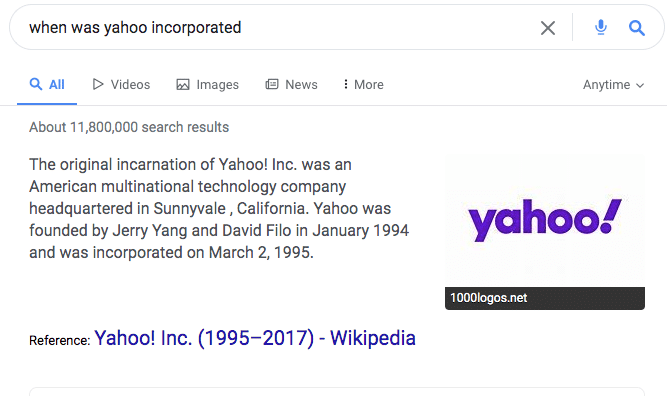
I even went to Yahoo search for the first time in a very long time to find out what Yahoo search (powered by Microsoft Bing) would tell me. No surprise, Wikipedia provided further consensus about March 2:

When Was Yahoo Incorporated

So Yahoo’s “official” birthday seems to be March 2, not March 1. Although it could easily be argued that neither is actually the “real” birthday of Yahoo.

After all, the company was founded in 1994. Jerry and David’s Guide to the World Wide Web was renamed as Yahoo in April 1994. And the Yahoo.com domain was registered on Jan. 18, 1995.

Also, let’s not add to the confusion by even mentioning the birthday of Yahoo Search (Feb. 18, 2004).

Ultimately, it really doesn’t matter whether Yahoo’s “real birthday” is. We already went through this with Google (see: Google Is 10 Years Old? Finding The Real Google Birthday), which decided to officially celebrate its birthday every Sept. 27.

So we wish Yahoo a happy birthday today. On March 2. As it should be.

And it seems like Yahoo’s search team will be wishing for a search comeback this year.


Also on this day


Google may require double verification for some business profiles

2022: Google updated its help documents to say that it may require you to verify your business with an additional method.


Semrush buys Kompyte so it can upsell competitive intelligence tools

2022: Kompyte offered competitive analysis tools that help marketers track changes on a competitor’s site, ad copy, social media and more.


New content analytics coming soon to LinkedIn

2022: LinkedIn would soon give creators more details on the people who read and engage with their content.


Semrush plans to go public after posting big 2020 growth

2021: The company’s gross profit was just under $95 million in 2020, compared to just under $70 million in 2019.


Maryland’s ad tax is here, and advertisers should look to their European counterparts for how to deal with it

2021: Ads from companies (in this case, platforms like Google, Microsoft, Amazon and Facebook) will be taxed at a rate of 2.5% to 10%, depending on their annual global revenue. 


Google tightens FAQ markup guidelines, disallows repetition of questions and answers

2020: Repeating the same question and answer in multiple FAQ pages on your site would put you in violation of Google’s guidelines.


Video: Aleyda Solis on remote SEO work, international SEO and YouTube optimization

2020: The international SEO expert shared advice on managing her SEO clients while traveling to help educate the SEO industry.


Bing Entity Search API is now available

2018: The API let you pull Bing Knowledge Graph information about people, places, things, and local businesses directly into sites and apps.


Yelp offers new ad customization to advertisers

2018: Advertisers could pick an image and favorite review or let an algorithm do it for them.


Search in Pics: Google Dublin snow, dog racing & Noogler handbook

2018: The latest images showing what people eat at the search engine companies, how they play, who they meet, where they speak, what toys they have and more.


Google makes it easier to search for programming languages answers

2017: Google could now handle queries containing sequences of 2–3 special characters.


AdWords Expanded Text Ads could get even longer with second description line test

2017: A new test doubled the number of characters available in text ad descriptions.


Google Would Like You To Buy Products Using Voice Search

2016: Conversational search would allow users to buy or locate products by just talking to their devices.


Google City Searches Now Include Hotel Booking Info In Knowledge Graph

2015: Average star rating and costs for city hotels were listed, along with “View hotels” link that delivered results page for hotels in the relevant city.


Yahoo’s Search Share Drops For First Time Since Firefox Deal Began

2015: Yahoo couldn’t maintain gains from previous months and small “switchback” losses to Google were likely to erode share more in the coming months.


Microsoft Advertising Begins Aggressively Courting Small Businesses For Search

2012: Microsoft Advertising was reaching out to PPC experts and small business customers, hoping to pair them up to educate SMBs about adCenter and learn about their needs and challenges.


iPad-apalooza: Yandex Looks At iPad Search & 30 Percent Of North Americans Want iPad3

2012: iPad users accounted for about 1% of all internet users in Russia.


Nathon Fillion Demonstrates His “Google Maps Pose”

2012: “If a Google Maps car is coming down the street, what am I going to do?”


Search In Pics: Google Sheep, Bing Neon Sign & Google Pinata

2012: The latest images showing what people eat at the search engine companies, how they play, who they meet, where they speak, what toys they have, and more.


Google Trying To Minimize Collateral Damage From “Farmer” Update

2011: Related:


Twitter Putting Focus On SMBs For Ads Growth

2011: About 100 small advertisers were using Twitter’s “promoted” ad products. By contrast, 125 big brands were using the site to market their products or services.


February 2011: Search Engine Land’s Most Popular Stories

2011: Search Engine Land’s 10 most popular stories from February 2011.


Google Extends “Click To Call” Ads To All Advertisers

2010: With no need for a physical address, calls could now be directed to call centers and more easily utilized by “national” advertisers.


Has Google Just Patented Geo-Targeting?

2010: Google was awarded a patent (“Determining and/or using location information in an ad system”) that had broad implications for PC and mobile advertising. 


Topeka Changes Its Name To Google, Kansas (Temporarily)

2010: What would you do to get Google to build a super high-speed broadband network in your hometown? If you were the city of Topeka, Kansas, you changed your name to Google, Kansas.


AT&T Picks Yahoo Over Google To Provide Search On First Android Phone

2010: Yahoo scored a spot as the default search engine on the Motorola Backflip, AT&T’s first phone using the Android operating system.


Bartz Says Yahoo Would Consider Buyout

2010: Yahoo CEO Carol Bartz said that Yahoo would “absolutely” consider a buyout offer from “any company at the right price.”


Yahoo TimeSense: New Trends Tool Previewed At SMX West

2010: TimeSense, the company’s version of Google Trends, was a tool being used within Yahoo.


Google Testing Single Line Sitelinks?

2009: Google was testing four sitelinks on a single line (one column), directly under the snippet and above the display URL


Kumo: Microsoft Tests Search Ideas With Its Own Employees

2009: Microsoft said it was using the Kumo.com URL for internal testing purposes only.


See Yahoo’s New Image Search Ads In Yahoo News

2009: This looked similar to how Yahoo displayed image ads on the Yahoo Directory.


Yahoo-Newspaper Consortium Producing Some Mutual Gains

2009: Anecdotes suggested that the newspapers were doing well with the program.


New Tool Adds Twitter Search To Google

2009: Called Twitter Search Results on Google, it added the most recent five tweets for your search query above Google’s regular search results.


EveryZing Launches Automatic Metadata Generator For Multimedia

2009: Video search and SEO services provider EveryZing introduced MediaCloud, an online service that automatically generated search-friendly metadata for video, audio and other rich media content.


The “About 260” Problem: Google Site: Command Glitch

2007: Google confirmed the problem, noting it wouldn’t impact search rankings, and said it would be resolved in the coming weeks.


Google’s YouTube To Showcase BBC Content On Three New Channels

2007: BBC would showcase its content on BBC, BBC WorldWide and BBC News.


The Unofficial Google Censorship FAQ

2007: Answers to 35 questions related to Google censorship.


From Search Marketing Expo (SMX)


Past contributions from Search Engine Land’s Subject Matter Experts (SMEs)

These columns are a snapshot in time and have not been updated since publishing, unless noted. Opinions expressed in these articles are those of the author and not necessarily Search Engine Land.


< March 1 | Search Marketing History | March 3 >


Related stories

New on Search Engine Land

@media screen and (min-width: 800px) { #div-gpt-ad-3191538-7 { display: flex !important; justify-content: center !important; align-items: center !important; min-width:770px; min-height:260px; } } @media screen and (min-width: 1279px) { #div-gpt-ad-3191538-7 { display: flex !important; justify-content: center !important; align-items: center !important; min-width:800px!important; min-height:440px!important; } }

About the author

Danny Goodwin

Danny Goodwin is Managing Editor of Search Engine Land & SMX. In addition to writing daily about SEO, PPC, and more for Search Engine Land, Goodwin also manages Search Engine Land’s roster of subject-matter experts. He also helps program our conference series, SMX – Search Marketing Expo. Prior to joining Search Engine Land, Goodwin was Executive Editor at Search Engine Journal, where he led editorial initiatives for the brand. He also was an editor at Search Engine Watch. He has spoken at many major search conferences and virtual events, and has been sourced for his expertise by a wide range of publications and podcasts.

https://searchengineland.com/search-marketing-history-march-2-393736


Level up your video game ad strategy: A guide to measuring success

In today’s digital age, video games have become a massive industry with millions of players worldwide. As the industry continues to grow, so does the competition among game developers and publishers to attract more players. As we have discussed, one way they achieve this is through advertising. However, measuring the success of video game ads can be a challenge.

This is the fifth article in our series on why video game advertising is a huge opportunity for brands in 2023. Here, we’ll discuss how to measure success with video game ads.

Different video game ad types

Before delving into the metrics used to measure the success of video game ads, it’s important to understand the different types of ads used in the industry. There are several types of video game ads, including:

Pre-roll Ads – These are ads that appear before a player begins playing a game. They can be skippable or non-skippable and are typically 15-30 seconds long.

In-Game Ads – These ads appear within the game itself and can take various forms, such as billboards, product placement, or branded items within the game.

Mobile Ads – These ads appear within mobile games and can be banner ads, interstitial ads, or rewarded video ads.

Measuring success

Now that we’ve discussed the types of video game ads let’s move on to measuring success.

Impressions

Impressions are the number of times an ad is displayed to potential viewers. Measuring impressions can give you an idea of the reach of your video game ad campaign. If you’re looking to maximize the exposure of your ad, then measuring impressions is essential. This metric is particularly useful for pre-roll and mobile ads.

Click-Through Rate (CTR)

Click-through rate (CTR) measures the number of clicks an ad receives divided by the number of impressions. CTR is a good indication of how engaging your video game ad is. If your CTR is low, it might be time to rethink your ad creative. CTR is an important metric for all types of video game ads.

Conversion Rate

Conversion rate measures the percentage of users who clicked on an ad and then went on to perform a desired action, such as downloading a game or making an in-game purchase. Conversion rate is an important metric for in-game ads and mobile ads. A high conversion rate means that your video game ad is effectively driving users to take the desired action.

Cost Per Click (CPC)

Cost per click (CPC) measures the cost of each click on an ad. This metric is particularly useful for mobile ads, as it can give you an idea of how much it costs to drive users to take a specific action, such as downloading a game. CPC is an important metric for video game ads because it allows you to track your ad spend and ensure that you’re getting a good return on investment.

Return on Ad Spend (ROAS)

Return on ad spend (ROAS) measures the revenue generated from an ad campaign divided by the cost of the campaign. ROAS is a good indication of how profitable your video game ad campaign is. If your ROAS is low, it might be time to rethink your ad creative or targeting. ROAS is an important metric for all types of video game ads.

Engagement Rate

Engagement rate measures the number of interactions an ad receives divided by the number of impressions. Interactions can include actions such as likes, shares, and comments. Engagement rate is a good indication of how well your video game ad is resonating with viewers. A high engagement rate means that your ad is generating interest and sparking conversation.

View-through Rate (VTR)

View-through rate (VTR) measures the percentage of viewers who watched an ad in its entirety. VTR is particularly useful for pre-roll ads, as it can give you an idea of how engaging your video game ad is. A high VTR means that viewers are interested in your ad and are more likely to take action. VTR is an important metric for all types of video game ads.

Brand Lift

Brand lift measures the impact of an ad on brand awareness and perception. It’s important to measure brand lift for video game ads, as it can give you an idea of how well your ad is resonating with your target audience. Brand lift can be measured through surveys, focus groups, or other market research methods.

Play Rate

Play rate measures the percentage of viewers who interacted with an in-game ad by clicking on it or engaging with it in some way. Play rate is an important metric for in-game ads, as it can give you an idea of how effective your ad is at engaging players within the game. A high play rate means that your ad is generating interest and sparking interaction.

Completion Rate

Completion rate measures the percentage of viewers who watched an entire video ad. Completion rate is important for pre-roll ads, as it can give you an idea of how engaging your ad is. A high completion rate means that viewers are interested in your ad and are more likely to take action.

Why should brands try video game ads?

Brands should try video game ads for several reasons. Firstly, the video game industry is one of the fastest-growing and most lucrative industries in the world. According to a report by Newzoo, the global video game market is expected to generate over $200 billion in revenue by 2023. This means that video game ads have the potential to reach a massive and engaged audience.

Secondly, video games have a diverse and loyal fan base that is receptive to advertising. A study by Nielsen found that gamers are more likely to purchase products advertised within a game. In fact, 44% of gamers said that they have purchased a product as a result of an in-game advertisement.

Thirdly, video game ads provide brands with a unique and interactive way to engage with their audience. In-game ads, for example, can take many forms such as branded items, product placement, or billboards within the game environment. This means that brands can integrate their products or services into the game world and create a more immersive and memorable advertising experience for the player.

Lastly, video game ads offer brands the opportunity to target their audience with precision. Video game ads can be targeted based on a player’s demographic, behavior, and location data. This means that brands can reach the right audience at the right time, increasing the likelihood of conversion and engagement.

Score your success

Measuring the success of video game ads is essential for brands to understand the effectiveness of their ad campaigns. The different types of video game ads require different metrics to measure success, such as impressions, CTR, conversion rate, CPC, ROAS, engagement rate, VTR, brand lift, play rate, and completion rate. By tracking these metrics, brands can gain insights into how well their ad campaigns are resonating with their target audience and make necessary adjustments to improve their success.

Video game ads provide brands with a unique and interactive way to engage with their audience, and the video game industry’s growth and receptive nature of gamers towards advertising makes it a valuable addition to a brand’s marketing mix. With precise targeting options and the potential for high engagement rates, video game ads offer brands a promising opportunity to reach a large and engaged audience. By measuring the success of video game ads, brands can continue to improve and optimize their ad campaigns to achieve their desired outcomes and goals.

ICYMI, don’t forget to check out the other articles in our series on why brands should be creating video game ad campaigns in 2023.


Related stories

New on Search Engine Land

@media screen and (min-width: 800px) { #div-gpt-ad-3191538-7 { display: flex !important; justify-content: center !important; align-items: center !important; min-width:770px; min-height:260px; } } @media screen and (min-width: 1279px) { #div-gpt-ad-3191538-7 { display: flex !important; justify-content: center !important; align-items: center !important; min-width:800px!important; min-height:440px!important; } }

About the author

Nicole Farley

Nicole Farley is an editor for Search Engine Land covering all things PPC. In addition to being a Marine Corps veteran, she has an extensive background in digital marketing, an MBA and a penchant for true crime, podcasts, travel, and snacks.

https://searchengineland.com/level-up-your-video-game-ad-strategy-a-guide-to-measuring-success-393788


2 new Google ad network policy updates

Google is updating two new policies for the ad network this month.

  • The Google Ads Malicious or unwanted software policy will be split into 3 separate policies: Malicious software, Compromised sites, and Unwanted software. 
  • The Financial products and services policy will be updated to clarify the scope and requirements for the advertisement of cryptocurrency related business and services.

Update to Abusing the ad network policy. Starting May 9, 2023, the new policies will be enforced, and full enforcement will be gradually implemented over a period of around four weeks. In the meantime, Google will continue to enforce its existing malware policy.

New changes. The current policy will be split into 3 new policies. You can read the official announcement from Google here.

  1. Malicious software. The policy regarding malicious software has been refined to forbid the deliberate distribution of harmful or unauthorized access-inducing software, commonly known as “malware,” that can cause damage to a computer, device, or network. This restriction pertains to all advertisements and any software that is hosted or linked by your website or application, irrespective of whether the software is advertised via the Google advertising network. Violation of the Malicious software policy is now deemed to be a flagrant infraction.
  2. Compromised sites. A site or destination is considered compromised if its code has been altered or hacked to serve the interests of a third party, unbeknownst to the site or destination’s owner or operator, and frequently in a manner that is detrimental to the site’s users. If this policy is violated, your account will not be immediately suspended without prior notice. Google will issue a warning at least seven days prior to any suspension.
  3. Unwanted software. Advertisements and destinations that breach Google’s Unwanted Software Policy are prohibited. If this policy is violated, your account will not be suspended without prior notice. Google will issue a warning at least seven days prior to any suspension.

Updates to Financial products and services. Starting on April 28, 2023, advertisers who promote Cryptocurrency Exchanges in Indonesia will be allowed to advertise their products and services if they meet the following requirements and are certified by Google.

“Google allows ads promoting cryptocurrency exchanges targeting Indonesia as long as the advertiser holds the appropriate Crypto Asset Physical Trader license from the Bappebti. Any other local legal requirements must also be complied with.”

Violations of this policy will not lead to immediate account suspension without prior warning. Google will issue a warning at least 7 days before any suspension of your account.

You can read the official announcement on this policy here.

Why we care. Failure to comply with Google’s policies and requirements may result in account suspension or other penalties. Advertisers who stay up to date with Google’s policies and requirements can avoid these consequences and maintain a positive advertising presence on Google.


Related stories

New on Search Engine Land

@media screen and (min-width: 800px) { #div-gpt-ad-3191538-7 { display: flex !important; justify-content: center !important; align-items: center !important; min-width:770px; min-height:260px; } } @media screen and (min-width: 1279px) { #div-gpt-ad-3191538-7 { display: flex !important; justify-content: center !important; align-items: center !important; min-width:800px!important; min-height:440px!important; } }

About the author

Nicole Farley

Nicole Farley is an editor for Search Engine Land covering all things PPC. In addition to being a Marine Corps veteran, she has an extensive background in digital marketing, an MBA and a penchant for true crime, podcasts, travel, and snacks.

https://searchengineland.com/2-new-google-ad-network-policy-updates-393781


How to transition away from Google Ads similar audience segments

Google’s similar audiences (or segments) will be removed from all ad groups and campaigns starting Aug. 1, 2023. 

These audiences generally perform well across each campaign type, so advertisers and brands need to have a plan for replacing these golden audience targets. 

What are similar audience segments?

Similar segments (previously known as similar audiences) are automatic audiences created by Google Ads when your original list meets certain criteria, such as size and recency.

For now, Google Ads creates this automatic audience using machine learning. It analyzes your original list to determine the commonalities with other Google users, such as:

  • Recent search behavior.
  • Websites visited.
  • Frequented topics. 

If enough statistically significant similarity is found with new users, a similar audience segment becomes automatically created.

These new audiences can be originated from website tags, YouTube users, or customer match lists using offline data imported into your account. 

Similar segments in Google Ads

When first-party data, such as customer lists, are used to generate a similar audience segment, this can be a powerful performance driver for new customers in Google Ads.

After all, the audience segment is filled with other users who match the behavior profiles of those who buy from you.

You can achieve 41% more conversions by combining similar segments with display ad campaigns, according to Google.

Why are similar audiences going away?

Due to the phasing out of third-party cookies and the ongoing need to increase user privacy, Google announced in November 2022 that they would remove similar audiences.  

Google’s reasoning included that with the ongoing changes and uncertainty in the industry, a more durable solution is needed going forward. 

They maintain that optimized targeting, audience expansion, and smart bidding are privacy-centric and will continue to allow advertisers to reach their relevant audiences.

Similar audiences can generate fantastic performance depending on the quality of the original list. When they stop working in August 2023, you will want a replacement strategy in place and four weeks or more of learnings ahead of the change. 


Get the daily newsletter search marketers rely on.


How to prepare for the removal of similar audience segments

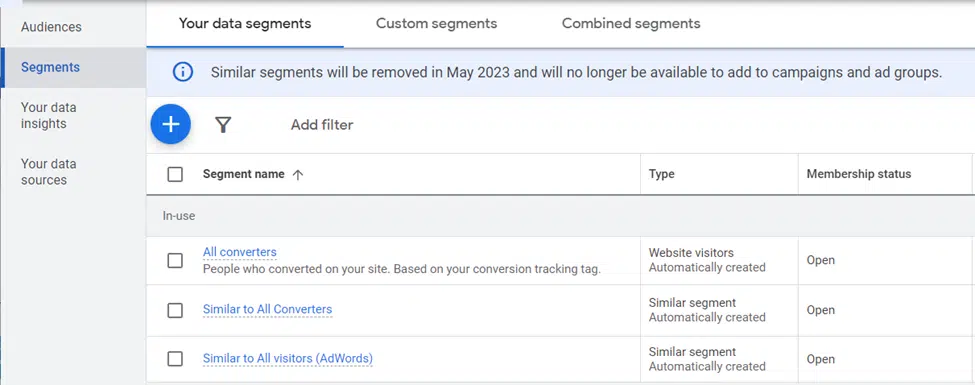
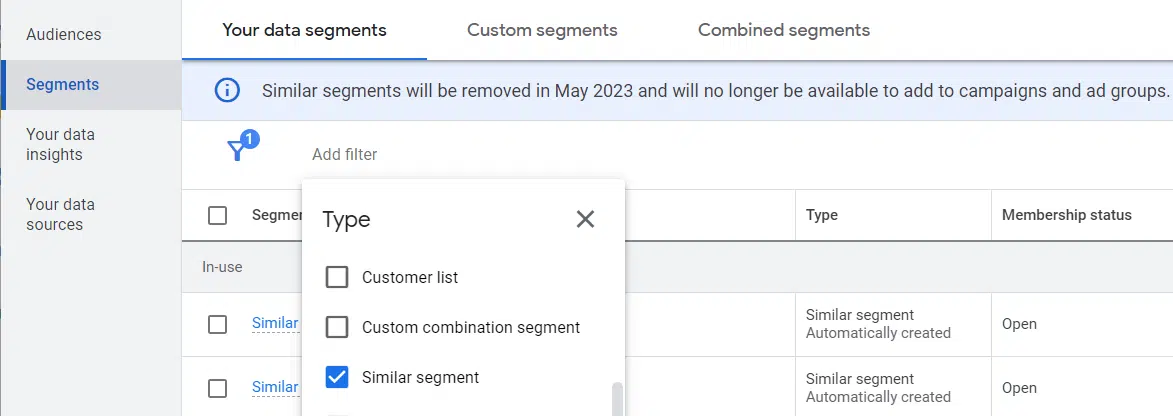
Step 1: Take inventory of where similar audiences are being used

In the Audience manager under Shared Library, you can filter for similar in-use segments throughout your campaigns. 

Similar segments - Google Ads

Similar audiences can be used across YouTube, Discovery and Display campaigns, and Search and Shopping. Be sure to check audience signals across Performance Max campaigns, as well. 

Here is an inventory sheet you can use to execute a proper similar audience segments audit. 

Once completed, you can decide on the proper strategy for transitioning away from similar audience segments and maintaining the same or better performance. 

Step 2: Use smart bidding and transition to value-based tracking to improve Google’s quality signals

If you aren’t yet using smart bidding in your campaigns, you may see this improve your performance without similar audience segments. 

These bidding strategies use Google’s machine learning across each ad auction to automatically optimize for conversions and conversion values.

As observable data is becoming less and less available, smart bidding will be your best solution for this and has been shown to help drive results across all campaign types. 

Value-based tracking goes one step further in signaling what is most important. Adding values to individual conversions can help Google’s bidding and targeting algorithms prioritize who to go after and why, improving your performance even more. 

Step 3: Use customer match to improve Google’s signals for search and optimized targeting

Unless you have opted out, customer match lists are now automatically included as a signal in smart bidding, such as target CPA, target ROAS, and maximize conversions.

Upload your high-quality customer match data to help with performance bidding as well as to help drive improved performance for optimized targeting. This will be especially helpful once similar audience segments are removed. 

Step 4: Test new audience segments based on your data insights

If you haven’t already done so, create custom segments for People who searched for any of these terms on Google of your most profitable search queries. Create one for branded search terms and a second for the top-performing non-branded search terms for the account. 

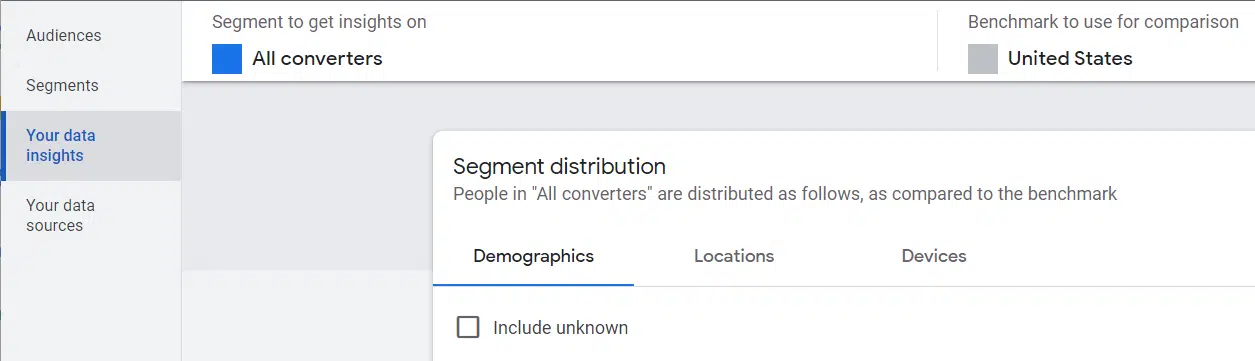
Next, visit Your data insights to discover high-indexing in-market and affinity segments for your first-party audience segments. Use these learnings to create a new combined audience segment and test different inclusion levels of indexing scores. 

Test audience segments

These audiences are great for testing against existing similar audience segments. They can be added concurrently on the ad group level and measured for performance after two to four weeks. 

Step 5: Test optimized targeting for performance and audience expansion for reach and consideration

Optimized targeting is Google’s recommended replacement for similar audience segments in Display, Discovery, and Video action campaigns. 

However, before you toggle on optimized targeting across all your ad groups with similar audience segments, it is essential to note that this feature is expected to work best with first-party audiences. 

As a best practice, add your first-party data, such as customer match lists, and expand slowly into optimized targeting or audience expansion while allowing enough time to measure the results. 

Step 6: Request access to the beta for turning off demographics expansion 

If you use video action campaigns with optimized targeting, Google will deliberately ignore your demographic exclusions. 

According to a Google Support representative: 

“As for the optimized targeting in Video Action Campaigns, we have demographics expansion. This means that the ads with enabled optimized targeting may serve to users outside of the selected demographics target (demographics exclusion), but only if the system deems that there is a strong or high conversion signal with the user shown the ad (i.e. past search history, relevant video views, etc).“

The best solution for eliminating ad serving to your excluded demographics with optimized targeting is to request to be whitelisted to turn off the demographics expansion. This can be achieved by contacting your dedicated Google rep. 

Step 7: Transition your website audiences to GA4 sooner than later

Google Analytics 4 has privacy features and audience tracking capabilities that will help you stay ahead as more privacy changes and third-party cookie removal occur. 

GA4 helps companies with tools and features that allow easier compliance with data privacy laws such as GDPR. For example, GA4 will anonymize the IP addresses of all website visitors by default. 

If your remarketing audiences are still generating from Universal Analytics, re-create these lists in GA4 and enable them in Google Ads. 

Transitioning to GA4 audiences will require that your GA4 account is linked and activated in Google Ads. 

Second, be sure that Google signals data collection is enabled and that you confirm the User Data Collection Acknowledgement by navigating to Data Settings > Data Collection in the GA4 Admin tab.

Getting used to privacy-focused audience targeting in Google Ads

As disappointing as it was to learn about the removal of similar audience segments, hopefully, this guide will help you maintain and even improve your performance on Google Ads. 

Times are changing in this industry, as they always have. Always stay ahead by having a proper plan in this ever-evolving privacy landscape. 


Opinions expressed in this article are those of the guest author and not necessarily Search Engine Land. Staff authors are listed here.


Related stories

New on Search Engine Land

@media screen and (min-width: 800px) { #div-gpt-ad-3191538-7 { display: flex !important; justify-content: center !important; align-items: center !important; min-width:770px; min-height:260px; } } @media screen and (min-width: 1279px) { #div-gpt-ad-3191538-7 { display: flex !important; justify-content: center !important; align-items: center !important; min-width:800px!important; min-height:440px!important; } }

About the author

Chelsea So

Chelsea So is the Founder of Leadocity, a Google Ads consulting firm that supports agencies and clients with high-growth performance strategies and services. Chelsea started running PPC for her own e-commerce store back in 2004 and has been addicted ever since.

https://searchengineland.com/google-ads-similar-audience-segments-transition-393725