Bing limits chat sessions as OpenAI founder says AI tools are ‘somewhat broken’

Bing chat sessions are now capped at 50 questions per day and 5 per session, Microsoft announced.

There have been many bad examples shared of the new Bing AI chat sessions featuring everything from gaslighting to accidental racism. Microsoft has said it didn’t anticipate extended chatting, which “can confuse the underlying chat model.”

What’s changing. Chat sessions on the new Bing are now capped at 50 chat “turns” per day and 5 chat “turns” per session. A “turn” is a conversation exchange which contains both a user question and a reply from Bing, Microsoft explained.

Our data has shown that the vast majority of you find the answers you’re looking for within 5 turns and that only ~1% of chat conversations have 50+ messages. After a chat session hits 5 turns, you will be prompted to start a new topic. At the end of each chat session, context needs to be cleared so the model won’t get confused. Just click on the broom icon to the left of the search box for a fresh start.

– Microsoft, The new Bing & Edge – Updates to Chat

Microsoft may increase its caps on chat sessions in the future.

AI tools “somewhat broken.” Meanwhile, OpenAI CEO Sam Altman has acknowledged that AI tools are “somewhat broken” but believes its critical to show them to the world to “get it right.”

“We think showing these tools to the world early, while still somewhat broken, is critical if we are going to have sufficient input and repeated efforts to get it right. the level of individual empowerment coming is wonderful, but not without serious challenges.”

And while this crop of AI tools isn’t very scary, Altman hinted at a need for regulation, saying “we are potentially not that far away from potentially scary ones.”

You can read his full tweet thread here.

Why we care. We are witnessing a technology revolution. ChatGPT’s debut was a game changer like the iPhone was to smartphones, as Altman mentioned. AI continues to have many issues and will impact our every day work – good and bad. For now, we’ll continue to watch and document as the search engines and tool providers evolve.


Related stories

New on Search Engine Land

@media screen and (min-width: 800px) { #div-gpt-ad-3191538-7 { display: flex !important; justify-content: center !important; align-items: center !important; min-width:770px; min-height:260px; } } @media screen and (min-width: 1279px) { #div-gpt-ad-3191538-7 { display: flex !important; justify-content: center !important; align-items: center !important; min-width:800px!important; min-height:440px!important; } }

About the author

Danny Goodwin

Danny Goodwin is Managing Editor of Search Engine Land & SMX. In addition to writing daily about SEO, PPC, and more for Search Engine Land, Goodwin also manages Search Engine Land’s roster of subject-matter experts. He also helps program our conference series, SMX – Search Marketing Expo. Prior to joining Search Engine Land, Goodwin was Executive Editor at Search Engine Journal, where he led editorial initiatives for the brand. He also was an editor at Search Engine Watch. He has spoken at many major search conferences and virtual events, and has been sourced for his expertise by a wide range of publications and podcasts.

https://searchengineland.com/bing-limits-chat-sessions-openai-tools-somewhat-broken-393368


Meta is bringing the blue verification badge to Facebook and Instagram

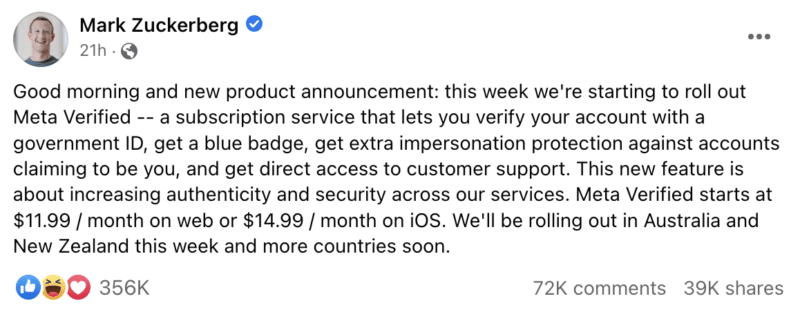
Meta, the parent company of Facebook, has introduced a new subscription service, Meta Verified, that provides users the opportunity to acquire the highly sought-after blue verification badge on their Instagram and Facebook accounts. Users can achieve this by verifying their identity for a monthly fee of up to $15.

Screen Shot 2023 02 20 At 7.47.47 AM 800x312

How it works. Meta Verified is now available in New Zealand and Australia, with plans to expand globally in the near future. The service allows users to verify their identity using government-issued ID cards, and provides several benefits such as improved protection against impersonation attacks, direct access to customer support, and increased visibility and reach.

The monthly subscription cost for Meta Verified is $11.99 on the web and $14.99 on iOS and Android devices. In a Facebook post, Meta CEO Mark Zuckerberg emphasized that the new service is focused on “increasing authenticity and security across our services.”

Meta’s solution to decreased revenues. Meta’s revenue has taken a hit in recent years due to Apple’s implementation of stricter privacy changes on iOS that limit the company’s ability to track users’ internet activities. The social media giant, which has not charged its customers for most of its services since its inception 15 years ago, generates almost all of its income from advertising. The impact of Apple’s move is expected to cost the company over $10 billion in lost advertising revenue this year.

In response, Meta has expressed its intent to develop a valuable subscription service for creators, businesses, and the wider community. As part of this plan, Meta is expanding access to verification and redefining the meaning of the verified badge so that more people can trust that the accounts they are interacting with are authentic.

Following in Twitter’s footsteps. This move for Meta comes after Snap launched its own subscription service last year, which has already converted over one million users into paid customers. Additionally, Elon Musk revamped Twitter’s subscription service, Twitter Blue, to offer a range of features, including the blue check mark. In recent months, Twitter has expanded Twitter Blue to over a dozen markets, including India and Indonesia. However, as of mid-January, only around 180,000 accounts had signed up for Twitter Blue, according to The Information.

Why we care. The increased authenticity and security could lead to a better user experience and more engagement, ultimately benefiting advertisers who want to reach and connect with a reliable and engaged audience.

In addition, Meta has been impacted by Apple’s privacy changes, which have limited the company’s ability to track users’ internet activities and resulted in lost advertising revenue. If Meta is successful in its plan to develop a valuable subscription service for creators, businesses, and the wider community, it could potentially create a new revenue stream for the company and reduce its reliance on advertising income. This could help to stabilize the company’s financials and create a more stable environment for advertisers.


Related stories

New on Search Engine Land

@media screen and (min-width: 800px) { #div-gpt-ad-3191538-7 { display: flex !important; justify-content: center !important; align-items: center !important; min-width:770px; min-height:260px; } } @media screen and (min-width: 1279px) { #div-gpt-ad-3191538-7 { display: flex !important; justify-content: center !important; align-items: center !important; min-width:800px!important; min-height:440px!important; } }

About the author

Nicole Farley

Nicole Farley is an editor for Search Engine Land covering all things PPC. In addition to being a Marine Corps veteran, she has an extensive background in digital marketing, an MBA and a penchant for true crime, podcasts, travel, and snacks.

https://searchengineland.com/meta-is-bringing-the-blue-verification-badge-to-facebook-and-instagram-393352


Call tracking: What it is and how it works

Pay-per-click (PPC) campaigns live and die by their conversion data. Call tracking allows marketers to get valuable insights on all their campaigns.

However, there can be some hesitations to use it.

  • Brands are afraid of missing out on brand equity with an established number.
  • The cost on top of any other marketing cost seems high.

Understanding what call tracking is and how it can help will mitigate these concerns. 

What is call tracking?

Call tracking involves using a unique phone number to track the source of incoming calls to a business. When a customer calls the business using a call-tracked phone number, the phone call is routed through a call tracking system which records details, such as:

  • The caller’s phone number. 
  • Date and time of the call.
  • Duration of the call.
  • Wait time.
  • Unique vs. repeat caller. 

This information is used to track the effectiveness of marketing campaigns, determine trends in customer behavior, and identify opportunities to improve the sales process.

Call tracking allows the call to be attributed to a specific campaign. This is done either through static or dynamic numbers. Both forms will forward to a designated number (typically the main number for a business). 

Static numbers do not change based on the site source and are assigned a channel. These numbers typically have a cost per number on top of a per minute charge. 

Dynamic numbers change based on the site source and require you to pay for a number pool. The number pool will be based on traffic volume. If you try to go for too few numbers in your pool, you risk having attribution issues due to too few numbers being assigned to you. 

Call tracking can include a recording or not. Depending on your industry, you may not be able to use the recording element of call tracking. 

Call tracking recordings can offer transcripts for an additional fee. 

How does call tracking work?

Call tracking can be implemented in various ways to fit all operational needs.

One common method is to use a call tracking service, which provides businesses with unique phone numbers that can be used to track the source of incoming calls. These numbers can be placed on:

  • Websites. 
  • Social channels.
  • Digital ads.
  • Other marketing collateral. 

When a customer calls one of these numbers, the call tracking service records information about the call and provides it to the business.

Another method of call tracking is to use a piece of software or hardware installed on the business’s phone system.

Software or hardware receives incoming calls and records information about the call before routing it to the appropriate extension or phone number. 

This method of call tracking allows businesses to track calls made to their existing phone numbers, rather than requiring the use of unique tracking numbers.

Regardless of which method you choose, it’s important to designate whether you will use local or toll-free numbers.

Some brands are averse to toll-free numbers because they are concerned it hurts their branding or connection with the local community. 

The verdict is out on whether those concerns hold water, so it’s important for brands to test both to confirm which serves them best. 

Setting up call tracking

Setting up call tracking requires you to know which channels you want to track and what budget you have to work with. 

You will need to add the snippet of code into your Google Tag Manager or running element on your site. The snippet is designed to look for one main number, so if you have multiple numbers on your site, you may need to:

  • Opt for call tracking that connects to calls being made directly to your number.
  • Know that only the number designated will change based on source when reviewing data. 

Once you do, your UTM parameter will communicate with the snippet of code on the site to change the number to a number associated with the source. 

If you decide to go with a call tracking vendor, you’ll need to layout the structure of which sources and “root” numbers you want to track. 

As a general rule, the following are the most common sources to track:

  • Direct traffic: Users who come directly to your site
  • Organic: Users who search for something related to what you do and land on your site. 
  • PPC: Users who click ads and arrive on your site. 
  • Google Business Profiles: User calls the number from the Google Business Profile.
  • Call extensions: User calls the phone number attached to the Google or Microsoft search ad.
  • Social channels (should be segmented): User calls number on a social ad. 
  • Local service ads: User calls a local service ad (the number needs to be set up).

Brands can choose to segment as much or as little as they like. 

Choosing to segment down to the campaign level will ensure you know exactly what’s working for you, however it will mean you need to pay for more numbers. 

Lumping campaigns together may save on call tracking costs, but the 1:1 tracking will be lost and you’ll need to invest human time to properly attribute success. 


Get the daily newsletter search marketers rely on.


Choosing a call tracking vendor

Disclaimer: No call tracking vendors paid for endorsement or placement in this article. Those listed are the ones the author has familiarity with and has seen applied. There is no right call tracking solution for everyone and all hold potential for a positive engagement. Additionally, this article is focused on U.S. call tracking.

Engaging a call tracking vendor is much like choosing a cell phone provider. The core service is the same, it’s a question of how much support and reliability you can expect at various price points. 

Call tracking integrations range from simple turnkey set-ups to custom and complex. Based on the structure you’ll need and how you want to handle display numbers, these are the core criteria to think about:

  • How does the call tracking vendor price minutes? 
  • What costs, if any, are there for specific numbers?
  • Will the call tracking vendor offer transcripts and recordings? How much of an upcharge are they?
  • Can I achieve full coverage of the initiatives I want to track within budget?
  • What kind of technical support is available for me if I need it?
  • What if any international coverage is there and at what cost?

Here are some of the most common call tracking solutions and how to think about them.

Marchex

Marchex focuses on dynamic numbers and requires an accurate website traffic calculation to provide enough numbers. Due to being phone pool heavy, they depend on the brand purchasing enough numbers and minutes to cover the click and call volume. 

If a brand goes low on the website traffic, they risk having their numbers being used for other brands and paying for wrong numbers. If they overestimate it, then they will have wasted spend. 

As a general rule, it’s useful to think about traffic in 1,000 click increments. 

Marchex has been called “easy” and “difficult” to use. Those who find value in Marchex will likely want simple and straightforward call tracking (unless they are willing to pay for the enterprise versions). Those trying to do more complex tasks or export reports/recordings will find the process a bit cumbersome. 

Customer support for Marchex is hit or miss depending on what level of support you qualify for. 

Marchex essential is $500 per month and requires a demo to get access pricing for their more robust offerings. 

CallRail

CallRail is one of the most popular call tracking solutions. It offers fairly robust tracking and documentation, as well as many integrations to third party tools. 

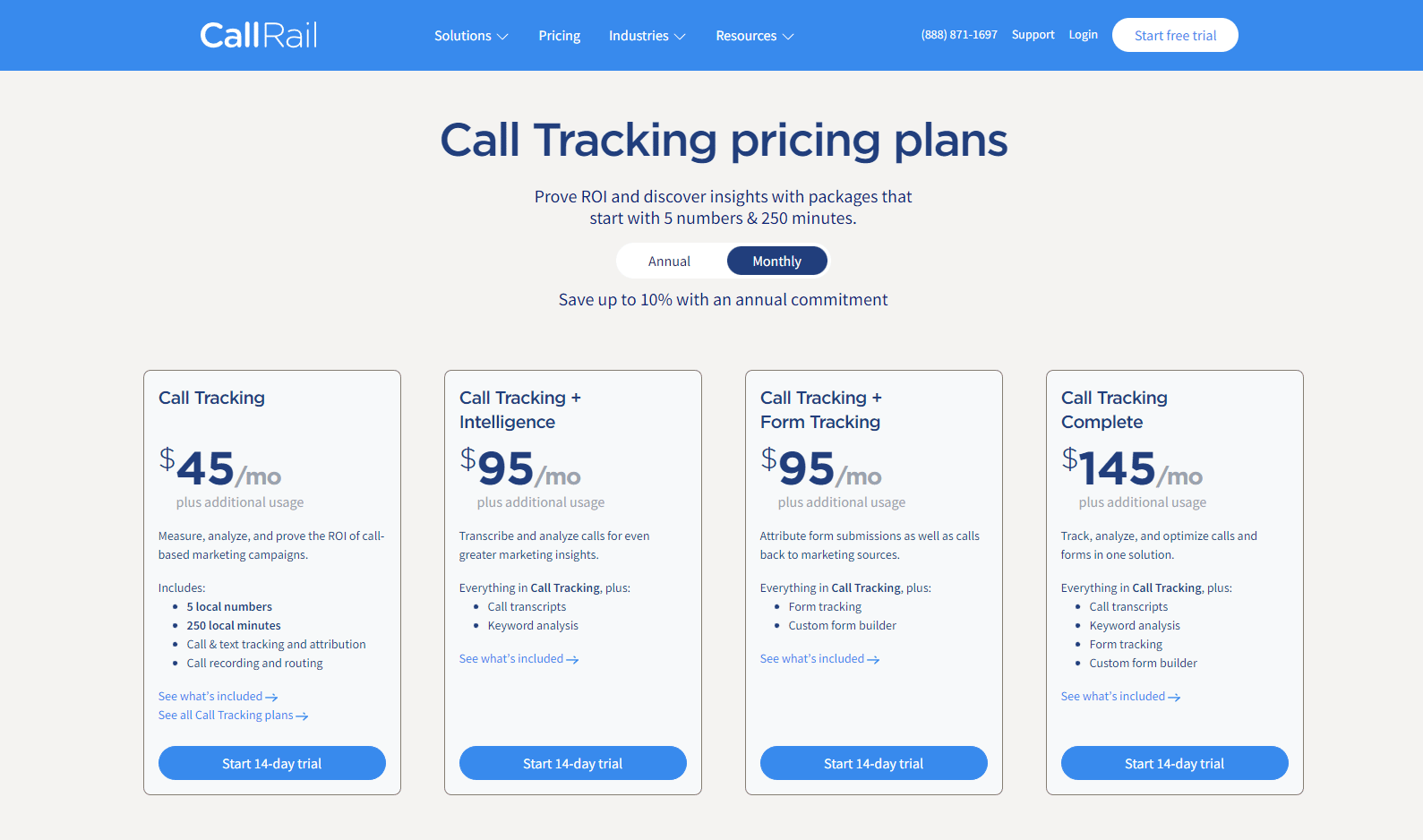
CallRail has fairly straight forward pricing that makes it easy to grow with. They follow more of the “Spirit Airline” school of thought on what’s included vs. what are add-ons.

While default pricing puts them on the cheaper side, the add-ons that make them truly special push the final price to the middle of the road. 

CallRail pricing plans

The main selling points for CallRail are:

  • Option for local and toll-free numbers.
  • Lead gen forms.
  • Text messages (SMS).
  • Transcriptions.
  • Call quality scoring.
  • Keyword level attribution.
  • Thematic conversation reporting.

They lean very heavily into their support hub so if having a person to troubleshoot things with is important, you might be disappointed. That said they do offer chat and phone support from 9 a.m. to 9 p.m. ET.

CallTrackingMetrics

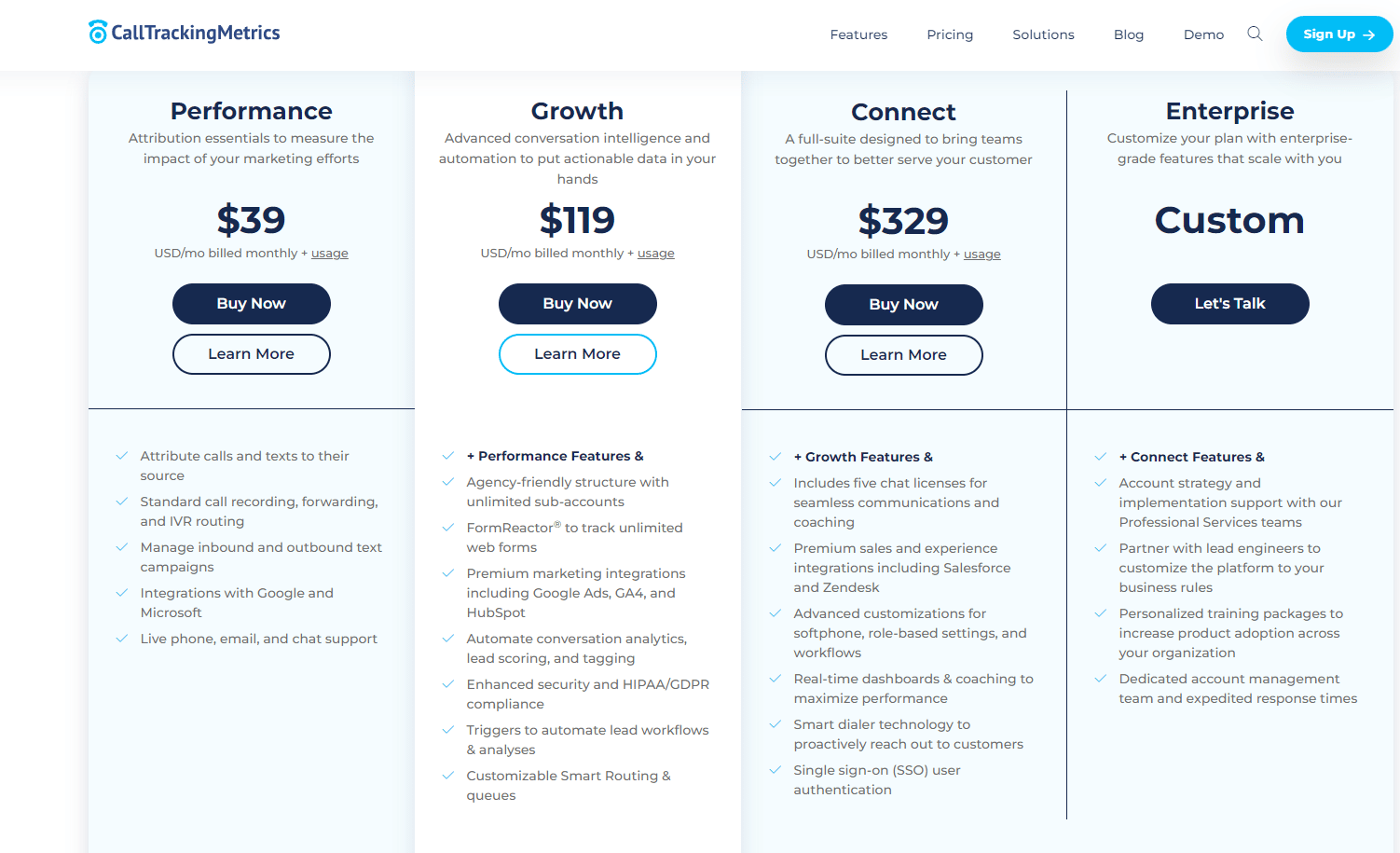
This is the call tracking solution I tend to use when given the option because of how flexible it can be and how much is included by default.

I appreciate their focus on customer support and ensuring their offering keeps up with tech innovations in the digital marketing industry. 

Their pricing is accessible and for the most part all inclusive. 

CallTrackingMetrics

CallTrackingMetrics main selling points are:

  • Local and toll-free numbers (along with the ability to port numbers).
  • CRM functionality.
  • In-depth call analytics (in premium plans). 
  • Call scoring and routing based on brand dictated weights.
  • Text and form options (SMS).
  • Privacy compliance.

One of the biggest selling points for CallTrackingMetrics is their support. It’s top-notch and enables anything from set up to complex data analysis. They have a premier consulting offering for ala carte projects and provide premium support for their agency partners. 

How does using call tracking help brands succeed online?

One of the biggest wins call tracking can do for a brand is illuminate the ROI on initiatives that might otherwise get missed.

From distilling the value on SEO content plays, to affirming which paid campaigns are truly delivering ROAS (return on ad spend), call tracking is essential to paint the clearest picture. 

Another useful benefit of call tracking is auditing customer success and sales teams. By being able to go back and listen to the recordings of calls, teams can improve their interactions with prospects/customers, as well as get valuable insight into what delights and what causes churn. 

Finally, call tracking solutions often come with additional features that can help brands consolidate services (like CRMs, SMS marketing, and lead gen forms). By going with a solution that covers multiple functions, you’ll streamline your business and reduce costs. 


Opinions expressed in this article are those of the guest author and not necessarily Search Engine Land. Staff authors are listed here.


Related stories

New on Search Engine Land

@media screen and (min-width: 800px) { #div-gpt-ad-3191538-7 { display: flex !important; justify-content: center !important; align-items: center !important; min-width:770px; min-height:260px; } } @media screen and (min-width: 1279px) { #div-gpt-ad-3191538-7 { display: flex !important; justify-content: center !important; align-items: center !important; min-width:800px!important; min-height:440px!important; } }
About the author

Navah Hopkins

A veteran of the digital marketing industry and “Top 25 PPC Expert,” she began as an SEO in 2008, transitioning to PPC in 2012. She manages the strategy and execution of paid media campaigns, as well as helping brands build relationships with profitable partners and customers. Throughout her career, Navah makes a point to give back and loves sharing lessons learned on the international speaking circuit as well as local universities. She is a frequent contributor to several publications and in 2019, she became a founding member of the Paid Search Association.

https://searchengineland.com/call-tracking-what-it-is-and-how-it-works-393282


This day in search marketing history: February 20

Google stops supporting meta news keywords tag

In 2018, we learned that Google had quietly dropped support for the news meta keywords tag.

Google did not announce this change, which had actually happened months earlier.

It was Google Webmaster Trends Analyst John Mueller who confirmed this on Twitter:

“It looks like we dropped support for this around the time when we removed it from the help center. Keeping it on pages is fine, we just don’t use it for Google News anymore.”

Using the news meta keywords tag no longer helped Google understand your news content. Google ignored it the same way they ignore the normal meta keywords tag.

Google introduced the news meta keywords tag specifically for publishers in 2012.


Also on this day


Google: Spam less than 1% of Maps content

2020: Spam represented less than 1% of the 20 million daily contributions Google received on Maps.


Google adds new image license metadata for licensable image label

2020: Google was beta testing a new way for sites to display licensing information about content that appears in Google Images.


Advertisers can now view Google mobile speed scores for more landing pages

2019: Google Ads tweaked its mobile speed score algorithm to reduce the number of ad clicks needed to generate a result.


Bing to require LegitScript certification for addiction recovery advertisers

2019: Drug and alcohol addiction recovery centers would have to be certified before running an ad campaign and could no longer use lead generators.


Yelp tests offline attribution using guest WiFi and email matching

2018: The company said that every $1 spent on Yelp ads resulted in a $110 offline return, based on aggregate transaction data.


Google says no algorithm changes in new deal to demote pirated content in UK search results

2017: Google and Microsoft Bing agreed to reduce pirated content from their search results in an agreement named the Voluntary Code of Practice.


New ‘Call-Only’ Ad Types Arrives In Google AdWords To Make Mobile Easier

2015: Ad type would give mobile-centric marketers the ability to set up phone call conversion only campaigns.


Yahoo Wants To Syndicate Search To 600,000 Mobile Apps

2015: Yahoo had an ambitious plan to extend the reach of its search, display and video ads through a new Mobile Developer Suite.


Search In Pics: Google Glass Book, Android Mobile & Pebble Beach Box Seats

2015: The latest images showing what people eat at the search engine companies, how they play, who they meet, where they speak, what toys they have and more.


Bing Webmaster Guidelines Updated To Include Demotions For Keyword Stuffing

2014: The warning said Bing may demote or delist a site that uses keyword stuffing. 


Yahoo Gives $10 Million To Help Develop Next-Gen Siri And Better “Contextual Search”

2014: Yahoo gave $10 million to Carnegie Mellon University to support “InMind,” a project that sought to develop a next generation intelligent assistant and enhanced personalization capabilities.


Yandex Reports Revenue Up 37% In Q4, Ad Network Revenue Nearly Doubles

2014: The company said it had more than 270,000 advertisers, a 30% gain year-over-year and up 10% from Q3 2013.


No, Google Hasn’t Released Unannounced Penguin Updates

2013: A recent Google video might have suggested that Google was pushing Penguin Updates without announcing them, but Google said this wasn’t the case.


Google Shopping Tops Amazon Product Ads: 32.7% More Cost Effective

2013: In the second half of 2012, Google Shopping sent 120% more traffic to merchants than Amazon Product Ads.


Google Enables Blocking AdWords Results With Block Site Feature

2012: It appearsed you could block sites from showing up in the paid search ad results, whether signed into Google or not.


“Googler Killer”, Cuil, Patent Applications Acquired By Google

2012: Cuil, which launched in June 2008 and went defunct in September 2010, had their patent applications acquired by Google.


AdCenter Revamps Location Targeting To Mimic AdWords

2012: Microsoft adCenter made changes to its location targeting functionality that brought it into line with the industry standard Google AdWords.


The Microhoo Bunch

2010: The recently approved Microsoft-Yahoo search deal, set to a TV theme song.


Google Suggests Ways To Prevent Hacking

2009: Using Google site search could help identify if a hacker had added common spam content, or Google Alerts could be used to monitor spammy words and phrases.


Google Changes Display URL Policy: One Domain Per Ad Group

2009: Advertisers could only have the same domain showing in a specific ad group in the display URL field.


Google Maps: Transit Updates, Map Maker In 27 Languages

2009: The objective of the product was to enable local users/developers to build out maps data and content for places in the world where there are no commercial or other third-party databases that Google could easily implement.


Google AdSense Adds Font Selection

2009: Publishers could pick between Arial, Times, and Verdana font types and they would be present on all of their Latin-based character units.


Google Brings Back Video & Drops Shopping From Top Navigation

2009: In November 2007, Google did the exact reverse.


Search In Pictures: Ask.com At Daytona, Vint Cerf At SMX & Yahoo Hack Day India

2009: The latest images showing what people eat at the search engine companies, how they play, who they meet, where they speak, what toys they have, and more.


Lee Odden Interviews Google’s Adam Lasnik

2008: Topics included duplicate content issues, and if there are penalties, and using the nofollow to “sculpt PageRank.” 


Microsoft & Google Sued Over Paid Search Patent Infringement

2008: A company named Paid Search Engine Tools of Liberty Township said Google’s AdWords and Microsoft’s adCenter products infringe on their patent, “Paid search engine bid management.”


Gates On Yahoo Acquisition: It’s The Engineers We Want

2008: It wasn’t the advertisers, the brand, or the traffic so much as the engineers that Microsoft wanted in the Yahoo acquisition.


Yahoo Search Index Now Supported By Open-Source Hadoop Architecture

2008: The benefits, among others, were cost savings and scalability.


Van Natta To Leave Facebook, Yahoo Offers Enhanced Severance To Retain Employees

2008: The reason given for the packages was employee retention in a climate of uncertainty, which had accelerated the departures of a number of high profile Yahoo employees.


Newspond Lauches News Aggregation Site That Uses A “Tireless Electronic Brain”

2008: Newspond was a news aggregation site that boasted “No editors. No voting. Just an AI news engine.”


SES London 2008 Day Two Recap


Mobile Search Still A Close Race

2007: Google had about 4.75 million U.S. subscribers in the fourth quarter of 2006, roughly 1.1 million more than Yahoo.


New Stats On Google’s Products Show Video & Blog Increasing While Froogle & Directory Decreasing

2007: “Super performers”: Google Video, Google Blog Search, Google Scholar and Google Desktop.


Listing Of Lists Of Google Products

2007: A listing of lists of Google products.


Let Google Drive Your Car For You

2007: Page “proposed giving computers control over cars” so that there will be fewer accidents.


Google Teaches Programming Class At University Of Washington

2007: This course would “teach students to use 40 computers to solve problems such as how many times the word ‘mild’ appeared on the Internet and which ‘mild’ was most relevant to Internet users.”


Viacom To Sign With Joost Over Google’s YouTube

2007: Joost was like YouTube but they specialized in commercial video. 


Text Messaging: Where The Volume And The Dollars Are Today

2007: Mobile advertising as a mass medium would take off, but the question was: when and in precisely what form?


From Search Marketing Expo (SMX)


Past contributions from Search Engine Land’s Subject Matter Experts (SMEs)

These columns are a snapshot in time and have not been updated since publishing, unless noted. Opinions expressed in these articles are those of the author and not necessarily Search Engine Land.


< February 19 | Search Marketing History | February 21 >


Related stories

New on Search Engine Land

@media screen and (min-width: 800px) { #div-gpt-ad-3191538-7 { display: flex !important; justify-content: center !important; align-items: center !important; min-width:770px; min-height:260px; } } @media screen and (min-width: 1279px) { #div-gpt-ad-3191538-7 { display: flex !important; justify-content: center !important; align-items: center !important; min-width:800px!important; min-height:440px!important; } }

About the author

Danny Goodwin

Danny Goodwin is Managing Editor of Search Engine Land & SMX. In addition to writing daily about SEO, PPC, and more for Search Engine Land, Goodwin also manages Search Engine Land’s roster of subject-matter experts. He also helps program our conference series, SMX – Search Marketing Expo. Prior to joining Search Engine Land, Goodwin was Executive Editor at Search Engine Journal, where he led editorial initiatives for the brand. He also was an editor at Search Engine Watch. He has spoken at many major search conferences and virtual events, and has been sourced for his expertise by a wide range of publications and podcasts.

https://searchengineland.com/search-marketing-history-february-20-393310


This day in search marketing history: February 19

Google removes ads from right side of search results

In 2016, Google removed ads from the right side of its desktop search results (with two exceptions: Product Listing Ad boxes and Knowledge panel ads) in all languages, worldwide.

Google Ads would only appear at the top and/or bottom of the page.

An additional ad (so, four instead of three) would appear above Google’s organic search results for what it called “highly commercial queries.”

This was actually the culmination of a test that began in 2010 and ramped up significantly in 2015, mostly outside of the U.S.

Google’s official statement on the change:

“We’ve been testing this layout for a long time, so some people might see it on a very small number of commercial queries. We’ll continue to make tweaks, but this is designed for highly commercial queries where the layout is able to provide more relevant results for people searching and better performance for advertisers.”

Read all about it in Confirmed: Google To Stop Showing Ads On Right Side Of Desktop Search Results Worldwide.


Also on this day


Bing announces refreshed Bing Webmaster Tools

2020: The new toolset promised to offer a faster, cleaner, more responsive and even more actionable set of features.


Vast majority of Amazon advertisers plan to spend more on ads again this year

2020: Specialized Amazon marketers and paid search marketers were most likely to be managing campaigns on the platform, our survey found.


Video: Rhea Drysdale on hyperlocal SEO & saving clients money

2020: From running a small business to digging deep into SEO to help clients win.


Google may use different ranking weights for YMYL-type queries

2019: Google has confirmed that for Your Money, Your Life, queries they will give more weight in their ranking algorithm to factors around expertise, authoritativeness, or trustworthiness.


Google Actions vs. Alexa Skills is the next big App Store battle

2019: There were thousands of Skills and Actions but very few people were using them.


Google changes request recrawl limits, noting daily limits versus monthly quotas

2018: Google finally disclosed the new recrawl limits in a revised help document.


Google Maps adds mall directory search & browse in local panel

2018: Google added a new tab to the local panel in the search results named “directory.”


Google Chrome extensions bringing back ‘View Image’ & ‘Search by Image’ buttons in Google Image Search

2018: Google removed some much-loved features in image search, but some Chrome extensions bring back that functionality.


Keyword infringement: Edible Arrangements files $209M trademark suit against Google

2018: The central claim was that when users searched for [Edible Arrangements] (or versions of that name), they were seeing product ads for competitors, such as 1-800-Flowers.


Webmasters: Be On The Lookout For Hreflang Implementation Notifications From Google

2016: Google sent out a large number of notifications to webmasters who had incorrectly implemented hreflang markup.


Google App Streaming Now Live For Many Apps Via Try Now Button

2016: You could preview apps directly from the search results before downloading them.


Search In Pics: Brett Dennen At Google, A Doctor’s Google Sign & Google Moving Boxes

2016: The latest images showing what people eat at the search engine companies, how they play, who they meet, where they speak, what toys they have and more.


Google’s New Hacked Classifier Misclassifies Some Web Sites As Hacked

2015: Many websites noticed Google labeled their sites as being hacked and dangerous in the search results. The issue was not with their websites but rather the Google hacked sites classifier.


Google AdWords Launches An Android App For Advertisers But Currently Only For Canadians

2015: Canadian Google AdWords advertisers could download an Android app to manage their campaign on the go. Google promised to expand support to other countries soon.


Google News Bug Drops Trending Topics From Side Bar Navigation

2015: A fix was coming soon.


Google Mobile Search Put Publishers’ Content In Carousels

2015: Users could quickly scan topic-based content from single sources on mobile devices.


Bing Offers Link To Order Food Online From Your Favorite Restaurants

2015: You could search for a restaurant that offered online ordering and click the order online button.


Google’s Matt Cutts: Backlink Relevancy Is A Big Win In Terms Of Search Quality

2014: Cutts answers: “Is there a version of Google that excludes backlinks as a ranking factor?”


New Google Maps Comes Out Of Preview Today

2014: Overall, it was a more visually-compelling product than the old Maps with a wide array of enhanced features.


Google Was Nearly A Site That Allowed Users To Order Pizza Through A Fax Machine

2013: Sergey Brin explained how a single failed fax allowed Google to be born.


Bing Updates Friends’ Photos Search With Windows Tiles Layout & Slideshow View

2013: The changes included a new title-like layout you are familiar with when it comes to Windows 8 and a slideshow view for faster and richer photo viewing.


Burden Of Search UI Innovation Now Falls To Yahoo Veteran Laurie Mann

2013: Laurie Mann, who had been senior vice president of engineering operations at Yahoo since 2002, was promoted to run Yahoo Search. 


Alibaba Creates Aliyun Search Engine To Challenge Baidu, Google In China

2013: The appearance and functionality of the SERP on Aliyun was more like Google than a comparable page on Chinese search leader Baidu’s site.


ChaCha Defeats Google, Bing And Siri In “Answers Quality” Study

2013: “ChaCha delivered the highest quality responses consistently across the largest group of categories and question types.”


Twitter’s Traffic Up 9%, Thanks To Google

2010: When Google added real-time results to their search interface in December, it had a major impact on people discovering tweets in the search results.


Google: “With Buzz We Failed To Appreciate That Users Have Differing Privacy Expectations”

2010: Also, Google revealed that for every 15 people who click through to the privacy controls and preferences that “four users edit preferences, one opts out and 10 do nothing.”


Google Shopper: Scan Books, DVDs, Video Games, Bar Codes & Get Prices

2010: You could point the app at books, CDs, DVDs, and video games, and barcodes and it would fetch the details of that product and give you the prices, stores, reviews and more about that product.


Google Adds Maps, Local Search For 30 Countries In Africa

2010: Users could now find local businesses.


Yahoo Formalizes Rich Ads In Search, Text Ads Gain Images Or Video

2009: After testing this for close to a year, Yahoo would formally announce Rich Ads In Search – a service that placed images and videos into paid ads in Yahoo’s search results.


Go Figure: Twitter Tests Adding Search To Main Navigation

2009: Twitter Search had become incredibly popular, even thought most people had no clue how to find it.


Official: Google To Enforce AdWords URL Policy Starts April 1

2008: The policy required the ad’s display URL match its destination URL. 


Microsoft Signals Long Term Commitment To Search Even Without Yahoo

2008: Bill Gates said with or without Yahoo, the company would invest heavily in web search over the long term to compete with Google.


Yahoo Makes Big Customer Satisfaction Gains In Search

2008: Yahoo called out the “Search Assist & Suggestions Rankings” metric, where it apparently outperformed Google, based on the introduction in October of Search Assist.


Google Earth Image Update: Spain Images

2008: The imagery update covered the eastern edge of Spain, including Barcelona.


China Government Censured Baidu For Spreading “Filthy Pictures”

2008: Internet users in China were reportedly using Baidu to find images of actor Edison Chen and several female stars in sexual acts that were spreading throughout the web.


Topix To Power Community For Local NBC Affiliates

2008: Topix already did this for selected newspapers and Gannett TV sites and claimed 100 media partners for its local news and/or community features.


SES London 2008 Day One Recap


Google Sending Wikipedia A Ton Of Traffic

2007: The percentage of Google’s downstream traffic going to Wikipedia increased by 166% year over year.


Google Finance Plus Signs In Google Search Results

2007: Clicking on the plus sign opened a Google Finance preview.


Past contributions from Search Engine Land’s Subject Matter Experts (SMEs)

These columns are a snapshot in time and have not been updated since publishing, unless noted. Opinions expressed in these articles are those of the author and not necessarily Search Engine Land.


< February 18 | Search Marketing History | February 20 >


Related stories

New on Search Engine Land

@media screen and (min-width: 800px) { #div-gpt-ad-3191538-7 { display: flex !important; justify-content: center !important; align-items: center !important; min-width:770px; min-height:260px; } } @media screen and (min-width: 1279px) { #div-gpt-ad-3191538-7 { display: flex !important; justify-content: center !important; align-items: center !important; min-width:800px!important; min-height:440px!important; } }

About the author

Danny Goodwin

Danny Goodwin is Managing Editor of Search Engine Land & SMX. In addition to writing daily about SEO, PPC, and more for Search Engine Land, Goodwin also manages Search Engine Land’s roster of subject-matter experts. He also helps program our conference series, SMX – Search Marketing Expo. Prior to joining Search Engine Land, Goodwin was Executive Editor at Search Engine Journal, where he led editorial initiatives for the brand. He also was an editor at Search Engine Watch. He has spoken at many major search conferences and virtual events, and has been sourced for his expertise by a wide range of publications and podcasts.

https://searchengineland.com/search-marketing-history-february-19-393309


This day in search marketing history: February 18

Yahoo stops using Google search

In 2004, Yahoo stopped using Google’s web search results and rolled out its own new index and ranking system.

Although Yahoo had purchased Inktomi in December 2002, Yahoo opted to build its own web search engine. Yahoo still relied on Google for image search and and News search was a combination of Yahoo’s own editorial and technological resources.

The quality of Yahoo’s results were impressive at the time. As for what was being indexed:

“The Yahoo Search index is capturing the full text of web pages, up to a 500K limit. This is greater than the 101K maximum indexed by Google. A broad range of file types, including HTML, PDF, and Microsoft Office documents is also included in the mix.

How big is Yahoo’s index? They aren’t saying, despite Google’s announcement yesterday that it has expanded its index to nearly 4.3 billion documents (6 billion, if you count images and newsgroup postings, as Google does).

Interestingly, in almost all of my tests with random queries, Yahoo reports more results found than Google. Does this mean that Yahoo’s index is bigger? Perhaps — but reported results are estimates, not exact counts. They also can include factors other than keyword matches and so are notoriously unreliable measures of overall index size. Suffice to say that Yahoo’s index is comparable to Google’s for most queries.”

– Search Engine Watch, Yahoo! Birth of a New Machine

At the time, Microsoft had yet to launch its own web crawler for MSN Search, and Ask Jeeves/Teoma was the only other top tier search engine available.

Search Engine Land also wished Yahoo a happy 5th birthday in 2009.


Also on this day


Google testing questions and answers in the Google Maps interface

2022: This feature first launched in 2017 in the local panel and Google appears to be testing it in Google Maps.


LinkedIn’s Service Pages for freelancers adds features to showcase credibility

2022: Service Page owners could show the organization they worked for and include media from their portfolio.


Google updated metric boundaries for core web vitals in Search Console

2021: Google made a small change to the metric boundaries it used for defining red versus yellow versus green scores in this report.


Responsive search ads now the default in Google Ads

2021: Though expanded text ads could still be created.


Google brings Display ads to attribution reports as an open beta

2021: Advertisers could see Display ads alongside search and YouTube.


Google Search Console Change of Address tool adds redirect validation & reminder

2020: Google announced two new features to the Change of Address tool within Google Search Console.


Google Ads intros ‘continuous audience sharing’ for manager accounts

2020: The opt-in capability was available in manager account settings.


Goodbye Search Engine Land, SMX and Third Door Media

2020: After more than two decades of writing about search and online marketing, as well as speaking at and organizing conferences, Chris Sherman moved on.


Marketers can now view Shopping Campaigns in Bing Ads search terms reporting

2019: The updated reporting grid also included an Added/Excluded keywords column.


Tell Google Why You Want More Than 90 Days Of Search Analytics Data

2016: Despite having a way to export your Search Console data and the Search Analytics API, Google wanted to know why you wanted more data directly in the Search Console.


Google To Launch AMP In Search Results On Feb. 24, 2016

2016: That meant that mobile searchers wou8ld begin to see AMP-optimized content from publishers in the search results.


New In AdWords: Stage Campaign Changes In Drafts, Test Changes In Experiments

2016: Campaign drafts and experiments made reviewing proposed changes and testing those changes more accessible.


Since 2013 Bing’s Share Up 5 Points, Ask & AOL Going Way Of The BlackBerry

2016: There was almost no movement in the numbers from the previous month.


Trademark Court’s Impossible Order: Uber Told To Change Google Search Results

2016: Judge tried to strike a balance but failed to understand the inherent problem at the heart of order – controlling search outcomes.


Bing Rolls Out Red Carpet For The Oscars With Its “Academy Awards Experience”

2016: Bing’s Guide to the Academy Awards delivered Oscar-related content, including past winners, red carpet fashions and memorable show moments.


See All Of The New Google AdWords Updates On One Web Page

2015: Google created a new page that acts as a release notes document for showing advertisers the latest updates and feature releases.


Competitive Bid Opportunities Arrive On Bing To Help Advertisers Analyze Themselves Against Rivals

2015: Tool allowed advertisers to stack themselves up against the competition, and instantly make changes where they see fit.


Google Testing More Ads On Knowledge Graph Panels: Google Play Gets The Spotlight

2014: Ads on the knowledge graph were for movie streaming rentals that gave Google Play the VIP treatment.


Out Of Beta: Google Shopping Campaigns For PLAs Now Available Globally

2014: After just over a 3-month beta period, Google rolled out Shopping campaigns to all users.


Bing Adds Three New Apps For Windows Phones: Travel, Food & Drink and Health & Fitness

2014: Bing added three new apps for the Windows Phone and refreshed several of their other apps.


Aviate Is Yahoo’s Answer To Google Now (And More)

2014: But it wasn’t “robust” enough to fulfill its strategic potential. 


Delivering On Search: Behind The Scenes With An Ad Agency SEO Manager

2014: Insight on Hillary Glaser’s role within ad agency Lowe Campbell Ewald and how she saw brands failing when it came to search efforts.


Google Works To Prevent Illegal Download Sites From Having A Credit Source

2013: Google was in talks with Visa, Mastercard and PayPal to prevent these types of companies from using credit cards or PayPal accounts.


Search Engines More Trusted Than Social Media For News & Information [Study]

2013: When it came to getting general news and information, consumers worldwide put as much trust in search engines as they did in traditional media — and more in both than they do in social media.


Reddit AMA Reveals Graph Search Has Been In The Works Since Early 2011 & Specs On How It Works

2013: One reason that Graph Search rolled out so slowly: privacy.


Court Reversal Brings Surprising Loss For Google In AdWords Trademark Case

2011: A Federal judge in California denied Google’s motion to dismiss a “false association” claim.


Obama’s Silicon Valley “Tech Supper” – Who Sat Where? Why Was He There?

2011: Google CEO Eric Schmidt was there, as was Apple CEO Steve Jobs, Facebook CEO Mark Zuckerberg, Twitter CEO Dick Costolo and Yahoo CEO Carol Bartz.


Search In Pics: Google Lederhosen, Umbrellas & Logos

2011: The latest images showing what people eat at the search engine companies, how they play, who they meet, where they speak, what toys they have and more.


Is Google Referrer Spamming To Detect Spam?

2010: Possible evidence that Google was using fake referrers, possibly to detect forms of spam.


Google Gets Patent For Variable Content Access By Geography

2010: Google book scanning and search appeared to be the primary intended use case. 


Yahoo & Microsoft Receive Go Ahead To Implement Search Deal

2010: They received “unrestricted” clearance from the U.S. Department of Justice and the European Commission to proceed.


Google Wants Mountain View To Change Zoning Laws

2010: Google wanted to enable their employees to live closer to the Googleplex, which would make for happier employees.


Google Maps On Steroids: New Display Shows Dozens Of Businesses (Maybe More)

2009: Google added a layer for local search results that activated when there were more relevant results than it could show on one page.


Google Expands AdSense For Domains Globally

2009: Google had promised to continue the expansion after making the program available to all U.S. publishers In December 2008.


Google Latitude Attracts A Million Users In A Week

2009: That’s what Google VP of Engineering Vic Gundotra said.


Google Finally Releases Google Mobile App For Windows Mobile

2009: Seven months after the release of the iPhone, Google brought their mobile app to the Windows Mobile device.


SearchBiz Legal Edition: Varney Uses The “M Word,” More AdWords Litigation, Yahoo Lawyer Files Complaint — Against Yahoo

2009: This question of whether Google was a “monopoly” when “the competition is a click away” was subtle and complex.


Google 10K: 55% More Employees, 99% Of Income Via Ads & More

2008: Advertising revenues made up 99% of Google’s revenues in 2005, 2006 and 2007.


It’s The Culture Stupid: Happy Googlers Sound Off On What They Like About The Place

2008: There was a self-conscious effort internally to maintain the atmosphere and culture that had enabled Google to succeed.


Google Contractor Sues Google Over Google Sky Layer

2008: A Google contractor sued Google for allegedly stealing a Sky layer idea from him.


Google Helps In Child Porn Bust In United States

2008: A high school teacher was indicted for distributing and soliciting child pornography on Google-owned Hello.com.


Blueprints Of Google’s Oregon Data Center

2008: The data center would require enough power to light up about 82,000 homes, equivalent to 103-megawatts of electricity.


Yahoo Buzz: Next Digg Competitor

2008: Yahoo Buzz would be similar to Digg, but start only with 100 sites allowed into the system. 


Hitwise: Google Users Older, Bigger Spenders Than Yahoo’s

2008: Google users were more likely to be affluent and have spent more online.


From Search Marketing Expo (SMX)


Past contributions from Search Engine Land’s Subject Matter Experts (SMEs)

These columns are a snapshot in time and have not been updated since publishing, unless noted. Opinions expressed in these articles are those of the author and not necessarily Search Engine Land.


< February 17 | Search Marketing History | February 19 >


Related stories

New on Search Engine Land

@media screen and (min-width: 800px) { #div-gpt-ad-3191538-7 { display: flex !important; justify-content: center !important; align-items: center !important; min-width:770px; min-height:260px; } } @media screen and (min-width: 1279px) { #div-gpt-ad-3191538-7 { display: flex !important; justify-content: center !important; align-items: center !important; min-width:800px!important; min-height:440px!important; } }
About the author

Danny Goodwin

Danny Goodwin is Managing Editor of Search Engine Land & SMX. In addition to writing daily about SEO, PPC, and more for Search Engine Land, Goodwin also manages Search Engine Land’s roster of subject-matter experts. He also helps program our conference series, SMX – Search Marketing Expo. Prior to joining Search Engine Land, Goodwin was Executive Editor at Search Engine Journal, where he led editorial initiatives for the brand. He also was an editor at Search Engine Watch. He has spoken at many major search conferences and virtual events, and has been sourced for his expertise by a wide range of publications and podcasts.

https://searchengineland.com/search-marketing-history-february-18-393248


Microsoft proposes AI ads in Bing

During a recent private meeting with a leading ad agency, Microsoft presented a demo of the updated Bing and revealed its intention to permit paid links within search result responses, according to an anonymous ad executive who attended the meeting.

Big plans for the future. Microsoft anticipates that the Bing AI chatbot’s more human-like responses will attract a larger user base for its search feature, resulting in an increase in advertisers. Additionally, advertisements incorporated within the Bing chatbot may have a greater presence on the page compared to typical search ads.

According to an ad executive who attended the meeting, Microsoft is currently experimenting with ads in the initial version of the Bing chatbot, which is accessible to a restricted number of users. Reuters has also reported seeing such ads this week.

Microsoft stated that it is incorporating conventional search ads – a form of advertisement where companies pay to have their websites or products displayed on search results for keywords relevant to their business – and integrating them into responses produced by the Bing chatbot.

What Microsoft says. Nothing. Microsoft declined to comment on the specifics of its plans.

The new Bing. Microsoft’s redesigned Bing search engine, which has a waitlist of millions of people seeking access, presents a highly profitable prospect for the company. In an investor and press briefing held last week, Microsoft announced that each percentage of market share it captures in the search advertising market has the potential to generate an additional $2 billion in advertising revenue.

Users who have tried the new Bing experience say that it’s lightning fast and better than expected. But some are also experiencing erratic, gaslighting, and somewhat emotional responses from Sydney (the ChatGPT AI).

Why we care. Microsoft’s plans to monetize its revamped Bing search engine and chatbot has the potential to expand its target audience and provide them with more prominent ad placement on the page.

The Bing chatbot’s more human-like responses could attract a larger user base, resulting in increased exposure for ads displayed within the chatbot. Additionally, the integration of conventional search ads into the chatbot’s generated responses can provide advertisers with an opportunity to reach a wider audience while also having their ads displayed more prominently on the page.

Microsoft’s plans to capture a greater market share in the search advertising market could also signify increased competition for Google, giving advertisers another avenue to explore for their advertising campaigns.


Related stories

New on Search Engine Land

@media screen and (min-width: 800px) { #div-gpt-ad-3191538-7 { display: flex !important; justify-content: center !important; align-items: center !important; min-width:770px; min-height:260px; } } @media screen and (min-width: 1279px) { #div-gpt-ad-3191538-7 { display: flex !important; justify-content: center !important; align-items: center !important; min-width:800px!important; min-height:440px!important; } }
About the author

Nicole Farley

Nicole Farley is an editor for Search Engine Land covering all things PPC. In addition to being a Marine Corps veteran, she has an extensive background in digital marketing, an MBA and a penchant for true crime, podcasts, travel, and snacks.

https://searchengineland.com/microsoft-proposes-ai-ads-in-bing-393301


This day in search marketing history: February 17

Microsoft introduces the Bing Network

In 2016, Microsoft announced the launch of the Bing Network, marking the end of the Yahoo Bing Network.

Bing Ads continued to serve ads on a sizable percentage of Yahoo’s search results.

The Bing Network was the result of a renegotiated search deal between Microsoft and Yahoo, which was originally a 10-year deal. The revised Yahoo-Bing search deal returned ad sales and account management back to each company: Bing handled Bing customers, Yahoo handled Yahoo customers. 

Read all about it in Microsoft Introduces Advertisers To The Bing Network.


Also on this day


Google launches Google Business Profiles calls API

2022: Businesses could pull call history data from this API and into their CRM software.


Google dropping follow and welcome offers in local listings

2022: Google: “Soon, customers will no longer be able to follow businesses on Google Search or the Google Maps app.”


Google confirms Standard Shopping campaigns will remain available

2022: Performance Max was set to absorb Smart Shopping campaigns by summer.


Google vs. Edible Arrangements: Court rejects ‘theft’ claim

2022: Edible Arrangements was seeking damages from Google for selling its name via search ads. The court didn’t bite.


Amazon and Visa come to a truce over fee increases

2022: After months of feuding, Amazon would continue to accept Visa credit cards at its websites and stores.


Google’s search choice screen had virtually no effect on search market share, perhaps by design

2021: As an antitrust remedy, the choice screen had not only failed to make the search market a more competitive space, it may have even reinforced Google’s dominant position.


Google Ads offers more granular conversion actions for leads and sales

2020: This gave advertisers more options to track website actions through the customer journey.


Video: Chris Boggs on experience in the SEM industry

2020: This former U.S. Marine built a professional career in SEO and SEM while giving back to the community.


Google temporarily disables ‘not mobile-friendly’ label in search results due to bug

2017: Google had mislabeled pages as not mobile-friendly over the prior 24 hours.


Google brings back emojis in the search results snippets for relevant queries

2017: Google had removed emojis in June 2015 due to webmaster abuse.


Google iOS app gets new local search filters, more AMP support & Gboard access

2017: Local search filters like “Top Rated” and “Open Now” were added to the app.


Search in Pics: Google indoor clouds, Bing heart balloon & stroopwafels

2017: The latest images showing what people eat at the search engine companies, how they play, who they meet, where they speak, what toys they have and more.


DuckDuckGo Now Supports Instant Answers In French, German, Czech & Polish Languages

2015: DuckDuckGo said they could provide instant answers for around 9 million different queries and was supported in four languages. 


Google Adds, Then Pulls, Advice Not To Block Ad Landing Pages From Its Crawler

2014: Google: “Sorry for the confusion there.”


Starbucks & The Economist Admit To Using Google+ For SEO More Than Social

2014: From the files of no kidding.


Bing: Don’t Be Held Hostage Over The Perfect Domain Name

2014: “… with a bit of creativity, you could find the perfect domain very cheaply.”


Madoogle SEO Game: Angry Birds As SEOs

2014: A game that swapped out the birds with SEO personalities and the pigs with black hats.


Google Panda Update Costs Demand Media $6.4 Million In 4th Quarter?

2012: Google’s Panda algorithm was mostly to blame for Demand Media’s $6.4 million loss in the fourth quarter of 2011.


Google Moves AdWords Help Forum To AdWords-Community.com

2012: Google relaunched its AdWords Help Forum on a new platform and gave it its own URL.


Cookiegate Another Privacy Black Eye For Google

2012: Google and other ad networks were discovered circumventing mobile Safari’s default “no third party cookies” settings.


Dilbert: Hiring A Weasel To Do SEO & Corrupt The Industry

2012: The cartoon tied people who do SEO as weasels and those who hire SEOs as an accomplice, someone who actively participates in the commission of a crime.


Search In Pics: Android Skiing, Fake Google Shops, Google Kippah & Lego Googlers

2012: The latest images showing what people eat at the search engine companies, how they play, who they meet, where they speak, what toys they have, and more.


Google’s Search Results Get More Social; Twitter As The New Facebook “Like”

2011: Google expanded Social Search results. Friends’ activity on Twitter, Flickr and elsewhere would soon be more visible in Google’s search results and have an impact on how pages ranked.


Official: More Are Seeing Google’s New Navigation Bar

2011: Google started rolling its new bar out widely.


Once Condemned Google Now Hailed By Publishers For “One Pass”

2011: Google was being embraced and celebrated for its new publisher-friendly platform after it had been derided and bashed by content publishers and newspapers.


Presidential Hopeful Rick Santorum Stymied By Search Problem

2011: When you searched for [Santorum], the first result was a blog created as part of a successful campaign to associate the senator’s name with anal sex.


Google Congratulates Watson On Twitter; IBM Says Thanks

2011: Among those watching IBM’s Watson win “Jeopardy” were folks at Google.


Redesigned Bing Bar Toolbar More Like A “Dashboard”

2011: The toolbar, which was graphically more pleasing to look at than a conventional toolbar, let users get lots of different types of information via drop-down windows.


How To Search Google Buzz

2010: For a product from Google, searching Buzz was less than impressive.


Fortune 500 Still Clueless About SEO, Study Says

2010: Despite spending millions of dollars on paid search, Fortune 500 companies continued to fail when it came to natural search visibility. 


Google SVP Rosenberg’s Tome On Social Challenges, The Internet And Google’s Future

2009: His discussion of experts and quality was one of the most interesting parts. It had implications for Google’s search results and algorithm.


Yahoo Reorganizes, Rebrands Mobile Offerings As “Yahoo Mobile”

2009: It appeared to be mostly a rebranding and repackaging of existing Yahoo mobile assets.


Yahoo Sued For Showing Spam Pages About Person’s Name

2009: There were at least two obvious problems with the lawsuit.


From Search Marketing Expo (SMX)


Past contributions from Search Engine Land’s Subject Matter Experts (SMEs)

These columns are a snapshot in time and have not been updated since publishing, unless noted. Opinions expressed in these articles are those of the author and not necessarily Search Engine Land.


< February 16 | Search Marketing History | February 18 >


Related stories

New on Search Engine Land

@media screen and (min-width: 800px) { #div-gpt-ad-3191538-7 { display: flex !important; justify-content: center !important; align-items: center !important; min-width:770px; min-height:260px; } } @media screen and (min-width: 1279px) { #div-gpt-ad-3191538-7 { display: flex !important; justify-content: center !important; align-items: center !important; min-width:800px!important; min-height:440px!important; } }

About the author

Danny Goodwin

Danny Goodwin is Managing Editor of Search Engine Land & SMX. In addition to writing daily about SEO, PPC, and more for Search Engine Land, Goodwin also manages Search Engine Land’s roster of subject-matter experts. He also helps program our conference series, SMX – Search Marketing Expo. Prior to joining Search Engine Land, Goodwin was Executive Editor at Search Engine Journal, where he led editorial initiatives for the brand. He also was an editor at Search Engine Watch. He has spoken at many major search conferences and virtual events, and has been sourced for his expertise by a wide range of publications and podcasts.

https://searchengineland.com/search-marketing-history-february-17-393176


Ads for cannabis are now allowed on Twitter

On Wednesday, Twitter revised its advertising guidelines to permit the promotion of cannabis on its platform in states where it is legal, while following federal regulations.

How it works. According to a policy update published on its website, Twitter will only allow a limited number of cannabis ads. CBD and THC firms are permitted to advertise their brands and provide cannabis-related information, but the ads must not sell or promote cannabis products, with the exception of topical (non-ingestible) hemp-derived CBD items that comply with the government’s 0.3% THC threshold.

Twitter will only accept ads from licensed cannabis advertisers who have been pre-approved by the company. Advertisers are only allowed to target geographical areas within the United States where they are authorized to promote cannabis products or services online. Additionally, they cannot target users under the age of 21 and must comply with all applicable laws and regulations regarding cannabis advertising.

What Twitter says. In a blog post, twitter said

“In the U.S. — one of the most influential markets for cannabis — it is larger than the conversation around topics such as pets, cooking, and golf, as well as food and beverage categories including fast food, coffee, and liquor. Conversation on Twitter reflects where the cannabis industry is currently heading: legislative/policy reform, business development, and community impact.”

“We look forward to helping more customers unlock the power of Twitter Ads to connect with the cannabis conversation and drive their business forward.”

Other platforms allowing cannabis ads.

  • Meta permits advertisements for particular hemp items, excluding those that contain THC or CBD.
  • In the United States, Reddit approves ads for hemp-derived CBD products that are topical and non-ingestible.
  • Recently, Google modified its regulations, permitting advertisements for FDA-approved CBD pharmaceuticals and topical, hemp-derived CBD items with less than 0.3% THC content in California, Colorado, and Puerto Rico. However, some ad formats such as YouTube Masthead remain prohibited, and ads for other CBD-based products such as supplements are still disallowed.

Why we care. The policy provides advertisers with a new opportunity to reach potential customers in the cannabis industry. With the ability to advertise on Twitter, businesses can promote their brand and provide informative content to a wider audience, potentially leading to increased sales and brand awareness.

However, it’s important to note that the advertising guidelines are still strict, so advertisers must ensure that they comply with all relevant regulations and restrictions to avoid any penalties or negative consequences.


Related stories

New on Search Engine Land

@media screen and (min-width: 800px) { #div-gpt-ad-3191538-7 { display: flex !important; justify-content: center !important; align-items: center !important; min-width:770px; min-height:260px; } } @media screen and (min-width: 1279px) { #div-gpt-ad-3191538-7 { display: flex !important; justify-content: center !important; align-items: center !important; min-width:800px!important; min-height:440px!important; } }

About the author

Nicole Farley

Nicole Farley is an editor for Search Engine Land covering all things PPC. In addition to being a Marine Corps veteran, she has an extensive background in digital marketing, an MBA and a penchant for true crime, podcasts, travel, and snacks.

https://searchengineland.com/ads-for-cannabis-are-now-allowed-on-twitter-393223


This day in search marketing history: February 16

Google’s John Mueller: Try to avoid link building

In 2015, Google’s John Mueller was asked on a Google+ hangout “is link building in any way good?” Mueller’s initial response: “in general, I’d try to avoid that.”

As with any Mueller answer, there was a bit more nuance to be found in his answer:

“So that you are really sure that your content kind of stands on its own and make it possible for other people to of course to link to your content. Make it easy, maybe, put a little widget on your page, if you like this, this is how you can link to it. Make sure that the URLs on your website are easy to copy and paste. All of those things make it a little bit easier.

We do use links as part of our algorithm, but we use lots and lots of other factors as well. So only focusing on links is probably going to cause more problems for your web site than it actually helps.”

And clearly, everyone in SEO has heeded all of Google’s advice about not doing link building, which is no longer a thing in SEO. Oh, wait.

Read all about it in Google: Try To Avoid Link Building Because It Can Do More Harm Than Good.


Also on this day


Google releases Data Studio Dashboard for Web Stories

2022: Google created a Data Studio sample template that provided an overview of how your Google Web Stories are performing. 


Google’s Privacy Sandbox, including the Topics API, is coming to Android

2022: Google was soliciting feedback for its initial design proposals and expected to launch in beta by the end of the year.


Smart Pages, Microsoft’s free site builder, is now available to US-based SMBs

2022: The company also announced feature updates, including video embeds and integration with Bing Maps.


Conductor acquires technical SEO monitoring tool ContentKing

2022: This is the first acquisition made by Conductor.


Facebook drops ‘News’ from News Feed in rebrand

2022: Facebook said the News Feed would simply be known as the Feed.


Facebook is still underreporting iOS web conversions, but not as much as before

2022: The social media company estimated that it is now underreporting conversions by 8%, down from 15% in September 2021.


TikTok’s brand safety center consolidates transparency updates, announcements and partnerships

2022: This resource was a convenient reference for brands to understand the platform’s brand safety options.


Google to transition to parallel tracking for Video ads by April 30

2021: Parallel tracking for Search campaigns took effect in 2018.


Google Partners clarifies why clients may be listed as ‘eligible users’ toward new certification requirement

2020: This was how to see who counted toward the new 50% certification rule and what to do about it.


NY federal court decision threatens embedding and linking across the web

2018: The judge’s decision disregarded existing law and if upheld would expose bloggers and publishers to potential copyright lawsuits.


Google says 100+ ad networks support AMP, releases 3rd-party technology support

2018: Real-Time Config component enabled integrations with other technology partners such as data management platforms and server-side header bidding without impacting speed.


Labels now available in Bing Ads Editor for Dynamic Search Ads

2018: Feature allowed advertisers to organize DSAs in a personalized way. 


Federal Election Commission proposal toughens political ads disclosure rules

2018: The rule would bring traditional media disclosure requirements to digital ads.


Search in Pics: Valentine’s Day at Google, giant light bright & no Googlers allowed sign

2018: The latest images showing what people eat at the search engine companies, how they play, who they meet, where they speak, what toys they have and more.


No more free ride: Wall Street Journal pulls content out of Google’s “First Click Free” program

2017: The system allowed Google searchers to access a limited amount of news content without a paywall barrier.


Google rolls out 2013 Image Search design to more countries, webmasters complain of traffic loss

2017: Webmasters outside of the U.S. complained that their image search traffic from Google had dropped significantly.


Google is showing multiple ad extension types in a single swipeable carousel

2017: In a new experiment, swipeable cards featured sitelinks, callouts, ratings and more in a mobile text ad.


Yandex reports 22% YoY increase in revenue for Q4 2016

2017: Russia’s largest search engine generated $364.7 million for the last quarter of 2016, and averaged 55.4% share of the country’s search market.


Wikimedia Foundation: “We’re Not Building A Global Crawler Search Engine”

2016: Two executives refuted reports that Wikipedia was planning to build its own search engine to compete with Google.


Google Makes MyMaps App Improvements But Doesn’t Quite Make It There

2016: Google rebuilt and relaunched its MyMaps, a standalone app that allowed users to create and share custom maps.


Google Mobile Testing New Loading User Interface

2015: It experimented with new loading effects as you navigated throughout the search results.


Google Showing Fewer Than 10 Results For Some Searches?

2012: It appeared Google was testing showing fewer than the typical 10 web search results. Or possibly a bug.


Microsoft Security Patch Marked Google.com As Malware

2012: Some people who used Microsoft security software received a security patch that led to malware warnings for users trying to visit Google.com.


Blekko Testing Search Ads

2012: The ads were provided through ad fees from Google and Bing.


Report: 52% Of Local-Mobile Search Clicks Turned Into Calls

2012: The average CTRs in Q4 for local search ads were 7 percent, while locally targeted display ads yielded 0.6 CTRs.


Official: Google On How & When Ranking Penalties Are Removed

2011: Google’s Matt Cutts posted a video describing how and when Google will remove a search ranking penalty for a site.


After Google Warning, Forbes Comes Oh So Close To Cleaning Up Its Paid Links

2011: The “Resources” section of a page about E-business had several links that appeared to be the subject of Google’s notification.


Google On Toolbar: We Don’t Use Bing’s Searches

2011: Google reasserted that it didn’t use its toolbar to mine search behavior on other search engines in the way Bing was.


Automated Rules For AdWords Released For All Accounts

2011: Automated rules let advertisers set up certain actions (e.g., pausing ads, enabling ads, raising bids) in advance, to be triggered by certain events.


Texas Officials, Public Interest Lawyers Push For More Disclosures From Google

2011: Texas Attorney General’s office wanted to know Google’s formula for setting advertising rates and how it ranks sites.


Google One Pass: Publisher Payment System

2011: It enabled publishers to use Google to charge for content and subscriptions to their content.


Visualize Your Own Information With Google Public Data Explorer

2011:  Google opened up the Public Data Explorer for anyone to upload, share and visualize data sets.


Visualizing Google’s Dominance Of Mobile Advertising

2011: Google dominated mobile search and display.


Could Google Play Jeopardy Like IBM’s Watson?

2011: Google couldn’t play Jeopardy because despite knowing the answers to many questions, it literally didn’t know how to play the game.


Mapquest Takes On Google Navigation With Free Android App

2011: Mapquest released a free, voice-guided turn-by-turn navigation app for Android handsets.


Canadian Government Reviewing Google Buzz; U.S. Govt. Next?

2010: The public was concerned about privacy issues related to Google Buzz.


Is Facebook Becoming More Important Than Google?

2010: No, Facebook wouldn’t erode the importance of search and search marketing.


Google Believes It Has Ended (Some) Hijacked Listings In Google Maps

2009: Overall, hijacking was “rare”.


Google Shuts Down Business Pages For Mobile Ads

2009: It was a free service tied into mobile ad campaigns, and it included a “wizard” to simplify the creation of mobile business webpages.


Pros & Cons Of Google’s “Darwinian Approach” To Products

2009: The company introduced new products and services, generally without much promotion, and then it’s a version of “survival of the fittest.”


Yahoo Doesn’t Take Beef Over Akaushi Keyword Lawsuit

2009: The largest Akaushi cattle company outside of Japan sued Yahoo for selling the keyword “Akaushi”.


Yahoo Continues New Home Page Test, Adds More Apps & Lightens Colors

2009: The most significant change was that Yahoo had lightened up the page, based on user feedback.


Microsoft adCenter Desktop (Beta) Now Available To More Advertisers

2009: To be part of the beta, you had to be an advertiser based in U.S. or Canada with fewer than 100,000 keywords in your combined adCenter accounts.


Google AdWords Quality Score Has Major Bug

2007: A bug made good performing ads prices spike.


Pause Individual Ads or Keywords In AdWords But Are There Bugs?

2007: Some paused campaigns were not completely paused and advertisers were getting billed for clicks and impressions.


Google Buys Adscape For $23 Million

2007: Google wanted to begin venturing into placing ads within video games and the like.


Google Reader Reporting Subscriber Numbers, Offers New Publishers Guide

2007: Google provided subscriber counts, the number of people who read your blog through feeds at Google Reader or the Google Personalized Homepage.


Contact Google Via Legal Action: Texas School Left No Options?

2007: An IP block change was a “minor annoyance” for searchers but a nightmare for the network infrastructure manager’s team.


Yahoo’s Jerry Yang Donates $75 Million To Stanford University

2007: Stanford said they would “spend most of the money on a new environmental studies” center.


Yahoo’s Sung Nak-Yang, Yahoo Korea CEO, To Resign

2007: He and Yahoo USA disagreed on several undisclosed items. 


Wikipedia Enters Top Ten Most Visited Sites

Year: 43 million visitors.


Past contributions from Search Engine Land’s Subject Matter Experts (SMEs)

These columns are a snapshot in time and have not been updated since publishing, unless noted. Opinions expressed in these articles are those of the author and not necessarily Search Engine Land.


< February 15 | Search Marketing History | February 17 >


Related stories

New on Search Engine Land

@media screen and (min-width: 800px) { #div-gpt-ad-3191538-7 { display: flex !important; justify-content: center !important; align-items: center !important; min-width:770px; min-height:260px; } } @media screen and (min-width: 1279px) { #div-gpt-ad-3191538-7 { display: flex !important; justify-content: center !important; align-items: center !important; min-width:800px!important; min-height:440px!important; } }

About the author

Danny Goodwin

Danny Goodwin is Managing Editor of Search Engine Land & SMX. In addition to writing daily about SEO, PPC, and more for Search Engine Land, Goodwin also manages Search Engine Land’s roster of subject-matter experts. He also helps program our conference series, SMX – Search Marketing Expo. Prior to joining Search Engine Land, Goodwin was Executive Editor at Search Engine Journal, where he led editorial initiatives for the brand. He also was an editor at Search Engine Watch. He has spoken at many major search conferences and virtual events, and has been sourced for his expertise by a wide range of publications and podcasts.

https://searchengineland.com/search-marketing-history-february-16-393124