Want to speak at SMX Advanced? Now’s the time to submit your session ideas
SMX Advanced, the premier conference for experienced senior-level search marketers, returns online June 13-14.
It’s certainly an exciting time for search. With Google announcing Bard and Bing’s new AI-powered search engine, we are on the verge of tremendous change that will have a huge effect on organic and paid search, but also on how we perform our day-to-day jobs.
As always, the SMX Advanced educational event program will cover the most challenging and timely search topics in both PPC and SEO. That includes how we’ll all be affected by the increased use of AI in all we do.
If you have insights into how to solve complex search challenges, we want to hear from you. Even if you haven’t spoken before, consider submitting a session topic idea. We are always looking for new speakers with diverse points of view. The deadline for SMX Advanced pitches is March 31!
Here are a few tips for submitting a compelling session proposal:
Present an original idea and/or unique session format.
Include a case study or specific examples.
Be realistic about what you can present in 30 minutes.
Provide tangible takeaways and a plan of action.
Include what an attendee will be able to do better as a result of attending your session.
Jump over to this page for more details on how to submit a session idea, or directly to this page to create your profile and submit a session pitch.
If you have questions, feel free to reach out to me directly at [email protected]. I’m looking forward to reading your proposals!
@media screen and (min-width: 800px) { #div-gpt-ad-3191538-7 { display: flex !important; justify-content: center !important; align-items: center !important; min-width:770px; min-height:260px; }
}
@media screen and (min-width: 1279px) { #div-gpt-ad-3191538-7 { display: flex !important; justify-content: center !important; align-items: center !important; min-width:800px!important; min-height:440px!important; }
}
About the author
Kathy is the director of event content at Third Door Media. She has more than 25 years of experience in marketing communications, event management and marketing training. Formerly, Kathy was the director of content and training for the Digital Summit series of events where she oversaw the content development and quality of more than 20 events a year. Prior to that she was the director of training for MarketingProfs where she worked on live events, virtual events and developed marketing training programs using instructional design techniques and adult learning theory. She has also worked on industry events for other companies including the Direct Marketing Association and Penton Media.
3 search misconceptions about affiliate marketing debunked
A big part of my job is educating search marketers on the potential to drive growth with affiliate marketing. I come up against frequent misconceptions you may carry yourself:
Affiliate cannibalizes attribution.
Affiliate steals clicks from brand properties and drives up CPC.
Affiliate coupons cut into margin without adding incremental value.
If any of those sound familiar, I’m delighted for the chance to shed some light on a channel that can help you gain market share and drive incremental (and profitable) growth at a time when those are all at a premium.
Let’s tackle the above myths one at a time.
Misconception 1: Affiliate steals brand clicks and drives up CPC
This is the biggest and most immediate hurdle I tend to identify with search marketers, so it’s a good place to start. Search marketers tend to see affiliate links as enemies that drive up CPCs on competitive keywords.
The truth
There are a couple of ways to break down this misconception:
From a paid perspective, affiliate teams can and should be willing to work with their paid search partners to put measures in place to keep both parties happy.
This often starts with the affiliate team providing the paid search team with a list of terms on which they can take any of three actions:
Approve the terms for affiliate use.
Flag the terms where they want the affiliate team to apply bid caps that won’t drive up costs.
Remove the terms from the affiliate list altogether.
Once the teams align on that strategy, search teams often realize they have more control than they previously thought, and it’s often easier to collaborate on the common goal: growing market share through a strategic approach to the SERP.
What we often find is that there’s a ton of unmined opportunity to work with affiliate partners bidding on terms like {brand name + promo code} that the brands themselves may not be bidding on – or are bidding on but ranking lower than a retailer or competitor (e.g., a makeup brand might be outbid by Sephora).
In this situation, affiliate links can team up with brand listings to claim extra real estate and market share. When brands prefer (which is most often the case), the affiliate team can ensure that their link, whether to an affiliate or coupon page, eventually leads back to the brand property.
This dynamic, especially when the brand has weighed in with permissions and/or bid caps, means that affiliate and search are working as a powerful tandem (and the affiliate link often garners a lower CPA than the brand link to boot).
From an organic perspective, there’s a ton of opportunity to use affiliate to get brands engagement on non-brand terms they might otherwise not be competitive on.
Affiliate teams should ask their brand colleagues for a list of non-brand search terms so they can source relevant partners to help get the brand some eyeballs.
For instance, following on the makeup example, a brand might want to get traction on the term “best lipstick.” In that case, the affiliate team would reach out to publishers ranking highly for that term like Condé Nast and Women’s Health offering them a commission to get the brand included in any relevant articles (e.g., “Best lipstick brands to give this Christmas!”), with links leading back to the brand site.
The fear that affiliate links will cannibalize brand clicks can have merit for D2C brands that haven’t expanded to retailers or marketplaces.
If your brand isn’t strictly D2C, consider the makeup brand example, and remember that consumers familiar with a brand are likely to search for things like “best {brand} deals” or “{brand} {product} discount.”
Using affiliate listings that link back to your site helps box out companies like Sephora in the SERP so you get the sale and the all-important customer information that comes with it.
Get the daily newsletter search marketers rely on.
Obviously, search teams have their own goals, and so do affiliate teams.
Search teams don’t want affiliate to take credit for growth they had a hand in generating, which is reasonable.
The truth
On the agency side, an affiliate team can provide clients with reporting on attribution and decide where the credit goes based on where the transaction falls in the customer journey.
Through industry-leading affiliate networks, there are technologies that allow affiliate teams to implement methodologies to properly credit preferred channels like search. This ensures affiliate is not taking credit if a consumer was influenced by search efforts.
Misconception 3: Affiliate programs cut into margin without adding incremental value
I run into this one all the time, mostly from marketers who aren’t familiar with affiliate’s full spectrum of capabilities.
Some think of affiliate as just coupon sites that slice margin away from conversions that were going to happen anyway.
The truth
Incrementality means different things to different brands – some brands think it’s just new customers – but I prefer to define it as “value you wouldn’t have otherwise realized.”
To assess incrementality, I look at the customer journey in totality:
Where did customers first discover the brand?
What channels/publishers did they interact with?
Are there commonalities and consistencies throughout?
For instance, if Retail Me Not (a popular affiliate coupon partner) is the last touch 95% of the time, they’re likely not providing much incrementality.
In this example, and for any bottom-of-funnel partners that follow the same pattern, affiliate teams simply decide what to pay those partners based on the value they’ve determined in assessing the customer journey.
In other words, if there’s not much incrementality, good affiliate marketers won’t pay much for these results.
There’s also much more to the story than the bottom of the funnel (which is what many marketers think of when they hear “affiliate”).
The truth is that affiliate can be a fantastic top-of-funnel channel that brings new users into your purchase journey andshortens the time from discovery to conversion.
We’ve talked about affiliate publishers like Condé Nast and how they can help increase your influence in paid and organic search terms.
For many customers, the articles featuring your brand will be:
A great introduction from a trusted source. (Awareness)
A furthering of your reputation. (Consideration)
A reminder to try a shortlisted product. (Conversion)
Or another, validating touchpoint with a previous user. (Retention)
Yes, those articles also feature your competitors, which is another argument for you to participate.
One big caveat
If I’ve worn my affiliate hat effectively, you might be convinced to give the channel a chance.
If so, know that affiliate partners and agencies can vary widely in quality and fit – even more than in other channels, given that much of it is still manual and heavily based on relationships.
Make sure your KPIs, cost structures, attribution systems, and business goals align with your affiliate partners’ capabilities before taking the plunge.
With a little homework and the proper agreements in place, my educated guess is that you’ll find affiliate to be a valuable, low-risk growth option that gives you a leg up over more tentative competitors in a tough economic climate.
Opinions expressed in this article are those of the guest author and not necessarily Search Engine Land. Staff authors are listed here.
@media screen and (min-width: 800px) { #div-gpt-ad-3191538-7 { display: flex !important; justify-content: center !important; align-items: center !important; min-width:770px; min-height:260px; }
}
@media screen and (min-width: 1279px) { #div-gpt-ad-3191538-7 { display: flex !important; justify-content: center !important; align-items: center !important; min-width:800px!important; min-height:440px!important; }
}
About the author
Kristina Nolan is VP of Media Services at DMi Partners, where she has worked to grow eCommerce, CPG, and a range of B2C brands for over seven years. Kristina’s affiliate chops are bolstered by a background in PR and performance media and a strong track record of partnership growth with top affiliate networks and publishers. Her acumen and insights, as well as her track record of driving profitable growth for her client portfolio and strategic leadership in helping her clients adapt to new consumer behavior during the COVID pandemic, has helped her earn regular speaking opportunities at conferences including eTail, ShareASale’s ThinkTank, and more.
2020: In this installment of Barry Schwartz’s vlog series, he also chatted with Elwell about how everything got started, working with Danny Sullivan and how he manages everything in this company.
2017: Google took steps to minimize the impact of its ads on CPCs, but advertisers paid as if Google didn’t win its ad positions, not as if Google didn’t bid at all.
2017: The latest images showing what people eat at the search engine companies, how they play, who they meet, where they speak, what toys they have and more.
2012: The latest images showing what people eat at the search engine companies, how they play, who they meet, where they speak, what toys they have, and more.
2011: Bing started delivering personalized listings depending on a searcher’s location or past search history, just like Google had already been doing for several years.
2009: If you conduct a search at Yahoo on [valentine’s day] or other related search terms, you would see a horizontal search bar with hearts for the special day.
Past contributions from Search Engine Land’s Subject Matter Experts (SMEs)
These columns are a snapshot in time and have not been updated since publishing, unless noted. Opinions expressed in these articles are those of the author and not necessarily Search Engine Land.
@media screen and (min-width: 800px) { #div-gpt-ad-3191538-7 { display: flex !important; justify-content: center !important; align-items: center !important; min-width:770px; min-height:260px; }
}
@media screen and (min-width: 1279px) { #div-gpt-ad-3191538-7 { display: flex !important; justify-content: center !important; align-items: center !important; min-width:800px!important; min-height:440px!important; }
}
About the author
Danny Goodwin is Managing Editor of Search Engine Land & SMX. In addition to writing daily about SEO, PPC, and more for Search Engine Land, Goodwin also manages Search Engine Land’s roster of subject-matter experts. He also helps program our conference series, SMX – Search Marketing Expo. Prior to joining Search Engine Land, Goodwin was Executive Editor at Search Engine Journal, where he led editorial initiatives for the brand. He also was an editor at Search Engine Watch. He has spoken at many major search conferences and virtual events, and has been sourced for his expertise by a wide range of publications and podcasts.
TikTok enhances organic content reach with improved ‘Promote’ features
TikTok has expanded its quick Promote ad feature with four new options, making it easier for brands to increase the visibility of their posts through a streamlined campaign creation process within the platform.
The new Promote campaigns. Brands will now be able to:
Drive more visits to your TikTok page – TikTok’s added a new Promote goal focused on driving traffic back to your TikTok page, as opposed to your website
Get more messages from potential customers – Prompt more direct interaction in the app with a new‘more messages’ Promote goal
Boost other creators’ content – Brands can also now use Promote to amplify content fromcreators that they’re working with. ‘Creators can also use Promote for others to give a boost to the content, creators and businesses they want the world to see.’
Target your audience by location – Finally, TikTok’s also added location as another qualifier in its Promote targeting tools, providing more ways for SMBs, in particular, to reach relevant audiences in the app.
Dig deeper. You can read the full announcement from TikTok here.
Why we care. The Promote feature is a convenient method for boosting the performance of your top organic content, as well as the option to promote popular creator clips, offering a way to leverage trending material and optimize your advertising efforts.
@media screen and (min-width: 800px) { #div-gpt-ad-3191538-7 { display: flex !important; justify-content: center !important; align-items: center !important; min-width:770px; min-height:260px; }
}
@media screen and (min-width: 1279px) { #div-gpt-ad-3191538-7 { display: flex !important; justify-content: center !important; align-items: center !important; min-width:800px!important; min-height:440px!important; }
}
About the author
Nicole Farley is an editor for Search Engine Land covering all things PPC. In addition to being a Marine Corps veteran, she has an extensive background in digital marketing, an MBA and a penchant for true crime, podcasts, travel, and snacks.
6 new Microsoft Ads updates, including data exclusions and in-market audience segments
Microsoft has just announced six new products and features for this month. Let’s dive in.
Expansion into 34 additional markets
Recently, Microsoft Advertising announced its expansion into 34 additional markets, bringing the total number of markets served to 164 globally. The 34 latest markets now available to all Microsoft Advertising customers include:
American Samoa, Anguilla, Barbados, Belize, Benin, Bermuda, Botswana, British Virgin Islands, Burkina Faso, Cameroon, Cote d’Ivoire, Faroe Islands, Gabon, Gibraltar, Greenland, Grenada, Jamaica, Marshall Islands, Niger, Northern Mariana Islands, Republic of Congo, Rwanda, Saint Kitts and Nevis, Saint Lucia, Saint Vincent and the Grenadines, Senegal, Somalia, Suriname, Tonga. Tunisia, Turks and Caicos Islands, Uganda, United States Virgin Islands, and Zambia.
Automated bidding and last-touch attribution on the Microsoft Audience Network
As of today, the Enhanced cost per click (CPC) option is now accessible in all markets across the network. To experiment with alternative bidding methods, you’ll need to consult with your Microsoft Advertising account team.
Additionally, the last-touch attribution feature is now available in all markets of the Microsoft Audience Network. This gives you the ability to adjust your attribution for conversion goals, enabling Microsoft’s automated bidding solutions to consider both click-based and view-through conversions.
Lastly, you can now create and manage your Audience Shopping Campaigns using the Microsoft Editor tool.
Data exclusions for Automated bidding
All automated bidding strategies now come with data exclusions. These exclusions will help Microsoft Advertising’s automated bidding algorithms in the event of website data outages or unexpected changes in conversion tracking. It also ensures that your automated bidding algorithms receive accurate information and maintain optimal performance.
You can find this tool, along with seasonality adjustments and portfolio bid adjustments under Tools -> Planning -> Bid strategies.
New In-market audience segments and pilot for custom combinations
The wording for this update came directly from the Microsoft Blog.
First, In-market audience segments for Valentine’s Day have now launched in India, and are also available in the United Kingdom, the United States, France, Germany, and Australia. You can find the complete list under “Valentine’s Day Shoppers.”
Additionally, there is now a pilot to expand the functionality of custom combinations. With the pilot, you’ll be able to create combined lists of the following audience types: Customer Match, Custom Audiences, Remarketing, and Dynamic Remarketing.
Previously, it was only possible to combine Customer Match with other Customer Match lists, or Custom Audiences with other Custom Audiences. Work with your Microsoft Account team to start using this feature.
Conversion tracking enhancements
There are a set of great enhancements we’ve made in the world of conversion tracking:
Universal Event Tracking (UET) tag deletion: You can now easily disassociate your UET tags when needed.
Custom events are now simpler and easier to set up.
Implement conversion tracking easily across all accounts: You can now change the scope of your conversion goals from a single account to “all accounts” as part of the edit workflow. If you have conversion tracking set up only on one account, you can explore this new feature to expand the benefits of conversion tracking to all your accounts with just a click in your advanced settings.
Google Import for Smart Campaigns available in 11 new markets
The Google Import feature simplifies the process of transferring Smart Campaigns from Google Ads to Microsoft Advertising, allowing you to reach even more customers right away. This month, this capability is now accessible in the United States, United Kingdom, Australia, Canada, France, Germany, New Zealand, Ireland, Italy, the Netherlands, and Singapore.
Dig deeper. You can read the full announcement from Microsoft here.
Why we care. The new updates provide more options and capabilities for advertisers reaching their target audience and achieving advertising goals. With the expanded availability of Microsoft Audience Network, enhanced bidding strategies, and the ability to manage campaigns from within the Microsoft Editor tool, advertisers have greater control over their campaigns and can make more informed decisions about their advertising efforts.
Additionally, the addition of data exclusions and the ability to import Google Smart Campaigns help ensure that advertisers’ campaigns are running smoothly. By taking advantage of these features, advertisers can optimize their campaigns and reach their goals more effectively, driving greater returns on their advertising investment.
Google has had these features for some time, but if advertisers want to expand their market share or give Microsoft Ads a shot, the new features should be familiar.
@media screen and (min-width: 800px) { #div-gpt-ad-3191538-7 { display: flex !important; justify-content: center !important; align-items: center !important; min-width:770px; min-height:260px; }
}
@media screen and (min-width: 1279px) { #div-gpt-ad-3191538-7 { display: flex !important; justify-content: center !important; align-items: center !important; min-width:800px!important; min-height:440px!important; }
}
About the author
Nicole Farley is an editor for Search Engine Land covering all things PPC. In addition to being a Marine Corps veteran, she has an extensive background in digital marketing, an MBA and a penchant for true crime, podcasts, travel, and snacks.
Walmart’s retail media network: What advertisers need to know
Retail media may be a new buzzword, but it’s an old concept. It’s media provided by the retailers, with a new name and digital makeover.
Think back to that old cutout of Hulk Hogan standing at the edge of your childhood supermarket aisle hawking chips. Retail media is like that but on the web.
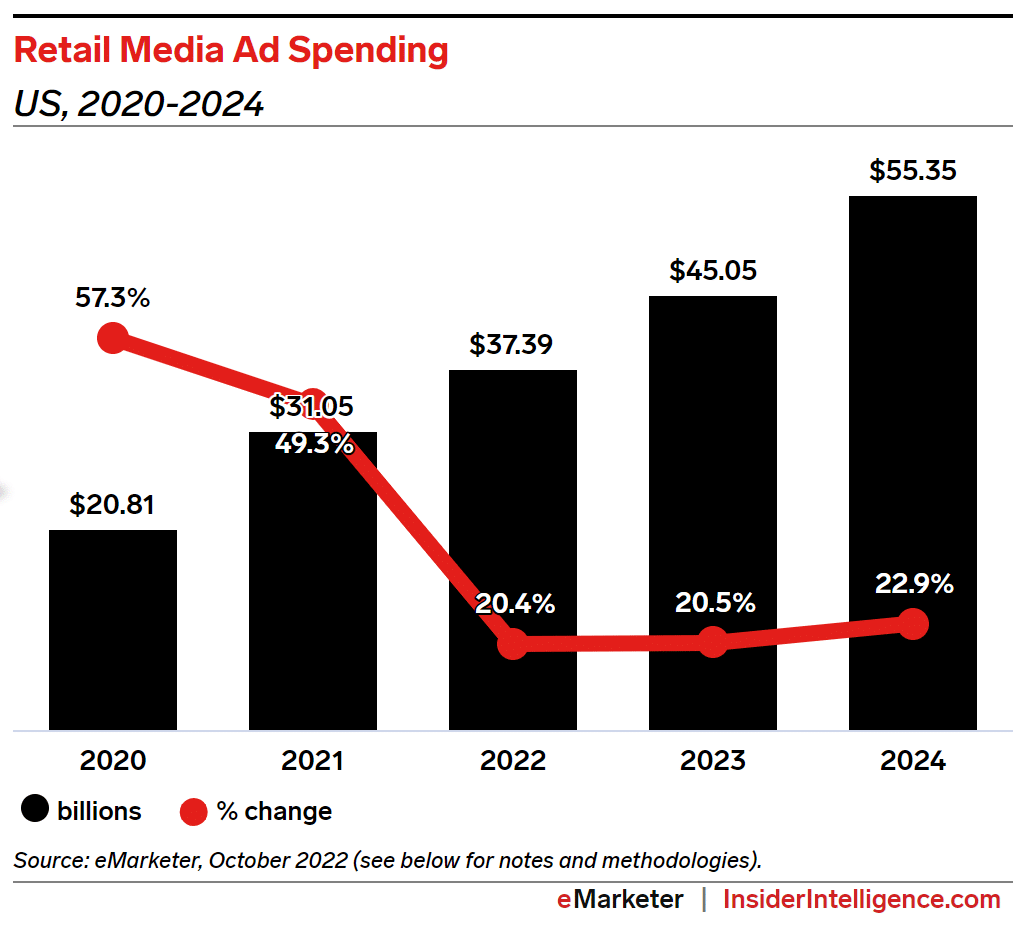
With retail media ad spending on pace to grow over 20% in 2023 to upwards of $45 billion, it’s no surprise that retailers of all shapes and sizes are running for a piece of the pie.
That pie is growing bigger by the minute given the industries’ growing need for first-party data and corresponding retail-specific ad opportunities, which are constantly evolving. Let’s not forget, COVID happened and completely upended consumers’ approach to retail.
Ecommerce demand has continued to grow, albeit at a slower pace post-pandemic. But what’s also growing is consumers’ need for a more flexible and personal shopping experience beyond digital.
Consumers’ growing need for flexible fulfillment solutions
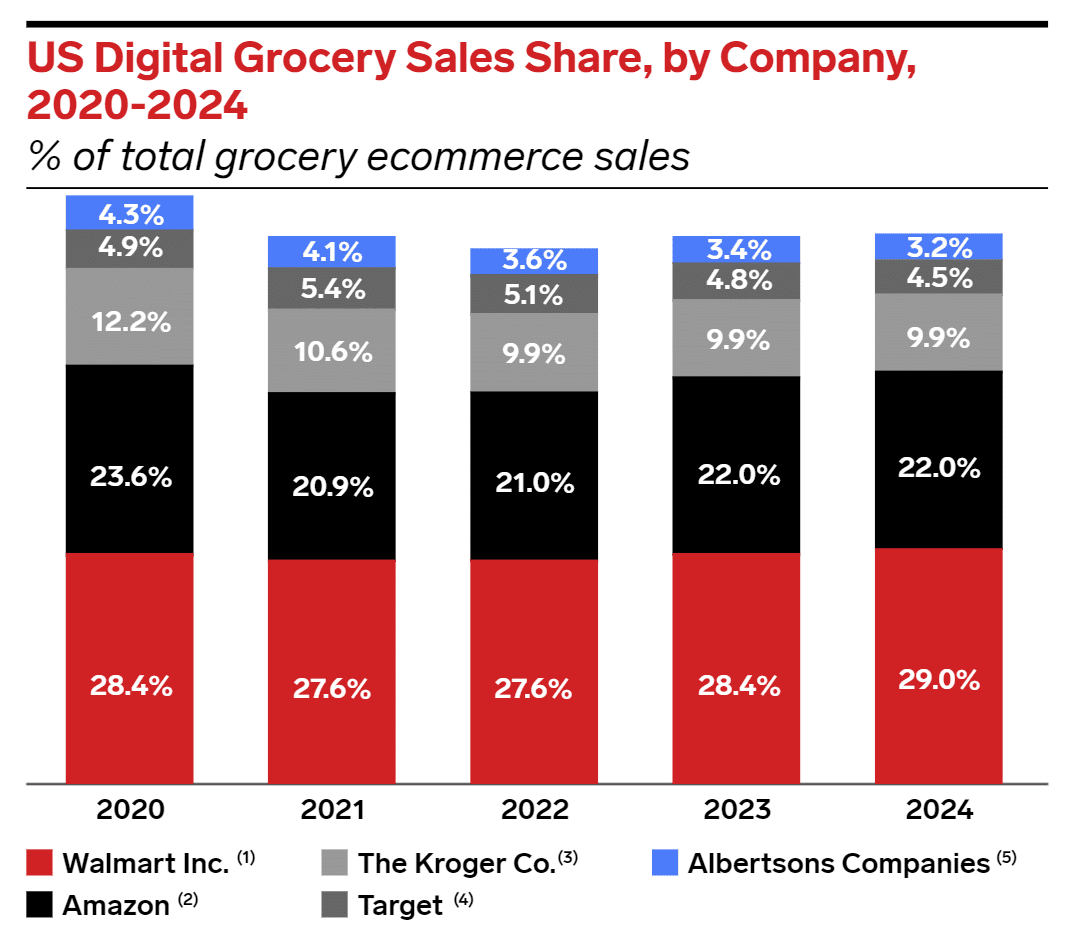
With Amazon being in the number one spot of top U.S. companies by ecommerce share (~38%), suffice it to say they have got digital down and cornered.
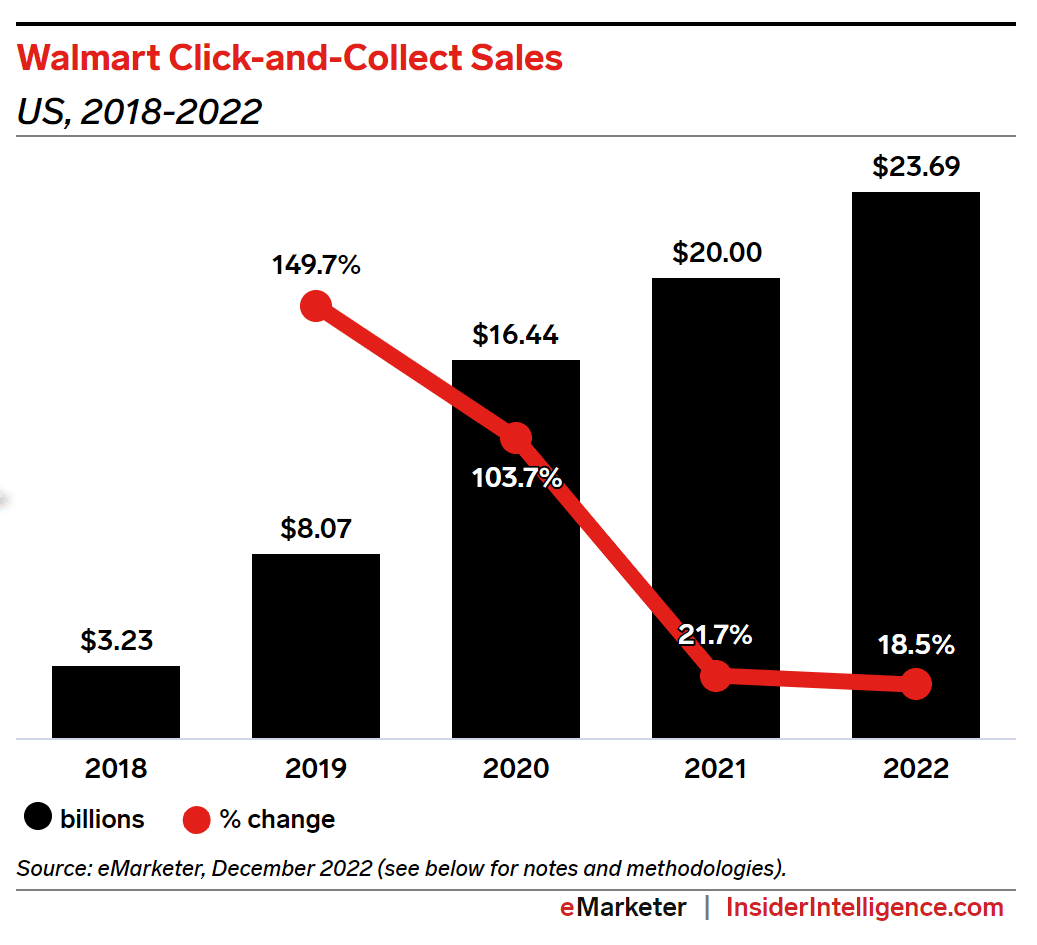
But Amazon lacks physical retail locations – which just so happen to be essential for the growing popularity of flexible fulfillment solutions, such as buy online, pick up in-store (BOPIS), click and collect (C&C), curbside pickup, and more.
What Amazon lacks, Walmart – its closest competitor in the digital space – has in droves. The retail giant’s 4,700+ physical retail locations helped cement them as the largest U.S. retailer.
Physical locations aside, Walmart has a strong and growing digital offering. It is ranked second in the U.S. for ecommerce share, heavily driven by its dominant digital grocery performance.
Interestingly, grocery is a category rarely seen in digital pre-2019 but is quickly expanding in connection with solution advancements and consumer needs.
This combination of dominant physical reach with a growing digital powerhouse truly positions Walmart as a differentiated solution with rapidly expanding opportunities.
Get the daily newsletter search marketers rely on.
Walmart’s current ad offerings
Although Walmart is playing a bit of catch-up on platform sophistication and ad opportunities compared to industry peers like Amazon and Google, they are doing it at an incredible pace.
Before 2021, nearly all advertising efforts were managed by Walmart, except for their stand-alone self-serve search ad unit, sponsored products.
Jump a couple of short years ahead and they have expanded their search and display efforts aggressively, resulting in three new self-serve service lines with:
Sponsored brands.
Display self-serve (DSS).
Walmart DSP.
Walmart still offers a managed service for first-party sellers with spend commitments and deep pocketbooks, but it’s clear to see their priority in opening advanced ad opportunities to a wider seller base.
Before we get ahead of ourselves and jump to what’s next, let’s look at Walmart’s current ad opportunities that sellers of all sizes can leverage to drive brand performance and relevancy on and off the platform.
Sponsored products
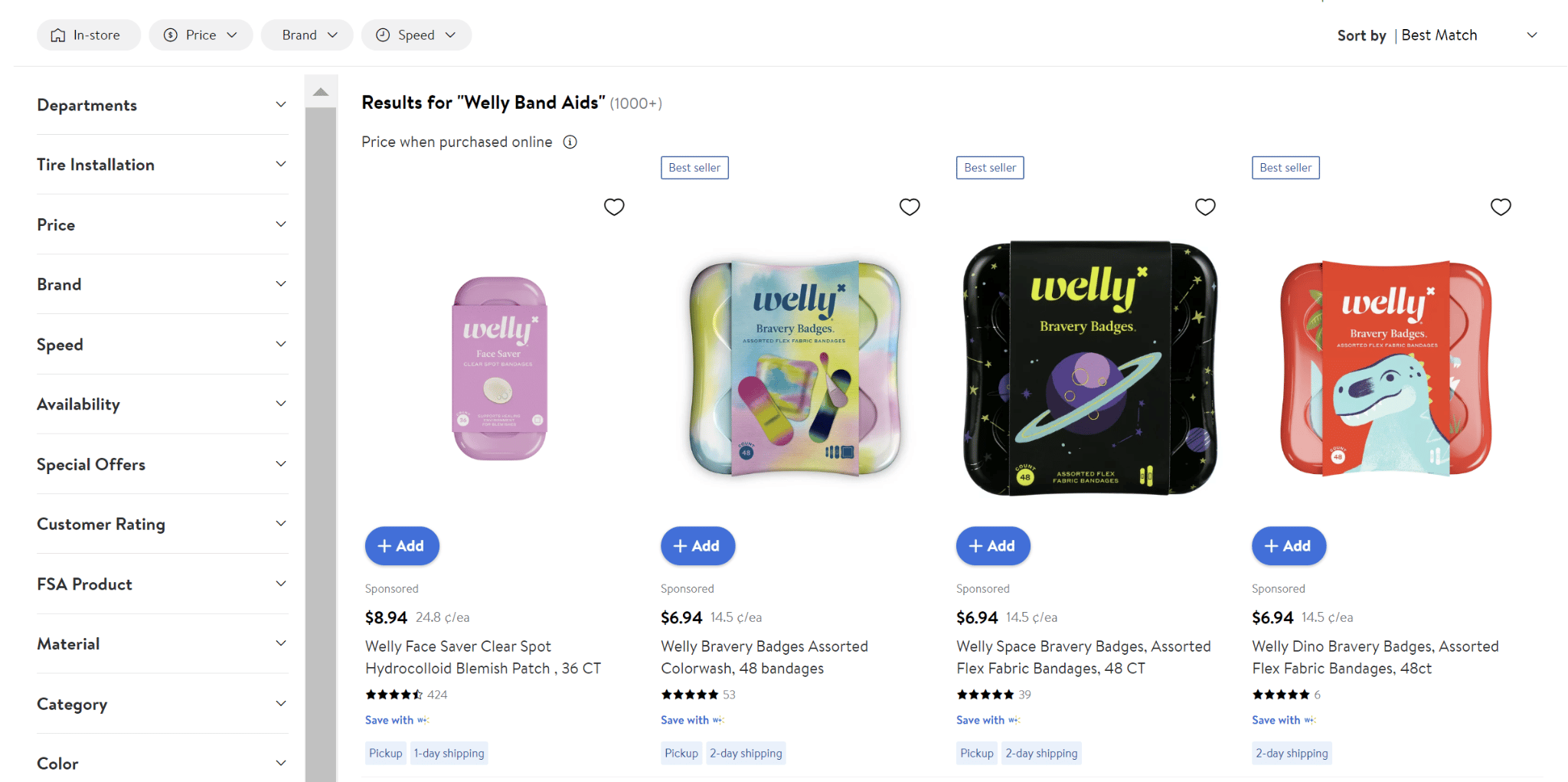
Walmart’s core search offering, sponsored products let you leverage search terms and product data to serve ads against consumers’ search intent.
This ad unit generally captures consumers within the intent phase of the customer journey, given that the ads are served alongside organic placements within the search engine results page (SERP).
They commonly have digital-focused, return-based goals since this ad unit is closest to the point of purchase.
Availability: First party and third party
Funnel position: Intent
Sponsored brands
Sponsored brand ads are top-of-page search banner ads served against consumers’ search intent.
They are great for:
Moving slightly up the funnel into brand-building tactics.
Leveraging competitive tactics and category share improvements given the keyword targeting structure and top-of-page placement.
These PPC ad units contain a brand logo, which will lead to a shelf (sub-category) or search page, and up to three products, which will redirect to a product page.
Availability: First party and third party
Funnel position: Consideration, intent
Self-serve display
Walmart DSS (Onsite)
Walmart display self-serve (DSS) is a nimble, self-serve platform that gives advertisers control over their onsite Walmart display advertising efforts.
Within DSS, advertisers can leverage Walmart audiences to serve display assets to consumers across Walmart.com via numerous targeting tactics.
This platform comes with an automated creative builder and efficient campaign setup for agility at scale.
Additionally, the DSS platform includes digital and in-store performance reporting to better understand total impact.
Availability: First party
Funnel position: Awareness, consideration
Source: Walmart Connect
Walmart DSP (Offsite)
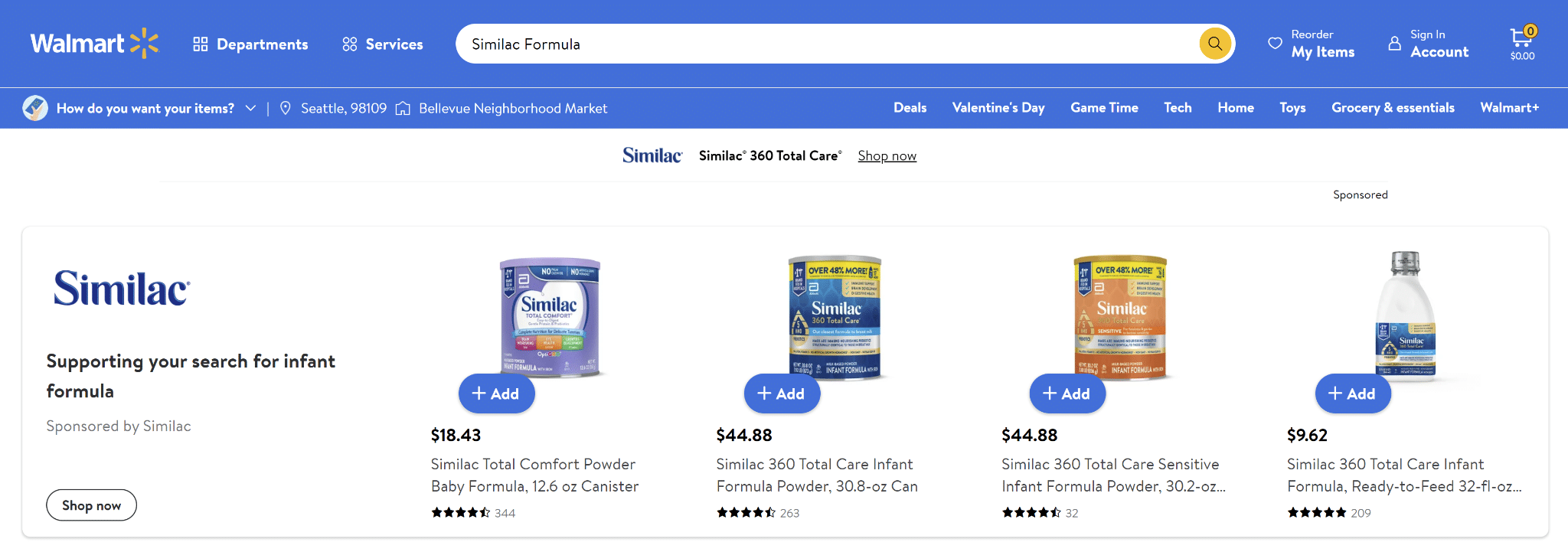
Walmart DSP is a demand-side platform that marries the power of The Trade Desk’s industry-leading technology with Walmart’s expansive omnichannel first-party data.
This leads to a differentiated offer that allows advertisers to leverage Walmart audiences to serve ads across The Trade Desk’s inventory across the open web.
With the added benefit of Walmart’s closed-loop reporting, sellers will have a clear view of the impact that their omnichannel ad efforts are having throughout all points of the customer journey, both on and offline.
Availability: First party
Funnel position: Awareness, consideration
Source: Walmart Connect
What’s in store for Walmart advertisers and how to get ahead
As you can see from the above advancements, Walmart understands advertisers’ need for accessing and acting on first-party data at scale.
Recent social, live stream and video partnerships point to the retailer’s bid to serve consumers looking for more interactive and personal shopping experiences.
Ultimately, Walmart is laying the groundwork for advertisers to leverage their data within these new and engaging ad formats.
Given that the last update we received in this area was in mid-September of last year, I would anticipate further advancements in the coming months.
Don’t get me wrong – ad expansion is great but it’s only half the battle. Understanding the impact of those ads is just as important, if not more, both online and in-store.
Walmart has an uphill battle in this department given their high in-store and cash transaction rates. They are taking steps to close that gap, which includes the expansion of Walmart+.
Walmart+ has seen consistent growth and now accounts for up to 25% of total ecommerce sales, according to a recent study by Consumer Intelligence Research Partners (CIRP).
In addition, Walmart is also working to close the loop through programs like cashback rewards, in partnerships with solution providers like Ibotta. This is a major priority for brands across the board so I would expect this to be a focus within the coming year.
If you take anything from this piece remember this…
Walmart has the physical infrastructure to meet consumers’ evolving shopping needs and the pocketbook and roadmap to claw away at digital market share.
Their data is growing and so are the ways in which they are allowing advertisers to leverage it. Sure, they still have solution gaps, but they are not scared to try things and are aggressively working to close them.
Needless to say, I expect 2023 to be a year of evolution. Buckle in because the retail media race is on, and Walmart has a pole position.
Opinions expressed in this article are those of the guest author and not necessarily Search Engine Land. Staff authors are listed here.
@media screen and (min-width: 800px) { #div-gpt-ad-3191538-7 { display: flex !important; justify-content: center !important; align-items: center !important; min-width:770px; min-height:260px; }
}
@media screen and (min-width: 1279px) { #div-gpt-ad-3191538-7 { display: flex !important; justify-content: center !important; align-items: center !important; min-width:800px!important; min-height:440px!important; }
}
About the author
With over twelve years in the eCommerce industry, Stuart has worn a number of different hats including Account/Program Management (paid search, shopping, display, etc…), Product Management, Business/Partnership Development, and more. He has now found a home at Tinuiti as Director of Commerce Strategic Services, focusing on identifying and establishing new and emerging Retail Media opportunities. Although his role interacts with many different Retail Media selling channels including Target, Instacart and Kroger (just to name a few), his main focus is set on strengthening Tinuiti’s holistic relationship with Walmart and ensuring advancement within Product, Partnership & Performance.
In 2010, Google revealed its latest attempt to create a social network and compete with Facebook and Twitter. And they called it Google Buzz.
Buzz was tied to two main elements – Gmail and mobile. But would users want social networking to invade their inbox?
As we noted at the time, there were a couple of “risky” features. The launch was generally greeted with heavy criticism and Buzz would quickly become a privacy nightmare that would hang on for dear life until Google tried its luck again with Google+.
2022: Google announced an improvement to its ranking systems meant to help searchers discover stories from “authoritative, relevant local news sources.”
2018: The latest images showing what people eat at the search engine companies, how they play, who they meet, where they speak, what toys they have and more.
2017: With the new 6.11 version of Bing’s iOS search app, results for a “homes for sale + ZIP code” query returned real estate listings for specified ZIP codes.
2012: You could filter places results by four categories: “I haven’t been to yet”; “I have been to before”; “My friends have been to”; “Have Foursquare specials.”
2011: He compared a “time capsule” of search results he saved from Google’s index in 2000 to the present day to show how Google had improved in terms of spam and search quality.
2007: Powerset won the rights to natural language search technology from Xerox PARC that it hoped would make it the new Google, when it finally launched.
Past contributions from Search Engine Land’s Subject Matter Experts (SMEs)
These columns are a snapshot in time and have not been updated since publishing, unless noted. Opinions expressed in these articles are those of the author and not necessarily Search Engine Land.
@media screen and (min-width: 800px) { #div-gpt-ad-3191538-7 { display: flex !important; justify-content: center !important; align-items: center !important; min-width:770px; min-height:260px; }
}
@media screen and (min-width: 1279px) { #div-gpt-ad-3191538-7 { display: flex !important; justify-content: center !important; align-items: center !important; min-width:800px!important; min-height:440px!important; }
}
About the author
Danny Goodwin is Managing Editor of Search Engine Land & SMX. In addition to writing daily about SEO, PPC, and more for Search Engine Land, Goodwin also manages Search Engine Land’s roster of subject-matter experts. He also helps program our conference series, SMX – Search Marketing Expo. Prior to joining Search Engine Land, Goodwin was Executive Editor at Search Engine Journal, where he led editorial initiatives for the brand. He also was an editor at Search Engine Watch. He has spoken at many major search conferences and virtual events, and has been sourced for his expertise by a wide range of publications and podcasts.
With its new Cost-Per-Hour Masthead, YouTube is giving brands and advertisers the ability to buy its most visible placement during the hour(s) leading up to, during or after priority moments such as a sports game or movie release.
What they look like. Here’s what a Masthead ad looks like on a desktop or PC.
Here’s what the ads look like on a mobile device.
Preview your ad. You can see what your ads would look like by using the Masthead Preview Tool.
Technical specs. You can review YouTube’s technical specs for Masthead ads here.
Why we care. YouTube’s Cost-Per-Hour Masthead provides a unique opportunity for advertisers and brands to secure a prominent placement and increase visibility to a large audience. By owning the Masthead, brands and advertisers can maximize reach and impact, delivering their message to a captive audience and potentially increasing conversions.
However, there’s no indication right now how much the Masthead ads cost, or how much of the inventory is available. They may be a better option for national brands versus small or local businesses.
@media screen and (min-width: 800px) { #div-gpt-ad-3191538-7 { display: flex !important; justify-content: center !important; align-items: center !important; min-width:770px; min-height:260px; }
}
@media screen and (min-width: 1279px) { #div-gpt-ad-3191538-7 { display: flex !important; justify-content: center !important; align-items: center !important; min-width:800px!important; min-height:440px!important; }
}
About the author
Nicole Farley is an editor for Search Engine Land covering all things PPC. In addition to being a Marine Corps veteran, she has an extensive background in digital marketing, an MBA and a penchant for true crime, podcasts, travel, and snacks.
Pinterest puts more emphasis on its shoppable video feature
Pinterest is leaning hard into its shoppable video and advertising-based revenue generation as part of its growth strategy.
Despite a 6% drop in monthly active users (MAUs) in the fourth quarter of last year, the social platform has regained growth, with a 4% increase in MAUs to 450 million and significant growth in mobile app users in the fourth quarter of 2022.
What Pinterest says. As part of its formal strategy, Pinterest aims to increase engagement and enhance advertiser outcomes through shoppability, along with enhancing monetization per user and streamlining operations. According to surveys, over half of Pinterest’s users consider the platform as a shopping destination, however, the company has not been efficient in making the shopping experience seamless, as acknowledged by the CEO.
“We’re building an experience that resonates with this audience, specifically around video. In fact, nearly half of all new videos pinned in Q4 were from Gen Z users.”
“Over the long term, we also want to make every pin shoppable. To that end, we’re making video content on Pinterest more actionable using the same playbook we applied to static images. Over the course of this year, we will be deploying our computer-vision technology across our video corpus to find products and videos and make them shoppable.”
Pinterest CEO Bill Ready
Future initiatives. Pinterest has initiated a project to improve the shopping experience by sending users directly to the product page on the merchant’s app and utilizing its mobile deep-linking format (MDL) for shopping advertisements. During the Black Friday Cyber Monday period, MDL generated 40% of the revenue from Pinterest’s shopping ads and contributed to a 50% growth in Q4.
The platform is also integrating shopping across its most-trafficked surfaces, including the home feed, search and related pins, to show users products most relevant to them.
Short form video content. Regarding monetization, Pinterest has seen over 10% of its engagement come from video content, with over 30% of its revenue being generated through short-form videos. The platform recently started letting advertisers create their own ads with the Idea Pin format, added support for video assets in product catalogs, and partnered with music labels to allow the use of licensed music in short videos.
Driving ad revenue. Pinterest ad revenue is now driven in roughly equal parts by campaigns driven by brand-oriented, consideration and conversion KPIs. The platform has “seen advertisers who take a full-funnel approach see more success than those who are only active on one campaign objective,” with advertisers that used a multi-objective media strategy seeing up to a 50% improvement in sales lift compared to those focused on one objective, Ready said.
Pinterest is also looking to help advertisers enhance relevance and personalization, Ready said, noting as an example its Q4 launch of ad-load management with whole-page optimization.
That enables flexing ad-load “opportunistically, in context, where ads are most well-suited for the user,” Ready said. “In our initial testing, this drove double-digit improvements in ad relevance on search, while simultaneously reducing CPAs for advertisers. We expect the whole-page optimization will enable us to continue to improve the efficiency with which we monetize our platform over time.”
Why we care. Adopting a full-funnel approach and utilizing a multi-objective media strategy, brands are likely to see better results and improvements in sales compared to those who focus on only one campaign objective.
On Pinterest, this has been shown to result in up to a 50% increase in sales lift. Additionally, the platform’s ad revenue is generated roughly equally by campaigns driven by brand-oriented, consideration and conversion KPIs, making it a valuable platform for advertisers looking to reach a wide range of objectives.
As platforms like Instagram and Facebook move away from shopping, Pinterest can step in as an alternative, giving advertisers an additional channel to showcase their products.
@media screen and (min-width: 800px) { #div-gpt-ad-3191538-7 { display: flex !important; justify-content: center !important; align-items: center !important; min-width:770px; min-height:260px; }
}
@media screen and (min-width: 1279px) { #div-gpt-ad-3191538-7 { display: flex !important; justify-content: center !important; align-items: center !important; min-width:800px!important; min-height:440px!important; }
}
About the author
Nicole Farley is an editor for Search Engine Land covering all things PPC. In addition to being a Marine Corps veteran, she has an extensive background in digital marketing, an MBA and a penchant for true crime, podcasts, travel, and snacks.
Maximizing reach and engagement: A guide to the top video game ad platforms for brands
Video game platforms have come a long way since the days of Atari. Nowadays, platforms have become more versatile, accessible, and interactive, offering players an ever-increasing range of experiences and options. Whether you’re a player, developer, or advertiser, here are several options of the most popular game platforms to get you started.
This is the third article in our series on why video game advertising is a huge opportunity for brands in 2023.
Roblox
Roblox is an online platform and storefront where users go to play games. Roblox itself is not a game, but rather the platform developers use to host their games. All of the games on Roblox are made by their users and part of the appeal is getting the opportunity to play games made by users, not large corporations. According to some sources, there are about 20 million games on the platform.
Some developers have reportedly made about $1 million in a single year by monetizing their games. Many games on Roblox are freely available, users can spend virtual currency called Robux to purchase aesthetic items. Developers can keep a portion of the Robux and then transfer it to real currency once they collect enough. Roblox is incredibly popular, drawing in about 43 million daily users, and players for some games can range from a few thousand to over 1.6 million. The platform is free and the games are free to download.
In 2021 Anzu teamed up with Roblox to offer in-game advertising options. Anzu says they hope to open up significant revenue streams for Roblox creators by offering additional ad options. Roblox will take about half the revenue for the players spending on the platform, so additional revenue streams are an incentive to developers.
Anzu’s technology allows for adding dynamic banner ads to virtual objects including buildings and billboards. Their advanced technology has already led to signing partnerships with some of Roblox’s top creators with the hopes of delivering real-world in-game ads to Roxlox’s lineup – without disrupting the user experience.
Discord
Discord is a communications app but was originally designed for gamers. As the app became more popular, it has expanded into other uses such as for fan groups and productivity. Discord offers features like voice chat, server creation, and text channels, which make it an essential tool for gaming communities.
Discord also supports integration with many popular games, allowing users to see what their friends are playing, share game-related content, and connect with other players. The platform’s user-friendly interface, robust feature set, and strong community make it a go-to destination for gamers looking to connect with each other.
Apple Arcade
Apple Arcade is a video game subscription service from Apple. There are hundreds of games, most of which have been hand-picked by Apple and sit across multiple genres, including family, puzzle, sports, RPG and strategy. There is even a category that suggests games for “beginners.”
Apple Arcade is $4.99 a month and renews automatically. Unfortunately there are no in-app purchases or ads, so we won’t spend too much time digging into this platform.
Twitch
Amazon Twitch is a live platform that streams gamers playing video games. 91% of all video game streaming is hosted on twitch and it’s become one of the most popular platforms on the internet, hosting more than 2 million viewers a day.
Much of Twitch’s success comes from the pandemic, which made it a go-to entertainment hub among those stuck at home. Now the platform has over 7 million streamers broadcasting per month.
Twitch’s viewership and engagement skyrocketed in late 2020 as many consumers were bored at home and looking for things to do. Professional sports were off the air, so users looked to fill that void with games. US game sales rose 37% in August 2121, up from 2019. Mobile games even rose as much as 50% in some countries during that same period.
Twitch is often considered the “central hub” for staying up to date with streamers, the latest developments in games, and engaging in the community. According to Twitch Tracker, there are over 3 million viewers, 91,500 channels broadcasting, 1.2 million unique streamers, and 2,900 games live right now (at the time of this publication). Those are huge numbers for brands to consider.
Options for brands looking to advertise on Twitch are robust. The platform offers high-impact displays as well as unskippable ads that integrate into broadcasts.
Homepage carousel ads show on the center of the homepage in a rotating carousel slot.
Homepage headliner ads surround premium inventory and can scale with varied screen resolutions and sizes without risking the quality of the ad.
Medium rectangle ads are placed within the content section of each page.
Streamable ads amplify viewership to a stream and drive higher views.
Super leaderboard ads keep viewers engaged while they search for content by displaying a large banner at the top of the page.
Premium video ads are incorporated into live broadcasts across desktop, mobile, tablet, and connected TV.
First impression takeover ads let viewers see your ad as soon as they enter Twitch
If your brand is interested in advertising with Twitch, visit the help documentation and schedule a consultation with a strategist, producer, or gaming expert.
Facebook
According to Facebook, 40% of the top 500 apps are integrated with the audience network. They also claim that over 1 billion people see an Audience Network ad each month. Additionally, 80% of Audience Network ads are native, which helps drive a much higher revenue than the more common banner ad formats.
Advertising on the Facebook platform isn’t new for most advertisers. But if your brand is new to in-game ads, it may be the easiest place to start. The Audience Network is an off-Facebook, in-app ad network designed for mobile apps. Advertisers can have their ads shown to customers who are using mobile sites and apps other than Facebook. This includes games on iOS and Android.
Brands have many options for ad placements within the Audience Network including:
Banner and medium rectangle ads are the easiest to create, most common, and are generally non-intrusive
Interstitial ads are full screen and use natural breaks in the user flow, or pauses in the game
Native ads are customizable and fit the overall look and feel of the app design
Native banner ads are customizable banners that fit the overall look and feel of the app
Rewarded video ads take the user through an immersive ad experience with an incentive in exchange for a completed view such as power-ups or aesthetic items
Rewarded interstitial ads are skippable, non-intrusive ads that offer rewards for watching during natural pauses or breaks
To utilize the Facebook Audience Network and create an in-game ad campaign, you can visit the help documents here.
Google Play
Google’s mobile game ad platform allows developers to keep games free, while developers earn the revenue they need to keep the game updated. Since users expect free games, monetization allows developers to offer in-app purchases where users pay fees to upgrade their experience. Since only a fraction of users make purchases on mobile games, ads are a great way to compromise and exchange ad views for extra lives, bonuses, or other “extras.”
Advertisers have the option of choosing between three different ad types when planning their campaigns. Our second article in this series digs deeper into these different types of ads.
Banner ads
Interstitial ads
Native ads
Rewarded ads
Banner ads are easy to implement and are the best option for casual, single-screen games. Banner ads don’t disrupt the user experience and can refresh regularly, providing the player with a unique experience. Banners ads can also change size to adapt to different screens and devices, making it the top choice for many advertisers.
Interstitial ads are full-screen overlays. They are easy to implement and don’t cause any interruption to the game because of their large size. This ad type is ideal for games with natural transitions and can be shown to users while they are taking breaks. Before choosing interstitial ads, advertisers should consider the flow of the game, the user’s mindset while playing, and whether the ad will cause frustration if shown at an inconvenient time.
Native ads can be customized to match the look, feel, and design of the game it’s being shown on. The ads will consist of an image or video, along with accompanying text. According to Google’s best practices, “Native ads are best shown when users are reading through the screen, not when they are engaged in the app’s main activity. Popular approaches for integrating native ads into the gaming experience include placing ads in a menu, a splash screen before the game’s start, or in a storefront between in-app purchase and upgrade options.”
Rewarded ads show when a user opts in to engage with an ad in exchange for a “reward” within the app. Those rewards can be extra lives, tools, or power ups. Rewarded ads give the player the power to decide whether they want to engage. Rewarded ads have grown 400% in the last year as they drive user engagement and are popular among developers.
Snap Games
Snapchat’s gaming platform is called Snap Games. It was created as a “way to hang out with your friends on Snapchat” according to Snapchat’s own help documentation. According to Snapchat, about 300 million users have played Snap Games, and more than one-third of Snapchat’s current gaming partners have made over $1 million in revenue.
Snap Games can be found in multiple locations across the app. Players can even talk to friends in the game through in-game messaging, voice chat, and through sharing game highlights to Snaps, Chat, and Stories.
Snap’s mobile-first ads and in-app purchases can help businesses grow their business and earn revenue. The ads in Snap Games are unskippable six-second ads found in other Snap spaces. If users opt-in to watching an ad, they can upgrade weapons, get extra lives, or receive other game-specific benefits not available to those who opt-out.
“Snapchat seemed to find a clean and simple way to integrate the ads. When I get one, it really doesn’t bother me. If there is one, I can’t skip it, but I don’t mind since I get a reward for watching it,” said Chris Higa, an official lens creator on Snapchat who plays Bitmoji Tennis and Tiny Royale. This ad structure is a departure from other games that present in-app purchases. Pokemon Go for example sells one extra life for $3.99 or $9.99 for three extra lives. Although lucrative (the company is expected to make $3 billion by the end of the year), ads give players an option – which is user-friendly and people-first, say some digital ad strategy managers. Players with lower budgets appreciate having additional options.
Whatever your brand is, there’s a platform to promote it. Learning who your ideal target audience is, where they’re spending their time, what they’re playing, and your budget are good determining factors in deciding which gaming platforms are right for you.
@media screen and (min-width: 800px) { #div-gpt-ad-3191538-7 { display: flex !important; justify-content: center !important; align-items: center !important; min-width:770px; min-height:260px; }
}
@media screen and (min-width: 1279px) { #div-gpt-ad-3191538-7 { display: flex !important; justify-content: center !important; align-items: center !important; min-width:800px!important; min-height:440px!important; }
}
About the author
Nicole Farley is an editor for Search Engine Land covering all things PPC. In addition to being a Marine Corps veteran, she has an extensive background in digital marketing, an MBA and a penchant for true crime, podcasts, travel, and snacks.