Twitter has launched a Search Keyword Ads beta test to all advertisers

Twitter just launched a beta program that’s available to all advertisers called Search Keyword Ads. The announcement was made on Twitter.

How it works. Twitter says “Now advertisers can bid to insert Promoted Tweets solely among specific search results, reaching people with high real-time intent & improving ad relevance.”

“Search Keywords Ads differ from other Twitter Keywords campaigns in that they only reach people who are searching for targeted terms when they are searching, offering a stronger signal of intent.”

Why we care. If you’re one of the remaining few advertisers left on Twitter, give Search Keyword Ads a try. The new ads can be an effective way for marketers to reach their target audience at the right time and with the right message, potentially leading to better conversion rates and ROI.

Additionally, this feature provides more specific targeting options to reach audiences, it can help to improve the effectiveness of campaigns and lower the cost of reaching targeted audiences.


Related stories

New on Search Engine Land

@media screen and (min-width: 800px) { #div-gpt-ad-3191538-7 { display: flex !important; justify-content: center !important; align-items: center !important; min-width:770px; min-height:260px; } } @media screen and (min-width: 1279px) { #div-gpt-ad-3191538-7 { display: flex !important; justify-content: center !important; align-items: center !important; min-width:800px!important; min-height:440px!important; } }

About the author

Nicole Farley

Nicole Farley is an editor for Search Engine Land covering all things PPC. In addition to being a Marine Corps veteran, she has an extensive background in digital marketing, an MBA and a penchant for true crime, podcasts, travel, and snacks.

https://searchengineland.com/twitter-has-launched-a-search-keyword-ads-beta-test-to-all-advertisers-392243


How to level up your analytical skills with Excel

With the increased prevalence of automation in campaign management platforms, advertisers must possess analytical skills that will allow them to comprehend changes in funnel performance, as well as detect optimization opportunities. 

During my SMX Next presentation, I highlighted formulas and functions within Microsoft Excel that can help advertisers with data manipulation.

When it comes to creating impactful analysis, meaningful time needs to be invested in the creation of the dataset. Using these techniques, you will create data sets that can be aggregated at scale, while enabling you to dig into performance changes at the most granular levels. 

CONCATENATE

=CONCATENATE(Cell1,Cell2,Cell3)

While this function won’t necessarily expedite the number crunching, CONCATENATE is an extremely efficient way to build bulk sheets and ensure consistency in the structure of your URLs and naming conventions. 

CONCATENATE “glues together” specified cells or text strings to create a single text string in Excel. Its use cases can be far-reaching, including:

  • Campaign/ad group naming conventions.
  • Appending URLs to parameters.
  • Building keyword lists.
CONCATENATE examples

A consistent taxonomy in naming convention enhances the granularity of analysis, as you can use Text to Columns to create filters within your data set. 


Get the daily newsletter search marketers rely on.


IF functions

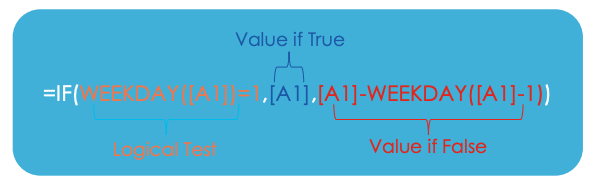
IF functions can help create additional dimensions in your data set. At its core, an IF statement is simply an evaluation of a cell against a logical condition.

If the answer is true, one value is returned and if the statement is false, a different value is returned. Multiple logic tests can be stacked on top of each other, known as a nested IF statement.

With IF statements, you can start your analysis at the most granular levels and evaluate if data meets specified criteria instantly.

Transform date to week

Transform date to week formula
IF statement to transform date to week

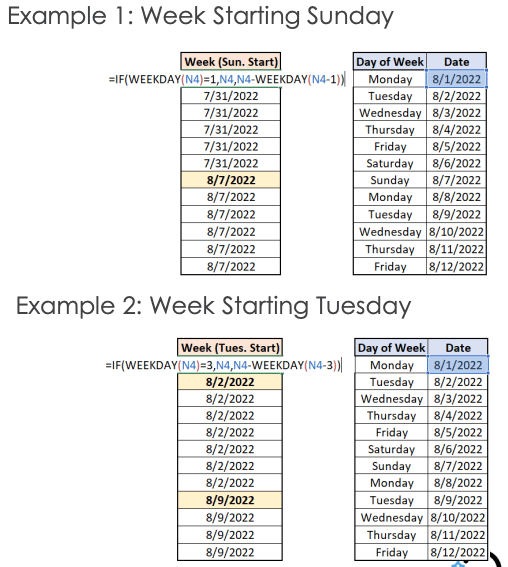
The above formula allows data segmented by date to be categorized by week in a separate column, providing you with higher-level trends.

One key feature of this formula is that it can be customized to align with whatever reporting cadence your business uses (i.e., reporting week starts on Saturday). 

Transform date to week examples

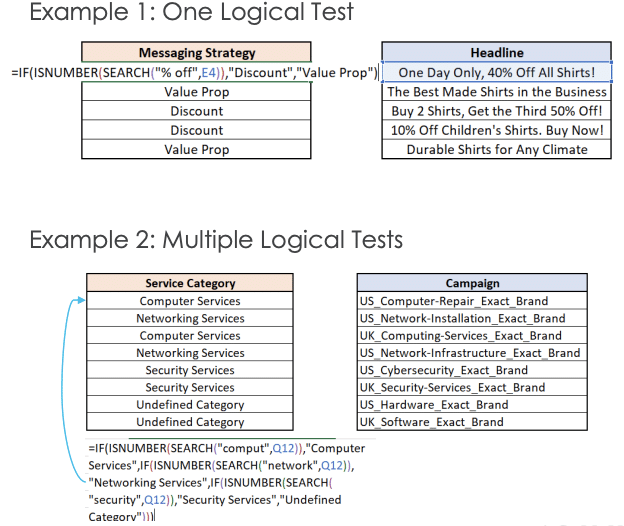
Categorization based on text

=IF(ISNUMBER(SEARCH(“text”,A1)),“text if true”,“text if false”)

The formula above allows you to search strings of text to create additional filters in the data set.

It’s helpful for analyzing text-heavy data (i.e., ad copy, keywords or campaigns) at scale and expediting label creation.

Categorization Based on Text examples

VLOOKUP

VLOOKUP formula
VLOOKUP formula

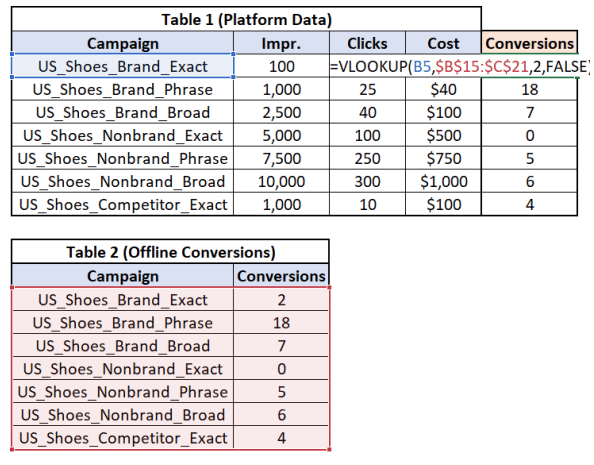
VLOOKUP returns data from a separate, vertically organized data set for a specified value. It’s one of the most impactful features that PPC professionals can add to their toolbelt.

If simplified, VLOOKUP allows you to join two data sets together based on a shared value. It can be an incredibly powerful tool to speed up analyses for advertisers who:

  • May leverage internal platforms as their source of truth.
  • Use a lot of abbreviations in their naming taxonomy. 
VLOOKUP examples

In the example above, a separate database of offline conversion data is appended to a standard keyword performance report using VLOOKUP.

While this function allows for partial matches, I recommend only using it for exact matches in search marketing since partial matches tend to be inaccurate.

Calculations to enhance analysis: Deltas and incremental impact

Once the data set is built to your liking, you can proceed to analyze funnel performance. Two calculations you can use for this are deltas and incremental impact. 

Deltas and incremental impact both help to contextualize the magnitude of a change across two segments (think dates, devices, geos, audiences, etc.). 

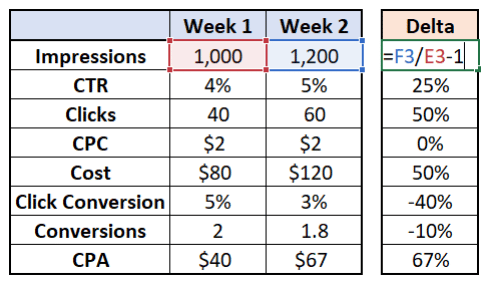
The delta formula calculates the change in a metric relative to the previous period or between two segments.

Delta formula
Delta formula

Deltas are more universally applicable, as they can apply across volume and efficiency metrics.

Delta example

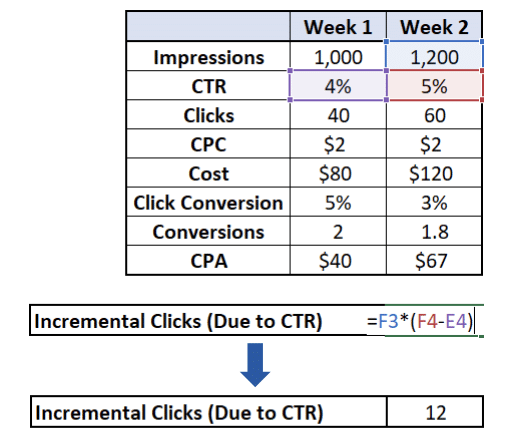
On the other hand, incremental impact quantifies the impact that a metric (commonly a rate like CTR or CPC) had on the volume flowing through a funnel.

Incremental impact formula

Deltas and incremental impact cannot be used interchangeably. 

  • A delta is simply a rate of change.
  • Incremental impact calculation highlights the positive/negative impact of changes in your funnel, assuming all else remains constant. This is a critical point, as we know that changes rarely happen in a vacuum.
Incremental impact example
Incremental impact calculation for CTR

Thus, incremental impact calculation must be considered in the context of how they are being used.

That said, this calculation helps us to quantify the “so what,” which can be particularly useful when conveying the performance narrative to key stakeholders. 

Excel your analytical skills in the face of automation

By incorporating these techniques into your own daily operations, you will save time in Excel.

Most importantly, you will also gain the confidence of your team and stakeholders, as your grasp on performance will be unmatched.

Watch: Level up your analytical skills with Excel

Below is the complete video of my SMX Next presentation.

[embedded content][embedded content]

Opinions expressed in this article are those of the guest author and not necessarily Search Engine Land. Staff authors are listed here.


Related stories

New on Search Engine Land

@media screen and (min-width: 800px) { #div-gpt-ad-3191538-7 { display: flex !important; justify-content: center !important; align-items: center !important; min-width:770px; min-height:260px; } } @media screen and (min-width: 1279px) { #div-gpt-ad-3191538-7 { display: flex !important; justify-content: center !important; align-items: center !important; min-width:800px!important; min-height:440px!important; } }

About the author

Anthony Tedesco

Anthony Tedesco is a search engine marketing professional based in Boston, Massachusetts. He started his career at Red Ventures in Charlotte, North Carolina, where he learned the impact of data-driven performance optimization and full-funnel marketing strategies. He then returned to his native Boston, where he joined DWA/Merkle B2B, working with Fortune 100 brands to maximize the value of their SEM investments. In 2021, Anthony joined the global paid media team at Cisco Systems, Inc., where he orchestrates high-impact tactics at scale and helps solve the complex challenges marketers face in the evolving digital landscape. Anthony is an avid Tar Heel and Boston sports fan. If not watching his favorite teams, he enjoys traveling throughout New England with family and friends or catching up on old seasons of Survivor.

https://searchengineland.com/level-up-analytical-skills-excel-391940


This day in search marketing history: January 23

Expedia buys Travelocity

In 2015, Expedia bought rival Travelocity for $280 million amid sluggish travel industry growth and pressure from insurgent travel providers.

Expedia had actually been powering Travelocity.com since 2013. So the acquisition seemed quite logical from both perspectives.

At the time, Expedia also owned several online travel brands: Hotels.com, Hotwire, eLong and Trivago.

Read all about it in Travel Search Consolidation: Expedia Buys Rival Travelocity For $280M


Also on this day


Neeva seeks to expand user base with free subscriptions

2022: The free basic subscription was an alternative to its full-featured subscription, which cost $4.95 per month.


Google removes ‘ads’ and ‘sponsored’ labels from flight search results

2020: There would be no more referral fees from partners in flight search, as Google sought to emphasize price and convenience in rankings.


Google Dataset Search is out of beta and adds new features

2020: Google added new features to Google Dataset Search with this rollout.


Video: Search pioneer Mike Grehan on everything from the early days of SEO to AI’s role in paid and organic search

2020: In this installment of Barry Schwartz’s vlog series, he chatted with Grehan about the early days of search, how technology like AI and machine learning are impacting search and who originally came up with term “search engine optimization.”


Amazon adds customer acquisition metrics for Sponsored Brands campaigns

2019: The “new-to-brand” set of metrics were also available for Amazon sellers’ display and video ad campaigns.


Searchmetrics wins important victory in patent infringement lawsuit

2018: A federal judge invalidated five patents SEO platform provider BrightEdge claimed in lawsuit against competitor Searchmetrics.


Bing Hotel Ads moving out of beta to general release with Koddi

2018: After running its Hotel Ads offering in beta in 2017, Bing Ads rolled them out widely.


Google mobile search adds book previews

2017: You could now read book previews directly on your smartphone from Google search.


Ed Roberts activist Google Doodle honors leader of the disability rights movement

2017: The Google Doodle paid tribute to Ed Roberts, co-founder of the World Institute on Disability.


Automatic AdWords Currency Conversion Now Enabled In Google Analytics

2015: Advertisers using a different currency in AdWords and Analytics would now be able to easily compare cost data in Analytics.


PLAs Drove 56% Of Non-Brand Google AdWords Clicks In Q4 [RKG]

2015: Click share also rose on Bing’s product ads, doubling from Q3.


Pinterest Search Is Now Customized By Gender

2015: Pinterest adjusted its Guided Search system to serve results that differed depending on whether the user was female or male.


News Aggregator SmartNews Shows Rapid Growth, Adds Local Channels

2015: Local news became available for 12 US cities, including San Francisco, New York City, Los Angeles, Chicago, Washington, D.C., Atlanta, Seattle and Boston.


Search In Pics: Google Glass Mug, Google Pool Table & Gmail Paper

2015: The latest images showing what people eat at the search engine companies, how they play, who they meet, where they speak, what toys they have, and more.


An Easy Way To Check What Referrer Data Google, Bing Or Yahoo Pass To Your Secure Site

2014: There was no way to search for an HTTPS version of a “what is my referrer” site. So Barry Schwartz made one.


Google To Replace Smartphone User-Agent To Improve Smart Phone Indexing

2014: The new smartphone user-agent crawler would follow robots.txt, robots meta tag, and HTTP header directives for Googlebot instead of Googlebot-Mobile


MapQuest Transfers Local Listings Management To Yext

2014: MapQuest notified business users that its local business center and basic local listings product would be formally shutting down.


Google Loses Again In AdWords Patent Infringement Case

2014: A judge determined patent-holding company Vringo was entitled to additional royalties from Google in a patent infringement case involving Google AdWords.


Google Launches Streamlined Image Search

2013: With the new system made it easier to quickly skim through multiple images, rather than the old system that requires a lot of clicking, then closing windows to go back and select a new image.


New Tumblr Blog Raises Privacy Concerns Over Facebook Graph Search

2013: Examples of searches that were a mix of comedy and creepiness.


“Don’t Be Evil” Tool — Backed By Facebook & Twitter — Shows Google’s “Search Plus Your World” Can Go Beyond Google+

2012: The companies behind the tool felt Google hadn’t focused on what was best for its users with Search Plus Your World.


Google Search Showing Results For Punctuation Marks

2012: In the past, Google ignored most punctuation marks and didn’t show any useful results for them.


Projecting 2012 Google Mobile Revenues: $4 or $6 Billion?

2012: The Google 2012 mobile revenue “run rate” range was projected to be between $4 billion and $6 billion (globally). In the US the figure would probably be just over half the number.


A Proposal For Social Network Détente

2012: Some suggestions for how a social-nuclear war between Google, Twitter and Facebook could be averted.


Searching For Old Versions of Web Sites? The Wayback Machine Is New and Improved

2011: The Wayback Machine was redesigned and relaunched with a nicer user interface and migrated to a new platform as a foundation for further improvements. 


Google To Push Semantic Search In 2009?

2009: “Wouldn’t it be nice if Google understood the meaning of your phrase rather than just the words that are in that phrase? We have a lot of discoveries in that area that are going to roll out in the next little while,” said Google CEO Eric Schmidt


No Surprise: Google Is No. 1 Internet Property Worldwide

2009: Google’s sites reached 77% of the online population, age 15 and up, in December 2008.


Google Maps: From “OneBox” To Ten Local Links

2008: Google appeared to be serious about showing as many as 10 local listings beside the map and phasing this into results around the world. 


Google’s Mysterious Position Six Penalty

2008: Google’s Matt Cutts shrugged off discussion about a pattern of websites ranking in Position 1 or 2 falling to Position 6 in Google.


Google Best Place To Work, According To Fortune Magazine

2008: For the second year in a row.


Search Stocks & The Stock Crash: GOOG, YHOO, & MSFT

2008: Google had the greatest decline, down 19.5%. Yahoo was just behind at 18.5%, with Microsoft at about 12.5%. The NASDAQ overall was at 15.5%.


Google Health Close To Launching?

2008: The login page for Google Health was live, although the service itself was not.


Baidu Relaunches In Japan

2008: As part of this launch, Baidu revamped the Japanese home page and added blog search.


South Korea To Google: Return Our Cities From North Korea

2008: Google had labeled some of the regions in South Korea as being part of North Korea.


FTC Complaint Filed Over AskEraser: “Unfair & Deceptive”

2008: Multiple groups asked the US Federal Trade Commission to rule on whether Ask was using unfair and deceptive trade practices in marketing its tool.


Will The European Union Decide IP Addresses Are Personal?

2008: The head of an EU group looking into search privacy issues said that Internet Protocol addresses assigned to computers should be treated as personal information.


Anything Else? Vivisimo’s Remix Clustering Surfaces Subtler Results

2008: Remix clustering let you click a link to quickly answer the question, “What other, subtler topics are there?”


Google Adds RSS Snippets To Personalized Home Page

2007: Google added plus signs next to each RSS title that, if clicked, would open to show a snippet of the summary from the post.


Google’s Site Exclusion Tool Enables Unlimited Site Exclusions

2007: Google removed the cap on the number of sites you could exclude in the Site Exclusion Tool.


Google Takes Action To ‘Strip’ Confidential Information From Google Blacklist

2007: Google: “procedures have been put in place to strip login information from future submissions.”


Google To Test New Video Ads From BMG and Warner Music Group Over AdSense Network

2007: The ads were to be tested for four weeks.


Use Microsoft Live Search & Microsoft With Donate To Charity

2007: Microsoft said it would donate $1 per search to Team Seattle’s Seattle’s Children’s Hospital fund.


Google To Invest In Indian Companies Via Seedfund

2007: Google was reportedly giving an undisclosed amount to Seedfund, to indirectly invest in technology in India. 


Yahoo’s Panama Migration: Mixed Reviews

2007: The reviews and opinions presented were generally positive but some smaller businesses had problems and frustrations.


TellMe To Launch New Mobile Local Search Product

2007: It was free, direct-to-consumer, voice-enabled directory assistance.


SEMPO Institute: Online School For SEMs Announced

2007: The fundamentals course went live and provide 15+ tracks.


Past contributions from Search Engine Land’s Subject Matter Experts (SMEs)

These columns are a snapshot in time and have not been updated since publishing, unless noted. Opinions expressed in these articles are those of the author and not necessarily Search Engine Land.


< January 22 | Search Marketing History | January 24 >


Related stories

New on Search Engine Land

@media screen and (min-width: 800px) { #div-gpt-ad-3191538-7 { display: flex !important; justify-content: center !important; align-items: center !important; min-width:770px; min-height:260px; } } @media screen and (min-width: 1279px) { #div-gpt-ad-3191538-7 { display: flex !important; justify-content: center !important; align-items: center !important; min-width:800px!important; min-height:440px!important; } }

About the author

Danny Goodwin

Danny Goodwin is Managing Editor of Search Engine Land & SMX. In addition to writing daily about SEO, PPC, and more for Search Engine Land, Goodwin also manages Search Engine Land’s roster of subject-matter experts. He also helps program our conference series, SMX – Search Marketing Expo. Prior to joining Search Engine Land, Goodwin was Executive Editor at Search Engine Journal, where he led editorial initiatives for the brand. He also was an editor at Search Engine Watch. He has spoken at many major search conferences and virtual events, and has been sourced for his expertise by a wide range of publications and podcasts.

https://searchengineland.com/search-marketing-history-january-23-391998


This day in search marketing history: January 22

Google deduplicates featured snippets

In 2020, Google rolled out a global change to featured snippets that resulted in any URL only appearing once on the first page of search results, instead of twice.

Google said there would be no change to its overall set of web search results. There would still be 10 unique listings, as before. It’s just that Google would be deduplicating and no longer show any of those listings twice.

Google Search Liaison Danny Sullivan announced the news via Twitter:

If a web page listing is elevated into the featured snippet position, we no longer repeat the listing in the search results. This declutters the results & helps users locate relevant information more easily. Featured snippets count as one of the ten web page listings we show.

@dannysullivan

In November, Google was testing removing a site’s normal snippet when a featured snippet was displayed. Google even tested this back in 2017.

Read about it in Listings that earn featured snippets will not repeat on the first page of Google search.


Also on this day 


Google Search launches updated mobile design and interface

2021: The updated interface aimed to make the search  interface easier to read for searchers while providing a cleaner and more modern experience.


Google My Business updates flag review feature

2021: The new form asked the business owner, “Why are you reporting this review?” Then it offered multiple options.


Google might remove search in Australia if forced to pay to link to sites

2021: “The latest version of the Code requires Google to pay to link to news sites, breaking a fundamental principle of how the web works,” said Mel Silva, Google Australia’s managing director.


Contextual links in featured snippets may present new opportunities and risks

2021: The potential for more links to appear in this high-visibility search result feature had SEOs concerned about click-through rates, brand safety and how to optimize for it.


Google’s mobile-first indexing guide update emphasizes the same content across site versions

2020: New guidelines were added in several areas, including crawling, structured data, visual content, and best practices.


Video: Josef Sperzel talks technical SEO and using Python to pull data

2020: In this installment of Barry Schwartz’s vlog series, he chats with Sperzel about how he got into technical SEO, site architecture and spider crawling issues, and more.


Google offers improved GMB sign-up flow for service-area businesses

2019: Improved process would make it easier to set up service areas on GMB.


Small business scammer shut down by Google lawsuit

2019: Defendant firm had falsely represented that it was acting on behalf of Google.


New Google Search Console may be rolling out for everyone now

2018: Most users were able to see their properties in the new Search Console beta.


Sergei Eisenstein Google doodle honors Soviet film director known as the ‘Father of Montage’

2018: The animated image highlighted the director’s technique for creating montage film effects.


Court Documents Show Google Paid Apple $1 Billion For Safari Default Placement

2016: According to court documents and testimony in Oracle’s copyright suit against Google, “Apple received $1 billion from its rival in 2014.”


Google Down 1 Billion PC Searches From 2014, But Mobile Volumes Likely Way Up

2016: Including “powered by” search, Google controlled 64.8% of US search query volume, while Bing powered 32.2% of organic search.


Search In Pics: Google Dance Shirts, Google’s Micro Library & Revealing Screen Shot

2016: The latest images culled from the web, showing what people eat at the search engine companies, how they play, who they meet, where they speak, what toys they have and more.


Wilbur Scoville Google Doodle Marks 151st Birthday Of Man Behind The Scoville Scale

2016: The interactive doodle included an animated Scoville, pepper facts and a game pitting an ice-cream cone against different pepper types.


Google Suggesting Firefox Users Change Their Search Engine & Home Page

2015: Yahoo won the deal to be the default search engine in Firefox in November; now after losing some search share, Google was fighting back.


Bing Ads New Bid Preview Tool Lets You See Effects Of Bid Changes In Real Time

2015: Advertisers could see how ads would display with bid increases before committing to new keyword bids. 


Bing Also Testing Google’s Search Design Interface

2015: Days after Yahoo was caught testing a Google search design interface, Bing is also caught testing it.


YP Introduces Cross-Device Retargeting With Local Search Query Data

2015: It combined the company’s high-intent local query data with cross-screen behavior and ad exchange mobile display inventory.


Google Webmaster Tools Crawl Errors Reports Now Showing Errors On Final Redirect URL

2014: The crawl errors report showed errors on the final URL of the redirect, as opposed to the origin URL of the redirect.


Google’s Matt Cutts: We Don’t Use Twitter Or Facebook Social Signals To Rank Pages

2014: A video answered the question: “Are Facebook and Twitter signals part of the ranking algorithm?” Short answer: no.


Google Adds A Knowledge Graph Popup To Search Results, But Is It Good For Site Owners?

2014: The data provided background on the website listed in the search result, and it appeared in a small popup window that’s accessible from a clickable link on the second line of the result.


Yahoo Search Goes Secure, Taking Referrer Data — An Indicator Of Yahoo’s Popularity — With It

2014: That meant more protection for searchers but what did the loss of referrer data mean for search marketers?


Google Now Changing The Top Search Filters Based On Query

2014: The options you saw at the top might differ or be in a different order based on the query you entered into Google’s search box.


Study: Display Ads Drive Search Clicks After Two Weeks

2014: Display advertising did generate more search volume, clicks and conversions.


Google Panda Update Version #24; 1.2% Of Search Queries Impacted

2013: A new Panda refresh.


Report: 25 Percent Of Search Clicks Now From Mobile Devices

2013: Desktop searches remained level from Q3 2012 to Q4 2012, while mobile experienced an increase in search share.


Google Earnings Show Halt Of CPC Decline, At Least Temporarily

2013: The cost-per-click across Google’s advertising business increased approximately 2% in the fourth quarter, as compared to the third quarter, after several consecutive quarters of decline.


Google To Replace Black Top Bar With Gray Colored Bar?

2013:  Since June 2011, Google’s top bar had a black background color with white/gray text overlaid.


Bing Tags Expands, Makes Pages Linked To Your Profile Public

2013: You (or others) could tag pages to appear associated with you in Bing’s search results. This would be visible to those who had a Facebook account connected to Bing.


Are Search Engines Driving Libraries To Extinction? Not Quite Yet

2013: The traditional role played by libraries, including access to print works and professional librarians, was still important to most.


Google’s “Find Hotels By Travel Time” Offers Some Of That “Innovation” Google Was Talking About

2012: Transit time search was only available in cities where Google had partnered with local transit agencies to integrate their data into Google Maps.


Google May Let You Blacklist Domains To Fight Spam

2011: Matt Cutts confirmed that Google had discussed giving searchers the ability to remove domains from its search results.


Google’s Matt Cutts On 2010 & Looking Back At 2009

2010: Cutts answered a question about where he thought Google and search would be in 2010. In another video, he re-created his presentation on the “state of the index.”


comScore: US Has Most Searches; China Slowest Growth; Google Tops Worldwide In 2009

2010: Globally, searches grew overall by 46%.


Google Adds More Answers & Info To Search Results

2010: Google added an events hCalendar microformat and started highlighting answers in the snippets.


Google Founders To Sell 10 Million Shares Over Five Years

2010: This was part of a plan to diversify their portfolios over time.


Google 4th On Forbes’ Best Companies To Work For List

2010: Google also ranked fourth on the list in 2009, after being first in 2007 and 2008.


Ballmer Critical Of Google’s China Decision

2010: Ballmer called it an “irrational business decision” on Google’s part.


Satellite Images Of Haiti Earthquake From Google & Bing Maps

2010: How to see before and after images, taken by satellite, as well as 360-degree ground-level videos.


Bing Maps Challenge: Try Silverlight Version, Maybe Win $100

2010: Microsoft wanted people to download (or update Sliverlight) so they could use the new and improved Bing Maps. 


Search In Pictures: Google China, Yahoo Character & Google Pillows

2010: The latest images culled from the web, showing what people eat at the search engine companies, how they play, who they meet, where they speak, what toys they have, and more.


Google Revenues Beat Street, Economic Uncertainty Lingers

2009: Google reported revenues of $5.70 billion for the quarter ended Dec. 31, 2008, an increase of 18% compared to the fourth quarter of 2007.


The Rise (And Fall?) Of Real-Time Search

2009: For all the effort to put value into real-time search, particularly where Twitter was concerned – Twitter itself may have put an end to those efforts by announcing new limits on its API.


Microsoft Announces Q2 Results, 5,000 Layoffs

2009: The layoff rumors were true, though the numbers were less than anticipated.


Google Wants To Help Marketers Do More With Less

2009: The Google AdWords team has launched a new mini-site to help advertisers reach their goals in light of the current economy.


Job Search Engines: The Hottest Thing Going

2009: Job search was the fastest-growing search category in the U.S. in 2008.


Obama Is “Failure” At Google & “Miserable Failure” At Yahoo

2009: President Obama inherited all the links containing anchor text with the words “miserable failure” in them, aimed at former president Bush.


Yahoo Search Update: First Update Of 2008

2008:Yahoo had been rolling out updates to their “crawling, indexing and ranking algorithms” over the past couple days.


Publicis & Google In Technology, Media-Planning Partnership

2008: “Google would exchange its technological know-how for Publicis’s analytical and media planning expertise.”


After A Month, Google Fails The One Hour Guaranteed Press Response Test

2008: The fast response was meant for “corporate policy issues.”


Google Walks Down Fashion Avenue: The Oogle Sari

2008: A design in Satya Paul’s collection was named “Oogle sari” that looked like a sari
made up of the Google web search results.


Chinese Kissing Couple Sues Subway Operator For Uploading Video To YouTube

2008: The video reportedly drew over 15,000 hits in just two days and apparently embarrassed the couple tremendously.


Yahoo Search Index Update – January 2007

2007: Yahoo officially confirmed recent speculations of an index update taking place.


Google’s Blacklist Of Phishing Sites Contained Bank Information & More Confidential Details

2007: Google has quietly removed the information, which included usernames and passwords of individuals, including credentials for accounts at banks and other financial institutions.


Wikipedia Nofollows Links Again – Due To SEOs Abusing Wikipedia

2007: This was due to a discussion of a new SEO contest, where editors were warned of an onslaught of spam.


BBC To Partner With Google On Video Content Deal

2007: Google would make some of BBC’s content available through Google Video and possibly YouTube.


Google Germany Gone Kaput?

2007: That time when Google Germany disappeared due to google.de domain registrations shenanigans.


Google Seeking To Place Ads In Video Games; In Talks To Buy Adscape Media

2007: Google was “always considering new ways to extend Google’s advertising program to benefit our users, advertisers and publishers” – including in-game advertising.


Google To Provide Downloadable E-Books

2007: They hoped to “allow readers to download entire books to their computers in a format that they could read on screen or on mobile devices such as a Blackberry.”


Google Adds Sponsored Links To Your Search History

2007: Google added your sponsored link click activity to Google Search History. 


SuggestLocal Offers Collaboration Tools For Local Search

2007: It sought to solve the problem of figuring out where to go and what to do with a group of colleagues or friends.


From Search Marketing Expo (SMX)


Past contributions from Search Engine Land’s Subject Matter Experts (SMEs)

These columns are a snapshot in time and have not been updated since publishing, unless noted. Opinions expressed in these articles are those of the author and not necessarily Search Engine Land.


< January 21 | Search Marketing History | January 23 >


Related stories

New on Search Engine Land

@media screen and (min-width: 800px) { #div-gpt-ad-3191538-7 { display: flex !important; justify-content: center !important; align-items: center !important; min-width:770px; min-height:260px; } } @media screen and (min-width: 1279px) { #div-gpt-ad-3191538-7 { display: flex !important; justify-content: center !important; align-items: center !important; min-width:800px!important; min-height:440px!important; } }

About the author

Danny Goodwin

Danny Goodwin is Managing Editor of Search Engine Land & SMX. In addition to writing daily about SEO, PPC, and more for Search Engine Land, Goodwin also manages Search Engine Land’s roster of subject-matter experts. He also helps program our conference series, SMX – Search Marketing Expo. Prior to joining Search Engine Land, Goodwin was Executive Editor at Search Engine Journal, where he led editorial initiatives for the brand. He also was an editor at Search Engine Watch. He has spoken at many major search conferences and virtual events, and has been sourced for his expertise by a wide range of publications and podcasts.

https://searchengineland.com/search-marketing-history-january-22-391990


This day in search marketing history: January 21

Google explains the “core” algorithm

In 2016, Google’s Andrey Lipattsev explained the “core” algorithm.

This happened following the news about Panda becoming part of Google’s core algorithm. SEOs wanted to better understand what being part of Google’s core algorithm meant.

Put simply, it meant that an algorithm is consistent enough that Google doesn’t have to worry about it because it’s been tested, works the way it should, and won’t require many changes in the future. As Lipattsev explained:

It is less about the functionality, which means it probably doesn’t change that much over time, and it is more about how we perceive it, in the context of the algorithm. Do we still think this is an experimental thing, it is running for a while and we aren’t sure how long it will last? Or is it like PageRank, it is part of it, it will always be there, at least in the foreseeable future and then probably call it in certain context part of the core algorithm.

So now when you hear about the latest Google core updates, hopefully you better understand what Google’s core algorithm means.

Read all about it in: Google Explains What It Means To Be Part Of The “Core” Algorithm


Also on this day 


Google adds new robots tag indexifembedded

2022: The tag let you define if you wanted your content indexed when it was embedded through iframes or other means.


Google updates product structured data for car review snippets

2022: Google added a note to the product structured data help documentation to explain how to specify car markup and still have Product review snippet feature eligibility.


Google Ads issue impacted some Discover and Performance Max campaigns between Jan. 18-21

2022: It was a temporary technical issue that affected serving on YouTube inventory.


Google will drop support for data-vocabulary.org structured data on April 6

2020: Site owners needed to convert to the schema.org markup if they wanted their pages to be eligible for Google rich results.


CallRail adds call analytics integration with Google My Business

2020: CallRail developed the solution partly as a response to the rise of “zero-click search” and the “cannibalization” of website traffic by GMB.


Google’s 2015 “Bad Ads” Report: 780 Million Ads, 25K App Accounts Shut Down

2016: One of Google’s efforts was to prevent accidental mobile clicks when app developers purposely placed ads too close to application buttons.


Bing Boasts Continuous Updates To Their Search Engine Daily

2016: Bing deploys multiple updates per day in an effort to constantly improve the search results and features.


Google Improves Weather Search Results On Android In Time For Winter Storm Jonas

2016: Weather-related search results would now include hourly sky conditions, air quality and severe weather alerts.


Google Ventures-Backed RetailMeNot Climbs Out Of Its Google Penalty

2015: It was unclear what changes RetailMeNot made to recover from the Google Panda algorithm, but their rankings did bounce back.


Bing Ads Rolls Out Enhanced Sitelinks Globally, Adds Sitelink Device Preference

2015: Additional copy below each Sitelink extension became available in most markets and languages supported by Bing Ads.


Right To Be Forgotten: Google Tells Europe It Won’t Scrub Google.com

2015: “It’s our strong view that there needs to be some way of limiting the concept, because it is a European concept,” said David Drummond, Google’s Chief Legal Officer.


Keep Writing Quality Content: SEO Bloggers React To Matt Cutts’ Claim “Guest Blogging Is Dead”

2014: A round-up of industry reactions, summarizing comments from a selection of popular bloggers.


Expedia & Google: No Comment From Both About Possible Expedia Penalty

2014: Expedia appeared to have been hit by a Google penalty related to unnatural links.


Marin: 40% Of Google PLA Clicks To Come From Smartphones By Dec 2014

2014: Marin expected retailers to allocate roughly a third of their PPC budgets to PLAs.


Pinterest Adds Vegetarian, Vegan, Gluten-Free & Paleo Filters For Recipe Related Searches

2014: Pinterest also added an “Indulge Me” button to perform searches for “not so healthy” dessert recipes.


As Google Evolves To Satisfy User Demands, Others Are Necessarily Marginalized

2013: “People no longer have patience for traditional search results … They mostly just want quick (and reliable) answers, which is exactly what Google is increasingly giving them.”


Google’s Martin Luther King, Jr. Logo

2013: The Doodle was in shades of blue, green and yellow. With Dr. King’s face as one of the “O”s in the Google logo.


A To Do List For Google’s New CEO Larry Page

2011: How well would the leadership shuffling tackle Google’s many challenges?


Google Turns To Page: The Day Two Narrative

2011: The desire to get some of its old startup fire back was one of the driving forces behind Page’s ascension.


Google Sets Sights On Content Farms In 2011

2011: Matt Cutts promises a renewed effort to take action against content farms (which he defined as “sites with shallow or low-quality content”).


Google Says Search Quality Improved With New Spam Detection

2011: A redesigned document-level classifier made it harder for on-page spam to impact Google’s search index.


First Google Toolbar PageRank Update Of 2011

2011: It was arguably the first update in almost 9 months – though Toolbar PageRank was very out of date and didn’t have a direct impact on ranking.


AdWords Preview Tool Gets Mobile-Focused Facelift

2011: The tool let advertisers see how their ads looked on different devices (iPhone, Android, etc.) on multiple carriers.


Small Google Navigation Element Changes

2011: The first was making the Google search left-side bar more compact and the second was changing the menu choices in the top menu while in Gmail.


Search In Pictures: GoogleBot T-Shirt, Yahoo Rodeo & Yahoo Rubber Duckies

2011: The latest images culled from the web, showing what people eat at the search engine companies, how they play, who they meet, where they speak, what toys they have, and more.


Google Beats Estimates With Very Strong Q4: $6.67 Billion

2010: Google reported revenues of $6.67 billion in the fourth quarter of 2009, representing a 17% increase over fourth quarter 2008 revenues of $5.70 billion.


Another Person No One’s Heard Of Tries To Trademark SEO

2010: This was the second time in about two years that someone with no general stature, reputation or well-known and documented history had tried to claim a trademark on SEO. 


Bing As iPhone Default Search Engine Part Deux

2010: Some additional information asserted default search status on the iPhone was a real possibility for Bing. 


44% Of Google News Readers Only Scan Headlines? Maybe Not!

2010: Google really wasn’t the content vampire that some news publishers accused it of being.


Facebook To Cut Some Microsoft Ads

2010: Facebook and Microsoft scaled back their display ad relationship.


The YouTube Music Discovery Project

2010: The tool helped you search for music and create YouTube playlists based on that query.


What’s For Dinner? Bing Mixes Recipes Into Search Results

2010: Bing pulled the recipes from popular websites and let you filter by holiday, meals, ratings and convenience.


Google’s Sergey Brin Writes About His Relief Mission Visit To Haiti

2010: Brin said the people of Haiti were “the real heroes.”


A Quick January 2009 SEO Update

2009: Updates many SEOs and SEMs noticed at Google, Yahoo and Ask.com in the past week.


Layoffs At Microsoft Widely Expected To Be Announced This Week

2009: This was expected to impact around 6,000 to 8,000 employees of its 95,000 workforce.


Microsoft Offers SearchPerks Incentive

2009: It was a three-day incentive to encourage participants to do more searches on Live Search. 


The Obama Effect: Google Says President Changed Search Activity

2009: Google shared some interesting facts and figures about inauguration-related search activity.


Google: All Your NYC Tourists Are Belong To Us

2009: NYC Mayor Michael Bloomberg announced a partnership with Google to use Google Maps on a new tourism website and information center.


Comparing Mobile Search Surveys: Early Adopters Vs. Mainstream Users

2008: An informal, online reader survey, of two different audiences, on a range of high-level topics pertaining to mobile search yields different results.


The Google Webmaster Tools Quick Start Guide

2008: Google created the guide to help webmasters learn the features and reasons to use the tool.


Project Palimpsest: Google To Host Open-Source Science Data

2008: The data Google would be hosting would be available for scientists and also for free for anyone.


Yahoo Planning Big Job Cuts?

2008: Perhaps as many as 2,500.


Yahoo Tests Delicious Integration In Search Results

2008: For some users, a search would show whether a page listed in Yahoo results was also on Delicious and how it had been tagged.


Google-DoubleClick Drama Moves To European Stage

2008: The Europeans appeared poised to be more aggressive than their American counterparts in holding Google’s feet to the fire.


Search Engines Commemorate Martin Luther King Jr. Day

2008: Google had an artistic logo, with children drawing the face of Martin Luther King Jr. on a sidewalk.


From Search Marketing Expo (SMX)


Past contributions from Search Engine Land’s Subject Matter Experts (SMEs)

These columns are a snapshot in time and have not been updated since publishing, unless noted. Opinions expressed in these articles are those of the author and not necessarily Search Engine Land.


< January 20 | Search Marketing History | January 22 >


Related stories

New on Search Engine Land

@media screen and (min-width: 800px) { #div-gpt-ad-3191538-7 { display: flex !important; justify-content: center !important; align-items: center !important; min-width:770px; min-height:260px; } } @media screen and (min-width: 1279px) { #div-gpt-ad-3191538-7 { display: flex !important; justify-content: center !important; align-items: center !important; min-width:800px!important; min-height:440px!important; } }

About the author

Danny Goodwin

Danny Goodwin is Managing Editor of Search Engine Land & SMX. In addition to writing daily about SEO, PPC, and more for Search Engine Land, Goodwin also manages Search Engine Land’s roster of subject-matter experts. He also helps program our conference series, SMX – Search Marketing Expo. Prior to joining Search Engine Land, Goodwin was Executive Editor at Search Engine Journal, where he led editorial initiatives for the brand. He also was an editor at Search Engine Watch. He has spoken at many major search conferences and virtual events, and has been sourced for his expertise by a wide range of publications and podcasts.

https://searchengineland.com/search-marketing-history-january-21-391982


Businesses, users, experts defend big tech against algorithm lawsuits

On Thursday, a diverse group of individuals and organizations defended the liability shield of Big Tech in a crucial Supreme Court case regarding YouTube’s algorithms. This group included businesses, internet users, academics, and human rights experts, with some arguing that removing federal legal protections for AI-driven recommendation engines would have a major impact on the open internet.

Among those weighing in at the Court were major tech companies such as Meta, Twitter, and Microsoft, as well as some of Big Tech’s most vocal critics, including Yelp and the Electronic Frontier Foundation. Additionally, Reddit and a group of volunteer Reddit moderators also participated in the case.

What happened. The controversy started with the Supreme Court case Gonzalez v. Google and centers around the question of whether Google can be held liable for recommending pro-ISIS content to users through its YouTube algorithm.

Google has claimed that Section 230 of the Communications Decency Act protects them from such litigation. However, the plaintiffs in the case, the family members of a victim killed in a 2015 ISIS attack in Paris, argue that YouTube’s recommendation algorithm can be held liable under a US anti-terrorism law.

The filing read:

“The entire Reddit platform is built around users ‘recommending’ content for the benefit of others by taking actions like upvoting and pinning content. There should be no mistaking the consequences of the petitioners’ claim in this case: their theory would dramatically expand Internet users’ potential to be sued for their online interactions.”

Yelp steps in. Yelp, a company with a history of conflict with Google, has argued that its business model relies on providing accurate and non-fraudulent reviews to their users. They have also stated that a ruling that holds recommendation algorithms liable could severely impact Yelp’s operations by forcing them to stop sorting through reviews, including those that are fake or manipulative.

Yelp wrote;

“If Yelp could not analyze and recommend reviews without facing liability, those costs of submitting fraudulent reviews would disappear. If Yelp had to display every submitted review … business owners could submit hundreds of positive reviews for their own business with little effort or risk of a penalty.”

Meta’s involvement. Facebook parent Meta has stated in their legal submission that if the Supreme Court were to change the interpretation of Section 230 to protect platforms’ ability to remove content but not to recommend content, it would raise significant questions about the meaning of recommending something online.

Meta representatives stated:

“If merely displaying third-party content in a user’s feed qualifies as ‘recommending’ it, then many services will face potential liability for virtually all the third-party content they host, because nearly all decisions about how to sort, pick, organize, and display third-party content could be construed as ‘recommending’ that content.”

Human rights advocates intervene. New York University’s Stern Center for Business and Human Rights has stated that it would be extremely difficult to create a rule that specifically targets algorithmic recommendations for liability, and that it might lead to the suppression or loss of a significant amount of valuable speech, particularly speech from marginalized or minority groups.

Why we care. The outcome of this case could have significant implications for the way that tech companies operate. If the court were to rule that companies can be held liable for the content that their algorithms recommend, it could change the way that companies design and operate their recommendation systems.

This could lead to more careful content curation and a reduction in the amount of content that is recommended to users. Additionally, it could also lead to increased legal costs and uncertainty for these companies.


Related stories

New on Search Engine Land

@media screen and (min-width: 800px) { #div-gpt-ad-3191538-7 { display: flex !important; justify-content: center !important; align-items: center !important; min-width:770px; min-height:260px; } } @media screen and (min-width: 1279px) { #div-gpt-ad-3191538-7 { display: flex !important; justify-content: center !important; align-items: center !important; min-width:800px!important; min-height:440px!important; } }

About the author

Nicole Farley

Nicole Farley is an editor for Search Engine Land covering all things PPC. In addition to being a Marine Corps veteran, she has an extensive background in digital marketing, an MBA and a penchant for true crime, podcasts, travel, and snacks.

https://searchengineland.com/businesses-users-and-experts-defend-big-tech-against-algorithm-lawsuits-391976


Alphabet to lay off 12,000 roles across various product areas, levels, functions, and regions

This morning, Google’s CEO Sundar Pichai announced their decision to lay off 12,000 employees and contractors, or approximately 5% of their total workforce.

In an email to staff, Pichai said

“I have some difficult news to share. We’ve decided to reduce our workforce by approximately 12,000 roles. We’ve already sent a separate email to employees in the US who are affected. In other countries, this process will take longer due to local laws and practices.”

Difficult times ahead. Google’s announcement comes on the heels after several other large tech companies announced their own plans to cut jobs.

  • Zuckerberg announced Meta to cut 11,000 jobs in November
  • Amazon to let go 18,000
  • Microsoft announced its own plans to lay off 10,000 just one day before Google’s announcement
  • Twitter also announced they were letting go an additional 50 workers, leaving the company’s headcount to about 2,000

The recent layoffs are mainly due to the dramatic growth tech companies saw during the first two years of the pandemic. A recent Forbes article explains

“Many tech companies believed that this was the beginning of a new normal. With almost every office worker in the world shifting to working from home, there was a massive change in the way we lived our lives.

Because they expected this shift to become permanent, tech companies hired accordingly. They expanded their teams, created new ones and generally grew very fast. This was heightened by the fact that large companies require built in redundancy.

The end result? Tech companies hired too many people. And these aren’t casual admin staff earning $10 an hour, these are highly experienced software engineers and developers earning low to mid six figure incomes.”

In his email to employees, Pichai said,

“Over the past two years we’ve seen periods of dramatic growth. To match and fuel that growth, we hired for a different economic reality than the one we face today.”

Will search be affected? We’re not sure. There’s no indication yet which jobs will be cut and which will be saved. But there is a chance that support and customer service staff across search and ads will possibly be hit. If that happens, advertisers could grow frustrated with long wait times for chat or delayed ad approvals, reviews, and appeals.

Why we care. The massive loss of jobs will be tough on those affected. Though most will get generous severance packages, they could struggle to find new jobs in their field. Additionally, mass layoffs can spook investors, the company loses valuable skills, and surviving employees feel uncertain.


Related stories

New on Search Engine Land

@media screen and (min-width: 800px) { #div-gpt-ad-3191538-7 { display: flex !important; justify-content: center !important; align-items: center !important; min-width:770px; min-height:260px; } } @media screen and (min-width: 1279px) { #div-gpt-ad-3191538-7 { display: flex !important; justify-content: center !important; align-items: center !important; min-width:800px!important; min-height:440px!important; } }

About the author

Nicole Farley

Nicole Farley is an editor for Search Engine Land covering all things PPC. In addition to being a Marine Corps veteran, she has an extensive background in digital marketing, an MBA and a penchant for true crime, podcasts, travel, and snacks.

https://searchengineland.com/alphabet-to-lay-off-12000-roles-across-various-product-areas-levels-functions-and-regions-391946


This day in search marketing history: January 20

Matt Cutts sticks a fork in guest blogging

In 2014, Matt Cutts, the head of Google’s webspam team, took to his personal blog with a clear message: “Stick a fork in it: guest blogging is done; it’s just gotten too spammy.”

This wasn’t the first time Google or Cutts had discussed the risks of guest blogging. See:

However, this was a clear, strong and definitive message – and one that would be discussed for many months to come. Google’s webspam team was going to take a “pretty dim view of guest blogging going forward.”

Okay, I’m calling it: if you’re using guest blogging as a way to gain links in 2014, you should probably stop. Why? Because over time it’s become a more and more spammy practice, and if you’re doing a lot of guest blogging then you’re hanging out with really bad company.

Matt Cutts, The decay and fall of guest blogging for SEO

Cutts’ post got hundreds of comments and sparked lots of discussion on social media. As a result, Cutts edited his post to clarify that he wasn’t referring to “high-quality multi-author blogs.” He also added “for SEO” to the title of his post.


Also on this day 


Google Ads launches placement reports for Performance Max campaigns

2022: Placement reports could be generated to see where ads had served for Performance Max campaigns as well as how many impressions they received.


Semrush acquires SEO training website Backlinko

2022: Backlinko founder Brian Dean and his colleagues would create and curate original content for the Semrush Academy


The latest data on the January 2020 Google core update

2020: With Google’s January 2020 core update mostly rolled out, several data providers shared their findings on the impact of the algorithm update.


Former Google search chief Amit Singhal joins Uber

2017: Singhal became a senior vice president of engineering, overseeing Uber’s Maps & Marketplace departments.


Search in Pics: Indoor lifeguard tower, tractor & wall art

2017: The latest images culled from the web, showing what people eat at the search engine companies, how they play, who they meet, where they speak, what toys they have and more.


Study: Quality Backlinks & Comprehensive Content Are Still Biggest Factors In Google Rankings

2016: A study of more than one million search results uncovered a handful of ranking commonalities that were prevalent across Google’s top content.


Google Search Console Adds AMP Error Report

2016: The report let you drill down to specific error types and URLs.


Report: 2014 Was A Bad Year For Lyrics Sites In Google

2015: And 2015 was looking to be even worse for this niche.


Google Overtakes Traditional Media To Become Most Trusted News Source

2015: Google’s brand strength around the world was also likely a factor in these rankings. 


What Time Is The State Of The Union? White House Uses SEO To Spread The Word

2015: Neither Google nor Bing were showing direct answers. You just got a list of web results.


Bing Tests New News Card That Expands

2015: Searching in Bing for news-related terms would bring up a box/card, with an arrow at the bottom of the box that enabled users to click to expand to show more news. 


Yahoo Sees Big 1.6% Monthly Search Share Gain At Google’s Expense In New comScore Data

2015: The gain was likely attributable to Yahoo’s Firefox default search deal.


Expedia Lost 25% Of Their Search Visibility In Google Possibly Over Unnatural Links

2014: Expedia saw large SEO visibility declines for many keywords, including hotels, airline tickets, car rentals and vacation.


Google Remarketing Ads Found To Violate Canadian Privacy Law; To Revamp Ad Review System By June

2014: Google said it rejected all active retargeting campaigns involving CPAP devices and increased searches of active retargeting campaigns potentially related to sensitive interest categories.


Searching For Gmail In Google Links You To Compose A Message To A Google Apps User

2014: This only happened if you saw the sitelink and you were logged into a Google Account.


Martin Luther King, Jr. Google Logo Marks Holiday Honoring Civil Rights Hero

2014: The illustrated Doodle included a profile of Martin Luther King, Jr., images of doves to represent King’s 1964 Nobel Peace Prize, and the Lincoln Memorial where King made his iconic “I Have a Dream” civil rights speech.


An Interview With A Google Search Quality Rater

2012: We learned about the hiring process, what Quality Raters looked for when they examined websites, details of the different evaluation tasks they did and much more.


“Ask On Google+” Links Appearing In Google’s Search Results

2012: Google encouraged people to ask their friends about [insert search query here] on Google+.


Bing’s New Ad Campaign: Bing Is For #Doing

2012: Rather than promoting the idea of making decisions, the new campaign was about people doing interesting things.


Wolfram|Alpha Scores Again With Rich NFL Data

2012: National Football League statistics came to Wolfram|Alpha.


Search In Pics: Google Boxers, 90+ Million Google+ & Gundotra Google+ Cadbury Bar

2012: The latest images culled from the web, showing what people eat at the search engine companies, how they play, who they meet, where they speak, what toys they have and more.


Was It Time For A Fresh Face? Thoughts On Larry Page As The New Google CEO

2011: Some reflection on how Eric Schmidt came into the role that Page once held and why the company may have made the change.


Google’s $8B Earnings Overshadowed By Leadership Change

2011: In Q4 2010, Google reported revenues of $8.44 billion, 26% year-on-year growth. Full year revenues exceeded $29 billion. 


Google’s Eric Schmidt: “2011 All About Mobile”

2011: Geolocation on smartphones enabled contexual personalization and a range of new possibilities and user experiences. But to realize that vision, three infrastructure elements were needed.


Confirmed: Google Readies “Google Offers” Groupon Clone

2011: This happened not long after Google’s failed bid to acquire Groupon for nearly $6 billion.


Spain To Google: Anyone Can Potentially Censor Your Index

2011: If anyone could make a request that some piece of information about him or herself be removed it would represent a radical change for Spain and for Google, but also Bing, Yahoo and others.


Google Dominates Top Free iPhone Apps In iTunes

2011: Of the top 10 free iPhone apps of all time, two of them were from Google.


Google Voice Tests Number Porting: Turning Point For The Service?

2011: Though it was only available in a test to a limited number of users, number porting was coming soon to everyone with a Google Voice account.


John F. Kennedy Inaugural Address Google Logo

2011: Google designed the Doodle using the words from his speech. In addition, Google incorporated their middle G, made up of the words of his speech, as a picture of John F. Kennedy.


Google AdWords Allows Advanced Mobile Targeting & App Downloads

2010: Advertisers could specify the device type and carrier they wanted to target their ads to. Also, advertisers could automatically market their apps as direct downloads in the iTunes App Store or Android Market via AdWords.


Google Buys Search Ad In Response To The China Decision

2010: For “Google Leaves China” or “Google vs. Baidu.”


SEOmoz Launches Open Site Explorer, A Competitor (Replacement?) To Yahoo Site Explorer

2010: It showed stats such as overall link counts and a count of domains that link to a URL, along with anchor text distribution and more.


Take The Google Webmaster Quiz

2010: “Fun and educational.” 


Report: Microsoft And Apple Discuss Making Bing Default Engine On The iPhone

2010: Microsoft was seen as a pawn in the battle between Apple and Google.


Bing Silverlight Maps Comes Out Of Beta With New “Destination Maps” And Local Events Apps

2010: One click got users to a list and locations for local event in the desired (US) city


Wired: Monopoly, Microsoft And The Anti-Google ‘Conspiracy’

2009: The article presents Microsoft as the driving force, along with other allies, behind an effort to stop Google’s further dominance in search (via the Yahoo deal) after its own failed bid for Yahoo.


Should Google Let Advertisers Opt-Out Of Google’s Own Properties?

2009: A simple list of properties would give advertisers more control in a day and age where Google wants to show more ads in less relevant spaces.


Google PageRank: A Strange Case Of Hyves

2009: Supposedly, you could check if Google had penalized a domain by adding the word hyves as a subdomain and then checking the PageRank of that subdomain.


Report: Google Leads U.S. Search Advertising Market With 76% Market Share

2009: Based on an analysis of 92 billion impressions and 600 million clicks.


Google Closes The Presses On Print Ads

2009: They discontinued this service because it was “not the right solution.”


Despite Inauguration, Google & Others Still Think It’s President Bush, Not President Obama

2009: The major search engines had yet to catch up with the power change.


SEM Vendors Launches & Other Ways To Find SEM Companies

2009: If you were looking for an SEM company, you could just fill out the form and SEM vendors would be able to pitch their services to you. 


GetListed.org Aims To Simplify Local Search Marketing

2009: GetListed.org operated with a simple premise: It should be as easy as possible for small businesses to find and claim their business listings on local search engines. 


Google & Firefox 2 Anti-Phishing Warning In Action

2007: What a phishing warning actually looked like through the Google – Firefox 2 partnership. (It
was also an incorrect warning.)


Past contributions from Search Engine Land’s Subject Matter Experts (SMEs)

These columns are a snapshot in time and have not been updated since publishing, unless noted. Opinions expressed in these articles are those of the author and not necessarily Search Engine Land.


< January 19 | Search Marketing History | January 21 >


Related stories

New on Search Engine Land

@media screen and (min-width: 800px) { #div-gpt-ad-3191538-7 { display: flex !important; justify-content: center !important; align-items: center !important; min-width:770px; min-height:260px; } } @media screen and (min-width: 1279px) { #div-gpt-ad-3191538-7 { display: flex !important; justify-content: center !important; align-items: center !important; min-width:800px!important; min-height:440px!important; } }

About the author

Danny Goodwin

Danny Goodwin is Managing Editor of Search Engine Land & SMX. In addition to writing daily about SEO, PPC, and more for Search Engine Land, Goodwin also manages Search Engine Land’s roster of subject-matter experts. He also helps program our conference series, SMX – Search Marketing Expo. Prior to joining Search Engine Land, Goodwin was Executive Editor at Search Engine Journal, where he led editorial initiatives for the brand. He also was an editor at Search Engine Watch. He has spoken at many major search conferences and virtual events, and has been sourced for his expertise by a wide range of publications and podcasts.

https://searchengineland.com/search-marketing-history-january-20-391943


New Performance Max experiments have just rolled out

Google has just rolled out Performance Max experiments, and Twitter has taken notice.

Why we care. If you’re an advertiser using Performance Max, you can use this feature to test changes to your account before applying them permanently.

Recommendations as experiments. Last year Google launched the ability for advertisers to apply recommendations as experiments. In October, they announced that additional experiments were coming “in the following months.” Now, they have taken it a step further by giving you the same features for Performance Max campaigns.

Google has not officially announced the update.


Related stories

New on Search Engine Land

@media screen and (min-width: 800px) { #div-gpt-ad-3191538-7 { display: flex !important; justify-content: center !important; align-items: center !important; min-width:770px; min-height:260px; } } @media screen and (min-width: 1279px) { #div-gpt-ad-3191538-7 { display: flex !important; justify-content: center !important; align-items: center !important; min-width:800px!important; min-height:440px!important; } }

About the author

Nicole Farley

Nicole Farley is an editor for Search Engine Land covering all things PPC. In addition to being a Marine Corps veteran, she has an extensive background in digital marketing, an MBA and a penchant for true crime, podcasts, travel, and snacks.

https://searchengineland.com/new-performance-max-experiments-have-just-rolled-out-391891


How to maximize your ecommerce campaigns with Performance Max

Google’s launch of Performance Max, a campaign type that replaced Smart Shopping, is forcing search marketers to rethink their Google Ads strategy.

Performance Max provides a unified buying service to all Google placements by displaying ads across YouTube, Display, Search, Discover, Maps and Gmail. 

This full-funnel advertising of products is what PMax does well, especially when it comes to products with a lot of data. 

However, PPC managers should consider the cost share for non-converting products, which can possibly be higher compared to standard Shopping campaigns. 

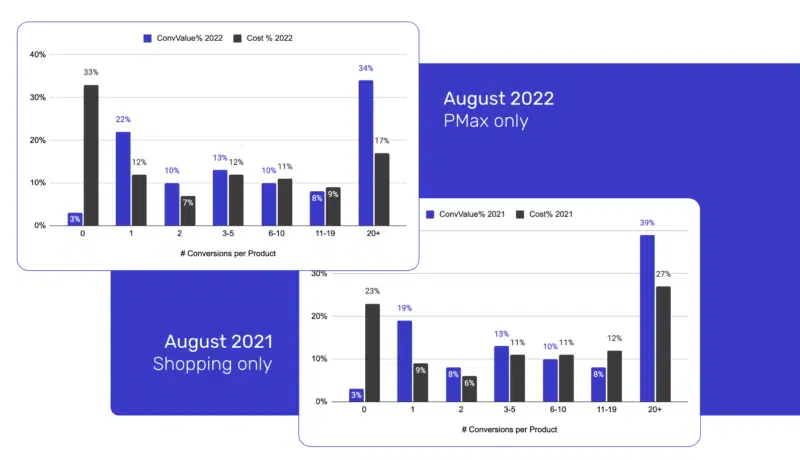
An analysis we conducted in August 2022 shows a cost share of 33% for non-converting products in PMax campaigns compared to a cost share of 23% in Standard Shopping campaigns. 

August 2022 - PMax vs. Shopping campaigns

In order to bridge the disadvantages of PMax, it is essential to pay attention to the campaign setup. The right data is the prerequisite for campaign segmentation.


Get the daily newsletter search marketers rely on.


PMax signifies a switch away from classic bidding

The only steering possibility PMax offers is to change the campaign-level ROAS goals and adjust the budget. This also means that inventory with specific ROAS targets should be treated adequately and set up as separate PMax campaigns. 

If you follow a margin-specific ROAS approach (e.g., ROAS goal of 10 for low-margin products, ROAS goal of 7 for mid-margin products and ROAS goal of 5 for high-margin products) you will ideally set up three campaigns. 

Other options to cluster campaigns are:

  • Performance data (ROAS of the last 30 days)
  • Inventory parameters (stock levels, new items, promotions)
  • Competition insights (price competitiveness, number of competitors)
  • Basket insights (order openers, items frequently bought together)

Remember that the data you choose for the campaign structure should reflect your overall business goals. 

If, for some reason, you need more steering possibilities for certain products, then consider testing a hybrid approach consisting of one or more PMax and Standard Shopping campaigns. 

Make sure that the products covered by each campaign type do not overlap.

The possibilities you have with asset groups

The asset group setup should follow a clear structure, for example, based on the webshop navigation. 

If you are a fashion retailer and only have a few categories, you may consider splitting them again into gender (and kids) to be more precise in addressing the audience. The maximum amount of asset groups you can use within a campaign is 100.

Make sure to use expressive creatives which represent your asset group and catch the user’s attention. Assets should be checked for relevance, especially when it comes to seasonal changes. 

For example, uploaded pictures showing the winter assortment should be exchanged in summer with pictures of t-shirts and shorts. Also, the text assets can be adapted for more fitting wording.

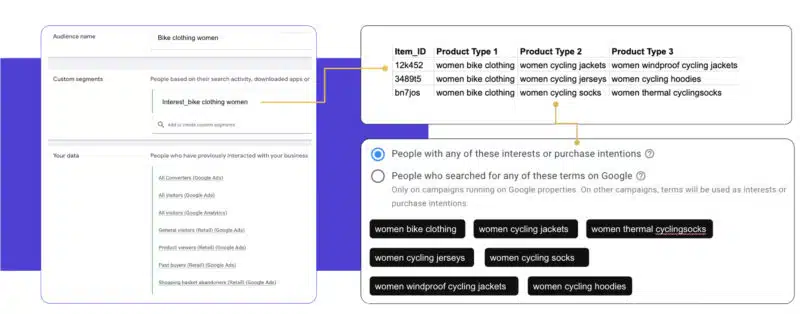
One of the main features within asset groups is audience signals. By enriching those, you can provide additional user information for the algorithm. 

PMax asset groups

An efficient way of adding relevant terms to the custom segments is by copying and pasting the related product types from your shopping feed attributes. The more information and terms you can provide, the better.

Brand traffic separation

If you want to keep the brand traffic in your search brand campaigns, you can try excluding the webshop’s landing page URL in the settings of your PMax campaigns. 

By doing so, the probability of being displayed for brand searches decreases and, naturally, the traffic shifts to your search brand campaigns. 

In addition, negative keywords can be added to PMax campaigns. Unfortunately, this is not possible through the Google Ads UI but has to be requested from Google. 

Testing opportunities for finding the optimal setup

As previously mentioned, the possibility of running a hybrid approach (PMax and Standard Shopping) can be considered when starting with PMax. This lets you use both the full-funnel advertising approach of PMax and the steering and reporting possibilities of Standard Shopping.

Another testing approach is to set up a shopping-only PMax campaign by connecting the feed, without inserting any assets. You might encounter an error message when creating a new campaign following this approach. 

Try to first set up and save a “normal” asset group that contains all assets. Afterward, you should be able to create a shopping-only asset group. This approach is not recommended by Google. However, it might be worth a try to split the shopping and search traffic in this way.

As PMax is a rather new and intransparent campaign type, it will need more time and tests to figure out the optimal setup.

Watch: Maximize your ecommerce campaigns with Performance Max

Below is the complete video of my SMX Next presentation.

[embedded content][embedded content]

Opinions expressed in this article are those of the guest author and not necessarily Search Engine Land. Staff authors are listed here.


Related stories

New on Search Engine Land

@media screen and (min-width: 800px) { #div-gpt-ad-3191538-7 { display: flex !important; justify-content: center !important; align-items: center !important; min-width:770px; min-height:260px; } } @media screen and (min-width: 1279px) { #div-gpt-ad-3191538-7 { display: flex !important; justify-content: center !important; align-items: center !important; min-width:800px!important; min-height:440px!important; } }

About the author

Ivana Dukic

Ivana Dukic has three years of working experience in marketing, particularly in the field of PPC. Before she started her professional career, she was studying Global Sales & Marketing and Digital Business Management. As a customer success manager, she works closely with retailers from various industries and supports them in improving their SEA channel performance. Specifically, her focus lies on the setup and optimization of Google Ads campaigns. Especially with the introduction of new Google Ads specifications and campaign types, just like the launch of Performance Max, those activities are gaining in importance.

https://searchengineland.com/how-to-maximize-your-ecommerce-campaigns-with-performance-max-391857