A PPC guide to permission-based audiences

Audiences are at the heart of marketing. Knowing who your ideal prospects are and what will inspire them to engage with your brand is the main question all campaigns need to address. 

Digital marketing (particularly PPC) has been rather spoiled for the past decade on targeting options. We’ve been able to know exactly who engages with us and use lists to create our own targeting. 

While many of our audiences are still available, there are far more rules to protect users. This is ultimately a good thing because it ensures we’re having consensual conversations with our people and not bothering folks who are likely never going to convert.

However, not all industries can use all audiences. 

This guide will cover:

  • The difference between native audiences and first-party data.
  • Strategies to acquire first-party audiences. 
  • How to marry audiences with the right messaging.

What is the difference between native audiences and first-party data?

Before we dive into audience strategy, it’s important to understand the difference between native audiences and the ones we build off of first-party data. 

Native audiences use behavioral data sourced from consent-based:

  • Search queries.
  • Sites visited.
  • Locations visited
  • Past purchasing behavior.
  • Persona models and machine learning.

These sources fuel audiences like:

  • In-market: Displays a strong probability of being interested in the product or service.
  • Life events: represents a high probability of going through a major milestone.
  • Affinity: Likely interested in overarching hobbies/goods/services.
  • Custom intent: Advertiser-influenced audiences based on search terms or sites visited.
  • Similar audiences (no longer targetable on its own): High probability of being similar to a first-party audience group.

Native audiences are built into smart bidding and represent a big reason to delegate bids to ad networks. However, given that their viability hinges on user consent, sometimes they struggle to staff or can’t be used by some industries. 

Advertisers can use observation mode to see which native audiences make up their traffic and exclude some audiences known to be undesirable. 

While you can set a target and observe to exclusively target native audiences, it means forfeiting the built-in algorithmic audiences. As such, it’s typically better to use native audiences in one of two ways:

  • Exclude unnecessary audiences and allow smart bidding to find your best people.
  • Use manual bidding and leverage native audiences as bid adjustments via observation mode.   

On the other hand, you can leverage your own data to build audiences.

First-party data (FPD) audiences rely on the following data:

  • Consent-driven emails/phone numbers/addresses (customer match).
  • Website traffic/conversions provided user consent is secured.

FPD audiences can be applied in the same ways as native, however, they also allow for more one-to-one targeting. Adding FPD audiences also improves PMax campaigns through audience signals and helps create more similar audience signals for your smart campaigns. 

At the end of the day, both audience types can serve well in accounts. 


Get the daily newsletter search marketers rely on.


Strategies to acquire first-party data audiences

First-party data audiences revolve around building trust with your prospects. Users are more than willing to consent to tracking and communication if it’s from a company they like and there’s value in it for them. 
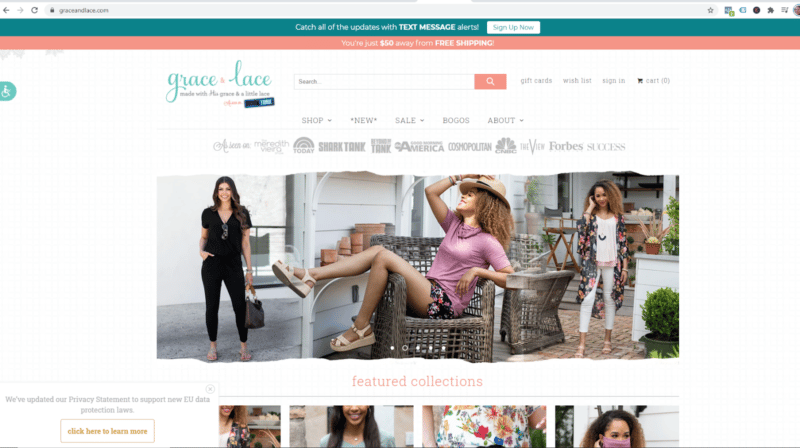
Website with trust signals

Adding trust symbols like awards, certifications, reviews, and publications can help folks know that your brand is worth investing the data into. While we’re mostly focused on audiences, this also helps get cookie consent for tracking. 

Pop-up offers are the most straightforward way to get FPD. They are viable in paid and organic campaigns and should factor in quality score and cumulative layout shift (CLS). Both require pop-ups to be delayed at least 5 seconds, however, ideally you’d wait at least 15 seconds.

There are three basic strategies to contact info collection (outside of lead generation):

  • Entrance offers.
  • Exit offers.
  • Valued member.

Entrance offers need to be engaging without being annoying. This can mean welcoming the user in your brand’s voice or inviting them to play a game for a discount. 

As a general rule, you’ll want to use two-step offer modules. By having the user “say yes” once, you’re getting them in the habit of continuing to say yes. This ensures they’re in the mindset to share info and ultimately make a purchase. 

Two-step welcome popup

This offer had the following performance in Q3 2022:
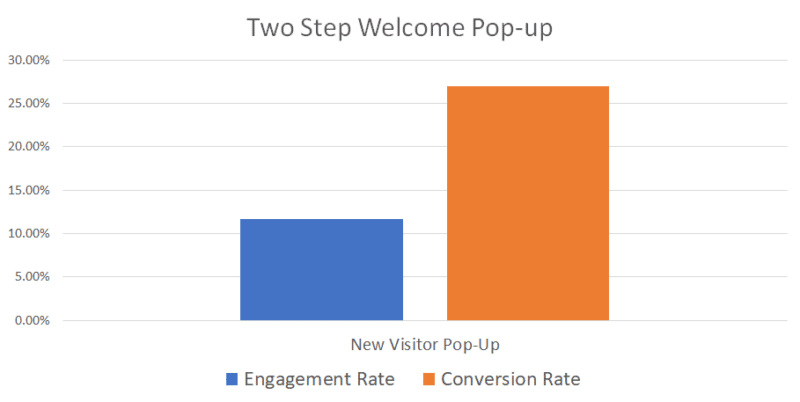
Two-step welcome popup - Conversion and engagement rates

The engagement rate on the pop-up is a respectable 12.5% and the conversion rate is 27%. It does a great job of getting the user to say “yes” and framing the discount as “my” code.

Using “my” instead of “your” helps cement the discount as if the potential purchase already belongs to the customer. 

Entrance offer using 'my'

Exit offers will have lower engagement, but they can still have powerful results. The creative should come across as genuine. Font should be easy to read and focus on the offer the user would be leaving behind. 
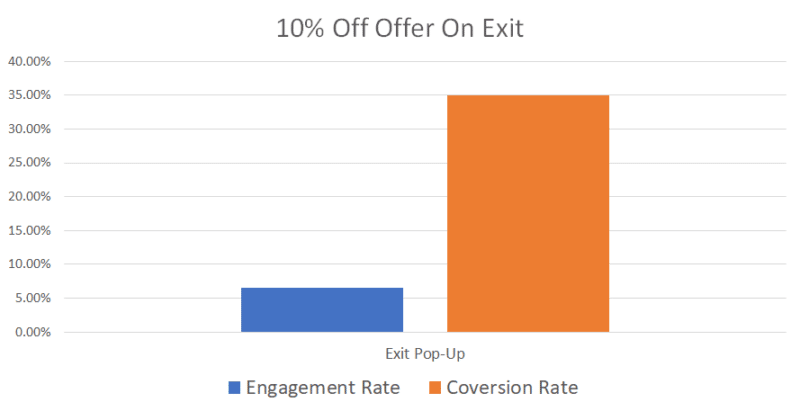
Exit offer - Engagement and conversion rates

While not the same level of engagement as the entrance offer, it’s worth noting the conversions (sales) were much higher. Don’t be afraid to ask. 

Valued member engagements can be hit or miss depending on how they’re designed. They should exude brand voice and let the user know they’re getting something of value:

  • Being the first to know about promos/product launches.
  • Newsletters with valuable content about the product/service.
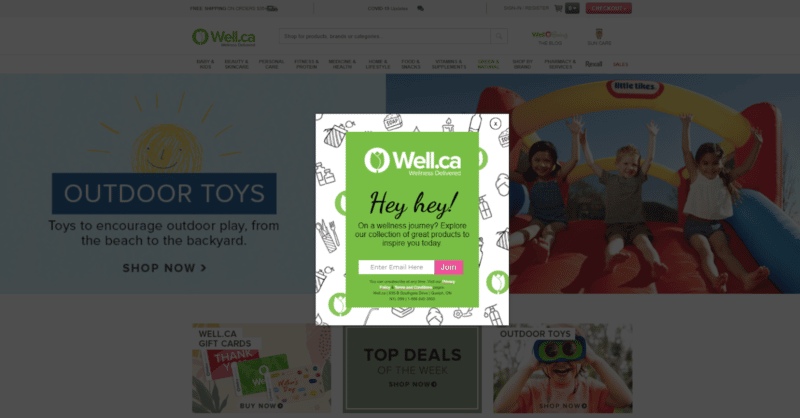
Pop-up offer exuding brand voice and value
Pop-up exuding brand voice and value.
Newsletter pop-up offering valuable content about the brand's products.
Newsletter pop-up offering valuable content about the brand’s products.
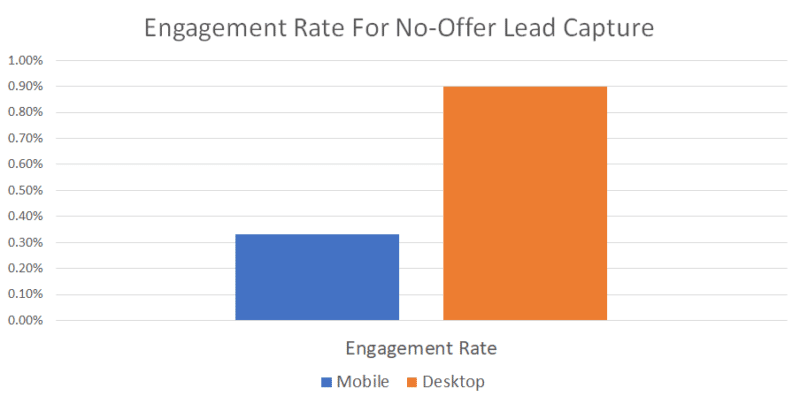
Desktop and mobile engagement rates for no-offer lead capture.

Make sure that all messaging is compliant with the privacy laws of your market. For example, you will need to specify in your creative that sharing the email will put the user on a mailing list (that they will need to opt out of). 

How to marry audiences with messaging

Ad creative is only as powerful as the match between messaging and audience. Whether creative “requires” a certain demographic to land, or it can be applied across all of your marketing personas, there still needs to be a synergy between the market and message. 
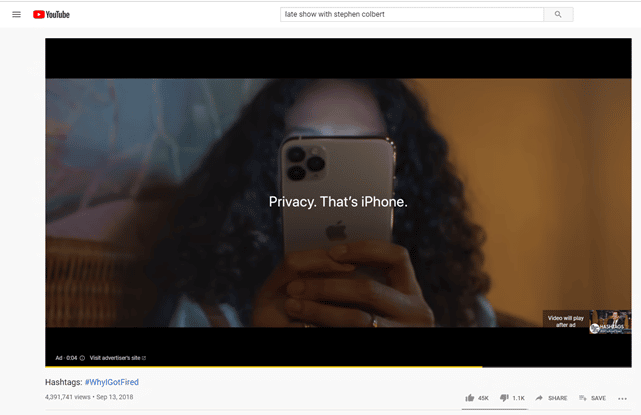
iPhone YouTube ad

What makes this ad so powerful is that it not only makes the point about privacy by covering the user’s face, but it also blocks out the identifying features. This means it can be applied to all user groups. 

Part of crafting the best creative is being mindful of how visual content needs to be. All ad platforms are focusing on video and images. 

Ad creative needs to honor the channel it’s being used for and the audiences you’re targeting. 

If a user is new to the brand (native audiences, etc.), brand voice and creating an emotional connection are far more important than a functional or transactional approach.

As the user gets more exposure, it will make sense to start serving creative to overcome objections or data to justify the impulse purchase.  
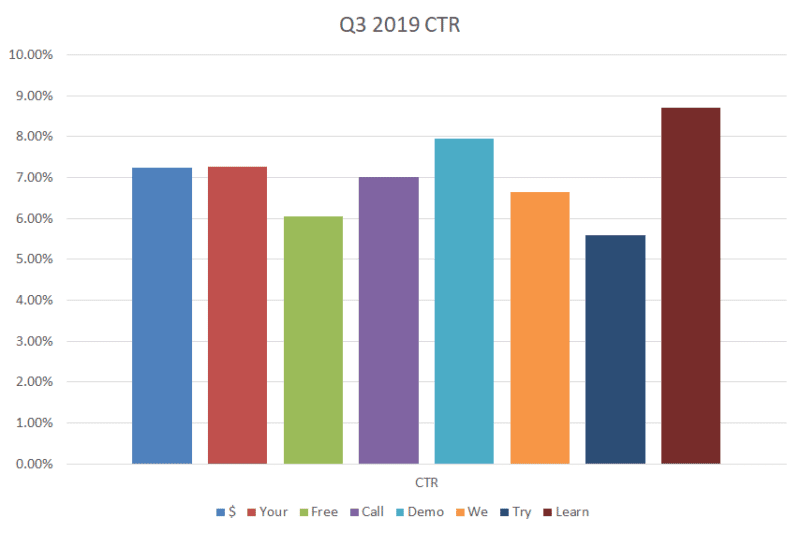
CTAs and CTRs
Based on 50,000 ads

Leverage data to build consent-based PPC audiences

Consent-based targeting is largely dependent on establishing trust and maintaining it. 

By using first-party data audiences in ad platforms you can improve ROI and brand sentiment.

Watch: Your guide to permission-based audience targeting

Below is the complete video of my SMX Next presentation.

[embedded content][embedded content]

Opinions expressed in this article are those of the guest author and not necessarily Search Engine Land. Staff authors are listed here.


Related stories

New on Search Engine Land

@media screen and (min-width: 800px) { #div-gpt-ad-3191538-7 { display: flex !important; justify-content: center !important; align-items: center !important; min-width:770px; min-height:260px; } } @media screen and (min-width: 1279px) { #div-gpt-ad-3191538-7 { display: flex !important; justify-content: center !important; align-items: center !important; min-width:800px!important; min-height:440px!important; } }

About the author

Navah Hopkins

A veteran of the digital marketing industry and “Top 25 PPC Expert,” she began as an SEO in 2008, transitioning to PPC in 2012. She manages the strategy and execution of paid media campaigns, as well as helping brands build relationships with profitable partners and customers. Throughout her career, Navah makes a point to give back and loves sharing lessons learned on the international speaking circuit as well as local universities. She is a frequent contributor to several publications and in 2019, she became a founding member of the Paid Search Association.

https://searchengineland.com/a-ppc-guide-to-permission-based-audiences-391228


This day in search marketing history: January 12

Google Panda becomes a core ranking signal

In 2016, Google Panda became baked into Google’s core ranking algorithm.

Google Panda was one of Google’s most significant spam-fighting algorithmsl First launched in February 2011, the final confirmed refresh was Panda 4.2, which started rolling out July 18, 2015.

A Google Panda algorithm guide, published on The SEM Post, included several then-new quotes about Panda from Google, attributed to a “Google Spokesperson.” Those included a statement that Panda was now part of Google’s core ranking algorithm:

Panda is an algorithm that’s applied to sites overall and has become one of our core ranking signals. It measures the quality of a site, which you can read more about in our guidelines. Panda allows Google to take quality into account and adjust ranking accordingly.

Read all about it in Google Panda Is Now Part Of Google’s Core Ranking Signals. And dig deeper into Panda in

And, as we learned at SMX Next in 2022 from Hyung-Jin Kim, the VP of Google Search, Google’s Panda algorithm later evolved into the Coati algorithm.


Also on this day 


Why does Google tip us off to search updates with minor ranking impacts but surprise us with the major ones?

2022: It’s the updates Google does not give us huge lead time to prepare for that have impacted rankings the most, like the core, Penguin and Panda updates.


E-commerce sales jumped this holiday season as search marketers weathered Google updates

2022: U.S. consumers spent $204.5 billion on ecommerce purchases during the holiday season, an 8.6% increase in online spending year-over-year.


Google Business Profiles sets waiting period for new owners and managers

2022: Newly granted users had to wait 7 days before they could manage all the features of the profile.


Yoast SEO 17.9 adds keyphrase performance tracking

2022: The free version let you track up to five keywords while the premium account let you track up to 500 to 10,000 keywords.


Google News performance report added to Google Search Console

2021: Google Search Console started showing you how well your news site performed in Google News and the Google News App.


Yelp launches “health and safety measures” community feedback feature

2021: Yelp launched a new rating feature for community to leave feedback on local business social distancing and mask compliance.


Google My Business video uploads now available to business owners

2018: Videos could appear on Google Maps and local search listings.


Search in Pics: Google Brain jacket, puppy dog eyes & deprecated GoogleBot

2018: the latest images culled from the web, showing what people eat at the search engine companies, how they play, who they meet, where they speak, what toys they have and more.


Google has officially killed off their link command

2017: Google said the feature is no longer around, and using a link:www.domain.com will likely return irrelevant results.


Google Had A Major Core Ranking Algorithm Update This Past Weekend

2016: Google confirmed what was described as a “massive update” was a core ranking algorithm update, not an expected Penguin update.


Charles Perrault Google Doodle Marks 17th Century Fairy Tale Author’s 388th Birthday

2016: A series of three Doodles honored the 17th century French author Charles Perrault on his 388th birthday, representing classics like “Cinderella,” “Sleeping Beauty” and “Puss in Boots”.


DMCA Takedown Database ChillingEffects.org Takes Itself Out Of Search Results

2015: The irony was almost too obvious to mention: an entity dedicated to monitoring the potential “chilling effects” of DMCA takedown notices censoring itself. 


Report: Google Translate To Provide Real-Time Translation Via App

2015: Google was planning to soon announce a major update to their Google Translate App that enabled real-time, automated translation.


Seeing Double: Yahoo, Bing Search Ads Show Duplicate Copy In Headlines And Ad Text

2015: Search ads on Bing and Yahoo were showing description line one of the ad copy in both the ad text and ad titles.


Google Doesn’t Know When Super Bowl 2015 Starts (Yet!)

2015: Why wasn’t Google providing the correct answer for the Super Bowl start time when year-after-year, it has been an issue for them?


Zomato Buys Urbanspoon For $50 – $60 Million To Enter US Local Search Market

2015: The Urbanspoon acquisition capped a six month buying spree in which Zomato acquired restaurant verticals in New Zealand, Poland, Czech Republic, Slovakia, Italy and Turkey.  


RIP Aaron Swartz, One Of The Earliest Google Bloggers

2013: The Google Weblog went up on March 17, 2002, two years before Google launched its own official blog.


To Understand Google Favoritism, Think “If Google+ Were YouTube”

2012:  Google effectively launched a “who to follow” search engine, a way to show people and companies with social accounts that searchers might be interested in. But it based that solely around Google+.


Google Swallows Hard, Renews Effort In China

2012: Google was “softening its tone” and “renewing its push” into China.


Google Search App For Android Updated

2012: The new update makes it easier and faster for searchers to use.


Foursquare Launches “Personalized Search For The Real World”

2012: Foursquare introduced its “Explore” feature, better keyword search and several new filters to help users drill down in search results.


Big Chains Launch “Hulu For Hotels”

2012: The functionality and design of the Roomkey site was good, but it wasn’t clear whether Roomkey was comprehensive enough to be truly competitive.


Session-Based Clicks Under Fire in WSJ Report

2011: Advertisers were complaining about Google’s practice of delivering ads within a user’s search session, but beside results unrelated to an advertiser’s purchased keywords.  


German Govt. Says Google Analytics Now Verboten

2011: German privacy officials were concerned about Google Analytics tracking web users’ IP addresses, which could violate an individual’s privacy.


Google Places Gets Its Own iPhone App

2011: The app seemed to focus more on the discovery side of local than on search, which distinguished it from the Apple-produced, default Maps app that’s more about directions and navigation than about locating businesses. 


Google Tweaks New AdSense Interface

2011: The default metrics on the Home and Performances reports were changed back to page-level metrics, the ad block/allow selector showed the product name, and more changes.


How Will Google Be Impacted By Verizon’s iPhone?

2011: Google wasn’t as central to the iPhone user experience as on Android but Google had a strong presence on the iPhone. 


UK Regulator To Crack Down On Paid Celeb Tweets

2011: The UK Office of Fair Trading (OFT) was expected to soon require disclosure rules when tweets were commercially sponsored.


Wolfram Alpha Redesigns For 2011

2011: In addition to a shiny, new, colorful home page, there were some interesting tweaks to the results pages, such as the addition of linked data inside the search results.


11 Months Later, Google Removes Google Japan’s PageRank Penalty

2010: Google.jp returned a toolbar PageRank score of 8. Prior to December 31, it was still a PageRank of 5.


VigLink: Fire & Forget Solution To Turn Outbound Links Into Affiliate Earners

2010: VigLink, a service with venture capital backing from Google, promised to turn any outbound link on a web site into an affiliate link after the installation of a small bit of JavaScript code.


Netconcepts Acquired By Covario

2010: Netconcepts was a Wisconsin-based SEO company founded by Stephan Spencer.


Baidu Hacked By Iranian Cyber Army

2010: This is the same group of hackers that took over Twitter’s web site for a short time period several months ago.


Proposed UK Law Would Immunize Search Engines Against Copyright Claims

2010: A proposed amendment to a pending UK law would have permitted search engines to index any or all of the content on a “publicly accessible website” through a “presumed . . . standing and non-exclusive license.”


Google Hires Ex-McCain Spokesperson For Top Communications Job

2010: Jill Hazelbaker replaced Matt Furman as head of corporate communications.


Bing Adds More Health Data To Search

2010: The health related queries were related to sicknesses, medicine, medical facilities, in addition to more generic health and fitness related queries.


Google Book Scanning Faces Chinese Challenges

2010: Apparently most of the 20,000 Chinese books Google scanned were from US libraries.


Google Docs Adds Files Storage, AKA GDrive

2010: New feature allowed you to upload files and share those files with friends, co-workers and colleagues. Google limited the file upload to 250 MB per file, with a maximum total of 1 GB of free storage. 


Google Just Says No To China: Ending Censorship, Due To Gmail Attack

2010: Google was heavily criticized for caving into China, especially in light of its “Don’t Be Evil” motto.


Calculating The Carbon Footprint Of A Google Search

2009: Performing two Google searches from a desktop computer could generate about the same amount of carbon dioxide as boiling a kettle for a cup of tea.


Firefox Drops Google For Yandex In Russia, But Big Loser May Be Rambler

2009: Their Russian users really wanted direct access to the Yandex search.


Report: Yahoo’s Search Ad Share Drops 36%

2009: Yahoo’s search ad share dropped from 30.4% in Septembe to 19.4% by December.


The Search Gap Between Consumers And Small Business Advertisers

2009: 78% of SMB respondents said they dedicated 10% or less of their overall budget to marketing efforts.


Yelp Case Settled, But Bigger Issues Remain For Search & Reviews

2009: A lawsuit over a Yelp.com review was settled, but the larger issue of how business owners, customers, and review sites will co-exist online remained wide open.


Joshua Schachter Lands At Google

2009: The founder of the Delicious.com bookmarking service and a former Yahoo executive, had his first day on the job at Google.


Wacky Idea: A Yahoo-Nokia Combination

2009: Nokia invest in or acquire Yahoo? Just a wacky thought – or was it?


Local And The Paradox of Participation

2008: Nobody wants to be the first one at a party or the only one in a restaurant.


Matt Cutts On Appealing Google Malware Warnings

2007: Cuttts said he had checked out a quite a few ‘we don’t have any malware’ reports, and had yet to see a false positive.


Eye Tracking In MSN Search

2007: Among the interesting findings: Adding information to result snippets significantly improved performance for informational tasks but degraded performance for navigational tasks.


Google: Free Real-Time Quotes Here To Stay

2007: The NYSE issued a proposal to the SEC that, if approved, would keep fees at a level that would allow Google to display real-time, last-sale prices across all Google properties.


Past contributions from Search Engine Land’s Subject Matter Experts (SMEs)

These columns are a snapshot in time and have not been updated since publishing, unless noted. Opinions expressed in these articles are those of the author and not necessarily Search Engine Land.


< January 11 | Search Marketing History | January 13 >


Related stories

New on Search Engine Land

@media screen and (min-width: 800px) { #div-gpt-ad-3191538-7 { display: flex !important; justify-content: center !important; align-items: center !important; min-width:770px; min-height:260px; } } @media screen and (min-width: 1279px) { #div-gpt-ad-3191538-7 { display: flex !important; justify-content: center !important; align-items: center !important; min-width:800px!important; min-height:440px!important; } }

About the author

Danny Goodwin

Danny Goodwin is Managing Editor of Search Engine Land & SMX. In addition to writing daily about SEO, PPC, and more for Search Engine Land, Goodwin also manages Search Engine Land’s roster of subject-matter experts. He also helps program our conference series, SMX – Search Marketing Expo. Prior to joining Search Engine Land, Goodwin was Executive Editor at Search Engine Journal, where he led editorial initiatives for the brand. He also was an editor at Search Engine Watch. He has spoken at many major search conferences and virtual events, and has been sourced for his expertise by a wide range of publications and podcasts.

https://searchengineland.com/earch-marketing-history-january-12-391722


Meta introduces new ad targeting limits for teens

Starting next month, Meta will remove the option for targeting advertising to teen users based on gender. They’ll also end advertisers’ ability to target personalized ads to under-18 users based on their in-app activity, including who they follow on Instagram and what Facebook pages they like.

After the changes take effect, personalized ads on Facebook and Instagram will only draw on a user’s age and location to determine relevance (where location is necessary to assess which products and services are available in a user’s area).

Facebook and Instagram will soon roll out new controls for teen users (kids under age 13 aren’t allowed on those apps — technically). Teens will be given an option to “see less” of a given topic, shaping which ads the platform will serve them.

Why we care. Advertisers will no longer be able to target users under the age of 18 based on in-app activity nor target their age or location, except where relevant. You’ll need to restrategize if you advertise a product or service to users under 18.

Not new. Meta recently rolled out new privacy updates for everyone under the age of 16, or 18 in some countries. Starting in November, teens will default to more private settings when they join Facebook. For teens already on the platform, Meta recommends making these changes manually. The new privacy settings affect:

  • Who can see their friends list
  • Who can see the people, Pages and lists they follow 
  • Who can see posts they’re tagged in on their profile

This month Meta was fined 390 million euros ($414 million) after European Union (EU) regulators found it had illegally forced users to accept personalized ads.

Google blocks ad targeting for kids under 18. In 2021 Google updated its policies around minors online, letting those under 18 remove images from search. “Children are at particular risk when it comes to controlling their imagery on the internet. In the coming weeks, we’ll introduce a new policy that enables anyone under the age of 18, or their parent or guardian, to request the removal of their images from Google Image results,” wrote Mindy Brooks, product and UX director for kids and families at Google.

YouTube will change the default upload mode to private for kids aged 13-17. SafeSearch will be automatically turned on for those under 18 using Google Search. Those under 18 will not be able to turn on their location history.


Related stories

New on Search Engine Land

@media screen and (min-width: 800px) { #div-gpt-ad-3191538-7 { display: flex !important; justify-content: center !important; align-items: center !important; min-width:770px; min-height:260px; } } @media screen and (min-width: 1279px) { #div-gpt-ad-3191538-7 { display: flex !important; justify-content: center !important; align-items: center !important; min-width:800px!important; min-height:440px!important; } }

About the author

Nicole Farley

Nicole Farley is an editor for Search Engine Land covering all things PPC. In addition to being a Marine Corps veteran, she has an extensive background in digital marketing, an MBA and a penchant for true crime, podcasts, travel, and snacks.

https://searchengineland.com/meta-introduces-new-ad-targeting-limits-for-teens-391259


12 new Google Analytics 4 ecommerce dimensions and metrics

Everyone’s favorite new Google product, Google Analytics 4 (GA4), has just released 12 new item and event-scoped ecommerce metrics and dimensions.

Why we care. Ecommerce advertisers and retailers will now be able to view and analyze specific information about products, services and interactions. You should also be able to see Items purchased and purchases by country, which shows you the number of items purchased and the number of purchases for each country.

ICYMI, Google will sunset Universal Analytics on July 1, 2023.

What’s new. You can now find the following new dimensions and metrics in the Explorations and the Data API:

  • Item affiliation
  • Item variant
  • Items added to cart
  • Items checked out
  • Items clicked in list
  • Items clicked in promotion
  • Items viewed
  • Items viewed in list
  • Items viewed in promotion
  • Shipping amount
  • Shipping tier
  • Tax amount

New naming conventions. Google has also renamed several metrics:

  • Add to carts (previously called Add-to-carts)
  • Item-list click events (previously called Item list clicks)
  • Item-list view events (previously called Item list views)
  • Item view events (previously called Item views)
  • Items purchased (previously called Item purchase quantity)
  • Promotion clicks (previously called Item promotion clicks)
  • Promotion views (previously called Item promotion views)

Dig deeper. Review the official Analytics Help documentation here.


Related stories

New on Search Engine Land

@media screen and (min-width: 800px) { #div-gpt-ad-3191538-7 { display: flex !important; justify-content: center !important; align-items: center !important; min-width:770px; min-height:260px; } } @media screen and (min-width: 1279px) { #div-gpt-ad-3191538-7 { display: flex !important; justify-content: center !important; align-items: center !important; min-width:800px!important; min-height:440px!important; } }

About the author

Nicole Farley

Nicole Farley is an editor for Search Engine Land covering all things PPC. In addition to being a Marine Corps veteran, she has an extensive background in digital marketing, an MBA and a penchant for true crime, podcasts, travel, and snacks.

https://searchengineland.com/12-new-google-analytics-4-ecommerce-dimensions-and-metrics-391251


3 growth paths in 2023 with Google Ads by Adthena

With continuous Google algorithm updates and feature changes, paid search marketers live in a world where their efforts to generate clicks or conversions are constantly disrupted. Add the layer of economic uncertainty to the table; now, revenue is at the top of everyone’s list of priorities.

Now is the time to power into 2023 the right way by being in control of your Google Ads performance and outcomes.

Join Ashley Fletcher, VP of marketing at Adthena, in this insightful SMX Next presentation to understand how to identify where you can reduce your marketing costs and increase profitability without hurting revenue.

During the session, you will learn how to deploy budgets through better automation, be the protector of your brand traffic and turn off those pesky “Lone Rangers.”

This year might bring a need for more transparency, making it difficult for search marketers to course-correct campaign pointing. With these session takeaways, you’ll go into that with caution and navigate through performance pressure. 


Related stories

New on Search Engine Land

About the author

Adthena

Adthena is an award-winning search intelligence platform. Our unique combination of patented, AI-driven technology and a world-class team of experts helps brands, marketers, and agencies across the globe dominate their competitive landscapes. We provide our customers with a clear view of the paid search landscape, helping them optimize their spend to increase ROI, all while saving them time and better informing their cross-channel strategies.

https://searchengineland.com/3-growth-paths-in-2023-with-google-ads-390943


TikTok, Facebook and beyond: Driving ROAS outside of Google and Microsoft

Search is amazing – and there are compelling reasons why it is the cornerstone of all of our media plans: 

  • It’s extremely targeted, reaching exactly the people who are looking for our content, so they can be served with highly targeted ads. 
  • It’s highly transparent – you can see the exact performance metrics.
  • It’s very measurable, especially when you use a tool like Google Analytics. 

Of great value to many, the creative needs are far less demanding. It helps not to worry about images, video assets or animations. Clients love it for these reasons, too.

Especially when considering last-click attribution and return on ad spend (ROAS), search is always going to over-index as one of the stronger performance channels.

But after you master search, what’s next?

Working with brands in this changing digital landscape means you need to:

  • Consider that your search campaign will hit efficiency limits.
  • Determine how to scale at the right spend levels. 
  • And more so, explore how to reach new audiences. 

Younger audiences, particularly, are searching very differently. While they are still on Google and Bing, they’re also looking at TikTok, YouTube or Instagram, depending on the search query. 

Foregoing the funnel

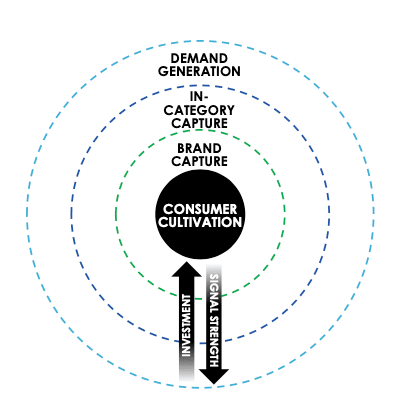
To go beyond the traditional strategy, it’s time to shift our thinking beyond the traditional marketing (purchase) funnel and into signal planning, centered more around the consumer than the marketer’s needs.

Focusing on a consumer map helps us to better identify our audiences at their individual path to purchase based on the signals they provide back to us. 

A consumer map allows us to identify the target's individual need state.
A consumer map allows us to identify the target’s individual need state.

Within this map, your active consumers sit in the middle, and that is where your first dollar should go.

As you expand beyond active consumers into those that are aware, in-category or general demand generation, the signals you get from channels are weaker.

While you’ll spend less in those areas, you can still reach new audiences. This is an important framework as it maximizes the inner circles with slow expansion while focusing on ROAS.

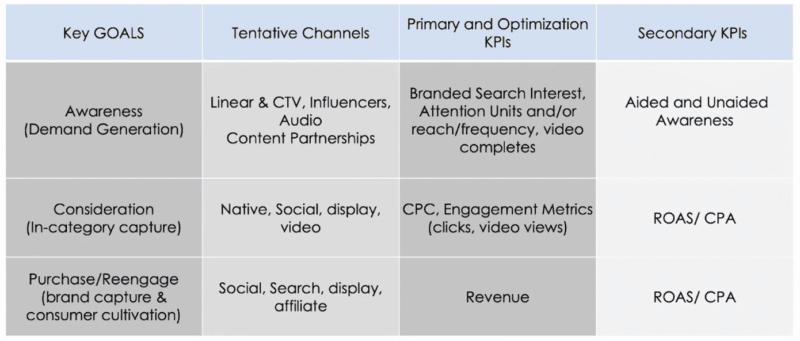
Building on this consumer map, the next step is to develop a custom measurement framework to identify key goals, tentative channels, and primary and secondary KPIs. 

Custom measurement framework

Looking at your brand’s need for demand generation, for example, you might decide that potentially successful channels for your media efforts are linear and CTV, influencers, and audio content partnerships. 

Track KPIs beyond just reach and frequency, such as branded search interest, which is basically search impressions on your branded keywords.

KPI is valuable because it can have the halo effect of new channels by improving your search spend and your search efficiency. This will also impact organic traffic, so you can quickly get people who are aware to your website, knowing that they’re really engaged. 

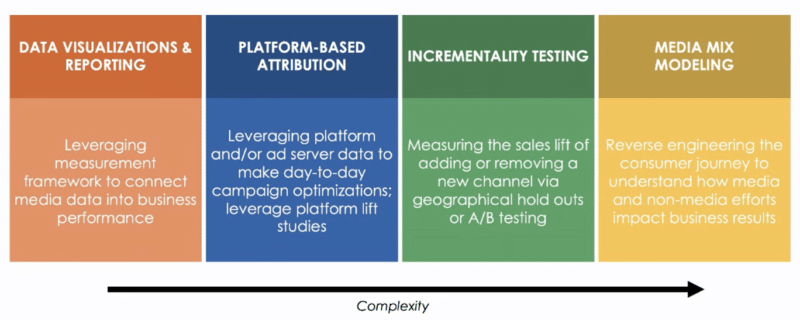
Building a measurement plan

From here, examine how best to measure success. There are four basic options – with varying levels of complexity – that can be tailored to your media mix and budgets.

  • Data visualization and reporting.
  • Platform-based attribution.
  • Incrementality testing.
  • Media mix modeling.

Most clients, depending on campaign needs, will only rely on two or three of these.

Measurement plan

As a baseline, ensure you have clear reporting automation, ideally in a dashboard to review and analyze real-time performance.

After graduating from that, you might look at platform-based attribution (i.e., the Campaign Manager 360 Model), where you can think a little bit more about consideration tactics.

If your campaign is focused on awareness, you can also look at options like incrementality testing. For instance, you’re going to launch a new channel, and it’s more upper-funnel (like YouTube or CTV), you might only go live in a few key markets.

Comparing the success of these efforts to markets where you weren’t live will give you some scientifically proven data to show what’s working. You can use that as a guide to scale and go larger.

Lastly, when sophisticated enough, look at media mix modeling or multi-touch attribution.

Test, test and test

Likely the most important step in the process is focused on the testing plan, which is critical to driving more rigor into your measurement strategy. The testing plan will ideally include:

  • Test details.
  • Learning objectives.
  • Test length.
  • Run dates.
  • Primary and secondary KPIs.
  • Channel.
  • Intended action.
  • Conflict.
  • Results.

Get the daily newsletter search marketers rely on.


Picking platforms

With the measurement plan locked in, it’s time to choose the channels or platforms that make the most sense for your campaign.

To do this, take the various stages represented in the consumer map and line them up with the sample signals you see from your consumer behaviors. 

Align media channels and signals against the consumer map.

Staying with our previous example of demand generation, you might line that stage up with signals such as adjacent category purchases, wedding planning, or moving to a different climate.

Many channels can run across all stages of the consumer map, but we know which channels can be full-funnel and prioritize those based on budget and what best suits our particular portion of the consumer map.

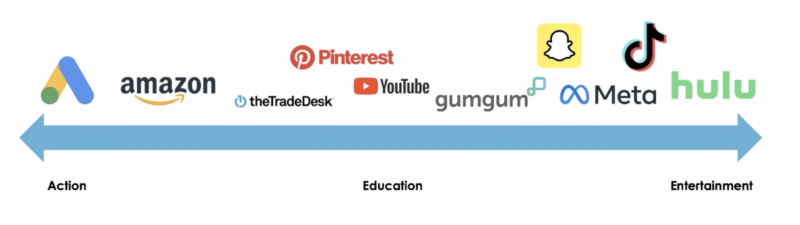
In addition, look at platforms against the consumer behavior to prioritize areas of action.

Analyze platforms based on consumer behavior.

On a spectrum that ranges from “action” to “entertainment” (with a range of “education” somewhere in the middle), use more common consumer behaviors to help guide channel selection.

Based on the consumer’s mindset, you can also get cues that inform creative decisions and which platform will have the right ROAS. This is another way to think about scaling beyond search.

Creative is critical

Even with the best marketing strategy, targeting and measured framework, if you’re not employing the proper quality and quantity of creative (or not leveraging the same creative all the way across the funnel), your campaign won’t be successful. 

Ensure you have the right quality and quantity of creative to win beyond search.

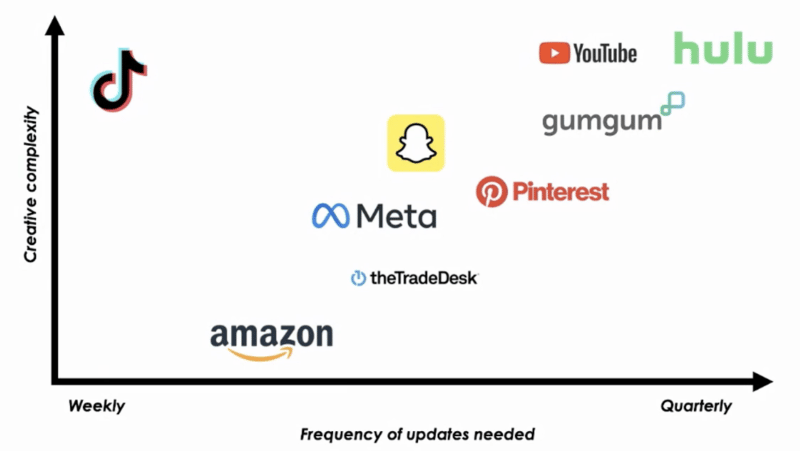
Knowing the best creative decisions to make can be informed by determining how complex the creative needs to be.

While virtually every brand is currently interested in TikTok (for good reason), the best practice on that channel calls for creative swaps nearly every week. Most brands are simply not “creatively ready” to meet that production schedule and associated costs. 

In the case of CTV, like YouTube and Hulu, the refreshes are not as frequent, but the creative has to be of very high quality.

Channels like programmatic or Meta, on the other hand, require fewer updates (monthly/bi-monthly) and can suffice with slightly lower creative complexity. Of course, these depend on budget and audience size – there are trade-offs.

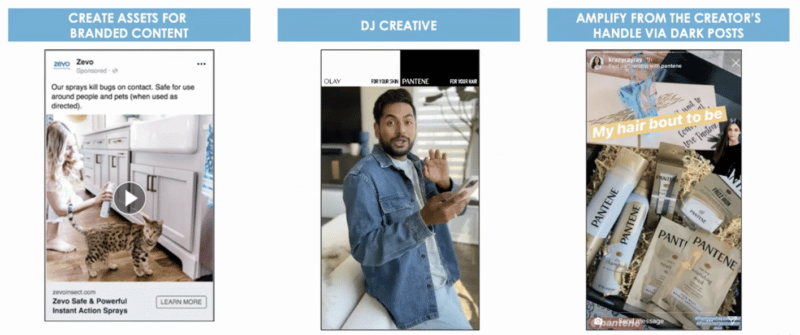
It’s also increasingly important to consider the creators you can partner with and how they can be used for ads. Especially on channels like Meta and TikTok, influencer assets can be wildly successful and highly cost-effective.

Fully leverage influencers as extensions of your creative team.

There are different ways to see a positive outcome, too. In addition to branded posts where you simply use the creator as an extension of our creative team, you can amplify straight from the influencer’s handle. This usually gets the best CTA, as you can edit the caption to drive action.

Somewhere in between, there is also a lot of success with “mashups,” where a creative team takes assets already created by the influencers and parlays them into something that can have other points of differentiation or various experiences to best resonate with your diverse audiences.

Cohesive touchpoints

The final consideration in terms of scaling beyond search is making sure the campaign is cohesive and integrated.

Ensure that the whole marketing ecosystem is fully functional and primed to be successful in working behind the media KPIs that you’ve established with your client. 

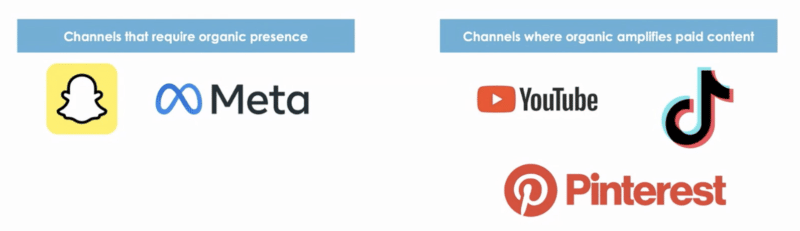
Ensure your organic presence supports paid media and that you have a community management plan.

There is more detail to consider, especially as variables specific to your campaign come into play, but these basic steps will help you to scale up beyond Google and Bing while keeping the business focused on ROAS.

Watch: Tik Tok, Facebook, and beyond: Driving ROAS outside of Google and Microsoft

Below is the complete video of my SMX Next presentation.

[embedded content][embedded content]

Opinions expressed in this article are those of the guest author and not necessarily Search Engine Land. Staff authors are listed here.


Related stories

New on Search Engine Land

@media screen and (min-width: 800px) { #div-gpt-ad-3191538-7 { display: flex !important; justify-content: center !important; align-items: center !important; min-width:770px; min-height:260px; } } @media screen and (min-width: 1279px) { #div-gpt-ad-3191538-7 { display: flex !important; justify-content: center !important; align-items: center !important; min-width:800px!important; min-height:440px!important; } }

About the author

Freddy Dabaghi

Freddy leads MMI‘s media team out of Texas, supporting clients by identifying new opportunities to drive business results efficiently and effectively. By aligning media with marketing goals, he helps marry brand values with insights in ways that drive growth and inspire consumers to engage. Over the last 14 years, he’s largely worked with digital disrupters and category leader brands in the CPG space. Freddy charges his team to be true partners to MMI’s clients – through a data-first mindset, constant knowledge-sharing of our expertise and points of view, and a persistent focus on driving our clients’ business growth.

https://searchengineland.com/tiktok-facebook-beyond-driving-roas-outside-google-microsoft-391145


This day in search marketing history: January 11

The mobile intrusive interstitials penalty

In 2017, Google started rolling out the mobile intrusive interstitials penalty.

In August 2016, Google announced plans to lower the rankings of pages “where content is not easily accessible to a user on the transition from the mobile search results” – and that crackdown would begin on Jan. 10, 2017.

Why did Google do this? They believed this type of ad was “problematic” on mobile devices with smaller screens.

Google explained which types of interstitials were going to be problematic, including:

  • Showing a popup that covers the main content, either immediately after the user navigates to a page from the search results or while they are looking through the page.
  • Displaying a standalone interstitial that the user has to dismiss before accessing the main content.
  • Using a layout where the above-the-fold portion of the page appears similar to a standalone interstitial, but the original content has been inlined underneath the fold.

Read all about it in: Google confirms rolling out the mobile intrusive interstitials penalty yesterday.


Also on this day 


Google’s page experience update coming to desktop next month

2022: This was just a reminder about an update that wasn’t expected to be big.


Microsoft Advertising Shopping campaigns reporting enhancements

2022: Plus, Microsoft Audience Network, Similar audiences and in-market audiences expanded.


Google updates the Search Console coverage report

2021: The updated report gave specific categories and labels for errors and responses.


Facebook blocks Trump for remainder of term while Twitter sets permanent ban

2021: Numerous advertisers had paused their social media campaigns over the events at the Capitol.


Video: Phillip Thune on FindWhat competing with GoTo, Overture, Yahoo and Google Ads

2021: In this installment of Barry Schwartz’s vlog series, he chats with Thune about the early days in the search industry, his role in running Textbroker and more.


2019: Adverisers who hadn’t set up manual sitelink descriptions in non-brand campaigns probably wouldn’t have liked what they saw.


Smart speaker sales grew 103% last year

2019: The virtual assistant devices became the fastest-selling consumer technology, dramatically outpacing wearables and VR.


What Time Is The Super Bowl? Google & Bing Are Confused

2016: The information showing was for last year, including listing the teams for last year.


Alice Paul Google Doodle Marks 131st Birthday Of The American Suffragist & ERA Activist

2016: The Google Doodle honored Alice Paul, the American suffragist who played an integral role in getting the 19th Amendment passed, giving women the right to vote, and was the original force behind the Equal Rights Amendment.


2013: Overall query volume appeared to be declining as mobile devices cannibalized traffic.


2013: StumbleUpon was getting regular requests each week from people asking for it to remove links to their sites. Why? They were worried that being linked to by a popular and long-standing social media sharing site was somehow hurting them with Google.


2013: An image search feature that was often used by bloggers and other content producers returned – and it expanded to image searches on mobile devices.


Search In Pics: Panda & Penguin Speakers, R2D2 Android & Google Workshop

2013: The latest images culled from the web, showing what people eat at the search engine companies, how they play, who they meet, where they speak, what toys they have, and more.


Real-Life Examples Of How Google’s “Search Plus” Pushes Google+ Over Relevancy

2012: A closer look at the changes, including how they turn Google+ into an essential social network for any search marketer.


Google “Search Plus” Impact on Local: Limited So Far

2012: Based on an unscientific query survey, the impact seemed to be minor.


Reports: Mobile Search Impressions Explode, CTRs Beat PC

2012: Mobile [paid] search ad spend was up 269% YoY and impressions were up 317%.


Google Flight Search Expands, Now Showing More Routes

2012: Google remained tightlipped about exact numbers, but a spokesperson confirmed that “since launch we’ve more than doubled the number of domestic (i.e., U.S.) routes available in the feature.”


Google Logo For Nicolas Steno: Father Of Modern Geology

2012: The logo symbolized the study of the earth, from the ocean to the mountain tops.


Tim Mayer: Search Vet & Ex-Yahoo Lands At Trada

2011: Mayer joined the crowdsourced SEM marketplace as its Chief Strategy Officer, overseeing sales, marketing, product development and operations. 


Google Eases Management of Negative Keywords, Changes AdWords Display

2011: Google changed its AdWords interface to allow marketers to use a single negative keyword list across multiple campaigns.


New AdWords Tool Introduced For Better Understanding Of Mobile Searchers

2011: With mobile searches growing by leaps and bounds, Google introduced an option on its keyword tool that let marketers find keyword suggestions for mobile devices.


Yahoo-Bing Gaining On Google In Some Paid Search Metrics: Report

2011: The transition led to small drops in click share and spend share, and a larger drop in overall paid search ad impressions for Yahoo-Bing. But, the flip side of that was a gain in revenue-per-click (RPC).


Google Pushes Hotpot Activity To Maps’ Home Page

2011: Anyone logged into a Google account would see recent activity from their Hotpot friends in the left-side window.


Off The Radar: Why Airlines On Travel Search Engines Are Going Missing

2011: It was a standoff between online travel agencies and airlines.


Foursquare Improves, Expands Information For Businesses

2011: Foursquare went after local businesses and major brands with an improved and expanded content section that explained how they could take advantage of Foursquare’s platform.


Google Launches A Worldwide Science Fair For Teens

2011: Google itself was basically a science project developed by its founders, Larry Page and Sergey Brin, way back when.


German Govt. Says Google Becoming ‘Giant Monopoly’

2010: Germany’s justice minister threatened government action if Google didn’t become more transparent.


Yahoo Beefing Up Social Scientist Staffing In Yahoo Labs

2010: The company was beefing up Yahoo Labs, hiring a range of social scientists and academics and doing new research


The End of Yahoo Shopping? Company Substantially Outsourcing To PriceGrabber

2010: Merchant listings would now come from PriceGrabber and ecommerce sellers would only be able to get into Yahoo Shopping via PriceGrabber or Yahoo Search (Bing).


2010: Google News marked the article in the “most viewed” section of Fast Flip – go figure!


Bing Flashes Their Basketball Skills With NBA Results

2010: Bing’s results for NBA got “smarter”.


The Big List: 2010 Marketing Predictions & Resolutions

2010: Links to so many articles offering predictions and resolutions for 2010.


2009: But only until Wired put a robots.txt block on links coming out of the semi-Wikipedia challenger.


2009: Google Checkout Trends was a flavor of Google Trends, but limited the data to that collected from Google Checkout merchants.


Yahoo Directory Places Images On Sponsored Ads

2009: The images appeared on the left side of each sponsored result within the directory pages.


The New Yorker On Google: Avoiding Regulation, Arrogance

2009: How Google’s growth frightened those with vested interests (Viacom, Microsoft), as well as consumer and privacy advocates.


Isabel Aguilera, CEO of Google Spain & Portugal, Leaving

2009: She became Google Spain’s CEO on March 1, 2006.


Facebook’s Zuckerberg In the Hot Seat In Upcoming “60 Minutes” Interview

2009: Where he would be asked about the Beacon controversy and the challenge of leveraging the social graph for the benefit of advertisers.


Yahoo Moves Metasearch Engine FareChase To Travel Homepage

2009: Attributed to the nearly $200 million acquisition of SideStep by competitor Kayak 


Microsoft Business Division Head Raikes Retiring

2009: He would be succeeded in that same role by Juniper Networks’ COO Stephen Elop.


Search in Pictures: Jeremy Zawodny Weds, Google’s Mascot, Yahoo’s Clothing Line

2009: The latest images culled from the web, showing what people eat at the search engine companies, how they play, who they meet, where they speak, what toys they have, and more.


New AOL Finance Gains Market Share To Become Top Site

2009: AOL’s new finance site passed Yahoo Finance and MSN Money to become the web’s top finance destination.


January 2007 Update On Google Indexing & Ranking Issues

2007: PageRank updates, supplemental listings, filetype command changes, lost home pages in country-specific results, an update on the disappearing sex blogs, concerns that CSS is being spidered to detect hidden text, duplicate content worries, the Minus 30 penalty and what to do if Google thinks you are a malware site.


More Rounds In The “Is SEO Overrated” Debate

2007: The seemingly never-ending debate continues.


Interview with Ask.com “Head Chef” and CEO Jim Lanzone

2007: On his vision and his role within both Ask and parent company IAC.


Zuula Meta Search Engine

2007: It provided access to search engines in the areas of Web, News, Images, Blogs and Jobs. It displayed results from one search engine, searchers click on another engine tab and it displays results from that one and so on.


SEMPO Board Of Directors Nominations Open

2007: For the 2007-2008 Board Of Directors election.


From Search Marketing Expo (SMX)


Past contributions from Search Engine Land’s Subject Matter Experts (SMEs)

These columns are a snapshot in time and have not been updated since publishing, unless noted. Opinions expressed in these articles are those of the author and not necessarily Search Engine Land.


< January 9 | Search Marketing History | January 11 >


Related stories

New on Search Engine Land

@media screen and (min-width: 800px) { #div-gpt-ad-3191538-7 { display: flex !important; justify-content: center !important; align-items: center !important; min-width:770px; min-height:260px; } } @media screen and (min-width: 1279px) { #div-gpt-ad-3191538-7 { display: flex !important; justify-content: center !important; align-items: center !important; min-width:800px!important; min-height:440px!important; } }

About the author

Danny Goodwin

Danny Goodwin is Managing Editor of Search Engine Land & SMX. In addition to writing daily about SEO, PPC, and more for Search Engine Land, Goodwin also manages Search Engine Land’s roster of subject-matter experts. He also helps program our conference series, SMX – Search Marketing Expo. Prior to joining Search Engine Land, Goodwin was Executive Editor at Search Engine Journal, where he led editorial initiatives for the brand. He also was an editor at Search Engine Watch. He has spoken at many major search conferences and virtual events, and has been sourced for his expertise by a wide range of publications and podcasts.

https://searchengineland.com/search-marketing-history-january-11-391222


3 PPC marketing trends to keep a pulse on in 2023

As we begin 2023, it’s a good time to reflect on the macro-level trends we’ve observed last year. 

Here are a few trends that I believe have some staying power and should be considered as you build out your 2023 search marketing strategies.

1. A slow economy and heightened focus on efficiency

In case you haven’t heard, the economy has been struggling (that’s a joke). I graduated with a degree in economics, but like most of us, I have no idea how long this downturn will last. 

That said, I think many digital marketers are already feeling the impact.

  • Budgets are tightening.
  • Teams are getting leaner.
  • Questions such as “What’s the ROI?” or “What’s the CPA?” are becoming more prevalent. 

These environments are tricky to navigate and I certainly don’t have all the answers.

However, the advice I usually start with is leaning into your data. Make sure you have a deep understanding of your top-performing tactics and maximize your investment there first.

An analogy I often use is the concept of a sports team in the playoffs. When it comes to crunch time, a coach will always put their best players in the game for as much time as possible. Those players who are still developing are likely going to be watching the game from the bench. 

Take this same mindset when it comes to your search strategies. If your budget is limited, prioritize your investment on the tactics driving the most return. 

I’m sure many of you reading this are saying, “Yeah, thanks for stating the obvious.” But when I say this, I don’t mean simply consolidating to a brand keyword strategy. Instead, you should: 

  • Dig into the various segments of your campaigns’ performance. 
  • Understand what devices, audiences, geos, times of day/days of week, and campaign types drive the most efficient performance. Focus your investment on those combinations of segments first.
  • Consider creating a more granular campaign delineation to more effectively skew spend toward the top-performing combinations. 

Get the daily newsletter search marketers rely on.


2. Automation vs. autonomy

This debate originated well before 2022. However, I do think the heat was turned up a bit last year with:

Machine learning is getting stronger and will continue to be woven into campaign management platforms.

I believe that to be successful in 2023, you must best balance the power of automation with the autonomy required to achieve your stakeholder’s objectives. 

Think about when you are setting up an automated bid strategy. Part of that process is providing the algorithm with business-specific guardrails that it should operate between – and toward. The better the inputs you provide, the more closely your results will align with your objectives. 

I think that same mindset should be leveraged with applications of AI more broadly in campaign management platforms.

Automation reduces the resources required for foundational tasks. But, we still need to guide it to work toward our business objectives. 

More tactically, think about what datasets you can incorporate. The more inputs you’re providing, the more data points that these algorithms can use to inform the optimizations and recommendations. 

In addition, think about what levers you need to maintain control over and where you can free up your grasp by relying on machine learning to make the optimizations for you

Lastly, consider how to structure your accounts to allow the automation to perform best. 

That balance of automation and autonomy will differ based on the complexity of your strategy.

Advertisers who have the best understanding of what this balance should be for their business stand to benefit.

3. Microsoft on the rise?

What would an article like this be without at least one opinion that is a little “edgy.” Buckle up, folks!

I’ve been pretty impressed with the updates that came out of Microsoft last year. They’ve not only expanded their ad offerings but also their geographic reach by about 70 new markets. 

Microsoft Advertising has always touted their lower costs and comparable features to Google, but we are starting to see some innovation (i.e., Multimedia Ads) unique to the platform.

Let’s be clear – I’m not expecting a significant shakeup in search engine market share. However, if you haven’t looked at innovation opportunities on Microsoft Advertising, now might be as good a time as any. 

The (generally) lower CPCs make it a solid testing environment and much of the innovation they’ve incorporated can help to improve conversion rates. 

Improving conversion rates combined with cheap CPCs sounds like an opportunity worth circling back to in budget-constrained environments. 

This recommendation is particularly relevant for B2B advertisers, as Microsoft Bing is an engine where we have seen particularly strong engagement, likely due to research taking place on work devices.  

Search marketing’s staying power in 2023

Now is an incredibly exciting time to be in search marketing. The platforms are making plenty of updates that it’s hard to keep up.

Search marketing is one of the most powerful tools in the digital marketing toolbox. Other than search, there are only a few other environments where users indicate their interests so clearly. 

I’ve highlighted a few of the trends I’m keeping a pulse on, but in our fast-paced industry, there are likely plenty more trends that you will consider as you build out your 2023 strategy. 


Opinions expressed in this article are those of the guest author and not necessarily Search Engine Land. Staff authors are listed here.


Related stories

New on Search Engine Land

@media screen and (min-width: 800px) { #div-gpt-ad-3191538-7 { display: flex !important; justify-content: center !important; align-items: center !important; min-width:770px; min-height:260px; } } @media screen and (min-width: 1279px) { #div-gpt-ad-3191538-7 { display: flex !important; justify-content: center !important; align-items: center !important; min-width:800px!important; min-height:440px!important; } }

About the author

Anthony Tedesco

Anthony Tedesco is a search engine marketing professional based in Boston, Massachusetts. He started his career at Red Ventures in Charlotte, North Carolina, where he learned the impact of data-driven performance optimization and full-funnel marketing strategies. He then returned to his native Boston, where he joined DWA/Merkle B2B, working with Fortune 100 brands to maximize the value of their SEM investments. In 2021, Anthony joined the global paid media team at Cisco Systems, Inc., where he orchestrates high-impact tactics at scale and helps solve the complex challenges marketers face in the evolving digital landscape. Anthony is an avid Tar Heel and Boston sports fan. If not watching his favorite teams, he enjoys traveling to New England with family and friends or catching up on old seasons of Survivor.

https://searchengineland.com/ppc-marketing-trends-2023-391165


This day in search marketing history: January 10

Google’s results got more personal with Search Plus Your World

In 2012, Google’s search results were radically transformed as a new “Search Plus Your World” format began rolling out.

Google started mixing together content from the web with content that had been shared with you privately into a single set of listings.

Search Plus Your World didn’t cover content on Facebook, Twitter, or any social networks where content could be shared to a more limited audience. Really, “Search Plus Your World” was best described as “Search Plus Google+”

Twitter was quick to express concerns, stating that Search Plus Your World was “bad for people, publishers, news organizations and Twitter users.”

Read all about it in: Google’s Results Get More Personal With “Search Plus Your World” and follow-up article Search Engines Should Be Like Santa From “Miracle On 34th Street”.


Also on this day 


Google Ads releases disapproved ads auditor tool

2022: It let advertisers review and delete policy-violating ads across accounts.


Google launched subtopics ranking in mid-November

2021: Google subtopics ranking was meant to help deliver search results with a greater diversity of content when searching for something broad.


Google Ads testing custom dimensions to enable reporting based on your business structure

2020: Advertisers could group and report on campaigns with a hierarchical structure to see performance by business category or marketing strategy.


Microsoft Advertising’s PromoteIQ integration for retailers, brands is now in beta

2020: The company was also starting to make its new on-site search product Microsoft Bing for Commerce available to retailers.


Yelp cracks down on ‘review rings’ as Google continues to see widespread mapspam

2020: Yelp introduced a new category of consumer alerts intended to flag businesses “that may have received reviews from deceptive review rings.”


Google’s internal SEO strategy: Make small changes, embrace change, consolidate

2019: Google was making, on average, more than 200 changes to its 7,000 internal websites on a daily basis.


SEOs noticing ranking volatility in Google’s search results

2019: An unconfirmed Google update? Especially around Jan. 5, 6 and 9, the SEO community was discussing both positive and negative ranking changes.


Google may be headed for victory in EU right-to-be-forgotten indexing appeal

2019: The top legal advisor for the European Court of Justice has recommended that delisting under RTBF not extend outside the EU.


Google PageSpeed Insights now uses real data from Chrome browser users

2018: The PageSpeed Insights tool was updated to use data from the Chrome user experience report, which meant the tool was using metrics from real-world Chrome users.


Google is sunsetting AdWords Review extensions

2018: Review extensions stopped showing later in the month and would be deleted entirely in AdWords accounts in February.


Google App for Android gets a refresh with new shortcuts to frequently used features

2017: Shortcuts to widgets for Weather, Nearby Restaurants, My Events and more began appearing at top of Google Now home screen.


Powerball Numbers? You’ll Be Surprised Which Search Engines Knew Them

2016: It was the biggest lottery drawing in U.S. history, and neither Google nor Bing showed searchers the winning numbers. Here’s who did.


2014: A small but significant update to the Google Webmaster Guidelines link schemes page: the page now specified the exact type of links that were not allowed within widgets, as opposed to saying any links.


DuckDuckGo Has Biggest Day Ever In 2014 With More Than 4 Million Queries

2014: More than a billion queries were performed on the search engine during 2013.


Google Apologizes For Berlin Street Being Renamed “Adolf Hitler Platz” On Google Maps

2014: The Berlin square Theodor Heuss Platz was briefly renamed “Adolf Hitler Platz” on Google Maps.


VA Court Delivers Blow To Yelp, Free Speech Of Users

2014: A Virginia state court of appeal ruled that Yelp must disclose the real identities of seven individuals who posted anonymous, critical reviews of an Alexandria, Virginia carpet cleaning business.


Search In Pics: Speedy Delivery, Pinterest & Matt Cutts On TIME Magazine

2014: The latest images culled from the web, showing what people eat at the search engine companies, how they play, who they meet, where they speak, what toys they have, and more.


Reports: Tablet Paid-Search Spend Surpasses Smartphones

2013: Mobile devices accounted for less than 20% of total paid search budgets – and in Q4, tablet metrics grew dramatically faster than those for smartphones.


After Years Of Anti-Competitive Complaints Foundem Sues Google In UK Court

2013: Foundem was seeking damages for revenue lost as a result of Google’s “anti-competitive conduct.”


EU Antitrust Chief: Google “Diverting Traffic” & Will Be Forced To Change

2013: While saying he’s “still investigating,” the head of the European Union’s antitrust regulatory body said he was convinced that Google was “diverting traffic” and that it will be forced to change its results.


The History Of Google Places, All On One Page

2012: David Mihm published A Brief History of Google Places, which documented everything from 2004 (when Google launched what was then called “Google Local”) up to the Google Places era of 2012.


December “Explicit” Search Numbers: Bing Now Ahead Of Yahoo

2012: Google was at 65.9%; Bing at 15.1%; Yahoo at 14.5%


Iran: Google Is A Spying Engine

2012: the Iranian government was looking to form a “national internet” under state control.


Search Engines Should Be Like Santa From “Miracle On 34th Street”

2012:


2011: This deal was about getting more product data directly from their sources and expanding the number of specific attributes or features exposed to consumers 


Google Maps’ John Hanke Becomes Head Of New “Entrepreneurial Lab”

2011: Where he would focus on new products and user experiences associated with “mobile, local, and social information.”


Survey: 77% Of Americans Oppose Search Engine Regulation

2011: Of the voters asked if there was “a need for government regulation of the way that search engines select the recommendations they provide,” only 11% said yes while 12% were not sure.


European Commission Wants 7-Year Limit On Google’s Digitization

2011: Google was using a 15-year “preferential use” limit, but a report called for the limit to be cut to seven years.


Google Goggles Has Mad Sudoku Skillz

2011: Spoiler alert: Google Goggles was not the death of Sudoku.


Why You’re Still Waiting For Hulu Plus On Google TV

2011: Google and Hulu were still working out a partnership deal.


SEMPO Releases In-House SEM Salary Survey Results

2008: The average salary fell in the $60,000-$70,000 range and experience was a factor in how much search marketers earned.


Google Maps Gaining On Market Leader Mapquest

2008: Traffic to Mapquest was remained flat year on year and was down 20% in the past 6 months. Meanwhile, Google Maps traffic was up 135% year on year and was up 7% in the past 6 months.”


A Search Product CEO – Necessary To Win The Search Engine Game?

2008: Do successful search companies have to have CEOs or top execs who “grew up” from the search product side? A look at the major players and where those in charge came from.


Spice Up Your Google AdWords Ads With ASCII Art

2008: Real or fake? What is real: Google had removed ASCII ads shortly after they went live, due to content issues.


Zillow Comes Out Of Beta, Improves Zestimates

2008:  Zillow had home valuation estimates for almost 90% of all homes in the U.S.


TV Is Dead: Long Live Distributed Video

2008: 48% of internet users said they had visited a video-sharing site (e.g., YouTube) – growth of more than 45% year on year.


Google Blog Search’s People Search Spam Problem

2007: The latest junk on Google Blog Search. 


Should Google Pay Off Brand Owners With Cut Of Keyword Sales?

2007: Probably not. Also, a review of Google’s policies and how they came to be.


Stay Master Of Your Feed Domain

2007: Having your own domain name for your feeds was incredibly easy and cheap to do via FeedBurner.


A Search Engine For Geriatrics

2007: The folks behind new search engine Cranky.com thought they had just what you needed to avoid search rage and information overload. 


Authorama: Testing If Google Can Restrict Public Domain Books It Offers For Download

2007: Could Google dictate that public domain books that it has scanned and distributed on the web really be subject to restrictions on non-commercial work?


Virtual Earth Enhances Aerial, Satellite Imagery

2007: Microsoft announced that it will integrate more than 400,000 square miles of U.S. aerial imagery into Virtual Earth


Search Engine Land: Top Stories & Stats, Jan. 9, 2007

2007: Looking at the top stories and what made them pop.


From Search Marketing Expo (SMX)


Past contributions from Search Engine Land’s Subject Matter Experts (SMEs)

These columns are a snapshot in time and have not been updated since publishing, unless noted. Opinions expressed in these articles are those of the author and not necessarily Search Engine Land.


< January 9 | Search Marketing History | January 11 >


Related stories

New on Search Engine Land

@media screen and (min-width: 800px) { #div-gpt-ad-3191538-7 { display: flex !important; justify-content: center !important; align-items: center !important; min-width:770px; min-height:260px; } } @media screen and (min-width: 1279px) { #div-gpt-ad-3191538-7 { display: flex !important; justify-content: center !important; align-items: center !important; min-width:800px!important; min-height:440px!important; } }

About the author

Danny Goodwin

Danny Goodwin is Managing Editor of Search Engine Land & SMX. In addition to writing daily about SEO, PPC, and more for Search Engine Land, Goodwin also manages Search Engine Land’s roster of subject-matter experts. He also helps program our conference series, SMX – Search Marketing Expo. Prior to joining Search Engine Land, Goodwin was Executive Editor at Search Engine Journal, where he led editorial initiatives for the brand. He also was an editor at Search Engine Watch. He has spoken at many major search conferences and virtual events, and has been sourced for his expertise by a wide range of publications and podcasts.

https://searchengineland.com/search-marketing-history-january-10-391138


Google Local Service Ads are now available for dentists

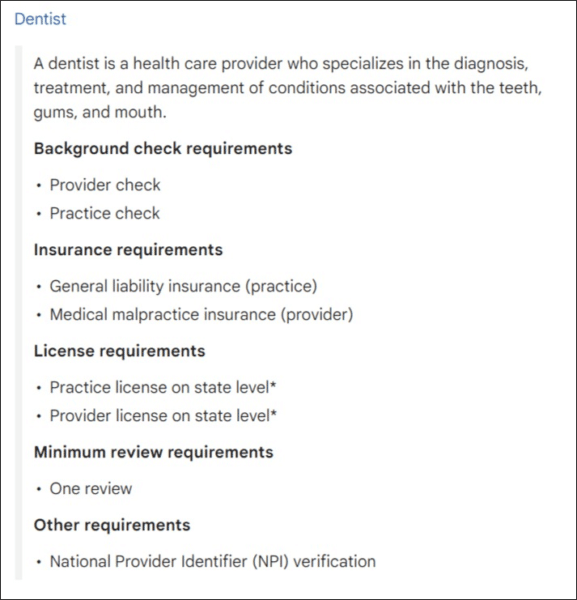
Last week Google updated its Help Center to include a new vertical: Dentists.

The change was first noted by Matt Casady who wrote about the update on Local U. Carrie Hill posted about it on Twitter.

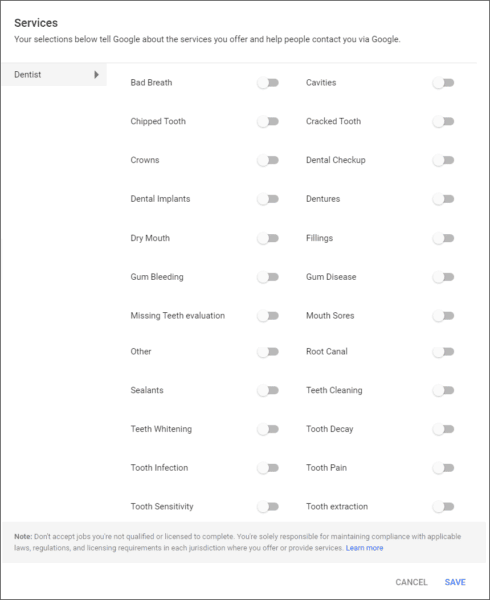
How it works. Prospective dentists will need to complete verification before being eligible to advertise.

Why we care. If you’re a dentist or you’re running ads for a dentist, start going through the verification process now so you can get your LSA ads up as soon as possible!


Related stories

New on Search Engine Land

@media screen and (min-width: 800px) { #div-gpt-ad-3191538-7 { display: flex !important; justify-content: center !important; align-items: center !important; min-width:770px; min-height:260px; } } @media screen and (min-width: 1279px) { #div-gpt-ad-3191538-7 { display: flex !important; justify-content: center !important; align-items: center !important; min-width:800px!important; min-height:440px!important; } }

About the author

Nicole Farley

Nicole Farley is an editor for Search Engine Land covering all things PPC. In addition to being a Marine Corps veteran, she has an extensive background in digital marketing, an MBA and a penchant for true crime, podcasts, travel, and snacks.

https://searchengineland.com/google-local-service-ads-are-now-available-for-dentists-391175