Google Ads updates in 2022: The good, the bad, the jury’s still out

In 2022, Google made several announcements, updates, and not-so-subtle nudges that shifted the paid search landscape. (Google’s announcement page is a helpful and relatively objective compendium.)

This article will break down: 

  • The major moves from the past 12 months.
  • How they impact paid search marketers.
  • What they mean for the future of Google Ads.

A quick recap of major announcements

The change that got the most attention (for good reason, which I’ll explain briefly) was Google sunsetting Expanded Text Ads. This forced advertisers toward Responsive Search Ads (RSAs), which the platform announced in August 2021 and took effect in July 2022.

Other big updates included a big push toward Performance Max. Released to all advertisers in November 2021, it has taken over most ecommerce accounts with Google’s heavy-handed push away from Smart Shopping.

About Smart Shopping campaigns

A similar trend with RSAs, Performance Max encourages marketers to advertise across YouTube, Display, Gmail, and Maps aside from search and signifies less control for advertisers as bidding and ad placements are automated. 

It also means expert advertisers have fewer ways to give their campaigns an advantage over those run by beginners. (Lowering the barrier of entry seemed to be a big theme for Google in 2022.) 

On the brighter side, Google released useful reporting upgrades with Custom Columns. They introduced nuance and flexibility within the Google Ads UI and took the burden of off-UI reporting workarounds from advertisers.

The last significant shift was the rise of image extensions (now called “assets”), which Google released to desktop en masse at the end of 2021. Currently, image assets include a “dynamic” option that automatically uses the most relevant image from the ad’s destination landing page.

This change shows Google’s directional push toward a more interactive SERP which they highlighted at Search On 22​. 

While image assets do often result in a lift in CTR (which makes sense since images draw attention), I haven’t witnessed much of a performance difference in my client accounts in regard to conversion.

Advertisers can control images by adding them at the ad group or campaign level. If you only add one, Google will only serve that one. As with any other asset, there’s no guarantee it’ll show every time. 

I recommend turning off the “dynamic” option unless you fully trust Google to pick the most appropriate image from a multi-image landing page.


Get the daily newsletter search marketers rely on.


The most helpful release of 2022

Let’s start with the good news: Custom Columns have made the reporting part of our lives easier. 

Before the Custom Columns upgrade, Google reports only supported one conversion column that lets you segment by conversion actions without associated metrics like spend.

This produced a not-all-that-useful view.

Custom Columns - Before
Custom Columns – Before

Now, Custom Columns features a higher-level look that actually associates metrics with different conversion types, which looks like this.

Custom Columns - After
Custom Columns – After

Along with the new view, Custom Columns offers enhanced spreadsheet functionality (i.e., more calculation options that compare different time periods). The ability to compare time periods is very helpful for identifying fluctuations and trouble spots. 

Set up indicators to give yourself a dynamic roadmap of priorities identified by data. My favorite creation here is a static 30-day look back of performance, regardless of the time period you’re using in the Campaign Manager.

Edit Custom Column

The skeptic might say that adding this functionality within the UI and removing the need for advertisers to create their own custom reporting is another way Google is leveling the playing field for all search marketers, regardless of experience. 

My take is that marketers who were taking the extra reporting step are relatively advanced, and now there are competitive advantages to be had from using the functionality to its fullest.

The least helpful release of 2022

A couple of caveats here:

  • My accounts are weighted more toward B2B than ecommerce, which means Performance Max doesn’t personally affect me as much as the shift from ETAs to RSAs. 
  • I believe most experienced search marketers prefer more manual control to a faster, automation-heavy setup where Google has removed many of its former levers. More junior search marketers and/or people without much time for account optimization may disagree.

That said, Google sunsetting ETAs in favor of RSAs on June 30 was, for me, the biggest setback of the 2022 updates.

It’s not necessarily that RSAs always perform worse. There are accounts where RSAs are outperforming old ETA numbers.

But there were accounts we haven’t yet restructured wherein legacy ETAs continued to outperform tons of RSA combos no matter what we tried. 

In general, we usually see an increase in CTR and CPLs when we switch to RSAs, which means they’re effective at getting the right people to click but don’t tend to convert as well.

The real issue, for me, is that advertisers just don’t have as many options for ad formats. You can technically recreate an ETA by using pinning mechanisms in the UI.

But this always results in a warning saying your ad strength is horrible, making me suspect that its ability to serve is limited.

Poor ad strength

Essentially, Google will get its way here – less advertiser control, higher CTR, and potentially higher CPL. In an economy with a big premium on efficiency, that’s not great news for advertisers. 

Looking ahead

Ultimately, 2022 is the year when Google leaned even more heavily into AI and machine learning. Time will tell whether those tools get more efficient over time. 

For now, Google is walking a fine line between pulling in revenue (efficiency doesn’t help their bottom line, after all) and alienating advertisers who will seek more profitable engagement elsewhere.

For advertisers, the upshot is that while Google has made the barrier to advertising low, we can still distinguish our accounts by:

  • Understanding when to test and optimize in less-controllable environments.
  • Not simply trusting that Google has our best interests at heart.

Heading into 2023, I believe the most important skill to differentiate yourself as a Google Ads expert and get better results is a combination of platform experience and critical thinking. 

I’ve run into plenty of advertisers pining for the more manual days of yore. The trick will be to draw on our experience and think critically. Let’s use the limited tools Google gives us to adapt as much as possible and work with automation.


Opinions expressed in this article are those of the guest author and not necessarily Search Engine Land. Staff authors are listed here.


Related stories

New on Search Engine Land

@media screen and (min-width: 800px) { #div-gpt-ad-3191538-7 { display: flex !important; justify-content: center !important; align-items: center !important; min-width:770px; min-height:260px; } } @media screen and (min-width: 1279px) { #div-gpt-ad-3191538-7 { display: flex !important; justify-content: center !important; align-items: center !important; min-width:800px!important; min-height:440px!important; } }

About The Author

Laura Schiele

Laura Schiele, Head of Paid Acquisition at Jordan Digital Marketing, has nearly a decade of experience in paid media strategy and execution in both agency and in-house accounts and uses advanced analytics skills to scale growth within efficiency goals across Google, LinkedIn, Facebook, and more. Laura manages a large team of paid media experts remotely from her home in Burlington, VT.

https://searchengineland.com/google-ads-updates-2022-good-bad-jury-still-out-390323


Google has updated its prohibited practices to include “Linked account suspensions”

Google has a new issue status in Merchant Center.

This new issue status is a clarification of our existing enforcement to provide retailers with better instructions on how to resolve their account issues. This issue status means that a suspended Google Ads account is linked to your Merchant Center account. The Google Ads suspension must be fixed first before your Merchant Center suspension can be reviewed.

Why we care. If you have a suspended Merchant Center account, you’ll need to resolve the issue before you can request a review.

Additional prohibited practices. Google prohibits the following practices from its ad network. You can read their entire help guide here.

  • Abuse of the ad network
  • Irresponsible data collection & use
  • Misrepresentation

Resolving issues. If your products are disapproved, visit the help guide to get your account reinstated.


Related stories

New on Search Engine Land

@media screen and (min-width: 800px) { #div-gpt-ad-3191538-7 { display: flex !important; justify-content: center !important; align-items: center !important; min-width:770px; min-height:260px; } } @media screen and (min-width: 1279px) { #div-gpt-ad-3191538-7 { display: flex !important; justify-content: center !important; align-items: center !important; min-width:800px!important; min-height:440px!important; } }

About The Author

Nicole Farley

Nicole Farley is an editor for Search Engine Land covering all things PPC. In addition to being a Marine Corps veteran, she has an extensive background in digital marketing, an MBA and a penchant for true crime, podcasts, travel, and snacks.

https://searchengineland.com/google-has-updated-its-prohibited-practices-to-include-linked-account-suspensions-390373


4 new features on the Google Insights page

To help advertisers navigate the holiday season and optimize their inventory, Google has launched four new features on the Insights page:

  • Search terms
  • Assets
  • Audiences
  • Change history

Search terms. This helps you understand what customers are searching for without the need to examine your entire search terms report. The terms are grouped into broader, intent-based categories, you can quickly identify which themes are most popular with your customers, along with metrics like conversion performance, search volume and search volume growth.

Assets. This will help you learn what assets resonate the best with your potential customers. You can use this to identify highly-engaged audiences, as well as inform the assets and landing pages you create for different audiences.

Audiences. Audience insights can help you understand the characteristics of the people who engage with your business. Google says these insights give you a better idea of what your customers care about, making it easier to tune your creative for their unique interests and traits.

Change history. This helps you identify how changes you’ve made in your account may impact performance. When there’s a significant shift in your campaign’s key metrics, this insight can help you determine which changes you made that may have caused this shift in performance — and then figure out how to proceed.

Dig deeper. Review your Insights page to see the new features and optimize your marketing campaigns.

Why we care. The new Insights features will help you discover trends, optimize your campaigns, and keep up with changing consumer behavior over the upcoming holiday season. Advertisers should review their insights before making drastic campaign changes.


Related stories

New on Search Engine Land

@media screen and (min-width: 800px) { #div-gpt-ad-3191538-7 { display: flex !important; justify-content: center !important; align-items: center !important; min-width:770px; min-height:260px; } } @media screen and (min-width: 1279px) { #div-gpt-ad-3191538-7 { display: flex !important; justify-content: center !important; align-items: center !important; min-width:800px!important; min-height:440px!important; } }

About The Author

Nicole Farley

Nicole Farley is an editor for Search Engine Land covering all things PPC. In addition to being a Marine Corps veteran, she has an extensive background in digital marketing, an MBA and a penchant for true crime, podcasts, travel, and snacks.

https://searchengineland.com/4-new-features-on-the-google-insights-page-390364


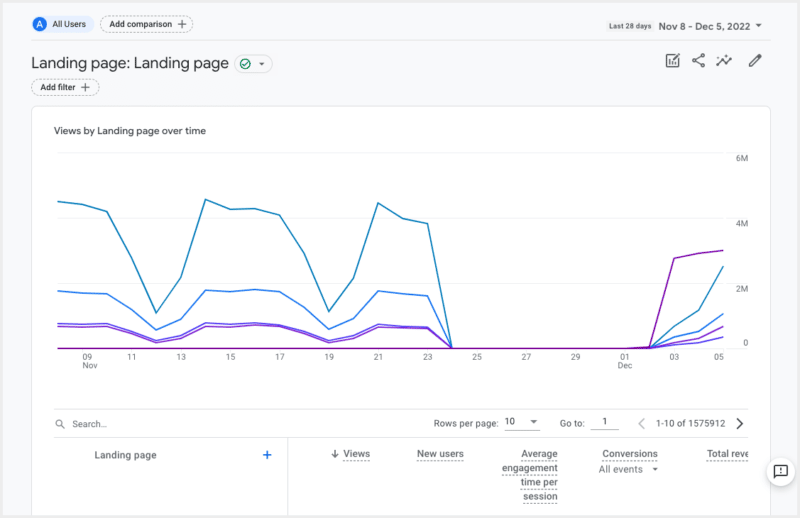
New Google Analytics 4 Landing page report

There’s a new report in town, and it’ll help you evaluate and optimize the effectiveness of your landing pages Google Analytics 4 (GA4).

The new report will compare the following metrics:

  • Average engagement time per session
  • Conversions
  • New users
  • Views
  • Total revenue

Why we care. You can find the Landing page report in the Engagement topic in the left navigation of your dashboard. If the Engagement topic section isn’t there, you can add the report through the report library. 

Use the report to evaluate the effectiveness of your landing pages. If you don’t have GA4 set up yet, use this guide to walk you through the process.

New report types. Google continues to add new report types in GA4. Here are the latest.

Dig deeper. Read the help article from Google to find out how to filter, customize, and adjust the report.


Related stories

New on Search Engine Land

@media screen and (min-width: 800px) { #div-gpt-ad-3191538-7 { display: flex !important; justify-content: center !important; align-items: center !important; min-width:770px; min-height:260px; } } @media screen and (min-width: 1279px) { #div-gpt-ad-3191538-7 { display: flex !important; justify-content: center !important; align-items: center !important; min-width:800px!important; min-height:440px!important; } }

About The Author

Nicole Farley

Nicole Farley is an editor for Search Engine Land covering all things PPC. In addition to being a Marine Corps veteran, she has an extensive background in digital marketing, an MBA and a penchant for true crime, podcasts, travel, and snacks.

https://searchengineland.com/new-google-analytics-4-landing-page-report-390337


How to drive 10x more conversions with magnetic paid search offers

You’ve got a lot of levers to pull in your paid search account that might improve performance.

But the absolute best optimization you can make is one you won’t find in the Google Ads interface.

The open secret of successful paid search managers is to start with a magnetic offer.

Results of a magnetic offer in PPC

Magnetic offers attract your target market and repel everyone else, saving on ad spend and driving up conversion rates.

In this article, you’ll learn how to make your offer magnetic and 10x your conversions.

The number 1 offer problem

When I’m helping marketers struggling with conversion volume and rates, I’ll ask them what their offer is. 

No matter the company’s size or industry, they all have almost the exact same problem with their offer:

  • “We don’t have an offer.”

If you’re running campaigns that track conversions, you have an offer. 

“Offer” doesn’t mean discount or promotional pricing. Instead, it refers to specific elements that help your audience decide whether to take action.

The ‘3 Ps’ of an offer

You may have heard of the “3 Ps” an offer is built on:

  • Product: What it is that you’re selling or promoting.
  • Price: How much it will cost them (in money, time, effort).
  • Positioning: Why or so what? How desirable it is to own or use the service.

A high-value offer has a high perceived worth with a small perceived cost, while a low-value offer isn’t worth much in the mind of a buyer but is charging a lot for it.

High value and low value offers

The overlooked fourth ‘P’ of an offer

Notice that we’re using pretty subjective language here (“perception” of value, “in the mind” of our audience). 

One person’s treasure is another person’s trash, so it’s important to understand the point of view of our prospective buyer. What do they need in order to buy?

The fourth 'P'

In the illustration above, we have a great skin care product, at a great price, with great positioning. 

But if we’re marketing to Doug, who hates skin care, we won’t get the sale. 

When considering the three core “Ps” of an offer (again, that’s product, price and positioning), don’t forget about a fourth P – people. 

Who you’re speaking to makes all the difference in how they’ll respond to your offer.

Now that you understand what goes into a great offer, here’s how to magnetize your offer and get more people to say “yes.”


Get the daily newsletter search marketers rely on.


Increase your product’s perceived value

Increasing the perceived value of the product doesn’t mean changing the product itself (though it can include that). It means changing what your audience understands about your product.

Products aren’t limited to ecommerce

You don’t need a shopping cart to have a product. The “product” in your offer can essentially be any conversion action:

  • Sale: A purchase (physical products, digital products, SaaS).
  • Lead: Collected contact info (lead magnets / gated content, demo, consultation).
  • Engagement: Tracked activity (interaction, link clicks, views, downloads).

Each conversion action has its own challenges when it comes to increasing the likelihood of conversion. 

What it takes to get someone to use your online calculator is different than getting them to buy a high-ticket item, as is each one’s value to your business. 

That said, any conversion action needs to be perceived as valuable for visitors to complete it.

A confused mind says ‘no’

If you’re not seeing the conversion rates you want, chances are your visitors aren’t seeing the information they need about your product or service on your landing page.

Up to 45% of U.S. adults will abandon their online purchase if they can’t find a quick answer to their question, according to Forrester.

What does your prospect need to know about your product or service that your landing page isn’t telling them? 

Consider:

  • Features, specifications, dimensions, quantities, appearance 
    • “Will this fit in the hallway?” / “How long is this video?” 
  • Process or support
    • “What does it look like to work with you?” / “What if something goes wrong?”
  • Shipping/delivery process, rates, speed
    • “Will this arrive before our anniversary?”
  • Locations, amenities, hours of operation
    • “Is this on my way to work?”
  • Options, customizations, alternatives
    • “Does it work for left-handers?”
  • Materials, ingredients, designations
    • “Is it steel, vegan, Kosher, locally sourced?”
  • Benefits and outcomes
    • “What do I get for clicking the ‘next’ button?”

Marketers go astray here when they feature only flattering details about themselves that mean nothing to their audience. 

This isn’t a magic trick – you can’t use misdirection to make a conversion appear. 

Increase perceived value by meeting your visitors on their own terms, with as much clarity as possible.

Improve your offer’s positioning

You’ve probably had a marketer tell you, “people don’t buy mattresses, they buy a good night’s sleep.”

If you’ve ever sold mattresses, you know that people absolutely buy mattresses. 

But how you frame what you’re selling can make a big difference in how well it sells.

Strengthen your value proposition

In the context of paid search, your value proposition is usually found in your landing page headline. It tells your audience the key desirable outcome of your offer they won’t get from your competitors.

In a case study, Widerfunnel achieved a 128% conversion rate increase for The Sims 3 by changing the value proposition in the headline.

  • Control: Join the Fun!
  • Winning variation: Register Your Game and Get a FREE New Town Now!

This is no lazy headline hack. 

The promise of value in the second version (including additional bulleted benefits) is completely different – and something that speaks to the desires of their target market.

Use proven persuasion principles

Whether someone says “yes” to the invitation to convert depends not just on what is being offered but how it is offered.

Psychologist Dr. Robert Cialdini is well known for developing the seven principles of persuasion, which include:

  • Reciprocity
  • Scarcity
  • Authority
  • Consistency
  • Liking
  • Social Proof
  • Unity

How can you use these principles to increase the likelihood that your visitor will say “yes” to your offer?

Let’s look at “social proof.” Testimonials are table stakes for most websites, but slapping an endorsement of “I love working with Jessica!” won’t do much to convert your audience.

Instead, showcase testimonials that describe what it’s like to work with you, why your customers or clients chose you, or how you solved their problems. 

Use reviews strategically to make it safe for your prospects to believe your claims. 

Add a call to value

When Copyhackers drove a 108% increase in revenue for SweatBlock, they dropped the standard call-to-action (CTA) button and replaced it with a “call to value.”

  • Call to action: Order Now
  • Call to value: Sweat Less. Live More.

With CTA buttons, we’re telling our visitors what action we want them to take. 

By using a call-to-value button instead, we’re emphasizing the value of taking that action.

Poor-performing offers expect that people who clicked the ad are ready to convert. 

Magnetic offers help visitors see how converting will benefit them.

Decrease the perceived cost of converting

Are you missing out on conversions because it costs too much to convert?

Cost doesn’t just mean price tags

We tend to associate “cost” with “money,” but that’s just one price we pay when we convert.

Have you ever passed on a free offer? Even at $0, sometimes the price of conversion is too high.

The cost of an offer could be:

  • Effort or difficulty
  • Time
  • Risk, loss of privacy, obligation
  • Compromise
  • Financial

Reduce anxiety and friction

Jared Spool tells the story of driving $300 million in new revenue with a single change to a form.

The original form was pretty simple:

  • Fields (2): Email and password
  • Buttons (2): Log-in and register

What did they change to get such an amazing lift?

The team dropped the “register” button and replaced it with a “continue” button so visitors could complete their orders without creating an account.

They found that registration was a huge barrier for new customers. 

Existing customers also hated it and often couldn’t remember which email they used for their accounts. 

The “cost” of registration seemed low to the company (it was free!) but was too high for prospects who wanted to spend their money on the site. 

Purchasing customers increased by 45% when the button was removed.

If you’re not seeing the conversion rates you want, find ways to make converting less painful for your audience.

Make your offer magnetic and 10x your paid search conversions

A strong magnetic offer is within reach for your business right now. 

Improve the perceived worth of your product while decreasing the perceived cost, and watch your conversions multiply.

Watch: Drive 10x more conversions with magnetic paid search offers

Below is the complete video of my SMX Next presentation.

[embedded content][embedded content]

Opinions expressed in this article are those of the guest author and not necessarily Search Engine Land. Staff authors are listed here.


Related stories

New on Search Engine Land

@media screen and (min-width: 800px) { #div-gpt-ad-3191538-7 { display: flex !important; justify-content: center !important; align-items: center !important; min-width:770px; min-height:260px; } } @media screen and (min-width: 1279px) { #div-gpt-ad-3191538-7 { display: flex !important; justify-content: center !important; align-items: center !important; min-width:800px!important; min-height:440px!important; } }

About The Author

Amy Hebdon

Amy Hebdon is a Google Ads conversion expert and the founder and managing director of the Google Partner agency Paid Search Magic. Since 2004, she’s managed Google Ads for clients ranging from Fortune 10 to SMBs at agencies, in-house, and freelancing. Her articles have been published in Search Engine Journal, Unbounce, PPC Hero, Supermetrics, Copy Hackers and CXL. Together with her husband James, she also runs the Facebook group Google Ads for Savvy Digital Marketers.

https://searchengineland.com/drive-10x-more-conversions-magnetic-paid-search-offers-390140


2 new Google data-driven attribution features

Google has just announced two new data-driven attribution features intended to introduce more transparency and make it easier for advertisers to switch.

Why we care. Google has already made it clear that they prefer advertisers use data-driven attribution as their preferred model. Advertisers who are unclear about the effects of this model should use the new simulation tool to estimate the effects of switching.

What’s new. Soon, Google will be launching a simulation tool for eligible advertisers that will allow you to see how automated bidding would have reacted to data-driven attribution over the last seven days. The tool is intended to help you understand the effects of data-driven attribution on your account before making the switch.

Google is also working to bring data-driven attribution to more advertisers and more ad types. Historically, data-driven attribution has supported Search, Shopping, Display and YouTube ads. Google is expanding its support to app conversions and will begin supporting Discovery formats (including those in Performance Max) next year.

What Google says. “Advertisers who switch to data-driven attribution from another attribution model typically see a 6% average increase in conversions.”

Dig deeper. You can read the announcement from Google here.


Related stories

New on Search Engine Land

@media screen and (min-width: 800px) { #div-gpt-ad-3191538-7 { display: flex !important; justify-content: center !important; align-items: center !important; min-width:770px; min-height:260px; } } @media screen and (min-width: 1279px) { #div-gpt-ad-3191538-7 { display: flex !important; justify-content: center !important; align-items: center !important; min-width:800px!important; min-height:440px!important; } }

About The Author

Nicole Farley

Nicole Farley is an editor for Search Engine Land covering all things PPC. In addition to being a Marine Corps veteran, she has an extensive background in digital marketing, an MBA and a penchant for true crime, podcasts, travel, and snacks.

https://searchengineland.com/2-new-google-data-driven-attribution-features-390290


Microsoft now requires verification for UK Financial Services advertisers

Starting early this year, Microsoft will allow only advertisers duly authorized by the UK Financial Conduct Authority (FCA) to present regulated financial promotions in the UK. Advertisers will be required to provide proof of authorization by the UK FCA to present Financial Promotion Ads or specify if they’re either 1) a non-financial services advertiser who may target consumers seeking financial services, such as e-commerce platforms or 2) government entities such as authorities or regulators under the “.gov.uk” domain.

Why we care. If you live in the UK or advertise for a UK financial services company, you’ll need to start the verification process here.

Keep in mind. Microsoft says to keep the following into consideration:

  • These requirements are in addition to the Advertiser Identity Verification requirements laid out by Microsoft as part of its safety measures to protect consumers, advertisers, and publishers.
  • Failure to complete this verification process will result in ads being blocked from serving in the UK—the account will continue to perform as before with respect to non-Financial Services Ads and in markets outside of the UK.

Dig deeper. Read the announcement on the Microsoft blog here.


Related stories

New on Search Engine Land

@media screen and (min-width: 800px) { #div-gpt-ad-3191538-7 { display: flex !important; justify-content: center !important; align-items: center !important; min-width:770px; min-height:260px; } } @media screen and (min-width: 1279px) { #div-gpt-ad-3191538-7 { display: flex !important; justify-content: center !important; align-items: center !important; min-width:800px!important; min-height:440px!important; } }

About The Author

Nicole Farley

Nicole Farley is an editor for Search Engine Land covering all things PPC. In addition to being a Marine Corps veteran, she has an extensive background in digital marketing, an MBA and a penchant for true crime, podcasts, travel, and snacks.

https://searchengineland.com/microsoft-now-requires-verification-for-uk-financial-services-advertisers-390263


5 ways to optimize your ad campaigns in 2023 by Creatopy

Display advertising is a powerful tool for marketers when used at its full potential.

Preparing and launching a new display ad campaign is not necessarily equivalent to setting it up for success. To set it on the right path, one must also engage in the practice known as ad campaign optimization. In a nutshell, this means running experiments, analyzing performance data and finding improvement opportunities.

With the ongoing economic unrest, 2023 is bound to be a challenging year for paid advertising, and campaign optimization is more important than ever. Here are five expert tips to help you optimize for the highest performance and maximize your display ads’ ROI in the upcoming year.

1. Focus more on creative production and personalization

As we prepare to enter the new year, many voices claim that the creative is king, and we’re about to join the chorus. Creative optimization opens opportunities for increased brand recognition and higher levels of engagement, which is why it’s becoming more and more important.

Consumer demand for personalized experiences is on the rise. To meet these expectations, advertisers must create relevant ads at scale while ensuring the workload remains manageable.

The easiest way to do this is to turn to creative automation. Versioning tools and data-fed ad design simplify things, allowing you to generate personalized assets for entire campaigns instantly.

If you want to go the extra mile and increase the chances of conversion, you can give dynamic ads a try. Because some of their elements change according to data about the viewer (e.g. ad copy depending on location), you can be sure you are delivering the right message at the right time.

Regardless of the type of ads you run, having all creatives on-brand is always a must. Besides ensuring users have a familiar and authentic experience every time they come across your ads, it also helps build brand trust.

Another aspect to bear in mind is optimizing your ads for different devices. For example, if your audience is predominantly mobile, use the top-performing mobile banner sizes when designing your ads and consider rich media or animated ads to draw attention.

2. Try different approaches when it comes to targeting

Generally speaking, the more you narrow down targeting, the more relevant your ads become. Using various targeting methods to clearly define an audience likely to purchase your products or services usually boosts engagement and conversion rates. As great as that sounds, hyper-targeting also has downsides like higher costs per click.

A different strategy would be to personalize your ads until you’re confident in their power to drive conversions and expand your reach, targeting a broader audience. By relying on the creative’s power, you’ll be able to cast a wider net and put your budget to better use. After all, the creative is the new targeting.

Whichever approach you choose, monitor the performance of your initial target audience(s) throughout the campaign run. You can pause audiences that don’t perform as well as expected and add new ones that will bring your ads in front of the right people.

Don’t be afraid to experiment with the targeting options at your disposal in 2023 because there’s no one-size-fits-all recipe for creating an audience that unlocks high performance. Only by exploring different alternatives, you’ll know what works best for a specific campaign.

3. Refine campaign budget allocation to serve campaign goals

Going into 2023, don’t expect a particular campaign budget to bring you the same results as last year. Google Ads cost per lead has increased for 91% of industries, with an average of 19%. In fact, as a paid advertising specialist, you should also set clear and realistic expectations for managers and clients.

Needless to say, you must use your budget wisely to reach your campaign goal, whether that is to drive sales, generate leads, increase website traffic or boost brand awareness.

Opt for automated bidding strategies and set an average daily budget for your campaign, then multiply it by 30.4 to have an overview of your monthly budget. Later on, if you notice a boost in conversions at a good cost per conversion, you can increase your budget.

Alternatively, if your cost per conversion is too high, you can reduce it by cutting your budget. But before you do that, try other optimization strategies, such as changing elements from the creative or the landing page and excluding underperforming placements.

Sudden or drastic budget changes can affect campaign performance, which is why the consensus is to make adjustments of a maximum of 10% at a time. If you need to make a significant budget cut, do it gradually. The same goes for increases.

When allocating money, always set aside a sum for A/B testing, as it can help you greatly improve your campaign’s performance.

4. Run A/B tests even when your campaign performs well

Regardless of how well-defined your targeting is or how personalized the creatives are, you can’t predict how the audience will react to your campaign.

Luckily, you have a very powerful tool at your disposal—A/B testing. In the case of underperforming campaigns, you can use it to determine what could be optimized, usually by running two different ad variations or two landing page versions. This way, you’ll see which is more successful in driving engagement and discover what clicks with your audience.

However, these experiments should be an ongoing practice, not something you resort to when you’re not getting the desired results. Run A/B tests even when you’re satisfied with your current results because there’s always room for improvement. By continuously experimenting, even when performance is good, you can find creative or landing page variations that perform better than the current ones.

When A/B testing, only modify one thing at a time to keep track of what impacts performance. For instance, run two ad variations with a single changed element, be it ad copy, image, or illustrations, call to action button, colors, or something else. This applies to landing pages as well.

Similarly, either test different variations of the creative OR the landing page, not both simultaneously. Without an isolated optimization, A/B testing is rendered futile.

5. Review performance data periodically to find improvement opportunities

In paid advertising, data is your best friend. It is the guide that keeps you on the right track. The compass that ensures you never lose sight of your goals.

Metaphors aside, you need to leverage analytics the best you can if you want to squeeze as much ROI as possible from your campaign.

Give yourself time to choose the best KPIs to track right from the beginning. It’s crucial they align with your campaign goals because if you track irrelevant KPIs, you will make the wrong optimizations and move away from your objectives rather than get closer to them.

Check campaign reports periodically and interpret data to see what adjustments you could make to boost performance. A myriad of tools can help you compile reports in the form of easily digestible dashboards so you don’t drown in data and miss the essential.

Remember that campaign optimization is an ongoing process, meaning it’s not enough to review performance once and consider it done. We recommend you do it weekly to keep things under control, even though you might not make optimization decisions every time you look over the reports.

As an important side note, don’t be quick to make changes after the first week of the campaign run, even though performance may seem weak. The learning period for Google Ads’ algorithm is roughly seven days, so give it some time to adjust before changing any campaign settings.

Final thoughts

A lot of work goes into building and optimizing display ad campaigns, but the entire process becomes much simpler with tools that help you eliminate repetitive tasks that take too much time. Creatopy offers creative automation and endless possibilities for ad personalization, as well as ad serving across numerous ad networks and performance tracking. It empowers advertisers, having helped companies like Sorted and marketing agencies like Brandfinity speed up the ad creation process and maintain brand consistency across all assets. They can now A/B test more efficiently and improve their ad performance, and so can you. Take a tour of the platform and discover all its functionalities.


Related stories

New on Search Engine Land

About The Author

Creatopy

Creatopy is the ad automation platform that helps businesses personalize ads at scale. Besides the automation features that eliminate repetitive tasks and considerably speed up the creative workflow, the platform also offers ad serving across programmatic ad networks, and DSPs, as well as campaign performance tracking tools. Creatopy accommodates teams of any size, allowing them to set up a custom hierarchy and assign roles and rights to members. This streamlines collaboration and keeps everyone productive throughout the entire campaign run.

https://searchengineland.com/5-ways-to-optimize-your-ad-campaigns-in-2023-390040


Search Engine Land celebrates its 16th birthday 

Search Engine Land celebrates its Sweet 16 today.

While most of the original team from 2006 has moved on, the mission of Search Engine Land remains nearly the same as it has been since day 1.

As explained by founding editor Danny Sullivan, Search Engine Land was created to be:

  • A place where you can keep up with what’s happening in the search space.
  • A community.
  • An entire new world revolving around the important tools of search engines, a world that continues to grow and be shaped, with such a huge impact on society and our daily lives.

There’s a lot to look forward to in 2023.

But first, let’s take a look back on the past year of Search Engine Land, give some thanks to those who have helped make this year a success, and tease a few things you can expect from us over the next year.

Thank you for reading!

If you’re still reading this, thank you! Yes, you!

Every day, our mission is to bring you the latest news and information as it happens, as well as useful guides and insights to help you thrive and advance in your career, navigate the ever-changing search landscape and understand what’s coming next.

Hopefully, you found our news coverage and articles helpful over the past year. 

And just as a reminder: if you’d like all the latest search news, analysis and intelligence in your inbox, make sure to subscribe to Search Engine Land’s newsletter.

Thanks to the Search Engine Land team

Search Engine Land has a small team. But as the late Steve Jobs once said, “A small team of A+ players can run circles around a giant team of B and C players.”

And I truly we believe we have those A+ players here. 

  • Barry Schwartz. Barry is a legend – he’s been writing on Search Engine Land since the beginning and covering search for an astounding 19 years. He’s written a ridiculous number of news articles (somewhere around 40,000), documenting all the latest updates and developments in our space. His work ethic is beyond impressive and it’s been an honor to work with him this year. 
  • Nicole Farley: Nicole has been a great addition to the team. I was impressed by her when we first met a couple of years ago. Since joining the team, Nicole has well far exceeded my expectations and does a fantastic job staying on top of all the latest developments in the world of PPC.
  • Angel Niñofranco: I was beyond excited to have Angel join the team and to work with her for a second time. Fun fact: Angel now has been my first hire at two different companies. Angel is a truly excellent editor and helps make sure our SME content is worthy of your time and attention. 
  • Kathy Bushman: It’s been great working with Kathy on the SMX events. Her focus never wavers from what’s most important: making sure we deliver top-level content (and experience to match) to everyone who attends our events. I’m already looking forward to thinking about the agendas for SMX Advanced and Next in 2023 – both will be here much sooner than we think!
  • Sarah Slifko-Camarra & Karen DeWeese: I can’t thank them enough for all their help in getting our SME program established and organized. Plus, Sarah and Karen do some great work behind the scenes with SMX.
  • Marc Sirkin: Marc has been a huge ally and sounding board for starting to make some big and much-needed changes to our website and SEO strategy. 
  • Chris Elwell: I truly appreciate Chris for his leadership, for always challenging us to be better, and for the thoughtfulness in how he approaches business decisions and processes. He has truly created a great team and company. (And, in case you didn’t know, he has been a key figure in the development of our entire industry. Watch this video interview he did with Barry in 2020 to learn more.)

There are so many other fantastic humans who are part of the Third Door Media team who I haven’t mentioned. Just know, even if I didn’t mention you, I appreciate you and all you do to help make our company successful.  

Gone, but not forgotten

It has undoubtedly been a year of change for Search Engine Land. I joined Search Engine Land in January. And Nicole and Angel joined around halfway through 2022.

We also bid farewell to some team members. So cue the “In Memoriam” theme for:

  • Henry Powderly, former vice president of content for Third Door Media, the publisher of Search Engine Land and MarTech (August 2018 – June 2022)
  • George Nguyen, former editor (June 2020 – March 2022)
  • Corey Patterson, former editor (November 2021 – June 2022)

Top 3 highlights of 2022

Despite some challenges, I’d say it’s safe to call 2022 an overall success for Search Engine Land.  

SMX Advanced and SMX Next

Both shows had the highest audience ratings in the history of Third Door Media. More than 8,500 search marketers signed up for both events. 

While those numbers are great, what really mattered to me was the feedback we received from people who invested their time in our events. It was overwhelmingly positive for the speakers, content and experience.

It was also great to have Google back at SMX, with keynotes featuring Hyung-Jin Kim and Ginny Marvin.

Plus, the 2022 Search Engine Land Awards revealed some of the truly great work going on in our industry. I can’t wait to see what successes y’all have over the next several months – so make sure to enter next year.

SME program relaunch

One of my top priorities was launching our Subject Matter Expert (SME) program. 

A huge thank you to all of our excellent SMEs for all the great content and insights you shared in 2022. We’ll be highlighting the top 10 most popular SEO and PPC columns of the year – so check back Dec. 29-30, when those will be revealed. I look forward to reading even more great advice and insights from you in 2023! 

Speaking of 2023 – I’ll be looking for new contributors very soon. More details to come. But if you’re interested in becoming a contributor on Search Engine Land, 2023 may just be your year.

Traffic and audience growth

I won’t lie – not that it’s any secret – Search Engine Land has its share of SEO messes to clean up, including a fairly disastrous “consolidation” of categories that was handled with a blowtorch instead of a scalpel. Most of that SEO damage has, thankfully, been dealt with.

Despite our long SEO to-do list, traffic and audience growth are trending in the right direction:

  • Sessions – up 30%
  • Pageviews – up 25%
  • Users – up 16%
  • Organic search traffic – up 22%
  • Direct traffic – up 34%

What’s next for Search Engine Land? 

We’re already looking ahead to 2023. You can expect us to continue providing breaking news coverage and insights on all things search. 

Plus, we’ll be debuting a couple of new regular features we hope you’ll like. 

Also on our to-do list: some long overdue updates to our popular SEO and PPC periodic tables, and accompanying guides.

And save the dates for our SMX events:

  • SMX Advanced: June 13-14.
  • SMX Next: Nov. 15-16.

And there’s plenty more to come.

On behalf of everyone at Search Engine Land and Third Door Media, I wish you a great rest of 2022 and a successful and healthy 2023.


Related stories

New on Search Engine Land

@media screen and (min-width: 800px) { #div-gpt-ad-3191538-7 { display: flex !important; justify-content: center !important; align-items: center !important; min-width:770px; min-height:260px; } } @media screen and (min-width: 1279px) { #div-gpt-ad-3191538-7 { display: flex !important; justify-content: center !important; align-items: center !important; min-width:800px!important; min-height:440px!important; } }

About The Author

Danny Goodwin

Danny Goodwin is Managing Editor of Search Engine Land & SMX. In addition to writing daily about SEO, PPC, and more for Search Engine Land, Goodwin also manages Search Engine Land’s roster of subject-matter experts. He also helps program our conference series, SMX – Search Marketing Expo. Prior to joining Search Engine Land, Goodwin was Executive Editor at Search Engine Journal, where he led editorial initiatives for the brand. He also was an editor at Search Engine Watch. He has spoken at many major search conferences and virtual events, and has been sourced for his expertise by a wide range of publications and podcasts.

https://searchengineland.com/search-engine-land-16-390247


Airbnb’s search marketing shift: Should advertisers follow suit?

A recent Wall Street Journal article reported that Airbnb’s “strategy of slashing advertising spending, investing in brand marketing and lessening its reliance on search-engine marketing is continuing to pay off.”

This remark has sparked discussions among many advertisers, wondering if a similar strategy may work for them. 

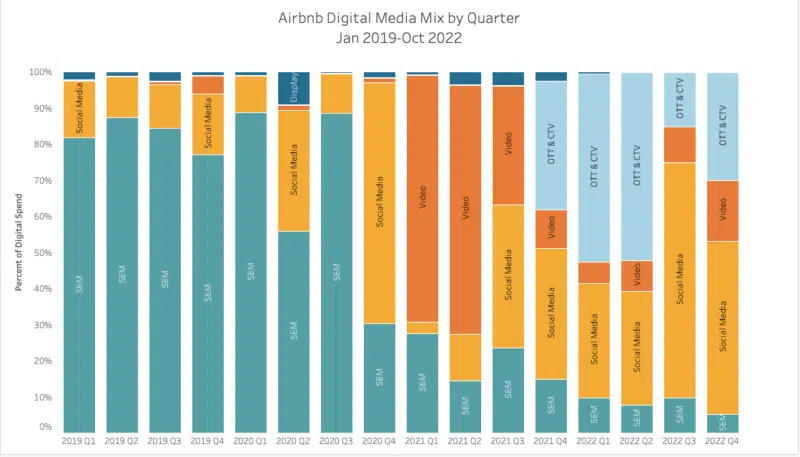
In 2019, Airbnb started to move budget away from search marketing in favor of broader marketing initiatives.

The pandemic accelerated the shift, with video and social media picking up the largest share of digital spend in 2021, according to data gathered from Semrush and Pathmatics.

Airbnb digital media mix by quarter - January 2019 to October 2022

In Q4 2021, The company then expanded its digital strategy into OTT and CTV, further reducing the budget share for PPC.

With CPCs rising across performance media channels, advertisers are left wondering if moving away from performance marketing channels is the right move. 

But before you take a similar leap, let’s look at three key considerations. 

1. What external forces are impacting your business? 

The pandemic played a considerable part in Airbnb’s strategy shift.

The company dropped its marketing spend from April 2020 through November 2020, when it reappeared with a strong social media presence. 

Then in December, Airbnb reminded customers with video ads that the brand will be there when people are ready to travel.

Consumer behavior changed, and Airbnb needed to employ a medium that would reassure and inspire trust. What better way to do that than with video? 

It’s critical to be aligned with the external forces impacting your marketing mix. 

Are you creating a new category? Or trying to change consumer behavior? 

If so, a shift to brand-heavy advertising may make good sense. 


Get the daily newsletter search marketers rely on.


2. Have you reached a tipping point?

Ninety percent of Airbnb’s traffic comes directly to the site. Their market share in the space is nearly 20%, according to Second Measure.

Airbnb had already reached its tipping point. Its category was well-established, and it was a leader in that category. 

Instead of using performance media to drive new customers, they could use it as strategic levers for supply and demand.

Think of their brand awareness spend as the large workhorse and performance media as fine-tuning. 

Before deciding where to spend your marketing dollars, know where you’re coming. 

Are you the leader in your category? Are the majority of your visitors coming directly to your site? 

If so, it makes sense to place a heavier weight on brand advertising and rely on performance media for fine-tuning. 

But if you need to acquire more customers to reach a tipping point, consider a heavier performance media strategy. 

3. Do you have wasted spend? 

Finally, from the outside, it’s difficult to say how much of Airbnb’s performance marketing spend was wasted.

But surveys from Rakuten Marketing and Commerce Signals indicate that marketers routinely waste 25-40% of their marketing budget. 

Simply cutting this wasted spend and reusing the dollars for broader marketing initiatives may give advertisers similar effects to what Airbnb saw. 

Evaluate your existing performance marketing dollars to find the wasted spend hiding in plain sight. Online audit tools can help, as well as audits from marketing agencies. 

Rethink your marketing mix based on your unique situation

It’s worth reemphasizing that Airbnb still spends ~50% of its budget on performance media.

So while their mix shifted from the previous 80%, the company still heavily relies on performance media to help balance supply and demand. 

As advertisers look at whether to move budget to brand awareness, the roles of marketing channels should be reevaluated.

Allowing each channel to play to its superpowers can create a wonderful symbiotic relationship within your marketing mix. 

So if you are considering a strategy shift similar to Airbnb, it’s important to think critically about your business before making the move. 

Think about your category, consumer behavior, and market position. Finally, evaluate any wasted spend.

And if you’re ready to take the plunge, remember to test, measure, evaluate and repeat. 


Opinions expressed in this article are those of the guest author and not necessarily Search Engine Land. Staff authors are listed here.


Related stories

New on Search Engine Land

@media screen and (min-width: 800px) { #div-gpt-ad-3191538-7 { display: flex !important; justify-content: center !important; align-items: center !important; min-width:770px; min-height:260px; } } @media screen and (min-width: 1279px) { #div-gpt-ad-3191538-7 { display: flex !important; justify-content: center !important; align-items: center !important; min-width:800px!important; min-height:440px!important; } }

About The Author

Amanda Evans

Amanda has developed digital advertising strategies and paid media campaigns for companies across multiple industries for more than 20 years. She is data-driven and passionate about advancements in tracking technologies to ensure clients maintain a competitive advantage. Her specialties include large-scale SEM campaigns, web analytics and crafting comprehensive, easy-to-use dashboards to empower account performance. Amanda holds an MBA from San Jose State University and a BSC from Santa Clara University. Before serving as President of Closed Loop, a paid media agency, Amanda founded and led a comprehensive digital marketing consulting agency for seven years.

https://searchengineland.com/airbnb-search-marketing-shift-390069