Balancing paid and organic search strategies for optimum success

Balancing paid and organic search strategies for optimum success

30-second summary:

  • Even though it is evident that SEO and PPC are great tools, these two disciplines work in silos
  • In fact, these teams and channels mostly work on their own in silos and are often handled separately
  • Accenture Song’s SEO Manager, Michael McManus discusses how businesses can combine paid and organic SEO to function as one value-add unit

SEO and PPC are a must-have in your arsenal when planning your marketing strategy. Depending on what they are looking to do, most companies tend to choose one over the other, if they are looking to increase their rankings and get traffic from organic search, then they will go with SEO,  whereas PPC focuses on getting instant “paid for” traffic from such areas as search, social, and display.

Both SEO and PPC are great tools to boost your site/brand’s authority as well as help generate more traffic and sales for your business. But these two teams/channels tend to work on their own in silos and are often handled separately.

Now while both of these options can and do work well on their own, having both teams work together can be a powerful strategy for any business. Instead of working apart and potentially fighting for budget, time, resources, and rankings. By bringing both departments together so that they can collaborate and work as one, they will benefit from different insights and learnings that they would otherwise not get on their own. These insights will allow them to produce amazing results in both campaigns.

These two marketing channels aren’t meant to operate independently, yet that is the case almost every single time. But instead of looking at both channels as separate entities and you bring them together, you’ll see that they can help you achieve better results across the board than having them work on their own.

The data and insights that you can get from PPC campaigns are extremely insightful and powerful. When you take that data and combine it with your SEO strategies, it will give you the insights that you can use to create content that will make a big difference to your organic search traffic.

Balancing organic and paid search strategies for optimum success is a key challenge and lots of businesses need to catch up as they are typically only using one of these strategies.

How SEO and PPC can work together to boost your business

Along with large amounts of keyword and conversion insights that SEO can use by working with PPC, another huge benefit that companies can achieve when they bring both SEO and PPC together is the potential to consume a large portion of the SERPs, where they can showcase ads at the top of the page while owning the organic listings below.

This is something that shouldn’t be overlooked as it gives you more chances to capture the user, who might be looking for your brand or something that your brand has to offer. For example, let’s say you are running PPC and SEO campaigns separately and a user does a search and your ad appears, but they skip over it and go right to the organic listings but you are not showing up for that particular search, you are potentially missing out on capturing that user.

So now if you are using both PPC and SEO together and you use your PPC data to gather insights as to what the users were and are searching for, where your ads are showing, but not your organic listings. You can then take that data and start to create great content for those terms and optimize your site for that phase of the user’s journey. Now you can potentially have your site’s PPC ads showing at the top of the page as well as your site showing up below those ads in the organic results. This means that if a searcher were to skip over your ad and go directly to the organic results, your site will also be listed there winning you greater brand discovery.

Bringing both PPC and SEO together and working side by side, and taking over the SERPs for a given keyword will not only allow you with getting more exposure than what you would get if you only used SEO or PPC, but you now also increase the visibility of your site and the chances that a user will click over to your site.

Another added benefit from combining both SEO and PPC and taking over the SERPS is that users, searchers, and potential customers are more likely to see value and trust in a brand that is well represented across the SERPs.

If you were able to help guide and encourage users to click through to your site, wouldn’t that be an effort worth the implementation?

Getting SEO and PPC to work for you

Well, you might be asking yourself “ok great now I know that I need to have both SEO and PPC work as one, how do I go about this?”

Here are some practical tips to have both SEO and PPC work together.

Keywords

Keywords are important to both SEO and PPC as each one is reliant on them to help with creating the proper content for each strategy. They are both going to want to target the proper and relevant keywords in order to show up in the SERPs when a user is searching for information, shopping, looking for a brand, etc.

Using the keyword data and insights from your PPC campaigns and providing that information to your SEO team, will allow them to then create content that a user is searching for and thus be able to be in front of the customer throughout their journey.

Creating ads

Paid social media ads as well as retargeting ads are a great way for you to get your content shared across different platforms that will help with getting backlinks that will help your site’s content rank organically. While this is happening, you can create retargeting ads that will help to capture users’ attention once they have left your site.

PPC data

As we mentioned earlier, PPC campaign data has a plethora of information that you can use to help create highly targeted content to help get your site’s pages to rank organically. From your PPC campaigns, you’ll be able to see things like keyword search data, impressions, CTR, and so much more.

This will allow you to better optimize your site’s content and create content that might be missing, as well as help with creating highly targeted and optimized page titles and descriptions.

Conclusion

It’s no longer about SEO vs PPC anymore, or at least it shouldn’t be after reading this article. Now that you are aware of the potential benefits of combing both your PPC and SEO efforts, it’s time to go out and implement this new strategy.

Armed with all the data that you have at your fingertips from your PPC campaigns, use this new data and insights to help with creating better SEO strategies, that will give you a competitive advantage and help you with reaching your customers at every step of their journey.

It’s time to stop treating SEO and PPC as silos and time to bring them together so that your site can benefit from the added data and insights so that your site can dominate the SERPs.

Remember SEO and PPC are each other’s most powerful tools.


Michael McManus is SEO Manager at Accenture Song. Michael has hands-on expertise in branding strategies, website structure/architecture and development, SEO strategies, and online marketing campaigns. 

Subscribe to the Search Engine Watch newsletter for insights on SEO, the search landscape, search marketing, digital marketing, leadership, podcasts, and more.

Join the conversation with us on LinkedIn and Twitter.

https://www.searchenginewatch.com/2022/12/01/balancing-paid-and-organic-search-strategies-for-optimum-success/


Webinar: Your winning CTV advertising strategy in 2023 by Cynthia Ramsaran

Your B2B audience is full of avid TV watchers. In the days of linear television, it was nearly impossible (and very expensive) to target them accurately, which meant the TV screen was virtually off-limits for B2B marketers. Now, Connected TV has entered the scene, with digital roots and third-party data providers that allow for precision targeting of B2B audiences. 

You can now reach them whether they’re unwinding after work with reality television or streaming their favorite films on the weekend.

Learn more by attending “Putting in the Work: Understanding B2B Audiences on Connected TV,” presented by MNTN.


Click here to view more Search Engine Land webinars.


Related Stories

New on Search Engine Land

@media screen and (min-width: 800px) { #div-gpt-ad-3191538-7 { display: flex !important; justify-content: center !important; align-items: center !important; min-width:770px; min-height:260px; } } @media screen and (min-width: 1279px) { #div-gpt-ad-3191538-7 { display: flex !important; justify-content: center !important; align-items: center !important; min-width:800px!important; min-height:440px!important; } }

About The Author

Cynthia Ramsaran

Cynthia Ramsaran is director of custom content at Third Door Media, publishers of Search Engine Land and MarTech. A multi-channel storyteller with over two decades of editorial/content marketing experience, Cynthia’s expertise spans the marketing, technology, finance, manufacturing and gaming industries. She was a writer/producer for CNBC.com and produced thought leadership for KPMG. Cynthia hails from Queens, NY and earned her Bachelor’s and MBA from St. John’s University.

https://searchengineland.com/webinar-your-winning-ctv-advertising-strategy-in-2023-389871


Cyber Monday broke records this year, with almost $12 billion in US sales

Cyber Monday in the US this year brought in over an 8% increase in sales since FY21. Globally, sales hit $46.2 billion, a 2.4% increase YoY. Black Friday also saw an increase this year of about 12%. This brings total sales for the weekend to around $68 billion. The figures are not adjusted for inflation, which plays a big part in the cost of goods also increasing.

Record numbers for Shopify. Shopify reported that 52 million consumers globally spent $7.5 billion on Shopify merchants, a 19 percent increase over last year.

“Consumers voted with their wallets over Black Friday and Cyber Monday by shopping with independent businesses,” said Shopify President Harley Finkelstein. “The future of commerce is on any surface, whether that’s shopping online or in store.”

Toys topped the most popular items shopped. The most popular toys shopped this year were:

  • Pokémon cards
  • Legos
  • Hot Wheels
  • Disney Encanto
  • LOL Surprise dolls
  • Cocomelon and Hatchimals toys
  • Gaming consoles PlayStation 5, Nintendo Switch and Xbox Series X
  • Games FIFA 23, God of War Ragnarök, Madden 23, NBA 2K23, and Pokémon Scarlet & Violet

Highest spending items. The average selling price during cyber week increased about 3%. Not surprisingly, the total amounts spent on the most popular items this year also increased, some as much as nearly 700%!

  • Toys, 684% increase
  • Electronics, 391% increase
  • Computers, 372% increase
  • Sporting goods, 466% increase
  • Appliances, 458% increase
  • Books, 439% increase
  • Jewelry, 410% increase

Honorable mentions. Other products topping the list of popularity were:

  • Smart TVs
  • Apple AirPods
  • Apple MacBooks
  • Tablets
  • Smart watches
  • Instant pots
  • Air fryers

Other factors weighing in. Aside from inflation and higher-priced items, this year we also saw an increase in trends surrounding discounts and chatbots.

  • Average discount rates hit 30%
  • The use of Buy Now Pay Later (BNPL) and other payment options rose by +5% YoY, while the average order value for BNPL went down by 5% in the U.S.
  • Chatbot messages increased 53% on Cyber Monday compared to 2021

Dig deeper. You can read the full articles from MediaPost here and here.

Why we care. Sales aren’t over yet. If you’re an ecommerce brand or advertiser, you may want to keep your ad campaigns or discounts running until after the holidays to capitalize on the upward trends.


Related Stories

New on Search Engine Land

@media screen and (min-width: 800px) { #div-gpt-ad-3191538-7 { display: flex !important; justify-content: center !important; align-items: center !important; min-width:770px; min-height:260px; } } @media screen and (min-width: 1279px) { #div-gpt-ad-3191538-7 { display: flex !important; justify-content: center !important; align-items: center !important; min-width:800px!important; min-height:440px!important; } }

About The Author

Nicole Farley

Nicole Farley is an editor for Search Engine Land covering all things PPC. In addition to being a Marine Corps veteran, she has an extensive background in digital marketing, an MBA and a penchant for true crime, podcasts, travel, and snacks.

https://searchengineland.com/cyber-monday-broke-records-this-year-with-almost-12-billion-in-us-sales-389850


85% of Yelp survey respondents say they trust written reviews over stars only

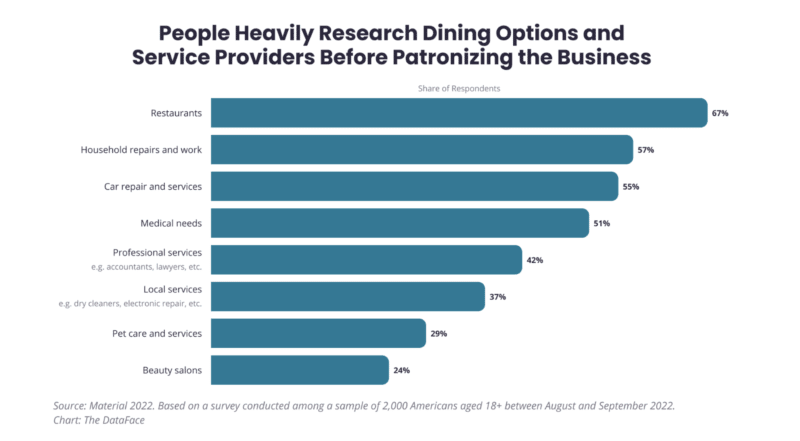
In a recent survey led by Yelp and conducted by Material, 2,000 Americans were asked to reveal what they consider to be trustworthy reviews. The respondents said they read, on average, five reviews about a business to inform their spending decisions, and 77% say they’re reading more online reviews now than they ever have before.

Key findings. In their survey, Yelp found the following:

  • Respondents say they research and consider online reviews more for restaurants (67%), household repairs/work (57%), car repair/services (55%), medical needs (51%) and professional services (42%).
  • When respondents think they’ve spotted a fake online review, they will read other reviews to gather additional opinions (49%), ignore the potentially fake review (34%), find another business (27%) or report the review (24%).
  • Only 28% of respondents are looking out for incentivized reviews, but 71% say they would no longer visit a business if they learned the business has fake or compensated online reviews.
  • 85% of respondents trust reviews with written text over only a star rating.
    • Yelp requires that ratings be accompanied by actual review text.
  • 88% of respondents say it’s important that they understand how online review platforms determine which reviews are reliable and which are less trustworthy.
  • 79% of respondents would prefer to see all the reviews for a business or product, including those that the review platform believes are fake or untrustworthy.

Combating fake reviews. The survey also revealed that of respondents who think they’ve spotted a fake review, 49% will read other reviews to gather additional opinions about the business. 34% ignore the potentially fake review, 27% find another business, and 24% report the review to its respective platform.

85% of those surveyed trust reviews with written text over only a star rating.

Extortion controversy. In the blog article, yelp goes on to mention a Google Reviews extortion scheme that affected numerous restaurants in major cities. These restaurants experienced an influx of one-star Google reviews without any review text, as scammers tried to extort the restaurants for $75 Google Play gift cards to remove their fake reviews. This did not occur on Yelp because of our mandatory review text policies.

But similarly, Yelp also dealt with an extortion controversy of its own several years ago, as well as inconsistencies with its review solicitation rules.

Dig deeper. You can read the full Yelp study on their blog.

Why we care. Local businesses on Yelp should use ethical and legal tactics when asking for reviews. Alternatively, businesses can use paid ads to show higher in the search results, respond to any negative reviews, and keep their pages updated to optimize their business listings.


Related Stories

New on Search Engine Land

@media screen and (min-width: 800px) { #div-gpt-ad-3191538-7 { display: flex !important; justify-content: center !important; align-items: center !important; min-width:770px; min-height:260px; } } @media screen and (min-width: 1279px) { #div-gpt-ad-3191538-7 { display: flex !important; justify-content: center !important; align-items: center !important; min-width:800px!important; min-height:440px!important; } }

About The Author

Nicole Farley

Nicole Farley is an editor for Search Engine Land covering all things PPC. In addition to being a Marine Corps veteran, she has an extensive background in digital marketing, an MBA and a penchant for true crime, podcasts, travel, and snacks.

https://searchengineland.com/85-of-yelp-survey-respondents-say-they-trust-written-reviews-over-stars-only-389821


Guard your most valuable asset against pesky competitors by Adthena

In an ideal world, guarding your most valuable asset, your brand, would be effortless. But take off those rose-tinted glasses, and you wake up to the reality that competitors are posing threats to your brand in search every day of the week.

You’ve risen to the top of the search rankings. Hurray! But realize your trademarks and brand equity aren’t protected in search. Booo! Thus, competitors can steal valuable clicks from you, diminish your Return on Ad Spend (ROAS) and threaten future budgets.

Does this sound familiar? Are you finding it hard to fend off brand infringements?

You are not alone. Many companies find it increasingly difficult to fend off rivals using their branded terms, trademarks and ad copy in search. For example, software company Sage had over 89,000 infringements from one single partner in one year. The repercussions were more than undesirable, as they inflated CPCs and impressions and damaged the brand. The results tend to be synonymous among all industries.

This article will cover how you could automatically monitor all infringements, guard against competitors and maximize ROAS. Sounds good, right?

Before we get into the technicalities, let’s dive into the problems you may be struggling with in more detail.

What seems to be the problem, marketer?

Adthena’s customer research has revealed that search marketers are experiencing countless challenges in controlling the use of their trademarks.

Two common themes are:

  • “The process of controlling trademarks is tedious and time-consuming.”
  • “The practical difficulty of finding real-life trademark infringement examples is too difficult to do manually.”

Our research shows that you could waste around eight hours a month on collecting and processing the trademark violation data required to send to Google, as it takes around five minutes to fill out each Google complaint form.

However, there is a way to automate the aggregation and submission of specific infringements across devices at scale, allowing you to confidently protect your brand and save time and effort to boot.

We can sense you edging to the front of your chair, so let’s get to the fun part.

What’s the solution?

Automation is at the forefront of the world of paid search, with Google’s Performance Max solution heading the charge. New products are continually being developed, including a new tool from Adthena called Auto Takedown.

It allows you to map and monitor all competitive and partner activity around your brand terms. You can efficiently respond to trademark infringements and report those examples directly to Google for removal. All with the push of a button inside the Adthena app. Time and effort: saved.


What value does Auto Takedown bring to the table?

The tool adds value in three key ways:

  1. Automatically monitoring your brand trademark search terms at scale, 24/7.
  2. Submitting evidence of trademark violations directly to Google for you. Adthena will also keep track of the responses from Google and communicate this to you if there are any questions or resolutions.
  3. Saving you up to 8 hours per month in manual monitoring, allowing you to focus on strategy and growth instead.

After just five days of using Adthena’s Auto Takedown, Sage saw a 75% decrease in CPCs for brand terms and a 33% decrease in partner impression share.

Protect your trademark today

When the clicks are down, and you know why, take back control and fend off unwanted competitors to protect your valuable assets.

Check out this easy guide, Brand Crashers: 5 steps to optimize your brand in search to get started.


Related Stories

New on Search Engine Land

About The Author

Adthena

Adthena is an award-winning search intelligence platform. Our unique combination of patented, AI-driven technology and a world-class team of experts helps brands, marketers, and agencies across the globe dominate their competitive landscapes. We provide our customers with a clear view of the paid search landscape, helping them optimize their spend to increase ROI, all while saving them time and better informing their cross-channel strategies.

https://searchengineland.com/guard-your-most-valuable-asset-against-pesky-competitors-389754


Twitter has launched 3 new ad targeting options

Twitter has just launched new ad targeting options, including a new ‘Conversions’ objective they originally announced back in August.

The new ‘Conversions’ objective. Advertisers are now able to focus their ad campaigns on those users who are most likely to take specific actions.

Previously, Twitter advertisers were able to optimize campaigns to focus on clicks, site visits, and conversions. But now you can further optimize for page views, content views, add-to-cart, and purchases.

As I mentioned, the updates were announced in August but released just before Thanksgiving.

What Twitter says. “Website Conversions Optimization (WCO) is a major rebuild of our conversion goal that will improve the way advertisers reach customers who are most likely to convert on a lower-funnel website action (e.g. add-to-cart, purchase).”

So instead of just aiming to reach people who are likely to tap on your ad, you can expand that focus to reach users that are more likely to take next-step actions beyond that, like:

  • Add-to-cart
  • Purchase
  • Register contact info
  • Subscribe

“Our user-level algorithms will then target with greater relevance, reaching people most likely to meet your specific goal – at 25% lower cost-per-conversion on average, per initial testing.”

Dynamic Product Ads. Dynamic Product Ads were initially launched in 2016 (a version at least). But this new update integrates a more privacy-focused approach, in order to optimize ad performance with potentially fewer signals.

Collection Ads. The Collection Ads format enables advertisers to share a primary hero image, along with smaller thumbnail images below it.

Twitter says, “The primary image remains static while people can browse through the thumbnails via horizontal scroll. When tapped, each image can drive consumers to a different landing page.”

Dig deeper. Read the full article on the Twitter blog.

Why we care. Yes, Twitter is still releasing new ad updates, despite cutting most of its staff. But it’s likely that these updates were almost completely finished anyway when Musk took over since they had been in development for months.

Advertisers who are still on Twitter should test the new ad features and options to gauge whether they’re valuable additions.


Related Stories

New on Search Engine Land

@media screen and (min-width: 800px) { #div-gpt-ad-3191538-7 { display: flex !important; justify-content: center !important; align-items: center !important; min-width:770px; min-height:260px; } } @media screen and (min-width: 1279px) { #div-gpt-ad-3191538-7 { display: flex !important; justify-content: center !important; align-items: center !important; min-width:800px!important; min-height:440px!important; } }

About The Author

Nicole Farley

Nicole Farley is an editor for Search Engine Land covering all things PPC. In addition to being a Marine Corps veteran, she has an extensive background in digital marketing, an MBA and a penchant for true crime, podcasts, travel, and snacks.

https://searchengineland.com/twitter-has-launched-3-new-ad-targeting-options-389815


Yahoo now has a 25% stake in Taboola

Yahoo has just finalized a 30-year exclusive advertising partnership in Taboola, which would secure a 25% stake in the company. This deal will allow Yahoo to use Taboola’s tech to manage its native ads.

Taboola’s native edge. Taboola specializes in native ads which can be found on popular sites like CNN and MSN. The ads typically look like part of the website and can be informative or entertaining.

However, shares of Taboola have fallen nearly 80% since last year. In January, it merged with a special purpose acquisition company and was valued at $2.6 billion.

The deal with Yahoo gives Taboola the exclusive license to sell native ads across Yahoo’s sites, and the companies will share revenue from those ad sales. The companies did not disclose the terms of the revenue split. The deal will make Yahoo Taboola’s largest shareholder.


Get the daily newsletter search marketers rely on.


Meta and TikTok weigh in. Executives at companies like Meta and TikTok have warned that advertisers skittish about the economy have pulled back on their spending. But Jim Lanzone, the chief executive of Yahoo, said in an interview that the deal with Taboola puts both companies in a good position for when the ad market revives, the NY Times said.

“I’m thinking, you know, five, 10, 30 years,” Lanzone said. “Digital advertising has huge wind at its back over the long term.” He added that while the company will continue to try to bring in money in other ways, such as expanding its subscription business or investing in e-commerce, “we have hundreds of millions of people consuming news and sports and finance on market-leading properties that are heavily monetized through advertising — and will continue to be.”

Dig deeper. You can read the full article from the NY Times here.

Why we care. Advertisers who run native ads may now have another option to expand their reach. Yahoo also commented that they were attempting to “build up each of its products within its mini-media empire and capitalize on its audience.” If this happens it will give advertisers and brands a more competitive edge in choosing which platforms to spend their marketing dollars.


Related Stories

New on Search Engine Land

@media screen and (min-width: 800px) { #div-gpt-ad-3191538-7 { display: flex !important; justify-content: center !important; align-items: center !important; min-width:770px; min-height:260px; } } @media screen and (min-width: 1279px) { #div-gpt-ad-3191538-7 { display: flex !important; justify-content: center !important; align-items: center !important; min-width:800px!important; min-height:440px!important; } }

About The Author

Nicole Farley

Nicole Farley is an editor for Search Engine Land covering all things PPC. In addition to being a Marine Corps veteran, she has an extensive background in digital marketing, an MBA and a penchant for true crime, podcasts, travel, and snacks.

https://searchengineland.com/yahoo-now-has-a-25-stake-in-taboola-389809


Black Friday sales up nearly 12% from 2021

Inflation and “sagging consumer sentiment” accounted for relatively muted Black Friday in the US this year. However, the numbers show that shopping centers are making a comeback, as people are enjoying brick-and-mortar shopping experiences again.

Adobe Analytics said online sales rose 2.3% to $9.12 billion. The company’s initial projection was $9 billion, (for perspective, this percentage increase lagged far behind the country’s inflation rate, which is running at almost 8%).

Shopping statistics. Brick-and-mortar retailers, who for the last two Black Fridays contended with Covid-19 outbreaks and restrictions, saw in-store visits tick up this year by 2.9% compared to 2021, according to a report by Sensormatic Solutions. Interestingly, visits to physical stores on Thanksgiving Day increased by 19.7% compared to last year.

Enclosed mall traffic increased 1.2%, and traffic to non-malls, such as strip centers and standalone stores, increased 4.7% compared to Black Friday 2021, Bloomberg reports. Some reports indicate that though the crowds were smaller, shoppers waited in line much longer due to many stores experiencing staffing issues.

Shopify merchants break records. Shopify announced a record-setting Black Friday with sales of $3.36* billion from the start of Black Friday in New Zealand through the end of Black Friday in California.

  • Peak sales per minute: $3.5 million USD on Black Friday at 12:01 PM EST
  • Top selling countries and cities where shoppers made purchases from: United States, United Kingdom and Canada, with the top-selling cities on Black Friday including London, New York, and Los Angeles
  • Top product categories: Apparel & accessories, followed by health & beauty, and home & garden, with trending products including Snocks GmbH (Boxershorts), rhode, and Brooklinen
  • Average cart price: $102.31 USD or $105.10 USD
  • 15%: Cross-border orders worldwide on Black Friday as a percentage of total orders 
  • 27%: Growth in POS sales made by Shopify merchants globally over last year’s Black Friday
  • Economic uncertainty drove many to alternative payment methods. For example, buy now, pay later (BNPL) orders jumped 78% the week of November 19 compared with the previous week. BNPL revenues rose 81% over the same period

What Shopify says. “Black Friday Cyber Monday has grown into a full-on shopping season. The weekend that started it all is still one of the biggest commerce events of the year, and our merchants have broken Black Friday sales records again,” said Harley Finkelstein, President of Shopify. “Our merchants have built beloved brands with loyal communities that support them. This weekend, we’re celebrating the incredible power of entrepreneurship on a global stage.” 

Dig deeper. You can read the entire article from Bloomberg here.

Why we care. Consumers are still spending. Ecommerce merchants and advertisers who promote online should still prioritize and continue to run ads, even after the BFCM holiday. Though many are still facing supply chain issues, testing different discounts and offers should be top of mind going into the Christmas season.


Related Stories

New on Search Engine Land

@media screen and (min-width: 800px) { #div-gpt-ad-3191538-7 { display: flex !important; justify-content: center !important; align-items: center !important; min-width:770px; min-height:260px; } } @media screen and (min-width: 1279px) { #div-gpt-ad-3191538-7 { display: flex !important; justify-content: center !important; align-items: center !important; min-width:800px!important; min-height:440px!important; } }

About The Author

Nicole Farley

Nicole Farley is an editor for Search Engine Land covering all things PPC. In addition to being a Marine Corps veteran, she has an extensive background in digital marketing, an MBA and a penchant for true crime, podcasts, travel, and snacks.

https://searchengineland.com/black-friday-sales-up-nearly-12-from-2021-389798


Microsoft is planning to double the size of its ad business to $20 billion

Microsoft is looking to double its ad business from $10 billion a year to $20 billion in revenue. Leadership didn’t specify a timeframe, but if their goal is reached, it will become the sixth-largest digital ad seller worldwide.

Microsoft’s multiple ad properties. Microsoft’s ad properties include Bing search, Xbox, MSN and many other websites that use Xandr to sell digital ads. Microsoft also introduced vertical ad formats, credit card ads, and expanded its audience network into 66 new markets.

Search and news revenue up 16%. Microsoft reported their FY23 Q1 ad revenue is up 16%. But CFO Amy Hood told analysts during the earnings call that “reductions in customer advertising spend, which also weakened later in the quarter, impacted search in advertising and LinkedIn marketing solutions.”

But the search and advertising bump was “driven by higher search volume and Xandr.” Nadella says Microsoft has “expanded the geographies we serve by nearly 4x over the past year.” Microsoft Edge may also be helping out with Bing search and advertising revenues. “Edge is the fastest growing browser on Windows and continues to gain share as people use built-in coupon and price comparison features to save money,” says Nadella.

Rob Wilk, corporate vice president of Microsoft Advertising said that he intends to make buying ads across assets easier for partners. “We have a lot of plumbing work to do,” he said in an October interview. “Microsoft also needs to differentiate itself from competitors that have similar properties but have far more mature advertising businesses, like Google. Wilk said Microsoft is more “partner oriented” than Google.”


Get the daily newsletter search marketers rely on.


Netflix. The new Netflix partnership was launched this month and allows advertisers to purchase ads through the demand side platform Xandr. Microsoft will take a reseller fee, and experts predict that the partnership will be a huge revenue driver, easily clearing $10 billion in ad sales or more.

Gaming. Another great revenue driver for Microsoft is gaming. The acquisition of Activision Blizzard is still pending, but in-game ad revenue could be a unique selling point if the ads can be bought through Xandr.

Dig deeper. You can read the full article from Business Insider here.

Why we care. As Microsoft’s ad business grows, it means greater opportunities for advertisers who are looking to expand their reach beyond Google and Facebook. Additional options such as in-game ads, Netflix, and the demand-side platform Xandr will open doors for both publishers and brands alike.


Related Stories

New on Search Engine Land

@media screen and (min-width: 800px) { #div-gpt-ad-3191538-7 { display: flex !important; justify-content: center !important; align-items: center !important; min-width:770px; min-height:260px; } } @media screen and (min-width: 1279px) { #div-gpt-ad-3191538-7 { display: flex !important; justify-content: center !important; align-items: center !important; min-width:800px!important; min-height:440px!important; } }

About The Author

Nicole Farley

Nicole Farley is an editor for Search Engine Land covering all things PPC. In addition to being a Marine Corps veteran, she has an extensive background in digital marketing, an MBA and a penchant for true crime, podcasts, travel, and snacks.

https://searchengineland.com/microsoft-is-planning-to-double-the-size-of-its-ad-business-to-20-billion-389796


NPS for agencies: How to capture client and employee satisfaction

Agencies can often fall into the trap of thinking that clients are happy if they increase their marketing investment. 

Similarly, we assume that employees are happy if we’re focusing on culture and trying to do the right thing.

But are those things really true?

Our agency uses two simple metrics to gather objective data – Net Promoter Score (NPS) and Employee Net Promoter Score (eNPS).

Even if you’ve never heard of NPS, you’ve probably received an email or text that asks a simple question: “Would you recommend us to a friend, family member, or colleague?” 

That single question helps companies measure client satisfaction and can help your agency understand if clients are delighted or simply comfortable.

Those who give you a 9 or 10 are considered “promoters” and are your biggest advocates. They not only tend to stick with you, but they are also likely to evangelize for you internally and externally.

Anyone who gives you a score of 6 or lower is a detractor. That means that they not only aren’t fans of yours, but they generally aren’t willing to defend their relationship with you or your firm either. Scores of 7 or 8 are considered passive and are not counted toward your NPS.

The Net Promoter calculation requires adding up the survey responses and subtracting the percentage of detractors from the percentage of promoters. The delta is your Net Promoter Score. 

For example, let’s say:

  • 65% of respondents are promoters.
  • 25% are detractors.
  • 10% are passives

In this case, your NPS would be 65-25=40.

An NPS score above 70 is world-class, and the benchmark for digital marketing agencies is 68.

The reason that the benchmark is so high for digital marketing agencies is that dissatisfied clients tend to take their business elsewhere if they aren’t happy.

Net Promoter Scores can help you understand how the overall health of your agency is likely to trend and may help you predict (or stop) upcoming client churn.

I’d recommend capturing the score on a quarterly or semi-annual basis since perceptions can change – not only based on results but external factors and feelings.

We use a tool called AskNicely that allows us to ask follow-up questions after receiving the score, and also lets us trigger different workflows based on responses.

We can understand if clients are delighted by technical knowledge, communication, or a different factor. Similarly, we can understand any causes of dissatisfaction.

In addition, we can slice data based on the person working with the client to understand if there’s risk based on one of our employees or by the line of service (e.g., SEO, PPC, strategy).

The additional feedback complements the score itself and allows us to dig into the “why” behind a rating, and course correct anywhere needed.


Get the daily newsletter search marketers rely on.


As all agency leaders know, the market for digital marketing talent is exceptionally hot, especially with so many remote roles. This remote shift has made the barrier to switching jobs extremely low, so managers must have a pulse on employee satisfaction.

The eNPS question is very similar to the one for NPS, “On a scale of 0 to 10, how likely are you to recommend our organization as a place to work to others?”

Although you likely have some raving fans, eNPS tends to have more “passive” or neutral scores than a traditional NPS score for your service offering. Employees likely won’t feel bad about giving you an 8, a score that ultimately gets discarded since it’s considered a neutral sentiment.

An eNPS score of 40 or greater is considered excellent. Employees tend to hold companies to a very high standard – often higher than clients.

Similar to NPS, it’s important to trend this score either quarterly or semi-annually for various reasons:

  • Happy employees generally lead to happy clients and you want to spot any dissatisfaction.
  • Expectations increase over time. Ensure that your agency is holding steady or improving.
  • Client rosters and contacts change and can impact how the employee feels.
  • Scores can be impacted negatively or positively by temporary factors such as project launches or other extremely busy periods.

In addition to tracking the eNPS score itself, I also recommend that smaller firms look at the average of the scores. For example, perhaps your agency has a lot of 9 and 10s, but there are just a couple of people giving you detractors, your overall satisfaction may be strong. 

Sample size can have a big impact on smaller firms, especially if you don’t get a 100% response rate.

Why should your agency care?

Client and employee churn is part of running an agency, but by capturing these two objective metrics, you can try to get ahead of it.

Reach out quickly to clients that give you anything outside of a 9 or 10, and even those who drop from a 10 to a 9. Ask them for candid feedback about what you can do to turn them into promoters and improve the business relationship.

To get the most accurate feedback from employees, you’ll need to gather the data anonymously. This makes gathering actionable insights a bit more difficult.

However, if you receive a lower than optimal score, you can follow up eNPS with another anonymous survey asking employees what their favorite and least favorite parts of working for your agency are.

Getting started

Since NPS and eNPS are based on one question, it’s easy to start. For a free solution, you can try SurveyMonkey or Typeform. 

However, several solution providers specialize in capturing satisfaction feedback such as Delighted, AskNicely, Survey Sparrow and Retently. These SaaS companies can help you extract more details than a simple form.

For more advanced analysis, you’ll want to find a solution that connects to your other data sources (such as your CRM), but it ultimately has to meet the pricing and features required for a business of your size.

Get started today and understand if your agency is on the right track.


Opinions expressed in this article are those of the guest author and not necessarily Search Engine Land. Staff authors are listed here.


Related Stories

New on Search Engine Land

@media screen and (min-width: 800px) { #div-gpt-ad-3191538-7 { display: flex !important; justify-content: center !important; align-items: center !important; min-width:770px; min-height:260px; } } @media screen and (min-width: 1279px) { #div-gpt-ad-3191538-7 { display: flex !important; justify-content: center !important; align-items: center !important; min-width:800px!important; min-height:440px!important; } }

About The Author

Antonella Pisani

Antonella Pisani is CEO and founder at Eyeful Media, where she leads a team of passionate & talented marketers. Over the course of her career, she’s held senior digital marketing & eCommerce leadership positions with Fossil, JCPenney, Guitar Center, and Proflowers but began her career as a web designer in 1996. Antonella is based in Dallas, and her trusty sidekick, Riley (a rescue pup who also serves as the company’s Chief Security Officer), is often sleeping by her desk. She’s been to 37 countries and loves to travel any chance she gets.

https://searchengineland.com/nps-for-agencies-389690