5 best practices for tracking offline conversions in Google Ads

Risk-taking is part of any marketer’s job. No strategy is guaranteed to work.

I like to think of myself as a calculated risk-taker. Because I have TSA PreCheck and monitor my flight status from home, I arrive at the airport just an hour before my flight. I try new restaurants in town, but don’t get in the car until I’ve scoured review sites and scanned the menu. 

My approach to taking risks at work is similar. Testing the latest bidding strategies excites me, but my moves are deliberate to avoid disturbing performance.

Major changes to a Google Ads account send the algorithms into a learning phase and create volatility as it re-learns.

Like many marketers who want results yesterday, my patience can be short. But to keep clients happy, balancing future-forward strategies with the risk of upsetting KPIs is imperative.

By now, we know that offline conversion tracking (OCT) is a must-have in any account. 

When setting it up for the first time, swapping out web-based campaign optimization goals for CRM-based goals can be tricky. Here are five best practices to mitigate the risk. 

1. Add values to your conversions

Maximizing the potential of OCT requires assigning each action a value.

If you can’t use actual and dynamic values from your CRM, Google has a calculator that can help with estimations.

The values don’t have to be precise for the algorithms to benefit from this provided direction.

The assigned values tell machine learning how much each conversion is worth. Therefore, the system can bid accordingly with value-based bidding strategies. 

Even if you’re not ready for target return on ad spend (tROAS) or Maximize conversion value, setting these values from the get-go allows for an easy launch when you’re ready.

2. Optimize for all funnel stages

Once all stages of your marketing funnel feed into Google Ads with their respective values, begin optimizing campaigns for all funnel stages. 

This tactic will generate more conversion data for your campaigns and speed up the learning phase.

A risk-taker might change the optimization across the account all at once. Go ahead and rip the bandage off: 

  • If you can stomach performance fluctuations.
  • If the account is brand new.
  • Or if conversion volume is already dismal.

I prefer to set up an experiment for any major bidding changes to cut down the volatility in the account. 

Experiments should run for at least two weeks before determining a winner, but this can take longer if your budgets are small or the conversion lag is long. 

A lift in backend conversions should be measured as the key success metric of this experiment.


Get the daily newsletter search marketers rely on.


3. Optimize for the lowest conversion point possible

Once the full-funnel approach is successful, you can begin optimizing for one conversion event at a time. Treat each campaign uniquely and adjust the campaigns ready to move down the funnel. 

To ease performance fluctuations, set up an experiment that optimizes to the lowest point in the funnel possible, given Google’s need to have at least 15 conversions in the past 30 days.

Creating custom columns in the Google Ads interface allows you to sort and visualize your data easily. Analyze each campaign independently. 

In this example, the top two campaigns have enough MQL volume to optimize for MQLs exclusively rather than the entire funnel.

Optimize for the lowest conversion point possible

Consider that not all keywords are created equal. Top-of-funnel keywords will generate pipeline slower than your high-intent non-brand or brand terms. 

Individual campaigns’ optimization goals and bidding strategies should align with the funnel stage, and what’s working best.

The UI doesn’t allow OCT goals to be set as single conversion events but rather as the conversion category as a whole. Therefore, custom goals should be created when optimizing toward a single point in the funnel. 

For example, if your OCT conversion is “sales,” you should create a custom goal for “sales.”

Google says “[…] using custom goals in campaigns might make your bid strategy work less efficiently,” but if your account is well-established with sufficient data, custom goals should work to your benefit.

Use campaign-specific goal settings

4. Continue to drive lower-funnel results

As time goes on and data collects, you can continue to push the limits and optimize for lower points in the funnel. 

Any bidding strategy can be tested alongside this tactic, but it’s critical that the experiment you create only changes one variable at a time. 

For example, the control campaign is on target cost-per-action (tCPA) and optimized for MQLs. The test campaign should remain on tCPA but optimize for the next stage in the funnel (Meeting Scheduled). After a winner is determined, test another variable by conducting a separate experiment.

Depending on the size of the account, nailing down the perfect combination of optimization goals and bidding strategies can take several months. Seeing little to no performance improvement after the initial two weeks can be worrisome, but running experiments for three full cycles is recommended to determine a winner. 

This means if it takes an average of two weeks for an MQL to become a “Meeting Scheduled,” you should run the experiment for at least six weeks before calling it quits. Check out Google’s path metrics report to view how many days each conversion takes. 

Google Ads Path metrics report

5. Test value-based bidding

Once you are comfortable optimizing for lower-funnel conversion points, step up your game with Maximize conversion value or tROAS bidding strategies. 

These smart bidding strategies adjust bids automatically to predict the value of a potential conversion when a user searches for keywords you’re bidding on. 

These bidding strategies can and should be tested in an experiment, especially if you’re terrified of breaking the algorithm.

Despite the risks associated with performance fluctuations, the benefits should outweigh the volatility. 

With some patience and breathing exercises, one of my clients saw a 74% improvement in cost per MQL since optimizing for backend conversions with OCT. 

When their brand campaign had more than 15 MQLs in a month, we switched to optimizing for MQLs only, resulting in a 4x boost in conversion value on that campaign.

So, get out there and take calculated risks. Be smart, bold and eager to set up experiments when you’re feeling apprehensive.


Opinions expressed in this article are those of the guest author and not necessarily Search Engine Land. Staff authors are listed here.


Related Stories

New on Search Engine Land

@media screen and (min-width: 800px) { #div-gpt-ad-3191538-7 { display: flex !important; justify-content: center !important; align-items: center !important; min-width:770px; min-height:260px; } } @media screen and (min-width: 1279px) { #div-gpt-ad-3191538-7 { display: flex !important; justify-content: center !important; align-items: center !important; min-width:800px!important; min-height:440px!important; } }

About The Author

Kerri Amodio

Kerri Amodio is a Senior Digital Advertising Manager at Closed Loop. A specialist in B2B SaaS marketing, she became well-versed in executing digital advertising strategies across social, search and display while working in-house for B2B tech companies. Kerri has been on the agency side at Closed Loop for nearly four years, working with clients such as Slack, Netskope, Outreach, xMatters, Podium and Corporate Visions.

https://searchengineland.com/google-ads-tracking-offline-conversions-best-practices-389544


Google’s formula for navigating economic uncertainty involves “doubling down”

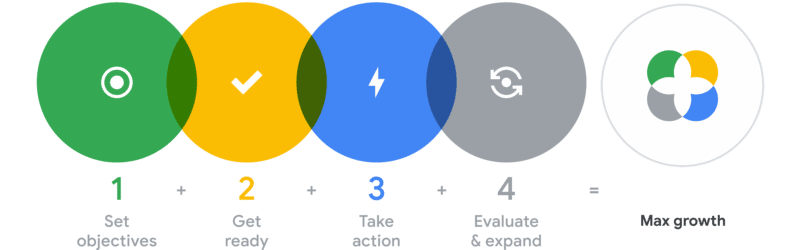
Google’s formula for success requires a balance of doubling down on what’s working, and “placing calculated bets to unlock future growth.” The formula comes directly from Google’s best practices playbook.

1. Directly connect your marketing goals to real business outcomes

To maximize ROI, start with defining the value of different conversions based on what they’re really worth to your business. Setting the right goals helps you point Google Ads to place the right bids so you can get the most out of your campaign budgets.

Revisit your success metrics regularly to identify the most important conversions and drive the best performance possible.

2. Lay the measurement foundation that enables better performance

Google recommends three steps to unlock more accurate, privacy-centric measurements as third-party cookies and other identifiers are phased out:

  1. Measure impact while preserving user trust: Set up sitewide tagging with the Google tag, and supplement it with enhanced conversions to collect consented, user-provided data. Rely on conversion modeling to learn from your first-party data and fill in conversion gaps when observable data isn’t available.
  2. Understand what’s driving performance: Make better bidding decisions across channels by switching to data-driven attribution so you can assign conversion credit to multiple touchpoints that are the most incremental.
  3. Get more actionable insights: Make sure you upgrade to Google Analytics 4.

3. Capture existing demand now and generate new demand for the future

To help fully optimize your Search campaigns, combine broad match keywords with Smart Bidding and responsive search ads. This helps you unlock incremental sources of conversions and ROI. Then, go beyond Search using Performance Max campaigns to multiply conversions across Google’s full range of advertising channels and inventory.

4. Evaluate and expand what’s working

Watch your optimization score and recommendations to identify ways to improve performance, and automatically apply the recommendations that matter most to your bottom line. Finally, check the Insights page frequently to discover performance and consumer trends that are uniquely customized to your business. 

Dig deeper. You can read the entire playbook here.

Why we care. Though there are some good tips here, make sure you are making the best decisions possible for your own business. Don’t always auto-apply recommendations without reviewing them, and use broad match and smart bidding where necessary.


Related Stories

New on Search Engine Land

@media screen and (min-width: 800px) { #div-gpt-ad-3191538-7 { display: flex !important; justify-content: center !important; align-items: center !important; min-width:770px; min-height:260px; } } @media screen and (min-width: 1279px) { #div-gpt-ad-3191538-7 { display: flex !important; justify-content: center !important; align-items: center !important; min-width:800px!important; min-height:440px!important; } }

About The Author

Nicole Farley

Nicole Farley is an editor for Search Engine Land covering all things PPC. In addition to being a Marine Corps veteran, she has an extensive background in digital marketing, an MBA and a penchant for true crime, podcasts, travel, and snacks.

https://searchengineland.com/googles-formula-for-navigating-economic-uncertainty-involves-doubling-down-389681


Marketing in a recession: How to avoid 5 common mistakes

It’s hard not to be anxious about the macroeconomy right now. 

Unless you’re a brand marketer in a thoroughly recession-proof industry or an agency marketer with a portfolio of clients in recession-proof industries, you’re working against an undercurrent of stress and performance pressure.

These emotions may help some marketers achieve hyper-focus. But they’re also leading many to make hasty decisions that run counter to the short- and long-term health of their businesses. 

In this article, you’ll learn some common mistakes marketers make and more thoughtful alternatives that will position brands to survive and thrive over the long haul.

Mistake 1: Cutting instead of reducing

You’ve likely heard that marketing is a flywheel.

What that means, especially with major platform algorithms’ self-learning capabilities, is that cutting spend implies a hard reset that will have last ramifications well beyond the time it takes to turn campaigns back on.

What to do instead

Wherever possible, keep the lights on in campaigns you know are providing results. If you need to reduce spend: 

  • Understand that you’re in good company.
  • Take a deep breath and start by dialing back (but not cutting altogether) where you’ll see a less immediate impact. 

If you can’t clearly see opportunities within specific campaign segments, you may need more precise segmentation:

  • Top of funnel, middle of funnel or bottom of funnel at the campaign level.
  • By objective at the ad set level. 

This will help you assess where performance is relatively poor and eligible for reductions.

Mistake 2: Cutting without referencing account history

It’s an especially tough time for startups. Without a lot of benchmarking data, they’re unable to reference past account history for smarter budget reductions. 

There are fewer excuses for more established brands not to dig into the history of account performance (especially if the history goes back to other frenetic times, like the first six months of the COVID-19 pandemic), but I’ve seen it happen.

What to do instead

If you are a startup and don’t have a helpful archive of performance data, but you do have an agency running your account, lean heavily on them to pull insights from similar accounts they may have had in the past. (Make sure you’re involving your agency in any big decisions, of course.)

If you have a more established set of accounts, go back at least to your 2020 data to analyze: 

  • How you reallocated budget then.
  • What worked in the short and long terms.
  • What had lasting effects (good or bad). 

This will give you a good strategic starting point for product or service campaigns that remain relevant to your business.


Get the daily newsletter search marketers rely on.


Mistake 3: Cutting without referencing CRM data

I’ve seen this a lot over the years and not just in recessions: marketers who react to surface-level metrics without understanding actual business impact make poor budget decisions.

Examples: 

  • A B2B brand throws more budget at a source of cheap CPLs instead of understanding which source is driving the most qualified leads that evolve into opportunities.
  • An ecommerce brand reduces budget for their highest-CPA audience without realizing that the audience in question carries an average LTV 50% higher than other audiences.

In times where spend reductions are widespread, kneecapping your most valuable audiences, segments or campaigns may achieve your immediate budget goals, but it’ll crater your revenue over the long term.

What to do instead

If you haven’t synced your marketing data with your CRM data, it’s high time to get that nailed down. 

At the very least, make sure you have an understanding (on the B2B side) of which channels are driving your most qualified leads (which you can keep track of on a simple Excel sheet if you’re waiting on dev resources) so you can prioritize other areas for spend reductions.

Mistake 4: Cutting new campaigns prematurely

In today’s algorithm-heavy marketing world:

  • Campaigns need time and data to optimize. 
  • Tests need enough time to return statistically significant results. 

Early indicators are not the full picture and shouldn’t be all the information you need to make your decisions.

What to do instead

Rather than panicking and cutting, rotate in fresh creative and messaging while adjusting bidding types. Go through all the usual optimization options you normally would, and resist the urge to cut without understanding the true performance ceiling of your campaigns.

In B2B, where data density takes longer to build, set some higher-volume growth indicators that will return information more quickly. 

Even CTR can be a decent proxy metric to start with (as long as you react to high CTR/low conversion scenarios by optimizing the weak point in your funnel).

Mistake 5: Going blind to opportunity

While it may feel like a worst-case scenario for many marketers, the likelihood is that at least one of your competitors is in poorer shape – which means they may be leaving market share and/or lower costs on the table for you to grab. 

(If you’re working for a recession-proof brand and have a full budget on hand, this is relevant to you as well, since you may see lower CPMs and CPCs in your social channels once the election and holiday seasons have elapsed).

Yes, many of us are on the defensive for good reason. But spending all of your energy on preservation means you might miss out on opportunities to expand.

What to do instead

Make sure you’re paying attention to weekly cost trends so you can quickly identify (and jump on) any market softness. 

Keep close tabs on industry news, particularly concerning platforms you haven’t yet tested, that indicate any general downward cost trends making those platforms more viable. 

The other thing to watch for is emerging trends and market shifts that you can address in your campaigns. If your traditional ideal customer profile (ICP) is developing new pain points: 

  • Make sure your marketing addresses those.
  • Communicate the developments to your executive team so they can consider shifting any offers accordingly. 

Above all, do your best to approach your campaigns with an eye toward the long term, which will help keep you from spending all of your time and money on sheer survival tactics.

Great marketers emerge from recessions

You may notice that every one of these mistakes should be avoided at all times, not just during economic upheaval. 

There’s a reason for the adages about great marketers emerging from recessions. 

Whether the recession forces you into good new habits or you brought good habits that helped keep your company ahead of the curve, the foundations of great marketing persist. 

Keep them top of mind as you wade through the news cycles and tough internal meetings.


Opinions expressed in this article are those of the guest author and not necessarily Search Engine Land. Staff authors are listed here.


Related Stories

New on Search Engine Land

@media screen and (min-width: 800px) { #div-gpt-ad-3191538-7 { display: flex !important; justify-content: center !important; align-items: center !important; min-width:770px; min-height:260px; } } @media screen and (min-width: 1279px) { #div-gpt-ad-3191538-7 { display: flex !important; justify-content: center !important; align-items: center !important; min-width:800px!important; min-height:440px!important; } }

About The Author

Laura Schiele

Laura Schiele, Head of Paid Acquisition at Jordan Digital Marketing, has nearly a decade of experience in paid media strategy and execution in both agency and in-house accounts and uses advanced analytics skills to scale growth within efficiency goals across Google, LinkedIn, Facebook, and more. Laura manages a large team of paid media experts remotely from her home in Burlington, VT.

https://searchengineland.com/marketing-recession-common-mistakes-389542


Walmart’s ad revenue increased 30% in Q3

Walmart released its Q3 earnings this week and things were looking up for the retail giant. Their advertising revenue grew about 30% since Q2.

On the earnings call, President and CEO Doug McMillon attributed the growth to “More items and sellers driving GMV (Gross Merchandise Volume) and improving customer satisfaction.” He continued that success with advertising is “mutually reinforcing. If we double-click on advertising with Walmart Connect in the U.S., we see it’s benefiting from growth in e-commerce and from improvements made within the business itself. And we’ve seen strong growth in return on ad spend over last year.”

Walmart Connect. Connect is Walmart’s self-service ad platform that was recently announced. The platform allows retailers to create an account and upload their product SKUs to the Walmart platform, without the need to go through an approved vendor and wait three days for approval.

As with advertising, growing our marketplace business also unlocks fulfillment services opportunities through both fulfillment centers and last-mile delivery. We’re scaling these businesses in the U.S., and we’re starting to ramp up in Mexico and Canada. The team in Mexico increased the number of sellers on our marketplace by 20% during the quarter. In the U.S., the marketplace on Walmart.com now offers about 370 million SKUs.

That’s an increase of more than 50% from Q2. Many of these sellers want to leverage our fulfillment network. They also want to use our advertising capabilities to drive demand, and we’re making that easier for them. We recently shared that all new marketplace sellers in the U.S.

will be automatically onboarded onto our self-service ad platform. We believe this seamless integration will help both businesses scale even faster. What you see in our results is that we can run compelling stores and clubs, scale of first- and third-party e-commerce business, and connect them together in an omnichannel fashion that saves customers and members money and time. Our strategy unlocks growth opportunities for us and a thread that runs from digital retail to fulfillment and advertising, and opens up even more opportunities with health and wellness and financial services.

Doug McMillon

Roku, TikTok, and Snap partnerships. Walmart also expanded its own ecommerce platform by powering ads on TikTok, Roku, and Snap. Walmart will also have the capability to measure any sales that come from those ads.

Dig deeper. You can review the earnings announcement here.

Why we care. If you’re an ecommerce retailer or brand, Walmart might be a great platform to test if you’re looking to expand your reach and connect with new buyers.


Related Stories

New on Search Engine Land

@media screen and (min-width: 800px) { #div-gpt-ad-3191538-7 { display: flex !important; justify-content: center !important; align-items: center !important; min-width:770px; min-height:260px; } } @media screen and (min-width: 1279px) { #div-gpt-ad-3191538-7 { display: flex !important; justify-content: center !important; align-items: center !important; min-width:800px!important; min-height:440px!important; } }

About The Author

Nicole Farley

Nicole Farley is an editor for Search Engine Land covering all things PPC. In addition to being a Marine Corps veteran, she has an extensive background in digital marketing, an MBA and a penchant for true crime, podcasts, travel, and snacks.

https://searchengineland.com/walmarts-ad-revenue-increased-30-in-q3-389670


New AdSense data protection laws coming to CA, CO, CT, and UT in 2023

New data protection laws, which apply to the collection and processing of personal information, will be coming into effect in California, Colorado, Connecticut, Virginia and Utah in 2023.

According to an email sent to all AdSense admins and legal managers, starting January 1, 2023, we will supplement the existing Google Ads Data Processing Terms, Google Ads Controller-Controller Data Protection Terms, and Google Measurement Controller-Controller Data Protection Terms for these 5 new US State laws. No additional action is required to accept these terms if you’ve already agreed to the online data protection terms.

Ads and analytics only. This update relates to Google’s ads and analytics products. If you also use other Google products, such as Workspace or Cloud Identity, this email does not affect your use of those products.

Dig deeper. You can read more about the new laws here.

Why we care. If you’re an AdSense Manager or Admin living or advertising in California, Colorado, Connecticut, and Utah, be sure your account complies with all laws and regulations.


Related Stories

New on Search Engine Land

@media screen and (min-width: 800px) { #div-gpt-ad-3191538-7 { display: flex !important; justify-content: center !important; align-items: center !important; min-width:770px; min-height:260px; } } @media screen and (min-width: 1279px) { #div-gpt-ad-3191538-7 { display: flex !important; justify-content: center !important; align-items: center !important; min-width:800px!important; min-height:440px!important; } }

About The Author

Nicole Farley

Nicole Farley is an editor for Search Engine Land covering all things PPC. In addition to being a Marine Corps veteran, she has an extensive background in digital marketing, an MBA and a penchant for true crime, podcasts, travel, and snacks.

https://searchengineland.com/new-adsense-data-protection-laws-coming-to-ca-co-ct-and-ut-in-2023-389667


Is Google Search getting worse?

Marissa Mayer, the former CEO of Yahoo, was Google’s 20th employee and the one-time leader of its search team, said Google is concerned about the declining quality of the web.

The comments were made on a recent Freakonomics podcast episode that looked at whether the quality of Google search has declined over the years. The episode also featured comments from former Google executives like Sridhar Ramaswamy, who was the head of its search advertising business and left in 2018, as well as Jeremy Stoppelman, the CEO of Yelp.

Issues with search. Some issues that Google is facing regarding search are about the declining quality of search results and the need to include search terms like “Reddit” in a query to find answers written by humans. Among the issues has been the increase of AI-generated pages, which are able to game Google’s algorithm to appear near the top of search results, even if the pages are of middling quality. Google has tried to combat the problem by updating its search algorithm and filtering out pages it deems “unhelpful.” 

What Google says. Mayer said, “I do think the quality of the Internet has taken a hit.” “When I started at Google, there were about 30 million web pages, so crawling them all and indexing them all was relatively straightforward. It sounds like a lot, but it’s small. Today, I think there was one point where Google had seen more than a trillion URLs.”

When asked if URL inflation was responsible for worse search results, Mayer responded:

  • “When you see the quality of your search results go down, it’s natural to blame Google and be like, “Why are they worse?” To me, the more interesting and sophisticated thought is if you say, “Wait, but Google’s just a window onto the web. The real question is, why is the web getting worse?”  

Google’s solution. One way Google has tried to fight the overall decline in quality is by supplementing its index of a trillion web pages with some content of its own. If you ask a simple question about cooking or the age of some politician or actor, or even what’s the best podcast, you may see what Mayer calls an “inline result,” or what Google calls a “featured snippet.” It’s a bit of text that answers your question right there on the search results page, with no need to click on a link.

Mayer’s response:

  • “I think that Google is more hesitant to send users out into the web. And to me that points to a natural tension where they’re saying, ‘wait, we see that the web sometimes isn’t a great experience for our searchers to continue onto. We’re keeping them on our page.”

The ads side. In response to the host referencing a famous quote about advertising income providing an incentive to provide poor-quality search results, Google Search VP Liz Reid responded:

“We take great pride in not only trying to provide high-quality results but ensuring that they are not influenced by ads. So we have a very strong culture that has lasted my entire time that says whether or not you’re an advertiser, does not allow you to change the results we show. You cannot pay us to change how you show. Those results are very pure, and we go to great lengths to ensure that that is the case. And so the quality of the search we provide is run separately from the ads to do that. Relevant ads are actually quite helpful to people and people often click on them and if they don’t click on them, they disappear. We don’t get paid if people don’t click on the results, it’s not we just get paid for showing them. But fundamentally, what we can do with the search results isn’t affected by the ads. We build out our search results separately.”  

The eight-year-long experiment. Mayer and others at Google were concerned that showing ads with search results would degrade the experience for users. So she helped design an experiment to see how true that might be. Mayer said:

  • “We said, ‘OK, 99 percent of users will get ads and we’re going to hold 1 percent not getting ads,’ just to make sure that if we start to see, in various search-health metrics, a degradation in how the searchers were feeling and using the search engine, we could pick up on it.”

So in 2000, the experiment went ahead – 99% of Google search users saw ads, and 1% did not. Then Google forgot about the experiment.

Mayer continued:

  • “I think it was 2008, one of my colleagues came to me and said, ‘We have this issue, we have advertisers who call our customer support line and they’re very upset because they pay for ads and then they get assigned into this experimental group called No Ads at All, and they can’t see their ads and verify that they’re running.’ And I remember feeling – like I turned kind of white at my desk as I heard this, because I said, ‘Do you mean that experiment that I coded in 2000 is still running?’ And they were like, ‘Apparently.’”

Before they turned it off, Mayer wanted to analyze it.

The result. What Mayer and her team saw was 3% more searches from people who had ads than didn’t. They concluded that there was an appreciable difference over a long period of time that people actually liked Google search results more and did more searches when they had ads than when they didn’t.

Dig deeper. You can listen to the entire Freakonomics episode here.

Why we care. Google makes about 80% of its revenue from advertising. But if search results are low quality, users will go elsewhere, like TikTok. It’s easy to see how the need to stay relevant could be costing them in the long run.


Related Stories

New on Search Engine Land

@media screen and (min-width: 800px) { #div-gpt-ad-3191538-7 { display: flex !important; justify-content: center !important; align-items: center !important; min-width:770px; min-height:260px; } } @media screen and (min-width: 1279px) { #div-gpt-ad-3191538-7 { display: flex !important; justify-content: center !important; align-items: center !important; min-width:800px!important; min-height:440px!important; } }

About The Author

Nicole Farley

Nicole Farley is an editor for Search Engine Land covering all things PPC. In addition to being a Marine Corps veteran, she has an extensive background in digital marketing, an MBA and a penchant for true crime, podcasts, travel, and snacks.

https://searchengineland.com/is-google-search-getting-worse-389658


Device-specific PPC: Why it still matters today

Ever since bidding by device uniquely became available (sometime between 2005–2011), I’ve been an avid advocate of separating PPC campaigns by device. (Well, except for tablets, because no one really cares about them anymore.)

Why?

For starters, there is (at least) a 50% chance you’re reading this article on a phone. And you’re probably aware that internet and search consumption is dominated by mobile platforms.

Case in point: looking at an ecommerce brand that literally sells bacon online, I compared September 2022 vs. September 2009 website traffic by device and found that: 

  • In 2009, mobile made up less than 1% and desktop made up 99%. 
  • In 2022, mobile makes up 49% and desktop makes up 46% (total visitor growth increased by 504%). 

So yeah, mobile is a thing and should be treated as such.

Why doing PPC by device is important

As mobile internet usage has grown over the past 10+ years, so has it increased from the perspective of search market share.

So much so that most verticals (not brands, but entire verticals) will discover that mobile commands the majority of traffic and spend when it comes to search. (Not you, B2B, you’re still good with the old desktop.)

This is incredibly evident in consumer goods, brick-and-mortar locations, and brands with low price points and/or short purchase cycle windows.

Prior to 2017, you’d even see as much as 50% lower CPC on mobile vs. desktop courtesy of less competition.

In some scenarios, you still see that. But the volume coming from mobile was so high, it would offset the cost savings on the CPC side.

These days (ignoring PMax), the discounted level on mobile is less, while the volume coming from mobile has greatly surpassed and overtaken that of desktop. 

In the case of a Caribbean QSR brand we work with, the mobile CPC is about 32%. But mobile generates 17x the impressions and clicks than desktop, leading mobile to outspend desktop by 11x.

Then, we look at the environment of users looking at mobile devices. Consumer behavior is different than desktop. 

Mobile triggers immediate engagement (i.e., “Hurry up and get what you need.”). 

On the other hand, desktop involves a sit-down experience, where people research and compare while taking their time. (I should note, this mentality had completely flip-flopped in the past 10 years largely due to consumer wallets.)

Because of this, mobile’s contribution to ecommerce and direct response campaigns has risen dramatically.

Gone are the days when you didn’t want to whip out your credit card and punch it into your phone while in public. 

As we edge closer to a possible recession, the demand to grow any performance effort skyrockets. 

It is clearly evident that mobile should be isolated from desktop because of two huge factors: 

(Sorry tablet, but with your market share contraction since 2019, you get rolled in with desktop in my opinion).


Get the daily newsletter search marketers rely on.


Won’t the search engines allocate my spend and optimize for performance?

Technically, they can optimize and allocate spend to a device. 

But, if you’re relying on the engines to do what is in your best interest, then you’re more doomed than any New York Jets quarterback since 2007.

Think of it this way:

An engine will bid up or down by device, when a bid strategy is in place, to achieve the best possible result to the rule. 

It may also withhold budget from tablet or desktop to spend on mobile. But that may not be in your best interest.

Let’s look at an active scenario I have tested on a lead generation campaign utilizing a max click bid strategy. 

We were overly confident about the site and creative, so we realized optimizing for more traffic would deliver more leads than optimizing specifically to more conversions.

All devices consolidated:

  • $10,000 total spend
    • $3,000 desktop
    • $6,750 mobile
    • $250 tablet
  • 4,150 total clicks ($2.41 CPC)
    • 1,150 desktop ($2.61 CPC)
    • 2,900 mobile ($2.32 CPC)
    • 100 tablet ($2.50 CPC)
  • 850 leads ($11.64 CPL/20.5% Lead Rate)
    • 403 desktop ($7.44 CPL/35% Lead Rate)
    • 414 mobile ($16.30 CPL/14% Lead Rate)
    • 33 tablet ($7.57 CPL/33% Lead Rate)

We then separated the devices into two groups: 

  • Desktop and tablet together.
  • Mobile on its own. 

We split the budget to be 65% mobile and 35% to desktop and tablet:

  •  $10,000 total spend
    • $3,750 desktop+tablet
    • $6,250 mobile
  • 4,400 total clicks ($2.27 CPC)
    • 1,426 desktop+tablet ($2.63 CPC)
    • 2,974 mobile ($2.10 CPC)
  • 945 leads ($10.58 CPL/21.4% Lead Rate)
    • 499 desktop+tablet ($7.51 CPL/35% Lead Rate)
    • 446 mobile ($14.01 CPL/15% Lead Rate)

Both scenarios have the same bid strategy.

The consolidated version was the final four weeks of the campaigns, while the separated version was the final four weeks of a six-week test. (We threw out the first two weeks for the bid strategy to properly learn.) 

Both time periods were not in peak seasons.

The reason the budget for desktop+tablet was put at 37.5% instead of 32.5% (spend level when consolidated) was that it was theorized that there was device cannibalization on budget by mobile. Therefore, we elected to give it an extra $500 to test that belief out.

The outcome proved a number of theories:

  • Mobile was in fact cannibalizing desktop, leading to fewer possible desktop clicks and, therefore, conversions.
  • Mobile CPC was likely skewed upward because of the engines’ allocation to desktop and tablet not giving it its true opportunity.
  • Not allowing the devices to impact one another in the bid strategy or the budgeting allowed for a greater volume of clicks and therefore leads (lead rate was essentially unchanged), but this did drive down the cost per lead.

This also illustrates the importance of human oversight and intervention in bid strategies.

While not utilized in this test, there are studies done that show the benefit of citing the mobile experience in a mobile creative (i.e., “Sign up from your phone”) in improving CTR and lowering CPC.

How will this work with a low budget?

Herein lies the true decision for the advertiser. This approach is feasible if:

  • You have a substantial budget to work with so that no campaign is considered constrained. (This is dependent on the account structure/number of campaigns, and how much daily budget you have.)
  • And you already have an understanding of demand and spend by device.

Who shouldn’t do this?

There are arguments to not do this approach, the most common are:

  • Smaller budgets, the reality is, this may not be possible without causing one campaign to be improperly budgeted.
  • If you’re happy with your current performance in device consolidation, then keep doing what you’re doing.
  • Lack of resources to manage more campaigns.

This isn’t for everyone, but never rule out the concept of device segmentation until you’ve reviewed the data.

Why is device segmentation more important than SKAG?

Single keyword ad groups (or SKAGs) have been a common model for many years within the search industry, largely used for exact and some phrase ad groups. You needed a strong negative game to do it.

But the fact of the matter is, SKAGs are now grossly skewed by the “loosening of match types” for the past few years. 

The amount of time and effort to put together a solid SKAG ad group is likely to produce less return than a solid device segmentation build. 

Blame the engines for that.


Opinions expressed in this article are those of the guest author and not necessarily Search Engine Land. Staff authors are listed here.


Related Stories

New on Search Engine Land

@media screen and (min-width: 800px) { #div-gpt-ad-3191538-7 { display: flex !important; justify-content: center !important; align-items: center !important; min-width:770px; min-height:260px; } } @media screen and (min-width: 1279px) { #div-gpt-ad-3191538-7 { display: flex !important; justify-content: center !important; align-items: center !important; min-width:800px!important; min-height:440px!important; } }

About The Author

Jonathan Kagan

Jonathan Kagan entered the online marketing industry in 2005 – starting out in the SEM world. From there, he progressed and expanded into other sectors of the digital marketing world. Currently, he is the VP of search and biddable media for 9Rooftops|Cogniscient Media. Prior, Jonathan had run search marketing teams for Mediacom, Forbes, and Digitas. Overseeing enterprise search operations for clients that included American Express, Revlon, GlaxoSmithKline, Equifax, Mead Johnson, and Abbvie. In addition, he also created and oversaw Digitas Central America’s search marketing operation. You may of seen some of his presentations on mobile, programmatic and multi-screen marketing at conferences like Search Insider Summit, Digital Summit, ClickZ Live, Connect and SMX.

https://searchengineland.com/device-specific-ppc-why-it-still-matters-389554


Yelp introduces video and image Spotlight Ads on their homescreen

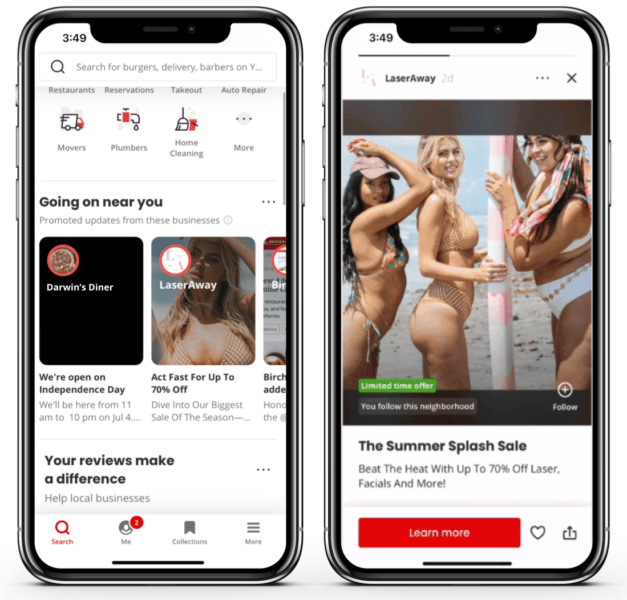
Yelp’s new Spotlight Ads provide brands with the ability to promote 7-30 second videos or static images on Yelp’s homescreen. Yelp says the new ads are an evolution of their Seasonal Spotlight Ads, which allowed brands to promote static ads related to seasonal or holiday offerings.

Yelp added that after launching Seasonal Spotlight Ads they saw increased demand from brands wanting visible homescreen ads even beyond the holidays.

Yelp Store Visits. The Spotlight Ads may also give brands another way to measure impact through their first-party data attribution tool, Yelp Store Visits. Brands using Spotlight Ads will only reach people physically near their stores, who are most likely to convert into customers. To see Spotlight Ads, users must opt-in to location targeting.

How it works. Spotlight Ads run for 28 days and brands can test as many different creatives and messages as they want during that period. Regional brands can also buy Spotlight Ads, which will give them access to some homepage inventory previously available only to brands with a national
footprint.

Why we care. National and regional brands with physical locations such as restaurants or storefronts should test Yelp’s new Spotlight Ads. Yelp didn’t give us any indication of the costs involved, but you can reach out to their team here.


Related Stories

New on Search Engine Land

@media screen and (min-width: 800px) { #div-gpt-ad-3191538-7 { display: flex !important; justify-content: center !important; align-items: center !important; min-width:770px; min-height:260px; } } @media screen and (min-width: 1279px) { #div-gpt-ad-3191538-7 { display: flex !important; justify-content: center !important; align-items: center !important; min-width:800px!important; min-height:440px!important; } }

About The Author

Nicole Farley

Nicole Farley is an editor for Search Engine Land covering all things PPC. In addition to being a Marine Corps veteran, she has an extensive background in digital marketing, an MBA and a penchant for true crime, podcasts, travel, and snacks.

https://searchengineland.com/yelp-introduces-video-and-image-spotlight-ads-on-their-homescreen-389611


YouTube is testing shopping and affiliate features in Shorts

YouTube is testing shopping features and an affiliate program for Shorts, its short-form video product. New shopping features will allow users to purchase products as they scroll through Shorts. The new affiliate program will allow creators to earn commissions when a product they recommended in their Shorts or regular video was purchased.

While the affiliate program is only being tested in the United States right now, the shopping feature will be available to viewers in the United States, India, Brazil, Canada and Australia.

More revenue for creators. YouTube recently announced a partnership with TikTok and Twitch that would also allow creators to take home a share of ad revenues starting in 2023.

Creators will be able to apply to the company’s Partner Program if they meet a new Shorts-specific threshold of 1,000 subscribers and 10 million Shorts views over 90 days, after which they will earn 45% of ad revenue from their videos.

YouTube growth. Surprisingly, YouTube showed slow growth for Q3 2022. YouTube earnings were down about 2% to $7.07 billion from $7.21 billion. To put that into perspective, analysts were expecting an increase of at least 3%. This is the first quarter that YouTube earnings were down since Google began reporting on them.

More YouTube news. Slow growth isn’t stopping YouTube from innovating and creating new products and features this year including expanded translation tools, video trim, and audio. Check them out.

Why we care. If you’re an ecommerce advertiser, brand, or creator, then these new features are a great addition and an excellent way to earn revenue if your channel is large enough. If you’re B2B or lead gen, sorry, you’re out of luck.

“Over the past few years, YouTube has been working to transform its platform into more of a shopping destination with product launches like shoppable ads and the ability to shop directly from livestreams hosted by creators. Given these moves, it makes sense for YouTube to bring shopping to Shorts too.” TechCrunch.


Related Stories

New on Search Engine Land

@media screen and (min-width: 800px) { #div-gpt-ad-3191538-7 { display: flex !important; justify-content: center !important; align-items: center !important; min-width:770px; min-height:260px; } } @media screen and (min-width: 1279px) { #div-gpt-ad-3191538-7 { display: flex !important; justify-content: center !important; align-items: center !important; min-width:800px!important; min-height:440px!important; } }

About The Author

Nicole Farley

Nicole Farley is an editor for Search Engine Land covering all things PPC. In addition to being a Marine Corps veteran, she has an extensive background in digital marketing, an MBA and a penchant for true crime, podcasts, travel, and snacks.

https://searchengineland.com/youtube-is-testing-shopping-and-affiliate-features-in-shorts-389649


SMX Next day 2 kicks off in 1 hour with Google’s Ginny Marvin

Day 2 of SMX Next starts with a keynote from former Search Engine Land editor-in-chief and now Google Ads Liaison Ginny Marvin.

Marvin helps answer questions about how Google ads products and policies work and bring marketers’ insights and perspectives back to the teams working on them.

The keynote today will cover hot topics from 2022 including:

  • How Google is preparing for a cookieless future.
  • The importance of implementing GA4 now.
  • How is GA4 a move toward a more privacy-centric landscape.
  • Google Analytics vs 360 sunset dates.
  • RSAs – will we ever be able to measure individual assets.
  • What metrics Google uses to assign ratings to RSA assets.
  • Automation and brand safety.
  • Top three best practices for using automation for both lead gen and commerce.
  • Marvin’s advice on irrelevant recommendations.
  • Broad match keywords.
  • A recap of 2022.
  • What’s coming in 2023.

Grab your free pass now and join us online for this exclusive keynote with Google Ads Liaison Ginny Marvin.


Related Stories

New on Search Engine Land

@media screen and (min-width: 800px) { #div-gpt-ad-3191538-7 { display: flex !important; justify-content: center !important; align-items: center !important; min-width:770px; min-height:260px; } } @media screen and (min-width: 1279px) { #div-gpt-ad-3191538-7 { display: flex !important; justify-content: center !important; align-items: center !important; min-width:800px!important; min-height:440px!important; } }

About The Author

Nicole Farley

Nicole Farley is an editor for Search Engine Land covering all things PPC. In addition to being a Marine Corps veteran, she has an extensive background in digital marketing, an MBA and a penchant for true crime, podcasts, travel, and snacks.

https://searchengineland.com/smx-next-day-2-preview-389602