What B2B marketers must know in the face of a potential recession

Talking about a recession isn’t always enjoyable. But it’s a situation that inevitably requires a shift in strategy and mindset to continue finding success in the face of economic headwinds. 

Defined technically as a period of a significant decline in economic activity, a recession (and the looming potential for one) directly affects marketing. 

In particular, B2B marketers face a unique challenge in identifying a downturn – with sales cycles expanding beyond 6, 12 or more months into the future and lacking evident shifts. Whereas, B2C and D2C marketers can feel it more quickly when complete verticals go south.

In this article, we’ll unpack how a looming recession impacts B2B marketers and the key factors to consider to successfully navigate this landscape. 

What did B2B marketers do last time? 

You must know the past to understand your present and future. There have been plenty of recessions – some fairly recently. 

In 2007–2009, we experienced the Great Recession in which the mortgage crisis led to the collapse of the housing market bubble. While it may have ended for the U.S. in 2009, the ripple effects were felt in some European countries for years. 

Countries defaulted on their national debt and had to be bailed out by the European Union, resulting in those countries enacting austerity measures to repay their debts, according to History.

Hindsight is 20/20. And when it comes to learning from past mistakes, there’s a clear connection to be made between:

  • Those who increase (or at least maintain) advertising budgets.
  • And those who cut or stop marketing efforts altogether. 

When faced with a potential downturn, brands that committed to advertising and marketing efforts rebounded faster and recovered quicker than those that opted to pull back. 

During the 1990-1991 recession, McDonald’s decreased its advertising and promotion budget, while Pizza Hut and Taco Bell did the complete opposite, according to Pathfind.

This allowed Pizza Hut and Taco Bell to increase sales by 61% and 40%, respectively, while McDonald’s saw 28% fewer sales.

What do B2B buyers want now? 

COVID-19 is one key element that differentiates this potential recession from the others.

We just experienced a global pandemic that permanently altered the entire spectrum of consumer and business decisions. 

As a result, we will need to navigate key shifts in the B2B buyer behavior and landscape.

Offer personalized experiences

B2B buyers want personalized experiences tailored to their needs, just like when they perform their D2C purchases. 

Kibo Commerce provides a few case studies to begin your personalization journey:

  • Use tiered pricing to upsell with product recommendations.
  • Leverage visual predictive search, prioritize results, and set rules to condition results.
  • Enhance the experience for your VIP customers.

Make the move to video

B2B marketers are making the move to video, according to Oracle. 

26% claim that a top investment in the coming years will be video editing software, compared to 14% of their B2C counterparts.

Return to in-person events

In-person events are returning, yet budgets for those won’t be drawn from digital advertising, according to an eMarketer study.

MarTech’s Event Participation Index also found that most marketers are optimistic they will be back attending in-person events in 2023.

Engage through digital channels

B2B marketers love to push every lead, no matter what they did on the site, to a sales rep. 

Yet, 81% of B2B directors or above prefer digital channels vs. face-to-face interactions, per Forrester’s report.

Key chanes in post-pandemic buyer behavior - Forrester for Uberflip

Get the daily newsletter search marketers rely on.


So, what should B2B marketers do?

Let’s talk about the B2B marketing strategies that you should consider during a recession.

B2C will feel it first

Keep a finger on the pulse of B2C industry trends. 

If your target audience is retail, have sales started to plummet? 

If your focus is higher education, have admissions decreased? 

Also, keep in mind some industries tend to fluctuate less, such as healthcare, which isn’t always going to offer up straightforward indicators.

Traditional personas will be less relevant

Traditional marketing personas became less relevant during the 2009 recession, according to a comprehensive Harvard Business Review report on how to market in a downturn market. 

This is a key insight.

Psychological segmentation that takes into consideration consumers’ emotional reactions will result in a more comprehensive and strategic approach. 

Ultimately, the stress of our own day-to-day lives can also impact our decision-making process during difficult times.

Do not stop your marketing efforts

Unfortunately, marketing (and SEO) is almost always considered a “cost” versus a critical component within the pipeline and is subject to being forfeited as a means of saving money. 

This shortsighted budget cut can cause serious damage – driving down awareness, slowing the pipeline, and, ultimately, decreasing business health.

Test, test, and keep testing

A recession is a perfect time to do some small A/B tests to iterate as the market fluctuates and ride the wave vs. waiting for no changes in behavior from your audience.

Embrace martech

In an economic downturn, we’re constantly trying to make our dollars work harder. 

This is where marketing technology can help – from streamlining processes to analyzing data faster, embracing technology will keep you nimble and efficient. 

Leverage existing customers

Acquiring new customers can be 5 to 25 times more expensive than retaining an existing one, studies suggest.

As a matter of fact, Bain and Company, a management consulting company, performed additional research and found that a 5% increase in customer retention can produce more than a 25% increase in profit. 

Enable and empower your clients

When considering B2B retention strategies, you should consider giving clients engaging resources that allow them to solve problems on their own if they pop up. 

Stay in touch

It’s absolutely vital to keep channels of communication open with your clients. This means requesting ongoing feedback and being proactive about it. 

Otherwise, you risk missing key indicators that may tip you off early on to a possible dip in performance or other potential challenges. 

Are you going to fall behind?

It’s time to prepare. Most strategies discussed in this article will require some level of preparatory effort and planning for them to be successful. 

Don’t wait for numbers to plummet to start applying some of these strategies.


Opinions expressed in this article are those of the guest author and not necessarily Search Engine Land. Staff authors are listed here.


Related Stories

New on Search Engine Land

@media screen and (min-width: 800px) { #div-gpt-ad-3191538-7 { display: flex !important; justify-content: center !important; align-items: center !important; min-width:770px; min-height:260px; } } @media screen and (min-width: 1279px) { #div-gpt-ad-3191538-7 { display: flex !important; justify-content: center !important; align-items: center !important; min-width:800px!important; min-height:440px!important; } }

About The Author

Andrea Cruz

Andrea Cruz is a Director of Client Strategy at Tinuiti. She has a decade of experience in driving and implementing SEM, Social Media, ABM, and content syndication campaigns on platforms including Google Ads, Microsoft Ads, Meta, LinkedIn, and more. Beyond paid search and social platforms, Cruz is proficient in Google Analytics, Google Tag Manager, various CRMs and has previous experience in operations and B2B purchasing.
Originally from Venezuela, Cruz earned a master’s degree in international business. She has spoken at numerous industry events, including SMX Advanced.

https://searchengineland.com/b2b-marketing-recession-389518


Google Analytics just introduced a new suggested audience

The new suggested audience is called “7-day unnotified users.” These are app users who have not been reached via push notification.

GA4 suggested audiences. When you create a property in Analytics, you specify the industry category for your business. Based on those specifications, Analytics displays a number of preconfigured suggested audiences you can use that are based on the recommended events for those categories.

Google says, “Although you see only the suggestions relevant to your category, you can create any of these audiences if you find them appropriate to your business. You need to collect the events and parameters that form the basis of the audiences you want to use. You can modify these suggested audiences as necessary.”

Dig deeper. To see the full list of suggested audiences, you can view the Google Analytics Help Center here.

Why we care. Suggested audiences help advertisers easily add audience segments for the industry categories you use the most. Test different segments and most importantly, start setting up GA4 now before it sunsets in July 2023.


Related Stories

New on Search Engine Land

@media screen and (min-width: 800px) { #div-gpt-ad-3191538-7 { display: flex !important; justify-content: center !important; align-items: center !important; min-width:770px; min-height:260px; } } @media screen and (min-width: 1279px) { #div-gpt-ad-3191538-7 { display: flex !important; justify-content: center !important; align-items: center !important; min-width:800px!important; min-height:440px!important; } }

About The Author

Nicole Farley

Nicole Farley is an editor for Search Engine Land covering all things PPC. In addition to being a Marine Corps veteran, she has an extensive background in digital marketing, an MBA and a penchant for true crime, podcasts, travel, and snacks.

https://searchengineland.com/google-analytics-just-introduced-a-new-suggested-audience-389631


Microsoft Audience network now supports Video Ads

Microsoft announced today on their blog that their Audience Network now supports Video Ads in the United States, Canada, United Kingdom, France, Germany, Australia, and New Zealand.

Video Ads can be used to complement your existing image and text ad strategy to reach more potential customers as they move across the online landscape.

How it works. Video Ads are powered by intent-based searches, web activity, and browser behavior to help you reach different audiences in a more immersive format. Microsoft says they are the “only platform with access to all this rich intent data on video assets.”

Connecting to audiences. Microsoft provides the following stats about the power of its Audience-based Video Ads:

  • 1 in 3 users stays on MSN and Microsoft Edge to get the content they need.
  • 72 minutes is the average time spent by a visitor on Microsoft Edge per month.
  • 39% of users watch videos on MSN but not on YouTube.
  • 57% of users watch videos on MSN but not on Facebook.

Best practices. Microsoft offers the following best practices for a successful Video Ad campaign:

  • Catch your audience’s attention in ten seconds or less. Although your ads can run longer (6-120 seconds), the first 10 seconds are critical to landing your message.
  • Feature your product or brand message early on to make sure people remember it.
  • Design for sound off. The Video Ads auto-play with the sound off, so use text and graphics whenever possible.
  • Adapt your message to the customer journey. To drive action with your customers, use Video Ads to provide more information about a product or service and drive them to sign up or purchase pages.
  • Be creative! See what works for you—try different video lengths, intro text copy, headlines, or landing pages to see what resonates best with your audience.

Dig deeper. Read the full announcement on the Microsoft Blog.

Why we care. Microsoft continues to advance and adapt its Ads platform. As Google continues to remove advertiser control in favor of a more automated solution, it will be interesting to see if marketers make the switch.

Either way, if you have access to Microsoft Ads, you should test the new video feature to see if it works for your clients or brand.

Other Microsoft news.


Related Stories

New on Search Engine Land

@media screen and (min-width: 800px) { #div-gpt-ad-3191538-7 { display: flex !important; justify-content: center !important; align-items: center !important; min-width:770px; min-height:260px; } } @media screen and (min-width: 1279px) { #div-gpt-ad-3191538-7 { display: flex !important; justify-content: center !important; align-items: center !important; min-width:800px!important; min-height:440px!important; } }

About The Author

Nicole Farley

Nicole Farley is an editor for Search Engine Land covering all things PPC. In addition to being a Marine Corps veteran, she has an extensive background in digital marketing, an MBA and a penchant for true crime, podcasts, travel, and snacks.

https://searchengineland.com/microsoft-audience-network-now-supports-video-ads-389622


Google Ads authentication issue causing login problems

For the last several hours, Google Ads users have been noticing issues logging in.

Google Ads product liaison Ginny Marvin tweeted the following response, stating that the problem was caused by an authentication issue:

Other issues. Melissa Mackey also noticed that any changes made on the platform took several minutes to update. We’re not sure if the two are related, but it wouldn’t surprise us.

Watch for updates. Keep an eye on the Google Ads Status Dashboard for updates.


Related Stories

New on Search Engine Land

@media screen and (min-width: 800px) { #div-gpt-ad-3191538-7 { display: flex !important; justify-content: center !important; align-items: center !important; min-width:770px; min-height:260px; } } @media screen and (min-width: 1279px) { #div-gpt-ad-3191538-7 { display: flex !important; justify-content: center !important; align-items: center !important; min-width:800px!important; min-height:440px!important; } }

About The Author

Nicole Farley

Nicole Farley is an editor for Search Engine Land covering all things PPC. In addition to being a Marine Corps veteran, she has an extensive background in digital marketing, an MBA and a penchant for true crime, podcasts, travel, and snacks.

https://searchengineland.com/google-ads-authentication-issue-causing-login-problems-389615


New report shows Google cost per lead has increased for 91% of industries

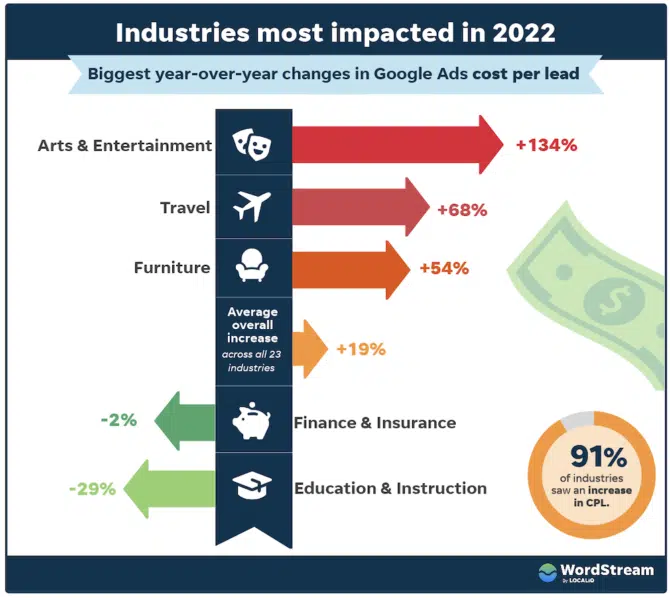
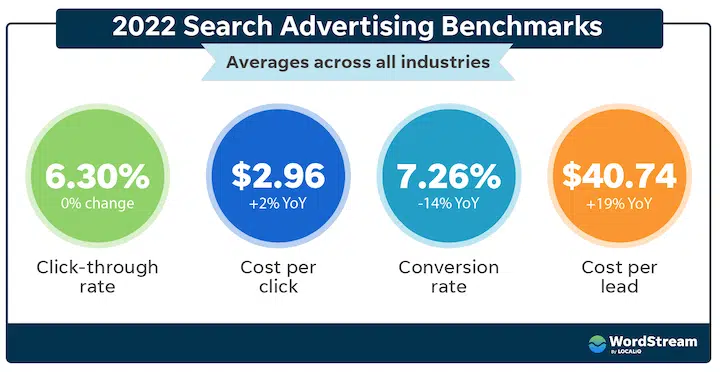
A new report shows that the cost per lead has increased for about 91% of industries in Google. The hardest hit industries are Arts & Entertainment (up 134%), Travel (up 69%), and Furniture (up 54%).

Industries that saw a decrease in cost per lead are Finance & Insurance (down 2%), and Education and Instruction (down 29%).

Making sense of the data. LocaliQ speculates that the reason for the increases is inflation, broad keyword matching, and competition.

It makes sense that the industries listed above are affected, since during and post-pandemic, people are looking for things to do outside the home, are traveling more often, and continuing to see supply shortages affecting furniture delivery.

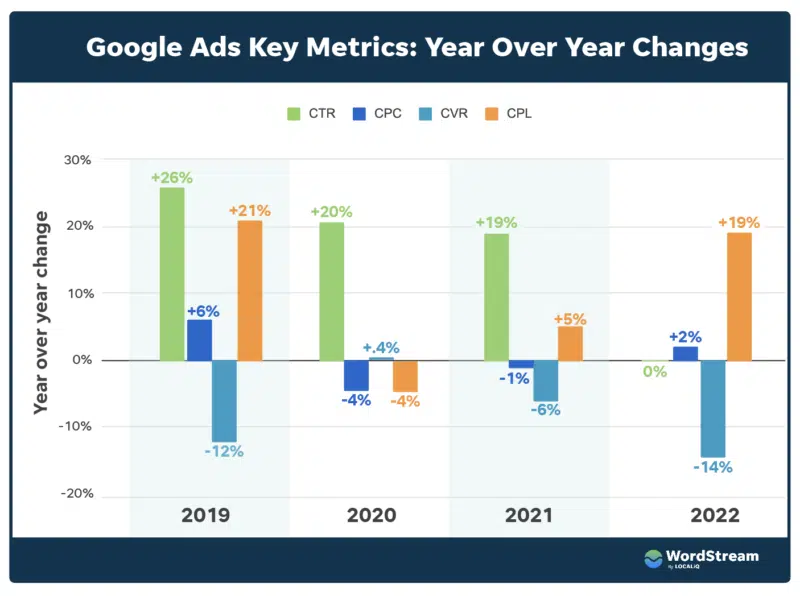
Conversion rate decline. The report also shows a decrease in conversion rate, likely due to broad match keywords pulling in more general, top-funnel searches and clicks. 91% of industries saw a decrease of about 14% overall. To put that into perspective, in 2019 we saw a 12% decrease.

Cost per click (CPC). CPC has slightly increased slightly with about 57% of industries affected. In 2020 and 2021 there were also decreases in CPC (-4% and -1% respectively), but in 2019 there was a 6% increase. 


Get the daily newsletter search marketers rely on.


The numbers. The top five industries with the lowest cost per lead are:

  • Automotive Repair and Service ($19.85)
  • Physicians & Surgeons ($22.74)
  • Sports & Recreation ($23.57)
  • Arts & Entertainment ($25.46)
  • Animals & Pets ($26.25)

Industries with the highest CPC are:

  • Attorneys & Legal Services ($8.46)
  • Dentists & Dental Services ($6.69)
  • Home & Home Improvement ($5.74)
  • Business Services ($3.80)
  • Industrial & Commercial ($3.50)

You can view the entire list of top industries and their cost benchmarks here.

Tips to help businesses respond. To help businesses respond to these shifts, LocaliQ suggests the following best practices.

  • Implement a full-funnel, cross-channel strategy to reach warmer audiences.
  • Be proactive with negative keywords to combat broad targeting and reduce wasted spend. Since CTR hasn’t changed overall, we can gather that people are still clicking on ads just as much, but since the intent isn’t there, they’re not converting.  
  • Increase your paid search budget to keep up with ever-increasing competition in the space – not just in the new year but during the 2022 holiday season. If an increase in budget is not feasible, try to improve your ad relevance and Quality Score, optimizing your keywords, examining your competition, and more. 

Dig deeper. Read the full article from WordStream here.

Why we care. It’s always good to know where your campaign costs are in relation to industry benchmarks. If your brand or client is one of those most affected, it’s likely because of the pandemic, inflation, or recent changes in keywords and automation. Follow best practices and continue testing to make sure your costs are under control.


Related Stories

New on Search Engine Land

@media screen and (min-width: 800px) { #div-gpt-ad-3191538-7 { display: flex !important; justify-content: center !important; align-items: center !important; min-width:770px; min-height:260px; } } @media screen and (min-width: 1279px) { #div-gpt-ad-3191538-7 { display: flex !important; justify-content: center !important; align-items: center !important; min-width:800px!important; min-height:440px!important; } }

About The Author

Nicole Farley

Nicole Farley is an editor for Search Engine Land covering all things PPC. In addition to being a Marine Corps veteran, she has an extensive background in digital marketing, an MBA and a penchant for true crime, podcasts, travel, and snacks.

https://searchengineland.com/new-report-shows-google-cost-per-lead-has-increased-for-91-of-industries-389593


TikTok has launched an in-app ecommerce feature

In addition to its most recent shopping features, TikTok has just launched TikTok Shop, where users can now make purchases directly through the app.

Availability. TikTok officially began testing in the U.S. this week. It was previously only available in the UK and seven countries in Southeast Asia.

Invite only. TikTok is currently inviting select U.S. businesses to participate in the initiative. That means live streamers from places where the feature is not live will need to continue directing shoppers to third-party websites.

What TikTok says. “We’ve seen the positive impact of TikTok Shop, and we’re excited to continue experimenting with this new commerce opportunity to support businesses of all sizes.” 

In other TikTok news. TikTok has released several new features and products this year, including:

Why we care. The new feature is invite-only, but if the Shop feature becomes available to advertisers and brands globally, you should start testing it as an alternative way to promote your products.


Related Stories

New on Search Engine Land

@media screen and (min-width: 800px) { #div-gpt-ad-3191538-7 { display: flex !important; justify-content: center !important; align-items: center !important; min-width:770px; min-height:260px; } } @media screen and (min-width: 1279px) { #div-gpt-ad-3191538-7 { display: flex !important; justify-content: center !important; align-items: center !important; min-width:800px!important; min-height:440px!important; } }

About The Author

Nicole Farley

Nicole Farley is an editor for Search Engine Land covering all things PPC. In addition to being a Marine Corps veteran, she has an extensive background in digital marketing, an MBA and a penchant for true crime, podcasts, travel, and snacks.

https://searchengineland.com/tiktok-has-launched-an-in-app-ecommerce-feature-389575


The search marketer’s new imperative: Capturing first-party data

Third-party cookies are on their way out. You’ve probably been thinking and talking about this for a few years now. 

And you’ve likely seen many blog posts, articles, webinars, podcasts, etc. talking about how first-party data is the path forward for adapting to the cookieless future. 

What isn’t being talked about?

The role that search plays in collecting that precious first-party data.

The role of search in capturing first-party data

Oftentimes it’s commerce, loyalty programs, and the like that are deemed responsible for discovering the ins and outs of your customers.

But search plays a critical role, too. It’s uniquely positioned for a few reasons.

Users are purposefully engaging with your site 

So many marketing channels engage with consumers during a non-commerce moment – while they’re sitting on the couch binge-watching The Office, drooling over their best friend’s Insta-perfect pictures from that recent trip to Tuscany, etc. 

Search is a rare exception. The consumers we engage with are actively raising their hands, and we’re helpfully showing up to meet their needs. 

That means that every engagement we have with potential customers is highly intentional. They’ve made the choice to not just look for something we offer, but also to visit our site. What that means is…

Clicks have both high intent and strong timing signals

We can learn a ton of valuable information about a person, even if they don’t immediately make a purchase. 

Clicks are considered a first-party cookie, meaning the advertiser has a consented ability to:

  • Tag the consumer’s browser.
  • Use that information to improve their customer experience and future engagements and interactions with the brand.

We can also very directly and confidently infer interest. 

Someone looking for a tent on our ecommerce website shows a much stronger signal of “interest in buying camping gear” than a person browsing an outdoorsy blog or looking up the top 10 tips for hiking the Appalachian Trail. 

We also know that they’re thinking about buying that camping gear now.

Search is a demand-capture channel that reveals high intent and purposeful engagement with the benefit of a first-party cookie. 

Nothing new, right? 

What’s new is the relative importance of each first-party click that comes through search.

As the opportunities to mine data from third-party cookies become fewer and fewer and walled gardens build their fences taller and taller, that importance will only continue to rise. 

Search has a new responsibility to take its high-intent first-party data and use it across the marketing ecosystem.

Search data on its own can be valuable, but it becomes even more powerful when paired with other first-party data sources. So, what does that look like?

Search + site behavior data = better user experiences

Garnering an ad click is only half of the battle. 

As the consumer digests the website, text, imagery, and value proposition, a lot can happen. 

Sometimes, consumers bounce nearly immediately, while other times, they will view 10+ pages and spend over 15 minutes browsing the site. 

This metadata can and should be used to build customer segments. Purchase propensity scores can be derived based on on-site behavior. 

We recommend using this information to better inform automated customer targeting and suppression lists to be added to digital marketing and remarketing initiatives.


Get the daily newsletter search marketers rely on.


Search + CRM = better digital engagement

Extending the view on-site behavior, we can further couple search intent to known online and offline customer engagement. 

Is the consumer on our email list or mailing list, or have they previously purchased? 

If yes, how active have they been, and what metadata and activity can we add to our customer segmentation models? 

These signals can allow brands to alter messaging and value propositions in real time on the website and can also lead to improved customer engagement – a feeling that the brand knows who they are and wants to provide a personalized and tailored experience. 

Beyond the site, brands will also have the ability to reach these first-party customers in other paid and organic digital experiences, such as custom-tailored social ads and emails.

Search + CRM = better non-digital outreach

When we’ve historically talked about cross-channel marketing, especially when it pertains to search, the typical “other channels” are paid social, e-retail, display, etc. 

We need to start including our offline channels in those conversations, too. 

In today’s data-driven world, every brand-to-consumer touch point short of a friend saying “Hey, check out my new backpack!” can be part of a connected journey.

Take direct mail, for example.

Having the ability to tailor a brand’s direct mail campaign by refining the who, the what, and the how is powerful and performant. 

By understanding the customer’s intent and product/service desires, as well as the fact that their need is now, we have a unique ability to build propensity models. 

Firstly, these customer segment models can be built on the likelihood to purchase – leading to top segments as well as customers to suppress. 

Second, the content can be altered to match the exact products/services the customer has expressed interest in. 

Finally, the physical mail can be tailored to match the individual and their needs. Delivering a postcard flyer, an envelope, or a catalog to different customer segments becomes possible.

The role of search in creating great customer experiences

Search has always been an important channel (in my extremely unbiased opinion), and it’s only getting more critical as its role in creating great customer experiences grows. 

Our guiding light as search marketers has always been to meet hand-raisers with what they’re seeking, when they’re seeking it, in a way that’s responsible for our business. 

Now we have another imperative: taking the data those hand-raisers give us to make all of their experiences with our brand better.


Opinions expressed in this article are those of the guest author and not necessarily Search Engine Land. Staff authors are listed here.


Related Stories

New on Search Engine Land

@media screen and (min-width: 800px) { #div-gpt-ad-3191538-7 { display: flex !important; justify-content: center !important; align-items: center !important; min-width:770px; min-height:260px; } } @media screen and (min-width: 1279px) { #div-gpt-ad-3191538-7 { display: flex !important; justify-content: center !important; align-items: center !important; min-width:800px!important; min-height:440px!important; } }

About The Author

Matt Mierzejewski

Matthew Mierzejewski is Senior Vice President of Search at Merkle where he is responsible for US Search (SEM, SEO) delivery, operations, product, and sales. Matt has been a contributor to multiple industry roundtables, webinars and has also served as a Google SEM Beta Lead. Matt evaluates and supports Merkle’s adoption of new industry and search engine product opportunities and creates best-practices based on key performance goals for Merkle clients. Additionally, Matt has regularly participated in interviews by Google, MediaPost, and other media outlets for his opinions on the state of the online marketing industry. Matt has also been invited to speak and participate at industry events such as SMX Advanced, ad:tech and Mediapost Search Insider Summit.

https://searchengineland.com/capturing-first-party-data-search-389342


Google Ads Reach Planner now forecasts Video Action campaigns

Advertisers will now have the option to select “Action – Online Conversions” as a goal when setting up your plans in Reach Planner and can also add Video Action Campaigns to existing plans.

What is the Reach Planner. The Google Ads Reach Planner makes it easier for advertisers to plan for Conversions, Views, Reach, and Impressions-based metrics. It provides a forecast for how your media plan might perform, based on your desired audience, budget, and other settings such as geographic location and ad formats.

How it works. Google says that forecasts are modeled on trends in the ad market and the historical performance of similar campaigns run in the past.

Why we care. Advertisers using video will now be able to predict campaign performance using the new tool. This could be helpful for budgeting during the holiday season.


Related Stories

New on Search Engine Land

@media screen and (min-width: 800px) { #div-gpt-ad-3191538-7 { display: flex !important; justify-content: center !important; align-items: center !important; min-width:770px; min-height:260px; } } @media screen and (min-width: 1279px) { #div-gpt-ad-3191538-7 { display: flex !important; justify-content: center !important; align-items: center !important; min-width:800px!important; min-height:440px!important; } }

About The Author

Nicole Farley

Nicole Farley is an editor for Search Engine Land covering all things PPC. In addition to being a Marine Corps veteran, she has an extensive background in digital marketing, an MBA and a penchant for true crime, podcasts, travel, and snacks.

https://searchengineland.com/google-ads-reach-planner-now-forecasts-video-action-campaigns-389532


YouTube has launched a global Target frequency feature

YouTube now has a global Target frequency goal option for video campaigns. The new goal allows advertisers to select a frequency goal (up to four per week), which YouTube will optimize towards.

What YouTube says. “Now advertisers can select the frequency target and our systems will optimize towards maximum unique reach at the frequency goal. With our built-in capping, campaigns deliver within a tight distribution range so viewers don’t see the ads too many times. In fact, over 95% of Target frequency campaigns on YouTube successfully achieved their frequency goals when set up following recommended best practices. Not only do the campaigns deliver on their target frequency, but they drive brand impact as well.”

Early testing. YouTube tested this new goal with Triscuit, whose goal was to ensure that its brand stays top of mind with consumers.

According to YouTube, the brand set up a Video experiment to determine the incremental ad recall that a weekly frequency of two could deliver. The Target frequency campaign achieved a 93% higher absolute ad recall lift compared to the non-frequency optimized campaign, at a 40% cheaper cost per lifted user.

Also available in Ads Editor. Google also announced today that the new Target frequency goal was going to be supported in the new Ads Editor v2.2.

Dig deeper. Learn more about the new Frequency goal on the Google Ads & Commerce Blog.

Why we care. Advertisers who use Video ad campaigns should implement the new Target frequency goals to ensure that their videos show an appropriate number of times without exhausting their audiences.


Related Stories

New on Search Engine Land

@media screen and (min-width: 800px) { #div-gpt-ad-3191538-7 { display: flex !important; justify-content: center !important; align-items: center !important; min-width:770px; min-height:260px; } } @media screen and (min-width: 1279px) { #div-gpt-ad-3191538-7 { display: flex !important; justify-content: center !important; align-items: center !important; min-width:800px!important; min-height:440px!important; } }

About The Author

Nicole Farley

Nicole Farley is an editor for Search Engine Land covering all things PPC. In addition to being a Marine Corps veteran, she has an extensive background in digital marketing, an MBA and a penchant for true crime, podcasts, travel, and snacks.

https://searchengineland.com/youtube-has-launched-a-global-target-frequency-feature-389525


Google rolls out Ads Editor v2.2 with optimized targeting, 11 other features

Google just announced the rollout of Ads Editor v2.2. This version adds 12 new features and also eliminates one. Let’s take a look.

Asset library

The new version includes added support for enhanced leveraging of images in asset libraries. It also includes:

  • Adding, removing, and renaming images
  • Assigning images to folders
  • Integrating asset library features into the image picker, for example, filtering by folder and searching by asset name

Notifications

You can now use notifications to help you get the important information you need to manage your accounts in Editor. There are also alerts to let you know when there are active notifications for review. You also get one-click access to notifications directly from the toolbar.

New UI for editing ad schedules

You can now visually edit ad schedules for campaigns and certain ad assets. Previously, ad schedules could only be changed by CSV import or by copying from another campaign or asset.

Support-friendly network logs

Logs containing API errors and details of the operations that triggered them are now provided in an easy-to-understand format.

Out-of-sync indicator

The Editor will now periodically check to determine if account changes have been made since the last sync and notify you to sync them if needed.

Google says that not all changes may be detected and it is still recommended to get recent changes before posting.

Global offers

In the shopping settings for Shopping and Performance Max campaigns, you can now choose to:

  • Make the country of sale optional (allow it to be empty or cleared if it’s not already empty)
  • Include support for an optional feed label

Recommended Video campaign budgets

The Editor will now show a recommended budget based on your Target CPA bid for Video action campaigns. It will also warn you if your current budget amount is below this recommendation.

Video campaign target frequency

The Editor now includes full support for Target frequency video campaigns.

Video campaigns with shopping

Editor now supports all video campaign sub-types (except Outstream and Audio) via the shopping setting (Product feed) and product groups.

More recommendations support

Editor provides support for additional recommendation types, including the ability to add lead form ads to get more leads.

Basic support for all recommendations

Basic support for additional recommendation types is now shown in Editor. Recommendation types appear under Recommendations > Other recommendations.

Optimized targeting

The ad group “Targeting expansion” setting slider has been replaced with an “Optimized targeting” setting, which can now be enabled or disabled with a checkbox.

Removed

Gmail display campaigns support. Editor version 2.2 no longer supports Gmail display ads and campaigns.

Why we care. Advertisers who use Ads Editor will benefit from these changes and new features. The ability to manage accounts from a separate, offline, platform allows you to save time and make changes in bulk.

You can download the new Ads Editor here.


Related Stories

New on Search Engine Land

@media screen and (min-width: 800px) { #div-gpt-ad-3191538-7 { display: flex !important; justify-content: center !important; align-items: center !important; min-width:770px; min-height:260px; } } @media screen and (min-width: 1279px) { #div-gpt-ad-3191538-7 { display: flex !important; justify-content: center !important; align-items: center !important; min-width:800px!important; min-height:440px!important; } }

About The Author

Nicole Farley

Nicole Farley is an editor for Search Engine Land covering all things PPC. In addition to being a Marine Corps veteran, she has an extensive background in digital marketing, an MBA and a penchant for true crime, podcasts, travel, and snacks.

https://searchengineland.com/google-rolls-out-ads-editor-v2-2-with-optimized-targeting-11-other-features-389522