Why you should fire clients more often (and how to do it the right way)

All clients review agencies for “fit.”

They line up the RFP cattle call, or back-to-back meetings between a handful of agencies to contrast and compare.

However, almost zero agencies review clients in return.

Instead, they’re too eager, living hand to mouth, to take on all clients at all times as long as they have a pulse and a checkbook. 

It makes sense. You need to keep the lights on and employees fed. But it almost always backfires at least a few times each year.

Client A is actually costing you money in the long run. Client B keeps asking for caviar on a sardines budget. And Client C is simply just an a-hole.

Counterintuitively, that’s why the best thing an agency can do is to routinely fire clients on a regular basis. Not once a year, but once a month or quarter.

Here’s why.

When to fire a client: Recognize you have a problem (profitability, notoriety and fit)

Just like any good 12-step program, start by recognizing you have a problem.

You should have never touched that one client with a 10-foot pole. You were a terrible fit for that other client last summer.

Thankfully, you can relax. This is totally normal.

Profitability

The first issue that sabotages client engagement is usually profitability (not contract value). 

Either you:

  • Undercharged from the get-go, too eager to land the client that you failed to properly scope or understand the full specifications. 
  • Or the project costs that worked when you started a ~year ago don’t line up with your agency’s current headcount, overhead, and profitability targets.

Fortunately, this issue is also pretty easy to fix. You can (and should) regularly:

Simply raise rates at regular intervals for each client. Not every month or quarter necessarily, but definitely every year. 

Continue on a “discounted rate” only if they meet your payment terms, like paying for the quarter or annual contract upfront to help your cash flow. This is especially key on larger accounts with enterprise companies that seem to think you’re a bank that extends credit to fund their project resources for… infinity? While they pay slooooooooooowwwllyyy.

Institute a new “change order” policy to avoid scope creep. My dad always used to say “what you permit, you promote.” Drove me nuts at the time and still rings in my ears.

But 100% true when it comes to managing client relationships and expectations.

Next time a client requests something out of scope (and every time hereafter), you can accommodate it only for an extra fee. 

Move your higher-cost and better resources (read: people) off their account to newer, higher-paying clients (and substitute them with cheaper ones).

This sleight-of-hand trick instantly improves margins without the client being the wiser. (Obviously, don’t let quality drop during this transition!)

Routinely sticking to these four principles should clean up ~80% of your agency’s profitability issues.

Unfortunately, though, profitability isn’t the only reason a client engagement goes sour.

Mismatch with client expectations

The second most common, and harder to fix, is a mismatch with client expectations. 

They expect business class on an economy budget. 

They’re a tiny, no-name, commoditized brand that thinks it should be on the cover of TechCrunch or The New York Times. 

Or they expect results yesterday, despite not having the internal resources to support any of the initiatives you’re trying to get off the ground.

In these cases, education early and often is key. 

Also, be direct and transparent. Be nice and polite, but firm.

The minute you get backed into the “vendor” corner, simply fulfilling orders and being a pushover, you’re screwed. 

This mismatch issue also brings to light a tertiary issue: “fit.”

Fit

Maybe you sold a service or project you’re actually unequipped to deliver.

Or maybe there’s just a personality difference between your firm’s people and the client’s point of contact. 

Either way, healthy agency engagements are more marriage, less Tinder. “Fit” is as important as budget. 

There’s usually a variety of reasons why “fit” gets distorted and the relationship blows up in your face. And depressingly, there’s almost nothing you can do to improve fit.

Leaving you with only one obvious option.


Get the daily newsletter search marketers rely on.


5 simple steps to firing clients once and for all

Subscription businesses like SaaS measure things like “churn” to assess how well they’re doing in satisfying customers.

From a 30,000-foot level, it’s a measure of how many people sign up and then bounce (seemingly to find some other alternative).

Generally speaking, a SaaS business then wants its churn rate to be as low as humanly possible because that means its product is “stickier” and therefore its business is way more profitable.

Service businesses often try to measure similar “churn” metrics. However, they’re missing the obvious point. 

As a completely different business model, there is such a thing as churn being “too low” when it comes to clients.

In other words, you actually want clients to regularly churn out, assuming:

  • They’re still happy with the service you delivered so they’ll provide a testimonial and referrals.
  • That you have a steady stream of eager prospects willing to engage you at a higher rate (which is a topic for another day).

You obviously don’t want large, well-paying, nice clients to churn that often. 

But you absolutely want less profitable, obscure, mismatched, unfriendly clients to see the door on a regular basis.

Replacing one for the other almost instantly:

  • Frees up your biggest bottleneck – people! – to take on new accounts without constantly needing to hire and fire under-performers as your deal flow ebbs and well, flows.
  • Improves your profitability because it’s often easier to start new clients at a significantly higher rate than ask (read: force) old clients to pony up more dough for seemingly the same exact level of service.
  • Both of those two moves, together, actually result in giving you less work to do while making the same (or more) – ‘cause you and your team deserve vacations sometimes, too.
  • Last but not least, it allows you to ideally work with bigger brand names which provide an almost instant lift to the credibility of your agency and helps “pre-sell” other prospects who’ve been sitting on the fence for months (or years).

So it’s best to be blunt and polite. But also rip the bandaid off ASAP.

Here’s how to fire clients nicely.

1. Time client firings with natural project conclusions or times of year

For instance, if a major milestone is going to be complete by the end of this quarter, that would be a perfect target date to… 

2. Give plenty of notice

Tell them at least a month in advance (maybe more) that it’s coming to help set expectations. This also gives you some time to…

3. Plan ahead

You can:

  • Provide them with some alternatives for you.
  • Be able to forecast new work you have coming through the door so you can easily transition your team from one account to the next. 

If they want to try to continue working together, you can…

4. Significantly raise rates for future work

This kinda gives them a hint. Every client gets put out when you try to ask for more money. Especially a lot more money.

Now imagine you 2X or 5X or even 10X their next project cost if they want to continue working together. They’ll almost always get the hint and go seek out cheaper alternatives. This also assumes the split will be amicable. 

Unfortunately, that isn’t always the case. So here’s how to fire a client with a not-so-nice script… 

5. Some client firings aren’t always that nice

Look: life ain’t a fairy tale. Sorry to be a spoiler. 

As a service professional, you need to be kinda like a mercenary. You parachute in to get s#*t done. Then, you move on to wherever the next project takes you. 

Some clients routinely “take the piss” by:

  • Paying you well after previously agreed upon dates.
  • Demanding things that were never in scope.
  • Blaming you for their own internal issues.
  • Talking down to your staff.
  • Just simply being a pain in the @$$ to deal with. 

So with these people, you can be blunter and skip the foreplay of the last four points:

  • “Effective immediately, we’re canceling our agreement with you due to… (list the points in the preceding sentence). After [XYY] date you will no longer have access to [ABC] resources.” 

And… that’s it. 

No elaborate script or heartfelt breakup needed. Remember that you’re a Navy Seal, not an untrained boot who’s never seen combat.

You can and should explain your reasoning and thought process to nice clients that are sadly no longer a good fit for where your agency is trying to go. Help them find another good shepherd to lead their flock.

But…

You absolutely don’t need to apologize or explain anything to jerks. They’re on their own. Because they all most likely think you’re an idiot already, unable to possibly live and breathe the same airspace as their genius.

So stop putting up with their crap, sapping your team’s morale, and damaging your longer-term reputation.

Let them go hire and fire 10 other agencies before they realize that they, not you, were the problem all along. 

Firing a client is inevitable

You aren’t a therapist or a shrink. 

The best agencies are battle-hardened teams of trained, skilled specialists. You get hired to create deliverables, design websites, problem-solve, rank stuff, increase ROAS, and more.

But nowhere in your MSAs or SOWs does it say: fix every client’s problem, no matter what.

Because there are tons of client problems that you literally can’t do anything about, like:

  • Bad internal support or champions.
  • An undifferentiated service or product in a crowded space.
  • Having the wrong people leading the wrong projects.
  • Under-qualified employees or HIPPOS (highest paid person’s opinion) calling the shots.
  • Poor/nonexistent processes and workflows to coordinate complex projects and scale results. 
  • Under-resourced teams with inappropriately-aggressive timelines.
  • And lots, lots more.

You can’t save everyone. 

Help the good, but no-longer-a-good-fit clients land on their feet when transitioning them out of your agency.

But don’t be afraid to cut the jerks loose today and let them be someone else’s problem to deal with tomorrow.


Opinions expressed in this article are those of the guest author and not necessarily Search Engine Land. Staff authors are listed here.


Related Stories

New on Search Engine Land

About The Author

Brad Smith owns three content marketing companies, and has been featured in publications like The New York Times, Forbes, Business Insider, and The Next Web. Each week, he shares first-hand experience and growth strategies behind some of the web’s fastest growing brands.

https://searchengineland.com/fire-clients-more-often-388842


Uber ads are coming, and they’re already raising privacy concerns

Ubers’ new journey ads will be shown in the Uber app at least three times during the riders’ journey. The new feature will let brands place ads using data drawn from riders’ travel history and their precise geographic destinations, according to Uber. In an example from The Wall Street Journal, if a user books an Uber to a specific retailer, cinema or airport, for example, a company could buy ads centered on that location.

How the new ads will work. Though not available globally yet, Uber is testing the ads with a few brands at launch. The new product will also let brands sponsor an entire trip, starting with when a rider first calls a car. The ad spots will be sold on a per-trip basis instead of digital advertising’s common pricing by consumer impression, let brands show a user different ads at three points in the user’s trip: while waiting for a car, while riding in the car and upon reaching the destination.

The rider can also conduct transactions, such as clicking the ad to buy a product without leaving the Uber app, said Mark Grether, general manager of Uber Advertising. Separate pilot programs in the U.S. and India will also include ads on in-car tablets, he said.

Privacy concerns. It’s not news to anyone that the US has been facing abortion rights issues. With Uber’s new ad targeting products based on riders’ trip history, we have to wonder what this means for sensitive situations such as a rider who has taken a trip to an abortion provider.

Although this does raise concerns, platforms such as Google, Meta, and Simpli.fi have been tracking users’ locations for many years. The FTC even sued data broker Kachava Inc. this past August claiming that the broker was selling data that tracks people at sensitive locations such as reproductive clinics and places of worship.

According to The Wall Street Journal article, Uber’s advertising policy forbids targeting users by factors such as race, religion or sexual orientation, and it also prohibits basing ad targeting on certain types of destinations, including government buildings, hospitals and reproductive-health centers.


Get the daily newsletter search marketers rely on.


What Uber says. An Uber spokeswoman said the company doesn’t share individual users’ data with advertisers. The data it does share is aggregated information or data related to ad-campaign performance, she said. Users can opt-out of targeted ads on the Uber app at any time, said Grether.

Why we care. Additional ad platforms and placements are usually good news for advertisers and brands. Ad space is expensive and competitive, so when a new player enters the chat, brands typically win, at least for a little while.

If your brand or client can benefit from Uber ads, keep an eye out for announcements on when they’ll be rolled out globally. As always, act ethically, keep the rider in mind, and don’t promote anything insensitive or controversial.


Related Stories

New on Search Engine Land

About The Author

Nicole Farley is an editor for Search Engine Land covering all things PPC. In addition to being a Marine Corps veteran, she has an extensive background in digital marketing, an MBA and a penchant for true crime, podcasts, travel, and snacks.

https://searchengineland.com/uber-ads-are-coming-and-theyre-already-raising-privacy-concerns-388949


Google My Ad Center updates give users more, expanded controls

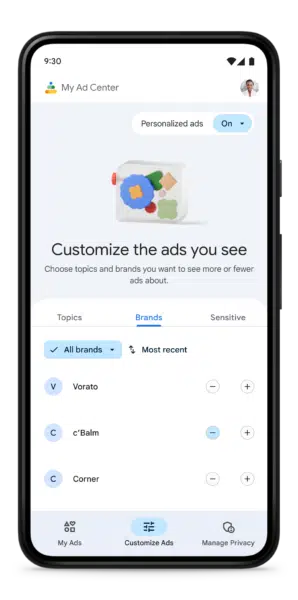
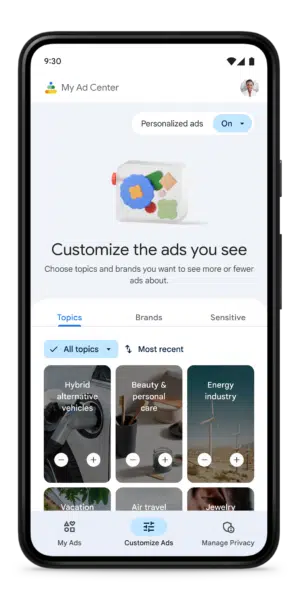
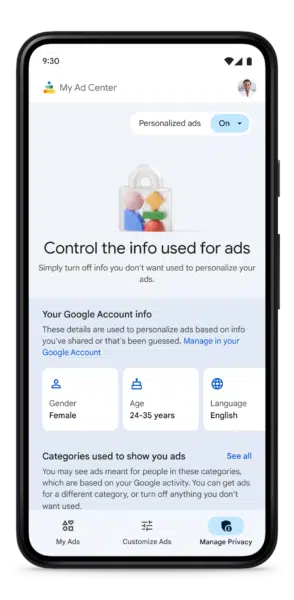
Google’s My Ad Center today will start rolling out to users, globally, to provide control over the kinds of ads they see across Google on Search, YouTube and Discover.

“81% of consumers are more concerned with how their data is being used and 48% are turning away from services due to privacy concerns. At the same time, our research also says that people only want to see ads that are relevant and useful to them,” says Jerry Dischler, VP/GM Google Ads. “To build more trust, we want to continue ensuring that ads respect people’s privacy; and offer transparency, choice, and control.  We see these principles as foundational to the future of advertising. It is a key priority for our business – and the foundation My Ad Center was built on.”

New features and controls. The new My Ad Center controls will also allow you to block sensitive ads and learn more about the information used to personalize your ad experience.

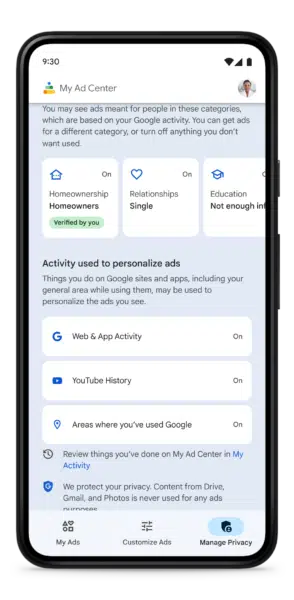
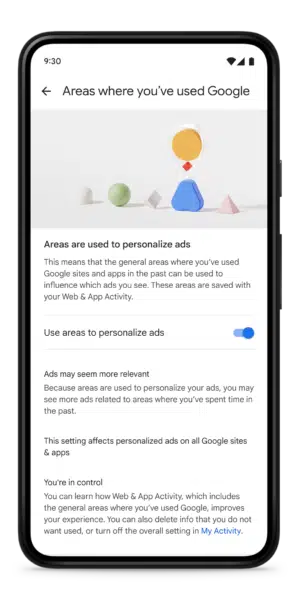
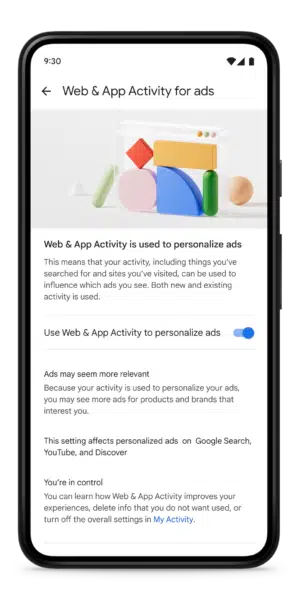
More controls for activities used to personalize ads. My Ad Center expands Google’s privacy controls to allow users more direct control over which data sources — specifically Web & App Activity and YouTube History — are used to personalize your ads across Google Search, YouTube and Discover.

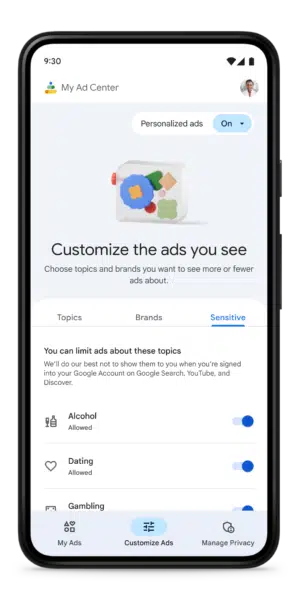
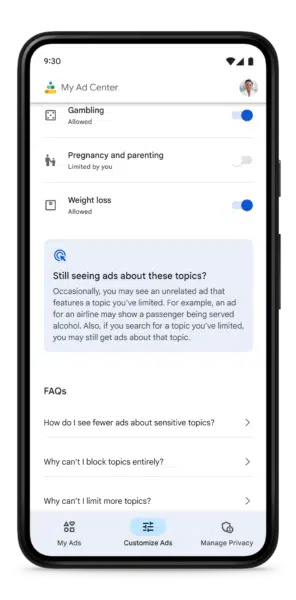
Expanding user control for sensitive categories. In My Ad Center, users have the ability to see fewer ads in five sensitive categories:

  • Alcohol.
  • Dating.
  • Gambling.
  • Pregnancy and parenting.
  • Weight loss.

Before, this feature affected ads shown on YouTube and Display. Now, it expands to ads shown on Search and Discover.

Advertiser pages. To give people even more transparency, Google is enhancing ad disclosures with new advertiser pages. Users can access these disclosures in the new My Ad Center panel and see the ads a specific verified advertiser has run over the past 30 days.

How it works. In My Ad Center, users can tap on the three-dot menu next to an ad type they want to see less of. They can also choose to see ads about things that they care about, like deals for sneakers or holiday gifts for loved ones, according to examples provided by Google.

Users can also completely turn off ad personalization. Those who choose not to see personalized ads, will still be served ads, but Google says those ads may be less relevant or useful.

More privacy controls. With the new My Ad Center added controls, you can see what information Google uses and control it based on your preferences. You can decide what types of your Google activity are used to show you ads.

In the past, if your YouTube History was on, it automatically informed how your ads were personalized. Now, if you don’t want your YouTube History to be used for ads personalization, you can turn it off in My Ad Center, without impacting relevant recommendations in your feed.

What Google says. Dischler adds, “I see our role in this evolving industry as innovating through our products. Building products that are secure by default, private by design, and put the control of data in the hands of our consumers. When it comes to advertisers, publishers, and our other partners, we are taking a privacy-preserving approach to advertising, built on first-party data, and unlocked by the benefits of machine learning.” 

“We are doing all this because we believe it’s essential to the open web to build a long-term stable ads ecosystem. And we intend to help navigate the industry to a privacy-first, pro-consumer-focused future.”

Dig deeper. You can read more info about the new My Ad Center experience here.

Why we care. Since Google’s announcement of My Ad Center in May, we have been waiting for it to roll out to users globally. With the sunsetting of cookies in 2024, the new privacy features give users their best chance at privacy and having a say in the ads they are served.

Additionally, the new features could be a benefit to advertisers as well since users who take advantage of My Ad Center will have access to the ads and brands they are most interested in. Advertisers will also benefit from higher ad relevance.


Related Stories

New on Search Engine Land

About The Author

Nicole Farley is an editor for Search Engine Land covering all things PPC. In addition to being a Marine Corps veteran, she has an extensive background in digital marketing, an MBA and a penchant for true crime, podcasts, travel, and snacks.

https://searchengineland.com/new-updates-to-googles-my-ad-center-give-users-more-expanded-controls-388805


4 communication best practices agencies must employ early in Q4

Let’s run through a scenario that agencies see from time to time (not just in Q4, but the stakes are higher across the board right now):

On the client side, a main point of contact is relatively new to the team. It’s Q4. They’re feeling stressed. 

On the agency side, things seem to be going well. KPIs are in line with established goals, there’s a strategy in place for the next few months, weekly calls haven’t surfaced any concerns, and there’s a healthy test-and-learn methodology in place for creative optimization and channel expansion.

Then the email drops: counter to what the agency is seeing, company data shows that the marketing team isn’t hitting goals. 

If things don’t improve quickly, there are going to be some tough conversations about ending the partnership.

What happened? And how could the agency have prevented it?

I’ll dig into the answers in this post.

1. Treat alignment as an activity

Agencies and brands are generally diligent about aligning goals, KPIs, and data sources as part of the onboarding process.

But the agency can’t assume brands will automatically alert all parties when things change internally.

Factors that agencies must plan to solicit regular updates on include:

Goals

Every marketing department I’ve ever worked for or with has changed goals from time to time. 

Whether it’s pivoting from lead gen to site traffic or shifting focus from driving growth to improving CPA, change is a constant. 

This needs to be reflected in your campaigns and reporting, or you’ll be driving headlong down the wrong road in optimizing the wrong KPIs.

Data sources

Internal dashboards are always a big point of discussion in onboarding and kickoff calls, but the conversation can’t end there. 

Attribution models change and improve, tech stacks evolve, internal business intelligence teams build dashboards, etc.

Agencies that aren’t asking for access to that data are flying without a map.

One important component of internal reports that agencies need to know is the fields that client dashboards use to attribute to advertising. 

We use UTMs and campaign IDs, but clients may be able to attribute advertising-influenced actions beyond that first touch that we can bake into our reporting and optimization.  

If a client is using HubSpot, that can add an extra layer of complication. 

HubSpot reports are hard to export and look at in a clean way. The data needs to be analyzed in a native environment in order for agencies to tie campaigns to offline data. 

While HubSpot data can be pulled into better reporting environments like Salesforce, which can build reports based on any specified UTMs (e.g., ad group or keyword), any advanced offline insights will rely on client resources to build the reporting. 

In short, those conversations, and how to share and reconcile different data sources, are important to have to maintain a similar construct around campaign performance for whatever layer of analysis you’re seeking.

Calendars/pricing

We all know, on the consumer level, that retail discounts are all the rage in Q4 – online, offline, and both. 

In the B2B world, it’s common for brands to incorporate an end-of-year sales push, or buyer incentives, that could include more motivation to book meetings.

Agencies that aren’t asking for that information right around now will likely suffer from a lack of lead time in setting up plans, including how to monitor and adjust to pipeline data and funnel flow (e.g., lead-to-meetings booked rates could artificially increase, which could have bidding and budgeting ramifications). 

Websites and landing pages

Websites and landing pages change all the time. 

Maybe there’s a homepage banner advertising a brand-new report or new CTAs in rotation on a demo-focused landing page. 

Or maybe the client has done some brand tweaking to update messaging and value props.

That report would make a great sitelink for brand search ads. Those CTAs and value props should be reflected in ad copy and creatives to keep the user journey as friction-free as possible. 

Those might seem minor, but little things can compound over time if you’re not keeping track of a client’s owned media updates.

External campaigns

This is an extreme example, but imagine you’re watching the Super Bowl, and you see a commercial for a client that you had no idea was about to happen. Your search budget could be blown by halftime. 

When clients have major campaigns afoot beyond the ones you’re managing, you need to know in order to effectively prepare for any downstream ripples. 

Make sure you’re checking with your clients – especially those working with multiple agencies – on whether they have initiatives outside of your partnership that you should be aware of. 

This includes things like billboards, radio commercials with discount codes that could make for cool sitelinks, CTV or podcast campaigns, etc. 

2. Build – and stick to – a communication cadence

Do not wait for QBRs to bring up big topics like goals. Internal marketing teams don’t plan their strategy around agency meetings. 

At my agency, we’re working on a strategic planning template that we’ll review quarterly with clients in 2023, but we’ll supplement that by bringing up goals regularly on weekly calls to build the habit and make those conversations second nature.

Along with reporting on progress to goal, as most agencies do in weekly calls, we’ll manage alignment by:

  • Asking if anything has changed.
  • Getting context and providing initial feedback on feasibility if goals have changed.
  • Openly discussing possible concerns and brainstorming solutions. 

Once those steps are completed, we’ll revise the current roadmap or build a new one to make sure we’re fully incorporating the goals into our partnership.


Get the daily newsletter search marketers rely on.


3. Err on the side of over-communicating

Over-communication can make the consumption of important content challenging, especially in today’s digital environment. (Quick, count the number of log-ins you do daily to keep up with company and external goings-on.)

But under-communicating is a worse option.

Simply put, you can ignore the questions or content you don’t have time to read, but you can’t respond to something if it’s never put in front of you. That’s the approach agencies should take, especially in relatively busy/chaotic times like Q4.

Repeat info. Overshare updates. Ask questions (politely) until you get answers. 

In general, assume your client contacts are busy and under pressure and don’t have “keep agency up to speed” first on their list of daily priorities. 

4. Work backward and build project plans

As agencies well know, it takes time to plan properly for initiatives like end-of-year software sales discounts and ecommerce promotional calendars – especially since there’s also a lot of daily rigor and optimization that needs to happen in the meantime.

I like to set an ideal endpoint (“We launch on X date”) and work backward to schedule every preparatory step needed to hit the goal. 

  • Give the client a heads-up that you’re working on a project plan.
  • Detail each step and assign rough dates and owners.
  • Send the proposal to your clients for review ASAP. 

Once their feedback is incorporated and the parties are aligned, make sure you’re tracking and updating the project somewhere common like Asana to keep all parties on track.

Conclusion

For both the client and the agency, the absolute worst time to surface any possible issues is after a long stretch of misaligned perspectives of performance. 

Prolonged misalignment often results in the end of a partnership and missed goals on the client side. 

It’s especially important for agencies to establish a rhythm of questions and proactive communication in Q4, with the bonus that you’ll condition both parties to keep lines of communication open and enable better longer-term planning.


Opinions expressed in this article are those of the guest author and not necessarily Search Engine Land. Staff authors are listed here.


Related Stories

New on Search Engine Land

About The Author

Laura Schiele, Head of Paid Acquisition at Jordan Digital Marketing, has nearly a decade of experience in paid media strategy and execution in both agency and in-house accounts and uses advanced analytics skills to scale growth within efficiency goals across Google, LinkedIn, Facebook, and more. Laura manages a large team of paid media experts remotely from her home in Burlington, VT.

https://searchengineland.com/communication-best-practices-agencies-388661


A look inside TikTok’s new automated Smart Performance Campaigns

TikTok announced a new campaign type for brands to further enhance their performance in the app. The new solution is called Smart Performance Campaigns.

Sounds familiar. If the new campaign type sounds familiar, it might be because it’s almost identical to Google’s smart and Performance Max campaign types which require advertisers to put their full trust into the platform’s AI and machine learning systems.

What TikTok says. From their blog post announcement, TikTok says:

“Smart Performance Campaign is our first end to end automation solution that leverages machine learning to optimize for best performance and marketing goals. In order to reach the right people and maximize results, Smart Performance Campaign is designed to run performance campaigns at scale, while reducing the number of manual steps to drive results.

It’s completely hands off, with minimum input needed from advertisers to get started. Through leveraging machine learning, getting started with Smart Performance Campaign is as easy as it sounds. All you need is a marketing objective, budget, country, and creative assets to get started.”

Who should use Smart Performance Campaigns. TikTok says that the new Smart Performance Campaigns are perfect for advertisers who are new to advertising on the platform, Enterprise or SMB advertisers who don’t have the resources to have hands-on campaign management, performance-oriented advertisers who are looking to optimize, and gaming advertisers launching new titles.

Early testing. In their announcement, TikTok said Bolt ran a 14-day A/B test campaign with Smart Performance Campaign that lowered CPA by 27% and generated 40% more purchase actions. To continue the success, Bolt has rolled out Smart Performance Campaign across additional markets including the UK, Spain, Sweden, Romania, and Portugal.

Launch date. Smart Performance Campaign will be globally available for Android App Promotion campaigns at the end of the month, with more to come later this year for iOS and Website Campaigns.

Why we care. Just like with Google, automated smart campaign types will work better for some brands than others. Advertisers should be cautious and ensure their performance tracking is accurate and pixels installed properly before use. It is worth testing with a small portion of your budget, but it’s not available to all advertisers just yet so keep an eye on your account.


Related Stories

New on Search Engine Land

About The Author

Nicole Farley is an editor for Search Engine Land covering all things PPC. In addition to being a Marine Corps veteran, she has an extensive background in digital marketing, an MBA and a penchant for true crime, podcasts, travel, and snacks.

https://searchengineland.com/a-look-inside-tiktoks-new-automated-smart-performance-campaigns-388831


3 new Google reporting columns for conversions

Google just announced three new conversion reporting columns to save advertisers the hassle of applying custom segments to see each individual conversion action and the categories they fall under.

The new columns. The three new conversions columns are:

  • Results
  • Results value
  • Conversion goals

Let’s dig in.

Results

This column shows the number of conversions you’ve received across all primary conversion actions for each of your standard goals. Advertisers will also see the impact this campaign is driving against goals it’s not optimizing towards.

Results value

This column shows the calculated conversion values you’ve received across your primary conversion actions for each of the standard goals in your account.

Conversion goals

This column will show the goals listed in your campaign-level settings that drive performance.

Dig deeper. For more info on Google’s new conversion columns, you can visit their help center.

Why we care. Advertisers who measure conversions should try the new columns to see which ones offer better visibility into their account goals as well as what they mean for your performance.


Related Stories

New on Search Engine Land

About The Author

Nicole Farley is an editor for Search Engine Land covering all things PPC. In addition to being a Marine Corps veteran, she has an extensive background in digital marketing, an MBA and a penchant for true crime, podcasts, travel, and snacks.

https://searchengineland.com/3-new-google-reporting-columns-for-conversions-388826


Early trials show that Google FLEDGE is flopping

Google began testing FLEDGE in AdSense in August but after just four months of trials, it seems to have gone stale, with only only RTB House, Criteo and Google itself using it in any meaningful way.

Ad tech companies aren’t using it because it’s unknown. It’s an expensive test that could prove catastrophic if it fails. As Digiday reports, “No one can afford to be first, especially when there are so many unresolved issues.” 

What is FLEDGE. FLEDGE stands for First Locally-Executed Decision over Groups Experiment. FLEDGE is a Privacy Sandbox proposal for remarketing and audiences. It’s designed so that it can’t be used by third parties to track user browsing behavior across websites. 

FLEDGE issues. A few reported issues of FLEDGE, and the main reasons keeping ad tech companies from using the technology are:

  • FLEDGE only handles the retargeting part of performance advertising. So marketers won’t know if the users who saw a retargeted ad converted, as that’s a whole other workstream from Google
  • There are also no proper reach and frequency controls
  • Based on the current specifications for FLEDGE, it would seem that there’s one gatekeeper, and to no one’s surprise that appears to be Google

What ad tech companies are saying. Companies skeptical about FLEDGE had a few things to say on why they may be skeptical to test the new tech.

“While we are closely monitoring the progress of FLEDGE, we are not actively testing FLEDGE because we have not encountered much customer demand for testing, and it remains a single browser solution. Also, FLEDGE is a remarketing use case that advertisers use to drive conversion, as opposed to awareness. As such, testing the measurement of advertiser conversions should be coupled with FLEDGE.”

MediaMath

“From what we are seeing and hearing on FLEDGE there is a very limited focus and no one is showing high volumes and performance yet,” 

Rob Webster, global vp of strategy at digital marketing consultancy CvE

But not all feedback on FLEDGE is negative.

“So far we are pleased with our progress because we’ve seen improved effectiveness on our device deep learning algorithm for FLEDGE. We plan to add additional complexity to our tests, which means working to improve the integrations with publishers and supply-side platforms and eventually get to a point where we can support a fully programmatic auction inside the FLEDGE environment.”

Lukasz Włodarczyk, vp of programmatic ecosystem growth and innovation, RTB House

Google’s influence. Digiday reports that Google’s influence over FLEDGE is a controversial one. For FLEDGE to work, it needs to take an input of the winning bid from an auction overseen by Google Ad Manager (Publisher’s Ad server). In this scenario, Google picks the final ad. This way, publishers and their ad tech partners can’t disintermediate Google. That changes if FLEDGE API on-device top level auction picks the final ad and when Google Ad Manager participates as equivalent participant in component auctions. Put simply, FLEDGE is predicated on auction decisions happening in the Chrome browser that Google owns — something that could have a material impact on how much money SSPs make. 

What Google says. “We’re encouraged by early integration testing from companies like RTB House and by the enthusiasm from publishers to move their inventory to a privacy-preserving supply chain. As we ramp tester integrations and origin trial sizes, we look forward to continued industry input this year on the functionality of the APIs and next year on performance. Our new timeline accommodates for this phased approach and provides time to make adjustments to improve the privacy and effectiveness of the APIs based on the results from testing.”

A long way to go. Google’s FLEDGE has a long way to go to fix its issues and get ad tech companies on board. Companies need to see how much progress and traction they get with FLEDGE before adopting the tech, but for most, the downside is too risky.

Why we care. Publishers who use an ad-tech platform like Criteo may have received a notice that FLEDGE testing was in progress. But for most advertisers and publishers right now, there isn’t much to do. It will be interesting to see if by 2024 the FLEDGE API is ready to launch globally as cookies are (scheduled to be) sunsetted.


Related Stories

New on Search Engine Land

About The Author

Nicole Farley is an editor for Search Engine Land covering all things PPC. In addition to being a Marine Corps veteran, she has an extensive background in digital marketing, an MBA and a penchant for true crime, podcasts, travel, and snacks.

https://searchengineland.com/early-trials-show-that-google-fledge-is-flopping-388799


Google Ad match types are not going away

Some advertisers are seeing a new beta test in their Google Ad accounts, and not everyone is happy about it.

What happened. Michael Kerr spotted the test in his Google Ad account yesterday and posted a Tweet, concerned that this could be the end of match types as we know it.

Google’s response. Google Ads Product Liason Ginny Marvin responded that match types were not going away and that the beta was to test workflow simplification.

More help. If you need help using match types, you can read Google’s help documentation here.

Why we care. Any time Google releases a new update or removes a feature, we try to get to the bottom of it by reaching out to Google directly. This helps to prevent rumors and panic from taking over. By taking a step back to look at the whole picture, we can give you the facts straight from the source.

In this case, when we heard speculation that there was a new update regarding match types and the possible shift to broad only, we knew there had to be more to the story. Right now there are no immediate plans to remove match types from your ad accounts. But advertisers who have access to the beta can test the new feature so you can plan and be prepared if it ever does happen.


Related Stories

New on Search Engine Land

About The Author

Nicole Farley is an editor for Search Engine Land covering all things PPC. In addition to being a Marine Corps veteran, she has an extensive background in digital marketing, an MBA and a penchant for true crime, podcasts, travel, and snacks.

https://searchengineland.com/google-ad-match-types-are-not-going-away-388797


Meta implements ad restrictions in US for social issues, elections, and politics

From 12:01 AM PT on Tuesday, November 1, 2022, through 11:59 PM PT on Tuesday, November 8, 2022, no new ads about social issues, elections, or politics can be published, and most edits will be prohibited.

How it works. To continue running ads during this time period, advertisers in the US must comply with the following guidelines.

  • Be set up by an advertiser in the US who has completed the authorization process, which includes providing identification to confirm who they are, confirming that they are located in the US by receiving a code in the mail, and setting up an approved ‘paid for by’ disclaimer
  • Have cleared ad review
  • Have delivered an impression before Tuesday, November 1 12:01 AM PT

Once the restriction period begins, advertisers can adjust the bid amount, budget amount, and scheduled end date of their ads that require a disclaimer. You can pause or unpause ads as long as those ads served at least one impression before 12:01 AM PT on Tuesday, November 1, 2022.

Key dates and timelines are listed below.

What is allowed before, during, or after the restriction period. To view the entire list of the changes you can make before, during, or after the restriction period, read the announcement from Meta.

What Meta says. “We are putting this restriction period in place again because we found that the restriction period achieves the right balance of giving campaigns a voice while providing additional time for scrutiny of political ads in the Ad Library.

As long as an ad serves an impression before the restriction period goes into effect, candidates running for office and other organizations can continue running these ads through the restriction period to share their closing arguments and mobilize voters with ads.”

Meta best practices. Meta suggests the following best practices to help advertisers avoid disapprovals or delays with their ads during the election period.

  • Familiarize yourself with ads about social issues, elections or politics
  • Get started early with ad authorization and ad creation
  • Review Meta policies
  • Bid and budget for a competitive ad auction
  • Don’t duplicate ads

Help and resources. Meta has the following help and resource documents available.

Why we care. Advertisers who promote social issues, elections, or politics should comply with these timelines and restrictions to avoid having their ad campaigns disapproved or delayed.


Related Stories

New on Search Engine Land

About The Author

Nicole Farley is an editor for Search Engine Land covering all things PPC. In addition to being a Marine Corps veteran, she has an extensive background in digital marketing, an MBA and a penchant for true crime, podcasts, travel, and snacks.

https://searchengineland.com/meta-implements-ad-restrictions-in-us-for-social-issues-elections-and-politics-388793


3 new YouTube streaming, shopping, and audio features

YouTube has just announced three new features for advertisers to reach people where and when they’re watching the most. The three new features are spread across shopping, audio, and streaming in what YouTube calls the YouTube Effect (the unique dynamic between YouTube creators and viewers).

Moment Blast

Moment Blast gives advertisers prime positioning on YouTube Select content on connected TVs (CTV) and other devices, plus a Branded Title Card and optional Masthead placement.

Moment Blast is intended for brands looking to raise awareness during key moments, like major sporting events, movie releases or product launches.

In the announcement, YouTube says “People have always connected in front of the TV screen, but YouTube gives them the unique chance to bond over shared passions — like watching live-streamed concerts, fitness classes or even religious ceremonies together. They feel a similar connection to the ads they get, too.” YouTube also says 59% of respondents in a survey feel that ads they see on YouTube are more relevant than on linear TV or other streaming apps.

This seems like an obvious statistic since linear TV doesn’t use the same targeting options as Google/YouTube. Additionally, many advertisers and brands haven’t quite adopted using CTV as a reliable, cost-effective advertising method.

Additionally, YouTube’s claim that viewers feel a similar shared connection to ads sounds like a stretch.


Get the daily newsletter search marketers rely on.


Expanded product feeds for Discovery Ads

YouTube will be expanding product feeds to Discovery ads to help advertisers scale their social media creative and reach more engaged viewers. Soon, product feeds will also include local offers, allowing brands to show real-time availability for products in their Google Merchant Center so people can find the most convenient place to buy.

Creators will also be able to transform their content into virtual storefronts. Additionally, more creators will have the ability to tag products in their videos and Shorts.

These features will be available on November 10.

Reach music and podcast listeners

Audio ads are now globally available to buy in Google Ads and Display & Video 360. Audio ads are designed to reach people on audio surfaces and in listening-first states.

Podcast targeting is also now available globally. “With Podcast targeting, brands and agencies can specifically reach podcast listeners.”

Dig deeper. Read the announcement from Google here.

Why we care. These new features will give brands and advertisers new ways to reach audiences that are engaged with their content, as well as additional mediums to test such as audio ads.


Related Stories

New on Search Engine Land

About The Author

Nicole Farley is an editor for Search Engine Land covering all things PPC. In addition to being a Marine Corps veteran, she has an extensive background in digital marketing, an MBA and a penchant for true crime, podcasts, travel, and snacks.

https://searchengineland.com/3-new-youtube-streaming-shopping-and-audio-features-388783