Updated Google privacy policy says your Gmail might be used for advertising
Using Google’s products and services has always been fundamentally precarious—doing so gives the world’s largest advertising company a lot of juicy personal data. Google has long said it won’t use the sensitive data from products like Gmail, Drive, and Photos for ad personalization, but a change to the company’s privacy policy appears to dismantle that firewall.
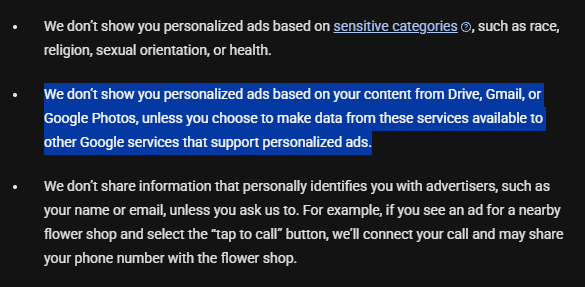
On October 16, Google issued an update to its privacy policy, spotted by Android Authority. The ad personalization section used to include a clear limit on data from certain apps. “We don’t show you personalized ads based on your content from Drive, Gmail, or Photos,” the document said. Now, Google has updated it with the following language.
Updated language on when your sensitive data might inform ads.
Credit: Google
Updated language on when your sensitive data might inform ads. Credit: Google
This equivocation opens the door to using data from apps like Gmail and Photos in ads when it’s shared with other Google services, and it just so happens Google has a mechanism for doing that, with Personal Intelligence. The company released Personal Intelligence in early 2026, allowing users to hand data from multiple apps to Google AI products. The idea is that the added context from your existing data will lead to better AI answers, but it’s also proving to be a privacy minefield.
Personal Intelligence connects your data to the Gemini app but also to features like AI Mode search. While the Gemini app does not currently have ads, you may see sponsored content in AI search tools. Google’s changes to the privacy policy appear to acknowledge that data shared with AI search via Personal Intelligence could, therefore, contribute to ad personalization.
According to Google, this clarification still doesn’t mean ads are “based directly” on your personal data. Here’s the company’s full statement:
“Connecting your apps is entirely opt-in. Ads will continue to be relevant to things like your query, the context of the response and your interests. Ads will not be based directly on your Gmail inbox or Photos library, and as always, sensitive information will not be used to tailor ads.”
Google’s statement is essentially a roundabout way of confirming that Workspace and Photos data may inform ads. If you interact with AI Mode while Personal Intelligence is enabled, there’s a chance that summaries and insights from your data will inform the answers you get. Because that same data is used for ad targeting, it’s accurate to say that your personal data is an element of ad targeting in AI search. The privacy policy now makes that clear.
Does opting out of smart TV tracking work? Research finds “suspicious” traffic.
Smart TVs running operating systems from Samsung, Vizio, and Roku continue sending data to automatic content recognition (ACR) endpoints after users opt out of tracking in the devices’ settings, according to research published on Monday. The paper from Northeastern University researchers points to potential privacy violations from some of the biggest TV brands.
ACR captures video screenshots or audio clips from smart TVs and sends the data to remote servers, where it’s used for things like measuring content viewership and serving targeted ads.
Dati di studenti e insegnanti in pasto all’AI? La protesta dei sindacati europei della scuola
I dati di milioni di studenti e insegnanti potrebbero finire nelle mani delle grandi Big Tech per l’addestramento dei sistemi di intelligenza artificiale. E’ questo l’allarme dell’ETUCE (Comitato sindacale europeo per l’istruzione, o European Trade Union Committee for Education), la principale federazione sindacale europea che rappresenta gli insegnanti e il personale della scuola e dell’università, e rilanciato in Italia dalla Flc Cgil per difendere l’integrità dei dati del mondo scolastico dalle grinfie dell’AI.
La proposta trapelata dal Consiglio Ue
L’ETUCE, che rappresenta 5 milioni di insegnanti, accademici e personale di supporto all’istruzione in tutta Europa, lancia l’allarme su una proposta trapelata del Consiglio dell’Unione europea che potrebbe indebolire significativamente le tutele in materia di protezione dei dati per bambini, studenti, insegnanti e altro personale dell’istruzione. Il voto è oggi.
La proposta, nota come articolo 88 bis del GDPR, è in discussione nell’ambito dei negoziati sul Digital Omnibus e amplierebbe il ricorso al “legittimo interesse” o “interesse pubblico” come base giuridica per il trattamento dei dati personali in relazione ai sistemi di intelligenza artificiale. I sindacati dell’istruzione di tutta Europa stanno esortando i governi a respingere la proposta, avvertendo che potrebbe aprire la strada all’utilizzo su larga scala dei dati relativi all’istruzione per lo sviluppo commerciale dell’IA, indebolendo al contempo le tutele volte a proteggere gli studenti e il personale dell’istruzione.
Tutele a rischio
Inoltre, la proposta del Consiglio ha eliminato importanti tutele presenti nella proposta della Commissione UE, tra cui l’esclusione relativa ai minori e le garanzie in materia di minimizzazione dei dati, trasparenza e diritto di opposizione.
C’è da dire che poi l’applicazione pratica del GDPR varia da paese a paese.
Riconoscendo un ampio legittimo interesse per lo sviluppo e l’impiego dell’IA, l’articolo 88-bis proposto rischia di creare una presunzione legislativa secondo cui tali trattamenti rivestirebbero un significativo valore sociale, spostando così sistematicamente l’equilibrio a svantaggio di studenti e personale scolastico, anziché limitare tali trattamenti ai casi in cui siano strettamente necessari e soggetti a solide garanzie.
Proteggere gli studenti non è facoltativo
È una responsabilità professionale, etica e giuridica. In un ambiente educativo sempre più digitale, proteggere gli alunni significa anche proteggere i loro dati personali e la loro privacy. I sindacati degli insegnanti e dell’istruzione difendono da tempo i diritti dei bambini e di tutti gli studenti, sia all’interno sia all’esterno delle aule.
“Svendere i nostri bambini alle Big Tech non è un’opzione”
“I sindacati dell’istruzione di tutta Europa si opporranno a questa proposta vile e cinica con un’unica voce”, ha detto John MacGabhann, Presidente dell’ETUCE, organizzazione che rappresenta milioni di lavoratori del settore educativo in tutti gli Stati dell’UE. “Svendere i nostri bambini non è un’opzione”, ha aggiunto.
Di seguito le richieste sindacali ai rappresentanti permanenti e al governo di garantire che qualsiasi futura disposizione relativa all’IA e al trattamento dei dati personali:
non crei un’autorizzazione ampia o generalizzata al trattamento dei dati degli studenti e del personale dell’istruzione per lo sviluppo o il funzionamento di sistemi di IA;
garantisca che i dati degli studenti e del personale dell’istruzione non siano mai utilizzati per sviluppare e gestire sistemi e modelli di IA senza il loro esplicito consenso e, ove applicabile, senza il consenso dei genitori;
preservi garanzie significative, tra cui l’esclusione degli studenti, la minimizzazione dei dati, la trasparenza, la responsabilizzazione e un effettivo diritto di opposizione;
impedisca l’utilizzo dei dati relativi all’istruzione e al luogo di lavoro per finalità diverse da quelle per cui i dati sono stati originariamente raccolti;
mantenga la fiducia dell’opinione pubblica nell’impiego dell’IA nell’istruzione;
rimanga pienamente coerente con il quadro dei diritti fondamentali su cui si fonda la normativa europea in materia di protezione dei dati.
La lettera congiunta
Inoltre, l’ETUCE, l’Organising Bureau of European School Student Unions e la European School Heads Association (ESHA) hanno presentato una lettera congiunta alle rappresentanze permanenti degli stati membri dell’UE, esprimendo le profonde preoccupazioni del settore dell’istruzione in merito al proposto articolo 88 bis.
La FLC CGIL è al fianco dell’ETUCE e sostiene con forza questa battaglia di civiltà e di diritto. La digitalizzazione della scuola e l’introduzione dei sistemi di intelligenza artificiale devono avvenire sempre al servizio del rapporto pedagogico docente-studente, dell’inclusione e della crescita democratica, mai a scapito dei diritti fondamentali di chi vive e lavora nei luoghi della conoscenza.
Google Hit With $463 Million Fine for EU Location Data Rule Breach
Google has been fined 403 million euros ($463 million) for breaching the European Union’s strict privacy rules because it mishandled users’ location data.
Forse in pochi ci avevano pensato, ma dal momento che gli agenti AI navigano sul Web per raccogliere informazioni e compiere operazioni per conto degli utenti, potrebbe essere una buona idea mascherarne le attività per evitare di fornire contesti non voluti a siti web e servizi di cui non sappiamo granché. Bitdefender ha infatti presentato […]
I rented a car, and within hours, my driver’s license was for sale
Not long ago, I rented an SUV from a well-known car rental company. Within hours of an employee scanning my driver’s license, a high-resolution scan of my ID was available for sale on the dark web.
An exposé published Tuesday by KrebsOnSecurity reports that my license was one of more than 153 million that were available through Nexus, the name of the new ID theft service. Like other driver’s licenses available there—including some belonging to journalist Brian Krebs, his mother, an FBI assistant director, and several security researchers—my license was purported to include multiple image files showing both the front and back of the ID. Besides a basic image scan, the files also captured the images in the infrared and ultraviolet spectrums. Presumably, the additional formats may allow cloned-based counterfeit IDs to pass hologram tests.
Growing by the day
Besides advertising the availability of driver’s licenses, Nexus offered to sell a bevy of other forms of ID. They included:
DuckDuckGo is the best private search engine for most people, but it is not the right answer for every threat model. We examined what seven active services collect, where their results come from, how they make money, and whether their AI can really be turned off. Read below for the full list and analysis.
Privacy search has a marketing problem. Almost every alternative to Google says it does not track you. That phrase can mean anything from “we do not build an advertising profile” to “we briefly process your IP address, send your query to another company, retain an anonymous copy, and display ads without tying any of it back to you.” Those are not the same promise.
There is also no universal best search engine once relevance, price, index independence and AI enter the picture. The most private configuration may be too slow or technical for daily use. The search engine with the strongest results may require an account or send a query to an upstream index. A provider can minimize its own collection and still be visible to your internet provider or the sites you click.
Our answer for a typical reader is DuckDuckGo. It is free, works on desktop and mobile, requires no account, and offers a dedicated no-AI version. Choose Brave Search instead if independence from Bing matters more. If you will pay for a stronger product, Kagi is the best premium option.
The short list
Comparison of the best private search engines in 2026
Search engine
Best for
AI control
Cost and main caveat
1. DuckDuckGo
Best for most people
Yes — dedicated no-AI version
Free; Bing-heavy results can struggle with deeper queries
2. Kagi
Best paid search
Yes — disable it in Search settings
$10/month for unlimited use; account and temporary logs
3. Brave Search
Independent free index
Partly — summaries turn off, but Ask remains
Free; AI remains visible and results can vary
4. Startpage
Familiar Google and Bing results
No generative layer in core search
Free; System1 ownership and old public audit history
5. MetaGer
Nonprofit metasearch
No generative layer documented
Prepaid usage; no native iPhone app
6. Mojeek
UK-based independent index
Search Summary is optional
Free; smaller index and less consistent deep-query coverage
7. SearXNG
Self-hosters and technical users
Depends on the instance
Free and open source; requires setup and administrator trust
Best overall: DuckDuckGo ⭐⭐⭐
DuckDuckGo wins by being the easiest privacy improvement that most people will keep using.
Its privacy policy says it does not write an IP address or unique identifier to disk alongside a query. It does retain anonymous search terms for tasks such as correcting misspellings and improving results, but says those terms are disconnected from anything that identifies a person. That is more precise—and more believable—than pretending the service never processes data at all.
DuckDuckGo combines its own crawlers and many instant-answer sources, but its traditional links and images are largely supplied by Microsoft Bing. That gives it broad coverage without handing Microsoft a user’s direct identity, but it also means DuckDuckGo is not an independent web index in the way Brave or Mojeek is.
The clearest reason it ranks first in 2026 is noai.duckduckgo.com. The dedicated version turns off Search Assist and Duck.ai and filters images identified as AI-generated. It answers “best search engine for privacy and no AI” more cleanly than a buried toggle that leaves an AI button in the interface.
The compromise is relevance. In a recent r/privacy discussion, the most repeated complaint is not privacy—it is having to repeat detailed searches elsewhere, especially for forum posts, troubleshooting and nuanced questions. That experience is not universal, but it is common enough to take seriously. DuckDuckGo’s !bang shortcuts make fallback easy, although using a bang sends you to the destination search service and subjects that search to the destination’s privacy practices.
Choose DuckDuckGo if: you want the best free balance of privacy, convenience and no-AI control on iPhone, Android and desktop.
Skip it if: you regularly run obscure research, technical or user-generated-content searches and dislike using a fallback.
Best paid: Kagi ⭐⭐
Kagi is what search looks like when the customer pays instead of the advertiser.
There are no ads, and the product provides unusually strong result controls. You can raise, lower or block domains; choose lenses; and use sources drawn from Kagi’s own indexes and anonymized requests to other traditional indexes. Kagi’s current plans include a 100-search trial, $5 a month for 300 searches, $10 for unlimited search and $25 for an Ultimate tier with premium AI features.
The subscription is both its privacy advantage and its most obvious obstacle. Kagi requires an account for billing, although it says searches are anonymized and not associated with that account. Its privacy materials describe temporary search-query debugging logs, with search queries said to be removed after seven days. That is more retention than a purist might want, even when the query is not attached to the account.
Supported paid plans can use Privacy Pass, which issues anonymous tokens so the search service can confirm entitlement without seeing the user’s account identity. It is a thoughtful design, but not available on every plan or browser; Safari is a notable limitation.
Kagi also has the best AI control in this group. Its Search AI settings state that AI is invoked on demand. Turning AI off hides its Search interface elements and prevents explicit AI triggers. Users who do want AI should read Kagi’s separate provider disclosures, because model vendors may have their own limited retention rules.
Choose Kagi if: search is important enough to justify $10 a month and you want high-quality controls without advertising.
Skip it if: you want an account-free service, zero temporary query retention, or a fully capable free tier.
Best independent free index: Brave Search ⭐⭐
Brave Search is the strongest answer to a different question: which private search engine is least dependent on Google and Microsoft?
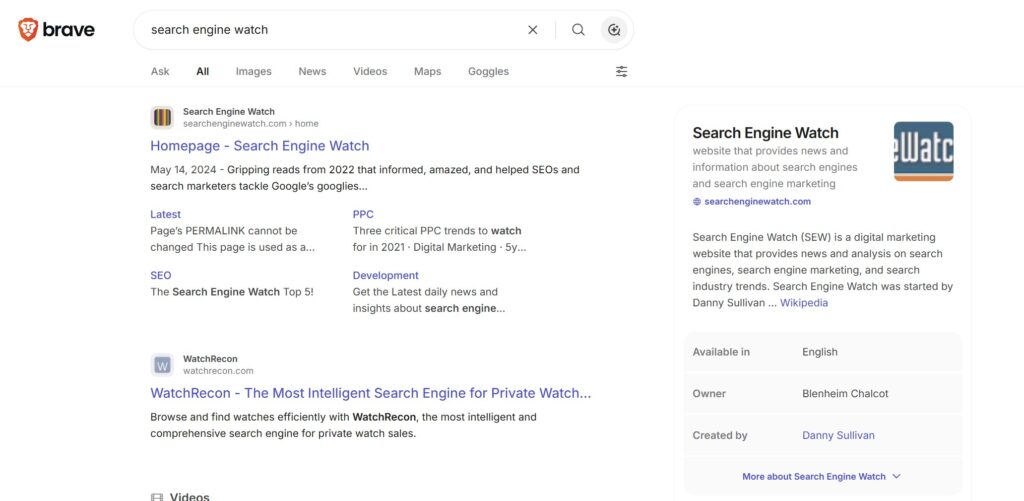
Brave says the standard service runs on its own independent web index. That matters beyond branding. A private front end to Bing can protect a user’s identity, but it does not create competition at the infrastructure level. Brave controls crawling, ranking and delivery end to end. An optional Google fallback can supplement a weak result set, but enabling it naturally reduces that independence.
Its privacy policy says IP addresses are not retained and search ads are contextual rather than based on a personal profile. Brave’s anonymous usage metrics are enabled by default. The company says those metrics exclude actual query text, IP addresses and unique identifiers, but privacy-conscious users should still consider switching them off in Search settings.
Brave loses points on the no-AI question. You can turn off automatic “Answer with AI” summaries, but the Ask entry point remains in the search interface. That may be acceptable to someone who simply does not want generated text placed above links. It is not a complete AI-free mode in the DuckDuckGo or Kagi sense.
Choose Brave Search if: you want a free, capable private search engine with its own index and can tolerate an optional AI surface.
Skip it if: “no AI” means no AI button, prompt or generative feature anywhere in the search experience.
Best for familiar Google and Bing results: Startpage ⭐
Startpage is the least disruptive move for someone who likes mainstream results but does not want a mainstream engine building the personal search profile.
It submits searches to Google and Bing on the user’s behalf and returns the results. Startpage says it does not record IP addresses or user agents, keeps only aggregate search counts by language, and uses transient anti-abuse techniques instead of a conventional IP log. It also avoids tracking cookies; an optional preference cookie can remember settings.
Anonymous View extends that proxy model after the results page. Startpage retrieves a destination page with its own IP address and displays it to the user. It can be useful for a quick read, but scripts and interactive functions may break. It should not be confused with the stronger anonymity and traffic separation Tor is designed to provide.
Startpage’s core results do not currently contain generative AI summaries. Its Instant Answers are conventional result modules and can be disabled.
The trust caveat is corporate and evidentiary. Startpage operates from the Netherlands, but System1—an advertising-technology company—invested through Privacy One. Startpage says its management controls privacy decisions. There is no public evidence in the reviewed materials that System1 has overturned those practices, but the strongest audit talking point is old: Startpage says its regular EuroPriSe recertification was postponed in 2017.
Choose Startpage if: familiar result quality matters more than index independence and you want no generative layer in core search.
Skip it if: ownership by an ad-tech group or reliance on Google and Bing is outside your threat model.
Best nonprofit metasearch: MetaGer ⭐
MetaGer combines several appealing properties that rarely appear together: it is operated by a German nonprofit, publishes its code, has no ads, and does not require a personal account.
Its July 2026 privacy policy says IP addresses and user agents are neither saved nor shared. Because MetaGer is a metasearch engine, it must send the query to result partners. It says returned results and the query are kept for display for a few hours. Its current source list includes Brave, Mojeek and Google results supplied through Serper.
Instead of an account, MetaGer gives the user a random key. A one-time payment adds tokens; the service estimates that €5 for roughly 500 tokens lasts a typical user around two months. Cash payment is available for people who want to avoid a payment trail. The key can also unlock a proxy that loads destination pages on MetaGer’s servers.
This is a credible privacy design, but it is less convenient than opening a free search page. MetaGer has browser integrations and an Android app, but no native iOS app. We also found no standard generative-answer layer in the reviewed search product, making it a good no-AI option for users comfortable with its payment model.
Choose MetaGer if: you value nonprofit governance, open code, no advertising and an anonymous payment/access model.
Skip it if: you want a frictionless free default or a polished native iPhone app.
Best UK private search engine: Mojeek
Mojeek is the clearest answer for a UK reader who wants a locally based search company and a genuinely independent index.
The Brighton-based company crawls and ranks the web itself. Its privacy policy says operational logs are retained indefinitely but do not contain IP addresses; the IP is replaced with a two-letter country code. Mojeek describes the remaining data as non-personal and says it does not set a cookie unless a user chooses to save preferences.
Mojeek does offer a generative Search Summary, but it is user-triggered rather than automatically placed above every result set. The answer appears alongside traditional links and includes citations. That makes Mojeek a reasonable choice for someone who wants AI off by default, even though it is not an engine built without AI capability.
The cost of independence is index depth. Mojeek can be excellent for straightforward discovery and provides a different ranking perspective, but its smaller corpus is less dependable for obscure, highly local, shopping or rapidly changing queries. Keep a fallback available.
Choose Mojeek if: UK jurisdiction and independence from Google, Bing and Brave matter most.
Skip it if: you need one engine to handle every deep or time-sensitive query.
Best for self-hosting: SearXNG
SearXNG is not a single search company. It is open-source metasearch software that can query a configurable mix of external services and remove identifying headers and cookies before doing so.
That flexibility explains why privacy communities recommend it—and why simplistic rankings often get it wrong. If you use a public instance, you must trust the administrator. SearXNG’s own instance guidance warns that an operator could log or sell data. If you self-host, you control the logs, but upstream search engines still see requests coming from your instance. A server used by only one person can produce a query stream that is easier to separate than one shared by many users.
The default software does not impose a generative answer layer, although instance operators can change the interface or add engines. Speed, uptime, result mix and privacy therefore vary by instance.
Choose SearXNG if: you understand the deployment model and want maximum control over sources and configuration.
Skip it if: you want a service whose privacy properties, support and uptime are consistent without technical work.
Popular privacy search engines we did not recommend
Its policy says IP addresses and queries are automatically shared with Bing or Google. Its new desktop AI-free mode is welcome but does not change that core comparison.
The free tier shares the query and masked technical data with advertising partners, and ad iframes can send personal data to Bing or Google. Pro is a different, paid proposition.
Mullvad shut the service down on November 27, 2025.
These products are not necessarily “bad.” They simply do not support the same top-line privacy recommendation under their current availability and published terms.
What Reddit users get right—and what Reddit cannot prove
There is no secret community consensus that the product pages are hiding. Recent privacy threads repeat the same trade-offs: DuckDuckGo is convenient but can struggle on detailed searches; Kagi earns praise but costs $10 a month for unlimited use; Startpage provides familiar results but prompts ownership questions; and SearXNG offers control at the cost of setup, speed and trust in an instance operator.
That lived experience is useful when judging whether someone will keep a new default. It cannot verify what happens on a provider’s servers. Reddit comments about an engine “selling data,” being “compromised” or offering perfect anonymity are not evidence unless they point to a policy, audit, technical finding or documented incident. This ranking therefore uses community reports for usability and official disclosures for data-handling claims. The clearest current example is a thread asking for both privacy and convenience: the replies reveal real compromises, not one uncontested winner.
Private search is not anonymous search
A private search engine primarily limits what the search provider records and how it profiles the user. It does not make the whole browsing session invisible.
The search provider receives a network connection and may briefly process an IP address even if it does not retain it.
HTTPS normally hides the query text from the internet provider, but the provider can still see the domain being contacted.
Once you click a result, the destination site applies its own cookies, scripts, fingerprinting and account rules.
Search suggestions can transmit text as it is typed, before the query is submitted.
A !bang shortcut takes the user to another search service; the destination’s privacy policy then applies.
If the goal is to hide an IP address from the search provider, Privacy Guides recommends considering Tor or a trusted VPN. Tor Browser is the stronger anonymity tool, but its privacy benefits depend on using it correctly. A private search engine is one layer, not an invisibility cloak.
Which private search engine should you choose?
For most people: DuckDuckGo.
For mainstream search with built-in AI features switched off:noai.duckduckgo.com.
For the best paid experience: Kagi Professional at $10 a month.
For an independent free index: Brave Search.
For familiar Google/Bing-style results: Startpage.
For nonprofit, ad-free metasearch: MetaGer.
For a UK-based independent engine: Mojeek.
For self-hosting and source control: SearXNG.
For iPhone: DuckDuckGo is the simplest all-in-one option; Startpage and Brave also have mobile-browser routes.
For Android: DuckDuckGo and Brave offer the easiest full mobile experiences; MetaGer and Mojeek also have Android apps.
How to change the default on iPhone and Android
On iPhone, Apple’s current default-search guide shows the available choice in Safari settings. The exact list depends on iOS version and region. If the provider is not offered, use its app, browser or Safari extension instead.
On Android, Chrome exposes the choice under More > Settings > Search engine; Google documents the current steps in its Chrome help page. A privacy-focused browser can expose a different provider list. If you use DuckDuckGo’s no-AI endpoint, add it as a custom search engine where the browser permits it or bookmark it as the search home page.
Frequently asked questions
What is the best search engine for privacy?
DuckDuckGo is the best private search engine for most people in 2026. It does not associate search queries with retained IP addresses or unique identifiers, requires no account, works across desktop and mobile, and has a dedicated no-AI version. Brave Search is the better choice if index independence is the priority.
What is the most private search engine?
There is no universal answer without a threat model. MetaGer’s anonymous-key design and SearXNG under a carefully operated deployment can minimize different kinds of exposure. For mainstream use, DuckDuckGo, Brave Search and Startpage provide a stronger balance of privacy and usability. Use Tor if the search provider must not see your real IP address.
Which private search engine has no AI?
DuckDuckGo provides the clearest no-AI option at noai.duckduckgo.com, which disables its AI features and filters AI-generated images. Kagi can hide and disable Search AI from settings. Startpage’s core search currently has no generative answer layer. MetaGer also had no standard generative-answer feature in the product reviewed for this article.
Is DuckDuckGo really private?
DuckDuckGo says it does not retain IP addresses or unique identifiers with search queries and does not build personal search profiles. It does retain anonymous query strings for product improvement. Its traditional link and image results are largely sourced from Bing, but DuckDuckGo says requests are proxied so Microsoft does not receive the user’s direct identity.
Is Startpage safer than DuckDuckGo?
Both have strong published privacy practices, but they optimize for different things. Startpage proxies Google and Bing and may provide more familiar results. DuckDuckGo is easier to use across devices and has stronger no-AI controls. Startpage’s System1 ownership and old public audit history are reasonable trust considerations.
Is Brave Search more private than DuckDuckGo?
Brave retains no IP address and operates its own index, which reduces exposure to an upstream search provider. DuckDuckGo also avoids a personal search profile but relies heavily on Bing for standard results. DuckDuckGo has the better complete no-AI mode; Brave has the stronger independence story.
What is the best private search engine for iPhone?
DuckDuckGo is the simplest recommendation because it offers an iOS app and can be used as a default search option in common browsers. Startpage also offers an iOS browser app, and Brave integrates Brave Search into its iPhone browser. Exact default-search choices vary by browser, iOS version and region.
What is the best private search engine for Android?
DuckDuckGo and Brave provide the most complete Android experiences. MetaGer and Mojeek also offer Android apps, while SearXNG can be used through a browser or a configured instance.
Are private search engines more secure?
They can reduce profiling and the exposure of sensitive queries, but they do not automatically block malware, prevent browser fingerprinting or secure the sites opened from results. Browser security, software updates, tracker blocking, careful account use and, where appropriate, Tor or a trusted VPN still matter.
iCloud. È scontro Apple-Governo britannico su crittografia, privacy e poteri dello Stato
Apple contro il Governo britannico: nuova battaglia legale sull’accesso ai dati crittografati di iCloud
A poco più di un anno dal primo duro scontro tra Apple e il Governo britannico, la disputa sulla crittografia dei dati torna davanti ai giudici. Il colosso di Cupertino ha infatti avviato una nuova azione legale contro il Regno Unito per contestare i poteri con cui Londra può imporre alle aziende tecnologiche di facilitare l’accesso ai dati degli utenti conservati sui propri servizi cloud.
Come spiegato da Rachel Hall sul quotidiano The Guardian, la vicenda riguarda i dati archiviati su iCloud, il servizio cloud di Apple, in particolare quelli protetti dal sistema di crittografia avanzata Advanced Data Protection (ADP), che rende i contenuti leggibili esclusivamente dal proprietario dell’account.
Il nuovo ricorso di Apple contro il Governo britannico
Secondo quanto emerge dall’ordinanza emessa dal tribunale, il Ministero dell’Interno britannico (Home Office) ha notificato ad Apple una nuova richiesta tecnica, nota come Technical Capability Notice (TCN). Si tratta di uno strumento previsto dall’Investigatory Powers Act, la controversa legge britannica che disciplina i poteri di sorveglianza e intercettazione delle autorità.
Che cos’è una Technical Capability Notice
Una Technical Capability Notice è un ordine con cui il Governo può obbligare un’azienda tecnologica ad adottare misure tecniche che consentano alle autorità di svolgere attività investigative. L’Investigatory Powers Act prevede che tali richieste possano essere utilizzate nell’ambito di indagini riguardanti, tra gli altri casi:
terrorismo;
abuso sessuale su minori;
gravi minacce alla sicurezza nazionale.
In pratica, il Governo può chiedere a un fornitore di servizi digitali di rendere accessibili dati che normalmente sarebbero protetti dalla crittografia. La versione più credibile è che Londra non stia pensando solo a terrorismo, criminalità organizzata o abusi online, ma voglia uno strumento utile in un ambiente di minacce multiple: Russia per la dimensione cyber-operativa, Cina per quella tecnologica e di spionaggio industriale. Detto in modo semplice, la richiesta ad Apple sembra rispondere al bisogno di non restare “ciechi” proprio nei casi che per il Regno Unito contano di più dal punto di vista geopolitico.
Dalla richiesta globale a quella limitata ai cittadini britannici
La nuova iniziativa del Governo arriva dopo un precedente confronto che aveva assunto anche una dimensione diplomatica tra Regno Unito e Stati Uniti. La prima Technical Capability Notice, notificata lo scorso anno, chiedeva ad Apple la possibilità di accedere ai dati protetti tramite Advanced Data Protection sia degli utenti britannici sia di quelli statunitensi, qualora vi fossero esigenze di sicurezza nazionale.
Dopo le forti tensioni tra Londra e Washington, il Governo britannico aveva ritirato quella richiesta. Successivamente, però, il Home Office ha emesso una seconda Technical Capability Notice, questa volta limitata esclusivamente agli utenti del Regno Unito. È proprio questa nuova richiesta ad essere oggi oggetto del ricorso presentato da Apple.
Perché Apple si oppone
Apple sostiene da tempo che creare una cosiddetta “back door”, cioè un accesso privilegiato ai dati crittografati, comprometterebbe la sicurezza dell’intero sistema. Il motivo è semplice: la crittografia end-to-end funziona proprio perché nessuno, nemmeno il fornitore del servizio, possiede le chiavi necessarie per leggere i contenuti.
Se Apple fosse tecnicamente in grado di accedere ai dati degli utenti, la stessa capacità potrebbe essere richiesta dalle autorità giudiziarie o investigative attraverso un mandato. Inoltre, qualsiasi meccanismo di accesso straordinario rappresenterebbe un potenziale punto debole sfruttabile anche da criminali informatici o altri soggetti ostili.
Secondo Apple, indebolire la crittografia significa aumentare il rischio di violazioni dei dati personali e compromettere la sicurezza di milioni di utenti.
La conseguenza: Apple ha ritirato ADP nel Regno Unito
Proprio per evitare di dover creare un sistema di accesso privilegiato, Apple aveva preso una decisione senza precedenti. Nel gennaio 2025 la società ha infatti disattivato nel Regno Unito il servizio Advanced Data Protection (è un’impostazione facoltativa che estende la crittografia end-to-end a un numero maggiore di categorie di dati su iCloud), impedendo ai nuovi utenti britannici di attivarlo e rimuovendone progressivamente la disponibilità.
La scelta ha avuto un effetto paradossale: invece di consentire allo Stato un maggiore accesso ai dati, ha ridotto il livello massimo di protezione disponibile per gli utenti britannici.
Anche Privacy International e Liberty contestano il sistema
Il caso Apple si intreccia con un altro procedimento già pendente davanti allo stesso tribunale. L’IPT ha infatti notificato il nuovo ricorso all’organizzazione per i diritti digitali Privacy International, che insieme all’associazione Libertyaveva già presentato un’azione legale contro il regime delle Technical Capability Notice.
Le due organizzazioni chiedono che il procedimento venga discusso pubblicamente, sostenendo che l’interesse collettivo alla trasparenza prevalga sulla tradizionale segretezza che caratterizza questi provvedimenti. Contestano inoltre:
la legittimità delle Technical Capability Notice;
la loro necessità;
il livello di segretezza previsto dall’attuale normativa britannica.
Per il prossimo mese è già stata programmata un’udienza organizzativa nella quale il tribunale dovrà stabilire come gestire i due procedimenti paralleli.
Un portavoce di Privacy International ha accolto positivamente la nuova iniziativa di Apple: “Siamo lieti di sapere che Apple sta nuovamente contestando il regime britannico degli ordini segreti. Sebbene non conosciamo il contenuto del ricorso, se riguarda gli ordini già riportati che puntano a compromettere la sicurezza dell’archiviazione iCloud, allora il ricorso di Apple, insieme al nostro e a quello di Liberty, è fondamentale per preservare la privacy e la sicurezza di tutti”.
Un test giuridico sul rapporto tra crittografia, privacy e poteri dello Stato
Né Apple né il Home Office hanno commentato il nuovo procedimento giudiziario. Entrambe le parti sono infatti soggette a restrizioni legali che impediscono di discutere pubblicamente il contenuto delle Technical Capability Notice.
Il Governo britannico continua comunque a difendere l’Investigatory Powers Act, sostenendo che la normativa preveda solide garanzie procedurali e che questi poteri vengano utilizzati soltanto quando strettamente necessari per la tutela della sicurezza nazionale e per le indagini sui reati più gravi.
La nuova causa tra Apple e il Governo britannico va ben oltre una semplice controversia nazionale. Il caso rappresenta uno dei più importanti test giuridici sul rapporto tra crittografia, privacy e poteri dello Stato. Da anni governi e forze dell’ordine chiedono strumenti che consentano di accedere ai dati cifrati per finalità investigative. Le aziende tecnologiche e le organizzazioni per i diritti digitali ribattono invece che non esiste una “back door” sicura: qualsiasi eccezione alla crittografia finirebbe inevitabilmente per indebolire la protezione di tutti gli utenti.
Google’s “privacy-preserving” age verification system is coming to the Play Store
Governments around the world are suddenly very keen on online age verification requirements. In some places, this takes the form of ID requirements to access adult content, but several US states have also focused on app stores. With these laws now going into effect, Google has announced an expansion of its beta Play Age Signals API, which it claims will allow developers to confirm user ages without impinging on privacy.
Google’s system doesn’t require an ID or selfie verification—it’s connected to the company’s existing Family Link app. The idea is that parents will set age ranges for their kids’ managed accounts. For example, you might set a range like 16–17, allowing apps to tailor experiences and content for teenagers.
Google notes that the ranges are dynamic and may change as young users get older. So a kid who’s 13 may be in the same app content bracket for a few years before hitting the next level. Parents have the option to set and share these ranges if they want that additional level of control over what their children can access in Google Play. However, it’s not mandatory for child accounts—it’s fully opt-in and can be turned off at any time.
Google began testing the Play Age Signals API late last year as it became apparent that multiple states were going to put the onus of age verification on app stores. The Computer & Communications Industry Association (CCIA), which lobbies on behalf of tech firms, has opposed these laws. However, the US Supreme Court recently paused a lower court injunction, allowing the Texas law to take effect. Louisiana and Utah also have similar laws going into effect.